HB 2319: DOH; SHPDA; Function and Responsibilities; Certificate of Need Exemption
- Session Year: 2025-2026
- House: House
- Latest Version Date: 2026-04-30
Current Status:
Passed
(2026-05-27: Act 049, on 05/27/2026 (Gov. Msg. No. 1149).)
Introduced
In Committee
First Chamber
In Committee
Second Chamber
Final Decking
Enacted
What does this bill do?
The bill changes the role of the State Health Planning and Development Agency and alters certificate-of-need (state approval) rules for hospitals, clinics, and other health providers. It adds a broad definition of “health care” and directs the agency to focus on universal access, equity, quality, cost analysis, and new areas like telehealth, artificial intelligence, and workforce development. It raises the exemption for bed changes to allow up to 30% of a facility’s licensed beds to be changed without a certificate of need and exempts Department of Health–run facilities or services from those requirements.
The summary is provided by generative AI which can make mistakes. For original language, please view the details in the table below.
Amends the functions and responsibilities of the State Health Planning and Development Agency. Adds a new definition of "health care" for the purposes of health planning and resource development and health care cost control. Increase the certificate of need exemption threshold for bed changes to up to thirty per cent of existing licensed beds. Exempts health care facilities or services operated by the Department of Health from certificate of need requirements. (CD1)
Amends the functions and responsibilities of the State Health Planning and Development Agency. Adds a new definition of "health care" for chapter 323D, HRS. Amends the exemption threshold for bed changes to up to thirty per cent of existing licensed bed types. Exempts the Department of Health from certificate of need requirements. Effective 1/30/2050. (SD1)
Amends the functions and responsibilities of the State Health Planning and Development Agency. Adds a new definition of "health care". Amends the exemption threshold for bed changes to up to thirty per cent of existing licensed bed types. Exempts the Department of Health from certificate of need requirements. Effective 7/1/3000. (HD2)
Amends the functions and responsibilities of the State Health Planning and Development Agency. Adds a new definition of "health care." Amends the exemption threshold for bed changes to up to thirty per cent of existing licensed bed types. Exempts the Department of Health from certificate of need requirements. Effective 7/1/3000. (HD1)
Amends the functions and responsibilities of the State Health Planning and Development Agency. Adds a new definition of "health care." Amends the exemption threshold for bed changes to up to thirty per cent of existing licensed bed types. Exempts the Department of Health from certificate of need requirements. Effective 7/1/2026.
|
HOUSE OF REPRESENTATIVES |
H.B. NO. |
2319 |
|
THIRTY-THIRD LEGISLATURE, 2026 |
H.D. 2 |
|
|
STATE OF HAWAII |
S.D. 1 |
|
|
|
C.D. 1 |
|
|
|
||
|
|
||
A BILL FOR AN ACT
RELATING TO THE STATE HEALTH PLANNING AND DEVELOPMENT AGENCY.
BE IT ENACTED BY THE LEGISLATURE OF THE STATE OF HAWAII:
SECTION 1. Section 323D-2, Hawaii Revised Statutes, is amended by adding a new definition to be appropriately inserted and to read as follows:
""Health care" means the improvement of a person's health through the prevention, diagnosis, treatment, and amelioration or cure of disease, illness, injury, or other physical and mental impairment, regardless of the setting in which those services are delivered. "Health care" includes oral health, behavioral health, and long-term care."
SECTION 2. Section 323D-12, Hawaii Revised Statutes, is amended to read as follows:
"§323D-12 Health planning and development functions; state agency. (a) The state agency shall:
(1) Have
as a principal function the responsibility for promoting [accessibility for
all the people of the State to quality health care services at reasonable cost.
The state agency shall conduct such
studies and investigations as may be necessary as to the causes of health care
costs including inflation. The state
agency may contract for services to implement this paragraph. The certificate of need program mandated under
part V shall serve this function. The
state agency shall promote the sharing of facilities or services by health care
providers whenever possible to achieve economies and shall restrict unusual or
unusually costly services to individual facilities or providers where
appropriate;
(2) Serve
as staff to and provide technical assistance and advice to the statewide
council and the subarea councils in the preparation, review, and revision of
the state health services and facilities plan;
(3) Conduct
the health planning activities of the State in coordination with the subarea
councils, implement the state health services and facilities plan, and
determine the statewide health needs of the State after consulting with the
statewide council; and] universal access to high-quality, equitable, and
affordable health care for all the people of the State and a shared vision of
the State's health care future;
(2) Conduct the health planning activities of the State in collaboration with state agencies and with private health care sector participants to assess and address gaps or concerns affecting access, quality, and cost, including but not limited to administrative simplification and health information technology, including artificial intelligence;
[(4)] (3)
Administer the state certificate of need
program pursuant to part V[.], and serve as staff and provide
technical assistance and advice to the statewide council and subarea councils;
and
(4) Establish a state health services and facilities plan and update that plan at least every four years following consultation with the statewide council.
(b) The state agency may:
(1) Prepare
[such] reports and recommendations on [Hawaii's] the State's
health care costs and public or private efforts to reduce or control costs and
health care quality as it deems necessary. The [report] reports may include[,
but not be limited to,] a review of health insurance plans[,];
the availability of various kinds of health insurance and malpractice insurance
to consumers[,]; data-supported analysis and evaluation of the status
of statewide and county health care services accessibility, adequacy, affordability,
efficiency, equity, and quality, including comparisons to national and other
state jurisdictions; and strategies for increasing competition in the
health insurance field[.] and across the health care delivery system;
[(2) Prepare
and revise as necessary the state health services and facilities plan.
(3) Prepare,
review, and revise the annual implementation plan.
(4)] (2)
Assist the statewide council in the
performance of its functions[.];
[(5)] (3)
Determine the need for new health
services proposed to be offered within the State[.];
[(6)] (4) Assess existing health care services and
facilities to determine whether there are redundant, excessive, or
inappropriate services or facilities and make public findings of any that are
found to be so. The state agency shall
weigh the costs of the health care services or facilities against the benefits
the services or facilities provide and there shall be a negative presumption
against marginal services[.];
[(7)] (5)
Provide technical assistance to persons,
public or private, in obtaining and filling out the necessary forms for the
development of projects and programs[.];
[(8)] (6)
Prepare reports, studies, and
recommendations on emerging health issues, such as medical ethics, health care
rationing, involuntary care, care for the indigent, and standards for research
and development of biotechnology [and], genetic engineering[.],
telehealth, artificial intelligence, and workforce development; and
[(9)] (7)
Conduct [such] other activities
as are necessary to meet the purposes of this chapter."
SECTION 3. Section 323D-54, Hawaii Revised Statutes, is amended to read as follows:
"§323D-54 Exemptions from certificate of need requirements. Nothing in this part or rules with respect to the requirement for certificates of need applies to:
(1) Offices of physicians, dentists, or other practitioners of the healing arts in private practice as distinguished from organized ambulatory health care facilities, except in any case of purchase or acquisition of equipment attendant to the delivery of health care service and the instruction or supervision for any private office or clinic involving a total expenditure in excess of the expenditure minimum;
(2) Laboratories,
[as defined in] regulated pursuant to section 321-11(12), except
in any case of purchase or acquisition of equipment attendant to the delivery
of health care service and the instruction or supervision for any laboratory
involving a total expenditure in excess of the expenditure minimum;
(3) Dispensaries and first aid stations located within business or industrial establishments and maintained solely for the use of employees; provided such facilities do not regularly provide inpatient or resident beds for patients or employees on a daily twenty-four-hour basis;
(4) Dispensaries or infirmaries in correctional or educational facilities;
(5) Dwelling establishments, such as hotels, motels, and rooming or boarding houses that do not regularly provide health care facilities or health care services;
(6) Any home or institution conducted only for those who, pursuant to the teachings, faith, or belief of any group, depend for healing upon prayer or other spiritual means;
(7) Dental clinics;
(8) Nonpatient areas of care facilities, such as parking garages and administrative offices;
(9) Bed
changes that involve [ten] up to thirty per cent [or ten beds
of existing licensed bed types, whichever is less,] of a facility's total
existing licensed beds within a two-year period;
(10) Projects that are wholly dedicated to meeting the State's obligations under court orders, including consent decrees, that have already determined that need for the projects exists;
(11) Replacement of existing equipment with its modern-day equivalent;
(12) Primary care clinics under the expenditure thresholds referenced in section 323D-2;
(13) Equipment and services related to that equipment, that are primarily invented and used for research purposes as opposed to usual and customary diagnostic and therapeutic care;
(14) Capital expenditures that are required:
(A) To eliminate or prevent imminent safety hazards as defined by federal, state, or county fire, building, or life safety codes or regulations;
(B) To comply with state licensure standards;
(C) To comply with accreditation standards, compliance with which is required to receive reimbursements under Title XVIII of the Social Security Act or payments under a state plan for medical assistance approved under Title XIX of such Act;
(15) Extended
care adult residential care homes and assisted living facilities; [or]
(16) Health care facilities or services operated by the department of health; or
[(16)] (17) Other facilities or services that the agency
through the statewide council chooses to exempt, by rules pursuant to section
323D-62."
SECTION 4. Statutory material to be repealed is bracketed and stricken. New statutory material is underscored.
SECTION 5. This Act shall take effect on July 1, 2026.
Report Title:
DOH; SHPDA; Function and Responsibilities; Certificate of Need Exemption
Description:
Amends the functions and responsibilities of the State Health Planning and Development Agency. Adds a new definition of "health care" for the purposes of health planning and resource development and health care cost control. Increase the certificate of need exemption threshold for bed changes to up to thirty per cent of existing licensed beds. Exempts health care facilities or services operated by the Department of Health from certificate of need requirements. (CD1)
The summary description of legislation appearing on this page is for informational purposes only and is not legislation or evidence of legislative intent.
|
HOUSE OF REPRESENTATIVES |
H.B. NO. |
2319 |
|
THIRTY-THIRD LEGISLATURE, 2026 |
H.D. 2 |
|
|
STATE OF HAWAII |
S.D. 1 |
|
|
|
|
|
|
|
||
|
|
||
A BILL FOR AN ACT
RELATING TO THE STATE HEALTH PLANNING AND DEVELOPMENT AGENCY.
BE IT ENACTED BY THE LEGISLATURE OF THE STATE OF HAWAII:
SECTION 1. Section 323D-2, Hawaii Revised Statutes, is amended by adding a new definition to be appropriately inserted and to read as follows:
""Health care" means the improvement of a person's health through the prevention, diagnosis, treatment, and amelioration or cure of disease, illness, injury, or other physical and mental impairment, regardless of the setting in which those services are delivered. "Health care" includes oral health, behavioral health, and long-term care."
SECTION 2. Section 323D-12, Hawaii Revised Statutes, is amended to read as follows:
"§323D-12 Health planning and development functions; state agency. (a) The state agency shall:
(1) Have
as a principal function the responsibility for promoting [accessibility for
all the people of the State to quality health care services at reasonable cost.
The state agency shall conduct such
studies and investigations as may be necessary as to the causes of health care
costs including inflation. The state
agency may contract for services to implement this paragraph. The certificate of need program mandated under
part V shall serve this function. The
state agency shall promote the sharing of facilities or services by health care
providers whenever possible to achieve economies and shall restrict unusual or
unusually costly services to individual facilities or providers where
appropriate;] universal access to high-quality, equitable, and
affordable health care for all the people of the State and a shared vision of
the State's health care future;
[(2) Serve
as staff to and provide technical assistance and advice to the statewide
council and the subarea councils in the preparation, review, and revision of
the state health services and facilities plan;
(3) Conduct
the health planning activities of the State in coordination with the subarea
councils, implement the state health services and facilities plan, and
determine the statewide health needs of the State after consulting with the
statewide council; and]
(2) Conduct the health planning activities of the State in collaboration with state agencies and with private health care sector participants to assess and address gaps or concerns affecting access, quality, and cost, including but not limited to administrative simplification and health information technology, including artificial intelligence;
[(4)] (3)
Administer the state certificate of need
program pursuant to part V[.], and serve as staff to and provide
technical assistance and advice to the statewide council and subarea councils;
and
(4) Establish a state health services and facilities plan and update that plan at least every four years following consultation with the statewide council.
(b) The state agency may:
(1) Prepare
[such] reports and recommendations on [Hawaii's] the State's
health care costs and public or private efforts to reduce or control costs and
health care quality as it deems necessary. The [report] reports may include[,
but not be limited to,] a review of health insurance plans[,];
the availability of various kinds of health insurance and malpractice insurance
to consumers[,]; data-supported analysis and evaluation of the status
of statewide and county health care services adequacy, accessibility, quality, equity,
efficiency, and affordability, including comparisons to national and other
state jurisdictions; and strategies for increasing competition in the
health insurance field[.] and across the health care delivery system;
[(2) Prepare
and revise as necessary the state health services and facilities plan.
(3) Prepare,
review, and revise the annual implementation plan.
(4)] (2)
Assist the statewide council in the
performance of its functions[.];
[(5)] (3)
Determine the need for new health
services proposed to be offered within the State[.];
[(6)] (4) Assess existing health care services and
facilities to determine whether there are redundant, excessive, or
inappropriate services or facilities and make public findings of any that are
found to be so. The state agency shall
weigh the costs of the health care services or facilities against the benefits
the services or facilities provide and there shall be a negative presumption
against marginal services[.];
[(7)] (5)
Provide technical assistance to persons,
public or private, in obtaining and filling out the necessary forms for the
development of projects and programs[.];
[(8)] (6)
Prepare reports, studies, and
recommendations on emerging health issues, such as medical ethics, health care
rationing, involuntary care, care for the indigent, and standards for research
and development of biotechnology [and], genetic engineering[.],
telehealth, artificial intelligence, and workforce development; and
[(9)] (7)
Conduct [such] other activities
as are necessary to meet the purposes of this chapter."
SECTION 3. Section 323D-54, Hawaii Revised Statutes, is amended to read as follows:
"§323D-54 Exemptions from certificate of need requirements. Nothing in this part or rules with respect to the requirement for certificates of need applies to:
(1) Offices of physicians, dentists, or other practitioners of the healing arts in private practice as distinguished from organized ambulatory health care facilities, except in any case of purchase or acquisition of equipment attendant to the delivery of health care service and the instruction or supervision for any private office or clinic involving a total expenditure in excess of the expenditure minimum;
(2) Laboratories,
[as defined in] regulated pursuant to section 321-11(12), except
in any case of purchase or acquisition of equipment attendant to the delivery
of health care service and the instruction or supervision for any laboratory
involving a total expenditure in excess of the expenditure minimum;
(3) Dispensaries and first aid stations located within business or industrial establishments and maintained solely for the use of employees; provided such facilities do not regularly provide inpatient or resident beds for patients or employees on a daily twenty-four-hour basis;
(4) Dispensaries or infirmaries in correctional or educational facilities;
(5) Dwelling establishments, such as hotels, motels, and rooming or boarding houses that do not regularly provide health care facilities or health care services;
(6) Any home or institution conducted only for those who, pursuant to the teachings, faith, or belief of any group, depend for healing upon prayer or other spiritual means;
(7) Dental clinics;
(8) Nonpatient areas of care facilities, such as parking garages and administrative offices;
(9) Bed
changes that involve [ten] up to thirty per cent [or ten beds
of existing licensed bed types, whichever is less,] of a facility's total
existing licensed beds within a two-year period;
(10) Projects that are wholly dedicated to meeting the State's obligations under court orders, including consent decrees, that have already determined that need for the projects exists;
(11) Replacement of existing equipment with its modern-day equivalent;
(12) Primary care clinics under the expenditure thresholds referenced in section 323D-2;
(13) Equipment and services related to that equipment, that are primarily invented and used for research purposes as opposed to usual and customary diagnostic and therapeutic care;
(14) Capital expenditures that are required:
(A) To eliminate or prevent imminent safety hazards as defined by federal, state, or county fire, building, or life safety codes or regulations;
(B) To comply with state licensure standards;
(C) To comply with accreditation standards, compliance with which is required to receive reimbursements under Title XVIII of the Social Security Act or payments under a state plan for medical assistance approved under Title XIX of such Act;
(15) Extended
care adult residential care homes and assisted living facilities; [or]
(16) Health care facilities or services operated by the department of health; or
[(16)] (17) Other facilities or services that the agency
through the statewide council chooses to exempt, by rules pursuant to section
323D-62."
SECTION 4. Statutory material to be repealed is bracketed and stricken. New statutory material is underscored.
SECTION 5. This Act shall take effect on January 30, 2050.
Report Title:
DOH; SHPDA; Function and Responsibilities; Certificate of Need Exemption
Description:
Amends the functions and responsibilities of the State Health Planning and Development Agency. Adds a new definition of "health care" for chapter 323D, HRS. Amends the exemption threshold for bed changes to up to thirty per cent of existing licensed bed types. Exempts the Department of Health from certificate of need requirements. Effective 1/30/2050. (SD1)
The summary description of legislation appearing on this page is for informational purposes only and is not legislation or evidence of legislative intent.
|
HOUSE OF REPRESENTATIVES |
H.B. NO. |
2319 |
|
THIRTY-THIRD LEGISLATURE, 2026 |
H.D. 2 |
|
|
STATE OF HAWAII |
|
|
|
|
|
|
|
|
||
|
|
||
A BILL FOR AN ACT
RELATING TO THE STATE HEALTH PLANNING AND DEVELOPMENT AGENCY.
BE IT ENACTED BY THE LEGISLATURE OF THE STATE OF HAWAII:
""Health care" means the improvement of a person's health through the prevention, diagnosis, treatment, and amelioration or cure of disease, illness, injury, or other physical and mental impairment, regardless of the setting in which those services are delivered. "Health care" includes oral health, behavioral health, and long-term care."
SECTION 2. Section 323D-12, Hawaii Revised Statutes, is amended to read as follows:
"§323D-12 Health planning and development functions; state agency. (a) The state agency shall:
(1) Have as a principal function the
responsibility for promoting [accessibility for all the people of the State
to quality health care services at reasonable cost. The state agency shall conduct such studies
and investigations as may be necessary as to the causes of health care costs
including inflation. The state agency
may contract for services to implement this paragraph. The certificate of need program mandated
under part V shall serve this function.
The state agency shall promote the sharing of facilities or services by
health care providers whenever possible to achieve economies and shall restrict
unusual or unusually costly services to individual facilities or providers
where appropriate;
(2) Serve as staff to and provide
technical assistance and advice to the statewide council and the subarea
councils in the preparation, review, and revision of the state health services
and facilities plan;
(3) Conduct the health planning
activities of the State in coordination with the subarea councils, implement
the state health services and facilities plan, and determine the statewide
health needs of the State after consulting with the statewide council; and]
universal access to high-quality, equitable, and affordable health care for
all the people of the State and a shared vision of the State's health care
future;
(2) Conduct the health planning activities of the State in collaboration with state agencies and with private health care sector participants to assess and address gaps or concerns affecting access, quality, and cost including but not limited to health insurance coverage and rates; health insurance benefits and affordability; workforce development and reimbursement; administrative simplification; and health information technology, including artificial intelligence;
[(4)] (3) Administer the state certificate of need
program pursuant to part V[.], and serve as staff, and provide
technical assistance and advice, to the statewide council and subarea councils;
and
(4) Establish a state health services and facilities plan and update that plan at least every four years following consultation with the statewide council.
(b) The state agency may:
(1) Prepare [such] reports and
recommendations on [Hawaii's] health care costs in the State and
public or private efforts to reduce or control costs and health care quality as
it deems necessary. The [report] reports
may include[, but not be limited to,] a review of health insurance
plans[,]; the availability of various kinds of health insurance
and malpractice insurance to consumers[,]; data-supported
analysis and evaluation of the status of statewide and county health care
services adequacy, accessibility, affordability, efficiency, equity, and quality,
including comparisons to national and other state jurisdictions; and
strategies for increasing competition in the health insurance field[.] and
across the health care delivery system;
[(2) Prepare and revise as necessary the
state health services and facilities plan.
(3) Prepare, review, and revise the
annual implementation plan.
(4)] (2)
Assist the statewide council in the performance of its functions[.];
[(5)] (3)
Determine the need for new health services proposed to be offered within
the State[.];
[(6)] (4)
Assess existing health care services and facilities to determine whether
there are redundant, excessive, or inappropriate services or facilities and
make public findings of any that are found to be so. The state agency shall weigh the costs of the
health care services or facilities against the benefits the services or
facilities provide and there shall be a negative presumption against marginal
services[.];
[(7)] (5)
Provide technical assistance to persons, public or private, in obtaining
and filling out the necessary forms for the development of projects and
programs[.];
[(8)] (6)
Prepare reports, studies, and recommendations on emerging health issues,
such as medical ethics, health care rationing, involuntary care, care for the
indigent, and standards for research and development of biotechnology [and],
genetic engineering[.], telehealth, artificial intelligence, and
workforce development; and
[(9)] (7) Conduct [such] other activities as are
necessary to meet the purposes of this chapter."
SECTION 3. Section 323D-54, Hawaii Revised Statutes, is amended to read as follows:
"§323D-54 Exemptions from certificate of need requirements. Nothing in this part or rules with respect to the requirement for certificates of need applies to:
(1) Offices of physicians, dentists, or other practitioners of the healing arts in private practice as distinguished from organized ambulatory health care facilities, except in any case of purchase or acquisition of equipment attendant to the delivery of health care service and the instruction or supervision for any private office or clinic involving a total expenditure in excess of the expenditure minimum;
(2) Laboratories, as [defined in] regulated
pursuant to section 321-11(12), except in any case of purchase or
acquisition of equipment attendant to the delivery of health care service and
the instruction or supervision for any laboratory involving a total expenditure
in excess of the expenditure minimum;
(3) Dispensaries and first aid stations located within business or industrial establishments and maintained solely for the use of employees; provided such facilities do not regularly provide inpatient or resident beds for patients or employees on a daily twenty-four-hour basis;
(4) Dispensaries or infirmaries in correctional or educational facilities;
(5) Dwelling establishments, such as hotels, motels, and rooming or boarding houses that do not regularly provide health care facilities or health care services;
(6) Any home or institution conducted only for those who, pursuant to the teachings, faith, or belief of any group, depend for healing upon prayer or other spiritual means;
(7) Dental clinics;
(8) Nonpatient areas of care facilities, such as parking garages and administrative offices;
(9) Bed changes that involve [ten] up
to thirty per cent [or ten beds of existing licensed bed types,
whichever is less,] of a facility's total existing licensed beds within a
two-year period;
(10) Projects that are wholly dedicated to meeting the State's obligations under court orders, including consent decrees, that have already determined that need for the projects exists;
(11) Replacement of existing equipment with its modern-day equivalent;
(12) Primary care clinics under the expenditure thresholds referenced in section 323D-2;
(13) Equipment and services related to that equipment, that are primarily invented and used for research purposes as opposed to usual and customary diagnostic and therapeutic care;
(14) Capital expenditures that are required:
(A) To eliminate or prevent imminent safety hazards as defined by federal, state, or county fire, building, or life safety codes or regulations;
(B) To comply with state licensure standards;
(C) To comply with accreditation standards, compliance with which is required to receive reimbursements under Title XVIII of the Social Security Act or payments under a state plan for medical assistance approved under Title XIX of such Act;
(15) Extended care adult residential care
homes and assisted living facilities; [or]
(16) Health care facilities or services operated by the department of health; or
[(16)] (17) Other facilities or services that the agency
through the statewide council chooses to exempt, by rules pursuant to section
323D-62."
SECTION 4. Statutory material to be repealed is bracketed and stricken. New statutory material is underscored.
SECTION 5. This Act shall take effect on July 1, 3000.
Report Title:
DOH; SHPDA; Function and Responsibilities; Certificate of Need Exemption
Description:
Amends the functions and responsibilities of the State Health Planning and Development Agency. Adds a new definition of "health care". Amends the exemption threshold for bed changes to up to thirty per cent of existing licensed bed types. Exempts the Department of Health from certificate of need requirements. Effective 7/1/3000. (HD2)
The summary description of legislation appearing on this page is for informational purposes only and is not legislation or evidence of legislative intent.
|
HOUSE OF REPRESENTATIVES |
H.B. NO. |
2319 |
|
THIRTY-THIRD LEGISLATURE, 2026 |
H.D. 1 |
|
|
STATE OF HAWAII |
|
|
|
|
|
|
|
|
||
|
|
||
A BILL FOR AN ACT
RELATING TO THE STATE HEALTH PLANNING AND DEVELOPMENT AGENCY.
BE IT ENACTED BY THE LEGISLATURE OF THE STATE OF HAWAII:
""Health care" means the improvement of a person's health through the prevention, diagnosis, treatment, and amelioration or cure of disease, illness, injury, or other physical and mental impairment, regardless of the setting in which those services are delivered. "Health care" includes oral health, behavioral health, and long-term care."
SECTION 2. Section 323D-12, Hawaii Revised Statutes, is amended to read as follows:
"§323D-12 Health planning and development functions; state agency. (a) The state agency shall:
(1) Have as a principal function the
responsibility for promoting [accessibility for all the people of the State
to quality health care services at reasonable cost. The state agency shall conduct such studies
and investigations as may be necessary as to the causes of health care costs
including inflation. The state agency
may contract for services to implement this paragraph. The certificate of need program mandated under
part V shall serve this function. The
state agency shall promote the sharing of facilities or services by health care
providers whenever possible to achieve economies and shall restrict unusual or
unusually costly services to individual facilities or providers where
appropriate;
(2) Serve as staff to and provide
technical assistance and advice to the statewide council and the subarea
councils in the preparation, review, and revision of the state health services
and facilities plan;
(3) Conduct the health planning
activities of the State in coordination with the subarea councils, implement
the state health services and facilities plan, and determine the statewide
health needs of the State after consulting with the statewide council; and]
universal access to high-quality, equitable, and affordable health care for
all the people of the State and a shared vision of Hawaii's health care future;
(2) Conduct the health planning activities of the State in collaboration with state agencies and with private health care sector participants to assess and address gaps or concerns affecting access, quality, and cost including but not limited to health insurance coverage and rates; health insurance benefits and affordability; workforce development and reimbursement; administrative simplification; and health information technology, including artificial intelligence;
[(4)] (3) Administer the state certificate of need
program pursuant to part V[.], and serve as staff, and provide
technical assistance and advice, to the statewide council and subarea councils;
and
(4) Establish a state health services, workforce, and facilities plan and update that plan at least every four years following consultation with the statewide council.
(b) The state agency may:
(1) Prepare [such] reports and
recommendations on Hawaii's health care costs and public or private efforts to
reduce or control costs and health care quality as it deems necessary. The [report] reports may include[,
but not be limited to,] a review of health insurance plans[,];
the availability of various kinds of health insurance and malpractice insurance
to consumers[,]; data-supported analysis and evaluation of the
status of statewide and county health care services adequacy accessibility,
quality, equity, efficiency and affordability, including comparisons to
national and other state jurisdictions; and strategies for increasing
competition in the health insurance field[.] and across the health
care delivery system;
[(2) Prepare and revise as necessary the
state health services and facilities plan.
(3) Prepare, review, and revise the
annual implementation plan.
(4)] (2)
Assist the statewide council in the performance of its functions[.];
[(5)] (3)
Determine the need for new health services proposed to be offered within
the State[.];
[(6)] (4)
Assess existing health care services and facilities to determine whether
there are redundant, excessive, or inappropriate services or facilities and
make public findings of any that are found to be so. The state agency shall weigh the costs of the
health care services or facilities against the benefits the services or
facilities provide and there shall be a negative presumption against marginal
services[.];
[(7)] (5)
Provide technical assistance to persons, public or private, in obtaining
and filling out the necessary forms for the development of projects and
programs[.];
[(8)] (6)
Prepare reports, studies, and recommendations on emerging health issues,
such as medical ethics, health care rationing, involuntary care, care for the
indigent, and standards for research and development of biotechnology [and],
genetic engineering[.], telehealth, artificial intelligence, and
workforce development; and
[(9)] (7) Conduct [such] other activities as are
necessary to meet the purposes of this chapter."
SECTION 3. Section 323D-54, Hawaii Revised Statutes, is amended to read as follows:
"§323D-54 Exemptions from certificate of need requirements. Nothing in this part or rules with respect to the requirement for certificates of need applies to:
(1) Offices of physicians, dentists, or other practitioners of the healing arts in private practice as distinguished from organized ambulatory health care facilities, except in any case of purchase or acquisition of equipment attendant to the delivery of health care service and the instruction or supervision for any private office or clinic involving a total expenditure in excess of the expenditure minimum;
(2) Laboratories, as defined in section 321-11(12), except in any case of purchase or acquisition of equipment attendant to the delivery of health care service and the instruction or supervision for any laboratory involving a total expenditure in excess of the expenditure minimum;
(3) Dispensaries and first aid stations located within business or industrial establishments and maintained solely for the use of employees; provided such facilities do not regularly provide inpatient or resident beds for patients or employees on a daily twenty-four-hour basis;
(4) Dispensaries or infirmaries in correctional or educational facilities;
(5) Dwelling establishments, such as hotels, motels, and rooming or boarding houses that do not regularly provide health care facilities or health care services;
(6) Any home or institution conducted only for those who, pursuant to the teachings, faith, or belief of any group, depend for healing upon prayer or other spiritual means;
(7) Dental clinics;
(8) Nonpatient areas of care facilities such as parking garages and administrative offices;
(9) Bed changes that involve [ten] up
to thirty per cent [or ten beds of existing licensed bed types,
whichever is less,] of a facility's total existing licensed beds within a
two-year period;
(10) Projects that are wholly dedicated to meeting the State's obligations under court orders, including consent decrees, that have already determined that need for the projects exists;
(11) Replacement of existing equipment with its modern-day equivalent;
(12) Primary care clinics under the expenditure thresholds referenced in section 323D-2;
(13) Equipment and services related to that equipment, that are primarily invented and used for research purposes as opposed to usual and customary diagnostic and therapeutic care;
(14) Capital expenditures that are required:
(A) To eliminate or prevent imminent safety hazards as defined by federal, state, or county fire, building, or life safety codes or regulations;
(B) To comply with state licensure standards;
(C) To comply with accreditation standards, compliance with which is required to receive reimbursements under Title XVIII of the Social Security Act or payments under a state plan for medical assistance approved under Title XIX of such Act;
(15) Extended care adult residential care
homes and assisted living facilities; [or]
(16) Health care facilities or services operated by the department of health; or
[(16)] (17) Other facilities or services that the agency
through the statewide council chooses to exempt, by rules pursuant to section
323D-62."
SECTION 4. Statutory material to be repealed is bracketed and stricken. New statutory material is underscored.
SECTION 5. This Act shall take effect on July 1, 3000.
Report Title:
DOH; SHPDA; Function and Responsibilities; Certificate of Need Exemption
Description:
Amends the functions and responsibilities of the State Health Planning and Development Agency. Adds a new definition of "health care." Amends the exemption threshold for bed changes to up to thirty per cent of existing licensed bed types. Exempts the Department of Health from certificate of need requirements. Effective 7/1/3000. (HD1)
The summary description of legislation appearing on this page is for informational purposes only and is not legislation or evidence of legislative intent.
|
HOUSE OF REPRESENTATIVES |
H.B. NO. |
2319 |
|
THIRTY-THIRD LEGISLATURE, 2026 |
|
|
|
STATE OF HAWAII |
|
|
|
|
|
|
|
|
||
|
|
||
A BILL FOR AN ACT
RELATING TO THE STATE HEALTH PLANNING AND DEVELOPMENT AGENCY.
BE IT ENACTED BY THE LEGISLATURE OF THE STATE OF HAWAII:
""Health care" means the improvement of a person's health through the prevention, diagnosis, treatment, and amelioration or cure of disease, illness, injury, or other physical and mental impairment, regardless of the setting in which those services are delivered. Health care includes oral health, behavioral health, and long-term care."
SECTION 2. Section 323D-12, Hawaii Revised Statutes, is amended to read as follows:
"§323D-12 Health planning and development functions; state agency. (a) The state agency shall:
(1) Have as a principal function the
responsibility for promoting [accessibility for all the people of the State
to quality health care services at reasonable cost. The state agency shall conduct such studies
and investigations as may be necessary as to the causes of health care costs
including inflation. The state agency
may contract for services to implement this paragraph. The certificate of need program mandated under
part V shall serve this function. The
state agency shall promote the sharing of facilities or services by health care
providers whenever possible to achieve economies and shall restrict unusual or
unusually costly services to individual facilities or providers where
appropriate;] universal access to high-quality, equitable, and
affordable health care for all the people of the State and a shared vision of
Hawaii's health care future;
[(2) Serve as staff to and provide
technical assistance and advice to the statewide council and the subarea
councils in the preparation, review, and revision of the state health services
and facilities plan;
(3) Conduct the health planning
activities of the State in coordination with the subarea councils, implement
the state health services and facilities plan, and determine the statewide
health needs of the State after consulting with the statewide council; and]
(2) Conduct the health planning activities of the State in collaboration with state agencies and with private health care sector participants to assess and address gaps or concerns affecting access, quality, and cost including, but not limited to, health insurance coverage and rates, health insurance benefits and affordability, workforce development and reimbursement, administrative simplification, and health information technology including artificial intelligence;
[(4)] (3) Administer the state certificate of need
program pursuant to part V[.], and serve as staff to and provide
technical assistance and advice to the statewide council and subarea councils;
and
(4) Establish a state health services, workforce, and facilities plan and update that plan at least every four years following consultation with the statewide council.
(b) The state agency may:
(1) Prepare [such] reports and
recommendations on Hawaii's health care costs and public or private efforts to
reduce or control costs and health care quality as it deems necessary. The [report] reports may include[,
but not be limited to,] a review of health insurance plans, the
availability of various kinds of health insurance and malpractice insurance to
consumers, data-supported analysis and evaluation of the status of statewide
and county health care services adequacy, accessibility, quality, equity, efficiency,
and affordability, including comparisons to national and other state
jurisdictions, and strategies for increasing competition in the health
insurance field[.] and across the health care delivery system;
[(2) Prepare and revise as necessary the
state health services and facilities plan.
(3) Prepare, review, and revise the
annual implementation plan.
(4)] (2) Assist the statewide council in the
performance of its functions[.];
[(5)] (3) Determine the need for new health services
proposed to be offered within the State[.];
[(6)] (4) Assess existing health care services and
facilities to determine whether there are redundant, excessive, or
inappropriate services or facilities and make public findings of any that are
found to be so. The state agency shall
weigh the costs of the health care services or facilities against the benefits
the services or facilities provide and there shall be a negative presumption
against marginal services[.];
[(7)] (5) Provide technical assistance to persons,
public or private, in obtaining
and filling out the necessary forms for the development of projects and
programs[.];
[(8)] (6) Prepare reports, studies, and recommendations
on emerging health issues, such as medical ethics, health care rationing,
involuntary care, care for the indigent, and standards for research and
development of biotechnology [and] genetic engineering[.],
telehealth, artificial intelligence, and workforce development; and
[(9)] (7) Conduct [such] other activities as are
necessary to meet the purposes of this chapter."
SECTION 3. Section 323D-54, Hawaii Revised Statutes, is amended to read as follows:
"§323D-54 Exemptions from certificate of need requirements. Nothing in this part or rules with respect to the requirement for certificates of need applies to:
(1) Offices of physicians, dentists, or other practitioners of the healing arts in private practice as distinguished from organized ambulatory health care facilities, except in any case of purchase or acquisition of equipment attendant to the delivery of health care service and the instruction or supervision for any private office or clinic involving a total expenditure in excess of the expenditure minimum;
(2) Laboratories, as defined in section 321-11(12), except in any case of purchase or acquisition of equipment attendant to the delivery of health care service and the instruction or supervision for any laboratory involving a total expenditure in excess of the expenditure minimum;
(3) Dispensaries and first aid stations located within business or industrial establishments and maintained solely for the use of employees; provided such facilities do not regularly provide inpatient or resident beds for patients or employees on a daily twenty-four-hour basis;
(4) Dispensaries or infirmaries in correctional or educational facilities;
(5) Dwelling establishments, such as hotels, motels, and rooming or boarding houses that do not regularly provide health care facilities or health care services;
(6) Any home or institution conducted only for those who, pursuant to the teachings, faith, or belief of any group, depend for healing upon prayer or other spiritual means;
(7) Dental clinics;
(8) Nonpatient areas of care facilities such as parking garages and administrative offices;
(9) Bed changes that involve [ten] up
to thirty per cent [or ten beds of existing licensed bed types,
whichever is less,] of a facility's total existing licensed beds within a
two-year period;
(10) Projects that are wholly dedicated to meeting the State's obligations under court orders, including consent decrees, that have already determined that need for the projects exists;
(11) Replacement of existing equipment with its modern-day equivalent;
(12) Primary care clinics under the expenditure thresholds referenced in section 323D-2;
(13) Equipment and services related to that equipment, that are primarily invented and used for research purposes as opposed to usual and customary diagnostic and therapeutic care;
(14) Capital expenditures that are required:
(A) To eliminate or prevent imminent safety hazards as defined by federal, state, or county fire, building, or life safety codes or regulations;
(B) To comply with state licensure standards;
(C) To comply with accreditation standards, compliance with which is required to receive reimbursements under Title XVIII of the Social Security Act or payments under a state plan for medical assistance approved under Title XIX of such Act;
(15) Extended care adult residential care
homes and assisted living facilities; [or]
(16) Health care facilities or services operated by the department of health; or
[(16)] (17) Other facilities or services that the agency
through the statewide council chooses to exempt, by rules pursuant to section
323D-62."
SECTION 4. Statutory material to be repealed is bracketed and stricken. New statutory material is underscored.
SECTION 5. This Act, upon its approval, shall take effect on July 1, 2026.
|
INTRODUCED BY: |
_____________________________ |
|
|
BY REQUEST |
Report Title:
DOH; SHPDA; Function and Responsibilities; Certificate of Need Exemption
Description:
Amends the functions and responsibilities of the State Health Planning and Development Agency. Adds a new definition of "health care." Amends the exemption threshold for bed changes to up to thirty per cent of existing licensed bed types. Exempts the Department of Health from certificate of need requirements. Effective 7/1/2026.
The summary description of legislation appearing on this page is for informational purposes only and is not legislation or evidence of legislative intent.
|
Date
|
Status
|
|---|---|
| May 27, 2026 | Act 049, on 05/27/2026 (Gov. Msg. No. 1149). |
| May 27, 2026 | Act 049, 05/27/2026 (Gov. Msg. No. 1149). |
| May 8, 2026 | Received notice of passage on Final Reading in House (Hse. Com. No. 888). |
| May 7, 2026 | Transmitted to Governor. |
| May 6, 2026 | Received notice of Final Reading (Sen. Com. No. 816). |
| May 6, 2026 | Passed Final Reading as amended in CD 1 with none voting aye with reservations; none voting no (0) and none excused (0). |
| May 6, 2026 | Passed Final Reading, as amended (CD 1). Ayes, 25; Aye(s) with reservations: none . 0 No(es): none. 0 Excused: none. |
| May 1, 2026 | 48 Hrs. Notice (as amended CD 1) 05-06-26 |
| May 1, 2026 | Reported from Conference Committee as amended CD 1 (Conf. Com. Rep. No. 100-26). |
| May 1, 2026 | Forty-eight (48) hours notice Wednesday, 05-06-26. |
| May 1, 2026 | Reported from Conference Committee (Conf Com. Rep. No. 100-26) as amended in (CD 1). |
| Apr 29, 2026 | The Conference Committee recommends that the measure be Passed, with Amendments. The votes were as follows: 4 Ayes: Representative(s) Takayama, Matayoshi, Keohokapu-Lee Loy, Alcos; Ayes with reservations: none; 0 Noes: none; and 0 Excused: none. |
| Apr 29, 2026 | The Conference committee recommends that the measure be PASSED, WITH AMENDMENTS. The votes of the Senate Conference Managers were as follows: 3 Aye(s): Senator(s) San Buenaventura, Kanuha, Fevella; Aye(s) with reservations: none ; 0 No(es): none; and 0 Excused: none. |
| Apr 28, 2026 | Conference committee meeting scheduled for 04-29-26 3:45PM; CR 329. |
| Apr 23, 2026 | Received notice of Senate conferees (Sen. Com. No. 725). |
| Apr 22, 2026 | Senate Conferees Appointed: San Buenaventura Chair; Kanuha Co-Chair; Fevella. |
| Apr 20, 2026 | Received notice of appointment of House conferees (Hse. Com. No. 786). |
| Apr 20, 2026 | House Conferees Appointed: Takayama, Matayoshi, Keohokapu-Lee Loy Co-Chairs; Alcos. |
| Apr 20, 2026 | Re-referred to HLT, CPC, FIN, referral sheet 30 |
| Apr 16, 2026 | Received notice of disagreement (Hse. Com. No. 599). |
| Apr 14, 2026 | House disagrees with Senate amendment (s). |
| Apr 10, 2026 | Returned from Senate (Sen. Com. No. 555) in amended form (SD 1). |
| Apr 10, 2026 | Report Adopted; Passed Third Reading. Ayes, 25; Aye(s) with reservations: none. Noes, 0 (none). Excused, 0 (none). Transmitted to House. |
| Apr 9, 2026 | One Day Notice 04-10-26. |
| Apr 9, 2026 | Reported from WAM (Stand. Com. Rep. No. 3631) with recommendation of passage on Third Reading. |
| Apr 6, 2026 | The committee(s) on WAM recommend(s) that the measure be PASSED, UNAMENDED. The votes in WAM were as follows: 12 Aye(s): Senator(s) Dela Cruz, Moriwaki, DeCoite, Elefante, Hashimoto, Inouye, Kanuha, Kidani, Kim, Richards, Wakai, Fevella; Aye(s) with reservations: none ; 0 No(es): none; and 1 Excused: Senator(s) Lee, C.. |
| Apr 1, 2026 | The committee(s) on WAM will hold a public decision making on 04-06-26 10:32AM; Conference Room 211 & Videoconference. |
| Mar 25, 2026 | Report adopted; Passed Second Reading, as amended (SD 1) and referred to WAM. |
| Mar 25, 2026 | Reported from HHS (Stand. Com. Rep. No. 3177) with recommendation of passage on Second Reading, as amended (SD 1) and referral to WAM. |
| Mar 18, 2026 | The committee(s) on HHS recommend(s) that the measure be PASSED, WITH AMENDMENTS. The votes in HHS were as follows: 5 Aye(s): Senator(s) San Buenaventura, McKelvey, Kanuha, Keohokalole, Fevella; Aye(s) with reservations: none ; 0 No(es): none; and 0 Excused: none. |
| Mar 13, 2026 | The committee(s) on HHS has scheduled a public hearing on 03-18-26 1:00PM; CR 225 & Videoconference. |
| Mar 12, 2026 | Referred to HHS, WAM. |
| Mar 12, 2026 | Passed First Reading. |
| Mar 12, 2026 | Received from House (Hse. Com. No. 396). |
| Mar 10, 2026 | Passed Third Reading as amended in HD 2 with none voting aye with reservations; none voting no (0) and Representative(s) Kong, Pierick excused (2). Transmitted to Senate. |
| Mar 6, 2026 | Forty-eight (48) hours notice Tuesday, 03-10-26. |
| Mar 6, 2026 | Reported from CPC (Stand. Com. Rep. No. 1065-26) as amended in HD 2, recommending passage on Third Reading. |
| Mar 3, 2026 | The committee on CPC recommend that the measure be PASSED, WITH AMENDMENTS. The votes were as follows: 10 Ayes: Representative(s) Matayoshi, Grandinetti, Chun, Ilagan, Ichiyama, Iwamoto, Kong, Lowen, Marten, Tam; Ayes with reservations: none; 0 Noes: none; and 1 Excused: Representative(s) Pierick. |
| Feb 27, 2026 | Bill scheduled to be heard by CPC on Tuesday, 03-03-26 2:00PM in House conference room 329 VIA VIDEOCONFERENCE. |
| Feb 18, 2026 | Passed Second Reading as amended in HD 1 and referred to the committee(s) on CPC with none voting aye with reservations; none voting no (0) and none excused (0). |
| Feb 18, 2026 | Reported from HLT (Stand. Com. Rep. No. 363-26) as amended in HD 1, recommending passage on Second Reading and referral to CPC. |
| Feb 13, 2026 | The committee on HLT recommend that the measure be PASSED, WITH AMENDMENTS. The votes were as follows: 9 Ayes: Representative(s) Takayama, Keohokapu-Lee Loy, Amato, Hartsfield, Marten, Olds, Takenouchi, Alcos, Garcia; Ayes with reservations: none; Noes: none; and Excused: none. |
| Feb 10, 2026 | Bill scheduled to be heard by HLT on Friday, 02-13-26 9:00AM in House conference room 329 VIA VIDEOCONFERENCE. |
| Feb 2, 2026 | Referred to HLT, CPC, referral sheet 6 |
| Jan 28, 2026 | Introduced and Pass First Reading. |
| Jan 26, 2026 | Pending introduction. |
|
Date
|
Description
|
Location
|
Votes
|
|
|---|---|---|---|---|
| May 6, 2026 | Final Reading | House Floor |
Passed |
|
| May 6, 2026 | Final Reading | Senate Floor |
Passed |
|
| Apr 10, 2026 | Third Reading | Senate Floor |
Passed |
|
| Apr 6, 2026 | The committee(s) on WAM recommend(s) that the measure be PASSED, UNAMENDED | Senate Standing Committee on Ways and Means |
Passed |
|
| Mar 18, 2026 | The committee(s) on HHS recommend(s) that the measure be PASSED, WITH AMENDMENTS | Senate Standing Committee on Health and Human Services |
Passed |
|
| Mar 10, 2026 | Third Reading | House Floor |
Passed |
|
| Mar 3, 2026 | The committee on CPC recommend that the measure be PASSED, WITH AMENDMENTS | House Standing Committee on Consumer Protection & Commerce |
Passed |
|
| Feb 13, 2026 | The committee on HLT recommend that the measure be PASSED, WITH AMENDMENTS | House Standing Committee on Health |
Passed |
This list shows positions taken on this bill by organizations on the date displayed, which is linked to the original source.
Positions by individuals are not included.
|
Organization
|
Position
|
Date
|
|---|---|---|
| AMR | *** Support | Apr 5, 2026 |
| Grassroot Institute of Hawaii | *** Support | Mar 18, 2026 |
| Hawaii Association of Health Plans (HAHP) | *** Against | Feb 13, 2026 |
| Hawaii Medical Service Association (HMSA) | *** Support | Apr 5, 2026 |
| State Health Planning and Development Agency (SHPDA) | *** Support | Mar 18, 2026 |
STAND. COM. REP. NO. 1065-26
Honolulu, Hawaii
, 2026
RE: H.B. No. 2319
H.D. 2
Honorable Nadine K. Nakamura
Speaker, House of Representatives
Thirty-Third State Legislature
Regular Session of 2026
State of Hawaii
Madame:
Your Committee on Consumer Protection & Commerce, to which was referred H.B. No. 2319, H.D. 1, entitled:
"A BILL FOR AN ACT RELATING TO THE STATE HEALTH PLANNING AND DEVELOPMENT AGENCY,"
begs leave to report as follows:
The purpose of this measure is to:
(1) Amend the functions and responsibilities of the State Health Planning and Development Agency to identify and coordinate activities and resources that affect health care access, cost, and quality across the State;
(2) Increase the certificate of need exemption threshold for bed changes to thirty percent of a facility's existing licensed beds; and
(3) Exempt health care facilities or services operated by the Department of Health from certificate of need requirements.
Your Committee finds that the State's evolving health care landscape requires clearer statutory direction to ensure statewide coordination, modernized planning functions, and more responsive regulatory mechanisms. The existing framework has not kept pace with changes in health care delivery, data systems, and system-level planning needs, while outdated thresholds and requirements may impede timely adjustments to capacity and services. This measure aims to strengthen statewide planning and support more accessible, efficient, and equitable health care.
Your Committee has amended this measure by:
(1) Clarifying that the State Health Planning and Development Agency is required to establish a state health services and facilities plan, rather than a state health services, workforce, and facilities plan; and
(2) Making technical, nonsubstantive amendments for the purposes of clarity, consistency, and style.
As affirmed by the record of votes of the members of your Committee on Consumer Protection & Commerce that is attached to this report, your Committee is in accord with the intent and purpose of H.B. No. 2319, H.D. 1, as amended herein, and recommends that it pass Third Reading in the form attached hereto as H.B. No. 2319, H.D. 2.
Respectfully submitted on behalf of the members of the Committee on Consumer Protection & Commerce,
|
|
|
____________________________ SCOT Z. MATAYOSHI, Chair |
|
|
|
|
STAND. COM. REP. NO. 363-26
Honolulu, Hawaii
, 2026
RE: H.B. No. 2319
H.D. 1
Honorable Nadine K. Nakamura
Speaker, House of Representatives
Thirty-Third State Legislature
Regular Session of 2026
State of Hawaii
Madame:
Your Committee on Health, to which was referred H.B. No. 2319 entitled:
"A BILL FOR AN ACT RELATING TO THE STATE HEALTH PLANNING AND DEVELOPMENT AGENCY,"
begs leave to report as follows:
The purpose of this measure is to:
(1) Amend the functions and responsibilities of the State Health Planning and Development Agency to identify and coordinate activities and resources that affect health care access, cost, and quality across the State; and
(2) Increase the certificate of need exemption threshold for bed changes to thirty percent of a facility's existing licensed beds.
Your Committee finds that there is a need to update the statutory functions and responsibilities of the State Health Planning and Development Agency to address the significant technological, medical, financial, political, and cultural developments over the past thirty years. This measure modernizes and clarifies the existing functions of the State Health Planning and Development Agency by establishing a comprehensive plan for assuring health care access, affordability, and quality.
Your Committee notes that this measure does not add new regulatory powers or expand the regulatory authority to the State Health Planning and Development Agency, particularly as it applies to insurance regulation.
Your Committee has amended this measure by:
(1) Changing the effective date to July 1, 3000, to encourage further discussion; and
(2) Making technical, nonsubstantive amendments for the purposes of clarity, consistency, and style.
As affirmed by the record of votes of the members of your Committee on Health that is attached to this report, your Committee is in accord with the intent and purpose of H.B. No. 2319, as amended herein, and recommends that it pass Second Reading in the form attached hereto as H.B. No. 2319, H.D. 1, and be referred to your Committee on Consumer Protection & Commerce.
Respectfully submitted on behalf of the members of the Committee on Health,
|
|
|
____________________________ GREGG TAKAYAMA, Chair |
|
|
|
|
|
Date
|
Testimony PDF
|
|---|---|
| Apr 5, 2026 | HB2319_SD1_TESTIMONY_WAM_04-06-26_.PDF |
| Mar 18, 2026 | HB2319_HD2_TESTIMONY_HHS_03-18-26_.PDF |
| Mar 3, 2026 | HB2319_HD1_TESTIMONY_CPC_03-03-26_.PDF |
| Feb 13, 2026 | HB2319_TESTIMONY_HLT_02-13-26_.PDF |
Discussed in Hearing
 1MIN
Conference Committee
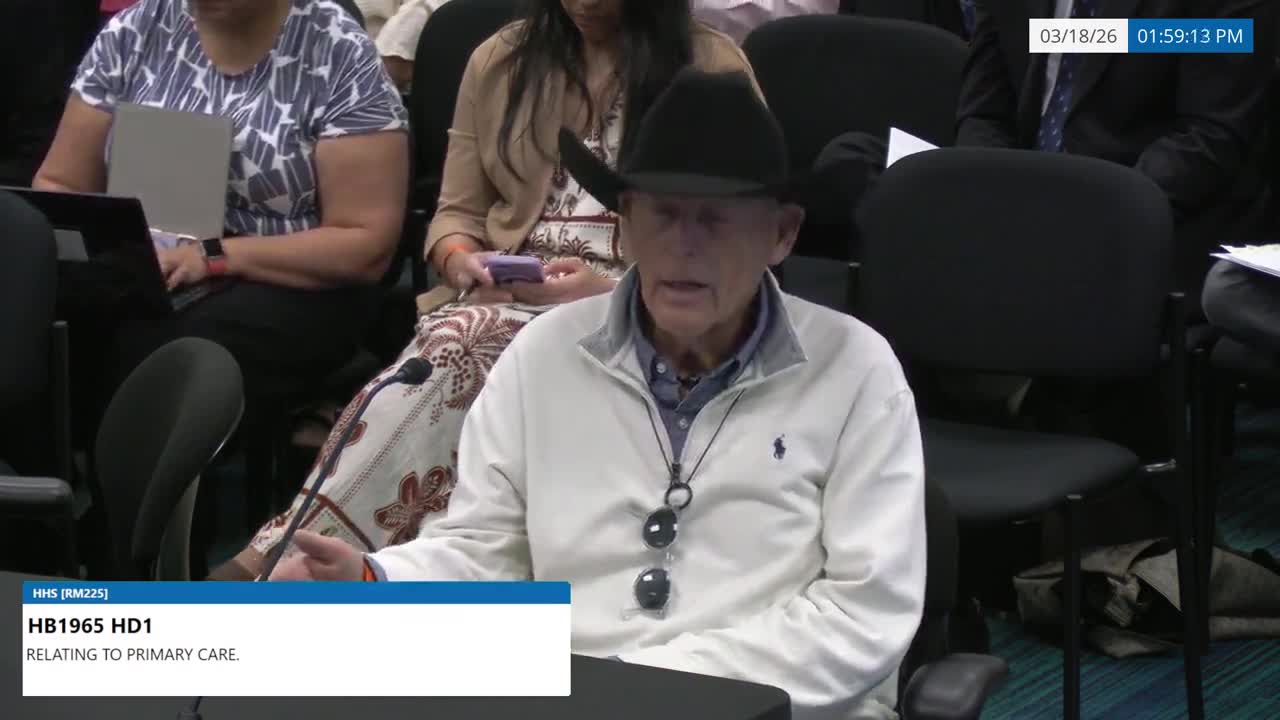 1MIN
Senate Standing Committee on Health and Human Services
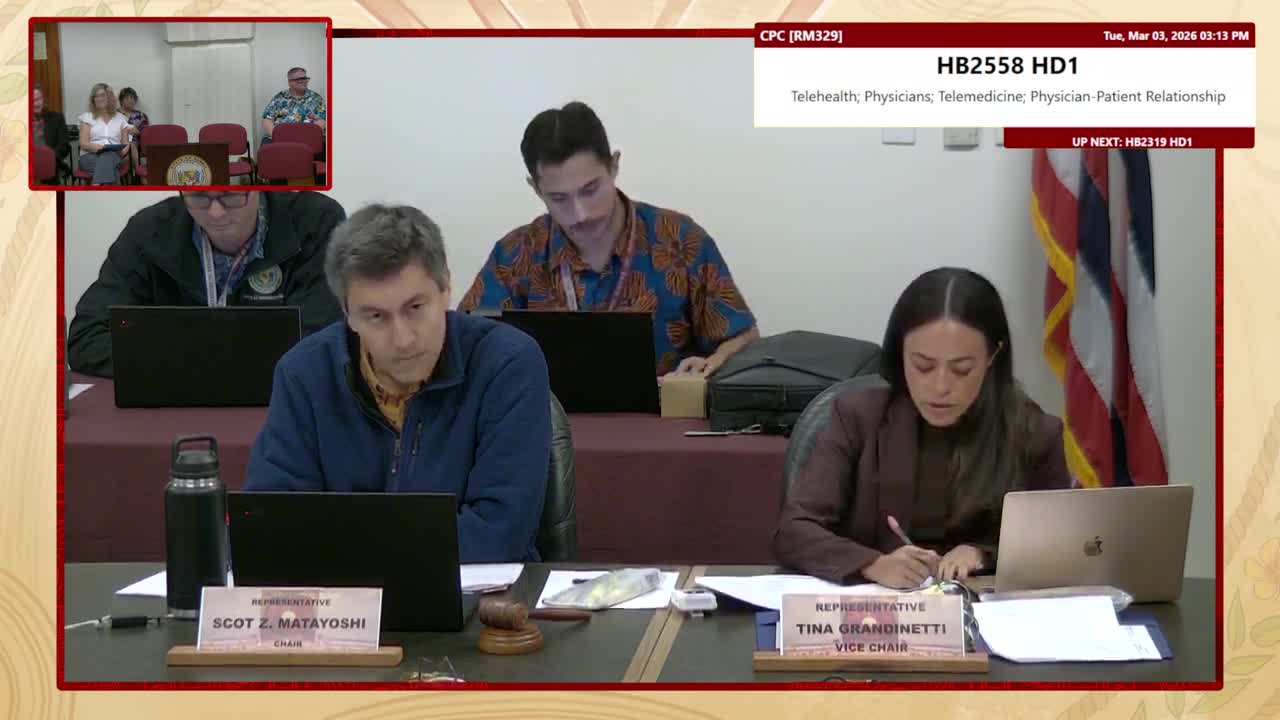 4MIN
House Standing Committee on Consumer Protection & Commerce
 35SEC
House Standing Committee on Consumer Protection & Commerce
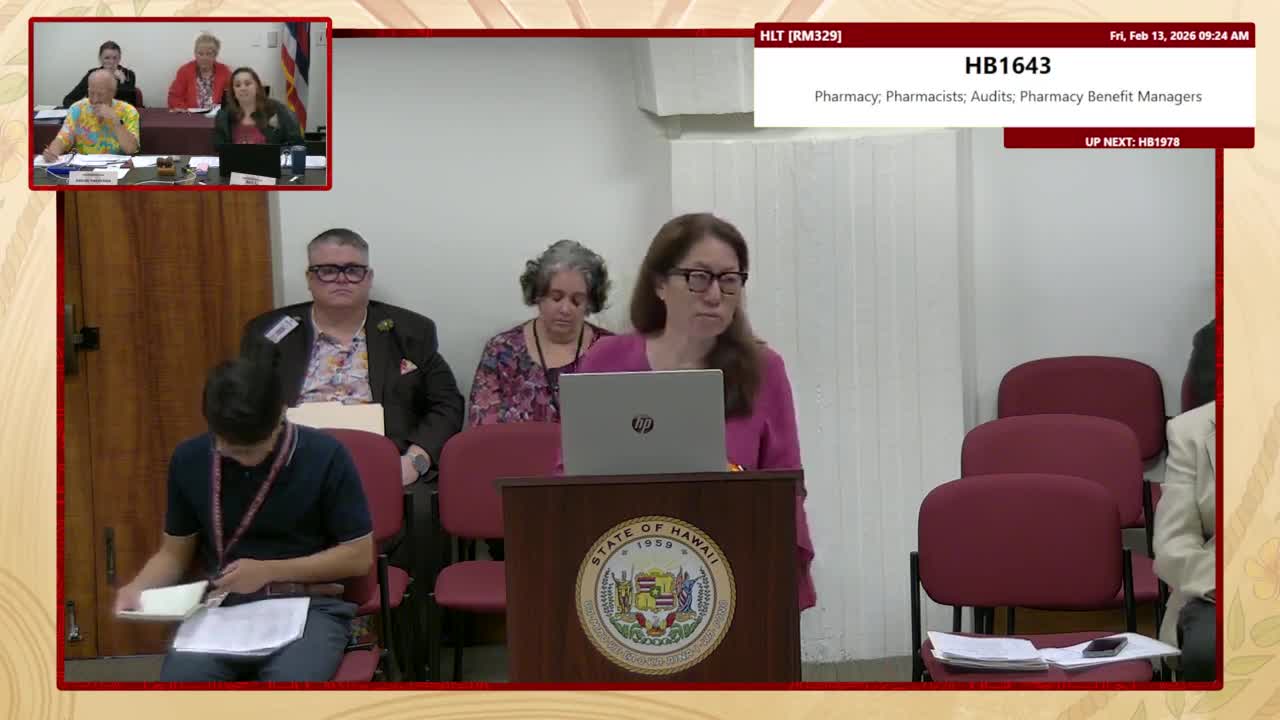 9MIN
House Standing Committee on Health
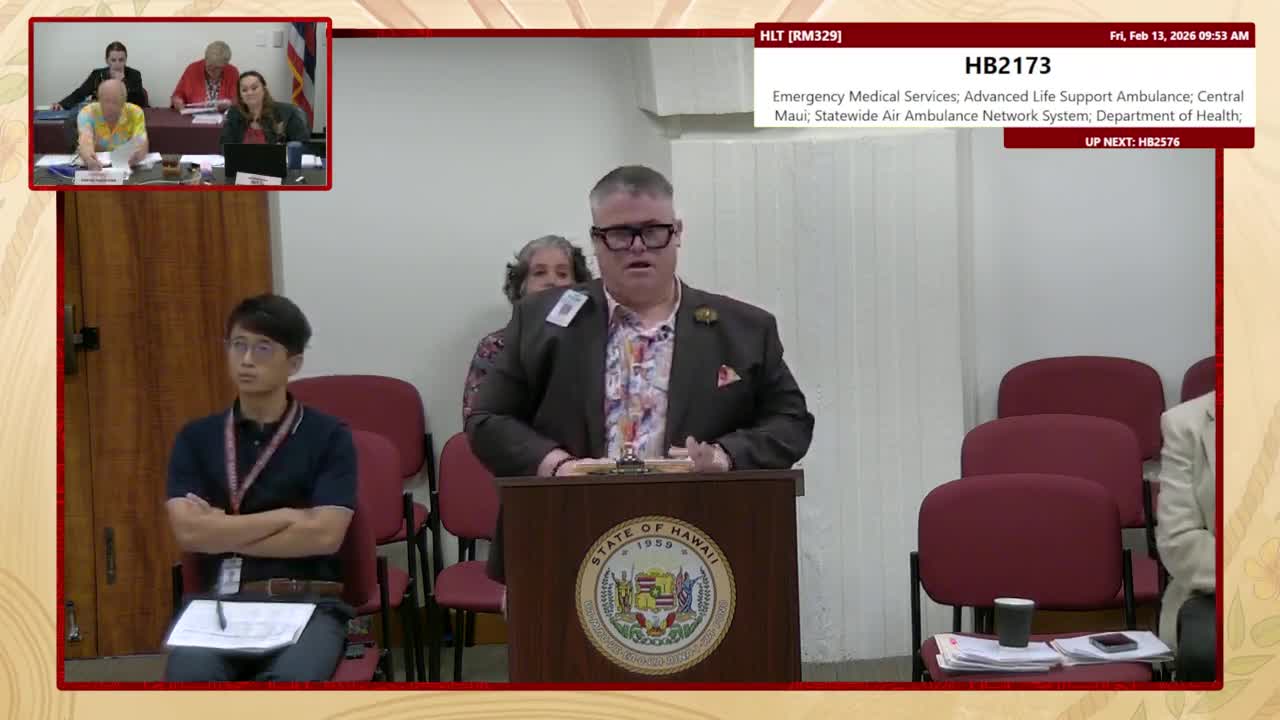 41SEC
House Standing Committee on Health
Bill Author
Bill Co-Author(s):