HB 1961: Health Care Facilities; Interference; Disruption; Criminal Penalties; Civil Remedies; Attorney General
- Session Year: 2025-2026
- House: House
- Latest Version Date: 2026-03-24
Current Status:
Passed
(2026-07-07: Act 202, on 07/07/2026 (Gov. Msg. No. 1304).)
Introduced
In Committee
First Chamber
In Committee
Second Chamber
Final Decking
Enacted
Prohibits persons from interfering with another person's access to or from a health care facility or disrupting the normal functioning of a health care facility. Makes violations a petty misdemeanor. Establishes a private right of action. Authorizes the Attorney General to bring an action for injunctive or other equitable relief. (SD1)
Prohibits persons from interfering with another person's access to or from a health care facility or disrupting the normal functioning of a health care facility. Makes violations a petty misdemeanor. Establishes a private right of action. Authorizes the Attorney General to bring an action for injunctive or other equitable relief. Effective 7/1/3000. (HD2)
Prohibits persons from interfering with another person's access to or from a health care facility or disrupting the normal functioning of a health care facility. Makes violations a petty misdemeanor. Establishes a private right of action. Authorizes the Attorney General to bring an action for injunctive or other equitable relief. Effective 7/1/3000. (HD1)
Prohibits persons from interfering with another person's access to or from a health care facility or disrupting the normal functioning of a health care facility. Makes violations a petty misdemeanor. Establishes a private right of action for individuals and health care facilities harmed as a result of interference with a health care facility. Authorizes the Attorney General to bring an action for injunctive or other equitable relief.
|
HOUSE OF REPRESENTATIVES |
H.B. NO. |
1961 |
|
THIRTY-THIRD LEGISLATURE, 2026 |
H.D. 2 |
|
|
STATE OF HAWAII |
S.D. 1 |
|
|
|
|
|
|
|
||
|
|
||
A BILL FOR AN ACT
RELATING TO HEALTH CARE.
BE IT ENACTED BY THE LEGISLATURE OF THE STATE OF HAWAII:
SECTION 1. The legislature finds that safe access to health care services is vital for the health and safety of all residents of the State. Individuals seeking or providing health care should be able to access health care facilities without fear, intimidation, or any form of harassment. The legislature therefore declares that interference with health care facilities should be prohibited and subject to civil and criminal penalties.
The purpose of this Act is to protect safe and unobstructed access to health care for patients and their providers by prohibiting persons from interfering with another person's access to a health care facility and establishing civil and criminal penalties for violations. This Act is not intended to affect any rights under federal or state law on peaceful expressive conduct, including labor demonstrations or exercising the right to strike.
SECTION 2. The Hawaii Revised Statutes is amended by adding a new chapter to title 19 to be appropriately designated and to read as follows:
"Chapter
interference with Health care facilities
§ -1 Definitions. For the purposes of this chapter:
"Aggrieved party" means any of the following persons or entities, when aggrieved by conduct in violation of this chapter:
(1) A person who is physically present at a health care facility whose access to or from the facility is interfered with;
(2) A person whose care is disrupted by another person's interference with a health care facility;
(3) A health care facility and health care facility employees; and
(4) The owner of a health care facility or the building or property upon which the health care facility is located.
"Health care facility" or "facility" has the same meaning as in section 323D-2 and includes:
(1) Any buildings or structures in which the facility is located and any associated driveway; and
(2) Common areas of the real property on which the facility is located.
"Health care facility employee" means an officer, director, employee, or agent of a health care facility.
"Health care provider" has the same meaning as in section 671-1.
§ -2 Interference with health care facilities prohibited; exception. Except as otherwise provided under federal or state law, it shall be unlawful for any person, alone or in concert, to intentionally, knowingly, or recklessly interfere with another person's access to or from a health care facility or intentionally, knowingly, or recklessly disrupt the normal functioning of a health care facility by:
(1) Physically obstructing or impeding the free passage of another person seeking to enter or depart from the facility;
(2) Making or causing repeated telephone calls to a person, including a health care facility employee or health care provider, or a health care facility with the intent to impede access to the person's or health care facility's telephone lines or otherwise disrupt the person's or health care facility's activities; or
(3) Threatening to inflict injury on the owners, agents, patients, employees, or property of the health care facility.
§ -3 Criminal penalties. (a) In addition to any other penalties, any person who intentionally, knowingly, or recklessly violates this part, whether alone or in concert, shall be guilty of a petty misdemeanor and shall be punished as follows:
(1) For a first offense, a fine of no less than $250 and a term of imprisonment of at least twenty-four consecutive hours;
(2) For a second offense, a fine of no less than $750 and a term of imprisonment of at least seven consecutive days; and
(3) For a third or subsequent offense, a fine of no less than $1,000 and a term of imprisonment of no more than thirty consecutive days.
(b) A court having jurisdiction in a criminal proceeding under this chapter shall, upon motion by an interested party, take all reasonably necessary steps to safeguard the individual privacy of an aggrieved party and prevent harassment of a patient, health care provider, or health care facility employee who is a party or witness to a proceeding.
(c) For the purposes of this section, "person" means a person eighteen years of age or older.
§ -4 Civil remedies. (a) Any aggrieved party may bring a civil suit against a person or persons who intentionally, knowingly, or recklessly violated this chapter in the district court of the district or the circuit court of the circuit in which the violation took place to enjoin further violations and recover actual damages sustained. The aggrieved party shall not be required to allege or prove actual damages to prevail.
(b) The court may, in its discretion, increase the award of damages to an amount not to exceed $500, or $5,000 if the aggrieved party is a health care facility, for each day of continued violation. The court may, in its discretion and subject to all applicable federal and state laws, regulations, and rules, issue injunctive relief without bond.
(c) In any action brought under this section, the prevailing party shall be entitled to the recovery of costs of the suit, including court costs and fees and reasonable attorney's fees.
(d) A court having jurisdiction in a civil proceeding under this chapter shall, upon motion by an interested party, take all reasonably necessary steps to safeguard the individual privacy of an aggrieved party and prevent harassment of a patient, health care provider, or health care facility employee who is a party or witness to a proceeding.
(e) The attorney general may bring an action in a court of competent jurisdiction for appropriate injunctive or other equitable relief against any person who is reasonably believed to violate or who is in the course of violating this chapter.
§ -5 Enforcement. Enforcement of this chapter shall be under the concurrent jurisdiction of the attorney general, the prosecuting attorneys or deputy prosecuting attorneys of the various counties, and the police departments of the various counties.
§ -6 Remedies and penalties not exclusive. The penalties and remedies provided in this chapter with respect to any violation of this chapter shall not be deemed exclusive of each other or of any other civil or criminal rights, remedies, or penalties provided or allowed by law with respect to any violation."
SECTION 3. This Act does not affect rights and duties that matured, penalties that were incurred, and proceedings that were begun before its effective date.
SECTION 4. This Act shall take effect upon its approval.
Report Title:
Health Care Facilities; Interference; Disruption; Criminal Penalties; Civil Remedies; Attorney General
Description:
Prohibits persons from interfering with another person's access to or from a health care facility or disrupting the normal functioning of a health care facility. Makes violations a petty misdemeanor. Establishes a private right of action. Authorizes the Attorney General to bring an action for injunctive or other equitable relief. (SD1)
The summary description of legislation appearing on this page is for informational purposes only and is not legislation or evidence of legislative intent.
|
HOUSE OF REPRESENTATIVES |
H.B. NO. |
1961 |
|
THIRTY-THIRD LEGISLATURE, 2026 |
H.D. 2 |
|
|
STATE OF HAWAII |
|
|
|
|
|
|
|
|
||
|
|
||
A BILL FOR AN ACT
RELATING TO HEALTH CARE.
BE IT ENACTED BY THE LEGISLATURE OF THE STATE OF HAWAII:
SECTION 1. The legislature finds that safe access to health care services is vital for the health and safety of all residents of the State. Individuals seeking or providing health care should be able to access health care facilities without fear, intimidation, or any form of harassment. The legislature therefore declares that interference with health care facilities should be prohibited and subject to civil and criminal penalties.
The purpose of this Act is to protect safe and unobstructed access to health care for patients and their providers by prohibiting persons from interfering with another person's access to a health care facility and establishing civil and criminal penalties for violations. This Act is not intended to affect any rights under federal or state law on peaceful expressive conduct, including labor demonstrations or exercising the right to strike.
SECTION 2. The Hawaii Revised Statutes is amended by adding a new chapter to title 19 to be appropriately designated and to read as follows:
"Chapter
interference with Health care facilities
§ -1 Definitions. For the purposes of this chapter:
"Aggrieved party" means any of the following persons or entities, when aggrieved by conduct in violation of this chapter:
(1) A person who is physically present at a health care facility whose access to or from the facility is interfered with;
(2) A person whose care is disrupted by another person's interference with a health care facility;
(3) A health care facility and health care facility employees; and
(4) The owner of a health care facility or the building or property upon which the health care facility is located.
"Health care facility" or "facility" has the same meaning as in section 323D-2 and includes:
(1) Any buildings or structures in which the facility is located and any associated driveway; and
(2) Common areas of the real property on which the facility is located.
"Health care facility employee" means an officer, director, employee, or agent of a health care facility.
"Health care provider" has the same meaning as in section 671-1.
§ -2 Interference with health care facilities prohibited; exception. Except as otherwise provided under federal or state law, it shall be unlawful for any person, alone or in concert, to intentionally, knowingly, or recklessly interfere with another person's access to or from a health care facility or intentionally, knowingly, or recklessly disrupt the normal functioning of a health care facility by:
(1) Physically obstructing or impeding the free passage of another person seeking to enter or depart from the facility;
(2) Making or causing repeated telephone calls to a person, including a health care facility employee or health care provider, or a health care facility with the intent to impede access to the person's or health care facility's telephone lines or otherwise disrupt the person's or health care facility's activities; or
(3) Threatening to inflict injury on the owners, agents, patients, employees, or property of the health care facility.
§ -3 Criminal penalties. (a) In addition to any other penalties, any person who intentionally, knowingly, or recklessly violates this part, whether alone or in concert, shall be guilty of a petty misdemeanor and shall be punished as follows:
(1) For a first offense, a fine of no less than $250 and a term of imprisonment of at least twenty-four consecutive hours;
(2) For a second offense, a fine of no less than $750 and a term of imprisonment of at least seven consecutive days; and
(3) For a third or subsequent offense, a fine of no less than $1,000 and a term of imprisonment of no more than thirty consecutive days.
(b) A court having jurisdiction in a criminal proceeding under this chapter shall, upon motion by an interested party, take all reasonably necessary steps to safeguard the individual privacy of an aggrieved party and prevent harassment of a patient, health care provider, or health care facility employee who is a party or witness to a proceeding.
(c) For the purposes of this section, "person" means a person eighteen years of age or older.
§ -4 Civil remedies. (a) Any aggrieved party may bring a civil suit against a person or persons who intentionally, knowingly, or recklessly violated this chapter in the district court of the district or the circuit court of the circuit in which the violation took place to enjoin further violations and recover actual damages sustained. The aggrieved party shall not be required to allege or prove actual damages to prevail.
(b) The court may, in its discretion, increase the award of damages to an amount not to exceed $500, or $5,000 if the aggrieved party is a health care facility, for each day of continued violation. The court may, in its discretion and subject to all applicable federal and state laws, regulations, and rules, issue injunctive relief without bond.
(c) In any action brought under this section, the prevailing party shall be entitled to the recovery of costs of the suit, including court costs and fees and reasonable attorney's fees.
(d) A court having jurisdiction in a civil proceeding under this chapter shall, upon motion by an interested party, take all reasonably necessary steps to safeguard the individual privacy of an aggrieved party and prevent harassment of a patient, health care provider, or health care facility employee who is a party or witness to a proceeding.
(e) The attorney general may bring an action in a court of competent jurisdiction for appropriate injunctive or other equitable relief against any person who is reasonably believed to violate or who is in the course of violating this chapter.
§ -5 Enforcement. Enforcement of this chapter shall be under the concurrent jurisdiction of the attorney general, the prosecuting attorneys or deputy prosecuting attorneys of the various counties, and the police departments of the various counties.
§ -6 Remedies and penalties not exclusive. The penalties and remedies provided in this chapter with respect to any violation of this chapter shall not be deemed exclusive of each other or of any other civil or criminal rights, remedies, or penalties provided or allowed by law with respect to any violation."
SECTION 3. This Act does not affect rights and duties that matured, penalties that were incurred, and proceedings that were begun before its effective date.
SECTION 4. This Act shall take effect on July 1, 3000.
Report Title:
Health Care Facilities; Interference; Disruption; Criminal Penalties; Civil Remedies; Attorney General
Description:
Prohibits persons from interfering with another person's access to or from a health care facility or disrupting the normal functioning of a health care facility. Makes violations a petty misdemeanor. Establishes a private right of action. Authorizes the Attorney General to bring an action for injunctive or other equitable relief. Effective 7/1/3000. (HD2)
The summary description of legislation appearing on this page is for informational purposes only and is not legislation or evidence of legislative intent.
|
HOUSE OF REPRESENTATIVES |
H.B. NO. |
1961 |
|
THIRTY-THIRD LEGISLATURE, 2026 |
H.D. 1 |
|
|
STATE OF HAWAII |
|
|
|
|
|
|
|
|
||
|
|
||
A BILL FOR AN ACT
RELATING TO HEALTH CARE.
BE IT ENACTED BY THE LEGISLATURE OF THE STATE OF HAWAII:
SECTION 1. The legislature finds that safe access to health care services is vital for the health and safety of all residents of the State. Individuals seeking or providing health care should be able to access health care facilities without fear, intimidation, or any form of harassment. The legislature therefore declares that interference with health care facilities should be prohibited and subject to civil and criminal penalties.
The purpose of this Act is to protect safe and unobstructed access to health care for patients and their providers by prohibiting persons from interfering with another person's access to a health care facility and establishing civil and criminal penalties for violations.
SECTION 2. The Hawaii Revised Statutes is amended by adding a new chapter to title 19 to be appropriately designated and to read as follows:
"Chapter
interference with Health care facilities
§ -1 Definitions. For the purposes of this chapter:
"Aggrieved party" means:
(1) A person who is physically present at a health care facility whose access is or is about to be obstructed or impeded by another person's intentional, knowing, or reckless interference;
(2) A person who is physically present at a health care facility whose care is or is about to be disrupted by another person's intentional, knowing, or reckless interference;
(3) A health care facility and its employees or agents; and
(4) The owner of a health care facility or the building or property upon which the health care facility is located.
"Health care facility" or "facility" has the same meaning as in section 323D-2 and includes any buildings or structures in which the facility is located and any associated driveway.
"Health care facility employee" means an officer, director, employee, or agent of a health care facility.
"Health care provider" has the same meaning as in section 671-1.
§ -2 Interference with health care facilities prohibited; exception. (a) Except as otherwise provided under federal or state law, it shall be unlawful for any person, alone or in concert, to intentionally, knowingly, or recklessly interfere with another person's access to or from a health care facility or intentionally, knowingly, or recklessly disrupt the normal functioning of a health care facility by:
(1) Physically obstructing or impeding the free passage of another person seeking to enter or depart from the facility or from the common areas of the real property on which the facility is located;
(2) Making or causing repeated telephone calls to a person, including a health care facility employee or health care provider, or a health care facility with the intent to impede access to the person's or health care facility's telephone lines or otherwise disrupt the person's or health care facility's activities; or
(3) Threatening to inflict injury on the owners, agents, patients, employees, or property of the health care facility.
(b) This section shall not apply to actions taken as part of a labor demonstration or when exercising the right to strike.
§ -3 Criminal penalties. (a) In addition to any other penalties, any person who intentionally, knowingly, or recklessly violates this part, whether alone or in concert, shall be guilty of a petty misdemeanor and shall be punished as follows:
(1) For a first offense, a fine of no less than $250 and a term of imprisonment of at least twenty-four consecutive hours;
(2) For a second offense, a fine of no less than $750 and a term of imprisonment of at least seven consecutive days; and
(3) For a third or subsequent offense, a fine of no less than $1,000 and a term of imprisonment of no more than thirty consecutive days.
(b) A court having jurisdiction in a criminal proceeding under this chapter shall take all reasonably necessary steps to safeguard the individual privacy of an aggrieved party and prevent harassment of a patient, health care provider, or health care facility employee who is a party or witness to a proceeding, including grating protective orders and motions in limine.
(c) For the purposes of this section, "person" means a person eighteen years of age or older.
§ -4 Civil remedies. (a) Any aggrieved party may bring a civil suit against a person or persons who intentionally, knowingly, or recklessly violated this chapter in the district court of the district in which the violation took place to enjoin further violations and recover actual damages sustained. The aggrieved party shall not be required to allege or prove actual damages to prevail.
(b) The court may, in its discretion, increase the award of damages to an amount not to exceed $500, or $5,000 if the aggrieved party is a health care facility, for each day of continued violation. The court may, in its discretion and subject to all applicable federal and state laws, regulations, and rules, issue injunctive relief without bond.
(c) In any action brought under this section, the prevailing party shall be entitled to the recovery of costs of the suit, including court costs and fees and reasonable attorney's fees.
(d) A court having jurisdiction in a criminal proceeding under this chapter shall take all reasonably necessary steps to safeguard the individual privacy of an aggrieved party and prevent harassment of a patient, health care provider, or health care facility employee who is a party or witness to a proceeding, including granting protective orders and motions in limine.
(e) The attorney general may bring an action in a court of competent jurisdiction for appropriate injunctive or other equitable relief against any person who is reasonably believed to violate or who is in the course of violating this chapter.
§ -5 Enforcement. Enforcement of this chapter shall be under the concurrent jurisdiction of the attorney general, the prosecuting attorneys or deputy prosecuting attorneys of the various counties, and the police departments of the various counties.
§ -6 Remedies and penalties not exclusive. The penalties and remedies provided in this chapter with respect to any violation of this chapter shall not be deemed exclusive of each other or of any other civil or criminal rights, remedies, or penalties provided or allowed by law with respect to any violation."
SECTION 3. This Act does not affect rights and duties that matured, penalties that were incurred, and proceedings that were begun before its effective date.
SECTION 4. This Act shall take effect on July 1, 3000.
Report Title:
Health Care Facilities; Interference; Disruption; Petty Misdemeanor; Private Right of Action; Civil Remedies; Criminal Penalties; Attorney General
Description:
Prohibits persons from interfering with another person's access to or from a health care facility or disrupting the normal functioning of a health care facility. Makes violations a petty misdemeanor. Establishes a private right of action. Authorizes the Attorney General to bring an action for injunctive or other equitable relief. Effective 7/1/3000. (HD1)
The summary description of legislation appearing on this page is for informational purposes only and is not legislation or evidence of legislative intent.
|
HOUSE OF REPRESENTATIVES |
H.B. NO. |
1961 |
|
THIRTY-THIRD LEGISLATURE, 2026 |
|
|
|
STATE OF HAWAII |
|
|
|
|
|
|
|
|
||
|
|
||
A BILL FOR AN ACT
relating to health care.
BE IT ENACTED BY THE LEGISLATURE OF THE STATE OF HAWAII:
SECTION 1. The legislature finds that safe access to health care services is vital for the health and safety of all residents of the State. Individuals seeking or providing health care should be able to access health care facilities without fear, intimidation, or any form of harassment. The legislature therefore declares that interference with health care facilities should be prohibited and subject to civil and criminal penalties.
The purpose of this Act is to protect safe and unobstructed access to health care for patients and their providers by prohibiting persons from interfering with another person's access to a health care facility and establishing civil and criminal penalties for violations.
SECTION 2. The Hawaii Revised Statutes is amended by adding a new chapter to title 19 to be appropriately designated and to read as follows:
"Chapter
interference with Health care facilities
§323- Definitions. For the purposes of this chapter:
"Aggrieved party" means:
(1) A person who is physically present at a health care facility whose access is or is about to be obstructed or impeded by another person's intentional, knowing, or reckless interference;
(2) A person who is physically present at a health care facility whose care is or is about to be disrupted by another person's intentional, knowing, or reckless interference;
(3) A health care facility and its employees or agents; and
(4) The owner of a health care facility or the building or property upon which the health care facility is located.
"Health care facility" or "facility" has the same meaning as in section 323D-2 and includes any buildings or structures in which the facility is located and any associated driveway.
"Health care facility employee" means an officer, director, employee, or agent of a health care facility.
"Health care provider" has the same meaning as in section 671-1.
§323- Interference with health care facilities prohibited; exception. (a) Except as otherwise provided under federal or state law, it shall be unlawful for any person, alone or in concert, to intentionally, knowingly, or recklessly interfere with another person's access to or from a health care facility or intentionally, knowingly, or recklessly disrupt the normal functioning of a health care facility by:
(1) Physically obstructing or impeding the free passage of another person seeking to enter or depart from the facility or from the common areas of the real property on which the facility is located;
(2) Making or causing a noise that unreasonably disturbs the peace within the facility or that constitutes a violation of section 342F-30;
(3) Trespassing on the facility or the common areas of the real property upon which the facility is located;
(4) Making or causing repeated telephone calls to a person, including a health care facility employee or health care provider, or a health care facility with the intent to impede access to the person's or health care facility's telephone lines or otherwise disrupt the person's or health care facility's activities; or
(5) Threatening to inflict injury on the owners, agents, patients, employees, or property of the health care facility.
(b) This section shall not apply to actions taken as part of a labor demonstration or when exercising the right to strike.
§323- Criminal penalties. (a) In addition to any other penalties, any person who intentionally, knowingly, or recklessly violates this part, whether alone or in concert, shall be guilty of a petty misdemeanor and shall be punished as follows:
(1) For a first offense, a fine of no less than $250 and a term of imprisonment of at least twenty-four consecutive hours;
(2) For a second offense, a fine of no less than $750 and a term of imprisonment of at least seven consecutive days; and
(3) For a third or subsequent offense, a fine of no less than $1,000 and a term of imprisonment of no more than thirty consecutive days.
(b) A court having jurisdiction in a criminal proceeding under this chapter shall take all reasonably necessary steps to safeguard the individual privacy of an aggrieved party and prevent harassment of a patient, health care provider, or health care facility employee who is a party or witness to a proceeding, including grating protective orders and motions in limine.
(c) For the purposes of this section, "person" means a person eighteen years of age or older.
§323- Civil remedies. (a) Any aggrieved party may bring a civil suit against a person or persons who intentionally, knowingly, or recklessly violated this chapter in the district court of the district in which the violation took place to enjoin further violations and recover actual damages sustained. The aggrieved party shall not be required to allege or prove actual damages to prevail.
(b) The court may, in its discretion, increase the award of damages to an amount not to exceed $500, or $5,000 if the aggrieved party is a health care facility, for each day of continued violation. The court may, in its discretion and subject to all applicable federal and state laws, regulations, and rules, issue injunctive relief without bond.
(c) In any action brought under this section, the prevailing party shall be entitled to the recovery of costs of the suit, including court costs and fees and reasonable attorney's fees.
(d) A court having jurisdiction in a criminal proceeding under this chapter shall take all reasonably necessary steps to safeguard the individual privacy of an aggrieved party and prevent harassment of a patient, health care provider, or health care facility employee who is a party or witness to a proceeding, including grating protective orders and motions in limine.
(e) The attorney general may bring an action in a court of competent jurisdiction for appropriate injunctive or other equitable relief against any person who is reasonably believed to violate or who is in the course of violating this chapter.
§323- Enforcement. Enforcement of this chapter shall be under the concurrent jurisdiction of the attorney general, the prosecuting attorneys or deputy prosecuting attorneys of the various counties, and the police departments of the various counties.
§323- Remedies and penalties not exclusive. The penalties and remedies provided in this chapter with respect to any violation of this chapter shall not be deemed exclusive of each other or of any other civil or criminal rights, remedies, or penalties provided or allowed by law with respect to any violation."
SECTION 3. This Act does not affect rights and duties that matured, penalties that were incurred, and proceedings that were begun before its effective date.
SECTION 4. This Act shall take effect upon its approval.
|
INTRODUCED BY: |
_____________________________ |
|
|
|
Report Title:
Health Care Facilities; Interference; Disruption; Petty Misdemeanor; Private Right of Action; Civil Remedies; Criminal Penalties; Attorney General
Description:
Prohibits persons from interfering with another person's access to or from a health care facility or disrupting the normal functioning of a health care facility. Makes violations a petty misdemeanor. Establishes a private right of action for individuals and health care facilities harmed as a result of interference with a health care facility. Authorizes the Attorney General to bring an action for injunctive or other equitable relief.
The summary description of legislation appearing on this page is for informational purposes only and is not legislation or evidence of legislative intent.
|
Date
|
Status
|
|---|---|
| Jul 7, 2026 | Act 202, on 07/07/2026 (Gov. Msg. No. 1304). |
| Jul 7, 2026 | Act 202, 07/07/2026 (Gov. Msg. No. 1304). |
| Apr 24, 2026 | Received notice of passage on Final Reading in House (Hse. Com. No. 823). |
| Apr 23, 2026 | Transmitted to Governor. |
| Apr 23, 2026 | Passed Final Reading as amended in SD 1 with Representative(s) Hussey voting aye with reservations; Representative(s) Alcos, Cochran, Garcia, Gedeon, Iwamoto, Kong, Matsumoto, Muraoka, Pierick, Shimizu voting no (10) and Representative(s) Evslin excused (1). |
| Apr 23, 2026 | House agrees to Senate amendment(s). |
| Apr 23, 2026 | Received notice of House reconsideration of action in disagreeing to the amendments proposed by the Senate (Hse. Com. No. 815). |
| Apr 22, 2026 | Reconsideration of action taken on 04-16-26. |
| Apr 17, 2026 | Received notice of disagreement (Hse. Com. No. 780). |
| Apr 16, 2026 | House disagrees with Senate amendment (s). |
| Apr 14, 2026 | Returned from Senate (Sen. Com. No. 645) in amended form (SD 1). |
| Apr 14, 2026 | Report Adopted; Passed Third Reading. Ayes, 21; Aye(s) with reservations: none. Noes, 4 (Senator(s) Awa, DeCorte, Fevella, Gabbard). Excused, 0 (none). Transmitted to House. |
| Apr 10, 2026 | One Day Notice 04-14-26. |
| Apr 10, 2026 | Reported from JDC (Stand. Com. Rep. No. 3753) with recommendation of passage on Third Reading. |
| Apr 7, 2026 | The committee(s) on JDC recommend(s) that the measure be PASSED, UNAMENDED. The votes in JDC were as follows: 3 Aye(s): Senator(s) Rhoads, Chang, San Buenaventura; Aye(s) with reservations: none ; 1 No(es): Senator(s) Gabbard; and 1 Excused: Senator(s) Awa. |
| Apr 1, 2026 | The committee(s) on JDC will hold a public decision making on 04-07-26 10:15AM; Conference Room 016 & Videoconference. |
| Mar 25, 2026 | Report adopted; Passed Second Reading, as amended (SD 1) and referred to JDC. |
| Mar 25, 2026 | Reported from HHS (Stand. Com. Rep. No. 3168) with recommendation of passage on Second Reading, as amended (SD 1) and referral to JDC. |
| Mar 18, 2026 | The committee(s) on HHS recommend(s) that the measure be PASSED, WITH AMENDMENTS. The votes in HHS were as follows: 4 Aye(s): Senator(s) San Buenaventura, McKelvey, Kanuha, Keohokalole; Aye(s) with reservations: none ; 1 No(es): Senator(s) Fevella; and 0 Excused: none. |
| Mar 13, 2026 | The committee(s) on HHS has scheduled a public hearing on 03-18-26 1:00PM; CR 225 & Videoconference. |
| Mar 12, 2026 | Referred to HHS, JDC. |
| Mar 12, 2026 | Passed First Reading. |
| Mar 12, 2026 | Received from House (Hse. Com. No. 327). |
| Mar 10, 2026 | Passed Third Reading as amended in HD 2 with Representative(s) Iwamoto voting aye with reservations; Representative(s) Alcos, Garcia, Gedeon, Kong, Matsumoto, Muraoka, Pierick, Shimizu voting no (8) and none excused (0). Transmitted to Senate. |
| Mar 6, 2026 | Forty-eight (48) hours notice Tuesday, 03-10-26. |
| Mar 6, 2026 | Reported from JHA (Stand. Com. Rep. No. 1152-26) as amended in HD 2, recommending passage on Third Reading. |
| Feb 24, 2026 | The committee on JHA recommend that the measure be PASSED, WITH AMENDMENTS. The votes were as follows: 7 Ayes: Representative(s) Tarnas, Poepoe, Belatti, Cochran, Kahaloa, Sayama, Takayama; Ayes with reservations: none; 1 Noes: Representative(s) Shimizu; and 2 Excused: Representative(s) Hashem, Garcia. |
| Feb 20, 2026 | Bill scheduled to be heard by JHA on Tuesday, 02-24-26 2:00PM in House conference room 325 VIA VIDEOCONFERENCE. |
| Feb 17, 2026 | Passed Second Reading as amended in HD 1 and referred to the committee(s) on JHA with Representative(s) Gedeon, Matsumoto voting aye with reservations; Representative(s) Alcos, Garcia, Muraoka, Pierick, Shimizu voting no (5) and Representative(s) Cochran, Lee, M., Poepoe excused (3). |
| Feb 17, 2026 | Reported from HLT (Stand. Com. Rep. No. 308-26) as amended in HD 1, recommending passage on Second Reading and referral to JHA. |
| Feb 6, 2026 | The committee on HLT recommend that the measure be PASSED, WITH AMENDMENTS. The votes were as follows: 7 Ayes: Representative(s) Takayama, Keohokapu-Lee Loy, Amato, Hartsfield, Marten, Olds, Takenouchi; Ayes with reservations: none; 2 Noes: Representative(s) Alcos, Garcia; and Excused: none. |
| Feb 3, 2026 | Bill scheduled to be heard by HLT on Friday, 02-06-26 9:00AM in House conference room 329 VIA VIDEOCONFERENCE. |
| Jan 28, 2026 | Referred to HLT, JHA, referral sheet 3 |
| Jan 26, 2026 | Introduced and Pass First Reading. |
| Jan 23, 2026 | Pending introduction. |
|
Date
|
Description
|
Location
|
Votes
|
|
|---|---|---|---|---|
| Apr 23, 2026 | Final Reading | House Floor |
Passed |
|
| Apr 14, 2026 | Third Reading | Senate Floor |
Passed |
|
| Apr 7, 2026 | The committee(s) on JDC recommend(s) that the measure be PASSED, UNAMENDED | Senate Standing Committee on Judiciary |
Passed |
|
| Mar 18, 2026 | The committee(s) on HHS recommend(s) that the measure be PASSED, WITH AMENDMENTS | Senate Standing Committee on Health and Human Services |
Passed |
|
| Mar 10, 2026 | Third Reading | House Floor |
Passed |
|
| Feb 24, 2026 | The committee on JHA recommend that the measure be PASSED, WITH AMENDMENTS | House Standing Committee on Judiciary & Hawaiian Affairs |
Passed |
|
| Feb 6, 2026 | The committee on HLT recommend that the measure be PASSED, WITH AMENDMENTS | House Standing Committee on Health |
Passed |
This list shows positions taken on this bill by organizations on the date displayed, which is linked to the original source.
Positions by individuals are not included.
|
Organization
|
Position
|
Date
|
|---|---|---|
| AAUW of Hawaiʻi | *** Support | Apr 7, 2026 |
| ACOG Hawaiʻi Section | *** Support | Feb 24, 2026 |
| American College of Obstetricians and Gynecologists (ACOG) Hawaiʻi Section | *** Support | Apr 7, 2026 |
| American College of Obstetricians and Gynecologists - Hawaiʻi Section (ACOG Hawaiʻi) | *** Support | Apr 7, 2026 |
| American College of Obstetricians and Gynecologists, Hawaiʻi Section | *** Support | Mar 18, 2026 |
| Catholic Church | *** Against | Feb 24, 2026 |
| Department of Health | *** Support | Apr 7, 2026 |
| Essential Access Health | *** Support | Apr 7, 2026 |
| Generation Action | *** Support | Feb 6, 2026 |
| Generation Action (student group) | *** Support | Apr 7, 2026 |
| Hawai'i Christian Coalition | *** Against | Mar 18, 2026 |
| Hawaii Family Forum | *** Against | Apr 7, 2026 |
| Hawaii Nurses Association | *** Support | Feb 6, 2026 |
| Hawaii Primary Care Association | *** Support | Apr 7, 2026 |
| Hawaii Primary Care Association (HPCA) | *** Support | Apr 7, 2026 |
| Hawaii State Commission on the Status of Women | *** Support | Apr 7, 2026 |
| Hawaii Women Lawyers | *** Support | Apr 7, 2026 |
| Hawaii Women’s Coalition | *** Support | Apr 7, 2026 |
| Hawaiʻi Nurses Association, OPEIU Local 50 | ** Support | |
| Hawaiʻi State LGBTQ+ Commission | *** Support | Apr 7, 2026 |
| Hawaiʻi State Youth Commission | *** Support | Apr 7, 2026 |
| Hawai‘i State Center for Nursing | *** Support | Apr 7, 2026 |
| Hawai‘i State Center for Nursing, University of Hawai‘i at Mānoa | *** Support | Apr 7, 2026 |
| Hawai‘i State LGBTQ+ Commission | *** Support | Feb 6, 2026 |
| Haʻaheo, ʻOhana, Kaulike, Ui Political Action Committee | ** Support | |
| Healthcare Association of Hawaii | *** Support | Mar 18, 2026 |
| HOKU PAC | *** Support | Apr 7, 2026 |
| Indivisables Hawaii | *** Support | Feb 6, 2026 |
| indivisible | *** Support | Apr 7, 2026 |
| Indivisible Hawaiʻi | *** Support | Apr 7, 2026 |
| Leeward Republican Women's Club | *** Against | Mar 18, 2026 |
| Planned Parenthood (organizer, personal capacity) | *** Support | Apr 7, 2026 |
| Planned Parenthood Alliance Advocate - Hawaiʻi | ** Support | |
| Planned Parenthood Alliance Advocates (volunteer) | *** Support | Apr 7, 2026 |
| Planned Parenthood Alliance Advocates - Hawaiʻi | ** Support | |
| Planned Parenthood Alliance Advocates – Hawaiʻi | *** Support | Apr 7, 2026 |
| Planned Parenthood Generation Action at UH | *** Support | Feb 24, 2026 |
| Planned Parenthood Generation Action at UH Mānoa | *** Support | Feb 24, 2026 |
| Pride at Work – Hawaiʻi | *** Support | Apr 7, 2026 |
| Pride at Work – Hawai‘i | *** Support | Apr 7, 2026 |
| Queens Medical Center; American College of Obstetricians and Gynecologists, Hawaiʻi Section | *** Support | Mar 18, 2026 |
| State Health Planning and Development Agency (SHPDA) | *** Support | Apr 7, 2026 |
| Stonewall Caucus of the Democratic Party of Hawaiʻi | *** Support | Apr 7, 2026 |
| University of Hawaiʻi at Manoa | *** Support | Apr 7, 2026 |
| Visibility Brigade Honolulu | ** Support |
STAND. COM. REP. NO. 1152-26
Honolulu, Hawaii
, 2026
RE: H.B. No. 1961
H.D. 2
Honorable Nadine K. Nakamura
Speaker, House of Representatives
Thirty-Third State Legislature
Regular Session of 2026
State of Hawaii
Madame:
Your Committee on Judiciary & Hawaiian Affairs, to which was referred H.B. No. 1961, H.D. 1, entitled:
"A BILL FOR AN ACT RELATING TO HEALTH CARE,"
begs leave to report as follows:
The purpose of this measure is to:
(1) Prohibit persons from interfering with another person's access to or from a health care facility or disrupting the normal functioning of a health care facility;
(2) Make violations a petty misdemeanor;
(3) Establish a private right of action; and
(4) Authorize the Attorney General to bring an action for injunctive or other equitable relief.
Your Committee received testimony in support of this measure from the State Health Planning and Development Agency; Hawaiʻi State Lesbian, Gay, Bisexual, Transgender, Queer Plus Commission; Hawaii State Commission on the Status of Women; Hawaiʻi State Youth Commission; AAUW of Hawaii; Pride at Work-Hawaiʻi; Haʻaheo, ʻOhana, Kaulike, Ui Political Action Committee; Stonewall Caucus of the Democratic Party of Hawaiʻi; Indivisible Hawaiʻi Healthcare Team; Visibility Brigade Honolulu; Indivisible Leeward Oahu; Hawaiʻi Primary Care Association; Planned Parenthood Alliance Advocate - Hawaiʻi; Healthcare Association of Hawaii; American College of Obstetricians and Gynecologists, Hawaii Section; Hawaiʻi Women Lawyers; Essential Access Health; and numerous individuals. Your Committee received testimony in opposition to this measure from the Hawaii Family Forum and numerous individuals. Your Committee received comments on this measure from the Department of the Attorney General.
Your Committee finds that individuals seeking or providing health care services must be able to access health care facilities without obstruction, intimidation, or disruption, and that interference with such access raises significant public safety, privacy, and due process concerns. Your Committee further finds that existing law does not adequately address conduct that intentionally, knowingly, or recklessly interferes with access to health care facilities or disrupts their normal functioning, resulting in risks to patients, providers, employees, and property. Establishing clear statutory prohibitions, narrowly tailored to address conduct rather than lawful expression or labor activity, and providing appropriate civil and criminal remedies will assist in preventing harassment and ensure patients and providers can safely access health care services.
Your Committee has amended this measure by:
(1) Clarifying the definitions of "aggrieved party" and "health care facility" or "facility";
(2) Deleting language that would have exempted certain activities from the prohibition against interfering with a person's access to or from a health care facility or disrupting the facility's normal operations;
(3) Clarifying the necessary steps a court must take in a criminal or civil proceeding to safeguard privacy and specifying that such actions shall be undertaken only upon motion by an interested party;
(4) Clarifying that an aggrieved party may bring a civil action in either the district court or the circuit court of the jurisdiction in which the violation occurred; and
(5) Making technical, nonsubstantive amendments for the purposes of clarity, consistency, and style.
As affirmed by the record of votes of the members of your Committee on Judiciary & Hawaiian Affairs that is attached to this report, your Committee is in accord with the intent and purpose of H.B. No. 1961, H.D. 1, as amended herein, and recommends that it pass Third Reading in the form attached hereto as H.B. No. 1961, H.D. 2.
Respectfully submitted on behalf of the members of the Committee on Judiciary & Hawaiian Affairs,
|
|
|
____________________________ DAVID A. TARNAS, Chair |
|
|
|
|
STAND. COM. REP. NO. 308-26
Honolulu, Hawaii
, 2026
RE: H.B. No. 1961
H.D. 1
Honorable Nadine K. Nakamura
Speaker, House of Representatives
Thirty-Third State Legislature
Regular Session of 2026
State of Hawaii
Madame:
Your Committee on Health, to which was referred H.B. No. 1961 entitled:
"A BILL FOR AN ACT RELATING TO HEALTH CARE,"
begs leave to report as follows:
The purpose of this measure is to prohibit persons from interfering with another person's access to a health care facility and establish civil and criminal penalties for violations.
Your Committee received testimony in support of this measure from the Hawaiʻi State Lesbian, Gay, Bisexual, Transgender, Queer Plus Commission; AAUW of Hawaiʻi; HOKU PAC; Hawaiʻi Nurses Association, OPEIU Local 50; Healthcare Association of Hawaii; Indivisible Hawaiʻi; Planned Parenthood Alliance Advocates - Hawaiʻi; American College of Obstetricians and Gynecologists, Hawaiʻi Section; Hawaii Primary Care Association; Pride at Work - Hawaiʻi; Hawaiʻi State Democratic Women's Caucus; and numerous individuals. Your Committee received testimony in opposition to this measure from one individual. Your Committee received comments on this measure from the Department of Health and one individual.
Your Committee finds that medical care is a personal decision determined by a patient and the patient's provider. Your Committee further finds that no person should be obstructed, harassed, or intimidated when seeking medical care, and no health care provider or facility should be prevented from carrying out its lawful purpose. Interference with access to medical care undermines personal autonomy, erodes public trust, and places vulnerable individuals at heightened risk. This measure protects individuals' access to health care facilities, safeguards the uninterrupted delivery of medical services, and establishes clear legal remedies when interference causes harm.
Your Committee acknowledges the concern raised by Planned Parenthood Alliance Advocates that because existing state law already prohibits excessive noise and trespass in contexts outside of interfering with a health care facility, including those elements as part of the prohibited acts that constitute interference with a health care facility may be duplicative and create confusion with enforcement.
Accordingly, your Committee has amended this measure by:
(1) Removing excessive noise and trespass from the prohibited acts provision of this measure;
(2) Changing the effective date to July 1, 3000, to encourage further discussion; and
(3) Making technical, nonsubstantive amendments for the purposes of clarity, consistency, and style.
As affirmed by the record of votes of the members of your Committee on Health that is attached to this report, your Committee is in accord with the intent and purpose of H.B. No. 1961, as amended herein, and recommends that it pass Second Reading in the form attached hereto as H.B. No. 1961, H.D. 1, and be referred to your Committee on Judiciary & Hawaiian Affairs.
Respectfully submitted on behalf of the members of the Committee on Health,
|
|
|
____________________________ GREGG TAKAYAMA, Chair |
|
|
|
|
|
Date
|
Testimony PDF
|
|---|---|
| Apr 7, 2026 | HB1961_SD1_TESTIMONY_JDC_04-07-26_.PDF |
| Mar 18, 2026 | HB1961_HD2_TESTIMONY_HHS_03-18-26_.PDF |
| Feb 24, 2026 | HB1961_HD1_TESTIMONY_JHA_02-24-26_.PDF |
| Feb 6, 2026 | HB1961_TESTIMONY_HLT-HSH_02-06-26_.PDF |
Discussed in Hearing
 19MIN
Senate Standing Committee on Health and Human Services
 9MIN
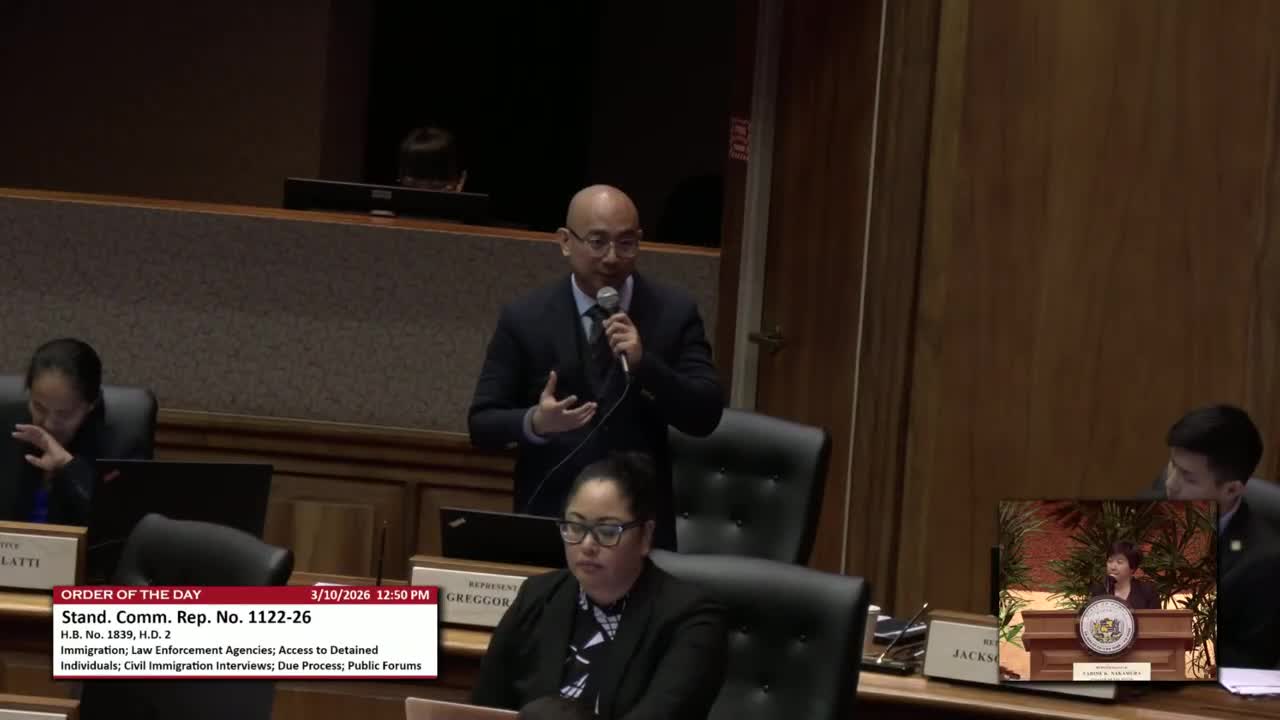
House Floor
 29MIN
House Standing Committee on Judiciary & Hawaiian Affairs
 2MIN
House Standing Committee on Judiciary & Hawaiian Affairs
 9MIN
House Standing Committee on Health
9MIN
House Standing Committee on Human Services & Homelessness
 35SEC
House Standing Committee on Health
35SEC
House Standing Committee on Human Services & Homelessness
Bill Author

Bill Co-Author(s):