HB 1891: DOE; Dyslexia Screening; Universal Screening; Evidence-Based Interventions; Teacher Professional Development
- Session Year: 2025-2026
- House: House
- Latest Version Date: 2026-05-01
Current Status:
Passed
(2026-07-14: Act 242, on 07/13/2026 (Gov. Msg. No. 1344).)
Introduced
In Committee
First Chamber
In Committee
Second Chamber
Final Decking
Enacted
What does this bill do?
The bill requires the State Department of Education to use dyslexia‑sensitive, linguistically appropriate universal screenings to find K–3 students and students new to public schools who are at risk for reading problems, and to provide evidence‑based reading interventions for those students. It also requires the department to offer teacher training in structured literacy and to work with college teacher‑preparation programs so new teachers learn these methods. Hawaiian language immersion schools and charter schools are excluded.
The summary is provided by generative AI which can make mistakes. For original language, please view the details in the table below.
Requires the Department of Education to implement dyslexia sensitive linguistically appropriate universal screenings and evidence-based interventions, offer professional development on structured literacy and evidenced-based interventions, and support pre-teacher programs in training candidates in structured literacy instruction. (CD1)
Requires the Department of Education to implement dyslexia sensitive linguistically appropriate universal screenings and evidence-based interventions, offer professional development on structured literacy and evidenced-based interventions, and support pre-teacher programs in training candidates in structured literacy instruction. Appropriates funds. Effective 7/31/2055. (SD1)
Requires the Department of Education to implement dyslexia sensitive linguistically appropriate universal screenings and evidence-based interventions, offer professional development on structured literacy and evidenced-based interventions, and support pre-teacher programs in training candidates in structured literacy instruction. Appropriates funds. Effective 7/1/3000. (HD1)
Requires the Department of Education to implement dyslexia sensitive linguistically appropriate universal screenings and evidence-based interventions, offer professional development on structured literacy and evidenced-based interventions, and support pre-teacher programs in training candidates in structured literacy instruction. Appropriates funds.
|
HOUSE OF REPRESENTATIVES |
H.B. NO. |
1891 |
|
THIRTY-THIRD LEGISLATURE, 2026 |
H.D. 1 |
|
|
STATE OF HAWAII |
S.D. 1 |
|
|
|
C.D. 1 |
|
|
|
||
|
|
||
A BILL FOR AN ACT
RELATING TO EDUCATION.
BE IT ENACTED BY THE LEGISLATURE OF THE STATE OF HAWAII:
SECTION 1. The legislature finds that in 1853, an estimated seventy-five per cent of the population in the Kingdom of Hawaii over the age of sixteen was literate. By 1878, eighty per cent were literate in Hawaiian, English, or a European language, making Hawaii one of the most literate nations in the world at the time. The legislature recognizes that the department of education is committed to preserving and honoring this legacy by ensuring that all students are proficient in reading by the time they graduate.
The legislature further finds that, currently, just over half of Hawaii's students are reading proficiently. To improve student reading proficiency, it is necessary to address the root causes that contribute to the present levels of poor reading proficiency rates. A proactive and systematic approach is required to achieve high literacy rates for all students. Presently, the department of education is striving to address poor reading proficiency rates by administering a universal screening at the beginning, middle, and end of the year for all students from kindergarten to grade nine. The purpose of this universal screening is to identify students who may be at risk for reading failure, and to provide evidence-based interventions to support these students, in addition to core-structured literacy instruction. However, not all universal screenings are able to detect or identify students who may have certain underlying language challenges that impact learning. This is problematic because students with dyslexia or other developmental language disorders may need more intensive support or a more individualized intervention program to address the causes of their reading challenges. Unfortunately, Hawaii is the only state in the country that lacks dyslexia-specific laws to support students in this area.
The legislature also finds that evidence shows that students who are not identified and brought to reading proficiency by third grade face significantly lower chances of success in the future. However, a substantial body of evidence also indicates that, with effective assessment and instruction, all students can learn to read. This includes students with language and literacy challenges and students who have dyslexia.
The purpose of this Act is to support students with dyslexia and students with language and literacy challenges by:
(1) Requiring department of education schools to administer department approved dyslexia sensitive linguistically appropriate universal screening as a part of the universal screening process;
(2) Implementing evidence-based interventions for students who are identified as having dyslexia and students who are flagged as having language and literacy challenges through the Hawaii multi-tiered system of support;
(3) Providing professional development for teachers to increase the implementation of structured literacy instruction; and
(4) Supporting pre-service teacher programs in training their general and special education teacher candidates in structured literacy instruction.
SECTION 2. Chapter 302A, Hawaii Revised Statutes, is amended by adding a new section to part II, subpart C, to be appropriately designated and to read as follows:
"§302A- Dyslexia sensitive linguistically appropriate universal screening; evidence-based interventions; professional development; pre-service requirements. (a) Beginning with the 2028-2029 school year, all department schools shall administer dyslexia sensitive linguistically appropriate universal screening approved by the department for:
(1) All students in kindergarten through third grade; and
(2) Any new student entering a department school for the first time in the State.
(b) The dyslexia sensitive linguistically appropriate universal screening shall be administered as part of the established universal screening process and shall also include, as developmentally appropriate, the following:
(1) Phonological and phonemic awareness;
(2) Sound symbol recognition;
(3) Alphabet knowledge;
(4) Decoding skills;
(5) Rapid naming skills, including letter naming and letter sound fluency;
(6) Encoding skills;
(7) Oral reading accuracy and fluency; and
(8) Oral language.
(c) All department schools shall implement evidence-based interventions for students identified as having dyslexia and students who are flagged as struggling readers through the universal screening process. Interventions and progress monitoring of the identified students shall be implemented within the established Hawaii multi-tiered system of support framework.
(d) The department shall provide professional learning opportunities for staff in complex areas and department schools on the implementation of structured literacy instruction and evidence-based interventions.
(e) Structured literacy instruction, as required under this section, shall involve detailed, step-by-step instruction necessary for developing strong reading and writing skills. In addition to explicit and systematic instruction, a structured literacy approach shall provide multiple opportunities for students to practice a skill or strategy and require teachers to provide immediate, specific feedback to students and continuously monitor progress.
(f) The department shall collaborate with pre-service teacher programs in higher education institutions to ensure general education teacher candidates and special education teacher candidates are trained on the implementation of structured literacy instruction to support all learners.
(g) This section shall not apply to Hawaiian language immersion schools and charter schools.
(h) For the purposes of this section:
"Dyslexia" means a specific learning disability that is neurological in origin and characterized by difficulties with accurate or fluent word recognition and by poor spelling and decoding abilities, which typically result from a deficit in the phonological component of language and literacy development that is often unexpected in relation to other cognitive abilities and the provision of effective classroom instruction. Secondary consequences of dyslexia may include problems in reading comprehension and reduced reading experience that can impede the growth of vocabulary and background knowledge.
"Dyslexia sensitive linguistically appropriate universal screening" means an assessment that measures a student's ability to demonstrate phonological and phonemic awareness; sound-symbol recognition; alphabet knowledge; decoding skills; rapid naming skills, including letter naming and letter sound fluency; encoding skills; oral reading accuracy and fluency; and accuracy of word reading on grade-level text.
"Hawaii multi-tiered system of support" means a comprehensive continuum of evidence-based, systemic practices to support a rapid response to a student's needs, with regular observation to facilitate data-based instructional decision-making.
"Phonological component of language and literacy development" means the ability to recognize that a spoken word consists of a sequence of individual sounds and the ability to manipulate individual sounds when speaking.
"Structured literacy instruction" means an evidence-based approach that emphasizes explicit and systematic instruction in the following components of literacy:
(1) Phonological awareness;
(2) Phonics (decoding and spelling);
(3) Fluency;
(4) Vocabulary;
(5) Comprehension; and
(6) Written expression.
"Universal screening" means the process of administering a brief standardized assessment to all students to identify those who are at risk of poor reading outcomes."
SECTION 3. New statutory material is underscored.
SECTION 4. This Act shall take effect on July 1, 2026.
Report Title:
DOE; Dyslexia Screening; Universal Screening; Evidence-Based Interventions; Teacher Professional Development
Description:
Requires the Department of Education to implement dyslexia sensitive linguistically appropriate universal screenings and evidence-based interventions, offer professional development on structured literacy and evidenced-based interventions, and support pre-teacher programs in training candidates in structured literacy instruction. (CD1)
The summary description of legislation appearing on this page is for informational purposes only and is not legislation or evidence of legislative intent.
|
HOUSE OF REPRESENTATIVES |
H.B. NO. |
1891 |
|
THIRTY-THIRD LEGISLATURE, 2026 |
H.D. 1 |
|
|
STATE OF HAWAII |
S.D. 1 |
|
|
|
|
|
|
|
||
|
|
||
A BILL FOR AN ACT
RELATING TO EDUCATION.
BE IT ENACTED BY THE LEGISLATURE OF THE STATE OF HAWAII:
SECTION 1. The legislature finds that in 1853, an estimated seventy-five per cent of the population in the Kingdom of Hawaii over the age of sixteen was literate. By 1878, eighty per cent were literate in Hawaiian, English, or a European language, making Hawaii one of the most literate nations in the world at the time. The legislature recognizes that the department of education is committed to preserving and honoring this legacy by ensuring that all students are proficient in reading by the time they graduate.
The legislature further finds that, currently, just over half of Hawaii's students are reading proficiently. To improve student reading proficiency, it is necessary to address the root causes that contribute to the present levels of poor reading proficiency rates. A proactive and systematic approach is required to achieve high literacy rates for all students. Presently, the department of education is striving to address poor reading proficiency rates by administering a universal screening at the beginning, middle, and end of the year for all students from kindergarten to grade nine. The purpose of this universal screening is to identify students who may be at risk for reading failure, and to provide evidence-based interventions to support these students, in addition to core-structured literacy instruction. However, not all universal screenings are able to detect or identify students who may have certain underlying language challenges that impact learning. This is problematic because students with dyslexia or other developmental language disorders may need more intensive support or a more individualized intervention program to address the causes of their reading challenges. Unfortunately, Hawaii is the only state in the country that lacks dyslexia-specific laws to support students in this area.
The legislature also finds that evidence shows that students who are not identified and brought to reading proficiency by third grade face significantly lower chances of success in the future. However, a substantial body of evidence also indicates that, with effective assessment and instruction, all students can learn to read. This includes students with language and literacy challenges and students who have dyslexia.
The purpose of this Act is to support students with dyslexia and students with language and literacy challenges by:
(1) Requiring schools to administer department of education approved dyslexia sensitive linguistically appropriate universal screening as a part of the universal screening process;
(2) Implementing evidence-based interventions for students who are identified as having dyslexia and students who are flagged as having language and literacy challenges through the Hawaii multi-tiered system of support;
(3) Providing professional development for teachers to increase the implementation of structured literacy instruction; and
(4) Supporting pre-service teacher programs in training their general and special education teacher candidates in structured literacy instruction.
SECTION 2. Chapter 302A, Hawaii Revised Statutes, is amended by adding a new section to part II, subpart C, to be appropriately designated and to read as follows:
"§302A- Dyslexia sensitive linguistically appropriate universal screening; evidence-based interventions; professional development; pre-service requirements. (a) Beginning with the 2028-2029 school year, all public schools shall administer dyslexia sensitive linguistically appropriate universal screening approved by the department for:
(1) All students in kindergarten through third grade; and
(2) Any new student entering a public school for the first time in the State.
The dyslexia sensitive linguistically appropriate universal screening shall be administered as part of the established universal screening process and shall also include, as developmentally appropriate, the following:
(1) Phonological and phonemic awareness;
(2) Sound symbol recognition;
(3) Alphabet knowledge;
(4) Decoding skills;
(5) Rapid naming skills, including letter naming and letter sound fluency;
(6) Encoding skills;
(7) Oral reading accuracy and fluency; and
(8) Oral language.
(b) All public schools shall implement evidence-based interventions for students identified as having dyslexia and students who are flagged as struggling readers through the universal screening process. Interventions and progress monitoring of the identified students shall be implemented within the established Hawaii multi-tiered system of support framework.
(c) The department shall provide professional learning opportunities for staff in complex areas and public schools on the implementation of structured literacy instruction and evidence-based interventions.
(d) Structured literacy instruction, as required under this section, shall involve detailed, step-by-step instruction necessary for developing strong reading and writing skills. In addition to explicit and systematic instruction, a structured literacy approach shall provide multiple opportunities for students to practice a skill or strategy and require teachers to provide immediate, specific feedback to students and continuously monitor progress.
(e) The department shall collaborate with pre-service teacher programs in higher education institutions to ensure general education teacher candidates and special education teacher candidates are trained on the implementation of structured literacy instruction to support all learners.
(f) For the purposes of this subsection:
"Dyslexia" means a specific learning disability that is neurological in origin and characterized by difficulties with accurate or fluent word recognition and by poor spelling and decoding abilities, which typically result from a deficit in the phonological component of language and literacy development that is often unexpected in relation to other cognitive abilities and the provision of effective classroom instruction. Secondary consequences of dyslexia may include problems in reading comprehension and reduced reading experience that can impede the growth of vocabulary and background knowledge.
"Dyslexia sensitive linguistically appropriate universal screening" means an assessment that measures a student's ability to demonstrate phonological and phonemic awareness; sound-symbol recognition; alphabet knowledge; decoding skills; rapid naming skills, including letter naming and letter sound fluency; encoding skills; oral reading accuracy and fluency; and accuracy of word reading on grade-level text.
"Hawaii multi-tiered system of support" means a comprehensive continuum of evidence-based, systemic practices to support a rapid response to a student's needs, with regular observation to facilitate data-based instructional decision-making.
"Phonological component of language and literacy development" means the ability to recognize that a spoken word consists of a sequence of individual sounds and the ability to manipulate individual sounds when speaking.
"Structured literacy instruction" means an evidence-based approach that emphasizes explicit and systematic instruction in the following components of literacy:
(1) Phonological awareness;
(2) Phonics (decoding and spelling);
(3) Fluency;
(4) Vocabulary;
(5) Comprehension; and
(6) Written expression.
"Universal screening" means the process of administering a brief standardized assessment to all students to identify those who are at risk of poor reading outcomes."
SECTION 3. There is appropriated out of the general revenues of the State of Hawaii the sum of $ or so much thereof as may be necessary for fiscal year 2026-2027 for dyslexia sensitive linguistically appropriate universal screenings.
The sum appropriated shall be expended by the department of education for the purposes of this Act.
SECTION 4. New statutory material is underscored.
SECTION 5. This Act shall take effect on July 31, 2055.
Report Title:
DOE; Dyslexia Screening; Universal Screening; Evidence-Based Interventions; Teacher Professional Development; Appropriation
Description:
Requires the Department of Education to implement dyslexia sensitive linguistically appropriate universal screenings and evidence-based interventions, offer professional development on structured literacy and evidenced-based interventions, and support pre-teacher programs in training candidates in structured literacy instruction. Appropriates funds. Effective 7/31/2055. (SD1)
The summary description of legislation appearing on this page is for informational purposes only and is not legislation or evidence of legislative intent.
|
HOUSE OF REPRESENTATIVES |
H.B. NO. |
1891 |
|
THIRTY-THIRD LEGISLATURE, 2026 |
H.D. 1 |
|
|
STATE OF HAWAII |
|
|
|
|
|
|
|
|
||
|
|
||
A BILL FOR AN ACT
RELATING TO EDUCATION.
BE IT ENACTED BY THE LEGISLATURE OF THE STATE OF HAWAII:
SECTION 1. The legislature finds that in 1853, an estimated seventy-five per cent of the population in the Kingdom of Hawaii over the age of sixteen was literate. By 1878, eighty per cent were literate in Hawaiian, English, or a European language, making Hawaii one of the most literate nations in the world at the time. The legislature recognizes that the department of education is committed to preserving and honoring this legacy by ensuring that all students are proficient in reading by the time they graduate.
The legislature further finds that, currently, just over half of Hawaii's students are reading proficiently. To improve student reading proficiency, it is necessary to address the root causes that contribute to the present levels of poor reading proficiency rates. A proactive and systematic approach is required to achieve high literacy rates for all students. Presently, the department of education is striving to address poor reading proficiency rates by administering a universal screener at the beginning, middle, and end of the year for all students from kindergarten to grade nine. The purpose of this universal screening is to identify students who may be at risk for reading failure, and to provide evidence-based interventions to support these students, in addition to core-structured literacy instruction. However, not all universal screeners are able to detect or identify students who may have certain underlying language challenges that impact learning. This is problematic because students with dyslexia or other developmental language disorders may need more intensive support or a more individualized intervention program to address the causes of their reading challenges. Unfortunately, Hawaii is the only state in the country that lacks dyslexia-specific laws to support students in this area.
The legislature also finds that evidence shows that students who are not identified and brought to reading proficiency by third grade face significantly lower chances of success in the future. However, a substantial body of evidence also indicates that, with effective assessment and instruction, all students can learn to read. This includes students with language and literacy challenges and students who have dyslexia.
The purpose of this Act is to support students with dyslexia and students with language and literacy challenges by:
(1) Requiring schools to administer department of education approved dyslexia sensitive linguistically appropriate universal screening as a part of the universal screening process;
(2) Implementing evidence-based interventions for students who are identified as having dyslexia and students who are flagged as having language and literacy challenges through the Hawaii multi-tiered system of supports;
(3) Providing professional development for teachers to increase the implementation of structured literacy instruction; and
(4) Supporting pre-service teacher programs in training their general and special education teacher candidates in structured literacy instruction.
SECTION 2. Chapter 302A, Hawaii Revised Statutes, is amended by adding a new section to part II, subpart C, to be appropriately designated and to read as follows:
"§302A- Dyslexia sensitive linguistically appropriate universal screening; evidence-based interventions; professional development; pre-service requirements. (a) Beginning with the 2028-2029 school year, all public schools shall administer dyslexia sensitive linguistically appropriate universal screening approved by the department for:
(1) All students in kindergarten through third grade; and
(2) Any new student entering a public school for the first time in the State.
The dyslexia sensitive linguistically appropriate universal screening shall be administered as part of the established universal screening process and shall also include, as developmentally appropriate, the following:
(1) Phonological and phonemic awareness;
(2) Sound symbol recognition;
(3) Alphabet knowledge;
(4) Decoding skills;
(5) Rapid naming skills, including letter naming and letter sound fluency;
(6) Encoding skills;
(7) Oral reading accuracy and fluency; and
(8) Oral language.
(b) All public schools shall implement evidence based interventions for students identified as having dyslexia and students who are flagged as struggling readers through the universal screening process. Interventions and progress monitoring of the identified students shall be implemented within the established Hawaii multi-tiered system of supports framework.
(c) The department shall provide professional learning opportunities for staff in complex areas and public schools on the implementation of structured literacy instruction and evidence based interventions.
(d) Structured literacy instruction, as required under this section, shall involve detailed, step by step instruction necessary for developing strong reading and writing skills. In addition to explicit and systematic instruction, a structured literacy approach shall provide multiple opportunities for students to practice a skill or strategy and require teachers to provide immediate, specific feedback to students and continuously monitor progress.
(e) The department shall collaborate with pre-service teacher programs in higher education institutions to ensure general education teacher candidates and special education teacher candidates are trained on the implementation of structured literacy instruction to support all learners."
SECTION 3. Section 302A-101, Hawaii Revised Statutes, is amended by adding six new definitions to be appropriately inserted and to read as follows:
""Dyslexia" means a specific learning disability that is neurological in origin and characterized by difficulties with accurate or fluent word recognition and by poor spelling and decoding abilities, which typically result from a deficit in the phonological component of language and literacy development that is often unexpected in relation to other cognitive abilities and the provision of effective classroom instruction. Secondary consequences of dyslexia may include problems in reading comprehension and reduced reading experience that can impede the growth of vocabulary and background knowledge.
"Dyslexia sensitive linguistically appropriate universal screening" means an assessment that measures a student's ability to demonstrate phonological and phonemic awareness; sound-symbol recognition; alphabet knowledge; decoding skills; rapid naming skills, including letter naming and letter sound fluency; encoding skills; oral reading accuracy and fluency; and accuracy of word reading on grade-level text.
"Hawaii multi-tiered system of supports" means a comprehensive continuum of evidence-based, systemic practices to support a rapid response to a student's needs, with regular observation to facilitate data-based instructional decision making.
"Phonological component of language and literacy development" means the ability to recognize that a spoken word consists of a sequence of individual sounds and the ability to manipulate individual sounds when speaking.
"Structured literacy instruction" means an evidence-based approach that emphasizes explicit and systematic instruction in the following components of literacy:
(1) Phonological awareness;
(2) Phonics (decoding and spelling);
(3) Fluency;
(4) Vocabulary;
(5) Comprehension; and
(6) Written expression.
"Universal screening" means the process of administering a brief standardized assessment to all students to identify those who are at risk of poor reading outcomes."
SECTION 4. There is appropriated out of the general revenues of the State of Hawaii the sum of $ or so much thereof as may be necessary for fiscal year 2026-2027 for dyslexia sensitive linguistically appropriate universal screeners.
The sum appropriated shall be expended by the department of education for the purposes of this Act.
SECTION 5. New statutory material is underscored.
SECTION 6. This Act shall take effect on July 1, 3000.
Report Title:
Department of Education; Dyslexia Screening; Universal Screening; Evidence-based Interventions; Teacher Professional Development; Appropriation
Description:
Requires the Department of Education to implement dyslexia sensitive linguistically appropriate universal screenings and evidence-based interventions, offer professional development on structured literacy and evidenced-based interventions, and support pre-teacher programs in training candidates in structured literacy instruction. Appropriates funds. Effective 7/1/3000. (HD1)
The summary description of legislation appearing on this page is for informational purposes only and is not legislation or evidence of legislative intent.
|
HOUSE OF REPRESENTATIVES |
H.B. NO. |
1891 |
|
THIRTY-THIRD LEGISLATURE, 2026 |
|
|
|
STATE OF HAWAII |
|
|
|
|
|
|
|
|
||
|
|
||
A BILL FOR AN ACT
relating to education.
BE IT ENACTED BY THE LEGISLATURE OF THE STATE OF HAWAII:
SECTION 1. The legislature finds that in 1853, an estimated seventy-five per cent of the population in the Kingdom of Hawaii over the age of sixteen was literate. By 1878, eighty per cent were literate in Hawaiian, English, or a European language, making Hawaii one of the most literate nations in the world at the time. The legislature recognizes that the department of education is committed to preserving and honoring this legacy by ensuring that all students are proficient in reading by the time they graduate.
The legislature further finds that, currently, just over half of Hawaii's students are reading proficiently. To improve student reading proficiency, it is necessary to address the root causes that contribute to the present levels of poor reading proficiency rates. A proactive and systematic approach is required to achieve high literacy rates for all students. Presently, the department of education is striving to address poor reading proficiency rates by administering a universal screener at the beginning, middle, and end of the year for all students from kindergarten to grade nine. The purpose of this universal screening is to identify students who may be at risk for reading failure, and to provide evidence-based interventions to support these students, in addition to core-structured literacy instruction. However, not all universal screeners are able to detect or identify students who may have certain underlying language challenges that impact learning. This is problematic because students with dyslexia or other developmental language disorders may need more intensive support or a more individualized intervention program to address the causes of their reading challenges. Unfortunately, Hawaii is the only state in the country that lacks dyslexia-specific laws to support students in this area.
The legislature also finds that evidence shows that students who are not identified and brought to reading proficiency by third grade face significantly lower chances of success in the future. However, a substantial body of evidence also indicates that, with effective assessment and instruction, all students can learn to read. This includes students with language and literacy challenges and students who have dyslexia.
The purpose of this Act is to support students with dyslexia and students with language and literacy challenges by:
(1) Requiring schools to administer department of education approved dyslexia sensitive linguistically appropriate universal screening as a part of the universal screening process;
(2) Implementing evidence-based interventions for students who are identified as having dyslexia and students who are flagged as having language and literacy challenges through the Hawaii multi-tiered system of supports;
(3) Providing professional development for teachers to increase the implementation of structured literacy instruction; and
(4) Supporting pre-service teacher programs in training their general and special education teacher candidates in structured literacy instruction.
SECTION 2. Chapter 302A, Hawaii Revised Statutes, is amended by adding a new section to part II, subpart C, to be appropriately designated and to read as follows:
"§302A- Dyslexia sensitive linguistically appropriate universal screening; evidence-based interventions; professional development; pre-service requirements. (a) Beginning with the 2027-2028 school year, all public schools shall administer dyslexia sensitive linguistically appropriate universal screening approved by the department for:
(1) All students in kindergarten through third grade; and
(2) Any new student entering a public school for the first time in the State.
The dyslexia sensitive linguistically appropriate universal screening shall be administered as part of the established universal screening process and shall also include, as developmentally appropriate, the following:
(1) Phonological and phonemic awareness;
(2) Sound symbol recognition;
(3) Alphabet knowledge;
(4) Decoding skills;
(5) Rapid naming skills, including letter naming and letter sound fluency;
(6) Encoding skills;
(7) Oral reading accuracy and fluency; and
(8) Oral language.
(b) All public schools shall implement evidence based interventions for students identified as having dyslexia and students who are flagged as struggling readers through the universal screening process. Interventions and progress monitoring of the identified students shall be implemented within the established Hawaii multi-tiered system of supports framework.
(c) The department shall provide professional learning opportunities for staff in complex areas and public schools on the implementation of structured literacy instruction and evidence based interventions.
(d) Structured literacy instruction, as required under this section, shall involve detailed, step by step instruction necessary for developing strong reading and writing skills. In addition to explicit and systematic instruction, a structured literacy approach shall provide multiple opportunities for students to practice a skill or strategy and require teachers to provide immediate, specific feedback to students and continuously monitor progress.
(e) The department shall collaborate with pre-service teacher programs in higher education institutions to ensure general education teacher candidates and special education teacher candidates are trained on the implementation of structured literacy instruction to support all learners."
SECTION 3. Section 302A-101, Hawaii Revised Statutes, is amended by adding six new definitions to be appropriately inserted and to read as follows:
""Dyslexia" means a specific learning disability that is neurological in origin and characterized by difficulties with accurate or fluent word recognition and by poor spelling and decoding abilities, which typically result from a deficit in the phonological component of language and literacy development that is often unexpected in relation to other cognitive abilities and the provision of effective classroom instruction. Secondary consequences of dyslexia may include problems in reading comprehension and reduced reading experience that can impede the growth of vocabulary and background knowledge.
"Dyslexia sensitive linguistically appropriate universal screening" means an assessment that measures a student's ability to demonstrate phonological and phonemic awareness; sound-symbol recognition; alphabet knowledge; decoding skills; rapid naming skills, including letter naming and letter sound fluency; encoding skills; oral reading accuracy and fluency; and accuracy of word reading on grade-level text.
"Hawaii multi-tiered system of supports" means a comprehensive continuum of evidence-based, systemic practices to support a rapid response to a student's needs, with regular observation to facilitate data-based instructional decision making.
"Phonological component of language and literacy development" means the ability to recognize that a spoken word consists of a sequence of individual sounds and the ability to manipulate individual sounds when speaking.
"Structured literacy instruction" means an evidence-based approach that emphasizes explicit and systematic instruction in the following components of literacy:
(1) Phonological awareness;
(2) Phonics (decoding and spelling);
(3) Fluency;
(4) Vocabulary;
(5) Comprehension; and
(6) Written expression.
"Universal screening" means the process of administering a brief standardized assessment to all students to identify those who are at risk of poor reading outcomes."
SECTION 4. There is appropriated out of the general revenues of the State of Hawaii the sum of $ or so much thereof as may be necessary for fiscal year 2026-2027 for dyslexia sensitive linguistically appropriate universal screeners.
The sum appropriated shall be expended by the department of education for the purposes of this Act.
SECTION 5. New statutory material is underscored.
SECTION 6. This Act shall take effect on July 1, 2026.
|
INTRODUCED BY: |
_____________________________ |
|
|
|
Report Title:
Department of Education; Dyslexia Screening; Universal Screening; Evidence-based Interventions; Teacher Professional Development; Appropriation
Description:
Requires the Department of Education to implement dyslexia sensitive linguistically appropriate universal screenings and evidence-based interventions, offer professional development on structured literacy and evidenced-based interventions, and support pre-teacher programs in training candidates in structured literacy instruction. Appropriates funds.
The summary description of legislation appearing on this page is for informational purposes only and is not legislation or evidence of legislative intent.
|
Date
|
Status
|
|---|---|
| Jul 14, 2026 | Act 242, on 07/13/2026 (Gov. Msg. No. 1344). |
| Jul 14, 2026 | Act 242, 07/13/2026 (Gov. Msg. No. 1344). |
| May 8, 2026 | Received notice of passage on Final Reading in House (Hse. Com. No. 888). |
| May 7, 2026 | Transmitted to Governor. |
| May 6, 2026 | Received notice of Final Reading (Sen. Com. No. 816). |
| May 6, 2026 | Passed Final Reading as amended in CD 1 with none voting aye with reservations; Representative(s) Pierick voting no (1) and none excused (0). |
| May 6, 2026 | Passed Final Reading, as amended (CD 1). Ayes, 25; Aye(s) with reservations: none . 0 No(es): none. 0 Excused: none. |
| May 1, 2026 | 48 Hrs. Notice (as amended CD 1) 05-06-26 |
| May 1, 2026 | Reported from Conference Committee as amended CD 1 (Conf. Com. Rep. No. 179-26). |
| May 1, 2026 | Forty-eight (48) hours notice Wednesday, 05-06-26. |
| May 1, 2026 | Reported from Conference Committee (Conf Com. Rep. No. 179-26) as amended in (CD 1). |
| May 1, 2026 | The Conference Committee recommends that the measure be Passed, with Amendments. The votes were as follows: 5 Ayes: Representative(s) Woodson, Lee, M., La Chica, Olds, Souza; Ayes with reservations: none; 0 Noes: none; and 0 Excused: none. |
| May 1, 2026 | The Conference committee recommends that the measure be PASSED, WITH AMENDMENTS. The votes of the Senate Conference Managers were as follows: 3 Aye(s): Senator(s) Kim, Kidani, DeCorte; Aye(s) with reservations: none ; 0 No(es): none; and 0 Excused: none. |
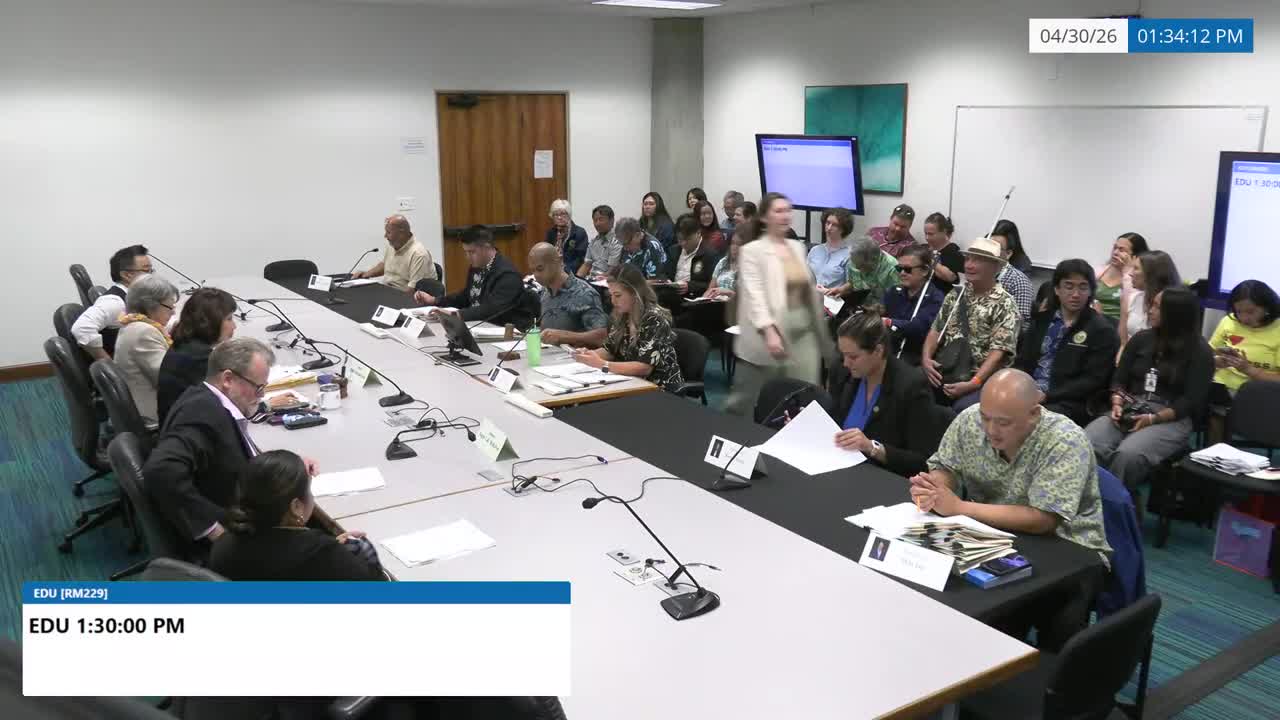
| Apr 30, 2026 | Conference Committee Meeting will reconvene on Friday 05-01-26 1:30PM in conference room 229. |
| Apr 29, 2026 | Conference Committee Meeting will reconvene on Thursday 04-30-26 1:37PM in conference room 229. |
| Apr 28, 2026 | Conference Committee Meeting will reconvene on Wednesday 04-29-26 1:30PM in conference room 229. |
| Apr 27, 2026 | Bill scheduled for Conference Committee Meeting on Tuesday, 04-28-26 1:35PM in conference room 229. |
| Apr 22, 2026 | Received notice of Senate conferees (Sen. Com. No. 719). |
| Apr 21, 2026 | Senate Conferees Appointed: Kim Chair; Kidani Co-Chair; DeCorte. |
| Apr 20, 2026 | Received notice of appointment of House conferees (Hse. Com. No. 786). |
| Apr 20, 2026 | House Conferees Appointed: Woodson, Lee, M. Co-Chairs; La Chica, Olds, Souza. |
| Apr 16, 2026 | Received notice of disagreement (Hse. Com. No. 599). |
| Apr 14, 2026 | House disagrees with Senate amendment (s). |
| Apr 10, 2026 | Returned from Senate (Sen. Com. No. 536) in amended form (SD 1). |
| Apr 10, 2026 | Report Adopted; Passed Third Reading. Ayes, 25; Aye(s) with reservations: none. Noes, 0 (none). Excused, 0 (none). Transmitted to House. |
| Apr 9, 2026 | One Day Notice 04-10-26. |
| Apr 9, 2026 | Reported from WAM (Stand. Com. Rep. No. 3651) with recommendation of passage on Third Reading. |
| Apr 6, 2026 | The committee(s) on WAM recommend(s) that the measure be PASSED, UNAMENDED. The votes in WAM were as follows: 12 Aye(s): Senator(s) Dela Cruz, Moriwaki, DeCoite, Elefante, Hashimoto, Inouye, Kanuha, Kidani, Kim, Richards, Wakai, Fevella; Aye(s) with reservations: none ; 0 No(es): none; and 1 Excused: Senator(s) Lee, C.. |
| Apr 1, 2026 | The committee(s) on WAM will hold a public decision making on 04-06-26 10:32AM; Conference Room 211 & Videoconference. |
| Mar 30, 2026 | Report adopted; Passed Second Reading, as amended (SD 1) and referred to WAM. |
| Mar 30, 2026 | Reported from EDU (Stand. Com. Rep. No. 3262) with recommendation of passage on Second Reading, as amended (SD 1) and referral to WAM. |
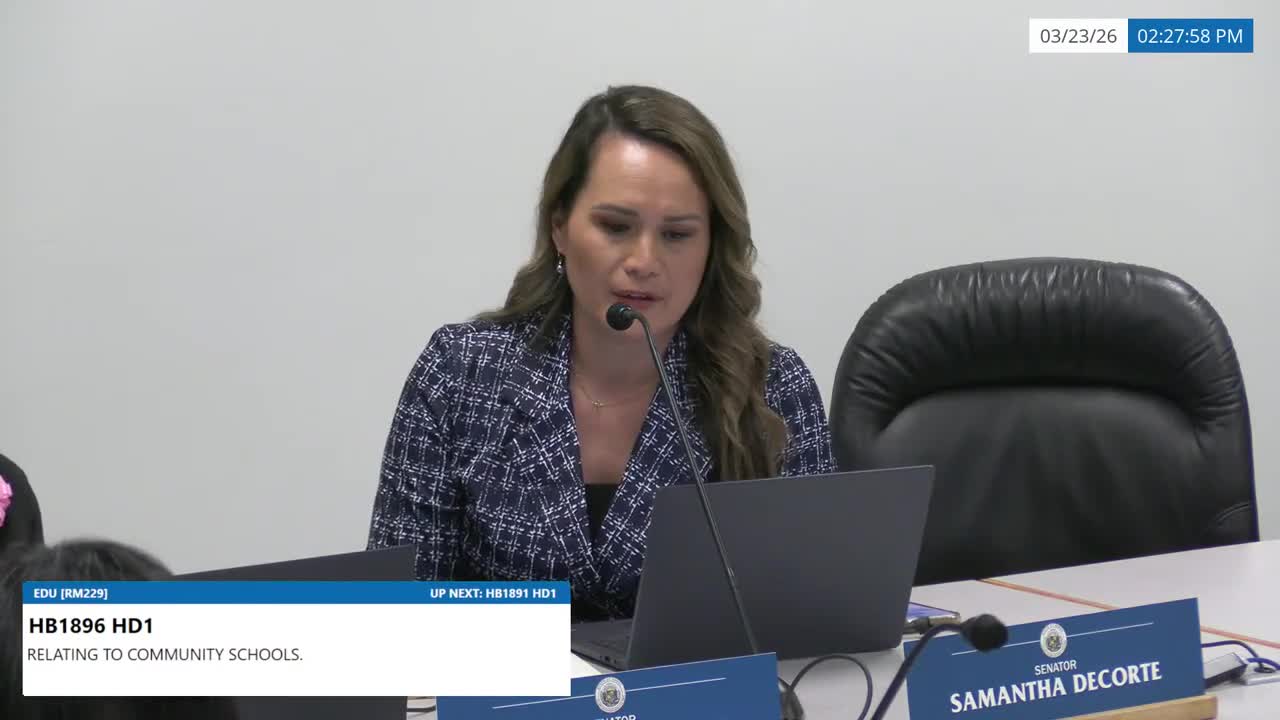
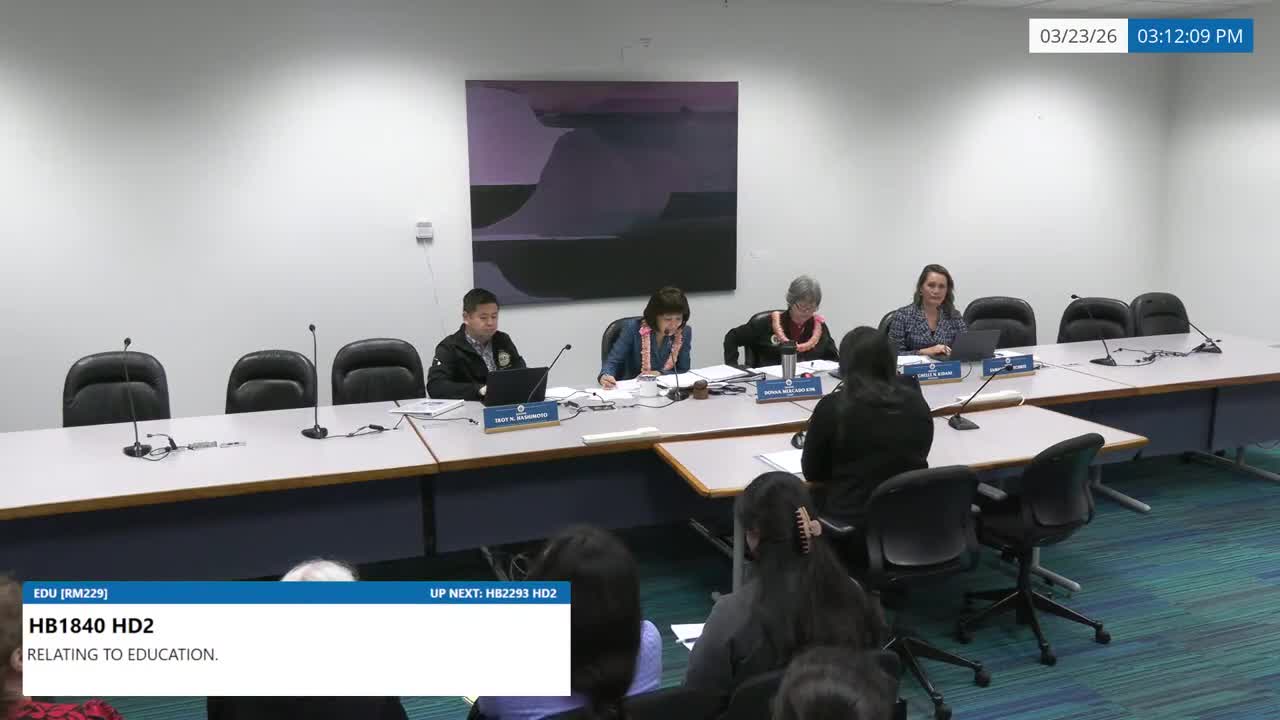
| Mar 23, 2026 | The committee(s) on EDU recommend(s) that the measure be PASSED, WITH AMENDMENTS. The votes in EDU were as follows: 4 Aye(s): Senator(s) Kim, Kidani, Hashimoto, DeCorte; Aye(s) with reservations: none ; 0 No(es): none; and 1 Excused: Senator(s) Fukunaga. |
| Mar 20, 2026 | The committee(s) on EDU has scheduled a public hearing on 03-23-26 1:11PM; Conference Room 229 & Videoconference. |
| Mar 10, 2026 | Referred to EDU, WAM. |
| Mar 10, 2026 | Passed First Reading. |
| Mar 10, 2026 | Received from House (Hse. Com. No. 163). |
| Mar 6, 2026 | Passed Third Reading with none voting aye with reservations; Representative(s) Pierick voting no (1) and Representative(s) Perruso, Sayama excused (2). Transmitted to Senate. |
| Mar 6, 2026 | Reported from FIN (Stand. Com. Rep. No. 938-26), recommending passage on Third Reading. |
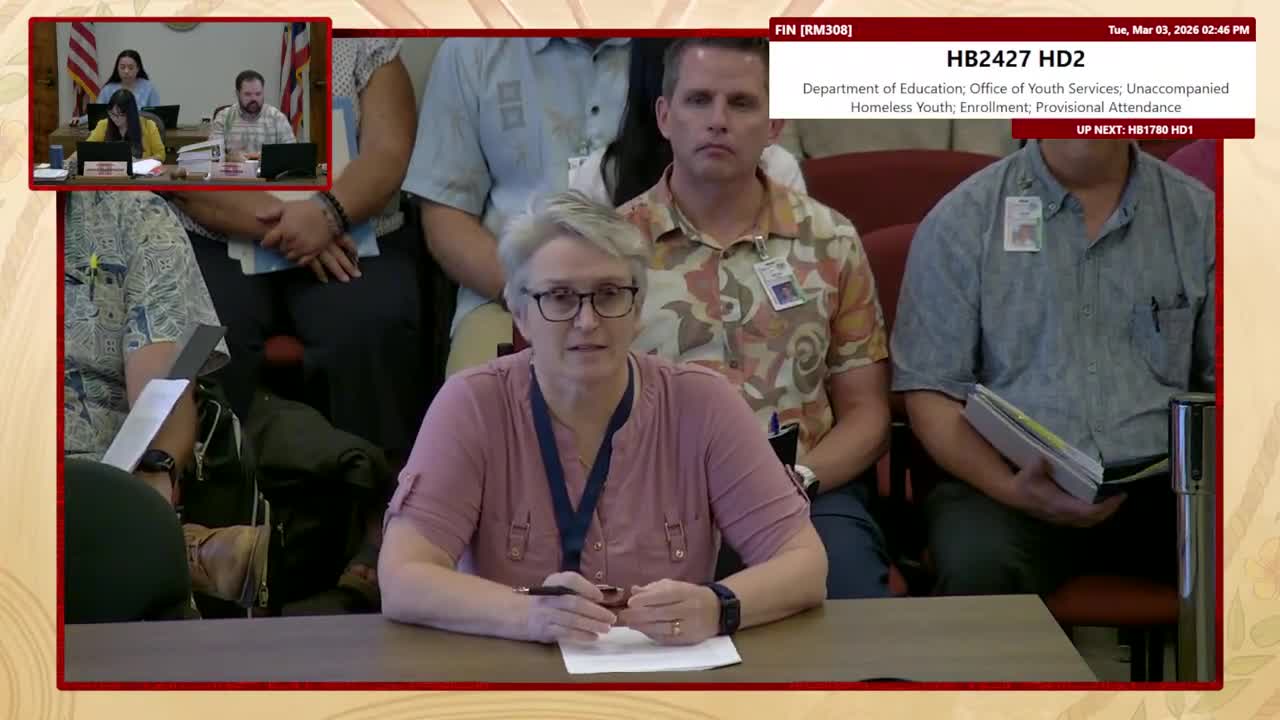
| Mar 3, 2026 | The committee on FIN recommend that the measure be PASSED, UNAMENDED. The votes were as follows: 16 Ayes: Representative(s) Todd, Takenouchi, Hartsfield, Hussey, Keohokapu-Lee Loy, Kitagawa, Kusch, Lee, M., Miyake, Morikawa, Perruso, Templo, Yamashita, Alcos, Gedeon, Reyes Oda; Ayes with reservations: none; 0 Noes: none; and 0 Excused: none. |
| Feb 27, 2026 | Bill scheduled to be heard by FIN on Tuesday, 03-03-26 2:00PM in House conference room 308 VIA VIDEOCONFERENCE. |
| Feb 19, 2026 | Passed Second Reading as amended in HD 1 and referred to the committee(s) on FIN with none voting aye with reservations; Representative(s) Pierick voting no (1) and none excused (0). |
| Feb 19, 2026 | Reported from EDN (Stand. Com. Rep. No. 492-26) as amended in HD 1, recommending passage on Second Reading and referral to FIN. |
| Feb 17, 2026 | The committee on EDN recommend that the measure be PASSED, WITH AMENDMENTS. The votes were as follows: 9 Ayes: Representative(s) Woodson, La Chica, Amato, Evslin, Kapela, Kila, Olds, Muraoka, Souza; Ayes with reservations: none; 0 Noes: none; and 1 Excused: Representative(s) Garrett. |
| Feb 13, 2026 | Bill scheduled to be heard by EDN on Tuesday, 02-17-26 2:00PM in House conference room 309 VIA VIDEOCONFERENCE. |
| Jan 26, 2026 | Referred to EDN, FIN, referral sheet 2 |
| Jan 26, 2026 | Introduced and Pass First Reading. |
| Jan 23, 2026 | Pending introduction. |
|
Date
|
Description
|
Location
|
Votes
|
|
|---|---|---|---|---|
| May 6, 2026 | Final Reading | House Floor |
Passed |
|
| May 6, 2026 | Final Reading | Senate Floor |
Passed |
|
| Apr 10, 2026 | Third Reading | Senate Floor |
Passed |
|
| Apr 6, 2026 | The committee(s) on WAM recommend(s) that the measure be PASSED, UNAMENDED | Senate Standing Committee on Ways and Means |
Passed |
|
| Mar 23, 2026 | The committee(s) on EDU recommend(s) that the measure be PASSED, WITH AMENDMENTS | Senate Standing Committee on Education |
Passed |
|
| Mar 6, 2026 | Third Reading | House Floor |
Passed |
|
| Mar 3, 2026 | The committee on FIN recommend that the measure be PASSED, UNAMENDED | House Standing Committee on Finance |
Passed |
|
| Feb 17, 2026 | The committee on EDN recommend that the measure be PASSED, WITH AMENDMENTS | House Standing Committee on Education |
Passed |
This list shows positions taken on this bill by organizations on the date displayed, which is linked to the original source.
Positions by individuals are not included.
|
Organization
|
Position
|
Date
|
|---|---|---|
| African American Diversity Cultural Center Hawaii | *** Support | Apr 5, 2026 |
| Aloha Independent Living Hawaii | *** Support | Apr 5, 2026 |
| American Academy of Pediatrics, Hawaii Chapter | *** Support | Mar 23, 2026 |
| Bess Press, Inc. | *** Support | Apr 5, 2026 |
| Collaborative Support Services, Inc. / Early Childhood Action Strategy | *** Support | Mar 23, 2026 |
| Disability and Communication Access Board | *** Support | Apr 5, 2026 |
| Hawaii Disability Rights Center | *** Support | Mar 23, 2026 |
| Hawaii State Literacy Coalition | ** Support | |
| Hawaii State Public Library System | *** Support | Mar 23, 2026 |
| HawaiiKidsCAN | *** Support | Apr 5, 2026 |
| Hawaiʻi State Council on Developmental Disabilities | *** Support | Apr 5, 2026 |
| Hawaiʻi State Literacy Coalition | ** Support | |
| Hawaiʻi State Literacy Coalition | *** Support | Apr 5, 2026 |
| Hawaiʻi State Youth Commission | ** Support | |
| Hawai‘i State Literacy Coalition | *** Support | Mar 3, 2026 |
| He'e Coalition | *** Support | Mar 3, 2026 |
| Heʻe Coalition | ** Support | |
| Le Jardin Academy | *** Support | Apr 5, 2026 |
| Le Jardin Academy Literacy/Dyslexia Advocacy Club | *** Support | Feb 17, 2026 |
| Orton Gillingham Academy | *** Support | Apr 5, 2026 |
| Special Education Advisory Council (SEAC) | *** Support | Apr 5, 2026 |
| State Council on Developmental Disabilities | *** Support | Mar 23, 2026 |
| Teach for America Hawaiʻi | *** Support | Apr 5, 2026 |
| The Reading League Hawai`i | *** Support | Feb 17, 2026 |
| The Reading League Hawaiʻi | *** Support | Apr 5, 2026 |
| University of Hawaiʻi at Manoa | *** Support | Feb 17, 2026 |
STAND. COM. REP. NO. 938-26
Honolulu, Hawaii
, 2026
RE: H.B. No. 1891
H.D. 1
Honorable Nadine K. Nakamura
Speaker, House of Representatives
Thirty-Third State Legislature
Regular Session of 2026
State of Hawaii
Madame:
Your Committee on Finance, to which was referred H.B. No. 1891, H.D. 1, entitled:
"A BILL FOR AN ACT RELATING TO EDUCATION,"
begs leave to report as follows:
The purpose of this measure is to:
(1) Require the Department of Education to implement dyslexia-sensitive, linguistically appropriate universal screenings and evidence-based interventions; offer professional development on structured literacy and evidenced-based interventions; and support pre-teacher programs in training candidates in structured literacy instruction; and
(2) Appropriate funds for dyslexia-sensitive, linguistically appropriate universal screeners.
Your Committee received testimony in support of this measure from the State Council on Developmental Disabilities; Disability and Communication Access Board; Hawaiʻi State Youth Commission; Hawaii State Literacy Coalition; Special Education Advisory Council; Hawaii Disability Rights Center; Teach for America Hawaiʻi; Aloha Independent Living Hawaii; HawaiiKidsCAN; The Reading League Hawaiʻi; and numerous individuals. Your Committee received comments on this measure from the Department of Education and State Public Charter School Commission.
As affirmed by the record of votes of the members of your Committee on Finance that is attached to this report, your Committee is in accord with the intent and purpose of H.B. No. 1891, H.D. 1, and recommends that it pass Third Reading.
Respectfully submitted on behalf of the members of the Committee on Finance,
|
|
|
____________________________ CHRIS TODD, Chair |
|
|
|
|
STAND. COM. REP. NO. 492-26
Honolulu, Hawaii
, 2026
RE: H.B. No. 1891
H.D. 1
Honorable Nadine K. Nakamura
Speaker, House of Representatives
Thirty-Third State Legislature
Regular Session of 2026
State of Hawaii
Madame:
Your Committee on Education, to which was referred H.B. No. 1891 entitled:
"A BILL FOR AN ACT RELATING TO EDUCATION,"
begs leave to report as follows:
The purpose of this measure is to:
(1) Require schools to administer Department of Education‑approved dyslexia‑sensitive universal screening as a part of the universal screening process;
(2) Implement evidence-based interventions for students who are identified as having dyslexia and students who are flagged as having language and literacy challenges through the Hawaii multi-tiered system of supports;
(3) Provide professional development for teachers to increase the implementation of structured literacy instruction; and
(4) Support pre-service teacher programs in training their general and special education teacher candidates in structured literacy instruction.
Your Committee received testimony in support of this measure from the State Council on Developmental Disabilities; Special Education Advisory Council; HawaiiKidsCAN; The Reading League Hawaiʻi; Hawaii Disability Rights Center; Hawaiʻi State Literacy Coalition; Heʻe Coalition; and numerous individuals. Your Committee received comments on this measure from the Department of Education.
Your Committee finds that the Department of Education aims to address poor reading proficiency rates by administering a universal screener at the beginning, middle, and end of the year for all students from kindergarten to grade nine to identify students who may be at risk for reading failure and to provide evidence-based interventions to support these students. Your Committee notes that not all universal screeners are able to detect or identify students who may have certain underlying language challenges that impact learning, which is challenging because students with dyslexia or other developmental language disorders may need more intensive support or a more individualized intervention program. This measure will support students with dyslexia and students with language and literacy challenges, which will enable these young students to achieve academic success in an effective and efficient manner.
Your Committee has amended this measure by:
(1) Delaying the administration of Department of Education‑approved dyslexia‑sensitive universal screenings to the beginning of the 2028-2029 school year; and
(2) Changing the effective date to July 1, 3000.
As affirmed by the record of votes of the members of your Committee on Education that is attached to this report, your Committee is in accord with the intent and purpose of H.B. No. 1891, as amended herein, and recommends that it pass Second Reading in the form attached hereto as H.B. No. 1891, H.D. 1, and be referred to your Committee on Finance.
Respectfully submitted on behalf of the members of the Committee on Education,
|
|
|
____________________________ JUSTIN H. WOODSON, Chair |
|
|
|
|
|
Date
|
Testimony PDF
|
|---|---|
| Apr 5, 2026 | HB1891_SD1_TESTIMONY_WAM_04-06-26_.PDF |
| Mar 23, 2026 | HB1891_HD1_TESTIMONY_EDU_03-23-26_.PDF |
| Mar 3, 2026 | HB1891_HD1_TESTIMONY_FIN_03-03-26_.PDF |
| Feb 17, 2026 | HB1891_TESTIMONY_EDN_02-17-26_.PDF |
Discussed in Hearing
 1MIN
Conference Committee
 1MIN
Conference Committee
 1MIN
Conference Committee
 33MIN
Senate Standing Committee on Education
33MIN
Senate Standing Committee on Labor and Technology
 1MIN
Senate Standing Committee on Education
1MIN
Senate Standing Committee on Labor and Technology
 15MIN
House Standing Committee on Finance
Bill Author
Bill Co-Author(s):