SB 2688: Hawaii Paroling Authority; Department of Corrections and Rehabilitation; Compassionate Release; Working Group
- Session Year: 2025-2026
- House: Senate
- Latest Version Date: 2026-03-27
Current Status:
Failed
(2026-04-27: Received notice of appointment of House conferees (Hse. Com. No. 839).)
Introduced
In Committee
First Chamber
In Committee
Second Chamber
Final Decking
Enacted
Establishes a protocol for compassionate release for certain ill or seriously debilitated incarcerated persons. Establishes a temporary working group within the Department of Corrections and Rehabilitation to develop initial administrative rules to implement the protocol. Effective 7/1/3000. (HD1)
Establishes a protocol for compassionate release for certain ill or seriously debilitated incarcerated persons. Appropriates funds. Effective 7/1/2050. (SD1)
Establishes a protocol for compassionate release for certain ill or seriously debilitated incarcerated persons.
|
THE SENATE |
S.B. NO. |
2688 |
|
THIRTY-THIRD LEGISLATURE, 2026 |
S.D. 1 |
|
|
STATE OF HAWAII |
H.D. 1 |
|
|
|
|
|
|
|
||
|
|
||
A BILL FOR AN ACT
RELATING TO COMPASSIONATE RELEASE.
BE IT ENACTED BY THE LEGISLATURE OF THE STATE OF HAWAII:
PART I
SECTION 1. The legislature finds that correctional facilities in Hawaii and across the United States are housing a growing number of incarcerated persons who require a high level of complex and costly medical care. This situation is due in part to an aging prison population and in part to the generally poor health of incarcerated persons.
The National Institute of Corrections defines older incarcerated persons as being aged fifty years or older, and many correctional institutions estimate that an incarcerated person's physiological age is ten to fifteen years older than the person's chronological age due to prior lack of medical care, drug use, and the stress of incarceration. As of mid-September 2025, the department of corrections and rehabilitation housed nine hundred ninety-six incarcerated persons fifty years of age or older, including over eighty incarcerated persons who were seventy or more years old. Concern over how society should deal with the aging and seriously ill prison population has led policymakers in all states and the federal government to provide for the early release of certain older and seriously ill individuals.
The legislature further finds that the early release of elderly and seriously ill incarcerated persons will reduce state spending on corrections. The average cost of housing an incarcerated person in Hawaii is $307 per day or $112,055 per year. However, the estimated total annual taxpayer cost per high-acuity, medically complex incarcerated person is six to eight times higher at $650,000 to $900,000 per year, and in some cases, exceeds several million dollars per person per year. This sum is attributed to costs related to a critically ill person's poor health, including specialty appointments, medical equipment, non-formulary prescriptions, laboratory tests and imaging, surgeries, Medevac flights, emergency room admissions, hospitalizations, transportation to and from appointments, and overtime pay for corrections officers who must accompany incarcerated individuals at all times when off-site for care.
The legislature additionally finds that parole board members, with the aid of medical and correctional professionals, are able to make informed decisions about granting compassionate release. Release policies are also supported by recidivism research, which shows that arrest rates drop to slightly more than two per cent for persons ages fifty to sixty-five years old, and to almost zero per cent for those older than sixty-five.
The legislature further finds that compassion is an expression of the aloha spirit and that compassionate release of seriously ill and debilitated incarcerated persons reflects the State's commitment to dignity, humanity, and justice.
Accordingly, the purpose of this Act is to:
(1) Create a compassionate release protocol for certain ill or seriously debilitated incarcerated persons with the express intent that all incarcerated persons who qualify for release are considered for release to the community in a fair, just, and expeditious manner; and
(2) Establish a working group within the department of corrections and rehabilitation to develop initial administrative rules to implement the protocol.
SECTION 2. Chapter 353, Hawaii Revised Statutes, is amended by adding a new subpart to part II to be appropriately designated and to read as follows:
" . Compassionate Release
§353- Definitions. As used in this subpart:
"Authority" means the Hawaii paroling authority.
"Compassionate release" means the release of an incarcerated person before the expiration of the incarcerated person's sentence due to the incarcerated person's terminal illness or debilitating or irreversible condition.
"Debilitating or irreversible condition" means a persistent or progressive medical, cognitive, or mental health condition that compromises an incarcerated person's ability to perform one or more activities of daily living or significantly compromises an incarcerated person's quality of life.
"Incarcerated person" means a person committed to the custody of the director who has been convicted of one or more felony offenses and is currently serving one or more felony sentences.
"Incarcerated person's representative" means an attorney, family member, or other person, including another incarcerated person, who is assisting the incarcerated person in initiating an application for compassionate release or navigating the compassionate release process.
"Terminal illness" means a progressive medical condition with a predictably poor prognosis that is expected to result in death.
§353- Referral. The director shall have an affirmative and ongoing duty to ensure that incarcerated persons who may meet the criteria for compassionate release pursuant to this subpart are identified by the department and shall refer such incarcerated persons to the authority for possible compassionate release as provided by this subpart.
§353- Compassionate release; authority to release; process. (a) An incarcerated person may be considered for compassionate release if the incarcerated person:
(1) Has a terminal illness;
(2) Has a debilitating or irreversible condition;
(3) Is too ill or cognitively impaired to participate in rehabilitation or to be aware of punishment; or
(4) Has a condition, a combination of conditions, or medical needs that requires a complexity of treatment or level of care that the department is unable to provide on a long-term basis or the incarcerated person's medical needs would otherwise be more appropriately managed in a community setting.
(b) The department shall promptly identify incarcerated persons who meet the criteria for compassionate release under subsection (a) and assist the incarcerated person in applying for compassionate release, including developing a plan that meets the medical and physical needs of the incarcerated person.
(c) An application for compassionate release may be initiated by the department's medical staff, the incarcerated person, or an incarcerated person's representative outside of the department.
(d) The director shall submit all applications for compassionate release to the authority within fifteen business days from the date of the original request, along with the director's recommendation for or against compassionate release, the reasons for the director's recommendation, and any other documents the director deems appropriate to assist the authority in making a decision for or against compassionate release; provided that if it appears that an application for compassionate release clearly does not meet the criteria for compassionate release or is clearly frivolous, the director may hold the request and not submit it to the authority until it is supported by a report from a licensed physician stating that, to a reasonable degree of medical probability, the incarcerated person meets the criteria for compassionate release. The incarcerated person or the incarcerated person's representative shall be responsible for obtaining the physician's report; provided that if the incarcerated person or the incarcerated person's representative is unable to obtain the physician's report due to medical, cognitive, or financial limitations, the department shall provide the incarcerated person or the incarcerated person's representative with reasonable assistance in obtaining the physician's report.
(e) The authority shall hold an administrative hearing to consider an application for compassionate release no later than ten business days after receiving an application for compassionate release from the director. At least forty-eight hours before an incarcerated person's hearing, the authority shall provide notice, including electronically, of the hearing to the prosecuting attorney of the applicable county, for the purposes of notifying victims. The authority shall grant release in accordance with subsection (f).
(f) The authority shall grant compassionate release and release the incarcerated person to an appropriate community setting unless the authority finds that the incarcerated person does not meet the medical criteria under subsection (a) for compassionate release or that the incarcerated person presently poses an unreasonable risk to public safety. If the authority denies an application for compassionate release, the authority shall state the reasons for the denial and shall notify the incarcerated person or the incarcerated person's representative of its decision. A denial of compassionate release shall not be appealed and shall not create a private right of action.
(g) Denial of compassionate release by the authority shall not affect an incarcerated person's eligibility for any other form of parole or release under any applicable federal or state law; provided that the incarcerated person or the incarcerated person's representative shall not reapply or be reconsidered for compassionate release unless there is a significant change in the incarcerated person's medical, cognitive, or mental health condition or any other material factor.
(h) A grant of compassionate release shall not be subject to the sixty-day notice requirement of section 706-669(5).
(i) Notwithstanding any law to the contrary, all persons incarcerated by the State, including but not limited to persons serving a mandatory minimum sentence or persons sentenced to life without parole, shall be eligible for compassionate release pursuant to this subpart.
§353- Conditions of release. (a) The authority shall set reasonable conditions for an incarcerated person's compassionate release, taking into consideration the incarcerated person's medical conditions and abilities.
(b) The incarcerated person shall comply with all conditions for compassionate release set by the authority.
§353- Revocation of compassionate release. (a) The authority may order an individual granted compassionate release pursuant to this subpart to be returned to the custody of the director to await a revocation hearing if the authority receives credible information that the individual has failed in a significant way to comply with the conditions established by the authority for the individual's compassionate release.
(b) When determining whether an individual's compassionate release should be revoked, the authority shall consider the individual's medical, cognitive, or mental health condition as it relates to the alleged violation.
(c) Revocation of compassionate release shall not affect an individual's eligibility for any other form of parole or release, including any subsequent application for compassionate release.
(d) Absent a material change or change in circumstance of the individual's medical, cognitive, or mental health condition, an individual whose compassionate release has been revoked shall not be eligible to apply for compassionate release for at least six months after the revocation of the individual's compassionate release.
§353- Reporting. (a) The department shall collect and maintain the following data regarding compassionate release of incarcerated persons pursuant to this subpart, which shall be complied into an annual report that shall be made publicly available no later than twenty days prior to the convening of each regular session:
(1) The number of applications for compassionate release received by the department;
(2) The number of applications for compassionate release forwarded to the authority; and
(3) For each applicant who has applied for compassionate release:
(A) The facility at which the applicant was housed at the time the application was submitted;
(B) Whether the application was initiated by the department's medical staff, the incarcerated person, or the incarcerated person's representative;
(C) The highest class of instant offense committed by the applicant;
(D) The length of time that the applicant had been incarcerated at the time of application; and
(E) Whether the applicant died before a decision on the application or after being granted compassionate release but before release from custody.
(b) The authority shall collect and maintain the following data regarding compassionate release of incarcerated persons pursuant to this subpart, which shall be complied into an annual report that shall be made publicly available no later than twenty days prior to the convening of each regular session:
(1) The number of incarcerated persons granted compassionate release by the authority pursuant to this subpart, disaggregated by race, ethnicity, age, and gender identity;
(2) The number of incarcerated persons whose application for compassionate release was denied by the authority, disaggregated by race, ethnicity, age, and gender identity;
(3) The length of time between submission of the application, the release decision, and the release date, if applicable;
(4) The number of incarcerated persons approved for compassionate release but whose release was delayed by more than fifteen days from the date of the administrative hearing and the reason for the delay; and
(5) The number of incarcerated persons returned to the custody of the department after being granted compassionate release."
SECTION 3. (a) There is established within the department of corrections and rehabilitation for administrative purposes, in collaboration with the Hawaii paroling authority and Hawaii correctional system oversight commission, a working group to develop initial administrative rules to implement the purposes of chapter 353, part II, subpart .
(b) The working group shall consist of the following members or their respective designees:
(1) The director of corrections and rehabilitation;
(2) The medical director for the department of corrections and rehabilitation;
(3) The chairperson of the Hawaii paroling authority;
(4) The chairperson of the Hawaii correctional system oversight commission;
(5) A formerly incarcerated individual, to be jointly appointed by the director of corrections and rehabilitation, chairperson of the Hawaii paroling authority, and chairperson of the Hawaii correctional system oversight commission, who:
(A) Worked as a medical aide while in the custody of the department of corrections and rehabilitation;
(B) Has direct knowledge of, or experience with, complex medical issues while in the custody of the department of corrections and rehabilitation; or
(C) Was granted release;
(6) An attorney with experience in applying for or representing an incarcerated person seeking compassionate release, to be jointly appointed by the director of corrections and rehabilitation, chairperson of the Hawaii paroling authority, and chairperson of the Hawaii correctional system oversight commission; and
(7) A subject-matter expert in compassionate release research, policy, and practice, to be jointly appointed by the director of corrections and rehabilitation, chairperson of the Hawaii paroling authority, and chairperson of the Hawaii correctional system oversight commission.
(c) The initial administrative rules developed by the working group shall be adopted pursuant to chapter 91, Hawaii Revised Statutes, by the department of corrections and rehabilitation and Hawaii paroling authority no later than twenty days prior to the convening of the regular session of 2028, after which the working group shall cease to exist.
PART II
SECTION 4. Chapter 353, Hawaii Revised Statutes, is amended by designating sections 353-61 to 353-72 as subpart A and inserting a title before section 353-61 to read as follows:
"A. Hawaii Paroling Authority – General Provisions"
PART III
SECTION 5. New statutory material is underscored.
SECTION 6. This Act shall take effect on July 1, 3000.
Report Title:
Hawaii Paroling Authority; Department of Corrections and Rehabilitation; Compassionate Release; Working Group
Description:
Establishes a protocol for compassionate release for certain ill or seriously debilitated incarcerated persons. Establishes a temporary working group within the Department of Corrections and Rehabilitation to develop initial administrative rules to implement the protocol. Effective 7/1/3000. (HD1)
The summary description of legislation appearing on this page is for informational purposes only and is not legislation or evidence of legislative intent.
|
THE SENATE |
S.B. NO. |
2688 |
|
THIRTY-THIRD LEGISLATURE, 2026 |
S.D. 1 |
|
|
STATE OF HAWAII |
|
|
|
|
|
|
|
|
||
|
|
||
A BILL FOR AN ACT
RELATING TO COMPASSIONATE RELEASE.
BE IT ENACTED BY THE LEGISLATURE OF THE STATE OF HAWAII:
SECTION 1. The legislature finds that correctional facilities in Hawaii and across the United States are housing a growing number of incarcerated persons who require a high level of complex and costly medical care. This is due in part to an aging prison population, and in part to the generally poor health of incarcerated persons.
The National Institute of Corrections defines aging or elderly incarcerated persons as being aged fifty-five years or older, and many correctional institutions estimate that an incarcerated person's physiological age is ten to fifteen years older than their chronological age due to prior lack of medical care, drug use, and the stress of incarceration. As of mid-September 2025, the department of corrections and rehabilitation housed nine hundred ninety-six incarcerated persons fifty years of age or older, including over eighty incarcerated persons who were seventy or more years old. Concern over how society should deal with the aging and seriously ill prison population has led policymakers in all states and the federal government to provide for the early release of certain older and seriously ill individuals.
The legislature further finds that the early release of elderly and seriously ill incarcerated persons will reduce State spending on corrections. The average cost of housing an incarcerated person in the State is $307 per day or $112,055 per year. Therefore the average cost to house the State's nine hundred ninety-six older incarcerated persons is $305,000 per day, or $111,000,000 per year, not including the cost of higher staffing needs, medications, and hospitalizations that are associated with caring for older incarcerated persons.
The legislature additionally finds that parole board members, with the aid of medical and correctional professionals, are able to make informed decisions about granting compassionate release. Release policies are also supported by recidivism research, which shows that arrest rates drop to slightly more than two per cent for persons ages fifty to sixty-five years old, and to almost zero per cent for those older than sixty-five.
The legislature further finds that compassion is an expression of the aloha spirit and that compassionate release of seriously ill and debilitated incarcerated persons reflects the State's commitment to dignity, humanity, and justice.
Accordingly, the purpose of this Act is to create a compassionate release protocol for certain ill or seriously debilitated incarcerated persons with the express intent that all incarcerated persons who qualify for release are considered for release to the community in a fair, just, and expeditious manner.
SECTION 2. Chapter 353, Hawaii Revised Statutes, is amended by adding a new subpart to part II to be appropriately designated and to read as follows:
" . Compassionate Release
§353- Definitions. As used in this subpart:
"Authority" means the Hawaii paroling authority.
"Compassionate release" means the release of an incarcerated person before the expiration of the incarcerated person's sentence due to the incarcerated person's terminal illness or debilitating, chronic, or irreversible condition.
"Debilitating, chronic, or irreversible condition" means a persistent or progressive medical, cognitive, or mental health condition that compromises an incarcerated person's ability to perform one or more activities of daily living or significantly compromises an incarcerated person's quality of life.
"Incarcerated person" means a person committed to the custody of the director who has been convicted of one or more felony offenses.
"Incarcerated person's representative" means an attorney, family member, or other person, including another incarcerated person, who is assisting the incarcerated person in initiating an application for compassionate release or navigating the compassionate release process.
"Terminal illness" means a progressive medical condition with a predictably poor prognosis that is expected to result in death.
§353- Referral. The director shall have an affirmative and ongoing duty to identify incarcerated persons who may meet the criteria for compassionate release pursuant to this subpart and shall refer the incarcerated persons to the authority for possible compassionate release as provided by this subpart.
§353- Compassionate release; authority to release; process. (a) An incarcerated person may be considered for compassionate release if the incarcerated person:
(1) Has a terminal illness; or
(2) Is too ill or cognitively impaired to participate in rehabilitation or to be aware of punishment.
(b) The department shall promptly identify incarcerated persons who meet the criteria for compassionate release under subsection (a) and assist the incarcerated person in applying for compassionate release, including developing a plan that meets the medical and physical needs of the incarcerated person.
(c) An application for compassionate release may be initiated by the department's medical staff, an incarcerated person, or an incarcerated person's representative.
(d) The director shall submit all applications for compassionate release to the authority within fifteen business days from the date of the original request, along with the director's recommendation for or against compassionate release, the reasons for the director's recommendation, and any other documents the director deems appropriate to assist the authority in making a decision for or against release; provided that if it appears that an application for compassionate release clearly does not meet the criteria for compassionate release or is clearly frivolous, the director may hold the request and not submit it to the authority until it is supported by a report from a licensed physician stating that, to a reasonable degree of medical probability, the incarcerated person meets the criteria for release. The incarcerated person or the incarcerated person's representative shall be responsible for obtaining the physician's report; provided that if the incarcerated person or the incarcerated person's representative is unable to obtain the physician's report due to medical, cognitive, or financial limitations, the department shall provide the incarcerated person or the incarcerated person's representative with reasonable assistance in obtaining the physician's report.
(e) The authority shall hold an administrative hearing to consider an application for compassionate release no later than ten business days after receiving an application for compassionate release from the director and shall grant release in accordance with subsection (f).
(f) The authority shall grant compassionate release and release the incarcerated person to an appropriate community setting unless the authority finds that the incarcerated person does not meet the medical criteria under subsection (a) for compassionate release or that the incarcerated person presently poses an unreasonable risk to public safety. If the authority denies an application for compassionate release, the authority shall state the reasons for the denial and shall notify the incarcerated person or the incarcerated person's representative of its decision. A denial of compassionate release may not be appealed and shall not create a private right of action.
(g) Denial of compassionate release by the authority shall not affect an incarcerated person's eligibility for any other form of parole or release under any applicable federal or state law; provided that the incarcerated person or the incarcerated person's representative shall not reapply or be reconsidered for compassionate release unless there is a significant change in the incarcerated person's medical condition or any other material factor.
(h) A grant of compassionate release shall not be subject to the sixty-day notice requirement of section 706-669(5).
(i) The authority shall notify the victim and prosecuting attorney of any incarcerated person released pursuant to this subpart.
(j) Notwithstanding any law to the contrary, all persons incarcerated by the State, except persons sentenced to life without possibility of parole, shall be eligible for compassionate release pursuant to this subpart. A mandatory minimum sentence shall not preclude eligibility for compassionate release pursuant to this subpart.
§353- Conditions of release. (a) The authority shall set reasonable conditions for an incarcerated person's compassionate release which shall take into consideration the incarcerated person's medical conditions and abilities.
(b) The incarcerated person shall comply with all conditions for compassionate release set by the authority.
§353- Revocation of compassionate release. (a) The authority may order an individual granted compassionate release pursuant to this subpart to be returned to the custody of the director to await a revocation hearing if the authority receives credible information that the individual has failed in a significant way to comply with the conditions established by the authority for the individual's compassionate release.
(b) When determining whether an individual's compassionate release should be revoked, the authority shall consider the individual's medical health, mental health, or cognitive condition as it relates to the alleged violation.
(c) Revocation of compassionate release shall not affect an individual's eligibility for any other form of parole or release, including any subsequent application for compassionate release.
(d) Absent a material change or change in circumstance of the individual's medical condition, an individual whose compassionate release has been revoked shall not be eligible to apply for compassionate release for at least six months after the revocation of their compassionate release.
§353- Reporting. (a) The department shall collect and maintain the following data on compassionate release of incarcerated persons pursuant to this subpart, which shall be compiled into an annual report that shall be made publicly available no later than of each year:
(1) The number of applications for compassionate release received by the department;
(2) The number of applications for compassionate release forwarded to the authority; and
(3) For each applicant who has applied for compassionate release:
(A) Where the applicant was housed at the time the application was submitted;
(B) If the application was initiated by the department's medical staff, the incarcerated person, or the incarcerated person's representative;
(C) The highest class of instant offense committed by the applicant;
(D) How long the applicant had been incarcerated at the time of application; and
(E) If the applicant died prior to a decision or after being granted compassionate release but prior to release from custody.
(b) The authority shall collect and maintain the following data on compassionate release of incarcerated persons pursuant to this subpart, which shall be compiled into an annual report that shall be made publicly available no later than of each year:
(1) The number of incarcerated persons granted compassionate release by the authority pursuant to this subpart, disaggregated by race, ethnicity, age, and gender identity;
(2) The number of incarcerated persons whose application for compassionate release was denied by the authority, disaggregated by race, ethnicity, age, and gender identity;
(3) The length of time between submission of the application, the release decision, and the release date;
(4) The number of incarcerated persons approved for compassionate release but whose release was delayed by more than fifteen days from the date of the hearing and the reason for the delay; and
(5) The number of incarcerated persons returned to the custody of the department after being granted compassionate release.
§353- Administrative rules; working group. (a) The department, authority, and Hawaii correctional system oversight commission shall convene a working group to develop administrative rules to implement the purposes of this subpart.
(b) The working group shall consist of the following members or their designees:
(1) The director of corrections and rehabilitation;
(2) The medical director for the department of corrections and rehabilitation;
(3) The chair of the Hawaii paroling authority;
(4) The chair of the Hawaii correctional system oversight commission;
(5) A formerly incarcerated individual, to be jointly appointed by the director of corrections and rehabilitation, chair of the Hawaii paroling authority, and chair of the Hawaii correctional system oversight commission, who:
(A) Worked as a medical aide while in the custody of the department;
(B) Has direct knowledge or experience of complex medical issues while in the custody of the department; or
(C) Was granted release;
(6) An attorney with experience in applying for or representing an incarcerated person seeking compassionate release, to be jointly appointed by the director of corrections and rehabilitation, chair of the Hawaii paroling authority, and chair of the Hawaii correctional system oversight commission; and
(7) A subject matter expert in compassionate release research, policy, and practice, to be jointly appointed by the director of corrections and rehabilitation, chair of the Hawaii paroling authority, and chair of the Hawaii correctional system oversight commission.
(c) The administrative rules developed by the working group shall be adopted pursuant to chapter 91 by the department and authority no later than twenty days prior to the convening of the regular session of 2028."
SECTION 3. Chapter 353, Hawaii Revised Statutes, is amended by designating sections 353-61 to 353-72 as subpart A and inserting a title before section 353-61 to read as follows:
"A. Hawaii Paroling Authority – General Provisions."
SECTION 4. There is appropriated out of the general revenues of the State of Hawaii the sum of $ or so much thereof as may be necessary for fiscal year 2026-2027 for the department of corrections and rehabilitation to implement the compassionate release requirements established by section 2 of this Act and for adequate healthcare facility placements.
The sum appropriated shall be expended by the department of corrections and rehabilitation for the purposes of this Act.
SECTION 5. New statutory material is underscored.
SECTION 6. This Act shall take effect on July 1, 2050.
Report Title:
Hawaii Paroling Authority; Department of Corrections and Rehabilitation; Compassionate Release; Reports; Appropriation
Description:
Establishes a protocol for compassionate release for certain ill or seriously debilitated incarcerated persons. Appropriates funds. Effective 7/1/2050. (SD1)
The summary description of legislation appearing on this page is for informational purposes only and is not legislation or evidence of legislative intent.
|
THE SENATE |
S.B. NO. |
2688 |
|
THIRTY-THIRD LEGISLATURE, 2026 |
|
|
|
STATE OF HAWAII |
|
|
|
|
|
|
|
|
||
|
|
||
A BILL FOR AN ACT
relating to compassionate release.
BE IT ENACTED BY THE LEGISLATURE OF THE STATE OF HAWAII:
SECTION 1. The legislature finds that correctional facilities in Hawaii and across the United States are housing a growing number of incarcerated persons who require a high level of complex and costly medical care. This is due in part to an aging prison population, and in part to the generally poor health of incarcerated persons.
The National Institute of Corrections defines older incarcerated persons as being aged fifty years or older, and many correctional institutions estimate that an incarcerated person's physiological age is ten to fifteen years older than their chronological age due to prior lack of medical care, drug use, and the stress of incarceration. As of mid-September 2025, the Department of Corrections and Rehabilitation housed nine hundred ninety-six incarcerated persons fifty years of age or older, including over eighty incarcerated persons who were seventy or more years old. Concern over how society should deal with the aging and seriously ill prison population has led policymakers in all states and the federal government to provide for the early release of certain older and seriously ill individuals.
The legislature further finds that the early release of elderly and seriously ill incarcerated persons will reduce State spending on corrections. The average cost of housing an incarcerated person in Hawaii is $307 per day or $112,055 per year. Therefore the average cost to house Hawaii's nine hundred ninety-six older incarcerated persons is $305,000 per day, or $111,000,000 per year, not including the cost of higher staffing needs, medications, and hospitalizations that are associated with caring for older incarcerated persons.
The legislature additionally finds that parole board members, with the aid of medical and correctional professionals, are able to make informed decisions about granting compassionate release. Release policies are also supported by recidivism research which shows that arrest rates drop to slightly more than two per cent for persons ages fifty to sixty-five years old, and to almost zero percent for those older than sixty-five.
The legislature further finds that compassion is an expression of the aloha spirit and that compassionate release of seriously ill and debilitated incarcerated persons reflects the State's commitment to dignity, humanity, and justice.
Accordingly, the purpose of this Act is to create a compassionate release protocol for certain ill or seriously debilitated incarcerated persons with the express intent that all incarcerated persons who qualify for release are considered for release to the community in a fair, just, and expeditious manner.
SECTION 2. Chapter 353, Hawaii Revised Statutes, is amended by adding a new subpart to part II to be appropriately designated and to read as follows:
" . Compassionate Release
§353- Definitions. As used in this subpart:
"Authority" means the Hawaii paroling authority.
"Compassionate release" means the release of an incarcerated person before the expiration of the incarcerated person's sentence due to the incarcerated person's terminal illness or debilitating, chronic, or irreversible condition.
"Debilitating, chronic, or irreversible condition" means a persistent or progressive medical, cognitive, or mental health condition that compromises an incarcerated person's ability to perform one or more activities of daily living or significantly compromises an incarcerated person's quality of life.
"Director" means the director of corrections and rehabilitation.
"Incarcerated person" means a person committed to the custody of the director who has been convicted of one or more felony offenses.
"Incarcerated person's representative" means an attorney, family member, or other person, including another incarcerated person, who is assisting the incarcerated person in initiating an application for compassionate release or navigating the compassionate release process.
"Terminal illness" means a progressive medical condition with a predictably poor prognosis that is expected to result in death.
§353- Referral. The director shall have an affirmative and ongoing duty to identify incarcerated persons who may meet the criteria for compassionate release pursuant to this subpart and shall refer such incarcerated persons to the authority for possible compassionate release as provided by this subpart.
§353- Compassionate release; authority to release; process. (a) An incarcerated person may be considered for compassionate release if the incarcerated person:
(1) Has a terminal illness;
(2) Has a debilitating, chronic, or irreversible condition;
(3) Is too ill or cognitively impaired to participate in rehabilitation or to be aware of punishment; or
(4) Has a condition or combination of conditions that requires a complexity of treatment or level of care that the department is unable to provide on a long-term basis or the incarcerated person would otherwise be more appropriately managed in a community setting.
(b) The department shall promptly identify incarcerated persons who meet the criteria for compassionate release under subsection (a) and assist the incarcerated person in applying for compassionate release, including developing a plan that meets the medical and physical needs of the incarcerated person.
(c) An application for compassionate release may be initiated by the department's medical staff, an incarcerated person, or an incarcerated person's representative.
(d) The director shall submit all applications for compassionate release to the authority within fifteen business days from the date of the original request, along with the director's recommendation for or against compassionate release, the reasons for the director's recommendation, and any other documents the director deems appropriate to assist the authority in making a decision for or against release; provided that if it appears that an application for compassionate release clearly does not meet the criteria for compassionate release or is clearly frivolous, the director may hold the request and not submit it to the authority until it is supported by a report from a licensed physician stating that, to a reasonable degree of medical probability, the incarcerated person meets the criteria for release. The incarcerated person or the incarcerated person's representative shall be responsible for obtaining the physician's report; provided that if the incarcerated person or the incarcerated person's representative is unable to obtain the physician's report due to medical, cognitive, or financial limitations, the department shall provide the incarcerated person or the incarcerated person's representative with reasonable assistance in obtaining the physician's report.
(e) The authority shall hold an administrative hearing to consider an application for compassionate release no later than ten business days after receiving an application for compassionate release from the director and shall grant release in accordance with subsection (f).
(f) The authority shall grant compassionate release and release the incarcerated person to an appropriate community setting unless the authority finds that the incarcerated person does not meet the medical criteria under subsection (a) for compassionate release or that the incarcerated person presently poses an unreasonable risk to public safety. If the authority denies an application for compassionate release, the authority shall state the reasons for the denial and shall notify the incarcerated person or the incarcerated person's representative of its decision. A denial of compassionate release may not be appealed and shall not create a private right of action.
(g) Denial of compassionate release by the authority shall not affect an incarcerated person's eligibility for any other form of parole or release under any applicable federal or state law; provided that the incarcerated person or the incarcerated person's representative shall not reapply or be reconsidered for compassionate release unless there is a significant change in the incarcerated person's medical condition or any other material factor.
(h) A grant of compassionate release shall not be subject to the sixty day notice requirement of section 706-669(5).
(i) Notwithstanding any law to the contrary, all persons incarcerated by the State, including but not limited to persons serving a mandatory minimum sentence or persons sentenced to life without parole, shall be eligible for compassionate release pursuant to this subpart. A mandatory minimum sentence or sentence of life without parole shall not preclude eligibility for compassionate release pursuant to this subpart.
§353- Conditions of release. (a) The authority shall set reasonable conditions for an incarcerated person's compassionate release which shall take into consideration the incarcerated person's medical conditions and abilities.
(b) The incarcerated person shall comply with all conditions for compassionate release set by the authority.
§353- Revocation of compassionate release. (a) The authority may order an individual granted compassionate release pursuant to this subpart to be returned to the custody of the director to await a revocation hearing if the authority receives credible information that the individual has failed in a significant way to comply with the conditions established by the authority for the individual's compassionate release.
(b) When determining whether an individual's compassionate release should be revoked, the authority shall consider the individual's medical health, mental health, or cognitive condition as it relates to the alleged violation.
(c) Revocation of compassionate release shall not affect an individual's eligibility for any other form of parole or release, including any subsequent application for compassionate release.
(d) Absent a material change or change in circumstance of the individual's medical condition, an individual whose compassionate release has been revoked shall not be eligible to apply for compassionate release for at least six months after the revocation of their compassionate release.
§353- Reporting. (a) The department shall collect and maintain the following data on compassionate release of incarcerated persons pursuant to this subpart, which shall be complied into an annual report that shall be made publicly available no later than of each year:
(1) The number of applications for compassionate release received by the department;
(2) The number of applications for compassionate release forwarded to the authority; and
(3) For each applicant who has applied for compassionate release:
(A) Where the applicant was housed at the time the application was submitted;
(B) If the application was initiated by the department's medical staff, the incarcerated person, or the incarcerated person's representative;
(C) The highest class of instant offense committed by the applicant;
(D) How long the applicant had been incarcerated at the time of application; and
(E) If the applicant died prior to a decision or after being granted compassionate release but prior to release from custody.
(b) The authority shall collect and maintain the following data on compassionate release of incarcerated persons pursuant to this subpart, which shall be complied into an annual report that shall be made publicly available no later than of each year:
(1) The number of incarcerated persons granted compassionate release by the authority pursuant to this subpart, disaggregated by race, ethnicity, age, and gender identity;
(2) The number of incarcerated persons whose application for compassionate release was denied by the authority, disaggregated by race, ethnicity, age, and gender identity;
(3) The length of time between submission of the application, the release decision, and the release date;
(4) The number of incarcerated persons approved for compassionate release but whose release was delayed by more than fifteen days from the date of the hearing and the reason for the delay; and
(5) The number of incarcerated persons returned to the custody of the department after being granted compassionate release.
§353- Administrative rules; working group. (a) The department, authority, and Hawaii correctional system oversight commission shall convene a working group to develop administrative rules to implement the purposes of this subpart.
(b) The working group shall consist of the following members or their designees:
(1) The director of corrections and rehabilitation;
(2) The medical director for the department of corrections and rehabilitation;
(3) The chair of the Hawaii paroling authority;
(4) The chair of the Hawaii correctional system oversight commission;
(5) A formerly incarcerated individual, to be jointly appointed by the director of corrections and rehabilitation, chair of the Hawaii paroling authority, and chair of the Hawaii correctional system oversight commission, who:
(A) Worked as a medical aide while in the custody of the department;
(B) Has direct knowledge or experience of complex medical issues while in the custody of the department; or
(C) Was granted release;
(6) An attorney with experience in applying for or representing an incarcerated person seeking compassionate release, to be jointly appointed by the director of corrections and rehabilitation, chair of the Hawaii paroling authority, and chair of the Hawaii correctional system oversight commission; and
(7) A subject matter expert in compassionate release research, policy, and practice, to be jointly appointed by the director of corrections and rehabilitation, chair of the Hawaii paroling authority, and chair of the Hawaii correctional system oversight commission.
(c) The administrative rules developed by the working group shall be adopted pursuant to chapter 91 by the department and authority no later than twenty days prior to the convening of the regular session of 2028."
SECTION 3. Chapter 353, Hawaii Revised Statutes, is amended by designating sections 353-61 to 353-72 as subpart A and inserting a title before section 353-61 to read as follows:
"A. Hawaii Paroling Authority – General Provisions."
SECTION 4. New statutory material is underscored.
SECTION 5. This Act shall take effect upon its approval.
|
INTRODUCED BY: |
_____________________________ |
Report Title:
Hawaii Paroling Authority; Department of Corrections and Rehabilitation; Compassionate Release
Description:
Establishes a protocol for compassionate release for certain ill or seriously debilitated incarcerated persons.
The summary description of legislation appearing on this page is for informational purposes only and is not legislation or evidence of legislative intent.
|
Date
|
Status
|
|---|---|
| Apr 27, 2026 | Received notice of appointment of House conferees (Hse. Com. No. 839). |
| Apr 24, 2026 | House Conferees Appointed: Tarnas, Kusch Co-Chairs; Poepoe, Shimizu. |
| Apr 16, 2026 | Received notice of disagreement (Sen. Com. No. 710). |
| Apr 16, 2026 | Senate disagrees with House amendments. |
| Apr 16, 2026 | Received from House (Hse. Com. No. 689). |
| Apr 14, 2026 | Passed Third Reading with Representative(s) Kila, Kitagawa, Reyes Oda voting aye with reservations; Representative(s) Alcos, Gedeon, Matayoshi, Muraoka, Pierick voting no (5) and Representative(s) Quinlan excused (1). Transmitted to Senate. |
| Apr 10, 2026 | Reported from FIN (Stand. Com. Rep. No. 2164-26), recommending passage on Third Reading. |
| Apr 7, 2026 | The committee on FIN recommend that the measure be PASSED, UNAMENDED. The votes were as follows: 14 Ayes: Representative(s) Todd, Takenouchi, Hussey, Kusch, Miyake, Morikawa, Perruso, Yamashita; Ayes with reservations: Representative(s) Hartsfield, Keohokapu-Lee Loy, Kitagawa, Lee, M., Templo, Reyes Oda; 2 Noes: Representative(s) Alcos, Gedeon; and Excused: none. |
| Apr 2, 2026 | Bill scheduled to be heard by FIN on Tuesday, 04-07-26 2:00PM in House conference room 308 VIA VIDEOCONFERENCE. |
| Mar 30, 2026 | Passed Second Reading as amended in HD 1 and referred to the committee(s) on FIN with none voting aye with reservations; Representative(s) Pierick voting no (1) and Representative(s) Cochran, Lowen, Perruso, Quinlan excused (4). |
| Mar 30, 2026 | Reported from JHA (Stand. Com. Rep. No. 1552-26) as amended in HD 1, recommending passage on Second Reading and referral to FIN. |
| Mar 25, 2026 | The committee on JHA recommend that the measure be PASSED, WITH AMENDMENTS. The votes were as follows: 6 Ayes: Representative(s) Tarnas, Poepoe, Kahaloa, Takayama, Garcia, Shimizu; Ayes with reservations: none; Noes: none; and 4 Excused: Representative(s) Belatti, Hashem, Sayama, Cochran. |
| Mar 23, 2026 | Bill scheduled to be heard by JHA on Wednesday, 03-25-26 2:00PM in House conference room 325 VIA VIDEOCONFERENCE. |
| Mar 20, 2026 | Re-referred to JHA, FIN, referral sheet 20 |
| Mar 12, 2026 | Referred to PBS, JHA, FIN, referral sheet 17 |
| Mar 12, 2026 | Pass First Reading |
| Mar 10, 2026 | Received from Senate (Sen. Com. No. 281) in amended form (SD 1). |
| Mar 10, 2026 | Report adopted; Passed Third Reading. Ayes, 25; Aye(s) with reservations: none . Noes, 0 (none). Excused, 0 (none). Transmitted to House. |
| Mar 6, 2026 | One Day Notice 03-10-26. |
| Mar 6, 2026 | Reported from JDC/WAM (Stand. Com. Rep. No. 3037) with recommendation of passage on Third Reading. |
| Mar 4, 2026 | The committee(s) on WAM recommend(s) that the measure be PASSED, UNAMENDED. The votes in WAM were as follows: 13 Aye(s): Senator(s) Dela Cruz, Moriwaki, DeCoite, Elefante, Hashimoto, Inouye, Kanuha, Kidani, Kim, Lee, C., Richards, Wakai, Fevella; Aye(s) with reservations: none ; 0 No(es): none; and 0 Excused: none. |
| Mar 4, 2026 | The committee(s) on JDC recommend(s) that the measure be PASSED, UNAMENDED. The votes in JDC were as follows: 5 Aye(s): Senator(s) Rhoads, Gabbard, Chang, San Buenaventura, Awa; Aye(s) with reservations: none ; 0 No(es): none; and 0 Excused: none. |
| Mar 2, 2026 | The committee(s) on JDC/WAM will hold a public decision making on 03-04-26 10:35AM; Conference Room 211 & Videoconference. |
| Feb 18, 2026 | Report adopted; Passed Second Reading, as amended (SD 1) and referred to JDC/WAM. |
| Feb 18, 2026 | Reported from PSM (Stand. Com. Rep. No. 2366) with recommendation of passage on Second Reading, as amended (SD 1) and referral to JDC/WAM. |
| Feb 11, 2026 | The committee(s) on PSM recommend(s) that the measure be PASSED, WITH AMENDMENTS. The votes in PSM were as follows: 3 Aye(s): Senator(s) Fukunaga, Hashimoto, Inouye; Aye(s) with reservations: none ; 0 No(es): none; and 2 Excused: Senator(s) Lee, C., DeCorte. |
| Feb 10, 2026 | The committee on PSM has added the measure to decision making scheduled on 02-11-26 3:00PM; CR 016 & Videoconference. |
| Feb 10, 2026 | Public notice requirement waived pursuant to Senate Rule 21. |
| Feb 8, 2026 | The committee on PSM has deleted the measure from decision making scheduled on 02-09-26 3:00PM; CR 016 & Videoconference. |
| Feb 4, 2026 | The committee(s) on PSM deferred the measure until 02-09-26 3:00PM; Conference Room 016 & Videoconference. |
| Jan 30, 2026 | The committee(s) on PSM has scheduled a public hearing on 02-04-26 3:02PM; CR 016 & Videoconference. |
| Jan 28, 2026 | Referred to PSM, JDC/WAM. |
| Jan 26, 2026 | Passed First Reading. |
| Jan 23, 2026 | Introduced. |
|
Date
|
Description
|
Location
|
Votes
|
|
|---|---|---|---|---|
| Apr 14, 2026 | Third Reading | House Floor |
Passed |
|
| Apr 7, 2026 | The committee on FIN recommend that the measure be PASSED, UNAMENDED | House Standing Committee on Finance |
Passed |
|
| Mar 25, 2026 | The committee on JHA recommend that the measure be PASSED, WITH AMENDMENTS | House Standing Committee on Judiciary & Hawaiian Affairs |
Passed |
|
| Mar 10, 2026 | Third Reading | Senate Floor |
Passed |
|
| Mar 4, 2026 | The committee(s) on WAM recommend(s) that the measure be PASSED, UNAMENDED | Senate Standing Committee on Ways and Means |
Passed |
|
| Mar 4, 2026 | The committee(s) on JDC recommend(s) that the measure be PASSED, UNAMENDED | Senate Standing Committee on Judiciary |
Passed |
|
| Feb 11, 2026 | The committee(s) on PSM recommend(s) that the measure be PASSED, WITH AMENDMENTS | Senate Standing Committee on Public Safety and Military Affairs |
Passed |
|
| Feb 11, 2026 | The committee(s) on PSM recommend(s) that the measure be PASSED, WITH AMENDMENTS | Senate Standing Committee on Public Safety and Military Affairs |
Passed |
This list shows positions taken on this bill by organizations on the date displayed, which is linked to the original source.
Positions by individuals are not included.
|
Organization
|
Position
|
Date
|
|---|---|---|
| ACLU Hawaiʻi | ** Support | |
| Community Alliance on Prisons | *** Support | Apr 7, 2026 |
| Crime Victim Compensation Commission | *** Against | Apr 7, 2026 |
| department of corrections and rehabilitation | *** Against | Apr 7, 2026 |
| Department of the Prosecuting Attorney, City and County of Honolulu | *** Against | Apr 7, 2026 |
| Department of the Prosecuting Attorney, County of Maui | *** Against | Mar 25, 2026 |
| Dignity for Final Days | *** Support | Apr 7, 2026 |
| Dignity for Final Days coalition | *** Support | Feb 4, 2026 |
| Famm | *** Support | Apr 7, 2026 |
| First Unitarian Church of Honolulu | ** Support | |
| Hawai'i Friends of Restorative Justice | *** Support | Apr 7, 2026 |
| Hawaii Disability Rights Center | *** Support | Mar 25, 2026 |
| Hawaii Paroling Authority | *** Against | Apr 7, 2026 |
| Hawaiʻi Correctional System Oversight Commission | *** Support | Apr 7, 2026 |
| Hawaiʻi Health and Harm Reduction Center | ** Support | |
| Hawai‘i Friends of Restorative Justice | *** Support | Mar 25, 2026 |
| Hoʻomana Pono, LLC | ** Support | |
| Hoʻomana Pono, LLC | *** Support | Feb 4, 2026 |
| Jikoen Hongwanji | *** Support | Mar 4, 2026 |
| Kingdom of The Hawaiian Islands H.I. | *** Support | Feb 4, 2026 |
| MLK Coalition | *** Support | Feb 4, 2026 |
| NAACP Honolulu | *** Support | Feb 4, 2026 |
| Native Hawaiian Legal Corporation | *** Support | Apr 7, 2026 |
| Office of Hawaiian Affairs | *** Support | Apr 7, 2026 |
| Office of the Prosecuting Attorney of the County of Kauaʻi | ** Support | |
| Office of the Public Defender | *** Support | Apr 7, 2026 |
| Ohana Ho`opakele | *** Support | Apr 7, 2026 |
| Ohana Ho`opakele | *** Support | Feb 4, 2026 |
| Ohana Hoʻopakele | ** Support | |
| Ohana Unity Party | *** Support | Feb 4, 2026 |
| ROAR & CARES | *** Support | Apr 7, 2026 |
| Sex Abuse Treatment Center | *** Against | Apr 7, 2026 |
| ʻEkolu Mea Nui | ** Support | |
| ʻEkolu Mea Nui | *** Support | Feb 4, 2026 |
| ʻOhana Hoʻopakele | *** Support | Feb 4, 2026 |
STAND. COM. REP. NO. 3037
Honolulu, Hawaii
RE: S.B. No. 2688
S.D. 1
Honorable Ronald D. Kouchi
President of the Senate
Thirty-Third State Legislature
Regular Session of 2026
State of Hawaii
Sir:
Your Committees on Judiciary and Ways and Means, to which was referred S.B. No. 2688, S.D. 1, entitled:
"A BILL FOR AN ACT RELATING TO COMPASSIONATE RELEASE,"
beg leave to report as follows:
The purpose and intent of this measure is to establish a protocol for compassionate release for certain ill or seriously debilitated incarcerated persons.
Your Committees received testimony in support of this measure from the Department of Corrections and Rehabilitation, Office of Hawaiian Affairs, ACLU Hawaiʻi, Community Alliance on Prisons, Hawaii Disability Rights Center, and six individuals.
Your Committees received testimony in opposition to this measure from the Crime Victim Compensation Commission, Hawaii Paroling Authority, Department of the Prosecuting Attorney of the City and County of Honolulu, Department of the Prosecuting Attorney of the County of Maui, and one individual.
Your Committees received comments on this measure from the Office of the Public Defender, Hawaii Correctional System Oversight Commission, FAMM, Hawaiʻi Friends of Restorative Justice, Native Hawaiian Legal Corporation, Jikoen Hongwanji, and four individuals.
Your Committees find the State has historically relied on internal policy rather than statute to address compassionate release, creating concerns regarding transparency and timely consideration. An in-depth 2022 study of compassionate release programs nationwide graded Hawaii's program a "F" due to its policy design, inconsistent rules, and lack of clarity. Improving the compassionate release program would make the prison system more humane and reduce the financial cost borne by the State. This measure aligns the State's compassionate release program with nationally recognized best practices and expresses the State's commitment to the aloha spirit.
As affirmed by the records of votes of the members of your Committees on Judiciary and Ways and Means that are attached to this report, your Committees are in accord with the intent and purpose of S.B. No. 2688, S.D. 1, and recommend that it pass Third Reading.
Respectfully submitted on behalf of the members of the Committees on Judiciary and Ways and Means,
|
________________________________ DONOVAN M. DELA CRUZ, Chair |
|
________________________________ KARL RHOADS, Chair |
|
|
|
|
STAND. COM. REP. NO. 2366
Honolulu, Hawaii
RE: S.B. No. 2688
S.D. 1
Honorable Ronald D. Kouchi
President of the Senate
Thirty-Third State Legislature
Regular Session of 2026
State of Hawaii
Sir:
Your Committee on Public Safety and Military Affairs, to which was referred S.B. No. 2688 entitled:
"A BILL FOR AN ACT RELATING TO COMPASSIONATE RELEASE,"
begs leave to report as follows:
The purpose and intent of this measure is to establish a protocol for compassionate release for certain ill or seriously debilitated incarcerated persons.
Your Committee received testimony in support of this measure from the Office of the Public Defender; Hawaii Correctional System Oversight Commission; Office of the Prosecuting Attorney of the County of Kauaʻi; Hawaii Disability Rights Center; Hoʻomana Pono, LLC; Community Alliance on Prisons; ʻEkolu Mea Nui; Ohana Hoʻopakele; FAMM; ACLU Hawaiʻi; Native Hawaiian Legal Corporation; Hawaiʻi Friends of Restorative Justice; First Unitarian Church of Honolulu; Hawaiʻi Health and Harm Reduction Center; and seventeen individuals.
Your Committee received testimony in opposition to this measure from the Department of Corrections and Rehabilitation, Hawaii Paroling Authority, Crime Victim Compensation Commission, Department of the Prosecuting Attorney of the City and County of Honolulu, Kapiʻolani Sex Abuse Treatment Center, and one individual.
Your Committee finds that many elderly, seriously ill, and dying individuals pose little threat to public safety, yet remain incarcerated. These incarcerated individuals are often held under conditions that are medically complex, emotionally painful, and inhumane. Compassionate release would allow these individuals to spend their final months with family, preserving dignity at the end of life while ensuring careful review standards, eligibility requirements, and public safety.
Additionally, compassionate release would reduce costs incurred through the incarceration of elderly, seriously ill, and dying individuals. For example, the costs to provide care for critically ill incarcerated individuals can exceed $900,000 in a single year. In extreme cases involving emergency medical evacuation and hospitalization, these costs can rise dramatically, leading to expenses exceeding $2,000,000. Compassionate release as established by this measure would substantially reduce these costs.
Your Committee notes that the Department of Corrections and Rehabilitation requires more funding and staff to implement a compassionate release program and to find adequate health care facility placements for incarcerated individuals.
Therefore, your Committee has amended this measure by:
(1) Limiting consideration for compassionate release to individuals with a terminal illness or who are too ill or cognitively impaired to participate in rehabilitation;
(2) Requiring the Hawaii Paroling Authority to notify the victim and prosecuting attorney when an incarcerated person is granted compassionate release;
(3) Excluding individuals who have been sentenced to life without possibility of parole from eligibility for compassionate release;
(4) Inserting a blank appropriation for the Department of Corrections and Rehabilitation to implement the compassionate release program and for adequate health care facility placements;
(5) Inserting an effective date of July 1, 2050, to encourage further discussion; and
(6) Making technical, nonsubstantive amendments for the purposes of clarity and consistency.
As affirmed by the record of votes of the members of your Committee on Public Safety and Military Affairs that is attached to this report, your Committee is in accord with the intent and purpose of S.B. No. 2688, as amended herein, and recommends that it pass Second Reading in the form attached hereto as S.B. No. 2688, S.D. 1, and be referred to your Committees on Judiciary and Ways and Means.
Respectfully submitted on behalf of the members of the Committee on Public Safety and Military Affairs,
|
|
|
________________________________ CAROL FUKUNAGA, Chair |
|
|
|
|
|
Date
|
Testimony PDF
|
|---|---|
| Apr 7, 2026 | SB2688_HD1_TESTIMONY_FIN_04-07-26_.PDF |
| Mar 25, 2026 | SB2688_SD1_TESTIMONY_JHA_03-25-26_.PDF |
| Mar 4, 2026 | SB2688_SD1_TESTIMONY_WAM-JDC_03-04-26_.PDF |
| Feb 4, 2026 | SB2688_TESTIMONY_PSM_02-04-26_.PDF |
Discussed in Hearing
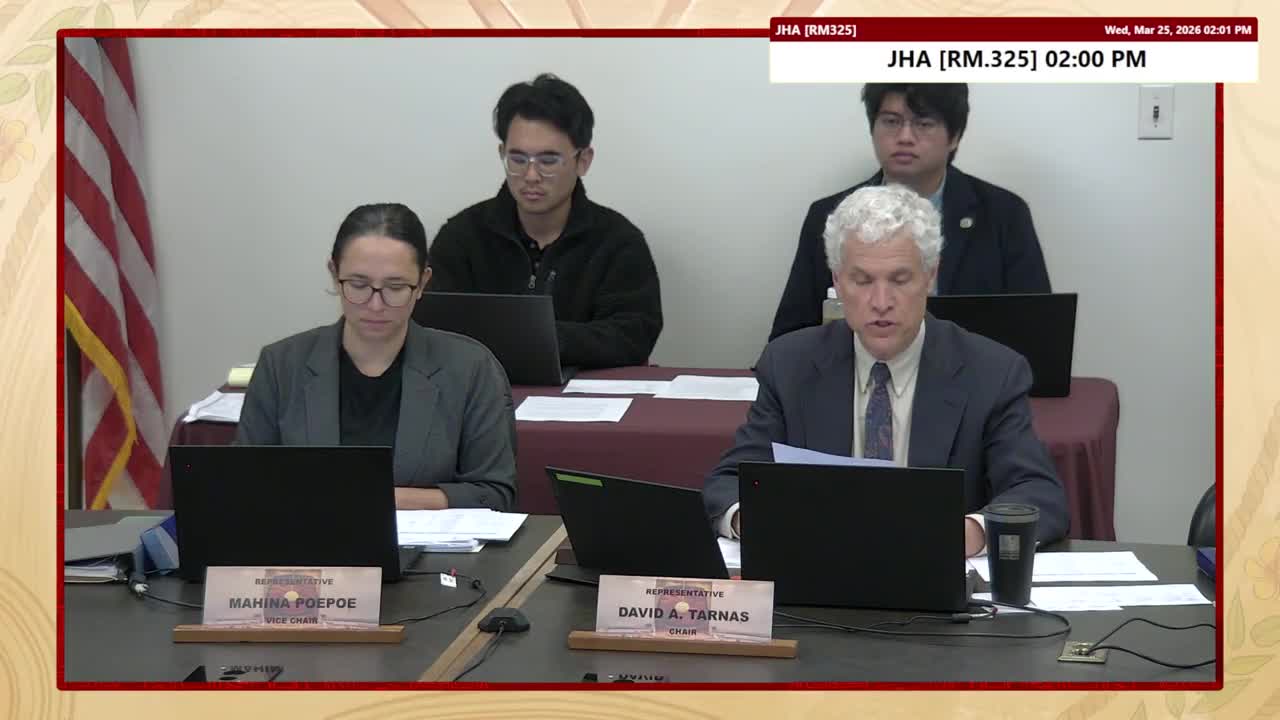 47MIN
House Standing Committee on Judiciary & Hawaiian Affairs
 40SEC
House Standing Committee on Judiciary & Hawaiian Affairs
 24SEC
Senate Standing Committee on Judiciary
24SEC
Senate Standing Committee on Ways and Means
 2MIN
Senate Standing Committee on Public Safety and Military Affairs
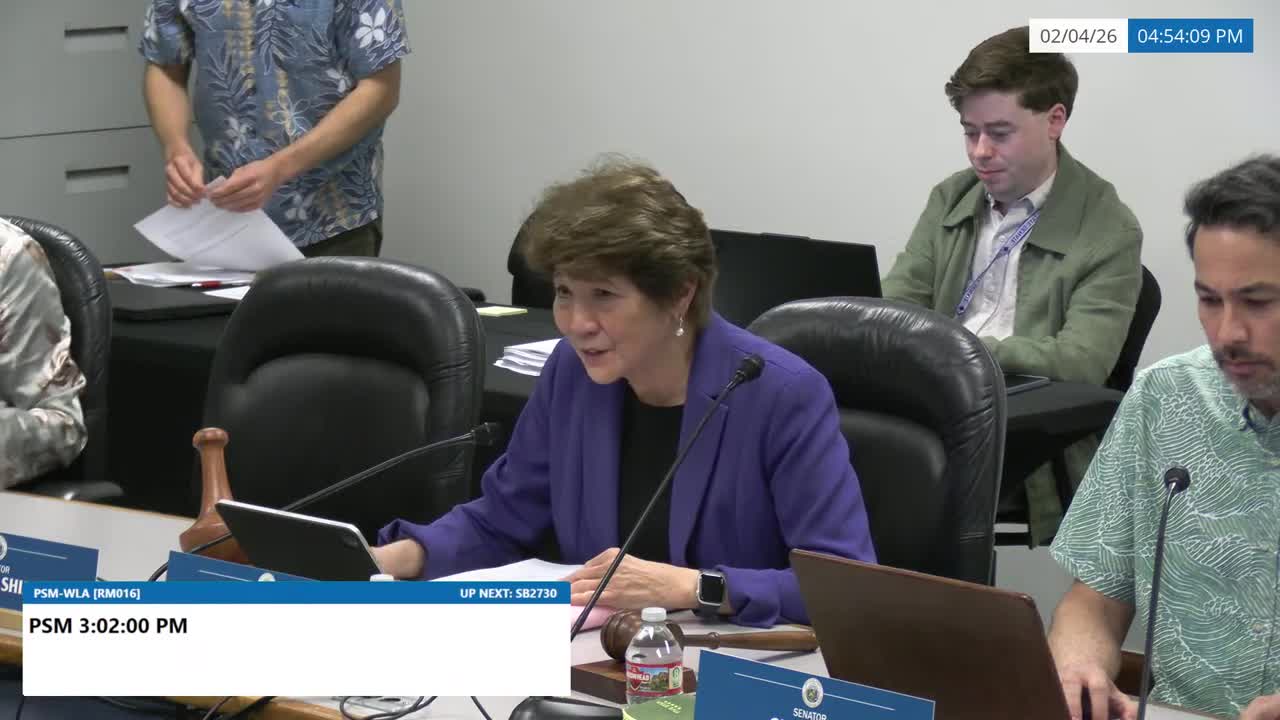 23MIN
Senate Standing Committee on Public Safety and Military Affairs
23MIN
Senate Standing Committee on Water, Land, Culture and the Arts
Bill Author