SB 2671: Counties; Permit Processing; Differential Payments; Salaries; Pilot Program; Reports
- Session Year: 2025-2026
- House: Senate
- Latest Version Date: 2026-05-01
Current Status:
Passed
(2026-06-09: Act 119, on 06/08/2026 (Gov. Msg. No. 1219).)
Introduced
In Committee
First Chamber
In Committee
Second Chamber
Final Decking
Enacted
What does this bill do?
The bill lets each county mayor run a pilot program to speed up and improve local permit review and processing, affecting county permitting staff, agencies, and people who apply for permits. Counties may designate certain jobs as "essential permitting positions," pay at least a 15% salary boost (and hire above the pay range), award milestone bonuses, set performance goals, name a permitting coordinator, and report progress to the county council.
The summary is provided by generative AI which can make mistakes. For original language, please view the details in the table below.
Authorizes the mayor of each county to implement a pilot program to improve the speed, accountability, and quality of permit processing within that county through targeted staffing, performance incentives, and interdepartmental competition. Authorizes increased pay for certain permitting positions and requires county personnel departments to prioritize the hiring of permitting positions as part of the pilot program. Requires participating county mayors and county agencies to establish goals for the pilot program. Requires participating county agencies to submit quarterly reports to the respective county councils on the pilot program. Sunsets the pilot project on 6/30/2030. (CD1)
Authorizes the mayor of each county with a population of less than five hundred thousand to implement a pilot program to improve the speed, accountability, and quality of permit processing within that county through targeted staffing, performance incentives, and interdepartmental competition. Authorizes increased pay for certain permitting positions and requires county personnel departments to prioritize the hiring of permitting positions as part of the pilot program. Requires participating county mayors and county agencies to establish goals for the pilot program. Requires participating county agencies to submit quarterly reports to the respective county councils on the pilot program. Sunsets the pilot project on 6/30/2030. Effective 7/1/3000. (HD2)
Authorizes the mayor of each county to implement a pilot program to improve the speed, accountability, and quality of permit processing within that county through targeted staffing, performance incentives, and interdepartmental competition. Authorizes increased pay for certain permitting positions and requires county personnel departments to prioritize the hiring of permitting positions as part of the pilot program. Requires county mayors and county agencies to establish goals for the pilot program. Requires county agencies to submit quarterly reports to the respective county councils on the pilot program. Sunsets 6/30/2031. Effective 4/19/2042. (HD1)
Authorizes a mayor to establish a pilot program to improve the speed, accountability, and quality of permit processing through targeted staffing, performance incentives, and interdepartmental competition within participating counties. Authorizes a mayor to designate any number of positions as essential permitting positions across departments involved in permit review, permit processing, or both. Authorizes the payment of a minimum differential payment to assist in employee recruitment and retention. Authorizes the hiring of essential permitting positions at salaries above the minimum salary within the approved salary range. Requires personnel departments to prioritize the hiring of individuals into essential permitting positions over other positions. Authorizes counties to use revenues from the county surcharge on state tax pursuant to pay for pilot program expenses. Requires annual reports to the Legislature. Sunsets 6/30/2031. Effective 4/19/2042. (SD1)
Establishes a pilot program to improve the speed, accountability, and quality of permit processing through targeted staffing, performance incentives, and interdepartmental competition within participating counties. Authorizes a mayor to designate any number of positions as essential permitting positions across departments involved in permit review, permit processing, or both. Authorizes the payment of a minimum differential payment to assist in employee recruitment and retention. Authorizes the hiring of essential permitting positions at salaries above the minimum salary within the approved salary range. Requires personnel departments to prioritize the hiring of individuals into essential permitting positions over other positions. Authorizes counties to use revenues from the county surcharge on state tax pursuant to pay for pilot program expenses. Requires annual reports to the Legislature. Sunsets 6/30/2031.
|
THE SENATE |
S.B. NO. |
2671 |
|
THIRTY-THIRD LEGISLATURE, 2026 |
S.D. 1 |
|
|
STATE OF HAWAII |
H.D. 2 |
|
|
|
C.D. 1 |
|
|
|
||
|
|
||
A BILL FOR AN ACT
RELATING TO ESSENTIAL PERMITTING POSITIONS.
BE IT ENACTED BY THE LEGISLATURE OF THE STATE OF HAWAII:
The legislature further finds that one proven strategy to improve recruitment and retention for hard-to-fill government roles is offering differential pay. The department of education implemented shortage differentials of up to $10,000 for special education, Hawaiian immersion, and other hard-to-staff teaching positions. These incentives led to a thirty-five per cent reduction in unlicensed special education teachers and significantly improved staffing stability. Similar models have been used in other departments and bargaining units to address workforce shortages.
In addition, the governor's operation hire Hawaii initiative has actively tackled personnel challenges across state agencies by promoting expedited hiring and workforce equity.
Accordingly, the purpose of this Act is to improve the speed, accountability, and quality of permit processing in county departments by authorizing the mayor of each county to implement a pilot program that targets staffing, performance incentives, and interdepartmental competition.
SECTION 2. (a) The mayor of any county may implement a pilot program to improve the speed, accountability, and quality of permit processing within that county through targeted staffing, performance incentives, and interdepartmental competition. The pilot program shall be implemented as an experimental modernization project pursuant to section 78-3.5, Hawaii Revised Statutes, and the purposes, methodology, duration, and criteria for evaluation developed pursuant to section 78-3.5(b)(1), Hawaii Revised Statutes, shall be consistent with this Act.
(b) Any pilot program implemented pursuant to subsection (a) shall operate for four fiscal years, beginning July 1, 2026, and shall ensure that:
(1) The mayor of a county participating in the pilot program may designate any number of positions in departments involved in permit review or permit processing, or both, as essential permitting positions;
(2) Each position designated as an essential permitting position shall receive a minimum differential payment equal to fifteen per cent of the position's salary; provided that an agency may increase the amount of the differential payment above fifteen per cent of the position's salary if the mayor deems it necessary to recruit or retain necessary workers in essential permitting positions;
(3) Persons may be hired into essential permitting positions at salaries above the minimum salary within the approved salary range for the purpose of attracting qualified candidates; and
(4) Personnel departments shall prioritize the hiring of individuals for essential permitting positions over the hiring for other positions. A personnel department shall make a conditional offer to candidates qualified for essential permitting positions within fourteen days of the date on which the candidate was interviewed by the county.
(c) A county that participates in the pilot program pursuant to this Act shall designate and set aside moneys for:
(1) Differential payments pursuant to subsection (b)(2);
(2) The hiring of new employees for essential permitting positions; and
(3) Financial awards for meeting milestone goals, as provided in subsection (e).
Notwithstanding any provision of section 46-16.8, Hawaii Revised Statutes, or any charter provision, ordinance, or other law to the contrary, moneys collected from the county surcharge on state tax and distributed to each participating county with a population of less than five hundred thousand pursuant to sections 46-16.8 and 237-8.6, Hawaii Revised Statutes, may be appropriated and allocated by a participating county to fulfill the requirements of this subsection and fund the positions subject to the pilot program.
(d) The mayor of a county participating in the pilot program pursuant to this Act shall establish a countywide goal that describes the specific metrics by which the county intends to improve permitting times by participating in the pilot program.
(e) In addition to the countywide goal in subsection (d), each participating county agency that participates in the pilot program shall establish four milestone goals that describe the specific metrics by which the agency aims to improve permitting efficiency. The milestone goals may include reducing average review times by a specific amount of time or increasing throughput by a specific amount.
Upon achieving each milestone goal, designated agency personnel shall receive financial awards pursuant to subsection (c) of at least three per cent of the person's annual salary, as determined by the county; provided that the county may pay a financial award greater than three per cent. The county agency shall designate the specific employees or classes of employees who shall be eligible for the financial awards.
(f) Each county agency that participates in the pilot program shall submit quarterly reports to the county council on the agency's progress in achieving the performance metrics described in subsections (d) and (e).
(g) Each participating county shall establish or designate a single position to serve as the countywide permitting program coordinator. The duties of the permitting program coordinator shall include:
(1) Overseeing and facilitating permit workflow across departments;
(2) Troubleshooting to resolve bottlenecks and interdepartmental issues;
(3) Serving as a liaison among stakeholders, including applicants, reviewers, inspectors, and department heads;
(4) Ensuring that milestone goals established pursuant to subsection (e) are tracked and reported accurately; and
(5) Submitting annual reports to the legislature no later than twenty days prior to the convening of each regular session. The annual reports shall include:
(A) Any recommended adjustments to the pilot program;
(B) Recommendations for pilot program expansion based on pilot program outcomes; and
(C) Any other findings and recommendations, including any proposed legislation.
(h) The pilot program shall cease to exist on June 30, 2030, unless the pilot program is extended by the legislature.
(i) For the purposes of this section, "essential permitting position" means a position designated by a mayor as a position that is essential for the review of permits, processing of permits, or both, pursuant to subsection (b)(1). "Essential permitting position" includes vacant positions and existing positions that are currently filled.
SECTION 3. This Act shall take effect on July 1, 2026.
Report Title:
Counties; Permit Processing; Differential Payments; Salaries; Pilot Program; Reports
Description:
Authorizes the mayor of each county to implement a pilot program to improve the speed, accountability, and quality of permit processing within that county through targeted staffing, performance incentives, and interdepartmental competition. Authorizes increased pay for certain permitting positions and requires county personnel departments to prioritize the hiring of permitting positions as part of the pilot program. Requires participating county mayors and county agencies to establish goals for the pilot program. Requires participating county agencies to submit quarterly reports to the respective county councils on the pilot program. Sunsets the pilot project on 6/30/2030. (CD1)
The summary description of legislation appearing on this page is for informational purposes only and is not legislation or evidence of legislative intent.
|
THE SENATE |
S.B. NO. |
2671 |
|
THIRTY-THIRD LEGISLATURE, 2026 |
S.D. 1 |
|
|
STATE OF HAWAII |
H.D. 2 |
|
|
|
|
|
|
|
||
|
|
||
A BILL FOR AN ACT
RELATING TO ESSENTIAL PERMITTING POSITIONS.
BE IT ENACTED BY THE LEGISLATURE OF THE STATE OF HAWAII:
The legislature further finds that one proven strategy to improve recruitment and retention for hard-to-fill government roles is offering differential pay. The department of education implemented shortage differentials of up to $10,000 for special education, Hawaiian immersion, and other hard-to-staff teaching positions. These incentives led to a thirty-five per cent reduction in unlicensed special education teachers and significantly improved staffing stability. Similar models have been used in other departments and bargaining units to address workforce shortages.
In addition, the governor's operation hire Hawaii initiative has actively tackled personnel challenges across state agencies by promoting expedited hiring and workforce equity.
Establishing a pilot program that empowers counties to streamline permitting operations through targeted staffing, performance incentives, and interdepartmental coordination will build on those successes.
Accordingly, the purpose of this Act is to improve the speed, accountability, and quality of permit processing in county departments by authorizing the mayor of county with a population of less than five hundred thousand to implement a pilot program that targets staffing, performance incentives, and interdepartmental competition.
SECTION 2. (a) The mayor of a county with a population of less than five hundred thousand may implement a pilot program to improve the speed, accountability, and quality of permit processing within that county through targeted staffing, performance incentives, and interdepartmental competition. The pilot program shall be implemented as an experimental modernization project pursuant to section 78-3.5, Hawaii Revised Statutes, and the purposes, methodology, duration, and criteria for evaluation developed pursuant to section 78-3.5(b)(1), Hawaii Revised Statutes, shall be consistent with this Act.
(b) Any pilot program implemented pursuant to subsection (a) shall operate for four fiscal years, beginning July 1, 2026, and shall ensure that:
(1) The mayor of a county participating in the pilot program may designate any number of positions in departments involved in permit review or permit processing, or both, as essential permitting positions;
(2) Each position designated as an essential permitting position shall receive a minimum differential payment equal to fifteen per cent of the position's salary; provided that an agency may increase the amount of the differential payment above fifteen per cent of the position's salary if the mayor deems it necessary to recruit or retain necessary workers in essential permitting positions;
(3) Persons may be hired into essential permitting positions at salaries above the minimum salary within the approved salary range for the purpose of attracting qualified candidates; and
(4) Personnel departments shall prioritize the hiring of individuals for essential permitting positions over the hiring for other positions. A personnel department shall make a conditional offer to candidates qualified for essential permitting positions within fourteen days of the date on which the candidate was interviewed by the county.
(c) A county that participates in the pilot program pursuant to this Act shall designate and set aside moneys for:
(1) Differential payments pursuant to subsection (b)(2);
(2) The hiring of new employees for essential permitting positions; and
(3) Financial awards for meeting milestone goals, as provided in subsection (e).
Notwithstanding any provision of section 46-16.8, Hawaii Revised Statutes, or any charter provision, ordinance, or other law to the contrary, moneys collected from the county surcharge on state tax and distributed to each participating county pursuant to sections 46-16.8 and 237-8.6, Hawaii Revised Statutes, may be appropriated and allocated by a participating county to fulfill the requirements of this subsection and fund the positions subject to the pilot program.
(d) The mayor of a county participating in the pilot program pursuant to this Act shall establish a countywide goal that describes the specific metrics by which the county intends to improve permitting times by participating in the pilot program.
(e) In addition to the countywide goal in subsection (d), each participating county agency that participates in the pilot program shall establish four milestone goals that describe the specific metrics by which the agency aims to improve permitting efficiency. The milestone goals may include reducing average review times by a specific amount of time or increasing throughput by a specific amount.
Upon achieving each milestone goal, designated agency personnel shall receive financial awards pursuant to subsection (c) of at least three per cent of the person's annual salary, as determined by the county; provided that the county may pay a financial award greater than three per cent. The county agency shall designate the specific employees or classes of employees who shall be eligible for the financial awards.
(f) Each county agency that participates in the pilot program shall submit quarterly reports to the county council on the agency's progress in achieving the performance metrics described in subsections (d) and (e).
(g) Each participating county shall establish or designate a single position to serve as the countywide permitting program coordinator. The duties of the permitting program coordinator shall include:
(1) Overseeing and facilitating permit workflow across departments;
(2) Troubleshooting to resolve bottlenecks and interdepartmental issues;
(3) Serving as a liaison among stakeholders, including applicants, reviewers, inspectors, and department heads;
(4) Ensuring that milestone goals established pursuant to subsection (e) are tracked and reported accurately; and
(5) Submitting annual reports to the legislature no later than twenty days prior to the convening of each regular session. The annual reports shall include:
(A) Any recommended adjustments to the pilot program;
(B) Recommendations for pilot program expansion based on pilot program outcomes; and
(C) Any other findings and recommendations, including any proposed legislation.
(h) The pilot program shall cease to exist on June 30, 2030, unless the pilot program is extended by the legislature.
(i) For the purposes of this section, "essential permitting position" means a position designated by a mayor as a position that is essential for the review of permits, processing of permits, or both, pursuant to subsection (b)(1). "Essential permitting position" includes vacant positions and existing positions that are currently filled.
SECTION 3. This Act shall take effect on July 1, 3000.
Report Title:
Counties; Permit Processing; Differential Payments; Salaries; Pilot Program; Reports
Description:
Authorizes the mayor of each county with a population of less than five hundred thousand to implement a pilot program to improve the speed, accountability, and quality of permit processing within that county through targeted staffing, performance incentives, and interdepartmental competition. Authorizes increased pay for certain permitting positions and requires county personnel departments to prioritize the hiring of permitting positions as part of the pilot program. Requires participating county mayors and county agencies to establish goals for the pilot program. Requires participating county agencies to submit quarterly reports to the respective county councils on the pilot program. Sunsets the pilot project on 6/30/2030. Effective 7/1/3000. (HD2)
The summary description of legislation appearing on this page is for informational purposes only and is not legislation or evidence of legislative intent.
|
THE SENATE |
S.B. NO. |
2671 |
|
THIRTY-THIRD LEGISLATURE, 2026 |
S.D. 1 |
|
|
STATE OF HAWAII |
H.D. 1 |
|
|
|
|
|
|
|
||
|
|
||
A BILL FOR AN ACT
RELATING TO ESSENTIAL PERMITTING POSITIONS.
BE IT ENACTED BY THE LEGISLATURE OF THE STATE OF HAWAII:
The legislature further finds that one proven strategy to improve recruitment and retention for hard-to-fill government roles is offering differential pay. The department of education implemented shortage differentials of up to $10,000 for special education, Hawaiian immersion, and other hard-to-staff teaching positions. These incentives led to a thirty-five per cent reduction in unlicensed special education teachers and significantly improved staffing stability. Similar models have been used in other departments and bargaining units to address workforce shortages.
In addition, the governor's operation hire Hawaii initiative has actively tackled personnel challenges across state agencies by promoting expedited hiring and workforce equity.
Establishing a pilot program that empowers counties to streamline permitting operations through targeted staffing, performance incentives, and interdepartmental coordination will build on those successes.
Accordingly, the purpose of this Act is to improve the speed, accountability, and quality of permit processing in county departments by authorizing the mayor of each county to implement a pilot program that targets staffing, performance incentives, and interdepartmental competition.
SECTION 2. (a) The mayor of a county may implement a pilot program to improve the speed, accountability, and quality of permit processing within counties that elect to participate in the pilot program through targeted staffing, performance incentives, and interdepartmental competition. The pilot program shall be implemented as an experimental modernization project pursuant to section 78-3.5, Hawaii Revised Statutes, and the purposes, methodology, duration, and criteria for evaluation developed pursuant to section 78-3.5(b)(1), Hawaii Revised Statutes, shall be consistent with subsections (b) through (h).
(b) Any pilot program implemented pursuant to subsection (a) shall operate for five fiscal years, beginning July 1, 2026, and shall ensure that:
(1) The mayor of a county participating in the pilot program may designate any number of positions in departments involved in permit review or permit processing, or both, as essential permitting positions;
(2) Each position designated as an essential permitting position shall receive a minimum differential payment equal to fifteen per cent of the position's salary; provided that an agency may increase the amount of the differential payment above fifteen per cent of the position's salary if the mayor deems it necessary to recruit or retain necessary workers in essential permitting positions;
(3) Persons may be hired into essential permitting positions at salaries above the minimum salary within the approved salary range for the purpose of attracting qualified candidates; and
(4) Personnel departments shall prioritize the hiring of individuals for essential permitting positions over the hiring for other positions. A personnel department shall make a conditional offer to candidates qualified for essential permitting positions within fourteen days of the date on which the candidate was interviewed by the county.
(c) A county that participates in the pilot program shall designate and set aside moneys for:
(1) Differential payments pursuant to subsection (b)(2);
(2) The hiring of new employees for essential permitting positions; and
(3) Financial awards for meeting milestone goals, as provided in subsection (e).
Notwithstanding any provision of section 46-16.8, Hawaii Revised Statutes, or any charter provision, ordinance, or other law to the contrary, moneys collected from the county surcharge on state tax and distributed to each county pursuant to sections 46-16.8 and 237-8.6, Hawaii Revised Statutes, may be appropriated and allocated by a participating county with a population of less than one million to fulfill the requirements of this subsection and fund the positions subject to the pilot program.
(d) The mayor of a county participating in the pilot program shall establish a countywide goal that describes the specific metrics by which the county intends to improve permitting times by participating in the pilot program.
(e) In addition to the countywide goal in subsection (d), each county agency that participates in the pilot program shall establish four milestone goals that describe the specific metrics by which the agency aims to improve permitting efficiency. The milestone goals may include reducing average review times by a specific amount of time or increasing throughput by a specific amount.
Upon achieving each milestone goal, designated agency personnel pursuant to subsection (c) shall receive financial awards of at least three per cent of the person's annual salary, as determined by the county; provided that the county may pay a financial award greater than three per cent. The county agency shall designate the specific employees or classes of employees who shall be eligible for the financial awards.
(f) Each county agency that participates in the pilot program shall submit quarterly reports to the county council on the agency's progress in achieving the performance metrics described in subsections (d) and (e).
(g) Each participating county shall establish or designate a single position to serve as the countywide permitting program coordinator. The duties of the permitting program coordinator shall include:
(1) Overseeing and facilitating permit workflow across departments;
(2) Troubleshooting to resolve bottlenecks and interdepartmental issues;
(3) Serving as a liaison among stakeholders, including applicants, reviewers, inspectors, and department heads;
(4) Ensuring that milestone goals established pursuant to subsection (e) are tracked and reported accurately; and
(5) Submitting annual reports to the legislature no later than twenty days prior to the convening of each regular session. The annual reports shall include:
(A) Any recommended adjustments to the pilot program;
(B) Recommendations for pilot program expansion based on pilot program outcomes; and
(C) Any other findings and recommendations, including any proposed legislation.
(h) The pilot program shall cease to exist on June 30, 2031, unless the pilot program is extended by the legislature.
(i) For the purposes of this section, "essential permitting position" means a position designated by a mayor as a position that is essential for the review of permits, processing of permits, or both, pursuant to subsection (b)(1). "Essential permitting positions" may include both vacant positions and existing positions that are currently filled.
SECTION 3. This Act shall take effect on April 19, 2042.
Report Title:
Counties; Permit Processing; Differential Payments; Salaries; Pilot Program; Reports
Description:
Authorizes the mayor of each county to implement a pilot program to improve the speed, accountability, and quality of permit processing within that county through targeted staffing, performance incentives, and interdepartmental competition. Authorizes increased pay for certain permitting positions and requires county personnel departments to prioritize the hiring of permitting positions as part of the pilot program. Requires county mayors and county agencies to establish goals for the pilot program. Requires county agencies to submit quarterly reports to the respective county councils on the pilot program. Sunsets 6/30/2031. Effective 4/19/2042. (HD1)
The summary description of legislation appearing on this page is for informational purposes only and is not legislation or evidence of legislative intent.
|
THE SENATE |
S.B. NO. |
2671 |
|
THIRTY-THIRD LEGISLATURE, 2026 |
S.D. 1 |
|
|
STATE OF HAWAII |
|
|
|
|
|
|
|
|
||
|
|
||
A BILL FOR AN ACT
RELATING TO ESSENTIAL PERMITTING POSITIONS.
BE IT ENACTED BY THE LEGISLATURE OF THE STATE OF HAWAII:
The legislature further finds that one proven strategy to improve recruitment and retention for hard-to-fill government roles is offering differential pay. The department of education implemented shortage differentials of up to $10,000 for special education, Hawaiian immersion, and other hard-to-staff teaching positions. These incentives led to a thirty-five per cent reduction in unlicensed special education teachers and significantly improved staffing stability. Similar models have been used in other departments and bargaining units to address workforce shortages.
In addition, the governor's operation hire Hawaii initiative has actively tackled personnel challenges across state agencies by promoting expedited hiring and workforce equity.
This Act establishes a pilot program that will build on those successes by empowering counties to streamline permitting operations through targeted staffing, performance incentives, and interdepartmental coordination.
Accordingly, the purpose of this Act is to improve the speed, accountability, and quality of permit processing in county departments through the implementation of a pilot program that targets staffing, performance incentives, and interdepartmental competition.
SECTION 2. (a) The mayor of a county may implement a pilot program to improve the speed, accountability, and quality of permit processing within counties that elect to participate in the pilot program through targeted staffing, performance incentives, and interdepartmental competition. The pilot program shall be implemented as an experimental modernization project pursuant to section 78-3.5, Hawaii Revised Statutes, and the purposes, methodology, duration, and criteria for evaluation developed pursuant to section 78-3.5(b)(1), Hawaii Revised Statutes, shall be consistent with subsections (b) through (h).
(b) Any pilot program implemented pursuant to subsection (a) shall operate for five fiscal years, beginning July 1, 2026, and shall include the following:
(1) The mayor of a county participating in the pilot program may designate any number of positions in departments involved in permit review, permit processing, or both, as essential permitting positions;
(2) Each position designated as an essential permitting position shall receive a minimum differential payment equal to fifteen per cent of the position's salary; provided that an agency may increase the amount of the differential payment above fifteen per cent of the position's salary if the mayor deems it necessary to recruit or retain necessary workers in essential permitting positions;
(3) Persons may be hired into essential permitting positions at salaries above the minimum salary within the approved salary range for the purpose of attracting qualified candidates; and
(4) Personnel departments shall prioritize the hiring of individuals for essential permitting positions over the hiring for other positions. A personnel department shall make a conditional offer to candidates qualified for essential permitting positions within fourteen days of the date on which the candidate was interviewed by the county.
(c) A county that participates in the pilot program shall designate and set aside moneys for:
(1) Differential payments pursuant to subsection (b)(2);
(2) The hiring of new employees for essential permitting positions; and
(3) Financial awards for meeting milestone goals, as provided in subsection (e).
Notwithstanding any provision of section 46-16.8, Hawaii Revised Statutes, or any charter provision, ordinance, or other law to the contrary, moneys collected from the county surcharge on state tax and distributed to each county pursuant to sections 46-16.8 and 237-8.6, Hawaii Revised Statutes, may be appropriated and allocated by a respective participating county to fulfill the requirements of this subsection and fund the positions subject to the pilot program.
(d) The mayor of a county participating in the pilot program shall establish a countywide goal that describes the specific metrics by which the county intends to improve permitting times by participating in the pilot program.
(e) In addition to the countywide goal in subsection (d), each county agency that participates in the pilot program shall establish four milestone goals that describe the specific metrics by which the agency aims to improve permitting efficiency. The milestone goals may include reducing average review times by a specific amount of time or increasing throughput by a specific amount.
Upon achieving each milestone goal, designated agency personnel pursuant to subsection (c) shall receive financial awards of at least three per cent of the person's annual salary, as determined by the county; provided that the county may pay a financial award greater than three per cent. The county agency shall designate the specific employees or classes of employees who shall be eligible for the financial awards.
(f) Each county agency that participates in the pilot program shall submit quarterly reports to the county council on the agency's progress in achieving the performance metrics described in subsections (d) and (e).
(g) Each participating county shall establish or designate a single position to serve as the countywide permitting program coordinator. The duties of the permitting program coordinator shall include:
(1) Overseeing and facilitating permit workflow across departments;
(2) Troubleshooting to resolve bottlenecks and interdepartmental issues;
(3) Serving as a liaison among stakeholders, including applicants, reviewers, inspectors, and department heads;
(4) Ensuring that milestone goals are tracked and reported accurately; and
(5) Submitting annual reports to the legislature no later than twenty days prior to the convening of each regular session. The annual reports shall include:
(A) Any recommended adjustments to the pilot program;
(B) Recommendations for pilot program expansion based on pilot program outcomes; and
(C) Any other findings and recommendations, including any proposed legislation.
(h) The pilot program shall cease to exist on June 30, 2031, unless the pilot program is extended by the legislature.
(i) For the purposes of this section, "essential permitting position" means a position designated by a mayor as a position that is essential for the review of permits, processing of permits, or both, pursuant to subsection (b)(1). "Essential permitting positions" may include both vacant positions and existing positions that are currently filled.
SECTION 3. This Act shall take effect on April 19, 2042.
Report Title:
Counties; Permit Processing; Differential Payments; Salaries; Pilot Program; Reports
Description:
Authorizes a mayor to establish a pilot program to improve the speed, accountability, and quality of permit processing through targeted staffing, performance incentives, and interdepartmental competition within participating counties. Authorizes a mayor to designate any number of positions as essential permitting positions across departments involved in permit review, permit processing, or both. Authorizes the payment of a minimum differential payment to assist in employee recruitment and retention. Authorizes the hiring of essential permitting positions at salaries above the minimum salary within the approved salary range. Requires personnel departments to prioritize the hiring of individuals into essential permitting positions over other positions. Authorizes counties to use revenues from the county surcharge on state tax pursuant to pay for pilot program expenses. Requires annual reports to the Legislature. Sunsets 6/30/2031. Effective 4/19/2042. (SD1)
The summary description of legislation appearing on this page is for informational purposes only and is not legislation or evidence of legislative intent.
|
THE SENATE |
S.B. NO. |
2671 |
|
THIRTY-THIRD LEGISLATURE, 2026 |
|
|
|
STATE OF HAWAII |
|
|
|
|
|
|
|
|
||
|
|
||
A BILL FOR AN ACT
relating to essential permitting positions.
BE IT ENACTED BY THE LEGISLATURE OF THE STATE OF HAWAII:
The legislature further finds that one proven strategy to improve recruitment and retention for hard-to-fill government roles is offering differential pay. The department of education implemented shortage differentials of up to $10,000 for special education, Hawaiian immersion, and other hard-to-staff teaching positions. These incentives led to a thirty-five per cent reduction in unlicensed special education teachers and significantly improved staffing stability. Similar models have been used in other departments and bargaining units to address workforce shortages.
In addition, the governor's operation hire Hawaii initiative has actively tackled personnel challenges across state agencies by promoting expedited hiring and workforce equity.
This Act establishes a pilot program that will build on those successes by empowering counties to streamline permitting operations through targeted staffing, performance incentives, and interdepartmental coordination.
Accordingly, the purpose of this Act is to improve the speed, accountability, and quality of permit processing in county departments through the implementation of a pilot program that targets staffing, performance incentives, and interdepartmental competition.
SECTION 2. (a) The mayor of a county may implement a pilot program to improve the speed, accountability, and quality of permit processing within counties that elect to participate in the pilot program through targeted staffing, performance incentives, and interdepartmental competition. The pilot program shall be implemented as an experimental modernization project pursuant to section 78-3.5, Hawaii Revised Statutes, and the purposes, methodology, duration, and criteria for evaluation developed pursuant to section 78-3.5(b)(1), Hawaii Revised Statutes, shall be consistent with subsections (b) through (h).
(b) The pilot program shall operate for five fiscal years, beginning July 1, 2026, and shall include the following:
(1) The mayor of a county participating in the pilot program may designate any number of positions in departments involved in permit review, permit processing, or both, as essential permitting positions;
(2) Each position designated as an essential permitting position shall receive a minimum differential payment equal to fifteen per cent of the position's salary; provided that an agency may increase the amount of the differential payment above fifteen per cent of the position's salary if the mayor deems it necessary to recruit or retain necessary workers in essential permitting positions;
(3) Persons may be hired into essential permitting positions at salaries above the minimum salary within the approved salary range for the purpose of attracting qualified candidates; and
(4) Personnel departments shall prioritize the hiring of individuals for essential permitting positions over the hiring for other positions. A personnel department shall make a conditional offer to candidates qualified for essential permitting positions within fourteen days of the date on which the candidate was interviewed by the county.
(c) A county that participates in the pilot program shall designate and set aside moneys for:
(1) Differential payments pursuant to subsection (b)(2);
(2) The hiring of new employees for essential permitting positions; and
(3) Financial awards for meeting milestone goals as provided in subsection (e).
Notwithstanding any provision of section 46-16.8, Hawaii Revised Statutes, or any charter provision, ordinance, or other law to the contrary, moneys collected from the county surcharge on state tax and distributed to each county pursuant to sections 46-16.8 and 237-8.6, Hawaii Revised Statutes, may be appropriated and allocated by a respective participating county to fulfill the requirements of this subsection and fund the positions subject to the pilot project.
(d) The mayor of a county participating in the pilot program shall establish a countywide goal that describes the specific metrics by which the county intends to improve permitting times by participating in the pilot program.
(e) In addition to the countywide goal in subsection (d), each county agency that participates in the pilot program shall establish four milestone goals that describe the specific metrics by which the agency aims to improve permitting efficiency. The milestone goals may include reducing average review times by a specific amount of time or increasing throughput by a specific amount.
Upon achieving each milestone goal, designated agency personnel pursuant to subsection (c) shall receive financial awards of at least three per cent of the person's annual salary, as determined by the county; provided that the county may pay a financial award greater than three per cent. The county agency shall designate the specific employees or classes of employees who shall be eligible for the financial awards.
(f) Each county agency that participates in the pilot program shall submit quarterly reports to the county council on the agency's progress in achieving the performance metrics described in subsections (d) and (e).
(g) Each participating county shall establish or designate a single position to serve as the county wide permitting program coordinator. The duties of the permitting program coordinator shall include:
(1) Overseeing and facilitating permit workflow across departments;
(2) Troubleshooting to resolve bottlenecks and interdepartmental issues;
(3) Serving as a liaison among stakeholders, including applicants, reviewers, inspectors, and department heads;
(4) Ensuring that milestone goals are tracked and reported accurately; and
(5) Submitting annual reports to the legislature no later than twenty days prior to the convening of each regular session. The annual reports shall include:
(A) Any recommended adjustments to the pilot program;
(B) Recommendations for pilot program expansion based on pilot program outcomes; and
(C) Any other findings and recommendations, including any proposed legislation.
(h) The pilot program shall cease to exist on June 30, 2031, unless the pilot program is extended by the legislature.
(i) As used in this section, "essential permitting position" means a position designated by a mayor as a position that is essential for the review of permits, processing of permits, or both, pursuant to subsection (b)(1). "Essential permitting positions" may include both vacant positions and existing positions that are currently filled.
SECTION 3. This Act shall take effect on July 1, 2026.
|
INTRODUCED BY: |
_____________________________ |
|
|
|
Report Title:
Counties; Permit Processing; Differential Payments; Salaries; Pilot Program; Reports
Description:
Establishes a pilot program to improve the speed, accountability, and quality of permit processing through targeted staffing, performance incentives, and interdepartmental competition within participating counties. Authorizes a mayor to designate any number of positions as essential permitting positions across departments involved in permit review, permit processing, or both. Authorizes the payment of a minimum differential payment to assist in employee recruitment and retention. Authorizes the hiring of essential permitting positions at salaries above the minimum salary within the approved salary range. Requires personnel departments to prioritize the hiring of individuals into essential permitting positions over other positions. Authorizes counties to use revenues from the county surcharge on state tax pursuant to pay for pilot program expenses. Requires annual reports to the Legislature. Sunsets 6/30/2031.
The summary description of legislation appearing on this page is for informational purposes only and is not legislation or evidence of legislative intent.
|
Date
|
Status
|
|---|---|
| Jun 9, 2026 | Act 119, on 06/08/2026 (Gov. Msg. No. 1219). |
| Jun 9, 2026 | Act 119, 06/08/2026 (Gov. Msg. No. 1219). |
| May 8, 2026 | Enrolled to Governor. |
| May 8, 2026 | Received notice of passage on Final Reading in House (Hse. Com. No. 888). |
| May 6, 2026 | Received notice of Final Reading (Sen. Com. No. 816). |
| May 6, 2026 | Passed Final Reading as amended in CD 1 with Representative(s) Iwamoto voting aye with reservations; Representative(s) Cochran voting no (1) and none excused (0). |
| May 6, 2026 | Passed Final Reading, as amended (CD 1). Ayes, 25; Aye(s) with reservations: none . 0 No(es): none. 0 Excused: none. |
| May 1, 2026 | Forty-eight (48) hours notice Wednesday, 05-06-26. |
| May 1, 2026 | Reported from Conference Committee (Conf Com. Rep. No. 191-26) as amended in (CD 1). |
| May 1, 2026 | 48 Hrs. Notice (as amended CD 1) 05-06-26. |
| May 1, 2026 | Reported from Conference Committee as amended CD 1 (Conf. Com. Rep. No. 191-26). |
| May 1, 2026 | The Conference Committee recommends that the measure be Passed, with Amendments. The votes were as follows: 5 Ayes: Representative(s) Ilagan, Sayama, Hussey, Tam, Gedeon; Ayes with reservations: none; 0 Noes: none; and 0 Excused: none. |
| May 1, 2026 | The Conference committee recommends that the measure be PASSED, WITH AMENDMENTS. The votes of the Senate Conference Managers were as follows: 2 Aye(s): Senator(s) Wakai, Hashimoto; Aye(s) with reservations: none ; 0 No(es): none; and 1 Excused: Senator(s) Fevella. |
| Apr 30, 2026 | Conference committee meeting to reconvene on 05-01-26 10:45AM; Conference Room 325. |
| Apr 28, 2026 | Conference committee meeting to reconvene on 04-30-26 10:45AM; Conference Room 325. |
| Apr 27, 2026 | Received notice of Senate conferees (Sen. Com. No. 762). |
| Apr 24, 2026 | Conference committee meeting scheduled for 04-28-26 10:45AM; Conference Room 325. |
| Apr 24, 2026 | Senate Conferees Appointed: Wakai Chair; Hashimoto Co-Chair; Fevella. |
| Apr 20, 2026 | Received notice of appointment of House conferees (Hse. Com. No. 787). |
| Apr 20, 2026 | House Conferees Appointed: Ilagan, Sayama, Hussey Co-Chairs; Tam, Gedeon. |
| Apr 10, 2026 | Received notice of disagreement (Sen. Com. No. 564). |
| Apr 10, 2026 | Senate disagrees with House amendments. |
| Apr 10, 2026 | Received from House (Hse. Com. No. 518). |
| Apr 9, 2026 | Passed Third Reading with none voting aye with reservations; none voting no (0) and Representative(s) Cochran excused (1). Transmitted to Senate. |
| Apr 9, 2026 | Reported from FIN (Stand. Com. Rep. No. 2001-26), recommending passage on Third Reading. |
| Apr 7, 2026 | The committee on FIN recommend that the measure be PASSED, UNAMENDED. The votes were as follows: 15 Ayes: Representative(s) Todd, Takenouchi, Hartsfield, Hussey, Keohokapu-Lee Loy, Kitagawa, Kusch, Lee, M., Miyake, Perruso, Templo, Yamashita, Alcos, Gedeon, Reyes Oda; Ayes with reservations: none; 0 Noes: none; and 1 Excused: Representative(s) Morikawa. |
| Apr 2, 2026 | Bill scheduled for decision making on Tuesday, 04-07-26 10:10AM in conference room 308 VIA VIDEOCONFERENCE. |
| Apr 2, 2026 | The committee(s) on FIN recommend(s) that the measure be deferred until 04-07-26. |
| Mar 31, 2026 | Bill scheduled to be heard by FIN on Thursday, 04-02-26 2:00PM in House conference room 308 VIA VIDEOCONFERENCE. |
| Mar 30, 2026 | Report adopted; referred to the committee(s) on FIN as amended in HD 2 with none voting aye with reservations; none voting no (0) and Representative(s) Cochran, Lowen, Perruso, Quinlan excused (4). |
| Mar 30, 2026 | Reported from LAB (Stand. Com. Rep. No. 1469-26) as amended in HD 2, recommending referral to FIN. |
| Mar 24, 2026 | The committee on LAB recommend that the measure be PASSED, WITH AMENDMENTS. The votes were as follows: 6 Ayes: Representative(s) Sayama, Lee, M., Garrett, Kapela, Kong, Reyes Oda; Ayes with reservations: none; Noes: none; and Excused: none. |
| Mar 20, 2026 | Bill scheduled to be heard by LAB on Tuesday, 03-24-26 9:30AM in House conference room 309 VIA VIDEOCONFERENCE. |
| Mar 20, 2026 | Passed Second Reading as amended in HD 1 and referred to the committee(s) on LAB with none voting aye with reservations; none voting no (0) and Representative(s) Quinlan excused (1). |
| Mar 20, 2026 | Reported from ECD (Stand. Com. Rep. No. 1283-26) as amended in HD 1, recommending passage on Second Reading and referral to LAB. |
| Mar 18, 2026 | The committee on ECD recommend that the measure be PASSED, WITH AMENDMENTS. The votes were as follows: 6 Ayes: Representative(s) Ilagan, Hussey, Tam, Templo, Yamashita, Gedeon; Ayes with reservations: none; Noes: none; and Excused: none. |
| Mar 12, 2026 | Bill scheduled to be heard by ECD on Wednesday, 03-18-26 8:30AM in House conference room 423 VIA VIDEOCONFERENCE. |
| Mar 12, 2026 | Referred to ECD, LAB, FIN, referral sheet 17 |
| Mar 12, 2026 | Pass First Reading |
| Mar 10, 2026 | Received from Senate (Sen. Com. No. 280) in amended form (SD 1). |
| Mar 10, 2026 | Report adopted; Passed Third Reading. Ayes, 25; Aye(s) with reservations: none . Noes, 0 (none). Excused, 0 (none). Transmitted to House. |
| Mar 6, 2026 | One Day Notice 03-10-26. |
| Mar 6, 2026 | Reported from WAM (Stand. Com. Rep. No. 2971) with recommendation of passage on Third Reading. |
| Mar 5, 2026 | The committee(s) on WAM recommend(s) that the measure be PASSED, UNAMENDED. The votes in WAM were as follows: 13 Aye(s): Senator(s) Dela Cruz, Moriwaki, DeCoite, Elefante, Hashimoto, Inouye, Kanuha, Kidani, Kim, Lee, C., Richards, Wakai, Fevella; Aye(s) with reservations: none ; 0 No(es): none; and 0 Excused: none. |
| Mar 4, 2026 | The committee(s) on WAM has rescheduled its decision making to 03-05-26 12:04PM; CR 211 & Videoconference. |
| Mar 3, 2026 | The committee(s) on WAM will hold a public decision making on 03-05-26 10:15AM; Conference Room 211 & Videoconference. |
| Feb 11, 2026 | Report adopted; Passed Second Reading, as amended (SD 1) and referred to WAM. |
| Feb 11, 2026 | Reported from EIG (Stand. Com. Rep. No. 2176) with recommendation of passage on Second Reading, as amended (SD 1) and referral to WAM. |
| Feb 5, 2026 | The committee(s) on EIG recommend(s) that the measure be PASSED, WITH AMENDMENTS. The votes in EIG were as follows: 5 Aye(s): Senator(s) Wakai, Chang, DeCoite, Richards, Fevella; Aye(s) with reservations: none ; 0 No(es): none; and 0 Excused: none. |
| Feb 2, 2026 | The committee(s) on EIG has scheduled a public hearing on 02-05-26 3:01PM; Conference Room 224 & Videoconference. |
| Jan 28, 2026 | Referred to EIG, WAM. |
| Jan 26, 2026 | Passed First Reading. |
| Jan 23, 2026 | Introduced. |
|
Date
|
Description
|
Location
|
Votes
|
|
|---|---|---|---|---|
| May 6, 2026 | Final Reading | House Floor |
Passed |
|
| May 6, 2026 | Final Reading | Senate Floor |
Passed |
|
| Apr 7, 2026 | The committee on FIN recommend that the measure be PASSED, UNAMENDED | House Standing Committee on Finance |
Passed |
|
| Mar 24, 2026 | The committee on LAB recommend that the measure be PASSED, WITH AMENDMENTS | House Standing Committee on Labor |
Passed |
|
| Mar 18, 2026 | The committee on ECD recommend that the measure be PASSED, WITH AMENDMENTS | House Standing Committee on Economic Development & Technology |
Passed |
|
| Mar 10, 2026 | Third Reading | Senate Floor |
Passed |
|
| Mar 5, 2026 | The committee(s) on WAM recommend(s) that the measure be PASSED, UNAMENDED | Senate Standing Committee on Ways and Means |
Passed |
|
| Feb 5, 2026 | The committee(s) on EIG recommend(s) that the measure be PASSED, WITH AMENDMENTS | Senate Standing Committee on Energy and Intergovernmental Affairs |
Passed |
This list shows positions taken on this bill by organizations on the date displayed, which is linked to the original source.
Positions by individuals are not included.
|
Organization
|
Position
|
Date
|
|---|---|---|
| BOMA Hawaiʻi | *** Support | Mar 17, 2026 |
| Building Industry Association of Hawaii | *** Support | Feb 5, 2026 |
| Chamber of Commerce Hawaii | *** Support | Apr 2, 2026 |
| Chamber of Commerce Maui | *** Support | Mar 24, 2026 |
| City and County of Honolulu Department of Planning and Permitting | *** Support | Mar 24, 2026 |
| County of Maui | *** Support | Apr 2, 2026 |
| Department of Planning and Permitting, City and County of Honolulu | *** Support | Mar 24, 2026 |
| General Contractors Association of Hawaii | *** Support | Apr 2, 2026 |
| Hawaii Government Employees Association (AFSCME Local 152, AFL-CIO) | *** Support | Apr 2, 2026 |
| Housing Hawai‘i’s Future | *** Support | Mar 24, 2026 |
| Land Use Research Foundation of Hawai‘i | *** Support | Mar 24, 2026 |
| Land Use Research Foundation of Hawai’i | *** Support | Mar 24, 2026 |
| Land Use Research Foundation of Hawai’i (LURF) | *** Support | Apr 2, 2026 |
| Maui Chamber of Commerce | *** Support | Apr 2, 2026 |
| Office of the Mayor | *** Support | Mar 17, 2026 |
STAND. COM. REP. NO. 2971
Honolulu, Hawaii
RE: S.B. No. 2671
S.D. 1
Honorable Ronald D. Kouchi
President of the Senate
Thirty-Third State Legislature
Regular Session of 2026
State of Hawaii
Sir:
Your Committee on Ways and Means, to which was referred S.B. No. 2671, S.D. 1, entitled:
"A BILL FOR AN ACT RELATING TO ESSENTIAL PERMITTING POSITIONS,"
begs leave to report as follows:
The purpose and intent of this measure is to authorize the mayor of each county to implement a pilot program within that county to improve the county's construction permitting process.
Specifically, this measure:
(1) Authorizes the mayor of each county to implement a pilot program to improve the speed, accountability, and quality of permit processing within that county through targeted staffing, performance incentives, and interdepartmental competition;
(2) Authorizes increased pay for certain permitting positions and requires county personnel departments to prioritize the hiring of permitting positions, as part of the pilot program;
(3) Requires participating mayors to establish goals for the pilot program; and
(4) Requires quarterly reports to county councils on the pilot program.
Your Committee received written comments in support of this measure from the City and County of Honolulu Department of Planning and Permitting, Hawaii Government Employees Association, Housing Hawaii's Future, Chamber of Commerce Hawaii, and Building Owners and Managers Association.
Your Committee received written comments on this measure from the Office of Planning and Sustainable Development, City and County of Honolulu Department of Human Resources, and City and County of Honolulu Department of Budget and Fiscal Services.
Your Committee finds that contractors often face lengthy county permitting processes that increase costs and cause delays for housing development in Hawaii. Your Committee believes that the authorizations provided by this measure to increase compensation and prioritize recruitment will assist counties in recruiting and retaining the personnel needed to timely review construction plans and to promptly issue building permits.
As affirmed by the record of votes of the members of your Committee on Ways and Means that is attached to this report, your Committee is in accord with the intent and purpose of S.B. No. 2671, S.D. 1, and recommends that it pass Third Reading.
Respectfully submitted on behalf of the members of the Committee on Ways and Means,
|
|
|
________________________________ DONOVAN M. DELA CRUZ, Chair |
|
|
|
|
STAND. COM. REP. NO. 2176
Honolulu, Hawaii
RE: S.B. No. 2671
S.D. 1
Honorable Ronald D. Kouchi
President of the Senate
Thirty-Third State Legislature
Regular Session of 2026
State of Hawaii
Sir:
Your Committee on Energy and Intergovernmental Affairs, to which was referred S.B. No. 2671 entitled:
"A BILL FOR AN ACT RELATING TO ESSENTIAL PERMITTING POSITIONS,"
begs leave to report as follows:
The purpose and intent of this measure is to:
(1) Authorize a mayor to establish a pilot program to improve the speed, accountability, and quality of permit processing through targeted staffing, performance incentives, and interdepartmental competition within participating counties;
(2) Authorize a mayor to designate any number of positions as essential permitting positions across departments involved in permit review, permit processing, or both;
(3) Authorize the payment of a minimum differential payment to assist in employee recruitment and retention;
(4) Authorize the hiring of essential permitting positions at salaries above the minimum salary within the approved salary range;
(5) Require personnel departments to prioritize the hiring of individuals into essential permitting positions over other positions;
(6) Authorize counties to use revenues from the county surcharge on state tax pursuant to pay for pilot program expenses; and
(7) Require annual reports to the Legislature.
Your Committee received testimony in support of this measure from the Department of Planning and Permitting of the City and County of Honolulu; Hawaii Government Employees Association AFSCME Local 152, AFL-CIO; and Building Industry Association of Hawaii.
Your Committee received comments on this measure from the Department of the Attorney General, Office of Planning and Sustainable Development, Department of Budget and Fiscal Services of the City and County of Honolulu, and Department of Human Resources of the City and County of Honolulu.
Your Committee finds that a major barrier to housing development in the State is the extensive time required to navigate through the permitting process. Outdated systems, staffing shortages, and fragmented workflows within permitting agencies significantly slow these critical reviews, creating a bottleneck that delays the delivery of new housing units. This measure will alleviate inefficiencies of the permitting process by focusing and investing in the recruitment and retention of employees involved in permitting.
Your Committee has amended this measure by:
(1) Inserting an effective date of April 19, 2042, to encourage further discussion; and
(2) Making technical, nonsubstantive amendments for the purposes of clarity and consistency.
As affirmed by the record of votes of the members of your Committee on Energy and Intergovernmental Affairs that is attached to this report, your Committee is in accord with the intent and purpose of S.B. No. 2671, as amended herein, and recommends that it pass Second Reading in the form attached hereto as S.B. No. 2671, S.D. 1, and be referred to your Committee on Ways and Means.
Respectfully submitted on behalf of the members of the Committee on Energy and Intergovernmental Affairs,
|
|
|
________________________________ GLENN WAKAI, Chair |
|
|
|
|
|
Date
|
Testimony PDF
|
|---|---|
| Apr 2, 2026 | SB2671_HD2_TESTIMONY_FIN_04-02-26_.PDF |
| Mar 24, 2026 | SB2671_HD1_TESTIMONY_LAB_03-24-26_.PDF |
| Mar 17, 2026 | SB2671_SD1_TESTIMONY_ECD_03-18-26_.PDF |
| Mar 5, 2026 | SB2671_SD1_TESTIMONY_WAM_03-05-26_.PDF |
| Feb 5, 2026 | SB2671_TESTIMONY_EIG_02-05-26_.PDF |
Discussed in Hearing
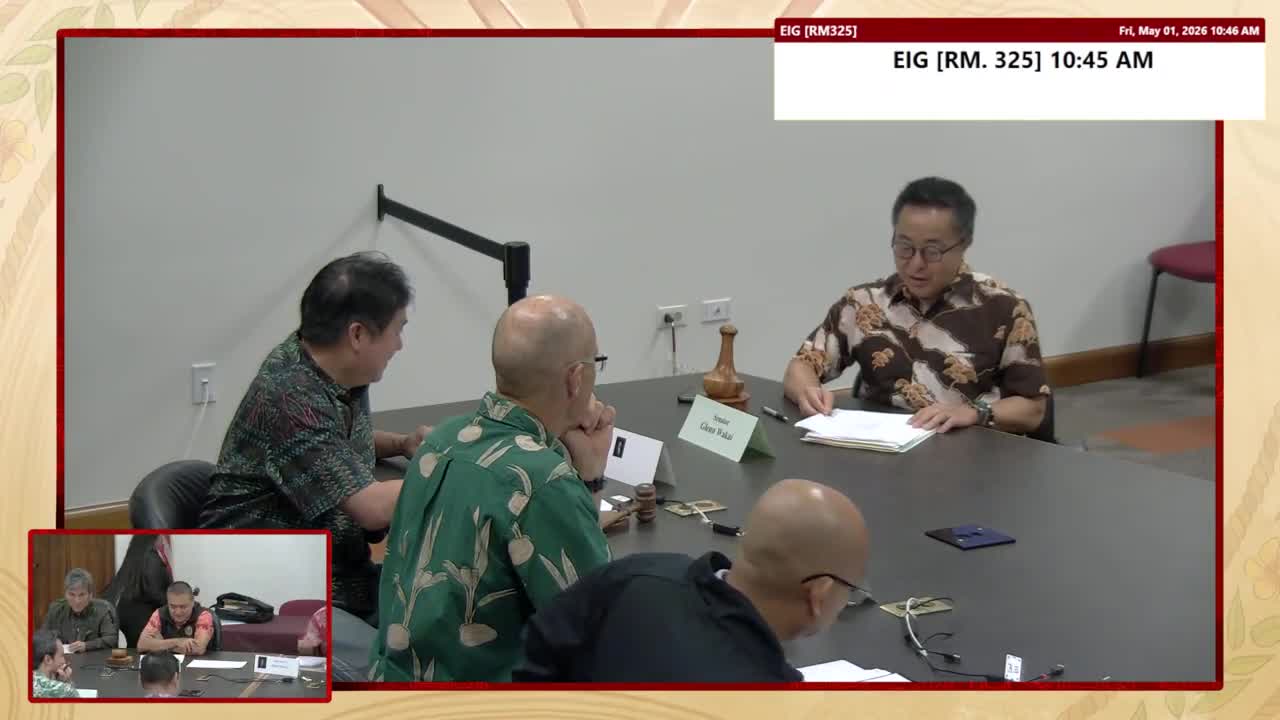 3MIN
Conference Committee
 4MIN
Conference Committee
 2MIN
Conference Committee
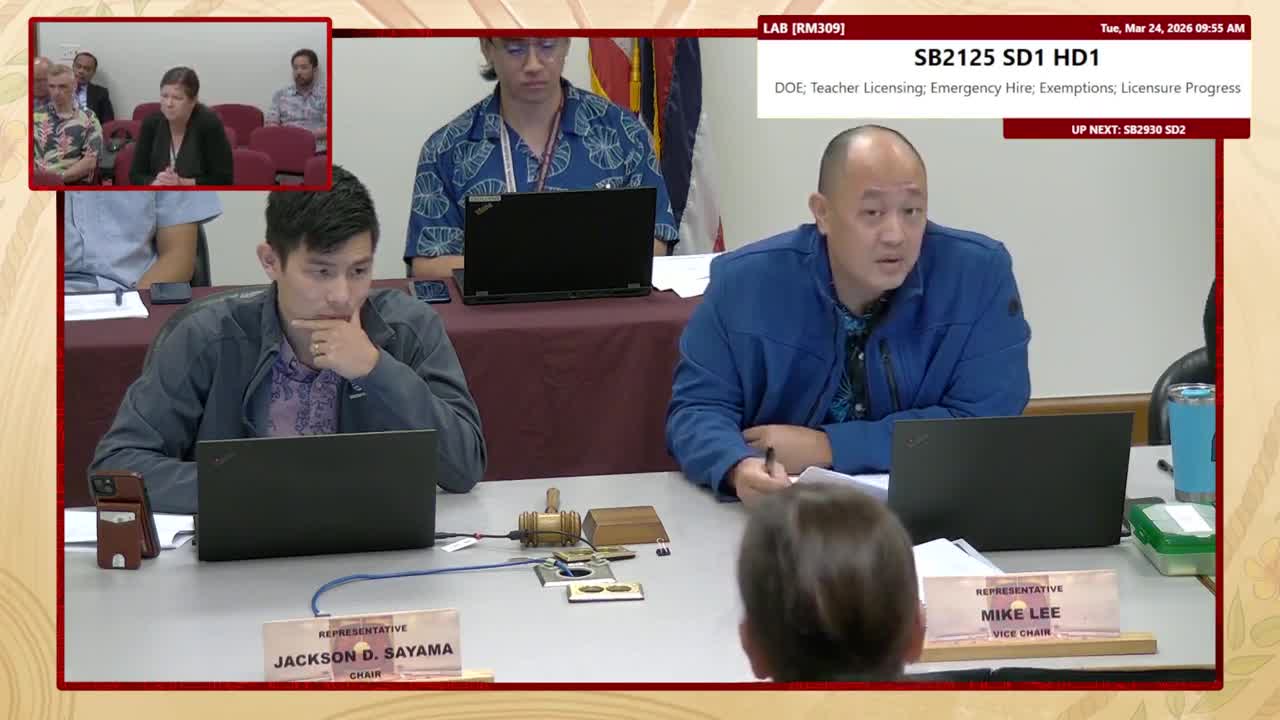 1MIN
House Standing Committee on Labor
 53SEC
House Standing Committee on Labor
 52SEC
House Standing Committee on Economic Development & Technology
 1MIN
House Standing Committee on Economic Development & Technology
 13SEC
Senate Standing Committee on Ways and Means
Bill Author