HB 2455: Employment Practices; Administrative Leave of Absence; Workplace Violence
- Session Year: 2025-2026
- House: House
- Latest Version Date: 2026-03-27
Current Status:
Failed
(2026-04-23: Received notice of appointment of House conferees (Hse. Com. No. 810).)
Introduced
In Committee
First Chamber
In Committee
Second Chamber
Final Decking
Enacted
What does this bill do?
The bill requires employers to give short paid administrative leave to employees who are victims of workplace violence or credible threats at work, with employers of 50 or more required to provide up to 10 days per year and smaller employers up to 5 days. It also extends existing unpaid victim-leave protections to cover workplace violence and lets employees use the paid leave for things like getting restraining orders, meeting with police or lawyers, or addressing immediate safety risks. The bill broadens the kinds of documents workers can use to show they need leave and bans employers from retaliating when employees use these rights.
The summary is provided by generative AI which can make mistakes. For original language, please view the details in the table below.
Requires certain employers to provide administrative leave of absence for victims of workplace violence or threat of workplace violence. Expands the type of certification an employee may provide to an employer if the leave exceeds five days per calendar year. Prohibits retaliation against employees for exercising rights related to domestic violence, sexual violence, or workplace violence or threat of workplace violence. Effective 1/1/2077. (SD1)
Requires certain employers to provide administrative leave of absence for victims of workplace violence or threat of workplace violence. Expands the type of certification an employee may provide to an employer if the leave exceeds five days per calendar year. Prohibits retaliation against employees for exercising rights related to domestic violence, sexual violence, or workplace violence or threat of workplace violence. Effective 7/1/3000. (HD2)
Requires certain employers to provide administrative leave of absence for victims of workplace violence or threat of workplace violence. Expands the type of certification an employee may provide to an employer if the leave exceeds five days per calendar year. Effective 7/1/3000. (HD1)
Requires certain employers to provide unpaid and paid leave of absence for victims of workplace violence or threat of workplace violence. Expands the type of certification an employee may provide to an employer if the leave exceeds five days per calendar year.
|
HOUSE OF REPRESENTATIVES |
H.B. NO. |
2455 |
|
THIRTY-THIRD LEGISLATURE, 2026 |
H.D. 2 |
|
|
STATE OF HAWAII |
S.D. 1 |
|
|
|
|
|
|
|
||
|
|
||
A BILL FOR AN ACT
RELATING TO EMPLOYMENT PRACTICES.
BE IT ENACTED BY THE LEGISLATURE OF THE STATE OF HAWAII:
SECTION 1. The legislature finds that workplace violence, harassment, and credible threats against employees have increased across multiple sectors nationwide and in Hawaii, with educators and school-based employees experiencing a particularly acute rise in threatening and intimidating behavior in recent years.
The legislature further finds that teachers, administrators, counselors, and other school officials increasingly report being subjected to harassment, stalking, intimidation, and threats of physical harm arising out of their employment, including threats made on campus, during school‑related activities, and through work-related communications. These incidents have been widely reported and have required some employees to seek temporary restraining orders, injunctions for protection, or other legal remedies to ensure their personal safety and the safety of others in the workplace.
The legislature recognizes that while employers may take steps to address inappropriate or threatening conduct, employees who are the direct targets of workplace violence or credible threats often bear the immediate burden of protecting themselves through court proceedings, meetings with law enforcement, and consultations with attorneys or victim services organizations. These actions frequently occur during working hours and may require short-term absences from work at critical moments when safety concerns are most acute.
The legislature finds that existing law provides unpaid leave protections for victims of domestic or sexual violence but does not explicitly address workplace violence or credible threats arising in the course of employment, nor does it provide clear, limited paid leave protections to ensure that employees are not forced to choose between their personal safety and their livelihoods. This gap disproportionately affects employees in public-facing roles, including educators and school officials, who regularly interact with members of the public as part of their job duties.
The legislature further finds that allowing a reasonable amount of paid administrative leave for employees who must take immediate legal or safety‑related action in response to workplace violence or threats serves an important public purpose. Such leave supports employee safety, promotes timely access to the courts and law enforcement, reduces the risk of escalation, and helps maintain safe and stable workplaces for employees and the communities they serve.
The purpose of this Act is to clarify that employees who experience workplace violence or credible threats of workplace violence arising out of their employment are entitled to job‑protected leave, and to establish a narrowly tailored, reasonable paid administrative leave provision for safety-related legal actions, while maintaining existing safeguards, certification requirements, and employer flexibility. This Act is not intended to alter employer disciplinary authority, regulate public access to workplaces, or infringe upon lawful speech, but rather to ensure that employees facing credible threats are able to take necessary steps to protect themselves without fear of retaliation or economic harm.
SECTION 2. Section 378-72, Hawaii Revised Statutes, is amended to read as follows:
"§378-72 Leave of absence for
domestic [or], sexual, or workplace violence. (a) [An]
Except as provided in subsection (b), an employer employing fifty or
more employees shall allow an employee to take up to thirty days of unpaid
victim leave from work per calendar year, or an employer employing [not]
no more than forty-nine employees shall allow an employee to take up to
five days of unpaid leave from work per calendar year, if the employee [or
the employee's minor child] is a victim of domestic [or] violence,
sexual violence[;], or workplace violence or threat of workplace
violence, or if the employee's minor child is a victim of domestic violence or
sexual violence; provided that the leave is to either:
(1) Seek medical
attention for the employee or employee's minor child to recover from physical
or psychological injury or disability caused by domestic [or] violence,
sexual violence[;], or workplace violence or threat of workplace
violence;
(2) Obtain services from a victim services organization;
(3) Obtain psychological or other counseling;
(4) Temporarily or permanently relocate; or
(5) Take legal action,
including preparing for or participating in any civil or criminal legal
proceeding related to or resulting from the domestic [or] violence,
sexual violence, or workplace violence or threat of workplace violence,
or other actions to enhance the physical, psychological, or economic health or
safety of the employee or the employee's minor child or to enhance the safety
of those who associate with or work with the employee.
(b) An employee who is a victim of workplace violence or threat of workplace violence shall be entitled to paid administrative leave for purposes directly related to the employee's safety or pursuit of legal protection, as follows:
(1) An employer employing fifty or more employees shall provide up to ten days of paid administrative leave per calendar year; and
(2) An employer employing no more than forty-nine employees shall provide up to five days of paid administrative leave per calendar year.
(c) Paid administrative leave under subsection (b) may be used to:
(1) Seek, obtain, or prepare for a temporary restraining order, order for protection, injunction against harassment, or other court‑ordered relief;
(2) Participate in court proceedings, meetings with law enforcement, or consultations with an attorney or victim services organization related to the workplace violence or threat of workplace violence; or
(3) Take reasonable actions necessary to address an immediate safety risk arising from the workplace violence or threat of workplace violence.
[(b)] (d) An employee's absence from work that is due
to or resulting from domestic [abuse or] violence, sexual
violence, or workplace violence or threat of workplace violence against
the employee or the employee's minor child as provided in this section shall be
considered by an employer to be a justification for leave for a reasonable
period of time, not to exceed the total number of days allocable for each
category of employer under subsection (a)[.] or (b), as applicable.
["Reasonable period of
time" as used in this section means:
(1) Where due to
physical or psychological injury to or disability to the employee or employee's
minor child, the period of time determined to be necessary by the attending
health care provider, considering the condition of the employee or employee's
minor child, and the job requirements; and
(2) Where due to an
employee's need to take legal or other actions, including preparing for or
participating in any civil or criminal legal proceeding, obtaining services
from a victim services organization, or permanently or temporarily relocating,
the period of time necessary to complete the activity as determined by the
employee's or employee's minor child's attorney or advocate, court, or
personnel of the relevant victim services organization.
(c)] (e) Where an employee is a victim of domestic [or]
violence, sexual violence, or workplace violence or threat of
workplace violence and seeks leave for medical attention to recover from
physical or psychological injury or disability caused by domestic [or] violence,
sexual violence, or workplace violence or threat of workplace violence,
the employer may request that the employee provide:
(1) A certificate from a health care provider estimating the number of leave days necessary and the estimated commencement and termination dates of leave required by the employee; and
(2) [Prior to] Before
the employee's return, a medical certificate from the employee's attending
health care provider attesting to the employee's condition and approving the
employee's return to work.
[(d)] (f) Where an employee has taken [not] no
more than five calendar days of leave for non-medical reasons, the employee
shall provide certification to the employer in the form of a signed statement
within a reasonable period after the employer's request, that the employee or
the employee's minor child is a victim of domestic [or] violence,
sexual violence, or workplace violence or threat of workplace violence
and the leave is for one of the purposes enumerated in subsection (a)[.]
or (c), as applicable. If the
leave exceeds five days per calendar year, then the certification shall be
provided by one of the following methods:
(1) Certified or exemplified restraining orders, protection orders, injunctions against harassment, and documents from criminal cases;
(2) Documentation from a
victim services organization or domestic or sexual violence program, agency, or facility, including a shelter or
safe house for victims of domestic or sexual violence; [or]
(3) Documentation
from a medical professional, mental health care provider, attorney, advocate,
social worker, or member of the clergy from whom the employee or the employee's
minor child has sought assistance in relation to the domestic [or] violence,
sexual violence[.], or workplace violence or threat of
workplace violence; or
(4) Documentation including but not limited to a police report, incident report, workplace safety report, or a written statement from a court, attorney, advocate, victim services organization, or employer representative confirming that the employee reported or sought assistance related to a credible workplace threat or act of workplace violence.
[(e)] (g) If certification is required, no leave shall
be protected until a certification, as provided in this section, is provided to
the employer.
[(f)] (h) The employee shall provide the employer with
reasonable notice of the employee's intention to take the leave, unless
providing that notice is not practicable due to imminent danger to the employee
or the employee's minor child.
[(g)] (i) Nothing in this section shall be construed to
prohibit an employer from requiring an employee on victim leave to report [not]
no less than once a week to the employer on the status of the employee
and intention of the employee to return to work.
[(h)] (j) Upon return from leave under this section,
the employee shall return to the employee's original job or to a position of
comparable status and pay, without loss of accumulated service credits and
privileges[, except]; provided that nothing in this subsection
shall be construed to entitle any restored employee to the accrual of:
(1) Any seniority or employment benefits during any period of leave, unless the seniority or benefits would be provided to a similarly situated employee who was on leave due to a reason other than domestic or sexual violence; or
(2) Any right, benefit, or position of employment to which the employee would not have otherwise been entitled.
[(i)] (k) All information provided to the employer
under this section, including statements of the employee, or any other
documentation, record, or corroborating evidence, and the fact that the
employee or employee's minor child has been a victim of domestic [or] violence,
sexual violence, or workplace violence or threat of workplace violence,
or the employee has requested leave pursuant to this section, shall be
maintained in the strictest confidence by the employer, and shall not be
disclosed, except to the extent that disclosure is:
(1) Requested or consented to by the employee;
(2) Ordered by a court or administrative agency; or
(3) Otherwise required by applicable federal or state law.
[(j)] (l) Any employee denied leave by an employer in
wilful violation of this section may file a civil action against the employer
to enforce this section and recover costs, including reasonable attorney's
fees, incurred in the civil action.
(m) No employer shall discharge, threaten, coerce, discriminate against, or retaliate against an employee for exercising rights under this section related to domestic violence, sexual violence, or workplace violence or threat of workplace violence.
(n) For purposes of this section:
"Reasonable period of time" means:
(1) Where due to physical or psychological injury to or disability to the employee or employee's minor child, the period of time determined to be necessary by the attending health care provider, considering the condition of the employee or employee's minor child, and the job requirements; and
(2) Where due to an employee's need to take legal or other actions, including preparing for or participating in any civil or criminal legal proceeding, obtaining services from a victim services organization, or permanently or temporarily relocating, the period of time necessary to complete the activity as determined by the employee's or employee's minor child's attorney or advocate, court, or personnel of the relevant victim services organization.
"Workplace violence or threat of workplace violence" means any act or credible threat of physical violence, harassment, intimidation, stalking, or threatening conduct that occurs at the workplace, at a work-related location, or arises out of or in the course of employment, including conduct committed by a client, customer, student, parent, guardian, member of the public, or any other third party, that a reasonable person would perceive to pose a risk to the health or safety of the employee or others in the workplace."
SECTION 3. Statutory material to be repealed is bracketed and stricken. New statutory material is underscored.
SECTION 4. This Act shall take effect on January 1, 2077.
Report Title:
Employment Practices; Administrative Leave of Absence; Workplace Violence
Description:
Requires certain employers to provide administrative leave of absence for victims of workplace violence or threat of workplace violence. Expands the type of certification an employee may provide to an employer if the leave exceeds five days per calendar year. Prohibits retaliation against employees for exercising rights related to domestic violence, sexual violence, or workplace violence or threat of workplace violence. Effective 1/1/2077. (SD1)
The summary description of legislation appearing on this page is for informational purposes only and is not legislation or evidence of legislative intent.
|
HOUSE OF REPRESENTATIVES |
H.B. NO. |
2455 |
|
THIRTY-THIRD LEGISLATURE, 2026 |
H.D. 2 |
|
|
STATE OF HAWAII |
|
|
|
|
|
|
|
|
||
|
|
||
A BILL FOR AN ACT
RELATING TO EMPLOYMENT PRACTICES.
BE IT ENACTED BY THE LEGISLATURE OF THE STATE OF HAWAII:
SECTION 1. The legislature finds that workplace violence, harassment, and credible threats against employees have increased across multiple sectors nationwide and in Hawaii, with educators and school-based employees experiencing a particularly acute rise in threatening and intimidating behavior in recent years.
The legislature further finds that teachers, administrators, counselors, and other school officials increasingly report being subjected to harassment, stalking, intimidation, and threats of physical harm arising out of their employment, including threats made on campus, during school‑related activities, and through work-related communications. These incidents have been widely reported and have required some employees to seek temporary restraining orders, injunctions for protection, or other legal remedies to ensure their personal safety and the safety of others in the workplace.
The legislature recognizes that while employers may take steps to address inappropriate or threatening conduct, employees who are the direct targets of workplace violence or credible threats often bear the immediate burden of protecting themselves through court proceedings, meetings with law enforcement, and consultations with attorneys or victim services organizations. These actions frequently occur during working hours and may require short-term absences from work at critical moments when safety concerns are most acute.
The legislature finds that existing law provides unpaid leave protections for victims of domestic or sexual violence but does not explicitly address workplace violence or credible threats arising in the course of employment, nor does it provide clear, limited paid leave protections to ensure that employees are not forced to choose between their personal safety and their livelihoods. This gap disproportionately affects employees in public-facing roles, including educators and school officials, who regularly interact with members of the public as part of their job duties.
The legislature further finds that allowing a reasonable amount of paid administrative leave for employees who must take immediate legal or safety‑related action in response to workplace violence or threats serves an important public purpose. Such leave supports employee safety, promotes timely access to the courts and law enforcement, reduces the risk of escalation, and helps maintain safe and stable workplaces for employees and the communities they serve.
The purpose of this Act is to clarify that employees who experience workplace violence or credible threats of workplace violence arising out of their employment are entitled to job‑protected leave, and to establish a narrowly tailored, reasonable paid administrative leave provision for safety-related legal actions, while maintaining existing safeguards, certification requirements, and employer flexibility. This Act is not intended to alter employer disciplinary authority, regulate public access to workplaces, or infringe upon lawful speech, but rather to ensure that employees facing credible threats are able to take necessary steps to protect themselves without fear of retaliation or economic harm.
SECTION 2. Section 378-72, Hawaii Revised Statutes, is amended to read as follows:
"§378-72 Leave of absence for
domestic [or], sexual, or workplace violence. (a) [An]
Except as provided in subsection (b), an employer employing fifty or
more employees shall allow an employee to take up to thirty days of unpaid
victim leave from work per calendar year, or an employer employing [not]
no more than forty-nine employees shall allow an employee to take up to
five days of unpaid leave from work per calendar year, if the employee [or
the employee's minor child] is a victim of domestic [or] violence,
sexual violence[;], or workplace violence or threat of workplace
violence, or if the employee's minor child is a victim of domestic violence or
sexual violence; provided that the leave is to either:
(1) Seek medical
attention for the employee or employee's minor child to recover from physical
or psychological injury or disability caused by domestic [or] violence,
sexual violence[;], or workplace violence or threat of workplace
violence;
(2) Obtain services from a victim services organization;
(3) Obtain psychological or other counseling;
(4) Temporarily or permanently relocate; or
(5) Take legal action,
including preparing for or participating in any civil or criminal legal
proceeding related to or resulting from the domestic [or] violence,
sexual violence, or workplace violence or threat of workplace violence,
or other actions to enhance the physical, psychological, or economic health or
safety of the employee or the employee's minor child or to enhance the safety
of those who associate with or work with the employee.
(b) An employee who is a victim of workplace violence or threat of workplace violence shall be entitled to paid administrative leave for purposes directly related to the employee's safety or pursuit of legal protection, as follows:
(1) An employer employing fifty or more employees shall provide up to ten days of paid administrative leave per calendar year; and
(2) An employer employing no more than forty-nine employees shall provide up to five days of paid administrative leave per calendar year.
(c) Paid administrative leave under subsection (b) may be used to:
(1) Seek, obtain, or prepare for a temporary restraining order, order for protection, injunction against harassment, or other court‑ordered relief;
(2) Participate in court proceedings, meetings with law enforcement, or consultations with an attorney or victim services organization related to the workplace violence or threat of workplace violence; or
(3) Take reasonable actions necessary to address an immediate safety risk arising from the workplace violence or threat of violence.
[(b)] (d) An employee's absence from work that is due
to or resulting from domestic [abuse or] violence, sexual
violence, or workplace violence or threat of workplace violence against
the employee or the employee's minor child as provided in this section shall be
considered by an employer to be a justification for leave for a reasonable
period of time, not to exceed the total number of days allocable for each
category of employer under subsection (a)[.] or (b), as applicable.
["Reasonable period of
time" as used in this section means:
(1) Where due to
physical or psychological injury to or disability to the employee or employee's
minor child, the period of time determined to be necessary by the attending
health care provider, considering the condition of the employee or employee's
minor child, and the job requirements; and
(2) Where due to an
employee's need to take legal or other actions, including preparing for or
participating in any civil or criminal legal proceeding, obtaining services
from a victim services organization, or permanently or temporarily relocating,
the period of time necessary to complete the activity as determined by the
employee's or employee's minor child's attorney or advocate, court, or
personnel of the relevant victim services organization.
(c)] (e) Where an employee is a victim of domestic [or]
violence, sexual violence, or workplace violence or threat of
workplace violence and seeks leave for medical attention to recover from
physical or psychological injury or disability caused by domestic [or] violence,
sexual violence, or workplace violence or threat of workplace violence,
the employer may request that the employee provide:
(1) A certificate from a health care provider estimating the number of leave days necessary and the estimated commencement and termination dates of leave required by the employee; and
(2) [Prior to] Before
the employee's return, a medical certificate from the employee's attending
health care provider attesting to the employee's condition and approving the
employee's return to work.
[(d)] (f) Where an employee has taken [not] no
more than five calendar days of leave for non-medical reasons, the employee
shall provide certification to the employer in the form of a signed statement
within a reasonable period after the employer's request, that the employee or
the employee's minor child is a victim of domestic [or] violence,
sexual violence, or workplace violence or threat of workplace violence
and the leave is for one of the purposes enumerated in subsection (a)[.]
or (c), if applicable. If the
leave exceeds five days per calendar year, then the certification shall be
provided by one of the following methods:
(1) Certified or exemplified restraining orders, protection orders, injunctions against harassment, and documents from criminal cases;
(2) Documentation from a
victim services organization or domestic or sexual violence program, agency, or facility, including a shelter or
safe house for victims of domestic or sexual violence; [or]
(3) Documentation
from a medical professional, mental health care provider, attorney, advocate,
social worker, or member of the clergy from whom the employee or the employee's
minor child has sought assistance in relation to the domestic [or] violence,
sexual violence[.], or workplace violence or threat of
workplace violence; or
(4) Documentation including but not limited to a police report, incident report, workplace safety report, or a written statement from a court, attorney, advocate, victim services organization, or employer representative confirming that the employee reported or sought assistance related to a credible workplace threat or act of workplace violence.
[(e)] (g) If certification is required, no leave shall
be protected until a certification, as provided in this section, is provided to
the employer.
[(f)] (h) The employee shall provide the employer with
reasonable notice of the employee's intention to take the leave, unless
providing that notice is not practicable due to imminent danger to the employee
or the employee's minor child.
[(g)] (i) Nothing in this section shall be construed to
prohibit an employer from requiring an employee on victim leave to report [not]
no less than once a week to the employer on the status of the employee
and intention of the employee to return to work.
[(h)] (j) Upon return from leave under this section,
the employee shall return to the employee's original job or to a position of
comparable status and pay, without loss of accumulated service credits and
privileges, [except]; provided that nothing in this subsection
shall be construed to entitle any restored employee to the accrual of:
(1) Any seniority or employment benefits during any period of leave, unless the seniority or benefits would be provided to a similarly situated employee who was on leave due to a reason other than domestic or sexual violence; or
(2) Any right, benefit, or position of employment to which the employee would not have otherwise been entitled.
[(i)] (k) All information provided to the employer
under this section, including statements of the employee, or any other
documentation, record, or corroborating evidence, and the fact that the
employee or employee's minor child has been a victim of domestic [or] violence,
sexual violence, or workplace violence or threat of workplace violence,
or the employee has requested leave pursuant to this section, shall be
maintained in the strictest confidence by the employer, and shall not be
disclosed, except to the extent that disclosure is:
(1) Requested or consented to by the employee;
(2) Ordered by a court or administrative agency; or
(3) Otherwise required by applicable federal or state law.
[(j)] (l) Any employee denied leave by an employer in
wilful violation of this section may file a civil action against the employer
to enforce this section and recover costs, including reasonable attorney's
fees, incurred in the civil action.
(m) No employer shall discharge, threaten, coerce, discriminate against, or retaliate against an employee for exercising rights under this section related to domestic violence, sexual violence, or workplace violence or threat of workplace violence.
(n) For purposes of this section:
"Reasonable period of time" means:
(1) Where due to physical or psychological injury to or disability to the employee or employee's minor child, the period of time determined to be necessary by the attending health care provider, considering the condition of the employee or employee's minor child, and the job requirements; and
(2) Where due to an employee's need to take legal or other actions, including preparing for or participating in any civil or criminal legal proceeding, obtaining services from a victim services organization, or permanently or temporarily relocating, the period of time necessary to complete the activity as determined by the employee's or employee's minor child's attorney or advocate, court, or personnel of the relevant victim services organization.
"Workplace violence or threat of workplace violence" means any act or credible threat of physical violence, harassment, intimidation, stalking, or threatening conduct that occurs at the workplace, at a work-related location, or arises out of or in the course of employment, including conduct committed by a client, customer, student, parent, guardian, member of the public, or any other third party, that a reasonable person would perceive as posing a risk to the health or safety of the employee or others in the workplace."
SECTION 3. Statutory material to be repealed is bracketed and stricken. New statutory material is underscored.
SECTION 4. This Act shall take effect on July 1, 3000.
Report Title:
Employment Practices; Administrative Leave of Absence; Workplace Violence
Description:
Requires certain employers to provide administrative leave of absence for victims of workplace violence or threat of workplace violence. Expands the type of certification an employee may provide to an employer if the leave exceeds five days per calendar year. Prohibits retaliation against employees for exercising rights related to domestic violence, sexual violence, or workplace violence or threat of workplace violence. Effective 7/1/3000. (HD2)
The summary description of legislation appearing on this page is for informational purposes only and is not legislation or evidence of legislative intent.
|
HOUSE OF REPRESENTATIVES |
H.B. NO. |
2455 |
|
THIRTY-THIRD LEGISLATURE, 2026 |
H.D. 1 |
|
|
STATE OF HAWAII |
|
|
|
|
|
|
|
|
||
|
|
||
A BILL FOR AN ACT
RELATING TO EMPLOYMENT PRACTICES.
BE IT ENACTED BY THE LEGISLATURE OF THE STATE OF HAWAII:
SECTION 1. The legislature finds that workplace violence, harassment, and credible threats against employees have increased across multiple sectors nationwide and in Hawaii, with educators and school-based employees experiencing a particularly acute rise in threatening and intimidating behavior in recent years.
The legislature further finds that teachers, administrators, counselors, and other school officials increasingly report being subjected to harassment, stalking, intimidation, and threats of physical harm arising out of their employment, including threats made on campus, during school‑related activities, and through work-related communications. These incidents have been widely reported and have required some employees to seek temporary restraining orders, injunctions for protection, or other legal remedies to ensure their personal safety and the safety of others in the workplace.
The legislature recognizes that while employers may take steps to address inappropriate or threatening conduct, employees who are the direct targets of workplace violence or credible threats often bear the immediate burden of protecting themselves through court proceedings, meetings with law enforcement, and consultations with attorneys or victim services organizations. These actions frequently occur during working hours and may require short-term absences from work at critical moments when safety concerns are most acute.
The legislature finds that existing law provides unpaid leave protections for victims of domestic or sexual violence but does not explicitly address workplace violence or credible threats arising in the course of employment, nor does it provide clear, limited paid leave protections to ensure that employees are not forced to choose between their personal safety and their livelihoods. This gap disproportionately affects employees in public-facing roles, including educators and school officials, who regularly interact with members of the public as part of their job duties.
The legislature further finds that allowing a reasonable amount of administrative leave for employees who must take immediate legal or safety‑related action in response to workplace violence or threats serves an important public purpose. Such leave supports employee safety, promotes timely access to the courts and law enforcement, reduces the risk of escalation, and helps maintain safe and stable workplaces for employees and the communities they serve.
The purpose of this Act is to clarify that employees who experience workplace violence or credible threats of workplace violence arising out of their employment are entitled to job‑protected leave, and to establish a narrowly tailored, reasonable administrative leave provision for safety-related legal actions, while maintaining existing safeguards, certification requirements, and employer flexibility. This Act is not intended to alter employer disciplinary authority, regulate public access to workplaces, or infringe upon lawful speech, but rather to ensure that employees facing credible threats are able to take necessary steps to protect themselves without fear of retaliation or economic harm.
SECTION 2. Section 378-72, Hawaii Revised Statutes, is amended to read as follows:
"§378-72 Leave of absence for
domestic [or], sexual violence[.], or workplace
violence. (a) [An] Except as provided in
subsection (b), an employer employing fifty or more employees shall allow
an employee to take up to thirty days of unpaid victim leave from work per
calendar year, or an employer employing [not] no more than
forty-nine employees shall allow an employee to take up to five days of unpaid
leave from work per calendar year, if the employee or the employee's minor
child is a victim of domestic [or], sexual violence[;],
or workplace violence or threat of workplace violence; provided the leave
is to either:
(1) Seek medical
attention for the employee or employee's minor child to recover from physical
or psychological injury or disability caused by domestic [or],
sexual violence[;], or workplace violence or threat of workplace
violence;
(2) Obtain services from a victim services organization;
(3) Obtain psychological or other counseling;
(4) Temporarily or permanently relocate; or
(5) Take legal action,
including preparing for or participating in any civil or criminal legal
proceeding related to or resulting from the domestic [or], sexual
violence, or workplace violence or threat of workplace violence, or
other actions to enhance the physical, psychological, or economic health or
safety of the employee or the employee's minor child or to enhance the safety
of those who associate with or work with the employee.
(b) An employee who is a victim of workplace violence or threat of workplace violence shall be entitled to administrative leave for purposes directly related to the employee's safety or pursuit of legal protection, as follows:
(1) An employer employing fifty or more employees shall provide up to ten days of administrative leave per calendar year; and
(2) An employer employing no more than forty-nine employees shall provide up to five days of administrative leave per calendar year.
(c) Administrative leave under subsection (b) may be used to:
(1) Seek, obtain, or prepare for a temporary restraining order, injunction for protection, or other court‑ordered relief;
(2) Participate in court proceedings, meetings with law enforcement, or consultations with an attorney or victim services organization related to the workplace violence or threat of workplace violence; or
(3) Take reasonable actions necessary to address an immediate safety risk arising from the workplace violence or threat of violence.
[(b)] (d) An employee's absence from work that is due
to or resulting from domestic abuse [or], sexual violence, or workplace
violence or threat of workplace violence against the employee or the
employee's minor child as provided in this section shall be considered by an
employer to be a justification for leave for a reasonable period of time, not
to exceed the total number of days allocable for each category of employer
under subsection (a).
["Reasonable period of
time" as used in this section means:
(1) Where due to
physical or psychological injury to or disability to the employee or employee's
minor child, the period of time determined to be necessary by the attending
health care provider, considering the condition of the employee or employee's
minor child, and the job requirements; and
(2) Where due to an
employee's need to take legal or other actions, including preparing for or
participating in any civil or criminal legal proceeding, obtaining services
from a victim services organization, or permanently or temporarily relocating,
the period of time necessary to complete the activity as determined by the
employee's or employee's minor child's attorney or advocate, court, or
personnel of the relevant victim services organization.]
[(c)] (e) Where an employee is a victim of domestic [or],
sexual violence, or workplace violence or threat of workplace violence
and seeks leave for medical attention to recover from physical or psychological
injury or disability caused by domestic [or], sexual violence, or
workplace violence or threat of workplace violence, the employer may
request that the employee provide:
(1) A certificate from a health care provider estimating the number of leave days necessary and the estimated commencement and termination dates of leave required by the employee; and
(2) [Prior to] Before
the employee's return, a medical certificate from the employee's attending
health care provider attesting to the employee's condition and approving the
employee's return to work.
[(d)] (f) Where an employee has taken [not] no
more than five calendar days of leave for non-medical reasons, the employee
shall provide certification to the employer in the form of a signed statement
within a reasonable period after the employer's request, that the employee or
the employee's minor child is a victim of domestic [or], sexual
violence, or workplace violence or threat of workplace violence and the
leave is for one of the purposes enumerated in subsection (a)[.] or
(c), if applicable. If the leave
exceeds five days per calendar year, then the certification shall be provided
by one of the following methods:
(1) Certified or exemplified restraining orders, injunctions against harassment, and documents from criminal cases;
(2) Documentation from a
victim services organization or domestic or sexual violence program, agency, or facility, including a shelter or
safe house for victims of domestic or sexual violence; [or]
(4) Documentation including but not limited to a police report, incident report, workplace safety report, or a written statement from a court, attorney, advocate, victim services organization, or employer representative confirming that the employee reported or sought assistance related to a credible workplace threat or act of workplace violence.
[(e)] (g) If certification is required, no leave shall
be protected until a certification, as provided in this section, is provided to
the employer.
[(f)] (h) The employee shall provide the employer with
reasonable notice of the employee's intention to take the leave, unless
providing that notice is not practicable due to imminent danger to the employee
or the employee's minor child.
[(g)] (i) Nothing in this section shall be construed to
prohibit an employer from requiring an employee on victim leave to report [not]
no less than once a week to the employer on the status of the employee
and intention of the employee to return to work.
[(h)] (j) Upon return from leave under this section,
the employee shall return to the employee's original job or to a position of
comparable status and pay, without loss of accumulated service credits and
privileges, except that nothing in this subsection shall be construed to
entitle any restored employee to the accrual of:
(1) Any seniority or employment benefits during any period of leave, unless the seniority or benefits would be provided to a similarly situated employee who was on leave due to a reason other than domestic or sexual violence; or
(2) Any right, benefit, or position of employment to which the employee would not have otherwise been entitled.
[(i)] (k) All information provided to the employer
under this section, including statements of the employee, or any other
documentation, record, or corroborating evidence, and the fact that the
employee or employee's minor child has been a victim of domestic or sexual
violence or the employee has requested leave pursuant to this section, shall be
maintained in the strictest confidence by the employer, and shall not be
disclosed, except to the extent that disclosure is:
(1) Requested or consented to by the employee;
(2) Ordered by a court or administrative agency; or
(3) Otherwise required by applicable federal or state law.
[(j)] (l) Any employee denied leave by an employer in
wilful violation of this section may file a civil action against the employer
to enforce this section and recover costs, including reasonable attorney's
fees, incurred in the civil action.
(m) No employer shall discharge, threaten, coerce, discriminate against, or retaliate against an employee for exercising rights under this section related to domestic violence, sexual violence, or workplace violence or threat of workplace violence.
(n) For purposes of this section:
"Reasonable period of time" means:
(1) Where due to physical or psychological injury to or disability to the employee or employee's minor child, the period of time determined to be necessary by the attending health care provider, considering the condition of the employee or employee's minor child, and the job requirements; and
(2) Where due to an employee's need to take legal or other actions, including preparing for or participating in any civil or criminal legal proceeding, obtaining services from a victim services organization, or permanently or temporarily relocating, the period of time necessary to complete the activity as determined by the employee's or employee's minor child's attorney or advocate, court, or personnel of the relevant victim services organization.
"Workplace violence or threat of workplace violence" means any act or credible threat of physical violence, harassment, intimidation, stalking, or threatening conduct that occurs at the workplace, at a work-related location, or arises out of or in the course of employment, including conduct committed by a client, customer, student, parent, guardian, member of the public, or any other third party, that a reasonable person would perceive as posing a risk to the health or safety of the employee or others in the workplace."
SECTION 3. Statutory material to be repealed is bracketed and stricken. New statutory material is underscored.
SECTION 4. This Act shall take effect on July 1, 3000.
Report Title:
Employment Practices; Administrative Leave of Absence; Workplace Violence
Description:
Requires certain employers to provide administrative leave of absence for victims of workplace violence or threat of workplace violence. Expands the type of certification an employee may provide to an employer if the leave exceeds five days per calendar year. Effective 7/1/3000. (HD1)
The summary description of legislation appearing on this page is for informational purposes only and is not legislation or evidence of legislative intent.
|
HOUSE OF REPRESENTATIVES |
H.B. NO. |
2455 |
|
THIRTY-THIRD LEGISLATURE, 2026 |
|
|
|
STATE OF HAWAII |
|
|
|
|
|
|
|
|
||
|
|
||
A BILL FOR AN ACT
relating to employment practices.
BE IT ENACTED BY THE LEGISLATURE OF THE STATE OF HAWAII:
SECTION 1. The legislature finds that workplace violence, harassment, and credible threats against employees have increased across multiple sectors nationwide and in Hawaii, with educators and school-based employees experiencing a particularly acute rise in threatening and intimidating behavior in recent years.
The legislature further finds that teachers, administrators, counselors, and other school officials increasingly report being subjected to harassment, stalking, intimidation, and threats of physical harm arising out of their employment, including threats made on campus, during school‑related activities, and through work-related communications. These incidents have been widely reported and have required some employees to seek temporary restraining orders, injunctions for protection, or other legal remedies to ensure their personal safety and the safety of others in the workplace.
The legislature recognizes that while employers may take steps to address inappropriate or threatening conduct, employees who are the direct targets of workplace violence or credible threats often bear the immediate burden of protecting themselves through court proceedings, meetings with law enforcement, and consultations with attorneys or victim services organizations. These actions frequently occur during working hours and may require short-term absences from work at critical moments when safety concerns are most acute.
The legislature finds that existing law provides unpaid leave protections for victims of domestic or sexual violence but does not explicitly address workplace violence or credible threats arising in the course of employment, nor does it provide clear, limited paid leave protections to ensure that employees are not forced to choose between their personal safety and their livelihoods. This gap disproportionately affects employees in public-facing roles, including educators and school officials, who regularly interact with members of the public as part of their job duties.
The legislature further finds that allowing a reasonable amount of paid leave, satisfied through existing employer leave benefits, for employees who must take immediate legal or safety‑related action in response to workplace violence or threats serves an important public purpose. Such leave supports employee safety, promotes timely access to the courts and law enforcement, reduces the risk of escalation, and helps maintain safe and stable workplaces for employees and the communities they serve.
The purpose of this Act is to clarify that employees who experience workplace violence or credible threats of workplace violence arising out of their employment are entitled to job‑protected leave, and to establish a narrowly tailored, reasonable paid leave provision for safety-related legal actions, while maintaining existing safeguards, certification requirements, and employer flexibility. This Act is not intended to alter employer disciplinary authority, regulate public access to workplaces, or infringe upon lawful speech, but rather to ensure that employees facing credible threats are able to take necessary steps to protect themselves without fear of retaliation or economic harm.
SECTION 2. Section 378-72, Hawaii Revised Statutes, is amended to read as follows:
"§378-72 Leave of absence for
domestic [or], sexual violence[.], or workplace
violence. (a) [An] Except as provided in
subsection (b), an employer employing fifty or more employees shall allow
an employee to take up to thirty days of unpaid victim leave from work per
calendar year, or an employer employing [not] no more than
forty-nine employees shall allow an employee to take up to five days of unpaid
leave from work per calendar year, if the employee or the employee's minor
child is a victim of domestic [or], sexual violence[;],
or workplace violence or threat of workplace violence; provided the leave
is to either:
(1) Seek medical
attention for the employee or employee's minor child to recover from physical
or psychological injury or disability caused by domestic [or],
sexual violence[;], or workplace violence or threat of workplace
violence;
(2) Obtain services from a victim services organization;
(3) Obtain psychological or other counseling;
(4) Temporarily or permanently relocate; or
(5) Take legal action,
including preparing for or participating in any civil or criminal legal
proceeding related to or resulting from the domestic [or], sexual
violence, or workplace violence or threat of workplace violence, or
other actions to enhance the physical, psychological, or economic health or
safety of the employee or the employee's minor child or to enhance the safety
of those who associate with or work with the employee.
(b) An employee who is a victim of workplace violence or threat of workplace violence shall be entitled to paid leave for purposes directly related to the employee's safety or pursuit of legal protection, as follows:
(1) An employer employing fifty or more employees shall provide up to ten days of paid leave per calendar year; and
(2) An employer employing no more than forty-nine employees shall provide up to five days of paid leave per calendar year.
Paid leave under this subsection may be satisfied through the use of accrued sick leave, vacation leave, administrative leave, or any other paid leave authorized by the employer, and shall not require the employer to provide additional paid leave beyond existing leave benefits.
(c) Paid leave under subsection (b) may be used to:
(1) Seek, obtain, or prepare for a temporary restraining order, injunction for protection, or other court‑ordered relief;
(2) Participate in court proceedings, meetings with law enforcement, or consultations with an attorney or victim services organization related to the workplace violence or threat of workplace violence; or
(3) Take reasonable actions necessary to address an immediate safety risk arising from the workplace violence or threat of violence.
[(b)] (d) An employee's absence from work that is due
to or resulting from domestic abuse [or], sexual violence, or workplace
violence or threat of workplace violence against the employee or the
employee's minor child as provided in this section shall be considered by an
employer to be a justification for leave for a reasonable period of time, not
to exceed the total number of days allocable for each category of employer
under subsection (a).
["Reasonable period of
time" as used in this section means:
(1) Where due to
physical or psychological injury to or disability to the employee or employee's
minor child, the period of time determined to be necessary by the attending
health care provider, considering the condition of the employee or employee's
minor child, and the job requirements; and
(2) Where due to an
employee's need to take legal or other actions, including preparing for or
participating in any civil or criminal legal proceeding, obtaining services
from a victim services organization, or permanently or temporarily relocating,
the period of time necessary to complete the activity as determined by the
employee's or employee's minor child's attorney or advocate, court, or
personnel of the relevant victim services organization.]
[(c)] (e) Where an employee is a victim of domestic [or],
sexual violence, or workplace violence or threat of workplace violence
and seeks leave for medical attention to recover from physical or psychological
injury or disability caused by domestic [or], sexual violence, or
workplace violence or threat of workplace violence, the employer may
request that the employee provide:
(1) A certificate from a health care provider estimating the number of leave days necessary and the estimated commencement and termination dates of leave required by the employee; and
(2) [Prior to] Before
the employee's return, a medical certificate from the employee's attending
health care provider attesting to the employee's condition and approving the
employee's return to work.
[(d)] (f) Where an employee has taken [not] no
more than five calendar days of leave for non-medical reasons, the employee
shall provide certification to the employer in the form of a signed statement
within a reasonable period after the employer's request, that the employee or
the employee's minor child is a victim of domestic [or], sexual
violence, or workplace violence or threat of workplace violence and the
leave is for one of the purposes enumerated in subsection (a)[.] or
(c), if applicable. If the leave
exceeds five days per calendar year, then the certification shall be provided
by one of the following methods:
(1) Certified or exemplified restraining orders, injunctions against harassment, and documents from criminal cases;
(2) Documentation from a
victim services organization or domestic or sexual violence program, agency, or facility, including a shelter or
safe house for victims of domestic or sexual violence; [or]
(4) Documentation including but not limited to a police report, incident report, workplace safety report, or a written statement from a court, attorney, advocate, victim services organization, or employer representative confirming that the employee reported or sought assistance related to a credible workplace threat or act of workplace violence.
[(e)] (g) If certification is required, no leave shall
be protected until a certification, as provided in this section, is provided to
the employer.
[(f)] (h) The employee shall provide the employer with
reasonable notice of the employee's intention to take the leave, unless
providing that notice is not practicable due to imminent danger to the employee
or the employee's minor child.
[(g)] (i) Nothing in this section shall be construed to
prohibit an employer from requiring an employee on victim leave to report [not]
no less than once a week to the employer on the status of the employee
and intention of the employee to return to work.
[(h)] (j) Upon return from leave under this section,
the employee shall return to the employee's original job or to a position of
comparable status and pay, without loss of accumulated service credits and
privileges, except that nothing in this subsection shall be construed to
entitle any restored employee to the accrual of:
(1) Any seniority or employment benefits during any period of leave, unless the seniority or benefits would be provided to a similarly situated employee who was on leave due to a reason other than domestic or sexual violence; or
(2) Any right, benefit, or position of employment to which the employee would not have otherwise been entitled.
[(i)] (k) All information provided to the employer
under this section, including statements of the employee, or any other
documentation, record, or corroborating evidence, and the fact that the
employee or employee's minor child has been a victim of domestic or sexual
violence or the employee has requested leave pursuant to this section, shall be
maintained in the strictest confidence by the employer, and shall not be
disclosed, except to the extent that disclosure is:
(1) Requested or consented to by the employee;
(2) Ordered by a court or administrative agency; or
(3) Otherwise required by applicable federal or state law.
[(j)] (l) Any employee denied leave by an employer in
wilful violation of this section may file a civil action against the employer
to enforce this section and recover costs, including reasonable attorney's
fees, incurred in the civil action.
(m) No employer shall discharge, threaten, coerce, discriminate against, or retaliate against an employee for exercising rights under this section related to domestic violence, sexual violence, or workplace violence or threat of workplace violence.
(n) For purposes of this section:
"Reasonable period of time" means:
(1) Where due to physical or psychological injury to or disability to the employee or employee's minor child, the period of time determined to be necessary by the attending health care provider, considering the condition of the employee or employee's minor child, and the job requirements; and
(2) Where due to an employee's need to take legal or other actions, including preparing for or participating in any civil or criminal legal proceeding, obtaining services from a victim services organization, or permanently or temporarily relocating, the period of time necessary to complete the activity as determined by the employee's or employee's minor child's attorney or advocate, court, or personnel of the relevant victim services organization.
"Workplace violence or threat of workplace violence" means any act or credible threat of physical violence, harassment, intimidation, stalking, or threatening conduct that occurs at the workplace, at a work-related location, or arises out of or in the course of employment, including conduct committed by a client, customer, student, parent, guardian, member of the public, or any other third party, that a reasonable person would perceive as posing a risk to the health or safety of the employee or others in the workplace."
SECTION 3. Statutory material to be repealed is bracketed and stricken. New statutory material is underscored.
SECTION 4. This Act shall take effect upon its approval.
|
INTRODUCED BY: |
_____________________________ |
|
|
|
Report Title:
Employment Practices; Paid Leave of Absence; Workplace Violence
Description:
Requires certain employers to provide unpaid and paid leave of absence for victims of workplace violence or threat of workplace violence. Expands the type of certification an employee may provide to an employer if the leave exceeds five days per calendar year.
The summary description of legislation appearing on this page is for informational purposes only and is not legislation or evidence of legislative intent.
|
Date
|
Status
|
|---|---|
| Apr 23, 2026 | Received notice of appointment of House conferees (Hse. Com. No. 810). |
| Apr 22, 2026 | House Conferees Appointed: Sayama, Tarnas, Lee, M. Co-Chairs; Reyes Oda. |
| Apr 22, 2026 | Re-referred to LAB, JHA, FIN, referral sheet 32 |
| Apr 17, 2026 | Received notice of disagreement (Hse. Com. No. 780). |
| Apr 16, 2026 | House disagrees with Senate amendment (s). |
| Apr 14, 2026 | Returned from Senate (Sen. Com. No. 693) in amended form (SD 1). |
| Apr 14, 2026 | Report Adopted; Passed Third Reading. Ayes, 22; Aye(s) with reservations: none. Noes, 3 (Senator(s) Awa, DeCorte, Fevella). Excused, 0 (none). Transmitted to House. |
| Apr 10, 2026 | One Day Notice 04-14-26. |
| Apr 10, 2026 | Reported from JDC/WAM (Stand. Com. Rep. No. 3778) with recommendation of passage on Third Reading. |
| Apr 8, 2026 | The committee(s) on JDC recommend(s) that the measure be PASSED, UNAMENDED. The votes in JDC were as follows: 5 Aye(s): Senator(s) Rhoads, Gabbard, Chang, San Buenaventura, Awa; Aye(s) with reservations: none ; 0 No(es): none; and 0 Excused: none. |
| Apr 8, 2026 | The committee(s) on WAM recommend(s) that the measure be PASSED, UNAMENDED. The votes in WAM were as follows: 13 Aye(s): Senator(s) Dela Cruz, Moriwaki, DeCoite, Elefante, Hashimoto, Inouye, Kanuha, Kidani, Kim, Lee, C., Richards, Wakai, Fevella; Aye(s) with reservations: none ; 0 No(es): none; and 0 Excused: none. |
| Apr 6, 2026 | The committee(s) on JDC/WAM will hold a public decision making on 04-08-26 10:15AM; Conference Room 211 & Videoconference. |
| Mar 30, 2026 | Report adopted; Passed Second Reading, as amended (SD 1) and referred to JDC/WAM. |
| Mar 30, 2026 | Reported from LBT (Stand. Com. Rep. No. 3350) with recommendation of passage on Second Reading, as amended (SD 1) and referral to JDC/WAM. |
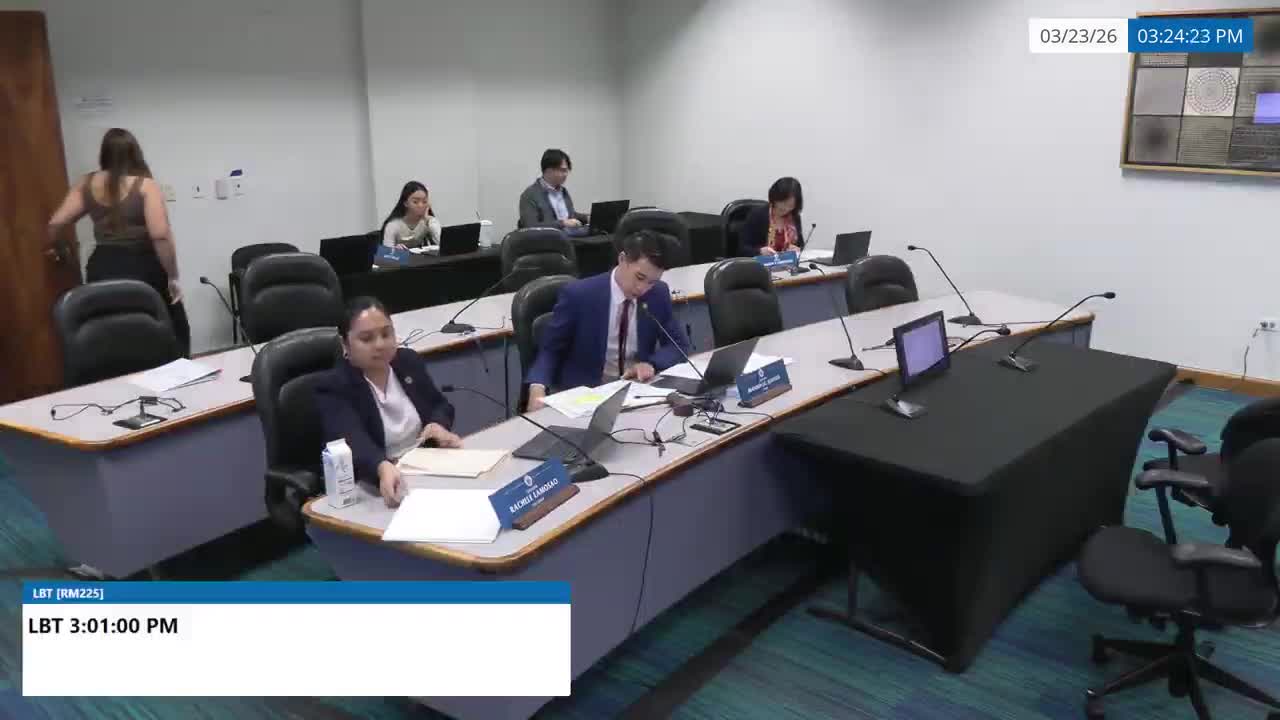
| Mar 23, 2026 | The committee(s) on LBT recommend(s) that the measure be PASSED, WITH AMENDMENTS. The votes in LBT were as follows: 3 Aye(s): Senator(s) Elefante, Lamosao, Moriwaki; Aye(s) with reservations: none ; 0 No(es): none; and 2 Excused: Senator(s) Ihara, Fevella. |
| Mar 20, 2026 | The committee(s) on LBT has scheduled a public hearing on 03-23-26 3:01PM; Conference Room 225 & Videoconference. |
| Mar 12, 2026 | Referred to LBT, JDC/WAM. |
| Mar 12, 2026 | Passed First Reading. |
| Mar 12, 2026 | Received from House (Hse. Com. No. 425). |
| Mar 10, 2026 | Passed Third Reading as amended in HD 2 with none voting aye with reservations; Representative(s) Garcia, Pierick, Shimizu voting no (3) and none excused (0). Transmitted to Senate. |
| Mar 6, 2026 | Forty-eight (48) hours notice Tuesday, 03-10-26. |
| Mar 6, 2026 | Reported from JHA (Stand. Com. Rep. No. 1154-26) as amended in HD 2, recommending passage on Third Reading. |
| Mar 3, 2026 | The committee on JHA recommend that the measure be PASSED, WITH AMENDMENTS. The votes were as follows: 9 Ayes: Representative(s) Tarnas, Poepoe, Belatti, Hashem, Kahaloa, Sayama, Takayama; Ayes with reservations: Representative(s) Garcia, Shimizu; Noes: none; and 1 Excused: Representative(s) Cochran. |
| Feb 27, 2026 | Bill scheduled to be heard by JHA on Tuesday, 03-03-26 2:00PM in House conference room 325 VIA VIDEOCONFERENCE. |
| Feb 20, 2026 | Passed Second Reading as amended in HD 1 and referred to the committee(s) on JHA with none voting aye with reservations; none voting no (0) and Representative(s) Quinlan excused (1). |
| Feb 20, 2026 | Reported from LAB (Stand. Com. Rep. No. 629-26) as amended in HD 1, recommending passage on Second Reading and referral to JHA. |
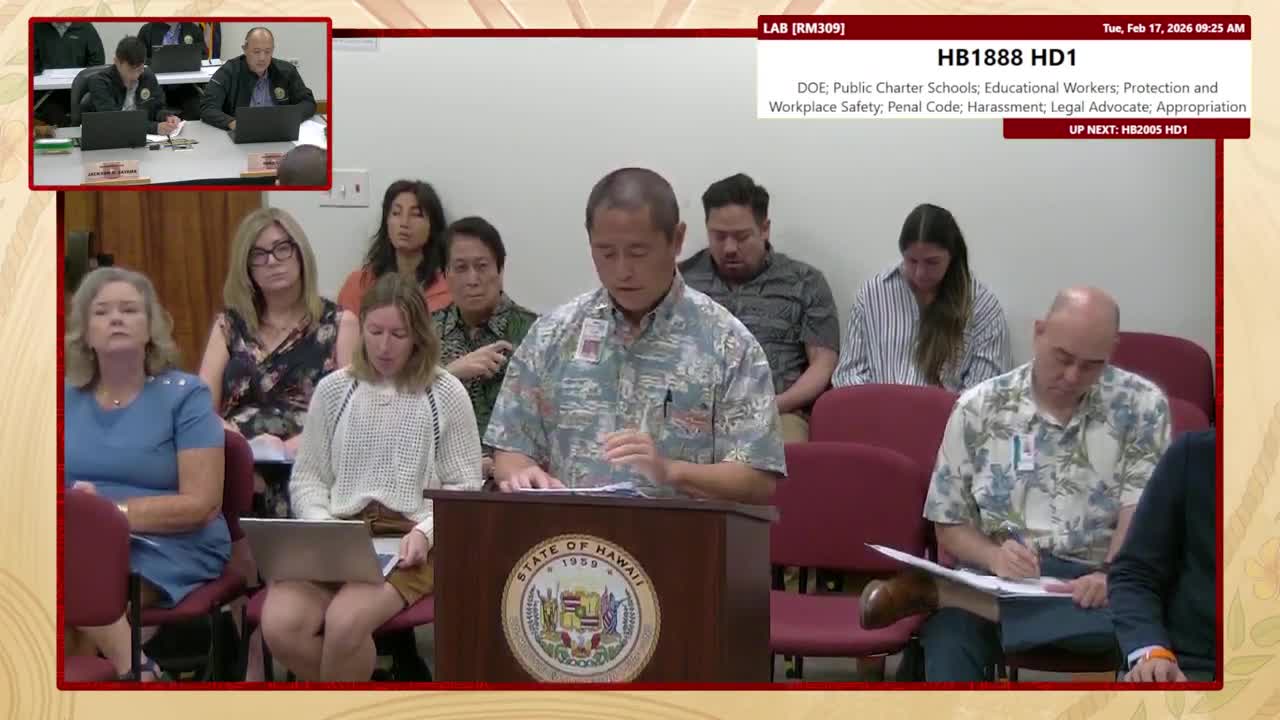
| Feb 17, 2026 | The committee on LAB recommend that the measure be PASSED, WITH AMENDMENTS. The votes were as follows: 6 Ayes: Representative(s) Sayama, Lee, M., Garrett, Kapela, Kong, Reyes Oda; Ayes with reservations: none; Noes: none; and Excused: none. |
| Feb 13, 2026 | Bill scheduled to be heard by LAB on Tuesday, 02-17-26 9:00AM in House conference room 309 VIA VIDEOCONFERENCE. |
| Feb 2, 2026 | Referred to LAB, JHA, referral sheet 6 |
| Jan 28, 2026 | Introduced and Pass First Reading. |
| Jan 27, 2026 | Pending introduction. |
|
Date
|
Description
|
Location
|
Votes
|
|
|---|---|---|---|---|
| Apr 14, 2026 | Third Reading | Senate Floor |
Passed |
|
| Apr 8, 2026 | The committee(s) on JDC recommend(s) that the measure be PASSED, UNAMENDED | Senate Standing Committee on Judiciary |
Passed |
|
| Apr 8, 2026 | The committee(s) on WAM recommend(s) that the measure be PASSED, UNAMENDED | Senate Standing Committee on Ways and Means |
Passed |
|
| Mar 23, 2026 | The committee(s) on LBT recommend(s) that the measure be PASSED, WITH AMENDMENTS | Senate Standing Committee on Labor and Technology |
Passed |
|
| Mar 10, 2026 | Third Reading | House Floor |
Passed |
|
| Mar 3, 2026 | The committee on JHA recommend that the measure be PASSED, WITH AMENDMENTS | House Standing Committee on Judiciary & Hawaiian Affairs |
Passed |
|
| Feb 17, 2026 | The committee on LAB recommend that the measure be PASSED, WITH AMENDMENTS | House Standing Committee on Labor |
Passed |
This list shows positions taken on this bill by organizations on the date displayed, which is linked to the original source.
Positions by individuals are not included.
|
Organization
|
Position
|
Date
|
|---|---|---|
| Af3irm Hawaiʻi | *** Support | Mar 23, 2026 |
| Bargaining Units 1 and 10 | *** Support | Apr 7, 2026 |
| Fujiwara & Rosenbaum, LLLC | ** Support | |
| Hawaii Government Employees Association (AFSCME Local 152) | *** Support | Apr 7, 2026 |
| Hawaii State Commission on the Status of Women | *** Support | Apr 7, 2026 |
| Hawaii State Democratic Women's Caucus | ** Support | |
| Hawaii State Department of Education | *** Support | Apr 7, 2026 |
| Hawaiʻi State Teachers Association | ** Support | |
| Hawaiʻi Women Lawyers | ** Support | |
| Hawaiʻi State Teachers Association | *** Support | Apr 7, 2026 |
| Sex Abuse Treatment Center (Kapiʻolani Medical Center for Women & Children) | *** Support | Mar 23, 2026 |
| United Public Workers | *** Support | Mar 23, 2026 |
| UNITED PUBLIC WORKERS (UPW) | *** Support | Apr 7, 2026 |
| University of Hawaii Professional Assembly | *** Support | Apr 7, 2026 |
STAND. COM. REP. NO. 1154-26
Honolulu, Hawaii
, 2026
RE: H.B. No. 2455
H.D. 2
Honorable Nadine K. Nakamura
Speaker, House of Representatives
Thirty-Third State Legislature
Regular Session of 2026
State of Hawaii
Madame:
Your Committee on Judiciary & Hawaiian Affairs, to which was referred H.B. No. 2455, H.D. 1, entitled:
"A BILL FOR AN ACT RELATING TO EMPLOYMENT PRACTICES,"
begs leave to report as follows:
The purpose of this measure is to:
(1) Require certain employers to provide administrative leave of absence for victims of workplace violence or threat of workplace violence; and
(2) Expand the type of certification an employee may provide to an employer if the leave exceeds five days.
Your Committee received testimony in support of this measure from the Department of Education; Hawaii State Commission on the Status of Women; Hawaiʻi State Teachers Association; Hawaiʻi Women Lawyers; University of Hawaii Professional Assembly; Hawaii Government Employees Association, AFSCME Local 152, AFL-CIO; AF3IRM Hawaiʻi; United Public Workers, AFSCME Local 646, AFL-CIO; Fujiwara & Rosenbaum, LLLC; and six individuals. Your Committee received comments on this measure from the Department of the Attorney General.
Your Committee finds that workplace violence, harassment, and credible threats against employees have increased in recent years and as a result, employees have had to seek temporary restraining orders, injunctions for protection, or other legal remedies. This measure establishes a narrowly tailored administrative leave provision to ensure that employees are able to take necessary legal steps to ensure their safety and the safety of others.
Your Committee has amended this measure by:
(1) Clarifying that the workplace violence provisions apply to an employee and not to the employee's child;
(2) Specifying that an employee who is a victim of workplace violence or threat of workplace violence shall be entitled to paid administrative leave for purposes directly related to the employee's safety or pursuit of legal protection; and
(3) Making technical, nonsubstantive amendments for the purposes of clarity, consistency, and style.
As affirmed by the record of votes of the members of your Committee on Judiciary & Hawaiian Affairs that is attached to this report, your Committee is in accord with the intent and purpose of H.B. No. 2455, H.D. 1, as amended herein, and recommends that it pass Third Reading in the form attached hereto as H.B. No. 2455, H.D. 2.
Respectfully submitted on behalf of the members of the Committee on Judiciary & Hawaiian Affairs,
|
|
|
____________________________ DAVID A. TARNAS, Chair |
|
|
|
|
STAND. COM. REP. NO. 629-26
Honolulu, Hawaii
, 2026
RE: H.B. No. 2455
H.D. 1
Honorable Nadine K. Nakamura
Speaker, House of Representatives
Thirty-Third State Legislature
Regular Session of 2026
State of Hawaii
Madame:
Your Committee on Labor, to which was referred H.B. No. 2455 entitled:
"A BILL FOR AN ACT RELATING TO EMPLOYMENT PRACTICES,"
begs leave to report as follows:
The purpose of this measure is to:
(1) Require certain employers to provide unpaid and paid leave for employees who experience workplace violence or credible threats of workplace violence; and
(2) Expand the type of certification an employee may provide to an employer if the leave exceeds five days per calendar year.
Your Committee received testimony in support of this measure from the Department of Education; Hawaii State Commission on the Status of Women; United Public Workers, AFSCME Local 646, AFL-CIO; Hawaiʻi State Teachers Association; University of Hawaii Professional Assembly; Hawaii Women Lawyers; Hawaii State Democratic Women's Caucus; and two individuals. Your Committee received comments on this measure from one individual.
Your Committee finds that incidents of workplace violence, harassment, and credible threats against employees have increased in Hawaii, particularly among public facing workers. Employees who experience such threats must often seek court-ordered protection, meet with law enforcement, or take other immediate safety related actions during work hours, yet existing law does not clearly provide job-protected or paid leave to support these urgent needs. Your Committee believes that establishing limited, reasonable paid and unpaid leave for employees responding to workplace violence will improve workplace safety, support timely access to legal remedies, and help ensure that employees are not forced to choose between personal safety and economic security.
Your Committee has amended this measure by:
(1) Specifying that an employee who is a victim of workplace violence or threat of workplace violence shall be entitled to administrative leave, rather than employee accrued leave;
(2) Changing the effective date to July 1, 3000, to encourage further discussion; and
(3) Making technical, nonsubstantive amendments for the purposes of clarity, consistency, and style.
As affirmed by the record of votes of the members of your Committee on Labor that is attached to this report, your Committee is in accord with the intent and purpose of H.B. No. 2455, as amended herein, and recommends that it pass Second Reading in the form attached hereto as H.B. No. 2455, H.D. 1, and be referred to your Committee on Judiciary & Hawaiian Affairs.
Respectfully submitted on behalf of the members of the Committee on Labor,
|
|
|
____________________________ JACKSON D. SAYAMA, Chair |
|
Date
|
Testimony PDF
|
|---|---|
| Apr 7, 2026 | HB2455_SD1_TESTIMONY_WAM-JDC_04-08-26_.PDF |
| Mar 23, 2026 | HB2455_HD2_TESTIMONY_LBT_03-23-26_.PDF |
| Mar 3, 2026 | HB2455_HD1_TESTIMONY_JHA_03-03-26_.PDF |
| Feb 17, 2026 | HB2455_TESTIMONY_LAB_02-17-26_.PDF |
Discussed in Hearing
 1MIN
Senate Standing Committee on Commerce and Consumer Protection
1MIN
Senate Standing Committee on Labor and Technology
 52SEC
Senate Standing Committee on Commerce and Consumer Protection
52SEC
Senate Standing Committee on Labor and Technology
 4MIN
House Standing Committee on Judiciary & Hawaiian Affairs
 1MIN
House Standing Committee on Judiciary & Hawaiian Affairs
 2MIN
House Standing Committee on Education
 1MIN
House Standing Committee on Labor
Bill Author