HB 1972: Kupuna Caucus; DOTAX; Family Caregiver Tax Credit; Report; Appropriation
- Session Year: 2025-2026
- House: House
- Latest Version Date: 2026-03-24
Current Status:
Failed
(2026-05-01: Conference Committee Meeting will reconvene on Friday 05-01-26 5:20PM in conference room 329.)
Introduced
In Committee
First Chamber
In Committee
Second Chamber
Final Decking
Enacted
Establishes a family caregiver tax credit for nonpaid family caregivers. Requires the Department of Taxation to submit annual reports to the Legislature. Appropriates funds. Applies to taxable years beginning after 12/31/2026. Effective 1/1/2050. (SD1)
Establishes a family caregiver tax credit for nonpaid family caregivers. Requires the Department of Taxation to submit annual reports to the Legislature. Appropriates funds. Applies to taxable years beginning after 12/31/2026. Effective 7/1/3000. (HD2)
Establishes a family caregiver tax credit for nonpaid family caregivers. Requires the Department of Taxation to submit annual reports to the Legislature. Appropriates funds. Applies to taxable years beginning after 12/31/2026. Effective 7/1/3000. (HD1)
Establishes a family caregiver tax credit for nonpaid family caregivers. Requires the Department of Taxation to submit annual reports to the Legislature. Appropriates moneys. The tax credit applies to taxable years beginning after 12/31/2026.
|
HOUSE OF REPRESENTATIVES |
H.B. NO. |
1972 |
|
THIRTY-THIRD LEGISLATURE, 2026 |
H.D. 2 |
|
|
STATE OF HAWAII |
S.D. 1 |
|
|
|
|
|
|
|
||
|
|
||
A BILL FOR AN ACT
RELATING TO TAXATION.
BE IT ENACTED BY THE LEGISLATURE OF THE STATE OF HAWAII:
Family caregivers provide more than $2,600,000,000 in unpaid care each year in Hawaii, helping adult family members live independently at home and in their communities. Caregiving services can range from managing personal finances and transporting for medical visits to providing twenty-four-hour supervision and assisting with bathing, toileting, and dressing so that their loved ones are not prematurely institutionalized and can remain in their homes.
The legislature further finds that nonpaid family caregivers face many physical, emotional, and financial challenges and often balance caregiving with work and other personal responsibilities. A 2021 national study found that, on average, family caregivers spend twenty-six per cent of their income on caregiving services; nearly eight in ten caregivers report having routine out-of-pocket expenses related to caregiving; and that these out-of-pocket expenses average $7,242 per year. The legislature believes that the demands on family caregivers are not isolated family issues and that the State should assist in the delivery of meaningful support and solutions for those who provide unpaid long-term care services in the State.
Accordingly, the purpose of this Act is to establish a nonrefundable tax credit for nonpaid family caregivers.
SECTION 2. Chapter 235, Hawaii Revised Statutes, is amended by adding a new section to be appropriately designated and to read as follows:
"§235- Family caregiver tax credit. (a) Each eligible taxpayer subject to the tax imposed by this chapter may claim a family caregiver tax credit against the taxpayer's individual net income tax liability, if any, imposed by this chapter for the taxable year in which the credit is properly claimed.
(b) The family caregiver tax credit shall be equal to seventy-five per cent of the qualified expenses of the eligible taxpayer, up to a maximum of $3,000 in any taxable year; provided that married individuals who do not file a joint tax return shall only be entitled to claim the tax credit to the extent that they would have been entitled to claim the tax credit had they filed a joint return.
(c) An eligible taxpayer may claim the tax credit for every taxable year or part thereof in which the eligible taxpayer:
(1) Provides care to a care recipient;
(2) Has personally incurred uncompensated expenses directly related to the care of a care recipient; and
(3) Has not claimed the care recipient as a dependent for the purpose of a tax deduction in the same taxable year.
(d) Only one eligible taxpayer per household may claim a tax credit under this section for any care recipient cared for in a taxable year. Only one tax credit under this section shall be claimed by an eligible taxpayer in any one taxable year, regardless of the number of care recipients receiving care from the eligible taxpayer.
(e) The director of taxation:
(1) Shall prepare any forms that may be necessary to claim a tax credit under this section;
(2) May require the taxpayer to furnish reasonable information to ascertain the validity of the claim for the tax credit made under this section, including a letter from a licensed health care provider confirming that the care recipient meets the criteria of the definition of that term in subsection (i); and
(3) Shall adopt rules pursuant to chapter 91 necessary to carry out this section.
(f) The credit authorized by this section shall not be used to reduce the tax liability of the taxpayer to less than $0. If the tax credit under this section exceeds the taxpayer's net income tax liability, the excess of the credit over liability shall not be carried over to subsequent years. All claims for the tax credit under this section, including amended claims, shall be filed on or before the end of the twelfth month following the close of the taxable year for which the credit may be claimed. Failure to comply with the foregoing provision shall constitute a waiver of the right to claim the credit.
(g) A taxpayer shall not claim qualified expenses under this section that are claimed as expenses for household and dependent care services necessary for gainful employment under section 235-55.6.
(h) The department of taxation shall submit a report to the legislature no later than twenty days prior to the convening of each regular session on the number of eligible taxpayers claiming the tax credit and the total cost of the tax credit under this section to the State during the preceding taxable year.
(i) For the purposes of this section:
"Activities of daily living" has the same meaning as defined in section 349-16.
"Care recipient" means an individual who:
(1) Is a citizen of the United States or a qualified alien; provided that for the purposes of this paragraph, "qualified alien" means a lawfully admitted permanent resident under the Immigration and Nationality Act;
(2) Does not reside in a long-term care facility, such as an intermediate care facility, assisted living facility, skilled nursing facility, hospital, adult foster home, community care foster family home, adult residential care home, expanded adult residential care home, or developmental disabilities domiciliary home; and
(3) Has an impairment in at least one of the following:
(A) Two activities of daily living;
(B) Two instrumental activities of daily living;
(C) One activity of daily living and one instrumental activity of daily living; or
(D) Substantive cognitive impairment requiring substantial supervision because the individual behaves in a manner that poses a serious health or safety hazard to the individual or another person.
"Care recipient" includes a person with a disability, as disability is defined under section 515-2.
"Eligible taxpayer" means any relative of a care recipient who:
(1) Has a federal adjusted gross income of $75,000 or less, or $125,000 if filing a joint tax return; and
(2) Has undertaken the care, custody, or physical assistance of the care recipient.
"Instrumental activity of daily living" has the same meaning as defined in section 349-16.
"Licensed health care provider" means a physician or an osteopathic physician licensed under chapter 453, a physician assistant licensed under chapter 453, or an advanced practice registered nurse licensed under chapter 457.
"Qualified expenses" means out-of-pocket expenses directly incurred by the eligible taxpayer in providing care to a care recipient that have not been reimbursed, credited, paid, or otherwise covered by another individual, organization, provider, or government entity. "Qualified expenses" include but are not limited to expenses for:
(1) The improvement of or alteration to the eligible taxpayer's primary residence in order to permit the care recipient to live in the residence and remain mobile, safe, and independent, including entrance ramps, safety grab bars by toilets, and the conversion of tubs to accessible showers;
(2) The purchase or lease of equipment and supplies, including but not limited to durable medical equipment and portable commodes, necessary to assist a care recipient in carrying out one or more activities of daily living;
(3) Professional home care services provided by a home care agency licensed under section 321-14.8; and
(4) Other expenses paid or incurred by the eligible taxpayer that assist the eligible taxpayer in providing care to a care recipient, such as expenditures related to:
(A) Home care aides or chore workers;
(B) Respite care;
(C) Adult day care or adult day health center services;
(D) Personal care attendants;
(E) Transportation, including but not limited to paratransit service for non-emergency medical transport;
(F) Health care equipment; and
(G) Assistive technology, including emergency alert systems and voice activated medication dispensers or reminders.
"Relative" means a spouse, child, parent, sibling, legal guardian, reciprocal beneficiary as defined in section 572C-3, partner as defined in section 572B-1, or any other person who is related to a care recipient by blood, marriage, or adoption, including a person who has a hanai or substantial familial relationship to the care recipient."
SECTION 3. There is appropriated out of the general revenues of the State of Hawaii the sum of $ or so much thereof as may be necessary for fiscal year 2026-2027 for infrastructure development and implementation of the family caregiver tax credit.
The sum appropriated shall be expended by the department of taxation for the purposes of this Act.
SECTION 4. New statutory material is underscored.
SECTION 5. This Act shall take effect on January 1, 2050; provided that:
(1) Section 2 shall apply to taxable years beginning after December 31, 2026; and
(2) Section 3 shall take effect on July 1, 2026.
Report Title:
Kupuna Caucus; DOTAX; Family Caregiver Tax Credit; Report; Appropriation
Description:
Establishes a family caregiver tax credit for nonpaid family caregivers. Requires the Department of Taxation to submit annual reports to the Legislature. Appropriates funds. Applies to taxable years beginning after 12/31/2026. Effective 1/1/2050. (SD1)
The summary description of legislation appearing on this page is for informational purposes only and is not legislation or evidence of legislative intent.
|
HOUSE OF REPRESENTATIVES |
H.B. NO. |
1972 |
|
THIRTY-THIRD LEGISLATURE, 2026 |
H.D. 2 |
|
|
STATE OF HAWAII |
|
|
|
|
|
|
|
|
||
|
|
||
A BILL FOR AN ACT
RELATING TO TAXATION.
BE IT ENACTED BY THE LEGISLATURE OF THE STATE OF HAWAII:
Family caregivers provide more than $2,600,000,000 in unpaid care each year in Hawaii, helping adult family members live independently at home and in their communities. Caregiving services can range from managing personal finances and transporting for medical visits to providing twenty-four-hour supervision and assisting with bathing, toileting, and dressing so that their loved ones are not prematurely institutionalized and can remain in their homes.
The legislature further finds that nonpaid family caregivers face many physical, emotional, and financial challenges and often balance caregiving with work and other personal responsibilities. A 2021 national study found that, on average, family caregivers spend twenty-six per cent of their income on caregiving services; nearly eight in ten caregivers report having routine out-of-pocket expenses related to caregiving; and that these out-of-pocket expenses average $7,242 per year. The legislature believes that the demands on family caregivers are not isolated family issues and that the State should assist in the delivery of meaningful support and solutions for those that provide unpaid long-term care services in the State.
Accordingly, the purpose of this Act is to establish a nonrefundable tax credit for nonpaid family caregivers.
SECTION 2. Chapter 235, Hawaii Revised Statutes, is amended by adding a new section to be appropriately designated and to read as follows:
"§235- Family caregiver tax credit. (a) Each eligible taxpayer subject to the tax imposed by this chapter may claim a family caregiver tax credit against the taxpayer's individual net income tax liability, if any, imposed by this chapter for the taxable year in which the credit is properly claimed.
(b) The family caregiver tax credit shall be equal to seventy-five per cent of the qualified expenses of the eligible taxpayer, up to a maximum of $3,000 in any taxable year; provided that married individuals who do not file a joint tax return shall only be entitled to claim the tax credit to the extent that they would have been entitled to claim the tax credit had they filed a joint return.
(c) An eligible taxpayer may claim the tax credit for every taxable year or part thereof that the eligible taxpayer:
(1) Provides care to a care recipient during the taxable year;
(2) Has personally incurred uncompensated expenses directly related to the care of a care recipient; and
(3) Has not claimed the care recipient as a dependent for the purpose of a tax deduction in the same taxable year.
(d) Only one eligible taxpayer per household may claim a tax credit under this section for any care recipient cared for in a taxable year. Only one tax credit under this section shall be claimed by an eligible taxpayer in any one taxable year, regardless of the number of care recipients receiving care from the eligible taxpayer.
(e) The director of taxation:
(1) Shall prepare any forms that may be necessary to claim a tax credit under this section;
(2) May require the taxpayer to furnish reasonable information to ascertain the validity of the claim for the tax credit made under this section, including a letter from a licensed health care provider confirming that the care recipient meets the criteria of the definition of that term in subsection (i); and
(3) Shall adopt rules pursuant to chapter 91 necessary to carry out this section.
(f) The credit authorized by this section shall not be used to reduce the tax liability of the taxpayer to less than $0. If the tax credit under this section exceeds the taxpayer's net income tax liability, the excess of the credit over liability shall not be carried over to subsequent years. All claims for the tax credit under this section, including amended claims, shall be filed on or before the end of the twelfth month following the close of the taxable year for which the credit may be claimed. Failure to comply with the foregoing provision shall constitute a waiver of the right to claim the credit.
(g) A taxpayer shall not claim qualified expenses under this section that are claimed as expenses for household and dependent care services necessary for gainful employment under section 235-55.6.
(h) The department of taxation shall submit a report to the legislature no later than twenty days prior to the convening of each regular session on the number of eligible taxpayers claiming the tax credit and the total cost of the tax credit under this section to the State during the preceding taxable year.
(i) For the purposes of this section:
"Activities of daily living" has the same meaning as defined in section 349-16.
"Care recipient" means an individual who:
(1) Is a citizen of the United States or a qualified alien; provided that for the purposes of this paragraph, "qualified alien" means a lawfully admitted permanent resident under the Immigration and Nationality Act;
(2) Does not reside in a long-term care facility, such as an intermediate care facility, assisted living facility, skilled nursing facility, hospital, adult foster home, community care foster family home, adult residential care home, expanded adult residential care home, or developmental disabilities domiciliary home; and
(3) Has impairments of at least one of the following:
(A) Two activities of daily living;
(B) Two instrumental activities of daily living;
(C) One activity of daily living and one instrumental activity of daily living; or
(D) Substantive cognitive impairment requiring substantial supervision because the individual behaves in a manner that poses a serious health or safety hazard to the individual or another person.
"Care recipient" includes a person with a disability, as disability is defined under section 515-2.
"Eligible taxpayer" means any relative of a care recipient who:
(1) Has a federal adjusted gross income of $75,000 or less, or $125,000 if filing a joint tax return; and
(2) Has undertaken the care, custody, or physical assistance of the care recipient.
"Instrumental activity of daily living" has the same meaning as defined in section 349-16.
"Licensed health care provider" means a physician or an osteopathic physician licensed under chapter 453, a physician assistant licensed under chapter 453, or an advanced practice registered nurse licensed under chapter 457.
"Qualified expenses" means out-of-pocket expenses directly incurred by the eligible taxpayer in providing care to a care recipient that have not been reimbursed, credited, paid, or otherwise covered by another individual, organization, provider, or government entity. "Qualified expenses" include but are not limited to:
(1) The improvement of or alteration to the eligible taxpayer's primary residence in order to permit the care recipient to live in the residence and remain mobile, safe, and independent, including entrance ramps, safety grab bars by toilets, and the conversion of tubs to accessible showers;
(2) The purchase or lease of equipment and supplies, including but not limited to durable medical equipment and portable commodes, necessary to assist a care recipient in carrying out one or more activities of daily living; and
(3) Other expenses paid or incurred by the eligible taxpayer that assist the eligible taxpayer in providing care to a care recipient, such as expenditures related to:
(A) Home care aides or chore workers;
(B) Respite care;
(C) Adult day care or adult day health center services;
(D) Personal care attendants;
(E) Transportation, including but not limited to paratransit service for non-emergency medical transport;
(F) Health care equipment; and
(G) Assistive technology, including emergency alert systems and voice activated medication dispensers or reminders.
"Relative" means a spouse, child, parent, sibling, legal guardian, reciprocal beneficiary as defined in section 572C-3, partner as defined in section 572B-1, or any other person who is related to a care recipient by blood, marriage, or adoption, including a person who has a hanai or substantial familial relationship to the care recipient."
SECTION 3. There is appropriated out of the general revenues of the State of Hawaii the sum of $ or so much thereof as may be necessary for fiscal year 2026-2027 for infrastructure development and implementation of the family caregiver tax credit.
The sum appropriated shall be expended by the department of taxation for the purposes of this Act.
SECTION 4. New statutory material is underscored.
SECTION 5. This Act shall take effect on July 1, 3000; provided that:
(1) Section 2 shall apply to taxable years beginning after December 31, 2026; and
(2) Section 3 shall take effect on July 1, 2026.
Report Title:
Kupuna Caucus; DOTAX; Family Caregiver Tax Credit; Report; Appropriation
Description:
Establishes a family caregiver tax credit for nonpaid family caregivers. Requires the Department of Taxation to submit annual reports to the Legislature. Appropriates funds. Applies to taxable years beginning after 12/31/2026. Effective 7/1/3000. (HD2)
The summary description of legislation appearing on this page is for informational purposes only and is not legislation or evidence of legislative intent.
|
HOUSE OF REPRESENTATIVES |
H.B. NO. |
1972 |
|
THIRTY-THIRD LEGISLATURE, 2026 |
H.D. 1 |
|
|
STATE OF HAWAII |
|
|
|
|
|
|
|
|
||
|
|
||
A BILL FOR AN ACT
RELATING TO TAXATION.
BE IT ENACTED BY THE LEGISLATURE OF THE STATE OF HAWAII:
Family caregivers provide more than $2,600,000,000 in unpaid care each year in Hawaii, helping adult family members live independently at home and in their communities. Caregiving services can range from managing personal finances and transporting for medical visits to providing twenty-four-hour supervision and assisting with bathing, toileting, and dressing so that their loved ones are not prematurely institutionalized and can remain in their homes.
The legislature further finds that nonpaid family caregivers face many physical, emotional, and financial challenges and often balance caregiving with work and other personal responsibilities. A 2021 national study found that, on average, family caregivers spend twenty-six per cent of their income on caregiving services; nearly eight in ten caregivers report having routine out-of-pocket expenses related to caregiving; and that these out-of-pocket expenses average $7,242 per year. The legislature believes that the demands on family caregivers are not isolated family issues and that the State should assist in the delivery of meaningful support and solutions for those that provide unpaid long-term care services in the State.
Accordingly, the purpose of this Act is to establish a nonrefundable tax credit for nonpaid family caregivers.
SECTION 2. Chapter 235, Hawaii Revised Statutes, is amended by adding a new section to be appropriately designated and to read as follows:
"§235- Family caregiver tax credit. (a) Each eligible taxpayer subject to the tax imposed by this chapter may claim a family caregiver tax credit against the taxpayer's individual net income tax liability, if any, imposed by this chapter for the taxable year in which the credit is properly claimed.
(b) The family caregiver tax credit shall be equal to seventy-five per cent of the qualified expenses of the eligible taxpayer, up to a maximum of $3,000 in any taxable year; provided that married individuals who do not file a joint tax return shall only be entitled to claim the tax credit to the extent that they would have been entitled to claim the tax credit had they filed a joint return.
(c) An eligible taxpayer may claim the tax credit for every taxable year or part thereof that the eligible taxpayer:
(1) Provides care to a care recipient during the taxable year;
(2) Has personally incurred uncompensated expenses directly related to the care of a care recipient; and
(3) Has not claimed the care recipient as a dependent for the purpose of a tax deduction in the same taxable year.
(d) Only one eligible taxpayer per household may claim a tax credit under this section for any care recipient cared for in a taxable year. Only one tax credit under this section shall be claimed by an eligible taxpayer in any one taxable year, regardless of the number of care recipients receiving care from the eligible taxpayer.
(e) The director of taxation:
(1) Shall prepare any forms that may be necessary to claim a tax credit under this section;
(2) May require the taxpayer to furnish reasonable information to ascertain the validity of the claim for the tax credit made under this section, including a letter from a licensed health care provider confirming that the care recipient meets the criteria of the definition of that term in subsection (i); and
(3) Shall adopt rules pursuant to chapter 91 necessary to carry out this section.
(f) The credit authorized by this section may not be used to reduce the tax liability of the taxpayer to less than $0. If the tax credit under this section exceeds the taxpayer's net income tax liability, the excess of the credit over liability shall not be carried over to subsequent years. All claims for the tax credit under this section, including amended claims, shall be filed on or before the end of the twelfth month following the close of the taxable year for which the credit may be claimed. Failure to comply with the foregoing provision shall constitute a waiver of the right to claim the credit.
(g) A taxpayer may not claim qualified expenses under this section that are claimed as expenses for household and dependent care services necessary for gainful employment under section 235-55.6.
(h) The department of taxation shall submit a report to the legislature no later than twenty days prior to the convening of each regular session on the number of eligible taxpayers claiming the tax credit and the total cost of the tax credit under this section to the State during the preceding taxable year.
(i) For the purposes of this section:
"Activities of daily living" has the same meaning as defined in section 349-16.
"Care recipient" means an individual who:
(1) Is a citizen of the United States or a qualified alien; provided that for the purposes of this paragraph, "qualified alien" means a lawfully admitted permanent resident under the Immigration and Nationality Act;
(2) Does not reside in a long-term care facility, such as an intermediate care facility, assisted living facility, skilled nursing facility, hospital, adult foster home, community care foster family home, adult residential care home, expanded adult residential care home, or developmental disabilities domiciliary home; and
(3) Has impairments of at least one of the following:
(A) Two activities of daily living;
(B) Two instrumental activities of daily living;
(C) One activity of daily living and one instrumental activity of daily living; or
(D) Substantive cognitive impairment requiring substantial supervision because the individual behaves in a manner that poses a serious health or safety hazard to the individual or another person.
"Care recipient" includes a person with a disability, as disability is defined under section 515-2.
"Eligible taxpayer" means any relative of a care recipient who:
(1) Has a federal adjusted gross income of $75,000 or less, or $125,000 if filing a joint tax return; and
(2) Has undertaken the care, custody, or physical assistance of the care recipient.
"Instrumental activity of daily living" has the same meaning as defined in section 349-16.
"Licensed health care provider" means a physician or an osteopathic physician licensed under chapter 453, a physician assistant licensed under chapter 453, or an advanced practice registered nurse licensed under chapter 457.
"Qualified expenses" means out-of-pocket expenses directly incurred by the eligible taxpayer in providing care to a care recipient that have not been reimbursed, credited, paid, or otherwise covered by another individual, organization, provider, or government entity. "Qualified expenses" include but are not limited to:
(1) The improvement of or alteration to the eligible taxpayer's primary residence in order to permit the care recipient to live in the residence and remain mobile, safe, and independent, including entrance ramps, safety grab bars by toilets, and the conversion of tubs to accessible showers;
(2) The purchase or lease of equipment and supplies, including but not limited to durable medical equipment and portable commodes, necessary to assist a care recipient in carrying out one or more activities of daily living; and
(3) Other expenses paid or incurred by the eligible taxpayer that assists the eligible taxpayer in providing care to a care recipient, such as expenditures related to:
(A) Home care aides or chore workers;
(B) Respite care;
(C) Adult day care or adult day health center services;
(D) Personal care attendants;
(E) Transportation, including but not limited to paratransit service for non-emergency medical transport;
(F) Health care equipment; and
(G) Assistive technology, including emergency alert systems and voice activated medication dispensers or reminders.
"Relative" means a spouse, child, parent, sibling, legal guardian, reciprocal beneficiary as defined in section 572C-3, partner as defined in section 572B-1, or any other person who is related to a care recipient by blood, marriage, or adoption, including a person who has a hanai or substantial familial relationship to the care recipient."
SECTION 3. There is appropriated out of the general revenues of the State of Hawaii the sum of $100,000 or so much thereof as may be necessary for fiscal year 2026-2027 for infrastructure development and implementation of the family caregiver tax credit.
The sum appropriated shall be expended by the department of taxation for the purposes of this Act.
SECTION 4. New statutory material is underscored.
SECTION 5. This Act shall take effect on July 1, 3000; provided that:
(1) Section 2 shall apply to taxable years beginning after December 31, 2026; and
(2) Section 3 shall take effect on July 1, 2026.
Report Title:
Kupuna Caucus; DOTAX; Family Caregiver Tax Credit; Report; Appropriation
Description:
Establishes a family caregiver tax credit for nonpaid family caregivers. Requires the Department of Taxation to submit annual reports to the Legislature. Appropriates funds. Applies to taxable years beginning after 12/31/2026. Effective 7/1/3000. (HD1)
The summary description of legislation appearing on this page is for informational purposes only and is not legislation or evidence of legislative intent.
|
HOUSE OF REPRESENTATIVES |
H.B. NO. |
1972 |
|
THIRTY-THIRD LEGISLATURE, 2026 |
|
|
|
STATE OF HAWAII |
|
|
|
|
|
|
|
|
||
|
|
||
A BILL FOR AN ACT
RELATING TO TAXATION.
BE IT ENACTED BY THE LEGISLATURE OF THE STATE OF HAWAII:
Family caregivers provide more than $2,600,000,000 in unpaid care each year in Hawaii, helping adult family members live independently at home and in their communities. Caregiving services can range from managing personal finances and transporting for medical visits to providing twenty-four-hour supervision and assisting with bathing, toileting, and dressing so that their loved ones are not prematurely institutionalized and can remain in their homes.
The legislature further finds that nonpaid family caregivers face many physical, emotional, and financial challenges and often balance caregiving with work and other personal responsibilities. A 2021 national study found that, on average, family caregivers spend twenty-six per cent of their income on caregiving services; nearly eight in ten caregivers report having routine out-of-pocket expenses related to caregiving; and that these out-of-pocket expenses average $7,242 per year. The legislature believes that the demands on family caregivers are not isolated family issues and that the State should assist in the delivery of meaningful support and solutions for those that provide unpaid long-term care services in the State.
Accordingly, the purpose of this Act is to establish a nonrefundable tax credit for nonpaid family caregivers.
SECTION 2. Chapter 235, Hawaii Revised Statutes, is amended by adding a new section to be appropriately designated and to read as follows:
"§235- Family caregiver tax credit. (a) Each eligible taxpayer subject to the tax imposed by this chapter may claim a family caregiver tax credit against the taxpayer's individual net income tax liability, if any, imposed by this chapter for the taxable year in which the credit is properly claimed.
(b) The family caregiver tax credit shall be equal to the qualified expenses of the eligible taxpayer, up to a maximum of $3,000 in any taxable year; provided that married individuals who do not file a joint tax return shall only be entitled to claim the tax credit to the extent that they would have been entitled to claim the tax credit had they filed a joint return.
(c) An eligible taxpayer may claim the tax credit for every taxable year or part thereof that the eligible taxpayer:
(1) Provides care to a care recipient during the taxable year;
(2) Has personally incurred uncompensated expenses directly related to the care of a care recipient; and
(3) Has not claimed the care recipient as a dependent for the purpose of a tax deduction in the same taxable year.
(d) Only one eligible taxpayer per household may claim a tax credit under this section for any care recipient cared for in a taxable year. Only one tax credit under this section shall be claimed by an eligible taxpayer in any one taxable year, regardless of the number of care recipients receiving care from the eligible taxpayer.
(e) The director of taxation:
(1) Shall prepare any forms that may be necessary to claim a tax credit under this section;
(2) May require the taxpayer to furnish reasonable information to ascertain the validity of the claim for the tax credit made under this section, including a letter from a licensed health care provider confirming that the care recipient meets the criteria of the definition of that term in subsection (h); and
(3) Shall adopt rules pursuant to chapter 91 necessary to carry out this section.
(f) The credit authorized by this section may not be used to reduce the tax liability of the taxpayer to less than zero dollars. If the tax credit under this section exceeds the taxpayer's net income tax liability, the excess of the credit over liability shall not be carried over to subsequent years. All claims for the tax credit under this section, including amended claims, shall be filed on or before the end of the twelfth month following the close of the taxable year for which the credit may be claimed. Failure to comply with the foregoing provision shall constitute a waiver of the right to claim the credit.
(g) The department of taxation shall submit a report to the legislature no later than twenty days prior to the convening of each regular session on the number of eligible taxpayers claiming the tax credit and the total cost of the tax credit under this section to the State during the past year.
(h) For the purposes of this section:
"Activities of daily living" has the same meaning as defined in section 349-16.
"Care recipient" means an individual who:
(1) Is a citizen of the United States or a qualified alien; provided that for the purposes of this paragraph, "qualified alien" means a lawfully admitted permanent resident under the Immigration and Nationality Act;
(2) Does not reside in a long-term care facility, such as an intermediate care facility, assisted living facility, skilled nursing facility, hospital, adult foster home, community care foster family home, adult residential care home, expanded adult residential care home, or developmental disabilities domiciliary home; and
(3) Has impairments of at least one of the following:
(A) Two activities of daily living;
(B) Two instrumental activities of daily living;
(C) One activity of daily living and one instrumental activity of daily living; or
(D) Substantive cognitive impairment requiring substantial supervision because the individual behaves in a manner that poses a serious health or safety hazard to the individual or another person.
"Care recipient" includes a person with a disability, as disability is defined under section 515-2.
"Eligible taxpayer" means any relative of a care recipient who:
(1) Has a federal adjusted gross income of $75,000 or less, or $125,000 if filing a joint tax return; and
(2) Has undertaken the care, custody, or physical assistance of the care recipient.
"Instrumental activity of daily living" has the same meaning as defined in section 349-16.
"Licensed health care provider" means a physician or an osteopathic physician licensed under chapter 453, a physician assistant licensed under chapter 453, or an advanced practice registered nurse licensed under chapter 457.
"Qualified expenses" means out-of-pocket expenses directly incurred by the eligible taxpayer in providing care to a care recipient that have not been reimbursed, credited, paid, or otherwise covered by another individual, organization, provider, or government entity. "Qualified expenses" include but are not limited to:
(1) The improvement of or alteration to the eligible taxpayer's primary residence in order to permit the care recipient to live in the residence and remain mobile, safe, and independent, including entrance ramps, safety grab bars by toilets, and the conversion of tubs to accessible showers;
(2) The purchase or lease of equipment and supplies, including but not limited to durable medical equipment and portable commodes, necessary to assist a care recipient in carrying out one or more activities of daily living; and
(3) Other expenses paid or incurred by the eligible taxpayer that assists the eligible taxpayer in providing care to a care recipient, such as expenditures related to:
(A) Home care aides or chore workers;
(B) Respite care;
(C) Adult day care or adult day health center services;
(D) Personal care attendants;
(E) Transportation, including but not limited to paratransit service for non-emergency medical transport;
(F) Health care equipment; and
(G) Assistive technology, including emergency alert systems and voice activated medication dispensers or reminders.
"Relative" means a spouse, child, parent, sibling, legal guardian, reciprocal beneficiary as defined in section 572C-3, partner as defined in section 572B-1, or any other person who is related to a care recipient by blood, marriage, or adoption, including a person who has a hanai or substantial familial relationship to the care recipient."
SECTION 3. There is appropriated out of the general revenues of the State of Hawaii the sum of $3,100,000 or so much thereof as may be necessary for fiscal year 2026-2027 to be allocated as follows:
(1) $100,000 for infrastructure development and implementation of the family caregiver tax credit; and
(2) $3,000,000 for the certification of claims for tax credits under the family caregiver tax credit.
The sum appropriated shall be expended by the department of taxation for the purposes of this Act.
SECTION 4. New statutory material is underscored.
SECTION 5. This Act shall take effect upon its approval; provided that:
(1) Section 2 shall apply to taxable years beginning after December 31, 2026; and
(2) Section 3 shall take effect on July 1, 2026.
|
INTRODUCED BY: |
_____________________________ |
|
|
|
Report Title:
Kupuna Caucus; DOTAX; Family Caregiver Tax Credit; Report; Appropriation
Description:
Establishes a family caregiver tax credit for nonpaid family caregivers. Requires the Department of Taxation to submit annual reports to the Legislature. Appropriates moneys. The tax credit applies to taxable years beginning after 12/31/2026.
The summary description of legislation appearing on this page is for informational purposes only and is not legislation or evidence of legislative intent.
|
Date
|
Status
|
|---|---|
| May 1, 2026 | Conference Committee Meeting will reconvene on Friday 05-01-26 5:20PM in conference room 329. |
| Apr 30, 2026 | Conference Committee Meeting will reconvene on Friday 05-01-26 2:00PM in conference room 329. |
| Apr 29, 2026 | Conference Committee Meeting will reconvene on Thursday 04-30-26 2:00PM in conference room 329. |
| Apr 28, 2026 | Conference Committee Meeting will reconvene on Wednesday 04-29-26 2:00PM in conference room 329. |
| Apr 24, 2026 | Bill scheduled for Conference Committee Meeting on Monday, 04-27-26 2:00PM in conference room 329. |
| Apr 23, 2026 | Received notice of Senate conferees (Sen. Com. No. 725). |
| Apr 22, 2026 | Senate Conferees Appointed: McKelvey Chair; Moriwaki Co-Chair; Fevella. |
| Apr 20, 2026 | Received notice of appointment of House conferees (Hse. Com. No. 786). |
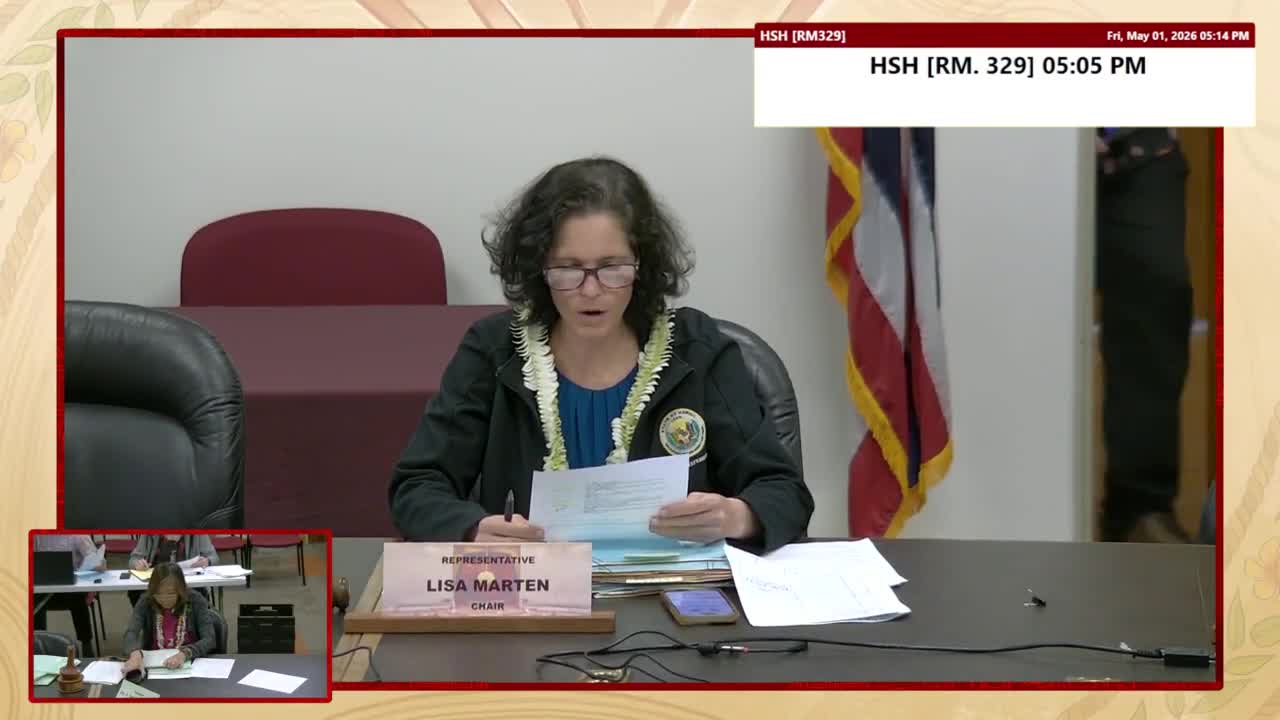
| Apr 20, 2026 | House Conferees Appointed: Marten, Ilagan, Keohokapu-Lee Loy Co-Chairs; Hartsfield, Garcia. |
| Apr 16, 2026 | Received notice of disagreement (Hse. Com. No. 599). |
| Apr 14, 2026 | House disagrees with Senate amendment (s). |
| Apr 10, 2026 | Returned from Senate (Sen. Com. No. 541) in amended form (SD 1). |
| Apr 10, 2026 | Report Adopted; Passed Third Reading. Ayes, 25; Aye(s) with reservations: none. Noes, 0 (none). Excused, 0 (none). Transmitted to House. |
| Apr 9, 2026 | One Day Notice 04-10-26. |
| Apr 9, 2026 | Reported from WAM (Stand. Com. Rep. No. 3623) with recommendation of passage on Third Reading. |
| Apr 6, 2026 | The committee(s) on WAM recommend(s) that the measure be PASSED, UNAMENDED. The votes in WAM were as follows: 12 Aye(s): Senator(s) Dela Cruz, Moriwaki, DeCoite, Elefante, Hashimoto, Inouye, Kanuha, Kidani, Kim, Richards, Wakai, Fevella; Aye(s) with reservations: none ; 0 No(es): none; and 1 Excused: Senator(s) Lee, C.. |
| Apr 1, 2026 | The committee(s) on WAM deferred the measure until 04-06-26 10:31AM; Conference Room 211 & Videoconference. |
| Mar 30, 2026 | The committee(s) on WAM will hold a public decision making on 04-01-26 10:03AM; Conference Room 211 & Videoconference. |
| Mar 25, 2026 | Report adopted; Passed Second Reading, as amended (SD 1) and referred to WAM. |
| Mar 25, 2026 | Reported from HHS (Stand. Com. Rep. No. 3190) with recommendation of passage on Second Reading, as amended (SD 1) and referral to WAM. |
| Mar 20, 2026 | The committee(s) on HHS recommend(s) that the measure be PASSED, WITH AMENDMENTS. The votes in HHS were as follows: 4 Aye(s): Senator(s) San Buenaventura, Kanuha, Keohokalole, Fevella; Aye(s) with reservations: none ; 0 No(es): none; and 1 Excused: Senator(s) McKelvey. |
| Mar 17, 2026 | The committee(s) on HHS has scheduled a public hearing on 03-20-26 1:00PM; Conference Room 225 & Videoconference. |
| Mar 10, 2026 | Referred to HHS, WAM. |
| Mar 6, 2026 | Passed First Reading. |
| Mar 6, 2026 | Received from House (Hse. Com. No. 68). |
| Mar 5, 2026 | Passed Third Reading with none voting aye with reservations; none voting no (0) and Representative(s) Perruso excused (1). Transmitted to Senate. |
| Mar 5, 2026 | Reported from FIN (Stand. Com. Rep. No. 824-26), recommending passage on Third Reading. |
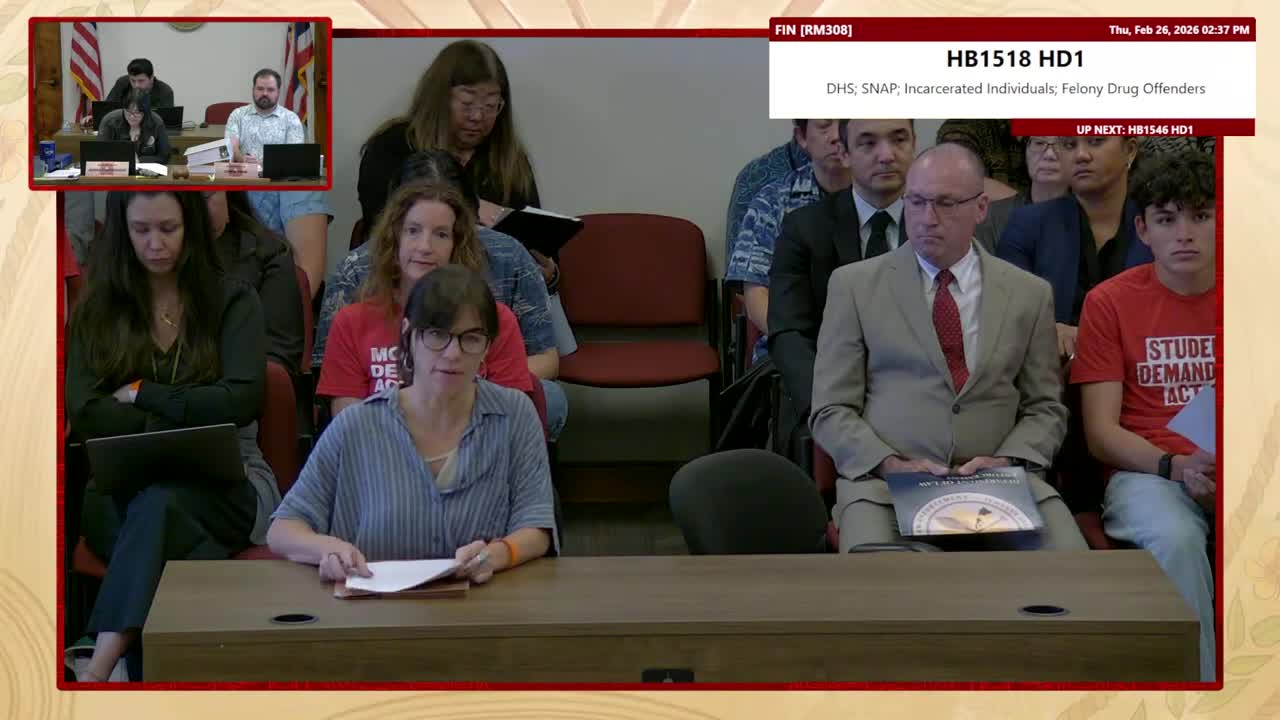
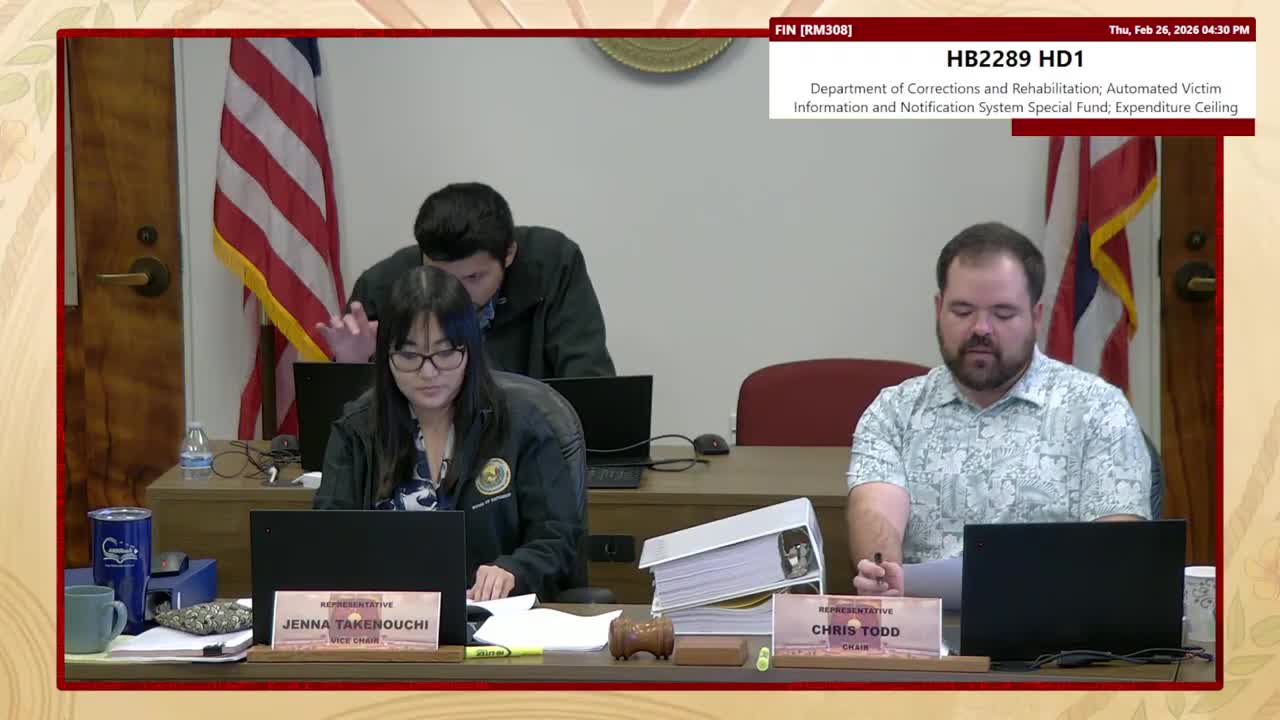
| Feb 26, 2026 | The committee on FIN recommend that the measure be PASSED, UNAMENDED. The votes were as follows: 16 Ayes: Representative(s) Todd, Takenouchi, Hartsfield, Hussey, Keohokapu-Lee Loy, Kitagawa, Kusch, Lee, M., Miyake, Morikawa, Perruso, Templo, Yamashita, Alcos, Gedeon, Reyes Oda; Ayes with reservations: none; Noes: none; and Excused: none. |
| Feb 24, 2026 | Bill scheduled to be heard by FIN on Thursday, 02-26-26 2:00PM in House conference room 308 VIA VIDEOCONFERENCE. |
| Feb 19, 2026 | Report adopted; referred to the committee(s) on FIN as amended in HD 2 with none voting aye with reservations; none voting no (0) and none excused (0). |
| Feb 19, 2026 | Reported from ECD (Stand. Com. Rep. No. 513-26) as amended in HD 2, recommending referral to FIN. |
| Feb 18, 2026 | The committee on ECD recommend that the measure be PASSED, WITH AMENDMENTS. The votes were as follows: 6 Ayes: Representative(s) Ilagan, Hussey, Tam, Templo, Yamashita, Gedeon; Ayes with reservations: none; 0 Noes: none; and 0 Excused: none. |
| Feb 12, 2026 | Bill scheduled to be heard by ECD on Wednesday, 02-18-26 9:30AM in House conference room 423 VIA VIDEOCONFERENCE. |
| Feb 11, 2026 | Passed Second Reading as amended in HD 1 and referred to the committee(s) on ECD with none voting aye with reservations; none voting no (0) and Representative(s) Holt excused (1). |
| Feb 11, 2026 | Reported from HSH (Stand. Com. Rep. No. 155-26) as amended in HD 1, recommending passage on Second Reading and referral to ECD. |
| Feb 5, 2026 | The committee on HSH recommend that the measure be PASSED, WITH AMENDMENTS. The votes were as follows: 9 Ayes: Representative(s) Marten, Olds, Amato, Hartsfield, Keohokapu-Lee Loy, Takayama, Takenouchi, Alcos, Garcia; Ayes with reservations: none; Noes: none; and Excused: none. |
| Feb 2, 2026 | Bill scheduled to be heard by HSH on Thursday, 02-05-26 9:30AM in House conference room 329 VIA VIDEOCONFERENCE. |
| Jan 28, 2026 | Referred to HSH, ECD, FIN, referral sheet 3 |
| Jan 26, 2026 | Introduced and Pass First Reading. |
| Jan 23, 2026 | Pending introduction. |
|
Date
|
Description
|
Location
|
Votes
|
|
|---|---|---|---|---|
| Apr 10, 2026 | Third Reading | Senate Floor |
Passed |
|
| Apr 6, 2026 | The committee(s) on WAM recommend(s) that the measure be PASSED, UNAMENDED | Senate Standing Committee on Ways and Means |
Passed |
|
| Mar 20, 2026 | The committee(s) on HHS recommend(s) that the measure be PASSED, WITH AMENDMENTS | Senate Standing Committee on Health and Human Services |
Passed |
|
| Mar 5, 2026 | Third Reading | House Floor |
Passed |
|
| Feb 26, 2026 | The committee on FIN recommend that the measure be PASSED, UNAMENDED | House Standing Committee on Finance |
Passed |
|
| Feb 18, 2026 | The committee on ECD recommend that the measure be PASSED, WITH AMENDMENTS | House Standing Committee on Economic Development & Technology |
Passed |
|
| Feb 5, 2026 | The committee on HSH recommend that the measure be PASSED, WITH AMENDMENTS | House Standing Committee on Human Services & Homelessness |
Passed |
This list shows positions taken on this bill by organizations on the date displayed, which is linked to the original source.
Positions by individuals are not included.
|
Organization
|
Position
|
Date
|
|---|---|---|
| AARP Hawai‘i | *** Support | Mar 31, 2026 |
| ALS Network | *** Support | Feb 26, 2026 |
| ALS Network | ** Support | |
| Alzheimer's Association - Hawaii Chapter | *** Support | Mar 20, 2026 |
| Catholic Charities Hawai‘i | *** Support | Mar 31, 2026 |
| Chamber of Commerce Hawaii | *** Support | Mar 31, 2026 |
| Disability and Communication Access Board | *** Support | Mar 31, 2026 |
| Executive Office on Aging | ** Support | |
| Hawaii Primary Care Association (HPCA) | *** Support | Mar 20, 2026 |
| Hawaii State Commission on the Status of Women | *** Support | Mar 31, 2026 |
| Hawaii Women Lawyers | *** Support | Feb 18, 2026 |
| Hawaiʻi Family Caregiver Coalition | ** Support | |
| Hawaiʻi State Council on Developmental Disabilities | *** Support | Mar 31, 2026 |
| Hawaiʻi Women Lawyers | ** Support | |
| Hawai‘i Children’s Action Network Speaks! | *** Support | Mar 31, 2026 |
| Hawai‘i Public Health Institute | *** Support | Mar 31, 2026 |
| Home Care Association Of America | ** Support | |
| Independent Living Hawaii (AILH) | *** Support | Mar 20, 2026 |
| LeadingAge Pacific West | ** Support | |
| LeadingAge Pacific West | *** Support | Mar 31, 2026 |
| Navian Hawaii | ** Support | |
| Policy Advisory Board for Elder Affairs (PABEA) | *** Support | Mar 31, 2026 |
| Research Information Services | *** Support | Mar 31, 2026 |
STAND. COM. REP. NO. 824-26
Honolulu, Hawaii
, 2026
RE: H.B. No. 1972
H.D. 2
Honorable Nadine K. Nakamura
Speaker, House of Representatives
Thirty-Third State Legislature
Regular Session of 2026
State of Hawaii
Madame:
Your Committee on Finance, to which was referred H.B. No. 1972, H.D. 2, entitled:
"A BILL FOR AN ACT RELATING TO TAXATION,"
begs leave to report as follows:
The purpose of this measure is to:
(1) Establish and appropriate funds for a family caregiver tax credit for nonpaid family caregivers; and
(2) Require the Department of Taxation to submit annual reports to the Legislature.
Your Committee received testimony in support of this measure from the Executive Office on Aging; Hawaii State Commission on the Status of Women; AARP Hawaiʻi; Hawaiʻi Family Caregiver Coalition; Alzheimer's Association Hawaii Chapter; Hawaiʻi Public Health Institute; PABEA Legislative Committee; LeadingAge Pacific West; Navian Hawaii; Hawaiʻi Children's Action Network Speaks!; Home Care Association of America; ALS Network; Hawaii Primary Care Association; and numerous individuals. Your Committee received comments on this measure from the Department of Taxation and Tax Foundation of Hawaii.
As affirmed by the record of votes of the members of your Committee on Finance that is attached to this report, your Committee is in accord with the intent and purpose of H.B. No. 1972, H.D. 2, and recommends that it pass Third Reading.
Respectfully submitted on behalf of the members of the Committee on Finance,
|
|
|
____________________________ CHRIS TODD, Chair |
|
|
|
|
STAND. COM. REP. NO. 513-26
Honolulu, Hawaii
, 2026
RE: H.B. No. 1972
H.D. 2
Honorable Nadine K. Nakamura
Speaker, House of Representatives
Thirty-Third State Legislature
Regular Session of 2026
State of Hawaii
Madame:
Your Committee on Economic Development & Technology, to which was referred H.B. No. 1972, H.D. 1, entitled:
"A BILL FOR AN ACT RELATING TO TAXATION,"
begs leave to report as follows:
Your Committee received testimony in support of this measure from the Hawaii State Commission on the Status of Women; Disability and Communication Access Board; Hawaiʻi Public Health Institute; AARP Hawaiʻi; Alzheimer's Association - Hawaii; Hawaii Family Caregiver Coalition; LeadingAge Pacific West; Hawaiʻi Children's Action Network Speaks!; Hawaii Primary Care Association; Home Care Association of America, Hawaii Chapter; Hawaiʻi Women Lawyers; and numerous individuals. Your Committee received comments on this measure from the Department of Taxation; Executive Office on Aging; and Tax Foundation of Hawaii.
Your Committee finds that family caregivers are the foundation of the long-term care system in the State. An estimated 154,000 adults in Hawaii provide unpaid care to family members or loved ones; these caregivers deliver unpaid care valued at an estimated $2,600,000,000 each year. Your Committee further finds that nonpaid family caregivers face many physical and emotional challenges and spend a significant amount of their income on caregiving services. Your Committee recognizes that the demands on family caregivers are not isolated family issues and that the State should provide financial assistance to these individuals to ensure that their contributions to the State's care system are compensated. This measure ensures that nonpaid family caregivers have a source of financial support by establishing a Family Caregiver Tax Credit.
Your Committee has amended this measure by:
(1) Changing the appropriation to an unspecified amount; and
(2) Making technical, nonsubstantive amendments for the purposes of clarity, consistency, and style.
Your Committee respectfully requests your Committee on Finance, should it deliberate on this measure, to consider an appropriation amount of $100,000.
As affirmed by the record of votes of the members of your Committee on Economic Development & Technology that is attached to this report, your Committee is in accord with the intent and purpose of H.B. No. 1972, H.D. 1, as amended herein, and recommends that it be referred to your Committee on Finance in the form attached hereto as H.B. No. 1972, H.D. 2.
Respectfully submitted on behalf of the members of the Committee on Economic Development & Technology,
|
|
|
____________________________ GREGGOR ILAGAN, Chair |
|
|
|
|
STAND. COM. REP. NO. 155-26
Honolulu, Hawaii
, 2026
RE: H.B. No. 1972
H.D. 1
Honorable Nadine K. Nakamura
Speaker, House of Representatives
Thirty-Third State Legislature
Regular Session of 2026
State of Hawaii
Madame:
Your Committee on Human Services & Homelessness, to which was referred H.B. No. 1972 entitled:
"A BILL FOR AN ACT RELATING TO TAXATION,"
begs leave to report as follows:
Your Committee received testimony in support of this measure from the Disability and Communication Access Board; Alzheimers AssociationHawaii; Hawaiʻi Children's Action Network Speaks!; AARP Hawaiʻi; Hawaiʻi Public Health Institute; Chamber of Commerce Hawaii; Hawaii Primary Care Association; Hawaii Family Caregiver Coalition; and numerous individuals. Your Committee received comments on this measure from the Department of Taxation; Executive Office on Aging; and Tax Foundation of Hawaii.
Your Committee finds that unpaid family caregivers provide essential daily support that allows many older adults and persons with disabilities to remain safely in their homes, but the financial strain of caregiving places significant pressure on household budgets and long‑term economic stability. Your Committee further finds that establishing a targeted family caregiver tax credit will help offset out‑of‑pocket caregiving costs and recognize the critical role family caregivers play in the State's long‑term care system. This measure offers financial relief to caregivers with modest incomes and strengthens the State's efforts to support aging in place.
Your Committee has amended this measure by:
(1) Making the amount of the credit equal to seventy-five percent of the taxpayer's qualified expenses;
(2) Removing the $3,000,000 appropriation as it appears to impose an aggregate cap that the Department of Taxation is unable to administer;
(3) Specifying that expenses that are used to claim the tax credit under this measure are not eligible to be claimed under the expenses for household and dependent care services necessary for gainful employment tax credit;
(4) Changing the effective date to July 1, 3000, to encourage further discussion; and
(5) Making technical, nonsubstantive amendments for the purposes of clarity, consistency, and style.
As affirmed by the record of votes of the members of your Committee on Human Services & Homelessness that is attached to this report, your Committee is in accord with the intent and purpose of H.B. No. 1972, as amended herein, and recommends that it pass Second Reading in the form attached hereto as H.B. No. 1972, H.D. 1, and be referred to your Committee on Economic Development & Technology.
Respectfully submitted on behalf of the members of the Committee on Human Services & Homelessness,
|
|
|
____________________________ LISA MARTEN, Chair |
|
Date
|
Testimony PDF
|
|---|---|
| Mar 31, 2026 | HB1972_SD1_TESTIMONY_WAM_04-01-26_.PDF |
| Mar 20, 2026 | HB1972_HD2_TESTIMONY_HHS_03-20-26_.PDF |
| Feb 26, 2026 | HB1972_HD2_TESTIMONY_FIN_02-26-26_.PDF |
| Feb 18, 2026 | HB1972_HD1_TESTIMONY_ECD_02-18-26_.PDF |
| Feb 4, 2026 | HB1972_TESTIMONY_HSH_02-05-26_.PDF |
Discussed in Hearing
 1MIN
Conference Committee
 36SEC
Conference Committee
 1MIN
Conference Committee
 1MIN
Conference Committee
 1MIN
Conference Committee
 12MIN
House Standing Committee on Finance
 20SEC
House Standing Committee on Finance
 5MIN
House Standing Committee on Economic Development & Technology
Bill Author
Bill Co-Author(s):