SB 855: DLIR; Hawaii Retirement Savings Act; Hawaii Retirement Savings Program; Covered Employer; Definition; Automatic Enrollment; Opt-Out Option
- Session Year: 2025-2026
- House: Senate
- Latest Version Date: 2025-04-25
Current Status:
In Progress
(2025-05-29: Act 113, on 05/29/2025 (Gov. Msg. No. 1213).)
Introduced
In Committee
First Chamber
In Committee
Second Chamber
Final Decking
Enacted
Clarifies the definition of "covered employer" under the Hawaii Retirement Savings Act. Requires covered employers to automatically enroll covered employees into the Hawaii Retirement Savings Program unless the employee opts out. Repeals the limit on the total fees and expenses that can be spent for the Program each year. Appropriates funds to the Department of Labor and Industrial Relations for the development and operation of the Program. Effective 7/1/2050. (SD1)
Clarifies the definition of "covered employer" under the Hawaii Retirement Savings Act. Requires covered employers to automatically enroll covered employees into the Hawaii Retirement Savings Program unless the employee chooses to opt out. Repeals the limit on the total fees and expenses that can be spent for the Program each year. Appropriates funds to the Department of Labor and Industrial Relations for the development and operation of the Program.
|
THE SENATE |
S.B. NO. |
855 |
|
THIRTY-THIRD LEGISLATURE, 2025 |
S.D. 1 |
|
|
STATE OF HAWAII |
H.D. 1 |
|
|
|
C.D. 1 |
|
|
|
||
|
|
||
A BILL FOR AN ACT
RELATING TO HAWAII RETIREMENT SAVINGS ACT.
BE IT ENACTED BY THE LEGISLATURE OF THE STATE OF HAWAII:
SECTION 1. The purpose of this Act is to:
(1) Clarify the definition of "covered employer" in the Hawaii Retirement Savings Act;
(2) Amend and align provisions of the Hawaii retirement savings program, the state-facilitated payroll‑deduction retirement savings plan for private sector employees in Hawaii who do not have access to employer-sponsored retirement plans, to require automatic enrollment unless the employee opts out; and
(3) Repeal the limit on the total fees and expenses that can be spent for the program each year.
SECTION 2. Section 389-2, Hawaii Revised Statutes, is amended by amending the definition of "covered employer" to read as follows:
""Covered employer" means any person who is in business in the State and has one or more individuals in employment. "Covered employer" does not include:
(1) The United States;
(2) The State or any of its political subdivisions; or
(3) [A
person] Any employer that
has [been maintaining] offered or maintained a retirement plan for
some or all employees [during]
at any time in the preceding two
years [a retirement plan] that is tax-qualified under or is
described in and satisfies the requirements of section 401(a), 401(k), 403(a),
403(b), 408(k), or 408(p) of the Internal Revenue Code."
SECTION 3. Section 389-4, Hawaii Revised Statutes, is amended by amending subsections (a) and (b) to read as follows:
"(a) The board shall have powers and duties in accordance with law to:
(1) Establish, implement, and maintain the program;
(2) Cause the program and arrangements and accounts established under the program to be designed, established, and operated:
(A) In accordance with best practices for retirement savings vehicles;
(B) To encourage participation, saving, sound investment practices, and appropriate selection of default investments;
(C) To maximize simplicity and ease of administration for employers;
(D) To minimize costs, including by collective investment and other measures to achieve economies of scale and other efficiencies in program design and administration;
(E) To promote portability of benefits; and
(F) To avoid preemption of the program by federal law;
(3) Arrange for collective, common, and pooled investment of assets of the program;
(4) Determine the eligibility of an employer, employee, or other individual to participate in the program;
(5) Ensure the program's compliance with all applicable laws and regulations;
(6) Establish procedures for the timely and fair resolution of participant and other disputes related to accounts or program operation;
(7) Develop and implement:
(A) An investment policy that defines the program's investment objectives and that is consistent with the objectives of the program; and
(B) Other policies and procedures consistent with those investment objectives;
(8) Cause expenses incurred to initiate, implement, maintain, and administer the program to be paid from the program and other available sources;
(9) Establish and collect application, account, and administrative fees;
(10) Accept grants, gifts, donations, legislative appropriations, loans, and other moneys from the State, any unit of federal, state, or local government, or any other person to defray the costs of administering and operating the program;
(11) Enter into contracts pursuant to chapter 103D for services that the board deems necessary to carry out the purposes of this chapter, including:
(A) Services of private and public financial institutions, depositories, consultants, actuaries, counsel, auditors, investment advisors, investment administrators, investment management firms, other investment firms, third-party administrators, other professionals and service providers;
(B) Research, technical, financial, administrative, and other services; and
(C) Services of other state agencies to assist the board in the exercise of its powers and duties;
(12) Develop and implement an outreach plan to gain input and disseminate information regarding the program and retirement savings in general;
(13) Cause moneys to be held and invested and reinvested under the program;
(14) Ensure that all contributions to individual retirement accounts under the program may be used only to:
(A) Pay benefits to participants under the program;
(B) Pay the cost of administering the program; and
(C) Make investments for the benefit of the program; provided that no assets of the program shall be transferred to the general fund of the State or to any other fund of the State or otherwise encumbered or used for any purpose other than those specified in this paragraph;
(15) Provide for the payment of costs of administration and operation of the program;
(16) Evaluate the need for and, if the board deems necessary, procure:
(A) Insurance against any and all loss in connection with the property, assets, or activities of the program; and
(B) Pooled private insurance;
(17) Indemnify, including procurement of insurance if and as needed for this purpose, each board member from personal loss or liability resulting from the member's action or inaction as a board member;
(18) Collaborate with and evaluate the role
of financial advisors or other financial professionals, including in assisting
and providing guidance for covered employees; [and]
(19) Reimburse, when appropriate, the general fund of the State of Hawaii for the initial expenses incurred for initiating, implementing, maintaining, and administering the program; and
(20) Take any other action the board deems reasonably necessary to carry out the purpose of this chapter.
(b) The board may develop and disseminate
information designed to educate covered employees about the impacts of [opting
in to] the program on take-home pay, savings strategies, and the benefits
of planning and saving for retirement to help covered employees in deciding
whether to participate and at what level participation may be
appropriate."
SECTION 4. Section 389-5, Hawaii Revised Statutes, is amended as follows:
1. By amending its title to read:
"[[]§389-5[]] Hawaii retirement savings program; due
diligence; establishment; payroll deduction [upon election to contribute]."
2. By amending subsections (d) through (f) to read:
"(d) [Any covered employee may elect to
contribute a portion of the employee's salary or wages to an individual
retirement account provided by the program through payroll deduction.] Each
covered employer shall enroll its covered employees in the program and withhold
and remit payroll deduction contributions from each covered employee's paycheck
unless the covered employee has elected not to participate.
(e) Beginning on a date to be determined by the board pursuant to subsection (a), a covered employer shall:
(1) [Allow a] Automatically
enroll covered [employee to enroll] employees into the
program after [providing] the covered employer provides the [covered
employee] employees with a written notice of the [employee's]
right of the employees to opt [in;] out; and
(2) For any covered employee who [has
opted in to] is enrolled into the program[:] and has not
opted out:
(A) Withhold the covered employee's contribution amount from the employee's salary or wages; and
(B) Transmit the covered employee's payroll deduction contribution to the program on the earliest date the amount withheld can reasonably be segregated from the covered employer's assets, but no later than the fifteenth day of the calendar month following the month in which the covered employee's contribution amounts are withheld.
(f) The program shall establish for each enrolled
employee a Roth IRA, into which the contributions deducted from [an] the
employee's payroll shall be deposited.
The board may add an option for all participants [to affirmatively
elect] to contribute to a traditional IRA in addition to or in lieu of
a Roth IRA."
SECTION 5. Section 389-7, Hawaii Revised Statutes, is amended by amending subsection (b) to read as follows:
"(b)
The program manager shall keep total fees and expenses as low as
practicable[; provided that the total fees and expenses of the program each
year shall not exceed seventy-five basis points of the total assets of the
program; provided further that this limit shall not apply during the initial
three-year period following the establishment of the program]."
SECTION 6. Section 389-14, Hawaii Revised Statutes, is amended by amending subsection (a) to read as follows:
"(a) Any covered employer who fails to enroll a covered employee into the program in accordance with section 389-5(e)(1) without equitable justification shall be liable:
(1) To the covered employee, in an amount equal to the contribution amount that would have been made by the employee into the program and interest at a rate of six per cent per year on the contribution amount, beginning from the date the contribution would have been made into the account; provided that the sum of the contribution amount and interest thereto shall be transmitted by the covered employer to the program to be paid into the covered employee's IRA; and
(2) A penalty of:
(A) $25 for each month the covered employee was not enrolled in the program; and
(B) $50 for each month the covered employee
continues to be unenrolled in the program after the date on which a penalty has
been assessed with respect to the covered employee who [had elected to
participate] should have been enrolled in the program."
SECTION 7. Statutory material to be repealed is bracketed and stricken. New statutory material is underscored.
SECTION 8. This Act shall take effect on July 1, 2025.
Report Title:
DLIR; Hawaii Retirement Savings Act; Hawaii Retirement Savings Program; Covered Employer; Definition; Automatic Enrollment; Opt-Out Option
Description:
The summary description of legislation appearing on this page is for informational purposes only and is not legislation or evidence of legislative intent.
|
THE SENATE |
S.B. NO. |
855 |
|
THIRTY-THIRD LEGISLATURE, 2025 |
S.D. 1 |
|
|
STATE OF HAWAII |
H.D. 1 |
|
|
|
|
|
|
|
||
|
|
||
A BILL FOR AN ACT
RELATING TO HAWAII RETIREMENT SAVINGS ACT.
BE IT ENACTED BY THE LEGISLATURE OF THE STATE OF HAWAII:
SECTION 1. The purpose of this Act is to:
(1) Clarify the definition of "covered employer" in the Hawaii Retirement Savings Act;
(2) Amend and align provisions of the Hawaii retirement savings program, the state-facilitated payroll‑deduction retirement savings plan for private sector employees in Hawaii who do not have access to employer-sponsored retirement plans, to require automatic enrollment unless the employee opts out;
(3) Repeal the limit on the total fees and expenses that can be spent for the program each year; and
(4) Appropriate funds for the Hawaii retirement savings program's development and operations.
SECTION 2. Section 389-2, Hawaii Revised Statutes, is amended by amending the definition of "covered employer" to read as follows:
""Covered employer" means any person who is in business in the State and has one or more individuals in employment. "Covered employer" does not include:
(1) The United States;
(2) The State or any of its political subdivisions; or
(3) [A
person] Any employer that
has [been maintaining] offered or maintained a retirement plan for
some or all employees [during]
at any time in the preceding two
years [a retirement plan] that is tax-qualified under or is
described in and satisfies the requirements of section 401(a), 401(k), 403(a),
403(b), 408(k), or 408(p) of the Internal Revenue Code."
SECTION 3. Section 389-4, Hawaii Revised Statutes, is amended by amending subsections (a) and (b) to read as follows:
"(a) The board shall have powers and duties in accordance with law to:
(1) Establish, implement, and maintain the program;
(2) Cause the program and arrangements and accounts established under the program to be designed, established, and operated:
(A) In accordance with best practices for retirement savings vehicles;
(B) To encourage participation, saving, sound investment practices, and appropriate selection of default investments;
(C) To maximize simplicity and ease of administration for employers;
(D) To minimize costs, including by collective investment and other measures to achieve economies of scale and other efficiencies in program design and administration;
(E) To promote portability of benefits; and
(F) To avoid preemption of the program by federal law;
(3) Arrange for collective, common, and pooled investment of assets of the program;
(4) Determine the eligibility of an employer, employee, or other individual to participate in the program;
(5) Ensure the program's compliance with all applicable laws and regulations;
(6) Establish procedures for the timely and fair resolution of participant and other disputes related to accounts or program operation;
(7) Develop and implement:
(A) An investment policy that defines the program's investment objectives and that is consistent with the objectives of the program; and
(B) Other policies and procedures consistent with those investment objectives;
(8) Cause expenses incurred to initiate, implement, maintain, and administer the program to be paid from the program and other available sources;
(9) Establish and collect application, account, and administrative fees;
(10) Accept grants, gifts, donations, legislative appropriations, loans, and other moneys from the State, any unit of federal, state, or local government, or any other person to defray the costs of administering and operating the program;
(11) Enter into contracts pursuant to chapter 103D for services that the board deems necessary to carry out the purposes of this chapter, including:
(A) Services of private and public financial institutions, depositories, consultants, actuaries, counsel, auditors, investment advisors, investment administrators, investment management firms, other investment firms, third-party administrators, other professionals and service providers;
(B) Research, technical, financial, administrative, and other services; and
(C) Services of other state agencies to assist the board in the exercise of its powers and duties;
(12) Develop and implement an outreach plan to gain input and disseminate information regarding the program and retirement savings in general;
(13) Cause moneys to be held and invested and reinvested under the program;
(14) Ensure that all contributions to individual retirement accounts under the program may be used only to:
(A) Pay benefits to participants under the program;
(B) Pay the cost of administering the program; and
(C) Make investments for the benefit of the program; provided that no assets of the program shall be transferred to the general fund of the State or to any other fund of the State or otherwise encumbered or used for any purpose other than those specified in this paragraph;
(15) Provide for the payment of costs of administration and operation of the program;
(16) Evaluate the need for and, if the board deems necessary, procure:
(A) Insurance against any and all loss in connection with the property, assets, or activities of the program; and
(B) Pooled private insurance;
(17) Indemnify, including procurement of insurance if and as needed for this purpose, each board member from personal loss or liability resulting from the member's action or inaction as a board member;
(18) Collaborate with and evaluate the role
of financial advisors or other financial professionals, including in assisting
and providing guidance for covered employees; [and]
(19) Reimburse, when appropriate, the general fund of the State of Hawaii for the initial expenses incurred for initiating, implementing, maintaining, and administering the program; and
(20) Take any other action the board deems reasonably necessary to carry out the purpose of this chapter.
(b) The board may develop and disseminate
information designed to educate covered employees about the impacts of [opting
in to] the program on take-home pay, savings strategies, and the benefits
of planning and saving for retirement to help covered employees in deciding
whether to participate and at what level participation may be
appropriate."
SECTION 4. Section 389-5, Hawaii Revised Statutes, is amended as follows:
1. By amending its title to read:
"[[]§389-5[]] Hawaii retirement savings program; due
diligence; establishment; payroll deduction [upon election to contribute]."
2. By amending subsections (d) through (f) to read:
"(d) [Any covered employee may elect to
contribute a portion of the employee's salary or wages to an individual
retirement account provided by the program through payroll deduction.] Each
covered employer shall enroll its covered employees in the program and withhold
and remit payroll deduction contributions from each covered employee's paycheck
unless the covered employee has elected not to participate.
(e) Beginning on a date to be determined by the board pursuant to subsection (a), a covered employer shall:
(1) [Allow a] Automatically
enroll covered [employee to enroll] employees into the
program after [providing] the covered employer provides the [covered
employee] employees with a written notice of the [employee's]
right of the employees to opt [in;] out; and
(2) For any covered employee who [has
opted in to] is enrolled into the program[:] and has not
opted out:
(A) Withhold the covered employee's contribution amount from the employee's salary or wages; and
(B) Transmit the covered employee's payroll deduction contribution to the program on the earliest date the amount withheld can reasonably be segregated from the covered employer's assets, but no later than the fifteenth day of the calendar month following the month in which the covered employee's contribution amounts are withheld.
(f) The program shall establish for each enrolled
employee a Roth IRA, into which the contributions deducted from [an] the
employee's payroll shall be deposited.
The board may add an option for all participants [to affirmatively
elect] to contribute to a traditional IRA in addition to or in lieu of
a Roth IRA."
SECTION 5. Section 389-7, Hawaii Revised Statutes, is amended by amending subsection (b) to read as follows:
"(b)
The program manager shall keep total fees and expenses as low as
practicable[; provided that the total fees and expenses of the program each
year shall not exceed seventy-five basis points of the total assets of the
program; provided further that this limit shall not apply during the initial
three-year period following the establishment of the program]."
SECTION 6. Section 389-14, Hawaii Revised Statutes, is amended by amending subsection (a) to read as follows:
"(a) Any covered employer who fails to enroll a covered employee into the program in accordance with section 389-5(e)(1) without equitable justification shall be liable:
(1) To the covered employee, in an amount equal to the contribution amount that would have been made by the employee into the program and interest at a rate of six per cent per year on the contribution amount, beginning from the date the contribution would have been made into the account; provided that the sum of the contribution amount and interest thereto shall be transmitted by the covered employer to the program to be paid into the covered employee's IRA; and
(2) A penalty of:
(A) $25 for each month the covered employee was not enrolled in the program; and
(B) $50 for each month the covered employee
continues to be unenrolled in the program after the date on which a penalty has
been assessed with respect to the covered employee who [had elected to
participate] should have been enrolled in the program."
SECTION 7. There is appropriated out of the general revenues of the State of Hawaii the sum of $ or so much thereof as may be necessary for fiscal year 2025-2026 and the same sum or so much thereof as may be necessary for fiscal year 2026-2027 for the development and operation of the Hawaii retirement savings program, including but not limited to expenses for legal, outreach, communication, and marketing services; and consultants, audits, and insurance.
The sums appropriated shall be expended by the department of labor and industrial relations for the purposes of this Act.
SECTION 8. Statutory material to be repealed is bracketed and stricken. New statutory material is underscored.
SECTION 9. This Act shall take effect on July 1, 3000.
Report Title:
DLIR; Hawaii Retirement Savings Act; Hawaii Retirement Savings Program; Covered Employer; Definition; Automatic Enrollment; Opt-Out Option; Appropriations
Description:
The summary description of legislation appearing on this page is for informational purposes only and is not legislation or evidence of legislative intent.
|
THE SENATE |
S.B. NO. |
855 |
|
THIRTY-THIRD LEGISLATURE, 2025 |
S.D. 1 |
|
|
STATE OF HAWAII |
|
|
|
|
|
|
|
|
||
|
|
||
A BILL FOR AN ACT
RELATING TO HAWAII RETIREMENT SAVINGS ACT.
BE IT ENACTED BY THE LEGISLATURE OF THE STATE OF HAWAII:
SECTION 1. The purpose of this Act is to:
(1) Clarify the definition of "covered employer" in the Hawaii Retirement Savings Act;
(2) Amend and align provisions of the Hawaii retirement savings program, the state-facilitated payroll‑deduction retirement savings plan for private sector employees in Hawaii who do not have access to employer-sponsored retirement plans, to require automatic enrollment unless the employee opts out;
(3) Repeal the limit on the total fees and expenses that can be spent for the program each year; and
(4) Appropriate funds for the Hawaii retirement savings program's development and operations.
SECTION 2. Section 389-2, Hawaii Revised Statutes, is amended by amending the definition of "covered employer" to read as follows:
""Covered employer" means any person who is in business in the State and has one or more individuals in employment. "Covered employer" does not include:
(1) The United States;
(2) The State or any of its political subdivisions; or
(3) [A
person] Any employer that
has [been maintaining] offered or maintained a retirement plan for
some or all employees [during]
at any time in the preceding two
years [a retirement plan] that is tax-qualified under or is
described in and satisfies the requirements of section 401(a), 401(k), 403(a),
403(b), 408(k), or 408(p) of the Internal Revenue Code."
SECTION 3. Section 389-4, Hawaii Revised Statutes, is amended by amending subsections (a) and (b) to read as follows:
"(a) The board shall have powers and duties in accordance with law to:
(1) Establish, implement, and maintain the program;
(2) Cause the program and arrangements and accounts established under the program to be designed, established, and operated:
(A) In accordance with best practices for retirement savings vehicles;
(B) To encourage participation, saving, sound investment practices, and appropriate selection of default investments;
(C) To maximize simplicity and ease of administration for employers;
(D) To minimize costs, including by collective investment and other measures to achieve economies of scale and other efficiencies in program design and administration;
(E) To promote portability of benefits; and
(F) To avoid preemption of the program by federal law;
(3) Arrange for collective, common, and pooled investment of assets of the program;
(4) Determine the eligibility of an employer, employee, or other individual to participate in the program;
(5) Ensure the program's compliance with all applicable laws and regulations;
(6) Establish procedures for the timely and fair resolution of participant and other disputes related to accounts or program operation;
(7) Develop and implement:
(A) An investment policy that defines the program's investment objectives and that is consistent with the objectives of the program; and
(B) Other policies and procedures consistent with those investment objectives;
(8) Cause expenses incurred to initiate, implement, maintain, and administer the program to be paid from the program and other available sources;
(9) Establish and collect application, account, and administrative fees;
(10) Accept grants, gifts, donations, legislative appropriations, loans, and other moneys from the State, any unit of federal, state, or local government, or any other person to defray the costs of administering and operating the program;
(11) Enter into contracts pursuant to chapter 103D for services that the board deems necessary to carry out the purposes of this chapter, including:
(A) Services of private and public financial institutions, depositories, consultants, actuaries, counsel, auditors, investment advisors, investment administrators, investment management firms, other investment firms, third-party administrators, other professionals and service providers;
(B) Research, technical, financial, administrative, and other services; and
(C) Services of other state agencies to assist the board in the exercise of its powers and duties;
(12) Develop and implement an outreach plan to gain input and disseminate information regarding the program and retirement savings in general;
(13) Cause moneys to be held and invested and reinvested under the program;
(14) Ensure that all contributions to individual retirement accounts under the program may be used only to:
(A) Pay benefits to participants under the program;
(B) Pay the cost of administering the program; and
(C) Make investments for the benefit of the program; provided that no assets of the program shall be transferred to the general fund of the State or to any other fund of the State or otherwise encumbered or used for any purpose other than those specified in this paragraph;
(15) Provide for the payment of costs of administration and operation of the program;
(16) Evaluate the need for and, if the board deems necessary, procure:
(A) Insurance against any and all loss in connection with the property, assets, or activities of the program; and
(B) Pooled private insurance;
(17) Indemnify, including procurement of insurance if and as needed for this purpose, each board member from personal loss or liability resulting from the member's action or inaction as a board member;
(18) Collaborate with and evaluate the role
of financial advisors or other financial professionals, including in assisting
and providing guidance for covered employees; [and]
(19) Reimburse, when appropriate, the general fund of the State of Hawaii for the initial expenses incurred for initiating, implementing, maintaining, and administering the program; and
(20) Take any other action the board deems reasonably necessary to carry out the purpose of this chapter.
(b) The board may develop and disseminate
information designed to educate covered employees about the impacts of [opting
in to] the program on take-home pay, savings strategies, and the benefits
of planning and saving for retirement to help covered employees in deciding
whether to participate and at what level participation may be
appropriate."
SECTION 4. Section 389-5, Hawaii Revised Statutes, is amended as follows:
1. By amending its title to read:
"[[]§389-5[]] Hawaii retirement savings program; due
diligence; establishment; payroll deduction [upon election to contribute]."
2. By amending subsections (d) through (f) to read:
"(d) [Any covered employee may elect to
contribute a portion of the employee's salary or wages to an individual
retirement account provided by the program through payroll deduction.] Each
covered employer shall enroll its covered employees in the program and withhold
and remit payroll deduction contributions from each covered employee's paycheck
unless the covered employee has elected not to participate.
(e) Beginning on a date to be determined by the board pursuant to subsection (a), a covered employer shall:
(1) [Allow a] Automatically
enroll covered [employee to enroll] employees into the
program after [providing] the covered employer provides the [covered
employee] employees with a written notice of the [employee's]
right of the employees to opt [in;] out; and
(2) For any covered employee who [has
opted in to] is enrolled into the program[:] and has not
opted out:
(A) Withhold the covered employee's contribution amount from the employee's salary or wages; and
(B) Transmit the covered employee's payroll deduction contribution to the program on the earliest date the amount withheld can reasonably be segregated from the covered employer's assets, but no later than the fifteenth day of the calendar month following the month in which the covered employee's contribution amounts are withheld.
(f) The program shall establish for each enrolled
employee a Roth IRA, into which the contributions deducted from [an] the
employee's payroll shall be deposited.
The board may add an option for all participants [to affirmatively
elect] to contribute to a traditional IRA in addition to or in lieu of
a Roth IRA."
SECTION 5. Section 389-7, Hawaii Revised Statutes, is amended by amending subsection (b) to read as follows:
"(b)
The program manager shall keep total fees and expenses as low as
practicable[; provided that the total fees and expenses of the program each
year shall not exceed seventy-five basis points of the total assets of the
program; provided further that this limit shall not apply during the initial
three-year period following the establishment of the program]."
SECTION 6. Section 389-14, Hawaii Revised Statutes, is amended by amending subsection (a) to read as follows:
"(a) Any covered employer who fails to enroll a covered employee into the program in accordance with section 389-5(e)(1) without equitable justification shall be liable:
(1) To the covered employee, in an amount equal to the contribution amount that would have been made by the employee into the program and interest at a rate of six per cent per year on the contribution amount, beginning from the date the contribution would have been made into the account; provided that the sum of the contribution amount and interest thereto shall be transmitted by the covered employer to the program to be paid into the covered employee's IRA; and
(2) A penalty of:
(A) $25 for each month the covered employee was not enrolled in the program; and
(B) $50 for each month the covered employee
continues to be unenrolled in the program after the date on which a penalty has
been assessed with respect to the covered employee who [had elected to
participate] should have been enrolled in the program."
SECTION 7. There is appropriated out of the general revenues of the State of Hawaii the sum of $ or so much thereof as may be necessary for fiscal year 2025-2026 and the same sum or so much thereof as may be necessary for fiscal year 2026-2027 for the development and operation of the Hawaii retirement savings program, including but not limited to expenses for legal, outreach, communication, and marketing services; and consultants, audits, and insurance.
The sums appropriated shall be expended by the department of labor and industrial relations for the purposes of this Act.
SECTION 8. Statutory material to be repealed is bracketed and stricken. New statutory material is underscored.
SECTION 9. This Act shall take effect on July 1, 2050.
Report Title:
DLIR; Hawaii Retirement Savings Act; Hawaii Retirement Savings Program; Covered Employer; Definition; Automatic Enrollment; Opt-Out Option; Appropriations
Description:
Clarifies the definition of "covered employer" under the Hawaii Retirement Savings Act. Requires covered employers to automatically enroll covered employees into the Hawaii Retirement Savings Program unless the employee opts out. Repeals the limit on the total fees and expenses that can be spent for the Program each year. Appropriates funds to the Department of Labor and Industrial Relations for the development and operation of the Program. Effective 7/1/2050. (SD1)
The summary description of legislation appearing on this page is for informational purposes only and is not legislation or evidence of legislative intent.
|
THE SENATE |
S.B. NO. |
855 |
|
THIRTY-THIRD LEGISLATURE, 2025 |
|
|
|
STATE OF HAWAII |
|
|
|
|
|
|
|
|
||
|
|
||
A BILL FOR AN ACT
RELATING TO HAWAII RETIREMENT SAVINGS ACT.
BE IT ENACTED BY THE LEGISLATURE OF THE STATE OF HAWAII:
SECTION 1. The purpose of this Act is to:
(1) Clarify the definition of "covered employer" in the Hawaii Retirement Savings Act;
(2) Amend and align provisions of the Hawaii retirement savings program, the state-facilitated payroll‑deduction retirement savings plan for private sector employees in Hawaii who do not have access to employer-sponsored retirement plans, to require automatic enrollment unless the employee opts out;
(3) Repeal the limit on the total fees and expenses that can be spent for the program each year; and
(4) Appropriate funds for the Hawaii retirement savings program's development and operations.
SECTION 2. Section 389-2, Hawaii Revised Statutes, is amended by amending the definition of "covered employer" to read as follows:
""Covered employer" means any person who is in business in the State and has one or more individuals in employment. "Covered employer" does not include:
(1) The United States;
(2) The State or any of its political subdivisions; or
(3) [A
person] Any employer that
has [been maintaining] offered or maintained a retirement plan for
some or all employees [during]
at any time in the preceding two
years [a retirement plan] that is tax-qualified under or is
described in and satisfies the requirements of section 401(a), 401(k), 403(a),
403(b), 408(k), or 408(p) of the Internal Revenue Code."
SECTION 3. Section 389-4, Hawaii Revised Statutes, is amended by amending subsections (a) and (b) to read as follows:
"(a) The board shall have powers and duties in accordance with law to:
(1) Establish, implement, and maintain the program;
(2) Cause the program and arrangements and accounts established under the program to be designed, established, and operated:
(A) In accordance with best practices for retirement savings vehicles;
(B) To encourage participation, saving, sound investment practices, and appropriate selection of default investments;
(C) To maximize simplicity and ease of administration for employers;
(D) To minimize costs, including by collective investment and other measures to achieve economies of scale and other efficiencies in program design and administration;
(E) To promote portability of benefits; and
(F) To avoid preemption of the program by federal law;
(3) Arrange for collective, common, and pooled investment of assets of the program;
(4) Determine the eligibility of an employer, employee, or other individual to participate in the program;
(5) Ensure the program's compliance with all applicable laws and regulations;
(6) Establish procedures for the timely and fair resolution of participant and other disputes related to accounts or program operation;
(7) Develop and implement:
(A) An investment policy that defines the program's investment objectives and that is consistent with the objectives of the program; and
(B) Other policies and procedures consistent with those investment objectives;
(8) Cause expenses incurred to initiate, implement, maintain, and administer the program to be paid from the program and other available sources;
(9) Establish and collect application, account, and administrative fees;
(10) Accept grants, gifts, donations, legislative appropriations, loans, and other moneys from the State, any unit of federal, state, or local government, or any other person to defray the costs of administering and operating the program;
(11) Enter into contracts pursuant to chapter 103D for services that the board deems necessary to carry out the purposes of this chapter, including:
(A) Services of private and public financial institutions, depositories, consultants, actuaries, counsel, auditors, investment advisors, investment administrators, investment management firms, other investment firms, third-party administrators, other professionals and service providers;
(B) Research, technical, financial, administrative, and other services; and
(C) Services of other state agencies to assist the board in the exercise of its powers and duties;
(12) Develop and implement an outreach plan to gain input and disseminate information regarding the program and retirement savings in general;
(13) Cause moneys to be held and invested and reinvested under the program;
(14) Ensure that all contributions to individual retirement accounts under the program may be used only to:
(A) Pay benefits to participants under the program;
(B) Pay the cost of administering the program; and
(C) Make investments for the benefit of the program; provided that no assets of the program shall be transferred to the general fund of the State or to any other fund of the State or otherwise encumbered or used for any purpose other than those specified in this paragraph;
(15) Provide for the payment of costs of administration and operation of the program;
(16) Evaluate the need for and, if the board deems necessary, procure:
(A) Insurance against any and all loss in connection with the property, assets, or activities of the program; and
(B) Pooled private insurance;
(17) Indemnify, including procurement of insurance if and as needed for this purpose, each board member from personal loss or liability resulting from the member's action or inaction as a board member;
(18) Collaborate with and evaluate the role
of financial advisors or other financial professionals, including in assisting
and providing guidance for covered employees; [and]
(19) Reimburse, when appropriate, the general fund of the State of Hawaii for the initial expenses incurred for initiating, implementing, maintaining, and administering the program; and
(20) Take any other action the board deems reasonably necessary to carry out the purpose of this chapter.
(b) The board may develop and disseminate
information designed to educate covered employees about the impacts of [opting
in to] the program on take-home pay, savings strategies, and the benefits
of planning and saving for retirement to help covered employees in deciding
whether to participate and at what level participation may be
appropriate."
SECTION 4. Section 389-5, Hawaii Revised Statutes, is amended as follows:
1. By amending its title to read:
"[[]§389-5[]] Hawaii retirement savings program; due
diligence; establishment; payroll deduction [upon election to contribute]."
2. By amending subsections (d) through (f) to read:
"(d) [Any covered employee may elect to
contribute a portion of the employee's salary or wages to an individual
retirement account provided by the program through payroll deduction.] Each
covered employer shall enroll its covered employees in the program and withhold
and remit payroll deduction contributions from each covered employee's paycheck
unless the covered employee has elected not to participate.
(e) Beginning on a date to be determined by the board pursuant to subsection (a), a covered employer shall:
(1) [Allow a] Automatically
enroll covered [employee to enroll] employees into the
program after [providing] the program administrator provides the
[covered employee] employees with a written notice of the [employee's]
right of the employees to opt [in;] out; and
(2) For any covered employee who [has
opted in to] is enrolled into the program[:] and has not
opted out, a covered employer shall:
(A) Withhold the covered employee's contribution amount from the employee's salary or wages; and
(B) Transmit the covered employee's payroll deduction contribution to the program on the earliest date the amount withheld can reasonably be segregated from the covered employer's assets, but no later than the fifteenth day of the calendar month following the month in which the covered employee's contribution amounts are withheld.
(f) The program shall establish for each enrolled
employee a Roth IRA, into which the contributions deducted from [an] the
employee's payroll shall be deposited.
The board may add an option for all participants to affirmatively elect
to contribute to a traditional IRA in addition to or in lieu of a Roth
IRA."
SECTION 5. Section 389-7, Hawaii Revised Statutes, is amended by amending subsection (b) to read as follows:
"(b)
The program manager shall keep total fees and expenses as low as
practicable[; provided that the total fees and expenses of the program each
year shall not exceed seventy-five basis points of the total assets of the
program; provided further that this limit shall not apply during the initial
three-year period following the establishment of the program]."
SECTION 6. Section 389-14, Hawaii Revised Statutes, is amended by amending subsection (a) to read as follows:
"(a) Any covered employer who fails to enroll a covered employee into the program in accordance with section 389-5(e)(1) without equitable justification shall be liable:
(1) To the covered employee, in an amount equal to the contribution amount that would have been made by the employee into the program and interest at a rate of six per cent per year on the contribution amount, beginning from the date the contribution would have been made into the account; provided that the sum of the contribution amount and interest thereto shall be transmitted by the covered employer to the program to be paid into the covered employee's IRA; and
(2) A penalty of:
(A) $25 for each month the covered employee was not enrolled in the program; and
(B) $50 for each month the covered employee
continues to be unenrolled in the program after the date on which a penalty has
been assessed with respect to the covered employee who [had elected to
participate] should have been enrolled in the program."
SECTION 7. There is appropriated out of the general revenues of the State of Hawaii the sum of $720,000 or so much thereof as may be necessary for fiscal year 2025-2026 and the same sum or so much thereof as may be necessary for fiscal year 2026-2027 for the development and operation of the Hawaii retirement savings program, including but not limited to expenses for legal, outreach, communication, and marketing services, and consultants, audits, and insurance.
The sums appropriated shall be expended by the department of labor and industrial relations for the purposes of this Act.
SECTION 8. Statutory material to be repealed is bracketed and stricken. New statutory material is underscored.
SECTION 9. This Act shall take effect on July 1, 2025.
|
INTRODUCED BY: |
_____________________________ |
|
|
|
Report Title:
DLIR; Hawaii Retirement Savings Act; Hawaii Retirement Savings Program; Covered Employer; Definition; Automatic Enrollment; Opt-Out Option; Appropriations
Description:
Clarifies the definition of "covered employer" under the Hawaii Retirement Savings Act. Requires covered employers to automatically enroll covered employees into the Hawaii Retirement Savings Program unless the employee chooses to opt out. Repeals the limit on the total fees and expenses that can be spent for the Program each year. Appropriates funds to the Department of Labor and Industrial Relations for the development and operation of the Program.
The summary description of legislation appearing on this page is for informational purposes only and is not legislation or evidence of legislative intent.
|
Date
|
Status
|
|---|---|
| May 29, 2025 | Act 113, on 05/29/2025 (Gov. Msg. No. 1213). |
| May 29, 2025 | Act 113, 05/29/2025 (Gov. Msg. No. 1213). |
| May 2, 2025 | Enrolled to Governor. |
| May 2, 2025 | Received notice of passage on Final Reading in House (Hse. Com. No. 821). |
| May 1, 2025 | Received notice of Final Reading (Sen. Com. No. 888). |
| Apr 30, 2025 | Passed Final Reading as amended in CD 1 with none voting aye with reservations; Representative(s) Garcia, Shimizu voting no (2) and Representative(s) Cochran excused (1). |
| Apr 30, 2025 | Passed Final Reading, as amended (CD 1). Ayes, 25; Aye(s) with reservations: none . 0 No(es): none. 0 Excused: none. |
| Apr 25, 2025 | Forty-eight (48) hours notice Wednesday, 04-30-25. |
| Apr 25, 2025 | Reported from Conference Committee (Conf Com. Rep. No. 144) as amended in (CD 1). |
| Apr 25, 2025 | 48 Hrs. Notice (as amended CD 1) 04-30-25. |
| Apr 25, 2025 | Reported from Conference Committee as amended CD 1 (Conf. Com. Rep. No. 144). |
| Apr 25, 2025 | The Conference Committee recommends that the measure be Passed, with Amendments. The votes were as follows: 3 Ayes: Representative(s) Sayama, Lee, M., Reyes Oda; Ayes with reservations: none; 0 Noes: none; and 0 Excused: none. |
| Apr 25, 2025 | The Conference committee recommends that the measure be PASSED, WITH AMENDMENTS. The votes of the Senate Conference Managers were as follows: 3 Aye(s): Senator(s) Aquino, Inouye, Fevella; Aye(s) with reservations: none ; 0 No(es): none; and 0 Excused: none. |
| Apr 24, 2025 | Conference committee meeting to reconvene on 04-25-25 10:15AM; Conference Room 016. |
| Apr 23, 2025 | Conference committee meeting to reconvene on 04-24-25 10:15AM; Conference Room 016. |
| Apr 22, 2025 | Conference committee meeting to reconvene on 04-23-25 10:15AM; Conference Room 016. |
| Apr 21, 2025 | Conference committee meeting to reconvene on 04-22-25 10:16AM; Conference Room 016. |
| Apr 17, 2025 | Conference committee meeting scheduled for 04-21-25 10:15AM; Conference Room 016. |
| Apr 15, 2025 | Received notice of Senate conferees (Sen. Com. No. 789). |
| Apr 15, 2025 | Senate Conferees Appointed: Aquino Chair; Inouye Co-Chair; Fevella. |
| Apr 15, 2025 | Received notice of appointment of House conferees (Hse. Com. No. 731). |
| Apr 14, 2025 | House Conferees Appointed: Sayama, Lee, M. Co-Chairs; Reyes Oda. |
| Apr 8, 2025 | Received notice of disagreement (Sen. Com. No. 774). |
| Apr 8, 2025 | Senate disagrees with House amendments. |
| Apr 8, 2025 | Received from House (Hse. Com. No. 587). |
| Apr 4, 2025 | Passed Third Reading with Representative(s) Reyes Oda voting aye with reservations; Representative(s) Alcos, Garcia, Muraoka, Pierick, Shimizu voting no (5) and Representative(s) Cochran, Kapela excused (2). Transmitted to Senate. |
| Apr 4, 2025 | Reported from FIN (Stand. Com. Rep. No. 1962), recommending passage on Third Reading. |
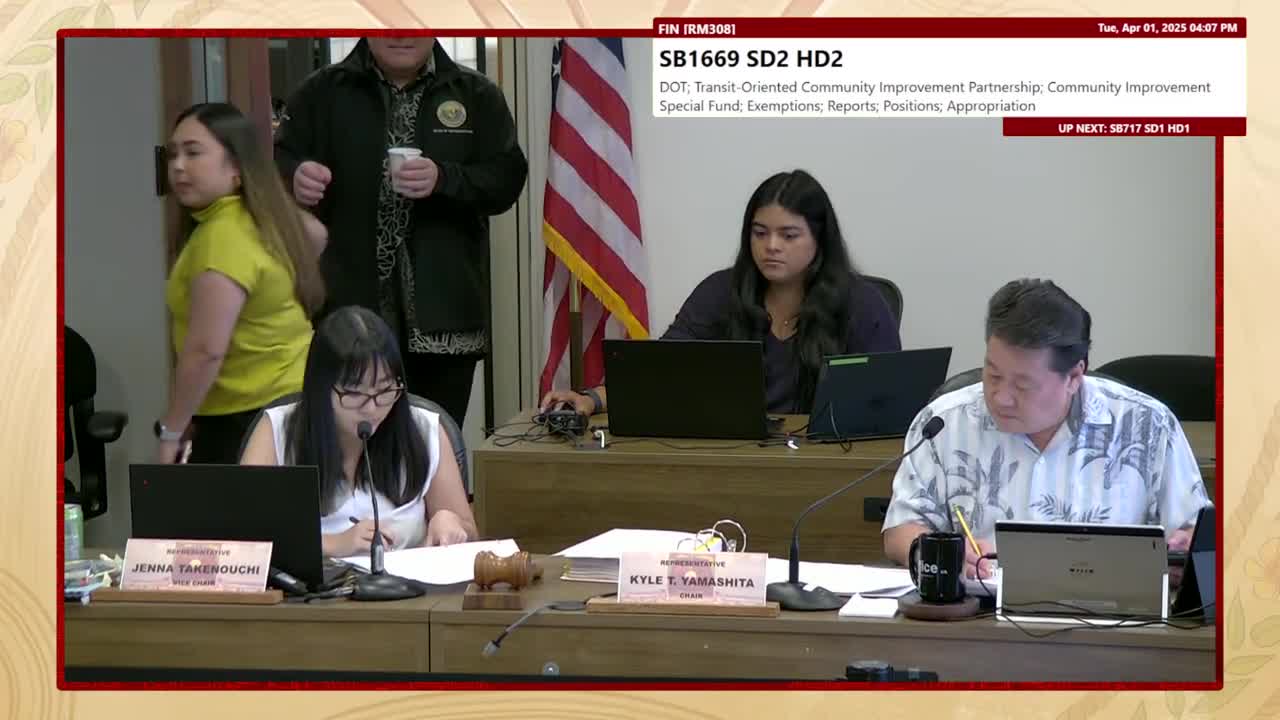
| Apr 1, 2025 | The committee on FIN recommend that the measure be PASSED, UNAMENDED. The votes were as follows: 14 Ayes: Representative(s) Yamashita, Takenouchi, Grandinetti, Holt, Hussey, Keohokapu-Lee Loy, Kitagawa, Kusch, Lamosao, Lee, M., Miyake, Morikawa, Templo, Reyes Oda; Ayes with reservations: none; Noes: none; and 1 Excused: Representative(s) Alcos. |
| Mar 28, 2025 | Bill scheduled to be heard by FIN on Tuesday, 04-01-25 2:00PM in House conference room 308 VIA VIDEOCONFERENCE. |
| Mar 13, 2025 | Passed Second Reading as amended in HD 1 and referred to the committee(s) on FIN with none voting aye with reservations; none voting no (0) and Representative(s) Cochran, Holt, Ward, Woodson excused (4). |
| Mar 13, 2025 | Reported from LAB (Stand. Com. Rep. No. 1181) as amended in HD 1, recommending passage on Second Reading and referral to FIN. |
| Mar 11, 2025 | The committee on LAB recommend that the measure be PASSED, WITH AMENDMENTS. The votes were as follows: 5 Ayes: Representative(s) Sayama, Lee, M., Garrett, Kapela; Ayes with reservations: Representative(s) Kong; Noes: none; and 1 Excused: Representative(s) Reyes Oda. |
| Mar 6, 2025 | Bill scheduled to be heard by LAB on Tuesday, 03-11-25 9:30AM in House conference room 309 VIA VIDEOCONFERENCE. |
| Feb 28, 2025 | Referred to LAB, FIN, referral sheet 17 |
| Feb 27, 2025 | Pass First Reading |
| Feb 19, 2025 | Received from Senate (Sen. Com. No. 9) in amended form (SD 1). |
| Feb 19, 2025 | Report Adopted; Passed Third Reading, as amended (SD 1). Ayes, 22; Aye(s) with reservations: none. Noes, 0 (none). Excused, 3 (Senator(s) Gabbard, Kouchi, Richards). Transmitted to House. |
| Feb 18, 2025 | One Day Notice 02-19-25. |
| Feb 18, 2025 | Reported from WAM (Stand. Com. Rep. No. 681) with recommendation of passage on Third Reading. |
| Feb 12, 2025 | The committee(s) on WAM recommend(s) that the measure be PASSED, UNAMENDED. The votes in WAM were as follows: 13 Aye(s): Senator(s) Dela Cruz, Moriwaki, Aquino, DeCoite, Elefante, Hashimoto, Inouye, Kanuha, Kidani, Kim, Lee, C., Wakai, Fevella; Aye(s) with reservations: none ; 0 No(es): none; and 0 Excused: none. |
| Feb 10, 2025 | The committee(s) on WAM will hold a public decision making on 02-12-25 10:01AM; Conference Room 211 & Videoconference. |
| Feb 6, 2025 | Report adopted; Passed Second Reading, as amended (SD 1) and referred to WAM. |
| Feb 6, 2025 | Reported from LBT (Stand. Com. Rep. No. 56) with recommendation of passage on Second Reading, as amended (SD 1) and referral to WAM. |
| Jan 29, 2025 | The committee(s) on LBT recommend(s) that the measure be PASSED, WITH AMENDMENTS. The votes in LBT were as follows: 3 Aye(s): Senator(s) Aquino, Lee, C., Fevella; Aye(s) with reservations: none ; 0 No(es): none; and 2 Excused: Senator(s) Ihara, Moriwaki. |
| Jan 24, 2025 | The committee(s) on LBT has scheduled a public hearing on 01-29-25 3:00PM; Conference Room 224 & Videoconference. |
| Jan 23, 2025 | Referred to LBT, WAM. |
| Jan 21, 2025 | Passed First Reading. |
| Jan 17, 2025 | Introduced. |
|
Date
|
Description
|
Location
|
Votes
|
|
|---|---|---|---|---|
| Apr 30, 2025 | Final Reading | House Floor |
Passed |
|
| Apr 30, 2025 | Final Reading | Senate Floor |
Passed |
|
| Apr 4, 2025 | Third Reading | House Floor |
Passed |
|
| Apr 1, 2025 | The committee on FIN recommend that the measure be PASSED, UNAMENDED | House Standing Committee on Finance |
Passed |
|
| Mar 11, 2025 | The committee on LAB recommend that the measure be PASSED, WITH AMENDMENTS | House Standing Committee on Labor |
Passed |
|
| Feb 19, 2025 | Third Reading | Senate Floor |
Passed |
|
| Feb 12, 2025 | The committee(s) on WAM recommend(s) that the measure be PASSED, UNAMENDED | Senate Standing Committee on Ways and Means |
Passed |
|
| Jan 29, 2025 | The committee(s) on LBT recommend(s) that the measure be PASSED, WITH AMENDMENTS | Senate Standing Committee on Labor and Technology |
Passed |
This list shows positions taken on this bill by organizations on the date displayed, which is linked to the original source.
Positions by individuals are not included.
|
Organization
|
Position
|
Date
|
|---|---|---|
| 3 Financial Group, LLC | *** Support | Mar 11, 2025 |
| AARP Hawaii | *** Support | Apr 1, 2025 |
| AARP Hawai‘i | *** Support | Apr 1, 2025 |
| Adult Foster Homecare Association of Hawaii (AFHA) | *** Support | Feb 12, 2025 |
| Alliance of Residential Care Administrators | ** Support | |
| Ching Store | *** Support | Apr 1, 2025 |
| Executive Office on Aging | ** Support | |
| Executive Office on Aging (Department of Health) | *** Support | Mar 11, 2025 |
| Gaylord's I, II, III and IV | *** Support | Apr 1, 2025 |
| Goya's Garage | *** Support | Apr 1, 2025 |
| Hawaii Retirement Savings Board | ** Support | |
| Hawaiʻi Primary Care Association | ** Support | |
| Hawaiʻi Community Lending | ** Support | |
| Hawaiʻi Family Caregiver Coalition | *** Support | Feb 12, 2025 |
| Hawaiʻi Island Chamber of Commerce | ** Support | |
| Hawaiʻi Retirement Savings Board | ** Support | |
| Hawaiʻi Retirement Savings Board | *** Support | Apr 1, 2025 |
| Hawai‘i Island Chamber of Commerce | *** Support | Apr 1, 2025 |
| Maui Chamber of Commerce | *** Against | Apr 1, 2025 |
| Maui Realty Co., Inc. | *** Support | Apr 1, 2025 |
| Policy Advisory Board for Elder Affairs | ** Support | |
| Retail Merchants of Hawaii | *** Against | Apr 1, 2025 |
CONFERENCE COMMITTEE REP. NO. 144
Honolulu, Hawaii
, 2025
RE: S.B. No. 855
S.D. 1
H.D. 1
C.D. 1
Honorable Ronald D. Kouchi
President of the Senate
Thirty-Third State Legislature
Regular Session of 2025
State of Hawaii
Honorable Nadine K. Nakamura
Speaker, House of Representatives
Thirty-Third State Legislature
Regular Session of 2025
State of Hawaii
Sir and Madam:
Your Committee on Conference on the disagreeing vote of the Senate to the amendments proposed by the House of Representatives in S.B. No. 855, S.D. 1, H.D. 1, entitled:
"A BILL FOR AN ACT RELATING TO HAWAII RETIREMENT SAVINGS ACT,"
having met, and after full and free discussion, has agreed to recommend and does recommend to the respective Houses the final passage of this bill in an amended form.
The purpose of this measure is to:
(1) Clarify the definition of "covered employer" under the Hawaii Retirement Savings Act;
(2) Require covered employers to automatically enroll covered employees into the Hawaii Retirement Savings Program unless the employee opts out;
(3) Repeal the limit on the total fees and expenses that can be spent for the Program each year; and
(4) Appropriate funds to the Department of Labor and Industrial Relations for the development and operation of the Program.
Your Committee on Conference finds that the Hawaii Retirement Savings Program will offer a critical retirement planning option to many private-sector employees in the State. Your Committee on Conference further finds, however, that the Program's use of an opt-in enrollment model will hinder its ability to accumulate a critical mass of participants, risk its long-term viability, and limit the potential for the State to enter into cost-cutting interstate compact agreements. Therefore, this measure implements an automatic enrollment model to align the Program with best practices in the retirement savings industry and provide for the long-term financial security of private sector employees.
Your Committee on Conference has amended this measure by:
(1) Deleting language that would have appropriated funds to the Department of Labor and Industrial Relations for the development and operation of the Hawaii Retirement Savings Program;
(2) Amending section 1 to reflect its amended purpose; and
(3) Changing its effective date to July 1, 2025.
As affirmed by the record of votes of the managers of your Committee on Conference that is attached to this report, your Committee on Conference is in accord with the intent and purpose of S.B. No. 855, S.D. 1, H.D. 1, as amended herein, and recommends that it pass Final Reading in the form attached hereto as S.B. No. 855, S.D. 1, H.D. 1, C.D. 1.
Respectfully submitted on behalf of the managers:
|
ON THE PART OF THE HOUSE |
|
ON THE PART OF THE SENATE |
|
____________________________ JACKSON D. SAYAMA Co-Chair |
|
____________________________ HENRY J.C. AQUINO Chair |
|
____________________________ MIKE LEE Co-Chair |
|
____________________________ LORRAINE R. INOUYE Co-Chair |
|
|
|
|
|
|
|
|
STAND. COM. REP. NO. 1962
Honolulu, Hawaii
, 2025
RE: S.B. No. 855
S.D. 1
H.D. 1
Honorable Nadine K. Nakamura
Speaker, House of Representatives
Thirty-Third State Legislature
Regular Session of 2025
State of Hawaii
Madame:
Your Committee on Finance, to which was referred S.B. No. 855, S.D. 1, H.D. 1, entitled:
"A BILL FOR AN ACT RELATING TO HAWAII RETIREMENT SAVINGS ACT,"
begs leave to report as follows:
The purpose of this measure is to:
(1) Clarify the definition of "covered employer" under the Hawaii Retirement Savings Act;
(2) Require each covered employer to automatically enroll its covered employees into the Hawaii Retirement Savings Program, unless a covered employee opts out;
(3) Repeal the limit on the total fees and expenses that can be spent for the Program each year; and
(4) Appropriate funds for the development and operation of the Hawaii Retirement Savings Program.
Your Committee received testimony in support of this measure from the Executive Office on Aging; Policy Advisory Board for Elder Affairs; Hawaiʻi Primary Care Association; Hawaiʻi Community Lending; Hawaiʻi Island Chamber of Commerce; Alliance of Residential Care Administrators; and numerous individuals. Your Committee received testimony in opposition to this measure from the Retail Merchants of Hawaii and Maui Chamber of Commerce. Your Committee received comments on this measure from the Hawaiʻi Retirement Savings Board; AARP Hawaiʻi; and Tax Foundation of Hawaii.
As affirmed by the record of votes of the members of your Committee on Finance that is attached to this report, your Committee is in accord with the intent and purpose of S.B. No. 855, S.D. 1, H.D. 1, and recommends that it pass Third Reading.
Respectfully submitted on behalf of the members of the Committee on Finance,
|
|
|
____________________________ KYLE T. YAMASHITA, Chair |
|
|
|
|
STAND. COM. REP. NO. 1181
Honolulu, Hawaii
, 2025
RE: S.B. No. 855
S.D. 1
H.D. 1
Honorable Nadine K. Nakamura
Speaker, House of Representatives
Thirty-Third State Legislature
Regular Session of 2025
State of Hawaii
Madame:
Your Committee on Labor, to which was referred S.B. No. 855, S.D. 1, entitled:
"A BILL FOR AN ACT RELATING TO HAWAII RETIREMENT SAVINGS ACT,"
begs leave to report as follows:
The purpose of this measure is to:
(1) Clarify the definition of "covered employer" under the Hawaii Retirement Savings Act;
(2) Require automatic enrollment of covered employees into the Hawaii Retirement Savings Program unless the employee opts out;
(3) Repeal the limit on the total fees and expenses that can be spent for the Program each year; and
(4) Appropriate funds for the development and operation of the Hawaii Retirement Savings Program.
Your Committee received testimony in support of this measure from the Executive Office on Aging; Hawaiʻi Retirement Savings Board; Policy Advisory Board for Elder Affairs; Hawaiʻi Island Chamber of Commerce; AARP Hawaiʻi; Hawaii Primary Care Association; Goya's Garage; Alliance of Residential Care Administrators; Hawaiʻi Community Lending; and numerous individuals. Your Committee received testimony in opposition to this measure from the Retail Merchants of Hawaii and Maui Chamber of Commerce. Your Committee received comments on this measure from Tax Foundation of Hawaii.
Your Committee finds that the Hawaii Retirement Savings Program provides long-term financial security and protection against inflation to qualified private-sector employees for retirement through automatic payroll deductions, who would otherwise have to independently save money for retirement. Your Committee notes that employers with retirement savings programs that have auto-enrollment policies have higher overall contribution rates by their employees than employers with only voluntary enrollment. This measure encourages employees to engage with their retirement plans and make proactive and informed decisions about their financial future.
Your Committee has amended this measure by changing the effective date to July 1, 3000, to encourage further discussion.
Your Committee respectfully requests your Committee on Finance, should it deliberate on this measure, to consider an appropriation amount of $720,000 for fiscal year 2025-2026 and $445,000 for fiscal year 2026-2027.
As affirmed by the record of votes of the members of your Committee on Labor that is attached to this report, your Committee is in accord with the intent and purpose of S.B. No. 855, S.D. 1, as amended herein, and recommends that it pass Second Reading in the form attached hereto as S.B. No. 855, S.D. 1, H.D. 1, and be referred to your Committee on Finance.
Respectfully submitted on behalf of the members of the Committee on Labor,
|
|
|
____________________________ JACKSON D. SAYAMA, Chair |
STAND. COM. REP. NO. 681
Honolulu, Hawaii
RE: S.B. No. 855
S.D. 1
Honorable Ronald D. Kouchi
President of the Senate
Thirty-Third State Legislature
Regular Session of 2025
State of Hawaii
Sir:
Your Committee on Ways and Means, to which was referred S.B. No. 855, S.D. 1, entitled:
"A BILL FOR AN ACT RELATING TO HAWAII RETIREMENT SAVINGS ACT,"
begs leave to report as follows:
The purpose and intent of this measure is to expand and make various improvements to the Hawaii Retirement Savings Program ("Program").
Specifically, this measure:
(1) Clarifies that covered employers of the Program include any employer that has offered or maintained a retirement plan for some or all employees at any time during the preceding two years;
(2) Requires automatic enrollment in the Program for covered employees;
(3) Removes the cap on total fees and expenses of the Program; and
(4) Appropriates funds for the Program.
Your Committee received written comments in support of this measure from the Hawaii Retirement Savings Board, Executive Office on Aging, Hawaii Primary Care Association, Hawaii Family Caregiver Coalition, Hawai`i Community Lending, AARP Hawaii, Adult Foster Homecare Association Of Hawaii, and nine individuals.
Your Committee received written comments in opposition to this measure from the Retail Merchants of Hawaii and Maui Chamber of Commerce.
Your Committee received written comments on this measure from the Tax Foundation of Hawaii.
Your Committee finds that requiring covered employees to enroll in the Program automatically will align with best practices of the retirement savings industry and facilitate employee retirement savings while also providing employees with the flexibility to voluntarily opt out of enrollment.
As affirmed by the record of votes of the members of your Committee on Ways and Means that is attached to this report, your Committee is in accord with the intent and purpose of S.B. No. 855, S.D. 1, and recommends that it pass Third Reading.
Respectfully submitted on behalf of the members of the Committee on Ways and Means,
|
|
|
________________________________ DONOVAN M. DELA CRUZ, Chair |
|
|
|
|
STAND. COM. REP. NO. 56
Honolulu, Hawaii
RE: S.B. No. 855
S.D. 1
Honorable Ronald D. Kouchi
President of the Senate
Thirty-Third State Legislature
Regular Session of 2025
State of Hawaii
Sir:
Your Committee on Labor and Technology, to which was referred S.B. No. 855 entitled:
"A BILL FOR AN ACT RELATING TO HAWAII RETIREMENT SAVINGS ACT,"
begs leave to report as follows:
The purpose and intent of this measure is to:
(1) Clarify the definition of "covered employer" in the Hawaii Retirement Savings Act;
(2) Require covered employers to automatically enroll covered employees in the Hawaii Retirement Savings Program unless the employee opts out;
(3) Repeal the limit on total fees and expenses that can be spent for the Program annually; and
(4) Appropriate funds to the Department of Labor and Industrial Relations for the development and operation of the Program.
Your Committee received testimony in support of this measure from the Executive Office on Aging, Hawaii Retirement Savings Board, AARP Hawaiʻi, Hawaiʻi Family Caregiver Coalition, Hawaiʻi Primary Care Association, and twelve individuals.
Your Committee received testimony in opposition to this measure from the Retail Merchants of Hawaii.
Your Committee received comments on this measure from the Tax Foundation of Hawaii.
Your Committee finds that there is an urgent need to provide a viable retirement savings option for private sector employees who do not have access to employer-sponsored retirement savings plans. Established to address this issue, a majority of local small businesses support the Hawaii Retirement Savings Program for its minimal fiscal impact on business and potential to stabilize and fortify the State's economy. Your Committee finds, however, that unlike other state-sponsored plans, the Hawaii Retirement Savings Program does not have an automatic enrollment process, which may hinder its ability to accumulate a critical mass of participants needed for the Program's long-term viability and potential to enter into interstate compact agreements. This measure will make the enrollment process automatic for covered employees, with an option to opt out, to avail this crucial life-planning option to an increased number of employees in the State.
Your Committee has amended this measure by:
(1) Requiring covered employers, rather than the program administrators, to provide covered employees with a written notice of their right to opt out of the Program;
(2) Clarifying that the Board may add an option for program participants to contribute to a traditional individual retirement account (IRA), in addition to or in lieu of a Roth IRA;
(3) Changing the appropriation to an unspecified amount;
(4) Inserting an effective date of July 1, 2050, to encourage further discussion; and
(5) Making technical, nonsubstantive amendments for the purposes of clarity and consistency.
Your Committee notes that this measure, as amended, contains an unspecified appropriation amount. Should your Committee on Ways and Means choose to deliberate on this measure, your Committee respectfully requests that it consider inserting an appropriation amount of $720,000 for the development and operation of the Hawaii Retirement Savings Program.
As affirmed by the record of votes of the members of your Committee on Labor and Technology that is attached to this report, your Committee is in accord with the intent and purpose of S.B. No. 855, as amended herein, and recommends that it pass Second Reading in the form attached hereto as S.B. No. 855, S.D. 1, and be referred to your Committee on Ways and Means.
Respectfully submitted on behalf of the members of the Committee on Labor and Technology,
|
|
|
________________________________ HENRY J.C. AQUINO, Chair |
|
|
|
|
|
Date
|
Testimony PDF
|
|---|---|
| Apr 1, 2025 | SB855_HD1_TESTIMONY_FIN_04-01-25_.PDF |
| Mar 11, 2025 | SB855_SD1_TESTIMONY_LAB_03-11-25_.PDF |
| Feb 12, 2025 | SB855_SD1_TESTIMONY_WAM_02-12-25_.PDF |
| Jan 29, 2025 | SB855_TESTIMONY_LBT_01-29-25_.PDF |



Bill Author
Bill Co-Author(s):