SB 822: Judiciary; Landlord-Tenant Code; Working Group; Reports
- Session Year: 2025-2026
- House: Senate
- Latest Version Date: 2025-04-04
Current Status:
Failed
(2026-04-02: Received notice of the discharge of all House Conferees (Hse. Com. No. 457).)
Introduced
In Committee
First Chamber
In Committee
Second Chamber
Final Decking
Enacted
Establishes a three-year Residential Landlord-Tenant Code Working Group within the Judiciary. Requires an initial report to the Legislature prior to the Regular Session of 2026 and a final report no later than 7/1/2028. Effective 7/1/3000. (HD2)
Establishes a three-year Residential Landlord-Tenant Code Working Group within the Department of the Attorney General. Requires an initial report to the Legislature prior to the Regular Session of 2026 and a final report no later than 7/1/2028. Effective 7/1/3000. (HD1)
Establishes a working group facilitated by the Judiciary to conduct a comprehensive review of and recommend updates to the Residential Landlord-Tenant Code. Requires a report to the Legislature. Effective 7/1/2050. (SD2)
Authorizes a landlord to petition a district court for a temporary restraining order, permanent restraining order, or injunction to compel a tenant's compliance with section 521-51, HRS. Establishes a working group facilitated by the Judiciary to conduct a comprehensive review of and recommend updates to the Residential Landlord-Tenant Code. Requires a report to the Legislature. Effective 7/1/2050. (SD1)
Authorizes a landlord to petition a district court for a temporary restraining order, permanent restraining order, or injunction to compel a tenant's compliance with section 521-51, Hawaii Revised Statutes.
|
THE SENATE |
S.B. NO. |
822 |
|
THIRTY-THIRD LEGISLATURE, 2025 |
S.D. 2 |
|
|
STATE OF HAWAII |
H.D. 2 |
|
|
|
|
|
|
|
||
|
|
||
A BILL FOR AN ACT
RELATING TO THE LANDLORD TENANT CODE.
BE IT ENACTED BY THE LEGISLATURE OF THE STATE OF HAWAII:
The legislature further finds that landlord-tenant relationships are governed by various federal and state laws, which require clear understanding and compliance to ensure fair and equitable treatment for landlords and tenants. The increasing complexity of these laws and navigating the court process can also create difficulties for landlords and tenants.
The legislature further finds that making improvements to the Residential Landlord-Tenant Code may help landlords have more certainty and confidence in their ability to rent their properties and provide Hawaii residents with much needed housing. In addition, clarifying the Residential Landlord-Tenant Code will reduce the number of cases that are brought to court, thus alleviating the burden placed on the judicial system.
Accordingly, the purpose of this Act is to establish a three-year working group to conduct a comprehensive review of the Residential Landlord-Tenant Code and recommend necessary updates.
SECTION 2. (a) There shall be established a three-year residential landlord-tenant code working group within the judiciary to:
(1) Conduct a comprehensive review of the Residential Landlord-Tenant Code to determine if any amendments or updates are necessary;
(2) Review existing mechanisms available to landlords and tenants for the enforcement of rights under the Residential Landlord-Tenant Code; and
(3) Consider the feasibility of statutory processes through which injunctive relief might be obtained.
(b) The working group shall consist of the following members:
(1) The chief justice of the Hawaii supreme court, or the chief justice's designee, who shall serve as the chairperson of the working group;
(2) The president of the senate, or the president's designee;
(3) The speaker of the house of representatives, or the speaker's designee;
(4) An attorney specializing in landlord-tenant laws, to be invited by the chairperson;
(5) One member who owns and manages a property, but is not a real estate licensee, to be invited by the chairperson;
(6) Two members from organizations representing professional property managers, to be invited as follows:
(A) One member to be invited by the president of the senate, or the president's designee; and
(B) One member to be invited by the speaker of the house of representatives, or the speaker's designee;
(7) Two members from organizations representing tenant concerns, to be invited as follows:
(A) One member to be invited by the president of the senate, or the president's designee; and
(B) One member to be invited by the speaker of the house of representatives, or the speaker's designee; and
(8) Any other member deemed necessary by the working group who provides the appropriate special expertise, including representatives from organizations with experience in landlord or tenant issues, upon approval by the chairperson.
(c) The members of the working group shall serve without compensation.
(d) No member of the working group shall be subject to chapter 84, Hawaii Revised Statutes, solely because of the member's participation in the working group.
(e) The working group shall submit an initial report of its findings and recommendations, including any proposed legislation, to the legislature no later than twenty days prior to the convening of the regular session of 2026, and a final report of its findings and recommendations, including any proposed legislation, to the legislature no later than July 1, 2028.
(f) An initial meeting of the working group shall be convened no later than July 1, 2025.
(g) The working group shall be dissolved on July 1, 2028.
SECTION 3. This Act shall take effect on July 1, 3000.
Report Title:
Judiciary; Landlord-Tenant Code; Working Group; Reports
Description:
Establishes a three-year Residential Landlord-Tenant Code Working Group within the Judiciary. Requires an initial report to the Legislature prior to the Regular Session of 2026 and a final report no later than 7/1/2028. Effective 7/1/3000. (HD2)
The summary description of legislation appearing on this page is for informational purposes only and is not legislation or evidence of legislative intent.
|
THE SENATE |
S.B. NO. |
822 |
|
THIRTY-THIRD LEGISLATURE, 2025 |
S.D. 2 |
|
|
STATE OF HAWAII |
H.D. 1 |
|
|
|
|
|
|
|
||
|
|
||
A BILL FOR AN ACT
RELATING TO THE LANDLORD TENANT CODE.
BE IT ENACTED BY THE LEGISLATURE OF THE STATE OF HAWAII:
The legislature further finds that landlord-tenant relationships are governed by various federal and state laws, which require clear understanding and compliance to ensure fair and equitable treatment for landlords and tenants. The increasing complexity of these laws and navigating the court process can also create difficulties for landlords and tenants.
The legislature further finds that making improvements to the Residential Landlord-Tenant Code may help landlords have more certainty and confidence in their ability to rent their properties and provide Hawaii residents with much needed housing. In addition, clarifying the Residential Landlord-Tenant Code will reduce the number of cases that are brought to court, thus alleviating the burden placed on the judicial system.
Accordingly, the purpose of this Act is to establish a three-year working group to research and improve the Residential Landlord-Tenant Code and address any other relevant landlord-tenant issues and provide an opportunity for collaboration among key stakeholders to identify concerns, evaluate potential solutions, and recommend best practices for the State's rental housing market.
SECTION 2. (a) There is established a three-year residential landlord-tenant code working group within the department of the attorney general to:
(1) Evaluate the challenges faced by landlords and tenants, including legal, financial, and procedural issues that are barriers to offering or obtaining rental housing;
(2) Identify best practices and potential Residential Landlord-Tenant Code or other regulatory improvements for property managers, property owners, and tenants;
(3) Determine problem areas that impact property managers, property owners, and tenants and whether educational resources or other solutions can help address those challenges; and
(4) Explore any other feasible ideas or relevant solutions, pursuant to the discretion of the working group.
(b) The working group shall consist of the following members:
(1) The attorney general, or the attorney general's designee, who shall serve as the chairperson of the working group;
(2) The president of the senate, or the president's designee;
(3) The speaker of the house of representatives, or the speaker's designee;
(4) A representative from the judiciary with experience in landlord-tenant cases;
(5) An attorney specializing in landlord-tenant laws, to be invited by the chairperson;
(6) One member who owns and manages a property, but is not a real estate licensee, to be invited by the chairperson;
(7) Two members from organizations representing professional property managers, to be invited as follows:
(A) One member to be invited by the president of the senate, or the president's designee; and
(B) One member to be invited by the speaker of the house of representatives, or the speaker's designee;
(8) Two members from organizations representing tenant concerns, to be invited as follows:
(A) One member to be invited by the president of the senate, or the president's designee; and
(B) One member to be invited by the speaker of the house of representatives, or the speaker's designee; and
(9) Any other member deemed necessary by the working group who provides the appropriate special expertise, including representatives from organizations with experience in landlord or tenant issues, upon approval by the chairperson.
(c) The members of the working group shall serve without compensation.
(d) No member of the working group shall be subject to chapter 84, Hawaii Revised Statutes, solely because of the member's participation in the working group.
(e) The working group shall submit an initial report of its findings and recommendations, including any proposed legislation, to the legislature no later than twenty days prior to the convening of the regular session of 2026, and a final report of its findings and recommendations, including any proposed legislation, to the legislature no later than July 1, 2028.
(f) An initial meeting of the working group shall be convened no later than July 1, 2025.
(g) The working group shall be dissolved on July 1, 2028.
SECTION 3. This Act does not affect rights and duties that matured, penalties that were incurred, and proceedings that were begun before its effective date.
SECTION 4. This Act shall take effect on July 1, 3000.
Report Title:
Landlord-Tenant Code; Working Group; Department of the Attorney General; Reports
Description:
Establishes a three-year Residential Landlord-Tenant Code Working Group within the Department of the Attorney General. Requires an initial report to the Legislature prior to the Regular Session of 2026 and a final report no later than 7/1/2028. Effective 7/1/3000. (HD1)
The summary description of legislation appearing on this page is for informational purposes only and is not legislation or evidence of legislative intent.
|
THE SENATE |
S.B. NO. |
822 |
|
THIRTY-THIRD LEGISLATURE, 2025 |
S.D. 2 |
|
|
STATE OF HAWAII |
|
|
|
|
|
|
|
|
||
|
|
||
A BILL FOR AN ACT
RELATING TO THE LANDLORD TENANT CODE.
BE IT ENACTED BY THE LEGISLATURE OF THE STATE OF HAWAII:
(1) Conduct a comprehensive review of the residential landlord‑tenant code and determine whether amendments and updates to the landlord-tenant code are necessary;
(2) Review existing mechanisms available to both landlords and tenants for the enforcement of rights under the landlord-tenant code; and
(3) Consider the feasibility of statutory processes through which injunctive relief might be obtained.
(b) The working group shall consist of the following members:
(1) The chief justice of the Hawaii supreme court, or the chief justice's designee, who shall serve as chairperson of the working group;
(2) One member appointed by the president of the senate;
(3) One member appointed by the speaker of the house of representatives; and
(4) Other members appointed by the chairperson of the working group.
(c) The members of the working group shall serve without compensation but shall be reimbursed for expenses, including travel expenses, necessary for the performance of their duties.
(d) No member of the working group shall be subject to chapter 84, Hawaii Revised Statutes, solely because of the member's participation in the working group.
(e) The working group shall submit a report of its findings and recommendations, including any proposed legislation, to the legislature no later than twenty days prior to the convening of the regular session of 2027.
(f) The working group shall be dissolved on June 30, 2027.
SECTION 2. This Act does not affect rights and duties that matured, penalties that were incurred, and proceedings that were begun before its effective date.
SECTION 3. This Act shall take effect on July 1, 2050.
Report Title:
Landlord-Tenant Code; Working Group; Report
Description:
Establishes a working group facilitated by the Judiciary to conduct a comprehensive review of and recommend updates to the Residential Landlord-Tenant Code. Requires a report to the Legislature. Effective 7/1/2050. (SD2)
The summary description of legislation appearing on this page is for informational purposes only and is not legislation or evidence of legislative intent.
|
THE SENATE |
S.B. NO. |
822 |
|
THIRTY-THIRD LEGISLATURE, 2025 |
S.D. 1 |
|
|
STATE OF HAWAII |
|
|
|
|
|
|
|
|
||
|
|
||
A BILL FOR AN ACT
RELATING TO THE LANDLORD TENANT CODE.
BE IT ENACTED BY THE LEGISLATURE OF THE STATE OF HAWAII:
SECTION 1. Section 521-69, Hawaii Revised Statutes, is amended to read as follows:
"§521-69
Landlord's remedies for tenant's waste, failure to maintain, or unlawful
use. (a) If the tenant is in material noncompliance
with section 521-51, the landlord, upon learning of [any such] the
noncompliance and after notifying the tenant in writing of the noncompliance
and allowing a specified time not less than ten days after receipt of the
notice, for the tenant to remedy the noncompliance:
(1) May terminate the rental agreement and
bring a summary proceeding for possession of the dwelling unit or any other
proper proceeding, action, or suit for possession if the tenant is in material
noncompliance with section 521-51(1); [or]
(2) May remedy the tenant's failure to
comply and bill the tenant for the actual and reasonable cost of [such] the
remedy if the noncompliance can be remedied by the landlord by cleaning,
repairing, replacing a damaged item, or the like, which bill shall be treated
by all parties as rent due and payable on the next regular rent collection date
or, if the tenancy has terminated, immediately upon receipt by the tenant[.];
or
(3) May petition a district court for a temporary restraining order, permanent restraining order, or injunction to compel the tenant's compliance with section 521-51; provided that:
(A) If the district court issues either a preliminary or permanent injunction against the tenant and the court subsequently determines that the tenant has violated the injunction, the court shall issue to the landlord a judgment for possession;
(B) A petition for relief filed under this subsection concerning a violation of section 521-51 shall be in writing, shall allege that a violation of section 521-51 has occurred, and shall be accompanied by an affidavit made under oath or a statement made under penalty of perjury stating the specific facts and circumstances for which relief is sought;
(C) The petition shall be set for a return hearing and notice served on the tenant in the same manner as a complaint for summary possession;
(D) At the return hearing, the court may temporarily restrain the person or persons named in the petition from violating section 521-51 upon a determination that there is probable cause to believe that a violation of section 521-51 occurred and that an injunction is reasonably necessary for the preservation of the property or to protect the landlord, other tenants, or any other person. The court may issue a temporary restraining order either in writing or orally; provided that oral orders shall be reduced to writing by the close of the next court day;
(E) Any order issued under this subsection shall be served upon the tenant via personal service or certified mail, unless the tenant was present at the hearing at which the court orally issued the order;
(F) Where service of a restraining order or injunction has been made or where the tenant is deemed to have received notice of a restraining order or injunction order, any knowing or intentional violation of the restraining order or injunction order shall subject the tenant to subparagraph (K);
(G) A temporary restraining order that is granted under this subsection shall remain in effect at the discretion of the court for a period not to exceed ninety days from the date the order is granted. A temporary injunction may be extended for up to three years by the court if the landlord proves by a preponderance of the evidence that the tenant has violated section 521-51;
(H) Upon the request of the tenant, the court may set an evidentiary hearing to determine if a temporary restraining order shall be dissolved, remain in effect for the initial ninety days, or become permanent and remain in effect for up to three years. The evidentiary hearing shall be held within ten days after a request to dissolve is received from the tenant unless a court closure due to a holiday or other reason prevents the hearing from taking place, in which case the hearing shall occur on the next available hearing date. The temporary restraining order shall be considered in effect until the court hears and adjudicates any request to dissolve the temporary restraining order;
(I) The parties named in the petition may file written responses or give oral responses explaining, excusing, justifying, or denying the alleged violation of section 521-51. The court shall receive at the hearing all relevant evidence and may make independent inquiry;
(J) If the court finds by a preponderance of the evidence that a violation of section 521-51 has occurred, in addition to any other relief provided for by law, the court shall issue to the landlord a judgment for possession for the rented premises, effective immediately; and
(K) If the tenant violates a restraining order issued under this paragraph, the landlord may immediately file a motion with the court regarding the violation of the restraining order and may seek a judgment for possession to remove the tenant from the rented premises. The hearing on the motion shall be heard within ten days of its filing, unless a court closure due to a holiday or other reason prevents the hearing from taking place, in which case the hearing shall occur on the next available hearing date. If the matter is not resolved by motion, the court may order an evidentiary hearing upon the request of either party. If the court finds by a preponderance of the evidence that a violation of the temporary restraining order has occurred, the court shall issue to the landlord a judgment for possession, effective immediately. The parties named in the petition may file written responses or give oral responses explaining, excusing, justifying, or denying the alleged violation of the temporary restraining order. The court shall receive at the hearing all relevant evidence and may make independent inquiry.
(b) No allowance of time to remedy noncompliance shall be required when noncompliance by the tenant causes or threatens to cause irremediable damage to any person or property. If the tenant cannot be served with notice as required, notice may be given to the tenant by posting the same in a conspicuous place on the dwelling unit.
[(b)]
(c) The landlord may terminate
the rental agreement and bring a summary proceeding for possession of the
dwelling unit or any other proper proceeding, action, or suit for possession
for any material noncompliance with section 521-51 by a roomer or boarder if
the roomer or boarder fails to comply within the time specified in the notice.
[(c)]
(d) The landlord may bring an
action or proceeding for waste or for breach of contract for damage suffered by
the tenant's wilful or negligent failure to comply with the tenant's
obligations under section 521-51.
(e) Nothing in this section shall be construed to prohibit constitutionally protected activities."
SECTION 2. (a) There is established the residential landlord-tenant code working group within the judiciary to conduct a comprehensive review of the residential landlord‑tenant code and prepare a report on whether amendments and updates to the code are necessary.
(b) The working group shall consist of the following members:
(1) The chief justice of the Hawaii supreme court, or the chief justice's designee, who shall serve as chairperson of the working group;
(2) One member appointed by the president of the senate;
(3) One member appointed by the speaker of the house of representatives; and
(4) Other members appointed by the chairperson of the working group.
(c) The members of the working group shall serve without compensation but shall be reimbursed for expenses, including travel expenses, necessary for the performance of their duties.
(d) No member of the working group shall be subject to chapter 84, Hawaii Revised Statutes, solely because of the member's participation in the working group.
(e) The working group shall report its findings and recommendations, including any proposed legislation, to the legislature no later than twenty days prior to the convening of the regular session of 2027.
(f) The working group shall be dissolved on June 30, 2027.
SECTION 3. This Act does not affect rights and duties that matured, penalties that were incurred, and proceedings that were begun before its effective date.
SECTION 4. Statutory material to be repealed is bracketed and stricken. New statutory material is underscored.
SECTION 5. This Act shall take effect on July 1, 2050.
Report Title:
Landlord-Tenant Code; Waste; Failure to Maintain; Unlawful Use; Working Group; Report
Description:
Authorizes a landlord to petition a district court for a temporary restraining order, permanent restraining order, or injunction to compel a tenant's compliance with section 521-51, HRS. Establishes a working group facilitated by the Judiciary to conduct a comprehensive review of and recommend updates to the Residential Landlord-Tenant Code. Requires a report to the Legislature. Effective 7/1/2050. (SD1)
The summary description of legislation appearing on this page is for informational purposes only and is not legislation or evidence of legislative intent.
|
THE SENATE |
S.B. NO. |
822 |
|
THIRTY-THIRD LEGISLATURE, 2025 |
|
|
|
STATE OF HAWAII |
|
|
|
|
|
|
|
|
||
|
|
||
A BILL FOR AN ACT
relating to the landlord tenant code.
BE IT ENACTED BY THE LEGISLATURE OF THE STATE OF HAWAII:
SECTION 1. Section 521-69, Hawaii Revised Statutes, is amended to read as follows:
"§521-69
Landlord's remedies for tenant's waste, failure to maintain, or unlawful
use. (a) If the tenant is in material noncompliance
with section 521-51, the landlord, upon learning of [any such] the
noncompliance and after notifying the tenant in writing of the noncompliance
and allowing a specified time not less than ten days after receipt of the
notice, for the tenant to remedy the noncompliance:
(1) May terminate the rental agreement and
bring a summary proceeding for possession of the dwelling unit or any other
proper proceeding, action, or suit for possession if the tenant is in material
noncompliance with section 521-51(1); [or]
(2) May remedy the tenant's failure to
comply and bill the tenant for the actual and reasonable cost of [such] the
remedy if the noncompliance can be remedied by the landlord by cleaning,
repairing, replacing a damaged item, or the like, which bill shall be treated
by all parties as rent due and payable on the next regular rent collection date
or, if the tenancy has terminated, immediately upon receipt by the tenant[.];
or
(3) May petition a district court for a temporary restraining order, permanent restraining order, or injunction to compel the tenant's compliance with section 521-51; provided that:
(A) The landlord may seek an injunction alone or may join a claim for an injunction with a summary possession claim;
(B) If the district court issues either a preliminary or permanent injunction against the tenant and the court subsequently determines that the tenant has violated the injunction, the court shall issue to the landlord a judgment for possession and writ of possession;
(C) A petition for relief filed under this subsection concerning a violation of section 521-51 shall be in writing, shall allege that a violation of section 521-51 has occurred, and shall be accompanied by an affidavit made under oath or a statement made under penalty of perjury stating the specific facts and circumstances for which relief is sought;
(D) The petition shall be set for a return hearing and notice served on the tenant in the same manner as a complaint for summary possession;
(E) At the return hearing, the court may temporarily restrain the person or persons named in the petition from violating section 521-51 upon a determination that there is probable cause to believe that a violation of section 521-51 occurred and that an injunction is reasonably necessary for the preservation of the property or to protect the landlord, other tenants, or any other person. The court may issue a temporary restraining order either in writing or orally; provided that oral orders shall be reduced to writing by the close of the next court day;
(F) Any order issued under this subsection shall be served upon the tenant via personal service or certified mail, unless the tenant was present at the hearing at which the court orally issued the order;
(G) Where service of a restraining order or injunction has been made or where the tenant is deemed to have received notice of a restraining order or injunction order, any knowing or intentional violation of the restraining order or injunction order shall subject the tenant to paragraph (L);
(H) A temporary restraining order that is granted under this subsection shall remain in effect at the discretion of the court for a period not to exceed ninety days from the date the order is granted. A temporary injunction may be extended for up to three years by the court if the landlord proves by a preponderance of the evidence that the tenant has violated section 521-51;
(I) Upon the request of the tenant, the court may set an evidentiary hearing to determine if a temporary restraining order shall be dissolved, remain in effect for the initial ninety days, or become permanent and remain in effect for up to three years. The evidentiary hearing shall be held within ten days after a request to dissolve is received from the tenant unless a court closure due to a holiday or other reason prevents the hearing from taking place, in which case the hearing shall occur on the next available hearing date. The temporary restraining order shall be considered in effect until the court hears and adjudicates any request to dissolve the temporary restraining order;
(J) The parties named in the petition may file written responses or give oral responses explaining, excusing, justifying, or denying the alleged violation of section 521-51. The court shall receive at the hearing all relevant evidence and may make independent inquiry;
(K) If the court finds by a preponderance of the evidence that a violation of section 521-51 has occurred, in addition to any other relief provided for by law, the court shall issue to the landlord a judgment for possession and writ of possession for the rented premises, effective immediately; and
(L) If the tenant violates a restraining order issued under this subsection, the landlord may immediately file a motion with the court regarding the violation of the restraining order and may seek a judgment for possession and writ of possession to remove the tenant from the rented premises. The hearing on the motion shall be heard within ten days of its filing, unless a court closure due to a holiday or other reason prevents the hearing from taking place, in which case the hearing shall occur on the next available hearing date. If the matter is not resolved by motion, the court may order an evidentiary hearing upon the request of either party. If the court finds by a preponderance of the evidence that a violation of the temporary restraining order has occurred, the court shall issue to the landlord a judgment for possession and writ of possession, effective immediately. The parties named in the petition may file written responses or give oral responses explaining, excusing, justifying, or denying the alleged violation of the temporary restraining order. The court shall receive at the hearing all relevant evidence and may make independent inquiry.
(b) No allowance of time to remedy noncompliance shall be required when noncompliance by the tenant causes or threatens to cause irremediable damage to any person or property. If the tenant cannot be served with notice as required, notice may be given the tenant by posting the same in a conspicuous place on the dwelling unit.
[(b)]
(c) The landlord may terminate
the rental agreement and bring a summary proceeding for possession of the
dwelling unit or any other proper proceeding, action, or suit for possession
for any material noncompliance with section 521-51 by a roomer or boarder if
the roomer or boarder fails to comply within the time specified in the notice.
[(c)]
(d) The landlord may bring an
action or proceeding for waste or for breach of contract for damage suffered by
the tenant's wilful or negligent failure to comply with the tenant's
obligations under section 521-51.
(e) Nothing in this section shall be construed to prohibit constitutionally protected activities."
SECTION 2. This Act does not affect rights and duties that matured, penalties that were incurred, and proceedings that were begun before its effective date.
SECTION 3. Statutory material to be repealed is bracketed and stricken. New statutory material is underscored.
SECTION 4. This Act shall take effect upon its approval.
|
INTRODUCED BY: |
_____________________________ |
|
|
|
Report Title:
Landlord Tenant Code; Waste; Failure to Maintain; Unlawful Use
Description:
Authorizes a landlord to petition a district court for a temporary restraining order, permanent restraining order, or injunction to compel a tenant's compliance with section 521-51, Hawaii Revised Statutes.
The summary description of legislation appearing on this page is for informational purposes only and is not legislation or evidence of legislative intent.
|
Date
|
Status
|
|---|---|
| Apr 2, 2026 | Received notice of the discharge of all House Conferees (Hse. Com. No. 457). |
| Apr 1, 2026 | House Conferee(s) discharged. |
| Mar 20, 2026 | Received notice of all Senate conferees being discharged (Sen. Com. No. 409). |
| Mar 20, 2026 | Senate Conferee(s) discharged. |
| Dec 8, 2025 | Carried over to 2026 Regular Session. |
| Apr 17, 2025 | Received notice of Senate conferees (Sen. Com. No. 829). |
| Apr 17, 2025 | Senate Conferees Appointed: Keohokalole Chair; Rhoads Co-Chair; Chang, Fukunaga. |
| Apr 15, 2025 | Received notice of appointment of House conferees (Hse. Com. No. 731). |
| Apr 14, 2025 | House Conferees Appointed: Matayoshi, Poepoe Co-Chairs; Pierick. |
| Apr 10, 2025 | Received notice of disagreement (Sen. Com. No. 779). |
| Apr 10, 2025 | Senate disagrees with House amendments. |
| Apr 10, 2025 | Received from House (Hse. Com. No. 658). |
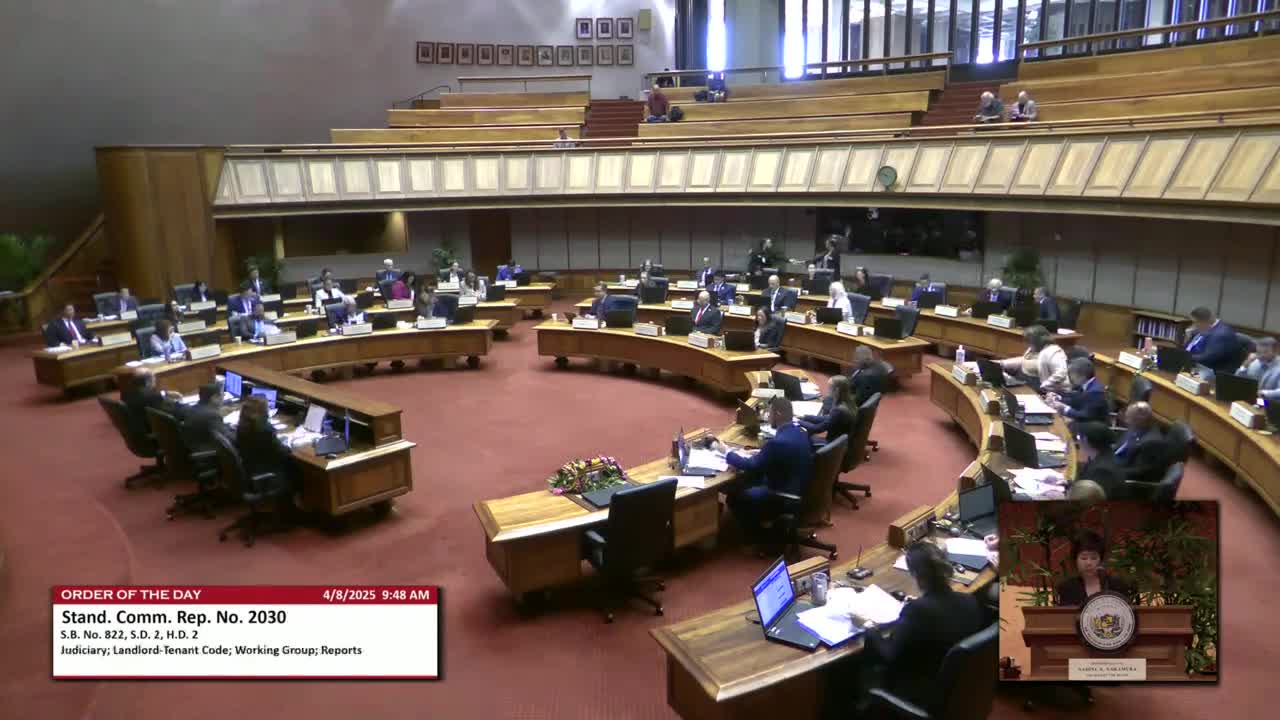
| Apr 8, 2025 | Passed Third Reading as amended in HD 2 with Representative(s) Iwamoto voting aye with reservations; Representative(s) Garcia, Muraoka voting no (2) and Representative(s) Cochran excused (1). Transmitted to Senate. |
| Apr 4, 2025 | Forty-eight (48) hours notice Tuesday, 04-08-25. |
| Apr 4, 2025 | Reported from JHA (Stand. Com. Rep. No. 2030) as amended in HD 2, recommending passage on Third Reading. |
| Apr 2, 2025 | The committee on JHA recommend that the measure be PASSED, WITH AMENDMENTS. The votes were as follows: 10 Ayes: Representative(s) Tarnas, Poepoe, Belatti, Hashem, Kahaloa, Perruso, Takayama, Todd, Shimizu; Ayes with reservations: Representative(s) Garcia; Noes: none; and 1 Excused: Representative(s) Cochran. |
| Mar 28, 2025 | Bill scheduled to be heard by JHA on Wednesday, 04-02-25 2:00PM in House conference room 325 VIA VIDEOCONFERENCE. |
| Mar 21, 2025 | Passed Second Reading as amended in HD 1 and referred to the committee(s) on JHA with Representative(s) Garcia voting aye with reservations; none voting no (0) and Representative(s) Cochran, Garrett, Kapela, Kitagawa, Ward excused (5). |
| Mar 21, 2025 | Reported from CPC (Stand. Com. Rep. No. 1477) as amended in HD 1, recommending passage on Second Reading and referral to JHA. |
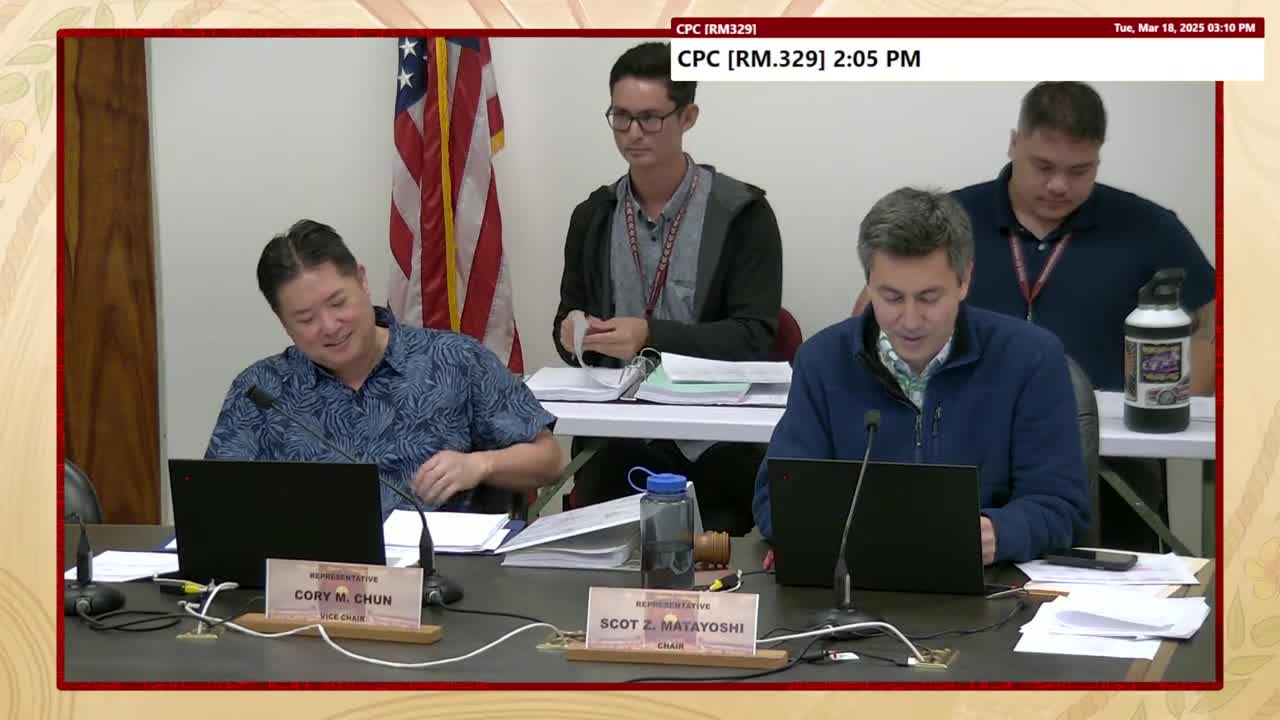
| Mar 18, 2025 | The committee on CPC recommend that the measure be PASSED, WITH AMENDMENTS. The votes were as follows: 8 Ayes: Representative(s) Matayoshi, Chun, Ilagan, Ichiyama, Kong, Lowen, Marten; Ayes with reservations: Representative(s) Iwamoto; Noes: none; and 2 Excused: Representative(s) Tam, Pierick. |
| Mar 14, 2025 | Bill scheduled to be heard by CPC on Tuesday, 03-18-25 2:05PM in House conference room 329 VIA VIDEOCONFERENCE. |
| Mar 6, 2025 | Referred to CPC, JHA, referral sheet 19 |
| Mar 6, 2025 | Pass First Reading |
| Mar 4, 2025 | Received from Senate (Sen. Com. No. 203) in amended form (SD 2). |
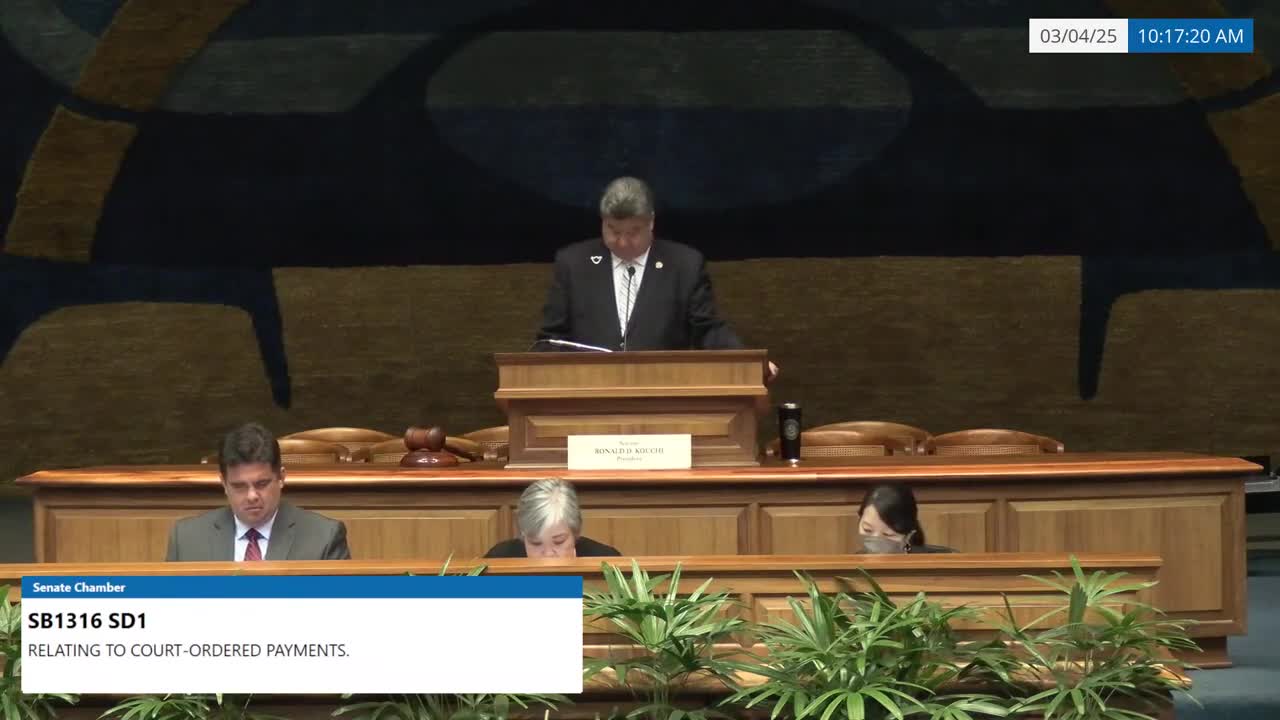
| Mar 4, 2025 | Report Adopted; Passed Third Reading, as amended (SD 2). Ayes, 24; Aye(s) with reservations: none. Noes, 1 (Senator(s) Awa). Excused, 0 (none). Transmitted to House. |
| Feb 28, 2025 | 48 Hrs. Notice 03-04-25. |
| Feb 28, 2025 | Reported from JDC (Stand. Com. Rep. No. 1016) with recommendation of passage on Third Reading, as amended (SD 2). |
| Feb 20, 2025 | The committee(s) on JDC recommend(s) that the measure be PASSED, WITH AMENDMENTS. The votes in JDC were as follows: 3 Aye(s): Senator(s) Rhoads, Chang, San Buenaventura; Aye(s) with reservations: none ; 1 No(es): Senator(s) Awa; and 1 Excused: Senator(s) Gabbard. |
| Feb 18, 2025 | The committee(s) on JDC will hold a public decision making on 02-20-25 10:01AM; CR 016 & Videoconference. |
| Feb 12, 2025 | Report adopted; Passed Second Reading, as amended (SD 1) and referred to JDC. |
| Feb 12, 2025 | Reported from CPN (Stand. Com. Rep. No. 383) with recommendation of passage on Second Reading, as amended (SD 1) and referral to JDC. |
| Feb 4, 2025 | The committee(s) on CPN recommend(s) that the measure be PASSED, WITH AMENDMENTS. The votes in CPN were as follows: 3 Aye(s): Senator(s) Keohokalole, Fukunaga, McKelvey; Aye(s) with reservations: none ; 1 No(es): Senator(s) Awa; and 1 Excused: Senator(s) Richards. |
| Jan 30, 2025 | The committee(s) on CPN has scheduled a public hearing on 02-04-25 9:35AM; Conference Room 229 & Videoconference. |
| Jan 23, 2025 | Referred to CPN, JDC. |
| Jan 21, 2025 | Passed First Reading. |
| Jan 17, 2025 | Introduced. |
|
Date
|
Description
|
Location
|
Votes
|
|
|---|---|---|---|---|
| Apr 8, 2025 | Third Reading | House Floor |
Passed |
|
| Apr 2, 2025 | The committee on JHA recommend that the measure be PASSED, WITH AMENDMENTS | House Standing Committee on Judiciary & Hawaiian Affairs |
Passed |
|
| Mar 18, 2025 | The committee on CPC recommend that the measure be PASSED, WITH AMENDMENTS | House Standing Committee on Consumer Protection & Commerce |
Passed |
|
| Mar 4, 2025 | Third Reading | Senate Floor |
Passed |
|
| Feb 20, 2025 | The committee(s) on JDC recommend(s) that the measure be PASSED, WITH AMENDMENTS | Senate Standing Committee on Judiciary |
Passed |
|
| Feb 4, 2025 | The committee(s) on CPN recommend(s) that the measure be PASSED, WITH AMENDMENTS | Senate Standing Committee on Commerce and Consumer Protection |
Passed |
This list shows positions taken on this bill by organizations on the date displayed, which is linked to the original source.
Positions by individuals are not included.
|
Organization
|
Position
|
Date
|
|---|---|---|
| and Hawaii Workers Center | ** Support | |
| County of Hawaiʻi Office of Housing and Community Development | ** Support | |
| County of Hawaiʻi Office of Housing and Community Development | *** Support | Apr 2, 2025 |
| Department of the Attorney General | ** Against | |
| Department of the Attorney General | *** Against | Apr 2, 2025 |
| Hawaii Council of Community Associations | ** Support | |
| Hawaiʻi Association of REALTORS | ** Support | |
| Honolulu Police Department | ** Against | |
| Judiciary | ** Support | |
| Kalihi Palama Neighborhood Board No. 15 | ** Support | |
| Maui Tenants & Workers Association | *** Support | Apr 2, 2025 |
| Office of Housing and Community Development of the County of Hawaiʻi | ** Support |
STAND. COM. REP. NO. 2030
Honolulu, Hawaii
, 2025
RE: S.B. No. 822
S.D. 2
H.D. 2
Honorable Nadine K. Nakamura
Speaker, House of Representatives
Thirty-Third State Legislature
Regular Session of 2025
State of Hawaii
Madame:
Your Committee on Judiciary & Hawaiian Affairs, to which was referred S.B. No. 822, S.D. 2, H.D. 1, entitled:
"A BILL FOR AN ACT RELATING TO THE LANDLORD TENANT CODE,"
begs leave to report as follows:
The purpose of this measure is to:
(1) Establish a three-year Residential Landlord-Tenant Code Working Group to research and improve the Residential-Landlord Tenant Code; and
(2) Require an initial report to the Legislature prior to the Regular Session of 2026 and a final report no later than July 1, 2028.
Your Committee received testimony in support of this measure from the Judiciary; Office of Housing and Community Development of the County of Hawaiʻi; Hawaiʻi Association of Realtors; and Hawaii Workers Center. Your Committee received testimony in opposition to this measure from the Department of the Attorney General.
Your Committee finds that rental housing is a critical component of Hawaii's housing market, with a significant portion of residents relying on rental properties for stability. However, the complexity of landlord-tenant laws and legal proceedings creates challenges for landlords and tenants, often leading to disputes, uncertainty, and an increased burden on the judicial system. This measure will facilitate collaboration among key stakeholders to identify issues, develop solutions, and enhance the rental housing market, ultimately increasing housing availability and stability for Hawaii residents.
Your Committee has amended this measure by:
(1) Placing the Residential Landlord-Tenant Code Working Group (Working Group) within the Judiciary, rather than the Department of the Attorney General, and updating the membership of the Working Group;
(2) Amending the scope of the Working Group;
(3) Deleting the savings clause; and
(4) Making technical, nonsubstantive amendments for the purposes of clarity, consistency, and style.
As affirmed by the record of votes of the members of your Committee on Judiciary & Hawaiian Affairs that is attached to this report, your Committee is in accord with the intent and purpose of S.B. No. 822, S.D. 2, H.D. 1, as amended herein, and recommends that it pass Third Reading in the form attached hereto as S.B. No. 822, S.D. 2, H.D. 2.
Respectfully submitted on behalf of the members of the Committee on Judiciary & Hawaiian Affairs,
|
|
|
____________________________ DAVID A. TARNAS, Chair |
|
|
|
|
STAND. COM. REP. NO. 1477
Honolulu, Hawaii
, 2025
RE: S.B. No. 822
S.D. 2
H.D. 1
Honorable Nadine K. Nakamura
Speaker, House of Representatives
Thirty-Third State Legislature
Regular Session of 2025
State of Hawaii
Madame:
Your Committee on Consumer Protection & Commerce, to which was referred S.B. No. 822, S.D. 2, entitled:
"A BILL FOR AN ACT RELATING TO THE LANDLORD TENANT CODE,"
begs leave to report as follows:
The purpose of this measure is to establish the Residential Landlord-Tenant Code Working Group to:
(1) Conduct a comprehensive review of the Residential Landlord-Tenant Code to determine, among other things, whether amendments and updates are necessary; and
(2) Submit a report of its findings and recommendations, including any proposed legislation, to the Legislature before the Regular Session of 2027.
Your Committee received testimony in support of this measure from the Judiciary; County of Hawaiʻi Office of Housing and Community Development; Hawaii Council of Community Associations; and Hawaiʻi Association of REALTORS.
Your Committee finds that the Residential Landlord-Tenant Code, codified as chapter 521, Hawaii Revised Statutes, provides a framework for the regulation of landlord-tenant relationships. Enacted in 1972, the Code has not undergone a thorough review since its inception, despite piecemeal updates over the years. The rental housing landscape in Hawaii has evolved significantly since that time and it is increasingly evident that the Code is in need of a comprehensive review to better address and reflect the needs of landlords and tenants in the present-day rental housing market. This measure therefore establishes a Working Group that explore solutions and propose necessary amendments to the Code.
Your Committee has amended this measure by:
(1) Inserting a purpose section;
(2) Clarifying that the Residential-Landlord Tenant Code Working Group (Working Group) is a three-year working group and placing the Working Group within the Department of the Attorney General, rather than the Judiciary;
(3) Clarifying and expanding the responsibilities of the Working Group;
(4) Amending the membership of the Working Group;
(5) Deleting reimbursement language relating to the members of the Working Group;
(6) Requiring the Working Group to submit an initial report to the Legislature prior to the Regular Session of 2026 and a final report no later than July 1, 2028;
(7) Requiring the initial meeting of the Working Group to convene no later than July 1, 2025;
(8) Changing the dissolution date of the Working Group to July 1, 2028;
(9) Changing the effective date to July 1, 3000, to encourage further discussion; and
(10) Making technical, nonsubstantive amendments for the purposes of clarity, consistency, and style.
As affirmed by the record of votes of the members of your Committee on Consumer Protection & Commerce that is attached to this report, your Committee is in accord with the intent and purpose of S.B. No. 822, S.D. 2, as amended herein, and recommends that it pass Second Reading in the form attached hereto as S.B. No. 822, S.D. 2, H.D. 1, and be referred to your Committee on Judiciary & Hawaiian Affairs.
Respectfully submitted on behalf of the members of the Committee on Consumer Protection & Commerce,
|
|
|
____________________________ SCOT Z. MATAYOSHI, Chair |
|
|
|
|
STAND. COM. REP. NO. 1016
Honolulu, Hawaii
RE: S.B. No. 822
S.D. 2
Honorable Ronald D. Kouchi
President of the Senate
Thirty-Third State Legislature
Regular Session of 2025
State of Hawaii
Sir:
Your Committee on Judiciary, to which was referred S.B. No. 822, S.D. 1, entitled:
"A BILL FOR AN ACT RELATING TO THE LANDLORD TENANT CODE,"
begs leave to report as follows:
The purpose and intent of this measure is to:
(1) Authorize a landlord to petition a district court for a temporary restraining order, permanent restraining order, or injunction to compel a tenant's compliance with section 521-51, Hawaii Revised Statutes;
(2) Establish a working group facilitated by the Judiciary to conduct a comprehensive review of and recommend updates to the Residential Landlord-Tenant Code; and
(3) Require a report to the Legislature.
Your Committee received testimony in support of this measure from the Judiciary, Kalihi Palama Neighborhood Board No. 15, and Hawaiʻi Association of REALTORS.
Your Committee received testimony in opposition to this measure from the Honolulu Police Department.
Your Committee finds that there are many instances where tenants violate rules and laws relating to their tenancy, such as continuous noise violations, smoking in a non-smoking building, storing illegal fireworks, or threatening to kill neighbors. These violations impact the health, safety, and quality of life of everyone subjected to such acts. Presently, the only option a landlord has to end the violations is to bring an eviction lawsuit against the violating tenant. However, eviction lawsuits may take two to three months to resolve.
Your Committee further finds that occasionally, tenants who are unlawfully removed or excluded from dwelling units by their landlords or have certain utilities intentionally interrupted occasionally seek temporary restraining orders and injunctive relief under existing law. However, the Landlord-Tenant Code does not currently contain a specific statutory process for these types of temporary restraining orders, timeframes for filing, service, and hearings of the restraining orders, or specific remedies available to tenants if landlords violate the temporary restraining order, leaving tenants with little guidance when filing these cases. Your Committee believes that the working group established by this measure should be allowed to discuss problems faced by both landlords and tenants and to explore possible statutory solutions to help landlords and tenants enforce their rights before amending the Landlord-Tenant Code. This measure will provide necessary information to the Legislature to update the Landlord-Tenant Code to ensure the fair and equitable enforcement of both tenant and landlord rights under the Code.
Accordingly, your Committee has amended this measure by:
(1) Deleting language that would have authorized a landlord to petition a district court for a temporary restraining order, permanent restraining order, or injunction to compel a tenant's compliance with section 521-51, Hawaii Revised Statutes;
(2) Requiring the working group established by this measure to:
(A) Review existing mechanisms available to both landlords and tenants for the enforcement of rights under the Landlord-Tenant Code; and
(B) Consider the feasibility of statutory processes through which injunctive relief might be obtained; and
(3) Making technical, nonsubstantive amendments for the purposes of clarity and consistency.
As affirmed by the record of votes of the members of your Committee on Judiciary that is attached to this report, your Committee is in accord with the intent and purpose of S.B. No. 822, S.D. 1, as amended herein, and recommends that it pass Third Reading in the form attached hereto as S.B. No. 822, S.D. 2.
Respectfully submitted on behalf of the members of the Committee on Judiciary,
|
|
|
________________________________ KARL RHOADS, Chair |
|
|
|
|
STAND. COM. REP. NO. 383
Honolulu, Hawaii
RE: S.B. No. 822
S.D. 1
Honorable Ronald D. Kouchi
President of the Senate
Thirty-Third State Legislature
Regular Session of 2025
State of Hawaii
Sir:
Your Committee on Commerce and Consumer Protection, to which was referred S.B. No. 822 entitled:
"A BILL FOR AN ACT RELATING TO THE LANDLORD TENANT CODE,"
begs leave to report as follows:
The purpose and intent of this measure is to allow a landlord to petition a district court for a temporary restraining order, permanent restraining order, or an injunction to compel a tenant's compliance with section 521-51, Hawaii Revised Statutes.
Your Committee received testimony in support of this measure from one individual.
Your Committee received testimony in opposition to this measure from the Honolulu Police Department.
Your Committee received comments on this measure from the Judiciary.
Your Committee finds that section 521-51, Hawaii Revised Statutes, requires tenants to maintain their dwelling units. Presently, the only option a landlord has to stop violations of this section is to bring an eviction action against the violating tenant, which can take up to several months or longer to resolve. This measure would allow district courts to enjoin a tenant from further violations while an eviction action against the tenant is contemporaneously pending.
Your Committee notes the testimony of the Judiciary expressing concerns that allowing claims for injunctions to be filed together with a summary possession claim would require the Judiciary staff to manually review every case to determine if a complaint includes a requests for an injunction to prioritize those hearings. This would cause considerable administrative burdens. Amendments to this measure are therefore necessary to address this concern and to decouple the summary possession claims from claims for an injunction.
Your Committee has amended this measure by:
(1) Deleting language that would have allowed a landlord to seek an injunction or join a claim for an injunction with a claim for summary possession;
(2) Inserting language to establish a working group to be facilitated by the Judiciary to conduct a comprehensive review of the Residential Landlord-Tenant Code and report its findings and recommendations to the Legislature twenty days prior to the convening of the Regular Session of 2027;
(3) Inserting an effective date of July 1, 2050, to encourage further discussion; and
(4) Making technical, nonsubstantive amendments for the purposes of clarity and consistency.
As affirmed by the record of votes of the members of your Committee on Commerce and Consumer Protection that is attached to this report, your Committee is in accord with the intent and purpose of S.B. No. 822, as amended herein, and recommends that it pass Second Reading in the form attached hereto as S.B. No. 822, S.D. 1, and be referred to your Committee on Judiciary.
Respectfully submitted on behalf of the members of the Committee on Commerce and Consumer Protection,
|
|
|
________________________________ JARRETT KEOHOKALOLE, Chair |
|
|
|
|
|
Date
|
Testimony PDF
|
|---|---|
| Apr 2, 2025 | SB822_HD1_TESTIMONY_JHA_04-02-25_.PDF |
| Mar 18, 2025 | SB822_SD2_TESTIMONY_CPC_03-18-25_.PDF |
| Feb 20, 2025 | SB822_SD1_TESTIMONY_JDC_02-20-25_.PDF |
| Feb 4, 2025 | SB822_TESTIMONY_CPN_02-04-25_.PDF |
Discussed in Hearing
 1MIN
House Floor
 4MIN
House Standing Committee on Judiciary & Hawaiian Affairs
 2MIN
House Standing Committee on Consumer Protection & Commerce
2MIN
House Standing Committee on Judiciary & Hawaiian Affairs
 4MIN
House Standing Committee on Consumer Protection & Commerce
4MIN
House Standing Committee on Judiciary & Hawaiian Affairs
 19SEC
Senate Floor
Bill Author

Bill Co-Author(s):