SB 739: Land Exchange; Diversified Agricultural Production; Affordable Housing; Workforce Housing; Housing Development
- Session Year: 2025-2026
- House: Senate
- Latest Version Date: 2025-04-25
Current Status:
In Progress
(2025-07-02: Act 279, on 07/02/2025 (Gov. Msg. No. 1382).)
Introduced
In Committee
First Chamber
In Committee
Second Chamber
Final Decking
Enacted
Allows the Governor to negotiate land exchanges, subject to approval by the Board of Land and Natural Resources, to acquire lands that are suitable for long-term diversified agricultural production in exchange for land for private affordable, workforce, or other housing development. Requires a report to the Legislature. (CD1)
Allows the Governor to negotiate land exchanges, subject to approval by the Board of Land and Natural Resources, to acquire lands that are suitable for long-term diversified agricultural production in exchange for land for private affordable, workforce, or other housing development. Requires a report to the Legislature. Effective 7/1/3000. (HD1)
Allows the Governor to negotiate land exchanges in consultation with the Board of Land and Natural Resources to acquire lands that are suitable for long-term diversified agricultural production in exchange for land for private affordable housing development. Requires a report to the Legislature. Effective 1/1/2050. (SD2)
Allows the Governor to negotiate land exchanges to acquire lands that are suitable for long-term diversified agricultural production in exchange for land for private affordable housing development. Requires a report to the Legislature. Effective 1/1/2050. (SD1)
Allows the governor to negotiate land exchanges to acquire lands that are suitable for long-term diversified agricultural production in exchange for land for private affordable housing development. Requires report to legislature.
|
THE SENATE |
S.B. NO. |
739 |
|
THIRTY-THIRD LEGISLATURE, 2025 |
S.D. 2 |
|
|
STATE OF HAWAII |
H.D. 1 |
|
|
|
C.D. 1 |
|
|
|
||
|
|
||
A BILL FOR AN ACT
RELATING TO LAND EXCHANGE.
BE IT ENACTED BY THE LEGISLATURE OF THE STATE OF HAWAII:
A report released by the department of agriculture, Statewide Agricultural Land Use Baseline 2015, and updated in 2020, shows a dramatic change in agricultural land over forty years as sugar production and pineapple production have downsized. According to the department of agriculture, there were 120,630 acres of agricultural land in crop production in 2020 compared to 350,830 acres in crop production in 1980.
Article XI, section 3, of the Hawaii State Constitution, directs the State to conserve and protect agricultural lands, promote diversified agriculture, increase agricultural self‑sufficiency, and assure the availability of agriculturally suitable lands. The State's agricultural production is insufficient to meet the State's food consumption needs. This over-reliance on imported food creates critical health, safety, and security issues for the State and threatens the State's sustainable future and preparedness for future disasters, emergencies, and crises. The legislature further finds that attempts to stimulate diversified agriculture in the private sector through regulatory controls and land use and zoning restrictions are not sufficient to address the business needs and subsidies necessary to effectively and significantly increase diversified agriculture to the extent necessary to avoid Hawaii's agricultural self-sufficiency crisis. Where feasible, the State must take a more active role in providing assistance and subsidies that promote farming businesses.
The legislature further finds that over the years, the State has prioritized a shift toward sustainability in agriculture and decreasing our food imports. Act 55, Session Laws of Hawaii 2013, amends the Hawaii State Planning Act to promote economically competitive activities that increase Hawaii's agricultural self-sufficiency, including the increased purchase and use of Hawaii-grown food and food products by residents, businesses, and governmental bodies. On September 1, 2016, Governor Ige pledged a commitment for Hawaii to double its food production by 2020. To accomplish that objective, the governor prioritized making more land available for agriculture.
Large tracts of agricultural land, including those formerly used for pineapple and sugar cane, are now fallow. These lands provide a unique opportunity for the State to fulfill the intent of the Hawaii State Constitution regarding diversified agriculture and agricultural self-sufficiency through acquisition of suitable agricultural land for long-term leases for diversified, bona fide agricultural operations to increase agricultural production.
The legislature also finds that the State continues to face a crisis in homelessness, affordable housing, workforce housing, and other housing inventory for the State's residents. According to the December 2016 Report to the Hawaii State Legislature in response to Act 127, Session Laws of Hawaii 2016, by the special action team on affordable rental housing, approximately 24,551 housing units were needed statewide in the five-year period from 2016 to 2020. Hawaii faces a critical shortage of safe, sanitary, and affordable housing units; work‑force housing; and other housing inventory for Hawaii residents and the legislature must act to eliminate or reduce that shortage. State initiatives acknowledging and attempting to mitigate this crisis include:
(1) Providing affordable rental and for-sale housing. Act 127, Session Laws of Hawaii 2016, as amended by Act 96, Session Laws of Hawaii 2017, establishes a goal of developing or vesting the development of at least 22,500 affordable rental housing units ready for occupancy by December 31, 2026, and establishes the special action team on affordable rental housing to make recommendations on actions to promote the development of at least 22,500 affordable rental housing units to be ready for occupancy between January 1, 2017, and December 31, 2026. The special action team's report to the legislature recommended expanding the public lands available for consideration to meet housing needs and also explained its ten-year plan and current development of suitability maps to identify state, county, and private parcels of land on each island that may be used for residential units. Additionally, the 2016 Hawaii housing planning study prepared by SMS for the Hawaii housing finance and development corporation found that a shortage of land available for development was a significant factor limiting the supply of housing;
(2) Development of state lands around transit-oriented development areas for housing. Act 130, Session Laws of Hawaii 2016, authorizes the department of education to use fees collected from transit-oriented development projects to be used for existing schools in the development area to address increases in school populations due to transit-oriented development, and establishes an interagency council for transit‑oriented development. In addition, Act 131, Session Laws of Hawaii 2016, enables the Hawaii housing finance and development corporation to develop mixed-use developments in partnership with state and county departments and agencies. The Hawaii interagency council for transit-oriented development's report to the legislature noted that, as one of the largest landowners along the Honolulu rail corridor, the State has a unique opportunity to revitalize neighborhoods, increase affordable housing, and improve accessibility to public facilities and services by applying smart growth and transit-oriented development principles as the construction of the rail transit system progresses; and
(3) Supporting housing projects through state infrastructure planning and construction. Act 130, Session Laws of Hawaii 2016, requires the Hawaii interagency council for transit-oriented development to identify transit-oriented development projects that lack sufficient infrastructure. In addition, Act 131, Session Laws of Hawaii 2016, includes infrastructure in its mandate to develop mixed-use developments and Act 132, Session Laws of Hawaii 2016, provides grants and loans to state agencies, and loans to the counties and private developers for infrastructure improvements. The Hawaii interagency council for transit-oriented development's report to the legislature also noted the importance of this issue, listing infrastructure as the most pressing concern that needed to be considered as transit-oriented development is pursued statewide.
The legislature further finds that lack of suitable, entitled lands for development of appropriate housing is a major contributing factor to the housing crisis, and substantial obstacles and delays in entitling such lands discourage development, lower housing inventory, and raise housing prices, among other negative effects.
Addressing the challenges of the State's agricultural self‑sufficiency and housing crises will require courageous and novel legislation that addresses these issues in an expeditious, economical, and flexible manner. The legislature additionally finds that land exchanges completed in other states, such as exchanges of state lands for privately owned lands to meet the needs of and mutually benefit both parties, have provided public benefit in the areas of conservation, economic growth, ecology, and recreation. Land exchanges thereby present a viable method of addressing the many housing and agricultural issues facing the State. Land exchanges present a win-win situation where the State is able to negotiate a mutually beneficial exchange of developable state lands for housing for privately owned agricultural lands for farming.
The purpose of this Act is to:
(1) Allow the governor, subject to approval by the board of land and natural resources, to negotiate land exchanges consistent with and in furtherance of the State's agricultural and housing needs and purposes, in a manner that ideally addresses all needs and purposes; and
(2) Require the governor to submit a report to the legislature of the negotiated land exchanges for final approval.
SECTION 2. (a) Subject to approval by the board of land and natural resources, the governor may negotiate land exchanges in accordance with chapter 171, Hawaii Revised Statutes, for the purpose of acquiring private lands that are suitable for long‑term diversified agricultural production by the State or its lessees, in exchange for state lands to be acquired by private parties for development of affordable housing, workforce housing, and other housing inventory for Hawaii residents.
(b) The governor may coordinate with the agribusiness development corporation, the department of land and natural resources, and any other department or agency of the State that holds title to or an assignment of state land that may be appropriate for exchange under subsection (a); provided that lands undergoing the development entitlement process and on which substantial state funds have been expended shall not be considered priority lands for an exchange under subsection (a).
(c) It is the intent of this Act that the exchanges negotiated pursuant to this Act will result in exchanges that address the State's agricultural and housing crises by:
(1) Obtaining large tracts of suitable agricultural lands for the State to lease to farmers for diversified agriculture; and
(2) Providing private parties with suitable urban lands for the expeditious development of affordable housing, workforce housing, and other housing inventory for Hawaii residents, and mixed use commercial and accessory uses within areas designated for transit‑oriented development and other appropriate urbanized areas.
(d) To facilitate successful negotiation of land exchanges, including the enhancement of optimal agricultural lands acquired by the State in exchange for urbanized lands and the expedient consummation of exchanges, the governor may, pursuant to subsection (e)(3), reclassify and rezone lands intended for exchange under this Act and transfer such state lands, authorized by subsection (a), to private parties for development of housing and other mixed uses within the state urban land use district with appropriate county residential or mixed-use zoning, subject to the following:
(1) The lands shall be within a one-half-mile radius of any rail station approved by the Federal Transportation Administration within the city and county of Honolulu;
(2) Any development on the lands to be transferred to private parties shall comply with all state and county laws, rules, and regulations regarding health and safety and building permit requirements for housing or mixed-use developments on private lands, and after transfer shall not be subject to laws, rules, and regulations applicable to state lands except as required by this Act; and
(3) Any lands received from private parties as part of a land exchange pursuant to subsection (a) shall assume the ceded or public land trust character of the state lands for which the lands were exchanged.
(e) To promote exchanges that address the objectives of the State in acquiring more lands for diversified agriculture and encouraging private parties to develop more affordable housing, workforce housing, and other housing inventory:
(1) Appraisals shall be performed, in compliance with section 171-50, of state lands for purposes of exchange with the urban, residential, or mixed-use land; provided that appraisals shall reflect any land‑use reclassification and rezoning adopted pursuant to this Act;
(2) The development of housing on private lands as contemplated by this Act shall be subject to chapters 6E and 343, Hawaii Revised Statutes, as applicable to private housing on private lands, notwithstanding the prior state ownership of the land or the use of state or county housing assistance programs;
(3) The governor, as necessary to facilitate and effect the purposes of this Act, may submit notifications and supporting information to:
(A) The land use commission for any necessary reclassification of land; and
(B) The planning director of the appropriate county for any necessary rezoning of land;
provided that the reclassification and rezoning shall be adopted within thirty days of receipt of the governor's notification;
(4) Private development of housing or mixed uses on private lands, as contemplated by this Act, shall be exempt from all applicable state and county procurement requirements, impact fees, and other exactions;
(5) The governor and all related state and county agencies shall take such further actions as may be necessary to facilitate and effect the purposes of this Act;
(6) Consummation of any exchange pursuant to this Act shall be subject to the requirements of section 3 of this Act; and
(7) Any state land transferred to a private party pursuant to this Act shall include a restrictive covenant or reversionary interest in the deed in favor of the State that requires the land to be used for the development of affordable housing, workforce housing, or other housing inventory.
SECTION 3. The governor shall submit a report to the legislature no later than twenty days prior to the convening of the regular session of 2026 on:
(1) The feasibility of any land exchanges of agricultural parcels of high interest to the State in exchange for urbanized lands for appropriate private development negotiated by the governor as contemplated by this Act, a list of lands suitable for such an exchange, and a description and the market value of the parcels; and
(2) Any appropriations, proposed legislation, or administrative action necessary to accomplish the goals of this Act.
After receipt of the governor's report, the legislature, if not in session, may convene in special session pursuant to article III, section 10 of the Hawaii State Constitution to act on land exchanges proposed pursuant to this Act.
SECTION 4. This Act shall take effect on July 1, 2025.
Report Title:
Land Exchange; Diversified Agricultural Production; Affordable Housing; Workforce Housing; Housing Development
Description:
Allows the Governor to negotiate land exchanges, subject to approval by the Board of Land and Natural Resources, to acquire lands that are suitable for long-term diversified agricultural production in exchange for land for private affordable, workforce, or other housing development. Requires a report to the Legislature. (CD1)
The summary description of legislation appearing on this page is for informational purposes only and is not legislation or evidence of legislative intent.
|
THE SENATE |
S.B. NO. |
739 |
|
THIRTY-THIRD LEGISLATURE, 2025 |
S.D. 2 |
|
|
STATE OF HAWAII |
H.D. 1 |
|
|
|
|
|
|
|
||
|
|
||
A BILL FOR AN ACT
RELATING TO LAND EXCHANGE.
BE IT ENACTED BY THE LEGISLATURE OF THE STATE OF HAWAII:
A report released by the department of agriculture, Statewide Agricultural Land Use Baseline 2015, and updated in 2020, shows a dramatic change in agricultural land over forty years as sugar production and pineapple production have downsized. According to the department of agriculture, there were 120,630 acres of agricultural land in crop production in 2020 compared to 350,830 acres in crop production in 1980.
Article XI, section 3, of the Hawaii State Constitution, directs the State to conserve and protect agricultural lands, promote diversified agriculture, increase agricultural self‑sufficiency, and assure the availability of agriculturally suitable lands. The State's agricultural production is insufficient to meet the State's food consumption needs. This over-reliance on imported food creates critical health, safety, and security issues for the State and threatens the State's sustainable future and preparedness for future disasters, emergencies, and crises. The legislature further finds that attempts to stimulate diversified agriculture in the private sector through regulatory controls and land use and zoning restrictions are not sufficient to address the business needs and subsidies necessary to effectively and significantly increase diversified agriculture to the extent necessary to avoid Hawaii's agricultural self-sufficiency crisis. Where feasible, the State must take a more active role in providing assistance and subsidies that promote farming businesses.
The legislature further finds that over the years, the State has prioritized a shift toward sustainability in agriculture and decreasing our food imports. Act 55, Session Laws of Hawaii 2013, amends the Hawaii State Planning Act to promote economically competitive activities that increase Hawaii's agricultural self-sufficiency, including the increased purchase and use of Hawaii-grown food and food products by residents, businesses, and governmental bodies. On September 1, 2016, Governor Ige pledged a commitment for Hawaii to double its food production by 2020. To accomplish that objective, the governor prioritized making more land available for agriculture.
Large tracts of agricultural land, including those formerly used for pineapple and sugar cane, are now fallow. These lands provide a unique opportunity for the State to fulfill the intent of the Hawaii State Constitution regarding diversified agriculture and agricultural self-sufficiency through acquisition of suitable agricultural land for long-term leases for diversified, bona fide agricultural operations to increase agricultural production.
The legislature also finds that the State continues to face a crisis in homelessness, affordable housing, workforce housing, and other housing inventory for the State's residents. According to the December 2016 Report to the Hawaii State Legislature in response to Act 127, Session Laws of Hawaii 2016, by the special action team on affordable rental housing, approximately 24,551 housing units were needed statewide in the five-year period from 2016 to 2020. Hawaii faces a critical shortage of safe, sanitary, and affordable housing units; work‑force housing; and other housing inventory for Hawaii residents and the legislature must act to eliminate or reduce that shortage. State initiatives acknowledging and attempting to mitigate this crisis include:
(1) Providing affordable rental and for-sale housing. Act 127, Session Laws of Hawaii 2016, as amended by Act 96, Session Laws of Hawaii 2017, establishes a goal of developing or vesting the development of at least 22,500 affordable rental housing units ready for occupancy by December 31, 2026, and establishes the special action team on affordable rental housing to make recommendations on actions to promote the development of at least 22,500 affordable rental housing units to be ready for occupancy between January 1, 2017, and December 31, 2026. The special action team's report to the legislature recommended expanding the public lands available for consideration to meet housing needs and also explained its ten-year plan and current development of suitability maps to identify state, county, and private parcels of land on each island that may be used for residential units. Additionally, the 2016 Hawaii housing planning study prepared by SMS for the Hawaii housing finance and development corporation found that a shortage of land available for development was a significant factor limiting the supply of housing;
(2) Development of state lands around transit-oriented development areas for housing. Act 130, Session Laws of Hawaii 2016, authorizes the department of education to use fees collected from transit-oriented development projects to be used for existing schools in the development area to address increases in school populations due to transit-oriented development, and establishes an interagency council for transit‑oriented development. In addition, Act 131, Session Laws of Hawaii 2016, enables the Hawaii housing finance and development corporation to develop mixed-use developments in partnership with state and county departments and agencies. The Hawaii interagency council for transit-oriented development's report to the legislature noted that, as one of the largest landowners along the Honolulu rail corridor, the State has a unique opportunity to revitalize neighborhoods, increase affordable housing, and improve accessibility to public facilities and services by applying smart growth and transit-oriented development principles as the construction of the rail transit system progresses; and
(3) Supporting housing projects through state infrastructure planning and construction. Act 130, Session Laws of Hawaii 2016, requires the Hawaii interagency council for transit-oriented development to identify transit-oriented development projects that lack sufficient infrastructure. In addition, Act 131, Session Laws of Hawaii 2016, includes infrastructure in its mandate to develop mixed-use developments and Act 132, Session Laws of Hawaii 2016, provides grants and loans to state agencies, and loans to the counties and private developers for infrastructure improvements. The Hawaii interagency council for transit-oriented development's report to the legislature also noted the importance of this issue, listing infrastructure as the most pressing concern that needed to be considered as transit-oriented development is pursued statewide.
The legislature further finds that lack of suitable, entitled lands for development of appropriate housing is a major contributing factor to the housing crisis, and substantial obstacles and delays in entitling such lands discourage development, lower housing inventory, and raise housing prices, among other negative effects.
Addressing the challenges of the State's agricultural self‑sufficiency and housing crises will require courageous and novel legislation that addresses these issues in an expeditious, economical, and flexible manner. The legislature additionally finds that land exchanges completed in other states, such as exchanges of state lands for privately owned lands to meet the needs of and mutually benefit both parties, have provided public benefit in the areas of conservation, economic growth, ecology, and recreation. Land exchanges thereby present a viable method of addressing the many housing and agricultural issues facing the State. Land exchanges present a win-win situation where the State is able to negotiate a mutually beneficial exchange of developable state lands for housing for privately owned agricultural lands for farming.
The purpose of this Act is to:
(1) Allow the governor, subject to approval by the board of land and natural resources, to negotiate land exchanges consistent with and in furtherance of the State's agricultural and housing needs and purposes, in a manner that ideally addresses all needs and purposes; and
(2) Require the governor to submit a report to the legislature of the negotiated land exchanges for final approval.
SECTION 2. (a) Subject to approval by the board of land and natural resources, the governor may negotiate land exchanges in accordance with chapter 171, Hawaii Revised Statutes, for the purpose of acquiring private lands that are suitable for long‑term diversified agricultural production by the State or its lessees, in exchange for state lands to be acquired by private parties for development of affordable housing, workforce housing, and other housing inventory for Hawaii residents.
(b) The governor may coordinate with the agribusiness development corporation, the department of land and natural resources, and any other department or agency of the State that holds title to or an assignment of state land that may be appropriate for exchange under subsection (a); provided that lands undergoing the development entitlement process and on which substantial state funds have been expended shall not be considered priority lands for an exchange under subsection (a).
(c) It is the intent of this Act that the exchanges negotiated pursuant to this Act will result in exchanges that address the State's agricultural and housing crises by:
(1) Obtaining large tracts of suitable agricultural lands for the State to lease to farmers for diversified agriculture; and
(2) Providing private parties with suitable urban lands for the expeditious development of affordable housing, workforce housing, and other housing inventory for Hawaii residents, and mixed use commercial and accessory uses within areas designated for transit‑oriented development and other appropriate urbanized areas.
(d) To facilitate successful negotiation of land exchanges, including the enhancement of optimal agricultural lands acquired by the State in exchange for urbanized lands and the expedient consummation of exchanges, the governor may, pursuant to subsection (e)(3), reclassify and rezone lands intended for exchange under this Act and transfer such state lands, authorized by subsection (a), to private parties for development of housing and other mixed uses within the state urban land use district with appropriate county residential or mixed-use zoning, subject to the following:
(1) The lands shall be within a one-half-mile radius of any rail station approved by the Federal Transportation Administration within the city and county of Honolulu;
(2) Any development on the lands to be transferred to private parties shall comply with all state and county laws, rules, and regulations regarding health and safety and building permit requirements for housing or mixed-use developments on private lands, and after transfer shall not be subject to laws, rules, and regulations applicable to state lands except as required by this Act; and
(3) Any lands received from private parties as part of a land exchange pursuant to subsection (a) shall assume the ceded or public land trust character of the state lands for which the lands were exchanged.
(e) To promote exchanges that address the objectives of the State in acquiring more lands for diversified agriculture and encouraging private parties to develop more affordable housing, workforce housing, and other housing inventory:
(1) Appraisals shall be performed, in compliance with section 171-50, of state lands for purposes of exchange with the urban, residential, or mixed-use land; provided that appraisals shall reflect any land‑use reclassification and rezoning adopted pursuant to this Act;
(2) The development of housing on private lands as contemplated by this Act shall be subject to chapters 6E and 343, Hawaii Revised Statutes, as applicable to private housing on private lands, notwithstanding the prior state ownership of the land or the use of state or county housing assistance programs;
(3) The governor, as necessary to facilitate and effect the purposes of this Act, may submit notifications and supporting information to:
(A) The land use commission for any necessary reclassification of land; and
(B) The planning director of the appropriate county for any necessary rezoning of land;
provided that the reclassification and rezoning shall be adopted within thirty days of receipt of the governor's notification;
(4) Private development of housing or mixed uses on private lands, as contemplated by this Act, shall be exempt from all applicable state and county procurement requirements, impact fees, and other exactions;
(5) The governor and all related state and county agencies shall take such further actions as may be necessary to facilitate and effect the purposes of this Act;
(6) Consummation of any exchange pursuant to this Act shall be subject to the requirements of section 3 of this Act; and
(7) Any state land transferred to a private party pursuant to this Act shall include a restrictive covenant or reversionary interest in the deed in favor of the State that requires the land to be used for the development of affordable housing, workforce housing, or other housing inventory.
SECTION 3. The governor shall submit a report to the legislature no later than twenty days prior to the convening of the regular session of 2026 on:
(1) The feasibility of any land exchanges of agricultural parcels of high interest to the State in exchange for urbanized lands for appropriate private development negotiated by the governor as contemplated by this Act, a list of lands suitable for such an exchange, and a description and the market value of the parcels; and
(2) Any appropriations, proposed legislation, or administrative action necessary to accomplish the goals of this Act.
After receipt of the governor's report, the legislature, if not in session, may convene in special session pursuant to article III, section 10 of the Hawaii State Constitution to act on land exchanges proposed pursuant to this Act.
SECTION 4. This Act shall take effect on July 1, 3000.
Report Title:
Land Exchange; Diversified Agricultural Production; Affordable Housing; Workforce Housing; Housing Development
Description:
Allows the Governor to negotiate land exchanges, subject to approval by the Board of Land and Natural Resources, to acquire lands that are suitable for long-term diversified agricultural production in exchange for land for private affordable, workforce, or other housing development. Requires a report to the Legislature. Effective 7/1/3000. (HD1)
The summary description of legislation appearing on this page is for informational purposes only and is not legislation or evidence of legislative intent.
|
THE SENATE |
S.B. NO. |
739 |
|
THIRTY-THIRD LEGISLATURE, 2025 |
S.D. 2 |
|
|
STATE OF HAWAII |
|
|
|
|
|
|
|
|
||
|
|
||
A BILL FOR AN ACT
RELATING TO LAND EXCHANGE.
BE IT ENACTED BY THE LEGISLATURE OF THE STATE OF HAWAII:
A report released by the department of agriculture, Statewide Agricultural Land Use Baseline 2015, and updated in 2020, shows a dramatic change in agricultural land over forty years as sugar production and pineapple production have downsized. According to the department of agriculture, there were 120,630 acres of agricultural land in crop production in 2020 compared to 350,830 acres in crop production in 1980.
Article XI, section 3, of the Hawaii State Constitution, directs the State to conserve and protect agricultural lands, promote diversified agriculture, increase agricultural self‑sufficiency, and assure the availability of agriculturally suitable lands. The State's agricultural production is insufficient to meet the State's food consumption needs. This over-reliance on imported food creates critical health, safety, and security issues for the State and threatens the State's sustainable future and preparedness for future disasters, emergencies, and crises. The legislature further finds that attempts to stimulate diversified agriculture in the private sector through regulatory controls and land use and zoning restrictions are not sufficient to address the business needs and subsidies necessary to effectively and significantly increase diversified agriculture to the extent necessary to avoid Hawaii's agricultural self-sufficiency crisis. Where feasible, the State must take a more active role in providing assistance and subsidies that promote farming businesses.
The legislature further finds that over the years, the State has prioritized a shift toward sustainability in agriculture and decreasing our food imports. Act 55, Session Laws of Hawaii 2013, amends the Hawaii State Planning Act to promote economically competitive activities that increase Hawaii's agricultural self-sufficiency, including the increased purchase and use of Hawaii-grown food and food products by residents, businesses, and governmental bodies. On September 1, 2016, the governor pledged a commitment for Hawaii to double its food production by 2020. To accomplish that objective, the governor prioritized making more land available for agriculture.
Large tracts of agricultural land, including those formerly used for pineapple and sugar cane, are now fallow. These lands provide a unique opportunity for the State to fulfill the intent of the Hawaii State Constitution regarding diversified agriculture and agricultural self-sufficiency through acquisition of suitable agricultural land for long-term leases for diversified, bona fide agricultural operations to increase agricultural production.
The legislature also finds that the State continues to face a crisis in homelessness, affordable housing, workforce housing, and other housing inventory for the State's residents. According to the December 2016 Report to the Hawaii State Legislature in response to Act 127, Session Laws of Hawaii 2016, by the special action team on affordable rental housing, approximately 24,551 housing units were needed statewide in the five-year period from 2016 to 2020. Hawaii faces a critical shortage of safe, sanitary and affordable housing units, work‑force housing and other housing inventory for Hawaii residents and the legislature must act to eliminate or reduce that shortage. State initiatives acknowledging and attempting to mitigate this crisis include:
(1) Providing affordable rental and for-sale housing. Act 127, Session Laws of Hawaii 2016, as amended by Act 96, Session Laws of Hawaii 2017, establishes a goal of developing or vesting the development of at least 22,500 affordable rental housing units ready for occupancy by December 31, 2026, and establishes the special action team on affordable rental housing to make recommendations on actions to promote the development of at least 22,500 affordable rental housing units to be ready for occupancy between January 1, 2017, and December 31, 2026. The special action team's report to the legislature recommended expanding the public lands available for consideration to meet housing needs and also explained its ten-year plan and current development of suitability maps to identify state, county, and private parcels of land on each island that may be used for residential units. Also, the 2016 Hawaii housing planning study prepared by SMS for the Hawaii housing finance and development corporation found that a shortage of land available for development was a significant factor limiting the supply of housing;
(2) Development of state lands around transit-oriented development areas for housing. Act 130, Session Laws of Hawaii 2016, authorizes the department of education to use fees collected from transit-oriented development projects to be used for existing schools in the development area to address increases in school populations due to transit-oriented development, and establishes an interagency council for transit‑oriented development. In addition, Act 131, Session Laws of Hawaii 2016, enables the Hawaii housing finance and development corporation to develop mixed-use developments in partnership with state and county departments and agencies. The Hawaii interagency council for transit-oriented development's report to the legislature noted that, as one of the largest landowners along the Honolulu rail corridor, the State has a unique opportunity to revitalize neighborhoods, increase affordable housing, and improve accessibility to public facilities and services by applying smart growth and transit-oriented development principles as the construction of the rail transit system progresses; and
(3) Supporting housing projects through state infrastructure planning and construction. Act 130, Session Laws of Hawaii 2016, requires the Hawaii interagency council for transit-oriented development to identify transit-oriented development projects that lack sufficient infrastructure. In addition, Act 131, Session Laws of Hawaii 2016, includes infrastructure in its mandate to develop mixed-use developments and Act 132, Session Laws of Hawaii 2016, provides grants and loans to state agencies, and loans to the counties and private developers for infrastructure improvements. The Hawaii interagency council for transit-oriented development's report to the legislature also noted the importance of this issue, listing infrastructure as the most pressing concern that needed to be considered as transit-oriented development is pursued statewide.
The legislature further finds that lack of suitable, entitled lands for development of appropriate housing is a major contributing factor to the housing crisis, and substantial obstacles and delays in entitling such lands result in discouraging development, lowering housing inventory, and raising housing prices, among other negative effects.
Addressing the challenges of the State's agricultural self‑sufficiency and housing crises will require courageous and novel legislation which addresses these issues in an expeditious, economical, and flexible manner. The legislature additionally finds that land exchanges completed in other states, for example, exchanges of state lands for privately owned lands to meet the needs of and mutually benefit both parties, have provided public benefit in the areas of conservation, economic growth, ecology, and recreation. Land exchanges thereby present a viable method of addressing the many housing and agricultural issues facing the State. Land exchanges present a win-win situation where the State is able to negotiate a mutually beneficial exchange of developable state lands for housing for privately owned agricultural lands for farming.
The purpose of this Act is to allow the governor to:
(1) Negotiate land exchanges consistent with and in furtherance of the foregoing agricultural and housing needs and purposes, in a manner which ideally addresses all needs and purposes; and
(2) Submit a report to the legislature of the negotiated land exchanges for final approval.
SECTION 2. (a) In consultation with the board of land and natural resources, the governor may negotiate land exchanges in accordance with chapter 171, Hawaii Revised Statutes, for the purpose of acquiring private lands that are suitable for long‑term diversified agricultural production by the State or its lessees, in exchange for state lands to be acquired by private parties for development of affordable, workforce, and other housing for Hawaii residents.
(b) The governor may coordinate with the agribusiness development corporation, the department of land and natural resources, and any other department or agency of the State that holds title to or an assignment of state land that may be appropriate for exchange under subsection (a).
(c) It is the intent of this Act that the exchanges negotiated pursuant to this Act will result in exchanges which address both the State's agricultural and housing crises by:
(1) Obtaining large tracts of suitable agricultural lands for the State to lease to farmers for diversified agriculture; and
(2) Providing to private parties suitable urban lands for expeditious development of affordable housing, workforce housing, and other housing inventory for Hawaii residents, and mixed use commercial and accessory uses within areas designated for transit‑oriented development and other appropriate urbanized areas.
(d) To facilitate successful negotiation of land exchanges, including the enhancement of optimal agricultural lands acquired by the State in exchange for urbanized lands and the expedient consummation of exchanges, the governor shall be authorized to, pursuant to subsection (e)(3), reclassify and rezone lands intended for exchange under this Act and transfer such state lands, authorized by subsection (a), to private parties for development of housing and other mixed-uses within the state urban land use district with appropriate county residential or mixed-use zoning, subject to the following:
(1) The lands shall be within a one-half-mile radius of any rail station approved by the Federal Transportation Administration within the city and county of Honolulu; and
(2) Any development on the lands to be transferred to private parties shall comply with all state and county laws, rules, and regulations regarding health and safety and building permit requirements for housing or mixed-use developments on private lands, and shall not be subject to laws, rules, and regulations applicable to state lands.
(e) To promote exchanges that address the objectives of the State in acquiring more lands for diversified agriculture and encouraging private parties to develop more affordable, workforce, and other housing:
(1) Appraisals shall be performed, in compliance with section 171-50, of state lands for purposes of exchange with the urban, residential, or mixed-use land; provided that appraisals shall reflect any land‑use and zoning classifications adopted pursuant to this Act;
(2) The development of housing on private lands as contemplated by this Act shall be subject to chapters 6E and 343, Hawaii Revised Statutes, as applicable to private housing on private lands; notwithstanding the prior state ownership of the land or the use of state or county housing assistance programs;
(3) The governor, as necessary to facilitate and effect the purposes of this Act, may submit notifications and supporting information to:
(A) The land use commission; and
(B) The planning director of the appropriate county for any necessary rezoning of land;
provided that the reclassification and rezoning shall be adopted within thirty days of receipt of the governor's notification;
(4) Private development of housing or mixed-uses on private lands, as contemplated by this Act, shall be exempt from all applicable state and county procurement requirements, impact fees, and other exactions;
(5) The governor and all related state and county agencies are authorized and directed to take such further actions as may be necessary to facilitate and effect the purposes of this Act; and
(6) Consummation of any exchange pursuant to this Act shall be subject to the requirements of section 3.
SECTION 3. The governor shall submit a report to the legislature no later than twenty days prior to the convening of the regular session of 2026 on:
(1) The feasibility of any land exchanges of agricultural parcels of high interest to the State in exchange for urbanized lands for appropriate private development negotiated by the governor as contemplated by this Act, a list of lands suitable for such an exchange, and a description and the market value of the parcels; and
(2) Any appropriations, proposed legislation, or administrative action necessary to accomplish the goals of this Act.
After receipt of the governor's report, the legislature, if not in session, may convene in special session pursuant to article III, section 10 of the Hawaii State Constitution to act on land exchanges proposed pursuant to this Act.
SECTION 4. This Act shall take effect on January 1, 2050.
Report Title:
Land Exchange; Diversified Agricultural Production; Affordable Housing Development
Description:
Allows the Governor to negotiate land exchanges in consultation with the Board of Land and Natural Resources to acquire lands that are suitable for long-term diversified agricultural production in exchange for land for private affordable housing development. Requires a report to the Legislature. Effective 1/1/2050. (SD2)
The summary description of legislation appearing on this page is for informational purposes only and is not legislation or evidence of legislative intent.
|
THE SENATE |
S.B. NO. |
739 |
|
THIRTY-THIRD LEGISLATURE, 2025 |
S.D. 1 |
|
|
STATE OF HAWAII |
|
|
|
|
|
|
|
|
||
|
|
||
A BILL FOR AN ACT
RELATING TO LAND EXCHANGE.
BE IT ENACTED BY THE LEGISLATURE OF THE STATE OF HAWAII:
A report released by the department of agriculture, Statewide Agricultural Land Use Baseline 2015, and updated in 2020, shows a dramatic change in agricultural land over forty years as sugar production and pineapple production have downsized. According to the department of agriculture, there were 120,630 acres of agricultural land in crop production in 2020 compared to 350,830 acres in crop production in 1980.
Article XI, section 3, of the Hawaii State Constitution, directs the State to conserve and protect agricultural lands, promote diversified agriculture, increase agricultural self‑sufficiency, and assure the availability of agriculturally suitable lands. The State's agricultural production is insufficient to meet the State's food consumption needs. This over-reliance on imported food creates critical health, safety, and security issues for the State and threatens the State's sustainable future and preparedness for future disasters, emergencies, and crises. The legislature further finds that attempts to stimulate diversified agriculture in the private sector through regulatory controls and land use and zoning restrictions are not sufficient to address the business needs and subsidies necessary to effectively and significantly increase diversified agriculture to the extent necessary to avoid Hawaii's agricultural self-sufficiency crisis. Where feasible, the State must take a more active role in providing assistance and subsidies that promote farming businesses.
The legislature further finds that over the years, the State has prioritized a shift toward sustainability in agriculture and decreasing our food imports. Act 55, Session Laws of Hawaii 2013, amends the Hawaii State Planning Act to promote economically competitive activities that increase Hawaii's agricultural self-sufficiency, including the increased purchase and use of Hawaii-grown food and food products by residents, businesses, and governmental bodies. On September 1, 2016, the governor pledged a commitment for Hawaii to double its food production by 2020. To accomplish that objective, the governor prioritized making more land available for agriculture.
Large tracts of agricultural land, including those formerly used for pineapple and sugar cane, are now fallow. These lands provide a unique opportunity for the State to fulfill the intent of the Hawaii State Constitution regarding diversified agriculture and agricultural self-sufficiency through acquisition of suitable agricultural land for long-term leases for diversified, bona fide agricultural operations to increase agricultural production.
The legislature also finds that the State continues to face a crisis in homelessness, affordable housing, workforce housing, and other housing inventory for the State's residents. According to the December 2016 Report to the Hawaii State Legislature in response to Act 127, Session Laws of Hawaii 2016, by the special action team on affordable rental housing, approximately 24,551 housing units were needed statewide in the five-year period from 2016 to 2020. Hawaii faces a critical shortage of safe, sanitary and affordable housing units, work-force housing and other housing inventory for Hawaii residents and the legislature must act to eliminate or reduce that shortage. State initiatives acknowledging and attempting to mitigate this crisis include:
(1) Providing affordable rental and for-sale housing. Act 127, Session Laws of Hawaii 2016, as amended by Act 96, Session Laws of Hawaii 2017, establishes a goal of developing or vesting the development of at least 22,500 affordable rental housing units ready for occupancy by December 31, 2026, and establishes the special action team on affordable rental housing to make recommendations on actions to promote the development of at least 22,500 affordable rental housing units to be ready for occupancy between January 1, 2017, and December 31, 2026. The special action team's report to the legislature recommended expanding the public lands available for consideration to meet housing needs and also explained its ten-year plan and current development of suitability maps to identify state, county, and private parcels of land on each island that may be used for residential units. Also, the 2016 Hawaii housing planning study prepared by SMS for the Hawaii housing finance and development corporation found that a shortage of land available for development was a significant factor limiting the supply of housing;
(2) Development of state lands around transit-oriented development areas for housing. Act 130, Session Laws of Hawaii 2016, authorizes the department of education to use fees collected from transit-oriented development projects to be used for existing schools in the development area to address increases in school populations due to transit-oriented development, and establishes an interagency council for transit‑oriented development. In addition, Act 131, Session Laws of Hawaii 2016, enables the Hawaii housing finance and development corporation to develop mixed-use developments in partnership with state and county departments and agencies. The Hawaii interagency council for transit-oriented development's report to the legislature noted that, as one of the largest landowners along the Honolulu rail corridor, the State has a unique opportunity to revitalize neighborhoods, increase affordable housing, and improve accessibility to public facilities and services by applying smart growth and transit-oriented development principles as the construction of the rail transit system progresses; and
(3) Supporting housing projects through state infrastructure planning and construction. Act 130, Session Laws of Hawaii 2016, requires the Hawaii interagency council for transit-oriented development to identify transit-oriented development projects that lack sufficient infrastructure. In addition, Act 131, Session Laws of Hawaii 2016, includes infrastructure in its mandate to develop mixed-use developments and Act 132, Session Laws of Hawaii 2016, provides grants and loans to state agencies, and loans to the counties and private developers for infrastructure improvements. The Hawaii interagency council for transit-oriented development's report to the legislature also noted the importance of this issue, listing infrastructure as the most pressing concern that needed to be considered as transit-oriented development is pursued statewide.
The legislature further finds that lack of suitable, entitled lands for development of appropriate housing is a major contributing factor to the housing crisis, and substantial obstacles and delays in entitling such lands result in discouraging development, lowering housing inventory, and raising housing prices, among other negative effects.
Addressing the challenges of the State's agricultural self‑sufficiency and housing crises will require courageous and novel legislation which addresses these issues in an expeditious, economical, and flexible manner. The legislature additionally finds that land exchanges completed in other states, for example, exchanges of state lands for privately owned lands to meet the needs of and mutually benefit both parties, have provided public benefit in the areas of conservation, economic growth, ecology, and recreation. Land exchanges thereby present a viable method of addressing the many housing and agricultural issues facing the State. Land exchanges present a win-win situation where the State is able to negotiate a mutually beneficial exchange of developable state lands for housing for privately owned agricultural lands for farming.
The purpose of this Act is to allow the governor to:
(1) Negotiate land exchanges consistent with and in furtherance of the foregoing agricultural and housing needs and purposes, in a manner which ideally addresses all needs and purposes; and
(2) Submit a report to the legislature of the negotiated land exchanges for final approval.
SECTION 2. (a) The governor may negotiate land exchanges in accordance with chapter 171, Hawaii Revised Statutes, for the purpose of acquiring private lands that are suitable for long‑term diversified agricultural production by the State or its lessees, in exchange for state lands to be acquired by private parties for development of affordable, workforce, and other housing for Hawaii residents.
(b) The governor may coordinate with the agribusiness development corporation, the department of land and natural resources, and any other department or agency of the State that holds title to or an assignment of state land that may be appropriate for exchange under subsection (a).
(c) It is the intent of this Act that the exchanges negotiated pursuant to this Act will result in exchanges which address both the State's agricultural and housing crises by:
(1) Obtaining large tracts of suitable agricultural lands for the State to lease to farmers for diversified agriculture; and
(2) Providing to private parties suitable urban lands for expeditious development of affordable housing, workforce housing, and other housing inventory for Hawaii residents, and mixed use commercial and accessory uses within areas designated for transit‑oriented development and other appropriate urbanized areas.
(d) To facilitate successful negotiation of land exchanges, including the enhancement of optimal agricultural lands acquired by the State in exchange for urbanized lands and the expedient consummation of exchanges, the governor shall be authorized to, pursuant to subsection (e)(3), reclassify and rezone lands intended for exchange under this Act and transfer such state lands, authorized by paragraph (1), to private parties for development of housing and other mixed-uses within the state urban land use district with appropriate county residential or mixed-use zoning, subject to the following:
(1) The lands shall be within a one-half-mile radius of any rail station approved by the Federal Transportation Administration within the city and county of Honolulu; and
(2) Any development on the lands to be transferred to private parties shall comply with all state and county laws, rules, and regulations regarding health and safety and building permit requirements for housing or mixed-use developments on private lands, and shall not be subject to laws, rules, and regulations applicable to state lands.
(e) To promote exchanges that address the objectives of the State in acquiring more lands for diversified agriculture and encouraging private parties to develop more affordable, workforce, and other housing:
(1) Appraisals shall be performed, in compliance with section 171-50, of state lands for purposes of exchange with the urban, residential, or mixed-use land; provided that appraisals shall reflect any land‑use and zoning classifications adopted pursuant to this Act;
(2) The development of housing on private lands as contemplated by this Act shall be subject to chapters 6E and 343, Hawaii Revised Statutes, as applicable to private housing on private lands; notwithstanding the prior state ownership of the land or the use of state or county housing assistance programs;
(3) The governor, as necessary to facilitate and effect the purposes of this Act, may submit notifications and supporting information to:
(A) The land use commission; and
(B) The planning director of the appropriate county for any necessary rezoning of land;
provided that the reclassification and rezoning shall be adopted within thirty days of receipt of the governor's notification;
(4) Private development of housing or mixed-uses on private lands, as contemplated by this Act, shall be exempt from all applicable state and county procurement requirements, impact fees, and other exactions;
(5) The governor and all related state and county agencies are authorized and directed to take such further actions as may be necessary to facilitate and effect the purposes of this Act; and
(6) Consummation of any exchange pursuant to this Act shall be subject to the requirements of section 3.
SECTION 3. The governor shall submit a report to the legislature no later than twenty days prior to the convening of the regular session of 2026 on:
(1) The feasibility of any land exchanges of agricultural parcels of high interest to the State in exchange for urbanized lands for appropriate private development negotiated by the governor as contemplated by this Act, a list of lands suitable for such an exchange, and a description and the market value of the parcels; and
(2) Any appropriations, proposed legislation, or administrative action necessary to accomplish the goals of this Act.
After receipt of the governor's report, the legislature, if not in session, may convene in special session pursuant to article III, section 10 of the Hawaii State Constitution to act on land exchanges proposed pursuant to this Act.
SECTION 4. This Act shall take effect on January 1, 2050.
Report Title:
Land Exchange; Diversified Agricultural Production; Affordable Housing Development
Description:
Allows the Governor to negotiate land exchanges to acquire lands that are suitable for long-term diversified agricultural production in exchange for land for private affordable housing development. Requires a report to the Legislature. Effective 1/1/2050. (SD1)
The summary description of legislation appearing on this page is for informational purposes only and is not legislation or evidence of legislative intent.
|
THE SENATE |
S.B. NO. |
739 |
|
THIRTY-THIRD LEGISLATURE, 2025 |
|
|
|
STATE OF HAWAII |
|
|
|
|
|
|
|
|
||
|
|
||
A BILL FOR AN ACT
RELATING TO LAND EXCHANGE.
BE IT ENACTED BY THE LEGISLATURE OF THE STATE OF HAWAII:
A report released by the department of agriculture, Statewide Agricultural Land Use Baseline 2015, and updated in 2020, shows a dramatic change in agricultural land over forty years as sugar production and pineapple production have downsized. According to the department of agriculture, there were 120,630 acres of agricultural land in crop production in 2020 compared to 350,830 acres in crop production in 1980.
Article XI, section 3, of the Hawaii State Constitution, directs the State to conserve and protect agricultural lands, promote diversified agriculture, increase agricultural self‑sufficiency, and assure the availability of agriculturally suitable lands. Hawaii's agricultural production is insufficient to meet the State's food consumption needs. This over-reliance on imported food creates critical health, safety, and security issues for Hawaii and threatens the State's sustainable future and preparedness for future disasters, emergencies, and crises. The legislature further finds that attempts to stimulate diversified agriculture in the private sector through regulatory controls and land use and zoning restrictions are not sufficient to address the business needs and subsidies necessary to effectively and significantly increase diversified agriculture to the extent necessary to avoid Hawaii's agricultural self-sufficiency crisis. Where feasible, the State must take a more active role in providing assistance and subsidies that promote farming businesses.
The legislature further finds that over the years, the State has prioritized a shift toward sustainability in agriculture and decreasing our food imports. Act 55, Session Laws of Hawaii 2013, amends the Hawaii State Planning Act to promote economically competitive activities that increase Hawaii's agricultural self-sufficiency, including the increased purchase and use of Hawaii-grown food and food products by residents, businesses, and governmental bodies. On September 1, 2016, the governor pledged a commitment for Hawaii to double its food production by 2020. To accomplish that objective, the governor prioritized making more land available for agriculture.
Large tracts of agricultural land, including those formerly used for pineapple and sugar cane, are now fallow. These lands provide a unique opportunity for the State to fulfill the intent of the Hawaii State Constitution regarding diversified agriculture and agricultural self-sufficiency through acquisition of suitable agricultural land for long-term leases for diversified, bona fide agricultural operations to increase agricultural production.
The legislature also finds that the State continues to face a crisis in homelessness, affordable housing, workforce housing, and other housing inventory for Hawaii's residents. According to the December 2016 Report to the Hawaii State Legislature in response to Act 127, Session Laws of Hawaii 2016, by the special action team on affordable rental housing, approximately 24,551 housing units were needed statewide in the five-year period from 2016 to 2020. Hawaii faces a critical shortage of safe, sanitary and affordable housing units, work-force housing and other housing inventory for Hawaii residents and the legislature must act to eliminate or reduce that shortage. State initiatives acknowledging and attempting to mitigate this crisis include:
(1) Providing affordable rental and for-sale housing. Act 127, Session Laws of Hawaii 2016, as amended by Act 96, Session Laws of Hawaii 2017, establishes a goal of developing or vesting the development of at least 22,500 affordable rental housing units ready for occupancy by December 31, 2026, and establishes the special action team on affordable rental housing to make recommendations on actions to promote the development of at least 22,500 affordable rental housing units to be ready for occupancy between January 1, 2017, and December 31, 2026. The special action team's report to the legislature recommended expanding the public lands available for consideration to meet housing needs and also explained its ten-year plan and current development of suitability maps to identify state, county, and private parcels of land on each island that may be used for residential units. Also, the 2016 Hawaii housing planning study prepared by SMS for the Hawaii housing finance and development corporation found that a shortage of land available for development was a significant factor limiting the supply of housing;
(2) Development of state lands around transit-oriented development areas for housing. Act 130, Session Laws of Hawaii 2016, authorizes the department of education to use fees collected from transit-oriented development projects to be used for existing schools in the development area to address increases in school populations due to transit-oriented development, and establishes an interagency council for transit‑oriented development. In addition, Act 131, Session Laws of Hawaii 2016, enables the Hawaii housing finance and development corporation to develop mixed-use developments in partnership with state and county departments and agencies. The Hawaii interagency council for transit-oriented development's report to the legislature noted that, as one of the largest landowners along the Honolulu rail corridor, the State has a unique opportunity to revitalize neighborhoods, increase affordable housing, and improve accessibility to public facilities and services by applying smart growth and transit-oriented development principles as the construction of the rail transit system progresses; and
(3) Supporting housing projects through state infrastructure planning and construction. Act 130, Session Laws of Hawaii 2016, requires the Hawaii interagency council for transit-oriented development to identify transit-oriented development projects that lack sufficient infrastructure. In addition, Act 131, Session Laws of Hawaii 2016, includes infrastructure in its mandate to develop mixed-use developments and Act 132, Session Laws of Hawaii 2016, provides grants and loans to state agencies, and loans to the counties and private developers for infrastructure improvements. The Hawaii interagency council for transit-oriented development's report to the legislature also noted the importance of this issue, listing infrastructure as the most pressing concern that needed to be considered as transit-oriented development is pursued statewide.
The legislature further finds that lack of suitable, entitled lands for development of appropriate housing is a major contributing factor to the housing crisis, and substantial obstacles and delays in entitling such lands result in discouraging development, lowering housing inventory, and raising housing prices, among other negative effects.
Addressing the challenges of Hawaii's agricultural self‑sufficiency and housing crises will require courageous and novel legislation which addresses these issues in an expeditious, economical, and flexible manner. The legislature additionally finds that land exchanges completed in other states, for example, exchanges of state lands for privately owned lands to meet the needs of and mutually benefit both parties, have provided public benefit in the areas of conservation, economic growth, ecology, and recreation. Land exchanges thereby present a viable method of addressing the many housing and agricultural issues facing the State. Land exchanges present a win-win situation where the State is able to negotiate a mutually beneficial exchange of developable state lands for housing for privately owned agricultural lands for farming.
The purpose of this Act is to allow the governor to:
(1) Negotiate land exchanges consistent with and in furtherance of the foregoing agricultural and housing needs and purposes, in a manner which ideally addresses all needs and purposes; and
(2) Submit a report to the legislature of the negotiated land exchanges for final approval.
SECTION 2. (a) The governor may negotiate land exchanges in accordance with chapter 171, Hawaii Revised Statutes, for the purpose of acquiring private lands that are suitable for long‑term diversified agricultural production by the State or its lessees, in exchange for state lands to be acquired by private parties for development of affordable, workforce, and other housing for Hawaii residents.
(b) The governor may coordinate with the agribusiness development corporation, the department of land and natural resources, and any other department or agency of the State that holds title to or an assignment of state land that may be appropriate for exchange under subsection (a).
(c) It is the intent of this Act that the exchanges negotiated pursuant to this Act will result in exchanges which address both the State's agricultural and housing crises by:
(1) Obtaining large tracts of suitable agricultural lands for the State to lease to farmers for diversified agriculture; and
(2) Providing to private parties suitable urban lands for expeditious development of affordable housing, workforce housing, and other housing inventory for Hawaii residents, and mixed use commercial and accessory uses within areas designated for transit‑oriented development and other appropriate urbanized areas.
(d) To facilitate successful negotiation of land exchanges, including the enhancement of optimal agricultural lands acquired by the State in exchange for urbanized lands and the expedient consummation of exchanges, the governor shall be authorized to, pursuant to subsection (e)(3), reclassify and rezone lands intended for exchange under this Act and transfer such state lands, authorized by paragraph (1), to private parties for development of housing and other mixed-uses within the state urban land use district with appropriate county residential or mixed-use zoning, subject to the following:
(1) The lands shall be within a one-half-mile radius of any rail station approved by the Federal Transportation Administration within the city and county of Honolulu; and
(2) Any development on the lands to be transferred to private parties shall comply with all state and county laws, rules, and regulations regarding health and safety and building permit requirements for housing or mixed-use developments on private lands, and shall not be subject to laws, rules, and regulations applicable to state lands.
(e) To promote exchanges that address the objectives of the State in acquiring more lands for diversified agriculture and encouraging private parties to develop more affordable, workforce, and other housing:
(1) Appraisals shall be performed, in compliance with section 171-50, of state lands for purposes of exchange with the urban, residential, or mixed-use land; provided that appraisals shall reflect any land‑use and zoning classifications adopted pursuant to this Act;
(2) The development of housing on private lands as contemplated by this Act shall be subject to chapters 6E and 343, Hawaii Revised Statutes, as applicable to private housing on private lands; notwithstanding the prior state ownership of the land or the use of state or county housing assistance programs;
(3) The governor, as necessary to facilitate and effect the purposes of this Act, may submit notifications and supporting information to:
(A) The land use commission; and
(B) The planning director of the appropriate county for any necessary rezoning of land;
provided that the reclassification and rezoning shall be adopted within thirty days of receipt of the governor's notification;
(4) Private development of housing or mixed-uses on private lands, as contemplated by this Act, shall be exempt from all applicable state and county procurement requirements, impact fees, and other exactions;
(5) The governor and all related state and county agencies are authorized and directed to take such further actions as may be necessary to facilitate and effect the purposes of this Act; and
(6) Consummation of any exchange pursuant to this Act shall be subject to the requirements of section 3.
SECTION 3. The governor shall submit a report to the legislature no later than twenty days prior to the convening of the regular session of 2026 on:
(1) The feasibility of any land exchanges of agricultural parcels of high interest to the State in exchange for urbanized lands for appropriate private development negotiated by the governor as contemplated by this Act, a list of lands suitable for such an exchange, and a description and the market value of the parcels; and
(2) Any appropriations, proposed legislation, or administrative action necessary to accomplish the goals of this Act.
After receipt of the governor's report, the legislature, if not in session, may convene in special session pursuant to article III, section 10 of the Hawaii State Constitution to act on land exchanges proposed pursuant to this Act.
SECTION 4. This Act shall take effect upon its approval.
|
INTRODUCED BY: |
_____________________________ |
|
|
|
Report Title:
Land Exchange; Diversified Agricultural Production; Affordable Housing Development
Description:
Allows the governor to negotiate land exchanges to acquire lands that are suitable for long-term diversified agricultural production in exchange for land for private affordable housing development. Requires report to legislature.
The summary description of legislation appearing on this page is for informational purposes only and is not legislation or evidence of legislative intent.
|
Date
|
Status
|
|---|---|
| Jul 2, 2025 | Act 279, on 07/02/2025 (Gov. Msg. No. 1382). |
| Jul 2, 2025 | Act 279, 07/02/2025 (Gov. Msg. No. 1382). |
| May 2, 2025 | Enrolled to Governor. |
| May 2, 2025 | Received notice of passage on Final Reading in House (Hse. Com. No. 821). |
| May 1, 2025 | Received notice of Final Reading (Sen. Com. No. 888). |
| Apr 30, 2025 | Passed Final Reading as amended in CD 1 with Representative(s) Amato, Hussey voting aye with reservations; Representative(s) Belatti, Garcia, Iwamoto, Muraoka, Pierick, Poepoe, Shimizu voting no (7) and Representative(s) Cochran excused (1). |
| Apr 30, 2025 | Passed Final Reading, as amended (CD 1). Ayes, 22; Aye(s) with reservations: none. Noes, 3 (Senator(s) Awa, DeCorte, McKelvey). Excused, 0 (none). |
| Apr 25, 2025 | Forty-eight (48) hours notice Wednesday, 04-30-25. |
| Apr 25, 2025 | Reported from Conference Committee (Conf Com. Rep. No. 193) as amended in (CD 1). |
| Apr 25, 2025 | 48 Hrs. Notice (as amended CD 1) 04-30-25. |
| Apr 25, 2025 | Reported from Conference Committee as amended CD 1 (Conf. Com. Rep. No. 193). |
| Apr 25, 2025 | The Conference committee recommends that the measure be PASSED, WITH AMENDMENTS. The votes of the Senate Conference Managers were as follows: 4 Aye(s): Senator(s) Inouye, Gabbard, Aquino, DeCorte; Aye(s) with reservations: none ; 0 No(es): none; and 1 Excused: Senator(s) McKelvey. |
| Apr 25, 2025 | The Conference Committee recommends that the measure be Passed, with Amendments. The votes were as follows: 5 Ayes: Representative(s) Hashem, Kahaloa, Lamosao, Morikawa, Souza; Ayes with reservations: none; 0 Noes: none; and 0 Excused: none. |
| Apr 25, 2025 | Received notice of change in Senate conferees (Sen. Com. No. 880). |
| Apr 25, 2025 | Senate Conferees Changed: Senator Aquino added as Co-Chair. Senator Hashimoto discharged as Co-Chair. |
| Apr 25, 2025 | Conference Committee Meeting will reconvene on Friday, 04-25-25 at 4:00PM in Conference Room 411. |
| Apr 24, 2025 | Conference committee meeting scheduled for 04-25-25 10:15AM; Conference Room 229. |
| Apr 21, 2025 | Received notice of appointment of House conferees (Hse. Com. No. 754). |
| Apr 17, 2025 | House Conferees Appointed: Hashem, Kahaloa, Lamosao Co-Chairs; Morikawa, Souza. |
| Apr 16, 2025 | Received notice of Senate conferees (Sen. Com. No. 809). |
| Apr 16, 2025 | Senate Conferees Appointed: Inouye Chair; Gabbard, Hashimoto Co-Chairs; McKelvey, DeCorte. |
| Apr 4, 2025 | Received notice of disagreement (Sen. Com. No. 590). |
| Apr 4, 2025 | Senate disagrees with House amendments. |
| Apr 4, 2025 | Received from House (Hse. Com. No. 471). |
| Apr 3, 2025 | Passed Third Reading with Representative(s) Amato voting aye with reservations; Representative(s) Garcia, Iwamoto, Muraoka, Pierick, Shimizu voting no (5) and Representative(s) Cochran, Woodson excused (2). Transmitted to Senate. |
| Apr 3, 2025 | Reported from FIN (Stand. Com. Rep. No. 1922), recommending passage on Third Reading. |
| Mar 28, 2025 | The committee on FIN recommend that the measure be PASSED, UNAMENDED. The votes were as follows: 14 Ayes: Representative(s) Yamashita, Takenouchi, Grandinetti, Holt, Keohokapu-Lee Loy, Kitagawa, Kusch, Lamosao, Lee, M., Miyake, Morikawa, Templo, Alcos, Reyes Oda; Ayes with reservations: none; 0 Noes: none; and 2 Excused: Representative(s) Hussey, Ward. |
| Mar 25, 2025 | Bill scheduled to be heard by FIN on Friday, 03-28-25 3:30PM in House conference room 308 VIA VIDEOCONFERENCE. |
| Mar 21, 2025 | Report adopted; referred to the committee(s) on FIN with Representative(s) Amato voting aye with reservations; Representative(s) Muraoka, Pierick voting no (2) and Representative(s) Cochran, Garrett, Kapela, Kitagawa, Ward excused (5). |
| Mar 21, 2025 | Reported from AGR (Stand. Com. Rep. No. 1408), recommending referral to FIN. |
| Mar 19, 2025 | The committee on AGR recommend that the measure be PASSED, UNAMENDED. The votes were as follows: 5 Ayes: Representative(s) Kahaloa, Kusch, Lowen, Perruso, Quinlan; Ayes with reservations: none; 0 Noes: none; and 1 Excused: Representative(s) Ward. |
| Mar 14, 2025 | Bill scheduled to be heard by AGR on Wednesday, 03-19-25 9:30AM in House conference room 325 VIA VIDEOCONFERENCE. |
| Mar 14, 2025 | Passed Second Reading as amended in HD 1 and referred to the committee(s) on AGR with none voting aye with reservations; Representative(s) Pierick voting no (1) and Representative(s) Cochran, Holt, Iwamoto, Ward excused (4). |
| Mar 14, 2025 | Reported from WAL (Stand. Com. Rep. No. 1266) as amended in HD 1, recommending passage on Second Reading and referral to AGR. |
| Mar 11, 2025 | The committee on WAL recommend that the measure be PASSED, WITH AMENDMENTS. The votes were as follows: 8 Ayes: Representative(s) Hashem, Lamosao, Belatti, Ichiyama, Morikawa, Poepoe, Shimizu, Souza; Ayes with reservations: none; 1 Noes: Representative(s) Iwamoto; and 1 Excused: Representative(s) Woodson. |
| Mar 7, 2025 | Bill scheduled to be heard by WAL on Tuesday, 03-11-25 9:00AM in House conference room 411 VIA VIDEOCONFERENCE. |
| Mar 6, 2025 | Referred to WAL, AGR, FIN, referral sheet 19 |
| Mar 6, 2025 | Pass First Reading |
| Mar 4, 2025 | Received from Senate (Sen. Com. No. 188) in amended form (SD 2). |
| Mar 4, 2025 | Report adopted; Passed Third Reading, as amended (SD 2). Ayes, 25; Aye(s) with reservations: none . Noes, 0 (none). Excused, 0 (none). Transmitted to House. |
| Feb 27, 2025 | 48 Hrs. Notice 03-04-25. |
| Feb 27, 2025 | Reported from WAM (Stand. Com. Rep. No. 761) with recommendation of passage on Third Reading, as amended (SD 2). |
| Feb 19, 2025 | The committee(s) on WAM recommend(s) that the measure be PASSED, WITH AMENDMENTS. The votes in WAM were as follows: 13 Aye(s): Senator(s) Dela Cruz, Moriwaki, Aquino, DeCoite, Elefante, Hashimoto, Inouye, Kanuha, Kidani, Kim, Lee, C., Wakai; Aye(s) with reservations: Senator(s) Fevella ; 0 No(es): none; and 0 Excused: none. |
| Feb 14, 2025 | The committee(s) on WAM will hold a public decision making on 02-19-25 10:02AM; Conference Room 211 & Videoconference. |
| Feb 14, 2025 | Report adopted; Passed Second Reading, as amended (SD 1) and referred to WAM. |
| Feb 14, 2025 | Reported from WTL/AEN (Stand. Com. Rep. No. 568) with recommendation of passage on Second Reading, as amended (SD 1) and referral to WAM. |
| Feb 12, 2025 | The committee(s) on AEN recommend(s) that the measure be PASSED, WITH AMENDMENTS. The votes in AEN were as follows: 4 Aye(s): Senator(s) Gabbard, Richards, Rhoads, Awa; Aye(s) with reservations: none ; 0 No(es): none; and 1 Excused: Senator(s) DeCoite. |
| Feb 12, 2025 | The committee(s) on WTL recommend(s) that the measure be PASSED, WITH AMENDMENTS. The votes in WTL were as follows: 5 Aye(s): Senator(s) Inouye, Elefante, Chang, McKelvey, DeCorte; Aye(s) with reservations: none ; 0 No(es): none; and 0 Excused: none. |
| Feb 7, 2025 | The committee(s) on WTL/AEN has scheduled a public hearing on 02-12-25 1:05PM; Conference Room 229 & Videoconference. |
| Jan 23, 2025 | Referred to WTL/AEN, WAM. |
| Jan 21, 2025 | Passed First Reading. |
| Jan 17, 2025 | Introduced. |
|
Date
|
Description
|
Location
|
Votes
|
|
|---|---|---|---|---|
| Apr 30, 2025 | Final Reading | House Floor |
Passed |
|
| Apr 30, 2025 | Final Reading | Senate Floor |
Passed |
|
| Apr 3, 2025 | Third Reading | House Floor |
Passed |
|
| Mar 28, 2025 | The committee on FIN recommend that the measure be PASSED, UNAMENDED | House Standing Committee on Finance |
Passed |
|
| Mar 19, 2025 | The committee on AGR recommend that the measure be PASSED, UNAMENDED | House Standing Committee on Agriculture & Food Systems |
Passed |
|
| Mar 11, 2025 | The committee on WAL recommend that the measure be PASSED, WITH AMENDMENTS | House Standing Committee on Water & Land |
Passed |
|
| Mar 4, 2025 | Third Reading | Senate Floor |
Passed |
|
| Feb 19, 2025 | The committee(s) on WAM recommend(s) that the measure be PASSED, WITH AMENDMENTS | Senate Standing Committee on Ways and Means |
Passed |
|
| Feb 12, 2025 | The committee(s) on AEN recommend(s) that the measure be PASSED, WITH AMENDMENTS | Senate Standing Committee on Agriculture and Environment |
Passed |
|
| Feb 12, 2025 | The committee(s) on WTL recommend(s) that the measure be PASSED, WITH AMENDMENTS | Senate Standing Committee on Water and Land |
Passed |
This list shows positions taken on this bill by organizations on the date displayed, which is linked to the original source.
Positions by individuals are not included.
|
Organization
|
Position
|
Date
|
|---|---|---|
| Agribusiness Development Corporation | *** Support | Mar 28, 2025 |
| Department of Land and Natural Resources | *** Support | Mar 18, 2025 |
| Hawai'i Farm Bureau | *** Support | Mar 28, 2025 |
| Hawaii Food+ Policy | ** Support | |
| Hawaii Farmers Union | ** Support | |
| Hawaii Farm Bureau | ** Support | |
| Land Use Research Foundation of Hawaii | ** Support | |
| Malama Kaua’i | *** Support | Feb 19, 2025 |
CONFERENCE COMMITTEE REP. NO. 193
Honolulu, Hawaii
, 2025
RE: S.B. No. 739
S.D. 2
H.D. 1
C.D. 1
Honorable Ronald D. Kouchi
President of the Senate
Thirty-Third State Legislature
Regular Session of 2025
State of Hawaii
Honorable Nadine K. Nakamura
Speaker, House of Representatives
Thirty-Third State Legislature
Regular Session of 2025
State of Hawaii
Sir and Madam:
Your Committee on Conference on the disagreeing vote of the Senate to the amendments proposed by the House of Representatives in S.B. No. 739, S.D. 2, H.D. 1, entitled:
"A BILL FOR AN ACT RELATING TO LAND EXCHANGE,"
having met, and after full and free discussion, has agreed to recommend and does recommend to the respective Houses the final passage of this bill in an amended form.
The purpose of this measure is to:
(1) Allow the Governor, subject to approval by the Board of Land and Natural Resources, to negotiate land exchanges consistent with and in furtherance of the State's agricultural and housing needs and purposes, in a manner that ideally addresses all needs and purposes; and
(2) Require the Governor to submit a report to the Legislature of the negotiated land exchanges for final approval.
Your Committee on Conference finds that the State's current level of agricultural production is insufficient to meet the State's food consumption needs, leaving the State overly reliant on imported food which threatens the State's sustainable future and preparedness for future disasters, emergencies, and crises. Your Committee on Conference also finds that the lack of suitable, entitled lands for development of appropriate housing is a major factor in the housing crisis, and substantial obstacles and delays in entitling such lands discourage development, lower housing inventory, and raise housing prices. Your Committee on Conference also finds that land exchanges represent a viable method of addressing the agricultural and housing challenges that the State currently experiences. This measure allows the Governor to negotiate mutually beneficial exchanges of developable state lands for housing for privately owned agricultural lands for farming.
Your Committee on Conference has amended this measure by changing its effective date to July 1, 2025.
As affirmed by the record of votes of the managers of your Committee on Conference that is attached to this report, your Committee on Conference is in accord with the intent and purpose of S.B. No. 739, S.D. 2, H.D. 1, as amended herein, and recommends that it pass Final Reading in the form attached hereto as S.B. No. 739, S.D. 2, H.D. 1, C.D. 1.
Respectfully submitted on behalf of the managers:
|
ON THE PART OF THE HOUSE |
|
ON THE PART OF THE SENATE |
|
____________________________ MARK J. HASHEM Co-Chair |
|
____________________________ LORRAINE R. INOUYE Chair |
|
____________________________ KIRSTIN KAHALOA Co-Chair |
|
____________________________ MIKE GABBARD Co-Chair |
|
____________________________ RACHELE LAMOSAO Co-Chair |
|
____________________________ HENRY J.C. AQUINO Co-Chair |
STAND. COM. REP. NO. 1922
Honolulu, Hawaii
, 2025
RE: S.B. No. 739
S.D. 2
H.D. 1
Honorable Nadine K. Nakamura
Speaker, House of Representatives
Thirty-Third State Legislature
Regular Session of 2025
State of Hawaii
Madame:
Your Committee on Finance, to which was referred S.B. No. 739, S.D. 2, H.D. 1, entitled:
"A BILL FOR AN ACT RELATING TO LAND EXCHANGE,"
begs leave to report as follows:
The purpose of this measure is to:
(1) Allow the Governor, subject to approval by the Board of Land and Natural Resources, to negotiate the acquisition of private lands that are suitable for long-term diversified agricultural production in exchange for state lands to be acquired by private parties for development of affordable, workforce, or other housing development; and
(2) Require the Governor to report to the Legislature the feasibility of certain land exchanges and certain related information and any appropriations, proposed legislation, or administrative action necessary to accomplish the goals of this measure.
Your Committee received testimony in support of this measure from the Hawaii Farm Bureau; Hawaii Farmers Union; and one individual. Your Committee received comments on this measure from the Department of Land and Natural Resources and Agribusiness Development Corporation.
As affirmed by the record of votes of the members of your Committee on Finance that is attached to this report, your Committee is in accord with the intent and purpose of S.B. No. 739, S.D. 2, H.D. 1, and recommends that it pass Third Reading.
Respectfully submitted on behalf of the members of the Committee on Finance,
|
|
|
____________________________ KYLE T. YAMASHITA, Chair |
|
|
|
|
STAND. COM. REP. NO. 1408
Honolulu, Hawaii
, 2025
RE: S.B. No. 739
S.D. 2
H.D. 1
Honorable Nadine K. Nakamura
Speaker, House of Representatives
Thirty-Third State Legislature
Regular Session of 2025
State of Hawaii
Madame:
Your Committee on Agriculture & Food Systems, to which was referred S.B. No. 739, S.D. 2, H.D. 1, entitled:
"A BILL FOR AN ACT RELATING TO LAND EXCHANGE,"
begs leave to report as follows:
The purpose of this measure is to:
(1) Allow the Governor to negotiate land exchanges, subject to approval by the Board of Land and Natural Resources, to acquire lands that are suitable for long-term diversified agricultural production in exchange for land for private affordable, workforce, or other housing development; and
(2) Require the Governor to submit a report to the Legislature prior to the Regular Session of 2026.
Your Committee received testimony in support of this measure from the Agribusiness Development Corporation; Hawaii Food+ Policy; Hawaii Farm Bureau; and one individual. Your Committee received testimony in opposition to this measure from one individual. Your Committee received comments on this measure from the Department of Land and Natural Resources and Office of Hawaiian Affairs.
Your Committee finds that Hawaii's shift away from plantation agriculture has left vast tracts of former sugar and pineapple lands unused, while the State simultaneously faces a severe shortage of affordable and workforce housing. This measure establishes a framework for the State to negotiate land exchanges that align with agricultural sustainability and housing development needs, ensuring efficient land use for public benefit.
As affirmed by the record of votes of the members of your Committee on Agriculture & Food Systems that is attached to this report, your Committee is in accord with the intent and purpose of S.B. No. 739, S.D. 2, H.D. 1, and recommends that it be referred to your Committee on Finance.
Respectfully submitted on behalf of the members of the Committee on Agriculture & Food Systems,
|
|
|
____________________________ KIRSTIN KAHALOA, Chair |
|
|
|
|
STAND. COM. REP. NO. 1266
Honolulu, Hawaii
, 2025
RE: S.B. No. 739
S.D. 2
H.D. 1
Honorable Nadine K. Nakamura
Speaker, House of Representatives
Thirty-Third State Legislature
Regular Session of 2025
State of Hawaii
Madame:
Your Committee on Water & Land, to which was referred S.B. No. 739, S.D. 2, entitled:
"A BILL FOR AN ACT RELATING TO LAND EXCHANGE,"
begs leave to report as follows:
The purpose of this measure is to:
(1) Allow the Governor to negotiate land exchanges consistent with and in furtherance of the State's agricultural housing needs and purposes; and
(2) Require the Governor to submit a report to the Legislature of the negotiated land exchanges for final approval.
Your Committee received testimony in support of this measure from the Agribusiness Development Corporation; Hawaii Farm Bureau; Hawaiʻi Food+ Policy; Land Use Research Foundation of Hawaii; and one individual. Your Committee received comments on this measure from the Department of Land and Natural Resources and Office of Hawaiian Affairs.
Your Committee finds that the State's agricultural production is insufficient to meet the State's food consumption needs. Your Committee further finds that privately held lands that were formerly used for pineapple and sugar cane are currently lying fallow and may be prime candidates for land exchanges for urban public lands that are suitable for affordable housing, workforce housing, or other types of housing inventory to assist the State in addressing its pressing housing and agricultural needs.
Your Committee has amended this measure by:
(1) Subjecting any land exchanges negotiated by the Governor to approval from the Board of Land and Natural Resources;
(2) Clarifying that lands undergoing the development entitlement process and on which substantial state funds have been expended shall not be considered priority lands for a land exchange;
(3) Requiring private lands obtained in a land exchange to assume the ceded or public land trust character of the state lands for which they were exchanged;
(4) Requiring a restrictive covenant or reversionary interest in favor of the State that requires the land to be used for the development of affordable housing, workforce housing, or other housing inventory to be attached to the deed of any state land transferred to a private party as part of a land exchange;
(5) Changing the effective date to July 1, 3000, to encourage further discussion; and
(6) Making technical, nonsubstantive amendments for the purposes of clarity, consistency, and style.
As affirmed by the record of votes of the members of your Committee on Water & Land that is attached to this report, your Committee is in accord with the intent and purpose of S.B. No. 739, S.D. 2, as amended herein, and recommends that it pass Second Reading in the form attached hereto as S.B. No. 739, S.D. 2, H.D. 1, and be referred to your Committee on Agriculture & Food Systems.
Respectfully submitted on behalf of the members of the Committee on Water & Land,
|
|
|
____________________________ MARK J. HASHEM, Chair |
|
|
|
|
STAND. COM. REP. NO. 761
Honolulu, Hawaii
RE: S.B. No. 739
S.D. 2
Honorable Ronald D. Kouchi
President of the Senate
Thirty-Third State Legislature
Regular Session of 2025
State of Hawaii
Sir:
Your Committee on Ways and Means, to which was referred S.B. No. 739, S.D. 1, entitled:
"A BILL FOR AN ACT RELATING TO LAND EXCHANGE,"
begs leave to report as follows:
The purpose and intent of this measure is to allow the Governor to negotiate land exchanges to acquire private lands that are suitable for long-term diversified agriculture production in exchange for urbanized state lands suitable for development by private parties for affordable, workforce, and other housing for Hawaii residents.
Specifically, this measure:
(1) Authorizes the Governor to negotiate these land exchanges under Chapter 171, Hawaii Revised Statutes, and coordinate with the Agribusiness Development Corporation, Department of Land and Natural Resources, and other departments that hold title to State lands appropriate for the exchanges;
(2) Facilitates the land exchanges by allowing certain rezoning and reclassification of lands identified for exchange, and acceleration of decision-making for county rezoning and reclassification; and
(3) Requires a report to the Legislature, prior to the Regular Session of 2026, on the feasibility of land exchanges under this measure, including a list of lands suitable for exchange and any appropriation, proposed legislation, or administrative action necessary to effect the exchanges.
Your Committee received written comments in support of this measure from the Agribusiness Development Corporation, the Hawaii Farm Bureau, and Malama Kauai.
Your Committee received written comments on this measure from the Department of Land and Natural Resources and the Office of Hawaiian Affairs.
Your Committee finds that over time, the State has prioritized a shift toward sustainability and decreasing reliance on imported food. Your Committee further finds that lack of suitable lands for development of housing contributes to the housing crisis in the State. Allowing exchanges of state lands suitable for housing development for private lands suitable for diversified agriculture offers a novel means of addressing two pressing issues facing the State.
Your Committee has amended this measure by:
(1) Requiring the Governor to consult with the Board of Land and Natural Resources when negotiating land exchanges authorized under this measure; and
(2) Making a technical, nonsubstantive amendment for the purpose of clarity.
As affirmed by the record of votes of the members of your Committee on Ways and Means that is attached to this report, your Committee is in accord with the intent and purpose of S.B. No. 739, S.D. 1, as amended herein, and recommends that it pass Third Reading in the form attached hereto as S.B. No. 739, S.D. 2.
Respectfully submitted on behalf of the members of the Committee on Ways and Means,
|
|
|
________________________________ DONOVAN M. DELA CRUZ, Chair |
|
|
|
|
STAND. COM. REP. NO. 568
Honolulu, Hawaii
RE: S.B. No. 739
S.D. 1
Honorable Ronald D. Kouchi
President of the Senate
Thirty-Third State Legislature
Regular Session of 2025
State of Hawaii
Sir:
Your Committees on Water and Land and Agriculture and Environment, to which was referred S.B. No. 739 entitled:
"A BILL FOR AN ACT RELATING TO LAND EXCHANGE,"
beg leave to report as follows:
The purpose and intent of this measure is to authorize the Governor to:
(1) Negotiate land exchanges consistent with and in furtherance of the foregoing agricultural and housing needs and purposes, in a manner which ideally addresses all needs and purposes; and
(2) Submit a report to the Legislature of the negotiated land exchanges for final approval.
Your Committees received testimony in support of this measure from the Agribusiness Development Corporation, Hawaiʻi Farm Bureau, and Hawaii Food+ Policy.
Your Committees received comments on this measure from the Department of Land and Natural Resources.
Your Committees find that land exchanges of state lands for privately-owned lands represent a viable option that the State should explore to improve agricultural efficiency and address the shortage of affordable housing. This measure enables the Governor to negotiate land exchanges to acquire lands that are suitable for long-term diversified agricultural production in exchange for land for private parties to develop affordable housing developments.
Your Committees have amended this measure by:
(1) Inserting an effective date of January 1, 2050, to encourage further discussion; and
(2) Making technical, nonsubstantive amendments for the purposes of clarity and consistency.
As affirmed by the records of votes of the members of your Committees on Water and Land and Agriculture and Environment that are attached to this report, your Committees are in accord with the intent and purpose of S.B. No. 739, as amended herein, and recommend that it pass Second Reading in the form attached hereto as S.B. No. 739, S.D. 1, and be referred to your Committee on Ways and Means.
Respectfully submitted on behalf of the members of the Committees on Water and Land and Agriculture and Environment,
|
________________________________ MIKE GABBARD, Chair |
|
________________________________ LORRAINE R. INOUYE, Chair |
|
|
|
|
|
Date
|
Testimony PDF
|
|---|---|
| Mar 28, 2025 | SB739_HD1_TESTIMONY_FIN_03-28-25_.PDF |
| Mar 18, 2025 | SB739_HD1_TESTIMONY_AGR_03-19-25_.PDF |
| Mar 11, 2025 | SB739_SD2_TESTIMONY_WAL-PBS_03-11-25_.PDF |
| Feb 19, 2025 | SB739_SD1_TESTIMONY_WAM_02-19-25_.PDF |
| Feb 12, 2025 | SB739_TESTIMONY_WTL-AEN_02-12-25_.PDF |
Discussed in Hearing
 6MIN
Conference Committee
 1MIN
Conference Committee
 41SEC
House Floor
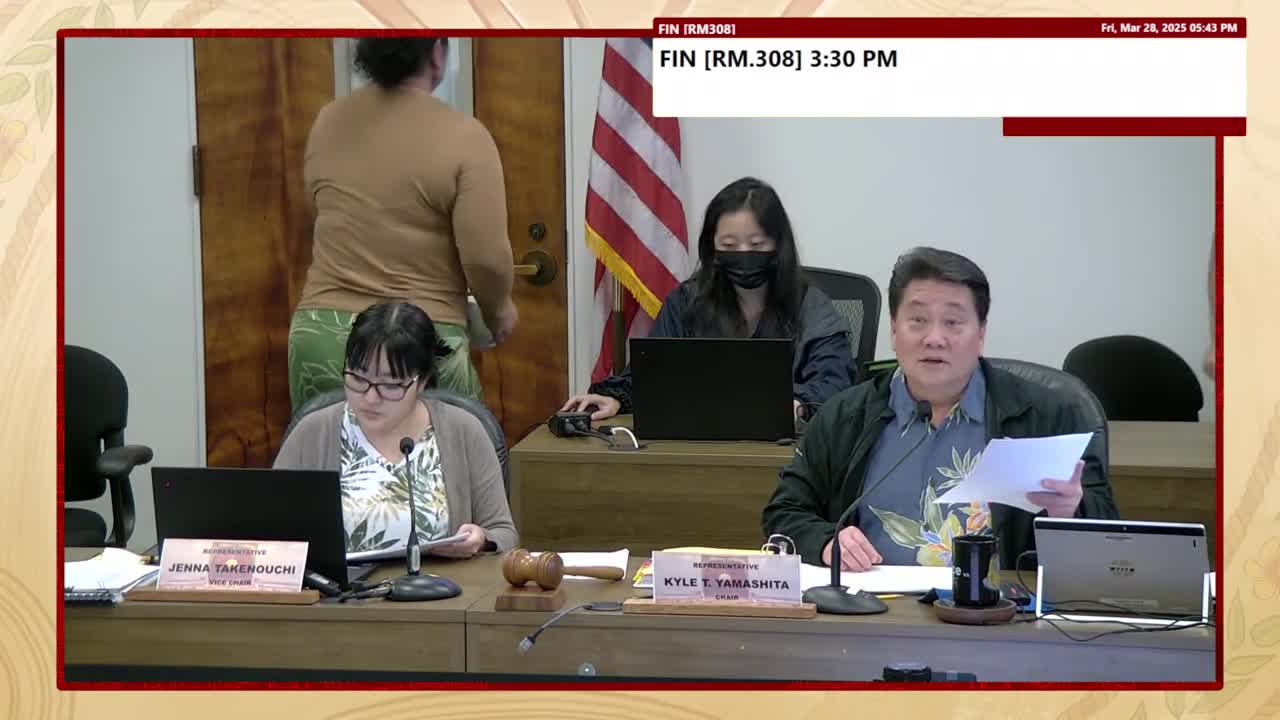 52SEC
House Standing Committee on Finance
 1MIN
House Standing Committee on Agriculture & Food Systems
 9MIN
House Standing Committee on Public Safety
9MIN
House Standing Committee on Water & Land
 4MIN
Senate Standing Committee on Agriculture and Environment
Bill Author

Bill Co-Author(s):