SB 443: DOA; Solar; Wind; Agricultural Lands
- Session Year: 2025-2026
- House: Senate
- Latest Version Date: 2025-04-04
Current Status:
Failed
(2026-04-17: Re-Referred to WLA/EIG, WAM.)
Introduced
In Committee
First Chamber
In Committee
Second Chamber
Final Decking
Enacted
Requires that lands within the agricultural district with class B or C soils that have solar or wind energy facilities must also obtain certification from the Department of Agriculture that the lands are also used for a farming operation. Effective 7/1/3000. (HD2)
Requires that lands within the agricultural district with class B or C soils that have solar energy facilities must also obtain certification from the Department of Agriculture that the lands are also used for a farming operation. Effective 7/1/3000. (HD1)
Requires that lands within the agricultural district that have solar energy facilities must also obtain certification from the Department of Agriculture that the lands are also used for a farming operation. (SD1)
Requires that lands within the agricultural district that have solar energy facilities must also obtain certification from the Board of Land and Natural Resources that the lands are also used for a farming operation.
|
THE SENATE |
S.B. NO. |
443 |
|
THIRTY-THIRD LEGISLATURE, 2025 |
S.D. 1 |
|
|
STATE OF HAWAII |
H.D. 2 |
|
|
|
|
|
|
|
||
|
|
||
A BILL FOR AN ACT
RELATING TO AGRICULTURAL LANDS.
BE IT ENACTED BY THE LEGISLATURE OF THE STATE OF HAWAII:
SECTION 1. Section 205-2, Hawaii Revised Statutes, is amended by amending subsection (d) to read as follows:
"(d) Agricultural districts shall include:
(1) Activities or uses as characterized by the cultivation of crops, crops for bioenergy, orchards, forage, and forestry;
(2) Farming activities or uses related to animal husbandry and game and fish propagation;
(3) Aquaculture, which means the production of aquatic plant and animal life within ponds and other bodies of water;
(4) Wind-generated energy production for public, private, and commercial use; provided that the department of agriculture certifies that the lands are also used for a farming operation as defined in section 165-2;
(5) Biofuel production, as described in section 205-4.5(a)(16), for public, private, and commercial use;
(6) Solar energy facilities; provided that:
(A) This paragraph shall apply only to land with soil classified by the land study bureau's detailed land classification as overall (master) productivity rating class B, C, D, or E; and
(B) Solar energy facilities placed within
land with soil classified as overall productivity rating class B or C [shall]:
(i) Shall not occupy more than ten per cent of the acreage of the parcel, or twenty acres of land, whichever is lesser, unless a special use permit is granted pursuant to section 205-6; and
(ii) Shall be permissible uses as long as the department of agriculture certifies that the lands are also used for a farming operation as defined in section 165-2;
(7) Bona fide agricultural services and uses that support the agricultural activities of the fee or leasehold owner of the property and accessory to any of the above activities, regardless of whether conducted on the same premises as the agricultural activities to which they are accessory, including farm dwellings as defined in section 205-4.5(a)(4), employee housing, farm buildings, mills, storage facilities, processing facilities, photovoltaic, biogas, and other small-scale renewable energy systems producing energy solely for use in the agricultural activities of the fee or leasehold owner of the property, agricultural-energy facilities as defined in section 205-4.5(a)(17), vehicle and equipment storage areas, and plantation community subdivisions as defined in section 205-4.5(a)(12);
(8) Wind machines and wind farms; provided that the department of agriculture certifies that the lands are also used for a farming operation as defined in section 165-2;
(9) Small-scale meteorological, air quality, noise, and other scientific and environmental data collection and monitoring facilities occupying less than one-half acre of land; provided that these facilities shall not be used as or equipped for use as living quarters or dwellings;
(10) Agricultural parks;
(11) Agricultural tourism conducted on a working
farm, or a farming operation as defined in section 165-2, for the enjoyment,
education, or involvement of visitors; provided that the agricultural tourism
activity is accessory and secondary to the principal agricultural use and does
not interfere with surrounding farm operations; [and] provided further
that this paragraph shall apply only to a county that has adopted ordinances
regulating agricultural tourism under section 205-5;
(12) Agricultural tourism activities, including overnight accommodations of twenty-one days or less, for any one stay within a county; provided that this paragraph shall apply only to a county that includes at least three islands and has adopted ordinances regulating agricultural tourism activities pursuant to section 205-5; provided further that the agricultural tourism activities coexist with a bona fide agricultural activity. For the purposes of this paragraph, "bona fide agricultural activity" means a farming operation as defined in section 165-2;
(13) Open area recreational facilities;
(14) Geothermal resources exploration and
geothermal resources development, as defined under section 182-1;
(15) Agricultural-based commercial operations registered in Hawaii, including:
(A) A roadside stand that is not an enclosed structure, owned and operated by a producer for the display and sale of agricultural products grown in Hawaii and value-added products that were produced using agricultural products grown in Hawaii;
(B) Retail activities in an enclosed structure owned and operated by a producer for the display and sale of agricultural products grown in Hawaii, value-added products that were produced using agricultural products grown in Hawaii, logo items related to the producer's agricultural operations, and other food items;
(C) A retail food establishment owned and operated by a producer and permitted under chapter 11-50, Hawaii administrative rules, that prepares and serves food at retail using products grown in Hawaii and value-added products that were produced using agricultural products grown in Hawaii;
(D) A farmers' market, which is an outdoor market limited to producers selling agricultural products grown in Hawaii and value-added products that were produced using agricultural products grown in Hawaii; and
(E) A food hub, which is a facility that may contain a commercial kitchen and provides for the storage, processing, distribution, and sale of agricultural products grown in Hawaii and value-added products that were produced using agricultural products grown in Hawaii.
The owner of an agricultural-based commercial operation shall certify, upon request of an officer or agent charged with enforcement of this chapter under section 205-12, that the agricultural products displayed or sold by the operation meet the requirements of this paragraph;
(16) Hydroelectric facilities as described in section 205-4.5(a)(23); and
(17) Composting and co-composting operations; provided that operations that process their own green waste and do not require permits from the department of health shall use the finished composting product only on the operation's own premises to minimize the potential spread of invasive species.
Agricultural districts shall not include golf courses and golf driving ranges, except as provided in section 205-4.5(d). Agricultural districts include areas that are not used for, or that are not suited to, agricultural and ancillary activities by reason of topography, soils, and other related characteristics."
SECTION 2. Section 205-4.5, Hawaii Revised Statutes, is amended by amending subsection (a) to read as follows:
"(a) Within the agricultural district, all lands with soil classified by the land study bureau's detailed land classification as overall (master) productivity rating class A or B and for solar energy facilities, class B or C, shall be restricted to the following permitted uses:
(1) Cultivation of crops, including crops for bioenergy, flowers, vegetables, foliage, fruits, forage, and timber;
(2) Game and fish propagation;
(3) Raising of livestock, including poultry, bees, fish, or other animal or aquatic life that are propagated for economic or personal use;
(4) Farm dwellings, employee housing, farm buildings, or activities or uses related to farming and animal husbandry. For the purposes of this paragraph, "farm dwelling" means a single-family dwelling located on and accessory to a farm, including clusters of single‑family farm dwellings permitted within agricultural parks developed by the State, or where agricultural activity provides income to the family occupying the dwelling;
(5) Public institutions and buildings that are necessary for agricultural practices;
(6) Public and private open area types of recreational uses, including day camps, picnic grounds, parks, and riding stables, but not including dragstrips, airports, drive-in theaters, golf courses, golf driving ranges, country clubs, and overnight camps; provided that overnight camps in operation before January 1, 1961, may be approved by special permit;
(7) Public, private, and quasi-public utility lines and roadways, transformer stations, communications equipment buildings, solid waste transfer stations, major water storage tanks, and appurtenant small buildings such as booster pumping stations, but not including offices or yards for equipment, material, vehicle storage, repair or maintenance, treatment plants, corporation yards, or other similar structures;
(8) Retention, restoration, rehabilitation, or improvement of buildings or sites of historic or scenic interest;
(9) Agricultural-based commercial operations as described in section 205-2(d)(15);
(10) Buildings and uses, including mills, storage, and processing facilities, maintenance facilities, photovoltaic, biogas, and other small-scale renewable energy systems producing energy solely for use in the agricultural activities of the fee or leasehold owner of the property, and vehicle and equipment storage areas that are normally considered directly accessory to the above-mentioned uses and are permitted under section 205-2(d);
(11) Agricultural parks;
(12) Plantation community subdivisions, which as used in this chapter means an established subdivision or cluster of employee housing, community buildings, and agricultural support buildings on land currently or formerly owned, leased, or operated by a sugar or pineapple plantation; provided that the existing structures may be used or rehabilitated for use, and new employee housing and agricultural support buildings may be allowed on land within the subdivision as follows:
(A) The
employee housing [is] shall be occupied by employees or former
employees of the plantation who have a property interest in the land;
(B) The employee housing units not owned by their occupants shall be rented or leased at affordable rates for agricultural workers; or
(C) The agricultural support buildings shall be rented or leased to agricultural business operators or agricultural support services;
(13) Agricultural tourism conducted on a working farm, or a farming operation as defined in section 165-2, for the enjoyment, education, or involvement of visitors; provided that the agricultural tourism activity is accessory and secondary to the principal agricultural use and does not interfere with surrounding farm operations; provided further that this paragraph shall apply only to a county that has adopted ordinances regulating agricultural tourism under section 205-5;
(14) Agricultural tourism activities, including overnight accommodations of twenty-one days or less, for any one stay within a county; provided that this paragraph shall apply only to a county that includes at least three islands and has adopted ordinances regulating agricultural tourism activities pursuant to section 205-5; provided further that the agricultural tourism activities coexist with a bona fide agricultural activity. For the purposes of this paragraph, "bona fide agricultural activity" means a farming operation as defined in section 165-2;
(15) Wind
energy facilities, including the appurtenances associated with the production
and transmission of wind generated energy; provided that [the]:
(A) The wind energy facilities and appurtenances are compatible with agriculture uses and cause minimal adverse impact on agricultural land; and
(B) The department of agriculture certifies that the lands are also used for a farming operation as defined in section 165-2;
(16) Biofuel processing facilities, including the appurtenances associated with the production and refining of biofuels that is normally considered directly accessory and secondary to the growing of the energy feedstock; provided that biofuel processing facilities and appurtenances do not adversely impact agricultural land and other agricultural uses in the vicinity.
For the purposes of this paragraph:
"Appurtenances" means operational infrastructure of the appropriate type and scale for economic commercial storage and distribution, and other similar handling of feedstock, fuels, and other products of biofuel processing facilities.
"Biofuel processing facility" means a facility that produces liquid or gaseous fuels from organic sources such as biomass crops, agricultural residues, and oil crops, including palm, canola, soybean, and waste cooking oils; grease; food wastes; and animal residues and wastes that can be used to generate energy;
(17) Agricultural-energy facilities, including appurtenances necessary for an agricultural-energy enterprise; provided that the primary activity of the agricultural-energy enterprise is agricultural activity. To be considered the primary activity of an agricultural-energy enterprise, the total acreage devoted to agricultural activity shall be no less than ninety per cent of the total acreage of the agricultural-energy enterprise. The agricultural‑energy facility shall be limited to lands owned, leased, licensed, or operated by the entity conducting the agricultural activity.
As used in this paragraph:
"Agricultural activity"
means any activity described in paragraphs (1) to (3) [of this subsection].
"Agricultural-energy enterprise" means an enterprise that integrally incorporates an agricultural activity with an agricultural-energy facility.
"Agricultural-energy facility" means a facility that generates, stores, or distributes renewable energy as defined in section 269-91 or renewable fuel including electrical or thermal energy or liquid or gaseous fuels from products of agricultural activities from agricultural lands located in the State.
"Appurtenances" means operational infrastructure of the appropriate type and scale for the economic commercial generation, storage, distribution, and other similar handling of energy, including equipment, feedstock, fuels, and other products of agricultural‑energy facilities;
(18) Construction and operation of wireless
communication antennas, including small wireless facilities; provided that[,
for] nothing in this paragraph shall be construed to permit the
construction of any new structure that is not deemed a permitted use under this
subsection.
For
the purposes of this paragraph[, "wireless]:
"Wireless
communication antenna" means communications equipment that is either
freestanding or placed upon or attached to an already existing structure and
that transmits and receives electromagnetic radio signals used in the provision
of all types of wireless communications services[; provided
further that "small].
"Small
wireless facilities" [shall have] has the same meaning as in
section 206N-2[; provided
further that nothing in this paragraph shall be construed to permit the
construction of any new structure that is not deemed a permitted use under this
subsection];
(19) Agricultural education programs conducted on a
farming operation as defined in section 165-2, for the education and
participation of the general public; provided that the agricultural education
programs are accessory and secondary to the principal agricultural use of the
parcels or lots on which the agricultural education programs are to occur and
do not interfere with surrounding farm operations. For the purposes of this paragraph,
"agricultural education programs" means activities or events designed
to promote knowledge and understanding of agricultural activities and practices
conducted on a farming operation as defined in section 165-2;
(20) Solar energy facilities that do not occupy more than ten per cent of the acreage of the parcel, or twenty acres of land, whichever is lesser or for which a special use permit is granted pursuant to section 205‑6; provided that this use shall not be permitted on lands with soil classified by the land study bureau's detailed land classification as overall (master) productivity rating class A;
(21) Solar energy facilities on lands with soil classified by the land study bureau's detailed land classification as overall (master) productivity rating B or C for which a special use permit is granted pursuant to section 205-6; provided that:
(A) The department of agriculture certifies that the lands are also used for a farming operation as defined in section 165-2;
[(A)] (B) The area occupied by the solar energy
facilities is also made available for compatible agricultural activities at a
lease rate that is at least fifty per cent below the fair market rent for
comparable properties;
[(B)] (C) Proof of financial security to
decommission the facility is provided to the satisfaction of the appropriate
county planning commission before the date of commencement of commercial
generation; and
[(C)] (D) Solar energy facilities shall be
decommissioned at the owner's expense according to the following requirements:
(i) Removal of all equipment related to the solar energy facility within twelve months of the conclusion of operation or useful life; and
(ii) Restoration of the disturbed earth to substantially the same physical condition as existed before the development of the solar energy facility.
For the purposes of this paragraph, "agricultural activities" means the activities described in paragraphs (1) to (3);
(22) Geothermal resources exploration and geothermal resources development, as defined under section 182-1;
(23) Hydroelectric facilities, including the appurtenances associated with the production and transmission of hydroelectric energy, subject to section 205-2; provided that the hydroelectric facilities and their appurtenances:
(A) Shall consist of a small hydropower facility as defined by the United States Department of Energy, including:
(i) Impoundment facilities using a dam to store water in a reservoir;
(ii) A diversion or run-of-river facility that channels a portion of a river through a canal or channel; and
(iii) Pumped storage facilities that store energy by pumping water uphill to a reservoir at higher elevation from a reservoir at a lower elevation to be released to turn a turbine to generate electricity;
(B) Comply with the state water code, chapter 174C;
(C) Shall, if over five hundred kilowatts
in hydroelectric generating capacity, have the approval of the commission on water
resource management, including a new instream flow standard established for any
new hydroelectric facility; and
(D) Do not impact or impede the use of agricultural land or the availability of surface or ground water for all uses on all parcels that are served by the ground water sources or streams for which hydroelectric facilities are considered; or
(24) Notwithstanding any other law to the contrary, composting and co-composting operations; provided that operations that process their own green waste and do not require permits from the department of health shall use the finished composting product only on the operation's own premises to minimize the potential spread of invasive species."
SECTION 3. This Act does not affect rights and duties that matured, penalties that were incurred, and proceedings that were begun before its effective date.
SECTION 4. Statutory material to be repealed is bracketed and stricken. New statutory material is underscored.
SECTION 5. This Act shall take effect on July 1, 3000.
Report Title:
DOA; Solar; Wind; Agricultural Lands
Description:
Requires that lands within the agricultural district with class B or C soils that have solar or wind energy facilities must also obtain certification from the Department of Agriculture that the lands are also used for a farming operation. Effective 7/1/3000. (HD2)
The summary description of legislation appearing on this page is for informational purposes only and is not legislation or evidence of legislative intent.
|
THE SENATE |
S.B. NO. |
443 |
|
THIRTY-THIRD LEGISLATURE, 2025 |
S.D. 1 |
|
|
STATE OF HAWAII |
H.D. 1 |
|
|
|
|
|
|
|
||
|
|
||
A BILL FOR AN ACT
RELATING TO AGRICULTURAL LANDS.
BE IT ENACTED BY THE LEGISLATURE OF THE STATE OF HAWAII:
SECTION 1. Section 205-2, Hawaii Revised Statutes, is amended by amending subsection (d) to read as follows:
"(d) Agricultural districts shall include:
(1) Activities or uses as characterized by the cultivation of crops, crops for bioenergy, orchards, forage, and forestry;
(2) Farming activities or uses related to animal husbandry and game and fish propagation;
(3) Aquaculture, which means the production of aquatic plant and animal life within ponds and other bodies of water;
(4) Wind-generated energy production for public, private, and commercial use;
(5) Biofuel production, as described in section 205-4.5(a)(16), for public, private, and commercial use;
(6) Solar energy facilities; provided that:
(A) This paragraph shall apply only to land with soil classified by the land study bureau's detailed land classification as overall (master) productivity rating class B, C, D, or E; and
(B) Solar energy facilities placed within
land with soil classified as overall productivity rating class B or C [shall]:
(i) Shall not occupy more than ten per cent of the acreage of the parcel, or twenty acres of land, whichever is lesser, unless a special use permit is granted pursuant to section 205-6; and
(ii) Are permissible uses as long as the department of agriculture certifies that the lands are also used for a farming operation as defined in section 165-2;
(7) Bona fide agricultural services and uses that support the agricultural activities of the fee or leasehold owner of the property and accessory to any of the above activities, regardless of whether conducted on the same premises as the agricultural activities to which they are accessory, including farm dwellings as defined in section 205-4.5(a)(4), employee housing, farm buildings, mills, storage facilities, processing facilities, photovoltaic, biogas, and other small-scale renewable energy systems producing energy solely for use in the agricultural activities of the fee or leasehold owner of the property, agricultural-energy facilities as defined in section 205-4.5(a)(17), vehicle and equipment storage areas, and plantation community subdivisions as defined in section 205-4.5(a)(12);
(8) Wind machines and wind farms;
(9) Small-scale meteorological, air quality, noise, and other scientific and environmental data collection and monitoring facilities occupying less than one-half acre of land; provided that these facilities shall not be used as or equipped for use as living quarters or dwellings;
(10) Agricultural parks;
(11) Agricultural tourism conducted on a working farm, or a farming operation as defined in section 165-2, for the enjoyment, education, or involvement of visitors; provided that the agricultural tourism activity is accessory and secondary to the principal agricultural use and does not interfere with surrounding farm operations; and provided further that this paragraph shall apply only to a county that has adopted ordinances regulating agricultural tourism under section 205-5;
(12) Agricultural tourism activities, including overnight accommodations of twenty-one days or less, for any one stay within a county; provided that this paragraph shall apply only to a county that includes at least three islands and has adopted ordinances regulating agricultural tourism activities pursuant to section 205-5; provided further that the agricultural tourism activities coexist with a bona fide agricultural activity. For the purposes of this paragraph, "bona fide agricultural activity" means a farming operation as defined in section 165-2;
(13) Open area recreational facilities;
(14) Geothermal resources exploration and
geothermal resources development, as defined under section 182-1;
(15) Agricultural-based commercial operations registered in Hawaii, including:
(A) A roadside stand that is not an enclosed structure, owned and operated by a producer for the display and sale of agricultural products grown in Hawaii and value-added products that were produced using agricultural products grown in Hawaii;
(B) Retail activities in an enclosed structure owned and operated by a producer for the display and sale of agricultural products grown in Hawaii, value-added products that were produced using agricultural products grown in Hawaii, logo items related to the producer's agricultural operations, and other food items;
(C) A retail food establishment owned and operated by a producer and permitted under chapter 11-50, Hawaii administrative rules, that prepares and serves food at retail using products grown in Hawaii and value-added products that were produced using agricultural products grown in Hawaii;
(D) A farmers' market, which is an outdoor market limited to producers selling agricultural products grown in Hawaii and value-added products that were produced using agricultural products grown in Hawaii; and
(E) A food hub, which is a facility that may contain a commercial kitchen and provides for the storage, processing, distribution, and sale of agricultural products grown in Hawaii and value-added products that were produced using agricultural products grown in Hawaii.
The owner of an agricultural-based commercial operation shall certify, upon request of an officer or agent charged with enforcement of this chapter under section 205-12, that the agricultural products displayed or sold by the operation meet the requirements of this paragraph;
(16) Hydroelectric facilities as described in section 205-4.5(a)(23); and
(17) Composting and co-composting operations; provided that operations that process their own green waste and do not require permits from the department of health shall use the finished composting product only on the operation's own premises to minimize the potential spread of invasive species.
Agricultural districts shall not include golf courses and golf driving ranges, except as provided in section 205-4.5(d). Agricultural districts include areas that are not used for, or that are not suited to, agricultural and ancillary activities by reason of topography, soils, and other related characteristics."
SECTION 2. Section 205-4.5, Hawaii Revised Statutes, is amended by amending subsection (a) to read as follows:
"(a) Within the agricultural district, all lands with soil classified by the land study bureau's detailed land classification as overall (master) productivity rating class A or B and for solar energy facilities, class B or C, shall be restricted to the following permitted uses:
(1) Cultivation of crops, including crops for bioenergy, flowers, vegetables, foliage, fruits, forage, and timber;
(2) Game and fish propagation;
(3) Raising of livestock, including poultry, bees, fish, or other animal or aquatic life that are propagated for economic or personal use;
(4) Farm dwellings, employee housing, farm buildings, or activities or uses related to farming and animal husbandry. For the purposes of this paragraph, "farm dwelling" means a single-family dwelling located on and accessory to a farm, including clusters of single‑family farm dwellings permitted within agricultural parks developed by the State, or where agricultural activity provides income to the family occupying the dwelling;
(5) Public institutions and buildings that are necessary for agricultural practices;
(6) Public and private open area types of recreational uses, including day camps, picnic grounds, parks, and riding stables, but not including dragstrips, airports, drive-in theaters, golf courses, golf driving ranges, country clubs, and overnight camps; provided that overnight camps in operation before January 1, 1961, may be approved by special permit;
(7) Public, private, and quasi-public utility lines and roadways, transformer stations, communications equipment buildings, solid waste transfer stations, major water storage tanks, and appurtenant small buildings such as booster pumping stations, but not including offices or yards for equipment, material, vehicle storage, repair or maintenance, treatment plants, corporation yards, or other similar structures;
(8) Retention, restoration, rehabilitation, or improvement of buildings or sites of historic or scenic interest;
(9) Agricultural-based commercial operations as described in section 205-2(d)(15);
(10) Buildings and uses, including mills, storage, and processing facilities, maintenance facilities, photovoltaic, biogas, and other small-scale renewable energy systems producing energy solely for use in the agricultural activities of the fee or leasehold owner of the property, and vehicle and equipment storage areas that are normally considered directly accessory to the above-mentioned uses and are permitted under section 205-2(d);
(11) Agricultural parks;
(12) Plantation community subdivisions, which as used in this chapter means an established subdivision or cluster of employee housing, community buildings, and agricultural support buildings on land currently or formerly owned, leased, or operated by a sugar or pineapple plantation; provided that the existing structures may be used or rehabilitated for use, and new employee housing and agricultural support buildings may be allowed on land within the subdivision as follows:
(A) The
employee housing [is] shall be occupied by employees or former
employees of the plantation who have a property interest in the land;
(B) The employee housing units not owned by their occupants shall be rented or leased at affordable rates for agricultural workers; or
(C) The agricultural support buildings shall be rented or leased to agricultural business operators or agricultural support services;
(13) Agricultural tourism conducted on a working farm, or a farming operation as defined in section 165-2, for the enjoyment, education, or involvement of visitors; provided that the agricultural tourism activity is accessory and secondary to the principal agricultural use and does not interfere with surrounding farm operations; provided further that this paragraph shall apply only to a county that has adopted ordinances regulating agricultural tourism under section 205-5;
(14) Agricultural tourism activities, including overnight accommodations of twenty-one days or less, for any one stay within a county; provided that this paragraph shall apply only to a county that includes at least three islands and has adopted ordinances regulating agricultural tourism activities pursuant to section 205-5; provided further that the agricultural tourism activities coexist with a bona fide agricultural activity. For the purposes of this paragraph, "bona fide agricultural activity" means a farming operation as defined in section 165-2;
(15) Wind energy facilities, including the appurtenances associated with the production and transmission of wind generated energy; provided that the wind energy facilities and appurtenances are compatible with agriculture uses and cause minimal adverse impact on agricultural land;
(16) Biofuel processing facilities, including the appurtenances associated with the production and refining of biofuels that is normally considered directly accessory and secondary to the growing of the energy feedstock; provided that biofuel processing facilities and appurtenances do not adversely impact agricultural land and other agricultural uses in the vicinity.
For the purposes of this paragraph:
"Appurtenances" means operational infrastructure of the appropriate type and scale for economic commercial storage and distribution, and other similar handling of feedstock, fuels, and other products of biofuel processing facilities.
"Biofuel processing facility" means a facility that produces liquid or gaseous fuels from organic sources such as biomass crops, agricultural residues, and oil crops, including palm, canola, soybean, and waste cooking oils; grease; food wastes; and animal residues and wastes that can be used to generate energy;
(17) Agricultural-energy facilities, including appurtenances necessary for an agricultural-energy enterprise; provided that the primary activity of the agricultural-energy enterprise is agricultural activity. To be considered the primary activity of an agricultural-energy enterprise, the total acreage devoted to agricultural activity shall be no less than ninety per cent of the total acreage of the agricultural-energy enterprise. The agricultural‑energy facility shall be limited to lands owned, leased, licensed, or operated by the entity conducting the agricultural activity.
As used in this paragraph:
"Agricultural activity"
means any activity described in paragraphs (1) to (3) [of this subsection].
"Agricultural-energy enterprise" means an enterprise that integrally incorporates an agricultural activity with an agricultural-energy facility.
"Agricultural-energy facility" means a facility that generates, stores, or distributes renewable energy as defined in section 269-91 or renewable fuel including electrical or thermal energy or liquid or gaseous fuels from products of agricultural activities from agricultural lands located in the State.
"Appurtenances" means operational infrastructure of the appropriate type and scale for the economic commercial generation, storage, distribution, and other similar handling of energy, including equipment, feedstock, fuels, and other products of agricultural‑energy facilities;
(18) Construction and operation of wireless
communication antennas, including small wireless facilities; provided that[,]
for the purposes of this paragraph, "wireless communication antenna"
means communications equipment that is either freestanding or placed upon or
attached to an already existing structure and that transmits and receives
electromagnetic radio signals used in the provision of all types of wireless
communications services; provided further that "small wireless
facilities" shall have the same meaning as in section 206N-2; provided further that nothing in this paragraph
shall be construed to permit the construction of any new structure that is not
deemed a permitted use under this subsection;
(19) Agricultural education programs conducted on a
farming operation as defined in section 165-2, for the education and
participation of the general public; provided that the agricultural education
programs are accessory and secondary to the principal agricultural use of the
parcels or lots on which the agricultural education programs are to occur and
do not interfere with surrounding farm operations. For the purposes of this paragraph,
"agricultural education programs" means activities or events designed
to promote knowledge and understanding of agricultural activities and practices
conducted on a farming operation as defined in section 165-2;
(20) Solar energy facilities that do not occupy more than ten per cent of the acreage of the parcel, or twenty acres of land, whichever is lesser or for which a special use permit is granted pursuant to section 205‑6; provided that this use shall not be permitted on lands with soil classified by the land study bureau's detailed land classification as overall (master) productivity rating class A;
(21) Solar energy facilities on lands with soil classified by the land study bureau's detailed land classification as overall (master) productivity rating B or C for which a special use permit is granted pursuant to section 205-6; provided that:
(A) The department of agriculture certifies that the lands are also used for a farming operation as defined in section 165-2;
[(A)] (B) The area occupied by the solar energy
facilities is also made available for compatible agricultural activities at a
lease rate that is at least fifty per cent below the fair market rent for
comparable properties;
[(B)] (C) Proof of financial security to
decommission the facility is provided to the satisfaction of the appropriate
county planning commission before the date of commencement of commercial
generation; and
[(C)] (D) Solar energy facilities shall be
decommissioned at the owner's expense according to the following requirements:
(i) Removal of all equipment related to the solar energy facility within twelve months of the conclusion of operation or useful life; and
(ii) Restoration of the disturbed earth to substantially the same physical condition as existed before the development of the solar energy facility.
For the purposes of this paragraph, "agricultural activities" means the activities described in paragraphs (1) to (3);
(22) Geothermal resources exploration and geothermal resources development, as defined under section 182-1;
(23) Hydroelectric facilities, including the appurtenances associated with the production and transmission of hydroelectric energy, subject to section 205-2; provided that the hydroelectric facilities and their appurtenances:
(A) Shall consist of a small hydropower facility as defined by the United States Department of Energy, including:
(i) Impoundment facilities using a dam to store water in a reservoir;
(ii) A diversion or run-of-river facility that channels a portion of a river through a canal or channel; and
(iii) Pumped storage facilities that store energy by pumping water uphill to a reservoir at higher elevation from a reservoir at a lower elevation to be released to turn a turbine to generate electricity;
(B) Comply with the state water code, chapter 174C;
(C) Shall, if over five hundred kilowatts
in hydroelectric generating capacity, have the approval of the commission on
water resource management, including a new instream flow standard established
for any new hydroelectric facility; and
(D) Do not impact or impede the use of agricultural land or the availability of surface or ground water for all uses on all parcels that are served by the ground water sources or streams for which hydroelectric facilities are considered; or
(24) Notwithstanding any other law to the contrary, composting and co-composting operations; provided that operations that process their own green waste and do not require permits from the department of health shall use the finished composting product only on the operation's own premises to minimize the potential spread of invasive species."
SECTION 3. This Act does not affect rights and duties that matured, penalties that were incurred, and proceedings that were begun before its effective date.
SECTION 4. Statutory material to be repealed is bracketed and stricken. New statutory material is underscored.
SECTION 5. This Act shall take effect on July 1, 3000.
Report Title:
DOA; Solar; Agricultural Lands
Description:
Requires that lands within the agricultural district with class B or C soils that have solar energy facilities must also obtain certification from the Department of Agriculture that the lands are also used for a farming operation. Effective 7/1/3000. (HD1)
The summary description of legislation appearing on this page is for informational purposes only and is not legislation or evidence of legislative intent.
|
THE SENATE |
S.B. NO. |
443 |
|
THIRTY-THIRD LEGISLATURE, 2025 |
S.D. 1 |
|
|
STATE OF HAWAII |
|
|
|
|
|
|
|
|
||
|
|
||
A BILL FOR AN ACT
RELATING TO AGRICULTURAL LANDS.
BE IT ENACTED BY THE LEGISLATURE OF THE STATE OF HAWAII:
SECTION 1. Section 205-4.5, Hawaii Revised Statutes, is amended by amending subsection (a) to read as follows:
"(a) Within the agricultural district, all lands with soil classified by the land study bureau's detailed land classification as overall (master) productivity rating class A or B and for solar energy facilities, class B or C, shall be restricted to the following permitted uses:
(1) Cultivation of crops, including crops for bioenergy, flowers, vegetables, foliage, fruits, forage, and timber;
(2) Game and fish propagation;
(3) Raising of livestock, including poultry, bees, fish, or other animal or aquatic life that are propagated for economic or personal use;
(4) Farm dwellings, employee housing, farm buildings, or activities or uses related to farming and animal husbandry. For the purposes of this paragraph, "farm dwelling" means a single-family dwelling located on and accessory to a farm, including clusters of single‑family farm dwellings permitted within agricultural parks developed by the State, or where agricultural activity provides income to the family occupying the dwelling;
(5) Public institutions and buildings that are necessary for agricultural practices;
(6) Public and private open area types of recreational uses, including day camps, picnic grounds, parks, and riding stables, but not including dragstrips, airports, drive-in theaters, golf courses, golf driving ranges, country clubs, and overnight camps; provided that overnight camps in operation before January 1, 1961, may be approved by special permit;
(7) Public, private, and quasi-public utility lines and roadways, transformer stations, communications equipment buildings, solid waste transfer stations, major water storage tanks, and appurtenant small buildings such as booster pumping stations, but not including offices or yards for equipment, material, vehicle storage, repair or maintenance, treatment plants, corporation yards, or other similar structures;
(8) Retention, restoration, rehabilitation, or improvement of buildings or sites of historic or scenic interest;
(9) Agricultural-based commercial operations as described in section 205-2(d)(15);
(10) Buildings and uses, including mills, storage, and processing facilities, maintenance facilities, photovoltaic, biogas, and other small-scale renewable energy systems producing energy solely for use in the agricultural activities of the fee or leasehold owner of the property, and vehicle and equipment storage areas that are normally considered directly accessory to the above-mentioned uses and are permitted under section 205-2(d);
(11) Agricultural parks;
(12) Plantation community subdivisions, which as used in this chapter means an established subdivision or cluster of employee housing, community buildings, and agricultural support buildings on land currently or formerly owned, leased, or operated by a sugar or pineapple plantation; provided that the existing structures may be used or rehabilitated for use, and new employee housing and agricultural support buildings may be allowed on land within the subdivision as follows:
(A) The employee housing is occupied by employees or former employees of the plantation who have a property interest in the land;
(B) The employee housing units not owned by their occupants shall be rented or leased at affordable rates for agricultural workers; or
(C) The agricultural support buildings shall be rented or leased to agricultural business operators or agricultural support services;
(13) Agricultural tourism conducted on a working farm, or a farming operation as defined in section 165-2, for the enjoyment, education, or involvement of visitors; provided that the agricultural tourism activity is accessory and secondary to the principal agricultural use and does not interfere with surrounding farm operations; provided further that this paragraph shall apply only to a county that has adopted ordinances regulating agricultural tourism under section 205-5;
(14) Agricultural tourism activities, including overnight accommodations of twenty-one days or less, for any one stay within a county; provided that this paragraph shall apply only to a county that includes at least three islands and has adopted ordinances regulating agricultural tourism activities pursuant to section 205-5; provided further that the agricultural tourism activities coexist with a bona fide agricultural activity. For the purposes of this paragraph, "bona fide agricultural activity" means a farming operation as defined in section 165-2;
(15) Wind energy facilities, including the appurtenances associated with the production and transmission of wind generated energy; provided that the wind energy facilities and appurtenances are compatible with agriculture uses and cause minimal adverse impact on agricultural land;
(16) Biofuel processing facilities, including the appurtenances associated with the production and refining of biofuels that is normally considered directly accessory and secondary to the growing of the energy feedstock; provided that biofuel processing facilities and appurtenances do not adversely impact agricultural land and other agricultural uses in the vicinity.
For the purposes of this paragraph:
"Appurtenances" means operational infrastructure of the appropriate type and scale for economic commercial storage and distribution, and other similar handling of feedstock, fuels, and other products of biofuel processing facilities.
"Biofuel processing facility" means a facility that produces liquid or gaseous fuels from organic sources such as biomass crops, agricultural residues, and oil crops, including palm, canola, soybean, and waste cooking oils; grease; food wastes; and animal residues and wastes that can be used to generate energy;
(17) Agricultural-energy facilities, including appurtenances necessary for an agricultural-energy enterprise; provided that the primary activity of the agricultural-energy enterprise is agricultural activity. To be considered the primary activity of an agricultural-energy enterprise, the total acreage devoted to agricultural activity shall be no less than ninety per cent of the total acreage of the agricultural-energy enterprise. The agricultural‑energy facility shall be limited to lands owned, leased, licensed, or operated by the entity conducting the agricultural activity.
As used in this paragraph:
"Agricultural activity" means any activity described in paragraphs (1) to (3) of this subsection.
"Agricultural-energy enterprise" means an enterprise that integrally incorporates an agricultural activity with an agricultural-energy facility.
"Agricultural-energy facility" means a facility that generates, stores, or distributes renewable energy as defined in section 269-91 or renewable fuel including electrical or thermal energy or liquid or gaseous fuels from products of agricultural activities from agricultural lands located in the State.
"Appurtenances" means operational infrastructure of the appropriate type and scale for the economic commercial generation, storage, distribution, and other similar handling of energy, including equipment, feedstock, fuels, and other products of agricultural‑energy facilities;
(18) Construction and operation of wireless communication antennas, including small wireless facilities; provided that, for the purposes of this paragraph, "wireless communication antenna" means communications equipment that is either freestanding or placed upon or attached to an already existing structure and that transmits and receives electromagnetic radio signals used in the provision of all types of wireless communications services; provided further that "small wireless facilities" shall have the same meaning as in section 206N-2; provided further that nothing in this paragraph shall be construed to permit the construction of any new structure that is not deemed a permitted use under this subsection;
(19) Agricultural education programs conducted on a
farming operation as defined in section 165-2, for the education and
participation of the general public; provided that the agricultural education
programs are accessory and secondary to the principal agricultural use of the
parcels or lots on which the agricultural education programs are to occur and
do not interfere with surrounding farm operations. For the purposes of this paragraph,
"agricultural education programs" means activities or events designed
to promote knowledge and understanding of agricultural activities and practices
conducted on a farming operation as defined in section 165-2;
(20) Solar energy facilities that do not occupy more than ten per cent of the acreage of the parcel, or twenty acres of land, whichever is lesser or for which a special use permit is granted pursuant to section 205‑6; provided that this use shall not be permitted on lands with soil classified by the land study bureau's detailed land classification as overall (master) productivity rating class A;
(21) Solar energy facilities on lands with soil classified by the land study bureau's detailed land classification as overall (master) productivity rating B or C for which a special use permit is granted pursuant to section 205-6; provided that:
(A) The department of agriculture certifies that the lands are also used for a farming operation as defined in section 165-2;
[(A)] (B) The area occupied
by the solar energy facilities is also made available for compatible
agricultural activities at a lease rate that is at least fifty per cent below
the fair market rent for comparable properties;
[(B)] (C)
Proof of financial security to decommission the facility is
provided to the satisfaction of the appropriate county planning commission
before the date of commencement of commercial generation; and
[(C)] (D) Solar energy
facilities shall be decommissioned at the owner's expense according to the
following requirements:
(i) Removal of all equipment related to the solar energy facility within twelve months of the conclusion of operation or useful life; and
(ii) Restoration of the disturbed earth to substantially the same physical condition as existed before the development of the solar energy facility.
For the purposes of this paragraph, "agricultural activities" means the activities described in paragraphs (1) to (3);
(22) Geothermal resources exploration and geothermal resources development, as defined under section 182-1;
(23) Hydroelectric facilities, including the appurtenances associated with the production and transmission of hydroelectric energy, subject to section 205-2; provided that the hydroelectric facilities and their appurtenances:
(A) Shall consist of a small hydropower facility as defined by the United States Department of Energy, including:
(i) Impoundment facilities using a dam to store water in a reservoir;
(ii) A diversion or run-of-river facility that channels a portion of a river through a canal or channel; and
(iii) Pumped storage facilities that store energy by pumping water uphill to a reservoir at higher elevation from a reservoir at a lower elevation to be released to turn a turbine to generate electricity;
(B) Comply with the state water code, chapter 174C;
(C) Shall, if over five hundred kilowatts
in hydroelectric generating capacity, have the approval of the commission on
water resource management, including a new instream flow standard established
for any new hydroelectric facility; and
(D) Do not impact or impede the use of agricultural land or the availability of surface or ground water for all uses on all parcels that are served by the ground water sources or streams for which hydroelectric facilities are considered; or
(24) Notwithstanding any other law to the contrary, composting and co-composting operations; provided that operations that process their own green waste and do not require permits from the department of health shall use the finished composting product only on the operation's own premises to minimize the potential spread of invasive species."
SECTION 2. This Act does not affect rights and duties that matured, penalties that were incurred, and proceedings that were begun before its effective date.
SECTION 3. Statutory material to be repealed is bracketed and stricken. New statutory material is underscored.
SECTION 4. This Act shall take effect upon its approval.
Report Title:
DOA; Solar; Agricultural Lands
Description:
Requires that lands within the agricultural district that have solar energy facilities must also obtain certification from the Department of Agriculture that the lands are also used for a farming operation. (SD1)
The summary description of legislation appearing on this page is for informational purposes only and is not legislation or evidence of legislative intent.
|
THE SENATE |
S.B. NO. |
443 |
|
THIRTY-THIRD LEGISLATURE, 2025 |
|
|
|
STATE OF HAWAII |
|
|
|
|
|
|
|
|
||
|
|
||
A BILL FOR AN ACT
relating to agricultural Lands.
BE IT ENACTED BY THE LEGISLATURE OF THE STATE OF HAWAII:
SECTION 1. Section 205-4.5, Hawaii Revised Statutes, is amended by amending subsection (a) to read as follows:
"(a) Within the agricultural district, all lands with soil classified by the land study bureau's detailed land classification as overall (master) productivity rating class A or B and for solar energy facilities, class B or C, shall be restricted to the following permitted uses:
(1) Cultivation of crops, including crops for bioenergy, flowers, vegetables, foliage, fruits, forage, and timber;
(2) Game and fish propagation;
(3) Raising of livestock, including poultry, bees, fish, or other animal or aquatic life that are propagated for economic or personal use;
(4) Farm dwellings, employee housing, farm buildings, or activities or uses related to farming and animal husbandry. For the purposes of this paragraph, "farm dwelling" means a single-family dwelling located on and accessory to a farm, including clusters of single‑family farm dwellings permitted within agricultural parks developed by the State, or where agricultural activity provides income to the family occupying the dwelling;
(5) Public institutions and buildings that are necessary for agricultural practices;
(6) Public and private open area types of recreational uses, including day camps, picnic grounds, parks, and riding stables, but not including dragstrips, airports, drive-in theaters, golf courses, golf driving ranges, country clubs, and overnight camps; provided that overnight camps in operation before January 1, 1961, may be approved by special permit;
(7) Public, private, and quasi-public utility lines and roadways, transformer stations, communications equipment buildings, solid waste transfer stations, major water storage tanks, and appurtenant small buildings such as booster pumping stations, but not including offices or yards for equipment, material, vehicle storage, repair or maintenance, treatment plants, corporation yards, or other similar structures;
(8) Retention, restoration, rehabilitation, or improvement of buildings or sites of historic or scenic interest;
(9) Agricultural-based commercial operations as described in section 205-2(d)(15);
(10) Buildings and uses, including mills, storage, and processing facilities, maintenance facilities, photovoltaic, biogas, and other small-scale renewable energy systems producing energy solely for use in the agricultural activities of the fee or leasehold owner of the property, and vehicle and equipment storage areas that are normally considered directly accessory to the above-mentioned uses and are permitted under section 205-2(d);
(11) Agricultural parks;
(12) Plantation community subdivisions, which as used in this chapter means an established subdivision or cluster of employee housing, community buildings, and agricultural support buildings on land currently or formerly owned, leased, or operated by a sugar or pineapple plantation; provided that the existing structures may be used or rehabilitated for use, and new employee housing and agricultural support buildings may be allowed on land within the subdivision as follows:
(A) The employee housing is occupied by employees or former employees of the plantation who have a property interest in the land;
(B) The employee housing units not owned by their occupants shall be rented or leased at affordable rates for agricultural workers; or
(C) The agricultural support buildings shall be rented or leased to agricultural business operators or agricultural support services;
(13) Agricultural tourism conducted on a working farm, or a farming operation as defined in section 165-2, for the enjoyment, education, or involvement of visitors; provided that the agricultural tourism activity is accessory and secondary to the principal agricultural use and does not interfere with surrounding farm operations; provided further that this paragraph shall apply only to a county that has adopted ordinances regulating agricultural tourism under section 205-5;
(14) Agricultural tourism activities, including overnight accommodations of twenty-one days or less, for any one stay within a county; provided that this paragraph shall apply only to a county that includes at least three islands and has adopted ordinances regulating agricultural tourism activities pursuant to section 205-5; provided further that the agricultural tourism activities coexist with a bona fide agricultural activity. For the purposes of this paragraph, "bona fide agricultural activity" means a farming operation as defined in section 165-2;
(15) Wind energy facilities, including the appurtenances associated with the production and transmission of wind generated energy; provided that the wind energy facilities and appurtenances are compatible with agriculture uses and cause minimal adverse impact on agricultural land;
(16) Biofuel processing facilities, including the appurtenances associated with the production and refining of biofuels that is normally considered directly accessory and secondary to the growing of the energy feedstock; provided that biofuel processing facilities and appurtenances do not adversely impact agricultural land and other agricultural uses in the vicinity.
For the purposes of this paragraph:
"Appurtenances" means operational infrastructure of the appropriate type and scale for economic commercial storage and distribution, and other similar handling of feedstock, fuels, and other products of biofuel processing facilities.
"Biofuel processing facility" means a facility that produces liquid or gaseous fuels from organic sources such as biomass crops, agricultural residues, and oil crops, including palm, canola, soybean, and waste cooking oils; grease; food wastes; and animal residues and wastes that can be used to generate energy;
(17) Agricultural-energy facilities, including appurtenances necessary for an agricultural-energy enterprise; provided that the primary activity of the agricultural-energy enterprise is agricultural activity. To be considered the primary activity of an agricultural-energy enterprise, the total acreage devoted to agricultural activity shall be no less than ninety per cent of the total acreage of the agricultural-energy enterprise. The agricultural‑energy facility shall be limited to lands owned, leased, licensed, or operated by the entity conducting the agricultural activity.
As used in this paragraph:
"Agricultural activity" means any activity described in paragraphs (1) to (3) of this subsection.
"Agricultural-energy enterprise" means an enterprise that integrally incorporates an agricultural activity with an agricultural-energy facility.
"Agricultural-energy facility" means a facility that generates, stores, or distributes renewable energy as defined in section 269-91 or renewable fuel including electrical or thermal energy or liquid or gaseous fuels from products of agricultural activities from agricultural lands located in the State.
"Appurtenances" means operational infrastructure of the appropriate type and scale for the economic commercial generation, storage, distribution, and other similar handling of energy, including equipment, feedstock, fuels, and other products of agricultural‑energy facilities;
(18) Construction and operation of wireless communication antennas, including small wireless facilities; provided that, for the purposes of this paragraph, "wireless communication antenna" means communications equipment that is either freestanding or placed upon or attached to an already existing structure and that transmits and receives electromagnetic radio signals used in the provision of all types of wireless communications services; provided further that "small wireless facilities" shall have the same meaning as in section 206N-2; provided further that nothing in this paragraph shall be construed to permit the construction of any new structure that is not deemed a permitted use under this subsection;
(19) Agricultural education programs conducted on a
farming operation as defined in section 165-2, for the education and
participation of the general public; provided that the agricultural education
programs are accessory and secondary to the principal agricultural use of the
parcels or lots on which the agricultural education programs are to occur and
do not interfere with surrounding farm operations. For the purposes of this paragraph,
"agricultural education programs" means activities or events designed
to promote knowledge and understanding of agricultural activities and practices
conducted on a farming operation as defined in section 165-2;
(20) Solar energy facilities that do not occupy more than ten per cent of the acreage of the parcel, or twenty acres of land, whichever is lesser or for which a special use permit is granted pursuant to section 205‑6; provided that this use shall not be permitted on lands with soil classified by the land study bureau's detailed land classification as overall (master) productivity rating class A;
(21) Solar energy facilities on lands with soil classified by the land study bureau's detailed land classification as overall (master) productivity rating B or C for which a special use permit is granted pursuant to section 205-6; provided that:
(A) The board certifies that the lands are also used for a farming operation, as defined under section 165-2;
[(A)] (B) The area occupied
by the solar energy facilities is also made available for compatible
agricultural activities at a lease rate that is at least fifty per cent below
the fair market rent for comparable properties;
[(B)] (C) Proof of financial security to
decommission the facility is provided to the satisfaction of the appropriate
county planning commission before the date of commencement of commercial
generation; and
[(C)] (D) Solar energy facilities shall be
decommissioned at the owner's expense according to the following requirements:
(i) Removal of all equipment related to the solar energy facility within twelve months of the conclusion of operation or useful life; and
(ii) Restoration of the disturbed earth to substantially the same physical condition as existed before the development of the solar energy facility.
For the purposes of this paragraph, "agricultural activities" means the activities described in paragraphs (1) to (3);
(22) Geothermal resources exploration and geothermal resources development, as defined under section 182-1;
(23) Hydroelectric facilities, including the appurtenances associated with the production and transmission of hydroelectric energy, subject to section 205-2; provided that the hydroelectric facilities and their appurtenances:
(A) Shall consist of a small hydropower facility as defined by the United States Department of Energy, including:
(i) Impoundment facilities using a dam to store water in a reservoir;
(ii) A diversion or run-of-river facility that channels a portion of a river through a canal or channel; and
(iii) Pumped storage facilities that store energy by pumping water uphill to a reservoir at higher elevation from a reservoir at a lower elevation to be released to turn a turbine to generate electricity;
(B) Comply with the state water code, chapter 174C;
(C) Shall, if over five hundred kilowatts
in hydroelectric generating capacity, have the approval of the commission on
water resource management, including a new instream flow standard established
for any new hydroelectric facility; and
(D) Do not impact or impede the use of agricultural land or the availability of surface or ground water for all uses on all parcels that are served by the ground water sources or streams for which hydroelectric facilities are considered; or
(24) Notwithstanding any other law to the contrary, composting and co-composting operations; provided that operations that process their own green waste and do not require permits from the department of health shall use the finished composting product only on the operation's own premises to minimize the potential spread of invasive species."
SECTION 2. This Act does not affect rights and duties that matured, penalties that were incurred, and proceedings that were begun before its effective date.
SECTION 3. Statutory material to be repealed is bracketed and stricken. New statutory material is underscored.
SECTION 4. This Act shall take effect upon its approval.
|
INTRODUCED BY: |
_____________________________ |
|
|
|
Report Title:
BLNR; Solar; Agricultural Lands
Description:
Requires that lands within the agricultural district that have solar energy facilities must also obtain certification from the Board of Land and Natural Resources that the lands are also used for a farming operation.
The summary description of legislation appearing on this page is for informational purposes only and is not legislation or evidence of legislative intent.
|
Date
|
Status
|
|---|---|
| Apr 17, 2026 | Re-Referred to WLA/EIG, WAM. |
| Mar 20, 2026 | Received notice of all Senate conferees being discharged (Sen. Com. No. 409). |
| Mar 20, 2026 | Senate Conferee(s) discharged. |
| Dec 8, 2025 | Carried over to 2026 Regular Session. |
| Apr 15, 2025 | Received notice of Senate conferees (Sen. Com. No. 789). |
| Apr 15, 2025 | Senate Conferees Appointed: Inouye Chair; Wakai, DeCoite Co-Chairs; DeCorte. |
| Apr 10, 2025 | Received notice of disagreement (Sen. Com. No. 779). |
| Apr 10, 2025 | Senate disagrees with House amendments. |
| Apr 10, 2025 | Received from House (Hse. Com. No. 648). |
| Apr 8, 2025 | Passed Third Reading as amended in HD 2 with none voting aye with reservations; Representative(s) Pierick voting no (1) and Representative(s) Cochran, Marten excused (2). Transmitted to Senate. |
| Apr 4, 2025 | Forty-eight (48) hours notice Tuesday, 04-08-25. |
| Apr 4, 2025 | Reported from CPC (Stand. Com. Rep. No. 2009) as amended in HD 2, recommending passage on Third Reading. |
| Apr 2, 2025 | The committee on CPC recommend that the measure be PASSED, WITH AMENDMENTS. The votes were as follows: 9 Ayes: Representative(s) Matayoshi, Chun, Ilagan, Ichiyama, Iwamoto, Kong, Lowen, Marten, Tam; Ayes with reservations: none; Noes: none; and 1 Excused: Representative(s) Pierick. |
| Mar 31, 2025 | Bill scheduled to be heard by CPC on Wednesday, 04-02-25 2:00PM in House conference room 329 VIA VIDEOCONFERENCE. |
| Mar 21, 2025 | Passed Second Reading as amended in HD 1 and referred to the committee(s) on CPC with none voting aye with reservations; Representative(s) Garcia voting no (1) and Representative(s) Cochran, Garrett, Kapela, Kitagawa, Ward excused (5). |
| Mar 21, 2025 | Reported from AGR/EEP (Stand. Com. Rep. No. 1411) as amended in HD 1, recommending passage on Second Reading and referral to CPC. |
| Mar 19, 2025 | The committee on EEP recommend that the measure be PASSED, WITH AMENDMENTS. The votes were as follows: 4 Ayes: Representative(s) Lowen, Perruso, Kahaloa, Kusch; Ayes with reservations: none; Noes: none; and 2 Excused: Representative(s) Quinlan, Ward. |
| Mar 19, 2025 | The committee on AGR recommend that the measure be PASSED, WITH AMENDMENTS. The votes were as follows: 4 Ayes: Representative(s) Kahaloa, Kusch, Lowen, Perruso; Ayes with reservations: none; Noes: none; and 2 Excused: Representative(s) Quinlan, Ward. |
| Mar 14, 2025 | Bill scheduled to be heard by AGR/EEP on Wednesday, 03-19-25 10:30AM in House conference room 325 VIA VIDEOCONFERENCE. |
| Mar 4, 2025 | Referred to AGR/EEP, CPC, referral sheet 18 |
| Mar 4, 2025 | Pass First Reading |
| Feb 28, 2025 | Received from Senate (Sen. Com. No. 42) in amended form (SD 1). |
| Feb 28, 2025 | Report Adopted; Passed Third Reading. Ayes, 23; Aye(s) with reservations: none. Noes, 0 (none). Excused, 2 (Senator(s) Fukunaga, Kidani). Transmitted to House. |
| Feb 27, 2025 | One Day Notice 02-28-25. |
| Feb 27, 2025 | Reported from WAM (Stand. Com. Rep. No. 776) with recommendation of passage on Third Reading. |
| Feb 19, 2025 | The committee(s) on WAM recommend(s) that the measure be PASSED, UNAMENDED. The votes in WAM were as follows: 13 Aye(s): Senator(s) Dela Cruz, Moriwaki, Aquino, DeCoite, Elefante, Hashimoto, Inouye, Kanuha, Kidani, Kim, Lee, C., Wakai, Fevella; Aye(s) with reservations: none ; 0 No(es): none; and 0 Excused: none. |
| Feb 14, 2025 | The committee(s) on WAM will hold a public decision making on 02-19-25 10:02AM; Conference Room 211 & Videoconference. |
| Feb 14, 2025 | Report adopted; Passed Second Reading, as amended (SD 1) and referred to WAM. |
| Feb 14, 2025 | Reported from WTL/EIG (Stand. Com. Rep. No. 603) with recommendation of passage on Second Reading, as amended (SD 1) and referral to WAM. |
| Feb 7, 2025 | The committee(s) on EIG recommend(s) that the measure be PASSED, WITH AMENDMENTS. The votes in EIG were as follows: 3 Aye(s): Senator(s) Wakai, Chang, Richards; Aye(s) with reservations: none ; 0 No(es): none; and 2 Excused: Senator(s) DeCoite, Fevella. |
| Feb 7, 2025 | The committee(s) on WTL recommend(s) that the measure be PASSED, WITH AMENDMENTS. The votes in WTL were as follows: 5 Aye(s): Senator(s) Inouye, Elefante, Chang, McKelvey, DeCorte; Aye(s) with reservations: none ; 0 No(es): none; and 0 Excused: none. |
| Feb 4, 2025 | The committee(s) on WTL/EIG has scheduled a public hearing on 02-07-25 1:11PM; Conference Room 229 & Videoconference. |
| Jan 21, 2025 | Referred to WTL/EIG, WAM. |
| Jan 16, 2025 | Passed First Reading. |
| Jan 16, 2025 | Introduced. |
|
Date
|
Description
|
Location
|
Votes
|
|
|---|---|---|---|---|
| Apr 8, 2025 | Third Reading | House Floor |
Passed |
|
| Apr 2, 2025 | The committee on CPC recommend that the measure be PASSED, WITH AMENDMENTS | House Standing Committee on Consumer Protection & Commerce |
Passed |
|
| Mar 19, 2025 | The committee on EEP recommend that the measure be PASSED, WITH AMENDMENTS | House Standing Committee on Energy & Environmental Protection |
Passed |
|
| Mar 19, 2025 | The committee on AGR recommend that the measure be PASSED, WITH AMENDMENTS | House Standing Committee on Agriculture & Food Systems |
Passed |
|
| Feb 28, 2025 | Third Reading | Senate Floor |
Passed |
|
| Feb 19, 2025 | The committee(s) on WAM recommend(s) that the measure be PASSED, UNAMENDED | Senate Standing Committee on Ways and Means |
Passed |
|
| Feb 7, 2025 | The committee(s) on EIG recommend(s) that the measure be PASSED, WITH AMENDMENTS | Senate Standing Committee on Energy and Intergovernmental Affairs |
Passed |
|
| Feb 7, 2025 | The committee(s) on WTL recommend(s) that the measure be PASSED, WITH AMENDMENTS | Senate Standing Committee on Water and Land |
Passed |
This list shows positions taken on this bill by organizations on the date displayed, which is linked to the original source.
Positions by individuals are not included.
|
Organization
|
Position
|
Date
|
|---|---|---|
| 350Hawaii.org | ** Support | |
| Agribusiness Development Corporation | ** Support | |
| Hawai'i Farm Bureau | *** Support | Apr 2, 2025 |
| Hawaii Cattlemen's Council, Inc | ** Support | |
| Hawaiʻi Farm Bureau | ** Support | |
| Hawaiʻi Farmers Union | ** Support | |
| Hawaiʻi Food+ Policy | ** Support | |
| Land Use Commission | ** Support | |
| Malama Kaua’i | *** Support | Feb 19, 2025 |
| State Land Use Commission | *** Support | Apr 2, 2025 |
| Ulupono Initiative | ** Support |
STAND. COM. REP. NO. 2009
Honolulu, Hawaii
, 2025
RE: S.B. No. 443
S.D. 1
H.D. 2
Honorable Nadine K. Nakamura
Speaker, House of Representatives
Thirty-Third State Legislature
Regular Session of 2025
State of Hawaii
Madame:
Your Committee on Consumer Protection & Commerce, to which was referred S.B. No. 443, S.D. 1, H.D. 1, entitled:
"A BILL FOR AN ACT RELATING TO AGRICULTURAL LANDS,"
begs leave to report as follows:
The purpose of this measure is to require lands within the agricultural district that have solar energy facilities to obtain certification from the Department of Agriculture that the lands are also used for farming operations.
Your Committee received testimony in support of this measure from the Land Use Commission; Agribusiness Development Corporation; Ulupono Initiative; Hawaiʻi Farm Bureau; 350Hawaii.org; Hawaiʻi Food+ Policy; Hawaiʻi Farmers Union; and Hawaii Cattlemen's Council, Inc. Your Committee received comments on this measure from the Department of Agriculture and Hawaii State Energy Office.
Your Committee finds that existing law allows for the establishment of solar energy facilities placed within land with soil classified as overall productivity rating class B or C as long as the facilities do not occupy more than ten percent of the parcel, or twenty acres, whichever is less. Your Committee further finds that once agricultural land is diverted from agricultural use to other development, those lands face significant barriers in returning to food production. Consequently, it has been projected that fifty percent of class B lands and twenty percent of class C lands will be lost to solar development. This measure provides an additional safeguard before valuable agricultural land is diverted by requiring the Department of Agriculture to certify the land's concurrent use for farming operations.
Your Committee has amended this measure by:
(1) Specifying that lands within the agricultural district that produce wind-generated energy for public, private, and commercial use; have wind machines and wind farms; or have wind energy facilities are also required to obtain certification that the lands are also used for farming operations; and
(2) Making technical, nonsubstantive amendments for the purposes of clarity, consistency, and style.
As affirmed by the record of votes of the members of your Committee on Consumer Protection & Commerce that is attached to this report, your Committee is in accord with the intent and purpose of S.B. No. 443, S.D. 1, H.D. 1, as amended herein, and recommends that it pass Third Reading in the form attached hereto as S.B. No. 443, S.D. 1, H.D. 2.
Respectfully submitted on behalf of the members of the Committee on Consumer Protection & Commerce,
|
|
|
____________________________ SCOT Z. MATAYOSHI, Chair |
|
|
|
|
STAND. COM. REP. NO. 1411
Honolulu, Hawaii
, 2025
RE: S.B. No. 443
S.D. 1
H.D. 1
Honorable Nadine K. Nakamura
Speaker, House of Representatives
Thirty-Third State Legislature
Regular Session of 2025
State of Hawaii
Madame:
Your Committees on Agriculture & Food Systems and Energy & Environmental Protection, to which was referred S.B. No. 443, S.D. 1, entitled:
"A BILL FOR AN ACT RELATING TO AGRICULTURAL LANDS,"
beg leave to report as follows:
Your Committees received testimony in support of this measure from the Agribusiness Development Corporation; Ulupono Initiative; 350Hawaii.org; Hawaii Farm Bureau; and Hawaiʻi Food+ Policy. Your Committees received comments on this measure from the Department of Agriculture and Hawaii State Energy Office.
Your Committees find that while renewable energy development is important, prime farmland is increasingly being repurposed for solar energy projects, reducing the availability of land for farming and diminishing the State's efforts to achieve agricultural self-sufficiency. This measure mitigates this issue by requiring that any lands within the agricultural district with class B or C soils upon which are sited solar energy facilities obtain certification from the Department of Agriculture to confirm active and legitimate farming operations. By reinforcing agricultural use requirements, this measure safeguards vital farmland, ensures that agricultural lands remain productive in agriculture, and upholds the State's commitment to strengthening local food security.
Your Committees have amended this measure by:
(1) Changing the effective date to July 1, 3000, to encourage further discussion; and
(2) Making technical, nonsubstantive amendments for the purposes of clarity, consistency, and style, including conforming amendments to section 205-2(d)(6)(B), Hawaii Revised Statutes.
As affirmed by the records of votes of the members of your Committees on Agriculture & Food Systems and Energy & Environmental Protection that are attached to this report, your Committees are in accord with the intent and purpose of S.B. No. 443, S.D. 1, as amended herein, and recommend that it pass Second Reading in the form attached hereto as S.B. No. 443, S.D. 1, H.D. 1, and be referred to your Committee on Consumer Protection & Commerce.
Respectfully submitted on behalf of the members of the Committees on Agriculture & Food Systems and Energy & Environmental Protection,
|
____________________________ NICOLE E. LOWEN, Chair |
|
____________________________ KIRSTIN KAHALOA, Chair |
|
|
|
|
STAND. COM. REP. NO. 776
Honolulu, Hawaii
RE: S.B. No. 443
S.D. 1
Honorable Ronald D. Kouchi
President of the Senate
Thirty-Third State Legislature
Regular Session of 2025
State of Hawaii
Sir:
Your Committee on Ways and Means, to which was referred S.B. No. 443, S.D. 1, entitled:
"A BILL FOR AN ACT RELATING TO AGRICULTURAL LANDS,"
begs leave to report as follows:
The purpose and intent of this measure is to require lands within the agricultural land district that have solar energy facilities to obtain certification from the Department of Agriculture that the lands are also used for farming operations.
Your Committee received written comments in support of this measure from the Agribusiness Development Corporation, Hawaii Farm Bureau, Malama Kauai, and 350 Hawaii.
Your Committee received written comments on this measure from the Department of Agriculture and State Energy Office.
Your Committee finds that the State has goals for both local food and agricultural production and renewable energy development. Your Committee further finds that there is growing concern regarding the use of agricultural lands for non-agricultural purposes. Your Committee believes that this measure will balance the State's renewable energy needs with its interest in preserving productive agricultural lands.
As affirmed by the record of votes of the members of your Committee on Ways and Means that is attached to this report, your Committee is in accord with the intent and purpose of S.B. No. 443, S.D. 1, and recommends that it pass Third Reading.
Respectfully submitted on behalf of the members of the Committee on Ways and Means,
|
|
|
________________________________ DONOVAN M. DELA CRUZ, Chair |
|
|
|
|
STAND. COM. REP. NO. 603
Honolulu, Hawaii
RE: S.B. No. 443
S.D. 1
Honorable Ronald D. Kouchi
President of the Senate
Thirty-Third State Legislature
Regular Session of 2025
State of Hawaii
Sir:
Your Committees on Water and Land and Energy and Intergovernmental Affairs, to which was referred S.B. No. 443 entitled:
"A BILL FOR AN ACT RELATING TO AGRICULTURAL LANDS,"
beg leave to report as follows:
The purpose and intent of this measure is to require that lands within the agricultural district that have solar energy facilities must also obtain certification from the Board of Land and Natural Resources that the lands are also used for a farming operation.
Your Committees received testimony in support of this measure from the Agribusiness Development Corporation, Hawaiʻi Farm Bureau, Hawaiʻi Farmers Union United, 350Hawaii.org, and one individual.
Your Committees received comments on this measure from the Department of Land and Natural Resources, Hawaii State Energy Office, Department of Agriculture, and Department of the Attorney General.
Your Committees find that it is essential to ensure that agricultural lands remain productive while accommodating renewable energy development. Your Committees further find that the loss of agricultural land to non-agricultural uses is a growing concern. Your Committees also find that while renewable energy development is a priority, it must be balanced with the need to preserve the State's limited farmland for food production. Accordingly, this measure requires that farming operations located in the agricultural district that have solar energy facilities obtain certification from the Department of Agriculture verifying that the lands are also used for a farming operation.
Your Committees note the concern raised by the Agribusiness Development Corporation, Department of Land and Natural Resources, and Department of the Attorney General that the Department of Agriculture may be a more appropriate certifying agency than the Board of Land and Natural Resources.
Accordingly, your Committees have amended this measure by:
(1) Specifying that the Department of Agriculture shall be the certifying agency instead of the Board of Land and Natural Resources; and
(2) Making a technical, nonsubstantive amendment for the purposes of clarity and consistency.
As affirmed by the records of votes of the members of your Committees on Water and Land and Energy and Intergovernmental Affairs that are attached to this report, your Committees are in accord with the intent and purpose of S.B. No. 443, as amended herein, and recommend that it pass Second Reading in the form attached hereto as S.B. No. 443, S.D. 1, and be referred to your Committee on Ways and Means.
Respectfully submitted on behalf of the members of the Committees on Water and Land and Energy and Intergovernmental Affairs,
|
________________________________ GLENN WAKAI, Chair |
|
________________________________ LORRAINE R. INOUYE, Chair |
|
|
|
|
|
Date
|
Testimony PDF
|
|---|---|
| Apr 2, 2025 | SB443_HD1_TESTIMONY_CPC_04-02-25_.PDF |
| Mar 18, 2025 | SB443_SD1_TESTIMONY_AGR-EEP_03-19-25_.PDF |
| Feb 19, 2025 | SB443_SD1_TESTIMONY_WAM_02-19-25_.PDF |
| Feb 7, 2025 | SB443_TESTIMONY_WTL-EIG_02-07-25_.PDF |
Discussed in Hearing
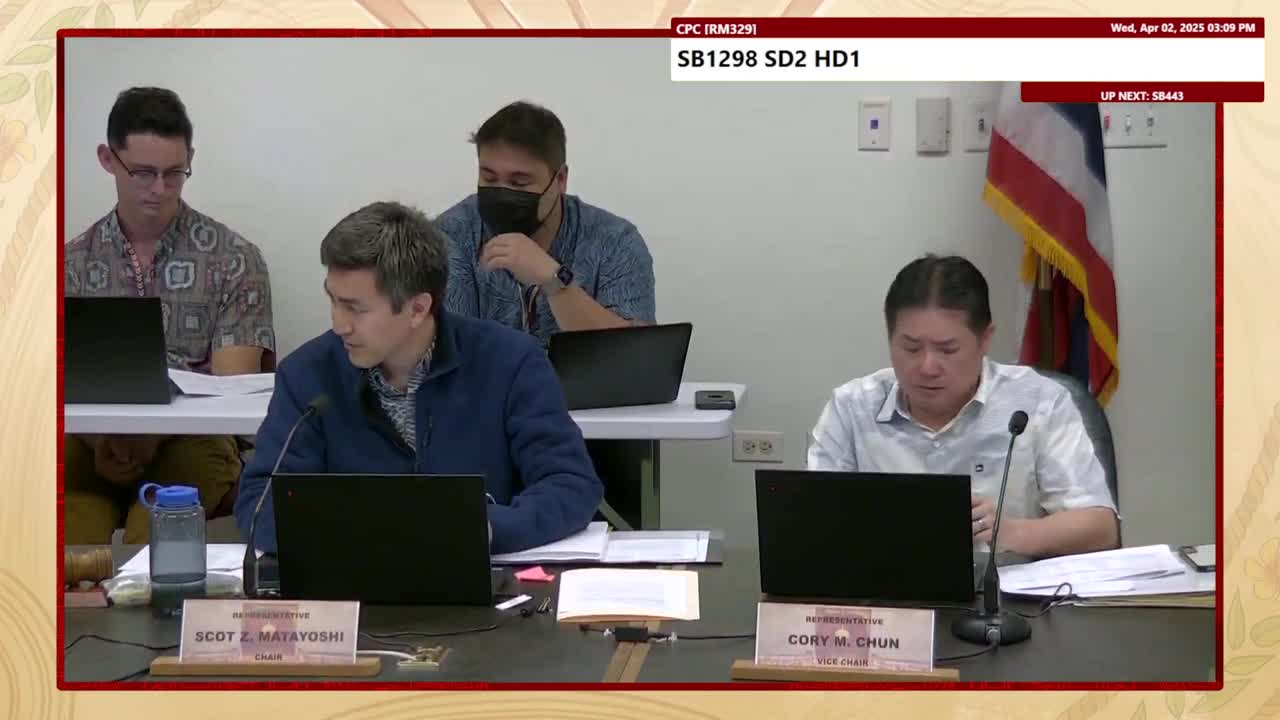 1MIN
House Standing Committee on Consumer Protection & Commerce
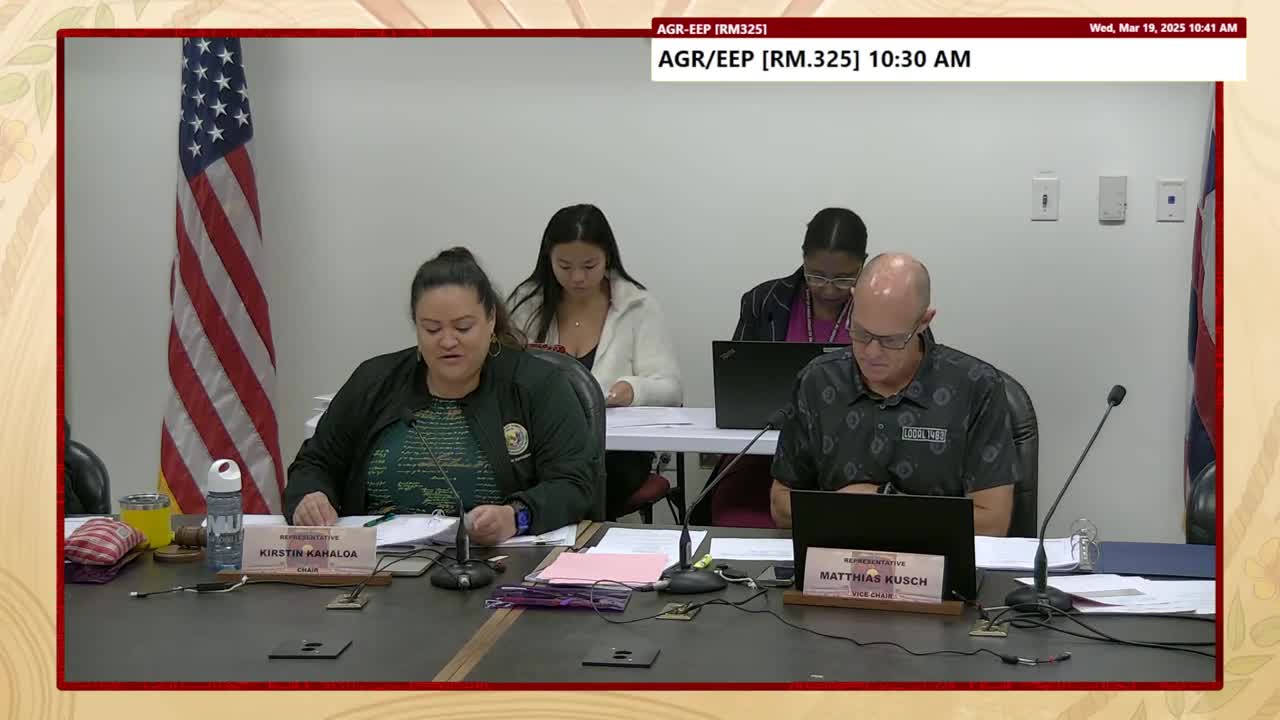 32MIN
House Standing Committee on Agriculture & Food Systems
Bill Author

Bill Co-Author(s):