SB 1571: Hawaii Tourism Authority; Positions; Civil Service Exemption; Convention Center; Hawaii Sense of Place; Board of Directors; President and CEO
- Session Year: 2025-2026
- House: Senate
- Latest Version Date: 2025-04-26
Current Status:
In Progress
(2025-05-29: Act 132, on 05/29/2025 (Gov. Msg. No. 1232).)
Introduced
In Committee
First Chamber
In Committee
Second Chamber
Final Decking
Enacted
What does this bill do?
The bill removes all positions filled by the Hawaii Tourism Authority within the Department of Business, Economic Development, and Tourism from the state's civil service system. It redesigns HTA governance by making the board advisory, removing the DBEDT director as a member, requiring at least one member to represent a tourism‑impacted entity, and giving the Senate president and House speaker each one appointment. The board will appoint the HTA president and CEO with the Senate's approval, the CEO must report to the governor and serve under a board contract, and convention center facilities must reflect a "Hawaii" sense of place.
The summary is provided by generative AI which can make mistakes. For original language, please view the details in the table below.
Exempts all positions filled by the Hawaii Tourism Authority within the Department of Business, Economic Development, and Tourism from the state civil service law. Amends the definition of "convention center facility" for purposes of chapter 201B, HRS, to clarify that the facilities must reflect a Hawaii sense of place. Designates the Hawaii Tourism Authority Board of Directors (Board) as an advisory board. Removes the Director of Business, Economic Development, and Tourism as a member of the Board. Requires a member of the Board to represent a tourism-impacted entity. Provides that the President of the Senate and Speaker of the House of Representatives each appoints a member of the Board. Makes the President and CEO of the Hawaii Tourism Authority a position appointed by the Board, with the advice and consent of the Senate. Requires the President and CEO of the Hawaii Tourism Authority to report to the Governor. Amends the eligibility requirements to serve on the Board. Provides that the President and CEO of the Hawaii Tourism Authority's length of term of service shall be set by written contract by the Board. (CD1)
Exempts all positions filled by the Hawaii Tourism Authority within the Department of Business, Economic Development, and Tourism from the state civil service law. Designates the Board of Directors of the Hawaii Tourism Authority as an advisory board. Makes the President and CEO of the Hawaii Tourism Authority a position appointed by the Governor, with the advice and consent of the Senate. Amends the eligibility requirements to serve on the Hawaii Tourism Authority board of directors by repealing the two-year waiting period for former Hawaii Visitors and Convention Bureau board members. Effective 7/1/3000. (HD3)
Exempts all positions filled by the Hawaii Tourism Authority within the Department of Business, Economic Development, and Tourism from the state civil service law. Designates the Board of Directors of the Hawaii Tourism Authority as an advisory board. Amends the eligibility requirements to serve on the Hawaii Tourism Authority board of directors by repealing the two-year waiting period for former Hawaii Visitors and Convention Bureau board members. Effective 7/1/3000. (HD2)
Exempts all positions filled by the Hawaii Tourism Authority within the Department of Business, Economic Development, and Tourism from the state civil service law. Amends the definition of "convention center facility" for purposes of chapter 201B, HRS, to clarify that the facilities must reflect a Hawaii sense of place. Designates the Board of Directors of the Hawaii Tourism Authority as an advisory board. Amends the eligibility requirements to serve on the Hawaii Tourism Authority board of directors by repealing the two-year waiting period for former Hawaii Visitors and Convention Bureau board members. Effective 7/1/2050. (HD1)
Exempts all positions within the Hawaii Tourism Authority from the state civil service law. Amends the definition of "convention center facility" for purposes of chapter 201B, HRS. Amends the eligibility requirements to serve on the Hawaii Tourism Authority board of directors. Effective 7/1/2050. (SD2)
Exempts all positions within the Hawaii Tourism Authority from the state civil service law. Provides that the powers described in section 201B-3, HRS, shall be granted to the Hawaii Tourism Authority except as otherwise provided by law. Amends the definition of "convention center facility" for purposes of chapter 201B, HRS. Amends the eligibility requirements to serve on the Hawaii Tourism Authority board of directors. Effective 7/1/2050. (SD1)
Exempts all positions within the Hawaii Tourism Authority from the state civil service law. Provides that the powers described in section 201B-3, HRS, shall be granted to the Hawaii Tourism Authority except as otherwise provided by law. Amends the definition of "convention center facility" for purposes of chapter 201B, HRS. Amends the eligibility requirements to serve on the Hawaii Tourism Authority board of directors.
|
THE SENATE |
S.B. NO. |
1571 |
|
THIRTY-THIRD LEGISLATURE, 2025 |
S.D. 2 |
|
|
STATE OF HAWAII |
H.D. 3 |
|
|
|
C.D. 1 |
|
|
|
||
|
|
||
A BILL FOR AN ACT
RELATING TO TOURISM.
BE IT ENACTED BY THE LEGISLATURE OF THE STATE OF HAWAII:
SECTION 1. Section 76-16, Hawaii Revised Statutes, is amended by amending subsection (b) to read as follows:
(1) Commissioned and enlisted personnel of the Hawaii National Guard and positions in the Hawaii National Guard that are required by state or federal laws or regulations or orders of the National Guard to be filled from those commissioned or enlisted personnel;
(2) Positions filled by persons employed by contract where the director of human resources development has certified that the service is special or unique or is essential to the public interest and that, because of circumstances surrounding its fulfillment, personnel to perform the service cannot be obtained through normal civil service recruitment procedures. Any contract may be for any period not exceeding one year;
(3) Positions that must be filled without delay to comply with a court order or decree if the director determines that recruitment through normal recruitment civil service procedures would result in delay or noncompliance, such as the Felix-Cayetano consent decree;
(4) Positions filled by the legislature or by either house or any committee thereof;
(5) Employees in the office of the governor and office of the lieutenant governor, and household employees at Washington Place;
(6) Positions filled by popular vote;
(7) Department heads, officers, and members of any board, commission, or other state agency whose appointments are made by the governor or are required by law to be confirmed by the senate;
(8) Judges, referees, receivers, masters, jurors, notaries public, land court examiners, court commissioners, and attorneys appointed by a state court for a special temporary service;
(9) One bailiff for the chief justice of the supreme court who shall have the powers and duties of a court officer and bailiff under section 606-14; one secretary or clerk for each justice of the supreme court, each judge of the intermediate appellate court, and each judge of the circuit court; one secretary for the judicial council; one deputy administrative director of the courts; three law clerks for the chief justice of the supreme court, two law clerks for each associate justice of the supreme court and each judge of the intermediate appellate court, one law clerk for each judge of the circuit court, two additional law clerks for the civil administrative judge of the circuit court of the first circuit, two additional law clerks for the criminal administrative judge of the circuit court of the first circuit, one additional law clerk for the senior judge of the family court of the first circuit, two additional law clerks for the civil motions judge of the circuit court of the first circuit, two additional law clerks for the criminal motions judge of the circuit court of the first circuit, and two law clerks for the administrative judge of the district court of the first circuit; and one private secretary for the administrative director of the courts, the deputy administrative director of the courts, each department head, each deputy or first assistant, and each additional deputy, or assistant deputy, or assistant defined in paragraph (16);
(10) First deputy and deputy attorneys general, the administrative services manager of the department of the attorney general, one secretary for the administrative services manager, an administrator and any support staff for the criminal and juvenile justice resources coordination functions, and law clerks;
(11) (A) Teachers, principals, vice-principals, complex area superintendents, deputy and assistant superintendents, other certificated personnel, and no more than twenty noncertificated administrative, professional, and technical personnel not engaged in instructional work;
(B) Effective July 1, 2003, teaching assistants, educational assistants, bilingual or bicultural school-home assistants, school psychologists, psychological examiners, speech pathologists, athletic health care trainers, alternative school work study assistants, alternative school educational or supportive services specialists, alternative school project coordinators, and communications aides in the department of education;
(C) The special assistant to the state librarian and one secretary for the special assistant to the state librarian; and
(D) Members
of the faculty of the [University] university of Hawaii,
including research workers, extension agents, personnel engaged in
instructional work, and administrative, professional, and technical personnel
of the university;
(12) Employees engaged in special, research, or demonstration projects approved by the governor;
(13) (A) Positions filled by inmates, patients of state institutions, and persons with severe physical or mental disabilities participating in the work experience training programs;
(B) Positions filled with students in accordance with guidelines for established state employment programs; and
(C) Positions that provide work experience training or temporary public service employment that are filled by persons entering the workforce or persons transitioning into other careers under programs such as the federal Workforce Investment Act of 1998, as amended, or the Senior Community Service Employment Program of the Employment and Training Administration of the United States Department of Labor, or under other similar state programs;
(14) A custodian or guide at Iolani Palace, the Royal Mausoleum, and Hulihee Palace;
(15) Positions filled by persons employed on a fee, contract, or piecework basis, who may lawfully perform their duties concurrently with their private business or profession or other private employment and whose duties require only a portion of their time, if it is impracticable to ascertain or anticipate the portion of time to be devoted to the service of the State;
(16) Positions of first deputies or first assistants of each department head appointed under or in the manner provided in section 6, article V, of the Hawaii State Constitution; three additional deputies or assistants either in charge of the highways, harbors, and airports divisions or other functions within the department of transportation as may be assigned by the director of transportation, with the approval of the governor; one additional deputy in the department of human services either in charge of welfare or other functions within the department as may be assigned by the director of human services; four additional deputies in the department of health, each in charge of one of the following: behavioral health, environmental health, hospitals, and health resources administration, including other functions within the department as may be assigned by the director of health, with the approval of the governor; two additional deputies in charge of the law enforcement programs, administration, or other functions within the department of law enforcement as may be assigned by the director of law enforcement, with the approval of the governor; three additional deputies each in charge of the correctional institutions, rehabilitation services and programs, and administration or other functions within the department of corrections and rehabilitation as may be assigned by the director of corrections and rehabilitation, with the approval of the governor; two administrative assistants to the state librarian; and an administrative assistant to the superintendent of education;
(17) Positions specifically exempted from this part by any other law; provided that:
(A) Any exemption created after July 1, 2014, shall expire three years after its enactment unless affirmatively extended by an act of the legislature; and
(B) All of the positions defined by paragraph (9) shall be included in the position classification plan;
(18) Positions in the state foster grandparent program and positions for temporary employment of senior citizens in occupations in which there is a severe personnel shortage or in special projects;
(19) Household
employees at the official residence of the president of the [University]
university of Hawaii;
(20) Employees in the department of education engaged in the supervision of students during meal periods in the distribution, collection, and counting of meal tickets, and in the cleaning of classrooms after school hours on a less than half-time basis;
(21) Employees hired under the tenant hire program of the Hawaii public housing authority; provided that no more than twenty-six per cent of the authority's workforce in any housing project maintained or operated by the authority shall be hired under the tenant hire program;
(22) Positions
of the federally funded expanded food and nutrition program of the [University]
university of Hawaii that require the hiring of nutrition program
assistants who live in the areas they serve;
(23) Positions filled by persons with severe disabilities who are certified by the state vocational rehabilitation office that they are able to perform safely the duties of the positions;
(24) The sheriff;
(25) A gender and other fairness coordinator hired by the judiciary;
(26) Positions in the Hawaii National Guard youth and adult education programs;
(27) In the Hawaii state energy office in the department of business, economic development, and tourism, all energy program managers, energy program specialists, energy program assistants, and energy analysts;
(28) Administrative appeals hearing officers in the department of human services;
(29) In the Med-QUEST division of the department of human services, the division administrator, finance officer, health care services branch administrator, medical director, and clinical standards administrator;
(30) In the director's office of the department of human services, the enterprise officer, information security and privacy compliance officer, security and privacy compliance engineer, security and privacy compliance analyst, information technology implementation manager, assistant information technology implementation manager, resource manager, community or project development director, policy director, special assistant to the director, and limited English proficiency project manager or coordinator;
(31) The Alzheimer's disease and related dementia services coordinator in the executive office on aging;
(32) In the Hawaii emergency management agency, the executive officer, public information officer, civil defense administrative officer, branch chiefs, and emergency operations center state warning point personnel; provided that for state warning point personnel, the director shall determine that recruitment through normal civil service recruitment procedures would result in delay or noncompliance;
(33) The executive director and seven full-time administrative positions of the school facilities authority;
(34) Positions in the Mauna Kea stewardship and oversight authority;
(35) In the office of homeland security of the department of law enforcement, the statewide interoperable communications coordinator;
(36) In the social services division of the department of human services, the business technology analyst;
(37) The executive director and staff of the 911 board;
[[](38)[]] Senior
software developers in the department of taxation;
[[](39)[]] In
the department of law enforcement, five Commission on Accreditation for Law
Enforcement Agencies, Inc., coordinator positions;
[[](40)[]] The state fire marshal; [and
[](41)[]] The
administrator for the law enforcement standards board[.]; and
(42) All positions filled by the Hawaii tourism authority within the department of business, economic development, and tourism.
The director shall determine the applicability of this section to specific positions.
Nothing in this section shall be deemed to affect the civil service status of any incumbent as it existed on July 1, 1955."
SECTION 2. Section 201B-1, Hawaii Revised Statutes, is amended by amending the definition of "convention center facility" to read as follows:
""Convention
center facility" or "convention center" means any combination of
land, buildings, and improvements thereon, acquired or developed by the State,
and includes exhibition halls, meeting rooms, a plenary session hall, and
support space that reflect a [Hawaiian] Hawaii sense of place;
any other structure or facility required or useful for the operation of a
convention center, including commercial, office, community service, parking,
garage, and other supporting service structures; and, all
necessary, useful, and related equipment, furnishings, and appurtenances."
SECTION 3. Section 201B-2, Hawaii Revised Statutes, is amended as follows:
1. By amending subsection (b) to read:
"(b)
The
authority shall be headed by [a policy-making] an advisory board
of directors that shall consist of twelve members; provided that:
(1) The members shall be appointed by the
governor as provided in section 26-34, except as provided by this section;
(2) The members shall include at least one representative each from the city and county of Honolulu and the counties of Hawaii, Kauai, and Maui;
(3) [Three members] One member
shall be appointed by [the governor from a list of three names submitted for
each appointment by] the president of the senate, and [three members]
one member shall be appointed by [the governor from a list of three
names submitted for each appointment by] the speaker of the house of
representatives[; provided that if fewer than three names are submitted for
each appointment, the governor may disregard the list];
(4) At least six members shall have knowledge,
experience, and expertise in the area of accommodations, transportation,
retail, entertainment, or attractions, and at least one member appointed by the
governor shall have knowledge, experience, and expertise in the area of
Hawaiian cultural practices[; provided that no more than three members shall
represent, be employed by, or be under contract to any sector of the industry
represented on the board];
(5) [One member shall be the director of
business, economic development, and tourism, or the director's designee, who
shall be an ex officio voting member;] At least one member shall
represent a tourism-impacted entity;
(6) The governor shall make appointments to
ensure the fulfillment of all requirements of paragraphs (2) and (4); provided
that upon the occurrence of a vacancy subject to paragraph (3), the governor
shall notify the president of the senate and the speaker of the house of
representatives of any unfulfilled requirements pursuant to paragraphs (2) and
(4), and the president of the senate or the speaker of the house of
representatives, as appropriate, shall [submit nominees] appoint a
member who [fulfill] fulfills those requirements; and
(7) No person who has served as a member of the board of directors of the Hawaii Visitors and Convention Bureau shall be eligible to sit as a member of the board of directors of the Hawaii tourism authority until at least two years have expired between the person's termination from service on the Hawaii Visitors and Convention Bureau board and the person's appointment to the authority's board of directors."
2. By amending subsection (f) to read:
"(f) The board shall [appoint one person] submit a nominee to the governor who shall transmit a
governor's message with the name of the nominee to the senate within ten days
of receipt, and shall, subject to the advice and consent of the senate, appoint
the nominee to serve as president and chief executive officer, exempt
from chapters 76 and 88, who shall oversee the authority staff; provided
[further] that the compensation package shall not include private sector
moneys or other contributions. Notwithstanding
any law to the contrary, the president and chief executive officer shall report
to the governor.
The board shall set the president and chief executive officer's duties, responsibilities, holidays, vacations, leaves, hours of work, and working conditions. It may grant other benefits as it deems necessary. The board shall set the length of the president and chief executive officer's term of service pursuant to written contract."
SECTION 4. Section 201B-3, Hawaii Revised Statutes, is amended by amending subsection (a) to read as follows:
"(a) Except as otherwise [limited by this
chapter,] provided by law, the authority may:
(1) Sue and be sued;
(2) Have a seal and alter the same at its pleasure;
(3) Through its president and chief executive officer, make and execute contracts and all other instruments necessary or convenient for the exercise of its powers and functions under this chapter; provided that the authority may enter into contracts and agreements for a period of up to five years, subject to the availability of funds; provided further that the authority may enter into agreements for the use of the convention center facility for a period of up to ten years;
(4) Make and alter bylaws for its organization and internal management;
(5) Unless otherwise provided in this chapter, adopt rules in accordance with chapter 91 with respect to its projects, operations, properties, and facilities;
(6) Through its president and chief executive officer, represent the authority in communications with the governor and legislature;
(7) Through its president and chief executive officer, provide for the appointment of officers, agents, a sports coordinator, and employees, subject to the approval of the board, prescribing their duties and qualifications, and fixing their salaries, without regard to chapters 76 and 78, if funds have been appropriated by the legislature and allotted as provided by law;
(8) Through its president and chief executive officer, purchase supplies, equipment, or furniture;
(9) Through its president and chief executive officer, allocate the space or spaces that are to be occupied by the authority and appropriate staff;
(10) Through its president and chief executive officer, engage the services of qualified persons to implement the State's strategic tourism management plan or portions thereof as determined by the authority;
(11) Through its president and chief executive officer, engage the services of consultants on a contractual basis for rendering professional and technical assistance and advice;
(12) Procure insurance against any loss in connection with its property and other assets and operations in amounts and from insurers as it deems desirable;
(13) Contract for or accept revenues, compensation, proceeds, and gifts or grants in any form from any public agency or any other source;
(14) Develop, coordinate, and implement state policies and directions for tourism and related activities taking into account the economic, social, and physical impacts of tourism on the State, Hawaii's natural environment, and areas frequented by visitors;
(15) Have a permanent, strong focus on Hawaii brand management;
(16) Coordinate all agencies and advise the private sector in the development of tourism-related activities and resources;
(17) Work to eliminate or reduce barriers to travel to provide a positive and competitive business environment, including coordinating with the department of transportation on issues affecting airlines and air route development;
(18) Market and promote sports-related activities and events;
(19) Coordinate the development of new products with the counties and other persons in the public sector and private sector, including the development of sports, culture, health and wellness, education, technology, agriculture, and nature tourism;
(20) Establish a public information and educational program to inform the public of tourism and tourism-related problems;
(21) Coordinate the development of tourism educational, training, and career counseling programs;
(22) Establish a program to monitor, investigate, and respond to complaints about problems resulting directly or indirectly from the tourism industry and taking appropriate action as necessary;
(23) Develop and implement emergency measures to respond to any adverse effects on the tourism industry, pursuant to section 201B-9;
(24) Set and collect rents, fees, charges, or other payments for the lease, use, occupancy, or disposition of the convention center facility without regard to chapter 91;
(25) Notwithstanding chapter 171, acquire, lease as lessee or lessor, own, rent, hold, and dispose of the convention center facility in the exercise of its powers and the performance of its duties under this chapter;
(26) Acquire by purchase, lease, or otherwise, and develop, construct, operate, own, manage, repair, reconstruct, enlarge, or otherwise effectuate, either directly or through developers, a convention center facility;
(27) Enhance the tourism industry in the State to grow its positive contributions to residents of the State; provided that the authority's initiatives shall follow destination management practices and integrate regenerative tourism; and
(28) Focus on perpetuating the uniqueness of the Hawaiian culture and community and their significance to the quality of the visitor experience by ensuring that:
(A) The Hawaiian culture is accurately portrayed by Hawaii's visitor industry;
(B) The Hawaiian language is supported and normalized as an official language of the State;
(C) Hawaiian cultural practitioners and cultural sites are supported, nurtured, and engaged in sustaining the visitor industry; and
(D) A Hawaiian cultural education and training program is provided for the members of the visitor industry workforce who have direct contact with visitors."
SECTION 5. Section 226-8, Hawaii Revised Statutes, is amended by amending subsection (b) to read as follows:
"(b) To achieve the visitor industry objective, it shall be the policy of the State to:
(1) Support and assist in the promotion of Hawaii's visitor attractions and facilities;
(2) Ensure that visitor industry activities are in keeping with the social, economic, and physical needs and aspirations of Hawaii's people;
(3) Improve the quality of existing visitor destination areas by utilizing Hawaii's strengths in science and technology;
(4) Encourage cooperation and coordination between the government and private sectors in developing and maintaining well-designed, adequately serviced visitor industry and related developments that are sensitive to neighboring communities and activities;
(5) Develop the industry in a manner that will:
(A) Continue to provide new job opportunities and steady employment for Hawaii's people;
(B) Commit to building the capacity of Hawaii's people; and
(C) Offer career opportunities to ultimately increase the percentage of Hawaii's people who hold management and leadership positions in the visitor industry;
(6) Provide opportunities for Hawaii's people to obtain job training and education that will allow for upward mobility within the visitor industry;
(7) Foster a recognition of the contribution of the visitor industry to Hawaii's economy and the need to perpetuate the aloha spirit;
(8) Foster an understanding by visitors of the aloha spirit and of the unique and sensitive character of Hawaii's cultures and values;
(9) [Form] Allow the formation of
community partnerships to ensure Native Hawaiian cultural integrity by:
(A) Supporting Hawaii's people and communities and their efforts to care for the land and protect the cultural and natural resources of the land, oceans, streams, and skies;
(B) Strengthening the relationships between the place and Hawaii's people and visitors alike;
(C) Engaging in collaborative efforts that provide visitors with genuine and meaningful experiences in Hawaii;
(D) Ensuring that kapu (prohibited) and environmentally sensitive contexts are protected from visitor traffic;
(E) Positioning local business owners and entrepreneurs in the economic value chain to ensure more meaningful visitor and resident engagement as well as economic benefit to local communities; and
(F) Acknowledging and, where appropriate, protecting Native Hawaiian cultural intellectual property, traditional knowledge, and traditional cultural expressions that contribute to Hawaii's economy;
(10) Apply innovative financial policies as well as data collection and analysis to incentivize and facilitate a shift to a regenerative visitor industry that has a smaller ecological footprint by implementing policies such as decreasing the impacts on beaches, reefs, and ocean life, and that aims to sustain and improve the quality of life for Hawaii's people by implementing policies such as decreasing the impacts of transient accommodations, vacation rentals, bed and breakfast operations, and rental cars;
(11) Target markets that have a high probability of alignment with the goal of cultivating a regenerative visitor industry;
(12) Actively support and encourage other economic sectors and clusters to reduce the State's dependence on tourism to support Hawaii's overall economic prosperity;
(13) Minimize negative economic, environmental, and social impacts to the State;
(14) Generate greater economic benefits for Hawaii's people, enhance the well-being of Hawaii's indigenous communities, and improve the working conditions of and access to the visitor industry;
(15) Involve Hawaii's people in decisions that affect their lives and life changes;
(16) Make positive contributions to the conservation of natural and cultural heritage for the maintenance of Hawaii's diversity;
(17) Provide more enjoyable experiences and a greater understanding of local cultural, social, and environmental issues for visitors through more meaningful connections with Hawaii's people; and
(18) Provide equitable access for individuals with disabilities and sociologically disadvantaged people that is culturally sensitive, engenders respect between visitors and Hawaii's people, and builds pride and confidence in Hawaii."
SECTION 6. Statutory material to be repealed is bracketed and stricken. New statutory material is underscored.
SECTION 7. This Act shall take effect upon its approval.
Report Title:
Hawaii Tourism Authority; Positions; Civil Service Exemption; Convention Center; Hawaii Sense of Place; Board of Directors; President and CEO
Description:
Exempts all positions filled by the Hawaii Tourism Authority within the Department of Business, Economic Development, and Tourism from the state civil service law. Amends the definition of "convention center facility" for purposes of chapter 201B, HRS, to clarify that the facilities must reflect a Hawaii sense of place. Designates the Hawaii Tourism Authority Board of Directors (Board) as an advisory board. Removes the Director of Business, Economic Development, and Tourism as a member of the Board. Requires a member of the Board to represent a tourism-impacted entity. Provides that the President of the Senate and Speaker of the House of Representatives each appoints a member of the Board. Makes the President and CEO of the Hawaii Tourism Authority a position appointed by the Board, with the advice and consent of the Senate. Requires the President and CEO of the Hawaii Tourism Authority to report to the Governor. Amends the eligibility requirements to serve on the Board. Provides that the President and CEO of the Hawaii Tourism Authority's length of term of service shall be set by written contract by the Board. (CD1)
The summary description of legislation appearing on this page is for informational purposes only and is not legislation or evidence of legislative intent.
|
THE SENATE |
S.B. NO. |
1571 |
|
THIRTY-THIRD LEGISLATURE, 2025 |
S.D. 2 |
|
|
STATE OF HAWAII |
H.D. 3 |
|
|
|
|
|
|
|
||
|
|
||
A BILL FOR AN ACT
RELATING TO TOURISM.
BE IT ENACTED BY THE LEGISLATURE OF THE STATE OF HAWAII:
SECTION 1. Section 76-16, Hawaii Revised Statutes, is amended by amending subsection (b) to read as follows:
(1) Commissioned and enlisted personnel of the Hawaii National Guard and positions in the Hawaii National Guard that are required by state or federal laws or regulations or orders of the National Guard to be filled from those commissioned or enlisted personnel;
(2) Positions filled by persons employed by contract where the director of human resources development has certified that the service is special or unique or is essential to the public interest and that, because of circumstances surrounding its fulfillment, personnel to perform the service cannot be obtained through normal civil service recruitment procedures. Any contract may be for any period not exceeding one year;
(3) Positions that must be filled without delay to comply with a court order or decree if the director determines that recruitment through normal recruitment civil service procedures would result in delay or noncompliance, such as the Felix-Cayetano consent decree;
(4) Positions filled by the legislature or by either house or any committee thereof;
(5) Employees in the office of the governor and office of the lieutenant governor, and household employees at Washington Place;
(6) Positions filled by popular vote;
(7) Department heads, officers, and members of any board, commission, or other state agency whose appointments are made by the governor or are required by law to be confirmed by the senate;
(8) Judges, referees, receivers, masters, jurors, notaries public, land court examiners, court commissioners, and attorneys appointed by a state court for a special temporary service;
(9) One bailiff for the chief justice of the supreme court who shall have the powers and duties of a court officer and bailiff under section 606-14; one secretary or clerk for each justice of the supreme court, each judge of the intermediate appellate court, and each judge of the circuit court; one secretary for the judicial council; one deputy administrative director of the courts; three law clerks for the chief justice of the supreme court, two law clerks for each associate justice of the supreme court and each judge of the intermediate appellate court, one law clerk for each judge of the circuit court, two additional law clerks for the civil administrative judge of the circuit court of the first circuit, two additional law clerks for the criminal administrative judge of the circuit court of the first circuit, one additional law clerk for the senior judge of the family court of the first circuit, two additional law clerks for the civil motions judge of the circuit court of the first circuit, two additional law clerks for the criminal motions judge of the circuit court of the first circuit, and two law clerks for the administrative judge of the district court of the first circuit; and one private secretary for the administrative director of the courts, the deputy administrative director of the courts, each department head, each deputy or first assistant, and each additional deputy, or assistant deputy, or assistant defined in paragraph (16);
(10) First deputy and deputy attorneys general, the administrative services manager of the department of the attorney general, one secretary for the administrative services manager, an administrator and any support staff for the criminal and juvenile justice resources coordination functions, and law clerks;
(11) (A) Teachers, principals, vice-principals, complex area superintendents, deputy and assistant superintendents, other certificated personnel, and no more than twenty noncertificated administrative, professional, and technical personnel not engaged in instructional work;
(B) Effective July 1, 2003, teaching assistants, educational assistants, bilingual or bicultural school-home assistants, school psychologists, psychological examiners, speech pathologists, athletic health care trainers, alternative school work study assistants, alternative school educational or supportive services specialists, alternative school project coordinators, and communications aides in the department of education;
(C) The special assistant to the state librarian and one secretary for the special assistant to the state librarian; and
(D) Members
of the faculty of the [University] university of Hawaii,
including research workers, extension agents, personnel engaged in
instructional work, and administrative, professional, and technical personnel
of the university;
(12) Employees engaged in special, research, or demonstration projects approved by the governor;
(13) (A) Positions filled by inmates, patients of state institutions, and persons with severe physical or mental disabilities participating in the work experience training programs;
(B) Positions filled with students in accordance with guidelines for established state employment programs; and
(C) Positions that provide work experience training or temporary public service employment that are filled by persons entering the workforce or persons transitioning into other careers under programs such as the federal Workforce Investment Act of 1998, as amended, or the Senior Community Service Employment Program of the Employment and Training Administration of the United States Department of Labor, or under other similar state programs;
(14) A custodian or guide at Iolani Palace, the Royal Mausoleum, and Hulihee Palace;
(15) Positions filled by persons employed on a fee, contract, or piecework basis, who may lawfully perform their duties concurrently with their private business or profession or other private employment and whose duties require only a portion of their time, if it is impracticable to ascertain or anticipate the portion of time to be devoted to the service of the State;
(16) Positions of first deputies or first assistants of each department head appointed under or in the manner provided in section 6, article V, of the Hawaii State Constitution; three additional deputies or assistants either in charge of the highways, harbors, and airports divisions or other functions within the department of transportation as may be assigned by the director of transportation, with the approval of the governor; one additional deputy in the department of human services either in charge of welfare or other functions within the department as may be assigned by the director of human services; four additional deputies in the department of health, each in charge of one of the following: behavioral health, environmental health, hospitals, and health resources administration, including other functions within the department as may be assigned by the director of health, with the approval of the governor; two additional deputies in charge of the law enforcement programs, administration, or other functions within the department of law enforcement as may be assigned by the director of law enforcement, with the approval of the governor; three additional deputies each in charge of the correctional institutions, rehabilitation services and programs, and administration or other functions within the department of corrections and rehabilitation as may be assigned by the director of corrections and rehabilitation, with the approval of the governor; two administrative assistants to the state librarian; and an administrative assistant to the superintendent of education;
(17) Positions specifically exempted from this part by any other law; provided that:
(A) Any exemption created after July 1, 2014, shall expire three years after its enactment unless affirmatively extended by an act of the legislature; and
(B) All of the positions defined by paragraph (9) shall be included in the position classification plan;
(18) Positions in the state foster grandparent program and positions for temporary employment of senior citizens in occupations in which there is a severe personnel shortage or in special projects;
(19) Household
employees at the official residence of the president of the [University]
university of Hawaii;
(20) Employees in the department of education engaged in the supervision of students during meal periods in the distribution, collection, and counting of meal tickets, and in the cleaning of classrooms after school hours on a less than half-time basis;
(21) Employees hired under the tenant hire program of the Hawaii public housing authority; provided that no more than twenty-six per cent of the authority's workforce in any housing project maintained or operated by the authority shall be hired under the tenant hire program;
(22) Positions
of the federally funded expanded food and nutrition program of the [University]
university of Hawaii that require the hiring of nutrition program
assistants who live in the areas they serve;
(23) Positions filled by persons with severe disabilities who are certified by the state vocational rehabilitation office that they are able to perform safely the duties of the positions;
(24) The sheriff;
(25) A gender and other fairness coordinator hired by the judiciary;
(26) Positions in the Hawaii National Guard youth and adult education programs;
(27) In the Hawaii state energy office in the department of business, economic development, and tourism, all energy program managers, energy program specialists, energy program assistants, and energy analysts;
(28) Administrative appeals hearing officers in the department of human services;
(29) In the Med-QUEST division of the department of human services, the division administrator, finance officer, health care services branch administrator, medical director, and clinical standards administrator;
(30) In the director's office of the department of human services, the enterprise officer, information security and privacy compliance officer, security and privacy compliance engineer, security and privacy compliance analyst, information technology implementation manager, assistant information technology implementation manager, resource manager, community or project development director, policy director, special assistant to the director, and limited English proficiency project manager or coordinator;
(31) The Alzheimer's disease and related dementia services coordinator in the executive office on aging;
(32) In the Hawaii emergency management agency, the executive officer, public information officer, civil defense administrative officer, branch chiefs, and emergency operations center state warning point personnel; provided that for state warning point personnel, the director shall determine that recruitment through normal civil service recruitment procedures would result in delay or noncompliance;
(33) The executive director and seven full-time administrative positions of the school facilities authority;
(34) Positions in the Mauna Kea stewardship and oversight authority;
(35) In the office of homeland security of the department of law enforcement, the statewide interoperable communications coordinator;
(36) In the social services division of the department of human services, the business technology analyst;
(37) The executive director and staff of the 911 board;
[[](38)[]] Senior software developers in the department of taxation;
[[](39)[]] In the department of law
enforcement, five Commission on Accreditation for Law Enforcement Agencies,
Inc., coordinator positions;
[[](40)[]] The
state fire marshal; [and
[](41)[]] The administrator for the law enforcement standards board[.];
and
(42) All positions filled by the Hawaii tourism authority within the department of business, economic development, and tourism.
The director shall determine the applicability of this section to specific positions.
Nothing in this section shall be deemed to affect the civil service status of any incumbent as it existed on July 1, 1955."
SECTION 2. Section 201B-2, Hawaii Revised Statutes, is amended as follows:
1. By amending subsection (b) to read:
"(b) The authority shall be headed by a policy-making and advisory board of directors that shall consist of twelve members; provided that:
(1) The
members shall be appointed by the governor as provided in section 26-34, except
as provided by this section;
(2) The members shall include at least one representative each from the city and county of Honolulu and the counties of Hawaii, Kauai, and Maui;
(3) Three members shall be appointed by the governor from a list of three names submitted for each appointment by the president of the senate, and three members shall be appointed by the governor from a list of three names submitted for each appointment by the speaker of the house of representatives; provided that if fewer than three names are submitted for each appointment, the governor may disregard the list;
(4) At least six members shall have knowledge, experience, and expertise in the area of accommodations, transportation, retail, entertainment, or attractions, and at least one member appointed by the governor shall have knowledge, experience, and expertise in the area of Hawaiian cultural practices; provided that no more than three members shall represent, be employed by, or be under contract to any sector of the industry represented on the board;
(5) One member shall be the director of business, economic development, and tourism, or the director's designee, who shall be an ex officio voting member; and
(6) The
governor shall make appointments to ensure the fulfillment of all requirements
of paragraphs (2) and (4); provided that upon the occurrence of a vacancy
subject to paragraph (3), the governor shall notify the president of the senate
and the speaker of the house of representatives of any unfulfilled requirements
pursuant to paragraphs (2) and (4), and the president of the senate or the
speaker of the house of representatives, as appropriate, shall submit nominees
who fulfill those requirements[; and
(7) No
person who has served as a member of the board of directors of the Hawaii
Visitors and Convention Bureau shall be eligible to sit as a member of the
board of directors of the Hawaii tourism authority until at least two years
have expired between the person's termination from service on the Hawaii
Visitors and Convention Bureau board and the person's appointment to the
authority's board of directors]."
2. By amending subsection (f) to read:
"(f) The [board] governor, with the
advice and consent of the senate, shall appoint one person to serve as
president and chief executive officer, exempt from chapters 76 and 88 who shall
oversee the authority staff; provided [further] that the compensation
package shall not include private sector moneys or other contributions. The board shall set the president and chief
executive officer's duties, responsibilities, holidays, vacations, leaves,
hours of work, and working conditions.
It may grant other benefits as it deems necessary."
SECTION 3. Section 201B-3, Hawaii Revised Statutes, is amended by amending subsection (a) to read as follows:
"(a) Except as otherwise [limited by this
chapter,] provided by law, the authority may:
(1) Sue and be sued;
(2) Have a seal and alter the same at its pleasure;
(3) Through its president and chief executive officer, make and execute contracts and all other instruments necessary or convenient for the exercise of its powers and functions under this chapter; provided that the authority may enter into contracts and agreements for a period of up to five years, subject to the availability of funds; provided further that the authority may enter into agreements for the use of the convention center facility for a period of up to ten years;
(4) Make and alter bylaws for its organization and internal management;
(5) Unless otherwise provided in this chapter, adopt rules in accordance with chapter 91 with respect to its projects, operations, properties, and facilities;
(6) Through its president and chief executive officer, represent the authority in communications with the governor and legislature;
(7) Through its president and chief executive officer, provide for the appointment of officers, agents, a sports coordinator, and employees, subject to the approval of the board, prescribing their duties and qualifications, and fixing their salaries, without regard to chapters 76 and 78, if funds have been appropriated by the legislature and allotted as provided by law;
(8) Through its president and chief executive officer, purchase supplies, equipment, or furniture;
(9) Through its president and chief executive officer, allocate the space or spaces that are to be occupied by the authority and appropriate staff;
(10) Through its president and chief executive officer, engage the services of qualified persons to implement the State's strategic tourism management plan or portions thereof as determined by the authority;
(11) Through its president and chief executive officer, engage the services of consultants on a contractual basis for rendering professional and technical assistance and advice;
(12) Procure insurance against any loss in connection with its property and other assets and operations in amounts and from insurers as it deems desirable;
(13) Contract for or accept revenues, compensation, proceeds, and gifts or grants in any form from any public agency or any other source;
(14) Develop, coordinate, and implement state policies and directions for tourism and related activities taking into account the economic, social, and physical impacts of tourism on the State, Hawaii's natural environment, and areas frequented by visitors;
(15) Have a permanent, strong focus on Hawaii brand management;
(16) Coordinate all agencies and advise the private sector in the development of tourism-related activities and resources;
(17) Work to eliminate or reduce barriers to travel to provide a positive and competitive business environment, including coordinating with the department of transportation on issues affecting airlines and air route development;
(18) Market and promote sports-related activities and events;
(19) Coordinate the development of new products with the counties and other persons in the public sector and private sector, including the development of sports, culture, health and wellness, education, technology, agriculture, and nature tourism;
(20) Establish a public information and educational program to inform the public of tourism and tourism-related problems;
(21) Coordinate the development of tourism educational, training, and career counseling programs;
(22) Establish a program to monitor, investigate, and respond to complaints about problems resulting directly or indirectly from the tourism industry and taking appropriate action as necessary;
(23) Develop and implement emergency measures to respond to any adverse effects on the tourism industry, pursuant to section 201B-9;
(24) Set and collect rents, fees, charges, or other payments for the lease, use, occupancy, or disposition of the convention center facility without regard to chapter 91;
(25) Notwithstanding chapter 171, acquire, lease as lessee or lessor, own, rent, hold, and dispose of the convention center facility in the exercise of its powers and the performance of its duties under this chapter;
(26) Acquire by purchase, lease, or otherwise, and develop, construct, operate, own, manage, repair, reconstruct, enlarge, or otherwise effectuate, either directly or through developers, a convention center facility;
(27) Enhance the tourism industry in the State to grow its positive contributions to residents of the State; provided that the authority's initiatives shall follow destination management practices and integrate regenerative tourism; and
(28) Focus on perpetuating the uniqueness of the Hawaiian culture and community and their significance to the quality of the visitor experience by ensuring that:
(A) The Hawaiian culture is accurately portrayed by Hawaii's visitor industry;
(B) The Hawaiian language is supported and normalized as an official language of the State;
(C) Hawaiian cultural practitioners and cultural sites are supported, nurtured, and engaged in sustaining the visitor industry; and
(D) A Hawaiian cultural education and training program is provided for the members of the visitor industry workforce who have direct contact with visitors."
SECTION 4. Section 226-8, Hawaii Revised Statutes, is amended by amending subsection (b) to read as follows:
"(b) To achieve the visitor industry objective, it shall be the policy of the State to:
(1) Support and assist in the promotion of Hawaii's visitor attractions and facilities;
(2) Ensure that visitor industry activities are in keeping with the social, economic, and physical needs and aspirations of Hawaii's people;
(3) Improve the quality of existing visitor destination areas by utilizing Hawaii's strengths in science and technology;
(4) Encourage cooperation and coordination between the government and private sectors in developing and maintaining well-designed, adequately serviced visitor industry and related developments that are sensitive to neighboring communities and activities;
(5) Develop the industry in a manner that will:
(A) Continue to provide new job opportunities and steady employment for Hawaii's people;
(B) Commit to building the capacity of Hawaii's people; and
(C) Offer career opportunities to ultimately increase the percentage of Hawaii's people who hold management and leadership positions in the visitor industry;
(6) Provide opportunities for Hawaii's people to obtain job training and education that will allow for upward mobility within the visitor industry;
(7) Foster a recognition of the contribution of the visitor industry to Hawaii's economy and the need to perpetuate the aloha spirit;
(8) Foster an understanding by visitors of the aloha spirit and of the unique and sensitive character of Hawaii's cultures and values;
(9) [Form] Allow the formation of
community partnerships to ensure Native Hawaiian cultural integrity by:
(A) Supporting Hawaii's people and communities and their efforts to care for the land and protect the cultural and natural resources of the land, oceans, streams, and skies;
(B) Strengthening the relationships between the place and Hawaii's people and visitors alike;
(C) Engaging in collaborative efforts that provide visitors with genuine and meaningful experiences in Hawaii;
(D) Ensuring that kapu (prohibited) and environmentally sensitive contexts are protected from visitor traffic;
(E) Positioning local business owners and entrepreneurs in the economic value chain to ensure more meaningful visitor and resident engagement as well as economic benefit to local communities; and
(F) Acknowledging and, where appropriate, protecting Native Hawaiian cultural intellectual property, traditional knowledge, and traditional cultural expressions that contribute to Hawaii's economy;
(10) Apply innovative financial policies as well as data collection and analysis to incentivize and facilitate a shift to a regenerative visitor industry that has a smaller ecological footprint by implementing policies such as decreasing the impacts on beaches, reefs, and ocean life, and that aims to sustain and improve the quality of life for Hawaii's people by implementing policies such as decreasing the impacts of transient accommodations, vacation rentals, bed and breakfast operations, and rental cars;
(11) Target markets that have a high probability of alignment with the goal of cultivating a regenerative visitor industry;
(12) Actively support and encourage other economic sectors and clusters to reduce the State's dependence on tourism to support Hawaii's overall economic prosperity;
(13) Minimize negative economic, environmental, and social impacts to the State;
(14) Generate greater economic benefits for Hawaii's people, enhance the well-being of Hawaii's indigenous communities, and improve the working conditions of and access to the visitor industry;
(15) Involve Hawaii's people in decisions that affect their lives and life changes;
(16) Make positive contributions to the conservation of natural and cultural heritage for the maintenance of Hawaii's diversity;
(17) Provide more enjoyable experiences and a greater understanding of local cultural, social, and environmental issues for visitors through more meaningful connections with Hawaii's people; and
(18) Provide equitable access for individuals with disabilities and sociologically disadvantaged people that is culturally sensitive, engenders respect between visitors and Hawaii's people, and builds pride and confidence in Hawaii."
SECTION 5. Statutory material to be repealed is bracketed and stricken. New statutory material is underscored.
SECTION 6. This Act shall take effect on July 1, 3000.
Report Title:
Tourism; Hawaii Tourism Authority; Positions; Convention Center Facility; Administration
Description:
Exempts all positions filled by the Hawaii Tourism Authority within the Department of Business, Economic Development, and Tourism from the state civil service law. Designates the Board of Directors of the Hawaii Tourism Authority as an advisory board. Makes the President and CEO of the Hawaii Tourism Authority a position appointed by the Governor, with the advice and consent of the Senate. Amends the eligibility requirements to serve on the Hawaii Tourism Authority board of directors by repealing the two-year waiting period for former Hawaii Visitors and Convention Bureau board members. Effective 7/1/3000. (HD3)
The summary description of legislation appearing on this page is for informational purposes only and is not legislation or evidence of legislative intent.
|
THE SENATE |
S.B. NO. |
1571 |
|
THIRTY-THIRD LEGISLATURE, 2025 |
S.D. 2 |
|
|
STATE OF HAWAII |
H.D. 2 |
|
|
|
|
|
|
|
||
|
|
||
A BILL FOR AN ACT
RELATING TO TOURISM.
BE IT ENACTED BY THE LEGISLATURE OF THE STATE OF HAWAII:
SECTION 1. Section 76-16, Hawaii Revised Statutes, is amended by amending subsection (b) to read as follows:
(1) Commissioned and enlisted personnel of the Hawaii National Guard and positions in the Hawaii National Guard that are required by state or federal laws or regulations or orders of the National Guard to be filled from those commissioned or enlisted personnel;
(2) Positions filled by persons employed by contract where the director of human resources development has certified that the service is special or unique or is essential to the public interest and that, because of circumstances surrounding its fulfillment, personnel to perform the service cannot be obtained through normal civil service recruitment procedures. Any contract may be for any period not exceeding one year;
(3) Positions that must be filled without delay to comply with a court order or decree if the director determines that recruitment through normal recruitment civil service procedures would result in delay or noncompliance, such as the Felix-Cayetano consent decree;
(4) Positions filled by the legislature or by either house or any committee thereof;
(5) Employees in the office of the governor and office of the lieutenant governor, and household employees at Washington Place;
(6) Positions filled by popular vote;
(7) Department heads, officers, and members of any board, commission, or other state agency whose appointments are made by the governor or are required by law to be confirmed by the senate;
(8) Judges, referees, receivers, masters, jurors, notaries public, land court examiners, court commissioners, and attorneys appointed by a state court for a special temporary service;
(9) One bailiff for the chief justice of the supreme court who shall have the powers and duties of a court officer and bailiff under section 606-14; one secretary or clerk for each justice of the supreme court, each judge of the intermediate appellate court, and each judge of the circuit court; one secretary for the judicial council; one deputy administrative director of the courts; three law clerks for the chief justice of the supreme court, two law clerks for each associate justice of the supreme court and each judge of the intermediate appellate court, one law clerk for each judge of the circuit court, two additional law clerks for the civil administrative judge of the circuit court of the first circuit, two additional law clerks for the criminal administrative judge of the circuit court of the first circuit, one additional law clerk for the senior judge of the family court of the first circuit, two additional law clerks for the civil motions judge of the circuit court of the first circuit, two additional law clerks for the criminal motions judge of the circuit court of the first circuit, and two law clerks for the administrative judge of the district court of the first circuit; and one private secretary for the administrative director of the courts, the deputy administrative director of the courts, each department head, each deputy or first assistant, and each additional deputy, or assistant deputy, or assistant defined in paragraph (16);
(10) First deputy and deputy attorneys general, the administrative services manager of the department of the attorney general, one secretary for the administrative services manager, an administrator and any support staff for the criminal and juvenile justice resources coordination functions, and law clerks;
(11) (A) Teachers, principals, vice-principals, complex area superintendents, deputy and assistant superintendents, other certificated personnel, and no more than twenty noncertificated administrative, professional, and technical personnel not engaged in instructional work;
(B) Effective July 1, 2003, teaching assistants, educational assistants, bilingual or bicultural school-home assistants, school psychologists, psychological examiners, speech pathologists, athletic health care trainers, alternative school work study assistants, alternative school educational or supportive services specialists, alternative school project coordinators, and communications aides in the department of education;
(C) The special assistant to the state librarian and one secretary for the special assistant to the state librarian; and
(D) Members
of the faculty of the [University] university of Hawaii,
including research workers, extension agents, personnel engaged in
instructional work, and administrative, professional, and technical personnel
of the university;
(12) Employees engaged in special, research, or demonstration projects approved by the governor;
(13) (A) Positions filled by inmates, patients of state institutions, and persons with severe physical or mental disabilities participating in the work experience training programs;
(B) Positions filled with students in accordance with guidelines for established state employment programs; and
(C) Positions that provide work experience training or temporary public service employment that are filled by persons entering the workforce or persons transitioning into other careers under programs such as the federal Workforce Investment Act of 1998, as amended, or the Senior Community Service Employment Program of the Employment and Training Administration of the United States Department of Labor, or under other similar state programs;
(14) A custodian or guide at Iolani Palace, the Royal Mausoleum, and Hulihee Palace;
(15) Positions filled by persons employed on a fee, contract, or piecework basis, who may lawfully perform their duties concurrently with their private business or profession or other private employment and whose duties require only a portion of their time, if it is impracticable to ascertain or anticipate the portion of time to be devoted to the service of the State;
(16) Positions of first deputies or first assistants of each department head appointed under or in the manner provided in section 6, article V, of the Hawaii State Constitution; three additional deputies or assistants either in charge of the highways, harbors, and airports divisions or other functions within the department of transportation as may be assigned by the director of transportation, with the approval of the governor; one additional deputy in the department of human services either in charge of welfare or other functions within the department as may be assigned by the director of human services; four additional deputies in the department of health, each in charge of one of the following: behavioral health, environmental health, hospitals, and health resources administration, including other functions within the department as may be assigned by the director of health, with the approval of the governor; two additional deputies in charge of the law enforcement programs, administration, or other functions within the department of law enforcement as may be assigned by the director of law enforcement, with the approval of the governor; three additional deputies each in charge of the correctional institutions, rehabilitation services and programs, and administration or other functions within the department of corrections and rehabilitation as may be assigned by the director of corrections and rehabilitation, with the approval of the governor; two administrative assistants to the state librarian; and an administrative assistant to the superintendent of education;
(17) Positions specifically exempted from this part by any other law; provided that:
(A) Any exemption created after July 1, 2014, shall expire three years after its enactment unless affirmatively extended by an act of the legislature; and
(B) All of the positions defined by paragraph (9) shall be included in the position classification plan;
(18) Positions in the state foster grandparent program and positions for temporary employment of senior citizens in occupations in which there is a severe personnel shortage or in special projects;
(19) Household
employees at the official residence of the president of the [University]
university of Hawaii;
(20) Employees in the department of education engaged in the supervision of students during meal periods in the distribution, collection, and counting of meal tickets, and in the cleaning of classrooms after school hours on a less than half-time basis;
(21) Employees hired under the tenant hire program of the Hawaii public housing authority; provided that no more than twenty-six per cent of the authority's workforce in any housing project maintained or operated by the authority shall be hired under the tenant hire program;
(22) Positions
of the federally funded expanded food and nutrition program of the [University]
university of Hawaii that require the hiring of nutrition program
assistants who live in the areas they serve;
(23) Positions filled by persons with severe disabilities who are certified by the state vocational rehabilitation office that they are able to perform safely the duties of the positions;
(24) The sheriff;
(25) A gender and other fairness coordinator hired by the judiciary;
(26) Positions in the Hawaii National Guard youth and adult education programs;
(27) In the Hawaii state energy office in the department of business, economic development, and tourism, all energy program managers, energy program specialists, energy program assistants, and energy analysts;
(28) Administrative appeals hearing officers in the department of human services;
(29) In the Med-QUEST division of the department of human services, the division administrator, finance officer, health care services branch administrator, medical director, and clinical standards administrator;
(30) In the director's office of the department of human services, the enterprise officer, information security and privacy compliance officer, security and privacy compliance engineer, security and privacy compliance analyst, information technology implementation manager, assistant information technology implementation manager, resource manager, community or project development director, policy director, special assistant to the director, and limited English proficiency project manager or coordinator;
(31) The Alzheimer's disease and related dementia services coordinator in the executive office on aging;
(32) In the Hawaii emergency management agency, the executive officer, public information officer, civil defense administrative officer, branch chiefs, and emergency operations center state warning point personnel; provided that for state warning point personnel, the director shall determine that recruitment through normal civil service recruitment procedures would result in delay or noncompliance;
(33) The executive director and seven full-time administrative positions of the school facilities authority;
(34) Positions in the Mauna Kea stewardship and oversight authority;
(35) In the office of homeland security of the department of law enforcement, the statewide interoperable communications coordinator;
(36) In the social services division of the department of human services, the business technology analyst;
(37) The executive director and staff of the 911 board;
[[](38)[]] Senior software developers in the department of taxation;
[[](39)[]] In the department of law
enforcement, five Commission on Accreditation for Law Enforcement Agencies,
Inc., coordinator positions;
[[](40)[]] The
state fire marshal; [and
[](41)[]] The administrator for the law enforcement standards board[.];
and
(42) All positions filled by the Hawaii tourism authority within the department of business, economic development, and tourism.
The director shall determine the applicability of this section to specific positions.
Nothing in this section shall be deemed to affect the civil service status of any incumbent as it existed on July 1, 1955."
SECTION 2. Section 201B-2, Hawaii Revised Statutes, is amended as follows:
1. By amending subsection (b) to read:
"(b) The authority shall be headed by a policy-making and advisory board of directors that shall consist of twelve members; provided that:
(1) The
members shall be appointed by the governor as provided in section 26-34, except
as provided by this section;
(2) The members shall include at least one representative each from the city and county of Honolulu and the counties of Hawaii, Kauai, and Maui;
(3) Three members shall be appointed by the governor from a list of three names submitted for each appointment by the president of the senate, and three members shall be appointed by the governor from a list of three names submitted for each appointment by the speaker of the house of representatives; provided that if fewer than three names are submitted for each appointment, the governor may disregard the list;
(4) At least six members shall have knowledge, experience, and expertise in the area of accommodations, transportation, retail, entertainment, or attractions, and at least one member appointed by the governor shall have knowledge, experience, and expertise in the area of Hawaiian cultural practices; provided that no more than three members shall represent, be employed by, or be under contract to any sector of the industry represented on the board;
(5) One member shall be the director of business, economic development, and tourism, or the director's designee, who shall be an ex officio voting member; and
(6) The
governor shall make appointments to ensure the fulfillment of all requirements
of paragraphs (2) and (4); provided that upon the occurrence of a vacancy
subject to paragraph (3), the governor shall notify the president of the senate
and the speaker of the house of representatives of any unfulfilled requirements
pursuant to paragraphs (2) and (4), and the president of the senate or the
speaker of the house of representatives, as appropriate, shall submit nominees
who fulfill those requirements[; and
(7) No
person who has served as a member of the board of directors of the Hawaii
Visitors and Convention Bureau shall be eligible to sit as a member of the
board of directors of the Hawaii tourism authority until at least two years
have expired between the person's termination from service on the Hawaii
Visitors and Convention Bureau board and the person's appointment to the
authority's board of directors]."
2. By amending subsection (f) to read:
"(f) The board shall appoint one person to serve
as president and chief executive officer, exempt from chapters 76 and 88 who
shall oversee the authority staff; provided [further] that the
compensation package shall not include private sector moneys or other
contributions. The board shall set the
president and chief executive officer's duties, responsibilities, holidays,
vacations, leaves, hours of work, and working conditions. It may grant other benefits as it deems
necessary."
SECTION 3. Section 201B-3, Hawaii Revised Statutes, is amended by amending subsection (a) to read as follows:
"(a) Except as otherwise [limited by this
chapter,] provided by law, the authority may:
(1) Sue and be sued;
(2) Have a seal and alter the same at its pleasure;
(3) Through its president and chief executive officer, make and execute contracts and all other instruments necessary or convenient for the exercise of its powers and functions under this chapter; provided that the authority may enter into contracts and agreements for a period of up to five years, subject to the availability of funds; provided further that the authority may enter into agreements for the use of the convention center facility for a period of up to ten years;
(4) Make and alter bylaws for its organization and internal management;
(5) Unless otherwise provided in this chapter, adopt rules in accordance with chapter 91 with respect to its projects, operations, properties, and facilities;
(6) Through its president and chief executive officer, represent the authority in communications with the governor and legislature;
(7) Through its president and chief executive officer, provide for the appointment of officers, agents, a sports coordinator, and employees, subject to the approval of the board, prescribing their duties and qualifications, and fixing their salaries, without regard to chapters 76 and 78, if funds have been appropriated by the legislature and allotted as provided by law;
(8) Through its president and chief executive officer, purchase supplies, equipment, or furniture;
(9) Through its president and chief executive officer, allocate the space or spaces that are to be occupied by the authority and appropriate staff;
(10) Through its president and chief executive officer, engage the services of qualified persons to implement the State's strategic tourism management plan or portions thereof as determined by the authority;
(11) Through its president and chief executive officer, engage the services of consultants on a contractual basis for rendering professional and technical assistance and advice;
(12) Procure insurance against any loss in connection with its property and other assets and operations in amounts and from insurers as it deems desirable;
(13) Contract for or accept revenues, compensation, proceeds, and gifts or grants in any form from any public agency or any other source;
(14) Develop, coordinate, and implement state policies and directions for tourism and related activities taking into account the economic, social, and physical impacts of tourism on the State, Hawaii's natural environment, and areas frequented by visitors;
(15) Have a permanent, strong focus on Hawaii brand management;
(16) Coordinate all agencies and advise the private sector in the development of tourism-related activities and resources;
(17) Work to eliminate or reduce barriers to travel to provide a positive and competitive business environment, including coordinating with the department of transportation on issues affecting airlines and air route development;
(18) Market and promote sports-related activities and events;
(19) Coordinate the development of new products with the counties and other persons in the public sector and private sector, including the development of sports, culture, health and wellness, education, technology, agriculture, and nature tourism;
(20) Establish a public information and educational program to inform the public of tourism and tourism-related problems;
(21) Coordinate the development of tourism educational, training, and career counseling programs;
(22) Establish a program to monitor, investigate, and respond to complaints about problems resulting directly or indirectly from the tourism industry and taking appropriate action as necessary;
(23) Develop and implement emergency measures to respond to any adverse effects on the tourism industry, pursuant to section 201B-9;
(24) Set and collect rents, fees, charges, or other payments for the lease, use, occupancy, or disposition of the convention center facility without regard to chapter 91;
(25) Notwithstanding chapter 171, acquire, lease as lessee or lessor, own, rent, hold, and dispose of the convention center facility in the exercise of its powers and the performance of its duties under this chapter;
(26) Acquire by purchase, lease, or otherwise, and develop, construct, operate, own, manage, repair, reconstruct, enlarge, or otherwise effectuate, either directly or through developers, a convention center facility;
(27) Enhance the tourism industry in the State to grow its positive contributions to residents of the State; provided that the authority's initiatives shall follow destination management practices and integrate regenerative tourism; and
(28) Focus on perpetuating the uniqueness of the Hawaiian culture and community and their significance to the quality of the visitor experience by ensuring that:
(A) The Hawaiian culture is accurately portrayed by Hawaii's visitor industry;
(B) The Hawaiian language is supported and normalized as an official language of the State;
(C) Hawaiian cultural practitioners and cultural sites are supported, nurtured, and engaged in sustaining the visitor industry; and
(D) A Hawaiian cultural education and training program is provided for the members of the visitor industry workforce who have direct contact with visitors."
SECTION 4. Section 226-8, Hawaii Revised Statutes, is amended by amending subsection (b) to read as follows:
"(b) To achieve the visitor industry objective, it shall be the policy of the State to:
(1) Support and assist in the promotion of Hawaii's visitor attractions and facilities;
(2) Ensure that visitor industry activities are in keeping with the social, economic, and physical needs and aspirations of Hawaii's people;
(3) Improve the quality of existing visitor destination areas by utilizing Hawaii's strengths in science and technology;
(4) Encourage cooperation and coordination between the government and private sectors in developing and maintaining well-designed, adequately serviced visitor industry and related developments that are sensitive to neighboring communities and activities;
(5) Develop the industry in a manner that will:
(A) Continue to provide new job opportunities and steady employment for Hawaii's people;
(B) Commit to building the capacity of Hawaii's people; and
(C) Offer career opportunities to ultimately increase the percentage of Hawaii's people who hold management and leadership positions in the visitor industry;
(6) Provide opportunities for Hawaii's people to obtain job training and education that will allow for upward mobility within the visitor industry;
(7) Foster a recognition of the contribution of the visitor industry to Hawaii's economy and the need to perpetuate the aloha spirit;
(8) Foster an understanding by visitors of the aloha spirit and of the unique and sensitive character of Hawaii's cultures and values;
(9) [Form] Allow the formation of
community partnerships to ensure Native Hawaiian cultural integrity by:
(A) Supporting Hawaii's people and communities and their efforts to care for the land and protect the cultural and natural resources of the land, oceans, streams, and skies;
(B) Strengthening the relationships between the place and Hawaii's people and visitors alike;
(C) Engaging in collaborative efforts that provide visitors with genuine and meaningful experiences in Hawaii;
(D) Ensuring that kapu (prohibited) and environmentally sensitive contexts are protected from visitor traffic;
(E) Positioning local business owners and entrepreneurs in the economic value chain to ensure more meaningful visitor and resident engagement as well as economic benefit to local communities; and
(F) Acknowledging and, where appropriate, protecting Native Hawaiian cultural intellectual property, traditional knowledge, and traditional cultural expressions that contribute to Hawaii's economy;
(10) Apply innovative financial policies as well as data collection and analysis to incentivize and facilitate a shift to a regenerative visitor industry that has a smaller ecological footprint by implementing policies such as decreasing the impacts on beaches, reefs, and ocean life, and that aims to sustain and improve the quality of life for Hawaii's people by implementing policies such as decreasing the impacts of transient accommodations, vacation rentals, bed and breakfast operations, and rental cars;
(11) Target markets that have a high probability of alignment with the goal of cultivating a regenerative visitor industry;
(12) Actively support and encourage other economic sectors and clusters to reduce the State's dependence on tourism to support Hawaii's overall economic prosperity;
(13) Minimize negative economic, environmental, and social impacts to the State;
(14) Generate greater economic benefits for Hawaii's people, enhance the well-being of Hawaii's indigenous communities, and improve the working conditions of and access to the visitor industry;
(15) Involve Hawaii's people in decisions that affect their lives and life changes;
(16) Make positive contributions to the conservation of natural and cultural heritage for the maintenance of Hawaii's diversity;
(17) Provide more enjoyable experiences and a greater understanding of local cultural, social, and environmental issues for visitors through more meaningful connections with Hawaii's people; and
(18) Provide equitable access for individuals with disabilities and sociologically disadvantaged people that is culturally sensitive, engenders respect between visitors and Hawaii's people, and builds pride and confidence in Hawaii."
SECTION 5. Statutory material to be repealed is bracketed and stricken. New statutory material is underscored.
SECTION 6. This Act shall take effect on July 1, 3000.
Report Title:
Tourism; Hawaii Tourism Authority; Positions; Convention Center Facility; Administration
Description:
Exempts all positions filled by the Hawaii Tourism Authority within the Department of Business, Economic Development, and Tourism from the state civil service law. Designates the Board of Directors of the Hawaii Tourism Authority as an advisory board. Amends the eligibility requirements to serve on the Hawaii Tourism Authority board of directors by repealing the two-year waiting period for former Hawaii Visitors and Convention Bureau board members. Effective 7/1/3000. (HD2)
The summary description of legislation appearing on this page is for informational purposes only and is not legislation or evidence of legislative intent.
|
THE SENATE |
S.B. NO. |
1571 |
|
THIRTY-THIRD LEGISLATURE, 2025 |
S.D. 2 |
|
|
STATE OF HAWAII |
H.D. 1 |
|
|
|
|
|
|
|
||
|
|
||
A BILL FOR AN ACT
RELATING TO TOURISM.
BE IT ENACTED BY THE LEGISLATURE OF THE STATE OF HAWAII:
SECTION 1. Section 76-16, Hawaii Revised Statutes, is amended by amending subsection (b) to read as follows:
(1) Commissioned and enlisted personnel of the Hawaii National Guard and positions in the Hawaii National Guard that are required by state or federal laws or regulations or orders of the National Guard to be filled from those commissioned or enlisted personnel;
(2) Positions filled by persons employed by contract where the director of human resources development has certified that the service is special or unique or is essential to the public interest and that, because of circumstances surrounding its fulfillment, personnel to perform the service cannot be obtained through normal civil service recruitment procedures. Any contract may be for any period not exceeding one year;
(3) Positions that must be filled without delay to comply with a court order or decree if the director determines that recruitment through normal recruitment civil service procedures would result in delay or noncompliance, such as the Felix-Cayetano consent decree;
(4) Positions filled by the legislature or by either house or any committee thereof;
(5) Employees in the office of the governor and office of the lieutenant governor, and household employees at Washington Place;
(6) Positions filled by popular vote;
(7) Department heads, officers, and members of any board, commission, or other state agency whose appointments are made by the governor or are required by law to be confirmed by the senate;
(8) Judges, referees, receivers, masters, jurors, notaries public, land court examiners, court commissioners, and attorneys appointed by a state court for a special temporary service;
(9) One bailiff for the chief justice of the supreme court who shall have the powers and duties of a court officer and bailiff under section 606-14; one secretary or clerk for each justice of the supreme court, each judge of the intermediate appellate court, and each judge of the circuit court; one secretary for the judicial council; one deputy administrative director of the courts; three law clerks for the chief justice of the supreme court, two law clerks for each associate justice of the supreme court and each judge of the intermediate appellate court, one law clerk for each judge of the circuit court, two additional law clerks for the civil administrative judge of the circuit court of the first circuit, two additional law clerks for the criminal administrative judge of the circuit court of the first circuit, one additional law clerk for the senior judge of the family court of the first circuit, two additional law clerks for the civil motions judge of the circuit court of the first circuit, two additional law clerks for the criminal motions judge of the circuit court of the first circuit, and two law clerks for the administrative judge of the district court of the first circuit; and one private secretary for the administrative director of the courts, the deputy administrative director of the courts, each department head, each deputy or first assistant, and each additional deputy, or assistant deputy, or assistant defined in paragraph (16);
(10) First deputy and deputy attorneys general, the administrative services manager of the department of the attorney general, one secretary for the administrative services manager, an administrator and any support staff for the criminal and juvenile justice resources coordination functions, and law clerks;
(11) (A) Teachers, principals, vice-principals, complex area superintendents, deputy and assistant superintendents, other certificated personnel, and no more than twenty noncertificated administrative, professional, and technical personnel not engaged in instructional work;
(B) Effective July 1, 2003, teaching assistants, educational assistants, bilingual or bicultural school-home assistants, school psychologists, psychological examiners, speech pathologists, athletic health care trainers, alternative school work study assistants, alternative school educational or supportive services specialists, alternative school project coordinators, and communications aides in the department of education;
(C) The special assistant to the state librarian and one secretary for the special assistant to the state librarian; and
(D) Members
of the faculty of the [University] university of Hawaii,
including research workers, extension agents, personnel engaged in
instructional work, and administrative, professional, and technical personnel
of the university;
(12) Employees engaged in special, research, or demonstration projects approved by the governor;
(13) (A) Positions filled by inmates, patients of state institutions, and persons with severe physical or mental disabilities participating in the work experience training programs;
(B) Positions filled with students in accordance with guidelines for established state employment programs; and
(C) Positions that provide work experience training or temporary public service employment that are filled by persons entering the workforce or persons transitioning into other careers under programs such as the federal Workforce Investment Act of 1998, as amended, or the Senior Community Service Employment Program of the Employment and Training Administration of the United States Department of Labor, or under other similar state programs;
(14) A custodian or guide at Iolani Palace, the Royal Mausoleum, and Hulihee Palace;
(15) Positions filled by persons employed on a fee, contract, or piecework basis, who may lawfully perform their duties concurrently with their private business or profession or other private employment and whose duties require only a portion of their time, if it is impracticable to ascertain or anticipate the portion of time to be devoted to the service of the State;
(16) Positions of first deputies or first assistants of each department head appointed under or in the manner provided in section 6, article V, of the Hawaii State Constitution; three additional deputies or assistants either in charge of the highways, harbors, and airports divisions or other functions within the department of transportation as may be assigned by the director of transportation, with the approval of the governor; one additional deputy in the department of human services either in charge of welfare or other functions within the department as may be assigned by the director of human services; four additional deputies in the department of health, each in charge of one of the following: behavioral health, environmental health, hospitals, and health resources administration, including other functions within the department as may be assigned by the director of health, with the approval of the governor; two additional deputies in charge of the law enforcement programs, administration, or other functions within the department of law enforcement as may be assigned by the director of law enforcement, with the approval of the governor; three additional deputies each in charge of the correctional institutions, rehabilitation services and programs, and administration or other functions within the department of corrections and rehabilitation as may be assigned by the director of corrections and rehabilitation, with the approval of the governor; two administrative assistants to the state librarian; and an administrative assistant to the superintendent of education;
(17) Positions specifically exempted from this part by any other law; provided that:
(A) Any exemption created after July 1, 2014, shall expire three years after its enactment unless affirmatively extended by an act of the legislature; and
(B) All of the positions defined by paragraph (9) shall be included in the position classification plan;
(18) Positions in the state foster grandparent program and positions for temporary employment of senior citizens in occupations in which there is a severe personnel shortage or in special projects;
(19) Household employees at the official residence of the president of the University of Hawaii;
(20) Employees in the department of education engaged in the supervision of students during meal periods in the distribution, collection, and counting of meal tickets, and in the cleaning of classrooms after school hours on a less than half-time basis;
(21) Employees hired under the tenant hire program of the Hawaii public housing authority; provided that no more than twenty-six per cent of the authority's workforce in any housing project maintained or operated by the authority shall be hired under the tenant hire program;
(22) Positions of the federally funded expanded food and nutrition program of the University of Hawaii that require the hiring of nutrition program assistants who live in the areas they serve;
(23) Positions filled by persons with severe disabilities who are certified by the state vocational rehabilitation office that they are able to perform safely the duties of the positions;
(24) The sheriff;
(25) A gender and other fairness coordinator hired by the judiciary;
(26) Positions in the Hawaii National Guard youth and adult education programs;
(27) In the Hawaii state energy office in the department of business, economic development, and tourism, all energy program managers, energy program specialists, energy program assistants, and energy analysts;
(28) Administrative appeals hearing officers in the department of human services;
(29) In the Med-QUEST division of the department of human services, the division administrator, finance officer, health care services branch administrator, medical director, and clinical standards administrator;
(30) In the director's office of the department of human services, the enterprise officer, information security and privacy compliance officer, security and privacy compliance engineer, security and privacy compliance analyst, information technology implementation manager, assistant information technology implementation manager, resource manager, community or project development director, policy director, special assistant to the director, and limited English proficiency project manager or coordinator;
(31) The Alzheimer's disease and related dementia services coordinator in the executive office on aging;
(32) In the Hawaii emergency management agency, the executive officer, public information officer, civil defense administrative officer, branch chiefs, and emergency operations center state warning point personnel; provided that for state warning point personnel, the director shall determine that recruitment through normal civil service recruitment procedures would result in delay or noncompliance;
(33) The executive director and seven full-time administrative positions of the school facilities authority;
(34) Positions in the Mauna Kea stewardship and oversight authority;
(35) In the office of homeland security of the department of law enforcement, the statewide interoperable communications coordinator;
(36) In the social services division of the department of human services, the business technology analyst;
(37) The executive director and staff of the 911 board;
[[](38)[]] Senior software developers in the department of taxation;
[[](39)[]] In the department of law
enforcement, five Commission on Accreditation for Law Enforcement Agencies,
Inc., coordinator positions;
[[](40)[]] The
state fire marshal; [and
[](41)[]] The administrator for the law enforcement standards board[.];
and
(42) All positions filled by the Hawaii tourism authority within the department of business, economic development, and tourism.
The director shall determine the applicability of this section to specific positions.
Nothing in this section shall be deemed to affect the civil service status of any incumbent as it existed on July 1, 1955."
SECTION 2. Section 201B-1, Hawaii Revised Statutes, is amended by amending the definition of "convention center facility" to read as follows:
""Convention center
facility" or "convention center" means any combination of land,
buildings, and improvements thereon, acquired or developed by the State, and
includes exhibition halls, meeting rooms, a plenary session hall, and support
space that reflect a [Hawaiian] Hawaii sense of place; any other
structure or facility required or useful for the operation of a convention
center, including commercial, office, community service, parking, garage, and
other supporting service structures; and, all necessary, useful,
and related equipment, furnishings, and appurtenances."
SECTION 3. Section 201B-2, Hawaii Revised Statutes, is amended as follows:
1. By amending subsection (b) to read:
"(b) The authority shall be headed by a policy-making and advisory board of directors that shall consist of twelve members; provided that:
(1) The
members shall be appointed by the governor as provided in section 26-34, except
as provided by this section;
(2) The members shall include at least one representative each from the city and county of Honolulu and the counties of Hawaii, Kauai, and Maui;
(3) Three members shall be appointed by the governor from a list of three names submitted for each appointment by the president of the senate, and three members shall be appointed by the governor from a list of three names submitted for each appointment by the speaker of the house of representatives; provided that if fewer than three names are submitted for each appointment, the governor may disregard the list;
(4) At least six members shall have knowledge, experience, and expertise in the area of accommodations, transportation, retail, entertainment, or attractions, and at least one member appointed by the governor shall have knowledge, experience, and expertise in the area of Hawaiian cultural practices; provided that no more than three members shall represent, be employed by, or be under contract to any sector of the industry represented on the board;
(5) One member shall be the director of business, economic development, and tourism, or the director's designee, who shall be an ex officio voting member; and
(6) The
governor shall make appointments to ensure the fulfillment of all requirements
of paragraphs (2) and (4); provided that upon the occurrence of a vacancy
subject to paragraph (3), the governor shall notify the president of the senate
and the speaker of the house of representatives of any unfulfilled requirements
pursuant to paragraphs (2) and (4), and the president of the senate or the
speaker of the house of representatives, as appropriate, shall submit nominees
who fulfill those requirements[; and
(7) No
person who has served as a member of the board of directors of the Hawaii
Visitors and Convention Bureau shall be eligible to sit as a member of the
board of directors of the Hawaii tourism authority until at least two years
have expired between the person's termination from service on the Hawaii
Visitors and Convention Bureau board and the person's appointment to the
authority's board of directors]."
2. By amending subsection (f) to read:
"(f) The board shall appoint one person to serve
as president and chief executive officer, exempt from chapters 76 and 88 who
shall oversee the authority staff; provided [further] that the
compensation package shall not include private sector moneys or other
contributions. The board shall set the
president and chief executive officer's duties, responsibilities, holidays,
vacations, leaves, hours of work, and working conditions. It may grant other benefits as it deems
necessary."
SECTION 4. Section 201B-3, Hawaii Revised Statutes, is amended by amending subsection (a) to read as follows:
"(a) Except as otherwise [limited by this
chapter,] provided by law, the authority may:
(1) Sue and be sued;
(2) Have a seal and alter the same at its pleasure;
(3) Through its president and chief executive officer, make and execute contracts and all other instruments necessary or convenient for the exercise of its powers and functions under this chapter; provided that the authority may enter into contracts and agreements for a period of up to five years, subject to the availability of funds; provided further that the authority may enter into agreements for the use of the convention center facility for a period of up to ten years;
(4) Make and alter bylaws for its organization and internal management;
(5) Unless otherwise provided in this chapter, adopt rules in accordance with chapter 91 with respect to its projects, operations, properties, and facilities;
(6) Through its president and chief executive officer, represent the authority in communications with the governor and legislature;
(7) Through its president and chief executive officer, provide for the appointment of officers, agents, a sports coordinator, and employees, subject to the approval of the board, prescribing their duties and qualifications, and fixing their salaries, without regard to chapters 76 and 78, if funds have been appropriated by the legislature and allotted as provided by law;
(8) Through its president and chief executive officer, purchase supplies, equipment, or furniture;
(9) Through its president and chief executive officer, allocate the space or spaces that are to be occupied by the authority and appropriate staff;
(10) Through its president and chief executive officer, engage the services of qualified persons to implement the State's strategic tourism management plan or portions thereof as determined by the authority;
(11) Through its president and chief executive officer, engage the services of consultants on a contractual basis for rendering professional and technical assistance and advice;
(12) Procure insurance against any loss in connection with its property and other assets and operations in amounts and from insurers as it deems desirable;
(13) Contract for or accept revenues, compensation, proceeds, and gifts or grants in any form from any public agency or any other source;
(14) Develop, coordinate, and implement state policies and directions for tourism and related activities taking into account the economic, social, and physical impacts of tourism on the State, Hawaii's natural environment, and areas frequented by visitors;
(15) Have a permanent, strong focus on Hawaii brand management;
(16) Coordinate all agencies and advise the private sector in the development of tourism-related activities and resources;
(17) Work to eliminate or reduce barriers to travel to provide a positive and competitive business environment, including coordinating with the department of transportation on issues affecting airlines and air route development;
(18) Market and promote sports-related activities and events;
(19) Coordinate the development of new products with the counties and other persons in the public sector and private sector, including the development of sports, culture, health and wellness, education, technology, agriculture, and nature tourism;
(20) Establish a public information and educational program to inform the public of tourism and tourism-related problems;
(21) Coordinate the development of tourism educational, training, and career counseling programs;
(22) Establish a program to monitor, investigate, and respond to complaints about problems resulting directly or indirectly from the tourism industry and taking appropriate action as necessary;
(23) Develop and implement emergency measures to respond to any adverse effects on the tourism industry, pursuant to section 201B-9;
(24) Set and collect rents, fees, charges, or other payments for the lease, use, occupancy, or disposition of the convention center facility without regard to chapter 91;
(25) Notwithstanding chapter 171, acquire, lease as lessee or lessor, own, rent, hold, and dispose of the convention center facility in the exercise of its powers and the performance of its duties under this chapter;
(26) Acquire by purchase, lease, or otherwise, and develop, construct, operate, own, manage, repair, reconstruct, enlarge, or otherwise effectuate, either directly or through developers, a convention center facility;
(27) Enhance the tourism industry in the State to grow its positive contributions to residents of the State; provided that the authority's initiatives shall follow destination management practices and integrate regenerative tourism; and
(28) Focus on perpetuating the uniqueness of the Hawaiian culture and community and their significance to the quality of the visitor experience by ensuring that:
(A) The Hawaiian culture is accurately portrayed by Hawaii's visitor industry;
(B) The Hawaiian language is supported and normalized as an official language of the State;
(C) Hawaiian cultural practitioners and cultural sites are supported, nurtured, and engaged in sustaining the visitor industry; and
(D) A Hawaiian cultural education and training program is provided for the members of the visitor industry workforce who have direct contact with visitors."
SECTION 5. Section 226-8, Hawaii Revised Statutes, is amended by amending subsection (b) to read as follows:
"(b) To achieve the visitor industry objective, it shall be the policy of the State to:
(1) Support and assist in the promotion of Hawaii's visitor attractions and facilities;
(2) Ensure that visitor industry activities are in keeping with the social, economic, and physical needs and aspirations of Hawaii's people;
(3) Improve the quality of existing visitor destination areas by utilizing Hawaii's strengths in science and technology;
(4) Encourage cooperation and coordination between the government and private sectors in developing and maintaining well-designed, adequately serviced visitor industry and related developments that are sensitive to neighboring communities and activities;
(5) Develop the industry in a manner that will:
(A) Continue to provide new job opportunities and steady employment for Hawaii's people;
(B) Commit to building the capacity of Hawaii's people; and
(C) Offer career opportunities to ultimately increase the percentage of Hawaii's people who hold management and leadership positions in the visitor industry;
(6) Provide opportunities for Hawaii's people to obtain job training and education that will allow for upward mobility within the visitor industry;
(7) Foster a recognition of the contribution of the visitor industry to Hawaii's economy and the need to perpetuate the aloha spirit;
(8) Foster an understanding by visitors of the aloha spirit and of the unique and sensitive character of Hawaii's cultures and values;
(9) [Form] Allow the formation of
community partnerships to ensure Native Hawaiian cultural integrity by:
(A) Supporting Hawaii's people and communities and their efforts to care for the land and protect the cultural and natural resources of the land, oceans, streams, and skies;
(B) Strengthening the relationships between the place and Hawaii's people and visitors alike;
(C) Engaging in collaborative efforts that provide visitors with genuine and meaningful experiences in Hawaii;
(D) Ensuring that kapu (prohibited) and environmentally sensitive contexts are protected from visitor traffic;
(E) Positioning local business owners and entrepreneurs in the economic value chain to ensure more meaningful visitor and resident engagement as well as economic benefit to local communities; and
(F) Acknowledging and, where appropriate, protecting Native Hawaiian cultural intellectual property, traditional knowledge, and traditional cultural expressions that contribute to Hawaii's economy;
(10) Apply innovative financial policies as well as data collection and analysis to incentivize and facilitate a shift to a regenerative visitor industry that has a smaller ecological footprint by implementing policies such as decreasing the impacts on beaches, reefs, and ocean life, and that aims to sustain and improve the quality of life for Hawaii's people by implementing policies such as decreasing the impacts of transient accommodations, vacation rentals, bed and breakfast operations, and rental cars;
(11) Target markets that have a high probability of alignment with the goal of cultivating a regenerative visitor industry;
(12) Actively support and encourage other economic sectors and clusters to reduce the State's dependence on tourism to support Hawaii's overall economic prosperity;
(13) Minimize negative economic, environmental, and social impacts to the State;
(14) Generate greater economic benefits for Hawaii's people, enhance the well-being of Hawaii's indigenous communities, and improve the working conditions of and access to the visitor industry;
(15) Involve Hawaii's people in decisions that affect their lives and life changes;
(16) Make positive contributions to the conservation of natural and cultural heritage for the maintenance of Hawaii's diversity;
(17) Provide more enjoyable experiences and a greater understanding of local cultural, social, and environmental issues for visitors through more meaningful connections with Hawaii's people; and
(18) Provide equitable access for individuals with disabilities and sociologically disadvantaged people that is culturally sensitive, engenders respect between visitors and Hawaii's people, and builds pride and confidence in Hawaii."
SECTION 6. Statutory material to be repealed is bracketed and stricken. New statutory material is underscored.
SECTION 7. This Act shall take effect on July 1, 2050.
Report Title:
Tourism; Hawaii Tourism Authority; Positions; Convention Center Facility; Administration
Description:
Exempts all positions filled by the Hawaii Tourism Authority within the Department of Business, Economic Development, and Tourism from the state civil service law. Amends the definition of "convention center facility" for purposes of chapter 201B, HRS, to clarify that the facilities must reflect a Hawaii sense of place. Designates the Board of Directors of the Hawaii Tourism Authority as an advisory board. Amends the eligibility requirements to serve on the Hawaii Tourism Authority board of directors by repealing the two-year waiting period for former Hawaii Visitors and Convention Bureau board members. Effective 7/1/2050. (HD1)
The summary description of legislation appearing on this page is for informational purposes only and is not legislation or evidence of legislative intent.
|
THE SENATE |
S.B. NO. |
1571 |
|
THIRTY-THIRD LEGISLATURE, 2025 |
S.D. 2 |
|
|
STATE OF HAWAII |
|
|
|
|
|
|
|
|
||
|
|
||
A BILL FOR AN ACT
RELATING TO TOURISM.
BE IT ENACTED BY THE LEGISLATURE OF THE STATE OF HAWAII:
SECTION 1. Section 76-16, Hawaii Revised Statutes, is amended by amending subsection (b) to read as follows:
(1) Commissioned and enlisted personnel of the Hawaii National Guard and positions in the Hawaii National Guard that are required by state or federal laws or regulations or orders of the National Guard to be filled from those commissioned or enlisted personnel;
(2) Positions filled by persons employed by contract where the director of human resources development has certified that the service is special or unique or is essential to the public interest and that, because of circumstances surrounding its fulfillment, personnel to perform the service cannot be obtained through normal civil service recruitment procedures. Any contract may be for any period not exceeding one year;
(3) Positions that must be filled without delay to comply with a court order or decree if the director determines that recruitment through normal recruitment civil service procedures would result in delay or noncompliance, such as the Felix-Cayetano consent decree;
(4) Positions filled by the legislature or by either house or any committee thereof;
(5) Employees in the office of the governor and office of the lieutenant governor, and household employees at Washington Place;
(6) Positions filled by popular vote;
(7) Department heads, officers, and members of any board, commission, or other state agency whose appointments are made by the governor or are required by law to be confirmed by the senate;
(8) Judges, referees, receivers, masters, jurors, notaries public, land court examiners, court commissioners, and attorneys appointed by a state court for a special temporary service;
(9) One bailiff for the chief justice of the supreme court who shall have the powers and duties of a court officer and bailiff under section 606-14; one secretary or clerk for each justice of the supreme court, each judge of the intermediate appellate court, and each judge of the circuit court; one secretary for the judicial council; one deputy administrative director of the courts; three law clerks for the chief justice of the supreme court, two law clerks for each associate justice of the supreme court and each judge of the intermediate appellate court, one law clerk for each judge of the circuit court, two additional law clerks for the civil administrative judge of the circuit court of the first circuit, two additional law clerks for the criminal administrative judge of the circuit court of the first circuit, one additional law clerk for the senior judge of the family court of the first circuit, two additional law clerks for the civil motions judge of the circuit court of the first circuit, two additional law clerks for the criminal motions judge of the circuit court of the first circuit, and two law clerks for the administrative judge of the district court of the first circuit; and one private secretary for the administrative director of the courts, the deputy administrative director of the courts, each department head, each deputy or first assistant, and each additional deputy, or assistant deputy, or assistant defined in paragraph (16);
(10) First deputy and deputy attorneys general, the administrative services manager of the department of the attorney general, one secretary for the administrative services manager, an administrator and any support staff for the criminal and juvenile justice resources coordination functions, and law clerks;
(11) (A) Teachers, principals, vice-principals, complex area superintendents, deputy and assistant superintendents, other certificated personnel, and no more than twenty noncertificated administrative, professional, and technical personnel not engaged in instructional work;
(B) Effective July 1, 2003, teaching assistants, educational assistants, bilingual or bicultural school-home assistants, school psychologists, psychological examiners, speech pathologists, athletic health care trainers, alternative school work study assistants, alternative school educational or supportive services specialists, alternative school project coordinators, and communications aides in the department of education;
(C) The special assistant to the state librarian and one secretary for the special assistant to the state librarian; and
(D) Members
of the faculty of the [University] university of Hawaii,
including research workers, extension agents, personnel engaged in
instructional work, and administrative, professional, and technical personnel
of the university;
(12) Employees engaged in special, research, or demonstration projects approved by the governor;
(13) (A) Positions filled by inmates, patients of state institutions, and persons with severe physical or mental disabilities participating in the work experience training programs;
(B) Positions filled with students in accordance with guidelines for established state employment programs; and
(C) Positions that provide work experience training or temporary public service employment that are filled by persons entering the workforce or persons transitioning into other careers under programs such as the federal Workforce Investment Act of 1998, as amended, or the Senior Community Service Employment Program of the Employment and Training Administration of the United States Department of Labor, or under other similar state programs;
(14) A custodian or guide at Iolani Palace, the Royal Mausoleum, and Hulihee Palace;
(15) Positions filled by persons employed on a fee, contract, or piecework basis, who may lawfully perform their duties concurrently with their private business or profession or other private employment and whose duties require only a portion of their time, if it is impracticable to ascertain or anticipate the portion of time to be devoted to the service of the State;
(16) Positions of first deputies or first assistants of each department head appointed under or in the manner provided in section 6, article V, of the Hawaii State Constitution; three additional deputies or assistants either in charge of the highways, harbors, and airports divisions or other functions within the department of transportation as may be assigned by the director of transportation, with the approval of the governor; one additional deputy in the department of human services either in charge of welfare or other functions within the department as may be assigned by the director of human services; four additional deputies in the department of health, each in charge of one of the following: behavioral health, environmental health, hospitals, and health resources administration, including other functions within the department as may be assigned by the director of health, with the approval of the governor; two additional deputies in charge of the law enforcement programs, administration, or other functions within the department of law enforcement as may be assigned by the director of law enforcement, with the approval of the governor; three additional deputies each in charge of the correctional institutions, rehabilitation services and programs, and administration or other functions within the department of corrections and rehabilitation as may be assigned by the director of corrections and rehabilitation, with the approval of the governor; two administrative assistants to the state librarian; and an administrative assistant to the superintendent of education;
(17) Positions specifically exempted from this part by any other law; provided that:
(A) Any exemption created after July 1, 2014, shall expire three years after its enactment unless affirmatively extended by an act of the legislature; and
(B) All of the positions defined by paragraph (9) shall be included in the position classification plan;
(18) Positions in the state foster grandparent program and positions for temporary employment of senior citizens in occupations in which there is a severe personnel shortage or in special projects;
(19) Household employees at the official residence of the president of the University of Hawaii;
(20) Employees in the department of education engaged in the supervision of students during meal periods in the distribution, collection, and counting of meal tickets, and in the cleaning of classrooms after school hours on a less than half-time basis;
(21) Employees hired under the tenant hire program of the Hawaii public housing authority; provided that no more than twenty-six per cent of the authority's workforce in any housing project maintained or operated by the authority shall be hired under the tenant hire program;
(22) Positions of the federally funded expanded food and nutrition program of the University of Hawaii that require the hiring of nutrition program assistants who live in the areas they serve;
(23) Positions filled by persons with severe disabilities who are certified by the state vocational rehabilitation office that they are able to perform safely the duties of the positions;
(24) The sheriff;
(25) A gender and other fairness coordinator hired by the judiciary;
(26) Positions in the Hawaii National Guard youth and adult education programs;
(27) In the Hawaii state energy office in the department of business, economic development, and tourism, all energy program managers, energy program specialists, energy program assistants, and energy analysts;
(28) Administrative appeals hearing officers in the department of human services;
(29) In the Med-QUEST division of the department of human services, the division administrator, finance officer, health care services branch administrator, medical director, and clinical standards administrator;
(30) In the director's office of the department of human services, the enterprise officer, information security and privacy compliance officer, security and privacy compliance engineer, security and privacy compliance analyst, information technology implementation manager, assistant information technology implementation manager, resource manager, community or project development director, policy director, special assistant to the director, and limited English proficiency project manager or coordinator;
(31) The Alzheimer's disease and related dementia services coordinator in the executive office on aging;
(32) In the Hawaii emergency management agency, the executive officer, public information officer, civil defense administrative officer, branch chiefs, and emergency operations center state warning point personnel; provided that for state warning point personnel, the director shall determine that recruitment through normal civil service recruitment procedures would result in delay or noncompliance;
(33) The executive director and seven full-time administrative positions of the school facilities authority;
(34) Positions in the Mauna Kea stewardship and oversight authority;
(35) In the office of homeland security of the department of law enforcement, the statewide interoperable communications coordinator;
(36) In the social services division of the department of human services, the business technology analyst;
(37) The executive director and staff of the 911 board;
[[](38)[]] Senior software developers in the department
of taxation;
[[](39)[]] In the department of law
enforcement, five Commission on Accreditation for Law Enforcement Agencies,
Inc., coordinator positions;
[[](40)[]] The
state fire marshal; [and
[](41)[]] The administrator for the law enforcement
standards board[.]; and
(42) All positions filled by the Hawaii tourism authority within the department of business, economic development, and tourism.
The director shall determine the applicability of this section to specific positions.
Nothing in this section shall be deemed to affect the civil service status of any incumbent as it existed on July 1, 1955."
SECTION 2. Section 201B-1, Hawaii Revised Statutes, is amended by amending the definition of "convention center facility" to read as follows:
""Convention
center facility" or "convention center" means any combination of
land, buildings, and improvements thereon, acquired or developed by the State,
and includes exhibition halls, meeting rooms, a plenary session hall, and
support space that reflect a [Hawaiian] Hawaii sense of place;
any other structure or facility required or useful for the operation of a
convention center, including commercial, office, community service, parking,
garage, and other supporting service structures; and, all necessary, useful,
and related equipment, furnishings, and appurtenances."
SECTION 3. Section 201B-2, Hawaii Revised Statutes, is amended as follows:
1. By amending subsection (b) to read:
"(b) The authority shall be headed by a policy-making board of directors that shall consist of twelve members; provided that:
(1) The members shall be appointed by the governor
as provided in section 26-34, except as provided by this section;
(2) The members shall include at least one representative each from the city and county of Honolulu and the counties of Hawaii, Kauai, and Maui;
(3) Three members shall be appointed by the governor from a list of three names submitted for each appointment by the president of the senate, and three members shall be appointed by the governor from a list of three names submitted for each appointment by the speaker of the house of representatives; provided that if fewer than three names are submitted for each appointment, the governor may disregard the list;
(4) At least six members shall have knowledge, experience, and expertise in the area of accommodations, transportation, retail, entertainment, or attractions, and at least one member appointed by the governor shall have knowledge, experience, and expertise in the area of Hawaiian cultural practices; provided that no more than three members shall represent, be employed by, or be under contract to any sector of the industry represented on the board;
(5) One member shall be the director of business, economic development, and tourism, or the director's designee, who shall be an ex officio voting member; and
(6) The governor shall make appointments to ensure
the fulfillment of all requirements of paragraphs (2) and (4); provided that
upon the occurrence of a vacancy subject to paragraph (3), the governor shall
notify the president of the senate and the speaker of the house of
representatives of any unfulfilled requirements pursuant to paragraphs (2) and
(4), and the president of the senate or the speaker of the house of
representatives, as appropriate, shall submit nominees who fulfill those
requirements[; and
(7) No person who has served as a member of the
board of directors of the Hawaii Visitors and Convention Bureau shall be
eligible to sit as a member of the board of directors of the Hawaii tourism
authority until at least two years have expired between the person's
termination from service on the Hawaii Visitors and Convention Bureau board and
the person's appointment to the authority's board of directors]."
2. By amending subsection (f) to read:
"(f) The board shall appoint one person to serve
as president and chief executive officer, exempt from chapters 76 and 88 who
shall oversee the authority staff; provided [further] that the
compensation package shall not include private sector moneys or other
contributions. The board shall set the
president and chief executive officer's duties, responsibilities, holidays,
vacations, leaves, hours of work, and working conditions. It may grant other benefits as it deems
necessary."
SECTION 4. Section 226-8, Hawaii Revised Statutes, is amended by amending subsection (b) to read as follows:
"(b) To achieve the visitor industry objective, it shall be the policy of the State to:
(1) Support and assist in the promotion of Hawaii's visitor attractions and facilities;
(2) Ensure that visitor industry activities are in keeping with the social, economic, and physical needs and aspirations of Hawaii's people;
(3) Improve the quality of existing visitor destination areas by utilizing Hawaii's strengths in science and technology;
(4) Encourage cooperation and coordination between the government and private sectors in developing and maintaining well-designed, adequately serviced visitor industry and related developments that are sensitive to neighboring communities and activities;
(5) Develop the industry in a manner that will:
(A) Continue to provide new job opportunities and steady employment for Hawaii's people;
(B) Commit to building the capacity of Hawaii's people; and
(C) Offer career opportunities to ultimately increase the percentage of Hawaii's people who hold management and leadership positions in the visitor industry;
(6) Provide opportunities for Hawaii's people to obtain job training and education that will allow for upward mobility within the visitor industry;
(7) Foster a recognition of the contribution of the visitor industry to Hawaii's economy and the need to perpetuate the aloha spirit;
(8) Foster an understanding by visitors of the aloha spirit and of the unique and sensitive character of Hawaii's cultures and values;
(9) [Form] Allow the formation of
community partnerships to ensure Native Hawaiian cultural integrity by:
(A) Supporting Hawaii's people and communities and their efforts to care for the land and protect the cultural and natural resources of the land, oceans, streams, and skies;
(B) Strengthening the relationships between the place and Hawaii's people and visitors alike;
(C) Engaging in collaborative efforts that provide visitors with genuine and meaningful experiences in Hawaii;
(D) Ensuring that kapu (prohibited) and environmentally sensitive contexts are protected from visitor traffic;
(E) Positioning local business owners and entrepreneurs in the economic value chain to ensure more meaningful visitor and resident engagement as well as economic benefit to local communities; and
(F) Acknowledging and, where appropriate, protecting Native Hawaiian cultural intellectual property, traditional knowledge, and traditional cultural expressions that contribute to Hawaii's economy;
(10) Apply innovative financial policies as well as data collection and analysis to incentivize and facilitate a shift to a regenerative visitor industry that has a smaller ecological footprint by implementing policies such as decreasing the impacts on beaches, reefs, and ocean life, and that aims to sustain and improve the quality of life for Hawaii's people by implementing policies such as decreasing the impacts of transient accommodations, vacation rentals, bed and breakfast operations, and rental cars;
(11) Target markets that have a high probability of alignment with the goal of cultivating a regenerative visitor industry;
(12) Actively support and encourage other economic sectors and clusters to reduce the State's dependence on tourism to support Hawaii's overall economic prosperity;
(13) Minimize negative economic, environmental, and social impacts to the State;
(14) Generate greater economic benefits for Hawaii's people, enhance the well-being of Hawaii's indigenous communities, and improve the working conditions of and access to the visitor industry;
(15) Involve Hawaii's people in decisions that affect their lives and life changes;
(16) Make positive contributions to the conservation of natural and cultural heritage for the maintenance of Hawaii's diversity;
(17) Provide more enjoyable experiences and a greater understanding of local cultural, social, and environmental issues for visitors through more meaningful connections with Hawaii's people; and
(18) Provide equitable access for individuals with disabilities and sociologically disadvantaged people that is culturally sensitive, engenders respect between visitors and Hawaii's people, and builds pride and confidence in Hawaii."
SECTION 5. Statutory material to be repealed is bracketed and stricken. New statutory material is underscored.
SECTION 6. This Act shall take effect on July 1, 2050.
Report Title:
Tourism; HTA; Positions; Convention Center Facility; Administration
Description:
Exempts all positions within the Hawaii Tourism Authority from the state civil service law. Amends the definition of "convention center facility" for purposes of chapter 201B, HRS. Amends the eligibility requirements to serve on the Hawaii Tourism Authority board of directors. Effective 7/1/2050. (SD2)
The summary description of legislation appearing on this page is for informational purposes only and is not legislation or evidence of legislative intent.
|
THE SENATE |
S.B. NO. |
1571 |
|
THIRTY-THIRD LEGISLATURE, 2025 |
S.D. 1 |
|
|
STATE OF HAWAII |
|
|
|
|
|
|
|
|
||
|
|
||
A BILL FOR AN ACT
RELATING TO TOURISM.
BE IT ENACTED BY THE LEGISLATURE OF THE STATE OF HAWAII:
SECTION 1. Section 76-16, Hawaii Revised Statutes, is amended by amending subsection (b) to read as follows:
(1) Commissioned and enlisted personnel of the Hawaii National Guard and positions in the Hawaii National Guard that are required by state or federal laws or regulations or orders of the National Guard to be filled from those commissioned or enlisted personnel;
(2) Positions filled by persons employed by contract where the director of human resources development has certified that the service is special or unique or is essential to the public interest and that, because of circumstances surrounding its fulfillment, personnel to perform the service cannot be obtained through normal civil service recruitment procedures. Any contract may be for any period not exceeding one year;
(3) Positions that must be filled without delay to comply with a court order or decree if the director determines that recruitment through normal recruitment civil service procedures would result in delay or noncompliance, such as the Felix-Cayetano consent decree;
(4) Positions filled by the legislature or by either house or any committee thereof;
(5) Employees in the office of the governor and office of the lieutenant governor, and household employees at Washington Place;
(6) Positions filled by popular vote;
(7) Department heads, officers, and members of any board, commission, or other state agency whose appointments are made by the governor or are required by law to be confirmed by the senate;
(8) Judges, referees, receivers, masters, jurors, notaries public, land court examiners, court commissioners, and attorneys appointed by a state court for a special temporary service;
(9) One bailiff for the chief justice of the supreme court who shall have the powers and duties of a court officer and bailiff under section 606-14; one secretary or clerk for each justice of the supreme court, each judge of the intermediate appellate court, and each judge of the circuit court; one secretary for the judicial council; one deputy administrative director of the courts; three law clerks for the chief justice of the supreme court, two law clerks for each associate justice of the supreme court and each judge of the intermediate appellate court, one law clerk for each judge of the circuit court, two additional law clerks for the civil administrative judge of the circuit court of the first circuit, two additional law clerks for the criminal administrative judge of the circuit court of the first circuit, one additional law clerk for the senior judge of the family court of the first circuit, two additional law clerks for the civil motions judge of the circuit court of the first circuit, two additional law clerks for the criminal motions judge of the circuit court of the first circuit, and two law clerks for the administrative judge of the district court of the first circuit; and one private secretary for the administrative director of the courts, the deputy administrative director of the courts, each department head, each deputy or first assistant, and each additional deputy, or assistant deputy, or assistant defined in paragraph (16);
(10) First deputy and deputy attorneys general, the administrative services manager of the department of the attorney general, one secretary for the administrative services manager, an administrator and any support staff for the criminal and juvenile justice resources coordination functions, and law clerks;
(11) (A) Teachers, principals, vice-principals, complex area superintendents, deputy and assistant superintendents, other certificated personnel, and no more than twenty noncertificated administrative, professional, and technical personnel not engaged in instructional work;
(B) Effective July 1, 2003, teaching assistants, educational assistants, bilingual or bicultural school-home assistants, school psychologists, psychological examiners, speech pathologists, athletic health care trainers, alternative school work study assistants, alternative school educational or supportive services specialists, alternative school project coordinators, and communications aides in the department of education;
(C) The special assistant to the state librarian and one secretary for the special assistant to the state librarian; and
(D) Members
of the faculty of the [University] university of Hawaii,
including research workers, extension agents, personnel engaged in
instructional work, and administrative, professional, and technical personnel
of the university;
(12) Employees engaged in special, research, or demonstration projects approved by the governor;
(13) (A) Positions filled by inmates, patients of state institutions, and persons with severe physical or mental disabilities participating in the work experience training programs;
(B) Positions filled with students in accordance with guidelines for established state employment programs; and
(C) Positions that provide work experience training or temporary public service employment that are filled by persons entering the workforce or persons transitioning into other careers under programs such as the federal Workforce Investment Act of 1998, as amended, or the Senior Community Service Employment Program of the Employment and Training Administration of the United States Department of Labor, or under other similar state programs;
(14) A custodian or guide at Iolani Palace, the Royal Mausoleum, and Hulihee Palace;
(15) Positions filled by persons employed on a fee, contract, or piecework basis, who may lawfully perform their duties concurrently with their private business or profession or other private employment and whose duties require only a portion of their time, if it is impracticable to ascertain or anticipate the portion of time to be devoted to the service of the State;
(16) Positions of first deputies or first assistants of each department head appointed under or in the manner provided in section 6, article V, of the Hawaii State Constitution; three additional deputies or assistants either in charge of the highways, harbors, and airports divisions or other functions within the department of transportation as may be assigned by the director of transportation, with the approval of the governor; one additional deputy in the department of human services either in charge of welfare or other functions within the department as may be assigned by the director of human services; four additional deputies in the department of health, each in charge of one of the following: behavioral health, environmental health, hospitals, and health resources administration, including other functions within the department as may be assigned by the director of health, with the approval of the governor; two additional deputies in charge of the law enforcement programs, administration, or other functions within the department of law enforcement as may be assigned by the director of law enforcement, with the approval of the governor; three additional deputies each in charge of the correctional institutions, rehabilitation services and programs, and administration or other functions within the department of corrections and rehabilitation as may be assigned by the director of corrections and rehabilitation, with the approval of the governor; two administrative assistants to the state librarian; and an administrative assistant to the superintendent of education;
(17) Positions specifically exempted from this part by any other law; provided that:
(A) Any exemption created after July 1, 2014, shall expire three years after its enactment unless affirmatively extended by an act of the legislature; and
(B) All of the positions defined by paragraph (9) shall be included in the position classification plan;
(18) Positions in the state foster grandparent program and positions for temporary employment of senior citizens in occupations in which there is a severe personnel shortage or in special projects;
(19) Household employees at the official residence of the president of the University of Hawaii;
(20) Employees in the department of education engaged in the supervision of students during meal periods in the distribution, collection, and counting of meal tickets, and in the cleaning of classrooms after school hours on a less than half-time basis;
(21) Employees hired under the tenant hire program of the Hawaii public housing authority; provided that no more than twenty-six per cent of the authority's workforce in any housing project maintained or operated by the authority shall be hired under the tenant hire program;
(22) Positions of the federally funded expanded food and nutrition program of the University of Hawaii that require the hiring of nutrition program assistants who live in the areas they serve;
(23) Positions filled by persons with severe disabilities who are certified by the state vocational rehabilitation office that they are able to perform safely the duties of the positions;
(24) The sheriff;
(25) A gender and other fairness coordinator hired by the judiciary;
(26) Positions in the Hawaii National Guard youth and adult education programs;
(27) In the Hawaii state energy office in the department of business, economic development, and tourism, all energy program managers, energy program specialists, energy program assistants, and energy analysts;
(28) Administrative appeals hearing officers in the department of human services;
(29) In the Med-QUEST division of the department of human services, the division administrator, finance officer, health care services branch administrator, medical director, and clinical standards administrator;
(30) In the director's office of the department of human services, the enterprise officer, information security and privacy compliance officer, security and privacy compliance engineer, security and privacy compliance analyst, information technology implementation manager, assistant information technology implementation manager, resource manager, community or project development director, policy director, special assistant to the director, and limited English proficiency project manager or coordinator;
(31) The Alzheimer's disease and related dementia services coordinator in the executive office on aging;
(32) In the Hawaii emergency management agency, the executive officer, public information officer, civil defense administrative officer, branch chiefs, and emergency operations center state warning point personnel; provided that for state warning point personnel, the director shall determine that recruitment through normal civil service recruitment procedures would result in delay or noncompliance;
(33) The executive director and seven full-time administrative positions of the school facilities authority;
(34) Positions in the Mauna Kea stewardship and oversight authority;
(35) In the office of homeland security of the department of law enforcement, the statewide interoperable communications coordinator;
(36) In the social services division of the department of human services, the business technology analyst;
(37) The executive director and staff of the 911 board;
[[](38)[]]Senior software
developers in the department of taxation;
[[](39)[]]In
the department of law enforcement, five Commission on Accreditation for Law
Enforcement Agencies, Inc., coordinator positions;
[[](40)[]]The state fire marshal; [and
[](41)[]]The
administrator for the law enforcement standards board[.]; and
(42) All positions filled by the Hawaii tourism authority within the department of business, economic development, and tourism.
The director shall determine the applicability of this section to specific positions.
Nothing in this section shall be deemed to affect the civil service status of any incumbent as it existed on July 1, 1955."
SECTION 2. Section 201B-1, Hawaii Revised Statutes, is amended by amending the definition of "convention center facility" to read as follows:
""Convention
center facility" or "convention center" means any combination of
land, buildings, and improvements thereon, acquired or developed by the State,
and includes exhibition halls, meeting rooms, a plenary session hall, and
support space that reflect a [Hawaiian] Hawaii sense of place;
any other structure or facility required or useful for the operation of a
convention center, including commercial, office, community service, parking,
garage, and other supporting service structures; and, all necessary, useful,
and related equipment, furnishings, and appurtenances."
SECTION 3. Section 201B-2, Hawaii Revised Statutes, is amended as follows:
1. By amending subsection (b) to read:
"(b) The authority shall be headed by a policy-making and advisory board of directors that shall consist of twelve members; provided that:
(1) The members shall be appointed by the governor
as provided in section 26-34, except as provided by this section;
(2) The members shall include at least one representative each from the city and county of Honolulu and the counties of Hawaii, Kauai, and Maui;
(3) Three members shall be appointed by the governor from a list of three names submitted for each appointment by the president of the senate, and three members shall be appointed by the governor from a list of three names submitted for each appointment by the speaker of the house of representatives; provided that if fewer than three names are submitted for each appointment, the governor may disregard the list;
(4) At least six members shall have knowledge, experience, and expertise in the area of accommodations, transportation, retail, entertainment, or attractions, and at least one member appointed by the governor shall have knowledge, experience, and expertise in the area of Hawaiian cultural practices; provided that no more than three members shall represent, be employed by, or be under contract to any sector of the industry represented on the board;
(5) One member shall be the director of business, economic development, and tourism, or the director's designee, who shall be an ex officio voting member; and
(6) The governor shall make appointments to ensure
the fulfillment of all requirements of paragraphs (2) and (4); provided that
upon the occurrence of a vacancy subject to paragraph (3), the governor shall
notify the president of the senate and the speaker of the house of
representatives of any unfulfilled requirements pursuant to paragraphs (2) and
(4), and the president of the senate or the speaker of the house of
representatives, as appropriate, shall submit nominees who fulfill those
requirements[; and
(7) No person who has served as a member of the
board of directors of the Hawaii Visitors and Convention Bureau shall be
eligible to sit as a member of the board of directors of the Hawaii tourism
authority until at least two years have expired between the person's
termination from service on the Hawaii Visitors and Convention Bureau board and
the person's appointment to the authority's board of directors]."
2. By amending subsection (f) to read:
"(f) The board shall appoint one person to serve
as president and chief executive officer, exempt from chapters 76 and 88 who
shall oversee the authority staff; provided [further] that the
compensation package shall not include private sector moneys or other
contributions. The board shall set the
president and chief executive officer's duties, responsibilities, holidays,
vacations, leaves, hours of work, and working conditions. It may grant other benefits as it deems
necessary."
SECTION 4. Section 201B-3, Hawaii Revised Statutes, is amended by amending subsection (a) to read as follows:
"(a) Except as otherwise [limited by this
chapter,] provided by law, the authority may:
(1) Sue and be sued;
(2) Have a seal and alter the same at its pleasure;
(3) Through its president and chief executive officer, make and execute contracts and all other instruments necessary or convenient for the exercise of its powers and functions under this chapter; provided that the authority may enter into contracts and agreements for a period of up to five years, subject to the availability of funds; provided further that the authority may enter into agreements for the use of the convention center facility for a period of up to ten years;
(4) Make and alter bylaws for its organization and internal management;
(5) Unless otherwise provided in this chapter, adopt rules in accordance with chapter 91 with respect to its projects, operations, properties, and facilities;
(6) Through its president and chief executive officer, represent the authority in communications with the governor and legislature;
(7) Through its president and chief executive officer, provide for the appointment of officers, agents, a sports coordinator, and employees, subject to the approval of the board, prescribing their duties and qualifications, and fixing their salaries, without regard to chapters 76 and 78, if funds have been appropriated by the legislature and allotted as provided by law;
(8) Through its president and chief executive officer, purchase supplies, equipment, or furniture;
(9) Through its president and chief executive officer, allocate the space or spaces that are to be occupied by the authority and appropriate staff;
(10) Through its president and chief executive officer, engage the services of qualified persons to implement the State's strategic tourism management plan or portions thereof as determined by the authority;
(11) Through its president and chief executive officer, engage the services of consultants on a contractual basis for rendering professional and technical assistance and advice;
(12) Procure insurance against any loss in connection with its property and other assets and operations in amounts and from insurers as it deems desirable;
(13) Contract for or accept revenues, compensation, proceeds, and gifts or grants in any form from any public agency or any other source;
(14) Develop, coordinate, and implement state policies and directions for tourism and related activities taking into account the economic, social, and physical impacts of tourism on the State, Hawaii's natural environment, and areas frequented by visitors;
(15) Have a permanent, strong focus on Hawaii brand management;
(16) Coordinate all agencies and advise the private sector in the development of tourism-related activities and resources;
(17) Work to eliminate or reduce barriers to travel to provide a positive and competitive business environment, including coordinating with the department of transportation on issues affecting airlines and air route development;
(18) Market and promote sports-related activities and events;
(19) Coordinate the development of new products with the counties and other persons in the public sector and private sector, including the development of sports, culture, health and wellness, education, technology, agriculture, and nature tourism;
(20) Establish a public information and educational program to inform the public of tourism and tourism-related problems;
(21) Coordinate the development of tourism educational, training, and career counseling programs;
(22) Establish a program to monitor, investigate, and respond to complaints about problems resulting directly or indirectly from the tourism industry and taking appropriate action as necessary;
(23) Develop and implement emergency measures to respond to any adverse effects on the tourism industry, pursuant to section 201B-9;
(24) Set and collect rents, fees, charges, or other payments for the lease, use, occupancy, or disposition of the convention center facility without regard to chapter 91;
(25) Notwithstanding chapter 171, acquire, lease as lessee or lessor, own, rent, hold, and dispose of the convention center facility in the exercise of its powers and the performance of its duties under this chapter;
(26) Acquire by purchase, lease, or otherwise, and develop, construct, operate, own, manage, repair, reconstruct, enlarge, or otherwise effectuate, either directly or through developers, a convention center facility;
(27) Enhance the tourism industry in the State to grow its positive contributions to residents of the State; provided that the authority's initiatives shall follow destination management practices and integrate regenerative tourism; and
(28) Focus on perpetuating the uniqueness of the Hawaiian culture and community and their significance to the quality of the visitor experience by ensuring that:
(A) The Hawaiian culture is accurately portrayed by Hawaii's visitor industry;
(B) The Hawaiian language is supported and normalized as an official language of the State;
(C) Hawaiian cultural practitioners and cultural sites are supported, nurtured, and engaged in sustaining the visitor industry; and
(D) A Hawaiian cultural education and training program is provided for the members of the visitor industry workforce who have direct contact with visitors."
SECTION 5. Section 226-8, Hawaii Revised Statutes, is amended by amending subsection (b) to read as follows:
"(b) To achieve the visitor industry objective, it shall be the policy of the State to:
(1) Support and assist in the promotion of Hawaii's visitor attractions and facilities;
(2) Ensure that visitor industry activities are in keeping with the social, economic, and physical needs and aspirations of Hawaii's people;
(3) Improve the quality of existing visitor destination areas by utilizing Hawaii's strengths in science and technology;
(4) Encourage cooperation and coordination between the government and private sectors in developing and maintaining well-designed, adequately serviced visitor industry and related developments that are sensitive to neighboring communities and activities;
(5) Develop the industry in a manner that will:
(A) Continue to provide new job opportunities and steady employment for Hawaii's people;
(B) Commit to building the capacity of Hawaii's people; and
(C) Offer career opportunities to ultimately increase the percentage of Hawaii's people who hold management and leadership positions in the visitor industry;
(6) Provide opportunities for Hawaii's people to obtain job training and education that will allow for upward mobility within the visitor industry;
(7) Foster a recognition of the contribution of the visitor industry to Hawaii's economy and the need to perpetuate the aloha spirit;
(8) Foster an understanding by visitors of the aloha spirit and of the unique and sensitive character of Hawaii's cultures and values;
(9) [Form] Allow the formation of
community partnerships to ensure Native Hawaiian cultural integrity by:
(A) Supporting Hawaii's people and communities and their efforts to care for the land and protect the cultural and natural resources of the land, oceans, streams, and skies;
(B) Strengthening the relationships between the place and Hawaii's people and visitors alike;
(C) Engaging in collaborative efforts that provide visitors with genuine and meaningful experiences in Hawaii;
(D) Ensuring that kapu (prohibited) and environmentally sensitive contexts are protected from visitor traffic;
(E) Positioning local business owners and entrepreneurs in the economic value chain to ensure more meaningful visitor and resident engagement as well as economic benefit to local communities; and
(F) Acknowledging and, where appropriate, protecting Native Hawaiian cultural intellectual property, traditional knowledge, and traditional cultural expressions that contribute to Hawaii's economy;
(10) Apply innovative financial policies as well as data collection and analysis to incentivize and facilitate a shift to a regenerative visitor industry that has a smaller ecological footprint by implementing policies such as decreasing the impacts on beaches, reefs, and ocean life, and that aims to sustain and improve the quality of life for Hawaii's people by implementing policies such as decreasing the impacts of transient accommodations, vacation rentals, bed and breakfast operations, and rental cars;
(11) Target markets that have a high probability of alignment with the goal of cultivating a regenerative visitor industry;
(12) Actively support and encourage other economic sectors and clusters to reduce the State's dependence on tourism to support Hawaii's overall economic prosperity;
(13) Minimize negative economic, environmental, and social impacts to the State;
(14) Generate greater economic benefits for Hawaii's people, enhance the well-being of Hawaii's indigenous communities, and improve the working conditions of and access to the visitor industry;
(15) Involve Hawaii's people in decisions that affect their lives and life changes;
(16) Make positive contributions to the conservation of natural and cultural heritage for the maintenance of Hawaii's diversity;
(17) Provide more enjoyable experiences and a greater understanding of local cultural, social, and environmental issues for visitors through more meaningful connections with Hawaii's people; and
(18) Provide equitable access for individuals with disabilities and sociologically disadvantaged people that is culturally sensitive, engenders respect between visitors and Hawaii's people, and builds pride and confidence in Hawaii."
SECTION 6. Statutory material to be repealed is bracketed and stricken. New statutory material is underscored.
SECTION 7. This Act shall take effect on July 1, 2050.
Report Title:
Tourism; HTA; Powers; Administration
Description:
Exempts all positions within the Hawaii Tourism Authority from the state civil service law. Provides that the powers described in section 201B-3, HRS, shall be granted to the Hawaii Tourism Authority except as otherwise provided by law. Amends the definition of "convention center facility" for purposes of chapter 201B, HRS. Amends the eligibility requirements to serve on the Hawaii Tourism Authority board of directors. Effective 7/1/2050. (SD1)
The summary description of legislation appearing on this page is for informational purposes only and is not legislation or evidence of legislative intent.
|
THE SENATE |
S.B. NO. |
1571 |
|
THIRTY-THIRD LEGISLATURE, 2025 |
|
|
|
STATE OF HAWAII |
|
|
|
|
|
|
|
|
||
|
|
||
A BILL FOR AN ACT
RELATING TO TOURISM.
BE IT ENACTED BY THE LEGISLATURE OF THE STATE OF HAWAII:
SECTION 1. Section 76-16, Hawaii Revised Statutes, is amended by amending subsection (b) to read as follows:
(1) Commissioned and enlisted personnel of the Hawaii National Guard and positions in the Hawaii National Guard that are required by state or federal laws or regulations or orders of the National Guard to be filled from those commissioned or enlisted personnel;
(2) Positions filled by persons employed by contract where the director of human resources development has certified that the service is special or unique or is essential to the public interest and that, because of circumstances surrounding its fulfillment, personnel to perform the service cannot be obtained through normal civil service recruitment procedures. Any contract may be for any period not exceeding one year;
(3) Positions that must be filled without delay to comply with a court order or decree if the director determines that recruitment through normal recruitment civil service procedures would result in delay or noncompliance, such as the Felix-Cayetano consent decree;
(4) Positions filled by the legislature or by either house or any committee thereof;
(5) Employees in the office of the governor and office of the lieutenant governor, and household employees at Washington Place;
(6) Positions filled by popular vote;
(7) Department heads, officers, and members of any board, commission, or other state agency whose appointments are made by the governor or are required by law to be confirmed by the senate;
(8) Judges, referees, receivers, masters, jurors, notaries public, land court examiners, court commissioners, and attorneys appointed by a state court for a special temporary service;
(9) One bailiff for the chief justice of the supreme court who shall have the powers and duties of a court officer and bailiff under section 606-14; one secretary or clerk for each justice of the supreme court, each judge of the intermediate appellate court, and each judge of the circuit court; one secretary for the judicial council; one deputy administrative director of the courts; three law clerks for the chief justice of the supreme court, two law clerks for each associate justice of the supreme court and each judge of the intermediate appellate court, one law clerk for each judge of the circuit court, two additional law clerks for the civil administrative judge of the circuit court of the first circuit, two additional law clerks for the criminal administrative judge of the circuit court of the first circuit, one additional law clerk for the senior judge of the family court of the first circuit, two additional law clerks for the civil motions judge of the circuit court of the first circuit, two additional law clerks for the criminal motions judge of the circuit court of the first circuit, and two law clerks for the administrative judge of the district court of the first circuit; and one private secretary for the administrative director of the courts, the deputy administrative director of the courts, each department head, each deputy or first assistant, and each additional deputy, or assistant deputy, or assistant defined in paragraph (16);
(10) First deputy and deputy attorneys general, the administrative services manager of the department of the attorney general, one secretary for the administrative services manager, an administrator and any support staff for the criminal and juvenile justice resources coordination functions, and law clerks;
(11) (A) Teachers, principals, vice-principals, complex area superintendents, deputy and assistant superintendents, other certificated personnel, and no more than twenty noncertificated administrative, professional, and technical personnel not engaged in instructional work;
(B) Effective July 1, 2003, teaching assistants, educational assistants, bilingual or bicultural school-home assistants, school psychologists, psychological examiners, speech pathologists, athletic health care trainers, alternative school work study assistants, alternative school educational or supportive services specialists, alternative school project coordinators, and communications aides in the department of education;
(C) The special assistant to the state librarian and one secretary for the special assistant to the state librarian; and
(D) Members of the faculty of the University of Hawaii, including research workers, extension agents, personnel engaged in instructional work, and administrative, professional, and technical personnel of the university;
(12) Employees engaged in special, research, or demonstration projects approved by the governor;
(13) (A) Positions filled by inmates, patients of state institutions, and persons with severe physical or mental disabilities participating in the work experience training programs;
(B) Positions filled with students in accordance with guidelines for established state employment programs; and
(C) Positions that provide work experience training or temporary public service employment that are filled by persons entering the workforce or persons transitioning into other careers under programs such as the federal Workforce Investment Act of 1998, as amended, or the Senior Community Service Employment Program of the Employment and Training Administration of the United States Department of Labor, or under other similar state programs;
(14) A custodian or guide at Iolani Palace, the Royal Mausoleum, and Hulihee Palace;
(15) Positions filled by persons employed on a fee, contract, or piecework basis, who may lawfully perform their duties concurrently with their private business or profession or other private employment and whose duties require only a portion of their time, if it is impracticable to ascertain or anticipate the portion of time to be devoted to the service of the State;
(16) Positions of first deputies or first assistants of each department head appointed under or in the manner provided in section 6, article V, of the Hawaii State Constitution; three additional deputies or assistants either in charge of the highways, harbors, and airports divisions or other functions within the department of transportation as may be assigned by the director of transportation, with the approval of the governor; one additional deputy in the department of human services either in charge of welfare or other functions within the department as may be assigned by the director of human services; four additional deputies in the department of health, each in charge of one of the following: behavioral health, environmental health, hospitals, and health resources administration, including other functions within the department as may be assigned by the director of health, with the approval of the governor; two additional deputies in charge of the law enforcement programs, administration, or other functions within the department of law enforcement as may be assigned by the director of law enforcement, with the approval of the governor; three additional deputies each in charge of the correctional institutions, rehabilitation services and programs, and administration or other functions within the department of corrections and rehabilitation as may be assigned by the director of corrections and rehabilitation, with the approval of the governor; two administrative assistants to the state librarian; and an administrative assistant to the superintendent of education;
(17) Positions specifically exempted from this part by any other law; provided that:
(A) Any exemption created after July 1, 2014, shall expire three years after its enactment unless affirmatively extended by an act of the legislature; and
(B) All of the positions defined by paragraph (9) shall be included in the position classification plan;
(18) Positions in the state foster grandparent program and positions for temporary employment of senior citizens in occupations in which there is a severe personnel shortage or in special projects;
(19) Household employees at the official residence of the president of the University of Hawaii;
(20) Employees in the department of education engaged in the supervision of students during meal periods in the distribution, collection, and counting of meal tickets, and in the cleaning of classrooms after school hours on a less than half-time basis;
(21) Employees hired under the tenant hire program of the Hawaii public housing authority; provided that no more than twenty-six per cent of the authority's workforce in any housing project maintained or operated by the authority shall be hired under the tenant hire program;
(22) Positions of the federally funded expanded food and nutrition program of the University of Hawaii that require the hiring of nutrition program assistants who live in the areas they serve;
(23) Positions filled by persons with severe disabilities who are certified by the state vocational rehabilitation office that they are able to perform safely the duties of the positions;
(24) The sheriff;
(25) A gender and other fairness coordinator hired by the judiciary;
(26) Positions in the Hawaii National Guard youth and adult education programs;
(27) In the Hawaii state energy office in the department of business, economic development, and tourism, all energy program managers, energy program specialists, energy program assistants, and energy analysts;
(28) Administrative appeals hearing officers in the department of human services;
(29) In the Med-QUEST division of the department of human services, the division administrator, finance officer, health care services branch administrator, medical director, and clinical standards administrator;
(30) In the director's office of the department of human services, the enterprise officer, information security and privacy compliance officer, security and privacy compliance engineer, security and privacy compliance analyst, information technology implementation manager, assistant information technology implementation manager, resource manager, community or project development director, policy director, special assistant to the director, and limited English proficiency project manager or coordinator;
(31) The Alzheimer's disease and related dementia services coordinator in the executive office on aging;
(32) In the Hawaii emergency management agency, the executive officer, public information officer, civil defense administrative officer, branch chiefs, and emergency operations center state warning point personnel; provided that for state warning point personnel, the director shall determine that recruitment through normal civil service recruitment procedures would result in delay or noncompliance;
(33) The executive director and seven full-time administrative positions of the school facilities authority;
(34) Positions in the Mauna Kea stewardship and oversight authority;
(35) In the office of homeland security of the department of law enforcement, the statewide interoperable communications coordinator;
(36) In the social services division of the department of human services, the business technology analyst;
(37) The executive director and staff of the 911 board;
[[](38)[]] Senior software developers in the department
of taxation;
[[](39)[]] In the department of law enforcement, five
Commission on Accreditation for Law Enforcement Agencies, Inc., coordinator
positions;
[[](40)[]] The state fire
marshal; [and
[](41)[]]
The administrator for the law enforcement standards board[.];
and
(42) All positions filled by the Hawaii tourism authority within the department of business, economic development, and tourism.
The director shall determine the applicability of this section to specific positions.
Nothing in this section shall be deemed to affect the civil service status of any incumbent as it existed on July 1, 1955."
SECTION 2. Section 201B-1, Hawaii Revised Statutes, is amended by amending the definition of "convention center facility" to read as follows:
""Convention
center facility" or "convention center" means any combination of
land, buildings, and improvements thereon, acquired or developed by the State,
and includes exhibition halls, meeting rooms, a plenary session hall, and support
space that reflect a [Hawaiian] Hawaii sense of place; any other
structure or facility required or useful for the operation of a convention
center, including commercial, office, community service, parking, garage, and
other supporting service structures; and, all necessary, useful, and related
equipment, furnishings, and appurtenances."
SECTION 3. Section 201B-2, Hawaii Revised Statutes, is amended as follows:
1. By amending subsection (b) to read:
"(b) The authority shall be headed by a policy-making and advisory board of directors that shall consist of twelve members; provided that:
(1) The members shall be appointed by the governor
as provided in section 26-34, except as provided by this section;
(2) The members shall include at least one representative each from the city and county of Honolulu and the counties of Hawaii, Kauai, and Maui;
(3) Three members shall be appointed by the governor from a list of three names submitted for each appointment by the president of the senate, and three members shall be appointed by the governor from a list of three names submitted for each appointment by the speaker of the house of representatives; provided that if fewer than three names are submitted for each appointment, the governor may disregard the list;
(4) At least six members shall have knowledge, experience, and expertise in the area of accommodations, transportation, retail, entertainment, or attractions, and at least one member appointed by the governor shall have knowledge, experience, and expertise in the area of Hawaiian cultural practices; provided that no more than three members shall represent, be employed by, or be under contract to any sector of the industry represented on the board;
(5) One member shall be the director of business, economic development, and tourism, or the director's designee, who shall be an ex officio voting member; and
(6) The governor shall make appointments to ensure
the fulfillment of all requirements of paragraphs (2) and (4); provided that
upon the occurrence of a vacancy subject to paragraph (3), the governor shall
notify the president of the senate and the speaker of the house of
representatives of any unfulfilled requirements pursuant to paragraphs (2) and
(4), and the president of the senate or the speaker of the house of
representatives, as appropriate, shall submit nominees who fulfill those
requirements[; and
(7) No person who has served as a member of the
board of directors of the Hawaii Visitors and Convention Bureau shall be
eligible to sit as a member of the board of directors of the Hawaii tourism
authority until at least two years have expired between the person's
termination from service on the Hawaii Visitors and Convention Bureau board and
the person's appointment to the authority's board of directors]."
2. By amending subsection (f) to read:
"(f) The board shall appoint one person to serve
as president and chief executive officer, exempt from chapters 76 and 88 who
shall oversee the authority staff; provided [further] that the
compensation package shall not include private sector moneys or other
contributions. The board shall set the
president and chief executive officer's duties, responsibilities, holidays,
vacations, leaves, hours of work, and working conditions. It may grant other benefits as it deems
necessary."
SECTION 4. Section 201B-3, Hawaii Revised Statutes, is amended by amending subsection (a) to read as follows:
"(a) Except as otherwise [limited by this
chapter,] provided by law, the authority may:
(1) Sue and be sued;
(2) Have a seal and alter the same at its pleasure;
(3) Through its president and chief executive officer, make and execute contracts and all other instruments necessary or convenient for the exercise of its powers and functions under this chapter; provided that the authority may enter into contracts and agreements for a period of up to five years, subject to the availability of funds; provided further that the authority may enter into agreements for the use of the convention center facility for a period of up to ten years;
(4) Make and alter bylaws for its organization and internal management;
(5) Unless otherwise provided in this chapter, adopt rules in accordance with chapter 91 with respect to its projects, operations, properties, and facilities;
(6) Through its president and chief executive officer, represent the authority in communications with the governor and legislature;
(7) Through its president and chief executive officer, provide for the appointment of officers, agents, a sports coordinator, and employees, subject to the approval of the board, prescribing their duties and qualifications, and fixing their salaries, without regard to chapters 76 and 78, if funds have been appropriated by the legislature and allotted as provided by law;
(8) Through its president and chief executive officer, purchase supplies, equipment, or furniture;
(9) Through its president and chief executive officer, allocate the space or spaces that are to be occupied by the authority and appropriate staff;
(10) Through its president and chief executive officer, engage the services of qualified persons to implement the State's strategic tourism management plan or portions thereof as determined by the authority;
(11) Through its president and chief executive officer, engage the services of consultants on a contractual basis for rendering professional and technical assistance and advice;
(12) Procure insurance against any loss in connection with its property and other assets and operations in amounts and from insurers as it deems desirable;
(13) Contract for or accept revenues, compensation, proceeds, and gifts or grants in any form from any public agency or any other source;
(14) Develop, coordinate, and implement state policies and directions for tourism and related activities taking into account the economic, social, and physical impacts of tourism on the State, Hawaii's natural environment, and areas frequented by visitors;
(15) Have a permanent, strong focus on Hawaii brand management;
(16) Coordinate all agencies and advise the private sector in the development of tourism-related activities and resources;
(17) Work to eliminate or reduce barriers to travel to provide a positive and competitive business environment, including coordinating with the department of transportation on issues affecting airlines and air route development;
(18) Market and promote sports-related activities and events;
(19) Coordinate the development of new products with the counties and other persons in the public sector and private sector, including the development of sports, culture, health and wellness, education, technology, agriculture, and nature tourism;
(20) Establish a public information and educational program to inform the public of tourism and tourism-related problems;
(21) Coordinate the development of tourism educational, training, and career counseling programs;
(22) Establish a program to monitor, investigate, and respond to complaints about problems resulting directly or indirectly from the tourism industry and taking appropriate action as necessary;
(23) Develop and implement emergency measures to respond to any adverse effects on the tourism industry, pursuant to section 201B-9;
(24) Set and collect rents, fees, charges, or other payments for the lease, use, occupancy, or disposition of the convention center facility without regard to chapter 91;
(25) Notwithstanding chapter 171, acquire, lease as lessee or lessor, own, rent, hold, and dispose of the convention center facility in the exercise of its powers and the performance of its duties under this chapter;
(26) Acquire by purchase, lease, or otherwise, and develop, construct, operate, own, manage, repair, reconstruct, enlarge, or otherwise effectuate, either directly or through developers, a convention center facility;
(27) Enhance the tourism industry in the State to grow its positive contributions to residents of the State; provided that the authority's initiatives shall follow destination management practices and integrate regenerative tourism; and
(28) Focus on perpetuating the uniqueness of the Hawaiian culture and community and their significance to the quality of the visitor experience by ensuring that:
(A) The Hawaiian culture is accurately portrayed by Hawaii's visitor industry;
(B) The Hawaiian language is supported and normalized as an official language of the State;
(C) Hawaiian cultural practitioners and cultural sites are supported, nurtured, and engaged in sustaining the visitor industry; and
(D) A Hawaiian cultural education and training program is provided for the members of the visitor industry workforce who have direct contact with visitors."
SECTION 5. Section 226-8, Hawaii Revised Statutes, is amended by amending subsection (b) to read as follows:
"(b) To achieve the visitor industry objective, it shall be the policy of the State to:
(1) Support and assist in the promotion of Hawaii's visitor attractions and facilities;
(2) Ensure that visitor industry activities are in keeping with the social, economic, and physical needs and aspirations of Hawaii's people;
(3) Improve the quality of existing visitor destination areas by utilizing Hawaii's strengths in science and technology;
(4) Encourage cooperation and coordination between the government and private sectors in developing and maintaining well-designed, adequately serviced visitor industry and related developments that are sensitive to neighboring communities and activities;
(5) Develop the industry in a manner that will:
(A) Continue to provide new job opportunities and steady employment for Hawaii's people;
(B) Commit to building the capacity of Hawaii's people; and
(C) Offer career opportunities to ultimately increase the percentage of Hawaii's people who hold management and leadership positions in the visitor industry;
(6) Provide opportunities for Hawaii's people to obtain job training and education that will allow for upward mobility within the visitor industry;
(7) Foster a recognition of the contribution of the visitor industry to Hawaii's economy and the need to perpetuate the aloha spirit;
(8) Foster an understanding by visitors of the aloha spirit and of the unique and sensitive character of Hawaii's cultures and values;
(9) [Form] Allow the formation of
community partnerships to ensure Native Hawaiian cultural integrity by:
(A) Supporting Hawaii's people and communities and their efforts to care for the land and protect the cultural and natural resources of the land, oceans, streams, and skies;
(B) Strengthening the relationships between the place and Hawaii's people and visitors alike;
(C) Engaging in collaborative efforts that provide visitors with genuine and meaningful experiences in Hawaii;
(D) Ensuring that kapu (prohibited) and environmentally sensitive contexts are protected from visitor traffic;
(E) Positioning local business owners and entrepreneurs in the economic value chain to ensure more meaningful visitor and resident engagement as well as economic benefit to local communities; and
(F) Acknowledging and, where appropriate, protecting Native Hawaiian cultural intellectual property, traditional knowledge, and traditional cultural expressions that contribute to Hawaii's economy;
(10) Apply innovative financial policies as well as data collection and analysis to incentivize and facilitate a shift to a regenerative visitor industry that has a smaller ecological footprint by implementing policies such as decreasing the impacts on beaches, reefs, and ocean life, and that aims to sustain and improve the quality of life for Hawaii's people by implementing policies such as decreasing the impacts of transient accommodations, vacation rentals, bed and breakfast operations, and rental cars;
(11) Target markets that have a high probability of alignment with the goal of cultivating a regenerative visitor industry;
(12) Actively support and encourage other economic sectors and clusters to reduce the State's dependence on tourism to support Hawaii's overall economic prosperity;
(13) Minimize negative economic, environmental, and social impacts to the State;
(14) Generate greater economic benefits for Hawaii's people, enhance the well-being of Hawaii's indigenous communities, and improve the working conditions of and access to the visitor industry;
(15) Involve Hawaii's people in decisions that affect their lives and life changes;
(16) Make positive contributions to the conservation of natural and cultural heritage for the maintenance of Hawaii's diversity;
(17) Provide more enjoyable experiences and a greater understanding of local cultural, social, and environmental issues for visitors through more meaningful connections with Hawaii's people; and
(18) Provide equitable access for individuals with disabilities and sociologically disadvantaged people that is culturally sensitive, engenders respect between visitors and Hawaii's people, and builds pride and confidence in Hawaii."
SECTION 6. Statutory material to be repealed is bracketed and stricken. New statutory material is underscored.
SECTION 7. This Act shall take effect on July 1, 2025.
|
INTRODUCED BY: |
_____________________________ |
|
|
|
Report Title:
Tourism; HTA; Powers; Administration
Description:
Exempts all positions within the Hawaii Tourism Authority from the state civil service law. Provides that the powers described in section 201B-3, HRS, shall be granted to the Hawaii Tourism Authority except as otherwise provided by law. Amends the definition of "convention center facility" for purposes of chapter 201B, HRS. Amends the eligibility requirements to serve on the Hawaii Tourism Authority board of directors.
The summary description of legislation appearing on this page is for informational purposes only and is not legislation or evidence of legislative intent.
|
Date
|
Status
|
|---|---|
| May 29, 2025 | Act 132, on 05/29/2025 (Gov. Msg. No. 1232). |
| May 29, 2025 | Act 132, 05/29/2025 (Gov. Msg. No. 1232). |
| May 2, 2025 | Enrolled to Governor. |
| May 2, 2025 | Received notice of passage on Final Reading in House (Hse. Com. No. 821). |
| May 1, 2025 | Received notice of Final Reading (Sen. Com. No. 888). |
| Apr 30, 2025 | Passed Final Reading as amended in CD 1 with none voting aye with reservations; Representative(s) Alcos, Garcia, Matsumoto, Muraoka, Pierick, Reyes Oda voting no (6) and Representative(s) Cochran excused (1). |
| Apr 30, 2025 | Passed Final Reading, as amended (CD 1). Ayes, 23; Aye(s) with reservations: none. Noes, 2 (Senator(s) Awa, DeCorte). Excused, 0 (none). |
| Apr 25, 2025 | Forty-eight (48) hours notice Wednesday, 04-30-25. |
| Apr 25, 2025 | Reported from Conference Committee (Conf Com. Rep. No. 216) as amended in (CD 1). |
| Apr 25, 2025 | Forty-eight (48) hours notice Wednesday 04-30-25. |
| Apr 25, 2025 | 48 Hrs. Notice (as amended CD 1) 04-30-25. |
| Apr 25, 2025 | Reported from Conference Committee as amended CD 1 (Conf. Com. Rep. No. 216). |
| Apr 25, 2025 | The Conference Committee recommends that the measure be Passed, with Amendments. The votes were as follows: 3 Ayes: Representative(s) Tam, Templo, Matsumoto; Ayes with reservations: none; 0 Noes: none; and 1 Excused: Representative(s) Sayama. |
| Apr 25, 2025 | The Conference committee recommends that the measure be PASSED, WITH AMENDMENTS. The votes of the Senate Conference Managers were as follows: 5 Aye(s): Senator(s) DeCoite, Aquino, Wakai, Kim, Fevella; Aye(s) with reservations: none ; 0 No(es): none; and 0 Excused: none. |
| Apr 25, 2025 | Conference committee meeting to reconvene on 04-25-25 5:15 PM; Conference Room 411. |
| Apr 25, 2025 | Conference Committee Meeting will reconvene on Friday, 04-25-25 at 5:15PM in Conference Room 411. |
| Apr 25, 2025 | Conference Committee Meeting will reconvene on Friday, 04-25-25 at 4:30PM in Conference Room 411. |
| Apr 24, 2025 | Conference Committee Meeting will reconvene on Friday 04-25-25 10:30AM in conference room 411. |
| Apr 23, 2025 | Conference committee meeting to reconvene on 04-24-25 9:31AM; Conference Room 411. |
| Apr 22, 2025 | Conference committee meeting to reconvene on 04-23-25 9:50AM; Conference Room 411. |
| Apr 21, 2025 | Conference committee meeting scheduled for 04-22-25 10:03AM; Conference Room 411. |
| Apr 17, 2025 | Received notice of Senate conferees (Sen. Com. No. 829). |
| Apr 17, 2025 | Senate Conferees Appointed: DeCoite Chair; Aquino, Wakai Co-Chairs; Kim, Fevella. |
| Apr 21, 2025 | Received notice of appointment of House conferees (Hse. Com. No. 757). |
| Apr 17, 2025 | House Conferees Appointed: Tam, Sayama, Templo Co-Chairs; Matsumoto. |
| Apr 10, 2025 | Received notice of disagreement (Sen. Com. No. 779). |
| Apr 10, 2025 | Senate disagrees with House amendments. |
| Apr 10, 2025 | Received from House (Hse. Com. No. 697). |
| Apr 8, 2025 | Passed Third Reading as amended in HD 3 with none voting aye with reservations; Representative(s) Alcos, Amato, Garcia, Iwamoto, Matsumoto, Muraoka, Pierick, Reyes Oda, Shimizu voting no (9) and Representative(s) Cochran excused (1). Transmitted to Senate. |
| Apr 4, 2025 | Forty-eight (48) hours notice Tuesday, 04-08-25. |
| Apr 4, 2025 | Reported from FIN (Stand. Com. Rep. No. 2021) as amended in HD 3, recommending passage on Third Reading. |
| Mar 28, 2025 | The committee on FIN recommend that the measure be PASSED, WITH AMENDMENTS. The votes were as follows: 14 Ayes: Representative(s) Yamashita, Takenouchi, Grandinetti, Holt, Keohokapu-Lee Loy, Kitagawa, Kusch, Lamosao, Lee, M., Miyake, Morikawa, Templo, Alcos, Reyes Oda; Ayes with reservations: none; Noes: none; and 2 Excused: Representative(s) Hussey, Ward. |
| Mar 25, 2025 | Bill scheduled to be heard by FIN on Friday, 03-28-25 2:00PM in House conference room 308 VIA VIDEOCONFERENCE. |
| Mar 20, 2025 | Report adopted; referred to the committee(s) on FIN as amended in HD 2 with none voting aye with reservations; Representative(s) Amato, Pierick voting no (2) and Representative(s) Cochran, Ward excused (2). |
| Mar 20, 2025 | Reported from LAB (Stand. Com. Rep. No. 1392) as amended in HD 2, recommending referral to FIN. |
| Mar 18, 2025 | The committee on LAB recommend that the measure be PASSED, WITH AMENDMENTS. The votes were as follows: 5 Ayes: Representative(s) Sayama, Lee, M., Garrett, Kapela, Kong; Ayes with reservations: none; 1 Noes: Representative(s) Reyes Oda; and Excused: none. |
| Mar 14, 2025 | Bill scheduled to be heard by LAB on Tuesday, 03-18-25 9:30AM in House conference room 309 VIA VIDEOCONFERENCE. |
| Mar 13, 2025 | Passed Second Reading as amended in HD 1 and referred to the committee(s) on LAB with Representative(s) Matsumoto voting aye with reservations; Representative(s) Alcos, Amato, Garcia, Muraoka, Pierick, Reyes Oda voting no (6) and Representative(s) Cochran, Holt, Ward, Woodson excused (4). |
| Mar 13, 2025 | Reported from TOU (Stand. Com. Rep. No. 1186) as amended in HD 1, recommending passage on Second Reading and referral to LAB. |
| Mar 11, 2025 | The committee on TOU recommend that the measure be PASSED, WITH AMENDMENTS. The votes were as follows: 7 Ayes: Representative(s) Tam, Templo, Holt, Hussey, Ilagan, Todd, Matsumoto; Ayes with reservations: none; Noes: none; and Excused: none. |
| Mar 7, 2025 | Bill scheduled to be heard by TOU on Tuesday, 03-11-25 10:30AM in House conference room 423 VIA VIDEOCONFERENCE. |
| Mar 6, 2025 | Referred to TOU, LAB, FIN, referral sheet 19 |
| Mar 6, 2025 | Pass First Reading |
| Mar 4, 2025 | Received from Senate (Sen. Com. No. 370) in amended form (SD 2). |
| Mar 4, 2025 | Report Adopted; Passed Third Reading, as amended (SD 2). Ayes, 23; Aye(s) with reservations: Senator(s) Elefante, Inouye. Noes, 2 (Senator(s) Awa, DeCorte). Excused, 0 (none). Transmitted to House. |
| Feb 28, 2025 | 48 Hrs. Notice 03-04-25. |
| Feb 28, 2025 | Reported from WAM (Stand. Com. Rep. No. 1011) with recommendation of passage on Third Reading, as amended (SD 2). |
| Feb 28, 2025 | The committee(s) on WAM recommend(s) that the measure be PASSED, WITH AMENDMENTS. The votes in WAM were as follows: 11 Aye(s): Senator(s) Dela Cruz, Moriwaki, Aquino, DeCoite, Hashimoto, Inouye, Kanuha, Kim, Wakai; Aye(s) with reservations: Senator(s) Elefante, Fevella ; 0 No(es): none; and 2 Excused: Senator(s) Kidani, Lee, C.. |
| Feb 26, 2025 | The committee(s) on WAM will hold a public decision making on 02-28-25 10:35AM; Conference Room 211 & Videoconference. |
| Feb 13, 2025 | Report adopted; Passed Second Reading, as amended (SD 1) and referred to WAM. |
| Feb 13, 2025 | Reported from EDT/LBT (Stand. Com. Rep. No. 449) with recommendation of passage on Second Reading, as amended (SD 1) and referral to WAM. |
| Feb 6, 2025 | The committee(s) on LBT recommend(s) that the measure be PASSED, WITH AMENDMENTS. The votes in LBT were as follows: 3 Aye(s): Senator(s) Aquino, Lee, C., Moriwaki; Aye(s) with reservations: none ; 1 No(es): Senator(s) Fevella; and 1 Excused: Senator(s) Ihara. |
| Feb 6, 2025 | The committee(s) on EDT recommend(s) that the measure be PASSED, WITH AMENDMENTS. The votes in EDT were as follows: 4 Aye(s): Senator(s) DeCoite, Wakai, Fukunaga, Kim; Aye(s) with reservations: none ; 1 No(es): Senator(s) Awa; and 0 Excused: none. |
| Feb 3, 2025 | The committee(s) on EDT/LBT has scheduled a public hearing on 02-06-25 1:10PM; Conference Room 229 & Videoconference. |
| Jan 27, 2025 | Referred to EDT/LBT, WAM. |
| Jan 23, 2025 | Introduced and passed First Reading. |
| Jan 22, 2025 | Pending Introduction. |
|
Date
|
Description
|
Location
|
Votes
|
|
|---|---|---|---|---|
| Apr 30, 2025 | Final Reading | House Floor |
Passed |
|
| Apr 30, 2025 | Final Reading | Senate Floor |
Passed |
|
| Apr 8, 2025 | Third Reading | House Floor |
Passed |
|
| Mar 28, 2025 | The committee on FIN recommend that the measure be PASSED, WITH AMENDMENTS | House Standing Committee on Finance |
Passed |
|
| Mar 18, 2025 | The committee on LAB recommend that the measure be PASSED, WITH AMENDMENTS | House Standing Committee on Labor |
Passed |
|
| Mar 11, 2025 | The committee on TOU recommend that the measure be PASSED, WITH AMENDMENTS | House Standing Committee on Tourism |
Passed |
|
| Mar 4, 2025 | Third Reading | Senate Floor |
Passed |
|
| Feb 28, 2025 | The committee(s) on WAM recommend(s) that the measure be PASSED, WITH AMENDMENTS | Senate Standing Committee on Ways and Means |
Passed |
|
| Feb 6, 2025 | The committee(s) on LBT recommend(s) that the measure be PASSED, WITH AMENDMENTS | Senate Standing Committee on Labor and Technology |
Passed |
|
| Feb 6, 2025 | The committee(s) on EDT recommend(s) that the measure be PASSED, WITH AMENDMENTS | Senate Standing Committee on Economic Development and Tourism |
Passed |
This list shows positions taken on this bill by organizations on the date displayed, which is linked to the original source.
Positions by individuals are not included.
|
Organization
|
Position
|
Date
|
|---|---|---|
| Council for Native Hawaiian Advancement | *** Against | Mar 17, 2025 |
| Department of Business, Economic Development, and Tourism | *** Support | Mar 28, 2025 |
| HAWAII GOVERNMENT EMPLOYEES ASSOCIATION | *** Against | Feb 28, 2025 |
| Hawaii Government Employees Association, AFSCME Local 152, ALF-CIO | ** Against |
CONFERENCE COMMITTEE REP. NO. 216
Honolulu, Hawaii
, 2025
RE: S.B. No. 1571
S.D. 2
H.D. 3
C.D. 1
Honorable Ronald D. Kouchi
President of the Senate
Thirty-Third State Legislature
Regular Session of 2025
State of Hawaii
Honorable Nadine K. Nakamura
Speaker, House of Representatives
Thirty-Third State Legislature
Regular Session of 2025
State of Hawaii
Sir and Madam:
Your Committee on Conference on the disagreeing vote of the Senate to the amendments proposed by the House of Representatives in S.B. No. 1571, S.D. 2, H.D. 3, entitled:
"A BILL FOR AN ACT RELATING TO TOURISM,"
having met, and after full and free discussion, has agreed to recommend and does recommend to the respective Houses the final passage of this bill in an amended form.
The purpose of this measure is to:
(2) Designate the Board of Directors of the Authority as an advisory board;
(3) Make the President and Chief Executive Officer of the Authority a position appointed by the Governor, with the advice and consent of the Senate; and
(4) Amend the eligibility requirements to serve on the Authority's Board of Directors by repealing the two-year waiting period for former Hawaii Visitors and Convention Bureau board members.
Your Committee on Conference finds that exempting all positions within the Authority from the State's Civil Service Law is necessary to support the State's commitment to the improving the visitor industry. This measure will provide the Authority with greater flexibility to recruit skilled professionals to carry out its mission.
Your Committee on Conference notes that this measure is an effort to improve and strengthen and rebuild public trust in the Authority by ensuring leadership accountability and proper oversight.
Your Committee on Conference has amended this measure by:
(1) Inserting language that amends the definition of "convention center facility" for the purposes of chapter 201B, Hawaii Revised Statutes, to mean any combination of land, buildings, and improvements thereon acquired or developed by the State that reflects a Hawaii, rather than Hawaiian, sense of place;
(2) Designating the Authority's Board of Directors as an advisory board, rather than a policy-making board;
(3) Amending the composition of the Authority's Board of Directors by:
(A) Requiring the President of the Senate and the Speaker of the House of Representatives to each appoint one member, rather than requiring three members to be appointed by the Governor from a list of three names submitted for each appointment by the President of the Senate, and three members to be appointed by the Governor from a list of three names submitted for each appointment by the Speaker of the House of representatives; provided that if fewer than three names are submitted for each appointment, the Governor may disregard the list;
(B) Repealing statutory language that prohibits more than three members to represent, be employed by, or be under contract to any sector of the industry represented on the Board;
(C) Repealing statutory language that requires one member to be the Director of Business, Economic Development, and Tourism, or the Director's designee;
(D) Inserting language that requires at least one member to represent a tourism-impacted entity;
(E) Clarifying that, upon the occurrence of a vacancy of a member appointed by the President of the Senate or the Speaker of the House of Representatives, the President of the Senate or the Speaker of the House of Representatives, as appropriate, shall appoint a member to fulfill those positions, rather than submitting nominees; and
(4) Requiring the Authority's Board of Directors to submit a nominee to the Governor, who shall:
(A) Transmit a Governors' message with the name of the nominee to the Senate within ten days of receipt; and
(B) Appoint the nominee to serve as the President and Chief Executive Officer of the Authority, subject to the advice and consent of the Senate,
rather than requiring the Governor, with the advice and consent of the Senate, to appoint one person to serve as President and Chief Executive Officer of the Authority;
(5) Requiring the Authority's President and Chief Executive Officer to report to the Governor, notwithstanding any law to the contrary;
(6) Requiring the Authority's Board of Directors to set, pursuant to written contract, the length of the President and Chief Executive Officer's term of service;
(7) Making it effective upon its approval; and
(8) Making technical, nonsubstantive amendments for the purposes of clarity and consistency.
As affirmed by the record of votes of the managers of your Committee on Conference that is attached to this report, your Committee on Conference is in accord with the intent and purpose of S.B. No. 1571, S.D. 2, H.D. 3, as amended herein, and recommends that it pass Final Reading in the form attached hereto as S.B. No. 1571, S.D. 2, H.D. 3, C.D. 1.
Respectfully submitted on behalf of the managers:
|
ON THE PART OF THE HOUSE |
|
ON THE PART OF THE SENATE |
|
____________________________ ADRIAN K. TAM Co-Chair |
|
____________________________ LYNN DECOITE Chair |
|
____________________________ JACKSON D. SAYAMA Co-Chair |
|
____________________________ HENRY J.C. AQUINO Co-Chair |
|
____________________________ SHIRLEY ANN TEMPLO Co-Chair |
|
____________________________ GLENN WAKAI Co-Chair |
|
|
|
|
STAND. COM. REP. NO. 2021
Honolulu, Hawaii
, 2025
RE: S.B. No. 1571
S.D. 2
H.D. 3
Honorable Nadine K. Nakamura
Speaker, House of Representatives
Thirty-Third State Legislature
Regular Session of 2025
State of Hawaii
Madame:
Your Committee on Finance, to which was referred S.B. No. 1571, S.D. 2, H.D. 2, entitled:
"A BILL FOR AN ACT RELATING TO TOURISM,"
begs leave to report as follows:
The purpose of this measure is to:
(1) Exempt all positions filled by the Hawaii Tourism Authority within the Department of Business, Economic Development, and Tourism from the state civil service law;
(2) Designate the Board of Directors of the Hawaii Tourism Authority as an advisory board; and
(3) Amend the eligibility requirements to serve on the Hawaii Tourism Authority board of directors by repealing the two-year waiting period for former Hawaii Visitors and Convention Bureau board members.
Your Committee has amended this measure by making the President and Chief Executive Officer of the Hawaii Tourism Authority a position appointed by the Governor, with the advice and consent of the Senate.
As affirmed by the record of votes of the members of your Committee on Finance that is attached to this report, your Committee is in accord with the intent and purpose of S.B. No. 1571, S.D. 2, H.D. 2, as amended herein, and recommends that it pass Third Reading in the form attached hereto as S.B. No. 1571, S.D. 2, H.D. 3.
Respectfully submitted on behalf of the members of the Committee on Finance,
|
|
|
____________________________ KYLE T. YAMASHITA, Chair |
|
|
|
|
STAND. COM. REP. NO. 1392
Honolulu, Hawaii
, 2025
RE: S.B. No. 1571
S.D. 2
H.D. 2
Honorable Nadine K. Nakamura
Speaker, House of Representatives
Thirty-Third State Legislature
Regular Session of 2025
State of Hawaii
Madame:
Your Committee on Labor, to which was referred S.B. No. 1571, S.D. 2, H.D. 1, entitled:
"A BILL FOR AN ACT RELATING TO TOURISM,"
begs leave to report as follows:
The purpose of this measure is to:
(1) Exclude all positions within the Hawaii Tourism Authority from civil service law;
(2) Amend the definition of "convention center facility" or "convention center" to clarify that the facilities must reflect a "Hawaii" sense of place rather than a "Hawaiian" sense of place;
(3) Designate the Board of Directors of the Hawaii Tourism Authority as an advisory board; and
(4) Repeal the statutory limitation on when a former board member of the Hawaii Visitors and Convention Bureau can serve on the Hawaii Tourism Authority's Board of Directors.
Your Committee finds that many departments and agencies in the State are facing staffing shortages. Exempting all positions within the Hawaii Tourism Authority from civil service law provides a method for the Hawaii Tourism Authority to attract qualified individuals to apply to its positions.
Your Committee has amended this measure by:
(1) Reverting the proposed amendment to the statutory definition of "convention center facility" or "convention center" back to existing law to reflect a "Hawaiian sense of place" rather than a "Hawaii sense of place";
(2) Changing the effective date to July 1, 3000, to encourage further discussion; and
(3) Making technical, nonsubstantive amendments for the purposes of clarity, consistency, and style.
As affirmed by the record of votes of the members of your Committee on Labor that is attached to this report, your Committee is in accord with the intent and purpose of S.B. No. 1571, S.D. 2, H.D. 1, as amended herein, and recommends that it be referred to your Committee on Finance in the form attached hereto as S.B. No. 1571, S.D. 2, H.D. 2.
Respectfully submitted on behalf of the members of the Committee on Labor,
|
|
|
____________________________ JACKSON D. SAYAMA, Chair |
|
|
|
|
STAND. COM. REP. NO. 1186
Honolulu, Hawaii
, 2025
RE: S.B. No. 1571
S.D. 2
H.D. 1
Honorable Nadine K. Nakamura
Speaker, House of Representatives
Thirty-Third State Legislature
Regular Session of 2025
State of Hawaii
Madame:
Your Committee on Tourism, to which was referred S.B. No. 1571, S.D. 2, entitled:
"A BILL FOR AN ACT RELATING TO TOURISM,"
begs leave to report as follows:
The purpose of this measure is to:
(1) Exempt all positions filled by the Hawaii Tourism Authority within the Department of Business, Economic Development, and Tourism from the State's civil service law;
(2) Amend the definition of "convention center facility" to clarify that its facilities must reflect a Hawaii sense of place; and
(3) Amend the eligibility requirements for service on the Hawaii Tourism Authority's Board of Directors by repealing the two-year waiting period for former Hawaii Visitors and Convention Bureau board members.
Your Committee finds that exempting positions within the Hawaii Tourism Authority from the State's civil service law will provide the Authority with greater flexibility to recruit and hire the skilled professionals it needs to carry out its responsibilities.
Your Committee has amended this measure by:
(1) Designating the Board of Directors of the Hawaii Tourism Authority as an advisory board;
(2) Inserting language to specify that the powers described in section 201B-3, Hawaii Revised Statutes, are granted to the Hawaii Tourism Authority except as otherwise provided by law, rather than as otherwise limited by chapter 201B, Hawaii Revised Statutes; and
(3) Making technical, nonsubstantive amendments for the purposes of clarity, consistency, and style.
As affirmed by the record of votes of the members of your Committee on Tourism that is attached to this report, your Committee is in accord with the intent and purpose of S.B. No. 1571, S.D. 2, as amended herein, and recommends that it pass Second Reading in the form attached hereto as S.B. No. 1571, S.D. 2, H.D. 1, and be referred to your Committee on Labor.
Respectfully submitted on behalf of the members of the Committee on Tourism,
|
|
|
____________________________ ADRIAN K. TAM, Chair |
STAND. COM. REP. NO. 1011
Honolulu, Hawaii
RE: S.B. No. 1571
S.D. 2
Honorable Ronald D. Kouchi
President of the Senate
Thirty-Third State Legislature
Regular Session of 2025
State of Hawaii
Sir:
Your Committee on Ways and Means, to which was referred S.B. No. 1571, S.D. 1, entitled:
"A BILL FOR AN ACT RELATING TO TOURISM,"
begs leave to report as follows:
The purpose and intent of this measure is to amend provisions of law relating to the Hawaii Tourism Authority's governance, powers, and duties.
Specifically, this measure:
(1) Exempts all positions within the Hawaii Tourism Authority from the State's civil service law;
(2) Provides that the powers described in section 201B-3, Hawaii Revised Statutes, are granted to the Hawaii Tourism Authority, except as otherwise provided by law;
(3) Amends the definition of "convention center facility" to clarify that its facilities shall reflect a Hawaii sense of place; and
(4) Amends the eligibility requirements for service on the Hawaii Tourism Authority's Board of Directors.
Your Committee received written comments in support of this measure from the Department of Business, Economic Development, and Tourism.
Your Committee received written comments in opposition to this measure from the Hawaii Government Employees Association.
Your Committee received written comments on this measure from the Hawaii Tourism Authority.
Your Committee finds that exempting positions within the Hawaii Tourism Authority from the State's civil service law will provide the Authority with more flexibility to recruit skilled professionals who are needed to perform its statutory duties.
Your Committee has amended this measure by:
(1) Deleting amendments that would have provided that the powers described in section 201B-3, Hawaii Revised Statutes, are granted to the Hawaii Tourism Authority "except as otherwise provided by law"; and
(2) Deleting language that would have designated the Hawaii Tourism Authority as an advisory board.
As affirmed by the record of votes of the members of your Committee on Ways and Means that is attached to this report, your Committee is in accord with the intent and purpose of S.B. No. 1571, S.D. 1, as amended herein, and recommends that it pass Third Reading in the form attached hereto as S.B. No. 1571, S.D. 2.
Respectfully submitted on behalf of the members of the Committee on Ways and Means,
|
|
|
________________________________ DONOVAN M. DELA CRUZ, Chair |
|
|
|
|
STAND. COM. REP. NO. 449
Honolulu, Hawaii
RE: S.B. No. 1571
S.D. 1
Honorable Ronald D. Kouchi
President of the Senate
Thirty-Third State Legislature
Regular Session of 2025
State of Hawaii
Sir:
Your Committees on Economic Development and Tourism and Labor and Technology, to which was referred S.B. No. 1571 entitled:
"A BILL FOR AN ACT RELATING TO TOURISM,"
beg leave to report as follows:
The purpose and intent of this measure is to:
(1) Exempt all positions within the Hawaii Tourism Authority from the State's Civil Service Law;
(2) Provide that the powers described in section 201B-3, Hawaii Revised Statutes, shall be granted to the Hawaii Tourism Authority except as otherwise provided by law;
(3) Amend the definition of "convention center facility" for purposes of chapter 201B, Hawaii Revised Statutes; and
(4) Amend the eligibility requirements to serve on the Hawaii Tourism Authority Board of Directors.
Your Committees received testimony in opposition to this measure from the Hawaii Government Employees Association, AFSCME Local 152, AFL-CIO and two individuals.
Your Committees received comments on this measure from the Hawaiʻi Tourism Authority.
Your Committees find that the Hawaii Tourism Authority was established in 1998 to serve as the State's lead agency supporting tourism, the State's largest industry. Your Committees find that this measure by exempting all positions within the Hawaii Tourism Authority from the State's Civil Service Law, will enable the Authority to hire best-qualified professionals. Your Committees further find that this measure will allow the Authority to more effectively and strategically manage Hawaii's tourism in a sustainable manner, consistent with economic goals, cultural values, preservation of natural resources, community values, and visitor industry needs.
Your Committees note the concerns raised during the hearing on this measure regarding the proposed repeal of the prohibition against individuals who served as a member of the Board of Directors of the Hawaii Visitors and Convention Bureau (HVCB Board) from serving on the Hawaii Tourism Authority Board of Directors until at least two years after the termination of the individual's service on the HVCB, as doing so would negate the discussions held on the matter during prior legislative sessions. Your Committees believe this conversation merits further consideration and respectfully requests that subsequent Committees to which this measure is referred examine the issues.
Accordingly, your Committees have amended this measure by:
(1) Inserting an effective date of July 1, 2050, to encourage further discussion; and
(2) Making a technical, nonsubstantive amendment for the purposes of clarity and consistency.
As affirmed by the records of votes of the members of your Committees on Economic Development and Tourism and Labor and Technology that are attached to this report, your Committees are in accord with the intent and purpose of S.B. No. 1571, as amended herein, and recommend that it pass Second Reading in the form attached hereto as S.B. No. 1571, S.D. 1, and be referred to your Committee on Ways and Means.
Respectfully submitted on behalf of the members of the Committees on Economic Development and Tourism and Labor and Technology,
|
________________________________ HENRY J.C. AQUINO, Chair |
|
________________________________ LYNN DECOITE, Chair |
|
|
|
|
|
Date
|
Testimony PDF
|
|---|---|
| Mar 28, 2025 | SB1571_HD2_TESTIMONY_FIN_03-28-25_.PDF |
| Mar 17, 2025 | SB1571_HD1_TESTIMONY_LAB_03-18-25_.PDF |
| Mar 10, 2025 | SB1571_SD2_TESTIMONY_TOU_03-11-25_.PDF |
| Feb 28, 2025 | SB1571_SD1_TESTIMONY_WAM_02-28-25_.PDF |
| Feb 7, 2025 | SB1571_TESTIMONY_EDT-LBT_02-06-25_.PDF |
Discussed in Hearing
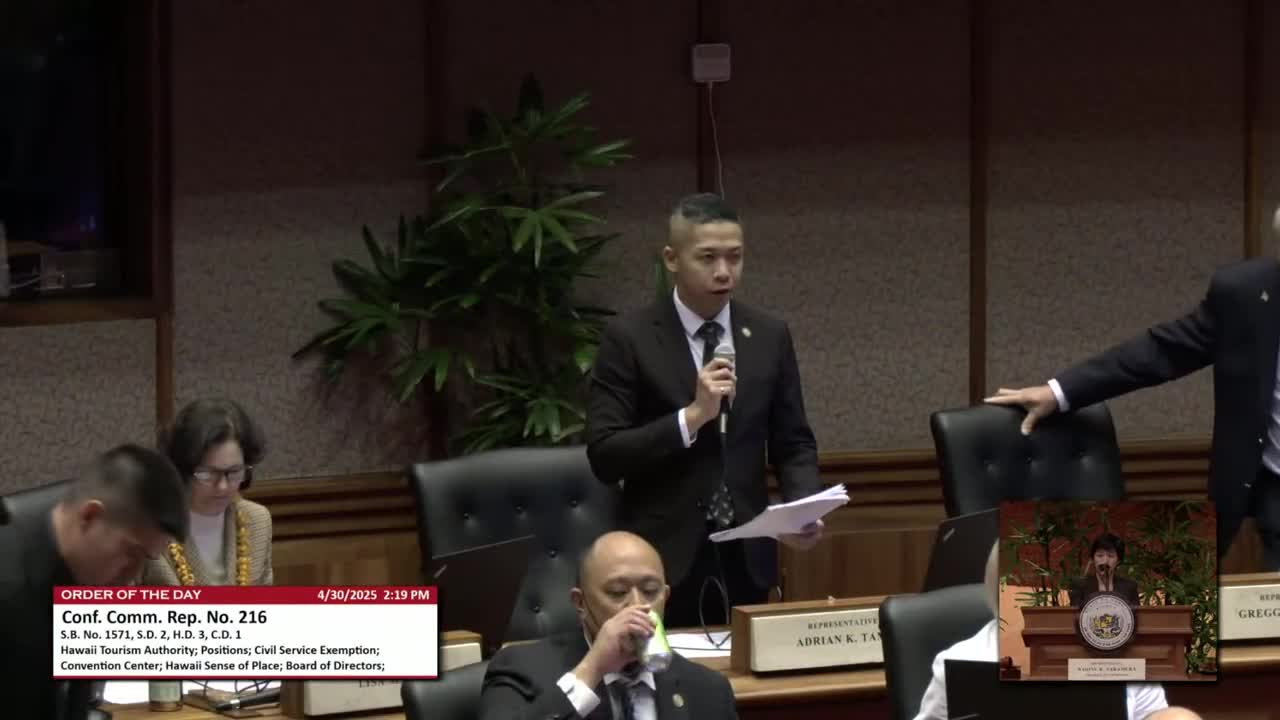 1MIN
House Floor
 42SEC
Conference Committee
 4MIN
Conference Committee
 37SEC
Conference Committee
 2MIN
Conference Committee
 1MIN
Conference Committee
 1MIN
House Floor
 1MIN
House Standing Committee on Finance
Bill Author