SB 1249: DLE; Department of Agriculture; Agricultural Crimes; Agricultural Enforcement Pilot Program; Theft of an Agricultural Product or Commodity; Inspection; Branding; Penalties; Positions; Appropriations
- Session Year: 2025-2026
- House: Senate
- Latest Version Date: 2025-04-26
Current Status:
In Progress
(2025-06-27: Act 235, on 06/27/2025 (Gov. Msg. No. 1337).)
Introduced
In Committee
First Chamber
In Committee
Second Chamber
Final Decking
Enacted
Establishes the temporary Agricultural Enforcement Pilot Program within the Department of Law Enforcement. Clarifies, creates, and strengthens laws regarding crimes and violations related to agriculture or agricultural lands. Establishes clear distinctions between administrative and criminal penalties. Establishes positions. Appropriates funds. (CD1)
Establishes an agricultural crime prevention program within the Department of Agriculture to provide grants, education, administrative enforcement, and other services for the benefit of the State's agricultural industry. Clarifies, creates, and strengthens laws regarding crimes and violations related to agriculture or agricultural lands and hunting on private agricultural lands. Establishes clear distinctions between administrative and criminal penalties. Appropriates funds. Effective 7/1/3000. (HD2)
Establishes an agricultural crime prevention program within the Department of Agriculture to provide grants, education, administrative enforcement, and other services for the benefit of the State's agricultural industry. Clarifies, creates, and strengthens laws regarding crimes and violations related to agriculture or agricultural lands and hunting on private agricultural lands. Establishes clear distinctions between administrative and criminal penalties. Appropriates funds. Effective 7/1/3000. (HD1)
Establishes an agricultural crime prevention program within the Department of Agriculture to provide grants, education, administrative enforcement, and other services for the benefit of the State's agricultural industry. Clarifies, creates, and strengthens laws regarding crimes and violations related to agriculture or agricultural lands and hunting on private agricultural lands. Establishes clear distinctions between administrative and criminal penalties. Appropriates funds. Effective 7/1/2050. (SD1)
Establishes an agricultural crime prevention program within the Department of Agriculture to provide grants, education, administrative enforcement, and other services for the benefit of the State's agricultural industry. Clarifies, creates, and strengthens laws regarding crimes and violations related to agriculture or agricultural lands and hunting on private agricultural lands. Establishes clear distinctions between administrative and criminal penalties. Appropriates funds.
|
THE SENATE |
S.B. NO. |
1249 |
|
THIRTY-THIRD LEGISLATURE, 2025 |
S.D. 1 |
|
|
STATE OF HAWAII |
H.D. 2 |
|
|
|
C.D. 1 |
|
|
|
||
|
|
||
A BILL FOR AN ACT
RELATING TO AGRICULTURE.
BE IT ENACTED BY THE LEGISLATURE OF THE STATE OF HAWAII:
SECTION 1. This Act shall be known and may be cited as "Duke's Law" in memory of Cranston "Duke" Pia.
SECTION 2. The legislature finds that agricultural crimes pose a significant and growing threat to the sustainability and vitality of the State's agricultural industry. These crimes, which include homicide, terroristic threatening, theft, vandalism, trespassing, and illegal hunting on agricultural lands, not only jeopardize the livelihoods of farmers but also undermine food security, disrupt local economies, and erode public confidence in the protection of vital resources. Agriculture remains a cornerstone of the State's economy and cultural heritage, contributing to both economic diversification and community resilience. However, the increasing prevalence of agricultural crimes poses a grave risk to this essential sector.
The legislature further finds that unauthorized hunting also significantly impacts agricultural lands. Livestock endangerment and losses are common when unpermitted hunters disturb farm animals on agricultural lands, and accidental shootings, noise-related stress, and damaged enclosures put livestock at risk, leading to financial losses for farmers and ranchers. Additionally, the erosion of landowner rights and agricultural stability are also critical concerns, as farmers and ranchers depend on private property rights to maintain secure and productive operations. Unauthorized hunting disregards these rights, undermining responsible land stewardship.
Recognizing the complexity and multifaceted nature of agricultural crimes, this Act is designed to provide a comprehensive response by strengthening existing legal frameworks and establishing clearer definitions and penalties for violations related to agriculture and agricultural lands. By differentiating between administrative and criminal penalties, this Act ensures that the consequences of agricultural crimes are proportionate and effective, thereby enhancing deterrence and accountability.
The legislature affirms its commitment to preserving the State's agricultural legacy and protecting the individuals and communities who dedicate themselves to this critical industry. Through this Act, the State seeks to ensure the safety, integrity, and sustainability of the State's agricultural lands for present and future generations.
Accordingly, the purpose of this Act is to:
(1) Establish an agricultural enforcement pilot program within the department of law enforcement on the islands of Oahu and Hawaii, to be implemented at the discretion of the deputy director of law enforcement;
(2) Appropriate funds for and establish positions within the agricultural enforcement pilot program;
(3) Clarify, create, and strengthen laws regarding crimes and violations related to agriculture or agricultural lands and hunting on private agricultural lands; and
(4) Establish clear distinctions between administrative and criminal penalties.
PART II
SECTION 3. Chapter 353C, Hawaii Revised Statutes, is amended by adding one new section to be appropriately designated and to read as follows:
"§353C- Agricultural enforcement pilot program. (a) There shall be established within the department an agricultural enforcement pilot program on the islands of Oahu and Hawaii, to be implemented at the discretion of the deputy director of law enforcement. The department shall employ or appoint, and remove, the following persons, subject to chapter 76 and section 78-1:
(1) An assistant chief, who shall be the administrator of the agricultural enforcement pilot program and shall have charge, direction, and control, subject to the direction or control of the deputy director, of all matters relating to the enforcement of an offense listed in section 708-835.55 involving theft of an agricultural product or commodity and any other matters as determined by the deputy director. The assistant chief shall be an administrator experienced in addressing agricultural theft; and
(2) Personnel, state law enforcement officers, and investigators, including but not limited to state law enforcement officers serving on a voluntary basis without pay.
(b) In addition to all police powers and duties, state law enforcement officers in the agricultural enforcement pilot program shall:
(1) Focus on offenses under sections 708-830.5, 708-831, 708-832, and 708-833 that involve the theft of an agricultural product or commodity;
(2) Gather evidence, conduct investigations, and conduct field observations, as required or assigned;
(3) Cooperate with any enforcement authorities of the federal, state, or county government in the development of programs and mutual aid agreements for agricultural activities within the State; and
(4) Carry out other duties and responsibilities as determined by the deputy director.
(c) The department shall enter into memoranda of agreement with the division of conservation and resources enforcement of the department of land and natural resources and each county police department, as necessary, to effectuate the purposes of this section.
(d) For purposes of this section, "deputy director" means the deputy director of law enforcement."
SECTION 4. There is appropriated out of the general revenues of the State of Hawaii the sum of $949,856 or so much thereof as may be necessary for fiscal year 2025-2026 and the same sum or so much thereof as may be necessary for fiscal year 2026-2027 for:
(1) The establishment of the following positions within the agricultural enforcement pilot program established pursuant to section 353C- , Hawaii Revised Statutes:
(A) One full-time equivalent (1.0 FTE) assistant chief position;
(B) Two full-time equivalent (2.0 FTE) state law enforcement investigator positions; provided that one position shall be assigned to the county of Hawaii and one position shall be assigned to the city and county of Honolulu; and
(C) Six full-time equivalent (6.0 FTE) uniformed state law enforcement officer positions for patrol functions; provided that three positions shall be assigned to the county of Hawaii and three positions shall be assigned to the city and county of Honolulu; and
(2) Other operating expenditures of the agricultural enforcement pilot program established pursuant to section 353C- , Hawaii Revised Statutes.
The sums appropriated shall be expended by the department of law enforcement for the purposes of this Act.
PART III
SECTION 5. Chapter 142, Hawaii Revised Statutes, is amended by adding two new sections to part I to be appropriately designated and to read as follows:
"§142-A Administrative penalties. (a) Except as otherwise provided by law, the department of agriculture may set, charge, and collect administrative fines, fees, and costs for any violation of this chapter for which a penalty is not otherwise provided, including attorneys' fees and costs, or bring legal action to recover administrative fines, fees, and costs, including attorneys' fees and costs, or payment for damages or for the cost to correct damages resulting from a violation of this chapter or any rule adopted thereunder.
(b) For any administrative violation of this chapter or any rule adopted thereunder, unless provided otherwise by law, the fine shall be as follows:
(1) For a first violation, or any violation not preceded within a five-year period for the same violation, a fine of not more than $200;
(2) For a second violation within five years of a previous violation, a fine of not more than $500; and
(3) For a third or subsequent violation within five years of a previous violation, a fine of not more than $1,000.
Each day or instance of violation shall constitute a separate violation.
(c) The board of agriculture may impose applicable fines by order in addition to any other administrative or judicial remedy provided by this chapter or any rule adopted thereunder.
(d) For any judicial proceeding to recover a fine, fee, or cost imposed under this section, the chairperson of the board of agriculture need only show that:
(1) Notice was given and a hearing was held or the time granted for requesting a hearing has expired without receiving a request;
(2) The fine, fee, or cost was imposed; and
(3) The fine, fee, or cost remains unpaid.
(e) In addition to any other administrative or judicial remedy provided in this chapter or any rule adopted thereunder, the department of agriculture may impound, seize, confiscate, destroy, quarantine, sell, auction, or dispose of any animal, animal product, container, crate, or any other item under the jurisdiction of this chapter in the best interest of the State.
(f) Any criminal action against a person for any violation of this chapter or any rule adopted thereunder shall not preclude the State from pursuing civil legal action to recover administrative fines, fees, or costs or damages against the person. Any civil legal action to recover administrative fines, fees, or costs or damages for a violation of this chapter or any rule adopted thereunder shall not preclude the State from pursuing any appropriate criminal action against that person. Unless otherwise provided, all fines, fees, costs, and damages recovered by the department of agriculture pursuant to this section shall be deposited in the animal industry special fund established under section 142-3.6.
§142-B Habitual agricultural crime. (a) A person commits the offense of habitual agricultural crime if the person is a habitual agricultural crime perpetrator and commits a criminal offense under this chapter.
(b) For the purposes of this section, "habitual agricultural crime perpetrator" means a person who, within five years of the instant offense, has any combination of three or more prior convictions for criminal offenses under this chapter or one or more prior convictions under this section. The convictions shall be for separate incidents on separate dates. The prosecution shall not be required to prove any state of mind with respect to the person's status as a habitual agricultural crime perpetrator. Proof that the person has the requisite minimum prior convictions shall be sufficient to establish this element.
(c) Habitual agricultural crime is a class C felony.
(d) For a conviction under this section, the sentence shall be either:
(1) An indeterminate term of imprisonment of five years; provided that the minimum term of imprisonment shall be not less than one year; or
(2) A term of probation of five years, with conditions to include but not be limited to one year of imprisonment; provided that probation shall only be available for a first conviction under this section."
SECTION 6. Chapter 142, Hawaii Revised Statutes, is amended by adding two new sections to part II to be appropriately designated and to read as follows:
"§142-C Definitions. As used in this part:
"Brand" means a design that is permanently impressed on the hide of an animal by burning with acid, a chemical compound, or a hot iron.
"Mark" means a design that is cut into or from the ear, dewlap, or other part of an animal.
§142-D Inspection before slaughter. No person shall allow livestock to enter a livestock harvesting establishment that slaughters or processes livestock meat and meat products unless the establishment's management has conducted a prior examination and inspection to verify the brand on animals match the ownership of the consignee, collects a copy of and confirms the brand with the ownership of the livestock ownership and movement certificate pursuant to section 142-49. The establishment's management may seek assistance from the department of agriculture or a law enforcement officer if ownership determination via brand inspection is in question, or violation or theft is suspected. Livestock ownership and movement certificates that correlate with all livestock harvested at the plant shall be submitted by the establishment's management to the department of agriculture weekly."
SECTION 7. Section 142-2, Hawaii Revised Statutes, is amended to read as follows:
"§142-2 Rules. Subject to chapter 91, the department
of agriculture may make and amend rules for the inspection, quarantine,
disinfection, or destruction, either upon introduction into the State or at any
time or place within the State, of animals and the premises and effects used in
connection with the animals. Included
therein may be rules governing the control and eradication of transmissible
diseases of animals and the transportation of animals between the different
islands of the State and along the highways thereof, the registration and inspection of brands or marks on
livestock, as
well as rules requiring the owner or captain of any vessel or aircraft arriving
in the State with animals aboard and the managers or agents of trucking and air
and water transportation companies carrying animals within the State to report
on the number and class of animals carried, names of owners and consignees, the
places to and from which the animals are shipped, the manner of handling the
animals, the number of deaths or injuries to animals occurring in transit or
while being loaded or unloaded, together with the causes of the deaths
or injuries, and all other matters [which] that may be deemed
necessary by the department for a full and complete record of the shipping and
handling of animals. The department may
also prohibit the importation into the State from any foreign country or other
parts of the United States or the movement from one island within the State to
another island therein or to one locality from another locality on the same
island, of animals known to be or suspected of being infected with a
contagious, infectious, or communicable disease or known to have been exposed
to any of those diseases."
SECTION 8. Section 142-3, Hawaii Revised Statutes, is amended to read as follows:
"§142-3
Department[,]; general duties[.] and powers. (a)
The department of agriculture shall have charge, direction, and control
of all matters relating to the inspection of animals, including brand inspection, and the prevention
and eradication of contagious, infectious, and communicable diseases among
animals and of all matters relating to the animal industry within this
chapter.
(b) In the performance of its duties under this chapter, the department of agriculture may:
(1) Conduct investigations, collect data, and require reports from owners of animals, including livestock animals, as may be necessary to conduct inspections or facilitate its decisions;
(2) Enter upon private property, including agricultural lands, as may be necessary in making any investigation or inspection required or authorized by this chapter; provided that the entry shall not constitute a cause of action in favor of the owner of the land, except for damages resulting from wilful acts or negligence by the department or its employees acting in the course of their official duties;
(3) Establish and assess fees pursuant to chapter 91 to cover a portion of the department's costs in carrying out the implementation and administration of any programs established or authorized under this chapter;
(4) Recover expenses incurred in taking any action required by the owner of the animals, including livestock, in the same manner that debts are recoverable by law;
(5) Assess and collect administrative penalties for violation of this chapter, any rule adopted thereunder, or order issued by the department or board of agriculture pursuant to this chapter;
(6) Place liens, as needed, on the owner's property, to be collected as delinquent taxes against lands and property, if the owner neglects to pay any costs, expenses, or penalties chargeable to the owner under this chapter, or any rule, order, or condition adopted, issued, or required under this chapter;
(7) With the assistance of the attorney general, institute and pursue all court actions that may be necessary to obtain the enforcement of any order issued by the department or board of agriculture in carrying out this chapter;
(8) Cooperate, advise, consult, contract, or enter into cooperative agreements with the United States government, or any of its agencies, other state agencies, or the county governments, or any of its agencies; and
(9) Take any and all other actions as may be necessary to carry out this chapter."
SECTION 9. Section 142-3.6, Hawaii Revised Statutes, is amended to read as follows:
"§142-3.6 Animal industry special fund. There is established the animal industry special fund to be administered by the board of agriculture. Moneys received by the board of agriculture from:
(1) The use or rental of the division of animal industry's properties or facilities, including the animal quarantine property or facilities pursuant to section 142-3.5;
(2) Revenue from fees for diagnostic,
surveillance, and other work by the animal industry division veterinary
laboratory and animal disease control branch; [and]
(3) Fines, fees, costs, and damages recovered by the department of agriculture under section 142-A;
(4) Fees for applications to register a brand or mark pursuant to section 142-41; and
[(3)] (5)
Appropriations or other moneys made available,
shall be deposited into the special fund. Fines collected under section 708- shall be deposited into the special fund. All interest earned or accrued on moneys deposited in the special fund shall become part of the special fund. Moneys in the special fund shall be expended to cover costs of the division of animal industry, including the costs of salaries, fringe benefits, operating expenses, equipment, motor vehicles, contract with any qualified person or entity for livestock handling services, improvements to laboratory capabilities and operations, and operating and maintenance of the animal industry facilities; provided that moneys in the special fund may be used to fund the department's resource management and planning programs. A reserve shall be maintained in the special fund to cover contingency costs, including accrued vacation leave, unemployment insurance, and workers' compensation."
SECTION 10. Section 142-4, Hawaii Revised Statutes, is amended to read as follows:
"§142-4 Entry of animals without inspection prohibited. (a) No animal shall be allowed to enter the State except after inspection by the department of agriculture and the issuance of a permit by the department to the consignee or owner; provided that no fees for inspection shall be charged, nor delays caused, concerning the landing of any domestic animal for which a certificate of health has been issued as prescribed by the Federal Cattle Contagious Disease Act. Every carrier, owner, or handler bringing animals into the State shall be required to present these animals to the department of agriculture for inspection.
(b) Any person who fails to present an animal pursuant to subsection (a) shall be assessed an administrative penalty of not more than $1,000 for each violation. Each animal that enters the State without inspection shall constitute a separate violation."
SECTION 11. Section 142-8, Hawaii Revised Statutes, is amended to read as follows:
"§142-8
Notification of arrival. (a) The captain of any vessel or aircraft
transporting any live animal to any port in [this] the State
shall immediately upon arrival in the State notify the department of
agriculture. No animal so transported,
nor any portion of the food or water nor any effects connected therewith or
provided for the animal's use during transit, shall be removed from the wharf
or airport until the department of agriculture has inspected and passed
the same. The department[,] of
agriculture, at the owner's or shipper's expense, may require that the
animal be moved to a more suitable location for inspection.
(b) A person who violates this section shall be guilty of a misdemeanor."
SECTION 12. Section 142-12, Hawaii Revised Statutes, is amended to read as follows:
"§142-12
Penalties. (a) Any person violating any provision of this
chapter or any rule adopted pursuant [thereto, for which action a penalty is
not otherwise provided, is guilty of a misdemeanor and, upon conviction
thereof,] to this chapter that is designated as a petty misdemeanor
shall be [punished] sentenced as follows:
(1) For the first [conviction, by] offense,
or any offense not preceded within a five-year period by an offense under the
same section, a fine of not [more] less than [$1,000] $250
or [by] imprisonment of [not more than one year,] thirty days
or less, but not less than three consecutive days, or both[.];
(2) For [a second conviction within one
year] an offense that occurs within five years of a previous
conviction[, by] for an offense under the same section, a fine of
not less than $500 [nor more than $1,000] or [by] imprisonment of
[not more than one year,] thirty days or less, but not less than ten
days, or both[.]; and
(3) For [a third conviction] an
offense that occurs within five years of [the first conviction, by] two
or more previous convictions for offenses under the same section, a fine of
[not less than] $1,000 or [by] imprisonment of [one year,]
thirty days, or both.
(b) Any person[, carrier, or handler who has
been convicted of a violation] violating any provision of this
chapter [more than three times within a five-year period or whose violation
poses a grave or serious health threat to the State's citizens, animal
industry, wildlife, or domestic animals, shall be guilty of a class C felony
and upon conviction] or any rule adopted pursuant to this chapter that
is designated as a misdemeanor shall be [punished] sentenced
as follows:
(1) For the first [conviction, by] offense,
or any offense not preceded within a five-year period by an offense under the
same section, a fine of not [more] less than [$5,000] $500
or [by] imprisonment of [not more than five years,] one year
or less, but not less than five consecutive days, or both[.];
(2) For [a second conviction] an
offense that occurs within five years of a previous conviction[, by]
for an offense under the same section, a fine of not less than [$3,000
nor more than $5,000 or by] $1,000 or imprisonment of [not more
than five years,] one year or less, but not less than thirty days,
or both[.]; and
(3) For [a third or subsequent
conviction] an offense that occurs within five years of [the
first conviction, by] two or more previous convictions for offenses
under the same section, a fine of [not less than $5,000 or by] $2,000
or imprisonment of [not more than five years,] one year, or
both.
(c) [In addition to the penalties in
subsection (a) or (b) and for the first conviction, the department of
agriculture may impound, seize, confiscate, destroy, quarantine, sell, auction,
or dispose of any animal, animal product, container, crate, or any other item
under the jurisdiction of this chapter in the best interest of the State.] Any provision of this chapter or any rule adopted pursuant to
this chapter that is not specifically designated as a petty misdemeanor,
misdemeanor, or felony, shall be enforced via civil or administrative means.
(d) [Persons found to be in possession of any
animal, fodder, fittings, or effects contrary to this chapter shall be found
guilty and upon conviction shall be punished in accordance with this section.]
Any property used or intended for use in the commission of, attempt to
commit, or conspiracy to commit a violation of this chapter, or that
facilitated or assisted the activity, and any proceeds or other property
acquired or maintained with the proceeds from a violation of this chapter may
be ordered forfeited to the State, subject to the requirements of chapter 712A."
SECTION 13. Section 142-18, Hawaii Revised Statutes, is amended to read as follows:
"§142-18 Disposal of tuberculous animals. (a)
The owner of all cattle reacting to the tuberculin test shall, subject
to section 142-16, cause them to be segregated immediately and, within a
reasonable time thereafter, to be delivered for slaughter at [such] a
time and place as may be designated by the department of agriculture. The slaughter shall be under the direct
supervision of the department of agriculture and in accordance with the
meat inspection regulations of the United States Department of Agriculture.
(b) Any person who fails to segregate tuberculous animals or deliver them for slaughter shall be guilty of a misdemeanor."
SECTION 14. Section 142-20, Hawaii Revised Statutes, is amended to read as follows:
"§142-20
Premises from which tuberculous cattle removed to be disinfected. (a)
Any premises [upon which have been kept] where animals
affected with tuberculosis have been kept shall be disinfected promptly
after the removal of the animals [and], in a manner satisfactory
to the department of agriculture and at the expense of the owner.
(b) Violation of this section shall be a misdemeanor."
SECTION 15. Section 142-23.5, Hawaii Revised Statutes, is amended by amending subsection (b) to read as follows:
"(b) Any person who violates [the provisions of]
subsection (a) [of this section] shall be [fined not more than $1,000
or imprisoned not more than one year, or both.] guilty of a misdemeanor."
SECTION 16. Section 142-41, Hawaii Revised Statutes, is amended to read as follows:
"§142-41
Brands or marks to be registered and recorded[, etc.];
penalties. (a) Every owner of livestock in the State shall
have the owner's brand or mark, in order to secure its validity and
individuality, recorded in a separate book kept for that purpose by the
department of agriculture to be known as the "Hawaii Brand
Book". No brand or mark shall be
recorded [which] that may be similar or approximate in design to
any brand or mark [which] that has been previously recorded. No record shall be made of any earmark,
except only as supplemental identification of a brand. Numerals from 1 to
9 and 0, not used in combination or with symbols, as a brand, shall not be
subject to preemptive use but shall be the common property of all persons.
(b) The department of agriculture shall
establish, by rule adopted pursuant to chapter 91, a fee for each
application [for registration shall be established by rule adopted pursuant
to chapter 91.] to register a brand or mark. The application may be made directly to the
department[,] of agriculture, through its duly authorized agents,
or through any duly authorized police officer.
The chief of police of the respective counties shall authorize police
officers to receive applications for registration of brands under this
section. All moneys [so] received
under this section shall be [paid to the director of finance.] deposited
with the director of finance who shall deposit the moneys into the animal
industry special fund established pursuant to section 142-3.6. A signed and dated receipt shall be issued
for each paid application. All
applications shall be promptly forwarded to the department[.] of
agriculture.
(c) If it is determined that the application
seeks the registration of a brand [which] that either has not
already been recorded by another person or is not similar in design to any
other previously recorded brand [which] that has not expired,
then a certificate showing that [such] the brand or mark has been
duly recorded shall be issued forthwith to the applicant. [No record shall be made of any earmark,
except only as supplemental identification of a brand. Numerals from 1 to 9 and 0, not used in combination
or with symbols, as a brand, shall not be subject to preemptive use but shall
be the common property of all persons.]
(d) It shall be unlawful for any person to use any brand that has not been duly registered pursuant to this section and any rule adopted thereunder. Any person who violates this subsection shall be fined not more than $200. Each instance a brand is used in violation of this subsection shall constitute a separate violation."
SECTION 17. Section 142-47, Hawaii Revised Statutes, is amended to read as follows:
"§142-47
[Obliterating] Altering, removing, or obliterating brand[;]
or mark; penalty. Any person
who alters, removes, or obliterates any brand or mark, on any animal, by
placing another brand or mark over the same, or otherwise, [although without
felonious intent,] shall be fined not more than [$200] $500
for every brand or mark so altered, removed, or obliterated."
SECTION 18. Section 142-48, Hawaii Revised Statutes, is amended to read as follows:
"§142-48
[Felonious] Prohibited branding[;] or marking;
penalty. [Whoever wilfully and
feloniously brands, or otherwise marks,] Any
person who intentionally or knowingly places their own brand or mark on
any kine, horse, mule, sheep, goat, or other cattle belonging to another[,
with one's mark,] or [with] places the brand or mark
of [another not] anyone other than the animal's owner [of
the animal so branded or marked,] with the intent to convert it to one's
own use[,] or to the use of another shall be [imprisoned not more
than one year, or fined not more] guilty of a class C felony and, in
addition to any other penalties imposed by the court, be fined not less
than [$200] $1,000 for each kine, horse, mule, sheep, goat,
or other cattle thus branded or marked."
SECTION 19. Section 142-49, Hawaii Revised Statutes, is amended to read as follows:
"§142-49
Livestock ownership and movement
certification[.];
penalty. (a) Every owner, upon sale or transportation of
livestock, including cattle, horses, sheep, goats, pigs, bison, or llamas,
shall complete a certificate describing the animal or animals including sex,
breed, age, and brand and indicating the seller or owner, buyer or consignee,
and origin and destination. Two copies
of the certificate shall accompany the shipment, one copy shall be given or
electronically transmitted to the department of agriculture, and [a]
one copy shall be retained by the owner.
One of the copies of the certificate shall be presented upon request to
a law enforcement officer or other officer or employee as described in section
142-29.
(b) Any person who violates this section upon the sale of livestock, transport of livestock to slaughter, or transport of livestock interisland or interstate shall be assessed an administrative penalty of up to $500 per animal moved without a certificate."
SECTION 20. Section 142-61, Hawaii Revised Statutes, is amended by amending subsection (i) to read as follows:
"(i) Any person who constructs or maintains an
electrically charged fence or fence with electrically charged attachments not
conforming to the requirements of this section shall be [fined no more than
$500, or imprisoned no more than one year, or both.] guilty of a
misdemeanor."
SECTION 21. Section 142-62, Hawaii Revised Statutes, is amended to read as follows:
"§142-62
Breaking, etc., of fence; penalty.
If any person maliciously and designedly opens a gateway, or breaks a
fence, so as to allow any animal ingress or egress, so that it may commit a
trespass, or maliciously and designedly drives or leads any animal into another
locality where it may commit a trespass, the person shall, for every offense,
be [fined not more than $100, or imprisoned not more than one year.] guilty
of a petty misdemeanor."
SECTION 22. Section 142-72, Hawaii Revised Statutes, is amended to read as follows:
"§142-72 Procedure, if owner believes impounding
illegal.
If the owner of any animal taken up for trespass has reason to believe
that the taking up or impounding of the animal was illegal, or if the owner
regards the claim for damages or expenses as excessive, the owner may have the
owner's animal returned to the owner upon the [owner's] owner delivering
to the landowner or to the pound keeper[, if the animal has been impounded,]
a certificate from any district judge of the circuit[,] in which the
animal was impounded, stating that the owner has deposited with the judge
the amount claimed by the landowner, together with the pound fees, if any, or a
good and sufficient bond for the same and the costs of an action before the
judge."
SECTION 23. Section 142-74, Hawaii Revised Statutes, is amended by amending subsection (a) to read as follows:
"(a) If any dog, while on private property without
the consent of the owner of that property, injures or destroys any sheep,
cattle, goat, hog, fowl, or other property belonging to any person other than
the owner of the dog, the owner of the dog shall be liable in damages to the
person injured for the value of the property so injured or destroyed. The owner of the dog shall confine or destroy
the dog, and if the owner of the dog neglects or refuses to do so, the owner of
the dog, in the event of any further damage being done to the person or
property of any person by the dog, in addition to paying the person injured for
the damage, shall be guilty of a misdemeanor and pay the costs of the
trial [together with the penalty imposed under section 142-12], and it
shall be lawful for any other person to destroy the dog."
SECTION 24. Section 142-91, Hawaii Revised Statutes, is amended to read as follows:
"§142-91
Destruction of animals ferae naturae[.]; penalty. (a) No
person shall shoot or otherwise destroy any animal ferae naturae or its progeny
within ten years of the introduction of the species into the State.
(b) Nothing in this section shall be construed to
prohibit the destruction of [such] animals [as shall be proved] that
are proven to be common nuisances.
(c) Any person who violates this section shall be guilty of a misdemeanor."
SECTION 25. Section 142-93, Hawaii Revised Statutes, is amended to read as follows:
"§142-93
Harboring mongoose; penalty.
Any person harboring, feeding, or in any way caring for a mongoose,
except upon and according to the terms of a written permit [which] that
may be granted [therefor] by the department of agriculture, in its
discretion, to scientists, scientific institutions, associations, or colleges,
or to officers, boards, or commissions of the State or any county, shall be [penalized
pursuant to section 142-12.] guilty of a misdemeanor."
SECTION 26. Section 142-95, Hawaii Revised Statutes, is amended to read as follows:
"§142-95 Rabbits, Belgian hares, to be kept off ground; penalty. (a) Any person who breeds, raises, or keeps rabbits or Belgian hares shall keep them off the ground.
(b) Any person who violates this section shall be
[fined not more than $100 or imprisoned not more than six months, or both.]
guilty of a petty misdemeanor."
PART IV
SECTION 27. Section 145-5, Hawaii Revised Statutes, is amended to read as follows:
"§145-5
Reports of consignment sales.
Every commission merchant shall make a written report to the producer
for farm produce handled on consignment [in] on behalf of said
producer [which shall be], within [such] the time
and [in such detail] manner as may be prescribed by the
department. Making a false or incorrect
report shall constitute a misdemeanor under section 145-12."
SECTION 28. Section 145-12, Hawaii Revised Statutes, is amended to read as follows:
"§145-12
[Misdemeanor.] Criminal penalties. [Any] Unless otherwise provided,
any person who violates this chapter shall be [fined not more than
$1,000 or imprisoned not more than one year, or both.] guilty of a
misdemeanor."
SECTION 29. Section 145-22, Hawaii Revised Statutes, is amended as follows:
1. By amending subsection (a) to read:
"(a) Every person, upon sale of any agricultural
commodity or upon transportation of lots of any agricultural commodity [of
more than two hundred pounds or with a value of at least $100 that is marketed
for commercial purposes], shall complete and retain a certificate
describing the commodity, the amount of the commodity, and value of the
commodity[, and]. The
certificate shall include:
(1) The seller's name, residence address, telephone number, and license plate number of any vehicle used by the seller to deliver the commodity to the place of purchase;
(2) The name of the farm owner and address of origin;
(3) The name of the buyer or consignee, and destination; and
(4) The signature of the seller and, upon sale, the signature of the buyer or consignee."
2. By amending subsection (e) to read:
"(e) [This] A failure to comply with any
requirement under this section shall constitute a criminal offense subject to
penalties under section 145-25; provided that this section shall not apply
to the retail sale of an agricultural commodity to the final consumer."
SECTION 30. Section 145-24, Hawaii Revised Statutes, is amended to read as follows:
"[[]§145-24[]] Authorization to inspect. (a)
Every law enforcement officer or other officer or employee [as
described in section 145-25] having [probable cause] reason to
believe based upon specific and articulable facts that the possession,
sale, or transportation of agricultural commodities is unlawful, may take
reasonable steps to detain the person having possession, selling, or
transporting the agricultural commodities and request from the person being
detained proof of ownership of the commodities.
(b) For the purposes of this section, "officer or employee" has the same meaning as defined in section 145-27."
SECTION 31. Section 145-25, Hawaii Revised Statutes, is amended to read as follows:
"§145-25
Enforcement; criminal penalties.
[Violations] In addition to any civil or administrative
penalties or remedies, violations of this part or any rule adopted pursuant
thereto shall be criminal offenses and shall be sentenced as follows:
(1) [A violation] Any offense
in which the value of the agricultural commodity exceeds $100 shall be a class
C felony; and
(2) [A violation] Any offense
in which the value of the agricultural commodity is $100 or less shall be a
misdemeanor."
SECTION 32. Section 145-23, Hawaii Revised Statutes, is repealed.
["§145-23
Lack of proof of ownership as a violation. The failure of any person who sells,
transports, or possesses after sale or transport, agricultural commodities to
maintain a certificate of ownership or other written proof of ownership of the
agricultural commodity, as described in section 145-22, is a violation of this
part and also prima facie evidence of an offense under section 708-831(1)(e)."]
PART V
SECTION 33. Section 146-22, Hawaii Revised Statutes, is amended to read as follows:
"§146-22
Reports. Every person who
slaughters a calf, heifer, cow, steer, or bull, whether wild or domesticated,
at any place other than a duly licensed slaughterhouse shall comply with
section 146-21 and[, in addition thereto, shall forthwith] report [such]
the slaughtering to the officer in charge of recording brands. [Such] The report shall include
a description of the animal slaughtered, including its sex and a full
description of each and every brand on the animal, the date and place of
slaughter, and the name of the person from whom, and date when, the animal was
acquired. If any of the described brands
on the animal appear to be altered, removed, or obliterated, as
described in section 142-47, or to be [felonious,] prohibited, as
described in section 142-48, the person discovering the altered, removed,
obliterated, or prohibited brand shall make a report of the altered,
removed, obliterated, or [felonious] prohibited brand
to any law enforcement officer or the department of agriculture, as provided
by law, and the appropriate law enforcement agency [pursuant to rules
adopted by the department of agriculture]."
SECTION 34. Section 159-15, Hawaii Revised Statutes, is amended to read as follows:
"§159-15 Bonding.
Upon a person being granted a license to slaughter animals for the
purpose of using the meat or meat products thereof in intrastate commerce, the
board shall exact from the licensee a bond, or other form of surety acceptable
to the board or an appropriate agent, officer, or employee designated by the
board, in the penal sum of $5,000, the bond or other form of surety to be
obtained from a surety company or financial institution authorized to do
business in the State and to be so conditioned that the licensee shall be
required to keep a full and accurate record concerning every animal [which]
that the licensee may purchase, kill, or sell; and that the licensee
will at all times during regular business hours keep the record open for the
inspection by representatives of the board who may desire to examine the
same. The record shall contain:
(1) The
sex of the animal[.];
(2) A
full description of each and every brand on the animal, stating the position of
each brand on the animal. If any of the
described brands on the animal appear to be altered, removed, or
obliterated, as described in section 142-47, or to be [felonious,] prohibited,
as described in section 142-48, the person shall make a report of the altered,
removed, obliterated, or [felonious] prohibited brand
to the appropriate law enforcement agency pursuant to rules adopted by the
department of agriculture[.];
(3) Ear
tag number or other mark of identification[.];
(4) The
principal color of the animal[.];
(5) The
name of the person who sold the animal to the licensee[.];
(6) The
date when the animal was sold to the licensee[.];
(7) The
date when the animal was delivered to the licensee[.]; and
(8) The date when the animal was killed."
PART VI
SECTION 35. Section 183D-1, Hawaii Revised Statutes, is amended by adding a new definition to be appropriately inserted and to read as follows:
""Agricultural land" means any land used primarily for a farming operation, as defined in section 165-2. "Agricultural land" includes land used for farm buildings and dwellings and roads and irrigation infrastructure associated with the agricultural land."
SECTION 36. Section 183D-5, Hawaii Revised Statutes, is amended to read as follows:
"§183D-5
Penalties. (a) Any person violating section 183D-21,
183D-25, 183D-33, or 183D-63 or any rule adopted under this chapter shall be
guilty of a petty misdemeanor, and upon conviction thereof, shall be [punished]
sentenced as follows:
(1) For a first conviction, by a mandatory fine of not less than $100, or imprisonment of not more than thirty days, or both;
(2) For a second conviction within five years of a previous conviction, by a mandatory fine of not less than $500, or by imprisonment of not more than thirty days, or both, and all firearms used in the commission of the violations shall be considered contraband to be forfeited to and disposed of by the State; and
(3) For a third or subsequent conviction within five years of the first two or more convictions, by a mandatory fine of not less than $1,000, or by imprisonment of not more than thirty days, or both, and all firearms used in the commission of the violations shall be considered contraband to be forfeited to and disposed of by the State.
(b) Any person violating section [183D-66,]
183D-25.5, [183D-26, 183D-27,] 183D-32, 183D-62, [or] 183D-64,
or 183D-66 shall be guilty of a misdemeanor, and upon conviction thereof,
shall be [punished] sentenced as follows:
(1) For a first conviction, by a mandatory fine of not less than $200, or by imprisonment of not more than one year, or both and all animal parts, products, or items containing prohibited animal parts or products involved in the commission of the violations shall be considered contraband to be forfeited to and disposed of by the State;
(2) For a second conviction within five years of a previous conviction, by a mandatory fine of not less than $1,000, or by imprisonment of not more than one year, or both, and all firearms, animal parts, products, or items containing prohibited animal parts or products used in the commission of the violations shall be considered contraband to be forfeited to and disposed of by the State; and
(3) For a third or subsequent conviction
within five years of the first two or more convictions, by a mandatory fine of
not less than $2,000, or by imprisonment of not more than one year, or both,
and all firearms, animal parts, products, or items containing prohibited animal
parts or products used in the commission of the violations shall be considered
contraband to be forfeited to and disposed of by the State[.];
provided that any violation of section 183D-26 or 183D-27 that occurs on agricultural land shall be sentenced pursuant to subsection (d).
(c) Any person who violates section 183D-52 shall
be guilty of a misdemeanor, and upon conviction thereof, shall be [punished]
sentenced as follows:
(1) For a first conviction, by a mandatory fine of not less than $10,000 and payment of any costs incurred in the eradication of any deer and the deer's progeny that has been possessed, transferred, transported, or released after transport, or [by] imprisonment of not more than one year, or both;
(2) For a second conviction within five years of a previous conviction, by a mandatory fine of not less than $15,000 and payment of any costs incurred in the eradication of any deer and the deer's progeny that has been possessed, transferred, transported, or released after transport, or by imprisonment of not more than one year, or both; and
(3) For a third or subsequent conviction
within five years of the first two or more convictions, by a mandatory fine of
not less than $25,000 and payment of any costs incurred in the eradication of
any deer and the deer's progeny that has been possessed, transferred,
transported, or released after transport, or by imprisonment of not more than
one year, or both[.];
provided that any violation of section 183D-26 or 183D-27 that occurs on agricultural land shall be sentenced pursuant to subsection (d).
(d) Any person who violates section 183D-26 or 183D-27, if the offense occurred on agricultural land, shall be guilty of a class C felony, and upon conviction thereof, shall be sentenced as follows, without possibility of probation or suspension of sentence:
(1) For a first offense, or any offense not preceded within a ten-year period by a conviction for an offense under the same section:
(A) An indeterminate term of imprisonment of five years with a mandatory minimum term of imprisonment of not less than one hundred eighty days; or
(B) A term of probation of four years with conditions to include but not be limited to not less than one hundred eighty days of imprisonment; or
(2) For an offense that occurs within ten years of a previous conviction for an offense under the same section, an indeterminate term of imprisonment of five years with a mandatory minimum term of imprisonment of not less than one year;
provided that all animal parts, products, or items containing prohibited animal parts or products involved in the commission of the violations shall be considered contraband to be forfeited to and disposed of by the State; provided further that any property used in the commission of the offense, or that facilitated or assisted in the offense, including firearms, hunting animals, or vehicles, shall be subject to forfeiture under chapter 712A.
[(d)]
(e) Any person who violates
section 183D-35, 183D‑36, 183D-37, 183D-38, 183D-39, 183D-40, or 183D-42
shall be guilty of a petty misdemeanor, and upon conviction thereof, shall be
fined not less than $100 or imprisoned not more than thirty days, or both.
[(e)]
(f) In addition to any other
penalty imposed under this section, a mandatory fine of $100 shall be levied
for each bird illegally taken under this chapter and a mandatory fine of $500
shall be levied for each mammal illegally taken under this chapter.
[(f)]
(g) Any person who is convicted
of violating any of the game laws of the State shall immediately have the
person's hunting license forfeited and any person convicted for a second
offense shall not be granted a license to hunt for a period of three years
after the date of the second conviction.
[(g)]
(h) The environmental court, in
lieu of the actual cash payment of any mandatory fine, may allow the defendant
to perform the community service as directed by the department of land and
natural resources at the rate of one hour of service for every $10 of mandatory
fine imposed.
[(h)]
(i) Any criminal action against a
person for any violation of this chapter shall not be deemed to preclude the
State from pursuing civil legal action to recover administrative fines and
costs against that person. Any civil
legal action against a person to recover administrative fines and costs for any
violation of subtitle 4 of title 12 or any rule adopted thereunder shall not be
deemed to preclude the State from pursuing any criminal action against that
person."
SECTION 37. Section 183D-27, Hawaii Revised Statutes, is amended to read as follows:
"§183D-27 Night hunting on private lands; prohibition. (a) Notwithstanding section 183D-26, no person shall take or pursue any game bird, game mammal, wild bird, or wild mammal at night on privately owned lands, except as authorized by the department pursuant to section 183D-61. For the purpose of this section, "night" means the period between one-half hour after sunset and one-half hour before sunrise.
(b) For purposes of this section, the fact that the person is found upon any privately owned agricultural land shall be prima facie evidence that the person knew that the person had entered privately owned agricultural land.
(c) If the offense occurs on agricultural land, any property used or intended for use in the commission of, attempt to commit, or conspiracy to commit the offense, or that facilitated or assisted the activity, and any proceeds or other property acquired or maintained with the proceeds from the offense may be ordered forfeited to the State, subject to the requirements of chapter 712A."
PART VII
SECTION 38. Chapter 708, Hawaii Revised Statutes, is amended by adding a new section to part III to be appropriately designated and to read as follows:
"§708- Criminal trespass on agricultural land. (1) A person commits the offense of criminal trespass on agricultural land if the person enters or remains unlawfully on agricultural land without the permission of the owner of the land, the owner's agent who is authorized by the owner to give the permission, or the person in lawful possession of the land, and the agricultural land:
(a) Is fenced, enclosed, or secured in a manner designed to exclude intruders or marked by a structure or barrier, including a cattle grid, cattle grate, or other obstacle, used to secure livestock; or
(b) At the time of entry, is fallow or has a visible presence of livestock-raising, such as cattle, horses, water troughs, shelters, or paddocks, or a crop:
(i) Under cultivation;
(ii) In the process of being harvested; or
(iii) That has been harvested.
(2) Subsection (1) shall not apply to:
(a) A process server who enters or remains in or upon the land or premises of another, unless the land or premises are secured with a fence and locked gate, for the purpose of making a good faith attempt to perform the process server's legal duties and to serve process upon any of the following:
(i) An owner or occupant of the land or premises;
(ii) An agent of the owner or occupant of the land or premises; or
(iii) A lessee of the land or premises.
For the purposes of this paragraph, "process server" means any person authorized under the Hawaii rules of civil procedure, district court rules of civil procedure, Hawaii family court rules, or section 353C‑11 to serve process; or
(b) A professional land surveyor, or assistant under the direct supervision of the professional land surveyor, who enters or remains in or upon the land or premises of another for the purpose of performing land surveying at the request of the landowner of, or person with an interest in, the real property to be surveyed.
(3) Except as provided in subsection (4), criminal trespass on agricultural land shall be a misdemeanor, and any person who violates this section shall be sentenced as follows, without possibility of probation or suspension of sentence:
(a) For a first offense, or any offense not preceded within five years of a previous conviction for an offense under this section:
(i) A term of imprisonment of not less than three consecutive days; and
(ii) A fine of not less than $500;
(b) For an offense that occurs within five years of a previous conviction for an offense under this section:
(i) A term of imprisonment of not less than thirty days; and
(ii) A fine of not less than $1,000; and
(c) For an offense that occurs within five years of two or more previous convictions for offenses under this section:
(i) A term of imprisonment of not less than ninety days; and
(ii) A fine of $2,000.
(4) Any person who violates this section while in possession of a dangerous instrument shall be guilty of a class C felony.
(5) Any fines imposed in connection with the offense under this section shall be deposited with the director of finance who shall deposit the fines into the animal industry special fund established pursuant to section 142-3.6.
(6) For the purposes of this section:
"Agricultural land" means any land used primarily for a farming operation. "Agricultural land" includes state- or county-owned agricultural land, privately owned agricultural land, and land used for farm buildings and dwellings and roads and irrigation infrastructure associated with these lands.
"Dangerous instrument" has the same meaning as defined in section 707-700.
"Fallow" means land associated with agricultural production that is left unseeded or unplanted for one or more growing seasons.
"Farming operation" means a commercial agricultural or aquacultural facility or pursuit conducted, in whole or in part, including the care and production of livestock and livestock products, poultry and poultry products, apiary products, and plant and animal production for nonfood uses; the planting, cultivating, harvesting, and processing of crops; and the farming or ranching of any plant or animal species in a controlled salt, brackish, or freshwater environment."
SECTION 39. Section 708-814, Hawaii Revised Statutes, is amended by amending subsection (1) to read as follows:
"(1) A person commits the offense of criminal trespass in the second degree if:
(a) The person knowingly enters or remains unlawfully in or upon premises that are enclosed in a manner designed to exclude intruders or are fenced;
(b) The person enters or remains unlawfully in or upon commercial premises after a reasonable warning or request to leave by the owner or lessee of the commercial premises, the owner's or lessee's authorized agent, or a police officer; provided that this paragraph shall not apply to any conduct or activity subject to regulation by the National Labor Relations Act.
For the purposes of this paragraph, "reasonable warning or request" means a warning or request communicated in writing at any time within a one-year period inclusive of the date the incident occurred, which may be evidenced by a copy of the previously issued written warning or request, whether or not the copy is posted at the premises or retained by the county police department, and which may contain but is not limited to the following information:
(i) A warning statement advising the person that the person's presence is no longer desired on the property for a period of one year from the date of the notice, that a violation of the warning will subject the person to arrest and prosecution for trespassing pursuant to this subsection, and that criminal trespass in the second degree is a petty misdemeanor;
(ii) The legal name, any aliases, and a photograph, if practicable, or a physical description, including but not limited to sex, racial extraction, age, height, weight, hair color, eye color, or any other distinguishing characteristics of the person warned;
(iii) The name of the person giving the warning along with the date and time the warning was given; and
(iv) The signature of the person giving the warning, the signature of a witness or police officer who was present when the warning was given and, if possible, the signature of the violator;
[(c) The person enters or remains
unlawfully on agricultural lands without the permission of the owner of the
land, the owner's agent, or the person in lawful possession of the land, and
the agricultural lands:
(i) Are fenced, enclosed, or secured in
a manner designed to exclude intruders;
(ii) Have a sign or signs displayed on
the unenclosed cultivated or uncultivated agricultural land sufficient
to give notice and reading as follows:
"Private Property" or "Government Property - No
Trespassing". The sign or signs,
containing letters no less than two inches in height, shall be placed at
reasonable intervals no less than three signs to a mile along the boundary line
of the land and at roads and trails entering the land in a manner and position
as to be clearly noticeable from outside the boundary line; or
(iii) At the time of entry, are fallow or
have a visible presence of livestock or a crop:
(A) Under cultivation;
(B) In the process of being harvested;
or
(C) That has been harvested;
(d)] (c) The person enters or remains unlawfully on
unimproved or unused lands without the permission of the owner of the land, the
owner's agent[,] who is authorized to give the permission, or the
person in lawful possession of the land, and the lands:
(i) Are fenced, enclosed, or secured in a manner designed to exclude the general public; or
(ii) Have a sign or signs displayed on the unenclosed, unimproved, or unused land sufficient to give reasonable notice and reads as follows: "Private Property - No Trespassing", "Government Property - No Trespassing", or a substantially similar message; provided that the sign or signs shall contain letters no less than two inches in height and shall be placed at reasonable intervals no less than three signs to a mile along the boundary line of the land and at roads and trails entering the land in a manner and position as to be clearly noticeable from outside the boundary line.
For the purposes of this paragraph, "unimproved or unused lands" means any land upon which there is no improvement; construction of any structure, building, or facility; or alteration of the land by grading, dredging, or mining that would cause a permanent change in the land or that would change the basic natural condition of the land. Land remains "unimproved or unused land" under this paragraph notwithstanding minor improvements, including the installation or maintenance of utility poles, signage, and irrigation facilities or systems; minor alterations undertaken for the preservation or prudent management of the unimproved or unused land, including the installation or maintenance of fences, trails, or pathways; maintenance activities, including forest plantings and the removal of weeds, brush, rocks, boulders, or trees; and the removal or securing of rocks or boulders undertaken to reduce risk to downslope properties; or
[(e)] (d)
The person enters or remains unlawfully in or upon any area of a
housing project that is closed to the public pursuant to section 356D-6.7 and
meets the signage requirements of section 356D-6.7, or the person enters or
remains unlawfully in or upon any property that is subject to section 356D-6.7 and
meets the signage requirements of section 356D-6.7 after a reasonable warning
or request to leave by the housing authority or law enforcement officer, as
defined in section 710-1000, based upon an alleged violation of law or
administrative rule, notwithstanding any invitation or authorization provided
to the person by a tenant of that housing project or a member of that tenant's
household.
As used in this paragraph:
"Housing authority" means a property manager, resident manager, tenant monitors, security guards, or others officially designated by the Hawaii public housing authority, for the housing project.
"Housing project" means a public housing project, or elder or elderly housing as defined in section 356D-1, or state low-income housing project as defined in section 356D-51.
"Reasonable warning or request" means a warning or request communicated in writing at any time within a one-year period inclusive of the date the incident occurred, which may contain but is not limited to the following information:
(i) A warning statement advising the person that for a period of one year from the date of the notice, the person's presence is no longer desired in or on the areas of the subject housing project that are closed to the public, that a violation of the warning will subject the person to arrest and prosecution for trespassing pursuant to this subsection, and that criminal trespass in the second degree is a petty misdemeanor;
(ii) The legal name, any aliases, and a photograph, if practicable, or a physical description, including but not limited to sex, racial extraction, age, height, weight, hair color, eye color, or any other distinguishing characteristics of the person warned;
(iii) The name of the person giving the warning along with the date and time the warning was given;
(iv) The signature of the person giving the warning and, if possible, the signature of the violator; and
(v) The name and signature of a witness or law enforcement officer, as defined in section 710-1000, who was present when the warning was given."
SECTION 40. Section 708-820, Hawaii Revised Statutes, is amended by amending subsection (2) to read as follows:
"(2)
Criminal property damage in the first degree is a class B felony[.];
provided that any person convicted of
violating subsection (1)(d) shall be sentenced to a term of imprisonment of not
less than one hundred eighty days, without possibility of probation or
suspension of sentence."
SECTION 41. Section 708-821, Hawaii Revised Statutes, is amended by amending subsection (2) to read as follows:
"(2)
Criminal property damage in the second degree is a class C felony[.]; provided that any person convicted of
violating subsection (1)(c) shall be sentenced to a term of imprisonment of not
less than one hundred eighty days, without possibility of probation or
suspension of sentence."
SECTION 42. Section 708-822, Hawaii Revised Statutes, is amended by amending subsection (2) to read as follows:
"(2)
Criminal property damage in the third degree is a misdemeanor[.]; provided that any person convicted of
violating subsection (1)(c) shall be sentenced to a term of imprisonment of not
less than ninety days, without possibility of probation or suspension of
sentence."
PART VIII
SECTION 43. Section 712A-4, Hawaii Revised Statutes, is amended to read as follows:
"§712A-4 Covered offenses. Offenses for which property is subject to forfeiture under this chapter are:
(a) All offenses that specifically authorize forfeiture;
(b) Murder; kidnapping; labor trafficking; unlicensed sale of liquor; unlicensed manufacture of liquor; gambling; criminal property damage; robbery; bribery; extortion; theft; unauthorized entry into motor vehicle; burglary; money laundering; trademark counterfeiting; insurance fraud; promoting a dangerous, harmful, or detrimental drug; commercial promotion of marijuana; methamphetamine trafficking; manufacturing of a controlled substance with a child present; promoting child abuse; promoting prostitution; sex trafficking; commercial sexual exploitation of a minor; habitual commercial sexual exploitation; or electronic enticement of a child that is chargeable as a felony offense under state law;
(c) The manufacture, sale, or distribution of a
controlled substance in violation of chapter 329, promoting detrimental drugs
or intoxicating compounds, promoting pornography, promoting pornography for
minors, or commercial sexual exploitation near schools or public parks, which
is chargeable as a felony or misdemeanor offense, but not as a petty
misdemeanor, under state law; [and]
(d) The attempt, conspiracy, solicitation,
coercion, or intimidation of another to commit any offense for which property
is subject to forfeiture[.];
and
(e) Criminal trespass on agricultural land as defined in section 708- ."
PART IX
SECTION 44. This Act does not affect rights and duties that matured, penalties that were incurred, and proceedings that were begun before its effective date.
SECTION 45. In codifying the new sections added by sections 5 and 6 of this Act, the revisor of statutes shall substitute appropriate section numbers for the letters used in designating the new sections in this Act.
SECTION 46. Statutory material to be repealed is bracketed and stricken. New statutory material is underscored.
SECTION 47. This Act shall take effect on July 1, 2025; provided that part II of this Act shall be repealed on July 1, 2028.
Report Title:
DLE; Department of Agriculture; Agricultural Crimes; Agricultural Enforcement Pilot Program; Theft of an Agricultural Product or Commodity; Inspection; Branding; Penalties; Positions; Appropriations
Description:
Establishes the temporary Agricultural Enforcement Pilot Program within the Department of Law Enforcement. Clarifies, creates, and strengthens laws regarding crimes and violations related to agriculture or agricultural lands. Establishes clear distinctions between administrative and criminal penalties. Establishes positions. Appropriates funds. (CD1)
The summary description of legislation appearing on this page is for informational purposes only and is not legislation or evidence of legislative intent.
|
THE SENATE |
S.B. NO. |
1249 |
|
THIRTY-THIRD LEGISLATURE, 2025 |
S.D. 1 |
|
|
STATE OF HAWAII |
H.D. 2 |
|
|
|
|
|
|
|
||
|
|
||
A BILL FOR AN ACT
RELATING TO AGRICULTURE.
BE IT ENACTED BY THE LEGISLATURE OF THE STATE OF HAWAII:
SECTION 1. This Act shall be known and may be cited as "Duke's Law" in memory of Cranston "Duke" Pia.
SECTION 2. The legislature finds that agricultural crimes pose a significant and growing threat to the sustainability and vitality of the State's agricultural industry. These crimes, which include homicide, terroristic threatening, theft, vandalism, trespassing, and illegal hunting on agricultural lands, not only jeopardize the livelihoods of farmers and ranchers but also undermine food security, disrupt local economies, and erode public confidence in the protection of vital resources. Agriculture remains a cornerstone of the State's economy and cultural heritage, contributing to both economic diversification and community resilience. However, the increasing prevalence of agricultural crimes poses a grave risk to this essential sector.
The legislature further finds that unauthorized hunting also significantly impacts agricultural lands. Livestock endangerment and losses are common when unpermitted hunters disturb farm animals on agricultural lands, and accidental shootings, noise-related stress, and damaged enclosures put livestock at risk, leading to financial losses for farmers and ranchers. Additionally, the erosion of landowner rights and agricultural stability are also critical concerns, as farmers and ranchers depend on private property rights to maintain secure and productive operations. Unauthorized hunting disregards these rights, undermining responsible land stewardship.
Recognizing the complexity and multifaceted nature of agricultural crimes, this Act is designed to provide a comprehensive response by strengthening existing legal frameworks and establishing clearer definitions and penalties for violations related to agriculture and agricultural lands. By differentiating between administrative and criminal penalties, this Act ensures that the consequences of agricultural crimes are proportionate and effective, thereby enhancing deterrence and accountability.
Moreover, this Act establishes an agricultural crime prevention program within the department of agriculture, which will play a pivotal role in safeguarding the State's agricultural industry through a combination of grants, educational initiatives, and administrative enforcement measures. By equipping agricultural property owners and community-based organizations with resources such as surveillance equipment, signage, and fencing, the program seeks to proactively deter criminal activity. Additionally, it will support partnerships between law enforcement, community groups, and private entities to enhance investigative and prosecutorial efforts.
The legislature affirms its commitment to preserving the State's agricultural legacy and protecting the individuals and communities who dedicate themselves to this critical industry. Through this Act, the State seeks to ensure the safety, integrity, and sustainability of the State's agricultural lands for present and future generations.
Accordingly, the purpose of this Act is to:
(1) Establish an agricultural crime prevention program within the department of agriculture to provide grants, education, administrative enforcement, and other services for the benefit of the State's agricultural industry;
(2) Clarify, create, and strengthen laws regarding crimes and violations related to agriculture or agricultural lands and hunting on private agricultural lands;
(3) Establish clear distinctions between administrative and criminal penalties; and
(4) Appropriate funds for certain positions.
PART II
SECTION 3. Chapter 141, Hawaii Revised Statutes, is amended by adding a new part to be appropriately designated and to read as follows:
"Part . agricultural crime prevention program
§141-A Agricultural crime prevention special fund; established. (a) There shall be established within the state treasury the agricultural crime prevention special fund. The special fund shall be administered by the department of agriculture and shall include:
(1) Fees received pursuant to section 141-B;
(2) Fines collected pursuant to section 708- ;
(3) Interest earned or accrued on moneys in the special fund;
(4) Any moneys appropriated by the legislature to the special fund; and
(5) Grants, donations, and contributions from private or public sources for the purposes of the special fund.
(b) The department of agriculture shall expend moneys from the special fund to carry out the purposes of this part, including the implementation and administration of the agricultural crime prevention program.
(c) Moneys on balance in the agricultural crime prevention special fund at the close of each fiscal year shall remain in the special fund and shall not lapse to the credit of the general fund.
§141-B Agricultural crime prevention program; established. (a) The department of agriculture shall establish an agricultural crime prevention program for the purpose of providing grants to agricultural property owners to deter, prevent, and prosecute agricultural crimes.
(b) The department of agriculture may:
(1) Provide grants to assist agricultural property owners with procuring signage, cameras, fencing, and other protective or surveillance equipment;
(2) Provide signage, cameras, fencing, and other protective or surveillance equipment directly to agricultural property owners;
(3) Provide grants to assist community-based organizations or law enforcement agencies to develop, implement, and support programs for deterring or preventing and, where appropriate, investigating or prosecuting agricultural crimes;
(4) Provide staff, administration, and related support required to administer this part;
(5) Enter into agreements that set forth terms and conditions of the grants, accept funds or grants, and cooperate with private entities and state or county agencies to carry out the purposes of this part;
(6) Establish, determine, charge, and collect any premiums, fees, charges, costs, and expenses, including application fees, commitment fees, program fees, financing charges, or publication fees, in connection with its activities under this part;
(7) Take whatever actions are necessary or appropriate to protect the State's interest in the event of bankruptcy, default, foreclosure, or noncompliance with the terms and conditions of grants provided under this part, including the ability to recapture funds if the grant recipient is found to be noncompliant with the terms and conditions of the grant agreement;
(8) Establish application, notification, contract, and other forms and procedures deemed necessary and appropriate;
(9) Utilize vendors or contract work to carry out the purposes of this part; and
(10) Take any other action that is consistent with the intent of this part.
(c) The department of agriculture shall adopt rules in accordance with chapter 91 to implement this part, including:
(1) Additional requirements and qualifications for determining eligibility of applicants for grants;
(2) Preferences and priorities in determining eligibility for grants;
(3) Conditions, consistent with the purpose of this part, for the awarding of grants;
(4) Requirements for the inspection at reasonable hours of properties, including facilities, books, and records, of a grant applicant or grant recipient;
(5) Requirements for the submission of progress and final reports by grant recipients; and
(6) Appropriate management counseling and monitoring of business activities for grant recipients.
§141-C Agricultural crime prevention grants; standards and conditions. (a) Grants made pursuant to this part shall be awarded on a competitive and annual basis. Grants made under this part shall further and promote the goals of the agricultural crime prevention program.
(b) Applications for grants shall be made to the department of agriculture and contain any information required under this part and rules adopted pursuant to this part. At a minimum, an applicant shall include the following:
(1) The name of the organization or individual applying for the grant;
(2) A statement that the applicant meets the criteria for the grant;
(3) The intended use of the grant; and
(4) The location of the agricultural property or community to be benefited.
(c) Recipients of grants made pursuant to this part shall be subject to the following conditions:
(1) The recipient shall not use public funds for purposes of entertainment or perquisites, including lobbying activities;
(2) The recipient of a grant shall comply with state laws and county ordinances;
(3) The recipient of a grant shall comply with any other requirements that may be prescribed by rules adopted pursuant to this part;
(4) The recipient of a grant shall allow the department of agriculture, legislature, and auditor full access to records, reports, files, and other related documents so that the program, management, and fiscal practices of the grant recipient may be monitored and evaluated to assure the proper and effective expenditure of public funds;
(5) Each grant shall be monitored according to rules adopted pursuant to this part to ensure compliance with this part or rules adopted pursuant to this part; and
(6) Any recipient who withholds or omits any material fact or deliberately misrepresents facts to the department of agriculture or who violates the terms of the recipient's contract shall be in violation of this part and, in addition to any other penalties provided by law, shall be prohibited from applying for a grant under this part for a period of five years from the date of termination of the grant or contract."
PART III
SECTION 4. Chapter 142, Hawaii Revised Statutes, is amended by adding two new sections to part I to be appropriately designated and to read as follows:
"§142-A Administrative penalties. (a) Except as otherwise provided by law, the department of agriculture may set, charge, and collect administrative fines, fees, and costs for any violation of this chapter for which a penalty is not otherwise provided, including attorneys' fees and costs, or bring legal action to recover administrative fines, fees, and costs, including attorneys' fees and costs, or payment for damages or for the cost to correct damages resulting from a violation of this chapter or any rule adopted thereunder.
(b) For any administrative violation of this chapter or any rule adopted thereunder, unless provided otherwise by law, the fine shall be as follows:
(1) For a first violation, or any violation not preceded within a five-year period for the same violation, a fine of no more than $200;
(2) For a second violation within five years of a previous violation, a fine of no more than $500; and
(3) For a third or subsequent violation within five years of a previous violation, a fine of no more than $1,000.
Each day or instance of violation shall constitute a separate violation.
(c) The board of agriculture may impose applicable fines by order in addition to any other administrative or judicial remedy provided by this chapter or any rule adopted thereunder.
(d) For any judicial proceeding to recover a fine, fee, or cost imposed under this section, the chairperson of the board of agriculture need only show that:
(1) Notice was given and a hearing was held or the time granted for requesting a hearing has expired without receiving a request;
(2) The fine, fee, or cost was imposed; and
(3) The fine, fee, or cost remains unpaid.
(e) In addition to any other administrative or judicial remedy provided in this chapter or any rule adopted thereunder, the department of agriculture may impound, seize, confiscate, destroy, quarantine, sell, auction, or dispose of any animal, animal product, container, crate, or any other item under the jurisdiction of this chapter in the best interest of the State.
(f) Any criminal action against a person for any violation of this chapter or any rule adopted thereunder shall not preclude the State from pursuing civil legal action to recover administrative fines, fees, or costs or damages against the person. Any civil legal action to recover administrative fines, fees, or costs or damages for a violation of this chapter or any rule adopted thereunder shall not preclude the State from pursuing any appropriate criminal action against that person. Unless otherwise provided, all fines, fees, costs, and damages recovered by the department of agriculture pursuant to this section shall be deposited in the animal industry special fund established under section 142-3.6.
§142-B Habitual agricultural crime. (a) A person commits the offense of habitual agricultural crime if the person is a habitual agricultural crime perpetrator and commits a criminal offense under this chapter.
(b) For the purposes of this section, "habitual agricultural crime perpetrator" means a person who, within five years of the instant offense, has any combination of three or more prior convictions for criminal offenses under this chapter or one or more prior convictions under this section. The convictions shall be for separate incidents on separate dates. The prosecution shall not be required to prove any state of mind with respect to the person's status as a habitual agricultural crime perpetrator. Proof that the person has the requisite minimum prior convictions shall be sufficient to establish this element.
(c) Habitual agricultural crime shall be a class C felony."
SECTION 5. Chapter 142, Hawaii Revised Statutes, is amended by adding four new sections to part II to be appropriately designated and to read as follows:
"§142-C Definitions. As used in this part:
"Brand" means a design registered with the department of agriculture that is permanently impressed on the skin of an animal by freezing or a hot iron.
"Mark" means a design that is cut into or from the ear, dewlap, or other part of an animal.
§142-D Livestock inspectors and veterinary medical officers; establishment; duties. (a) There shall be established within the department of agriculture an additional five livestock inspectors and one veterinary medical officer supervisor, whose duty shall be to carry out enforcement of this part and other rules adopted under this chapter, as authorized under this chapter and directed by the chairperson of the board of agriculture. The chairperson of the board of agriculture may locate and staff the livestock inspectors and veterinary medical officer as needed to fulfill their duties.
(b) Livestock inspectors shall be provided with suitable badges or insignia of office by the department of agriculture and shall have the power to:
(1) Initiate civil or administrative investigations;
(2) Institute, serve, and execute warrants;
(3) Issue citations;
(4) Seize contraband or other related articles;
(5) Educate; and
(6) Use any other means of enforcement authorized under this chapter,
to enforce this part and related rules adopted under this chapter.
(c) Whenever a livestock inspector deems it necessary to enter private property, including any land, building, vehicle, vessel, or aircraft, for the purposes of enforcing this part, the livestock inspector may apply to the district court in which the property is located for a warrant to enter the property. The district court may issue a warrant authorizing the livestock inspector to enter the property and seize, capture, confiscate, or remove any animals, equipment, records, or other articles used or intended for use in the commission or attempt to commit a violation of this part or related rules adopted under this chapter.
§142-E Inspection before slaughter. No person shall allow livestock to enter a livestock harvesting establishment that slaughters or processes livestock meat and meat products unless the establishment's management has conducted a prior examination and inspection to verify the brand on animals match the ownership of the consignee, collects a copy of and confirms the brand with the ownership of the livestock ownership and movement certificate pursuant to section 142-49. The establishment's management may seek assistance from a livestock inspector if ownership determination via brand inspection is in question, or violation or theft is suspected. Livestock ownership and movement certificates that correlate with all livestock harvested at the plant shall be submitted by the establishment's management to a livestock inspector weekly.
§142-F Brand inspection special fund. (a) There shall be established in the state treasury the brand inspection special fund. The special fund shall be administered by the department of agriculture and shall include:
(1) Fees, including brand registration fees, fines, and penalties received pursuant to this part;
(2) Interest earned or accrued on moneys in the special fund;
(3) All moneys received and deposited into the special fund pursuant to section 142-41;
(4) Any moneys appropriated by the legislature to the special fund; and
(5) Grants, donations, and contributions from private or public sources for the purposes of the special fund.
(b) Moneys deposited into the special fund shall be expended by the department of agriculture for the implementation and administration of the livestock inspectors and veterinary medical officers under section 142-D."
SECTION 6. Section 142-2, Hawaii Revised Statutes, is amended to read as follows:
"§142-2 Rules. Subject to chapter 91, the department
of agriculture may make and amend rules for the inspection, quarantine,
disinfection, or destruction, either upon introduction into the State or at any
time or place within the State, of animals and the premises and effects used in
connection with the animals. Included
therein may be rules governing the control and eradication of transmissible
diseases of animals [and], the transportation of animals between
the different islands of the State and along the highways thereof, and the registration and inspection of brands or marks, as those
terms are defined in section 142-C, on livestock, as well as rules requiring the owner
or captain of any vessel or aircraft arriving in the State with animals aboard
and the managers or agents of trucking and air and water transportation
companies carrying animals within the State to report on the number and class
of animals carried, names of owners and consignees, the places to and from
which the animals are shipped, the manner of handling the animals, the number
of deaths or injuries to animals occurring in transit or while being loaded or
unloaded, together with the causes of the deaths or injuries, and all
other matters [which] that may be deemed necessary by the
department for a full and complete record of the shipping and handling of
animals. The department may also
prohibit the importation into the State from any foreign country or other parts
of the United States or the movement from one island within the State to
another island therein or to one locality from another locality on the same
island, of animals known to be or suspected of being infected with a
contagious, infectious, or communicable disease or known to have been exposed
to any of those diseases."
SECTION 7. Section 142-3, Hawaii Revised Statutes, is amended to read as follows:
"§142-3
Department[,]; general duties[.] and powers. (a)
The department of agriculture shall have charge, direction, and control
of all matters relating to the inspection of animals, including brand inspection, and the prevention
and eradication of contagious, infectious, and communicable diseases among
animals and of all matters relating to the animal industry within this
chapter.
(b) In the performance of its administrative duties under this chapter, the department of agriculture may:
(1) Conduct investigations, collect data, and require reports from owners of animals, including livestock animals, as may be necessary to conduct inspections or facilitate its decisions;
(2) Enter upon private property, including agricultural lands, as may be necessary in making any investigation or inspection required or authorized by this chapter; provided that the entry shall not constitute a cause of action in favor of the owner of the land, except for damages resulting from wilful acts or negligence by the department or its employees acting in the course of their official duties;
(3) Establish and assess fees pursuant to chapter 91 to cover a portion of the department's costs in carrying out the implementation and administration of any programs established or authorized under this chapter;
(4) Recover expenses incurred in taking any action required by the owner of the animals, including livestock, in the same manner that debts are recoverable by law;
(5) Assess and collect administrative penalties for violation of this chapter, any rule adopted thereunder, or order issued by the department or board of agriculture pursuant to this chapter;
(6) Place liens, as needed, on the owner's property, to be collected as delinquent taxes against lands and property, if the owner neglects to pay any costs, expenses, or penalties chargeable to the owner under this chapter, or any rule, order, or condition adopted, issued, or required under this chapter;
(7) With the assistance of the attorney general, institute and pursue all court actions that may be necessary to obtain the enforcement of any order issued by the department or board of agriculture in carrying out this chapter;
(8) Cooperate, advise, consult, contract, or enter into cooperative agreements with the United States government, or any of its agencies, other state agencies, or the county governments, or any of its agencies; and
(9) Take any and all other actions as may be necessary to carry out this chapter."
SECTION 8. Section 142-3.6, Hawaii Revised Statutes, is amended to read as follows:
"§142-3.6
Animal industry special fund.
There [is] shall be established the animal industry
special fund to be administered by the board of agriculture. Moneys received by the board of agriculture
from:
(1) The use or rental of the division of animal industry's properties or facilities, including the animal quarantine property or facilities pursuant to section 142-3.5;
(2) Revenue from fees for diagnostic,
surveillance, and other work by the animal industry division veterinary
laboratory and animal disease control branch; [and]
(3) Fines, fees, costs, and damages recovered by the department of agriculture under section 142-A; and
[(3)] (4)
Appropriations or other moneys made available,
shall be deposited into the special fund. All interest earned or accrued on moneys deposited in the special fund shall become part of the special fund. Moneys in the special fund shall be expended to cover costs of the division of animal industry, including the costs of salaries, fringe benefits, operating expenses, equipment, motor vehicles, contract with any qualified person or entity for livestock handling services, improvements to laboratory capabilities and operations, and operating and maintenance of the animal industry facilities; provided that moneys in the special fund may be used to fund the department's resource management and planning programs. A reserve shall be maintained in the special fund to cover contingency costs, including accrued vacation leave, unemployment insurance, and workers' compensation."
SECTION 9. Section 142-4, Hawaii Revised Statutes, is amended to read as follows:
"§142-4 Entry of animals without inspection prohibited. (a) No animal shall be allowed to enter the State except after inspection by the department of agriculture and the issuance of a permit by the department to the consignee or owner; provided that no fees for inspection shall be charged, nor delays caused, concerning the landing of any domestic animal for which a certificate of health has been issued as prescribed by the Federal Cattle Contagious Disease Act. Every carrier, owner, or handler bringing animals into the State shall be required to present these animals to the department of agriculture for inspection.
(b) Any person who fails to present an animal pursuant to subsection (a) shall be assessed an administrative penalty of no more than $1,000 for each violation. Each animal that enters the State without inspection shall constitute a separate violation."
SECTION 10. Section 142-8, Hawaii Revised Statutes, is amended to read as follows:
"§142-8
Notification of arrival. (a) The captain of any vessel or aircraft
transporting any live animal to any port in [this] the State
shall immediately upon arrival in the State notify the department of
agriculture. No animal so transported,
nor any portion of the food or water nor any effects connected therewith or
provided for the animal's use during transit, shall be removed from the wharf
or airport until the department of agriculture has inspected and passed
the same. The department[,] of
agriculture, at the owner's or shipper's expense, may require that the
animal be moved to a more suitable location for inspection.
(b) A person who violates this section shall be guilty of a misdemeanor."
SECTION 11. Section 142-12, Hawaii Revised Statutes, is amended to read as follows:
"§142-12
Penalties. (a) Any person violating any provision of this
chapter or any rule adopted pursuant [thereto, for which action a penalty is
not otherwise provided, is guilty of a misdemeanor and, upon conviction
thereof,] to this chapter that is designated as a petty misdemeanor
shall be [punished] sentenced as follows:
(1) For the first [conviction, by] offense,
or any offense not preceded within a five-year period by an offense under the
same section, a fine of [not more] no less than [$1,000]
$250 or [by] imprisonment of [not more than one year,] thirty
days or less, but no less than three consecutive days, or both[.];
(2) For [a second conviction within one
year] an offense that occurs within five years of a previous
conviction[, by] for an offense under the same section, a fine of
[not] no less than $500 [nor more than $1,000] or [by]
imprisonment of [not more than one year,] thirty days or less, but no
less than ten days, or both[.]; and
(3) For [a third conviction] an
offense that occurs within five years of [the first conviction, by] two
or more previous convictions for offenses under the same section, a fine of
[not less than] $1,000 or [by] imprisonment of [one year,]
thirty days, or both.
(b) Any person[, carrier, or handler who has
been convicted of a violation] violating any provision of this
chapter [more than three times within a five-year period or whose violation
poses a grave or serious health threat to the State's citizens, animal
industry, wildlife, or domestic animals, shall be guilty of a class C felony
and upon conviction] or any rule adopted pursuant to this chapter that
is designated as a misdemeanor shall be [punished] sentenced
as follows:
(1) For the first [conviction, by] offense,
or any offense not preceded within a five-year period by an offense under the
same section, a fine of [not more] no less than [$5,000]
$500 or [by] imprisonment of [not more than five years,] one
year or less, but no less than five consecutive days, or both[.];
(2) For [a second conviction] an
offense that occurs within five years of a previous conviction[, by]
for an offense under the same section, a fine of [not] no
less than [$3,000 nor more than $5,000 or by] $1,000 or
imprisonment of [not more than five years,] one year or less, but no
less than thirty days, or both[.]; and
(3) For [a third or subsequent
conviction] an offense that occurs within five years of [the
first conviction, by] two or more previous convictions for offenses
under the same section, a fine of [not less than $5,000 or by] $2,000
or imprisonment of [not more than five years,] one year, or
both.
(c) [In addition to the penalties in subsection
(a) or (b) and for the first conviction, the department of agriculture may
impound, seize, confiscate, destroy, quarantine, sell, auction, or dispose of
any animal, animal product, container, crate, or any other item under the
jurisdiction of this chapter in the best interest of the State.] Any provision of this chapter or any rule adopted pursuant to
this chapter that is not specifically designated as a petty misdemeanor,
misdemeanor, or felony, shall be enforced via civil or administrative means.
(d) [Persons found to be in possession of any
animal, fodder, fittings, or effects contrary to this chapter shall be found
guilty and upon conviction shall be punished in accordance with this section.]
Any property used or intended for use in the commission of, attempt to
commit, or conspiracy to commit a violation of this chapter, or that
facilitated or assisted the activity, and any proceeds or other property
acquired or maintained with the proceeds from violation of this chapter may be
ordered forfeited to the State, subject to the requirements of chapter 712A."
SECTION 12. Section 142-18, Hawaii Revised Statutes, is amended to read as follows:
"§142-18 Disposal of tuberculous animals. (a)
The owner of all cattle reacting to the tuberculin test shall, subject
to section 142-16, cause them to be segregated immediately and, within a
reasonable time thereafter, to be delivered for slaughter at [such] a
time and place as may be designated by the department of agriculture. The slaughter shall be under the direct
supervision of the department of agriculture and in accordance with the
meat inspection regulations of the United States Department of Agriculture.
(b) Any person who fails to segregate tuberculous animals or deliver them for slaughter shall be guilty of a misdemeanor."
SECTION 13. Section 142-20, Hawaii Revised Statutes, is amended to read as follows:
"§142-20
Premises from which tuberculous cattle removed to be disinfected. (a)
Any premises [upon which have been kept] where animals
affected with tuberculosis have been kept shall be disinfected promptly
after the removal of the animals [and], in a manner satisfactory
to the department of agriculture and at the expense of the owner.
(b) Violation of this section shall be a misdemeanor."
SECTION 14. Section 142-23.5, Hawaii Revised Statutes, is amended by amending subsection (b) to read as follows:
"(b) Any person who violates [the provisions of]
subsection (a) [of this section] shall be [fined not more than $1,000
or imprisoned not more than one year, or both.] guilty of a misdemeanor."
SECTION 15. Section 142-41, Hawaii Revised Statutes, is amended to read as follows:
"§142-41
Brands or marks to be registered and recorded[, etc.];
penalties. (a) Every owner of livestock in the State shall
have the owner's brand or mark, in order to secure its validity and
individuality, recorded in a separate book kept for that purpose by the
department of agriculture to be known as the "Hawaii Brand
Book". No brand or mark shall be
recorded [which] that may be similar or approximate in design to
any brand or mark [which] that has been previously recorded. No record shall be made of any earmark,
except only as supplemental identification of a brand. Numerals from 1 to 9 and 0, not used in
combination or with symbols, as a brand, shall not be subject to preemptive use
but shall be the common property of all persons.
(b) The department of agriculture shall
establish, by rule adopted pursuant to chapter 91, a fee for each
application [for registration shall be established by rule adopted pursuant
to chapter 91.] to register a brand or mark. The application may be made directly to the
department[,] of agriculture, through its duly authorized agents,
or through any duly authorized police officer.
The chief of police of the respective counties shall authorize police
officers to receive applications for registration of brands under this
section. All moneys [so] received
under this section shall be [paid to the director of finance.] deposited
with the director of finance who shall deposit the moneys into the brand
inspection special fund pursuant to section 142-F. A signed and dated receipt shall be issued
for each paid application. All
applications shall be promptly forwarded to the department[.] of
agriculture.
(c) If it is determined that the application
seeks the registration of a brand [which] that either has not
already been recorded by another person or is not similar in design to any
other previously recorded brand [which] that has not expired,
then a certificate showing that [such] the brand or mark has been
duly recorded shall be issued forthwith to the applicant. [No record shall be made of any earmark,
except only as supplemental identification of a brand. Numerals from 1 to 9 and 0, not used in
combination or with symbols, as a brand, shall not be subject to preemptive use
but shall be the common property of all persons.]
(d) It shall be unlawful for any person to use any brand that has not been duly registered pursuant to this section and any rule adopted thereunder. Any person who violates this subsection shall be fined no more than $200. Each instance a brand is used in violation of this subsection shall constitute a separate violation."
SECTION 16. Section 142-47, Hawaii Revised Statutes, is amended to read as follows:
"§142-47
[Obliterating] Altering, removing, or obliterating brand[;]
or mark; penalty. Any person
who alters, removes, or obliterates any brand or mark, on any animal, by
placing another brand or mark over the same, or otherwise, [although without
felonious intent,] shall be fined [not] no more than [$200]
$500 for every brand or mark so obliterated."
SECTION 17. Section 142-48, Hawaii Revised Statutes, is amended to read as follows:
"§142-48
[Felonious] Prohibited branding[;] or marking;
penalty. [Whoever wilfully and
feloniously brands, or otherwise marks,] Any
person who intentionally or knowingly places their own brand or mark on
any kine, horse, mule, sheep, goat, or other cattle belonging to another[,
with one's mark,] or [with] places the brand or mark
of [another not] anyone other than the animal's owner [of
the animal so branded or marked],
with the intent to convert it to one's own use[,] or to the use of
another, shall be [imprisoned not more than one year, or fined not
more] guilty of a class C felony and, in addition to any other penalties
imposed by the court, be fined no less than [$200] $1,000 for
each kine, horse, mule, sheep, goat, or other cattle thus branded or
marked."
SECTION 18. Section 142-49, Hawaii Revised Statutes, is amended to read as follows:
"§142-49
Livestock ownership and movement
certification[.];
penalty. (a) Every owner, upon sale or transportation of
livestock, including cattle, horses, sheep, goats, pigs, bison, or llamas,
shall complete a certificate describing the animal or animals including sex,
breed, age, and brand and indicating the seller or owner, buyer or consignee,
and origin and destination. Two copies
of the certificate shall accompany the shipment, one copy shall be given or
electronically transmitted to the department of agriculture, and [a]
one copy shall be retained by the owner.
One of the copies of the certificate shall be presented upon request to
a law enforcement officer or other officer or employee as described in section
142-29.
(b) Any person who violates this section upon the sale of livestock, transport of livestock to slaughter, or transport of livestock interisland or interstate shall be assessed an administrative penalty of up to $500 per animal moved without a certificate."
SECTION 19. Section 142-61, Hawaii Revised Statutes, is amended by amending subsection (i) to read as follows:
"(i) Any person who constructs or maintains an
electrically charged fence or fence with electrically charged attachments not
conforming to the requirements of this section shall be [fined no more than
$500, or imprisoned no more than one year, or both.] guilty of a
misdemeanor."
SECTION 20. Section 142-62, Hawaii Revised Statutes, is amended to read as follows:
"§142-62
Breaking, etc., of fence; penalty.
If any person maliciously and designedly opens a gateway, or breaks a
fence, so as to allow any animal ingress or egress, so that it may commit a
trespass, or maliciously and designedly drives or leads any animal into another
locality where it may commit a trespass, the person shall, for every offense,
be [fined not more than $100, or imprisoned not more than one year.] guilty
of a misdemeanor."
SECTION 21. Section 142-68, Hawaii Revised Statutes, is amended to read as follows:
"§142-68
Fine for continued trespassing by animals. [In case] If cattle, horses,
mules, asses, sheep, swine, or goats trespass on any land, the owner of the
animals, if known, shall be notified by the owner or occupier of the land
trespassed upon, and if the owner of the animals does not remove [them] the
animals within [twenty-four]:
(1) Twenty-four hours, if the
animals are trespassing on a homesite, garden, or truck farm[,];
or [within forty-eight]
(2) Forty-eight hours, if the animals are trespassing on any other type of land,
the owner
of the animals shall be [subject to penalties as provided in section 142-12.]
guilty of a misdemeanor."
SECTION 22. Section 142-72, Hawaii Revised Statutes, is amended to read as follows:
"§142-72 Procedure, if owner believes impounding
illegal.
If the owner of any animal taken up for trespass has reason to believe
that the taking up or impounding of the animal was illegal, or if the owner
regards the claim for damages or expenses as excessive, the owner may have the
owner's animal returned to the owner upon the [owner's] owner delivering
to the landowner or to the pound keeper[, if the animal has been impounded,]
a certificate from any district judge of the circuit[,] in which the
animal was impounded, stating that the owner has deposited with the judge
the amount claimed by the landowner, together with the pound fees, if any, or a
good and sufficient bond for the same and the costs of an action before the
judge."
SECTION 23. Section 142-91, Hawaii Revised Statutes, is amended to read as follows:
"§142-91
Destruction of animals ferae naturae[.]; penalty. (a) No
person shall shoot or otherwise destroy any animal ferae naturae or its progeny
within ten years of the introduction of the species into the State.
(b) Nothing in this section shall be construed to
prohibit the destruction of [such] animals [as shall be proved] that
are proven to be common nuisances.
(c) Any person who violates this section shall be guilty of a misdemeanor."
SECTION 24. Section 142-93, Hawaii Revised Statutes, is amended to read as follows:
"§142-93
Harboring mongoose; penalty.
Any person harboring, feeding, or in any way caring for a mongoose,
except upon and according to the terms of a written permit [which] that
may be granted [therefor] by the department of agriculture, in its
discretion, to scientists, scientific institutions, associations, or colleges,
or to officers, boards, or commissions of the State or any county, shall be [penalized
pursuant to section 142-12.] guilty of a misdemeanor."
SECTION 25. Section 142-95, Hawaii Revised Statutes, is amended to read as follows:
"§142-95 Rabbits, Belgian hares, to be kept off ground; penalty. (a) Any person who breeds, raises, or keeps rabbits or Belgian hares shall keep them off the ground.
(b) Any person who violates this section shall be
[fined not more than $100 or imprisoned not more than six months, or both.]
guilty of a petty misdemeanor."
SECTION 26. Section 706-660, Hawaii Revised Statutes, is amended by amending subsection (2) to read as follows:
"(2) A person who has been convicted under section 142-B or of a class B or class C felony for any offense under part IV of chapter 712 may be sentenced to an indeterminate term of imprisonment; provided that this subsection shall not apply to sentences imposed under sections 706-606.5, 706-660.1, 712-1240.5, 712-1240.8 as that section was in effect prior to July 1, 2016, 712-1242, 712-1245, 712-1249.5, 712‑1249.6, 712-1249.7, and 712-1257.
When ordering a sentence under this subsection, the court shall impose a term of imprisonment, which shall be as follows:
(a) For a class B felony--ten years or
less, but [not] no less than five years; and
(b) For a class C felony--five years or
less, but [not] no less than one year.
The minimum length of imprisonment shall be determined by the Hawaii paroling authority in accordance with section 706-669."
PART IV
SECTION 27. Section 145-5, Hawaii Revised Statutes, is amended to read as follows:
"§145-5
Reports of consignment sales.
Every commission merchant shall make a written report to the producer
for farm produce handled on consignment [in] on behalf of said
producer [which shall be], within [such] the time
and [in such detail] manner as may be prescribed by the
department. Making a false or incorrect
report shall constitute a misdemeanor under section 145-12."
SECTION 28. Section 145-12, Hawaii Revised Statutes, is amended to read as follows:
"§145-12
[Misdemeanor.] Criminal penalties. [Any] Unless otherwise provided,
any person who violates this chapter shall be [fined not more than
$1,000 or imprisoned not more than one year, or both.] guilty of a
misdemeanor."
SECTION 29. Section 145-22, Hawaii Revised Statutes, is amended as follows:
1. By amending subsection (a) to read:
"(a) Every person, upon sale of any agricultural
commodity or upon transportation of lots of any agricultural commodity [of
more than two hundred pounds or with a value of at least $100 that is marketed
for commercial purposes], shall complete and retain a certificate
describing the commodity, the amount of the commodity, and value of the
commodity[, and]. The
certificate shall include:
(1) The seller's name, residence address, and telephone number, and license plate number of any vehicle used by the seller to deliver the commodity to the place of purchase;
(2) The name of the farm owner and address of origin;
(3) The name of the buyer or consignee, and destination; and
(4) The signature of the seller and, upon sale, the signature of the buyer or consignee."
2. By amending subsection (e) to read:
"(e) [This] A failure to comply with any
requirement under this section shall constitute a criminal offense subject to penalties
under section 145-25; provided that this section shall not apply to the
retail sale of an agricultural commodity to the final consumer."
SECTION 30. Section 145-24, Hawaii Revised Statutes, is amended to read as follows:
"[[]§145-24[]] Authorization to inspect. (a)
Every law enforcement officer or other officer or employee [as
described in section 145-25] having [probable cause] reason to
believe based upon specific and articulable facts that the possession,
sale, or transportation of agricultural commodities is unlawful, may take
reasonable steps to detain the person having possession, selling, or
transporting the agricultural commodities and request from the person being
detained proof of ownership of the commodities.
(b) For the purposes of this section, "officer or employee" has the same meaning as in section 145-27."
SECTION 31. Section 145-25, Hawaii Revised Statutes, is amended to read as follows:
"§145-25
Enforcement; criminal penalties.
[Violations] In addition to any civil or administrative
penalties or remedies, violations of this part or any rule adopted pursuant
thereto shall be criminal offenses and shall be sentenced as follows:
(1) [A violation] Any offense
in which the value of the agricultural commodity exceeds $100 shall be a class
C felony; and
(2) [A violation] Any offense
in which the value of the agricultural commodity is $100 or less shall be a
misdemeanor."
SECTION 32. Section 145-23, Hawaii Revised Statutes, is repealed.
["§145-23
Lack of proof of ownership as a violation. The failure of any person who sells,
transports, or possesses after sale or transport, agricultural commodities to
maintain a certificate of ownership or other written proof of ownership of the
agricultural commodity, as described in section 145-22, is a violation of this
part and also prima facie evidence of an offense under section 708-831(1)(e)."]
PART V
SECTION 33. Section 146-22, Hawaii Revised Statutes, is amended to read as follows:
"§146-22
Reports. Every person who
slaughters a calf, heifer, cow, steer, or bull, whether wild or domesticated,
at any place other than a duly licensed slaughterhouse shall comply with
section 146-21 and[, in addition thereto, shall forthwith] report [such]
the slaughtering to the officer in charge of recording brands. [Such] The report shall include
a description of the animal slaughtered, including its sex and a full
description of each and every brand on the animal, the date and place of
slaughter, and the name of the person from whom, and date when, the animal was
acquired. If any of the described brands
on the animal appear to be altered, removed, or obliterated, as
described in section 142-47, or to be [felonious,] prohibited, as
described in section 142-48, the person discovering the altered, removed,
obliterated, or prohibited brand shall make a report of the altered,
removed, obliterated, or [felonious] prohibited brand
to any livestock inspector, as provided by law, and the appropriate law
enforcement agency [pursuant to rules adopted by the department of
agriculture]."
SECTION 34. Section 159-15, Hawaii Revised Statutes, is amended to read as follows:
"§159-15 Bonding.
Upon a person being granted a license to slaughter animals for the
purpose of using the meat or meat products thereof in intrastate commerce, the
board shall exact from the licensee a bond, or other form of surety acceptable
to the board or an appropriate agent, officer, or employee designated by the
board, in the penal sum of $5,000, the bond or other form of surety to be
obtained from a surety company or financial institution authorized to do
business in the State and to be so conditioned that the licensee shall be
required to keep a full and accurate record concerning every animal [which]
that the licensee may purchase, kill, or sell; and that the licensee
will at all times during regular business hours keep the record open for the
inspection by representatives of the board who may desire to examine the
same. The record shall contain:
(1) The
sex of the animal[.];
(2) A
full description of each and every brand on the animal, stating the position of
each brand on the animal. If any of the
described brands on the animal appear to be altered, removed, or
obliterated, as described in section 142-47, or to be [felonious,] prohibited,
as described in section 142-48, the person shall make a report of the altered,
removed, or obliterated or [felonious] prohibited brand to
the appropriate law enforcement agency pursuant to rules adopted by the
department of agriculture[.];
(3) Ear
tag number or other mark of identification[.];
(4) The
principal color of the animal[.];
(5) The
name of the person who sold the animal to the licensee[.];
(6) The
date when the animal was sold to the licensee[.];
(7) The
date when the animal was delivered to the licensee[.]; and
(8) The date when the animal was killed."
PART VI
SECTION 35. Section 183D-1, Hawaii Revised Statutes, is amended by adding a new definition to be appropriately inserted and to read as follows:
""Agricultural land" means any land used primarily for a farming operation, as defined in section 165-2. "Agricultural land" includes land used for farm buildings and dwellings and roads and irrigation infrastructure associated with the agricultural land."
SECTION 36. Section 183D-5, Hawaii Revised Statutes, is amended to read as follows:
"§183D-5 Penalties. (a) Any person violating section 183D-21, 183D-25, 183D-33, or 183D-63 or any rule adopted under this chapter shall be guilty of a petty misdemeanor, and upon conviction thereof, shall be punished as follows:
(1) For a first conviction, by a mandatory
fine of [not] no less than $100, or imprisonment of [not] no
more than thirty days, or both;
(2) For a second conviction within five
years of a previous conviction, by a mandatory fine of [not] no
less than $500, or [by] imprisonment of [not] no more than
thirty days, or both, and all firearms used in the commission of the violations
shall be considered contraband to be forfeited to and disposed of by the State;
and
(3) For a third or subsequent conviction within
five years of the first two or more convictions, by a mandatory fine of [not]
no less than $1,000, or [by] imprisonment of [not] no
more than thirty days, or both, and all firearms used in the commission of the
violations shall be considered contraband to be forfeited to and disposed of by
the State.
(b) Any person violating section [183D-66,]
183D-25.5, 183D-26, 183D-27, 183D-32, 183D-62, [or] 183D-64, or
183D-66 shall be guilty of a misdemeanor, and upon conviction thereof,
shall be punished as follows:
(1) For a first conviction, by a
mandatory fine of [not] no less than $200, or [by]
imprisonment of [not] no more than one year, or both, and
all animal parts, products, or items containing prohibited animal parts or
products involved in the commission of the violations shall be considered
contraband to be forfeited to and disposed of by the State;
(2) For a second conviction within five
years of a previous conviction, by a mandatory fine of [not] no
less than $1,000, or [by] imprisonment of [not] no more
than one year, or both, and all firearms, animal parts, products, or items
containing prohibited animal parts or products used in the commission of the
violations shall be considered contraband to be forfeited to and disposed of by
the State; and
(3) For a third or subsequent conviction
within five years of the first two or more convictions, by a mandatory fine of [not]
no less than $2,000, or [by] imprisonment of [not] no
more than one year, or both, and all firearms, animal parts, products, or items
containing prohibited animal parts or products used in the commission of the
violations shall be considered contraband to be forfeited to and disposed of by
the State[.];
provided that any violation of section 183D-26 or 183D-27 that occurs on agricultural land shall be sentenced pursuant to subsection (d).
(c) Any person who violates section 183D-52 shall be guilty of a misdemeanor, and upon conviction thereof, shall be punished as follows:
(1) For a first conviction, by a mandatory
fine of [not] no less than $10,000 and payment of any costs
incurred in the eradication of any deer and the deer's progeny that has been
possessed, transferred, transported, or released after transport, or [by]
imprisonment of [not] no more than one year, or both;
(2) For a second conviction within five
years of a previous conviction, by a mandatory fine of [not] no
less than $15,000 and payment of any costs incurred in the eradication of any
deer and the deer's progeny that has been possessed, transferred, transported,
or released after transport, or [by] imprisonment of [not] no
more than one year, or both; and
(3) For a third or subsequent conviction within
five years of the first two or more convictions, by a mandatory fine of [not]
no less than $25,000 and payment of any costs incurred in the
eradication of any deer and the deer's progeny that has been possessed,
transferred, transported, or released after transport, or [by]
imprisonment of [not] no more than one year, or both.
(d) Any person who violates section 183D-26 or 183D-27, if the offense occurred on agricultural land, shall be guilty of a class C felony, and upon conviction thereof, shall be sentenced as follows:
(1) For a first offense, or any offense not preceded within a ten-year period by a conviction for an offense under the same section:
(A) Imprisonment of five years or less, but no less than one hundred eighty days; or
(B) A term of probation of four years with conditions to include but not be limited to no less than one hundred eighty days of imprisonment; or
(2) For an offense that occurs within ten years of a previous conviction for an offense under the same section, imprisonment of five years or less, but no less than one year;
provided that all animal parts, products, or items containing prohibited animal parts or products involved in the commission of the violations shall be considered contraband to be forfeited to and disposed of by the State; provided further that any property used in the commission of the offense, or that facilitated or assisted in the offense, including firearms, hunting animals, or vehicles, shall be subject to forfeiture under chapter 712A.
[(d)]
(e) Any person who violates
section 183D-35, 183D‑36, 183D-37, 183D-38, 183D-39, 183D-40, or 183D-42
shall be guilty of a petty misdemeanor, and upon conviction thereof, shall be
fined [not] no less than $100 or imprisoned [not] no
more than thirty days, or both.
[(e)]
(f) In addition to any other
penalty imposed under this section, a mandatory fine of $100 shall be levied
for each bird illegally taken under this chapter and a mandatory fine of $500
shall be levied for each mammal illegally taken under this chapter.
[(f)]
(g) Any person who is convicted
of violating any of the game laws of the State shall immediately have the
person's hunting license forfeited and any person convicted for a second
offense shall not be granted a license to hunt for a period of three years
after the date of the second conviction.
[(g)]
(h) The environmental court, in
lieu of the actual cash payment of any mandatory fine, may allow the defendant
to perform the community service as directed by the department of land and
natural resources at the rate of one hour of service for every $10 of mandatory
fine imposed.
[(h)]
(i) Any criminal action against a
person for any violation of this chapter shall not be deemed to preclude the
State from pursuing civil legal action to recover administrative fines and
costs against that person. Any civil
legal action against a person to recover administrative fines and costs for any
violation of subtitle 4 of title 12 or any rule adopted thereunder shall not be
deemed to preclude the State from pursuing any criminal action against that
person."
SECTION 37. Section 183D-26, Hawaii Revised Statutes, is amended to read as follows:
"§183D-26
Hunting on private lands prohibited[.]; written authorization
required. (a) No person shall enter upon any land or
premises belonging to, held, or occupied by another, for the purpose of hunting
or to take any kind of wildlife including game without first having obtained permission
from the owner or a duly appointed agent, if the owner is the occupier or
holder, or if the owner has let another occupy or hold the same, without having
first obtained the permission of the occupier or holder thereof, or the duly
appointed agent of the occupier or holder[.]; provided that if the
land or premises is agricultural land, the permission shall be in writing and
signed by the owner or duly appointed agent.
(b) No person to whom written permission has been granted to enter upon any agricultural land belonging to, held, or occupied by another for the purpose of hunting or taking any kind of wildlife shall allow any other person to carry, display, or use the written permission in any way. Every person to whom written permission has been granted shall physically possess the written permission when hunting and shall show the written permission upon the demand of any officer authorized to enforce the game laws of the State.
(c) For the purposes of this section, the fact that a person is found upon any agricultural land belonging to, held, or occupied by another shall be prima facie evidence that the person knew the person had entered upon agricultural land belonging to, held, or occupied by another.
(d) If the offense under this section occurs on agricultural land, any property used or intended for use in the commission of, attempt to commit, or conspiracy to commit the offense, or that facilitated or assisted the activity, and any proceeds or other property acquired or maintained with the proceeds from the offense may be ordered forfeited to the State, subject to the requirements of chapter 712A.
[(b)]
(e) No prosecution shall be
brought under this section, except upon the sworn complaint of the owner,
occupier, or holder of the land or premises, or a duly appointed agent, or if
the owner, occupier, or holder is either a corporation or a partnership, then
the complaint shall be sworn to by an officer of the corporation or by one of
the members of the partnership."
SECTION 38. Section 183D-27, Hawaii Revised Statutes, is amended to read as follows:
"§183D-27 Night hunting on private lands; prohibition. (a) Notwithstanding section 183D-26, no person shall take or pursue any game bird, game mammal, wild bird, or wild mammal at night on privately owned lands, except as authorized by the department pursuant to section 183D-61. For the purpose of this section, "night" means the period between one-half hour after sunset and one-half hour before sunrise.
(b) For purposes of this section, the fact that the person is found upon any privately owned agricultural land shall be prima facie evidence that the person knew that the person had entered privately owned agricultural land.
(c) If the offense occurs on agricultural land, any property used or intended for use in the commission of, attempt to commit, or conspiracy to commit the offense, or that facilitated or assisted the activity, and any proceeds or other property acquired or maintained with the proceeds from the offense may be ordered forfeited to the State, subject to the requirements of chapter 712A."
SECTION 39. Section 183D-28, Hawaii Revised Statutes, is amended by amending subsection (a) to read as follows:
"(a) The department shall establish a hunter
education program to provide instruction in hunter safety, principles of
conservation, the duties and prohibitions
relating to hunting on agricultural lands, and sportsmanship. Upon successful completion of the program,
the department shall issue to the graduate a hunter education certificate [which]
that shall be valid for the life of the person. This certification shall be rescinded by
judicial action upon the conviction of a wildlife [and/or] or
firearms violation[.], or both.
No person shall be eligible for a hunting license unless the person
possesses a valid hunter education certificate or meets the requirements for
exemption provided in subsection (b)(2), and is either:
(1) Born after December 31, 1971; or
(2) Born before January 1, 1972, and has never been issued a hunting license in the State."
PART VII
SECTION 40. Chapter 708, Hawaii Revised Statutes, is amended by adding a new section to part III to be appropriately designated and to read as follows:
"§708- Criminal trespass on agricultural land. (1) A person commits the offense of criminal trespass on agricultural land if the person enters or remains unlawfully on agricultural land without the permission of the owner of the land, the owner's agent who is authorized by the owner to give the permission, or the person in lawful possession of the land, and the agricultural land:
(a) Is fenced, enclosed, or secured in a manner designed to exclude intruders or marked by a structure or barrier, including a cattle grid, cattle grate, or other obstacle, used to secure livestock;
(b) Has a sign or signs displayed on unenclosed cultivated or uncultivated agricultural lands reading as follows: "Agricultural Land - No Trespassing." The sign or signs, containing letters no less than two inches in height, shall be placed at reasonable intervals no less than three signs to a mile along the boundary line of the land and at roads and trails entering the land in a manner and position as to be clearly noticeable from outside the boundary line; or
(c) At the time of entry, is fallow or has a visible presence of livestock-raising, such as cattle, horses, water troughs, shelters, or paddocks, or a crop:
(i) Under cultivation;
(ii) In the process of being harvested; or
(iii) That has been harvested.
(2) Subsection (1) shall not apply to:
(a) A process server who enters or remains in or upon the land or premises of another, unless the land or premises are secured with a fence and locked gate, for the purpose of making a good faith attempt to perform the process server's legal duties and to serve process upon any of the following:
(i) An owner or occupant of the land or premises;
(ii) An agent of the owner or occupant of the land or premises; or
(iii) A lessee of the land or premises.
For the purposes of this paragraph, "process server" means any person authorized under the Hawaii rules of civil procedure, district court rules of civil procedure, Hawaii family court rules, or section 353C‑11 to serve process; or
(b) A professional land surveyor, or assistant under the direct supervision of the professional land surveyor, who enters or remains in or upon the land or premises of another for the purpose of performing land surveying at the request of the landowner of, or person with an interest in, the real property to be surveyed.
(3) Except as provided in subsection (4), criminal trespass on agricultural land shall be a misdemeanor, and any person who violates this section shall be sentenced as follows without possibility of probation or suspension of sentence:
(a) For a first offense, or any offense not preceded within a five-year period by an offense under this section:
(i) One year or less, but no less than three consecutive days; and
(ii) A fine of no less than $500;
(b) For an offense that occurs within five years of a previous conviction for an offense under this section:
(i) One year or less, but no less than thirty days; and
(ii) A fine of no less than $1,000; and
(c) For an offense that occurs within five years of two or more previous convictions for offenses under this section:
(i) One year or less, but no less than ninety days; and
(ii) A fine of $2,000.
(4) Any person who violates this section while in possession of a dangerous instrument shall be guilty of a class C felony.
(5) Any fines imposed in connection with the offense under this section shall be deposited with the director of finance, who shall transmit the fines to the agricultural crime prevention special fund established pursuant to section 141-A.
(6) For the purposes of this section:
"Agricultural land" means any land used primarily for a farming operation. "Agricultural land" includes state- and county-owned agricultural land and privately owned agricultural land and land used for farm buildings and dwellings and roads and irrigation infrastructure associated with these lands.
"Dangerous instrument" has the same meaning as in section 707-700.
"Fallow" means land associated with agricultural production that is left unseeded or unplanted for one or more growing seasons.
"Farming operation" means a commercial agricultural or aquacultural facility or pursuit, including the care and production of livestock and livestock products, poultry and poultry products, apiary products, and plant and animal production for nonfood uses; the planting, cultivating, harvesting, and processing of crops; and the farming or ranching of any plant or animal species in a controlled salt, brackish, or freshwater environment."
SECTION 41. Section 708-814, Hawaii Revised Statutes, is amended by amending subsection (1) to read as follows:
"(1) A person commits the offense of criminal trespass in the second degree if:
(a) The person knowingly enters or remains unlawfully in or upon premises that are enclosed in a manner designed to exclude intruders or are fenced;
(b) The person enters or remains unlawfully in or upon commercial premises after a reasonable warning or request to leave by the owner or lessee of the commercial premises, the owner's or lessee's authorized agent, or a police officer; provided that this paragraph shall not apply to any conduct or activity subject to regulation by the National Labor Relations Act.
For the purposes of this paragraph, "reasonable warning or request" means a warning or request communicated in writing at any time within a one-year period inclusive of the date the incident occurred, which may be evidenced by a copy of the previously issued written warning or request, whether or not the copy is posted at the premises or retained by the county police department, and which may contain but is not limited to the following information:
(i) A warning statement advising the person that the person's presence is no longer desired on the property for a period of one year from the date of the notice, that a violation of the warning will subject the person to arrest and prosecution for trespassing pursuant to this subsection, and that criminal trespass in the second degree is a petty misdemeanor;
(ii) The legal name, any aliases, and a photograph, if practicable, or a physical description, including but not limited to sex, racial extraction, age, height, weight, hair color, eye color, or any other distinguishing characteristics of the person warned;
(iii) The name of the person giving the warning along with the date and time the warning was given; and
(iv) The signature of the person giving the warning, the signature of a witness or police officer who was present when the warning was given and, if possible, the signature of the violator;
[(c) The person enters or remains
unlawfully on agricultural lands without the permission of the owner of the land,
the owner's agent, or the person in lawful possession of the land, and the
agricultural lands:
(i) Are fenced, enclosed, or secured in
a manner designed to exclude intruders;
(ii) Have a sign or signs displayed on
the unenclosed cultivated or uncultivated agricultural land sufficient
to give notice and reading as follows:
"Private Property" or "Government Property - No
Trespassing". The sign or signs,
containing letters no less than two inches in height, shall be placed at
reasonable intervals no less than three signs to a mile along the boundary line
of the land and at roads and trails entering the land in a manner and position
as to be clearly noticeable from outside the boundary line; or
(iii) At the time of entry, are fallow or
have a visible presence of livestock or a crop:
(A) Under cultivation;
(B) In the process of being harvested;
or
(C) That has been harvested;
(d)] (c) The person enters or remains unlawfully on
unimproved or unused lands without the permission of the owner of the land, the
owner's agent[,] who is authorized to give the permission, or the
person in lawful possession of the land, and the lands:
(i) Are fenced, enclosed, or secured in a manner designed to exclude the general public; or
(ii) Have a sign or signs displayed on the unenclosed, unimproved, or unused land sufficient to give reasonable notice and reads as follows: "Private Property - No Trespassing", "Government Property - No Trespassing", or a substantially similar message; provided that the sign or signs shall contain letters no less than two inches in height and shall be placed at reasonable intervals no less than three signs to a mile along the boundary line of the land and at roads and trails entering the land in a manner and position as to be clearly noticeable from outside the boundary line.
For the purposes of this paragraph, "unimproved or unused lands" means any land upon which there is no improvement; construction of any structure, building, or facility; or alteration of the land by grading, dredging, or mining that would cause a permanent change in the land or that would change the basic natural condition of the land. Land remains "unimproved or unused land" under this paragraph notwithstanding minor improvements, including the installation or maintenance of utility poles, signage, and irrigation facilities or systems; minor alterations undertaken for the preservation or prudent management of the unimproved or unused land, including the installation or maintenance of fences, trails, or pathways; maintenance activities, including forest plantings and the removal of weeds, brush, rocks, boulders, or trees; and the removal or securing of rocks or boulders undertaken to reduce risk to downslope properties; or
[(e)] (d)
The person enters or remains unlawfully in or upon any area of a
housing project that is closed to the public pursuant to section 356D-6.7 and
meets the signage requirements of section 356D-6.7, or the person enters or
remains unlawfully in or upon any property that is subject to section 356D-6.7 and
meets the signage requirements of section 356D-6.7 after a reasonable warning
or request to leave by the housing authority or law enforcement officer, as
defined in section 710-1000, based upon an alleged violation of law or
administrative rule, notwithstanding any invitation or authorization provided
to the person by a tenant of that housing project or a member of that tenant's
household.
As used in this paragraph:
"Housing authority" means a property manager, resident manager, tenant monitors, security guards, or others officially designated by the Hawaii public housing authority, for the housing project.
"Housing project" means a public housing project, or elder or elderly housing as defined in section 356D-1, or state low-income housing project as defined in section 356D-51.
"Reasonable warning or request" means a warning or request communicated in writing at any time within a one-year period inclusive of the date the incident occurred, which may contain but is not limited to the following information:
(i) A warning statement advising the person that for a period of one year from the date of the notice, the person's presence is no longer desired in or on the areas of the subject housing project that are closed to the public, that a violation of the warning will subject the person to arrest and prosecution for trespassing pursuant to this subsection, and that criminal trespass in the second degree is a petty misdemeanor;
(ii) The legal name, any aliases, and a photograph, if practicable, or a physical description, including but not limited to sex, racial extraction, age, height, weight, hair color, eye color, or any other distinguishing characteristics of the person warned;
(iii) The name of the person giving the warning along with the date and time the warning was given;
(iv) The signature of the person giving the warning and, if possible, the signature of the violator; and
(v) The name and signature of a witness or law enforcement officer, as defined in section 710-1000, who was present when the warning was given."
SECTION 42. Section 708-820, Hawaii Revised Statutes, is amended by amending subsection (2) to read as follows:
"(2) Criminal property damage in the first degree [is]
shall be a class B felony[.]; provided that any person convicted of violating subsection (1)(d) shall be
sentenced to a term of imprisonment of no less than one hundred eighty days,
without possibility of suspension of sentence."
SECTION 43. Section 708-821, Hawaii Revised Statutes, is amended by amending subsection (2) to read as follows:
"(2) Criminal property damage in the second degree
[is] shall be a class C felony[.];
provided that any person convicted of violating subsection (1)(c) shall be
sentenced to a term of imprisonment of no less than ninety days, without
possibility of suspension of sentence."
SECTION 44. Section 708-822, Hawaii Revised Statutes, is amended by amending subsection (2) to read as follows:
"(2) Criminal property damage in the third degree [is]
shall be a misdemeanor[.]; provided that
any person convicted of violating subsection (1)(c) shall be sentenced to a
term of imprisonment of no less than thirty days, without possibility of
suspension of sentence."
PART VIII
SECTION 45. Section 712A-4, Hawaii Revised Statutes, is amended to read as follows:
"§712A-4 Covered offenses. Offenses for which property is subject to forfeiture under this chapter are:
(a) All offenses that specifically authorize forfeiture;
(b) Murder; kidnapping; labor trafficking; unlicensed sale of liquor; unlicensed manufacture of liquor; gambling; criminal property damage; robbery; bribery; extortion; theft; unauthorized entry into motor vehicle; burglary; money laundering; trademark counterfeiting; insurance fraud; promoting a dangerous, harmful, or detrimental drug; commercial promotion of marijuana; methamphetamine trafficking; manufacturing of a controlled substance with a child present; promoting child abuse; promoting prostitution; sex trafficking; commercial sexual exploitation of a minor; habitual commercial sexual exploitation; or electronic enticement of a child that is chargeable as a felony offense under state law;
(c) The
manufacture, sale, or distribution of a controlled substance in violation of
chapter 329, promoting detrimental drugs or intoxicating compounds, promoting
pornography, promoting pornography for minors, or commercial sexual
exploitation near schools or public parks, which is chargeable as a felony or
misdemeanor offense, but not as a petty misdemeanor, under state law; [and]
(d) The
attempt, conspiracy, solicitation, coercion, or intimidation of another to
commit any offense for which property is subject to forfeiture[.]; and
(e) Criminal trespass on agricultural land under section 708- ."
PART IX
SECTION 46. There is appropriated out of the general revenues of the State of Hawaii the sum of $ or so much thereof as may be necessary for fiscal year 2025-2026 and the same sum or so much thereof as may be necessary for fiscal year 2026-2027 to carry out the purposes of this Act and for the hiring of necessary staff, including:
(1) full-time equivalent ( FTE) grant chief positions, to assist with the awarding of grants pursuant to section 141-B, Hawaii Revised Statutes;
(2) full-time equivalent ( FTE) supervising livestock inspector positions; and
(3) full-time equivalent ( FTE) livestock inspector positions for each county.
The sums appropriated shall be expended by the department of agriculture for the purposes of this Act.
PART X
SECTION 47. This Act does not affect rights and duties that matured, penalties that were incurred, and proceedings that were begun before its effective date.
SECTION 48. In codifying the new sections added by sections 3, 4, and 5, of this Act, the revisor of statutes shall substitute appropriate section numbers for the letters used in designating the new sections in this Act.
SECTION 49. Statutory material to be repealed is bracketed and stricken. New statutory material is underscored.
SECTION 50. This Act shall take effect on July 1, 3000.
Report Title:
DOA; Agricultural Crime; Agricultural Crime Prevention Program; Branding; Inspectors; Penalties; Appropriation
Description:
Establishes an agricultural crime prevention program within the Department of Agriculture to provide grants, education, administrative enforcement, and other services for the benefit of the State's agricultural industry. Clarifies, creates, and strengthens laws regarding crimes and violations related to agriculture or agricultural lands and hunting on private agricultural lands. Establishes clear distinctions between administrative and criminal penalties. Appropriates funds. Effective 7/1/3000. (HD2)
The summary description of legislation appearing on this page is for informational purposes only and is not legislation or evidence of legislative intent.
|
THE SENATE |
S.B. NO. |
1249 |
|
THIRTY-THIRD LEGISLATURE, 2025 |
S.D. 1 |
|
|
STATE OF HAWAII |
H.D. 1 |
|
|
|
|
|
|
|
||
|
|
||
A BILL FOR AN ACT
RELATING TO AGRICULTURE.
BE IT ENACTED BY THE LEGISLATURE OF THE STATE OF HAWAII:
SECTION 1. The legislature finds that agricultural crimes pose a significant and growing threat to the sustainability and vitality of the State's agricultural industry. These crimes, which include theft, vandalism, trespassing, and illegal hunting on agricultural lands, not only jeopardize the livelihoods of farmers but also undermine food security, disrupt local economies, and erode public confidence in the protection of vital resources. Agriculture remains a cornerstone of the State's economy and cultural heritage, contributing to both economic diversification and community resilience. However, the increasing prevalence of agricultural crimes poses a grave risk to this essential sector.
The legislature further finds that unauthorized hunting also significantly impacts agricultural lands. Livestock endangerment and losses are common when unpermitted hunters disturb farm animals on agricultural lands, and accidental shootings, noise-related stress, and damaged enclosures put livestock at risk, leading to financial losses for farmers. Additionally, the erosion of landowner rights and agricultural stability are also critical concerns, as farmers and ranchers depend on private property rights to maintain secure and productive operations. Unauthorized hunting disregards these rights, undermining responsible land stewardship.
Recognizing the complexity and multifaceted nature of agricultural crimes, this Act is designed to provide a comprehensive response by strengthening existing legal frameworks and establishing clearer definitions and penalties for violations related to agriculture and agricultural lands. By differentiating between administrative and criminal penalties, this Act ensures that the consequences of agricultural crimes are proportionate and effective, thereby enhancing deterrence and accountability.
Moreover, this Act establishes an agricultural crime prevention program within the department of agriculture, which will play a pivotal role in safeguarding the State's agricultural industry through a combination of grants, educational initiatives, and administrative enforcement measures. By equipping agricultural property owners and community-based organizations with resources such as surveillance equipment, signage, and fencing, the program seeks to proactively deter criminal activity. Additionally, it will support partnerships between law enforcement, community groups, and private entities to enhance investigative and prosecutorial efforts.
The legislature affirms its commitment to preserving the State's agricultural legacy and protecting the individuals and communities who dedicate themselves to this critical industry. Through this Act, the State seeks to ensure the safety, integrity, and sustainability of the State's agricultural lands for present and future generations.
Accordingly, the purpose of this Act is to:
(1) Establish an agricultural crime prevention program within the department of agriculture to provide grants, education, administrative enforcement, and other services for the benefit of the State's agricultural industry;
(2) Clarify, create, and strengthen laws regarding crimes and violations related to agriculture or agricultural lands and hunting on private agricultural lands;
(3) Establish clear distinctions between administrative and criminal penalties; and
(4) Appropriate funds for certain positions.
PART II
SECTION 2. Chapter 141, Hawaii Revised Statutes, is amended by adding a new part to be appropriately designated and to read as follows:
"Part . agricultural crime prevention program
§141-A Agricultural crime prevention special fund; established. (a) There is established within the state treasury the agricultural crime prevention special fund. The fund shall be administered by the department of agriculture and shall include:
(1) Fees received pursuant to section 141-B;
(2) Interest earned or accrued on moneys in the special fund;
(3) Any moneys appropriated by the legislature to the special fund; and
(4) Grants, donations, and contributions from private or public sources for the purposes of the special fund.
(b) The department of agriculture shall expend moneys from the special fund to carry out the purposes of this part, including the implementation and administration of the agricultural crime prevention program.
(c) Moneys on balance in the agricultural crime prevention special fund at the close of each fiscal year shall remain in the fund and shall not lapse to the credit of the general fund.
§141-B Agricultural crime prevention program; established. (a) The department of agriculture shall establish an agricultural crime prevention program for the purpose of providing grants to agricultural property owners to deter, prevent, and prosecute agricultural crimes.
(b) The department of agriculture may:
(1) Provide grants to assist agricultural property owners with procuring signage, cameras, fencing, and other protective or surveillance equipment;
(2) Provide signage, cameras, fencing, and other protective or surveillance equipment directly to agricultural property owners;
(3) Provide grants to assist community-based organizations or law enforcement agencies to develop, implement, and support programs for deterring or preventing, and where appropriate, investigating or prosecuting agricultural crimes;
(4) Provide staff, administration, and related support required to administer this part;
(5) Enter into agreements that set forth terms and conditions of the grants, accept funds or grants, and cooperate with private entities and state or county agencies to carry out the purposes of this part;
(6) Establish, determine, charge, and collect any premiums, fees, charges, costs, and expenses, including application fees, commitment fees, program fees, financing charges, or publication fees, in connection with its activities under this part;
(7) Take whatever actions are necessary or appropriate to protect the State's interest in the event of bankruptcy, default, foreclosure, or noncompliance with the terms and conditions of grants provided under this part, including the ability to recapture funds if the grant recipient is found to be noncompliant with the terms and conditions of the grant agreement;
(8) Establish application, notification, contract, and other forms and procedures deemed necessary and appropriate;
(9) Utilize vendors or contract work to carry out the purposes of this part; and
(10) Take any other action that is consistent with the intent of this part.
(c) The department of agriculture shall adopt rules in accordance with chapter 91 to implement this part, including:
(1) Additional requirements and qualifications for determining eligibility of applicants for grants;
(2) Preferences and priorities in determining eligibility for grants;
(3) Conditions, consistent with the purpose of this part, for the awarding of grants;
(4) Requirements for the inspection at reasonable hours of properties, including facilities, books, and records, of a grant applicant or grant recipient;
(5) Requirements for the submission of progress and final reports by grant recipients; and
(6) Appropriate management counseling and monitoring of business activities for grant recipients.
§141-C Agricultural crime prevention grants; standards and conditions. (a) Grants made pursuant to this part shall be awarded on a competitive and annual basis. Grants made under this part shall further and promote the goals of the agricultural crime prevention program.
(b) Applications for grants shall be made to the department of agriculture and contain any information required under this part and rules adopted pursuant to this part. At a minimum, an applicant shall include the following:
(1) The name of the organization or individual applying for the grant;
(2) A statement that the applicant meets the criteria for the grant;
(3) The intended use of the grant; and
(4) The location of the agricultural property or community to be benefited.
(c) Recipients of grants made pursuant to this part shall be subject to the following conditions:
(1) The recipient shall not use public funds for purposes of entertainment or perquisites, including lobbying activities;
(2) The recipient of a grant shall comply with state laws and county ordinances;
(3) The recipient of a grant shall comply with any other requirements that may be prescribed by rules adopted pursuant to this part;
(4) The recipient of a grant shall allow the department of agriculture, the legislature, and the auditor full access to records, reports, files, and other related documents so that the program, management, and fiscal practices of the grant recipient may be monitored and evaluated to assure the proper and effective expenditure of public funds;
(5) Each grant shall be monitored according to rules adopted pursuant to this part to ensure compliance with this part or rules adopted pursuant to this part; and
(6) Any recipient who withholds or omits any material fact or deliberately misrepresents facts to the department of agriculture or who violates the terms of the recipient's contract shall be in violation of this part and, in addition to any other penalties provided by law, shall be prohibited from applying for a grant under this part for a period of five years from the date of termination of the grant or contract."
PART III
SECTION 3. Chapter 142, Hawaii Revised Statutes, is amended by adding two new sections to part I to be appropriately designated and to read as follows:
"§142-A Administrative penalties. (a) Except as otherwise provided by law, the department of agriculture may set, charge, and collect administrative fines, fees, and costs for any violation of this chapter for which a penalty is not otherwise provided, including attorneys' fees and costs, or bring legal action to recover administrative fines, fees, and costs, including attorneys' fees and costs, or payment for damages or for the cost to correct damages resulting from a violation of this chapter or any rule adopted thereunder.
(b) For any administrative violation of this chapter or any rule adopted thereunder, unless provided otherwise by law, the fine shall be as follows:
(1) For a first violation, or any violation not preceded within a five-year period for the same violation, a fine of no more than $200;
(2) For a second violation within five years of a previous violation, a fine of no more than $500; and
(3) For a third or subsequent violation within five years of a previous violation, a fine of no more than $1,000.
Each day or instance of violation shall constitute a separate violation.
(c) The board of agriculture may impose applicable fines by order in addition to any other administrative or judicial remedy provided by this chapter or any rule adopted thereunder.
(d) For any judicial proceeding to recover a fine, fee, or cost imposed under this section, the chairperson of the board of agriculture need only show that:
(1) Notice was given and a hearing was held or the time granted for requesting a hearing has expired without receiving a request;
(2) The fine, fee, or cost was imposed; and
(3) The fine, fee, or cost remains unpaid.
(e) In addition to any other administrative or judicial remedy provided in this chapter or any rule adopted thereunder, the department of agriculture may impound, seize, confiscate, destroy, quarantine, sell, auction, or dispose of any animal, animal product, container, crate, or any other item under the jurisdiction of this chapter in the best interest of the State.
(f) Any criminal action against a person for any violation of this chapter or any rule adopted thereunder shall not preclude the State from pursuing civil legal action to recover administrative fines, fees, or costs or damages against the person. Any civil legal action to recover administrative fines, fees, costs, or damages for a violation of this chapter or any rule adopted thereunder shall not preclude the State from pursuing any appropriate criminal action against that person. Unless otherwise provided, all fines, fees, costs, and damages recovered by the department of agriculture pursuant to this section shall be deposited in the animal industry special fund established under section 142-3.6.
§142-B Habitual agricultural crime. (a) A person commits the offense of habitual agricultural crime if the person is a habitual agricultural crime perpetrator and commits a criminal offense under this chapter.
(b) For the purposes of this section, "habitual agricultural crime perpetrator" means a person who, within five years of the instant offense, has any combination of three or more prior convictions for criminal offenses under this chapter or one or more prior convictions under this section. The convictions shall be for separate incidents on separate dates. The prosecution shall not be required to prove any state of mind with respect to the person's status as a habitual agricultural crime perpetrator. Proof that the person has the requisite minimum prior convictions shall be sufficient to establish this element.
(c) Habitual agricultural crime is a class C felony.
(d) For a conviction under this section, the sentence shall be either:
(1) An indeterminate term of imprisonment of five years; provided that the minimum term of imprisonment shall be no less than one year; or
(2) A term of probation of five years, with conditions to include but not be limited to one year of imprisonment; provided that probation shall only be available for a first conviction under this section."
SECTION 4. Chapter 142, Hawaii Revised Statutes, is amended by adding four new sections to part II to be appropriately designated and to read as follows:
"§142-C Definitions. As used in this part:
"Brand" means a design that is permanently impressed on the hide of an animal by burning with acid, a chemical compound, or a hot iron.
"Mark" means a design that is cut into or from the ear, dewlap, or other part of an animal.
§142-D Specialized unit of brand inspectors; establishment; duties. (a) There is established within the department of agriculture a specialized unit of brand inspectors, whose duty shall be to carry out enforcement of this part and related rules adopted under this chapter, as authorized under this chapter and directed by the chairperson of the board of agriculture. The chairperson of the board of agriculture may staff the unit as needed to fulfill its duties.
(b) Brand inspectors shall be provided with suitable badges or insignia of office by the department of agriculture and shall have the power to:
(1) Initiate civil or administrative investigations;
(2) Institute, serve, and execute warrants;
(3) Issue citations;
(4) Seize contraband or other related articles;
(5) Educate; and
(6) Use any other means of enforcement authorized under this chapter,
to enforce this part and related rules adopted under this chapter.
(c) Whenever a brand inspector deems it necessary to enter private property, including any land, building, vehicle, vessel, or aircraft, for the purposes of enforcing this part, the brand inspector may apply to the district court in which the property is located for a warrant to enter the property. The district court may issue a warrant authorizing the brand inspector to enter the property and seize, capture, confiscate, or remove any animals, equipment, records, or other articles used or intended for use in the commission or attempt to commit a violation of this part or related rules adopted under this chapter.
§142-E Inspection before slaughter. No person shall allow livestock to enter a processing establishment that slaughters or processes livestock meat and meat products unless the department of agriculture has conducted a prior examination and inspection to verify the correct brand pursuant to this part and confirm the livestock ownership movement certificate pursuant to section 142-49.
§142-F Brand inspection special fund. (a) There is established in the state treasury the brand inspection special fund. The special fund shall be administered by the department of agriculture and shall include:
(1) Fees, fines, and penalties received pursuant to this part;
(2) Interest earned or accrued on moneys in the special fund;
(3) All moneys received and deposited into the special fund pursuant to section 142-41;
(4) Any moneys appropriated by the legislature to the special fund; and
(5) Grants, donations, and contributions from private or public sources for the purposes of the special fund.
(b) Moneys deposited into the special fund shall be expended by the department of agriculture for the implementation and administration of the specialized unit of brand inspectors."
SECTION 5. Section 142-2, Hawaii Revised Statutes, is amended to read as follows:
"§142-2 Rules. Subject to chapter 91, the department
of agriculture may make and amend rules for the inspection, quarantine,
disinfection, or destruction, either upon introduction into the State or at any
time or place within the State, of animals and the premises and effects used in
connection with the animals. Included
therein may be rules governing the control and eradication of transmissible
diseases of animals and the transportation of animals between the different
islands of the State and along the highways thereof, the registration and inspection of brands or marks on, both
as defined in section 142-C, livestock, as well as rules requiring the owner
or captain of any vessel or aircraft arriving in the State with animals aboard
and the managers or agents of trucking and air and water transportation
companies carrying animals within the State to report on the number and class
of animals carried, names of owners and consignees, the places to and from
which the animals are shipped, the manner of handling the animals, the number
of deaths or injuries to animals occurring in transit or while being loaded or
unloaded, together with the causes of the deaths or injuries, and all
other matters [which] that may be deemed necessary by the
department for a full and complete record of the shipping and handling of
animals. The department may also
prohibit the importation into the State from any foreign country or other parts
of the United States or the movement from one island within the State to
another island therein or to one locality from another locality on the same
island, of animals known to be or suspected of being infected with a
contagious, infectious, or communicable disease or known to have been exposed
to any of those diseases."
SECTION 6. Section 142-3, Hawaii Revised Statutes, is amended to read as follows:
"§142-3
Department[,]; general duties[.] and powers. (a)
The department of agriculture shall have charge, direction, and control
of all matters relating to the inspection of animals, including brand inspection, and the prevention
and eradication of contagious, infectious, and communicable diseases among
animals and of all matters relating to animal industry within this chapter.
(b) In the performance of its duties under this chapter, the department of agriculture may:
(1) Conduct investigations, collect data, and require reports from owners of animals, including livestock animals, as may be necessary to conduct inspections or facilitate its decisions;
(2) Enter upon private property, including agricultural lands, as may be necessary in making any investigation or inspection required or authorized by this chapter; provided that the entry shall not constitute a cause of action in favor of the owner of the land, except for damages resulting from wilful acts or negligence by the department or its employees acting in the course of their official duties;
(3) Establish and assess fees pursuant to chapter 91 to cover a portion of the department's costs in carrying out the implementation and administration of any programs established or authorized under this chapter;
(4) Recover expenses incurred in taking any action required by the owner of the animals, including livestock, in the same manner that debts are recoverable by law;
(5) Assess and collect administrative penalties for violation of this chapter, any rule adopted thereunder, or order issued by the department of agriculture or board of agriculture pursuant to this chapter;
(6) Place liens, as needed, on the owner's property, to be collected as delinquent taxes against lands and property, if the owner neglects to pay any costs, expenses, or penalties chargeable to the owner under this chapter, or any rule, order, or condition adopted, issued, or required under this chapter;
(7) With the assistance of the attorney general, institute and pursue all court actions that may be necessary to obtain the enforcement of any order issued by the board of agriculture or department of agriculture in carrying out this chapter;
(8) Cooperate, advise, consult, contract, or enter into cooperative agreements with the United States government, or any of its agencies, other state agencies, or the county governments, or any of its agencies; and
(9) Take any and all other actions as may be necessary to carry out this chapter."
SECTION 7. Section 142-3.6, Hawaii Revised Statutes, is amended to read as follows:
"§142-3.6 Animal industry special fund. There is established the animal industry special fund to be administered by the board of agriculture. Moneys received by the board of agriculture from:
(1) The use or rental of the division of animal industry's properties or facilities, including the animal quarantine property or facilities pursuant to section 142-3.5;
(2) Revenue from fees for diagnostic,
surveillance, and other work by the animal industry division veterinary
laboratory and animal disease control branch; [and]
(3) Fines, fees, costs and damages recovered by the department of agriculture under section 142-A; and
[(3)] (4)
Appropriations or other moneys made available,
shall be deposited into the special fund. All interest earned or accrued on moneys deposited in the special fund shall become part of the special fund. Moneys in the special fund shall be expended to cover costs of the division of animal industry, including the costs of salaries, fringe benefits, operating expenses, equipment, motor vehicles, contract with any qualified person or entity for livestock handling services, improvements to laboratory capabilities and operations, and operating and maintenance of the animal industry facilities; provided that moneys in the special fund may be used to fund the department's resource management and planning programs. A reserve shall be maintained in the special fund to cover contingency costs, including accrued vacation leave, unemployment insurance, and workers' compensation."
SECTION 8. Section 142-4, Hawaii Revised Statutes, is amended to read as follows:
"§142-4 Entry of animals without inspection prohibited. (a) No animal shall be allowed to enter the State except after inspection by the department of agriculture and the issuance of a permit by the department to the consignee or owner; provided that no fees for inspection shall be charged, nor delays caused, concerning the landing of any domestic animal for which a certificate of health has been issued as prescribed by the Federal Cattle Contagious Disease Act. Every carrier, owner, or handler bringing animals into the State shall be required to present these animals to the department of agriculture for inspection.
(b) Any person who fails to present an animal pursuant to subsection (a) shall be assessed an administrative penalty of no more than $1,000 for each violation. Each animal that enters the State without inspection shall constitute a separate violation."
SECTION 9. Section 142-8, Hawaii Revised Statutes, is amended to read as follows:
"§142-8
Notification of arrival. (a) The captain of any vessel or aircraft
transporting any live animal to any port in [this] the State
shall immediately upon arrival in the State notify the department of
agriculture. No animal so transported,
nor any portion of the food or water nor any effects connected therewith or
provided for the animal's use during transit, shall be removed from the wharf
or airport until the department has inspected and passed the same. The department, at the owner's or shipper's
expense, may require that the animal be moved to a more suitable location for
inspection.
(b) A person who violates this section shall be guilty of a misdemeanor."
SECTION 10. Section 142-12, Hawaii Revised Statutes, is amended to read as follows:
"§142-12
Penalties. (a) Any person violating any provision of this
chapter or any rule adopted pursuant [thereto, for which action a penalty is
not otherwise provided, is guilty of a misdemeanor and, upon conviction
thereof,] to this chapter that is designated as a petty
misdemeanor shall be [punished] sentenced as follows:
(1) For the first [conviction, by] offense,
or any offense not preceded within a five-year period for an offense under the
same section, a fine of [not more] no less than [$1,000]
$250 or [by] imprisonment of [not more] no less
than [one year,] three consecutive days, or both[.];
(2) For [a second conviction
within one year] an offense that occurs within five years of a
previous conviction[, by] for an offense under the same section,
a fine of [not] no less than $500 [nor more than $1,000]
or [by] imprisonment of [not more] no less than [one
year,] ten days, or both[.]; and
(3) For [a third conviction] an
offense that occurs within five years of [the first conviction, by] two
or more prior convictions for an offense under the same section, a fine of
[not less than] $1,000 or [by] imprisonment of [one year,]
thirty days, or both.
(b) Any person[, carrier, or handler who has
been convicted of a violation] violating any provision of this
chapter [more than three times within a five-year period or whose violation
poses a grave or serious health threat to the State's citizens, animal
industry, wildlife, or domestic animals, shall be guilty of a class C felony
and upon conviction] or any rule adopted pursuant to this chapter that
is designated as a misdemeanor shall be [punished] sentenced
as follows:
(1) For the first conviction, [by] or
any offense not preceded within a five-year period for an offense under the
same section, a fine of [not more] no less than [$5,000]
$500 or [by] imprisonment of [not more] no less
than five [years,] consecutive days, or both[.];
(2) For [a second conviction] an
offense that occurs within five years of a previous conviction[, by]
for an offense under the same section, a fine of [not] no
less than [$3,000 nor more than $5,000 or by] $1,000 or
imprisonment of [not more] no less than [five years,] thirty
days, or both[.]; and
(3) For [a third or subsequent
conviction] an offense that occurs within five years of [the
first conviction, by] two or more prior convictions for an offense under
the same section, a fine of [not less than $5,000 or by] $2,000
or imprisonment of [not more than five years,] one year, or
both.
(c) [In addition to the penalties in
subsection (a) or (b) and for the first conviction, the department of
agriculture may impound, seize, confiscate, destroy, quarantine, sell, auction,
or dispose of any animal, animal product, container, crate, or any other item
under the jurisdiction of this chapter in the best interest of the State.] Any provision of this chapter or any rule adopted pursuant to
this chapter that is not specifically designated as a petty misdemeanor,
misdemeanor, or felony, shall be enforced via civil or administrative means.
(d) [Persons found to be in possession of any]
Any animal, fodder, fittings, or other personal effects [contrary
to] seized in relation to an offense under this chapter,
including any vehicles used in the commission of the offense, shall be [found
guilty and upon conviction shall be punished in accordance with this section.]
subject to forfeiture under chapter 712A."
SECTION 11. Section 142-18, Hawaii Revised Statutes, is amended to read as follows:
"§142-18 Disposal of tuberculous animals. (a)
The owner of all cattle reacting to the tuberculin test shall, subject
to section 142-16, cause them to be segregated immediately and, within a
reasonable time thereafter, to be delivered for slaughter at [such] a
time and place as may be designated by the department of agriculture. The slaughter shall be under the direct
supervision of the department and in accordance with the meat inspection
regulations of the United States Department of Agriculture.
(b) Any person who fails to segregate tuberculous animals or deliver them for slaughter shall be guilty of a misdemeanor."
SECTION 12. Section 142-20, Hawaii Revised Statutes, is amended to read as follows:
"§142-20 Premises from which tuberculous cattle removed to be disinfected. (a) Any premises upon which have been kept animals affected with tuberculosis shall be disinfected promptly after the removal of the animals and in a manner satisfactory to the department of agriculture and at the expense of the owner.
(b) Violation of this section shall be a misdemeanor."
SECTION 13. Section 142-23.5, Hawaii Revised Statutes, is amended by amending subsection (b) to read as follows:
"(b) Any person who violates [the provisions of]
subsection (a) [of this section] shall be [fined not more than $1,000
or imprisoned not more than one year, or both.] guilty of a misdemeanor."
SECTION 14. Section 142-41, Hawaii Revised Statutes, is amended to read as follows:
"§142-41
Brands to be registered and recorded[, etc]. (a)
Every owner of livestock in the State shall have the owner's brand or
mark, in order to secure its validity and individuality, recorded in a separate
book kept for that purpose by the department of agriculture to be known as the
"Hawaii Brand Book". No brand
or mark shall be recorded [which] that may be similar or
approximate in design to any brand or mark [which] that has been
previously recorded. No record shall
be made of any earmark, except only as supplemental identification of a
brand. Numerals from 1 to 9 and 0, not used in combination or with
symbols, as a brand, shall not be subject to preemptive use but shall be the
common property of all persons.
(b) The department of agriculture shall
establish, by rule adopted pursuant to chapter 91, a fee for each
application [for registration shall be established by rule adopted pursuant
to chapter 91.] to register a brand or mark. The application may be made directly to the
department, through its duly authorized agents, or through any duly authorized
police officer. The chief of police of
the respective counties shall authorize police officers to receive applications
for registration of brands under this section.
All moneys [so] received under this section shall be [paid
to the director of finance.] deposited with the director of finance who
shall deposit the moneys into the brand inspection special fund pursuant to
section 142-F. A signed and dated
receipt shall be issued for each paid application. All applications shall be promptly forwarded
to the department.
(c) If it is determined that the application
seeks the registration of a brand [which] that either has not
already been recorded by another person or is not similar in design to any
other previously recorded brand [which] that has not expired,
then a certificate showing that [such] the brand or mark has been
duly recorded shall be issued forthwith to the applicant. [No record shall be made of any earmark,
except only as supplemental identification of a brand. Numerals from 1 to 9 and 0, not used in combination
or with symbols, as a brand, shall not be subject to preemptive use but shall
be the common property of all persons.]
(d) It shall be unlawful for any person to use any brand that has not been duly registered pursuant to this section and any rule adopted thereunder. Any person who violates this subsection shall be fined no more than $200. Each instance a brand is used in violation of this subsection shall constitute a separate violation."
SECTION 15. Section 142-47, Hawaii Revised Statutes, is amended to read as follows:
"§142-47
[Obliterating] Altering, removing, or obliterating brand[;]
or mark; penalty. Any person
who alters, removes, or obliterates any brand or mark, on any animal, by
placing another brand or mark over the same, or otherwise, [although without
felonious intent,] shall be fined [not] no more than [$200]
$500 for every brand or mark so obliterated."
SECTION 16. Section 142-48, Hawaii Revised Statutes, is amended to read as follows:
"§142-48
[Felonious] Prohibited branding[;] or marking;
penalty. [Whoever wilfully and
feloniously brands, or otherwise marks,] Any
person who intentionally or knowingly places their own brand or mark on
any kine, horse, mule, sheep, goat, or other cattle belonging to another[,
with one's mark,] or [with] places the brand or mark
of [another not] anyone other than the animal's owner [of
the animal so branded or marked,] with the intent to convert it to one's
own use[,] or to the use of another, shall be [imprisoned not
more than one year, or fined not more] guilty of a class C felony and,
in addition to any other penalties imposed by the court, be fined no less
than [$200] $1,000 for each kine, horse, mule, sheep, goat or
other cattle thus branded or marked."
SECTION 17. Section 142-49, Hawaii Revised Statutes, is amended to read as follows:
"§142-49
Livestock ownership and movement
certification. (a) Every owner, upon sale or transportation of
livestock, including cattle, horses, sheep, goats, pigs, bison, or llamas,
shall complete a certificate describing the animal or animals including sex,
breed, age, and brand and indicating the seller or owner, buyer or consignee,
and origin and destination. Two copies
of the certificate shall accompany the shipment[,]; provided that
one copy shall be given to the department of agriculture, and [a] one
copy shall be retained by the owner. One
of the copies of the certificate shall be presented upon request to a [law
enforcement officer] brand inspector or other officer or employee as
described in section 142-29.
(b) Any person who violates this section shall be assessed an administrative penalty up to $500 per animal moved without a certificate."
SECTION 18. Section 142-61, Hawaii Revised Statutes, is amended by amending subsection (i) to read as follows:
"(i) Any person who constructs or maintains an
electrically charged fence or fence with electrically charged attachments not
conforming to the requirements of this section shall be [fined no more than
$500, or imprisoned no more than one year, or both.] guilty of a
misdemeanor."
SECTION 19. Section 142-62, Hawaii Revised Statutes, is amended to read as follows:
"§142-62
Breaking, etc., of fence; penalty.
If any person maliciously and designedly opens a gateway, or breaks a
fence, so as to allow any animal ingress or egress, so that it may commit a
trespass, or maliciously and designedly drives or leads any animal into another
locality where it may commit a trespass, the person shall, for every offense,
be [fined not more than $100, or imprisoned not more than one year.] guilty
of a petty misdemeanor."
SECTION 20. Section 142-68, Hawaii Revised Statutes, is amended to read as follows:
"§142-68
Fine for continued trespassing by animals. [In case] If cattle, horses,
mules, asses, sheep, swine, or goats trespass on any land, the owner of the
animals, if known, shall be notified by the owner or occupier of the land
trespassed upon, and if the owner of the animals does not remove them within [twenty-four]:
(1) Twenty-four hours, if the
animals are trespassing on a homesite, garden, or truck farm[,];
or [within forty-eight]
(2) Forty-eight hours, if the animals are trespassing on any other type of land,
the owner
of the animals shall be [subject to penalties as provided in section 142-12.]
guilty of a misdemeanor."
SECTION 21. Section 142-72, Hawaii Revised Statutes, is amended to read as follows:
"§142-72 Procedure, if owner believes impounding
illegal.
If the owner of any animal taken up for trespass has reason to believe
that the taking up or impounding of the animal was illegal, or if the owner
regards the claim for damages or expenses as excessive, the owner may have the
owner's animal returned to the owner upon the [owner's] owner delivering
to the landowner or to the pound keeper[, if the animal has been impounded,]
a certificate from any district judge of the circuit[,] in which the
animal was impounded, stating that the owner has deposited with the judge
the amount claimed by the landowner, together with the pound fees, if any, or a
good and sufficient bond for the same and the costs of an action before the
judge."
SECTION 22. Section 142-74, Hawaii Revised Statutes, is amended by amending subsection (a) to read as follows:
"(a) If any dog, while on private property without
the consent of the owner of that property, injures or destroys any sheep,
cattle, goat, hog, fowl, or other property belonging to any person other than
the owner of the dog, the owner of the dog shall be liable in damages to the
person injured for the value of the property so injured or destroyed. The owner of the dog shall confine or destroy
the dog, and if the owner of the dog neglects or refuses to do so, the owner of
the dog, in the event of any further damage being done to the person or
property of any person by the dog, in addition to paying the person injured for
the damage, shall be guilty of a misdemeanor and pay the costs of the
trial [together with the penalty imposed under section 142-12], and it
shall be lawful for any other person to destroy the dog."
SECTION 23. Section 142-91, Hawaii Revised Statutes, is amended to read as follows:
"§142-91 Destruction of animals ferae naturae. (a) No person shall shoot or otherwise destroy any animal ferae naturae or its progeny within ten years of the introduction of the species into the State.
(b) Nothing in this section shall be construed to prohibit the destruction of such animals as shall be proved to be common nuisances.
(c) Any person who violates this section shall be guilty of a misdemeanor."
SECTION 24. Section 142-93, Hawaii Revised Statutes, is amended to read as follows:
"§142-93
Harboring mongoose; penalty.
Any person harboring, feeding, or in any way caring for a mongoose,
except upon and according to the terms of a written permit [which] that
may be granted [therefor] by the department of agriculture, in its
discretion, to scientists, scientific institutions, associations, or colleges,
or to officers, boards, or commissions of the State or any county, shall be [penalized
pursuant to section 142-12.] guilty of a misdemeanor."
SECTION 25. Section 142-95, Hawaii Revised Statutes, is amended to read as follows:
"§142-95 Rabbits, Belgian hares, to be kept off ground; penalty. (a) Any person who breeds, raises or keeps rabbits or Belgian hares shall keep them off the ground.
(b) Any person who violates this section shall be
[fined not more than $100 or imprisoned not more than six months, or both.]
guilty of a petty misdemeanor."
PART IV
SECTION 26. Section 145-5, Hawaii Revised Statutes, is amended to read as follows:
"§145-5
Reports of consignment sales.
Every commission merchant shall make a written report to the producer
for farm produce handled on consignment [in] on behalf of said
producer [which shall be], within [such] the time
and [in such detail] manner as may be prescribed by the
department. Making a false or incorrect
report shall constitute a misdemeanor under section 145-12."
SECTION 27. Section 145-12, Hawaii Revised Statutes, is amended to read as follows:
"§145-12
[Misdemeanor.] Criminal penalties. [Any] Unless otherwise provided,
any person who violates this chapter shall be guilty of a misdemeanor
and shall be fined [not] no more than [$1,000] $2,000
or imprisoned [not] no more than one year, or both."
SECTION 28. Section 145-22, Hawaii Revised Statutes, is amended as follows:
1. By amending subsection (a) to read:
"(a) Every person, upon sale of any agricultural
commodity or upon transportation of lots of any agricultural commodity [of
more than two hundred pounds or with a value of at least $100 that is marketed
for commercial purposes], shall complete and retain a certificate
describing the commodity, the amount and value of the commodity, and shall
include:
(1) The seller's name, residence address, telephone number, and license plate number of any vehicle used by the seller to deliver the commodity to the place of purchase;
(2) The name of the farm owner and address of origin;
(3) The name of the buyer or consignee, and destination; and
(4) The signature of the seller and, upon sale, the signature of the buyer or consignee."
2. By amending subsection (e) to read:
"(e) [This] A failure to comply with any
requirement under this section shall constitute a criminal offense subject to
penalties under section 145-25; provided that this section shall not apply
to the retail sale of an agricultural commodity to the final consumer."
SECTION 29. Section 145-24, Hawaii Revised Statutes, is amended to read as follows:
"[[]§145-24[]] Authorization to inspect. (a)
Every law enforcement officer or other officer or employee [as
described in section 145-25] having [probable cause] reason to
believe based upon specific and articulable facts that the possession,
sale, or transportation of agricultural commodities is unlawful, may take
reasonable steps to detain the person having possession, selling, or
transporting the agricultural commodities and request from the person being
detained proof of ownership of the commodities.
(b) For the purposes of this section, "officer or employee" has the same meaning as in section 145-27."
SECTION 30. Section 145-25, Hawaii Revised Statutes, is amended to read as follows:
"§145-25
Enforcement; criminal penalties.
[Violations] In addition to any civil or administrative
penalties or remedies, violations of this part or any rule adopted pursuant
thereto shall be criminal offenses and shall be sentenced as follows:
(1) [A violation] Any offense
in which the value of the agricultural commodity exceeds $100 shall be a class
C felony; and
(2) [A violation] Any offense
in which the value of the agricultural commodity is $100 or less shall be a
misdemeanor."
SECTION 31. Section 145-23, Hawaii Revised Statutes, is repealed.
["§145-23
Lack of proof of ownership as a violation. The failure of any person who sells,
transports, or possesses after sale or transport, agricultural commodities to
maintain a certificate of ownership or other written proof of ownership of the
agricultural commodity, as described in section 145-22, is a violation of this
part and also prima facie evidence of an offense under section 708-831(1)(e)."]
PART V
SECTION 32. Section 146-22, Hawaii Revised Statutes, is amended to read as follows:
"§146-22
Reports. Every person who
slaughters a calf, heifer, cow, steer, or bull, whether wild or domesticated,
at any place other than a duly licensed slaughterhouse shall comply with
section 146-21 and[, in addition thereto, shall forthwith] report [such]
the slaughtering to the officer in charge of recording brands. [Such] The report shall include
a description of the animal slaughtered, including its sex and a full
description of each and every brand on the animal, the date and place of
slaughter, and the name of the person from whom, and date when, the animal was
acquired. If any of the described brands
on the animal appear to be altered, removed, or obliterated, as
described in section 142-47, or to be [felonious,] prohibited, as
described in section 142-48, the person discovering the altered, removed, obliterated,
or prohibited brand shall make a report of the altered, removed,
obliterated, or [felonious] prohibited brand to any
branding inspector, as provided by law, and the appropriate law enforcement
agency [pursuant to rules adopted by the department of agriculture]."
PART VI
SECTION 33. Section 183D-5, Hawaii Revised Statutes, is amended to read as follows:
"§183D-5
Penalties. (a) Any person violating section 183D-21,
183D-25, 183D-33, or 183D-63 or any rule adopted under this chapter shall be
guilty of a petty misdemeanor, and upon conviction thereof, shall be [punished]
sentenced as follows[:], without possibility of probation or
suspension of sentence:
(1) For a first [conviction, by]
offense, or any offense not preceded within a five-year period by a
conviction for an offense under the same section, a mandatory fine of [not]
no less than $100, or imprisonment of [not more] no less
than [thirty] three consecutive days, or both;
(2) For [a second conviction] an
offense that occurs within five years of a previous conviction[, by]
for an offense under the same section, a mandatory fine of [not] no
less than $500, or [by] imprisonment of [not more] no less
than [thirty] ten days, or both[, and]; provided that
all firearms used in the commission of the violations shall be considered
contraband to be forfeited to and disposed of by the State; and
(3) For [a third or subsequent
conviction] an offense that occurs within five years of [the
first] two or more convictions[, by] for offenses under the same
section, a mandatory fine of [not less than] $1,000, or [by]
imprisonment of [not more than] thirty days, or both[, and];
provided that all firearms used in the commission of the violations shall
be considered contraband to be forfeited to and disposed of by the State.
(b) Any person violating section [183D-66,]
183D-25.5, [183D-26, 183D-27,] 183D-32, 183D-62, [or] 183D-64,
or 183D-66 shall be guilty of a misdemeanor, and upon conviction thereof,
shall be [punished] sentenced as follows:
(1) For a first [conviction by] offense,
or any offense not preceded within a five-year period by a conviction for an
offense under the same section, a mandatory fine of [not] no
less than $200, or [by] imprisonment of [not more than one year,]
no less than five days, or both [and]; provided that all
animal parts, products, or items containing prohibited animal parts or products
involved in the commission of the violations shall be considered contraband to
be forfeited to and disposed of by the State;
(2) For [a second conviction] an
offense that occurs within five years of a previous conviction[, by]
for an offense under the same section, a mandatory fine of [not] no
less than $1,000, or [by] imprisonment of [not more than one year,]
no less than thirty days, or both[, and]; provided that
all firearms, animal parts, products, or items containing prohibited animal
parts or products used in the commission of the violations shall be considered
contraband to be forfeited to and disposed of by the State; and
(3) For [a third or subsequent
conviction] an offense that occurs within five years of [the
first] two or more previous convictions[, by] for offenses
under the same section, a mandatory fine of [not] no less
than $2,000, or [by] imprisonment of [not more than one year,] no
less than ninety days, or both[, and]; provided that all
firearms, animal parts, products, or items containing prohibited animal parts
or products used in the commission of the violations shall be considered
contraband to be forfeited to and disposed of by the State.
(c) Any person who violates section 183D-52 shall
be guilty of a misdemeanor, and upon conviction thereof, shall be [punished]
sentenced as follows:
(1) For a first [conviction, by]
offense, or any offense not preceded within a five-year period by a
conviction for an offense under the same section, a mandatory fine of [not]
no less than $10,000 and payment of any costs incurred in the
eradication of any deer and the deer's progeny that has been possessed,
transferred, transported, or released after transport, or [by]
imprisonment of [not] no more than one year, or both;
(2) For [a second conviction] an
offense that occurs within five years of a previous conviction[, by]
for an offense under the same section, a mandatory fine of [not] no
less than $15,000 and payment of any costs incurred in the eradication of any
deer and the deer's progeny that has been possessed, transferred, transported,
or released after transport, or [by] imprisonment of [not] no
more than one year, or both; and
(3) For [a third or subsequent
conviction] an offense that occurs within five years of [the
first] two or more previous convictions[, by] for offenses
under the same section, a mandatory fine of [not] no less
than $25,000 and payment of any costs incurred in the eradication of any deer
and the deer's progeny that has been possessed, transferred, transported, or
released after transport, or [by] imprisonment of [not] no
more than one year, or both.
(d) Any person who violates section 183D-26 or 183D-27 shall be guilty of a class C felony, and upon conviction thereof, shall be sentenced as follows, without possibility of probation or suspension of sentence:
(1) For a first offense, or any offense not preceded within ten years of a previous conviction for an offense under the same section, a mandatory fine of no less than $1,000 or imprisonment of no less than thirty days, or both; provided that all firearms, hunting animals, vehicles, animal parts, products, or items containing prohibited animal parts or products involved in the commission of the violations shall be considered contraband to be forfeited to and disposed of by the State;
(2) For an offense that occurs within ten years of a previous conviction for an offense under the same section, a fine of no less than $2,000, or imprisonment of no less than ninety days, or both; provided that all firearms, hunting animals, vehicles, animal parts, products, or items containing prohibited animal parts or products used in the commission of the violations shall be considered contraband to be forfeited to and disposed of by the State; and
(3) For an offense that occurs within ten years of two or more previous convictions for offenses under the same section, a fine of $5,000, and:
(A) An indeterminate term of imprisonment of five years; provided that the minimum term of imprisonment shall be no less than one year; or
(B) A term of probation of five years, with conditions to include but not be limited to one year of imprisonment;
provided that all firearms, hunting animals, vehicles, animal parts, products, or items containing prohibited animal parts or products used in the commission of the violations shall be considered contraband to be forfeited to and disposed of by the State.
[(d)]
(e) Any person who violates
section 183D-35, 183D‑36, 183D-37, 183D-38, 183D-39, 183D-40, or 183D-42
shall be guilty of a petty misdemeanor, and upon conviction thereof, shall be
fined [not] no less than $100 or imprisoned not more than thirty
days, or both.
[(e)]
(f) In addition to any other
penalty imposed under this section, a mandatory fine of $100 shall be levied
for each bird illegally taken under this chapter and a mandatory fine of $500
shall be levied for each mammal illegally taken under this chapter.
[(f)]
(g) Any person who is convicted
of violating any of the game laws of the State shall immediately have the
person's hunting license forfeited and any person convicted for a second
offense shall not be granted a license to hunt for a period of three years
after the date of the second conviction.
[(g)]
(h) The environmental court, in
lieu of the actual cash payment of any mandatory fine, may allow the defendant
to perform the community service as directed by the department of land and
natural resources at the rate of one hour of service for every $10 of mandatory
fine imposed.
[(h)]
(i) Any criminal action against a
person for any violation of this chapter shall not be deemed to preclude the
State from pursuing civil legal action to recover administrative fines and
costs against that person. Any civil
legal action against a person to recover administrative fines and costs for any
violation of subtitle 4 of title 12 or any rule adopted thereunder shall not be
deemed to preclude the State from pursuing any criminal action against that
person."
SECTION 34. Section 183D-26, Hawaii Revised Statutes, is amended to read as follows:
"§183D-26
Hunting on private lands prohibited[.]; written authorization required. (a) No
person shall intentionally or knowingly enter or remain upon any
land or premises belonging to, held[,] by, or occupied by
another, for the purpose of hunting or to take any kind of wildlife including
game without first having obtained [permission from] written
authorization signed by the owner or a duly appointed agent[, if the
owner is the occupier or holder, or if the owner has let another occupy or hold
the same, without having first obtained the permission of the occupier or
holder thereof, or the duly appointed agent of the occupier or holder.] of
the owner.
(b) No person to whom written authorization has been granted to enter or remain upon any land or premises belonging to, held by, or occupied by another for the purpose of hunting or taking any kind of wildlife shall allow any other person to carry, display, or use the written authorization in any way. Every person to whom a written authorization has been granted shall physically possess the written authorization when hunting and shall show the written authorization upon the demand of any officer authorized to enforce the game laws of the State.
(c) For the purposes of this section, the fact that the defendant is found upon any land or premises belonging to, held by, or occupied by another shall be prima facie evidence that the defendant knew that the defendant had entered or remained upon the land or premises belonging to, held by, or occupied by another.
(d) Any property used in the commission of an offense under this section, or that facilitated or assisted in the offense, including firearms, hunting animals, and vehicles, shall be subject to forfeiture under chapter 712A.
[(b)]
(e) No prosecution shall be
brought under this section, except upon the sworn complaint of the owner,
occupier, or holder of the land or premises, or a duly appointed agent[,]
of the owner, occupier, or holder, or if the owner, occupier, or holder
is either a corporation or a partnership, then the complaint shall be sworn to
by an officer of the corporation or by one of the members of the
partnership."
SECTION 35. Section 183D-27, Hawaii Revised Statutes, is amended to read as follows:
"§183D-27
Night hunting on private lands; prohibition. (a)
Notwithstanding section 183D-26, no person shall [take or pursue any
game bird, game mammal, wild bird, or wild mammal at night on privately owned
lands,] intentionally or knowingly
enter or remain upon any land or premises belonging to, held by, or occupied by
another at night for the purpose of pursuing, hunting, taking, or attempting to
pursue, hunt, or take any kind of wildlife, including game, thereupon,
except as authorized by the department pursuant to section 183D-61. For the purpose of this [section,] subsection,
"night" means the period between [one-half hour after sunset and
one-half hour before sunrise.] seven o'clock p.m. and six o'clock
a.m.
(b) For purposes of this section, the fact that the defendant is found upon any land or premises belonging to, held by, or occupied by another shall be prima facie evidence that the defendant knew that they had entered the land or premises belonging to, held by, or occupied by another.
(c) Any property used in the commission of an offense under this section, or that facilitated or assisted in the offense, including firearms, hunting animals, and vehicles, shall be subject to forfeiture under chapter 712A.
(d) No prosecution shall be brought under this section, except upon the sworn complaint of the owner, occupier, or holder of the land or premises, or a duly appointed agent of the owner, occupier, or holder, or if the owner, occupier, or holder is either a corporation or a partnership, then the complaint shall be sworn to by an officer of the corporation or by one of the members of the partnership."
SECTION 36. Section 183D-28, Hawaii Revised Statutes, is amended by amending subsection (a) to read as follows:
"(a) The department shall establish a hunter
education program to provide instruction in hunter safety, principles of
conservation, the duties and prohibitions
relating to hunting on private lands, and sportsmanship. Upon successful completion of the program,
the department shall issue to the graduate a hunter education certificate [which]
that shall be valid for the life of the person. This certification shall be rescinded by
judicial action upon the conviction of a wildlife [and/or] or
firearms violation[.], or both.
No person shall be eligible for a hunting license unless the person
possesses a valid hunter education certificate or meets the requirements for
exemption provided in subsection (b)(2), and is either:
(1) Born after December 31, 1971; or
(2) Born before January 1, 1972, and has never been issued a hunting license in the State."
PART VII
SECTION 37. Chapter 708, Hawaii Revised Statutes, is amended by adding a new section to part III to be appropriately designated and to read as follows:
"§708-A Criminal trespass on agricultural land. (1) A person commits the offense of criminal trespass on agricultural land if the person enters or remains unlawfully on agricultural land without the permission of the owner of the land, the owner's agent who is authorized by the owner to give the permission, or the person in lawful possession of the land, and the agricultural land:
(a) Is fenced, enclosed, or secured in a manner designed to exclude intruders or marked by a structure or barrier, including a cattle grid, cattle grate, or other obstacle, used to secure livestock;
(b) Has a sign or signs displayed on unenclosed cultivated or uncultivated agricultural lands reading as follows: "Agricultural Land - No Trespassing." The sign or signs, containing letters not less than two inches in height, shall be placed at reasonable intervals no less than three signs to a mile along the boundary line of the land and at roads and trails entering the land in a manner and position as to be clearly noticeable from outside the boundary line; or
(c) At the time of entry, is fallow or has a visible presence of livestock-raising, such as cattle, horses, water troughs, shelters, or paddocks, or a crop:
(i) Under cultivation;
(ii) In the process of being harvested; or
(iii) That has been harvested.
(2) Subsection (1) shall not apply to:
(a) A process server who enters or remains in or upon the land or premises of another, unless the land or premises are secured with a fence and locked gate, for the purpose of making a good faith attempt to perform the process server's legal duties and to serve process upon any of the following:
(i) An owner or occupant of the land or premises;
(ii) An agent of the owner or occupant of the land or premises; or
(iii) A lessee of the land or premises.
For the purposes of this paragraph, "process server" means any person authorized under the Hawaii rules of civil procedure, district court rules of civil procedure, Hawaii family court rules, or section 353C‑11 to serve process; or
(b) A professional land surveyor, or assistant under the direct supervision of the professional land surveyor, who enters or remains in or upon the land or premises of another for the purpose of performing land surveying at the request of the landowner of, or person with an interest in, the real property to be surveyed.
(3) Except as provided in subsection (4), criminal trespass on agricultural land is a misdemeanor, and any person who violates this section shall be sentenced as follows without possibility of probation or suspension of sentence:
(a) For a first offense or any offense not preceded within five years of a previous conviction for an offense under this section:
(i) A term of imprisonment of no less than three consecutive days; and
(ii) A fine of no less than $500;
(b) For an offense that occurs within five years of a previous conviction for an offense under this section:
(i) A term of imprisonment of no less than thirty days; and
(ii) A fine of no less than $1,000; and
(c) For an offense that occurs within five years of two or more previous convictions for offenses under this section:
(i) A term of imprisonment of no less than ninety days; and
(ii) A fine of $2,000.
(4) Any person who violates this section while in possession of a dangerous instrument shall be guilty of a class C felony. For the purposes of this subsection, "dangerous instrument" has the same meaning as in section 707-700.
(5) Any fines imposed in connection with the offense under this section shall be deposited with the director of finance, who shall transmit the fines to the agricultural crime prevention special fund established pursuant to section 141-A.
(6) For the purposes of this section:
"Agricultural land" means any land used primarily for a farming operation. "Agricultural land" includes state- and county-owned agricultural land and privately owned agricultural land and land used for farm buildings and dwellings and roads and irrigation infrastructure associated with these lands.
"Fallow" means land associated with agricultural production that is left unseeded or unplanted for one or more growing seasons.
"Farming operation" means a commercial agricultural or aquacultural facility or pursuit, including the care and production of livestock and livestock products, poultry and poultry products, apiary products, and plant and animal production for nonfood uses; the planting, cultivating, harvesting, and processing of crops; and the farming or ranching of any plant or animal species in a controlled salt, brackish, or freshwater environment."
SECTION 38. Section 708-814, Hawaii Revised Statutes, is amended by amending subsection (1) to read as follows:
"(1) A person commits the offense of criminal trespass in the second degree if:
(a) The person knowingly enters or remains unlawfully in or upon premises that are enclosed in a manner designed to exclude intruders or are fenced;
(b) The person enters or remains unlawfully in or upon commercial premises after a reasonable warning or request to leave by the owner or lessee of the commercial premises, the owner's or lessee's authorized agent, or a police officer; provided that this paragraph shall not apply to any conduct or activity subject to regulation by the National Labor Relations Act.
For the purposes of this paragraph, "reasonable warning or request" means a warning or request communicated in writing at any time within a one-year period inclusive of the date the incident occurred, which may be evidenced by a copy of the previously issued written warning or request, whether or not the copy is posted at the premises or retained by the county police department, and which may contain but is not limited to the following information:
(i) A warning statement advising the person that the person's presence is no longer desired on the property for a period of one year from the date of the notice, that a violation of the warning will subject the person to arrest and prosecution for trespassing pursuant to this subsection, and that criminal trespass in the second degree is a petty misdemeanor;
(ii) The legal name, any aliases, and a photograph, if practicable, or a physical description, including but not limited to sex, racial extraction, age, height, weight, hair color, eye color, or any other distinguishing characteristics of the person warned;
(iii) The name of the person giving the warning along with the date and time the warning was given; and
(iv) The signature of the person giving the warning, the signature of a witness or police officer who was present when the warning was given and, if possible, the signature of the violator;
[(c) The person enters or remains
unlawfully on agricultural lands without the permission of the owner of the
land, the owner's agent, or the person in lawful possession of the land, and
the agricultural lands:
(i) Are fenced, enclosed, or secured in
a manner designed to exclude intruders;
(ii) Have a sign or signs displayed on
the unenclosed cultivated or uncultivated agricultural land sufficient
to give notice and reading as follows:
"Private Property" or "Government Property - No
Trespassing". The sign or signs,
containing letters no less than two inches in height, shall be placed at
reasonable intervals no less than three signs to a mile along the boundary line
of the land and at roads and trails entering the land in a manner and position
as to be clearly noticeable from outside the boundary line; or
(iii) At the time of entry, are fallow or
have a visible presence of livestock or a crop:
(A) Under cultivation;
(B) In the process of being harvested;
or
(C) That has been harvested;
(d)] (c) The person enters or remains unlawfully on
unimproved or unused lands without the permission of the owner of the land, the
owner's agent[,] who is authorized to give the permission, or the
person in lawful possession of the land, and the lands:
(i) Are fenced, enclosed, or secured in a manner designed to exclude the general public; or
(ii) Have a sign or signs displayed on the unenclosed, unimproved, or unused land sufficient to give reasonable notice and reads as follows: "Private Property - No Trespassing", "Government Property - No Trespassing", or a substantially similar message; provided that the sign or signs shall contain letters no less than two inches in height and shall be placed at reasonable intervals no less than three signs to a mile along the boundary line of the land and at roads and trails entering the land in a manner and position as to be clearly noticeable from outside the boundary line.
For the purposes of this paragraph, "unimproved or unused lands" means any land upon which there is no improvement; construction of any structure, building, or facility; or alteration of the land by grading, dredging, or mining that would cause a permanent change in the land or that would change the basic natural condition of the land. Land remains "unimproved or unused land" under this paragraph notwithstanding minor improvements, including the installation or maintenance of utility poles, signage, and irrigation facilities or systems; minor alterations undertaken for the preservation or prudent management of the unimproved or unused land, including the installation or maintenance of fences, trails, or pathways; maintenance activities, including forest plantings and the removal of weeds, brush, rocks, boulders, or trees; and the removal or securing of rocks or boulders undertaken to reduce risk to downslope properties; or
[(e)] (d)
The person enters or remains unlawfully in or upon any area of a
housing project that is closed to the public pursuant to section 356D-6.7 and
meets the signage requirements of section 356D-6.7, or the person enters or
remains unlawfully in or upon any property that is subject to section 356D-6.7 and
meets the signage requirements of section 356D-6.7 after a reasonable warning
or request to leave by the housing authority or law enforcement officer, as
defined in section 710-1000, based upon an alleged violation of law or
administrative rule, notwithstanding any invitation or authorization provided
to the person by a tenant of that housing project or a member of that tenant's
household.
As used in this paragraph:
"Housing authority" means a property manager, resident manager, tenant monitors, security guards, or others officially designated by the Hawaii public housing authority, for the housing project.
"Housing project" means a public housing project, or elder or elderly housing as defined in section 356D-1, or state low-income housing project as defined in section 356D-51.
"Reasonable warning or request" means a warning or request communicated in writing at any time within a one-year period inclusive of the date the incident occurred, which may contain but is not limited to the following information:
(i) A warning statement advising the person that for a period of one year from the date of the notice, the person's presence is no longer desired in or on the areas of the subject housing project that are closed to the public, that a violation of the warning will subject the person to arrest and prosecution for trespassing pursuant to this subsection, and that criminal trespass in the second degree is a petty misdemeanor;
(ii) The legal name, any aliases, and a photograph, if practicable, or a physical description, including but not limited to sex, racial extraction, age, height, weight, hair color, eye color, or any other distinguishing characteristics of the person warned;
(iii) The name of the person giving the warning along with the date and time the warning was given;
(iv) The signature of the person giving the warning and, if possible, the signature of the violator; and
(v) The name and signature of a witness or law enforcement officer, as defined in section 710-1000, who was present when the warning was given."
SECTION 39. Section 708-820, Hawaii Revised Statutes, is amended by amending subsection (2) to read as follows:
"(2) Criminal property damage in the first degree
is a class B felony[.]; provided that any person convicted of violating subsection (1)(d) shall be
sentenced to a term of imprisonment of no less than one hundred eighty days,
without possibility of suspension of sentence."
SECTION 40. Section 708-821, Hawaii Revised Statutes, is amended by amending subsection (2) to read as follows:
"(2) Criminal property damage in the second degree
is a class C felony[.]; provided that
any person convicted of violating subsection (1)(c) shall be sentenced to a
term of imprisonment of no less than ninety days, without possibility of
suspension of sentence."
SECTION 41. Section 708-822, Hawaii Revised Statutes, is amended by amending subsection (2) to read as follows:
"(2) Criminal property damage in the third degree
is a misdemeanor[.]; provided that
any person convicted of violating subsection (1)(c) shall be sentenced to a
term of imprisonment of no less than thirty days, without possibility of
suspension of sentence."
PART VIII
SECTION 42. Section 712A-4, Hawaii Revised Statutes, is amended to read as follows:
"§712A-4 Covered offenses. Offenses for which property is subject to forfeiture under this chapter are:
(a) All offenses that specifically authorize forfeiture;
(b) Murder; kidnapping; labor trafficking; unlicensed sale of liquor; unlicensed manufacture of liquor; gambling; criminal property damage; robbery; bribery; extortion; theft; unauthorized entry into motor vehicle; burglary; money laundering; trademark counterfeiting; insurance fraud; promoting a dangerous, harmful, or detrimental drug; commercial promotion of marijuana; methamphetamine trafficking; manufacturing of a controlled substance with a child present; promoting child abuse; promoting prostitution; sex trafficking; commercial sexual exploitation of a minor; habitual commercial sexual exploitation; or electronic enticement of a child that is chargeable as a felony offense under state law;
(c) The
manufacture, sale, or distribution of a controlled substance in violation of
chapter 329, promoting detrimental drugs or intoxicating compounds, promoting
pornography, promoting pornography for minors, or commercial sexual
exploitation near schools or public parks, which is chargeable as a felony or
misdemeanor offense, but not as a petty misdemeanor, under state law; [and]
(d) The
attempt, conspiracy, solicitation, coercion, or intimidation of another to
commit any offense for which property is subject to forfeiture[.]; and
(e) Criminal trespass on agricultural land under section 708-A."
PART IX
SECTION 43. There is appropriated out of the general revenues of the State of Hawaii the sum of $ or so much thereof as may be necessary for fiscal year 2025-2026 and the same sum or so much thereof as may be necessary for fiscal year 2026-2027 to carry out the purposes of this Act and for the hiring of necessary staff, including:
(1) full-time equivalent ( FTE) grant chief positions, to assist with the awarding of grants pursuant to section 141-B, Hawaii Revised Statutes;
(2) full-time equivalent ( FTE) supervising brand inspector positions; and
(3) full-time equivalent ( FTE) brand inspector positions for each county.
The sums appropriated shall be expended by the department of agriculture for the purposes of this Act.
PART X
SECTION 44. This Act does not affect rights and duties that matured, penalties that were incurred, and proceedings that were begun before its effective date.
SECTION 45. In codifying the new sections added by sections 2, 3, 4, and 37 of this Act, the revisor of statutes shall substitute appropriate section numbers for the letters used in designating the new sections in this Act.
SECTION 46. Statutory material to be repealed is bracketed and stricken. New statutory material is underscored.
SECTION 47. This Act shall take effect on July 1, 3000.
Report Title:
DOA; Agricultural Crime; Branding; Inspectors; Agricultural Crime Prevention Program; Appropriation
Description:
Establishes an agricultural crime prevention program within the Department of Agriculture to provide grants, education, administrative enforcement, and other services for the benefit of the State's agricultural industry. Clarifies, creates, and strengthens laws regarding crimes and violations related to agriculture or agricultural lands and hunting on private agricultural lands. Establishes clear distinctions between administrative and criminal penalties. Appropriates funds. Effective 7/1/3000. (HD1)
The summary description of legislation appearing on this page is for informational purposes only and is not legislation or evidence of legislative intent.
|
THE SENATE |
S.B. NO. |
1249 |
|
THIRTY-THIRD LEGISLATURE, 2025 |
S.D. 1 |
|
|
STATE OF HAWAII |
|
|
|
|
|
|
|
|
||
|
|
||
A BILL FOR AN ACT
RELATING TO AGRICULTURE.
BE IT ENACTED BY THE LEGISLATURE OF THE STATE OF HAWAII:
SECTION 1. The legislature finds that agricultural crimes pose a significant and growing threat to the sustainability and vitality of the State's agricultural industry. These crimes, which include theft, vandalism, trespassing, and illegal hunting on agricultural lands, not only jeopardize the livelihoods of farmers but also undermine food security, disrupt local economies, and erode public confidence in the protection of vital resources. Agriculture remains a cornerstone of the State's economy and cultural heritage, contributing to both economic diversification and community resilience. However, the increasing prevalence of agricultural crimes poses a grave risk to this essential sector.
Recognizing the complexity and multifaceted nature of agricultural crimes, this Act is designed to provide a comprehensive response by strengthening existing legal frameworks and establishing clearer definitions and penalties for violations related to agriculture and agricultural lands. By differentiating between administrative and criminal penalties, this Act ensures that the consequences of agricultural crimes are proportionate and effective, thereby enhancing deterrence and accountability.
Moreover, this Act establishes an agricultural crime prevention program within the department of agriculture, which will play a pivotal role in safeguarding the State's agricultural industry through a combination of grants, educational initiatives, and administrative enforcement measures. By equipping agricultural property owners and community-based organizations with resources such as surveillance equipment, signage, and fencing, the program seeks to proactively deter criminal activity. Additionally, it will support partnerships between law enforcement, community groups, and private entities to enhance investigative and prosecutorial efforts.
The legislature affirms its commitment to preserving the State's agricultural legacy and protecting the individuals and communities who dedicate themselves to this critical industry. Through this Act, the State seeks to ensure the safety, integrity, and sustainability of the State's agricultural lands for present and future generations.
Accordingly, the purpose of this Act is to:
(1) Establish an agricultural crime prevention program within the department of agriculture to provide grants, education, administrative enforcement, and other services for the benefit of the State's agricultural industry;
(2) Clarify, create, and strengthen laws regarding crimes and violations related to agriculture or agricultural lands and hunting on private agricultural lands; and
(3) Establish clear distinctions between administrative and criminal penalties.
PART II
SECTION 2. Chapter 141, Hawaii Revised Statutes, is amended by adding a new part to be appropriately designated and to read as follows:
"Part . agricultural crime prevention program
§141-A Agricultural crime prevention special fund; established. (a) There is established within the state treasury the agricultural crime prevention special fund. The fund shall be administered and expended by the department of agriculture. Moneys deposited in the special fund shall be used to fulfill the purposes of this part and shall include:
(1) Fees received pursuant to section 141-B;
(2) Interest earned or accrued on moneys in the special fund;
(3) Any moneys appropriated by the legislature to the special fund; and
(4) Grants, donations, and contributions from private or public sources for the purposes of the special fund.
(b) The department of agriculture may use the moneys in the special fund to carry out the purposes of this part, including for the implementation and administration of the agricultural crime prevention program.
(c) Moneys on balance in the agricultural crime prevention special fund at the close of each fiscal year shall remain in the fund and shall not lapse to the credit of the general fund.
§141-B Agricultural crime prevention program; established. (a) The department of agriculture shall establish an agricultural crime prevention program for the purpose of providing grants to agricultural property owners to deter, prevent, and prosecute agricultural crimes.
(b) The department of agriculture may:
(1) Provide grants to assist agricultural property owners with procuring signage, cameras, fencing, and other protective or surveillance equipment;
(2) Provide signage, cameras, fencing, and other protective or surveillance equipment directly to agricultural property owners;
(3) Provide grants to assist community-based organizations or law enforcement agencies to develop, implement, and support programs for deterring or preventing, and where appropriate, investigating or prosecuting agricultural crimes;
(4) Provide staff, administration, and related support required to administer this part;
(5) Enter into agreements that set forth terms and conditions of the grants, accept funds or grants, and cooperate with private entities and state or county agencies to carry out the purposes of this part;
(6) Establish, determine, charge, and collect any premiums, fees, charges, costs, and expenses, including application fees, commitment fees, program fees, financing charges, or publication fees in connection with its activities under this part;
(7) Take whatever actions are necessary or appropriate to protect the State's interest in the event of bankruptcy, default, foreclosure, or noncompliance with the terms and conditions of grants provided under this part, including the ability to recapture funds if the grant recipient is found to be noncompliant with the terms and conditions of the grant agreement;
(8) Establish application, notification, contract, and other forms and procedures deemed necessary and appropriate;
(9) Utilize vendors or contract work to carry out the purposes of this part; and
(10) Take any other action that is consistent with the intent of this part.
(c) The department of agriculture shall adopt rules in accordance with chapter 91 to implement this part, including:
(1) Additional requirements and qualifications for determining eligibility of applicants for grants;
(2) Preferences and priorities in determining eligibility for grants;
(3) Conditions, consistent with the purpose of this part, for the awarding of grants;
(4) Requirements for the inspection at reasonable hours of properties, including facilities, books, and records, of a grant applicant or grant recipient;
(5) Requirements for the submission of progress and final reports by grant recipients; and
(6) Appropriate management counseling and monitoring of business activities for grant recipients.
§141-C Agricultural crime prevention grants; standards and conditions. (a) Grants made pursuant to this part shall be awarded on a competitive and annual basis. Grants made under this part shall further and promote the goals of the agricultural crime prevention program.
(b) Applications for grants shall be made to the department of agriculture and contain any information required under this part and rules adopted thereunder. At a minimum, an applicant shall include the following:
(1) The name of the organization or individual applying for the grant;
(2) A statement that the applicant meets the criteria for the grant;
(3) The intended use of the grant; and
(4) The location of the agricultural property or community to be benefited.
(c) Recipients of grants made pursuant to this part shall be subject to the following conditions:
(1) The recipient shall not use public funds for purposes of entertainment or perquisites, including lobbying activities;
(2) The recipient of a grant shall comply with state laws and county ordinances;
(3) The recipient of a grant shall comply with any other requirements that may be prescribed by rules adopted pursuant to this part;
(4) The recipient of a grant shall allow the department of agriculture, the legislature, and the auditor full access to records, reports, files, and other related documents so that the program, management, and fiscal practices of the grant recipient may be monitored and evaluated to assure the proper and effective expenditure of public funds;
(5) Each grant shall be monitored according to rules adopted pursuant to this part to ensure compliance with this part or rules adopted thereunder; and
(6) Any recipient who withholds or omits any material fact or deliberately misrepresents facts to the department of agriculture or who violates the terms of the recipient's contract shall be in violation of this part and, in addition to any other penalties provided by law, shall be prohibited from applying for a grant under this part for a period of five years from the date of termination."
PART III
SECTION 3. Chapter 142, Hawaii Revised Statutes, is amended by adding two new sections to part I to be appropriately designated and to read as follows:
"§142-A Administrative penalties. (a) Except as otherwise provided by law, the department of agriculture may set, charge, and collect administrative fines, fees, and costs for any violation of this chapter for which a penalty is not otherwise provided, including attorneys' fees and costs, or bring legal action to recover administrative fines, fees, and costs, including attorneys' fees and costs, or payment for damages or for the cost to correct damages resulting from a violation of this chapter or any rule adopted thereunder.
(b) For any administrative violation of this chapter or any rule adopted thereunder, unless provided otherwise by law, the fine shall be as follows:
(1) For a first violation, or any violation not preceded within a five-year period for the same violation, a fine of not more than $200;
(2) For a second violation within five years of a previous violation, a fine of not more than $500; and
(3) For a third or subsequent violation within five years of a previous violation, a fine of not more than $1,000.
Each day or instance of violation shall constitute a separate violation.
(c) The board of agriculture may impose applicable fines by order in addition to any other administrative or judicial remedy provided by this chapter or any rule adopted thereunder.
(d) For any judicial proceeding to recover a fine, fee, or cost imposed under this section, the chairperson of the board of agriculture need only show that:
(1) Notice was given and a hearing was held or the time granted for requesting a hearing has expired without receiving a request;
(2) The fine, fee, or cost was imposed; and
(3) The fine, fee, or cost remains unpaid.
(e) In addition to any other administrative or judicial remedy provided in this chapter or any rule adopted thereunder, the department of agriculture may impound, seize, confiscate, destroy, quarantine, sell, auction, or dispose of any animal, animal product, container, crate, or any other item under the jurisdiction of this chapter in the best interest of the State.
(f) Any criminal action against a person for any violation of this chapter or any rule adopted thereunder shall not preclude the State from pursuing civil legal action to recover administrative fines, fees, or costs or damages against the person. Any civil legal action to recover administrative fines, fees, or costs or damages for a violation of this chapter or any rule adopted thereunder shall not preclude the State from pursuing any appropriate criminal action against that person. Unless otherwise provided, all fines, fees, costs, and damages recovered by the department of agriculture pursuant to this section shall be deposited in the animal industry special fund established under section 142-3.6.
§142-B Habitual agricultural crime. (a) A person commits the offense of habitual agricultural crime if the person is a habitual agricultural crime perpetrator and commits a criminal offense under this chapter.
(b) For the purposes of this section, "habitual agricultural crime perpetrator" means a person who, within five years of the instant offense, has any combination of three or more prior convictions for criminal offenses under this chapter or one or more prior convictions under this section. The convictions shall be for separate incidents on separate dates. The prosecution shall not be required to prove any state of mind with respect to the person's status as a habitual agricultural crime perpetrator. Proof that the person has the requisite minimum prior convictions shall be sufficient to establish this element.
(c) Habitual agricultural crime is a class C felony.
(d) For a conviction under this section, the sentence shall be either:
(1) An indeterminate term of imprisonment of five years; provided that the minimum term of imprisonment shall be not less than one year; or
(2) A term of probation of five years, with conditions to include but not be limited to one year of imprisonment; provided that probation shall only be available for a first conviction under this section."
SECTION 4. Chapter 142, Hawaii Revised Statutes, is amended by adding five new sections to part II to be appropriately designated and to read as follows:
"§142-C Definitions. As used in this part:
"Brand" means a design that is permanently impressed on the hide of an animal by burning with acid, a chemical compound, or a hot iron.
"Mark" means a design that is cut into or from the ear, dewlap, or other part of an animal.
§142-D Specialized unit of brand inspectors; establishment; duties. (a) There is established within the department of agriculture a specialized unit of brand inspectors, whose duty shall be to carry out enforcement of this part and related rules adopted under this chapter, as authorized under this chapter and directed by the chairperson of the board of agriculture. The chairperson of the board of agriculture may staff the unit as needed to fulfill its duties.
(b) Brand inspectors shall be provided with suitable badges or insignia of office by the department of agriculture and shall have the power to:
(1) Initiate civil or administrative investigations;
(2) Institute, serve, and execute warrants;
(3) Issue citations;
(4) Seize contraband or other related articles;
(5) Educate; and
(6) Use any other means of enforcement authorized under this chapter,
to enforce this part and related rules adopted under this chapter.
(c) Whenever a brand inspector deems it necessary to enter private property, including any land, building, vehicle, vessel, or aircraft, for the purposes of enforcing this part, the brand inspector may apply to the district court in which the property is located for a warrant to enter the property. The district court may issue a warrant authorizing the brand inspector to enter the property and seize, capture, confiscate, or remove any animals, equipment, records, or other articles used or intended for use in the commission or attempt to commit a violation of this part or related rules adopted under this chapter.
§142-E Inspection before slaughter. No person shall allow livestock to enter a processing establishment that slaughters or processes livestock meat and meat products unless the department of agriculture has conducted a prior examination and inspection to verify the correct brand pursuant to this part and confirm the livestock ownership movement certificate pursuant to section 142-49.
§142-F Brand inspection special fund. (a) There is established in the state treasury the brand inspection special fund. The special fund shall be administered and expended by the department of agriculture. Moneys deposited into the special fund shall be used for the implementation and administration of the specialized unit of brand inspectors and shall include:
(1) Fees, fines, and penalties received pursuant to this part;
(2) Interest earned or accrued on moneys in the special fund;
(3) Any moneys appropriated by the legislature to the special fund; and
(4) Grants, donations, and contributions from private or public sources for the purposes of the special fund."
SECTION 5. Section 142-2, Hawaii Revised Statutes, is amended to read as follows:
"§142-2 Rules. Subject to chapter 91 the department of agriculture may make and amend rules for the inspection, quarantine, disinfection, or destruction, either upon introduction into the State or at any time or place within the State, of animals and the premises and effects used in connection with the animals. Included therein may be rules governing the control and eradication of transmissible diseases of animals and the transportation of animals between the different islands of the State and along the highways thereof, the registration and inspection of brands or marks on livestock, as well as rules requiring the owner or captain of any vessel or aircraft arriving in the State with animals aboard and the managers or agents of trucking and air and water transportation companies carrying animals within the State to report on the number and class of animals carried, names of owners and consignees, the places to and from which the animals are shipped, the manner of handling the animals, the number of deaths or injuries to animals occurring in transit or while being loaded or unloaded together with the causes of the deaths or injuries, and all other matters which may be deemed necessary by the department for a full and complete record of the shipping and handling of animals. The department may also prohibit the importation into the State from any foreign country or other parts of the United States or the movement from one island within the State to another island therein or to one locality from another locality on the same island, of animals known to be or suspected of being infected with a contagious, infectious, or communicable disease or known to have been exposed to any of those diseases."
SECTION 6. Section 142-3, Hawaii Revised Statutes, is amended to read as follows:
"§142-3
Department, general duties[.] and powers. (a)
The department of agriculture shall have charge, direction, and control
of all matters relating to the inspection of animals, including brand inspection, and the prevention
and eradication of contagious, infectious, and communicable diseases among
animals and of all matters relating to animal industry within this chapter.
(b) In the performance of its duties under this chapter, the department of agriculture may:
(1) Conduct investigations, collect data, and require reports from owners of animals, including livestock animals, as may be necessary to conduct inspections or facilitate its decisions;
(2) Enter upon private property, including agricultural lands, as may be necessary in making any investigation or inspection required or authorized by this chapter; provided that the entry shall not constitute a cause of action in favor of the owner of the land, except for damages resulting from wilful acts or negligence by the department or its employees acting in the course of their official duties;
(3) Establish and assess fees pursuant to chapter 91 to cover a portion of the department's costs in carrying out the implementation and administration of any programs established or authorized under this chapter;
(4) Recover expenses incurred in taking any action required by the owner of the animals, including livestock, in the same manner that debts are recoverable by law;
(5) Assess and collect administrative penalties for violation of this chapter, any rule adopted thereunder, or order issued by the department of agriculture or board of agriculture pursuant to this chapter;
(6) Place liens, as needed, on the owner's property, to be collected as delinquent taxes against lands and property, if the owner neglects to pay any costs, expenses, or penalties chargeable to the owner under this chapter, or any rule, order, or condition adopted, issued, or required under this chapter;
(7) With the assistance of the attorney general, institute and pursue all court actions that may be necessary to obtain the enforcement of any order issued by the board of agriculture or department of agriculture in carrying out this chapter;
(8) Cooperate, advise, consult, contract, or enter into cooperative agreements with the United States government, or any of its agencies, other state agencies, or the county governments, or any of its agencies; and
(9) Take any and all other actions as may be necessary to carry out this chapter."
SECTION 7. Section 142-3.6, Hawaii Revised Statutes, is amended to read as follows:
"§142-3.6 Animal industry special fund. There is established the animal industry special fund to be administered by the board of agriculture. Moneys received by the board of agriculture from:
(1) The use or rental of the division of animal industry's properties or facilities, including the animal quarantine property or facilities pursuant to section 142-3.5;
(2) Revenue from fees for diagnostic,
surveillance, and other work by the animal industry division veterinary
laboratory and animal disease control branch; [and]
(3) Fines, fees, costs and damages recovered by the department of agriculture under section 142-A; and
[(3)] (4)
Appropriations or other moneys made available,
shall be deposited into the special fund. All interest earned or accrued on moneys deposited in the special fund shall become part of the special fund. Moneys in the special fund shall be expended to cover costs of the division of animal industry, including the costs of salaries, fringe benefits, operating expenses, equipment, motor vehicles, contract with any qualified person or entity for livestock handling services, improvements to laboratory capabilities and operations, and operating and maintenance of the animal industry facilities; provided that moneys in the special fund may be used to fund the department's resource management and planning programs. A reserve shall be maintained in the special fund to cover contingency costs, including accrued vacation leave, unemployment insurance, and workers' compensation."
SECTION 8. Section 142-4, Hawaii Revised Statutes, is amended to read as follows:
"§142-4 Entry of animals without inspection prohibited. (a) No animal shall be allowed to enter the State except after inspection by the department of agriculture and the issuance of a permit by the department to the consignee or owner; provided that no fees for inspection shall be charged, nor delays caused, concerning the landing of any domestic animal for which a certificate of health has been issued as prescribed by the Federal Cattle Contagious Disease Act. Every carrier, owner, or handler bringing animals into the State shall be required to present these animals to the department of agriculture for inspection.
(b) Any person who fails to present an animal pursuant to subsection (a) shall be assessed an administrative penalty of not more than $1,000 for each violation. Each animal that enters the State without inspection shall constitute a separate violation."
SECTION 9. Section 142-8, Hawaii Revised Statutes, is amended to read as follows:
"§142-8 Notification of arrival. (a) The captain of any vessel or aircraft transporting any live animal to any port in this State shall immediately upon arrival in the State notify the department of agriculture. No animal so transported, nor any portion of the food or water nor any effects connected therewith or provided for the animal's use during transit, shall be removed from the wharf or airport until the department has inspected and passed the same. The department, at the owner's or shipper's expense, may require that the animal be moved to a more suitable location for inspection.
(b) A person who violates this section shall be guilty of a misdemeanor."
SECTION 10. Section 142-12, Hawaii Revised Statutes, is amended to read as follows:
"§142-12
Penalties. (a) Any person violating any provision of this
chapter or any rule adopted pursuant [thereto, for which action a penalty is
not otherwise provided, is guilty of a misdemeanor and, upon conviction
thereof,] to this chapter that is designated as a petty
misdemeanor shall be [punished] sentenced as follows:
(1) For the first [conviction, by] offense,
or any offense not preceded within a five-year period for an offense under the
same section, a fine of not [more] less than [$1,000] $250
or [by] imprisonment of not [more] less than [one year,]
three consecutive days, or both[.];
(2) For [a second conviction
within one year] an offense that occurs within five years of a
previous conviction[, by] for an offense under the same section,
a fine of not less than $500 [nor more than $1,000] or [by]
imprisonment of not [more] less than [one year,] ten
days, or both[.]; and
(3) For [a third conviction] an
offense that occurs within five years of [the first conviction, by] two
or more prior convictions for an offense under the same section, a fine of
[not less than] $1,000 or [by] imprisonment of [one year,]
thirty days, or both.
(b) Any person[, carrier, or handler who has
been convicted of a violation] violating any provision of this
chapter [more than three times within a five-year period or whose violation
poses a grave or serious health threat to the State's citizens, animal
industry, wildlife, or domestic animals, shall be guilty of a class C felony
and upon conviction] or any rule adopted pursuant to this chapter that
is designated as a misdemeanor shall be [punished] sentenced
as follows:
(1) For the first conviction, [by] or
any offense not preceded within a five-year period for an offense under the
same section, a fine of not [more] less than [$5,000] $500
or [by] imprisonment of not [more] less than five [years,]
consecutive days, or both[.];
(2) For [a second conviction] an
offense that occurs within five years of a previous conviction[, by]
for an offense under the same section, a fine of not less than [$3,000
nor more than $5,000 or by] $1,000 or imprisonment of not [more]
less than [five years,] thirty days, or both[.];
and
(3) For [a third or subsequent
conviction] an offense that occurs within five years of [the
first conviction, by] two or more prior convictions for an offense under
the same section, a fine of [not less than $5,000 or by] $2,000
or imprisonment of [not more than five years,] one year, or
both.
(c) [In addition to the penalties in
subsection (a) or (b) and for the first conviction, the department of
agriculture may impound, seize, confiscate, destroy, quarantine, sell, auction,
or dispose of any animal, animal product, container, crate, or any other item
under the jurisdiction of this chapter in the best interest of the State.] Any provision of this chapter or any rule adopted pursuant to
this chapter that is not specifically designated as a petty misdemeanor,
misdemeanor, or felony, shall be enforced via civil or administrative means.
(d) [Persons found to be in possession of any]
Any animal, fodder, fittings, or other personal effects [contrary
to] seized in relation to an offense under this chapter,
including any vehicles used in the commission of the offense, shall be [found
guilty and upon conviction shall be punished in accordance with this section.]
subject to forfeiture under chapter 712A."
SECTION 11. Section 142-18, Hawaii Revised Statutes, is amended to read as follows:
"§142-18 Disposal of tuberculous animals. (a) The owner of all cattle reacting to the tuberculin test shall, subject to section 142-16, cause them to be segregated immediately and, within a reasonable time thereafter, to be delivered for slaughter at such time and place as may be designated by the department of agriculture. The slaughter shall be under the direct supervision of the department and in accordance with the meat inspection regulations of the United States Department of Agriculture.
(b) Any person who fails to segregate tuberculous animals or deliver them for slaughter shall be guilty of a misdemeanor."
SECTION 12. Section 142-20, Hawaii Revised Statutes, is amended to read as follows:
"§142-20 Premises from which tuberculous cattle removed to be disinfected. (a) Any premises upon which have been kept animals affected with tuberculosis shall be disinfected promptly after the removal of the animals and in a manner satisfactory to the department of agriculture and at the expense of the owner.
(b) Violation of this section shall be a misdemeanor."
SECTION 13. Section 142-23.5, Hawaii Revised Statutes, is amended by amending subsection (b) to read as follows:
"(b) Any person who violates [the provisions of]
subsection (a) [of this section] shall be [fined not more than $1,000
or imprisoned not more than one year, or both.] guilty of a misdemeanor."
SECTION 14. Section 142-41, Hawaii Revised Statutes, is amended to read as follows:
"§142-41
Brands to be registered and recorded[, etc]. (a)
Every owner of livestock in the State shall have the owner's brand or
mark, in order to secure its validity and individuality, recorded in a separate
book kept for that purpose by the department of agriculture to be known as the
"Hawaii Brand Book". No brand
or mark shall be recorded [which] that may be similar or
approximate in design to any brand or mark [which] that has been
previously recorded. No record shall
be made of any earmark, except only as supplemental identification of a
brand. Numerals from 1 to 9 and 0, not used in combination or with
symbols, as a brand, shall not be subject to preemptive use but shall be the
common property of all persons.
(b) The department of agriculture shall
establish, by rule adopted pursuant to chapter 91, a fee for each
application [for registration shall be established by rule adopted pursuant
to chapter 91.] to register a brand or mark. The application may be made directly to the
department, through its duly authorized agents, or through any duly authorized
police officer. The chief of police of
the respective counties shall authorize police officers to receive applications
for registration of brands under this section.
All moneys [so] received under this section shall be [paid
to the director of finance.] deposited with the director of finance who
shall transmit the moneys to the brand inspection special fund pursuant to
section 142-F. A signed and dated
receipt shall be issued for each paid application. All applications shall be promptly forwarded
to the department.
(c) If it is determined that the application
seeks the registration of a brand [which] that either has not
already been recorded by another person or is not similar in design to any
other previously recorded brand [which] that has not expired,
then a certificate showing that [such] the brand or mark has been
duly recorded shall be issued forthwith to the applicant. [No record shall be made of any earmark,
except only as supplemental identification of a brand. Numerals from 1 to 9 and 0, not used in combination
or with symbols, as a brand, shall not be subject to preemptive use but shall
be the common property of all persons.]
(d) It shall be unlawful for any person to use any brand that has not been duly registered pursuant to this section and any rule adopted thereunder. Any person who violates this subsection shall be fined not more than $200. Each instance a brand is used in violation of this subsection shall constitute a separate violation."
SECTION 15. Section 142-47, Hawaii Revised Statutes, is amended to read as follows:
"§142-47
Obliterating brand; penalty.
Any person who alters, removes, or obliterates any brand or mark,
on any animal, by placing another brand or mark over the same, or otherwise, [although
without felonious intent,] shall be fined not more than [$200] $500
for every brand or mark so obliterated."
SECTION 16. Section 142-48, Hawaii Revised Statutes, is amended to read as follows:
"§142-48
[Felonious] Prohibited branding; penalty. [Whoever wilfully and feloniously brands,
or otherwise marks,] Any person who intentionally
or knowingly places their own brand or mark on any kine, horse,
mule, sheep, goat, or other cattle belonging to another[, with one's mark,]
or [with] places the brand or mark of [another not]
anyone other than the animal's owner [of the animal so branded
or marked,] with the intent to convert it to one's own use[,] or to
the use of another, shall be [imprisoned not more than one year, or
fined not more] guilty of a class C felony and, in addition to any other
penalties imposed by the court, be fined not less than [$200] $1,000
for each kine, horse, mule, sheep, goat or other cattle thus branded or
marked."
SECTION 17. Section 142-49, Hawaii Revised Statutes, is amended to read as follows:
"§142-49
Livestock ownership and movement
certification. (a) Every owner, upon sale or transportation of
livestock, including cattle, horses, sheep, goats, pigs, bison, or llamas,
shall complete a certificate describing the animal or animals including sex,
breed, age, and brand and indicating the seller or owner, buyer or consignee,
and origin and destination. Two copies
of the certificate shall accompany the shipment, one copy shall be given to the
department of agriculture, and a copy shall be retained by the owner. One of the copies of the certificate shall be
presented upon request to a [law enforcement officer] brand inspector
or other officer or employee as described in section 142-29.
(b) Any person who violates this section shall be assessed an administrative penalty up to $500 per animal moved without a certificate."
SECTION 18. Section 142-61, Hawaii Revised Statutes, is amended by amending subsection (i) to read as follows:
"(i) Any person who constructs or maintains an
electrically charged fence or fence with electrically charged attachments not
conforming to the requirements of this section shall be [fined no more than
$500, or imprisoned no more than one year, or both.] guilty of a
misdemeanor."
SECTION 19. Section 142-62, Hawaii Revised Statutes, is amended to read as follows:
"§142-62
Breaking, etc., of fence; penalty.
If any person maliciously and designedly opens a gateway, or breaks a
fence, so as to allow any animal ingress or egress, so that it may commit a
trespass, or maliciously and designedly drives or leads any animal into another
locality where it may commit a trespass, the person shall, for every offense,
be [fined not more than $100, or imprisoned not more than one year.] guilty
of a petty misdemeanor."
SECTION 20. Section 142-68, Hawaii Revised Statutes, is amended to read as follows:
"§142-68
Fine for continued trespassing by animals. In case cattle, horses, mules, asses, sheep,
swine, or goats trespass on any land, the owner of the animals, if known, shall
be notified by the owner or occupier of the land trespassed upon, and if the
owner of the animals does not remove them within twenty-four hours, if the
animals are trespassing on a homesite, garden, or truck farm, or within
forty-eight hours, if the animals are trespassing on any other type of land,
the owner of the animals shall be [subject to penalties as provided in
section 142-12.] guilty of a misdemeanor."
SECTION 21. Section 142-72, Hawaii Revised Statutes, is amended to read as follows:
"§142-72 Procedure, if owner believes impounding
illegal.
If the owner of any animal taken up for trespass has reason to believe
that the taking up or impounding of the animal was illegal, or if the owner
regards the claim for damages or expenses as excessive, the owner may have the
owner's animal returned to the owner upon the [owner's] owner delivering
to the landowner or to the pound keeper[, if the animal has been impounded,]
a certificate from any district judge of the circuit[,] where the
animal was impounded in, stating that the owner has deposited with the
judge the amount claimed by the landowner, together with the pound fees, if
any, or a good and sufficient bond for the same and the costs of an action
before the judge."
SECTION 22. Section 142-74, Hawaii Revised Statutes, is amended by amending subsection (a) to read as follows:
"(a) If any dog, while on private property without
the consent of the owner of that property, injures or destroys any sheep,
cattle, goat, hog, fowl, or other property belonging to any person other than
the owner of the dog, the owner of the dog shall be liable in damages to the
person injured for the value of the property so injured or destroyed. The owner of the dog shall confine or destroy
the dog, and if the owner of the dog neglects or refuses to do so, the owner of
the dog, in the event of any further damage being done to the person or
property of any person by the dog, in addition to paying the person injured for
the damage, shall be guilty of a misdemeanor and pay the costs of the
trial [together with the penalty imposed under section 142-12], and it
shall be lawful for any other person to destroy the dog."
SECTION 23. Section 142-91, Hawaii Revised Statutes, is amended to read as follows:
"§142-91 Destruction of animals ferae naturae. (a) No person shall shoot or otherwise destroy any animal ferae naturae or its progeny within ten years of the introduction of the species into the State.
(b) Nothing in this section shall be construed to prohibit the destruction of such animals as shall be proved to be common nuisances.
(c) Any person who violates this section shall be guilty of a misdemeanor."
SECTION 24. Section 142-93, Hawaii Revised Statutes, is amended to read as follows:
"§142-93
Harboring mongoose; penalty.
Any person harboring, feeding, or in any way caring for a mongoose,
except upon and according to the terms of a written permit [which] that
may be granted therefor by the department of agriculture, in its discretion, to
scientists, scientific institutions, associations, or colleges, or to officers,
boards, or commissions of the State or any county, shall be [penalized
pursuant to section 142-12.] guilty of a misdemeanor."
SECTION 25. Section 142-95, Hawaii Revised Statutes, is amended to read as follows:
"§142-95 Rabbits, Belgian hares, to be kept off ground; penalty. (a) Any person who breeds, raises or keeps rabbits or Belgian hares shall keep them off the ground.
(b) Any person who violates this section shall be
[fined not more than $100 or imprisoned not more than six months, or both.]
guilty of a petty misdemeanor."
PART IV
SECTION 26. Section 145-5, Hawaii Revised Statutes, is amended to read as follows:
"§145-5
Reports of consignment sales.
Every commission merchant shall make a written report to the producer
for farm produce handled on consignment [in] on behalf of said
producer [which shall be], within [such] the time
and [in such detail] manner as may be prescribed by the
department. Making a false or incorrect
report shall constitute a misdemeanor under section 145-12."
SECTION 27. Section 145-12, Hawaii Revised Statutes, is amended to read as follows:
"§145-12
[Misdemeanor.] Criminal penalties. [Any] Unless otherwise provided,
any person who violates this chapter shall be guilty of a misdemeanor
and shall be fined not more than [$1,000] $2,000 or
imprisoned not more than one year, or both."
SECTION 28. Section 145-22, Hawaii Revised Statutes, is amended as follows:
1. By amending subsection (a) to read:
"(a) Every person, upon sale of any agricultural
commodity or upon transportation of lots of any agricultural commodity [of
more than two hundred pounds or with a value of at least $100 that is marketed
for commercial purposes], shall complete and retain a certificate
describing the commodity, the amount and value of the commodity, and shall
include:
(1) The seller's name, residence address, telephone number, and license plate number of any vehicle used by the seller to deliver the commodity to the place of purchase;
(2) The name of the farm owner and address of origin;
(3) The name of the buyer or consignee, and destination; and
(4) The signature of the seller and, upon sale, the signature of the buyer or consignee."
2. By amending subsection (e) to read:
"(e) [This] A failure to comply with any
requirement under this section shall constitute a criminal offense pursuant to
section 145-25; provided that this section shall not apply to the retail
sale of an agricultural commodity to the final consumer."
SECTION 29. Section 145-24, Hawaii Revised Statutes, is amended to read as follows:
"[[]§145-24[]] Authorization to inspect. (a)
Every law enforcement officer or other officer or employee [as
described in section 145-25] having [probable cause] reason to
believe based upon specific and articulable facts that the possession,
sale, or transportation of agricultural commodities is unlawful, may take
reasonable steps to detain the person having possession, selling, or
transporting the agricultural commodities and request from the person being
detained proof of ownership of the commodities.
(b) For the purposes of this section, "officer or employee" has the same meaning as defined in section 145-27."
SECTION 30. Section 145-25, Hawaii Revised Statutes, is amended to read as follows:
"§145-25
Enforcement; criminal penalties.
[Violations] In addition to any civil or administrative
penalties or remedies, violations of this part or any rule adopted pursuant
thereto shall be criminal offenses and shall be sentenced as follows:
(1) [A violation] Any offense
in which the value of the agricultural commodity exceeds $100 shall be a class
C felony; and
(2) [A violation] Any offense
in which the value of the agricultural commodity is $100 or less shall be a
misdemeanor."
SECTION 31. Section 145-23, Hawaii Revised Statutes, is repealed.
["§145-23
Lack of proof of ownership as a violation. The failure of any person who sells,
transports, or possesses after sale or transport, agricultural commodities to
maintain a certificate of ownership or other written proof of ownership of the
agricultural commodity, as described in section 145-22, is a violation of this
part and also prima facie evidence of an offense under section 708-831(1)(e)."]
PART V
SECTION 32. Section 146-22, Hawaii Revised Statutes, is amended to read as follows:
"§146-22
Reports. Every person who
slaughters a calf, heifer, cow, steer, or bull, whether wild or domesticated,
at any place other than a duly licensed slaughterhouse shall comply with
section 146-21 and[, in addition thereto, shall forthwith] report [such]
the slaughtering to the officer in charge of recording brands. [Such] The report shall include
a description of the animal slaughtered, including its sex and a full
description of each and every brand on the animal, the date and place of
slaughter, and the name of the person from whom, and date when, the animal was
acquired. If any of the described brands
on the animal appear to be obliterated, as described in section 142-47, or to
be [felonious,] prohibited, as described in section 142-48, the
person discovering the obliterated or prohibited brand shall make a
report of the obliterated or [felonious] prohibited brand to any
branding inspector, as provided by law, and the appropriate law enforcement
agency [pursuant to rules adopted by the department of agriculture.]"
PART VI
SECTION 33. Section 183D-5, Hawaii Revised Statutes, is amended to read as follows:
"§183D-5
Penalties. (a) Any person violating section 183D-21,
183D-25, 183D-33, or 183D-63 or any rule adopted under this chapter shall be
guilty of a petty misdemeanor, and upon conviction thereof, shall be [punished]
sentenced as follows[:], without possibility of probation or
suspension of sentence:
(1) For a first [conviction, by]
offense, or any offense not preceded within a five-year period by a
conviction for an offense under the same section, a mandatory fine of not
less than $100, or imprisonment of not [more] less than [thirty]
three consecutive days, or both;
(2) For [a second conviction] an
offense that occurs within five years of a previous conviction[, by]
for an offense under the same section, a mandatory fine of not less than
$500, or [by] imprisonment of not [more] less than [thirty]
ten days, or both[, and]; provided that all firearms used
in the commission of the violations shall be considered contraband to be
forfeited to and disposed of by the State; and
(3) For [a third or subsequent
conviction] an offense that occurs within five years of [the
first] two or more convictions[, by] for offenses under the same
section, a mandatory fine of [not less than] $1,000, or [by]
imprisonment of [not more than] thirty days, or both[, and];
provided that all firearms used in the commission of the violations shall
be considered contraband to be forfeited to and disposed of by the State.
(b) Any person violating section [183D-66,]
183D-25.5, [183D-26, 183D-27,] 183D-32, 183D-62, [or] 183D-64,
or 183D-66 shall be guilty of a misdemeanor, and upon conviction thereof,
shall be [punished] sentenced as follows:
(1) For [a first conviction by] an
offense, or any offense not preceded within a five-year period by a conviction
for an offense under the same section, a mandatory fine of not less than
$200, or [by] imprisonment of not [more than one year,] less
than five days, or both [and]; provided that all animal
parts, products, or items containing prohibited animal parts or products
involved in the commission of the violations shall be considered contraband to
be forfeited to and disposed of by the State;
(2) For [a second conviction] an
offense that occurs within five years of a previous conviction[, by]
for an offense under the same section, a mandatory fine of not less than
$1,000, or [by] imprisonment of not [more than one year,] less
than thirty days, or both[, and]; provided that all firearms,
animal parts, products, or items containing prohibited animal parts or products
used in the commission of the violations shall be considered contraband to be
forfeited to and disposed of by the State; and
(3) For [a third or subsequent
conviction] an offense that occurs within five years of [the
first] two or more previous convictions[, by] for offenses
under the same section, a mandatory fine of not less than $2,000, or [by]
imprisonment of not [more than one year,] less than ninety days,
or both[, and]; provided that all firearms, animal parts,
products, or items containing prohibited animal parts or products used in the
commission of the violations shall be considered contraband to be forfeited to
and disposed of by the State.
(c) Any person who violates section 183D-52 shall
be guilty of a misdemeanor, and upon conviction thereof, shall be [punished]
sentenced as follows:
(1) For a first [conviction, by]
offense, or any offense not preceded within a five-year period by a
conviction for an offense under the same section, a mandatory fine of not
less than $10,000 and payment of any costs incurred in the eradication of any
deer and the deer's progeny that has been possessed, transferred, transported,
or released after transport, or [by] imprisonment of not more than one
year, or both;
(2) For [a second conviction] an
offense that occurs within five years of a previous conviction[, by]
for an offense under the same section, a mandatory fine of not less than
$15,000 and payment of any costs incurred in the eradication of any deer and
the deer's progeny that has been possessed, transferred, transported, or
released after transport, or [by] imprisonment of not more than one
year, or both; and
(3) For [a third or subsequent
conviction] an offense that occurs within five years of [the
first] two or more previous convictions[, by] for offenses
under the same section, a mandatory fine of not less than $25,000 and
payment of any costs incurred in the eradication of any deer and the deer's
progeny that has been possessed, transferred, transported, or released after
transport, or [by] imprisonment of not more than one year, or both.
(d) Any person who violates section 183D-26 or 183D-27 shall be guilty of a class C felony, and upon conviction thereof, shall be sentenced as follows, without possibility of probation or suspension of sentence:
(1) For a first offense, or any offense not preceded within ten years of a previous conviction for an offense under the same section, a mandatory fine of not less than $1,000 or imprisonment of not less than thirty days, or both; provided that all firearms, hunting animals, vehicles, animal parts, products, or items containing prohibited animal parts or products involved in the commission of the violations shall be considered contraband to be forfeited to and disposed of by the State;
(2) For an offense that occurs within ten years of a previous conviction for an offense under the same section, a fine of not less than $2,000, or imprisonment of not less than ninety days, or both; provided that all firearms, hunting animals, vehicles, animal parts, products, or items containing prohibited animal parts or products used in the commission of the violations shall be considered contraband to be forfeited to and disposed of by the State; and
(3) For an offense that occurs within ten years of two or more previous convictions for offenses under the same section, a fine of $5,000, and:
(A) An indeterminate term of imprisonment of five years; provided that the minimum term of imprisonment shall not be less than one year; or
(B) A term of probation of five years, with conditions to include but not be limited to one year of imprisonment;
provided that all firearms, hunting animals, vehicles, animal parts, products, or items containing prohibited animal parts or products used in the commission of the violations shall be considered contraband to be forfeited to and disposed of by the State.
[(d)]
(e) Any person who violates
section 183D-35, 183D‑36, 183D-37, 183D-38, 183D-39, 183D-40, or 183D-42
shall be guilty of a petty misdemeanor, and upon conviction thereof, shall be
fined not less than $100 or imprisoned not more than thirty days, or both.
[(e)]
(f) In addition to any other
penalty imposed under this section, a mandatory fine of $100 shall be levied
for each bird illegally taken under this chapter and a mandatory fine of $500
shall be levied for each mammal illegally taken under this chapter.
[(f)]
(g) Any person who is convicted
of violating any of the game laws of the State shall immediately have the
person's hunting license forfeited and any person convicted for a second
offense shall not be granted a license to hunt for a period of three years
after the date of the second conviction.
[(g)]
(h) The environmental court, in
lieu of the actual cash payment of any mandatory fine, may allow the defendant
to perform the community service as directed by the department of land and
natural resources at the rate of one hour of service for every $10 of mandatory
fine imposed.
[(h)]
(i) Any criminal action against a
person for any violation of this chapter shall not be deemed to preclude the
State from pursuing civil legal action to recover administrative fines and
costs against that person. Any civil
legal action against a person to recover administrative fines and costs for any
violation of subtitle 4 of title 12 or any rule adopted thereunder shall not be
deemed to preclude the State from pursuing any criminal action against that
person."
SECTION 34. Section 183D-26, Hawaii Revised Statutes, is amended to read as follows:
"§183D-26
Hunting on private lands prohibited[.]; written authorization
required. (a) No person shall intentionally or knowingly
enter or remain upon any land or premises belonging to, held[,] by,
or occupied by another, for the purpose of hunting or to take any kind of
wildlife including game without first having obtained [permission from] written
authorization signed by the owner or a duly appointed agent[, if the
owner is the occupier or holder, or if the owner has let another occupy or hold
the same, without having first obtained the permission of the occupier or
holder thereof, or the duly appointed agent of the occupier or holder.] of
the owner.
(b) No person to whom written authorization has been granted to enter or remain upon any land or premises belonging to, held by, or occupied by another for the purpose of hunting or taking any kind of wildlife shall allow any other person to carry, display, or use the written authorization in any way. Every person to whom a written authorization has been granted shall physically possess the written authorization when hunting and shall show the written authorization upon the demand of any officer authorized to enforce the game laws of the State.
(c) For the purposes of this section, the fact that the defendant is found upon any land or premises belonging to, held by, or occupied by another shall be prima facie evidence that the defendant knew that the defendant had entered or remained upon the land or premises belonging to, held by, or occupied by another.
(d) Any property used in the commission of an offense under this section, or that facilitated or assisted in the offense, including firearms, hunting animals, and vehicles, shall be subject to forfeiture under chapter 712A.
[(b)]
(e) No prosecution shall be
brought under this section, except upon the sworn complaint of the owner,
occupier, or holder of the land or premises, or a duly appointed agent[,]
of the owner, occupier, or holder, or if the owner, occupier, or holder
is either a corporation or a partnership, then the complaint shall be sworn to
by an officer of the corporation or by one of the members of the
partnership."
SECTION 35. Section 183D-27, Hawaii Revised Statutes, is amended to read as follows:
"§183D-27
Night hunting on private lands; prohibition. (a)
Notwithstanding section 183D-26, no person shall [take or pursue any
game bird, game mammal, wild bird, or wild mammal at night on privately owned
lands,] intentionally or knowingly
enter or remain upon any land or premises belonging to, held by, or occupied by
another at night for the purpose of pursuing, hunting, taking, or attempting to
pursue, hunt, or take any kind of wildlife, including game, thereupon,
except as authorized by the department pursuant to section 183D-61. For the purpose of this section,
"night" means the period between [one-half hour after sunset and
one-half hour before sunrise.] seven o'clock p.m. and six o'clock
a.m.
(b) For purposes of this section, the fact that the defendant is found upon any land or premises belonging to, held by, or occupied by another shall be prima facie evidence that the defendant knew that they had entered the land or premises belonging to, held by, or occupied by another.
(c) Any property used in the commission of an offense under this section, or that facilitated or assisted in the offense, including firearms, hunting animals, and vehicles, shall be subject to forfeiture under chapter 712A.
(d) No prosecution shall be brought under this section, except upon the sworn complaint of the owner, occupier, or holder of the land or premises, or a duly appointed agent of the owner, occupier, or holder, or if the owner, occupier, or holder is either a corporation or a partnership, then the complaint shall be sworn to by an officer of the corporation or by one of the members of the partnership."
SECTION 36. Section 183D-28, Hawaii Revised Statutes, is amended by amending subsection (a) to read as follows:
"(a) The department shall establish a hunter
education program to provide instruction in hunter safety, principles of
conservation, the duties and prohibitions
relating to hunting on private lands, and sportsmanship. Upon successful completion of the program,
the department shall issue to the graduate a hunter education certificate which
shall be valid for the life of the person.
This certification shall be rescinded by judicial action upon the
conviction of a wildlife [and/or] or firearms violation[.],
or both. No person shall be eligible
for a hunting license unless the person possesses a valid hunter education
certificate or meets the requirements for exemption provided in subsection
(b)(2), and is either:
(1) Born after December 31, 1971; or
(2) Born before January 1, 1972, and has never been issued a hunting license in the State."
PART VII
SECTION 37. Chapter 708, Hawaii Revised Statutes, is amended by adding a new section to part III to be appropriately designated and to read as follows:
"§708-A Criminal trespass on agricultural land. (1) A person commits the offense of criminal trespass on agricultural land if the person enters or remains unlawfully on agricultural land without the permission of the owner of the land, the owner's agent who is authorized by the owner to give the permission, or the person in lawful possession of the land, and the agricultural land:
(a) Is fenced, enclosed, or secured in a manner designed to exclude intruders or marked by a structure or barrier, including a cattle grid, cattle grate, or other obstacle, used to secure livestock;
(b) Has a sign or signs displayed on unenclosed cultivated or uncultivated agricultural lands reading as follows: "Agricultural Land - No Trespassing." The sign or signs, containing letters not less than two inches in height, shall be placed at reasonable intervals not less than three signs to a mile along the boundary line of the land and at roads and trails entering the land in a manner and position as to be clearly noticeable from outside the boundary line; or
(c) At the time of entry, is fallow or has a visible presence of livestock-raising, such as cattle, horses, water troughs, shelters, or paddocks, or a crop:
(i) Under cultivation;
(ii) In the process of being harvested; or
(iii) That has been harvested.
(2) Subsection (1) shall not apply to:
(a) A process server who enters or remains in or upon the land or premises of another, unless the land or premises are secured with a fence and locked gate, for the purpose of making a good faith attempt to perform the process server's legal duties and to serve process upon any of the following:
(i) An owner or occupant of the land or premises;
(ii) An agent of the owner or occupant of the land or premises; or
(iii) A lessee of the land or premises.
For the purposes of this paragraph, "process server" means any person authorized under the Hawaii rules of civil procedure, district court rules of civil procedure, Hawaii family court rules, or section 353C‑11 to serve process; or
(b) A professional land surveyor, or assistant under the direct supervision of the professional land surveyor, who enters or remains in or upon the land or premises of another for the purpose of performing land surveying at the request of the landowner of, or person with an interest in, the real property to be surveyed.
(3) Except as provided in subsection (5), criminal trespass on agricultural land is a misdemeanor, and any person who violates this section shall be sentenced as follows without possibility of probation or suspension of sentence:
(a) For a first offense or any offense not preceded within five years of a previous conviction for an offense under this section:
(i) A term of imprisonment of not less than three consecutive days; and
(ii) A fine of not less than $500;
(b) For an offense that occurs within five years of a previous conviction for an offense under this section:
(i) A term of imprisonment of not less than thirty days; and
(ii) A fine of not less than $1,000; and
(c) For an offense that occurs within five years of two or more previous convictions for offenses under this section:
(i) A term of imprisonment of not less than ninety days; and
(ii) A fine of $2,000.
(4) Any person who violates this section while in possession of a dangerous instrument shall be guilty of a class C felony. For the purposes of this subsection, "dangerous instrument" has the same meaning as defined in section 707-700.
(5) Any fines imposed in connection with the offense under this section shall be deposited with the state director of finance who shall transmit the fines to the agricultural crime prevention special fund established pursuant to section 141-A.
(6) For the purposes of this section:
"Agricultural land" means any land used primarily for a farming operation; provided that the term shall include land used for farm buildings and dwellings and roads and irrigation infrastructure associated with the agricultural land. "Agricultural land" includes both state- and county-owned agricultural land and privately owned agricultural land.
"Fallow" means land associated with agricultural production that is left unseeded or unplanted for one or more growing seasons.
"Farming operation" means a commercial agricultural or aquacultural facility or pursuit conducted, in whole or in part, including the care and production of livestock and livestock products, poultry and poultry products, apiary products, and plant and animal production for nonfood uses; the planting, cultivating, harvesting, and processing of crops; and the farming or ranching of any plant or animal species in a controlled salt, brackish, or freshwater environment."
SECTION 38. Section 708-814, Hawaii Revised Statutes, is amended by amending subsection (1) to read as follows:
"(1) A person commits the offense of criminal trespass in the second degree if:
(a) The person knowingly enters or remains unlawfully in or upon premises that are enclosed in a manner designed to exclude intruders or are fenced;
(b) The person enters or remains unlawfully in or upon commercial premises after a reasonable warning or request to leave by the owner or lessee of the commercial premises, the owner's or lessee's authorized agent, or a police officer; provided that this paragraph shall not apply to any conduct or activity subject to regulation by the National Labor Relations Act.
For the purposes of this paragraph, "reasonable warning or request" means a warning or request communicated in writing at any time within a one-year period inclusive of the date the incident occurred, which may be evidenced by a copy of the previously issued written warning or request, whether or not the copy is posted at the premises or retained by the county police department, and which may contain but is not limited to the following information:
(i) A warning statement advising the person that the person's presence is no longer desired on the property for a period of one year from the date of the notice, that a violation of the warning will subject the person to arrest and prosecution for trespassing pursuant to this subsection, and that criminal trespass in the second degree is a petty misdemeanor;
(ii) The legal name, any aliases, and a photograph, if practicable, or a physical description, including but not limited to sex, racial extraction, age, height, weight, hair color, eye color, or any other distinguishing characteristics of the person warned;
(iii) The name of the person giving the warning along with the date and time the warning was given; and
(iv) The signature of the person giving the warning, the signature of a witness or police officer who was present when the warning was given and, if possible, the signature of the violator;
[(c) The person enters or remains
unlawfully on agricultural lands without the permission of the owner of the
land, the owner's agent, or the person in lawful possession of the land, and
the agricultural lands:
(i) Are fenced, enclosed, or secured in
a manner designed to exclude intruders;
(ii) Have a sign or signs displayed on
the unenclosed cultivated or uncultivated agricultural land sufficient
to give notice and reading as follows:
"Private Property" or "Government Property - No
Trespassing". The sign or signs,
containing letters no less than two inches in height, shall be placed at
reasonable intervals no less than three signs to a mile along the boundary line
of the land and at roads and trails entering the land in a manner and position
as to be clearly noticeable from outside the boundary line; or
(iii) At the time of entry, are fallow or
have a visible presence of livestock or a crop:
(A) Under cultivation;
(B) In the process of being harvested;
or
(C) That has been harvested;
(d)] (c) The person enters or remains unlawfully on
unimproved or unused lands without the permission of the owner of the land, the
owner's agent[,] who is authorized to give the permission, or the
person in lawful possession of the land, and the lands:
(i) Are fenced, enclosed, or secured in a manner designed to exclude the general public; or
(ii) Have a sign or signs displayed on the unenclosed, unimproved, or unused land sufficient to give reasonable notice and reads as follows: "Private Property - No Trespassing", "Government Property - No Trespassing", or a substantially similar message; provided that the sign or signs shall contain letters no less than two inches in height and shall be placed at reasonable intervals no less than three signs to a mile along the boundary line of the land and at roads and trails entering the land in a manner and position as to be clearly noticeable from outside the boundary line.
For the purposes of this paragraph, "unimproved or unused lands" means any land upon which there is no improvement; construction of any structure, building, or facility; or alteration of the land by grading, dredging, or mining that would cause a permanent change in the land or that would change the basic natural condition of the land. Land remains "unimproved or unused land" under this paragraph notwithstanding minor improvements, including the installation or maintenance of utility poles, signage, and irrigation facilities or systems; minor alterations undertaken for the preservation or prudent management of the unimproved or unused land, including the installation or maintenance of fences, trails, or pathways; maintenance activities, including forest plantings and the removal of weeds, brush, rocks, boulders, or trees; and the removal or securing of rocks or boulders undertaken to reduce risk to downslope properties; or
[(e)] (d)
The person enters or remains unlawfully in or upon any area of a
housing project that is closed to the public pursuant to section 356D-6.7 and
meets the signage requirements of section 356D-6.7, or the person enters or
remains unlawfully in or upon any property that is subject to section 356D-6.7 and
meets the signage requirements of section 356D-6.7 after a reasonable warning
or request to leave by the housing authority or law enforcement officer, as
defined in section 710-1000, based upon an alleged violation of law or
administrative rule, notwithstanding any invitation or authorization provided to
the person by a tenant of that housing project or a member of that tenant's
household.
As used in this paragraph:
"Housing authority" means a property manager, resident manager, tenant monitors, security guards, or others officially designated by the Hawaii public housing authority, for the housing project.
"Housing project" means a public housing project, or elder or elderly housing as defined in section 356D-1, or state low-income housing project as defined in section 356D-51.
"Reasonable warning or request" means a warning or request communicated in writing at any time within a one-year period inclusive of the date the incident occurred, which may contain but is not limited to the following information:
(i) A warning statement advising the person that for a period of one year from the date of the notice, the person's presence is no longer desired in or on the areas of the subject housing project that are closed to the public, that a violation of the warning will subject the person to arrest and prosecution for trespassing pursuant to this subsection, and that criminal trespass in the second degree is a petty misdemeanor;
(ii) The legal name, any aliases, and a photograph, if practicable, or a physical description, including but not limited to sex, racial extraction, age, height, weight, hair color, eye color, or any other distinguishing characteristics of the person warned;
(iii) The name of the person giving the warning along with the date and time the warning was given;
(iv) The signature of the person giving the warning and, if possible, the signature of the violator; and
(v) The name and signature of a witness or law enforcement officer, as defined in section 710-1000, who was present when the warning was given."
SECTION 39. Section 708-820, Hawaii Revised Statutes, is amended by amending subsection (2) to read as follows:
"(2)
Criminal property damage in the first degree is a class B felony[.];
provided that any person convicted of
violating subsection (1)(d) shall be sentenced to a term of imprisonment of not
less than one hundred eighty days, without possibility of probation or
suspension of sentence."
SECTION 40. Section 708-821, Hawaii Revised Statutes, is amended by amending subsection (2) to read as follows:
"(2)
Criminal property damage in the second degree is a class C felony[.]; provided that any person convicted of
violating subsection (1)(c) shall be sentenced to a term of imprisonment of not
less than ninety days, without possibility of probation or suspension of
sentence."
SECTION 41. Section 708-822, Hawaii Revised Statutes, is amended by amending subsection (2) to read as follows:
"(2)
Criminal property damage in the third degree is a misdemeanor[.]; provided that any person convicted of
violating subsection (1)(c) shall be sentenced to a term of imprisonment of not
less than thirty days, without possibility of probation or suspension of
sentence."
PART VIII
SECTION 42. Section 712A-4, Hawaii Revised Statutes, is amended to read as follows:
"§712A-4 Covered offenses. Offenses for which property is subject to forfeiture under this chapter are:
(a) All offenses that specifically authorize forfeiture;
(b) Murder; kidnapping; labor trafficking; unlicensed sale of liquor; unlicensed manufacture of liquor; gambling; criminal property damage; robbery; bribery; extortion; theft; unauthorized entry into motor vehicle; burglary; money laundering; trademark counterfeiting; insurance fraud; promoting a dangerous, harmful, or detrimental drug; commercial promotion of marijuana; methamphetamine trafficking; manufacturing of a controlled substance with a child present; promoting child abuse; promoting prostitution; sex trafficking; commercial sexual exploitation of a minor; habitual commercial sexual exploitation; or electronic enticement of a child that is chargeable as a felony offense under state law;
(c) The manufacture, sale, or distribution of a
controlled substance in violation of chapter 329, promoting detrimental drugs
or intoxicating compounds, promoting pornography, promoting pornography for
minors, or commercial sexual exploitation near schools or public parks, which
is chargeable as a felony or misdemeanor offense, but not as a petty
misdemeanor, under state law; [and]
(d) The attempt, conspiracy, solicitation,
coercion, or intimidation of another to commit any offense for which property
is subject to forfeiture[.];
and
(e) Criminal trespass or vandalism on agricultural land as defined in section 708-A."
PART IX
SECTION 43. There is appropriated out of the general revenues of the State of Hawaii the sum of $ or so much thereof as may be necessary for fiscal year 2025-2026 and the same sum or so much thereof as may be necessary for fiscal year 2026-2027 to carry out the purposes of this Act and for the hiring of necessary staff, including:
(1) full-time equivalent ( FTE) grant chief positions, to assist with the awarding of grants pursuant to section 141-B, Hawaii Revised Statutes;
(2) full-time equivalent ( FTE) supervising brand inspector positions; and
(3) full-time equivalent ( FTE) brand inspector positions for each county.
The sums appropriated shall be expended by the department of agriculture for the purposes of this Act.
PART X
SECTION 44. This Act does not affect rights and duties that matured, penalties that were incurred, and proceedings that were begun before its effective date.
SECTION 45. In codifying the new sections added by sections 2, 3, 4, and 37 of this Act, the revisor of statutes shall substitute appropriate section numbers for the letters used in designating the new sections in this Act.
SECTION 46. Statutory material to be repealed is bracketed and stricken. New statutory material is underscored.
SECTION 47. This Act shall take effect on July 1, 2050.
Report Title:
DOA; Agricultural Crime; Branding; Inspectors; Agricultural Crime Prevention Program; Appropriations
Description:
Establishes an agricultural crime prevention program within the Department of Agriculture to provide grants, education, administrative enforcement, and other services for the benefit of the State's agricultural industry. Clarifies, creates, and strengthens laws regarding crimes and violations related to agriculture or agricultural lands and hunting on private agricultural lands. Establishes clear distinctions between administrative and criminal penalties. Appropriates funds. Effective 7/1/2050. (SD1)
The summary description of legislation appearing on this page is for informational purposes only and is not legislation or evidence of legislative intent.
|
THE SENATE |
S.B. NO. |
1249 |
|
THIRTY-THIRD LEGISLATURE, 2025 |
|
|
|
STATE OF HAWAII |
|
|
|
|
|
|
|
|
||
|
|
||
A BILL FOR AN ACT
relating to agriculture.
BE IT ENACTED BY THE LEGISLATURE OF THE STATE OF HAWAII:
SECTION 1. The legislature finds that agricultural crimes pose a significant and growing threat to the sustainability and vitality of the State's agricultural industry. These crimes, which include theft, vandalism, trespassing, and illegal hunting on agricultural lands, not only jeopardize the livelihoods of farmers but also undermine food security, disrupt local economies, and erode public confidence in the protection of vital resources. Agriculture remains a cornerstone of the State's economy and cultural heritage, contributing to both economic diversification and community resilience. However, the increasing prevalence of agricultural crimes poses a grave risk to this essential sector.
Recognizing the complexity and multifaceted nature of agricultural crimes, this Act is designed to provide a comprehensive response by strengthening existing legal frameworks and establishing clearer definitions and penalties for violations related to agriculture and agricultural lands. By differentiating between administrative and criminal penalties, this Act ensures that the consequences of agricultural crimes are proportionate and effective, thereby enhancing deterrence and accountability.
Moreover, this Act establishes an agricultural crime prevention program within the department of agriculture, which will play a pivotal role in safeguarding the State's agricultural industry through a combination of grants, educational initiatives, and administrative enforcement measures. By equipping agricultural property owners and community-based organizations with resources such as surveillance equipment, signage, and fencing, the program seeks to proactively deter criminal activity. Additionally, it will support partnerships between law enforcement, community groups, and private entities to enhance investigative and prosecutorial efforts.
The legislature affirms its commitment to preserving the State's agricultural legacy and protecting the individuals and communities who dedicate themselves to this critical industry. Through this Act, the State seeks to ensure the safety, integrity, and sustainability of the State's agricultural lands for present and future generations.
Accordingly, the purpose of this Act is to:
(1) Establish an agricultural crime prevention program within the department of agriculture to provide grants, education, administrative enforcement, and other services for the benefit of the State's agricultural industry;
(2) Clarify, create, and strengthen laws regarding crimes and violations related to agriculture or agricultural lands and hunting on private agricultural lands; and
(3) Establish clear distinctions between administrative and criminal penalties.
PART II
SECTION 2. Chapter 141, Hawaii Revised Statutes, is amended by adding a new part to be appropriately designated and to read as follows:
"Part . agricultural crime prevention program
§141-A Agricultural crime prevention special fund; established. (a) There is established within the state treasury the agricultural crime prevention special fund. The fund shall be administered and expended by the department of agriculture. Moneys deposited in the special fund shall be used to fulfill the purposes of this part and shall include:
(1) Fees received pursuant to section 141-B;
(2) Interest earned or accrued on moneys in the special fund;
(3) Any moneys appropriated by the legislature to the special fund; and
(4) Grants, donations, and contributions from private or public sources for the purposes of the special fund.
(b) The department of agriculture may use the moneys in the special fund to carry out the purposes of this part, including for the implementation and administration of the agricultural crime prevention program.
(c) Moneys on balance in the agricultural crime prevention special fund at the close of each fiscal year shall remain in the fund and shall not lapse to the credit of the general fund.
§141-B Agricultural crime prevention program; established. (a) The department of agriculture shall establish an agricultural crime prevention program for the purpose of providing grants to agricultural property owners to deter, prevent, and prosecute agricultural crimes.
(b) The department of agriculture may:
(1) Provide grants to assist agricultural property owners with procuring signage, cameras, fencing, and other protective or surveillance equipment;
(2) Provide signage, cameras, fencing, and other protective or surveillance equipment directly to agricultural property owners;
(3) Provide grants to assist community-based organizations or law enforcement agencies to develop, implement, and support programs for deterring or preventing, and where appropriate, investigating or prosecuting agricultural crimes;
(4) Provide staff, administration, and related support required to administer this part;
(5) Enter into agreements that set forth terms and conditions of the grants, accept funds or grants, and cooperate with private entities and state or county agencies to carry out the purposes of this part;
(6) Establish, determine, charge, and collect any premiums, fees, charges, costs, and expenses, including application fees, commitment fees, program fees, financing charges, or publication fees in connection with its activities under this part;
(7) Take whatever actions are necessary or appropriate to protect the State's interest in the event of bankruptcy, default, foreclosure, or noncompliance with the terms and conditions of grants provided under this part, including the ability to recapture funds if the grant recipient is found to be noncompliant with the terms and conditions of the grant agreement;
(8) Establish application, notification, contract, and other forms and procedures deemed necessary and appropriate;
(9) Utilize vendors or contract work to carry out the purposes of this part; and
(10) Take any other action that is consistent with the intent of this part.
(c) The department of agriculture shall adopt rules in accordance with chapter 91 to implement this part, including:
(1) Additional requirements and qualifications for determining eligibility of applicants for grants;
(2) Preferences and priorities in determining eligibility for grants;
(3) Conditions, consistent with the purpose of this part, for the awarding of grants;
(4) Requirements for the inspection at reasonable hours of properties, including facilities, books, and records, of a grant applicant or grant recipient;
(5) Requirements for the submission of progress and final reports by grant recipients; and
(6) Appropriate management counseling and monitoring of business activities for grant recipients.
§141-C Agricultural crime prevention grants; standards and conditions. (a) Grants made pursuant to this part shall be awarded on a competitive and annual basis. Grants made under this part shall further and promote the goals of the agricultural crime prevention program.
(b) Applications for grants shall be made to the department of agriculture and contain any information required under this part and rules adopted thereunder. At a minimum, an applicant shall include the following:
(1) The name of the organization or individual applying for the grant;
(2) A statement that the applicant meets the criteria for the grant;
(3) The intended use of the grant; and
(4) The location of the agricultural property or community to be benefited.
(c) Recipients of grants made pursuant to this part shall be subject to the following conditions:
(1) The recipient shall not use public funds for purposes of entertainment or perquisites, including lobbying activities;
(2) The recipient of a grant shall comply with state laws and county ordinances;
(3) The recipient of a grant shall comply with any other requirements that may be prescribed by rules adopted pursuant to this part;
(4) The recipient of a grant shall allow the department of agriculture, the legislature, and the auditor full access to records, reports, files, and other related documents so that the program, management, and fiscal practices of the grant recipient may be monitored and evaluated to assure the proper and effective expenditure of public funds;
(5) Each grant shall be monitored according to rules adopted pursuant to this part to ensure compliance with this part or rules adopted thereunder; and
(6) Any recipient who withholds or omits any material fact or deliberately misrepresents facts to the department of agriculture or who violates the terms of the recipient's contract shall be in violation of this part and, in addition to any other penalties provided by law, shall be prohibited from applying for a grant under this part for a period of five years from the date of termination."
PART III
SECTION 3. Chapter 142, Hawaii Revised Statutes, is amended by adding two new sections to part I to be appropriately designated and to read as follows:
"§142-A Administrative penalties. (a) Except as otherwise provided by law, the department of agriculture may set, charge, and collect administrative fines, fees, and costs for any violation of this chapter for which a penalty is not otherwise provided, including attorneys' fees and costs, or bring legal action to recover administrative fines, fees, and costs, including attorneys' fees and costs, or payment for damages or for the cost to correct damages resulting from a violation of this chapter or any rule adopted thereunder.
(b) For any administrative violation of this chapter or any rule adopted thereunder, unless provided otherwise by law, the fine shall be as follows:
(1) For a first violation, or any violation not preceded within a five-year period for the same violation, a fine of not more than $200;
(2) For a second violation within five years of a previous violation, a fine of not more than $500; and
(3) For a third or subsequent violation within five years of a previous violation, a fine of not more than $1,000.
Each day or instance of violation shall constitute a separate violation.
(c) The board of agriculture may impose applicable fines by order in addition to any other administrative or judicial remedy provided by this chapter or any rule adopted thereunder.
(d) For any judicial proceeding to recover a fine, fee, or cost imposed under this section, the chairperson of the board of agriculture need only show that:
(1) Notice was given and a hearing was held or the time granted for requesting a hearing has expired without receiving a request;
(2) The fine, fee, or cost was imposed; and
(3) The fine, fee, or cost remains unpaid.
(e) In addition to any other administrative or judicial remedy provided in this chapter or any rule adopted thereunder, the department of agriculture may impound, seize, confiscate, destroy, quarantine, sell, auction, or dispose of any animal, animal product, container, crate, or any other item under the jurisdiction of this chapter in the best interest of the State.
(f) Any criminal action against a person for any violation of this chapter or any rule adopted thereunder shall not preclude the State from pursuing civil legal action to recover administrative fines, fees, or costs or damages against the person. Any civil legal action to recover administrative fines, fees, or costs or damages for a violation of this chapter or any rule adopted thereunder shall not preclude the State from pursuing any appropriate criminal action against that person. Unless otherwise provided, all fines, fees, costs, and damages recovered by the department of agriculture pursuant to this section shall be deposited in the animal industry special fund established under section 142-3.6.
§142-B Habitual agricultural crime. (a) A person commits the offense of habitual agricultural crime if the person is a habitual agricultural crime perpetrator and commits a criminal offense under this chapter.
(b) For the purposes of this section, "habitual agricultural crime perpetrator" means a person who, within five years of the instant offense, has any combination of three or more prior convictions for criminal offenses under this chapter or one or more prior convictions under this section. The convictions shall be for separate incidents on separate dates. The prosecution shall not be required to prove any state of mind with respect to the person's status as a habitual agricultural crime perpetrator. Proof that the person has the requisite minimum prior convictions shall be sufficient to establish this element.
(c) Habitual agricultural crime is a class C felony.
(d) For a conviction under this section, the sentence shall be either:
(1) An indeterminate term of imprisonment of five years; provided that the minimum term of imprisonment shall be not less than one year; or
(2) A term of probation of five years, with conditions to include but not be limited to one year of imprisonment; provided that probation shall only be available for a first conviction under this section."
SECTION 4. Chapter 142, Hawaii Revised Statutes, is amended by adding five new sections to part II to be appropriately designated and to read as follows:
"§142-C Definitions. As used in this part:
"Brand" means a design that is permanently impressed on the hide of an animal by burning with acid, a chemical compound, or a hot iron.
"Mark" means a design that is cut into or from the ear, dewlap, or other part of an animal.
§142-D Specialized unit of brand inspectors; establishment; duties. (a) There is established within the department of agriculture a specialized unit of brand inspectors, whose duty shall be to carry out enforcement of this part and related rules adopted under this chapter, as authorized under this chapter and directed by the chairperson of the board of agriculture. The chairperson of the board of agriculture may staff the unit as needed to fulfill its duties.
(b) Brand inspectors shall be provided with suitable badges or insignia of office by the department of agriculture and shall have the power to:
(1) Initiate civil or administrative investigations;
(2) Institute, serve, and execute warrants;
(3) Issue citations;
(4) Seize contraband or other related articles;
(5) Educate; and
(6) Use any other means of enforcement authorized under this chapter,
to enforce this part and related rules adopted under this chapter.
(c) Whenever a brand inspector deems it necessary to enter private property, including any land, building, vehicle, vessel, or aircraft, for the purposes of enforcing this part, the brand inspector may apply to the district court in which the property is located for a warrant to enter the property. The district court may issue a warrant authorizing the brand inspector to enter the property and seize, capture, confiscate, or remove any animals, equipment, records, or other articles used or intended for use in the commission or attempt to commit a violation of this part or related rules adopted under this chapter.
§142-E Inspection before slaughter. No person shall allow livestock to enter a processing establishment that slaughters or processes livestock meat and meat products unless the department of agriculture has conducted a prior examination and inspection to verify the correct brand pursuant to this part and confirm the livestock ownership movement certificate pursuant to section 142-49.
§142-F Brand inspection special fund. (a) There is established in the state treasury the brand inspection special fund. The special fund shall be administered and expended by the department of agriculture. Moneys deposited into the special fund shall be used for the implementation and administration of the specialized unit of brand inspectors and shall include:
(1) Fees, fines, and penalties received pursuant to this part;
(2) Interest earned or accrued on moneys in the special fund;
(3) Any moneys appropriated by the legislature to the special fund; and
(4) Grants, donations, and contributions from private or public sources for the purposes of the special fund."
SECTION 5. Section 142-2, Hawaii Revised Statutes, is amended to read as follows:
"§142-2 Rules. Subject to chapter 91 the department of agriculture may make and amend rules for the inspection, quarantine, disinfection, or destruction, either upon introduction into the State or at any time or place within the State, of animals and the premises and effects used in connection with the animals. Included therein may be rules governing the control and eradication of transmissible diseases of animals and the transportation of animals between the different islands of the State and along the highways thereof, the registration and inspection of brands or marks on livestock, as well as rules requiring the owner or captain of any vessel or aircraft arriving in the State with animals aboard and the managers or agents of trucking and air and water transportation companies carrying animals within the State to report on the number and class of animals carried, names of owners and consignees, the places to and from which the animals are shipped, the manner of handling the animals, the number of deaths or injuries to animals occurring in transit or while being loaded or unloaded together with the causes of the deaths or injuries, and all other matters which may be deemed necessary by the department for a full and complete record of the shipping and handling of animals. The department may also prohibit the importation into the State from any foreign country or other parts of the United States or the movement from one island within the State to another island therein or to one locality from another locality on the same island, of animals known to be or suspected of being infected with a contagious, infectious, or communicable disease or known to have been exposed to any of those diseases."
SECTION 6. Section 142-3, Hawaii Revised Statutes, is amended to read as follows:
"§142-3
Department, general duties[.] and powers. (a)
The department of agriculture shall have charge, direction, and control
of all matters relating to the inspection of animals, including brand inspection, and the prevention
and eradication of contagious, infectious, and communicable diseases among
animals and of all matters relating to animal industry within this chapter.
(b) In the performance of its duties under this chapter, the department of agriculture may:
(1) Conduct investigations, collect data, and require reports from owners of animals, including livestock animals, as may be necessary to conduct inspections or facilitate its decisions;
(2) Enter upon private property, including agricultural lands, as may be necessary in making any investigation or inspection required or authorized by this chapter; provided that the entry shall not constitute a cause of action in favor of the owner of the land, except for damages resulting from wilful acts or negligence by the department or its employees acting in the course of their official duties;
(3) Establish and assess fees pursuant to chapter 91 to cover a portion of the department's costs in carrying out the implementation and administration of any programs established or authorized under this chapter;
(4) Recover expenses incurred in taking any action required by the owner of the animals, including livestock, in the same manner that debts are recoverable by law;
(5) Assess and collect administrative penalties for violation of this chapter, any rule adopted thereunder, or order issued by the department of agriculture or board of agriculture pursuant to this chapter;
(6) Place liens, as needed, on the owner's property, to be collected as delinquent taxes against lands and property, if the owner neglects to pay any costs, expenses, or penalties chargeable to the owner under this chapter, or any rule, order, or condition adopted, issued, or required under this chapter;
(7) With the assistance of the attorney general, institute and pursue all court actions that may be necessary to obtain the enforcement of any order issued by the board of agriculture or department of agriculture in carrying out this chapter;
(8) Cooperate, advise, consult, contract, or enter into cooperative agreements with the United States government, or any of its agencies, other state agencies, or the county governments, or any of its agencies; and
(9) Take any and all other actions as may be necessary to carry out this chapter."
SECTION 7. Section 142-3.6, Hawaii Revised Statutes, is amended to read as follows:
"§142-3.6 Animal industry special fund. There is established the animal industry special fund to be administered by the board of agriculture. Moneys received by the board of agriculture from:
(1) The use or rental of the division of animal industry's properties or facilities, including the animal quarantine property or facilities pursuant to section 142-3.5;
(2) Revenue from fees for diagnostic,
surveillance, and other work by the animal industry division veterinary
laboratory and animal disease control branch; [and]
(3) Fines, fees, costs and damages recovered by the department of agriculture under section 142-A; and
[(3)] (4)
Appropriations or other moneys made available, shall be deposited
into the special fund. All interest
earned or accrued on moneys deposited in the special fund shall become part of
the special fund. Moneys in the special
fund shall be expended to cover costs of the division of animal industry,
including the costs of salaries, fringe benefits, operating expenses,
equipment, motor vehicles, contract with any qualified person or entity for
livestock handling services, improvements to laboratory capabilities and
operations, and operating and maintenance of the animal industry facilities;
provided that moneys in the special fund may be used to fund the department's
resource management and planning programs.
A reserve shall be maintained in the special fund to cover contingency
costs, including accrued vacation leave, unemployment insurance, and workers'
compensation."
SECTION 8. Section 142-4, Hawaii Revised Statutes, is amended to read as follows:
"§142-4 Entry of animals without inspection prohibited. (a) No animal shall be allowed to enter the State except after inspection by the department of agriculture and the issuance of a permit by the department to the consignee or owner; provided that no fees for inspection shall be charged, nor delays caused, concerning the landing of any domestic animal for which a certificate of health has been issued as prescribed by the Federal Cattle Contagious Disease Act. Every carrier, owner, or handler bringing animals into the State shall be required to present these animals to the department of agriculture for inspection.
(b) Any person who fails to present an animal pursuant to subsection (a) shall be assessed an administrative penalty of not more than $1,000 for each violation. Each animal that enters the State without inspection shall constitute a separate violation."
SECTION 9. Section 142-8, Hawaii Revised Statutes, is amended to read as follows:
"§142-8 Notification of arrival. (a) The captain of any vessel or aircraft transporting any live animal to any port in this State shall immediately upon arrival in the State notify the department of agriculture. No animal so transported, nor any portion of the food or water nor any effects connected therewith or provided for the animal's use during transit, shall be removed from the wharf or airport until the department has inspected and passed the same. The department, at the owner's or shipper's expense, may require that the animal be moved to a more suitable location for inspection.
(b) A person who violates this section shall be guilty of a misdemeanor."
SECTION 10. Section 142-12, Hawaii Revised Statutes, is amended to read as follows:
"§142-12
Penalties. (a) Any person violating any provision of this
chapter or any rule adopted pursuant [thereto, for which action a penalty is
not otherwise provided, is guilty of a misdemeanor and, upon conviction
thereof,] to this chapter that is designated as a petty
misdemeanor shall be [punished] sentenced as follows:
(1) For the first [conviction, by] offense,
or any offense not preceded within a five-year period for an offense under the
same section, a fine of not [more] less than [$1,000] $250
or [by] imprisonment of not [more] less than [one year,]
three consecutive days, or both[.];
(2) For [a second conviction
within one year] an offense that occurs within five years of a
previous conviction[, by] for an offense under the same section,
a fine of not less than $500 [nor more than $1,000] or [by]
imprisonment of not [more] less than [one year,] ten
days, or both[.]; and
(3) For [a third conviction] an
offense that occurs within five years of [the first conviction, by] two
or more prior convictions for an offense under the same section, a fine of [not
less than] $1,000 or [by] imprisonment of [one year,] thirty
days, or both.
(b) Any person[, carrier, or handler who has
been convicted of a violation] violating any provision of this
chapter [more than three times within a five-year period or whose violation
poses a grave or serious health threat to the State's citizens, animal
industry, wildlife, or domestic animals, shall be guilty of a class C felony
and upon conviction] or any rule adopted pursuant to this chapter that
is designated as a misdemeanor shall be [punished] sentenced
as follows:
(1) For the first conviction, [by] or
any offense not preceded within a five-year period for an offense under the
same section, a fine of not [more] less than [$5,000] $500
or [by] imprisonment of not [more] less than five [years,]
consecutive days, or both[.];
(2) For [a second conviction] an
offense that occurs within five years of a previous conviction[, by]
for an offense under the same section, a fine of not less than [$3,000
nor more than $5,000 or by] $1,000 or imprisonment of not [more]
less than [five years,] thirty days, or both[.];
and
(3) For [a third or subsequent
conviction] an offense that occurs within five years of [the
first conviction, by] two or more prior convictions for an offense under
the same section, a fine of [not less than $5,000 or by] $2,000
or imprisonment of [not more than five years,] one year, or
both.
(c) [In addition to the penalties in
subsection (a) or (b) and for the first conviction, the department of
agriculture may impound, seize, confiscate, destroy, quarantine, sell, auction,
or dispose of any animal, animal product, container, crate, or any other item
under the jurisdiction of this chapter in the best interest of the State.] Any provision of this chapter or any rule adopted pursuant to
this chapter that is not specifically designated as a petty misdemeanor,
misdemeanor, or felony, shall be enforced via civil or administrative means.
(d) [Persons found to be in possession of any]
Any animal, fodder, fittings, or other personal effects [contrary
to] seized in relation to an offense under this chapter,
including any vehicles used in the commission of the offense, shall be [found
guilty and upon conviction shall be punished in accordance with this section.]
subject to forfeiture under chapter 712A."
SECTION 11. Section 142-18, Hawaii Revised Statutes, is amended to read as follows:
"§142-18 Disposal of tuberculous animals. (a) The owner of all cattle reacting to the tuberculin test shall, subject to section 142-16, cause them to be segregated immediately and, within a reasonable time thereafter, to be delivered for slaughter at such time and place as may be designated by the department of agriculture. The slaughter shall be under the direct supervision of the department and in accordance with the meat inspection regulations of the United States Department of Agriculture.
(b) Any person who fails to segregate tuberculous animals or deliver them for slaughter shall be guilty of a misdemeanor."
SECTION 12. Section 142-20, Hawaii Revised Statutes, is amended to read as follows:
"§142-20 Premises from which tuberculous cattle removed to be disinfected. (a) Any premises upon which have been kept animals affected with tuberculosis shall be disinfected promptly after the removal of the animals and in a manner satisfactory to the department of agriculture and at the expense of the owner.
(b) Violation of this section shall be a misdemeanor."
SECTION 13. Section 142-23.5, Hawaii Revised Statutes, is amended by amending subsection (b) to read as follows:
"(b) Any person who violates [the provisions of]
subsection (a) [of this section] shall be [fined not more than $1,000
or imprisoned not more than one year, or both.] guilty of a misdemeanor."
SECTION 14. Section 142-41, Hawaii Revised Statutes, is amended to read as follows:
"§142-41
Brands to be registered and recorded[, etc]. (a)
Every owner of livestock in the State shall have the owner's brand or
mark, in order to secure its validity and individuality, recorded in a separate
book kept for that purpose by the department of agriculture to be known as the
"Hawaii Brand Book". No brand
or mark shall be recorded [which] that may be similar or
approximate in design to any brand or mark [which] that has been
previously recorded. No record shall
be made of any earmark, except only as supplemental identification of a
brand. Numerals from 1 to 9 and 0, not used in combination or with
symbols, as a brand, shall not be subject to preemptive use but shall be the
common property of all persons.
(b) The department of agriculture shall
establish, by rule adopted pursuant to chapter 91, a fee for each
application [for registration shall be established by rule adopted pursuant
to chapter 91.] to register a brand or mark. The application may be made directly to the
department, through its duly authorized agents, or through any duly authorized
police officer. The chief of police of
the respective counties shall authorize police officers to receive applications
for registration of brands under this section.
All moneys [so] received under this section shall be [paid
to the director of finance.] deposited with the director of finance who
shall transmit the moneys to the brand inspection special fund pursuant to
section 142-F. A signed and dated
receipt shall be issued for each paid application. All applications shall be promptly forwarded
to the department.
(c) If it is determined that the application
seeks the registration of a brand [which] that either has not
already been recorded by another person or is not similar in design to any
other previously recorded brand [which] that has not expired,
then a certificate showing that [such] the brand or mark has been
duly recorded shall be issued forthwith to the applicant. [No record shall be made of any earmark,
except only as supplemental identification of a brand. Numerals from 1 to 9 and 0, not used in combination
or with symbols, as a brand, shall not be subject to preemptive use but shall
be the common property of all persons.]
(d) It shall be unlawful for any person to use any brand that has not been duly registered pursuant to this section and any rule adopted thereunder. Any person who violates this subsection shall be fined not more than $200. Each instance a brand is used in violation of this subsection shall constitute a separate violation."
SECTION 15. Section 142-47, Hawaii Revised Statutes, is amended to read as follows:
"§142-47
Obliterating brand; penalty.
Any person who alters, removes, or obliterates any brand or mark,
on any animal, by placing another brand or mark over the same, or otherwise, [although
without felonious intent,] shall be fined not more than [$200] $500
for every brand or mark so obliterated."
SECTION 16. Section 142-48, Hawaii Revised Statutes, is amended to read as follows:
"§142-48
[Felonious] Prohibited branding; penalty. [Whoever wilfully and feloniously brands,
or otherwise marks,] Any person who intentionally
or knowingly places their own brand or mark on any kine, horse,
mule, sheep, goat, or other cattle belonging to another[, with one's mark,]
or [with] places the brand or mark of [another not]
anyone other than the animal's owner [of the animal so branded
or marked,] with the intent to convert it to one's own use[,] or to
the use of another, shall be [imprisoned not more than one year, or
fined not more] guilty of a class C felony and, in addition to any other
penalties imposed by the court, be fined not less than [$200] $1,000
for each kine, horse, mule, sheep, goat or other cattle thus branded or
marked."
SECTION 17. Section 142-49, Hawaii Revised Statutes, is amended to read as follows:
"§142-49
Livestock ownership and movement
certification. (a) Every owner, upon sale or transportation of
livestock, including cattle, horses, sheep, goats, pigs, bison, or llamas,
shall complete a certificate describing the animal or animals including sex,
breed, age, and brand and indicating the seller or owner, buyer or consignee,
and origin and destination. Two copies
of the certificate shall accompany the shipment, one copy shall be given to the
department of agriculture, and a copy shall be retained by the owner. One of the copies of the certificate shall be
presented upon request to a [law enforcement officer] brand inspector
or other officer or employee as described in section 142-29.
(b) Any person who violates this section shall be assessed an administrative penalty up to $500 per animal moved without a certificate."
SECTION 18. Section 142-61, Hawaii Revised Statutes, is amended by amending subsection (i) to read as follows:
"(i) Any person who constructs or maintains an
electrically charged fence or fence with electrically charged attachments not
conforming to the requirements of this section shall be [fined no more than
$500, or imprisoned no more than one year, or both.] guilty of a
misdemeanor."
SECTION 19. Section 142-62, Hawaii Revised Statutes, is amended to read as follows:
"§142-62
Breaking, etc., of fence; penalty.
If any person maliciously and designedly opens a gateway, or breaks a
fence, so as to allow any animal ingress or egress, so that it may commit a
trespass, or maliciously and designedly drives or leads any animal into another
locality where it may commit a trespass, the person shall, for every offense,
be [fined not more than $100, or imprisoned not more than one year.] guilty
of a petty misdemeanor."
SECTION 20. Section 142-68, Hawaii Revised Statutes, is amended to read as follows:
"§142-68
Fine for continued trespassing by animals. In case cattle, horses, mules, asses, sheep,
swine, or goats trespass on any land, the owner of the animals, if known, shall
be notified by the owner or occupier of the land trespassed upon, and if the
owner of the animals does not remove them within twenty-four hours, if the
animals are trespassing on a homesite, garden, or truck farm, or within
forty-eight hours, if the animals are trespassing on any other type of land,
the owner of the animals shall be [subject to penalties as provided in
section 142-12.] guilty of a misdemeanor."
SECTION 21. Section 142-72, Hawaii Revised Statutes, is amended to read as follows:
"§142-72 Procedure, if owner believes impounding
illegal.
If the owner of any animal taken up for trespass has reason to believe
that the taking up or impounding of the animal was illegal, or if the owner
regards the claim for damages or expenses as excessive, the owner may have the
owner's animal returned to the owner upon the [owner's] owner delivering
to the landowner or to the pound keeper[, if the animal has been impounded,]
a certificate from any district judge of the circuit[,] where the
animal was impounded in, stating that the owner has deposited with the
judge the amount claimed by the landowner, together with the pound fees, if
any, or a good and sufficient bond for the same and the costs of an action
before the judge."
SECTION 22. Section 142-74, Hawaii Revised Statutes, is amended by amending subsection (a) to read as follows:
"(a) If any dog, while on private property without
the consent of the owner of that property, injures or destroys any sheep,
cattle, goat, hog, fowl, or other property belonging to any person other than
the owner of the dog, the owner of the dog shall be liable in damages to the
person injured for the value of the property so injured or destroyed. The owner of the dog shall confine or destroy
the dog, and if the owner of the dog neglects or refuses to do so, the owner of
the dog, in the event of any further damage being done to the person or
property of any person by the dog, in addition to paying the person injured for
the damage, shall be guilty of a misdemeanor and pay the costs of the
trial [together with the penalty imposed under section 142-12], and it
shall be lawful for any other person to destroy the dog."
SECTION 23. Section 142-91, Hawaii Revised Statutes, is amended to read as follows:
"§142-91 Destruction of animals ferae naturae. (a) No person shall shoot or otherwise destroy any animal ferae naturae or its progeny within ten years of the introduction of the species into the State.
(b) Nothing in this section shall be construed to prohibit the destruction of such animals as shall be proved to be common nuisances.
(c) Any person who violates this section shall be guilty of a misdemeanor."
SECTION 24. Section 142-93, Hawaii Revised Statutes, is amended to read as follows:
"§142-93
Harboring mongoose; penalty.
Any person harboring, feeding, or in any way caring for a mongoose,
except upon and according to the terms of a written permit [which] that
may be granted therefor by the department of agriculture, in its discretion, to
scientists, scientific institutions, associations, or colleges, or to officers,
boards, or commissions of the State or any county, shall be [penalized
pursuant to section 142-12.] guilty of a misdemeanor."
SECTION 25. Section 142-95, Hawaii Revised Statutes, is amended to read as follows:
"§142-95 Rabbits, Belgian hares, to be kept off ground; penalty. (a) Any person who breeds, raises or keeps rabbits or Belgian hares shall keep them off the ground.
(b) Any person who violates this section shall be
[fined not more than $100 or imprisoned not more than six months, or both.]
guilty of a petty misdemeanor."
PART IV
SECTION 26. Section 145-5, Hawaii Revised Statutes, is amended to read as follows:
"§145-5
Reports of consignment sales.
Every commission merchant shall make a written report to the producer
for farm produce handled on consignment [in] on behalf of said
producer [which shall be], within [such] the time
and [in such detail] manner as may be prescribed by the
department. Making a false or incorrect
report shall constitute a misdemeanor under section 145-12."
SECTION 27. Section 145-12, Hawaii Revised Statutes, is amended to read as follows:
"§145-12
[Misdemeanor.] Criminal penalties. [Any] Unless otherwise provided,
any person who violates this chapter shall be guilty of a misdemeanor
and shall be fined not more than [$1,000] $2,000 or
imprisoned not more than one year, or both."
SECTION 28. Section 145-22, Hawaii Revised Statutes, is amended as follows:
1. By amending subsection (a) to read:
"(a) Every person, upon sale of any agricultural
commodity or upon transportation of lots of any agricultural commodity [of
more than two hundred pounds or with a value of at least $100 that is marketed
for commercial purposes], shall complete and retain a certificate
describing the commodity, the amount and value of the commodity, and shall
include:
(1) The seller's name, residence address, telephone number, and license plate number of any vehicle used by the seller to deliver the commodity to the place of purchase;
(2) The name of the farm owner and address of origin;
(3) The name of the buyer or consignee, and destination; and
(4) The signature of the seller and, upon sale, the signature of the buyer or consignee."
2. By amending subsection (e) to read:
"(e) [This] A failure to comply with any
requirement under this section shall constitute a criminal offense pursuant to
section 145-25; provided that this section shall not apply to the retail
sale of an agricultural commodity to the final consumer."
SECTION 29. Section 145-24, Hawaii Revised Statutes, is amended to read as follows:
"[[]§145-24[]] Authorization to inspect. (a)
Every law enforcement officer or other officer or employee [as
described in section 145-25] having [probable cause] reason to
believe based upon specific and articulable facts that the possession,
sale, or transportation of agricultural commodities is unlawful, may take
reasonable steps to detain the person having possession, selling, or
transporting the agricultural commodities and request from the person being
detained proof of ownership of the commodities.
(b) For the purposes of this section, "officer or employee" has the same meaning as defined in section 145-27."
SECTION 30. Section 145-25, Hawaii Revised Statutes, is amended to read as follows:
"§145-25
Enforcement; criminal penalties.
[Violations] In addition to any civil or administrative
penalties or remedies, violations of this part or any rule adopted pursuant
thereto shall be criminal offenses and shall be sentenced as follows:
(1) [A violation] Any offense
in which the value of the agricultural commodity exceeds $100 shall be a class
C felony; and
(2) [A violation] Any offense
in which the value of the agricultural commodity is $100 or less shall be a
misdemeanor."
SECTION 31. Section 145-23, Hawaii Revised Statutes, is repealed.
["§145-23
Lack of proof of ownership as a violation. The failure of any person who sells,
transports, or possesses after sale or transport, agricultural commodities to
maintain a certificate of ownership or other written proof of ownership of the
agricultural commodity, as described in section 145-22, is a violation of this
part and also prima facie evidence of an offense under section 708-831(1)(e)."]
PART V
SECTION 32. Section 146-22, Hawaii Revised Statutes, is amended to read as follows:
"§146-22
Reports. Every person who
slaughters a calf, heifer, cow, steer, or bull, whether wild or domesticated,
at any place other than a duly licensed slaughterhouse shall comply with
section 146-21 and[, in addition thereto, shall forthwith] report [such]
the slaughtering to the officer in charge of recording brands. [Such] The report shall include
a description of the animal slaughtered, including its sex and a full
description of each and every brand on the animal, the date and place of
slaughter, and the name of the person from whom, and date when, the animal was
acquired. If any of the described brands
on the animal appear to be obliterated, as described in section 142-47, or to
be [felonious,] prohibited, as described in section 142-48, the
person discovering the obliterated or prohibited brand shall make a
report of the obliterated or [felonious] prohibited brand to any
branding inspector, as provided by law, and the appropriate law enforcement
agency [pursuant to rules adopted by the department of agriculture.]"
PART VI
SECTION 33. Section 183D-5, Hawaii Revised Statutes, is amended to read as follows:
"§183D-5
Penalties. (a) Any person violating section 183D-21,
183D-25, 183D-33, or 183D-63 or any rule adopted under this chapter shall be
guilty of a petty misdemeanor, and upon conviction thereof, shall be [punished]
sentenced as follows[:], without possibility of probation or
suspension of sentence:
(1) For a first [conviction, by]
offense, or any offense not preceded within a five-year period by a
conviction for an offense under the same section, a mandatory fine of not
less than $100, or imprisonment of not [more] less than [thirty]
three consecutive days, or both;
(2) For [a second conviction] an
offense that occurs within five years of a previous conviction[, by]
for an offense under the same section, a mandatory fine of not less than
$500, or [by] imprisonment of not [more] less than [thirty]
ten days, or both[, and]; provided that all firearms used
in the commission of the violations shall be considered contraband to be
forfeited to and disposed of by the State; and
(3) For [a third or subsequent
conviction] an offense that occurs within five years of [the
first] two or more convictions[, by] for offenses under the same
section, a mandatory fine of [not less than] $1,000, or [by]
imprisonment of [not more than] thirty days, or both[, and];
provided that all firearms used in the commission of the violations shall
be considered contraband to be forfeited to and disposed of by the State.
(b) Any person violating section 183D-66,
183D-25.5, [183D-26, 183D-27,] 183D-32, 183D-62, or 183D-64 shall be
guilty of a misdemeanor, and upon conviction thereof, shall be [punished]
sentenced as follows:
(1) For a [first conviction by]
offense, or any offense not preceded within a five-year period by a
conviction for an offense under the same section, a mandatory fine of not
less than $200, or [by] imprisonment of not [more than one year,]
less than five days, or both [and]; provided that all
animal parts, products, or items containing prohibited animal parts or products
involved in the commission of the violations shall be considered contraband to
be forfeited to and disposed of by the State;
(2) For [a second conviction] an
offense that occurs within five years of a previous conviction[, by]
for an offense under the same section, a mandatory fine of not less than
$1,000, or [by] imprisonment of not [more than one year,] less
than thirty days, or both[, and]; provided that all firearms,
animal parts, products, or items containing prohibited animal parts or products
used in the commission of the violations shall be considered contraband to be
forfeited to and disposed of by the State; and
(3) For [a third or subsequent
conviction] an offense that occurs within five years of [the
first] two or more previous convictions[, by] for offenses
under the same section, a mandatory fine of not less than $2,000, or [by]
imprisonment of not [more than one year,] less than ninety days,
or both[, and]; provided that all firearms, animal parts,
products, or items containing prohibited animal parts or products used in the
commission of the violations shall be considered contraband to be forfeited to
and disposed of by the State.
(c) Any person who violates section 183D-52 shall
be guilty of a misdemeanor, and upon conviction thereof, shall be [punished]
sentenced as follows:
(1) For a first [conviction, by]
offense, or any offense not preceded within a five-year period by a
conviction for an offense under the same section, a mandatory fine of not
less than $10,000 and payment of any costs incurred in the eradication of any
deer and the deer's progeny that has been possessed, transferred, transported,
or released after transport, or [by] imprisonment of not more than one
year, or both;
(2) For [a second conviction] an
offense that occurs within five years of a previous conviction[, by]
for an offense under the same section, a mandatory fine of not less than
$15,000 and payment of any costs incurred in the eradication of any deer and
the deer's progeny that has been possessed, transferred, transported, or
released after transport, or [by] imprisonment of not more than one
year, or both; and
(3) For [a third or subsequent
conviction] an offense that occurs within five years of [the
first] two or more previous convictions[, by] for offenses
under the same section, a mandatory fine of not less than $25,000 and
payment of any costs incurred in the eradication of any deer and the deer's
progeny that has been possessed, transferred, transported, or released after
transport, or [by] imprisonment of not more than one year, or both.
(d) Any person who violates section 183D-26 or 183D-27 shall be guilty of a class C felony, and upon conviction thereof, shall be sentenced as follows, without possibility of probation or suspension of sentence:
(1) For a first offense, or any offense not preceded within ten years of a previous conviction for an offense under the same section, a mandatory fine of not less than $1,000 or imprisonment of not less than thirty days, or both; provided that all firearms, hunting animals, vehicles, animal parts, products, or items containing prohibited animal parts or products involved in the commission of the violations shall be considered contraband to be forfeited to and disposed of by the State;
(2) For an offense that occurs within ten years of a previous conviction for an offense under the same section, a fine of not less than $2,000, or imprisonment of not less than ninety days, or both; provided that all firearms, hunting animals, vehicles, animal parts, products, or items containing prohibited animal parts or products used in the commission of the violations shall be considered contraband to be forfeited to and disposed of by the State; and
(3) For an offense that occurs within ten years of two or more previous convictions for offenses under the same section, a fine of $5,000, and:
(A) An indeterminate term of imprisonment of five years; provided that the minimum term of imprisonment shall not be less than one year; or
(B) A term of probation of five years, with conditions to include but not be limited to one year of imprisonment;
provided that all firearms, hunting animals, vehicles, animal parts, products, or items containing prohibited animal parts or products used in the commission of the violations shall be considered contraband to be forfeited to and disposed of by the State.
[(d)]
(e) Any person who violates
section 183D-35, 183D‑36, 183D-37, 183D-38, 183D-39, 183D-40, or 183D-42
shall be guilty of a petty misdemeanor, and upon conviction thereof, shall be
fined not less than $100 or imprisoned not more than thirty days, or both.
[(e)]
(f) In addition to any other
penalty imposed under this section, a mandatory fine of $100 shall be levied
for each bird illegally taken under this chapter and a mandatory fine of $500
shall be levied for each mammal illegally taken under this chapter.
[(f)]
(g) Any person who is convicted
of violating any of the game laws of the State shall immediately have the
person's hunting license forfeited and any person convicted for a second
offense shall not be granted a license to hunt for a period of three years
after the date of the second conviction.
[(g)]
(h) The environmental court, in
lieu of the actual cash payment of any mandatory fine, may allow the defendant
to perform the community service as directed by the department of land and
natural resources at the rate of one hour of service for every $10 of mandatory
fine imposed.
[(h)]
(i) Any criminal action against a
person for any violation of this chapter shall not be deemed to preclude the
State from pursuing civil legal action to recover administrative fines and
costs against that person. Any civil
legal action against a person to recover administrative fines and costs for any
violation of subtitle 4 of title 12 or any rule adopted thereunder shall not be
deemed to preclude the State from pursuing any criminal action against that
person."
SECTION 34. Section 183D-26, Hawaii Revised Statutes, is amended to read as follows:
"§183D-26
Hunting on private lands prohibited[.]; written authorization
required. (a) No person shall intentionally or knowingly
enter or remain upon any land or premises belonging to, held[,] by,
or occupied by another, for the purpose of hunting or to take any kind of
wildlife including game without first having obtained [permission from] written
authorization signed by the owner or a duly appointed agent[, if the
owner is the occupier or holder, or if the owner has let another occupy or hold
the same, without having first obtained the permission of the occupier or
holder thereof, or the duly appointed agent of the occupier or holder.] of
the owner.
(b) No person to whom written authorization has been granted to enter or remain upon any land or premises belonging to, held by, or occupied by another for the purpose of hunting or taking any kind of wildlife shall allow any other person to carry, display, or use the written authorization in any way. Every person to whom a written authorization has been granted shall physically possess the written authorization when hunting and shall show the written authorization upon the demand of any officer authorized to enforce the game laws of the State.
(c) For the purposes of this section, the fact that the defendant is found upon any land or premises belonging to, held by, or occupied by another shall be prima facie evidence that the defendant knew that the defendant had entered or remained upon the land or premises belonging to, held by, or occupied by another.
(d) Any property used in the commission of an offense under this section, or that facilitated or assisted in the offense, including firearms, hunting animals, and vehicles, shall be subject to forfeiture under chapter 712A.
[(b)]
(e) No prosecution shall be
brought under this section, except upon the sworn complaint of the owner,
occupier, or holder of the land or premises, or a duly appointed agent[,]
of the owner, occupier, or holder, or if the owner, occupier, or holder
is either a corporation or a partnership, then the complaint shall be sworn to
by an officer of the corporation or by one of the members of the
partnership."
SECTION 35. Section 183D-27, Hawaii Revised Statutes, is amended to read as follows:
"§183D-27
Night hunting on private lands; prohibition. (a)
Notwithstanding section 183D-26, no person shall [take or pursue any
game bird, game mammal, wild bird, or wild mammal at night on privately owned
lands,] intentionally or knowingly
enter or remain upon any land or premises belonging to, held by, or occupied by
another at night for the purpose of pursuing, hunting, taking, or attempting to
pursue, hunt, or take any kind of wildlife, including game, thereupon,
except as authorized by the department pursuant to section 183D-61. For the purpose of this section,
"night" means the period between [one-half hour after sunset and
one-half hour before sunrise.] seven o'clock p.m. and six o'clock
a.m.
(b) For purposes of this section, the fact that the defendant is found upon any land or premises belonging to, held by, or occupied by another shall be prima facie evidence that the defendant knew that they had entered the land or premises belonging to, held by, or occupied by another.
(c) Any property used in the commission of an offense under this section, or that facilitated or assisted in the offense, including firearms, hunting animals, and vehicles, shall be subject to forfeiture under chapter 712A.
(d) No prosecution shall be brought under this section, except upon the sworn complaint of the owner, occupier, or holder of the land or premises, or a duly appointed agent of the owner, occupier, or holder, or if the owner, occupier, or holder is either a corporation or a partnership, then the complaint shall be sworn to by an officer of the corporation or by one of the members of the partnership."
SECTION 36. Section 183D-28, Hawaii Revised Statutes, is amended by amending subsection (a) to read as follows:
"(a) The department shall establish a hunter
education program to provide instruction in hunter safety, principles of
conservation, the duties and prohibitions
relating to hunting on private lands, and sportsmanship. Upon successful completion of the program,
the department shall issue to the graduate a hunter education certificate which
shall be valid for the life of the person.
This certification shall be rescinded by judicial action upon the
conviction of a wildlife [and/or] or firearms violation[.],
or both. No person shall be eligible
for a hunting license unless the person possesses a valid hunter education
certificate or meets the requirements for exemption provided in subsection
(b)(2), and is either:
(1) Born after December 31, 1971; or
(2) Born before January 1, 1972, and has never been issued a hunting license in the State."
PART VII
SECTION 37. Chapter 708, Hawaii Revised Statutes, is amended by adding a new section to part III to be appropriately designated and to read as follows:
"§708-A Criminal trespass on agricultural land. (1) A person commits the offense of criminal trespass on agricultural land if the person enters or remains unlawfully on agricultural land without the permission of the owner of the land, the owner's agent who is authorized by the owner to give the permission, or the person in lawful possession of the land, and the agricultural land:
(a) Is fenced, enclosed, or secured in a manner designed to exclude intruders or marked by a structure or barrier, including a cattle grid, cattle grate, or other obstacle, used to secure livestock;
(b) Has a sign or signs displayed on unenclosed cultivated or uncultivated agricultural lands reading as follows: "Agricultural Land - No Trespassing." The sign or signs, containing letters not less than two inches in height, shall be placed at reasonable intervals not less than three signs to a mile along the boundary line of the land and at roads and trails entering the land in a manner and position as to be clearly noticeable from outside the boundary line; or
(c) At the time of entry, is fallow or has a visible presence of livestock-raising, such as cattle, horses, water troughs, shelters, or paddocks, or a crop:
(i) Under cultivation;
(ii) In the process of being harvested; or
(iii) That has been harvested.
(2) Subsection (1) shall not apply to:
(a) A process server who enters or remains in or upon the land or premises of another, unless the land or premises are secured with a fence and locked gate, for the purpose of making a good faith attempt to perform the process server's legal duties and to serve process upon any of the following:
(i) An owner or occupant of the land or premises;
(ii) An agent of the owner or occupant of the land or premises; or
(iii) A lessee of the land or premises.
For the purposes of this paragraph, "process server" means any person authorized under the Hawaii rules of civil procedure, district court rules of civil procedure, Hawaii family court rules, or section 353C‑10 to serve process; or
(b) A professional land surveyor, or assistant under the direct supervision of the professional land surveyor, who enters or remains in or upon the land or premises of another for the purpose of performing land surveying at the request of the landowner of, or person with an interest in, the real property to be surveyed.
(3) Except as provided in subsection (5), criminal trespass on agricultural land is a misdemeanor, and any person who violates this section shall be sentenced as follows without possibility of probation or suspension of sentence:
(a) For a first offense or any offense not preceded within five years of a previous conviction for an offense under this section:
(i) A term of imprisonment of not less than three consecutive days; and
(ii) A fine of not less than $500;
(b) For an offense that occurs within five years of a previous conviction for an offense under this section:
(i) A term of imprisonment of not less than thirty days; and
(ii) A fine of not less than $1,000; and
(c) For an offense that occurs within five years of two or more previous convictions for offenses under this section:
(i) A term of imprisonment of not less than ninety days; and
(ii) A fine of $2,000.
(4) Any person who violates this section while in possession of a dangerous instrument shall be guilty of a class C felony. For the purposes of this subsection, "dangerous instrument" has the same meaning as defined in section 707-700.
(5) Any fines imposed in connection with the offense under this section shall be deposited with the state director of finance who shall transmit the fines to the agricultural crime prevention special fund established pursuant to section 141-A.
(6) For the purposes of this section:
"Agricultural land" means any land used primarily for a farming operation; provided that the term shall include land used for farm buildings and dwellings and roads and irrigation infrastructure associated with the agricultural land. "Agricultural land" includes both state- and county-owned agricultural land and privately owned agricultural land.
"Fallow" means land associated with agricultural production that is left unseeded or unplanted for one or more growing seasons.
"Farming operation" means a commercial agricultural or aquacultural facility or pursuit conducted, in whole or in part, including the care and production of livestock and livestock products, poultry and poultry products, apiary products, and plant and animal production for nonfood uses; the planting, cultivating, harvesting, and processing of crops; and the farming or ranching of any plant or animal species in a controlled salt, brackish, or freshwater environment."
SECTION 38. Section 708-814, Hawaii Revised Statutes, is amended by amending subsection (1) to read as follows:
"(1) A person commits the offense of criminal trespass in the second degree if:
(a) The person knowingly enters or remains unlawfully in or upon premises that are enclosed in a manner designed to exclude intruders or are fenced;
(b) The person enters or remains unlawfully in or upon commercial premises after a reasonable warning or request to leave by the owner or lessee of the commercial premises, the owner's or lessee's authorized agent, or a police officer; provided that this paragraph shall not apply to any conduct or activity subject to regulation by the National Labor Relations Act.
For the purposes of this paragraph, "reasonable warning or request" means a warning or request communicated in writing at any time within a one-year period inclusive of the date the incident occurred, which may be evidenced by a copy of the previously issued written warning or request, whether or not the copy is posted at the premises or retained by the county police department, and which may contain but is not limited to the following information:
(i) A warning statement advising the person that the person's presence is no longer desired on the property for a period of one year from the date of the notice, that a violation of the warning will subject the person to arrest and prosecution for trespassing pursuant to this subsection, and that criminal trespass in the second degree is a petty misdemeanor;
(ii) The legal name, any aliases, and a photograph, if practicable, or a physical description, including but not limited to sex, racial extraction, age, height, weight, hair color, eye color, or any other distinguishing characteristics of the person warned;
(iii) The name of the person giving the warning along with the date and time the warning was given; and
(iv) The signature of the person giving the warning, the signature of a witness or police officer who was present when the warning was given and, if possible, the signature of the violator;
[(c) The person enters or remains
unlawfully on agricultural lands without the permission of the owner of the
land, the owner's agent, or the person in lawful possession of the land, and
the agricultural lands:
(i) Are fenced, enclosed, or secured in
a manner designed to exclude intruders;
(ii) Have a sign or signs displayed on
the unenclosed cultivated or uncultivated agricultural land sufficient
to give notice and reading as follows:
"Private Property" or "Government Property - No
Trespassing". The sign or signs,
containing letters no less than two inches in height, shall be placed at
reasonable intervals no less than three signs to a mile along the boundary line
of the land and at roads and trails entering the land in a manner and position
as to be clearly noticeable from outside the boundary line; or
(iii) At the time of entry, are fallow or
have a visible presence of livestock or a crop:
(A) Under cultivation;
(B) In the process of being harvested;
or
(C) That has been harvested;
(d)] (c) The person enters or remains unlawfully on
unimproved or unused lands without the permission of the owner of the land, the
owner's agent[,] who is authorized to give the permission, or the
person in lawful possession of the land, and the lands:
(i) Are fenced, enclosed, or secured in a manner designed to exclude the general public; or
(ii) Have a sign or signs displayed on the unenclosed, unimproved, or unused land sufficient to give reasonable notice and reads as follows: "Private Property - No Trespassing", "Government Property - No Trespassing", or a substantially similar message; provided that the sign or signs shall contain letters no less than two inches in height and shall be placed at reasonable intervals no less than three signs to a mile along the boundary line of the land and at roads and trails entering the land in a manner and position as to be clearly noticeable from outside the boundary line.
For the purposes of this paragraph, "unimproved or unused lands" means any land upon which there is no improvement; construction of any structure, building, or facility; or alteration of the land by grading, dredging, or mining that would cause a permanent change in the land or that would change the basic natural condition of the land. Land remains "unimproved or unused land" under this paragraph notwithstanding minor improvements, including the installation or maintenance of utility poles, signage, and irrigation facilities or systems; minor alterations undertaken for the preservation or prudent management of the unimproved or unused land, including the installation or maintenance of fences, trails, or pathways; maintenance activities, including forest plantings and the removal of weeds, brush, rocks, boulders, or trees; and the removal or securing of rocks or boulders undertaken to reduce risk to downslope properties; or
[(e)] (d)
The person enters or remains unlawfully in or upon any area of a
housing project that is closed to the public pursuant to section 356D-6.7 and
meets the signage requirements of section 356D-6.7, or the person enters or
remains unlawfully in or upon any property that is subject to section 356D-6.7 and
meets the signage requirements of section 356D-6.7 after a reasonable warning
or request to leave by the housing authority or law enforcement officer, as
defined in section 710-1000, based upon an alleged violation of law or
administrative rule, notwithstanding any invitation or authorization provided to
the person by a tenant of that housing project or a member of that tenant's
household.
As used in this paragraph:
"Housing authority" means a property manager, resident manager, tenant monitors, security guards, or others officially designated by the Hawaii public housing authority, for the housing project.
"Housing project" means a public housing project, or elder or elderly housing as defined in section 356D-1, or state low-income housing project as defined in section 356D-51.
"Reasonable warning or request" means a warning or request communicated in writing at any time within a one-year period inclusive of the date the incident occurred, which may contain but is not limited to the following information:
(i) A warning statement advising the person that for a period of one year from the date of the notice, the person's presence is no longer desired in or on the areas of the subject housing project that are closed to the public, that a violation of the warning will subject the person to arrest and prosecution for trespassing pursuant to this subsection, and that criminal trespass in the second degree is a petty misdemeanor;
(ii) The legal name, any aliases, and a photograph, if practicable, or a physical description, including but not limited to sex, racial extraction, age, height, weight, hair color, eye color, or any other distinguishing characteristics of the person warned;
(iii) The name of the person giving the warning along with the date and time the warning was given;
(iv) The signature of the person giving the warning and, if possible, the signature of the violator; and
(v) The name and signature of a witness or law enforcement officer, as defined in section 710-1000, who was present when the warning was given."
SECTION 39. Section 708-820, Hawaii Revised Statutes, is amended by amending subsection (2) to read as follows:
"(2)
Criminal property damage in the first degree is a class B felony[.];
provided that any person convicted of
violating subsection (1)(d) shall be sentenced to a term of imprisonment of not
less than one hundred eighty days, without possibility of probation or
suspension of sentence."
SECTION 40. Section 708-821, Hawaii Revised Statutes, is amended by amending subsection (2) to read as follows:
"(2)
Criminal property damage in the second degree is a class C felony[.]; provided that any person convicted of
violating subsection (1)(c) shall be sentenced to a term of imprisonment of not
less than ninety days, without possibility of probation or suspension of
sentence."
SECTION 41. Section 708-822, Hawaii Revised Statutes, is amended by amending subsection (2) to read as follows:
"(2)
Criminal property damage in the third degree is a misdemeanor[.]; provided that any person convicted of
violating subsection (1)(c) shall be sentenced to a term of imprisonment of not
less than thirty days, without possibility of probation or suspension of
sentence."
PART VIII
SECTION 42. Section 712A-4, Hawaii Revised Statutes, is amended to read as follows:
"§712A-4 Covered offenses. Offenses for which property is subject to forfeiture under this chapter are:
(a) All offenses that specifically authorize forfeiture;
(b) Murder; kidnapping; labor trafficking; unlicensed sale of liquor; unlicensed manufacture of liquor; gambling; criminal property damage; robbery; bribery; extortion; theft; unauthorized entry into motor vehicle; burglary; money laundering; trademark counterfeiting; insurance fraud; promoting a dangerous, harmful, or detrimental drug; commercial promotion of marijuana; methamphetamine trafficking; manufacturing of a controlled substance with a child present; promoting child abuse; promoting prostitution; sex trafficking; commercial sexual exploitation of a minor; habitual commercial sexual exploitation; or electronic enticement of a child that is chargeable as a felony offense under state law;
(c) The manufacture, sale, or distribution of a
controlled substance in violation of chapter 329, promoting detrimental drugs
or intoxicating compounds, promoting pornography, promoting pornography for
minors, or commercial sexual exploitation near schools or public parks, which
is chargeable as a felony or misdemeanor offense, but not as a petty
misdemeanor, under state law; [and]
(d) The attempt, conspiracy, solicitation,
coercion, or intimidation of another to commit any offense for which property
is subject to forfeiture[.]
and
(e) Criminal trespass or vandalism on agricultural land as defined in section 708-A."
PART IX
SECTION 43. There is appropriated out of the general revenues of the State of Hawaii the sum of $ or so much thereof as may be necessary for fiscal year 2025-2026 and the same sum or so much thereof as may be necessary for fiscal year 2026-2027 to carry out the purposes of this Act and for the hiring of necessary staff, including:
(1) full-time equivalent ( FTE) grant chief positions, to assist with the awarding of grants pursuant to section 141-B, Hawaii Revised Statutes;
(2) full-time equivalent ( FTE) supervising brand inspector positions; and
(3) full-time equivalent ( FTE) brand inspector positions for each county.
The sums appropriated shall be expended by the department of agriculture for the purposes of this Act.
PART X
SECTION 44. This Act does not affect rights and duties that matured, penalties that were incurred, and proceedings that were begun before its effective date.
SECTION 45. In codifying the new sections added by sections 2, 3, 4, and 37 of this Act, the revisor of statutes shall substitute appropriate section numbers for the letters used in designating the new sections in this Act.
SECTION 46. Statutory material to be repealed is bracketed and stricken. New statutory material is underscored.
SECTION 47. This Act shall take effect on July 1, 2025.
|
INTRODUCED BY: |
_____________________________ |
|
|
|
Report Title:
DOA; Agricultural Crime; Branding; Inspectors; Agricultural Crime Prevention Program; Appropriations
Description:
Establishes an agricultural crime prevention program within the Department of Agriculture to provide grants, education, administrative enforcement, and other services for the benefit of the State's agricultural industry. Clarifies, creates, and strengthens laws regarding crimes and violations related to agriculture or agricultural lands and hunting on private agricultural lands. Establishes clear distinctions between administrative and criminal penalties. Appropriates funds.
The summary description of legislation appearing on this page is for informational purposes only and is not legislation or evidence of legislative intent.
|
Date
|
Status
|
|---|---|
| Jun 27, 2025 | Act 235, on 06/27/2025 (Gov. Msg. No. 1337). |
| Jun 27, 2025 | Act 235, 06/27/2025 (Gov. Msg. No. 1337). |
| May 2, 2025 | Enrolled to Governor. |
| May 2, 2025 | Received notice of passage on Final Reading in House (Hse. Com. No. 821). |
| May 1, 2025 | Received notice of Final Reading (Sen. Com. No. 888). |
| Apr 30, 2025 | Passed Final Reading as amended in CD 1 with Representative(s) Iwamoto voting aye with reservations; Representative(s) Pierick voting no (1) and Representative(s) Cochran excused (1). |
| Apr 30, 2025 | Passed Final Reading, as amended (CD 1). Ayes, 25; Aye(s) with reservations: none. Noes, 0 (none). Excused, 0 (none). |
| Apr 25, 2025 | Forty-eight (48) hours notice Wednesday, 04-30-25. |
| Apr 25, 2025 | Reported from Conference Committee (Conf Com. Rep. No. 217) as amended in (CD 1). |
| Apr 25, 2025 | 48 Hrs. Notice (as amended CD 1) 04-30-25. |
| Apr 25, 2025 | Reported from Conference Committee as amended CD 1 (Conf. Com. Rep. No. 217). |
| Apr 25, 2025 | The Conference Committee recommends that the measure be Passed, with Amendments. The votes were as follows: 5 Ayes: Representative(s) Kahaloa, Tarnas, Kusch, Poepoe, Matsumoto; Ayes with reservations: none; 0 Noes: none; and 0 Excused: none. |
| Apr 25, 2025 | The Conference committee recommends that the measure be PASSED, WITH AMENDMENTS. The votes of the Senate Conference Managers were as follows: 4 Aye(s): Senator(s) Gabbard, DeCoite, Rhoads, Richards; Aye(s) with reservations: none ; 0 No(es): none; and 1 Excused: Senator(s) Awa. |
| Apr 25, 2025 | Conference Committee Meeting will reconvene on Friday, 04-25-25 at 2:40PM in Conference Room 411. |
| Apr 24, 2025 | Conference committee meeting to reconvene on 04-25-25 9:40AM; Conference Room 325. |
| Apr 23, 2025 | Conference committee meeting to reconvene on 04-24-25 9:30AM; Conference Room 325. |
| Apr 22, 2025 | Conference committee meeting to reconvene on 04-23-25 9:31AM; Conference Room 325. |
| Apr 21, 2025 | Conference committee meeting scheduled for 04-22-25 10:54AM; Conference Room 325. |
| Apr 21, 2025 | Received notice of appointment of House conferees (Hse. Com. No. 754). |
| Apr 17, 2025 | House Conferees Appointed: Kahaloa, Tarnas, Kusch Co-Chairs; Poepoe, Matsumoto. |
| Apr 15, 2025 | Received notice of Senate conferees (Sen. Com. No. 789). |
| Apr 15, 2025 | Senate Conferees Appointed: Gabbard Chair; DeCoite, Rhoads Co-Chairs; Richards, Awa. |
| Apr 4, 2025 | Received notice of disagreement (Sen. Com. No. 590). |
| Apr 4, 2025 | Senate disagrees with House amendments. |
| Apr 4, 2025 | Received from House (Hse. Com. No. 484). |
| Apr 3, 2025 | Passed Third Reading with Representative(s) Iwamoto voting aye with reservations; none voting no (0) and Representative(s) Cochran, Woodson excused (2). Transmitted to Senate. |
| Apr 3, 2025 | Reported from FIN (Stand. Com. Rep. No. 1896), recommending passage on Third Reading. |
| Mar 28, 2025 | The committee on FIN recommend that the measure be PASSED, UNAMENDED. The votes were as follows: 14 Ayes: Representative(s) Yamashita, Takenouchi, Grandinetti, Holt, Keohokapu-Lee Loy, Kitagawa, Kusch, Lamosao, Lee, M., Miyake, Morikawa, Templo, Alcos, Reyes Oda; Ayes with reservations: none; 0 Noes: none; and 2 Excused: Representative(s) Hussey, Ward. |
| Mar 25, 2025 | Bill scheduled to be heard by FIN on Friday, 03-28-25 3:30PM in House conference room 308 VIA VIDEOCONFERENCE. |
| Mar 21, 2025 | Report adopted; referred to the committee(s) on FIN as amended in HD 2 with none voting aye with reservations; none voting no (0) and Representative(s) Cochran, Garrett, Kapela, Kitagawa, Ward excused (5). |
| Mar 21, 2025 | Reported from JHA (Stand. Com. Rep. No. 1451) as amended in HD 2, recommending referral to FIN. |
| Mar 18, 2025 | The committee on JHA recommend that the measure be PASSED, WITH AMENDMENTS. The votes were as follows: 10 Ayes: Representative(s) Tarnas, Poepoe, Belatti, Hashem, Kahaloa, Perruso, Takayama, Todd, Garcia, Shimizu; Ayes with reservations: none; Noes: none; and 1 Excused: Representative(s) Cochran. |
| Mar 14, 2025 | Bill scheduled to be heard by JHA on Tuesday, 03-18-25 2:15PM in House conference room 325 VIA VIDEOCONFERENCE. |
| Mar 14, 2025 | Passed Second Reading as amended in HD 1 and referred to the committee(s) on JHA with none voting aye with reservations; none voting no (0) and Representative(s) Cochran, Holt, Iwamoto, Ward excused (4). |
| Mar 14, 2025 | Reported from AGR (Stand. Com. Rep. No. 1241) as amended in HD 1, recommending passage on Second Reading and referral to JHA. |
| Mar 12, 2025 | The committee on AGR recommend that the measure be PASSED, WITH AMENDMENTS. The votes were as follows: 5 Ayes: Representative(s) Kahaloa, Kusch, Lowen, Perruso, Quinlan; Ayes with reservations: none; 0 Noes: none; and 1 Excused: Representative(s) Ward. |
| Mar 7, 2025 | Bill scheduled to be heard by AGR on Wednesday, 03-12-25 9:00AM in House conference room 325 VIA VIDEOCONFERENCE. |
| Mar 6, 2025 | Referred to AGR, JHA, FIN, referral sheet 19 |
| Mar 6, 2025 | Pass First Reading |
| Mar 4, 2025 | Received from Senate (Sen. Com. No. 285) in amended form (SD 1). |
| Mar 4, 2025 | Report adopted; Passed Third Reading. Ayes, 25; Aye(s) with reservations: none . Noes, 0 (none). Excused, 0 (none). Transmitted to House. |
| Feb 28, 2025 | One Day Notice 03-04-25. |
| Feb 28, 2025 | Reported from WAM/JDC (Stand. Com. Rep. No. 927) with recommendation of passage on Third Reading. |
| Feb 26, 2025 | The committee(s) on JDC recommend(s) that the measure be PASSED, UNAMENDED. The votes in JDC were as follows: 5 Aye(s): Senator(s) Rhoads, Gabbard, Chang, San Buenaventura, Awa; Aye(s) with reservations: none ; 0 No(es): none; and 0 Excused: none. |
| Feb 26, 2025 | The committee(s) on WAM recommend(s) that the measure be PASSED, UNAMENDED. The votes in WAM were as follows: 13 Aye(s): Senator(s) Dela Cruz, Moriwaki, Aquino, DeCoite, Elefante, Hashimoto, Inouye, Kanuha, Kidani, Kim, Lee, C., Wakai, Fevella; Aye(s) with reservations: none ; 0 No(es): none; and 0 Excused: none. |
| Feb 21, 2025 | The committee(s) on WAM/JDC will hold a public decision making on 02-26-25 10:05AM; Conference Room 211 & Videoconference. |
| Feb 13, 2025 | Report adopted; Passed Second Reading, as amended (SD 1) and referred to WAM/JDC. |
| Feb 13, 2025 | Reported from AEN (Stand. Com. Rep. No. 469) with recommendation of passage on Second Reading, as amended (SD 1) and referral to WAM/JDC. |
| Feb 10, 2025 | The committee(s) on AEN recommend(s) that the measure be PASSED, WITH AMENDMENTS. The votes in AEN were as follows: 5 Aye(s): Senator(s) Gabbard, Richards, DeCoite, Rhoads, Awa; Aye(s) with reservations: none ; 0 No(es): none; and 0 Excused: none. |
| Feb 7, 2025 | The committee(s) on AEN has scheduled a public hearing on 02-10-25 1:01PM; Conference Room 224 & Videoconference. |
| Jan 27, 2025 | Referred to AEN, WAM/JDC. |
| Jan 23, 2025 | Introduced and passed First Reading. |
| Jan 21, 2025 | Pending Introduction. |
|
Date
|
Description
|
Location
|
Votes
|
|
|---|---|---|---|---|
| Apr 30, 2025 | Final Reading | House Floor |
Passed |
|
| Apr 30, 2025 | Final Reading | Senate Floor |
Passed |
|
| Apr 3, 2025 | Third Reading | House Floor |
Passed |
|
| Mar 28, 2025 | The committee on FIN recommend that the measure be PASSED, UNAMENDED | House Standing Committee on Finance |
Passed |
|
| Mar 18, 2025 | The committee on JHA recommend that the measure be PASSED, WITH AMENDMENTS | House Standing Committee on Judiciary & Hawaiian Affairs |
Passed |
|
| Mar 12, 2025 | The committee on AGR recommend that the measure be PASSED, WITH AMENDMENTS | House Standing Committee on Agriculture & Food Systems |
Passed |
|
| Mar 4, 2025 | Third Reading | Senate Floor |
Passed |
|
| Feb 26, 2025 | The committee(s) on JDC recommend(s) that the measure be PASSED, UNAMENDED | Senate Standing Committee on Judiciary |
Passed |
|
| Feb 26, 2025 | The committee(s) on WAM recommend(s) that the measure be PASSED, UNAMENDED | Senate Standing Committee on Ways and Means |
Passed |
|
| Feb 10, 2025 | The committee(s) on AEN recommend(s) that the measure be PASSED, WITH AMENDMENTS | Senate Standing Committee on Agriculture and Environment |
Passed |
This list shows positions taken on this bill by organizations on the date displayed, which is linked to the original source.
Positions by individuals are not included.
|
Organization
|
Position
|
Date
|
|---|---|---|
| Board of Agriculture | *** Support | Mar 18, 2025 |
| Department of Agriculture | ** Support | |
| Department of the Attorney General | *** Support | Mar 18, 2025 |
| Food+ Policy internship / Food+ Policy Team | *** Support | Mar 11, 2025 |
| Hawai'i Farm Bureau | *** Support | Mar 28, 2025 |
| Hawaii Cattlemen's Council, Inc. | ** Support | |
| Hawaii Farm Bureau | ** Support | |
| Hawaii Food+ Policy | ** Support | |
| Hawaiʻi Farmers Union United | ** Support | |
| Kapapala Ranch | ** Support | |
| Kingdom of The Hawaiian Islands | *** Support | Mar 28, 2025 |
| Kualoa Ranch | ** Support | |
| Kualoa Ranch | *** Support | Mar 11, 2025 |
| McCandless Ranch | ** Support | |
| Office of the Prosecuting Attorney of the County of Hawaiʻi | ** Support | |
| Office of the Public Defender | *** Against | Mar 28, 2025 |
| Ohana Unity Party | ** Support | |
| Ponoholo Ranch | ** Support | |
| State of Hawaiʻi Department of Agriculture, Board of Agriculture | *** Support | Mar 11, 2025 |
| Ulupalakua Ranch | ** Support |
CONFERENCE COMMITTEE REP. NO. 217
Honolulu, Hawaii
, 2025
RE: S.B. No. 1249
S.D. 1
H.D. 2
C.D. 1
Honorable Ronald D. Kouchi
President of the Senate
Thirty-Third State Legislature
Regular Session of 2025
State of Hawaii
Honorable Nadine K. Nakamura
Speaker, House of Representatives
Thirty-Third State Legislature
Regular Session of 2025
State of Hawaii
Sir and Madam:
Your Committee on Conference on the disagreeing vote of the Senate to the amendments proposed by the House of Representatives in S.B. No. 1249, S.D. 1, H.D. 2, entitled:
"A BILL FOR AN ACT RELATING TO AGRICULTURE,"
having met, and after full and free discussion, has agreed to recommend and does recommend to the respective Houses the final passage of this bill in an amended form.
The purpose of this measure is to:
(1) Establish an Agricultural Crime Prevention Program within the Department of Agriculture to provide grants, education, administrative enforcement, and other services to benefit the State's agricultural industry;
(2) Clarify create, and strengthen laws regarding crimes and violations related to agriculture or agricultural lands and hunting on private agricultural lands;
(3) Establish clear distinctions between administrative and criminal penalties; and
(4) Appropriate funds to the Department of Agriculture to carry out this measure and hire necessary staff.
Your Committee on Conference finds that agricultural crimes pose a significant and growing threat to the sustainability and growth of the State's agricultural industry. This measure seeks to address the complex and multifaceted nature of agricultural crimes and safeguard local food production for present and future generations by ensuring stronger legal protections for the agricultural producers of the State.
Your Committee on Conference has amended this measure by:
(1) Deleting language that would have established an Agricultural Crime Prevention Program within the Department of Agriculture to provide grants, education, administrative enforcement, and other services to benefit the State's agricultural industry, and replacing it with language that establishes the Agricultural Enforcement Pilot Program on the islands of Oahu and Hawaii to be implemented at the discretion of the Director of Law Enforcement, and appropriates $949,856 for each year of the fiscal biennium for:
(A) The establishment of the following positions within the Agricultural Enforcement Pilot Program:
(i) One full-time equivalent (1.0 FTE) assistant chief position;
(ii) Two full-time equivalent (2.0 FTE) state law enforcement investigator positions; provided that one position shall be assigned to the County of Hawaii and one position shall be assigned to the City and County of Honolulu; and
(iii) Six full-time equivalent (6.0 FTE) uniformed state law enforcement officer positions for patrol functions; provided that three positions shall be assigned to the County of Hawaii and three positions shall be assigned to the City and County of Honolulu; and
(B) Other operating expenditures of the Agricultural Enforcement Pilot Program;
(2) Establishing sentencing requirements for a conviction of the offense of habitual agricultural crime;
(3) Amending the definition of "brand" as it relates to certain animals;
(4) Deleting language that would have established additional livestock inspectors and a veterinary medical officer within the Department of Agriculture;
(5) Clarifying that a livestock harvesting establishment may seek assistance from the Department of Agriculture or a law enforcement officer, rather than a livestock inspector, if ownership determination via brand inspection is in question, or violation or theft is suspected;
(6) Requiring the management of a livestock harvesting establishment to submit to the Department of Agriculture, on a weekly basis, livestock ownership and movement certificates that correlate with all livestock harvested;
(7) Deleting language that would have established the Brand Inspection Special Fund;
(8) Deleting language that would have specified that the Department of Agriculture's duties, under the laws on animals, brands, and fences, are administrative;
(9) Requiring the fees for applications to register a brand or mark and fines imposed in connection with the offense of criminal trespass on agricultural land to be deposited into the Animal Industry Special Fund;
(10) Clarifying that a person is guilty of a petty misdemeanor, rather than a misdemeanor, when the person maliciously and designedly opens a gateway, or breaks a fence, to allow an animal to commit a trespass;
(11) Deleting language that would have amended existing law regarding fines for continued trespassing by animals;
(12) Clarifying that dog owners who neglect or refuse to take certain actions when their dogs trespass on private property and cause property damage are guilty of a misdemeanor and shall pay the person injured for the damage and the costs of trial;
(13) Deleting language that would have allowed persons convicted of a habitual agricultural crime to be sentenced to an indeterminate term of imprisonment;
(14) Requiring persons discovering an altered, removed, obliterated, or prohibited brand to make a report of the altered, removed, obliterated, or prohibited brand to any law enforcement officer or the Department of Agriculture, rather than any livestock inspector;
(15) Denying the opportunity for probation or a suspension of sentence for any person convicted of hunting or night hunting on private agricultural lands and clarifying sentencing requirements;
(16) Deleting language that would have amended existing laws on hunting on private lands to require written authorization;
(17) Deleting language that would have included the duties and prohibitions relating to hunting on agricultural lands in the instruction provided by the Department of Agriculture's Hunter Education Program;
(18) Deleting language that would have required certain signage as an element of the offense of criminal trespass on agricultural land;
(19) Deleting language that would have required sentences without the possibility of probation for those convicted of criminal property damage in the first degree, second degree, and third degree;
(20) Increasing the minimum term of imprisonment for those for those convicted of criminal property damage in the second degree from ninety days to one hundred eighty days;
(21) Increasing the minimum term of imprisonment for those for those convicted of criminal property damage in the third degree from thirty days to ninety days;
(22) Deleting language that would have appropriated funds to the Department of Agriculture to carry out this measure and hire necessary staff;
(23) Amending section 1 to reflect its amended purpose;
(24) Changing the effective date to July 1, 2025; provided that the Agricultural Enforcement Pilot Program shall repeal on July 1, 2028; and
(25) Making technical, nonsubstantive amendments for the purposes of clarity and consistency.
As affirmed by the record of votes of the managers of your Committee on Conference that is attached to this report, your Committee on Conference is in accord with the intent and purpose of S.B. No. 1249, S.D. 1, H.D. 2, as amended herein, and recommends that it pass Final Reading in the form attached hereto as S.B. No. 1249, S.D. 1, H.D. 2, C.D. 1.
Respectfully submitted on behalf of the managers:
|
ON THE PART OF THE HOUSE |
|
ON THE PART OF THE SENATE |
|
____________________________ KIRSTIN KAHALOA Co-Chair |
|
____________________________ MIKE GABBARD Chair |
|
____________________________ DAVID A. TARNAS Co-Chair |
|
____________________________ LYNN DECOITE Co-Chair |
|
____________________________ MATTHIAS KUSCH Co-Chair |
|
____________________________ KARL RHOADS Co-Chair |
|
|
|
|
STAND. COM. REP. NO. 1896
Honolulu, Hawaii
, 2025
RE: S.B. No. 1249
S.D. 1
H.D. 2
Honorable Nadine K. Nakamura
Speaker, House of Representatives
Thirty-Third State Legislature
Regular Session of 2025
State of Hawaii
Madame:
Your Committee on Finance, to which was referred S.B. No. 1249, S.D. 1, H.D. 2, entitled:
"A BILL FOR AN ACT RELATING TO AGRICULTURE,"
begs leave to report as follows:
The purpose of this measure is to:
(1) Establish an Agricultural Crime Prevention Program within the Department of Agriculture to provide grants, education, administrative enforcement, and other services to benefit the State's agricultural industry;
(2) Clarify, create, and strengthen laws regarding crimes and violations related to agriculture or agricultural lands and hunting on private agricultural lands;
(3) Establish clear distinctions between administrative and criminal penalties; and
(4) Appropriate funds to the Department of Agriculture to carry out this measure and hire necessary staff.
Your Committee received testimony in support of this measure from the Hawaii Cattlemen's Council, Inc.; Kapapala Ranch; Hawaii Farm Bureau; Ponoholo Ranch; Hawaii Food+ Policy; Ohana Unity Party; and numerous individuals. Your Committee received testimony in opposition to this measure from the Office of the Public Defender. Your Committee received comments on this measure from the Department of Budget and Finance; Department of Agriculture; and Department of the Attorney General.
As affirmed by the record of votes of the members of your Committee on Finance that is attached to this report, your Committee is in accord with the intent and purpose of S.B. No. 1249, S.D. 1, H.D. 2, and recommends that it pass Third Reading.
Respectfully submitted on behalf of the members of the Committee on Finance,
|
|
|
____________________________ KYLE T. YAMASHITA, Chair |
|
|
|
|
STAND. COM. REP. NO. 1451
Honolulu, Hawaii
, 2025
RE: S.B. No. 1249
S.D. 1
H.D. 2
Honorable Nadine K. Nakamura
Speaker, House of Representatives
Thirty-Third State Legislature
Regular Session of 2025
State of Hawaii
Madame:
Your Committee on Judiciary & Hawaiian Affairs, to which was referred S.B. No. 1249, S.D. 1, H.D. 1, entitled:
"A BILL FOR AN ACT RELATING TO AGRICULTURE,"
begs leave to report as follows:
The purpose of this measure is to:
(1) Establish an Agricultural Crime Prevention Program within the Department of Agriculture to provide grants, education, administrative enforcement, and other services for the benefit of the State's agricultural industry;
(2) Clarify, create, and strengthen laws regarding crimes and violations related to agriculture or agricultural lands and hunting on private agricultural lands;
(3) Establish clear distinctions between administrative and criminal penalties; and
(4) Appropriate funds for certain positions.
Your Committee received testimony in support of this measure from the Department of Agriculture; Hawaiʻi Farm Bureau; Hawaiʻi Food+ Policy; Ohana Unity Party; and five individuals. Your Committee received testimony in opposition to this measure from the Office of the Public Defender. Your Committee received comments on this measure from the Department of the Attorney General; Department of Budget and Finance; and Hawaii Cattlemen's Council, Inc.
Your Committee finds that weak enforcement mechanisms and resource shortages related to agricultural crime have hindered effective crime prevention and prosecution, allowing repeat offenses to persist with limited legal consequences. To combat these issues, this measure creates an Agricultural Crime Prevention Program within the Department of Agriculture, offering financial support for security upgrades, expanding crime prevention education, and fostering stronger law enforcement partnerships.
Your Committee has amended this measure by:
(1) Designating the measure as "Duke's Law" in memory of Cranston "Duke" Pia and amending the preamble;
(2) Amending the sentencing requirements for a conviction of the offense of habitual agricultural crime;
(3) Amending the definition of "brand" as it relates to livestock branding;
(4) Establishing additional livestock inspectors and a veterinary medical officer in the Department of Agriculture, instead of a specialized unit of brand inspectors;
(5) Amending the requirements for livestock inspection before slaughter;
(6) Clarifying that brand registration fees shall be deposited into the Brand Inspection Special Fund;
(7) Clarifying that the performance of the Department of Agriculture's duties is administrative;
(8) Amending the penalties for violations of the chapter related to animals, brands, and fences;
(9) Allowing a livestock ownership and movement certificate to be electronically transmitted to the Department of Agriculture when livestock is sold or transported, and deleting language that would have required a copy of the certificate to be presented upon request to a brand inspector, instead of a law enforcement officer;
(10) Clarifying that the penalty for a violation of the law related to livestock ownership or movement only applies upon the sale of livestock, transport of livestock to slaughter, or transport of livestock interisland or interstate;
(11) Increasing the penalty from a petty misdemeanor to a misdemeanor for causing an animal to commit trespass by opening a gateway, breaking a fence, or driving or leading the animal into another locality;
(12) Deleting language that would have made it a misdemeanor for dog owners to neglect or refuse to take certain actions when their dog trespasses on private property and causes property damage;
(13) Deleting language that would have amended the penalties for various wildlife offenses, including hunting on private property, and instead establishing penalties and requirements specifically for hunting on agricultural lands;
(14) Amending the penalties for criminal trespass on agricultural land; and
(15) Making technical, nonsubstantive amendments for the purposes of clarity, consistency, and style.
As affirmed by the record of votes of the members of your Committee on Judiciary & Hawaiian Affairs that is attached to this report, your Committee is in accord with the intent and purpose of S.B. No. 1249, S.D. 1, H.D. 1, as amended herein, and recommends that it be referred to your Committee on Finance in the form attached hereto as S.B. No. 1249, S.D. 1, H.D. 2.
Respectfully submitted on behalf of the members of the Committee on Judiciary & Hawaiian Affairs,
|
|
|
____________________________ DAVID A. TARNAS, Chair |
|
|
|
|
STAND. COM. REP. NO. 1241
Honolulu, Hawaii
, 2025
RE: S.B. No. 1249
S.D. 1
H.D. 1
Honorable Nadine K. Nakamura
Speaker, House of Representatives
Thirty-Third State Legislature
Regular Session of 2025
State of Hawaii
Madame:
Your Committee on Agriculture & Food Systems, to which was referred S.B. No. 1249, S.D. 1, entitled:
"A BILL FOR AN ACT RELATING TO AGRICULTURE,"
begs leave to report as follows:
The purpose of this measure is to:
(1) Establish an Agricultural Crime Prevention Program within the Department of Agriculture to provide grants, education, administrative enforcement, and other services for the benefit of the State's agricultural industry;
(2) Clarify, create, and strengthen laws regarding crimes and violations related to agriculture or agricultural lands and hunting on private agricultural lands;
(3) Establish clear distinctions between administrative and criminal penalties; and
(4) Appropriate funds for certain positions.
Your Committee received testimony in support of this measure from the Department of Agriculture; Office of the Prosecuting Attorney of the County of Hawaiʻi; Hawaii Farm Bureau; Ulupalakua Ranch; Kualoa Ranch; McCandless Ranch; Hawaiʻi Food+ Policy; and numerous individuals. Your Committee received comments on this measure from the Department of the Attorney General; Department of Budget and Finance; and Hawaii Cattlemen's Council.
Your Committee finds that agricultural crimes, including theft, vandalism, trespassing, and illegal hunting, pose a growing threat to Hawaii's farmers, ranchers, and overall food security. Limited law enforcement resources and enforcement gaps have made it difficult to effectively prevent and prosecute agricultural crimes, leaving farmers vulnerable to repeat offenses. To address these concerns, this measure establishes an Agricultural Crime Prevention Program within the Department of Agriculture to provide grants for security improvements, strengthen education and outreach, and enhance coordination with law enforcement, ensuring stronger protections for the agricultural sector and local food production.
Your Committee has amended this measure by:
(1) Strengthening language in the preamble related to how unauthorized hunting on private lands negatively impacts agricultural lands and farmers and ranchers;
(2) Clarifying certain sentencing provisions related to various criminal property damage offenses;
(3) Changing the effective date to July 1, 3000, to encourage further discussion; and
(4) Making technical, nonsubstantive amendments for the purposes of clarity, consistency, and style.
Your Committee respectfully requests your Committee on Finance, should it deliberate on this measure, to consider an appropriation amount of $83,064 for one full-time equivalent (1.0 FTE) Grant Chief position; $73,836 for one full-time equivalent (1.0 FTE) State Agricultural Crimes Coordinator position; $273,120 for four full-time equivalent (4.0 FTE) Agricultural Crimes County Coordinator positions; $49,860 for one full-time equivalent (1.0 FTE) Administrative Assistant III position; and $500,000 for vehicles, travel, office equipment, office space, and other expenses.
As affirmed by the record of votes of the members of your Committee on Agriculture & Food Systems that is attached to this report, your Committee is in accord with the intent and purpose of S.B. No. 1249, S.D. 1, as amended herein, and recommends that it pass Second Reading in the form attached hereto as S.B. No. 1249, S.D. 1, H.D. 1, and be referred to your Committee on Judiciary & Hawaiian Affairs.
Respectfully submitted on behalf of the members of the Committee on Agriculture & Food Systems,
|
|
|
____________________________ KIRSTIN KAHALOA, Chair |
|
|
|
|
STAND. COM. REP. NO. 927
Honolulu, Hawaii
RE: S.B. No. 1249
S.D. 1
Honorable Ronald D. Kouchi
President of the Senate
Thirty-Third State Legislature
Regular Session of 2025
State of Hawaii
Sir:
Your Committees on Ways and Means and Judiciary, to which was referred S.B. No. 1249, S.D. 1, entitled:
"A BILL FOR AN ACT RELATING TO AGRICULTURE,"
beg leave to report as follows:
The purpose and intent of this measure is to address agricultural crime in the State.
More specifically, this measure:
(1) Establishes an agricultural crime prevention program within the Department of Agriculture to provide grants, education, administrative enforcement, and other services for the benefit of the State's agricultural industry;
(2) Establishes, clarifies, and strengthens laws regarding crimes and violations related to agriculture or agricultural lands; and
(3) More clearly distinguishes administrative and criminal penalties.
Your Committees received written comments in support of this measure from the Department of Agriculture, Department of the Attorney General, Hawaii Farm Bureau, Hawaii Farmers Union, Kingdom of the Hawaiian Islands, Purple Maia Foundation, and eight individuals.
Your Committees received written comments on this measure from the Hawaii Cattlemen's Council.
Your Committees find that agricultural crimes pose a significant and growing threat to the sustainability and vitality of the State's agricultural industry. Your Committees further find that this measure will provide a comprehensive response to agricultural crimes by strengthening existing legal frameworks and establishing penalties for violations related to agriculture and agricultural lands.
Your Committees note that there are a number of other agricultural crime bills moving through the legislative process. Additionally, your Committees respectfully request that subsequent committees to which this measure is referred consider the proposed amendments offered by the Hawaii Cattlemen's Council.
As affirmed by the records of votes of the members of your Committees on Ways and Means and Judiciary that are attached to this report, your Committees are in accord with the intent and purpose of S.B. No. 1249, S.D. 1, and recommend that it pass Third Reading.
Respectfully submitted on behalf of the members of the Committees on Ways and Means and Judiciary,
|
________________________________ KARL RHOADS, Chair |
|
________________________________ DONOVAN M. DELA CRUZ, Chair |
|
|
|
|
STAND. COM. REP. NO. 469
Honolulu, Hawaii
RE: S.B. No. 1249
S.D. 1
Honorable Ronald D. Kouchi
President of the Senate
Thirty-Third State Legislature
Regular Session of 2025
State of Hawaii
Sir:
Your Committee on Agriculture and Environment, to which was referred S.B. No. 1249 entitled:
"A BILL FOR AN ACT RELATING TO AGRICULTURE,"
begs leave to report as follows:
The purpose and intent of this measure is to:
(1) Establish an Agricultural Crime Prevention Program;
(2) Clarify, create, and strengthen laws regarding crimes and violations related to agriculture, agricultural lands, and hunting on private agricultural lands;
(3) Establish clear distinctions between administrative and criminal penalties for agricultural crimes; and
(4) Appropriate funds.
Your Committee received testimony in support of this measure from the Department of Agriculture, Department of the Attorney General, Office of the Prosecuting Attorney of the County of Hawaiʻi, Hawaiʻi Farm Bureau, Hawaiʻi Farmers Union United, and seven individuals.
Your Committee received testimony in opposition to this measure from the Office of the Public Defender.
Your Committee received comments on this measure from the Department of Budget and Finance and Hawaii Cattlemen's Council, Inc.
Your Committee finds that the increasing prevalence of agricultural crimes pose a significant and growing threat to the sustainability and vitality of the State's agricultural industry. This measure addresses the complex and multifaceted nature of agricultural crimes by establishing the Program to provide grants, education, administrative enforcement, and other related services to ensure the safety, integrity, and sustainability of the State's agricultural lands for present and future generations.
Your Committee has amended this measure by:
(1) Inserting an effective date of July 1, 2050, to encourage further discussion; and
(2) Making technical, nonsubstantive amendments for the purposes of clarity and consistency.
Your Committee notes the concerns raised in testimony that the amount of the administrative penalties established in this measure may not have the deterrent effect that is needed to properly address the rampant agricultural crime being committed across the State. Other jurisdictions have had success in mitigating agricultural crime by increasing penalties for a first offense to $10,000, a second offense to $25,000, and a third offense to $100,000. Your Committee finds that this issue merits further consideration and respectfully requests that subsequent Committees who choose to deliberate on this measure consider increasing the penalties accordingly.
As affirmed by the record of votes of the members of your Committee on Agriculture and Environment that is attached to this report, your Committee is in accord with the intent and purpose of S.B. No. 1249, as amended herein, and recommends that it pass Second Reading in the form attached hereto as S.B. No. 1249, S.D. 1, and be referred to your Committees on Ways and Means and Judiciary.
Respectfully submitted on behalf of the members of the Committee on Agriculture and Environment,
|
|
|
________________________________ MIKE GABBARD, Chair |
|
|
|
|
|
Date
|
Testimony PDF
|
|---|---|
| Mar 28, 2025 | SB1249_HD2_TESTIMONY_FIN_03-28-25_.PDF |
| Mar 18, 2025 | SB1249_HD1_TESTIMONY_JHA_03-18-25_.PDF |
| Mar 11, 2025 | SB1249_SD1_TESTIMONY_AGR_03-12-25_.PDF |
| Feb 25, 2025 | SB1249_SD1_TESTIMONY_WAM-JDC_02-26-25_.PDF |
| Feb 10, 2025 | SB1249_TESTIMONY_AEN_02-10-25_.PDF |
Discussed in Hearing
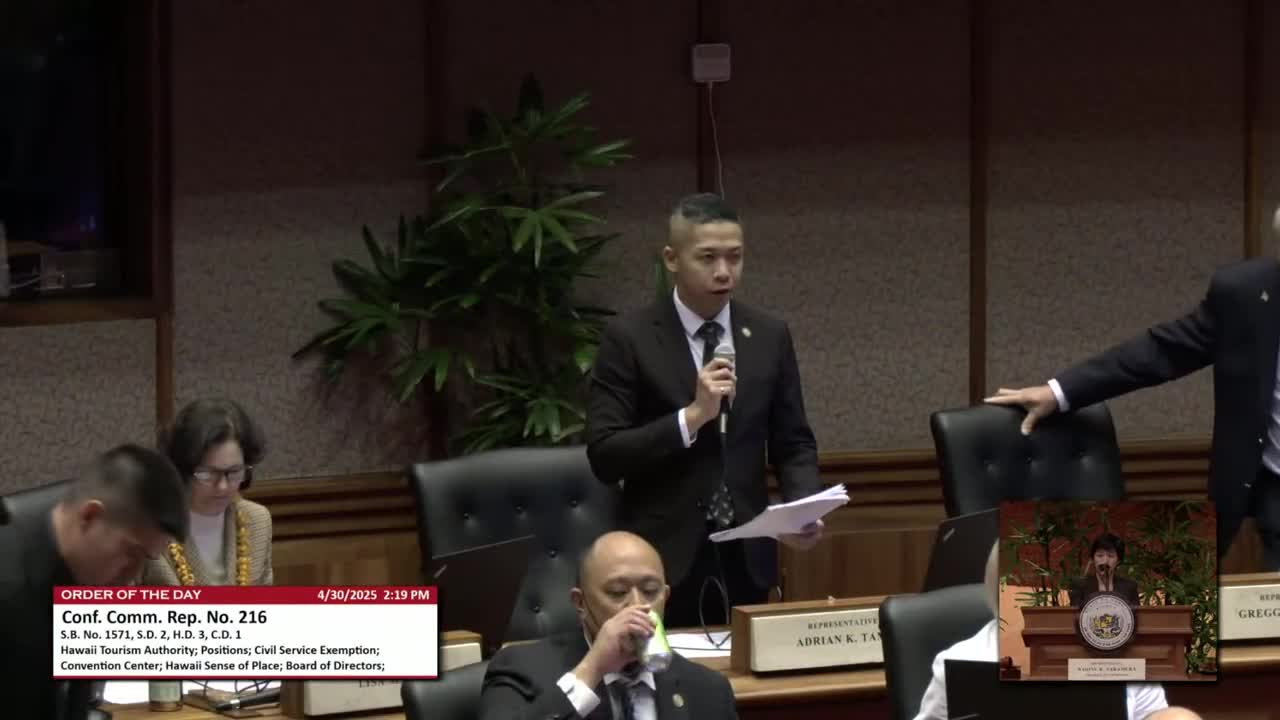 4MIN
House Floor
 9MIN
Senate Floor
 5MIN
Conference Committee
 4MIN
Conference Committee
 44SEC
Conference Committee
 40SEC
Conference Committee
 2MIN
House Floor
 3MIN
House Standing Committee on Finance
Bill Author