HB 1483
- Session Year: 2025-2026
- House: House
- Latest Version Date: 2025-04-30
Current Status:
In Progress
(2025-06-30: Act 243, on 06/30/2025 (Gov. Msg. No. 1346).)
Introduced
In Committee
First Chamber
In Committee
Second Chamber
Final Decking
Enacted
Establishes various criminal offenses and penalties related to fireworks or articles pyrotechnic. Amends multiple definitions and penalties for fireworks offenses, including heightened penalties if another person suffers substantial bodily injury, serious bodily injury, or death as a result of the fireworks offenses. Adds fireworks infractions to the existing adjudication of infractions process for traffic and emergency period infractions. (CD2)
Establishes various criminal offenses and penalties related to fireworks or articles pyrotechnic. Amends multiple definitions and penalties for fireworks offenses, including heightened penalties if another person suffers substantial bodily injury, serious bodily injury, or death as a result of the fireworks offenses. Adds fireworks infractions to the existing adjudication of infractions process for traffic and emergency period infractions. (CD1)
Amends multiple definitions and penalties for fireworks offenses, including heightened penalties if another person suffers substantial bodily injury, serious bodily injury, or death as a result of the fireworks offenses. Establishes various criminal offenses and penalties related to fireworks or articles pyrotechnics. Adds fireworks infractions to the existing adjudications of infractions process for traffic and emergency period infractions. Appropriates funds. (SD1)
Establishes an adjudication system and procedures to process fireworks infractions. Amends multiple definitions and penalties for fireworks offenses, including heightened penalties if another person suffers substantial bodily injury, serious bodily injury, or death as a result of the fireworks offenses. Establishes various criminal offenses and penalties related to fireworks or articles pyrotechnics. Appropriates funds. Effective 7/1/3000. (HD1)
Establishes an adjudication system and procedures to process fireworks infractions. Amends multiple definitions and penalties for fireworks offenses, including heightened penalties if another person suffers substantial bodily injury, serious bodily injury, or death as a result of the fireworks offenses. Establishes various criminal offenses and penalties related to fireworks or articles pyrotechnics. Appropriates funds.
HOUSE OF REPRESENTATIVES
|
AMENDMENT TO: |
H.B. No. 1483, H.D. 1, S.D. 1, C.D. 1 |
||
|
|
|||
|
OFFERED BY: |
Representative David A. Tarnas |
||
|
|
|||
|
DATE: |
|
||
SECTION 1. House Bill No. 1483, H.D. 1, S.D. 1, C.D. 1, is amended by amending subsection (a) of section 132D-B on p. 7, lines 13-20, to read as follows:
"(a) A person commits the offense of sending or receiving fireworks or articles pyrotechnic by air delivery if the person intentionally, knowingly, or recklessly sends or receives any amount of aerial devices, articles pyrotechnic, consumer fireworks, or display fireworks via any form of air delivery, including but not limited to any private courier, commercial carrier, or mail or postal services; provided that a person possessing a current explosives license issued by the federal Bureau of Alcohol, Tobacco, Firearms and Explosives shall not be prosecuted under this section if the person sends or receives the consumer fireworks, aerial devices, display fireworks, or articles pyrotechnic via any form of air delivery in compliance with federal law."
|
|
|
|
|
|
|
|
|
|
CARRIED |
|
FAILED TO CARRY |
|
WITHDRAWN |
|
|
|
|
|
||||
|
|
|
|
||||
|
|
|
|
||||
|
|
CHIEF CLERK, HOUSE OF REPRESENTATIVES |
|
||||
|
|
|
|
||||
SENATE FLOOR AMENDMENT
TO: H.B. No. 1483, H.D. 1, S.D. 1, C.D. 1
SECTION 1. House Bill No. 1483, H.D. 1, S.D. 1, C.D. 1, is amended by amending subsection (a) of section 132D-B on p. 7, lines 13-20, to read as follows:
"(a) A person commits the offense of sending or receiving fireworks or articles pyrotechnic by air delivery if the person intentionally, knowingly, or recklessly sends or receives any amount of aerial devices, articles pyrotechnic, consumer fireworks, or display fireworks via any form of air delivery, including but not limited to any private courier, commercial carrier, or mail or postal services; provided that a person possessing a current explosives license issued by the federal Bureau of Alcohol, Tobacco, Firearms and Explosives shall not be prosecuted under this section if the person sends or receives the consumer fireworks, aerial devices, display fireworks, or articles pyrotechnic via any form of air delivery in compliance with federal law."
|
Offered by: |
( ) Carried
|
|
|
( ) Failed to Carry
|
|
|
( ) Withdrawn
|
|
HOUSE OF REPRESENTATIVES |
H.B. NO. |
1483 |
|
THIRTY-THIRD LEGISLATURE, 2025 |
H.D. 1 |
|
|
STATE OF HAWAII |
S.D. 1 |
|
|
|
C.D. 2 |
|
|
|
||
|
|
||
A BILL FOR AN ACT
RELATING TO FIREWORKS.
BE IT ENACTED BY THE LEGISLATURE OF THE STATE OF HAWAII:
SECTION 1. The legislature finds that the widespread use of illegal fireworks poses an extreme danger and lethal risk to public health and safety, resulting in fires, serious burn injuries, and fatalities to innocent bystanders. The cost to the community far outweighs any intrinsic benefit, as numerous lives have been lost over the years from the use of illegal fireworks. In addition, the potential for wildfires in this time of climate change is a real and present danger and is a top priority for all levels of government.
Tragedies like the New Year's Eve explosion of 2024 have injured or claimed the lives of the elderly, adults, and children, seriously impacting entire neighborhoods in the middle of urban Honolulu and across the State.
Fireworks also emit excessive smoke and other toxins into the air, making breathing difficult for thousands of Hawaii residents with respiratory ailments. Noise from loud fireworks traumatizes many residents, particularly war veterans who may suffer from post-traumatic stress disorder from being in combat. Pets and vulnerable species in their natural habitats also must suffer each holiday season when fireworks noise and environmental pollution commences.
With the increase in fireworks-related calls, public safety agencies are heavily strained to maintain adequate response levels for other critical emergencies, which adds to the cost of state and county resources that could be used for natural disasters and other emergencies. They are often overwhelmed and are not able to stop the thousands of illegal fireworks being used, making it a death trap for thousands of innocent lives who are not involved in illegal fireworks use.
The legislature further finds that people in the State deserve to live in peace and security without the public safety risk and disruptive impact of illegal fireworks. There can be no more gray areas when lives are lost while this black market flourishes.
The legislature also finds that improved enforcement of the fireworks control laws is necessary, not only to protect property from avoidable fire damage, but also to protect the community from fire- and explosion-related injuries, respiratory distress caused by the air pollution, and recurring trauma to afflicted persons due to loud explosions.
The legislature believes that a more robust continuum of enforcement mechanisms must be established to promote compliance with the fireworks control laws. This includes implementing graduated penalties for repeat or felony-level offenses, imposing enhanced penalties for offenses that result in injury or death, and adjudicating fireworks infractions under the same system used for traffic and emergency period infractions. The fireworks infractions system will allow law enforcement agencies and the judiciary to quickly and efficiently process low-level cases, while also allowing them to prioritize higher-level cases as appropriate.
Accordingly, the purpose of this Act is to:
(1) Establish various criminal offenses and penalties related to fireworks or articles pyrotechnic;
(2) Amend and establish various definitions and penalties for fireworks offenses, including establishing heightened penalties under certain circumstances; and
(3) Incorporate fireworks infractions into the existing adjudication process for traffic and emergency period infractions.
SECTION 2. Chapter 132D, Hawaii Revised Statutes, is amended by adding seven new sections to be appropriately designated and to read as follows:
"§132D-A General fireworks or articles pyrotechnic prohibitions in the second degree. (a) A person commits the offense of general fireworks or articles pyrotechnic prohibitions in the second degree if, without a permit issued pursuant to sections 132D-10 and 132D-16, the person intentionally, knowingly, or recklessly:
(1) Sets off, ignites, discharges, or otherwise causes to explode any aerial devices, articles pyrotechnic, or display fireworks:
(A) Within one thousand feet of any operating hospital, licensed convalescent home, licensed home for the elderly, zoo, licensed animal shelter, or licensed animal hospital;
(B) In any school building, or on any school grounds or yards without first obtaining authorization from appropriate school officials;
(C) On any highway, alley, street, sidewalk, other public way, or public beach;
(D) In any park or officially designated forest or wildlife preserve;
(E) Within fifty feet of a canefield;
(F) Within one thousand feet of any building used for public worship during the periods when services are held; or
(G) Within five hundred feet of any dwelling; or
(2) Throws, catapults, or otherwise manually propels ignited aerial devices, articles pyrotechnic, consumer fireworks, or display fireworks.
(b) The state of mind requirement for the offense under subsection (a)(1)(A), (E), (F), and (G) shall not be applicable to whether the person was aware that the person was within the designated distance from an operating hospital, licensed convalescent home, licensed home for the elderly, zoo, licensed animal shelter, or licensed animal hospital; canefield; building used for public worship; or dwelling. A person shall be strictly liable with respect to the attendant circumstance that the person was within the designated distance from a prohibited place at the time of incident.
(c) Except as otherwise provided in subsections (d), (e), and (f), the offense of general fireworks or articles pyrotechnic prohibitions in the second degree shall be a misdemeanor.
(d) The offense of general fireworks or articles pyrotechnic prohibitions in the second degree shall be a class C felony if the person has been convicted one or more times for any offense under this chapter within ten years of the current offense.
(e) The offense of general fireworks or articles pyrotechnic prohibitions in the second degree shall be a class B felony if any of the aerial devices, articles pyrotechnic, or display fireworks set off, ignited, discharged, or otherwise caused to explode in the commission of the offense cause substantial bodily injury to another person.
(f) The offense of general fireworks or articles pyrotechnic prohibitions in the second degree shall be a class A felony if any of the aerial devices, articles pyrotechnic, or display fireworks set off, ignited, discharged, or otherwise caused to explode in the commission of the offense cause serious bodily injury or death to another person.
(g) The state of mind requirement for subsections (e) and (f) shall not be applicable to whether the person was aware the aerial devices, articles pyrotechnic, or display fireworks caused or would cause the injury or death. A person shall be strictly liable with respect to the result that the aerial devices, articles pyrotechnic, or display fireworks caused the injury or death.
§132D-B Sending or receiving fireworks or articles pyrotechnic by air delivery; prohibited. (a) A person commits the offense of sending or receiving fireworks or articles pyrotechnic by air delivery if the person intentionally, knowingly, or recklessly sends or receives any amount of aerial devices, articles pyrotechnic, consumer fireworks, or display fireworks via any form of air delivery, including but not limited to any private courier, commercial carrier, or mail or postal services; provided that a person possessing a current explosives license issued by the federal Bureau of Alcohol, Tobacco, Firearms and Explosives shall not be prosecuted under this section if the person sends or receives the consumer fireworks, aerial devices, display fireworks, or articles pyrotechnic via any form of air delivery in compliance with federal law.
(b) Except as provided in subsections (c) and (d), the offense of sending or receiving fireworks or articles pyrotechnic by air delivery shall be a class C felony.
(c) The offense of sending or receiving fireworks or articles pyrotechnic by air delivery shall be a class B felony if:
(1) The person has been convicted one or more times for any offense under this chapter within ten years of the current offense; or
(2) The total weight of the aerial devices, articles pyrotechnic, consumer fireworks, and display fireworks sent or received in the commission of the offense is five pounds or more but less than twenty-five pounds.
(d) The offense of sending or receiving fireworks or articles pyrotechnic by air delivery shall be a class A felony if the total weight of the aerial devices, articles pyrotechnic, consumer fireworks, and display fireworks sent or received in the commission of the offense is twenty-five pounds or more.
§132D-C Distributing fireworks or articles pyrotechnic to non-permit holder. (a) A person commits the offense of distributing fireworks or articles pyrotechnic to non-permit holder when the person, who holds a valid license required pursuant to section 132D-7, intentionally, knowingly, or recklessly distributes aerial devices, articles pyrotechnic, consumer fireworks, or display fireworks to another person who does not have a valid permit required pursuant to sections 132D‑10 and 132D-16.
(b) Except as provided in subsections (c) and (d), the offense of distributing fireworks or articles pyrotechnic to non-permit holder shall be a class C felony.
(c) The offense of distributing fireworks or articles pyrotechnic to non-permit holder shall be a class B felony if:
(1) The person has been convicted one or more times for any offense under this chapter within ten years of the current offense; or
(2) Any of the aerial devices, articles pyrotechnic, consumer fireworks, or display fireworks distributed in the commission of the offense cause substantial bodily injury to another person.
(d) The offense of distributing fireworks or articles pyrotechnic to non-permit holder shall be a class A felony if any of the aerial devices, articles pyrotechnic, consumer fireworks, or display fireworks distributed in the commission of the offense cause serious bodily injury or death to another person.
(e) The state of mind requirement for subsections (c)(2) and (d) shall not be applicable to whether the person was aware the aerial devices, articles pyrotechnic, consumer fireworks, or display fireworks caused or would cause the injury or death. A person shall be strictly liable with respect to the result that the aerial devices, articles pyrotechnic, consumer fireworks, or display fireworks caused the injury or death.
§132D-E Consumer fireworks prohibitions. (a) It shall be unlawful for any person to:
(1) Purchase, possess, set off, ignite, discharge, or otherwise cause to explode any consumer fireworks without a permit required pursuant to section 132D-10; or
(2) Set off, ignite, discharge, or otherwise cause to explode any consumer fireworks at any time not within the periods for use prescribed in section 132D-3;
provided that a person licensed pursuant to sections 132D-7 and 132D-8 may purchase and possess consumer fireworks in accordance with the person's license.
(b) It shall be unlawful for any person, other than a licensed wholesaler who is distributing consumer fireworks to a licensed retailer in accordance with the person's license, to distribute consumer fireworks:
(1) More than five calendar days before the time periods for permissible use under section 132D-3; or
(2) After 12:01 a.m. on New Year's Day, 6:00 p.m. on Chinese New Year's Day, or 8:00 p.m. on the Fourth of July.
(c) The state of mind requirement for the offense under subsections (a)(2) and (b) shall not be applicable to whether the person was aware of the date or time at the time of offense, or whether the date and time of offense fell within the prohibited periods. A person shall be strictly liable with respect to the date and time of any act proven to have occurred, and with respect to the attendant circumstance that the date and time fell within the prohibited dates and times provided in subsections (a)(2) and (b).
(d) Any person who violates:
(1) Subsection (a) shall be subject to a $200 fine;
(2) Subsection (b) shall be subject to a $1,000 fine; and
(3) This section shall be subject to proceedings under chapter 291D;
provided that nothing in this section shall be construed to prohibit prosecution under section 132D-7, 132D-8.6, or any other provision under this chapter.
(b) If the law enforcement officer has reasonable grounds to believe that the person is being deceptive or misleading in providing the person's name or address, the person shall provide proof thereof, upon the lawful order or direction of the law enforcement officer.
(c) Refusal to provide identification pursuant to this section shall be a petty misdemeanor.
§132D-G Requirements of carrier. (a) Any carrier or person shipping aerial devices, articles pyrotechnic, consumer fireworks, or display fireworks:
(1) Into the State shall notify the appropriate county official and designated state law enforcement agencies at the time the booking is made and, in any case, no later than fourteen days before arrival into the State; or
(2) Interisland within the State shall notify the appropriate county official and designated state law enforcement agencies at the time the booking is made and, in any case, no later than five days before departing from the island of origin;
provided that the notification shall include, when applicable, the container identification number, manifest, bill of lading, consignee, freight forwarder, sailing vessel name, route number, date of departure, and estimated date of arrival.
(b) For a first offense, or any offense not committed within five years of a prior judgment for the State under this section, the carrier or person shall be subject to a $1,000 fine.
(c) For a second offense committed within five years of a prior judgment for the State under this section, the carrier or person shall be subject to a $2,000 fine.
(d) For a third or subsequent offense committed within five years of two or more prior judgements for the State under this section, the carrier or person shall be subject to a $5,000 fine.
(e) All violations of this section shall be subject to proceedings under chapter 291D. Nothing in this section shall be construed to prohibit criminal prosecution under section 132D‑8.6 or any other section of this chapter."
SECTION 3. Section 132D-2, Hawaii Revised Statutes, is amended as follows:
1. By adding five new definitions to be appropriately inserted and to read:
""Carrier" means any shipper or anyone who transports goods, merchandise, property, or people by rail car, aircraft, motor vehicle, or vessel.
"Distribute" or "distribution" means to sell, transfer, deliver to another, give or deliver to another, or to leave, barter, or exchange with another, or to offer or agree to do the same.
"Dwelling" means a building that is used or usually used by a person for lodging.
"Serious bodily injury" means bodily injury that creates a substantial risk of death or which causes serious, permanent disfigurement, or protracted loss or impairment of the function of any bodily member or organ.
"Substantial bodily injury" means bodily injury that causes a:
(1) Major avulsion, laceration, or penetration of the skin;
(2) Burn of at least second degree severity;
(3) Bone fracture;
(4) Serious concussion; or
(5) Tearing, rupture, or corrosive damage to the esophagus, viscera, or other internal organs."
2. By amending the definition of "aerial device" to read:
""Aerial device" means any
fireworks [containing one hundred thirty milligrams or less of explosive
materials that produces an audible or visible effect and is designed to rise]
that upon ignition, discharge, or otherwise being
set off rises more than twelve feet into the air and [explode or
detonate] then combusts, explodes,
deflagrates, or detonates in the air, shoots or emits flaming
balls, or [to fly about above the ground, and that is prohibited for use
by any person who does not have a permit for display issued by a county under
section 132D-16. "Aerial devices"] shoots
or emits sparks. Alternatively, "aerial device" may include but is
not limited to any device classified as fireworks under UN0336 and
UN0337 by the United States Department of Transportation as set forth in [Title]
title 49 Code of Federal Regulations [include] that contains one hundred thirty milligrams or less of
explosive materials, including firework items commonly known as bottle rockets, sky rockets, missile-type
rockets, helicopters, torpedoes, daygo bombs, roman candles, flying pigs, and
jumping jacks that move about the ground farther than a circle with a radius of
twelve feet as measured from the point where the item was placed and ignited,
aerial shells, and mines."
3. By amending the definition of "consumer fireworks" to read:
""Consumer fireworks" means any
fireworks [designed primarily for retail sale to the public during
authorized dates and times,] that [produces] upon ignition, discharge, or otherwise being set off,
produce visible or audible effects [by combustion,] and that
[is designed to] remain on or near the
ground and, while stationary or spinning rapidly on or near the ground, [emits]
emit smoke, a shower of colored sparks, whistling effects, flitter
sparks, or balls of colored sparks, and includes combination items that [contain]
produce one or more of these effects. ["Consumer] Alternatively,
"consumer fireworks" [shall comply] may include but is
not limited to any firework that complies with the construction, chemical
composition, and labeling regulations of the United States Consumer Product
Safety Commission as set forth in [Title] title 16 Code of
Federal Regulations and fireworks classified as UN0336 and UN0337 by the United
States Department of Transportation as set forth in [Title] title
49 Code of Federal Regulations. "Consumer fireworks" may include
but need not be limited to firework items commonly known as firecrackers
that are single paper cylinders not exceeding one and one-half inches in length
excluding the fuse and one-quarter of an
inch in diameter [and contain a charge of not more than fifty milligrams of
pyrotechnic composition], snakes, sparklers, fountains, and cylindrical or
cone fountains that emit effects up to a height [not] no greater
than twelve feet above the ground, illuminating torches, bamboo cannons,
whistles, toy smoke devices, wheels, and ground spinners that when ignited
remain within a circle with a radius of twelve feet as measured from the point
where the item was placed and ignited, novelty or trick items, combination
items, and other fireworks of like construction that are designed to produce
the same or similar effects."
4. By amending the definitions of "display fireworks", "fireworks", and "import" to read:
""Display fireworks" means any
fireworks designed primarily for exhibition display by producing visible or
audible effects and classified as display fireworks or contained in the
regulations of the United States Department of Transportation and designated as
UN0333, UN0334, or UN0335, and includes salutes containing more than two grains
(one hundred and thirty milligrams) of explosive materials, aerial shells
containing more than forty grams of pyrotechnic compositions, and other display
pieces [which] that exceed the limits of explosive materials for
classification as "consumer fireworks". [This term] "Display
fireworks" also includes fused [setpieces] set pieces
containing components[, which] that together exceed fifty
milligrams of salute [power.] powder. The use of display
fireworks shall be prohibited for use by any person who does not have a display
permit issued by a county.
"Fireworks" means any combustible or
explosive composition, or any substance or combination of substances, [or
article prepared for the purpose of producing] that produces a
visible or audible effect by combustion, explosion, deflagration, or detonation
[and that meets the definition of aerial device or consumer or display
fireworks as defined by this section and contained], including but not limited to aerial devices, consumer
fireworks, or display fireworks as defined by this section.
"Fireworks" also includes but is not limited to aerial devices,
consumer fireworks, or display fireworks, as defined in the
regulations of the United States Department of Transportation as set forth in [Title]
title 49 Code of Federal Regulations. [The term
"fireworks" shall] "Fireworks" does not include
any explosives or pyrotechnics regulated under chapter 396 or automotive safety
flares, nor shall [the term] "fireworks" be construed
to include toy pistols, toy cannons, toy guns, party poppers, pop-its, or [other]
similar devices [which contain twenty-five hundredths of a grain or
less of explosive substance].
"Import" (and any nounal, verbal,
adjectival, adverbial, and other equivalent form of the term used
interchangeably in this chapter) means to bring or attempt to bring [fireworks]
into the State or to cause [fireworks] to be brought into the State[,]
any aerial devices, articles pyrotechnic, consumer
fireworks, or display fireworks, as defined in this section or as defined by
the United States Department of Transportation as set forth in title 49 Code of
Federal Regulations, and includes [fireworks] any aerial devices, articles pyrotechnic, consumer
fireworks, or display fireworks labeled or designated as samples,
even if not intended for retail sale."
5. By amending the definition of "pyrotechnic composition" or "pyrotechnic contents" to read:
""Pyrotechnic composition" or "pyrotechnic contents" means the combustible or explosive component of aerial devices, articles pyrotechnic, consumer fireworks, and display fireworks."
6. By repealing the definition of "law enforcement or fire officer".
[""Law enforcement or fire
officer" means any law enforcement officer having police power or county
fire department officer, including firefighters."]
SECTION 4. Section 132D-5, Hawaii Revised Statutes, is amended to read as follows:
"§132D-5 General fireworks or articles pyrotechnic prohibitions[.] in
the first degree. (a) It shall be unlawful for any person [without
a permit issued under section 132D-10 by a county fire department] to:
[(1) Remove or extract the pyrotechnic
contents from any fireworks;
(2)] (1) Throw, catapult, or
otherwise manually propel any ignited aerial devices, articles
pyrotechnic, consumer fireworks, or display fireworks:
(A) From, at, or into a vehicle;
(B) At a person or an animal; [and] or
(C) From above the first floor of any building; or
[(3)] (2) Set off, ignite, discharge, or
otherwise cause to explode any aerial devices, articles pyrotechnic, consumer
fireworks, or display fireworks:
(A) [Above] From above the
first floor of any building;
(B) In any vehicle; or
[(C) At any time not within the
periods for use prescribed in section 132D-3;
(D) Within one thousand feet of any
operating hospital, licensed convalescent home, licensed home for the elderly,
zoo, licensed animal shelter, or licensed animal hospital;
(E) In any school building, or on
any school grounds and yards without first obtaining authorization from
appropriate school officials;
(F) On any highway, alley, street,
sidewalk, or other public way; in any park; on any public beach; in any
officially designated forest or wildlife preserve; within fifty feet of a
canefield; or within one thousand feet of any building used for public worship
during the periods when services are held; and
(G) Within five hundred feet of any
hotel.
(b) It shall be unlawful to purchase
consumer fireworks more than five calendar days before the time periods for
permissible use under section 132D-3.
(c) It shall be unlawful to sell consumer
fireworks after 12:01 a.m. on New Year's Day, 6:00 p.m. on Chinese New Year's
Day, and 8:00 p.m. on the Fourth of July.]
(C) In any building; provided that firecrackers shall be permitted if used in accordance with sections 132D-3 and 132D-10 and all other applicable state and county laws, ordinances, and rules.
(b) Except as provided in subsections (c) and (d), the offense of general fireworks or articles pyrotechnic prohibitions in the first degree shall be a class C felony.
(c) If in the commission of the offense of general fireworks or articles pyrotechnic prohibitions in the first degree the person negligently causes substantial bodily injury to another person, the person shall be guilty of a class B felony.
(d) If in the commission of the offense of general fireworks or articles pyrotechnic prohibitions in the first degree the person negligently causes serious bodily injury or death to another person, the person shall be guilty of a class A felony."
SECTION 5. Section 132D-6, Hawaii Revised Statutes, is amended to read as follows:
"§132D-6 Exceptions. The
prohibitions in [section] sections 132D-5 [do], 132D-A, and 132D-D shall not apply to:
(1) The use of flares, noisemakers, or signals for
warning[,] or pest control, or illumination purposes by police
and fire departments, utility companies, transportation agencies, and other
governmental or private agencies or persons, including agricultural operations,
in connection with emergencies, their duties, or business;
(2) The sale or use of blank cartridges for a show or theater, or for signal, commercial, or institutional purposes in athletics or sports;
(3) The purchase and use of aerial devices, articles
pyrotechnic, consumer fireworks, [aerial devices,] or
display fireworks[, or articles pyrotechnic]:
(A) In a movie, television production, or theatrical production for which valid permits have been issued by a county pursuant to section 132D-10; and
(B) In a movie or television production for which valid permits have been issued by the department of business, economic development, and tourism pursuant to section 201-14, or for which permits have been approved by the authority having jurisdiction; and
(4) The testing, disposal, or destruction of [illegal]
any fireworks or articles
pyrotechnic by an agency with
authority to enforce this chapter."
SECTION 6. Section 132D-7, Hawaii Revised Statutes, is amended to read as follows:
"§132D-7 License or permit required. A person shall not:
(1) Import, store, [offer to sell, or sell,] or
distribute, including at wholesale or retail, any aerial devices, [display
fireworks,] articles pyrotechnic, [or] consumer fireworks, or
display fireworks unless the person has a valid license issued [by the
county;] pursuant to this chapter; or
(2) Possess any aerial devices, [display
fireworks, or] articles pyrotechnic, or display fireworks without a
valid license to import, store, or [sell] distribute aerial
devices, [display fireworks, or] articles pyrotechnic, or display
fireworks, or a valid display permit [as provided for in] issued
pursuant to this chapter."
SECTION 7. Section 132D-8, Hawaii Revised Statutes, is amended as follows:
1. By amending subsection (b) to read:
"(b) Each storage, wholesaling, and
retailing site shall be required to obtain a separate license. The license
shall specify the date of issuance or effect and the date of expiration, which
shall be March 31 of each year. The application shall be made on a form
setting forth the date upon which the storage[, sale, or offers for sale]
or distribution are to begin, the address of the location of the
licensee, and the name of the proprietor or, if a partnership, the name of the
partnership and the names of all partners or, if a corporation, the name of the
corporation and the names of its officers. Any license issued pursuant to this
chapter may be revoked by the county if the licensee violates any provision of
this chapter or if the licensee stores or handles the fireworks in a manner
that presents an unreasonable safety hazard."
2. By amending subsection (d) to read:
"(d) It shall be unlawful for any
licensee, other than a licensed wholesaler who is [selling or
transferring] distributing fireworks or articles pyrotechnic to a
licensed retailer[,] pursuant to the person's license, to [sell
or offer to sell, exchange for consideration, give, transfer, or donate] distribute
any fireworks or articles pyrotechnic at any time to any person who does not
present a permit duly issued as required by [section] sections
132D-10 [or] and 132D-16. The permit shall be signed by the seller
or transferor at the time of [sale or transfer] distribution of
the fireworks or articles pyrotechnic, and the seller or transferor shall
indicate on the permit the amount and type of fireworks or articles pyrotechnic
[sold or transferred.] distributed. No person shall [sell or
deliver] distribute fireworks to any permittee in any amount in
excess of the amount specified in the permit, less the amount shown on the
permit to have been previously purchased; provided that no fireworks shall be
sold to a permittee holding a permit issued for purposes of section 132D-3,
more than five calendar days before the applicable time period under section
132D-3."
SECTION 8. Section 132D-8.6, Hawaii Revised Statutes, is amended by amending subsection (a) to read as follows:
"(a) Any person who has obtained a
license [under] required pursuant to section 132D-7 and ships
fireworks or articles pyrotechnic into the State shall:
(1) Clearly designate the types of fireworks or articles pyrotechnic in each shipment on the bill of lading or shipping manifest with specificity;
(2) Declare on the bill of lading or shipping
manifest the gross weight of aerial devices, articles pyrotechnic, consumer
fireworks, and display fireworks[, articles pyrotechnic, and aerial
devices] to be imported in each shipment and the location of the storage
facility, if applicable, in which the fireworks or articles pyrotechnic are to
be stored;
(3) [Prior to] Before shipment and when
booking each shipment of fireworks[, display fireworks,] or
articles pyrotechnic[, or aerial devices] notify the [appropriate
county official as determined by the county] state fire marshal
regarding whether the shipment will be distributed from:
(A) Pier to pier;
(B) Pier to warehouse or storage facility; or
(C) Pier to redistribution;
(4) [Prior to] Before booking the
shipment, provide to the [applicable county fire chief:] state fire
marshal:
(A) Written
documentation regarding the proposed display event or events and related
contact information to allow the [fire chief] state fire marshal to
validate the importation of a three-month or six-month inventory under section
132D-8.5; and
(B) An inventory breakdown for each proposed display; and
(5) At the time shipping is booked, the importer or
consignee shall notify the [appropriate county official as determined by the
county] state fire marshal in writing of the expected shipment's
landing date[.]; provided that:
(A) Notifications shall be made through a system designated by the state fire marshal; and
(B) If a licensee fails to notify the state fire marshal two or more times within one year of the issuance of a license, the license may be revoked."
SECTION 9. Section 132D-10, Hawaii Revised Statutes, is amended to read as follows:
"§132D-10 Permits. (a) A permit shall be required for the purchase and use of:
(1) Any consumer fireworks commonly known as firecrackers upon payment of a fee of $25;
(2) Any aerial devices, [display fireworks, or]
articles pyrotechnic, or display fireworks for the purposes of section
132D-16 upon payment of a fee of $110; and
(3) Any consumer fireworks [for the purposes of
section 132D-5 or] for cultural uses that occur at any time other than
during the periods prescribed in section 132D-3(1) upon a payment of a fee of
$25.
(b) Each person may purchase a maximum of fifty permits per year; provided that this limit shall not apply to permits issued under subsection (a)(2); provided further that nothing in this section shall prohibit a county from enacting ordinances more stringent than this section for permits issued under subsection (a)(1) or (3)."
SECTION 10. Section 132D-12, Hawaii Revised Statutes, is amended to read as follows:
"§132D-12 [Sale] Distribution
to minors; [sale by minors;] prohibited. (a) It shall be
unlawful for any person to [offer for sale, sell, or give] distribute
any aerial devices, articles pyrotechnic, consumer fireworks, or [articles
pyrotechnic] display fireworks to minors, [and for any minor to
possess, purchase, sell, or set off, ignite, or otherwise cause to explode any
fireworks or articles pyrotechnic,] except as provided in section 132D-13.
(b) Any person who violates this section shall be guilty of a class C felony."
SECTION 11. Section 132D-13, Hawaii Revised Statutes, is amended to read as follows:
"§132D-13 Liability of parents or
guardians. [The parents,] (a) Except as provided in subsection
(b), it shall be unlawful for a parent, guardian, [and] or
other [persons] person having the custody or control of any
minor[, who] to knowingly permit the minor to [possess,]:
(1) Possess or purchase[, or set]
any aerial devices, articles pyrotechnic, consumer fireworks, or display
fireworks; or
(2) Set off, ignite, discharge,
or otherwise cause to explode any aerial devices, articles pyrotechnic,
consumer fireworks, or display fireworks [or articles pyrotechnic, shall
be deemed to be in violation of this chapter and shall be subject to the
penalties thereunder, except that the parents].
(b) The parent or guardian may allow the minor to use consumer fireworks while under the immediate supervision and control of the parent or guardian, or under the immediate supervision and control of another adult.
(c) Separate and apart from any civil liability that may result from this or any related incident, and except as provided in subsections (d) and (e), the violation of subsection (a) shall be a misdemeanor.
(d) If any of the aerial devices, articles pyrotechnic, consumer fireworks, or display fireworks set off, ignited, discharged, or otherwise caused to explode in violation of subsection (a)(2) cause substantial bodily injury to another person, the violation of subsection (a) shall be a class C felony.
(e) If any of the aerial devices, articles pyrotechnic, consumer fireworks, or display fireworks set off, ignited, discharged, or otherwise caused to explode in violation of subsection (a)(2) cause serious bodily injury or death to another person, the violation of subsection (a) shall be a class B felony.
(f) The state of mind requirement for subsections (d) and (e) shall not be applicable to whether the person was aware that the aerial devices, articles pyrotechnic, consumer fireworks, or display fireworks caused or would cause the injury or death. A person shall be strictly liable with respect to the result that the aerial devices, articles pyrotechnic, consumer fireworks, or display fireworks caused the injury or death."
SECTION 12. Section 132D-14, Hawaii Revised Statutes, is amended to read as follows:
"§132D-14 Penalty. (a) [Any]
Except as provided in subsections (b) and (c), any person:
(1) Importing, storing, or distributing aerial
devices, [display fireworks, or] articles pyrotechnic, consumer
fireworks, or display fireworks without having a valid license [under]
as required pursuant to section 132D-7 [shall]:
(A) Shall be guilty of a class C felony; and
(B) Notwithstanding subparagraph (A), if the total weight of the aerial devices, articles pyrotechnic, consumer fireworks, and display fireworks is twenty-five pounds or more, shall be guilty of a class B felony; and
(2) Purchasing, possessing, setting off, igniting, [or]
discharging, or otherwise causing to explode aerial devices, [display
fireworks, or] articles pyrotechnic, or display fireworks without a
valid permit [under] required pursuant to sections 132D-10 and
132D-16[, or storing, selling, or possessing aerial devices, display
fireworks, or articles pyrotechnic without a valid license under section
132D-7, or allowing an individual to possess, set off, ignite, discharge, or
otherwise cause to explode any aerial device in violation of section 132D-14.5]:
(A) If the total weight of the aerial devices, articles pyrotechnic, and display fireworks is fifty pounds or more, shall be guilty of a class B felony;
[(A)] (B) If the total weight of
the aerial devices, [display fireworks, or] articles pyrotechnic, and
display fireworks is twenty-five pounds or more, shall be guilty of a class
C felony; [or
(B)] (C) If the total weight of
the aerial devices, [display fireworks, or] articles pyrotechnic, and
display fireworks is [less than twenty-five pounds,] five pounds or
more, shall be guilty of a misdemeanor; and
(D) If the total weight of the aerial devices, articles pyrotechnic, and display fireworks is less than five pounds or if the total weight cannot be determined, shall be fined $300 and subject to proceedings under chapter 291D.
[(3) Who transfers or sells aerial devices,
display fireworks, or articles pyrotechnic to a person who does not have a
valid permit under sections 132D-10 and 132D-16, shall be guilty of a class C
felony; and
(4) Who removes or extracts the pyrotechnic
contents from any fireworks or articles pyrotechnic and uses the contents to
construct fireworks, articles pyrotechnic, or a fireworks or articles
pyrotechnic related device shall be guilty of a misdemeanor.]
(b) Any person who would otherwise be subject to sentencing for a criminal offense under subsection (a) shall be guilty of an offense one class or grade higher, as the case may be, than that provided in subsection (a) if:
(1) The person has been convicted one or more times for any offense under this chapter within ten years of the instant offense; or
(2) Any of the aerial devices, articles pyrotechnic, consumer fireworks, or display fireworks imported, stored, distributed, purchased, possessed, set off, ignited, discharged, or otherwise caused to explode in the commission of the offense under subsection (a) cause substantial bodily injury to another person.
(c) Any person who would otherwise be subject to sentencing for a criminal offense under subsection (a) shall be guilty of an offense two classes or grades higher, as the case may be, than that provided in subsection (a) if any of the aerial devices, articles pyrotechnic, consumer fireworks, or display fireworks imported, stored, distributed, purchased, possessed, set off, ignited, discharged, or otherwise caused to explode in the commission of the offense under subsection (a) cause serious bodily injury or death to another person; provided that for an offense already classified as a class B felony, the person shall be guilty of a class A felony.
(d) The state of mind requirement for subsections (b) and (c) shall not be applicable to whether the person was aware that any of the aerial devices, articles pyrotechnic, consumer fireworks, or display fireworks caused or would cause the injury or death. A person shall be strictly liable with respect to the attendant circumstance that the aerial devices, articles pyrotechnic, consumer fireworks, or display fireworks caused the injury or death.
[(b)] (e) Except as provided in
subsection (a), (b), or (c), or as otherwise specifically provided for
in this chapter, any person violating any other provision of this chapter,
shall be guilty of a violation and fined no less than $500 and no
more than $5,000 for each violation. [Notwithstanding any provision to the
contrary in this section, any person violating section 132D-14.5 shall be fined
at least $500 and no more than $5,000.]
[(c)] (f) The court shall
collect the fines imposed in subsections (a) [and], (b), (c),
and (e), for violating this chapter and, of the fines collected, shall pay
twenty per cent to the State and eighty per cent to the county in which the
fine was imposed, which shall be expended by the county for law enforcement
purposes.
[(d)] (g) Notwithstanding any
penalty set forth herein, violations of subsection (a)(1) [or (3)] may
be subject to nuisance abatement proceedings provided in part V of chapter 712.
[(e) For the purposes of this section:
(1) Each type of prohibited firework
imported, purchased, sold, possessed, set off, ignited, or discharged shall
constitute a separate violation for each unopened package; and
(2) Each separate firework imported,
purchased, sold, possessed, set off, ignited, or discharged shall be a separate
violation if the package is opened or the firework is not in a package.
(f) For the purposes of this section,
"package":
(1) Means any aerial device, display
firework, or article pyrotechnic:
(A) Enclosed in a container or
wrapped in any manner in advance of wholesale or retail sale; and
(B) With a weight or measure
determined in advance of wholesale or retail sale; and
(2) Does not mean:
(A) Inner wrappings not intended to
be individually sold to the customer;
(B) Shipping containers or wrapping
used solely for the transportation of any commodities in bulk or in quantity;
(C) Auxiliary containers or outer
wrappings used to deliver commodities if the containers or wrappings bear no
printed matter pertaining to any particular aerial device, display firework, or
article pyrotechnic;
(D) Containers used for retail tray
pack displays when the container itself is not intended to be sold; or
(E) Open carriers and transparent
wrappers or carriers for containers when the wrappers or carriers do not bear
printed matter pertaining to any particular aerial devices, display fireworks,
or articles pyrotechnic.]"
SECTION 13. Section 132D-14.5, Hawaii Revised Statutes, is amended to read as follows:
"[[]§132D-14.5[]]
Liability of homeowner, renter, or person otherwise responsible for real
property. [A] (a)
Except as provided in subsections (b) and (c), a homeowner, renter, or
person otherwise responsible for [the] real property who intentionally, knowingly, [or] recklessly [allows],
or negligently:
(1) Allows an individual, while on the
real property, to possess, set off, ignite, discharge, or otherwise
cause to explode any aerial [device] devices, articles pyrotechnic,
or display fireworks without a permit issued pursuant to this chapter shall
be [deemed to be in violation of this chapter and shall be subject to the
penalties specified in section 132D-14(a)(2) and (b).] guilty of a petty
misdemeanor;
(2) Allows any aerial devices, articles pyrotechnic, display fireworks, or pyrotechnic composition to be stored in the real property without a license issued pursuant to this chapter shall be guilty of a misdemeanor; and
(3) Notwithstanding paragraph (2), allows any aerial devices, articles pyrotechnic, display fireworks, or pyrotechnic composition to be stored in the real property, if the total weight of the aerial devices, articles pyrotechnic, display fireworks, and pyrotechnic composition is twenty-five pounds or more without a license issued pursuant to this chapter, shall be guilty of a class C felony.
(b) Any person who would otherwise be subject to sentencing under subsection (a) shall be guilty of an offense one class or grade higher, as the case may be, than that provided in subsection (a) if:
(1) The person has been convicted one or more times for any offense under this chapter within ten years of the instant offense; or
(2) Any of the aerial devices, articles pyrotechnic, display fireworks, or pyrotechnic composition possessed, set off, ignited, discharged, otherwise caused to explode, or stored in violation of subsection (a) cause substantial bodily injury to another person.
(c) Any person who would otherwise be subject to sentencing under subsection (a) shall be guilty of an offense two classes or grades higher, as the case may be, than that provided in subsection (a) if any of the aerial devices, articles pyrotechnic, display fireworks, or pyrotechnic composition possessed, set off, ignited, discharged, otherwise caused to explode, or stored in violation of subsection (a) cause serious bodily injury or death to another person.
(d) The state of mind requirement for subsections (b) and (c) shall not be applicable to whether the person was aware that any of the aerial devices, articles pyrotechnic, display fireworks, or pyrotechnic composition caused or would cause the injury or death. A person shall be strictly liable with respect to the attendant circumstance that the aerial devices, articles pyrotechnic, display fireworks, or pyrotechnic composition caused the injury or death."
SECTION 14. Section 132D-15, Hawaii Revised Statutes, is amended to read as follows:
"[[]§132D-15[]] Notice
requirements. Each licensed retail outlet shall post adequate notice that
clearly cautions each person purchasing consumer fireworks of the
prohibitions, liabilities, and penalties incorporated in sections 132D-12,
132D-13, [and] 132D-14[.], and 132D-E."
SECTION 15. Section 132D-17.5, Hawaii Revised Statutes, is amended to read as follows:
"[[]§132D-17.5[]] County
ordinances. (a) Nothing in this chapter shall be construed to supersede
or in any manner affect a county fireworks ordinance; provided that the
ordinance is at least as stringent in the control or prohibition of aerial
devices, articles pyrotechnic, consumer fireworks, and display fireworks as
the law under this chapter.
(b) Nothing in this chapter shall prohibit a county from enacting ordinances that are more stringent in the control or prohibition of aerial devices, articles pyrotechnic, consumer fireworks, and display fireworks than this chapter."
SECTION 16. Section 132D-21, Hawaii Revised Statutes, is amended to read as follows:
"§132D-21 Health care facilities;
report of fireworks and articles pyrotechnic incidents. (a) Health
care facilities in this State shall report all incidents of serious injuries
and fatalities caused by legal and illegal aerial
devices, articles pyrotechnic, consumer fireworks, or display
fireworks [or articles pyrotechnic] to the department of health and the
police department of the county in which the person was attended or treated.
All reports shall be in writing or in the manner specified by the department of
health.
(b) As used in this section,
"health care facilities" includes any outpatient clinic, emergency
room, or physician's office, private or public, whether organized for profit or
not, used, operated, or designed to provide medical diagnosis, treatment,
nursing, rehabilitative, or preventive care to any person or persons. [The
term] "Health care facilities" includes but is not limited
to health care facilities that are commonly referred to as hospitals, extended
care and rehabilitation centers, nursing homes, skilled nursing facilities,
intermediate care facilities, hospices for the terminally ill that require
licensure or certification by the department of health, kidney disease
treatment centers, including freestanding hemodialysis units, outpatient clinics,
organized ambulatory health care facilities, emergency care facilities and
centers, home health agencies, health maintenance organizations, and others
providing similarly organized services regardless of nomenclature."
SECTION 17. Section 132D-22, Hawaii Revised Statutes, is amended to read as follows:
"[[]§132D-22[]] Entry
onto premises; inspection of premises, books, and records; obstructing [law
enforcement or fire department] inspector operations; penalty.
(a) Any [law enforcement or fire officer] inspector may, at
reasonable hours, enter and inspect the premises of a licensee or permittee and
any relevant books or records therein to verify compliance with this chapter
and the conditions of the license or permit.
(b) Upon a request by any [law enforcement
or fire officer] inspector to enter and inspect the premises of a
licensee or permittee at reasonable hours, the licensee, the permittee, or an
employee of the licensee or permittee shall make [available for immediate
inspection and examination] the premises and all relevant books and records
therein[.] available for immediate inspection and examination.
(c) Any licensee or permittee who refuses the
[law enforcement or fire officer] inspector entry or access to
the premises, books, or records shall be in violation of the conditions of the
license or permit. After a hearing, the issuing department shall suspend or
revoke the license or permit for refusing entry or access or for violations of
any other requirement or condition of the license or permit or any provision of
this chapter or rule adopted pursuant to this chapter. The issuing department
shall provide the licensee or permittee with a written notice and order
describing the basis for the suspension or revocation. Any person aggrieved by
the suspension or revocation determination may request a contested case hearing
pursuant to chapter 91. To request a contested case hearing, the person shall
submit a written request to the issuing department within thirty calendar days
of the date of the notice and order of the suspension or revocation. Appeal to
the circuit court under section 91-14, or any other applicable statute, shall
only be taken from the issuing department's final order pursuant to a contested
case.
(d) Any licensee, permittee, employee of a licensee or permittee, or other person who:
(1) Threatens with the use of violence, force, or
physical interference or obstacle, or hinders, obstructs, or prevents any [law
enforcement or fire officer,] inspector, or any person assisting [a
law enforcement or fire officer,] an inspector, from entering into
the premises of the licensee or permittee; or
(2) Opposes, obstructs, or molests [a law
enforcement or fire officer] an inspector in the [officer's] inspector's
enforcement of this chapter,
shall be guilty of a misdemeanor, punishable by a fine of no more than $2,000 or imprisonment for no more than one year, or both.
(e) If any [law enforcement or fire
officer,] inspector having demanded admittance onto the premises of
a licensee or permittee and declared the [officer's] inspector's
name and office, is not admitted by the licensee, permittee, or person in
charge of the premises, the [officer] inspector may use force to
enter the premises.
(f) For purposes of this section[,
"premises]:
"Inspector" means any county fire department officer, including firefighters.
"Premises of a licensee or
permittee" does not include the licensee's or permittee's private
residence or a dwelling that is considered to be the person's [home,] dwelling,
including a [single family] single-family house, apartment unit,
condominium, townhouse, or cooperative unit."
SECTION 18. Section 291D-1, Hawaii Revised Statutes, is amended to read as follows:
"§291D-1 Purpose. (a) Act 222, Session Laws of Hawaii 1978, began the process of decriminalizing certain traffic offenses, not of a serious nature, to the status of violations. In response to a request by the legislature, the judiciary prepared a report in 1987 that recommended, among other things, further decriminalization of traffic offenses, elimination of most traffic arraignments, disposition of uncontested violations by mail, and informal hearings where the violation or the proposed penalty is questioned. The legislature finds that further decriminalization of certain traffic offenses and streamlining of the handling of those traffic cases will achieve a more expeditious system for the judicial processing of traffic infractions. The system of processing traffic infractions established by this chapter will:
(1) Eliminate the long and tedious arraignment proceeding for a majority of traffic matters;
(2) Facilitate and encourage the resolution of many traffic infractions through the payment of a monetary assessment;
(3) Speed the disposition of contested cases through a hearing, similar to small claims proceedings, in which the rules of evidence will not apply and the court will consider as evidence the notice of traffic infraction, applicable police reports, or other written statements by the police officer who issued the notice, any other relevant written material, and any evidence or statements by the person contesting the notice of traffic infraction;
(4) Dispense in most cases with the need for witnesses, including law enforcement officers, to be present and for the participation of the prosecuting attorney;
(5) Allow judicial, prosecutorial, and law enforcement resources to be used more efficiently and effectively; and
(6) Save the taxpayers money and reduce their frustration with the judicial system by simplifying the traffic court process.
The legislature further finds that this chapter will not require expansion of the current traffic division of the district courts, but will achieve greater efficiency through more effective use of existing resources of the district courts.
(b) The legislature finds that the pandemic related to the coronavirus disease 2019 necessitated the imposition of emergency period rules in an attempt to control the spread of the disease in the State. The thousands of violations of the emergency period rules caused an examination of the ability to impose infractions for lesser offenses as an alternative to using the Penal Code and to allow for more efficient use of the judicial system. The system of processing traffic infractions under this chapter was enacted in 1993 and has provided a useful mechanism for handling offenses deemed as infractions and is well-suited to certain types of violations of emergency period rules that are designated infractions by the governor or mayor under the state's emergency management laws.
(c) The legislature further finds that the illegal use of fireworks poses a serious public health and safety hazard. Due to the high number of fireworks being set off throughout the State, an expeditious adjudication system for fireworks infractions, such as the system for processing traffic infractions, will allow the judiciary to expediently process violations of the fireworks control law. This system will allow the judiciary to reserve resources for cases that require more resources."
SECTION 19. Section 291D-2, Hawaii Revised Statutes, is amended as follows:
1. By adding a new definition to be appropriately inserted and to read:
""Fireworks infraction" means any violation of chapter 132D that is not explicitly classified as a felony or misdemeanor, any rule adopted pursuant to chapter 132D, or any county ordinance or rule enacted pursuant to chapter 132D."
2. By amending the definition of "concurrent trial" to read:
""Concurrent
trial" means a trial proceeding held in the district or family court in
which the defendant is tried simultaneously in a civil case for any charged
traffic infraction [or], emergency period infraction, or
fireworks infraction and in a criminal case for any related criminal
offense, with trials to be held in one court on the same date and at the same
time."
3. By amending the definition of "hearing" to read:
""Hearing"
means a proceeding conducted by the district court pursuant to section 291D-8
at which the person to whom a notice of traffic infraction [or],
notice of emergency period infraction, or notice of fireworks infraction
was issued either admits to the infraction, contests the notice of traffic
infraction [or], notice of emergency period infraction, or
notice of fireworks infraction, or admits to the traffic infraction [or],
emergency period infraction, or fireworks infraction but offers an
explanation to mitigate the monetary assessment imposed."
4. By amending the definition of "related criminal offense" to read:
""Related criminal offense" means any
criminal violation or crime, committed in the same course of conduct as a
traffic infraction [or], emergency period infraction, or
fireworks infraction, for which the defendant is arrested or charged."
SECTION 20. Section 291D-3, Hawaii Revised Statutes, is amended by amending subsections (a) through (e) to read as follows:
"(a) Notwithstanding any other provision
of law to the contrary, all traffic infractions [and], emergency
period infractions, and fireworks infractions, including infractions
committed by minors, shall be adjudicated pursuant to this chapter, except as
provided in subsection (b). This chapter shall be applied uniformly throughout
the State and in all counties. No penal sanction that includes imprisonment
shall apply to a violation of a state statute or rule, or county ordinance or
rule, that would constitute a traffic infraction [or], an
emergency period infraction, or a fireworks infraction under this
chapter. No traffic infraction [or], emergency period infraction,
or fireworks infraction shall be classified as a criminal offense.
(b) Where a defendant is charged with a
traffic infraction [or], an emergency period infraction, or a
fireworks infraction and the infraction is committed in the same course of
conduct as a criminal offense for which the offender is arrested or charged,
the traffic infraction [or], emergency period infraction, or
fireworks infraction shall be adjudicated pursuant to this chapter;
provided that the court may schedule any initial appearance, hearing, or trial
on the traffic infraction [or], emergency period infraction,
or fireworks infraction at the same date, time, and place as the
arraignment, hearing, or trial on the related criminal offense.
Notwithstanding this subsection and subsection
(c), the court shall not schedule any initial appearance, hearing, or trial on
the traffic infraction [or], emergency period infraction, or
fireworks infraction at the same date, time, and place as the arraignment,
hearing, or trial on the related criminal offense where the related criminal
offense is a felony or is a misdemeanor for which the defendant has demanded a
jury trial.
(c) If the defendant requests a trial pursuant
to section 291D-13, the trial shall be held in the district court of the
circuit in which the traffic infraction [or], emergency period
infraction, or fireworks infraction was committed. If the court
schedules a concurrent trial pursuant to paragraph (1), the concurrent trial
shall be held in the appropriate district or family court of the circuit in
which the traffic infraction [or], emergency period infraction,
or fireworks infraction was committed, whichever has jurisdiction over the
related criminal offense charged pursuant to the applicable statute or rule of
court; provided that:
(1) The district or family court, for the purpose of
trial, may schedule a civil trial on the traffic infraction [or],
emergency period infraction, or fireworks infraction on the same date
and at the same time as a criminal trial on the related criminal offense
charged. The court shall enter a civil judgment as to the traffic infraction [or],
emergency period infraction, or fireworks infraction and a judgment of
conviction or acquittal as to the related criminal offense following [such]
the concurrent trial; and
(2) If trial on the traffic infraction [or],
emergency period infraction, or fireworks infraction is held separately
from and before trial on any related criminal offense, the following shall be
inadmissible in the prosecution or trial of the related criminal offense,
except as expressly provided by the Hawaii rules of evidence:
(A) Any written or oral statement made by the defendant in proceedings conducted pursuant to section 291D-7(b); and
(B) Any testimony given by the defendant in
the trial on the traffic infraction [or], emergency period
infraction[.], or fireworks infraction.
[Such] These statements or
testimony shall not be deemed a waiver of the defendant's privilege against
self-incrimination in connection with any related criminal offense.
(d) In no event shall section 701-109 preclude
prosecution for a related criminal offense where a traffic infraction [or],
an emergency period infraction, or a fireworks infraction committed in
the same course of conduct has been adjudicated pursuant to this chapter.
(e) If the defendant fails to appear at any scheduled court date before the date of trial or concurrent trial and:
(1) The defendant's civil liability for the traffic
infraction [or], emergency period infraction, or fireworks
infraction has not yet been adjudicated pursuant to section 291D-8, the
court shall enter a judgment by default in favor of the State for the traffic
infraction [or], emergency period infraction, or fireworks
infraction unless the court determines that good cause or excusable neglect
exists for the defendant's failure to appear; or
(2) The defendant's civil liability for the traffic
infraction [or], emergency period infraction, or fireworks
infraction has been adjudicated previously pursuant to section 291D-8, the
judgment earlier entered in favor of the State shall stand unless the court
determines that good cause or excusable neglect exists for the defendant's
failure to appear."
SECTION 21. Section 291D-4, Hawaii Revised Statutes, is amended to read as follows:
"§291D-4 Venue and
jurisdiction. (a) All violations of state law, ordinances, or rules
designated as traffic infractions [or], emergency period
infractions, or fireworks infractions in this chapter shall be
adjudicated in the district and circuit where the alleged infraction occurred,
except as otherwise provided by law.
(b) Except as otherwise provided by law,
jurisdiction is in the district court of the circuit where the alleged traffic
infraction [or], emergency period infraction, or fireworks
infraction occurred. Except as otherwise provided in this chapter,
district court judges shall adjudicate traffic infractions [and],
emergency period infractions[.], and fireworks infractions."
SECTION 22. Section 291D-5, Hawaii Revised Statutes, is amended by amending subsections (a) through (d) to read as follows:
"(a) The notice of traffic infraction for
moving violations, [and] the notice of emergency period infraction, and
the notice of fireworks infraction shall include the summons for the
purposes of this chapter. Whenever a notice of traffic infraction [or],
notice of emergency period infraction, or notice of fireworks infraction
is issued, the person's signature, driver's license number or state
identification number, electronic mail address, and current address shall be
noted on the notice. If the person refuses to sign the notice of traffic
infraction [or], notice of emergency period infraction, or
notice of fireworks infraction, the officer shall record this refusal on
the notice and issue the notice to the person. Anyone to whom a notice of
traffic infraction [or], notice of emergency period infraction,
or notice of fireworks infraction is issued under this chapter need not be
arraigned before the court, unless required by rule of the supreme court.
(b) The forms for the notice of traffic
infraction [and], notice of emergency period infraction, and
notice of fireworks infraction shall be prescribed by rules of the district
court, which shall be uniform throughout the State; provided that each judicial
circuit may include differing statutory, rule, or ordinance provisions on its
respective notice of traffic infraction [or], notice of emergency
period infraction[.], or notice of fireworks infraction.
(c) A notice of traffic infraction [or],
notice of emergency period infraction, or notice of fireworks infraction
that is generated by the use of electronic equipment or that bears the
electronically stored image of any person's signature, or both, shall be valid
under this chapter.
(d) The notice of traffic infraction [or],
notice of emergency period infraction, or notice of fireworks infraction
shall include the following:
(1) A statement of the specific infraction for which the notice was issued;
(2) Except in the case of parking-related traffic infractions, a brief statement of the facts;
(3) A statement of the total amount to be paid for each infraction, which amount shall include any fee, surcharge, or cost required by statute, ordinance, or rule, and any monetary assessment, established for the particular infraction pursuant to section 291D-9, to be paid by the person to whom the notice was issued, which shall be uniform throughout the State;
(4) A statement of the options provided in section 291D‑6(b) for answering the notice and the procedures necessary to exercise the options;
(5) A statement that the person to whom the notice is issued shall answer, choosing one of the options specified in section 291D-6(b), within twenty-one days of issuance of the notice;
(6) A statement that failure to answer the notice within twenty-one days of issuance shall result in the entry of judgment by default for the State and may result in the assessment of a late penalty;
(7) A statement that, at a hearing requested to contest the notice, pursuant to section 291D-8, no officer shall be present unless the person to whom the notice was issued timely requests the court to have the officer present, and that the standard of proof to be applied by the court is whether a preponderance of the evidence proves that the specified infraction was committed;
(8) A statement that, at a hearing requested for the purpose of explaining mitigating circumstances surrounding the commission of the infraction or in consideration of a written request for mitigation, the person shall be considered to have committed the infraction;
(9) A space in which the signature of the person to whom the notice was issued may be affixed; and
(10) The date, time, and place at which the person to whom the notice was issued shall appear in court, if the person is required by the notice to appear in person at the hearing."
SECTION 23. Section 291D-6, Hawaii Revised Statutes, is amended to read as follows:
"§291D-6 Answer required.
(a) A person who receives a notice of traffic infraction [or],
notice of emergency period infraction, or notice of fireworks infraction
shall answer the notice within twenty-one days of the date of issuance of the
notice. There shall be included with the notice of traffic infraction [or],
notice of emergency period infraction, or notice of fireworks infraction
a preaddressed envelope directed to the traffic [and], emergency
period, and fireworks violations bureau of the applicable district
court.
(b) Provided that the notice of traffic
infraction [or], notice of emergency period infraction, or
notice of fireworks infraction does not require an appearance in person at
a hearing as set forth in section 291D-5(d)(10), in answering a notice of
traffic infraction [or], notice of emergency period infraction, or
notice of fireworks infraction, a person shall have the following options:
(1) Admit the commission of the infraction in one of the following ways:
(A) By mail or in person, by completing the
appropriate portion of the notice of traffic infraction, notice of emergency
period infraction, notice of fireworks infraction, or preaddressed
envelope and submitting it to the authority specified on the notice together
with payment of the total amount stated on the notice of traffic infraction [or],
notice of emergency period infraction[.], or notice of fireworks
infraction. Payment by mail shall be in the form of a check, money order,
or by an approved credit or debit card. Payment in person shall be in the form
of United States currency, check, money order, or by an approved credit or
debit card; or
(B) Via the Internet or by telephone, by
submitting payment of the total amount stated on the notice of traffic
infraction [or], notice of emergency period infraction[.],
or notice of fireworks infraction. Payment via the Internet or by
telephone shall be by an approved credit or debit card;
(2) Deny the commission of the infraction and request
a hearing to contest the infraction by completing the appropriate portion of
the notice of traffic infraction, notice of emergency period infraction, notice
of fireworks infraction, or preaddressed envelope and submitting it, either
by mail or in person, to the authority specified on the notice. In lieu of
appearing in person at a hearing, the person may submit a written statement of
grounds on which the person contests the notice of traffic infraction [or],
notice of emergency period infraction, or notice of fireworks infraction,
which shall be considered by the court as a statement given in court pursuant
to section 291D-8(a); or
(3) Admit the commission of the infraction and request a hearing to explain circumstances mitigating the infraction by completing the appropriate portion of the notice of traffic infraction, notice of emergency period infraction, notice of fireworks infraction, or preaddressed envelope and submitting it, either by mail or in person, to the authority specified on the notice. In lieu of appearing in person at a hearing, the person may submit a written explanation of the mitigating circumstances, which shall be considered by the court as a statement given in court pursuant to section 291D-8(b).
(c) When answering the notice of traffic
infraction [or], notice of emergency period infraction, or
notice of fireworks infraction, the person shall affix the person's
signature to the answer and shall state the address at which the person will
accept future mailings from the court. No other response shall constitute an
answer for purposes of this chapter."
SECTION 24. Section 291D-7, Hawaii Revised Statutes, is amended to read as follows:
"§291D-7 Court action after answer or
failure to answer. (a) When an admitting answer is received, the court
shall enter judgment in favor of the State in the total amount specified in the
notice of traffic infraction [or], notice of emergency period
infraction[.], or notice of fireworks infraction.
(b) When a denying answer is received, the court shall proceed as follows:
(1) In the case of a traffic infraction [or],
emergency period infraction, or fireworks infraction where the person
requests a hearing at which the person will appear in person to contest the
infraction, the court shall notify the person in writing of the date, time, and
place of hearing to contest the notice of traffic infraction [or],
notice of emergency period infraction[.], or notice of fireworks
infraction. The notice of hearing shall be mailed to the address stated in
the denying answer[,] or, if none is given, to the address stated
on the notice of traffic infraction [or], notice of emergency
period infraction[.], or notice of fireworks infraction. An
electronic copy of the notice of hearing may be sent to the electronic mail
address stated on the notice of infraction. The notification also shall advise
the person that, if the person fails to appear at the hearing, the court shall
enter judgment by default in favor of the State, as of the date of the
scheduled hearing, and that the total amount specified in the default
judgment shall be paid within thirty days of entry of default judgment; and
(2) When a denying answer is accompanied by a written
statement of the grounds on which the person contests the notice of traffic
infraction [or], notice of emergency period infraction, or
notice of fireworks infraction, the court shall proceed as provided in
section 291D-8(a) and shall notify the person of its decision, including the
total amount assessed, if any, by mailing the notice of entry of judgment
within forty-five days of the postmarked date of the answer to the address
provided by the person in the denying answer[,] or, if none is
given, to the address given when the notice of traffic infraction [or],
notice of emergency period infraction, or notice of fireworks infraction
was issued or, in the case of parking violations, to the address at which the
vehicle is registered. An electronic copy of the notice of entry of judgment
may be sent to the electronic mail address stated on the notice of infraction.
The notice of entry of judgment also shall advise the person, if it is
determined that the infraction was committed and judgment is entered in favor
of the State, that the person has the right, within thirty days of entry of
judgment, to request a trial and shall specify the procedures for doing so.
The notice of entry of judgment shall also notify the person, if an amount is
assessed by the court for monetary assessments, fees, surcharges, or costs,
that if the person does not request a trial within the time specified in this
paragraph, the total amount assessed shall be paid within thirty days of entry
of judgment.
(c) When an answer admitting commission of the infraction but seeking to explain mitigating circumstances is received, the court shall proceed as follows:
(1) In the case of a traffic infraction [or],
emergency period infraction, or fireworks infraction where the person
requests a hearing at which the person will appear in person to explain
mitigating circumstances, the court shall notify the person in writing of the
date, time, and place of hearing to explain mitigating circumstances. The
notice of hearing shall be mailed to the address stated in the answer[,]
or, if none is given, to the address stated on the notice of traffic
infraction [or], notice of emergency period infraction[.],
or notice of fireworks infraction. An electronic copy of the notice of
hearing may be sent to the electronic mail address stated on the notice of
infraction. The notification also shall advise the person that, if the person
fails to appear at the hearing, the court shall enter judgment by default in
favor of the State, as of the date of the scheduled hearing, and that the total
amount stated in the default judgment shall be paid within thirty days of entry
of default judgment; and
(2) If a written explanation is included with an answer admitting commission of the infraction, the court shall enter judgment for the State and, after reviewing the explanation, determine the total amount of the monetary assessments, fees, surcharges, or costs to be assessed, if any. The court shall then notify the person of the total amount to be paid for the infraction, if any. There shall be no appeal from the judgment. If the court assesses an amount for monetary assessments, fees, surcharges, or costs, the court shall also notify the person that the total amount shall be paid within thirty days of entry of judgment.
(d) If the person fails to answer within
twenty-one days of issuance of the notice of traffic infraction [or],
notice of emergency period infraction, or notice of fireworks infraction,
the court shall take action as provided in subsection (e).
(e) Whenever judgment by default is entered
in favor of the State [is entered], the court shall mail a notice of
entry of default judgment to the address provided by the person when the notice
of traffic infraction [or], notice of emergency period infraction,
or notice of fireworks infraction was issued or, in the case of parking
infractions, to the address stated in the answer, if any, or the address at
which the vehicle is registered. An electronic copy of the notice of entry of
default judgment may be sent to the electronic mail address stated on the
notice of infraction. The notice of entry of default judgment shall advise the
person that the total amount specified in the default judgment shall be paid
within thirty days of entry of default judgment and shall explain the procedure
for setting aside a default judgment. Judgment by default entered for
the State [entered] pursuant to this chapter may be set aside pending
final disposition of the traffic infraction [or], emergency
period infraction, or fireworks infraction upon written application of
the person and posting of an appearance bond equal to the amount of the total
amount specified in the default judgment and any other assessment imposed
pursuant to section 291D-9. The application shall show good cause or excusable
neglect for the person's failure to take action necessary to prevent entry of
judgment by default. Thereafter, the court shall determine whether good cause
or excusable neglect exists for the person's failure to take action necessary
to prevent entry of judgment by default. If so, the application to set aside
default judgment shall be granted, the default judgment shall be set aside, and
the notice of traffic infraction [or], notice of emergency period
infraction, or notice of fireworks infraction shall be disposed of
pursuant to this chapter. If not, the application to set aside default
judgment shall be denied, the appearance bond shall be forfeited and applied to
satisfy amounts due under the default judgment, and the notice of traffic
infraction [or], notice of emergency period infraction, or
notice of fireworks infraction shall be finally disposed. In either case,
the court shall determine the existence of good cause or excusable neglect and
notify the person of its decision on the application in writing."
SECTION 25. Section 291D-8, Hawaii Revised Statutes, is amended to read as follows:
"§291D-8 Hearings. (a) In
proceedings to contest a notice of traffic infraction [or],
notice of emergency period infraction, or notice of fireworks infraction
where the person to whom the notice was issued has timely requested a hearing
and appears at [such] the hearing:
(1) In lieu of the personal appearance by the officer
who issued the notice of traffic infraction [or], notice of
emergency period infraction, or notice of fireworks infraction, the
court shall consider the notice of traffic infraction [or],
notice of emergency period infraction, or notice of fireworks infraction,
and any other written report made by the officer, if provided to the court by
the officer, together with any oral or written statement by the person to whom
the notice of infraction was issued, or in the case of traffic infractions
involving parking or equipment, the operator or registered owner of the motor
vehicle;
(2) The court may compel by subpoena the attendance
of the officer who issued the notice of traffic infraction [or],
notice of emergency period infraction, or notice of fireworks infraction,
and other witnesses from whom it may wish to hear;
(3) The standard of proof to be applied by the court
shall be whether, by a preponderance of the evidence, the court finds that the
traffic infraction [or], emergency period infraction, or
fireworks infraction was committed; and
(4) After due consideration of the evidence and
arguments, if any, the court shall determine whether commission of the traffic
infraction [or], emergency period infraction, or fireworks
infraction has been established. Where the commission of the traffic
infraction [or], emergency period infraction, or fireworks
infraction has not been established, judgment in favor of the defendant,
dismissing the notice of traffic infraction [or], notice of
emergency period infraction, or notice of fireworks infraction or any
count therein with prejudice, shall be entered in the record. Where it has
been established that the traffic infraction [or], emergency
period infraction, or fireworks infraction was committed, the court
shall enter judgment in favor of the State and shall assess a monetary
assessment pursuant to section 291D-9, together with any fees, surcharges, or
costs. The court also shall inform the person of the right to request a trial pursuant
to section 291D-13. If the person requests a trial at the time of the hearing,
the court shall provide the person with the trial date as soon as practicable.
(b) In proceedings to explain mitigating
circumstances where the person to whom the notice of traffic infraction [or],
notice of emergency period infraction, or notice of fireworks infraction
was issued has timely requested a hearing and appears at [such] the
hearing:
(1) The procedure shall be limited to the issue of
mitigating circumstances. A person who requests to explain the circumstances
shall not be permitted to contest the notice of traffic infraction [or],
notice of emergency period infraction[;], or notice of fireworks
infraction;
(2) After the court has received the explanation, the court shall enter judgment in favor of the State and may assess a monetary assessment pursuant to section 291D-9, together with any fees, surcharges, or costs;
(3) The court, after receiving the explanation, may vacate the admission and enter judgment in favor of the defendant, dismissing the notice of traffic infraction, notice of emergency period infraction, notice of fireworks infraction, or any count therein with prejudice, where the explanation establishes that the infraction was not committed; and
(4) There shall be no appeal from the judgment.
(c) If a person for whom a hearing has been
scheduled, to contest the notice of traffic infraction [or],
notice of emergency period infraction, or notice of fireworks infraction,
or to explain mitigating circumstances, fails to appear at the hearing, the
court shall enter judgment by default for the State and take action as provided
in section 291D-7(e)."
SECTION 26. Section 291D-9, Hawaii Revised Statutes, is amended to read as follows:
"§291D-9 Monetary assessments.
(a) A person found to have committed a traffic infraction [or],
emergency period infraction, or fireworks infraction shall be assessed a
monetary assessment not to exceed the maximum fine specified in the law or rule
defining the traffic infraction [or], emergency period infraction[.],
or fireworks infraction. The court shall consider a person's financial
circumstances, if disclosed, in determining the monetary assessment.
(b) Notwithstanding section 291C-161 or any
other law to the contrary, the district court of each circuit shall prescribe a
schedule of monetary assessments for all traffic infractions [and],
emergency period infractions, and fireworks infractions, and any
additional assessments to be imposed pursuant to subsection (c). The
particular assessment to be entered on the notice of traffic infraction [or],
notice of emergency period infraction, or notice of fireworks infraction
pursuant to section 291D-5 shall correspond to the schedule prescribed by the
district court. Except after proceedings conducted pursuant to section 291D-8
or a trial conducted pursuant to section 291D-13, monetary assessments assessed
pursuant to this chapter shall not vary from the schedule prescribed by the
district court having jurisdiction over the traffic infraction [or],
emergency period infraction[.], or fireworks infraction.
(c) In addition to any monetary assessment
imposed for a traffic infraction [or], an emergency period
infraction, or a fireworks infraction, the court may impose additional
assessments for:
(1) Failure to pay a monetary assessment by the scheduled date of payment; or
(2) The cost of service of a penal summons issued pursuant to this chapter.
(d) In addition to any monetary assessment imposed for a fireworks infraction, the court shall impose an administrative fee of $20 for each fireworks infraction in which judgment is entered in favor of the State. The clerk of the district court shall deposit the administrative fees collected into the judiciary computer system special fund pursuant to section 601‑3.7.
[(d)] (e) Upon request of a
person claiming inability to pay a monetary assessment, the court may grant an
extension of the period in which the monetary assessment shall be paid or may
impose community service in lieu thereof.
[(e)] (f) At any point before
full payment of a monetary assessment, any person who suffers a change in
financial circumstances may request a hearing to modify the monetary assessment
or to request community service in lieu thereof."
SECTION 27. Section 291D-12, Hawaii Revised Statutes, is amended to read as follows:
"§291D-12 Powers of the district court
judge sitting in the traffic [and], emergency period, and
fireworks division. (a) A district court judge sitting in the traffic
[and], emergency period, and fireworks division and
hearing cases pursuant to this chapter shall have all the powers of a district
court judge under chapter 604, including the [following powers:] power
to:
(1) [To conduct] Conduct traffic
infraction [and], emergency period infraction, and fireworks
infraction hearings and [to] impose monetary assessments;
(2) [To permit] Permit deferral of
monetary assessment or impose community service in lieu thereof;
(3) [To dismiss] Dismiss a notice of
traffic infraction [or], notice of emergency period infraction, or
notice of fireworks infraction, with or without prejudice, or [to]
set aside a judgment for the State;
(4) [To order] Order temporary driver's
license suspension or driver's license reinstatement;
(5) [To approve] Approve the issuance
or renewal of a driver's license or instruction permit pursuant to section 286-109(c);
(6) [To issue] Issue penal summonses
and bench warrants and initiate contempt of court proceedings in proceedings
conducted pursuant to section 291D-13;
(7) [To issue] Issue penal summonses
and bench warrants and initiate failure to appear proceedings in proceedings
conducted pursuant to section 291D-5(d)(10); and
(8) [To exercise] Exercise other powers
the court finds necessary and appropriate to carry out the purposes of this
chapter.
(b) A district court judge sitting in the
traffic [and], emergency period, and fireworks division
and hearing cases pursuant to this chapter shall not order the director of
finance to withhold issuing or renewing the driver's license, or registering,
renewing the registration of, or issuing the title to a motor vehicle, of any
person who has not paid a monetary assessment, has not performed community
service in lieu thereof, or has not otherwise satisfied a judgment for the
State entered pursuant to this chapter."
SECTION 28. Section 291D-13, Hawaii Revised Statutes, is amended by amending subsections (a) through (c) to read as follows:
"(a) There shall be no right to trial
unless the defendant contests the notice of traffic infraction [or],
notice of emergency period infraction, or notice of fireworks infraction
pursuant to section 291D-8. If, after proceedings to contest the notice of
traffic infraction [or], notice of emergency period infraction, or
notice of fireworks infraction, a determination is made that the defendant
committed the traffic infraction [or], emergency period
infraction, or fireworks infraction, judgment shall enter in favor of
the State. The defendant may request a trial pursuant to the Hawaii rules of
evidence and the rules of the district court; provided that any request for
trial shall be made within thirty days of entry of judgment. If, after
appearing in person at a hearing to contest the notice of traffic infraction [or],
notice of emergency period infraction, or notice of fireworks infraction,
the person requests a trial at the conclusion of the hearing, the court shall
provide the person with the trial date as soon as practicable.
(b) At the time of trial, the State shall be
represented by a prosecuting attorney of the county in which the infraction
occurred. The prosecuting attorney shall orally recite the charged civil
traffic infraction [or], emergency period infraction, or
fireworks infraction in court before commencement of the trial. Proof of
the defendant's commission of the traffic infraction [or],
emergency period infraction, or fireworks infraction shall be by a
preponderance of the evidence.
(c) If trial on the traffic infraction [or],
emergency period infraction, or fireworks infraction is held before
trial on any related criminal offense, the following shall be inadmissible in
the subsequent prosecution or trial of the related criminal offense:
(1) Any written or oral statement made by the defendant in proceedings conducted pursuant to section 291D-7(b); and
(2) Any testimony given by the defendant in the
traffic infraction [or], emergency period infraction, or
fireworks infraction trial.
The statement or testimony, or both, shall not be deemed a waiver of the defendant's privilege against self-incrimination in connection with any related criminal offense."
SECTION 29. Section 291D-14, Hawaii Revised Statutes, is amended by amending subsections (c) and (d) to read as follows:
"(c) Notwithstanding section 604-17,
while the court is sitting in any matter pursuant to this chapter, the court
shall not be required to preserve the testimony or proceedings, except
proceedings conducted pursuant to section 291D-13 and proceedings in which the
traffic infraction [or], emergency period infraction, or
fireworks infraction is heard on the same date and time as any related
criminal offense.
(d) The prosecuting attorney shall not
participate in traffic infraction [or], emergency period
infraction, or fireworks infraction proceedings conducted pursuant to
this chapter, except proceedings pursuant to section 291D-13 and proceedings in
which a related criminal offense is scheduled for arraignment, hearing, or
concurrent trial."
SECTION 30. Section 571-41, Hawaii Revised Statutes, is amended by amending subsection (f) to read as follows:
"(f) The judge, or the senior judge if
there is more than one, may by order confer concurrent jurisdiction on a
district court created under chapter 604 to hear and dispose of cases of
violation of traffic laws, traffic ordinances, [or] emergency
period rules, or fireworks infractions established
pursuant to chapter 291D, by children, provision to the contrary in
section 571-11 or elsewhere notwithstanding. The exercise of jurisdiction over
children by district courts shall, nevertheless, be considered noncriminal in
procedure and result in the same manner as though the matter had been
adjudicated and disposed of by a family court."
SECTION 31. Section 601-3.7, Hawaii Revised Statutes, is amended by amending subsection (a) to read as follows:
"(a) There [is] shall be
established in the state treasury a special fund to be known as the judiciary
computer system special fund, which shall contain the following:
(1) Moneys collected from administrative fees pursuant to section 287-3(a);
(2) Fees prescribed by the supreme court by rule of court for electronic document certification, electronic copies of documents, and for providing bulk access to electronic court records and compilations of data; and
(3) Fees pursuant to sections 291D-9(d), 607-4(b)(10), and 607‑5(c)(32)."
SECTION 32. Section 712-1270, Hawaii Revised Statutes, is amended to read as follows:
"§712-1270 Places used to commit offenses against public health and morals or other offenses, a nuisance. Every building, premises, or place used for the purpose of violating:
(1) Those laws pertaining to offenses against public health and morals contained in this chapter, except offenses under part IV that do not involve the manufacture or distribution of drugs and activities under part III that involve only social gambling as defined in section 712-1231(a);
(2) Section 132D-14(a)(1) [or (3)]; or
(3) Any offense under part II of chapter 708 that involves a person unlawfully residing on or otherwise occupying real property to which the person has no title, lease, or other legal claim,
and every building, premises, or place in or upon which violations of any of the laws set forth in paragraph (1), (2), or (3) are held or occur, is a nuisance that shall be enjoined, abated, and prevented, regardless of whether it is a public or private nuisance."
SECTION 33. Section 712-1270.3, Hawaii Revised Statutes, is amended to read as follows:
"§712-1270.3 Citizen's rights. Any citizen who brings a nuisance abatement suit against a place used for the purpose of committing:
(1) [Fireworks related] Fireworks-related
offenses contained in section 132D-14(a)(1) [or (3)]; or
(2) Drug offenses under part IV of this chapter or who files a complaint with the local police or drug nuisance abatement unit of the department of the attorney general,
shall be entitled to the same rights and protections of victims and witnesses in criminal proceedings in accordance with chapter 801D."
SECTION 34. Section 712-1281, Hawaii Revised Statutes, is amended to read as follows:
"[[]§712-1281 Forfeiture;
fireworks.[]] In addition to any other penalty that may be imposed
for violation of section 132D-14(a)(1) [or (3)], any property used or
intended for use in the commission of, attempt to commit, or conspiracy to
commit an offense under section 132D-14(a)(1) [or (3)], or that
facilitated or assisted such activity, and any proceeds or other property
acquired or maintained with the proceeds from violation of section
132D-14(a)(1) [or (3)] may be subject to forfeiture pursuant to chapter
712A."
SECTION 35. Sections 286-109, 286-245, 287-3, 291C-225, and 431:10C-117, Hawaii Revised Statutes, are amended by substituting the phrase "traffic, emergency period, and fireworks violations bureau", or similar phrase, wherever the phrase "traffic and emergency period violations bureau", or similar phrase, appears, as the context requires.
SECTION 36. In codifying the new sections added by section 2 of this Act, the revisor of statutes shall substitute appropriate section numbers for the letters used in designating the new sections in this Act.
SECTION 37. This Act does not affect rights and duties that matured, penalties that were incurred, and proceedings that were begun before its effective date.
SECTION 38. Statutory material to be repealed is bracketed and stricken. New statutory material is underscored.
SECTION 39. This Act shall take effect upon its approval.
Report Title:
Fireworks; Criminal Offenses; Penalties; Infractions; Adjudication
Description:
Establishes various criminal offenses and penalties related to fireworks or articles pyrotechnic. Amends multiple definitions and penalties for fireworks offenses, including heightened penalties if another person suffers substantial bodily injury, serious bodily injury, or death as a result of the fireworks offenses. Adds fireworks infractions to the existing adjudication of infractions process for traffic and emergency period infractions. (CD2)
The summary description of legislation appearing on this page is for informational purposes only and is not legislation or evidence of legislative intent.
|
HOUSE OF REPRESENTATIVES |
H.B. NO. |
1483 |
|
THIRTY-THIRD LEGISLATURE, 2025 |
H.D. 1 |
|
|
STATE OF HAWAII |
S.D. 1 |
|
|
|
C.D. 1 |
|
|
|
||
|
|
||
A BILL FOR AN ACT
RELATING TO FIREWORKS.
BE IT ENACTED BY THE LEGISLATURE OF THE STATE OF HAWAII:
SECTION 1. The legislature finds that the widespread use of illegal fireworks poses an extreme danger and lethal risk to public health and safety, resulting in fires, serious burn injuries, and fatalities to innocent bystanders. The cost to the community far outweighs any intrinsic benefit, as numerous lives have been lost over the years from the use of illegal fireworks. In addition, the potential for wildfires in this time of climate change is a real and present danger and is a top priority for all levels of government.
Tragedies like the New Year's Eve explosion of 2024 have injured or claimed the lives of the elderly, adults, and children, seriously impacting entire neighborhoods in the middle of urban Honolulu and across the State.
Fireworks also emit excessive smoke and other toxins into the air, making breathing difficult for thousands of Hawaii residents with respiratory ailments. Noise from loud fireworks traumatizes many residents, particularly war veterans who may suffer from post-traumatic stress disorder from being in combat. Pets and vulnerable species in their natural habitats also must suffer each holiday season when fireworks noise and environmental pollution commences.
With the increase in fireworks-related calls, public safety agencies are heavily strained to maintain adequate response levels for other critical emergencies, which adds to the cost of state and county resources that could be used for natural disasters and other emergencies. They are often overwhelmed and are not able to stop the thousands of illegal fireworks being used, making it a death trap for thousands of innocent lives who are not involved in illegal fireworks use.
The legislature further finds that people in the State deserve to live in peace and security without the public safety risk and disruptive impact of illegal fireworks. There can be no more gray areas when lives are lost while this black market flourishes.
The legislature also finds that improved enforcement of the fireworks control laws is necessary, not only to protect property from avoidable fire damage, but also to protect the community from fire- and explosion-related injuries, respiratory distress caused by the air pollution, and recurring trauma to afflicted persons due to loud explosions.
The legislature believes that a more robust continuum of enforcement mechanisms must be established to promote compliance with the fireworks control laws. This includes implementing graduated penalties for repeat or felony-level offenses, imposing enhanced penalties for offenses that result in injury or death, and adjudicating fireworks infractions under the same system used for traffic and emergency period infractions. The fireworks infractions system will allow law enforcement agencies and the judiciary to quickly and efficiently process low-level cases, while also allowing them to prioritize higher-level cases as appropriate.
Accordingly, the purpose of this Act is to:
(1) Establish various criminal offenses and penalties related to fireworks or articles pyrotechnic;
(2) Amend and establish various definitions and penalties for fireworks offenses, including establishing heightened penalties under certain circumstances; and
(3) Incorporate fireworks infractions into the existing adjudication process for traffic and emergency period infractions.
SECTION 2. Chapter 132D, Hawaii Revised Statutes, is amended by adding seven new sections to be appropriately designated and to read as follows:
"§132D-A General fireworks or articles pyrotechnic prohibitions in the second degree. (a) A person commits the offense of general fireworks or articles pyrotechnic prohibitions in the second degree if, without a permit issued pursuant to sections 132D-10 and 132D-16, the person intentionally, knowingly, or recklessly:
(1) Sets off, ignites, discharges, or otherwise causes to explode any aerial devices, articles pyrotechnic, or display fireworks:
(A) Within one thousand feet of any operating hospital, licensed convalescent home, licensed home for the elderly, zoo, licensed animal shelter, or licensed animal hospital;
(B) In any school building, or on any school grounds or yards without first obtaining authorization from appropriate school officials;
(C) On any highway, alley, street, sidewalk, other public way, or public beach;
(D) In any park or officially designated forest or wildlife preserve;
(E) Within fifty feet of a canefield;
(F) Within one thousand feet of any building used for public worship during the periods when services are held; or
(G) Within five hundred feet of any dwelling; or
(2) Throws, catapults, or otherwise manually propels ignited aerial devices, articles pyrotechnic, consumer fireworks, or display fireworks.
(b) The state of mind requirement for the offense under subsection (a)(1)(A), (E), (F), and (G) shall not be applicable to whether the person was aware that the person was within the designated distance from an operating hospital, licensed convalescent home, licensed home for the elderly, zoo, licensed animal shelter, or licensed animal hospital; canefield; building used for public worship; or dwelling. A person shall be strictly liable with respect to the attendant circumstance that the person was within the designated distance from a prohibited place at the time of incident.
(c) Except as otherwise provided in subsections (d), (e), and (f), the offense of general fireworks or articles pyrotechnic prohibitions in the second degree shall be a misdemeanor.
(d) The offense of general fireworks or articles pyrotechnic prohibitions in the second degree shall be a class C felony if the person has been convicted one or more times for any offense under this chapter within ten years of the current offense.
(e) The offense of general fireworks or articles pyrotechnic prohibitions in the second degree shall be a class B felony if any of the aerial devices, articles pyrotechnic, or display fireworks set off, ignited, discharged, or otherwise caused to explode in the commission of the offense cause substantial bodily injury to another person.
(f) The offense of general fireworks or articles pyrotechnic prohibitions in the second degree shall be a class A felony if any of the aerial devices, articles pyrotechnic, or display fireworks set off, ignited, discharged, or otherwise caused to explode in the commission of the offense cause serious bodily injury or death to another person.
(g) The state of mind requirement for subsections (e) and (f) shall not be applicable to whether the person was aware the aerial devices, articles pyrotechnic, or display fireworks caused or would cause the injury or death. A person shall be strictly liable with respect to the result that the aerial devices, articles pyrotechnic, or display fireworks caused the injury or death.
§132D-B Sending or receiving fireworks or articles pyrotechnic by air delivery; prohibited. (a) A person commits the offense of sending or receiving fireworks or articles pyrotechnic by air delivery if the person intentionally, knowingly, or recklessly sends or receives any amount of aerial devices, articles pyrotechnic, consumer fireworks, or display fireworks via any form of air delivery, including but not limited to any private courier, commercial carrier, or mail or postal services.
(b) Except as provided in subsections (c) and (d), the offense of sending or receiving fireworks or articles pyrotechnic by air delivery shall be a class C felony.
(c) The offense of sending or receiving fireworks or articles pyrotechnic by air delivery shall be a class B felony if:
(1) The person has been convicted one or more times for any offense under this chapter within ten years of the current offense; or
(2) The total weight of the aerial devices, articles pyrotechnic, consumer fireworks, and display fireworks sent or received in the commission of the offense is five pounds or more but less than twenty-five pounds.
(d) The offense of sending or receiving fireworks or articles pyrotechnic by air delivery shall be a class A felony if the total weight of the aerial devices, articles pyrotechnic, consumer fireworks, and display fireworks sent or received in the commission of the offense is twenty-five pounds or more.
§132D-C Distributing fireworks or articles pyrotechnic to non-permit holder. (a) A person commits the offense of distributing fireworks or articles pyrotechnic to non-permit holder when the person, who holds a valid license required pursuant to section 132D-7, intentionally, knowingly, or recklessly distributes aerial devices, articles pyrotechnic, consumer fireworks, or display fireworks to another person who does not have a valid permit required pursuant to sections 132D‑10 and 132D-16.
(b) Except as provided in subsections (c) and (d), the offense of distributing fireworks or articles pyrotechnic to non-permit holder shall be a class C felony.
(c) The offense of distributing fireworks or articles pyrotechnic to non-permit holder shall be a class B felony if:
(1) The person has been convicted one or more times for any offense under this chapter within ten years of the current offense; or
(2) Any of the aerial devices, articles pyrotechnic, consumer fireworks, or display fireworks distributed in the commission of the offense cause substantial bodily injury to another person.
(d) The offense of distributing fireworks or articles pyrotechnic to non-permit holder shall be a class A felony if any of the aerial devices, articles pyrotechnic, consumer fireworks, or display fireworks distributed in the commission of the offense cause serious bodily injury or death to another person.
(e) The state of mind requirement for subsections (c)(2) and (d) shall not be applicable to whether the person was aware the aerial devices, articles pyrotechnic, consumer fireworks, or display fireworks caused or would cause the injury or death. A person shall be strictly liable with respect to the result that the aerial devices, articles pyrotechnic, consumer fireworks, or display fireworks caused the injury or death.
§132D-E Consumer fireworks prohibitions. (a) It shall be unlawful for any person to:
(1) Purchase, possess, set off, ignite, discharge, or otherwise cause to explode any consumer fireworks without a permit required pursuant to section 132D-10; or
(2) Set off, ignite, discharge, or otherwise cause to explode any consumer fireworks at any time not within the periods for use prescribed in section 132D-3;
provided that a person licensed pursuant to sections 132D-7 and 132D-8 may purchase and possess consumer fireworks in accordance with the person's license.
(b) It shall be unlawful for any person, other than a licensed wholesaler who is distributing consumer fireworks to a licensed retailer in accordance with the person's license, to distribute consumer fireworks:
(1) More than five calendar days before the time periods for permissible use under section 132D-3; or
(2) After 12:01 a.m. on New Year's Day, 6:00 p.m. on Chinese New Year's Day, or 8:00 p.m. on the Fourth of July.
(c) The state of mind requirement for the offense under subsections (a)(2) and (b) shall not be applicable to whether the person was aware of the date or time at the time of offense, or whether the date and time of offense fell within the prohibited periods. A person shall be strictly liable with respect to the date and time of any act proven to have occurred, and with respect to the attendant circumstance that the date and time fell within the prohibited dates and times provided in subsections (a)(2) and (b).
(d) Any person who violates:
(1) Subsection (a) shall be subject to a $200 fine;
(2) Subsection (b) shall be subject to a $1,000 fine; and
(3) This section shall be subject to proceedings under chapter 291D;
provided that nothing in this section shall be construed to prohibit prosecution under section 132D-7, 132D-8.6, or any other provision under this chapter.
(b) If the law enforcement officer has reasonable grounds to believe that the person is being deceptive or misleading in providing the person's name or address, the person shall provide proof thereof, upon the lawful order or direction of the law enforcement officer.
(c) Refusal to provide identification pursuant to this section shall be a petty misdemeanor.
§132D-G Requirements of carrier. (a) Any carrier or person shipping aerial devices, articles pyrotechnic, consumer fireworks, or display fireworks:
(1) Into the State shall notify the appropriate county official and designated state law enforcement agencies at the time the booking is made and, in any case, no later than fourteen days before arrival into the State; or
(2) Interisland within the State shall notify the appropriate county official and designated state law enforcement agencies at the time the booking is made and, in any case, no later than five days before departing from the island of origin;
provided that the notification shall include, when applicable, the container identification number, manifest, bill of lading, consignee, freight forwarder, sailing vessel name, route number, date of departure, and estimated date of arrival.
(b) For a first offense, or any offense not committed within five years of a prior judgment for the State under this section, the carrier or person shall be subject to a $1,000 fine.
(c) For a second offense committed within five years of a prior judgment for the State under this section, the carrier or person shall be subject to a $2,000 fine.
(d) For a third or subsequent offense committed within five years of two or more prior judgements for the State under this section, the carrier or person shall be subject to a $5,000 fine.
(e) All violations of this section shall be subject to proceedings under chapter 291D. Nothing in this section shall be construed to prohibit criminal prosecution under section 132D‑8.6 or any other section of this chapter."
SECTION 3. Section 132D-2, Hawaii Revised Statutes, is amended as follows:
1. By adding five new definitions to be appropriately inserted and to read:
""Carrier" means any shipper or anyone who transports goods, merchandise, property, or people by rail car, aircraft, motor vehicle, or vessel.
"Distribute" or "distribution" means to sell, transfer, deliver to another, give or deliver to another, or to leave, barter, or exchange with another, or to offer or agree to do the same.
"Dwelling" means a building that is used or usually used by a person for lodging.
"Serious bodily injury" means bodily injury that creates a substantial risk of death or which causes serious, permanent disfigurement, or protracted loss or impairment of the function of any bodily member or organ.
"Substantial bodily injury" means bodily injury that causes a:
(1) Major avulsion, laceration, or penetration of the skin;
(2) Burn of at least second degree severity;
(3) Bone fracture;
(4) Serious concussion; or
(5) Tearing, rupture, or corrosive damage to the esophagus, viscera, or other internal organs."
2. By amending the definition of "aerial device" to read:
""Aerial device" means any
fireworks [containing one hundred thirty milligrams or less of explosive
materials that produces an audible or visible effect and is designed to rise]
that upon ignition, discharge, or otherwise being
set off rises more than twelve feet into the air and [explode or
detonate] then combusts, explodes,
deflagrates, or detonates in the air, shoots or emits flaming
balls, or [to fly about above the ground, and that is prohibited for use
by any person who does not have a permit for display issued by a county under
section 132D-16. "Aerial
devices"] shoots or emits sparks. Alternatively, "aerial device" may
include but is not limited to any device classified as fireworks
under UN0336 and UN0337 by the United States Department of Transportation as
set forth in [Title] title 49 Code of Federal Regulations [include] that contains one hundred thirty milligrams or less of
explosive materials, including firework items commonly known as bottle rockets, sky rockets, missile-type
rockets, helicopters, torpedoes, daygo bombs, roman candles, flying pigs, and
jumping jacks that move about the ground farther than a circle with a radius of
twelve feet as measured from the point where the item was placed and ignited,
aerial shells, and mines."
3. By amending the definition of "consumer fireworks" to read:
""Consumer fireworks" means
any fireworks [designed primarily for retail sale to the public during
authorized dates and times,] that [produces] upon ignition, discharge, or otherwise being set off,
produce visible or audible effects [by combustion,] and that
[is designed to] remain on or near the
ground and, while stationary or spinning rapidly on or near the ground, [emits]
emit smoke, a shower of colored sparks, whistling effects, flitter
sparks, or balls of colored sparks, and includes combination items that [contain]
produce one or more of these effects.
["Consumer] Alternatively, "consumer
fireworks" [shall comply] may include but is not limited to any
firework that complies with the construction, chemical composition, and
labeling regulations of the United States Consumer Product Safety Commission as
set forth in [Title] title 16 Code of Federal Regulations and
fireworks classified as UN0336 and UN0337 by the United States Department of
Transportation as set forth in [Title] title 49 Code of Federal
Regulations. "Consumer fireworks"
may include but need not be limited to firework items commonly
known as firecrackers that are single paper cylinders not exceeding one and
one-half inches in length excluding the fuse and one-quarter of an inch in diameter [and contain a charge of not
more than fifty milligrams of pyrotechnic composition], snakes, sparklers,
fountains, and cylindrical or cone fountains that emit effects up to a height [not]
no greater than twelve feet above the ground, illuminating torches,
bamboo cannons, whistles, toy smoke devices, wheels, and ground spinners that
when ignited remain within a circle with a radius of twelve feet as measured
from the point where the item was placed and ignited, novelty or trick items,
combination items, and other fireworks of like construction that are designed
to produce the same or similar effects."
4. By amending the definitions of "display fireworks", "fireworks", and "import" to read:
""Display fireworks" means
any fireworks designed primarily for exhibition display by producing visible or
audible effects and classified as display fireworks or contained in the
regulations of the United States Department of Transportation and designated as
UN0333, UN0334, or UN0335, and includes salutes containing more than two grains
(one hundred and thirty milligrams) of explosive materials, aerial shells
containing more than forty grams of pyrotechnic compositions, and other display
pieces [which] that exceed the limits of explosive materials for
classification as "consumer fireworks". [This term] "Display
fireworks" also includes fused [setpieces] set pieces
containing components[, which] that together exceed fifty
milligrams of salute [power.] powder. The use of display fireworks shall be
prohibited for use by any person who does not have a display permit issued by a
county.
"Fireworks" means any combustible
or explosive composition, or any substance or combination of substances, [or
article prepared for the purpose of producing] that produces a
visible or audible effect by combustion, explosion, deflagration, or detonation
[and that meets the definition of aerial device or consumer or display
fireworks as defined by this section and contained], including but not limited to aerial devices, consumer
fireworks, or display fireworks as defined by this section. "Fireworks" also includes but is
not limited to aerial devices, consumer fireworks, or display fireworks, as
defined in the regulations of the United States Department of
Transportation as set forth in [Title] title 49 Code of Federal
Regulations. [The term
"fireworks" shall] "Fireworks" does not include
any explosives or pyrotechnics regulated under chapter 396 or automotive safety
flares, nor shall [the term] "fireworks" be construed
to include toy pistols, toy cannons, toy guns, party poppers, pop-its, or [other]
similar devices [which contain twenty-five hundredths of a grain or
less of explosive substance].
"Import" (and any nounal, verbal,
adjectival, adverbial, and other equivalent form of the term used
interchangeably in this chapter) means to bring or attempt to bring [fireworks]
into the State or to cause [fireworks] to be brought into the State[,]
any aerial devices, articles pyrotechnic, consumer
fireworks, or display fireworks, as defined in this section or as defined by
the United States Department of Transportation as set forth in title 49 Code of
Federal Regulations, and includes [fireworks] any aerial devices, articles pyrotechnic, consumer
fireworks, or display fireworks labeled or designated as samples,
even if not intended for retail sale."
5. By amending the definition of "pyrotechnic composition" or "pyrotechnic contents" to read:
""Pyrotechnic composition" or "pyrotechnic contents" means the combustible or explosive component of aerial devices, articles pyrotechnic, consumer fireworks, and display fireworks."
6. By repealing the definition of "law enforcement or fire officer".
[""Law enforcement or fire
officer" means any law enforcement officer having police power or county
fire department officer, including firefighters."]
SECTION 4. Section 132D-5, Hawaii Revised Statutes, is amended to read as follows:
"§132D-5 General fireworks or articles pyrotechnic
prohibitions[.] in the
first degree. (a) It
shall be unlawful for any person [without a permit issued under section
132D-10 by a county fire department] to:
[(1) Remove
or extract the pyrotechnic contents from any fireworks;
(2)] (1) Throw, catapult, or otherwise manually
propel any ignited aerial devices, articles pyrotechnic, consumer
fireworks, or display fireworks:
(A) From, at, or into a vehicle;
(B) At
a person or an animal; [and] or
(C) From above the first floor of any building; or
[(3)] (2) Set off, ignite, discharge, or otherwise
cause to explode any aerial devices, articles pyrotechnic, consumer
fireworks, or display fireworks:
(A) [Above]
From above the first floor of any building;
(B) In any vehicle; or
[(C) At any time not within the periods for use
prescribed in section 132D-3;
(D) Within one thousand feet of any operating hospital, licensed
convalescent home, licensed home for the elderly, zoo, licensed animal shelter,
or licensed animal hospital;
(E) In any school building, or on any school grounds and yards
without first obtaining authorization from appropriate school officials;
(F) On any highway, alley, street, sidewalk, or other public way; in
any park; on any public beach; in any officially designated forest or wildlife
preserve; within fifty feet of a canefield; or within one thousand feet of any
building used for public worship during the periods when services are held; and
(G) Within five hundred feet of any hotel.
(b)
It shall be unlawful to purchase consumer fireworks more than five
calendar days before the time periods for permissible use under section 132D-3.
(c)
It shall be unlawful to sell consumer fireworks after 12:01 a.m. on New
Year's Day, 6:00 p.m. on Chinese New Year's Day, and 8:00 p.m. on the Fourth of
July.]
(C) In any building; provided that firecrackers shall be permitted if used in accordance with sections 132D-3 and 132D-10 and all other applicable state and county laws, ordinances, and rules.
(b) Except as provided in subsections (c) and (d), the offense of general fireworks or articles pyrotechnic prohibitions in the first degree shall be a class C felony.
(c) If in the commission of the offense of general fireworks or articles pyrotechnic prohibitions in the first degree the person negligently causes substantial bodily injury to another person, the person shall be guilty of a class B felony.
(d) If in the commission of the offense of general fireworks or articles pyrotechnic prohibitions in the first degree the person negligently causes serious bodily injury or death to another person, the person shall be guilty of a class A felony."
SECTION 5. Section 132D-6, Hawaii Revised Statutes, is amended to read as follows:
"§132D-6 Exceptions. The prohibitions in [section] sections
132D-5 [do], 132D-A, and 132D-D shall not apply to:
(1) The use of flares,
noisemakers, or signals for warning[,] or pest control, or
illumination purposes by police and fire departments, utility companies,
transportation agencies, and other governmental or private agencies or persons,
including agricultural operations, in connection with emergencies, their
duties, or business;
(2) The sale or use of blank cartridges for a show or theater, or for signal, commercial, or institutional purposes in athletics or sports;
(3) The purchase and
use of aerial devices, articles pyrotechnic, consumer fireworks, [aerial
devices,] or display fireworks[, or articles pyrotechnic]:
(A) In a movie, television production, or theatrical production for which valid permits have been issued by a county pursuant to section 132D-10; and
(B) In a movie or television production for which valid permits have been issued by the department of business, economic development, and tourism pursuant to section 201-14, or for which permits have been approved by the authority having jurisdiction; and
(4) The testing, disposal, or destruction of [illegal]
any fireworks or articles
pyrotechnic by an agency with
authority to enforce this chapter."
SECTION 6. Section 132D-7, Hawaii Revised Statutes, is amended to read as follows:
"§132D-7 License or permit required. A person shall not:
(1) Import,
store, [offer to sell, or sell,] or distribute, including at
wholesale or retail, any aerial devices, [display fireworks,]
articles pyrotechnic, [or] consumer fireworks, or display fireworks
unless the person has a valid license issued [by the county;] pursuant
to this chapter; or
(2) Possess
any aerial devices, [display fireworks, or] articles pyrotechnic,
or display fireworks without a valid license to import, store, or [sell]
distribute aerial devices, [display fireworks, or] articles
pyrotechnic, or display fireworks, or a valid display permit [as
provided for in] issued pursuant to this chapter."
SECTION 7. Section 132D-8, Hawaii Revised Statutes, is amended as follows:
1. By amending subsection (b) to read:
"(b)
Each storage, wholesaling, and retailing site shall be required to
obtain a separate license. The license
shall specify the date of issuance or effect and the date of expiration, which
shall be March 31 of each year. The
application shall be made on a form setting forth the date upon which the
storage[, sale, or offers for sale] or distribution are to begin,
the address of the location of the licensee, and the name of the proprietor or,
if a partnership, the name of the partnership and the names of all partners or,
if a corporation, the name of the corporation and the names of its officers. Any license issued pursuant to this chapter
may be revoked by the county if the licensee violates any provision of this
chapter or if the licensee stores or handles the fireworks in a manner that
presents an unreasonable safety hazard."
2. By amending subsection (d) to read:
"(d)
It shall be unlawful for any licensee, other than a licensed wholesaler
who is [selling or transferring] distributing fireworks or
articles pyrotechnic to a licensed retailer[,] pursuant to the
person's license, to [sell or offer to sell, exchange for consideration,
give, transfer, or donate] distribute any fireworks or articles
pyrotechnic at any time to any person who does not present a permit duly issued
as required by [section] sections 132D-10 [or] and
132D-16. The permit shall be signed by
the seller or transferor at the time of [sale or transfer] distribution
of the fireworks or articles pyrotechnic, and the seller or transferor shall
indicate on the permit the amount and type of fireworks or articles pyrotechnic
[sold or transferred.] distributed. No person shall [sell or deliver] distribute
fireworks to any permittee in any amount in excess of the amount specified in
the permit, less the amount shown on the permit to have been previously
purchased; provided that no fireworks shall be sold to a permittee holding a
permit issued for purposes of section 132D-3, more than five calendar days
before the applicable time period under section 132D-3."
SECTION 8. Section 132D-8.6, Hawaii Revised Statutes, is amended by amending subsection (a) to read as follows:
"(a) Any person who has
obtained a license [under] required pursuant to section 132D-7
and ships fireworks or articles pyrotechnic into the State shall:
(1) Clearly designate the types of fireworks or articles pyrotechnic in each shipment on the bill of lading or shipping manifest with specificity;
(2) Declare
on the bill of lading or shipping manifest the gross weight of aerial
devices, articles pyrotechnic, consumer fireworks, and display
fireworks[, articles pyrotechnic, and aerial devices] to be imported in
each shipment and the location of the storage facility, if applicable, in which
the fireworks or articles pyrotechnic are to be stored;
(3) [Prior
to] Before shipment and when booking each shipment of fireworks[,
display fireworks,] or articles pyrotechnic[, or aerial devices]
notify the [appropriate county official as determined by the county] state
fire marshal regarding whether the shipment will be distributed from:
(A) Pier to pier;
(B) Pier to warehouse or storage facility; or
(C) Pier to redistribution;
(4) [Prior to] Before
booking the shipment, provide to the [applicable county fire chief:] state
fire marshal:
(A) Written
documentation regarding the proposed display event or events and related
contact information to allow the [fire chief] state fire marshal to
validate the importation of a three-month or six-month inventory under section
132D-8.5; and
(B) An inventory breakdown for each proposed display; and
(5) At the time
shipping is booked, the importer or consignee shall notify the [appropriate
county official as determined by the county] state fire marshal in
writing of the expected shipment's landing date[.]; provided that:
(A) Notifications shall be made through a system designated by the state fire marshal; and
(B) If a licensee fails to notify the state fire marshal two or more times within one year of the issuance of a license, the license may be revoked."
SECTION 9. Section 132D-10, Hawaii Revised Statutes, is amended to read as follows:
"§132D-10 Permits. (a) A permit shall be required for the purchase and use of:
(1) Any consumer fireworks commonly known as firecrackers upon payment of a fee of $25;
(2) Any
aerial devices, [display fireworks, or] articles pyrotechnic, or
display fireworks for the purposes of section 132D-16 upon payment of a fee
of $110; and
(3) Any
consumer fireworks [for the purposes of section 132D-5 or] for cultural
uses that occur at any time other than during the periods prescribed in section
132D-3(1) upon a payment of a fee of $25.
(b) Each person may purchase a maximum of fifty permits per year; provided that this limit shall not apply to permits issued under subsection (a)(2); provided further that nothing in this section shall prohibit a county from enacting ordinances more stringent than this section for permits issued under subsection (a)(1) or (3)."
SECTION 10. Section 132D-12, Hawaii Revised Statutes, is amended to read as follows:
"§132D-12 [Sale] Distribution to minors;
[sale by minors;] prohibited. (a) It shall be unlawful for any person to [offer
for sale, sell, or give] distribute any aerial devices, articles
pyrotechnic, consumer fireworks, or [articles pyrotechnic] display
fireworks to minors, [and for any minor to possess, purchase, sell, or
set off, ignite, or otherwise cause to explode any fireworks or articles
pyrotechnic,] except as provided in section 132D-13.
(b) Any person who violates this section shall be guilty of a class C felony."
SECTION 11. Section 132D-13, Hawaii Revised Statutes, is amended to read as follows:
"§132D-13 Liability of parents or guardians.
[The parents,] (a)
Except as provided in subsection (b), it shall be unlawful for a parent,
guardian, [and] or other [persons] person having
the custody or control of any minor[, who] to knowingly permit
the minor to [possess,]:
(1) Possess or
purchase[, or set] any aerial devices, articles pyrotechnic, consumer
fireworks, or display fireworks; or
(2) Set off,
ignite, discharge, or otherwise cause to explode any aerial devices, articles
pyrotechnic, consumer fireworks, or display fireworks [or articles
pyrotechnic, shall be deemed to be in violation of this chapter and shall be
subject to the penalties thereunder, except that the parents].
(b) The parent or guardian may allow the minor to use consumer fireworks while under the immediate supervision and control of the parent or guardian, or under the immediate supervision and control of another adult.
(c) Separate and apart from any civil liability that may result from this or any related incident, and except as provided in subsections (d) and (e), the violation of subsection (a) shall be a misdemeanor.
(d) If any of the aerial devices, articles pyrotechnic, consumer fireworks, or display fireworks set off, ignited, discharged, or otherwise caused to explode in violation of subsection (a)(2) cause substantial bodily injury to another person, the violation of subsection (a) shall be a class C felony.
(e) If any of the aerial devices, articles pyrotechnic, consumer fireworks, or display fireworks set off, ignited, discharged, or otherwise caused to explode in violation of subsection (a)(2) cause serious bodily injury or death to another person, the violation of subsection (a) shall be a class B felony.
(f) The state of mind requirement for subsections (d) and (e) shall not be applicable to whether the person was aware that the aerial devices, articles pyrotechnic, consumer fireworks, or display fireworks caused or would cause the injury or death. A person shall be strictly liable with respect to the result that the aerial devices, articles pyrotechnic, consumer fireworks, or display fireworks caused the injury or death."
SECTION 12. Section 132D-14, Hawaii Revised Statutes, is amended to read as follows:
"§132D-14 Penalty. (a) [Any] Except as provided in
subsections (b) and (c), any person:
(1) Importing,
storing, or distributing aerial devices, [display fireworks, or]
articles pyrotechnic, consumer fireworks, or display fireworks without
having a valid license [under] as required pursuant to section
132D-7 [shall]:
(A) Shall be guilty of a class C felony; and
(B) Notwithstanding subparagraph (A), if the total weight of the aerial devices, articles pyrotechnic, consumer fireworks, and display fireworks is twenty-five pounds or more, shall be guilty of a class B felony; and
(2) Purchasing,
possessing, setting off, igniting, [or] discharging, or otherwise
causing to explode aerial devices, [display fireworks, or] articles
pyrotechnic, or display fireworks without a valid permit [under] required
pursuant to sections 132D-10 and 132D-16[, or storing, selling, or
possessing aerial devices, display fireworks, or articles pyrotechnic without a
valid license under section 132D-7, or allowing an individual to possess, set
off, ignite, discharge, or otherwise cause to explode any aerial device in
violation of section 132D-14.5]:
(A) If the total weight of the aerial devices, articles pyrotechnic, and display fireworks is fifty pounds or more, shall be guilty of a class B felony;
[(A)] (B) If the total
weight of the aerial devices, [display fireworks, or] articles
pyrotechnic, and display fireworks is twenty-five pounds or more, shall
be guilty of a class C felony; [or
(B)] (C) If the total
weight of the aerial devices, [display fireworks, or] articles
pyrotechnic, and display fireworks is [less than twenty-five pounds,]
five pounds or more, shall be guilty of a misdemeanor; and
(D) If the total weight of the aerial devices, articles pyrotechnic, and display fireworks is less than five pounds or if the total weight cannot be determined, shall be fined $300 and subject to proceedings under chapter 291D.
[(3) Who
transfers or sells aerial devices, display fireworks, or articles pyrotechnic
to a person who does not have a valid permit under sections 132D-10 and
132D-16, shall be guilty of a class C felony; and
(4) Who
removes or extracts the pyrotechnic contents from any fireworks or articles
pyrotechnic and uses the contents to construct fireworks, articles pyrotechnic,
or a fireworks or articles pyrotechnic related device shall be guilty of a
misdemeanor.]
(b) Any person who would otherwise be subject to sentencing for a criminal offense under subsection (a) shall be guilty of an offense one class or grade higher, as the case may be, than that provided in subsection (a) if:
(1) The person has been convicted one or more times for any offense under this chapter within ten years of the instant offense; or
(2) Any of the aerial devices, articles pyrotechnic, consumer fireworks, or display fireworks imported, stored, distributed, purchased, possessed, set off, ignited, discharged, or otherwise caused to explode in the commission of the offense under subsection (a) cause substantial bodily injury to another person.
(c) Any person who would otherwise be subject to sentencing for a criminal offense under subsection (a) shall be guilty of an offense two classes or grades higher, as the case may be, than that provided in subsection (a) if any of the aerial devices, articles pyrotechnic, consumer fireworks, or display fireworks imported, stored, distributed, purchased, possessed, set off, ignited, discharged, or otherwise caused to explode in the commission of the offense under subsection (a) cause serious bodily injury or death to another person; provided that for an offense already classified as a class B felony, the person shall be guilty of a class A felony.
(d) The state of mind requirement for subsections (b) and (c) shall not be applicable to whether the person was aware that any of the aerial devices, articles pyrotechnic, consumer fireworks, or display fireworks caused or would cause the injury or death. A person shall be strictly liable with respect to the attendant circumstance that the aerial devices, articles pyrotechnic, consumer fireworks, or display fireworks caused the injury or death.
[(b)] (e) Except as provided in subsection (a), (b),
or (c), or as otherwise specifically provided for in this chapter, any
person violating any other provision of this chapter, shall be guilty of a
violation and fined no less than $500 and no more than $5,000 for
each violation. [Notwithstanding any
provision to the contrary in this section, any person violating section
132D-14.5 shall be fined at least $500 and no more than $5,000.]
[(c)] (f) The court shall collect the fines imposed in
subsections (a) [and], (b), (c), and (e), for violating
this chapter and, of the fines collected, shall pay twenty per cent to the
State and eighty per cent to the county in which the fine was imposed, which
shall be expended by the county for law enforcement purposes.
[(d)] (g) Notwithstanding any penalty set forth herein,
violations of subsection (a)(1) [or (3)] may be subject to
nuisance abatement proceedings provided in part V of chapter 712.
[(e) For the purposes of this section:
(1) Each type of
prohibited firework imported, purchased, sold, possessed, set off, ignited, or
discharged shall constitute a separate violation for each unopened package; and
(2) Each separate
firework imported, purchased, sold, possessed, set off, ignited, or discharged
shall be a separate violation if the package is opened or the firework is not
in a package.
(f) For the purposes of this section,
"package":
(1) Means any
aerial device, display firework, or article pyrotechnic:
(A) Enclosed
in a container or wrapped in any manner in advance of wholesale or retail sale;
and
(B) With
a weight or measure determined in advance of wholesale or retail sale; and
(2) Does not mean:
(A) Inner
wrappings not intended to be individually sold to the customer;
(B) Shipping
containers or wrapping used solely for the transportation of any commodities in
bulk or in quantity;
(C) Auxiliary
containers or outer wrappings used to deliver commodities if the containers or
wrappings bear no printed matter pertaining to any particular aerial device,
display firework, or article pyrotechnic;
(D) Containers
used for retail tray pack displays when the container itself is not intended to
be sold; or
(E) Open
carriers and transparent wrappers or carriers for containers when the wrappers
or carriers do not bear printed matter pertaining to any particular aerial
devices, display fireworks, or articles pyrotechnic.]"
SECTION 13. Section 132D-14.5, Hawaii Revised Statutes, is amended to read as follows:
"[[]§132D-14.5[]] Liability of homeowner, renter, or person otherwise
responsible for real property. [A] (a)
Except as provided in subsections (b) and (c), a homeowner, renter, or person
otherwise responsible for [the] real property who intentionally, knowingly, [or] recklessly [allows],
or negligently:
(1) Allows an individual,
while on the real property, to possess, set off, ignite, discharge, or
otherwise cause to explode any aerial [device] devices, articles
pyrotechnic, or display fireworks without a permit issued pursuant to this
chapter shall be [deemed to be in violation of this chapter and shall be
subject to the penalties specified in section 132D-14(a)(2) and (b).] guilty
of a petty misdemeanor;
(2) Allows any aerial devices, articles pyrotechnic, display fireworks, or pyrotechnic composition to be stored in the real property without a license issued pursuant to this chapter shall be guilty of a misdemeanor; and
(3) Notwithstanding paragraph (2), allows any aerial devices, articles pyrotechnic, display fireworks, or pyrotechnic composition to be stored in the real property, if the total weight of the aerial devices, articles pyrotechnic, display fireworks, and pyrotechnic composition is twenty-five pounds or more without a license issued pursuant to this chapter, shall be guilty of a class C felony.
(b) Any person who would otherwise be subject to sentencing under subsection (a) shall be guilty of an offense one class or grade higher, as the case may be, than that provided in subsection (a) if:
(1) The person has been convicted one or more times for any offense under this chapter within ten years of the instant offense; or
(2) Any of the aerial devices, articles pyrotechnic, display fireworks, or pyrotechnic composition possessed, set off, ignited, discharged, otherwise caused to explode, or stored in violation of subsection (a) cause substantial bodily injury to another person.
(c) Any person who would otherwise be subject to sentencing under subsection (a) shall be guilty of an offense two classes or grades higher, as the case may be, than that provided in subsection (a) if any of the aerial devices, articles pyrotechnic, display fireworks, or pyrotechnic composition possessed, set off, ignited, discharged, otherwise caused to explode, or stored in violation of subsection (a) cause serious bodily injury or death to another person.
(d) The state of mind requirement for subsections (b) and (c) shall not be applicable to whether the person was aware that any of the aerial devices, articles pyrotechnic, display fireworks, or pyrotechnic composition caused or would cause the injury or death. A person shall be strictly liable with respect to the attendant circumstance that the aerial devices, articles pyrotechnic, display fireworks, or pyrotechnic composition caused the injury or death."
SECTION 14. Section 132D-15, Hawaii Revised Statutes, is amended to read as follows:
"[[]§132D-15[]]
Notice requirements. Each
licensed retail outlet shall post adequate notice that clearly cautions each
person purchasing consumer fireworks of the prohibitions, liabilities,
and penalties incorporated in sections 132D-12, 132D-13, [and] 132D-14[.],
and 132D-E."
SECTION 15. Section 132D-17.5, Hawaii Revised Statutes, is amended to read as follows:
"[[]§132D-17.5[]] County ordinances. (a) Nothing in this
chapter shall be construed to supersede or in any manner affect a county
fireworks ordinance; provided that the ordinance is at least as stringent in
the control or prohibition of aerial devices, articles pyrotechnic, consumer
fireworks, and display fireworks as the law under this chapter.
(b) Nothing in this chapter shall prohibit a county from enacting ordinances that are more stringent in the control or prohibition of aerial devices, articles pyrotechnic, consumer fireworks, and display fireworks than this chapter."
SECTION 16. Section 132D-21, Hawaii Revised Statutes, is amended to read as follows:
"§132D-21 Health care facilities; report of fireworks
and articles pyrotechnic incidents. (a) Health care facilities in this State shall
report all incidents of serious injuries and fatalities caused by legal and
illegal aerial devices, articles pyrotechnic, consumer
fireworks, or display fireworks [or articles pyrotechnic] to the
department of health and the police department of the county in which the
person was attended or treated. All
reports shall be in writing or in the manner specified by the department of
health.
(b)
As used in this section, "health care facilities" includes any
outpatient clinic, emergency room, or physician's office, private or public,
whether organized for profit or not, used, operated, or designed to provide
medical diagnosis, treatment, nursing, rehabilitative, or preventive care to
any person or persons. [The term]
"Health care facilities" includes but is not limited to health
care facilities that are commonly referred to as hospitals, extended care and
rehabilitation centers, nursing homes, skilled nursing facilities, intermediate
care facilities, hospices for the terminally ill that require licensure or
certification by the department of health, kidney disease treatment centers,
including freestanding hemodialysis units, outpatient clinics, organized
ambulatory health care facilities, emergency care facilities and centers, home
health agencies, health maintenance organizations, and others providing
similarly organized services regardless of nomenclature."
SECTION 17. Section 132D-22, Hawaii Revised Statutes, is amended to read as follows:
"[[]§132D-22[]] Entry onto premises; inspection of premises,
books, and records; obstructing [law enforcement or fire department] inspector
operations; penalty. (a) Any [law enforcement or fire officer] inspector
may, at reasonable hours, enter and inspect the premises of a licensee or
permittee and any relevant books or records therein to verify compliance with
this chapter and the conditions of the license or permit.
(b)
Upon a request by any [law enforcement or fire officer] inspector
to enter and inspect the premises of a licensee or permittee at reasonable
hours, the licensee, the permittee, or an employee of the licensee or permittee
shall make [available for immediate inspection and examination] the
premises and all relevant books and records therein[.] available for
immediate inspection and examination.
(c)
Any licensee or permittee who refuses the [law enforcement or fire
officer] inspector entry or access to the premises, books, or
records shall be in violation of the conditions of the license or permit. After a hearing, the issuing department shall
suspend or revoke the license or permit for refusing entry or access or for
violations of any other requirement or condition of the license or permit or
any provision of this chapter or rule adopted pursuant to this chapter. The issuing department shall provide the
licensee or permittee with a written notice and order describing the basis for
the suspension or revocation. Any person
aggrieved by the suspension or revocation determination may request a contested
case hearing pursuant to chapter 91. To request a contested case hearing,
the person shall submit a written request to the issuing department within
thirty calendar days of the date of the notice and order of the suspension or
revocation. Appeal to the circuit court
under section 91-14, or any other applicable statute, shall only be taken from
the issuing department's final order pursuant to a contested case.
(d) Any licensee, permittee, employee of a licensee or permittee, or other person who:
(1) Threatens with the
use of violence, force, or physical interference or obstacle, or hinders,
obstructs, or prevents any [law enforcement or fire officer,] inspector,
or any person assisting [a law enforcement or fire officer,] an
inspector, from entering into the premises of the licensee or permittee; or
(2) Opposes,
obstructs, or molests [a law enforcement or fire officer] an
inspector in the [officer's] inspector's enforcement of this
chapter,
shall be guilty of a misdemeanor, punishable by a fine of no more than $2,000 or imprisonment for no more than one year, or both.
(e)
If any [law enforcement or fire officer,] inspector having
demanded admittance onto the premises of a licensee or permittee and declared
the [officer's] inspector's name and office, is not admitted by
the licensee, permittee, or person in charge of the premises, the [officer]
inspector may use force to enter the premises.
(f)
For purposes of this section[, "premises]:
"Inspector" means any county fire department officer, including firefighters.
"Premises of a licensee
or permittee" does not include the licensee's or permittee's private
residence or a dwelling that is considered to be the person's [home,] dwelling,
including a [single family] single-family house, apartment unit,
condominium, townhouse, or cooperative unit."
SECTION 18. Section 291D-1, Hawaii Revised Statutes, is amended to read as follows:
"§291D-1 Purpose. (a) Act 222, Session Laws of Hawaii 1978, began the process of decriminalizing certain traffic offenses, not of a serious nature, to the status of violations. In response to a request by the legislature, the judiciary prepared a report in 1987 that recommended, among other things, further decriminalization of traffic offenses, elimination of most traffic arraignments, disposition of uncontested violations by mail, and informal hearings where the violation or the proposed penalty is questioned. The legislature finds that further decriminalization of certain traffic offenses and streamlining of the handling of those traffic cases will achieve a more expeditious system for the judicial processing of traffic infractions. The system of processing traffic infractions established by this chapter will:
(1) Eliminate the long and tedious arraignment proceeding for a majority of traffic matters;
(2) Facilitate and encourage the resolution of many traffic infractions through the payment of a monetary assessment;
(3) Speed the disposition of contested cases through a hearing, similar to small claims proceedings, in which the rules of evidence will not apply and the court will consider as evidence the notice of traffic infraction, applicable police reports, or other written statements by the police officer who issued the notice, any other relevant written material, and any evidence or statements by the person contesting the notice of traffic infraction;
(4) Dispense in most cases with the need for witnesses, including law enforcement officers, to be present and for the participation of the prosecuting attorney;
(5) Allow judicial, prosecutorial, and law enforcement resources to be used more efficiently and effectively; and
(6) Save the taxpayers money and reduce their frustration with the judicial system by simplifying the traffic court process.
The legislature further finds that this chapter will not require expansion of the current traffic division of the district courts, but will achieve greater efficiency through more effective use of existing resources of the district courts.
(b) The legislature finds that the pandemic related to the coronavirus disease 2019 necessitated the imposition of emergency period rules in an attempt to control the spread of the disease in the State. The thousands of violations of the emergency period rules caused an examination of the ability to impose infractions for lesser offenses as an alternative to using the Penal Code and to allow for more efficient use of the judicial system. The system of processing traffic infractions under this chapter was enacted in 1993 and has provided a useful mechanism for handling offenses deemed as infractions and is well-suited to certain types of violations of emergency period rules that are designated infractions by the governor or mayor under the state's emergency management laws.
(c) The legislature further finds that the illegal use of fireworks poses a serious public health and safety hazard. Due to the high number of fireworks being set off throughout the State, an expeditious adjudication system for fireworks infractions, such as the system for processing traffic infractions, will allow the judiciary to expediently process violations of the fireworks control law. This system will allow the judiciary to reserve resources for cases that require more resources."
SECTION 19. Section 291D-2, Hawaii Revised Statutes, is amended as follows:
1. By adding a new definition to be appropriately inserted and to read:
""Fireworks infraction" means any violation of chapter 132D that is not explicitly classified as a felony or misdemeanor, any rule adopted pursuant to chapter 132D, or any county ordinance or rule enacted pursuant to chapter 132D."
2. By amending the definition of "concurrent trial" to read:
""Concurrent
trial" means a trial proceeding held in the district or family court in
which the defendant is tried simultaneously in a civil case for any charged
traffic infraction [or], emergency period infraction, or
fireworks infraction and in a criminal case for any related criminal
offense, with trials to be held in one court on the same date and at the same
time."
3. By amending the definition of "hearing" to read:
""Hearing"
means a proceeding conducted by the district court pursuant to section 291D-8
at which the person to whom a notice of traffic infraction [or],
notice of emergency period infraction, or notice of fireworks infraction
was issued either admits to the infraction, contests the notice of traffic
infraction [or], notice of emergency period infraction, or
notice of fireworks infraction, or admits to the traffic infraction [or],
emergency period infraction, or fireworks infraction but offers an
explanation to mitigate the monetary assessment imposed."
4. By amending the definition of "related criminal offense" to read:
""Related
criminal offense" means any criminal violation or crime, committed in the
same course of conduct as a traffic infraction [or], emergency
period infraction, or fireworks infraction, for which the defendant is
arrested or charged."
SECTION 20. Section 291D-3, Hawaii Revised Statutes, is amended by amending subsections (a) through (e) to read as follows:
"(a) Notwithstanding any other provision of law to
the contrary, all traffic infractions [and], emergency period
infractions, and fireworks infractions, including infractions committed
by minors, shall be adjudicated pursuant to this chapter, except as provided in
subsection (b). This chapter shall be
applied uniformly throughout the State and in all counties. No penal sanction that includes imprisonment
shall apply to a violation of a state statute or rule, or county ordinance or
rule, that would constitute a traffic infraction [or], an
emergency period infraction, or a fireworks infraction under this
chapter. No traffic infraction [or],
emergency period infraction, or fireworks infraction shall be classified
as a criminal offense.
(b) Where a defendant is charged with a traffic
infraction [or], an emergency period infraction, or a
fireworks infraction and the infraction is committed in the same course of
conduct as a criminal offense for which the offender is arrested or charged,
the traffic infraction [or], emergency period infraction, or
fireworks infraction shall be adjudicated pursuant to this chapter;
provided that the court may schedule any initial appearance, hearing, or trial
on the traffic infraction [or], emergency period infraction,
or fireworks infraction at the same date, time, and place as the
arraignment, hearing, or trial on the related criminal offense.
Notwithstanding
this subsection and subsection (c), the court shall not schedule any initial
appearance, hearing, or trial on the traffic infraction [or],
emergency period infraction, or fireworks infraction at the same date,
time, and place as the arraignment, hearing, or trial on the related criminal
offense where the related criminal offense is a felony or is a misdemeanor for
which the defendant has demanded a jury trial.
(c) If the defendant requests a trial pursuant to
section 291D-13, the trial shall be held in the district court of the circuit
in which the traffic infraction [or], emergency period infraction,
or fireworks infraction was committed.
If the court schedules a concurrent trial pursuant to paragraph (1), the
concurrent trial shall be held in the appropriate district or family court of
the circuit in which the traffic infraction [or], emergency
period infraction, or fireworks infraction was committed, whichever has
jurisdiction over the related criminal offense charged pursuant to the
applicable statute or rule of court; provided that:
(1) The district or family court, for the purpose
of trial, may schedule a civil trial on the traffic infraction [or],
emergency period infraction, or fireworks infraction on the same date
and at the same time as a criminal trial on the related criminal offense
charged. The court shall enter a civil
judgment as to the traffic infraction [or], emergency period
infraction, or fireworks infraction and a judgment of conviction or
acquittal as to the related criminal offense following [such] the
concurrent trial; and
(2) If trial on the traffic infraction [or],
emergency period infraction, or fireworks infraction is held separately
from and before trial on any related criminal offense, the following shall be
inadmissible in the prosecution or trial of the related criminal offense,
except as expressly provided by the Hawaii rules of evidence:
(A) Any written or oral statement made by the defendant in proceedings conducted pursuant to section 291D-7(b); and
(B) Any testimony given by the defendant in the
trial on the traffic infraction [or], emergency period infraction[.],
or fireworks infraction.
[Such]
These statements or testimony shall not be deemed a waiver of the
defendant's privilege against self-incrimination in connection with any related
criminal offense.
(d) In no event shall section 701-109 preclude
prosecution for a related criminal offense where a traffic infraction [or],
an emergency period infraction, or a fireworks infraction committed in
the same course of conduct has been adjudicated pursuant to this chapter.
(e) If the defendant fails to appear at any scheduled court date before the date of trial or concurrent trial and:
(1) The defendant's civil liability for the
traffic infraction [or], emergency period infraction, or
fireworks infraction has not yet been adjudicated pursuant to section
291D-8, the court shall enter a judgment by default in favor of the State for
the traffic infraction [or], emergency period infraction, or
fireworks infraction unless the court determines that good cause or
excusable neglect exists for the defendant's failure to appear; or
(2) The defendant's civil liability for the
traffic infraction [or], emergency period infraction, or
fireworks infraction has been adjudicated previously pursuant to section
291D-8, the judgment earlier entered in favor of the State shall stand unless
the court determines that good cause or excusable neglect exists for the
defendant's failure to appear."
SECTION 21. Section 291D-4, Hawaii Revised Statutes, is amended to read as follows:
"§291D-4
Venue and jurisdiction.
(a) All violations of state law,
ordinances, or rules designated as traffic infractions [or],
emergency period infractions, or fireworks infractions in this chapter
shall be adjudicated in the district and circuit where the alleged infraction
occurred, except as otherwise provided by law.
(b) Except as otherwise provided by law,
jurisdiction is in the district court of the circuit where the alleged traffic
infraction [or], emergency period infraction, or fireworks
infraction occurred. Except as
otherwise provided in this chapter, district court judges shall adjudicate
traffic infractions [and], emergency period infractions[.],
and fireworks infractions."
SECTION 22. Section 291D-5, Hawaii Revised Statutes, is amended by amending subsections (a) through (d) to read as follows:
"(a) The notice of traffic infraction for moving
violations, [and] the notice of emergency period infraction, and the
notice of fireworks infraction shall include the summons for the purposes
of this chapter. Whenever a notice of
traffic infraction [or], notice of emergency period infraction,
or notice of fireworks infraction is issued, the person's signature, driver's
license number or state identification number, electronic mail address, and
current address shall be noted on the notice.
If the person refuses to sign the notice of traffic infraction [or],
notice of emergency period infraction, or notice of fireworks infraction,
the officer shall record this refusal on the notice and issue the notice to the
person. Anyone to whom a notice of
traffic infraction [or], notice of emergency period infraction,
or notice of fireworks infraction is issued under this chapter need not be
arraigned before the court, unless required by rule of the supreme court.
(b) The forms for the notice of traffic
infraction [and], notice of emergency period infraction, and
notice of fireworks infraction shall be prescribed by rules of the district
court, which shall be uniform throughout the State; provided that each judicial
circuit may include differing statutory, rule, or ordinance provisions on its
respective notice of traffic infraction [or], notice of emergency
period infraction[.], or notice of fireworks infraction.
(c) A notice of traffic infraction [or],
notice of emergency period infraction, or notice of fireworks infraction
that is generated by the use of electronic equipment or that bears the
electronically stored image of any person's signature, or both, shall be valid
under this chapter.
(d)
The notice of traffic infraction [or], notice of emergency
period infraction, or notice of fireworks infraction shall include the
following:
(1) A statement of the specific infraction for which the notice was issued;
(2) Except in the case of parking-related traffic infractions, a brief statement of the facts;
(3) A statement of the total amount to be paid for each infraction, which amount shall include any fee, surcharge, or cost required by statute, ordinance, or rule, and any monetary assessment, established for the particular infraction pursuant to section 291D-9, to be paid by the person to whom the notice was issued, which shall be uniform throughout the State;
(4) A statement of the options provided in section 291D‑6(b) for answering the notice and the procedures necessary to exercise the options;
(5) A statement that the person to whom the notice is issued shall answer, choosing one of the options specified in section 291D-6(b), within twenty-one days of issuance of the notice;
(6) A statement that failure to answer the notice within twenty-one days of issuance shall result in the entry of judgment by default for the State and may result in the assessment of a late penalty;
(7) A statement that, at a hearing requested to contest the notice, pursuant to section 291D-8, no officer shall be present unless the person to whom the notice was issued timely requests the court to have the officer present, and that the standard of proof to be applied by the court is whether a preponderance of the evidence proves that the specified infraction was committed;
(8) A statement that, at a hearing requested for the purpose of explaining mitigating circumstances surrounding the commission of the infraction or in consideration of a written request for mitigation, the person shall be considered to have committed the infraction;
(9) A space in which the signature of the person to whom the notice was issued may be affixed; and
(10) The date, time, and place at which the person to whom the notice was issued shall appear in court, if the person is required by the notice to appear in person at the hearing."
SECTION 23. Section 291D-6, Hawaii Revised Statutes, is amended to read as follows:
"§291D-6 Answer required. (a) A
person who receives a notice of traffic infraction [or], notice
of emergency period infraction, or notice of fireworks infraction shall
answer the notice within twenty-one days of the date of issuance of the
notice. There shall be included with the
notice of traffic infraction [or], notice of emergency period
infraction, or notice of fireworks infraction a preaddressed envelope
directed to the traffic [and], emergency period, and fireworks
violations bureau of the applicable district court.
(b) Provided that the notice of traffic
infraction [or], notice of emergency period infraction, or
notice of fireworks infraction does not require an appearance in person at
a hearing as set forth in section 291D-5(d)(10), in answering a notice of
traffic infraction [or], notice of emergency period infraction, or
notice of fireworks infraction, a person shall have the following options:
(1) Admit the commission of the infraction in one of the following ways:
(A) By mail or in person, by completing the
appropriate portion of the notice of traffic infraction, notice of emergency
period infraction, notice of fireworks infraction, or preaddressed
envelope and submitting it to the authority specified on the notice together
with payment of the total amount stated on the notice of traffic infraction [or],
notice of emergency period infraction[.], or notice of fireworks
infraction. Payment by mail shall be
in the form of a check, money order, or by an approved credit or debit
card. Payment in person shall be in the
form of United States currency, check, money order, or by an approved credit or
debit card; or
(B) Via the Internet or by telephone, by
submitting payment of the total amount stated on the notice of traffic
infraction [or], notice of emergency period infraction[.],
or notice of fireworks infraction.
Payment via the Internet or by telephone shall be by an approved credit
or debit card;
(2) Deny the commission of the infraction and
request a hearing to contest the infraction by completing the appropriate
portion of the notice of traffic infraction, notice of emergency period
infraction, notice of fireworks infraction, or preaddressed envelope and
submitting it, either by mail or in person, to the authority specified on the
notice. In lieu of appearing in person
at a hearing, the person may submit a written statement of grounds on which the
person contests the notice of traffic infraction [or], notice of
emergency period infraction, or notice of fireworks infraction, which
shall be considered by the court as a statement given in court pursuant to
section 291D-8(a); or
(3) Admit the commission of the infraction and request a hearing to explain circumstances mitigating the infraction by completing the appropriate portion of the notice of traffic infraction, notice of emergency period infraction, notice of fireworks infraction, or preaddressed envelope and submitting it, either by mail or in person, to the authority specified on the notice. In lieu of appearing in person at a hearing, the person may submit a written explanation of the mitigating circumstances, which shall be considered by the court as a statement given in court pursuant to section 291D-8(b).
(c) When answering the notice of traffic
infraction [or], notice of emergency period infraction, or
notice of fireworks infraction, the person shall affix the person's
signature to the answer and shall state the address at which the person will
accept future mailings from the court.
No other response shall constitute an answer for purposes of this
chapter."
SECTION 24. Section 291D-7, Hawaii Revised Statutes, is amended to read as follows:
"§291D-7
Court action after answer or failure to answer. (a)
When an admitting answer is received, the court shall enter judgment in
favor of the State in the total amount specified in the notice of traffic
infraction [or], notice of emergency period infraction[.],
or notice of fireworks infraction.
(b) When a denying answer is received, the court shall proceed as follows:
(1) In the case of a
traffic infraction [or], emergency period infraction, or
fireworks infraction where the person requests a hearing at which the
person will appear in person to contest the infraction, the court shall notify
the person in writing of the date, time, and place of hearing to contest the
notice of traffic infraction [or], notice of emergency period
infraction[.], or notice of fireworks infraction. The notice of hearing shall be mailed to the
address stated in the denying answer[,] or, if none is given, to
the address stated on the notice of traffic infraction [or],
notice of emergency period infraction[.], or notice of fireworks
infraction. An electronic copy of
the notice of hearing may be sent to the electronic mail address stated on the
notice of infraction. The notification
also shall advise the person that, if the person fails to appear at the
hearing, the court shall enter judgment by default in favor of the State, as of
the date of the scheduled hearing, and that the total amount specified
in the default judgment shall be paid within thirty days of entry of default
judgment; and
(2) When a denying
answer is accompanied by a written statement of the grounds on which the person
contests the notice of traffic infraction [or], notice of
emergency period infraction, or notice of fireworks infraction, the
court shall proceed as provided in section 291D-8(a) and shall notify the
person of its decision, including the total amount assessed, if any, by mailing
the notice of entry of judgment within forty-five days of the postmarked date
of the answer to the address provided by the person in the denying answer[,]
or, if none is given, to the address given when the notice of traffic
infraction [or], notice of emergency period infraction, or
notice of fireworks infraction was issued or, in the case of parking
violations, to the address at which the vehicle is registered. An electronic copy of the notice of entry of
judgment may be sent to the electronic mail address stated on the notice of
infraction. The notice of entry of
judgment also shall advise the person, if it is determined that the infraction
was committed and judgment is entered in favor of the State, that the person
has the right, within thirty days of entry of judgment, to request a trial and
shall specify the procedures for doing so.
The notice of entry of judgment shall also notify the person, if an
amount is assessed by the court for monetary assessments, fees, surcharges, or
costs, that if the person does not request a trial within the time specified in
this paragraph, the total amount assessed shall be paid within thirty days of
entry of judgment.
(c) When an answer admitting commission of the infraction but seeking to explain mitigating circumstances is received, the court shall proceed as follows:
(1) In the case of a
traffic infraction [or], emergency period infraction, or
fireworks infraction where the person requests a hearing at which the
person will appear in person to explain mitigating circumstances, the court
shall notify the person in writing of the date, time, and place of hearing to
explain mitigating circumstances. The
notice of hearing shall be mailed to the address stated in the answer[,]
or, if none is given, to the address stated on the notice of traffic
infraction [or], notice of emergency period infraction[.],
or notice of fireworks infraction.
An electronic copy of the notice of hearing may be sent to the
electronic mail address stated on the notice of infraction. The notification also shall advise the person
that, if the person fails to appear at the hearing, the court shall enter
judgment by default in favor of the State, as of the date of the scheduled
hearing, and that the total amount stated in the default judgment shall be paid
within thirty days of entry of default judgment; and
(2) If a written explanation is included with an answer admitting commission of the infraction, the court shall enter judgment for the State and, after reviewing the explanation, determine the total amount of the monetary assessments, fees, surcharges, or costs to be assessed, if any. The court shall then notify the person of the total amount to be paid for the infraction, if any. There shall be no appeal from the judgment. If the court assesses an amount for monetary assessments, fees, surcharges, or costs, the court shall also notify the person that the total amount shall be paid within thirty days of entry of judgment.
(d) If the person fails to answer within
twenty-one days of issuance of the notice of traffic infraction [or],
notice of emergency period infraction, or notice of fireworks infraction,
the court shall take action as provided in subsection (e).
(e)
Whenever judgment by default is entered in favor of the State [is
entered], the court shall mail a notice of entry of default judgment to the
address provided by the person when the notice of traffic infraction [or],
notice of emergency period infraction, or notice of fireworks infraction
was issued or, in the case of parking infractions, to the address stated in the
answer, if any, or the address at which the vehicle is registered. An electronic copy of the notice of entry of
default judgment may be sent to the electronic mail address stated on the
notice of infraction. The notice of
entry of default judgment shall advise the person that the total amount
specified in the default judgment shall be paid within thirty days of entry of
default judgment and shall explain the procedure for setting aside a default
judgment. Judgment by default entered
for the State [entered] pursuant to this chapter may be set aside
pending final disposition of the traffic infraction [or],
emergency period infraction, or fireworks infraction upon written
application of the person and posting of an appearance bond equal to the amount
of the total amount specified in the default judgment and any other assessment
imposed pursuant to section 291D-9. The
application shall show good cause or excusable neglect for the person's failure
to take action necessary to prevent entry of judgment by default. Thereafter, the court shall determine whether
good cause or excusable neglect exists for the person's failure to take action
necessary to prevent entry of judgment by default. If so, the application to set aside default
judgment shall be granted, the default judgment shall be set aside, and the
notice of traffic infraction [or], notice of emergency period
infraction, or notice of fireworks infraction shall be disposed of
pursuant to this chapter. If not, the
application to set aside default judgment shall be denied, the appearance bond
shall be forfeited and applied to satisfy amounts due under the default
judgment, and the notice of traffic infraction [or], notice of
emergency period infraction, or notice of fireworks infraction shall be
finally disposed. In either case, the
court shall determine the existence of good cause or excusable neglect and
notify the person of its decision on the application in writing."
SECTION 25. Section 291D-8, Hawaii Revised Statutes, is amended to read as follows:
"§291D-8 Hearings. (a) In
proceedings to contest a notice of traffic infraction [or],
notice of emergency period infraction, or notice of fireworks infraction
where the person to whom the notice was issued has timely requested a hearing
and appears at [such] the hearing:
(1) In lieu of the personal appearance by the
officer who issued the notice of traffic infraction [or], notice
of emergency period infraction, or notice of fireworks infraction, the
court shall consider the notice of traffic infraction [or],
notice of emergency period infraction, or notice of fireworks infraction,
and any other written report made by the officer, if provided to the court by
the officer, together with any oral or written statement by the person to whom
the notice of infraction was issued, or in the case of traffic infractions
involving parking or equipment, the operator or registered owner of the motor
vehicle;
(2) The court may compel by subpoena the
attendance of the officer who issued the notice of traffic infraction [or],
notice of emergency period infraction, or notice of fireworks infraction,
and other witnesses from whom it may wish to hear;
(3) The standard of proof to be applied by the
court shall be whether, by a preponderance of the evidence, the court finds
that the traffic infraction [or], emergency period infraction,
or fireworks infraction was committed; and
(4) After due consideration of the evidence and
arguments, if any, the court shall determine whether commission of the traffic
infraction [or], emergency period infraction, or fireworks
infraction has been established.
Where the commission of the traffic infraction [or],
emergency period infraction, or fireworks infraction has not been
established, judgment in favor of the defendant, dismissing the notice of
traffic infraction [or], notice of emergency period infraction,
or notice of fireworks infraction or any count therein with prejudice,
shall be entered in the record. Where it
has been established that the traffic infraction [or], emergency
period infraction, or fireworks infraction was committed, the court
shall enter judgment in favor of the State and shall assess a monetary
assessment pursuant to section 291D-9, together with any fees, surcharges, or
costs. The court also shall inform the person
of the right to request a trial pursuant to section 291D-13. If the person requests a trial at the time of
the hearing, the court shall provide the person with the trial date as soon as
practicable.
(b) In proceedings to explain mitigating
circumstances where the person to whom the notice of traffic infraction [or],
notice of emergency period infraction, or notice of fireworks infraction
was issued has timely requested a hearing and appears at [such] the
hearing:
(1) The procedure shall be limited to the issue of
mitigating circumstances. A person who
requests to explain the circumstances shall not be permitted to contest the
notice of traffic infraction [or], notice of emergency period
infraction[;], or notice of fireworks infraction;
(2) After the court has received the explanation, the court shall enter judgment in favor of the State and may assess a monetary assessment pursuant to section 291D-9, together with any fees, surcharges, or costs;
(3) The court, after receiving the explanation, may vacate the admission and enter judgment in favor of the defendant, dismissing the notice of traffic infraction, notice of emergency period infraction, notice of fireworks infraction, or any count therein with prejudice, where the explanation establishes that the infraction was not committed; and
(4) There shall be no appeal from the judgment.
(c) If a person for whom a hearing has been
scheduled, to contest the notice of traffic infraction [or],
notice of emergency period infraction, or notice of fireworks infraction,
or to explain mitigating circumstances, fails to appear at the hearing, the
court shall enter judgment by default for the State and take action as provided
in section 291D-7(e)."
SECTION 26. Section 291D-9, Hawaii Revised Statutes, is amended to read as follows:
"§291D-9 Monetary
assessments. (a) A person found to have committed a traffic
infraction [or], emergency period infraction, or fireworks
infraction shall be assessed a monetary assessment not to exceed the
maximum fine specified in the law or rule defining the traffic infraction [or],
emergency period infraction[.], or fireworks infraction. The court shall consider a person's financial
circumstances, if disclosed, in determining the monetary assessment.
(b) Notwithstanding section 291C-161 or any other
law to the contrary, the district court of each circuit shall prescribe a
schedule of monetary assessments for all traffic infractions [and],
emergency period infractions, and fireworks infractions, and any
additional assessments to be imposed pursuant to subsection (c). The particular assessment to be entered on
the notice of traffic infraction [or], notice of emergency period
infraction, or notice of fireworks infraction pursuant to section 291D-5
shall correspond to the schedule prescribed by the district court. Except after proceedings conducted pursuant
to section 291D-8 or a trial conducted pursuant to section 291D-13, monetary
assessments assessed pursuant to this chapter shall not vary from the schedule
prescribed by the district court having jurisdiction over the traffic
infraction [or], emergency period infraction[.], or
fireworks infraction.
(c) In addition to any monetary assessment
imposed for a traffic infraction [or], an emergency period
infraction, or a fireworks infraction, the court may impose additional
assessments for:
(1) Failure to pay a monetary assessment by the scheduled date of payment; or
(2) The cost of service of a penal summons issued pursuant to this chapter.
(d) In addition to any monetary assessment imposed for a fireworks infraction, the court shall impose an administrative fee of $20 for each fireworks infraction in which judgment is entered in favor of the State. The clerk of the district court shall deposit the administrative fees collected into the judiciary computer system special fund pursuant to section 601‑3.7.
[(d)]
(e) Upon request of a person
claiming inability to pay a monetary assessment, the court may grant an
extension of the period in which the monetary assessment shall be paid or may
impose community service in lieu thereof.
[(e)]
(f) At any point before full
payment of a monetary assessment, any person who suffers a change in financial
circumstances may request a hearing to modify the monetary assessment or to
request community service in lieu thereof."
SECTION 27. Section 291D-12, Hawaii Revised Statutes, is amended to read as follows:
"§291D-12
Powers of the district court judge sitting in the traffic [and],
emergency period, and fireworks division. (a) A
district court judge sitting in the traffic [and], emergency
period, and fireworks division and hearing cases pursuant to this
chapter shall have all the powers of a district court judge under chapter 604,
including the [following powers:] power to:
(1) [To conduct]
Conduct traffic infraction [and], emergency period
infraction, and fireworks infraction hearings and [to] impose
monetary assessments;
(2) [To permit]
Permit deferral of monetary assessment or impose community service in
lieu thereof;
(3) [To dismiss]
Dismiss a notice of traffic infraction [or], notice of
emergency period infraction, or notice of fireworks infraction, with or
without prejudice, or [to] set aside a judgment for the State;
(4) [To order] Order
temporary driver's license suspension or driver's license reinstatement;
(5) [To
approve] Approve the issuance or renewal of a driver's license or
instruction permit pursuant to section 286-109(c);
(6) [To issue] Issue
penal summonses and bench warrants and initiate contempt of court proceedings
in proceedings conducted pursuant to section 291D-13;
(7) [To issue] Issue
penal summonses and bench warrants and initiate failure to appear proceedings
in proceedings conducted pursuant to section 291D-5(d)(10); and
(8) [To exercise]
Exercise other powers the court finds necessary and appropriate to carry
out the purposes of this chapter.
(b) A district court judge sitting in the traffic
[and], emergency period, and fireworks division and
hearing cases pursuant to this chapter shall not order the director of finance
to withhold issuing or renewing the driver's license, or registering, renewing
the registration of, or issuing the title to a motor vehicle, of any person who
has not paid a monetary assessment, has not performed community service in lieu
thereof, or has not otherwise satisfied a judgment for the State entered
pursuant to this chapter."
SECTION 28. Section 291D-13, Hawaii Revised Statutes, is amended by amending subsections (a) through (c) to read as follows:
"(a) There shall be no right to trial unless the
defendant contests the notice of traffic infraction [or], notice
of emergency period infraction, or notice of fireworks infraction
pursuant to section 291D-8. If, after
proceedings to contest the notice of traffic infraction [or], notice
of emergency period infraction, or notice of fireworks infraction, a
determination is made that the defendant committed the traffic infraction [or],
emergency period infraction, or fireworks infraction, judgment shall
enter in favor of the State. The
defendant may request a trial pursuant to the Hawaii rules of evidence and the
rules of the district court; provided that any request for trial shall be made
within thirty days of entry of judgment.
If, after appearing in person at a hearing to contest the notice of
traffic infraction [or], notice of emergency period infraction, or
notice of fireworks infraction, the person requests a trial at the
conclusion of the hearing, the court shall provide the person with the trial
date as soon as practicable.
(b) At the time of trial, the State shall be
represented by a prosecuting attorney of the county in which the infraction
occurred. The prosecuting attorney shall
orally recite the charged civil traffic infraction [or],
emergency period infraction, or fireworks infraction in court before
commencement of the trial. Proof of the
defendant's commission of the traffic infraction [or], emergency
period infraction, or fireworks infraction shall be by a preponderance
of the evidence.
(c) If trial on the traffic infraction [or],
emergency period infraction, or fireworks infraction is held before
trial on any related criminal offense, the following shall be inadmissible in
the subsequent prosecution or trial of the related criminal offense:
(1) Any written or oral statement made by the defendant in proceedings conducted pursuant to section 291D-7(b); and
(2) Any testimony given by the defendant in the
traffic infraction [or], emergency period infraction, or
fireworks infraction trial.
The statement or testimony, or both, shall not be deemed a waiver of the defendant's privilege against self-incrimination in connection with any related criminal offense."
SECTION 29. Section 291D-14, Hawaii Revised Statutes, is amended by amending subsections (c) and (d) to read as follows:
"(c) Notwithstanding section 604-17, while the
court is sitting in any matter pursuant to this chapter, the court shall not be
required to preserve the testimony or proceedings, except proceedings conducted
pursuant to section 291D-13 and proceedings in which the traffic infraction [or],
emergency period infraction, or fireworks infraction is heard on the
same date and time as any related criminal offense.
(d) The prosecuting attorney shall not
participate in traffic infraction [or], emergency period
infraction, or fireworks infraction proceedings conducted pursuant to
this chapter, except proceedings pursuant to section 291D-13 and proceedings in
which a related criminal offense is scheduled for arraignment, hearing, or
concurrent trial."
SECTION 30. Section 571-41, Hawaii Revised Statutes, is amended by amending subsection (f) to read as follows:
"(f) The judge, or the senior judge if there is
more than one, may by order confer concurrent jurisdiction on a district court
created under chapter 604 to hear and dispose of cases of violation of traffic
laws, traffic ordinances, [or] emergency period rules, or fireworks
infractions established pursuant to chapter 291D, by children,
provision to the contrary in section 571-11 or elsewhere notwithstanding. The exercise of jurisdiction over children by
district courts shall, nevertheless, be considered noncriminal in procedure and
result in the same manner as though the matter had been adjudicated and
disposed of by a family court."
SECTION 31. Section 601-3.7, Hawaii Revised Statutes, is amended by amending subsection (a) to read as follows:
"(a) There [is] shall be established
in the state treasury a special fund to be known as the judiciary computer
system special fund, which shall contain the following:
(1) Moneys collected from administrative fees pursuant to section 287-3(a);
(2) Fees prescribed by the supreme court by rule of court for electronic document certification, electronic copies of documents, and for providing bulk access to electronic court records and compilations of data; and
(3) Fees pursuant to sections 291D-9(d), 607-4(b)(10), and 607‑5(c)(32)."
SECTION 32. Section 712-1270, Hawaii Revised Statutes, is amended to read as follows:
"§712-1270 Places used to commit offenses against public health and morals or other offenses, a nuisance. Every building, premises, or place used for the purpose of violating:
(1) Those laws pertaining to offenses against public health and morals contained in this chapter, except offenses under part IV that do not involve the manufacture or distribution of drugs and activities under part III that involve only social gambling as defined in section 712-1231(a);
(2) Section
132D-14(a)(1) [or (3)]; or
(3) Any offense under part II of chapter 708 that involves a person unlawfully residing on or otherwise occupying real property to which the person has no title, lease, or other legal claim,
and every building, premises, or place in or upon which violations of any of the laws set forth in paragraph (1), (2), or (3) are held or occur, is a nuisance that shall be enjoined, abated, and prevented, regardless of whether it is a public or private nuisance."
SECTION 33. Section 712-1270.3, Hawaii Revised Statutes, is amended to read as follows:
"§712-1270.3 Citizen's rights. Any citizen who brings a nuisance abatement suit against a place used for the purpose of committing:
(1) [Fireworks
related] Fireworks-related offenses contained in section
132D-14(a)(1) [or (3)]; or
(2) Drug offenses under part IV of this chapter or who files a complaint with the local police or drug nuisance abatement unit of the department of the attorney general,
shall be entitled to the same rights and protections of victims and witnesses in criminal proceedings in accordance with chapter 801D."
SECTION 34. Section 712-1281, Hawaii Revised Statutes, is amended to read as follows:
"[[]§712-1281 Forfeiture;
fireworks.[]] In addition to
any other penalty that may be imposed for violation of section 132D-14(a)(1) [or
(3)], any property used or intended for use in the commission of, attempt
to commit, or conspiracy to commit an offense under section 132D-14(a)(1) [or
(3)], or that facilitated or assisted such activity, and any proceeds or
other property acquired or maintained with the proceeds from violation of
section 132D-14(a)(1) [or (3)] may be subject to forfeiture pursuant to
chapter 712A."
SECTION 35. Sections 286-109, 286-245, 287-3, 291C-225, and 431:10C-117, Hawaii Revised Statutes, are amended by substituting the phrase "traffic, emergency period, and fireworks violations bureau", or similar phrase, wherever the phrase "traffic and emergency period violations bureau", or similar phrase, appears, as the context requires.
SECTION 36. In codifying the new sections added by section 2 of this Act, the revisor of statutes shall substitute appropriate section numbers for the letters used in designating the new sections in this Act.
SECTION 37. This Act does not affect rights and duties that matured, penalties that were incurred, and proceedings that were begun before its effective date.
SECTION 38. Statutory material to be repealed is bracketed and stricken. New statutory material is underscored.
SECTION 39. This Act shall take effect upon its approval.
Report Title:
Fireworks; Criminal Offenses; Penalties; Infractions; Adjudication
Description:
Establishes various criminal offenses and penalties related to fireworks or articles pyrotechnic. Amends multiple definitions and penalties for fireworks offenses, including heightened penalties if another person suffers substantial bodily injury, serious bodily injury, or death as a result of the fireworks offenses. Adds fireworks infractions to the existing adjudication of infractions process for traffic and emergency period infractions. (CD1)
The summary description of legislation appearing on this page is for informational purposes only and is not legislation or evidence of legislative intent.
|
HOUSE OF REPRESENTATIVES |
H.B. NO. |
1483 |
|
THIRTY-THIRD LEGISLATURE, 2025 |
H.D. 1 |
|
|
STATE OF HAWAII |
S.D. 1 |
|
|
|
|
|
|
|
||
|
|
||
A BILL FOR AN ACT
RELATING TO FIREWORKS.
BE IT ENACTED BY THE LEGISLATURE OF THE STATE OF HAWAII:
SECTION 1. The legislature finds that the widespread use of illegal fireworks poses an extreme danger and lethal risk to public health and safety, resulting in fires, serious burn injuries, and fatalities to innocent bystanders. The cost to the community far outweighs any intrinsic benefit, as numerous lives have been lost over the years from the use of illegal fireworks. In addition, the potential for wildfires in this time of climate change is a real and present danger and is a top priority for all levels of government.
Tragedies like the New Year's Eve explosion of 2024 have injured or claimed the lives of the elderly, adults, and children, seriously impacting entire neighborhoods in the middle of urban Honolulu and across the State.
Fireworks also emit excessive smoke and other toxins into the air, making breathing difficult for thousands of Hawaii residents with respiratory ailments. Noise from loud fireworks traumatizes many residents, particularly war veterans who may suffer from post-traumatic stress disorder from being in combat. Pets and vulnerable species in their natural habitats also must suffer each holiday season when fireworks noise and environmental pollution commences.
With the increase in fireworks-related calls, public safety agencies are heavily strained to maintain adequate response levels for other critical emergencies, which adds to the cost of state and county resources that could be used for natural disasters and other emergencies. They are often overwhelmed and are not able to stop the thousands of illegal fireworks being used, making it a death trap for thousands of innocent lives who are not involved in illegal fireworks use.
The legislature further finds that people in the State deserve to live in peace and security without the public safety risk and disruptive impact of illegal fireworks. There can be no more gray areas when lives are lost while this black market flourishes.
The legislature also finds that improved enforcement of the fireworks control laws is necessary, not only to protect property from avoidable fire damage, but also to protect the community from fire- and explosion-related injuries, respiratory distress caused by the air pollution, and recurring trauma to afflicted persons due to loud explosions.
The legislature believes a more robust continuum of enforcement mechanisms must be established to promote compliance with the fireworks control laws, including graduated penalties for repeat or felony level offenses, enhanced penalties for offenses that result in injury or death, and a dedicated adjudication system for fireworks infractions, similar to the existing traffic infraction system. Creating a fireworks infractions system will allow law enforcement agencies and the judiciary to quickly and efficiently process low-level cases, while also allowing them to prioritize higher-level cases as appropriate.
Accordingly, the purpose of this Act is to:
(1) Amend and establish various definitions and penalties for fireworks offenses, including establishing heightened penalties under certain circumstances;
(2) Establish various criminal offenses and penalties related to fireworks or articles pyrotechnic;
(3) Add fireworks infractions to the existing adjudication of infractions process for traffic and emergency period infractions; and
(4) Appropriate funds.
SECTION 2. Chapter 132D, Hawaii Revised Statutes, is amended by adding seven new sections to be appropriately designated and to read as follows:
"§132D-A General fireworks or articles pyrotechnic prohibitions in the second degree. (a) A person commits the offense of general fireworks or articles pyrotechnic prohibitions in the second degree if the person without a permit issued pursuant to sections 132D-10 and 132D-16 intentionally, knowingly, or recklessly:
(1) Sets off, ignites, discharges, or otherwise causes to explode any aerial devices, articles pyrotechnic, or display fireworks:
(A) Within one thousand feet of any operating hospital, licensed convalescent home, licensed home for the elderly, zoo, licensed animal shelter, or licensed animal hospital;
(B) In any school building, or on any school grounds or yards without first obtaining authorization from appropriate school officials;
(C) On any highway, alley, street, sidewalk, other public way, or public beach;
(D) In any park or officially designated forest or wildlife preserve;
(E) Within fifty feet of a canefield;
(F) Within one thousand feet of any building used for public worship during the periods when services are held; or
(G) Within five hundred feet of any dwelling; or
(2) Throws, catapults, or otherwise manually propels ignited aerial devices, articles pyrotechnic, consumer fireworks, or display fireworks.
(b) The state of mind requirement for the offense under subsection (a)(1)(A), (E), (F), and (G) shall not be applicable to whether the person was aware that the person was within the designated distance from an operating hospital, licensed convalescent home, licensed home for the elderly, zoo, licensed animal shelter, or licensed animal hospital; canefield; building used for public worship; or dwelling. A person shall be strictly liable with respect to the attendant circumstance that the person was within the designated distance from a prohibited place at the time of incident.
(c) Except as otherwise provided in subsections (d), (e), and (f), the offense of general fireworks or articles pyrotechnic prohibitions in the second degree shall be a misdemeanor.
(d) The offense of general fireworks or articles pyrotechnic prohibitions in the second degree shall be a class C felony if the person has been convicted one or more times for any offense under this chapter within ten years of the current offense.
(e) The offense of general fireworks or articles pyrotechnic prohibitions in the second degree shall be a class B felony if any of the aerial devices, articles pyrotechnic, or display fireworks set off, ignited, discharged, or otherwise caused to explode in the commission of the offense cause substantial bodily injury to another person.
(f) The offense of general fireworks or articles pyrotechnic prohibitions in the second degree shall be a class A felony if any of the aerial devices, articles pyrotechnic, or display fireworks set off, ignited, discharged, or otherwise caused to explode in the commission of the offense cause serious bodily injury or death to another person.
(g) The state of mind requirement for subsections (e) and (f) shall not be applicable to whether the person was aware the aerial devices, articles pyrotechnic, or display fireworks caused or would cause the injury or death. A person shall be strictly liable with respect to the result that the aerial devices, articles pyrotechnic, or display fireworks caused the injury or death.
§132D-B Sending or receiving fireworks or articles pyrotechnic by air delivery; prohibited. (a) A person commits the offense of sending or receiving fireworks or articles pyrotechnic by air delivery if the person intentionally, knowingly, or recklessly sends or receives any amount of aerial devices, articles pyrotechnic, consumer fireworks, or display fireworks via any form of air delivery, including but not limited to any private courier, commercial carrier, or mail or postal services.
(b) Except as provided in subsections (c) and (d), the offense of sending or receiving fireworks or articles pyrotechnic by air delivery shall be a class C felony.
(c) The offense of sending or receiving fireworks or articles pyrotechnic by air delivery shall be a class B felony if:
(1) The person has been convicted one or more times for any offense under this chapter within ten years of the current offense; or
(2) The total weight of the aerial devices, articles pyrotechnic, consumer fireworks, and display fireworks sent or received in the commission of the offense is five pounds or more but less than twenty-five pounds.
(d) The offense of sending or receiving fireworks or articles pyrotechnic by air delivery shall be a class A felony if the total weight of the aerial devices, articles pyrotechnic, consumer fireworks, and display fireworks sent or received in the commission of the offense is twenty-five pounds or more.
§132D-C Distributing fireworks or articles pyrotechnic to non-permit holder. (a) A person commits the offense of distributing fireworks or articles pyrotechnic to non-permit holder when the person, who holds a valid license required pursuant to section 132D-7, intentionally, knowingly, or recklessly distributes aerial devices, articles pyrotechnic, consumer fireworks, or display fireworks to another person who does not have a valid permit required pursuant to sections 132D‑10 and 132D-16.
(b) Except as provided in subsections (c) and (d), the offense of distributing fireworks or articles pyrotechnic to non-permit holder shall be a class C felony.
(c) The offense of distributing fireworks or articles pyrotechnic to non-permit holder shall be a class B felony if:
(1) The person has been convicted one or more times for any offense under this chapter within ten years of the current offense; or
(2) Any of the aerial devices, articles pyrotechnic, consumer fireworks, or display fireworks distributed in the commission of the offense cause substantial bodily injury to another person.
(d) The offense of distributing fireworks or articles pyrotechnic to non-permit holder shall be a class A felony if any of the aerial devices, articles pyrotechnic, consumer fireworks, or display fireworks distributed in the commission of the offense cause serious bodily injury or death to another person.
(e) The state of mind requirement for subsections (c)(2) and (d) shall not be applicable to whether the person was aware the aerial devices, articles pyrotechnic, consumer fireworks, or display fireworks caused or would cause the injury or death. A person shall be strictly liable with respect to the result that the aerial devices, articles pyrotechnic, consumer fireworks, or display fireworks caused the injury or death.
§132D-E Consumer fireworks prohibitions. (a) It shall be unlawful for any person to:
(1) Purchase, possess, set off, ignite, discharge, or otherwise cause to explode any consumer fireworks without a permit required pursuant to section 132D-10; or
(2) Set off, ignite, discharge, or otherwise cause to explode any consumer fireworks at any time not within the periods for use prescribed in section 132D-3;
except that a person licensed pursuant to sections 132D-7 and 132D-8 may purchase and possess consumer fireworks in accordance with the person's license.
(b) It shall be unlawful for any person, other than a licensed wholesaler who is distributing consumer fireworks to a licensed retailer in accordance with the person's license, to distribute consumer fireworks:
(1) More than five calendar days before the time periods for permissible use under section 132D-3; or
(2) After 12:01 a.m. on New Year's Day, 6:00 p.m. on Chinese New Year's Day, or 8:00 p.m. on the Fourth of July.
(c) The state of mind requirement for the offense under subsections (a)(2) and (b) shall not be applicable to whether the person was aware of the date or time at the time of offense, or whether the date and time of offense fell within the prohibited periods. A person shall be strictly liable with respect to the date and time of any act proven to have occurred, and with respect to the attendant circumstance that the date and time fell within the prohibited dates and times provided in subsections (a)(2) and (b).
(d) Any person who violates:
(1) Subsection (a) shall be subject to a $200 fine;
(2) Subsection (b) shall be subject to a $1,000 fine; and
(3) This section shall be subject to proceedings under chapter 291D;
provided that nothing in this section shall be construed to prohibit prosecution under section 132D-7, 132D-8.6, or any other provision under this chapter.
(b) If the law enforcement officer has reasonable grounds to believe that the person is being deceptive or misleading in providing the person's name or address, the person shall provide proof thereof, upon the lawful order or direction of the law enforcement officer.
(c) Refusal to provide identification pursuant to this section shall be a petty misdemeanor.
§132D-G Requirements of carrier. (a) Any carrier or person shipping aerial devices, articles pyrotechnic, consumer fireworks, or display fireworks:
(1) Into the State shall notify the appropriate county official and designated state law enforcement agencies at the time the booking is made and, in any case, no later than fourteen days before arrival into the State; or
(2) Interisland within the State shall notify the appropriate county official and designated state law enforcement agencies at the time the booking is made and, in any case, no later than five days before departing from the island of origin;
provided that the notification shall include, when applicable, the container identification number, manifest, bill of lading, consignee, freight forwarder, sailing vessel name, route number, date of departure, and estimated date of arrival.
(b) For a first offense, or any offense not committed within five years of a prior judgment for the State under this section, the carrier or person shall be subject to a $1,000 fine.
(c) For a second offense committed within five years of a prior judgment for the State under this section, the carrier or person shall be subject to a $2,000 fine.
(d) For a third or subsequent offense committed within five years of two or more prior judgements for the State under this section, the carrier or person shall be subject to a $5,000 fine.
(e) All violations of this section shall be subject to proceedings under chapter . Nothing in this section shall be construed to prohibit criminal prosecution under section 132D‑8.6 or any other section of this chapter."
SECTION 3. Section 132D-2, Hawaii Revised Statutes, is amended as follows:
1. By adding five new definitions to be appropriately inserted and to read:
""Carrier" means any shipper or anyone who transports goods, merchandise, property, or people by rail car, aircraft, motor vehicle, or vessel.
"Distribute" or "distribution" means to sell, transfer, deliver to another, give or deliver to another, or to leave, barter, or exchange with another, or to offer or agree to do the same.
"Dwelling" means a building that is used or usually used by a person for lodging.
"Serious bodily injury" means bodily injury that creates a substantial risk of death or which causes serious, permanent disfigurement, or protracted loss or impairment of the function of any bodily member or organ.
"Substantial bodily injury" means bodily injury that causes a:
(1) Major avulsion, laceration, or penetration of the skin;
(2) Burn of at least second degree severity;
(3) Bone fracture;
(4) Serious concussion; or
(5) Tearing, rupture, or corrosive damage to the esophagus, viscera, or other internal organs."
2. By amending the definition of "aerial device" to read:
""Aerial device" means any
fireworks [containing one hundred thirty milligrams or less of explosive
materials that produces an audible or visible effect and is designed to rise]
that upon ignition, discharge, or otherwise being
set off rises more than twelve feet into the air and [explode or
detonate] then combusts, explodes,
deflagrates, or detonates in the air, shoots or emits flaming
balls, or [to fly about above the ground, and that is prohibited for use
by any person who does not have a permit for display issued by a county under
section 132D-16. "Aerial
devices"] shoots or emits sparks. Alternatively, "aerial device" may
include but is not limited to any device classified as fireworks
under UN0336 and UN0337 by the United States Department of Transportation as
set forth in [Title] title 49 Code of Federal Regulations [include] that contains one hundred thirty milligrams or less of
explosive materials, including firework items commonly known as bottle rockets, sky rockets, missile-type
rockets, helicopters, torpedoes, daygo bombs, roman candles, flying pigs, and
jumping jacks that move about the ground farther than a circle with a radius of
twelve feet as measured from the point where the item was placed and ignited,
aerial shells, and mines."
3. By amending the definition of "consumer fireworks" to read:
""Consumer fireworks" means
any fireworks [designed primarily for retail sale to the public during
authorized dates and times,] that [produces] upon ignition, discharge, or otherwise being set off,
produce visible or audible effects [by combustion,] and that
[is designed to] remain on or near the
ground and, while stationary or spinning rapidly on or near the ground, [emits]
emit smoke, a shower of colored sparks, whistling effects, flitter
sparks, or balls of colored sparks, and includes combination items that [contain]
produce one or more of these effects.
["Consumer] Alternatively, "consumer
fireworks" [shall comply] may include but is not limited to any
firework that complies with the construction, chemical composition, and
labeling regulations of the United States Consumer Product Safety Commission as
set forth in [Title] title 16 Code of Federal Regulations and
fireworks classified as UN0336 and UN0337 by the United States Department of
Transportation as set forth in [Title] title 49 Code of Federal
Regulations. "Consumer
fireworks" may include but need not be limited to firework
items commonly known as firecrackers that are single paper cylinders not
exceeding one and one-half inches in length excluding the fuse and one-quarter of
an inch in diameter [and contain a charge
of not more than fifty milligrams of pyrotechnic composition], snakes,
sparklers, fountains, and cylindrical or cone fountains that emit effects up to
a height [not] no greater than twelve feet above the ground,
illuminating torches, bamboo cannons, whistles, toy smoke devices, wheels, and
ground spinners that when ignited remain within a circle with a radius of
twelve feet as measured from the point where the item was placed and ignited,
novelty or trick items, combination items, and other fireworks of like
construction that are designed to produce the same or similar effects."
4. By amending the definitions of "display fireworks", "fireworks", and "import" to read:
""Display fireworks" means
any fireworks designed primarily for exhibition display by producing visible or
audible effects and classified as display fireworks or contained in the
regulations of the United States Department of Transportation and designated as
UN0333, UN0334, or UN0335, and includes salutes containing more than two grains
(one hundred and thirty milligrams) of explosive materials, aerial shells
containing more than forty grams of pyrotechnic compositions, and other display
pieces [which] that exceed the limits of explosive materials for
classification as "consumer fireworks". [This term] "Display
fireworks" also includes fused [setpieces] set pieces
containing components[, which] that together exceed fifty
milligrams of salute [power.] powder. The use of display fireworks shall be
prohibited for use by any person who does not have a display permit issued by a
county.
"Fireworks" means any combustible
or explosive composition, or any substance or combination of substances, [or
article prepared for the purpose of producing] that produces a
visible or audible effect by combustion, explosion, deflagration, or detonation
[and that meets the definition of aerial device or consumer or display
fireworks as defined by this section and contained], including but not limited to aerial devices, consumer
fireworks, or display fireworks as defined by this section. "Fireworks" also includes but is
not limited to aerial devices, consumer fireworks, or display fireworks, as
defined in the regulations of the United States Department of
Transportation as set forth in [Title] title 49 Code of Federal
Regulations. [The term
"fireworks" shall] "Fireworks" does not include
any explosives or pyrotechnics regulated under chapter 396 or automotive safety
flares, nor shall the term be construed to include toy pistols, toy cannons,
toy guns, party poppers, pop-its, or [other] similar devices [which
contain twenty-five hundredths of a grain or less of explosive substance].
"Import" (and any nounal, verbal,
adjectival, adverbial, and other equivalent form of the term used
interchangeably in this chapter) means to bring or attempt to bring [fireworks]
into the State or to cause [fireworks] to be brought into the State[,]
any aerial devices, articles pyrotechnic, consumer
fireworks, or display fireworks, as defined in this section or as defined by
the United States Department of Transportation as set forth in title 49 Code of
Federal Regulations, and includes [fireworks] any aerial devices, articles pyrotechnic, consumer
fireworks, or display fireworks labeled or designated as samples,
even if not intended for retail sale."
5. By amending the definition of "pyrotechnic composition" or "pyrotechnic contents" to read:
""Pyrotechnic composition" or "pyrotechnic contents" means the combustible or explosive component of aerial devices, articles pyrotechnic, consumer fireworks, and display fireworks."
6. By repealing the definition of "law enforcement or fire officer".
[""Law enforcement or fire
officer" means any law enforcement officer having police power or county
fire department officer, including firefighters."]
SECTION 4. Section 132D-5, Hawaii Revised Statutes, is amended to read as follows:
"§132D-5 General fireworks or articles pyrotechnic
prohibitions[.] in the
first degree. (a) It
shall be unlawful for any person [without a permit issued under section
132D-10 by a county fire department] to:
[(1) Remove
or extract the pyrotechnic contents from any fireworks;
(2)] (1) Throw, catapult, or otherwise manually
propel any ignited aerial devices, articles pyrotechnic, consumer
fireworks, or display fireworks:
(A) From, at, or into a vehicle;
(B) At
a person or an animal; [and] or
(C) From above the first floor of any building; or
[(3)] (2) Set off, ignite, discharge, or otherwise
cause to explode any aerial devices, articles pyrotechnic, consumer
fireworks, or display fireworks:
(A) [Above]
From above the first floor of any building;
(B) In any vehicle;
[(C) At any time not within the periods for use
prescribed in section 132D-3;
(D) Within one thousand feet of any operating hospital, licensed
convalescent home, licensed home for the elderly, zoo, licensed animal shelter,
or licensed animal hospital;
(E) In any school building, or on any school grounds and yards
without first obtaining authorization from appropriate school officials;
(F) On any highway, alley, street, sidewalk, or other public way; in
any park; on any public beach; in any officially designated forest or wildlife
preserve; within fifty feet of a canefield; or within one thousand feet of any
building used for public worship during the periods when services are held; and
(G) Within five hundred feet of any hotel.
(b)
It shall be unlawful to purchase consumer fireworks more than five
calendar days before the time periods for permissible use under section 132D-3.
(c)
It shall be unlawful to sell consumer fireworks after 12:01 a.m. on New
Year's Day, 6:00 p.m. on Chinese New Year's Day, and 8:00 p.m. on the Fourth of
July.] or
(C) In any building; provided that firecrackers shall be permitted if used in accordance with sections 132D-3 and 132D-10 and all other applicable state and county laws, ordinances, and rules.
(b) Except as provided in subsections (c) and (d), the offense of general fireworks or articles pyrotechnic prohibitions in the first degree shall be a class C felony.
(c) If in the commission of the offense of general fireworks or articles pyrotechnic prohibitions in the first degree the person negligently causes substantial bodily injury to another person, the person shall be guilty of a class B felony.
(d) If in the commission of the offense of general fireworks or articles pyrotechnic prohibitions in the first degree the person negligently causes serious bodily injury or death to another person, the person shall be guilty of a class A felony."
SECTION 5. Section 132D-6, Hawaii Revised Statutes, is amended to read as follows:
"§132D-6 Exceptions. The prohibitions in [section] sections
132D-5 [do], 132D-A, and 132D-D shall not apply to:
(1) The use of flares,
noisemakers, or signals for warning[,] or pest control, or
illumination purposes by police and fire departments, utility companies,
transportation agencies, and other governmental or private agencies or persons,
including agricultural operations, in connection with emergencies, their
duties, or business;
(2) The sale or use of blank cartridges for a show or theater, or for signal, commercial, or institutional purposes in athletics or sports;
(3) The purchase and
use of aerial devices, articles pyrotechnic, consumer fireworks, [aerial
devices,] or display fireworks[, or articles pyrotechnic]:
(A) In a movie, television production, or theatrical production for which valid permits have been issued by a county pursuant to section 132D-10; and
(B) In a movie or television production for which valid permits have been issued by the department of business, economic development, and tourism pursuant to section 201-14, or for which permits have been approved by the authority having jurisdiction; and
(4) The testing, disposal, or destruction of [illegal]
any fireworks or articles
pyrotechnic by an agency with
authority to enforce this chapter."
SECTION 6. Section 132D-7, Hawaii Revised Statutes, is amended to read as follows:
"§132D-7 License or permit required. A person shall not:
(1) Import,
store, [offer to sell, or sell,] or distribute, including at
wholesale or retail, any aerial devices, [display fireworks,]
articles pyrotechnic, [or] consumer fireworks, or display fireworks
unless the person has a valid license issued [by the county;] pursuant
to this chapter; or
(2) Possess
any aerial devices, [display fireworks, or] articles pyrotechnic,
or display fireworks without a valid license to import, store, or [sell]
distribute aerial devices, [display fireworks, or] articles
pyrotechnic, or display fireworks, or a valid display permit [as
provided for in] issued pursuant to this chapter."
SECTION 7. Section 132D-8, Hawaii Revised Statutes, is amended as follows:
1. By amending subsection (b) to read:
"(b)
Each storage, wholesaling, and retailing site shall be required to
obtain a separate license. The license
shall specify the date of issuance or effect and the date of expiration, which
shall be March 31 of each year. The
application shall be made on a form setting forth the date upon which the
storage[, sale, or offers for sale] or distribution are to begin,
the address of the location of the licensee, and the name of the proprietor or,
if a partnership, the name of the partnership and the names of all partners or,
if a corporation, the name of the corporation and the names of its officers. Any license issued pursuant to this chapter
may be revoked by the county if the licensee violates any provision of this
chapter or if the licensee stores or handles the fireworks in a manner that
presents an unreasonable safety hazard."
2. By amending subsection (d) to read:
"(d) It shall be unlawful for any licensee, other
than a licensed wholesaler who is [selling or transferring] distributing
fireworks or articles pyrotechnic to a licensed retailer[,] pursuant
to the person's license, to [sell or offer to sell, exchange for
consideration, give, transfer, or donate] distribute any fireworks
or articles pyrotechnic at any time to any person who does not present a permit
duly issued as required by [section] sections 132D-10 [or]
and 132D-16. The permit shall be
signed by the seller or transferor at the time of [sale or transfer] distribution
of the fireworks or articles pyrotechnic, and the seller or transferor shall
indicate on the permit the amount and type of fireworks or articles pyrotechnic
[sold or transferred.] distributed. No person shall [sell or deliver] distribute
fireworks to any permittee in any amount in excess of the amount specified in
the permit, less the amount shown on the permit to have been previously
purchased; provided that no fireworks shall be sold to a permittee holding a
permit issued for purposes of section 132D-3, more than five calendar days
before the applicable time period under section 132D-3."
SECTION 8. Section 132D-8.6, Hawaii Revised Statutes, is amended by amending subsection (a) to read as follows:
"(a) Any person who has
obtained a license [under] required pursuant to section 132D-7
and ships fireworks or articles pyrotechnic into the State shall:
(1) Clearly designate the types of fireworks or articles pyrotechnic in each shipment on the bill of lading or shipping manifest with specificity;
(2) Declare
on the bill of lading or shipping manifest the gross weight of aerial
devices, articles pyrotechnic, consumer fireworks, and display
fireworks[, articles pyrotechnic, and aerial devices] to be imported in
each shipment and the location of the storage facility, if applicable, in which
the fireworks or articles pyrotechnic are to be stored;
(3) [Prior
to] Before shipment and when booking each shipment of fireworks[,
display fireworks,] or articles pyrotechnic[, or aerial devices]
notify the [appropriate county official as determined by the county] state
fire marshal regarding whether the shipment will be distributed from:
(A) Pier to pier;
(B) Pier to warehouse or storage facility; or
(C) Pier to redistribution;
(4) [Prior to] Before
booking the shipment, provide to the [applicable county fire chief:] state
fire marshal:
(A) Written documentation regarding the proposed display event or events and related contact information to allow the fire chief to validate the importation of a three-month or six-month inventory under section 132D-8.5; and
(B) An inventory breakdown for each proposed display; and
(5) At the time
shipping is booked, the importer or consignee shall notify the [appropriate
county official as determined by the county] state fire marshal in
writing of the expected shipment's landing date[.]; provided that:
(A) Notifications shall be made through a system designated by the state fire marshal; and
(B) If a licensee fails to notify the state fire marshal two or more times within one year of the issuance of a license, the license may be revoked."
SECTION 9. Section 132D-10, Hawaii Revised Statutes, is amended to read as follows:
"§132D-10 Permits. (a) A permit shall be required for the purchase and use of:
(1) Any consumer fireworks commonly known as firecrackers upon payment of a fee of $25;
(2) Any
aerial devices, [display fireworks, or] articles pyrotechnic, or
display fireworks for the purposes of section 132D-16 upon payment of a fee
of $110; and
(3) Any
consumer fireworks [for the purposes of section 132D-5 or] for cultural
uses that occur at any time other than during the periods prescribed in section
132D-3(1) upon a payment of a fee of $25.
(b) Each person may purchase a maximum of fifty permits per year; provided that nothing in this section shall prohibit a county from enacting ordinances more stringent than this section."
SECTION 10. Section 132D-12, Hawaii Revised Statutes, is amended to read as follows:
"§132D-12 [Sale] Distribution to minors;
[sale by minors;] prohibited. (a) It shall be unlawful for any person to [offer
for sale, sell, or give] distribute any aerial devices, articles
pyrotechnic, consumer fireworks, or [articles pyrotechnic] display
fireworks to minors, [and for any minor to possess, purchase, sell, or
set off, ignite, or otherwise cause to explode any fireworks or articles
pyrotechnic,] except as provided in section 132D-13.
(b) Any person who violates this section shall be guilty of a class C felony."
SECTION 11. Section 132D-13, Hawaii Revised Statutes, is amended to read as follows:
"§132D-13 Liability of parents or guardians.
[The parents,] (a)
Except as provided in subsection (b), it shall be unlawful for a parent,
guardian, [and] or other [persons] person having
the custody or control of any minor[, who] to knowingly permit
the minor to [possess,]:
(1) Possess or
purchase[, or set] any aerial devices, articles pyrotechnic, consumer
fireworks, or display fireworks; or
(2) Set off,
ignite, discharge, or otherwise cause to explode any aerial devices, articles
pyrotechnic, consumer fireworks, or display fireworks [or articles
pyrotechnic, shall be deemed to be in violation of this chapter and shall be
subject to the penalties thereunder, except that the parents].
(b) The parent or guardian may allow the minor to use consumer fireworks while under the immediate supervision and control of the parent or guardian, or under the immediate supervision and control of another adult.
(c) Separate and apart from any civil liability that may result from this or any related incident, and except as provided in subsections (d) and (e), the violation of subsection (a) shall be a misdemeanor.
(d) If any of the aerial devices, articles pyrotechnic, consumer fireworks, or display fireworks set off, ignited, discharged, or otherwise caused to explode in violation of subsection (a)(2) cause substantial bodily injury to another person, the violation of subsection (a) shall be a class C felony.
(e) If any of the aerial devices, articles pyrotechnic, consumer fireworks, or display fireworks set off, ignited, discharged, or otherwise caused to explode in violation of subsection (a)(2) cause serious bodily injury or death to another person, the violation of subsection (a) shall be a class B felony.
(f) The state of mind requirement for subsections (d) and (e) shall not be applicable to whether the person was aware that the aerial devices, articles pyrotechnic, consumer fireworks, or display fireworks caused or would cause the injury or death. A person shall be strictly liable with respect to the result that the aerial devices, articles pyrotechnic, consumer fireworks, or display fireworks caused the injury or death."
SECTION 12. Section 132D-14, Hawaii Revised Statutes, is amended to read as follows:
"§132D-14 Penalty. (a) [Any] Except as provided in
subsections (b) and (c), any person:
(1) Importing,
storing, or distributing aerial devices, [display fireworks, or]
articles pyrotechnic, consumer fireworks, or display fireworks without
having a valid license [under] as required pursuant to section
132D-7 [shall]:
(A) Shall be guilty of a class C felony; and
(B) Notwithstanding subparagraph (A), if the total weight of the aerial devices, articles pyrotechnic, consumer fireworks, and display fireworks is twenty-five pounds or more, shall be guilty of a class B felony; and
(2) Purchasing,
possessing, setting off, igniting, [or] discharging, or otherwise
causing to explode aerial devices, [display fireworks, or] articles
pyrotechnic, or display fireworks without a valid permit [under] required
pursuant to sections 132D-10 and 132D-16[, or storing, selling, or
possessing aerial devices, display fireworks, or articles pyrotechnic without a
valid license under section 132D-7, or allowing an individual to possess, set
off, ignite, discharge, or otherwise cause to explode any aerial device in
violation of section 132D-14.5]:
(A) If the total weight of the aerial devices, articles pyrotechnic, and display fireworks is fifty pounds or more, shall be guilty of a class B felony;
[(A)] (B) If the total
weight of the aerial devices, [display fireworks, or] articles
pyrotechnic, and display fireworks is twenty-five pounds or more, shall
be guilty of a class C felony; [or
(B)] (C) If the total
weight of the aerial devices, [display fireworks, or] articles
pyrotechnic, and display fireworks is [less than twenty-five pounds,]
five pounds or more, shall be guilty of a misdemeanor; and
(D) If the total weight of the aerial devices, articles pyrotechnic, and display fireworks is less than five pounds and if the total weight cannot be determined, shall be fined $300 and subject to proceedings under chapter 291D.
[(3) Who
transfers or sells aerial devices, display fireworks, or articles pyrotechnic
to a person who does not have a valid permit under sections 132D-10 and
132D-16, shall be guilty of a class C felony; and
(4) Who
removes or extracts the pyrotechnic contents from any fireworks or articles
pyrotechnic and uses the contents to construct fireworks, articles pyrotechnic,
or a fireworks or articles pyrotechnic related device shall be guilty of a
misdemeanor.]
(b) Any person who would otherwise be subject to sentencing for a criminal offense under subsection (a) shall be guilty of an offense one class or grade higher, as the case may be, than that provided in subsection (a) if:
(1) The person has been convicted one or more times for any offense under this chapter within ten years of the instant offense; or
(2) Any of the aerial devices, articles pyrotechnic, consumer fireworks, or display fireworks imported, stored, distributed, purchased, possessed, set off, ignited, discharged, or otherwise caused to explode in the commission of the offense under subsection (a) cause substantial bodily injury to another person.
(c) Any person who would otherwise be subject to sentencing for a criminal offense under subsection (a) shall be guilty of an offense two classes or grades higher, as the case may be, than that provided in subsection (a) if any of the aerial devices, articles pyrotechnic, consumer fireworks, or display fireworks imported, stored, distributed, purchased, possessed, set off, ignited, discharged, or otherwise caused to explode in the commission of the offense under subsection (a) cause serious bodily injury or death to another person; provided that for an offense already classified as a class B felony, the person shall be guilty of a class A felony.
(d) The state of mind requirement for subsections (b) and (c) shall not be applicable to whether the person was aware that any of the aerial devices, articles pyrotechnic, consumer fireworks, or display fireworks caused or would cause the injury or death. A person shall be strictly liable with respect to the attendant circumstance that the aerial devices, articles pyrotechnic, consumer fireworks, or display fireworks caused the injury or death.
[(b)] (e) Except as provided in subsection (a), (b),
or (c), or as otherwise specifically provided for in this chapter, any
person violating any other provision of this chapter, shall be guilty of a
violation and fined no less than $500 and no more than $5,000 for
each violation. [Notwithstanding any
provision to the contrary in this section, any person violating section
132D-14.5 shall be fined at least $500 and no more than $5,000.]
[(c)] (f) The court shall collect the fines imposed in
subsections (a) [and], (b), (c), and (e), for violating
this chapter and, of the fines collected, shall pay twenty per cent to the
State and eighty per cent to the county in which the fine was imposed, which
shall be expended by the county for law enforcement purposes.
[(d)] (g) Notwithstanding any penalty set forth herein,
violations of subsection (a)(1) [or (3)] may be subject to
nuisance abatement proceedings provided in part V of chapter 712.
[(e) For the purposes of this section:
(1) Each type of
prohibited firework imported, purchased, sold, possessed, set off, ignited, or
discharged shall constitute a separate violation for each unopened package; and
(2) Each separate
firework imported, purchased, sold, possessed, set off, ignited, or discharged
shall be a separate violation if the package is opened or the firework is not
in a package.
(f) For the purposes of this section,
"package":
(1) Means any
aerial device, display firework, or article pyrotechnic:
(A) Enclosed
in a container or wrapped in any manner in advance of wholesale or retail sale;
and
(B) With
a weight or measure determined in advance of wholesale or retail sale; and
(2) Does not mean:
(A) Inner
wrappings not intended to be individually sold to the customer;
(B) Shipping
containers or wrapping used solely for the transportation of any commodities in
bulk or in quantity;
(C) Auxiliary
containers or outer wrappings used to deliver commodities if the containers or
wrappings bear no printed matter pertaining to any particular aerial device,
display firework, or article pyrotechnic;
(D) Containers
used for retail tray pack displays when the container itself is not intended to
be sold; or
(E) Open
carriers and transparent wrappers or carriers for containers when the wrappers
or carriers do not bear printed matter pertaining to any particular aerial
devices, display fireworks, or articles pyrotechnic.]"
SECTION 13. Section 132D-14.5, Hawaii Revised Statutes, is amended to read as follows:
"[[]§132D-14.5[]] Liability of homeowner, renter, or person
otherwise responsible for real property. (a) A
homeowner, renter, or person otherwise responsible for [the]
real property who intentionally, knowingly, [or]
recklessly [allows], or negligently:
(1) Allows an individual,
while on the real property, to possess, set off, ignite, discharge, or
otherwise cause to explode any aerial [device] devices, articles
pyrotechnic, or display fireworks without a permit issued pursuant to this
chapter shall be [deemed to be in violation of this chapter and shall be
subject to the penalties specified in section 132D-14(a)(2) and (b).] guilty
of a petty misdemeanor;
(2) Allows any aerial devices, articles pyrotechnic, display fireworks, or pyrotechnic composition to be stored in the real property without a license issued pursuant to this chapter shall be guilty of a misdemeanor; and
(3) Notwithstanding paragraph (2), allows any aerial devices, articles pyrotechnic, display fireworks, or pyrotechnic composition to be stored in the real property, if the total weight of the aerial devices, articles pyrotechnic, display fireworks, and pyrotechnic composition is twenty-five pounds or more without a license issued pursuant to this chapter, shall be guilty of a class C felony.
(b) Any person who would otherwise be subject to sentencing under subsection (a) shall be guilty of an offense one class or grade higher, as the case may be, than that provided in subsection (a) if:
(1) The person has been convicted one or more times for any offense under this chapter within ten years of the instant offense; or
(2) Any of the aerial devices, articles pyrotechnic, display fireworks, or pyrotechnic composition possessed, set off, ignited, discharged, otherwise caused to explode, or stored in violation of subsection (a) cause substantial bodily injury to another person.
(c) Any person who would otherwise be subject to sentencing under subsection (a) shall be guilty of an offense two classes or grades higher, as the case may be, than that provided in subsection (a) if any of the aerial devices, articles pyrotechnic, display fireworks, or pyrotechnic composition possessed, set off, ignited, discharged, otherwise caused to explode, or stored in violation of subsection (a) cause serious bodily injury or death to another person.
(d) The state of mind requirement for subsections (b) and (c) shall not be applicable to whether the person was aware that any of the aerial devices, articles pyrotechnic, display fireworks, or pyrotechnic composition caused or would cause the injury or death. A person shall be strictly liable with respect to the attendant circumstance that the aerial devices, articles pyrotechnic, display fireworks, or pyrotechnic composition caused the injury or death."
SECTION 14. Section 132D-15, Hawaii Revised Statutes, is amended to read as follows:
"[[]§132D-15[]]
Notice requirements. Each
licensed retail outlet shall post adequate notice that clearly cautions each
person purchasing consumer fireworks of the prohibitions, liabilities,
and penalties incorporated in sections 132D-12, 132D-13, [and] 132D-14[.],
and 132D-E."
SECTION 15. Section 132D-17.5, Hawaii Revised Statutes, is amended to read as follows:
"[[]§132D-17.5[]] County ordinances. (a) Nothing in this
chapter shall be construed to supersede or in any manner affect a county
fireworks ordinance; provided that the ordinance is at least as stringent in
the control or prohibition of aerial devices, articles pyrotechnic, consumer
fireworks, and display fireworks as the law under this chapter.
(b) Nothing in this chapter shall prohibit a county from enacting ordinances that are more stringent in the control or prohibition of aerial devices, articles pyrotechnic, consumer fireworks, and display fireworks than this chapter."
SECTION 16. Section 132D-21, Hawaii Revised Statutes, is amended to read as follows:
"§132D-21 Health care facilities; report of fireworks
and articles pyrotechnic incidents. (a) Health care facilities in this State shall
report all incidents of serious injuries and fatalities caused by legal and
illegal aerial devices, articles pyrotechnic, consumer
fireworks, or display fireworks [or articles pyrotechnic] to the
department of health and the police department of the county in which the
person was attended or treated. All
reports shall be in writing or in the manner specified by the department of
health.
(b)
As used in this section, "health care facilities" includes any
outpatient clinic, emergency room, or physician's office, private or public,
whether organized for profit or not, used, operated, or designed to provide
medical diagnosis, treatment, nursing, rehabilitative, or preventive care to
any person or persons. [The term]
"Health care facilities" includes but is not limited to health
care facilities that are commonly referred to as hospitals, extended care and
rehabilitation centers, nursing homes, skilled nursing facilities, intermediate
care facilities, hospices for the terminally ill that require licensure or
certification by the department of health, kidney disease treatment centers,
including freestanding hemodialysis units, outpatient clinics, organized
ambulatory health care facilities, emergency care facilities and centers, home
health agencies, health maintenance organizations, and others providing
similarly organized services regardless of nomenclature."
SECTION 17. Section 132D-22, Hawaii Revised Statutes, is amended to read as follows:
"[[]§132D-22[]] Entry onto premises; inspection of premises,
books, and records; obstructing [law enforcement or fire department] inspector
operations; penalty. (a) Any [law enforcement or fire officer] inspector
may, at reasonable hours, enter and inspect the premises of a licensee or
permittee and any relevant books or records therein to verify compliance with
this chapter and the conditions of the license or permit.
(b)
Upon a request by any [law enforcement or fire officer] inspector
to enter and inspect the premises of a licensee or permittee at reasonable
hours, the licensee, the permittee, or an employee of the licensee or permittee
shall make available for immediate inspection and examination the premises and
all relevant books and records therein.
(c)
Any licensee or permittee who refuses the [law enforcement or fire
officer] inspector entry or access to the premises, books, or
records shall be in violation of the conditions of the license or permit. After a hearing, the issuing department shall
suspend or revoke the license or permit for refusing entry or access or for
violations of any other requirement or condition of the license or permit or
any provision of this chapter or rule adopted pursuant to this chapter. The issuing department shall provide the licensee
or permittee with a written notice and order describing the basis for the
suspension or revocation. Any person
aggrieved by the suspension or revocation determination may request a contested
case hearing pursuant to chapter 91. To request a contested case hearing,
the person shall submit a written request to the issuing department within
thirty calendar days of the date of the notice and order of the suspension or
revocation. Appeal to the circuit court
under section 91-14, or any other applicable statute, shall only be taken from
the issuing department's final order pursuant to a contested case.
(d) Any licensee, permittee, employee of a licensee or permittee, or other person who:
(1) Threatens with the
use of violence, force, or physical interference or obstacle, or hinders,
obstructs, or prevents any [law enforcement or fire officer,] inspector,
or any person assisting [a law enforcement or fire officer,] an
inspector, from entering into the premises of the licensee or permittee; or
(2) Opposes,
obstructs, or molests [a law enforcement or fire officer] an
inspector in the [officer's] inspector's enforcement of this
chapter,
shall be guilty of a misdemeanor, punishable by a fine of no more than $2,000 or imprisonment for no more than one year, or both.
(e)
If any [law enforcement or fire officer,] inspector having
demanded admittance onto the premises of a licensee or permittee and declared
the [officer's] inspector's name and office, is not admitted by
the licensee, permittee, or person in charge of the premises, the [officer]
inspector may use force to enter the premises.
(f)
For purposes of this section[, "premises]:
"Inspector" means any county fire department officer, including firefighters.
"Premises of a licensee
or permittee" does not include the licensee's or permittee's private
residence or a dwelling that is considered to be the person's [home,] dwelling,
including a [single family] single-family house, apartment unit,
condominium, townhouse, or cooperative unit."
SECTION 18. Section 291D-1, Hawaii Revised Statutes, is amended to read as follows:
"§291D-1 Purpose. (a) Act 222, Session Laws of Hawaii 1978, began the process of decriminalizing certain traffic offenses, not of a serious nature, to the status of violations. In response to a request by the legislature, the judiciary prepared a report in 1987 that recommended, among other things, further decriminalization of traffic offenses, elimination of most traffic arraignments, disposition of uncontested violations by mail, and informal hearings where the violation or the proposed penalty is questioned. The legislature finds that further decriminalization of certain traffic offenses and streamlining of the handling of those traffic cases will achieve a more expeditious system for the judicial processing of traffic infractions. The system of processing traffic infractions established by this chapter will:
(1) Eliminate the long and tedious arraignment proceeding for a majority of traffic matters;
(2) Facilitate and encourage the resolution of many traffic infractions through the payment of a monetary assessment;
(3) Speed the disposition of contested cases through a hearing, similar to small claims proceedings, in which the rules of evidence will not apply and the court will consider as evidence the notice of traffic infraction, applicable police reports, or other written statements by the police officer who issued the notice, any other relevant written material, and any evidence or statements by the person contesting the notice of traffic infraction;
(4) Dispense in most cases with the need for witnesses, including law enforcement officers, to be present and for the participation of the prosecuting attorney;
(5) Allow judicial, prosecutorial, and law enforcement resources to be used more efficiently and effectively; and
(6) Save the taxpayers money and reduce their frustration with the judicial system by simplifying the traffic court process.
The legislature further finds that this chapter will not require expansion of the current traffic division of the district courts, but will achieve greater efficiency through more effective use of existing resources of the district courts.
(b) The legislature finds that the pandemic related to the coronavirus disease 2019 necessitated the imposition of emergency period rules in an attempt to control the spread of the disease in the State. The thousands of violations of the emergency period rules caused an examination of the ability to impose infractions for lesser offenses as an alternative to using the Penal Code and to allow for more efficient use of the judicial system. The system of processing traffic infractions under this chapter was enacted in 1993 and has provided a useful mechanism for handling offenses deemed as infractions and is well-suited to certain types of violations of emergency period rules that are designated infractions by the governor or mayor under the state's emergency management laws.
(c) The legislature further finds that the illegal use of fireworks poses a serious public health and safety hazard. Due to the high number of fireworks being set off throughout the State, an expeditious adjudication system for fireworks infractions, such as the system for processing traffic infractions, will allow the judiciary to expediently process violations of the fireworks control law. This system will allow the judiciary to reserve resources for cases that require more resources."
SECTION 19. Section 291D-2, Hawaii Revised Statutes, is amended as follows:
1. By adding a new definition to be appropriately inserted and to read:
""Fireworks infraction" means any violation of chapter 132D that is not explicitly classified as a felony or misdemeanor, any rule adopted pursuant to chapter 132D, or any county ordinance or rule enacted pursuant to chapter 132D."
2. By amending the definition of "concurrent trial" to read:
""Concurrent
trial" means a trial proceeding held in the district or family court in
which the defendant is tried simultaneously in a civil case for any charged
traffic infraction [or], emergency period infraction, or
fireworks infraction and in a criminal case for any related criminal
offense, with trials to be held in one court on the same date and at the same
time."
3. By amending the definition of "hearing" to read:
""Hearing"
means a proceeding conducted by the district court pursuant to section 291D-8
at which the person to whom a notice of traffic infraction [or],
notice of emergency period infraction, or notice of fireworks infraction
was issued either admits to the infraction, contests the notice of traffic
infraction [or], notice of emergency period infraction, or
notice of fireworks infraction, or admits to the traffic infraction [or],
emergency period infraction, or fireworks infraction but offers an
explanation to mitigate the monetary assessment imposed."
4. By amending the definition of "related criminal offense" to read:
""Related
criminal offense" means any criminal violation or crime, committed in the
same course of conduct as a traffic infraction [or], emergency
period infraction, or fireworks infraction, for which the defendant is
arrested or charged."
SECTION 20. Section 291D-3, Hawaii Revised Statutes, is amended by amending subsections (a) through (e) to read as follows:
"(a) Notwithstanding any other provision of law to
the contrary, all traffic infractions [and], emergency period
infractions, and fireworks infractions, including infractions committed
by minors, shall be adjudicated pursuant to this chapter, except as provided in
subsection (b). This chapter shall be
applied uniformly throughout the State and in all counties. No penal sanction that includes imprisonment
shall apply to a violation of a state statute or rule, or county ordinance or
rule, that would constitute a traffic infraction [or], an
emergency period infraction, or a fireworks infraction under this
chapter. No traffic infraction [or],
emergency period infraction, or fireworks infraction shall be classified
as a criminal offense.
(b) Where a defendant is charged with a traffic
infraction [or], an emergency period infraction, or a
fireworks infraction and the infraction is committed in the same course of
conduct as a criminal offense for which the offender is arrested or charged,
the traffic infraction [or], emergency period infraction, or
fireworks infraction shall be adjudicated pursuant to this chapter;
provided that the court may schedule any initial appearance, hearing, or trial
on the traffic infraction [or], emergency period infraction,
or fireworks infraction at the same date, time, and place as the
arraignment, hearing, or trial on the related criminal offense.
Notwithstanding
this subsection and subsection (c), the court shall not schedule any initial
appearance, hearing, or trial on the traffic infraction [or],
emergency period infraction, or fireworks infraction at the same date,
time, and place as the arraignment, hearing, or trial on the related criminal
offense where the related criminal offense is a felony or is a misdemeanor for
which the defendant has demanded a jury trial.
(c) If the defendant requests a trial pursuant to
section 291D-13, the trial shall be held in the district court of the circuit
in which the traffic infraction [or], emergency period infraction,
or fireworks infraction was committed.
If the court schedules a concurrent trial pursuant to paragraph (1), the
concurrent trial shall be held in the appropriate district or family court of
the circuit in which the traffic infraction [or], emergency
period infraction, or fireworks infraction was committed, whichever has
jurisdiction over the related criminal offense charged pursuant to the
applicable statute or rule of court; provided that:
(1) The district or family court, for the purpose
of trial, may schedule a civil trial on the traffic infraction [or],
emergency period infraction, or fireworks infraction on the same date
and at the same time as a criminal trial on the related criminal offense
charged. The court shall enter a civil
judgment as to the traffic infraction [or], emergency period
infraction, or fireworks infraction and a judgment of conviction or
acquittal as to the related criminal offense following such concurrent trial;
and
(2) If trial on the traffic infraction [or],
emergency period infraction, or fireworks infraction is held separately
from and before trial on any related criminal offense, the following shall be
inadmissible in the prosecution or trial of the related criminal offense,
except as expressly provided by the Hawaii rules of evidence:
(A) Any written or oral statement made by the defendant in proceedings conducted pursuant to section 291D-7(b); and
(B) Any testimony given by the defendant in the
trial on the traffic infraction [or], emergency period infraction[.],
or fireworks infraction.
Such statements or testimony shall not be deemed a waiver of the defendant's privilege against self‑incrimination in connection with any related criminal offense.
(d) In no event shall section 701-109 preclude
prosecution for a related criminal offense where a traffic infraction [or],
an emergency period infraction, or a fireworks infraction committed in
the same course of conduct has been adjudicated pursuant to this chapter.
(e) If the defendant fails to appear at any scheduled court date before the date of trial or concurrent trial and:
(1) The defendant's civil liability for the
traffic infraction [or], emergency period infraction, or
fireworks infraction has not yet been adjudicated pursuant to section
291D-8, the court shall enter a judgment by default in favor of the State for
the traffic infraction [or], emergency period infraction, or
fireworks infraction unless the court determines that good cause or
excusable neglect exists for the defendant's failure to appear; or
(2) The defendant's civil liability for the traffic infraction or emergency period infraction has been adjudicated previously pursuant to section 291D-8, the judgment earlier entered in favor of the State shall stand unless the court determines that good cause or excusable neglect exists for the defendant's failure to appear."
SECTION 21. Section 291D-4, Hawaii Revised Statutes, is amended to read as follows:
"§291D-4
Venue and jurisdiction.
(a) All violations of state law,
ordinances, or rules designated as traffic infractions [or],
emergency period infractions, or fireworks infractions in this chapter
shall be adjudicated in the district and circuit where the alleged infraction
occurred, except as otherwise provided by law.
(b) Except as otherwise provided by law,
jurisdiction is in the district court of the circuit where the alleged traffic
infraction [or], emergency period infraction, or fireworks
infraction occurred. Except as
otherwise provided in this chapter, district court judges shall adjudicate
traffic infractions [and], emergency period infractions[.],
and fireworks infractions."
SECTION 22. Section 291D-5, Hawaii Revised Statutes, is amended by amending subsections (a) through (d) to read as follows:
"(a) The notice of traffic infraction for moving
violations, [and] the notice of emergency period infraction, and the
notice of fireworks infraction shall include the summons for the purposes
of this chapter. Whenever a notice of
traffic infraction [or], notice of emergency period infraction,
or notice of fireworks infraction is issued, the person's signature, driver's
license number or state identification number, electronic mail address, and
current address shall be noted on the notice.
If the person refuses to sign the notice of traffic infraction [or],
notice of emergency period infraction, or notice of fireworks infraction,
the officer shall record this refusal on the notice and issue the notice to the
person. Anyone to whom a notice of
traffic infraction [or], notice of emergency period infraction,
or notice of fireworks infraction is issued under this chapter need not be
arraigned before the court, unless required by rule of the supreme court.
(b) The forms for the notice of traffic
infraction [and], notice of emergency period infraction, and
notice of fireworks infraction shall be prescribed by rules of the district
court, which shall be uniform throughout the State; provided that each judicial
circuit may include differing statutory, rule, or ordinance provisions on its
respective notice of traffic infraction [or], notice of emergency
period infraction[.], or notice of fireworks infraction.
(c) A notice of traffic infraction [or],
notice of emergency period infraction, or notice of fireworks infraction
that is generated by the use of electronic equipment or that bears the
electronically stored image of any person's signature, or both, shall be valid
under this chapter.
(d)
The notice of traffic infraction [or], notice of emergency
period infraction, or notice of fireworks infraction shall include the
following:
(1) A statement of the specific infraction for which the notice was issued;
(2) Except in the case of parking-related traffic infractions, a brief statement of the facts;
(3) A statement of the total amount to be paid for each infraction, which amount shall include any fee, surcharge, or cost required by statute, ordinance, or rule, and any monetary assessment, established for the particular infraction pursuant to section 291D-9, to be paid by the person to whom the notice was issued, which shall be uniform throughout the State;
(4) A statement of the options provided in section 291D‑6(b) for answering the notice and the procedures necessary to exercise the options;
(5) A statement that the person to whom the notice is issued shall answer, choosing one of the options specified in section 291D-6(b), within twenty-one days of issuance of the notice;
(6) A statement that failure to answer the notice within twenty-one days of issuance shall result in the entry of judgment by default for the State and may result in the assessment of a late penalty;
(7) A statement that, at a hearing requested to contest the notice, pursuant to section 291D-8, no officer shall be present unless the person to whom the notice was issued timely requests the court to have the officer present, and that the standard of proof to be applied by the court is whether a preponderance of the evidence proves that the specified infraction was committed;
(8) A statement that, at a hearing requested for the purpose of explaining mitigating circumstances surrounding the commission of the infraction or in consideration of a written request for mitigation, the person shall be considered to have committed the infraction;
(9) A space in which the signature of the person to whom the notice was issued may be affixed; and
(10) The date, time, and place at which the person to whom the notice was issued shall appear in court, if the person is required by the notice to appear in person at the hearing."
SECTION 23. Section 291D-6, Hawaii Revised Statutes, is amended to read as follows:
"§291D-6 Answer required. (a) A
person who receives a notice of traffic infraction [or], notice
of emergency period infraction, or notice of fireworks infraction shall
answer the notice within twenty-one days of the date of issuance of the
notice. There shall be included with the
notice of traffic infraction [or], notice of emergency period
infraction, or notice of fireworks infraction a preaddressed envelope
directed to the traffic and emergency period violations bureau of the
applicable district court.
(b) Provided that the notice of traffic
infraction [or], notice of emergency period infraction, or
notice of fireworks infraction does not require an appearance in person at
a hearing as set forth in section 291D-5(d)(10), in answering a notice of
traffic infraction [or], notice of emergency period infraction, or
notice of fireworks infraction, a person shall have the following options:
(1) Admit the commission of the infraction in one of the following ways:
(A) By mail or in person, by completing the
appropriate portion of the notice of traffic infraction, notice of emergency
period infraction, notice of fireworks infraction, or preaddressed
envelope and submitting it to the authority specified on the notice together
with payment of the total amount stated on the notice of traffic infraction [or],
notice of emergency period infraction[.], or notice of fireworks
infraction. Payment by mail shall be
in the form of a check, money order, or by an approved credit or debit
card. Payment in person shall be in the
form of United States currency, check, money order, or by an approved credit or
debit card; or
(B) Via the Internet or by telephone, by
submitting payment of the total amount stated on the notice of traffic
infraction [or], notice of emergency period infraction[.],
or notice of fireworks infraction.
Payment via the Internet or by telephone shall be by an approved credit
or debit card;
(2) Deny the commission of the infraction and
request a hearing to contest the infraction by completing the appropriate
portion of the notice of traffic infraction, notice of emergency period
infraction, notice of fireworks infraction, or preaddressed envelope and
submitting it, either by mail or in person, to the authority specified on the
notice. In lieu of appearing in person
at a hearing, the person may submit a written statement of grounds on which the
person contests the notice of traffic infraction [or], notice of
emergency period infraction, or notice of fireworks infraction, which
shall be considered by the court as a statement given in court pursuant to
section 291D-8(a); or
(3) Admit the commission of the infraction and request a hearing to explain circumstances mitigating the infraction by completing the appropriate portion of the notice of traffic infraction, notice of emergency period infraction, notice of fireworks infraction, or preaddressed envelope and submitting it, either by mail or in person, to the authority specified on the notice. In lieu of appearing in person at a hearing, the person may submit a written explanation of the mitigating circumstances, which shall be considered by the court as a statement given in court pursuant to section 291D-8(b).
(c) When answering the notice of traffic
infraction [or], notice of emergency period infraction, or
notice of fireworks infraction, the person shall affix the person's
signature to the answer and shall state the address at which the person will
accept future mailings from the court.
No other response shall constitute an answer for purposes of this
chapter."
SECTION 24. Section 291D-7, Hawaii Revised Statutes, is amended to read as follows:
"§291D-7
Court action after answer or failure to answer. (a)
When an admitting answer is received, the court shall enter judgment in
favor of the State in the total amount specified in the notice of traffic
infraction [or], notice of emergency period infraction[.],
or notice of fireworks infraction.
(b) When a denying answer is received, the court shall proceed as follows:
(1) In the case of a
traffic infraction [or], emergency period infraction, or
fireworks infraction where the person requests a hearing at which the
person will appear in person to contest the infraction, the court shall notify
the person in writing of the date, time, and place of hearing to contest the
notice of traffic infraction [or], notice of emergency period
infraction[.], or notice of fireworks infraction. The notice of hearing shall be mailed to the
address stated in the denying answer, or if none is given, to the address
stated on the notice of traffic infraction [or], notice of
emergency period infraction[.], or notice of fireworks infraction. An electronic copy of the notice of hearing
may be sent to the electronic mail address stated on the notice of
infraction. The notification also shall
advise the person that, if the person fails to appear at the hearing, the court
shall enter judgment by default in favor of the State, as of the date of the
scheduled hearing, that the total amount specified in the default judgment
shall be paid within thirty days of entry of default judgment; and
(2) When a denying
answer is accompanied by a written statement of the grounds on which the person
contests the notice of traffic infraction [or], notice of
emergency period infraction, or notice of fireworks infraction, the
court shall proceed as provided in section 291D-8(a) and shall notify the
person of its decision, including the total amount assessed, if any, by mailing
the notice of entry of judgment within forty-five days of the postmarked date
of the answer to the address provided by the person in the denying answer, or
if none is given, to the address given when the notice of traffic infraction [or],
notice of emergency period infraction, or notice of fireworks infraction
was issued or, in the case of parking violations, to the address at which the
vehicle is registered. An electronic
copy of the notice of entry of judgment may be sent to the electronic mail
address stated on the notice of infraction.
The notice of entry of judgment also shall advise the person, if it is
determined that the infraction was committed and judgment is entered in favor
of the State, that the person has the right, within thirty days of entry of
judgment, to request a trial and shall specify the procedures for doing
so. The notice of entry of judgment
shall also notify the person, if an amount is assessed by the court for
monetary assessments, fees, surcharges, or costs, that if the person does not
request a trial within the time specified in this paragraph, the total amount
assessed shall be paid within thirty days of entry of judgment.
(c) When an answer admitting commission of the infraction but seeking to explain mitigating circumstances is received, the court shall proceed as follows:
(1) In the case of a
traffic infraction [or], emergency period infraction, or
fireworks infraction where the person requests a hearing at which the
person will appear in person to explain mitigating circumstances, the court
shall notify the person in writing of the date, time, and place of hearing to
explain mitigating circumstances. The
notice of hearing shall be mailed to the address stated in the answer, or if
none is given, to the address stated on the notice of traffic infraction [or],
notice of emergency period infraction[.], or notice of fireworks
infraction. An electronic copy of
the notice of hearing may be sent to the electronic mail address stated on the
notice of infraction. The notification
also shall advise the person that, if the person fails to appear at the
hearing, the court shall enter judgment by default in favor of the State, as of
the date of the scheduled hearing, and that the total amount stated in the
default judgment shall be paid within thirty days of entry of default judgment;
and
(2) If a written explanation is included with an answer admitting commission of the infraction, the court shall enter judgment for the State and, after reviewing the explanation, determine the total amount of the monetary assessments, fees, surcharges, or costs to be assessed, if any. The court shall then notify the person of the total amount to be paid for the infraction, if any. There shall be no appeal from the judgment. If the court assesses an amount for monetary assessments, fees, surcharges, or costs, the court shall also notify the person that the total amount shall be paid within thirty days of entry of judgment.
(d) If the person fails to answer within
twenty-one days of issuance of the notice of traffic infraction [or],
notice of emergency period infraction, or notice of fireworks infraction,
the court shall take action as provided in subsection (e).
(e)
Whenever judgment by default in favor of the State is entered, the court
shall mail a notice of entry of default judgment to the address provided by the
person when the notice of traffic infraction [or], notice of
emergency period infraction, or notice of fireworks infraction was
issued or, in the case of parking infractions, to the address stated in the
answer, if any, or the address at which the vehicle is registered. An electronic copy of the notice of entry of
default judgment may be sent to the electronic mail address stated on the
notice of infraction. The notice of
entry of default judgment shall advise the person that the total amount
specified in the default judgment shall be paid within thirty days of entry of
default judgment and shall explain the procedure for setting aside a default
judgment. Judgment by default for the
State entered pursuant to this chapter may be set aside pending final
disposition of the traffic infraction [or], emergency period
infraction, or fireworks infraction upon written application of the
person and posting of an appearance bond equal to the amount of the total
amount specified in the default judgment and any other assessment imposed
pursuant to section 291D-9. The application
shall show good cause or excusable neglect for the person's failure to take
action necessary to prevent entry of judgment by default. Thereafter, the court shall determine whether
good cause or excusable neglect exists for the person's failure to take action
necessary to prevent entry of judgment by default. If so, the application to set aside default
judgment shall be granted, the default judgment shall be set aside, and the
notice of traffic infraction [or], notice of emergency period
infraction, or notice of fireworks infraction shall be disposed of
pursuant to this chapter. If not, the
application to set aside default judgment shall be denied, the appearance bond
shall be forfeited and applied to satisfy amounts due under the default judgment,
and the notice of traffic infraction [or], notice of emergency
period infraction, or notice of fireworks infraction shall be finally
disposed. In either case, the court
shall determine the existence of good cause or excusable neglect and notify the
person of its decision on the application in writing."
SECTION 25. Section 291D-8, Hawaii Revised Statutes, is amended to read as follows:
"§291D-8 Hearings. (a) In
proceedings to contest a notice of traffic infraction [or],
notice of emergency period infraction, or notice of fireworks infraction
where the person to whom the notice was issued has timely requested a hearing
and appears at such hearing:
(1) In lieu of the personal appearance by the
officer who issued the notice of traffic infraction [or], notice
of emergency period infraction, or notice of fireworks infraction, the
court shall consider the notice of traffic infraction [or],
notice of emergency period infraction, or notice of fireworks infraction,
and any other written report made by the officer, if provided to the court by
the officer, together with any oral or written statement by the person to whom
the notice of infraction was issued, or in the case of traffic infractions
involving parking or equipment, the operator or registered owner of the motor
vehicle;
(2) The court may compel by subpoena the
attendance of the officer who issued the notice of traffic infraction [or],
notice of emergency period infraction, or notice of fireworks infraction,
and other witnesses from whom it may wish to hear;
(3) The standard of proof to be applied by the
court shall be whether, by a preponderance of the evidence, the court finds
that the traffic infraction [or], emergency period infraction,
or fireworks infraction was committed; and
(4) After due consideration of the evidence and
arguments, if any, the court shall determine whether commission of the traffic
infraction or emergency period infraction has been established. Where the commission of the traffic
infraction [or], emergency period infraction, or fireworks
infraction has not been established, judgment in favor of the defendant,
dismissing the notice of traffic infraction [or], notice of
emergency period infraction, or notice of fireworks infraction or any
count therein with prejudice, shall be entered in the record. Where it has been established that the
traffic infraction [or], emergency period infraction, or
fireworks infraction was committed, the court shall enter judgment in favor
of the State and shall assess a monetary assessment pursuant to section 291D-9,
together with any fees, surcharges, or costs.
The court also shall inform the person of the right to request a trial
pursuant to section 291D-13. If the
person requests a trial at the time of the hearing, the court shall provide the
person with the trial date as soon as practicable.
(b) In proceedings to explain mitigating
circumstances where the person to whom the notice of traffic infraction [or],
notice of emergency period infraction, or notice of fireworks infraction
was issued has timely requested a hearing and appears at such hearing:
(1) The procedure shall be limited to the issue of
mitigating circumstances. A person who
requests to explain the circumstances shall not be permitted to contest the
notice of traffic infraction [or], notice of emergency period
infraction[;], or notice of fireworks infraction;
(2) After the court has received the explanation, the court shall enter judgment in favor of the State and may assess a monetary assessment pursuant to section 291D-9, together with any fees, surcharges, or costs;
(3) The court, after receiving the explanation, may vacate the admission and enter judgment in favor of the defendant, dismissing the notice of traffic infraction, notice of emergency period infraction, notice of fireworks infraction, or any count therein with prejudice, where the explanation establishes that the infraction was not committed; and
(4) There shall be no appeal from the judgment.
(c) If a person for whom a hearing has been
scheduled, to contest the notice of traffic infraction [or],
notice of emergency period infraction, or notice of fireworks infraction,
or to explain mitigating circumstances, fails to appear at the hearing, the
court shall enter judgment by default for the State and take action as provided
in section 291D-7(e)."
SECTION 26. Section 291D-9, Hawaii Revised Statutes, is amended to read as follows:
"§291D-9 Monetary
assessments. (a) A person found to have committed a traffic
infraction [or], emergency period infraction, or fireworks
infraction shall be assessed a monetary assessment not to exceed the
maximum fine specified in the law or rule defining the traffic infraction [or],
emergency period infraction[.], or fireworks infraction. The court shall consider a person's financial
circumstances, if disclosed, in determining the monetary assessment.
(b) Notwithstanding section 291C-161 or any other
law to the contrary, the district court of each circuit shall prescribe a
schedule of monetary assessments for all traffic infractions [and],
emergency period infractions, and fireworks infractions, and any
additional assessments to be imposed pursuant to subsection (c). The particular assessment to be entered on
the notice of traffic infraction [or], notice of emergency period
infraction, or notice of fireworks infraction pursuant to section 291D-5
shall correspond to the schedule prescribed by the district court. Except after proceedings conducted pursuant
to section 291D-8 or a trial conducted pursuant to section 291D-13, monetary
assessments assessed pursuant to this chapter shall not vary from the schedule
prescribed by the district court having jurisdiction over the traffic
infraction [or], emergency period infraction[.], or
fireworks infraction.
(c) In addition to any monetary assessment
imposed for a traffic infraction [or], an emergency period
infraction, or a fireworks infraction, the court may impose additional
assessments for:
(1) Failure to pay a monetary assessment by the scheduled date of payment; or
(2) The cost of service of a penal summons issued pursuant to this chapter.
(d) In addition to any monetary assessment imposed for a fireworks infraction, the court shall impose an administrative fee of $20 for each fireworks infraction in which judgment is entered in favor of the State. The clerk of the district court shall deposit the administrative fees collected into the judiciary computer system special fund pursuant to section 601‑3.7.
[(d)]
(e) Upon request of a person claiming inability to pay a monetary
assessment, the court may grant an extension of the period in which the
monetary assessment shall be paid or may impose community service in lieu
thereof.
[(e)]
(f) At any point before full
payment of a monetary assessment, any person who suffers a change in financial
circumstances may request a hearing to modify the monetary assessment or to
request community service in lieu thereof."
SECTION 27. Section 291D-12, Hawaii Revised Statutes, is amended to read as follows:
"§291D-12
Powers of the district court judge sitting in the traffic [and],
emergency period, and fireworks division. (a) A
district court judge sitting in the traffic [and], emergency
period, and fireworks division and hearing cases pursuant to this
chapter shall have all the powers of a district court judge under chapter 604,
including the following powers:
(1) To conduct traffic
infraction [and], emergency period infraction, and fireworks
infraction hearings and to impose monetary assessments;
(2) To permit deferral of monetary assessment or impose community service in lieu thereof;
(3) To dismiss a
notice of traffic infraction [or], notice of emergency period
infraction, or notice of fireworks infraction, with or without
prejudice, or to set aside a judgment for the State;
(4) To order temporary driver's license suspension or driver's license reinstatement;
(5) To approve the issuance or renewal of a driver's license or instruction permit pursuant to section 286-109(c);
(6) To issue penal summonses and bench warrants and initiate contempt of court proceedings in proceedings conducted pursuant to section 291D-13;
(7) To issue penal summonses and bench warrants and initiate failure to appear proceedings in proceedings conducted pursuant to section 291D-5(d)(10); and
(8) To exercise other powers the court finds necessary and appropriate to carry out the purposes of this chapter.
(b) A district court judge sitting in the traffic
[and], emergency period, and fireworks division and
hearing cases pursuant to this chapter shall not order the director of finance
to withhold issuing or renewing the driver's license, or registering, renewing
the registration of, or issuing the title to a motor vehicle, of any person who
has not paid a monetary assessment, has not performed community service in lieu
thereof, or has not otherwise satisfied a judgment for the State entered
pursuant to this chapter."
SECTION 28. Section 291D-13, Hawaii Revised Statutes, is amended by amending subsections (a) through (c) to read as follows:
"(a) There shall be no right to trial unless the
defendant contests the notice of traffic infraction [or], notice
of emergency period infraction, or notice of fireworks infraction
pursuant to section 291D-8. If, after
proceedings to contest the notice of traffic infraction [or], notice
of emergency period infraction, or notice of fireworks infraction, a
determination is made that the defendant committed the traffic infraction [or],
emergency period infraction, or fireworks infraction judgment shall
enter in favor of the State. The
defendant may request a trial pursuant to the Hawaii rules of evidence and the
rules of the district court; provided that any request for trial shall be made
within thirty days of entry of judgment.
If, after appearing in person at a hearing to contest the notice of
traffic infraction [or], notice of emergency period infraction, or
notice of fireworks infraction, the person requests a trial at the
conclusion of the hearing, the court shall provide the person with the trial
date as soon as practicable.
(b) At the time of trial, the State shall be
represented by a prosecuting attorney of the county in which the infraction
occurred. The prosecuting attorney shall
orally recite the charged civil traffic infraction [or],
emergency period infraction, or fireworks infraction in court before
commencement of the trial. Proof of the
defendant's commission of the traffic infraction [or], emergency
period infraction, or fireworks infraction shall be by a preponderance
of the evidence.
(c) If trial on the traffic infraction [or],
emergency period infraction, or fireworks infraction is held before
trial on any related criminal offense, the following shall be inadmissible in
the subsequent prosecution or trial of the related criminal offense:
(1) Any written or oral statement made by the defendant in proceedings conducted pursuant to section 291D-7(b); and
(2) Any testimony given by the defendant in the
traffic infraction [or], emergency period infraction, or
fireworks infraction trial.
The statement or testimony, or both, shall not be deemed a waiver of the defendant's privilege against self-incrimination in connection with any related criminal offense."
SECTION 29. Section 291D-14, Hawaii Revised Statutes, is amended by amending subsections (c) and (d) to read as follows:
"(c) Notwithstanding section 604-17, while the
court is sitting in any matter pursuant to this chapter, the court shall not be
required to preserve the testimony or proceedings, except proceedings conducted
pursuant to section 291D-13 and proceedings in which the traffic infraction [or],
emergency period infraction, or fireworks infraction is heard on the
same date and time as any related criminal offense.
(d) The prosecuting attorney shall not
participate in traffic infraction [or], emergency period
infraction, or fireworks infraction proceedings conducted pursuant to
this chapter, except proceedings pursuant to section 291D-13 and proceedings in
which a related criminal offense is scheduled for arraignment, hearing, or
concurrent trial."
SECTION 30. Section 571-41, Hawaii Revised Statutes, is amended by amending subsection (f) to read as follows:
"(f) The judge, or the senior judge if there is
more than one, may by order confer concurrent jurisdiction on a district court
created under chapter 604 to hear and dispose of cases of violation of traffic
laws, traffic ordinances, [or] emergency period rules, or fireworks
infractions established pursuant to chapter 291D, by children,
provision to the contrary in section 571-11 or elsewhere notwithstanding. The exercise of jurisdiction over children by
district courts shall, nevertheless, be considered noncriminal in procedure and
result in the same manner as though the matter had been adjudicated and
disposed of by a family court."
SECTION 31. Section 601-3.7, Hawaii Revised Statutes, is amended by amending subsection (a) to read as follows:
"(a) There is established in the state treasury a special fund to be known as the judiciary computer system special fund, which shall contain the following:
(1) Moneys collected from administrative fees pursuant to section 287-3(a);
(2) Fees prescribed by the supreme court by rule of court for electronic document certification, electronic copies of documents, and for providing bulk access to electronic court records and compilations of data; and
(3) Fees pursuant to sections 291D-9(c), 607-4(b)(10), and 607‑5(c)(32)."
SECTION 32. Section 712-1270, Hawaii Revised Statutes, is amended to read as follows:
"§712-1270 Places used to commit offenses against public health and morals or other offenses, a nuisance. Every building, premises, or place used for the purpose of violating:
(1) Those laws pertaining to offenses against public health and morals contained in this chapter, except offenses under part IV that do not involve the manufacture or distribution of drugs and activities under part III that involve only social gambling as defined in section 712-1231(a);
(2) Section
132D-14(a)(1) [or (3)]; or
(3) Any offense under part II of chapter 708 that involves a person unlawfully residing on or otherwise occupying real property to which the person has no title, lease, or other legal claim,
and every building, premises, or place in or upon which violations of any of the laws set forth in paragraph (1), (2), or (3) are held or occur, is a nuisance that shall be enjoined, abated, and prevented, regardless of whether it is a public or private nuisance."
SECTION 33. Section 712-1270.3, Hawaii Revised Statutes, is amended to read as follows:
"§712-1270.3 Citizen's rights. Any citizen who brings a nuisance abatement suit against a place used for the purpose of committing:
(1) Fireworks related
offenses contained in section 132D-14(a)(1) [or (3)]; or
(2) Drug offenses under part IV of this chapter or who files a complaint with the local police or drug nuisance abatement unit of the department of the attorney general,
shall be entitled to the same rights and protections of victims and witnesses in criminal proceedings in accordance with chapter 801D."
SECTION 34. Section 712-1281, Hawaii Revised Statutes, is amended to read as follows:
"[[]§712-1281 Forfeiture;
fireworks.[]] In addition to
any other penalty that may be imposed for violation of section 132D-14(a)(1) [or
(3)], any property used or intended for use in the commission of, attempt
to commit, or conspiracy to commit an offense under section 132D-14(a)(1) [or
(3)], or that facilitated or assisted such activity, and any proceeds or
other property acquired or maintained with the proceeds from violation of
section 132D-14(a)(1) [or (3)] may be subject to forfeiture pursuant to
chapter 712A."
SECTION 35. There is appropriated out of the general revenues of the State of Hawaii the sum of $ or so much thereof as may be necessary for fiscal year 2025-2026 and the same sum or so much thereof as may be necessary for fiscal year 2026-2027 to carry out the purposes of this Act.
The sums appropriated shall be expended by the judiciary for the purposes of this Act.
SECTION 36. In codifying the new sections added by section 2 of this Act, the revisor of statutes shall substitute appropriate section numbers for the letters used in designating the new sections in this Act.
SECTION 37. This Act does not affect rights and duties that matured, penalties that were incurred, and proceedings that were begun before its effective date.
SECTION 38. Statutory material to be repealed is bracketed and stricken. New statutory material is underscored.
SECTION 39. This Act shall take effect upon approval.
Report Title:
Fireworks; Adjudication; Criminal Offenses; Penalties; Infractions; Appropriations
Description:
Amends multiple definitions and penalties for fireworks offenses, including heightened penalties if another person suffers substantial bodily injury, serious bodily injury, or death as a result of the fireworks offenses. Establishes various criminal offenses and penalties related to fireworks or articles pyrotechnics. Adds fireworks infractions to the existing adjudications of infractions process for traffic and emergency period infractions. Appropriates funds. (SD1)
The summary description of legislation appearing on this page is for informational purposes only and is not legislation or evidence of legislative intent.
|
HOUSE OF REPRESENTATIVES |
H.B. NO. |
1483 |
|
THIRTY-THIRD LEGISLATURE, 2025 |
H.D. 1 |
|
|
STATE OF HAWAII |
|
|
|
|
|
|
|
|
||
|
|
||
A BILL FOR AN ACT
RELATING TO FIREWORKS.
BE IT ENACTED BY THE LEGISLATURE OF THE STATE OF HAWAII:
SECTION 1. The legislature finds that the widespread use of illegal fireworks poses an extreme danger and lethal risk to public health and safety, resulting in fires, serious burn injuries, and fatalities to innocent bystanders. The cost to the community far outweighs any intrinsic benefit, as numerous lives have been lost over the years from the use of illegal fireworks. In addition, the potential for wildfires in this time of climate change is a real and present danger and is a top priority for all levels of government.
Tragedies like the New Year's Eve explosion of 2024 have injured or claimed the lives of the elderly, adults, and children, seriously impacting entire neighborhoods in the middle of urban Honolulu and across the State.
Fireworks also emit excessive smoke and other toxins into the air, making breathing difficult for thousands of Hawaii residents with respiratory ailments. Noise from loud fireworks traumatizes many residents, particularly war veterans who may suffer from post-traumatic stress disorder from being in combat. Pets and vulnerable species in their natural habitats also must suffer each holiday season when fireworks noise and environmental pollution commences.
With the increase in fireworks-related calls, public safety agencies are heavily strained to maintain adequate response levels for other critical emergencies, which adds to the cost of state and county resources that could be used for natural disasters and other emergencies. They are often overwhelmed and are not able to stop the thousands of illegal fireworks being used, making it a death trap for thousands of innocent lives who are not involved in illegal fireworks use.
The legislature further finds that people in the State deserve to live in peace and security without the public safety risk and disruptive impact of illegal fireworks. There can be no more gray areas when lives are lost while this black market flourishes.
The legislature also finds that improved enforcement of the fireworks control laws is necessary, not only to protect property from avoidable fire damage, but also to protect the community from fire- and explosion-related injuries, respiratory distress caused by the air pollution, and recurring trauma to afflicted persons due to loud explosions.
The legislature believes a more robust continuum of enforcement mechanisms must be established to promote compliance with the fireworks control laws, including graduated penalties for repeat or felony level offenses, enhanced penalties for offenses that result in injury or death, and a dedicated adjudication system for fireworks infractions, similar to the existing traffic infraction system. Creating a fireworks infractions system will allow law enforcement agencies and the judiciary to quickly and efficiently process low-level cases, while also allowing them to prioritize higher-level cases as appropriate.
Accordingly, the purpose of this Act is to:
(1) Establish an adjudication system and procedures to process fireworks infractions;
(2) Amend and establish various definitions and penalties for fireworks offenses, including establishing heightened penalties under certain circumstances;
(3) Establish various criminal offenses and penalties related to fireworks or articles pyrotechnics; and
(4) Appropriate funds.
SECTION 2. The Hawaii Revised Statutes is amended by adding a new chapter to title 38 to be appropriately designated and to read as follows:
"Chapter
ADJUDICATION OF FIREWORKS INFRACTIONS
§ -1 Definitions. As used in this chapter:
"Concurrent trial" means a trial proceeding held in the district or family court in which the defendant is tried simultaneously in a civil case for any charged fireworks infraction and in a criminal case for any related criminal offense, with trials to be held in one court on the same date and at the same time.
"Fireworks infraction" means any violation of chapter 132D, any rule adopted pursuant to chapter 132D, or any county ordinance or rule enacted pursuant to chapter 132D, for which the prescribed penalties do not include imprisonment and that are not otherwise specifically excluded from coverage of this chapter.
"Hearing" means a proceeding conducted by the district court pursuant to section -7 at which the defendant to whom a notice of infraction was issued either admits to the infraction, contests the infraction, or admits to the infraction but offers an explanation to mitigate the monetary assessment imposed.
"Law enforcement officer" means any employee of any federal, state, county, or military agency authorized by law to issue a notice of infraction.
"Notice of infraction" means the citation form that is issued to the defendant at or after the time of the fireworks infraction and notifies the defendant of the infraction the defendant is charged with committing.
"Related criminal offense" means any criminal violation or crime, committed in the same course of conduct as a fireworks infraction, for which the defendant is arrested or charged.
"Trial" means a trial conducted by the district court pursuant to the rules of the district court and the Hawaii rules of evidence.
§ -2 Applicability. (a) All fireworks infractions, including fireworks infractions committed by minors, shall be adjudicated pursuant to this chapter, except as provided in subsection (b). This chapter shall be applied uniformly throughout the State and in all counties. No penal sanction that includes imprisonment shall apply to a violation of state law, or county ordinance or rule, that would constitute a fireworks infraction under this chapter. No fireworks infraction shall be classified as a criminal offense.
(b) Where a defendant is charged with a fireworks infraction and the fireworks infraction is committed in the same course of conduct as a criminal offense for which the offender is arrested or charged, the fireworks infraction shall be adjudicated pursuant to this chapter; provided that the court may schedule any initial appearance, hearing, or trial on the fireworks infraction at the same date, time, and place as the arraignment, hearing, or trial on the related criminal offense.
Notwithstanding this subsection or subsection (c), no court shall schedule any initial appearance, hearing, or trial on the fireworks infraction at the same date, time, and place as the arraignment, hearing, or trial on the related criminal offense where the related criminal offense is a felony or is a misdemeanor for which the defendant has demanded a jury trial.
(c) If the defendant requests a trial pursuant to section -11, the trial shall be held in the district court of the circuit in which the fireworks infraction was committed. If the court schedules a concurrent trial pursuant to paragraph (1), the concurrent trial shall be held in the appropriate district or family court of the circuit in which the fireworks infraction was committed, whichever has jurisdiction over the related criminal offense charged pursuant to the applicable statute or rule of court; provided that:
(1) The district or family court, for the purpose of trial, may schedule a civil trial on the fireworks infraction on the same date and at the same time as a criminal trial on the related criminal offense charged. The court shall enter a civil judgment as to the fireworks infraction and a judgment of conviction or acquittal as to the related criminal offense following the concurrent trial; and
(2) If the trial on the fireworks infraction is held separately from and before trial on any related criminal offense, the following shall be inadmissible in the prosecution or trial of the related criminal offense, except as expressly provided by the Hawaii rules of evidence:
(A) Any written or oral statement made by the defendant in proceedings conducted pursuant to section -6(b); and
(B) Any testimony given by the defendant in the trial on the fireworks infraction.
These statements or testimony shall not be deemed as a waiver of the defendant's privilege against self‑incrimination in connection with any related criminal offense.
(d) In no event shall section 701-109 preclude prosecution for a related criminal offense where a fireworks infraction committed in the same course of conduct has been adjudicated pursuant to this chapter.
(e) If the defendant fails to appear at any scheduled court date before the date of trial or concurrent trial and:
(1) The defendant's civil liability for the fireworks infraction has not yet been adjudicated pursuant to section -7, the court shall enter a judgment by default in favor of the State for the fireworks infraction unless the court determines that good cause or excusable neglect exists for the defendant's failure to appear; or
(2) The defendant's civil liability for the fireworks infraction has been adjudicated previously pursuant to section -7, the judgment earlier entered in favor of the State shall stand unless the court determines that good cause or excusable neglect exists for the defendant's failure to appear.
(f) If the defendant fails to appear at any scheduled court date before concurrent trial or fails to appear for concurrent trial scheduled pursuant to subsection (c)(1), the court shall enter a disposition pursuant to the Hawaii rules of penal procedure for the criminal offense.
§ -3 Venue and jurisdiction. (a) All fireworks infractions shall be adjudicated in the district and circuit where the alleged infraction occurred, except as otherwise provided by law.
(b) Except as otherwise provided by law, jurisdiction is in the district court of the circuit where the alleged fireworks infraction occurred. Except as otherwise provided in this chapter, district court judges shall adjudicate fireworks infractions.
§ -4 Notice of infraction; form; determination final unless contested. (a) The notice of infraction shall include the summons for the purposes of this chapter. Whenever a notice of infraction is issued, and to the extent practicable, the defendant's signature, driver's license number or state identification number, current mailing address, and electronic mail address shall be included on the notice. If the defendant refuses to sign the notice of infraction, or refuses to provide any other required information, the law enforcement officer shall record this refusal on the notice and issue the notice to the defendant. Anyone to whom a notice of infraction is issued under this chapter need not be arraigned before the court, unless required by rule of the supreme court.
(b) The form for the notice of infraction shall be prescribed by rules of the district court, which shall be uniform throughout the State; provided that each judicial circuit may include differing statutory, rule, or ordinance provisions on its respective notice of infraction.
(c) A notice of infraction that is generated by the use of electronic equipment or that bears the electronically stored image of any defendant's signature, or both, shall be valid under this chapter.
(d) The notice of infraction shall include the following:
(1) A statement of the specific fireworks infraction for which the notice was issued;
(2) A brief statement of the facts;
(3) A statement of the total amount to be paid for each fireworks infraction, which shall include any fee, surcharge, or cost required by statute, ordinance, or rule, and any monetary assessment established pursuant to section -8, to be paid by the defendant to whom the notice was issued, which shall be uniform throughout the State;
(4) A statement of the options provided in section ‑5(b) for answering the notice and the procedures necessary to exercise the options;
(5) A statement that the defendant to whom the notice is issued shall answer, choosing one of the options specified in section -5(b), within twenty-one days of issuance of the notice;
(6) A statement that failure to answer the notice within twenty-one days of issuance shall result in the entry of judgment by default for the State and may result in the assessment of a late penalty;
(7) A statement that, at a hearing requested to contest the notice, pursuant to section -7, no law enforcement officer shall be present unless the defendant timely requests the court to have the law enforcement officer present, and that the standard of proof to be applied by the court is whether a preponderance of the evidence proves that the specified fireworks infraction was committed;
(8) A statement that, at a hearing requested for the purpose of explaining mitigating circumstances surrounding the commission of the fireworks infraction or in consideration of a written request for mitigation, the defendant shall be considered to have committed the fireworks infraction;
(9) A space in which the signature of the defendant to whom the notice was issued may be affixed; and
(10) The date, time, and place at which the defendant to whom the notice was issued shall appear in court, if the defendant is required by the notice to appear in person at the hearing.
(e) A citation shall not be dismissed for failure to include any information described in subsection (d).
§ -5 Answer required. (a) A defendant who receives a notice of infraction shall answer the notice within twenty-one days of the date of issuance of the notice. There shall be included with the notice of infraction a preaddressed envelope directed to the designated district court.
(b) A defendant shall have the following options in answering a notice of infraction if the notice of infraction does not require an appearance in person at a hearing as set forth in section ‑4(d)(10):
(1) Admit the commission of the fireworks infraction in one of the following manners:
(A) By mail or in person, by completing the appropriate portion of the notice of infraction or preaddressed envelope and submitting it to the authority specified on the notice together with payment of the total amount stated on the notice of infraction. Payment by mail shall be in the form of a check, money order, or by an approved credit or debit card. Payment in person shall be in the form of United States currency, check, money order, or by an approved credit or debit card; or
(B) Via the Internet or by telephone, by submitting payment of the total amount stated on the notice of infraction. Payment via the Internet or by telephone shall be by an approved credit or debit card;
(2) Deny the commission of the fireworks infraction and request a hearing to contest the fireworks infraction by completing the appropriate portion of the notice of infraction or preaddressed envelope and submitting it, either by mail or in person, to the authority specified on the notice. In lieu of appearing in person at a hearing, the defendant may submit a written statement of grounds on which the defendant contests the notice of infraction, which shall be considered by the court as a statement given in court pursuant to section -6(b)(2); or
(3) Admit the commission of the fireworks infraction and request a hearing to explain circumstances mitigating the fireworks infraction by completing the appropriate portion of the notice of infraction or preaddressed envelope and submitting it, either by mail or in person, to the authority specified on the notice. In lieu of appearing in person at a hearing, the defendant may submit a written explanation of the mitigating circumstances, which shall be considered by the court as a statement given in court pursuant to section -6(c)(2).
(c) When answering the notice of infraction, the defendant shall affix the defendant's signature to the answer and shall state the address at which the defendant will accept future mailings from the court. No other response shall constitute an answer for purposes of this chapter.
§ -6 Court action after answer or failure to answer. (a) When an admitting answer is received, the court shall enter judgment in favor of the State in the total amount specified in the notice of infraction.
(b) When a denying answer is received, the court shall proceed as follows:
(1) In the case of a fireworks infraction where the defendant requests a hearing at which the defendant will appear in person to contest the fireworks infraction, the court shall notify the defendant in writing of the date, time, and place of hearing to contest the notice of infraction. The notice of hearing shall be mailed to the address stated in the denying answer, or if none was given, to the address stated on the notice of infraction. If no address was provided, an electronic copy of the notice of hearing may be sent to the electronic mail address stated on the notice of infraction. The notification shall also advise the defendant that if the defendant fails to appear at the hearing, the court shall enter judgment by default in favor of the State, as of the date of the scheduled hearing, and that the total amount specified in the default judgment shall be paid within thirty days of entry of default judgment; and
(2) When a denying answer is accompanied by a written statement of the grounds on which the defendant contests the notice of infraction, the court shall proceed as provided in section -7(a) and shall notify the defendant of its decision, including the total amount assessed, if any, by mailing the notice of entry of judgment within forty-five days of the postmarked date of the answer to the address provided by the defendant in the denying answer, or if none was given, to the address given when the notice of infraction was issued. If no address was provided, an electronic copy of the notice of entry of judgment may be sent to the electronic mail address stated on the notice of infraction. The notice of entry of judgment shall also advise the defendant, if it is determined that the fireworks infraction was committed and judgment is entered in favor of the State, that the defendant has the right, within thirty days of entry of judgment, to request a trial and shall specify the procedures for doing so. The notice of entry of judgment shall also notify the defendant, if an amount is assessed by the court for monetary assessments, fees, surcharges, or costs, that if the defendant does not request a trial within the time specified in this paragraph, the total amount assessed shall be paid within thirty days of entry of judgment.
(c) When an answer admitting commission of the firework infraction but seeking to explain mitigating circumstances is received, the court shall proceed as follows:
(1) In the case of a fireworks infraction where the defendant requests a hearing at which the defendant will appear in person to explain mitigating circumstances, the court shall notify the defendant in writing of the date, time, and place of the hearing to explain mitigating circumstances. The notice of hearing shall be mailed to the address stated in the answer, or if none was given, to the address stated on the notice of infraction. If no address was provided, an electronic copy of the notice of hearing may be sent to the electronic mail address stated on the notice of infraction. The notification shall also advise the defendant that if the defendant fails to appear at the hearing, the court shall enter judgment by default in favor of the State, as of the date of the scheduled hearing, and that the total amount stated in the default judgment shall be paid within thirty days of entry of default judgment; and
(2) If a written explanation is included with an answer admitting commission of the fireworks infraction, the court shall enter judgment for the State and, after reviewing the explanation, determine the total amount of the monetary assessments, fees, surcharges, or costs to be assessed, if any. The court shall then notify the defendant of the total amount to be paid for the fireworks infraction, if any. There shall be no appeal from the judgment. If the court assesses an amount for monetary assessments, fees, surcharges, or costs, the court shall also notify the defendant that the total amount shall be paid within thirty days of entry of judgment.
(d) If the defendant fails to answer within twenty-one days of issuance of the notice of infraction, the court shall take action as provided in subsection (e).
(e) Whenever judgment by default in favor of the State is entered, the court shall mail a notice of entry of default judgment to the address provided by the defendant when the notice of infraction was issued, or if none was provided, to the electronic mail address stated on the notice of infraction. The notice of entry of default judgment shall advise the defendant that the total amount specified in the default judgment shall be paid within thirty days of entry of default judgment and shall explain the procedure for setting aside a default judgment.
(f) Judgment by default for the State entered pursuant to this chapter may be set aside pending final disposition of the fireworks infraction upon written application of the defendant and posting of an appearance bond equal to the amount of the total amount specified in the default judgment and any other assessment imposed pursuant to section -8. The application shall show good cause or excusable neglect for the defendant's failure to take action necessary to prevent entry of judgment by default. Thereafter, the court shall determine whether good cause or excusable neglect exists for the defendant's failure to take action necessary to prevent entry of judgment by default. If so, the application to set aside default judgment shall be granted, the default judgment shall be set aside, and the notice of infraction shall be disposed of pursuant to this chapter. If not, the application to set aside default judgment shall be denied, the appearance bond shall be forfeited and applied to satisfy amounts due under the default judgment, and the notice of infraction shall be finally disposed. In either case, the court shall determine the existence of good cause or excusable neglect and notify the defendant of its decision on the application in writing.
§ -7 Hearings. (a) In proceedings to contest a notice of infraction where the defendant to whom the notice was issued has timely requested a hearing and appears at the hearing:
(1) In lieu of the personal appearance by the law enforcement officer who issued the notice of infraction, the court shall consider the notice of infraction and any other relevant evidence, together with any oral or written statement by the defendant to whom the notice of infraction was issued;
(2) The court may compel by subpoena the attendance of the law enforcement officer who issued the notice of fireworks infraction and other witnesses from whom it may wish to hear;
(3) The standard of proof to be applied by the court shall be whether, by a preponderance of the evidence, the court finds that the fireworks infraction was committed; and
(4) After due consideration of the evidence and arguments, if any, the court shall determine whether commission of the fireworks infraction has been established. Where the commission of the fireworks infraction has not been established, judgment in favor of the defendant, dismissing the notice of infraction or any count therein with prejudice, shall be entered in the record. Where it has been established that the fireworks infraction was committed, the court shall enter judgment in favor of the State and shall assess a monetary assessment pursuant to section ‑8, together with any fees, surcharges, or costs. The court also shall inform the person of the right to request a trial pursuant to section -11. If the person requests a trial at the time of the hearing, the court shall provide the person with the trial date as soon as practicable.
(b) In proceedings to explain mitigating circumstances where the person to whom the notice of infraction was issued has timely requested a hearing and appears at the hearing:
(1) The procedure shall be limited to the issue of mitigating circumstances. A person who requests to explain the circumstances shall not be permitted to contest the notice of infraction;
(2) After the court has received the explanation, the court may enter judgment in favor of the State and may assess a monetary assessment pursuant to section ‑8, together with any fees, surcharges, or costs;
(3) The court, after receiving the explanation, may vacate the admission and enter judgment in favor of the defendant, dismissing the notice of infraction or any count therein with prejudice, where the explanation establishes that the fireworks infraction was not committed; and
(4) There shall be no appeal from the judgment.
(c) If a person for whom a hearing has been scheduled to contest the notice of infraction or to explain mitigating circumstances fails to appear at the hearing, the court shall enter judgment by default for the State and take action as provided in section -6(e).
§ -8 Monetary assessments. (a) A defendant found to have committed a fireworks infraction shall be assessed a monetary assessment not to exceed the maximum fine specified in the law or rule defining the fireworks infraction. The court shall consider the defendant's financial circumstances, if disclosed, in determining the monetary assessment.
(b) In addition to any monetary assessment imposed for a fireworks infraction, the court may impose additional assessments for:
(1) Failure to pay a monetary assessment by the scheduled date of payment; and
(2) The cost of service of a penal summons issued pursuant to this chapter.
(c) In addition to any monetary assessment imposed for a fireworks infraction, the court shall impose an administrative fee of $20 for each fireworks infraction in which judgment is entered in favor of the State. The clerk of the district court shall deposit the administrative fees collected into the judiciary computer system special fund pursuant to section 601-3.7.
(d) Upon request of a defendant claiming inability to pay a monetary assessment, the court may grant an extension of the period in which the monetary assessment shall be paid or may impose community service in lieu thereof.
(e) At any point before full payment of a monetary assessment, any person who suffers a change in financial circumstances may request a hearing to modify the monetary assessment or request community service in lieu thereof.
§ -9 Time computation. In computing any period of time prescribed or allowed by this chapter, the day of the act, event, or default from which the period of time begins to run shall not be included. The last day of the period so computed shall be included, unless it is a Saturday, Sunday, or state holiday, in which event the period runs until the end of the next day that is not a Saturday, Sunday, or state holiday. Intermediate Saturdays, Sundays, and state holidays shall be included. Whenever an act required to be performed under this chapter may be accomplished by mail, the act shall be deemed to have been performed on the date of the postmark on the mailed article.
§ -10 Powers of the district court judge hearing cases. A district court judge hearing cases pursuant to this chapter shall have all the powers of a district court judge under chapter 604, including the following powers:
(1) To conduct fireworks infraction hearings and impose monetary assessments;
(2) To permit deferral of monetary assessments or impose community service in lieu thereof;
(3) To dismiss a notice of infraction, with or without prejudice, or set aside a judgment for the State;
(4) To issue penal summonses and bench warrants and initiate contempt of court proceedings in proceedings conducted pursuant to section -11;
(5) To issue penal summonses and bench warrants and initiate failure to appear in proceedings noticed under section -4(d)(10); and
(6) To exercise other powers the court finds necessary and appropriate to carry out the purposes of this chapter.
§ -11 Trial and concurrent trial. (a) There shall be no right to trial unless the defendant contests the notice of infraction pursuant to section -7. If after proceedings to contest the notice of infraction a determination is made that the defendant committed the fireworks infraction, judgment shall enter in favor of the State. The defendant may request a trial pursuant to the Hawaii rules of evidence and the rules of the district court; provided that any request for trial shall be made within thirty days of entry of judgment. If after appearing in person at a hearing to contest the notice of infraction the defendant requests a trial at the conclusion of the hearing, the court shall provide the defendant with the trial date as soon as practicable.
(b) At the time of trial, the State shall be represented by a prosecuting attorney of the county in which the fireworks infraction occurred. The prosecuting attorney shall orally recite the charged fireworks infraction in court before commencement of the trial. Proof of the defendant's commission of the fireworks infraction shall be by a preponderance of the evidence.
(c) If trial on the fireworks infraction is held before trial on any related criminal offense, the following shall be inadmissible in the subsequent prosecution or trial of the related criminal offense:
(1) Any written or oral statement made by the defendant in proceedings conducted pursuant to section -6(b); and
(2) Any testimony given by the defendant in the trial on the fireworks infraction.
The statement or testimony, or both, shall not be deemed a waiver of the defendant's privilege against self-incrimination in connection with any related criminal offense.
(d) In any concurrent trial, the State shall be represented by a prosecuting attorney of the county in which the fireworks infraction and related criminal offense occurred. Proof of the defendant's commission of the fireworks infraction shall be by a preponderance of the evidence, and proof of the related criminal offense shall be by proof beyond a reasonable doubt. The concurrent trial shall be conducted pursuant to the rules of the appropriate court, Hawaii rules of evidence, and Hawaii rules of penal procedure.
§ -12 Rules. (a) The supreme court may adopt rules of procedure for the conduct of all proceedings conducted under this chapter.
(b) Chapter 626 shall not apply in proceedings conducted pursuant to this chapter, except for the rules governing privileged communications and proceedings conducted under section -11.
(c) Notwithstanding section 604-17, while the court is sitting in any matter pursuant to this chapter, the court shall not be required to preserve the testimony or proceedings, except proceedings conducted pursuant to section -11 and proceedings in which the fireworks infraction is heard on the same date and time as any related criminal offense.
(d) The prosecuting attorney shall not participate in fireworks infraction proceedings conducted pursuant to this chapter, except proceedings pursuant to section -11 and proceedings in which a related criminal offense is scheduled for arraignment, hearing, or concurrent trial.
(e) Chapter 91 shall not apply in proceedings before the court.
(f) Except as otherwise provided in section -2, chapter 571 and the Hawaii family court rules shall not apply in any proceedings conducted pursuant to this chapter."
SECTION 3. Chapter 132D, Hawaii Revised Statutes, is amended by adding seven new sections to be appropriately designated and to read as follows:
"§132D-A General fireworks or articles pyrotechnic prohibitions in the second degree. (a) A person commits the offense of general fireworks or articles pyrotechnic prohibitions in the second degree if the person intentionally, knowingly, or recklessly:
(1) Sets off, ignites, discharges, or otherwise causes to explode any aerial devices, articles pyrotechnic, or display fireworks:
(A) Within one thousand feet of any operating hospital, licensed convalescent home, licensed home for the elderly, zoo, licensed animal shelter, or licensed animal hospital;
(B) In any school building, or on any school grounds or yards without first obtaining authorization from appropriate school officials;
(C) On any highway, alley, street, sidewalk, other public way, or public beach;
(D) In any park or officially designated forest or wildlife preserve;
(E) Within fifty feet of a canefield;
(F) Within one thousand feet of any building used for public worship during the periods when services are held; or
(G) Within five hundred feet of any dwelling; or
(2) Throws, catapults, or otherwise manually propels ignited aerial devices, articles pyrotechnic, consumer fireworks, or display fireworks.
(b) The state of mind requirement for the offense under subsection (a)(1)(A), (E), (F), and (G) shall not be applicable to whether the person was aware that the person was within the designated distance from an operating hospital, licensed convalescent home, licensed home for the elderly, zoo, licensed animal shelter, or licensed animal hospital; canefield; building used for public worship; or dwelling. A person shall be strictly liable with respect to the attendant circumstance that the person was within the designated distance from a prohibited place, at the time of incident.
(c) Except as otherwise provided in subsections (d), (e), and (f), the offense of general fireworks or articles pyrotechnic prohibitions in the second degree shall be a misdemeanor.
(d) The offense of general fireworks or articles pyrotechnic prohibitions in the second degree shall be a class C felony if the person has been convicted one or more times for any offense under this chapter within ten years of the current offense.
(e) The offense of general fireworks or articles pyrotechnic prohibitions in the second degree shall be a class B felony if any of the aerial devices, articles pyrotechnic, or display fireworks set off, ignited, discharged, or otherwise caused to explode in the commission of the offense cause substantial bodily injury to another person.
(f) The offense of general fireworks or articles pyrotechnic prohibitions in the second degree shall be a class A felony if any of the aerial devices, articles pyrotechnic, or display fireworks set off, ignited, discharged, or otherwise caused to explode in the commission of the offense cause serious bodily injury or death to another person.
(g) The state of mind requirement for subsections (e) and (f) shall not be applicable to whether the person was aware the aerial devices, articles pyrotechnic, or display fireworks caused or would cause the injury or death. A person shall be strictly liable with respect to the result that the aerial devices, articles pyrotechnic, or display fireworks caused the injury or death.
§132D-B Sending or receiving fireworks or articles pyrotechnic by air delivery; prohibited. (a) A person commits the offense of sending or receiving fireworks or articles pyrotechnic by air delivery if the person intentionally, knowingly, or recklessly sends or receives any amount of aerial devices, articles pyrotechnic, consumer fireworks, or display fireworks via any form of air delivery, including but not limited to any private courier, commercial carrier, or mail or postal services.
(b) Except as provided in subsections (c) and (d), the offense of sending or receiving fireworks or articles pyrotechnic by air delivery shall be a class C felony.
(c) The offense of sending or receiving fireworks or articles pyrotechnic by air delivery shall be a class B felony if:
(1) The person has been convicted one or more times for any offense under this chapter within ten years of the current offense; or
(2) The total weight of the aerial devices, articles pyrotechnic, consumer fireworks, and display fireworks sent or received in the commission of the offense is five pounds or more but less than twenty-five pounds.
(d) The offense of sending or receiving fireworks or articles pyrotechnic by air delivery shall be a class A felony if the total weight of the aerial devices, articles pyrotechnic, consumer fireworks, and display fireworks sent or received in the commission of the offense is twenty-five pounds or more.
§132D-C Distributing fireworks or articles pyrotechnic to non-permit holder. (a) A person commits the offense of distributing fireworks or articles pyrotechnic to non-permit holder when the person, who holds a valid license required pursuant to section 132D-7, intentionally, knowingly, or recklessly distributes aerial devices, articles pyrotechnic, consumer fireworks, or display fireworks to another person who does not have a valid permit required pursuant to sections 132D-10 and 132D-16.
(b) Except as provided in subsections (c) and (d), the offense of distributing fireworks or articles pyrotechnic to non-permit holder shall be a class C felony.
(c) The offense of distributing fireworks or articles pyrotechnic to non-permit holder shall be a class B felony if:
(1) The person has been convicted one or more times for any offense under this chapter within ten years of the current offense; or
(2) Any of the aerial devices, articles pyrotechnic, consumer fireworks, or display fireworks distributed in the commission of the offense cause substantial bodily injury to another person.
(d) The offense of distributing fireworks or articles pyrotechnic to non-permit holder shall be a class A felony if any of the aerial devices, articles pyrotechnic, consumer fireworks, or display fireworks distributed in the commission of the offense cause serious bodily injury or death to another person.
(e) The state of mind requirement for subsections (c)(2) and (d) shall not be applicable to whether the person was aware the aerial devices, articles pyrotechnic, consumer fireworks, or display fireworks caused or would cause the injury or death. A person shall be strictly liable with respect to the result that the aerial devices, articles pyrotechnic, consumer fireworks, or display fireworks caused the injury or death.
§132D-E Consumer fireworks prohibitions. (a) It shall be unlawful for any person to:
(1) Purchase, possess, set off, ignite, discharge, or otherwise cause to explode any consumer fireworks without a permit required pursuant to section 132D-10; or
(2) Set off, ignite, discharge, or otherwise cause to explode any consumer fireworks at any time not within the periods for use prescribed in section 132D-3.
(b) It shall be unlawful for any person to distribute consumer fireworks:
(1) More than five calendar days before the time periods for permissible use under section 132D-3; or
(2) After 12:01 a.m. on New Year's Day, 6:00 p.m. on Chinese New Year's Day, or 8:00 p.m. on the Fourth of July.
(c) The state of mind requirement for the offense under subsections (a)(2) and (b) shall not be applicable to whether the person was aware of the date or time at the time of offense, or whether the date and time of offense fell within the prohibited periods. A person shall be strictly liable with respect to the date and time of any act proven to have occurred, and with respect to the attendant circumstance that the date and time fell within the prohibited dates and times provided in subsections (a)(2) and (b).
(d) Any person who violates:
(1) Subsection (a) shall be subject to a $200 fine;
(2) Subsection (b) shall be subject to a $1,000 fine; and
(3) This section shall be subject to proceedings under chapter ;
provided that nothing in this section shall be construed to prohibit prosecution under section 132D-7, 132D-8.6, or any other provision under this chapter.
(b) If the law enforcement officer has reasonable grounds to believe that the person is being deceptive or misleading in providing the person's name or address, the person shall provide proof thereof, upon the lawful order or direction of the law enforcement officer.
(c) Refusal to provide identification pursuant to this section shall be a petty misdemeanor.
§132D-G Requirements of carrier. (a) Any carrier or person shipping aerial devices, articles pyrotechnic, consumer fireworks, or display fireworks:
(1) Into the State shall notify the appropriate county official and designated state law enforcement agencies at the time the booking is made and, in any case, no later than fourteen days before arrival into the State; or
(2) Interisland within the State shall notify the appropriate county official and designated state law enforcement agencies at the time the booking is made and, in any case, no later than five days before departing from the island of origin;
provided that the notification shall include, when applicable, the container identification number, manifest, bill of lading, consignee, freight forwarder, sailing vessel name, route number, date of departure, and estimated date of arrival.
(b) For a first offense, or any offense not committed within five years of a prior judgment for the State under this section, the carrier or person shall be subject to a $1,000 fine.
(c) For a second offense committed within five years of a prior judgment for the State under this section, the carrier or person shall be subject to a $2,000 fine.
(d) For a third or subsequent offense committed within five years of two or more prior judgements for the State under this section, the carrier or person shall be subject to a $5,000 fine.
(e) All violations of this section shall be subject to proceedings under chapter . Nothing in this section shall be construed to prohibit criminal prosecution under section 132D-8.6 or any other section of this chapter."
SECTION 4. Section 132D-2, Hawaii Revised Statutes, is amended as follows:
1. By adding five new definitions to be appropriately inserted and to read:
""Carrier" means any shipper or anyone who transports goods, merchandise, property, or people by rail car, aircraft, motor vehicle, or vessel.
"Distribute" or "distribution" means to sell, transfer, deliver to another, give or deliver to another, or to leave, barter, or exchange with another, or to offer or agree to do the same.
"Dwelling" means a building that is used or usually used by a person for lodging.
"Serious bodily injury" means bodily injury that creates a substantial risk of death or which causes serious, permanent disfigurement, or protracted loss or impairment of the function of any bodily member or organ.
"Substantial bodily injury" means bodily injury that causes a:
(1) Major avulsion, laceration, or penetration of the skin;
(2) Burn of at least second degree severity;
(3) Bone fracture;
(4) Serious concussion; or
(5) Tearing, rupture, or corrosive damage to the esophagus, viscera, or other internal organs."
2. By amending the definition of "aerial device" to read:
""Aerial device" means any
fireworks [containing one hundred thirty milligrams or less of explosive
materials that produces an audible or visible effect and is designed to rise]
that upon ignition, discharge, or otherwise being
set off rises more than twelve feet into the air and [explode or
detonate] then combusts, explodes,
deflagrates, or detonates in the air, shoots or emits flaming
balls, or [to fly about above the ground, and that is prohibited for use
by any person who does not have a permit for display issued by a county under
section 132D-16. "Aerial
devices"] shoots or emits sparks. Alternatively, "aerial device" may
include but is not limited to any device classified as fireworks
under UN0336 and UN0337 by the United States Department of Transportation as
set forth in [Title] title 49 Code of Federal Regulations [include] that contains one hundred thirty milligrams or less of
explosive materials, including firework items commonly known as bottle rockets, sky rockets, missile-type
rockets, helicopters, torpedoes, daygo bombs, roman candles, flying pigs, and
jumping jacks that move about the ground farther than a circle with a radius of
twelve feet as measured from the point where the item was placed and ignited,
aerial shells, and mines."
3. By amending the definition of "consumer fireworks" to read:
""Consumer fireworks" means
any fireworks [designed primarily for retail sale to the public during
authorized dates and times,] that [produces] upon ignition, discharge, or otherwise being set off,
produce visible or audible effects [by combustion,] and that
[is designed to] remain on or near the
ground and, while stationary or spinning rapidly on or near the ground, [emits]
emit smoke, a shower of colored sparks, whistling effects, flitter
sparks, or balls of colored sparks, and includes combination items that [contain]
produce one or more of these effects.
["Consumer] Alternatively, "consumer
fireworks" [shall comply] may include but is not limited to any
firework that complies with the construction, chemical composition, and
labeling regulations of the United States Consumer Product Safety Commission as
set forth in [Title] title 16 Code of Federal Regulations and
fireworks classified as UN0336 and UN0337 by the United States Department of
Transportation as set forth in [Title] title 49 Code of Federal
Regulations. "Consumer
fireworks" may include but need not be limited to firework
items commonly known as firecrackers that are single paper cylinders not
exceeding one and one-half inches in length excluding the fuse and one-quarter of
an inch in diameter [and contain a charge
of not more than fifty milligrams of pyrotechnic composition], snakes,
sparklers, fountains, and cylindrical or cone fountains that emit effects up to
a height [not] no greater than twelve feet above the ground,
illuminating torches, bamboo cannons, whistles, toy smoke devices, wheels, and
ground spinners that when ignited remain within a circle with a radius of
twelve feet as measured from the point where the item was placed and ignited,
novelty or trick items, combination items, and other fireworks of like
construction that are designed to produce the same or similar effects."
4. By amending the definitions of "display fireworks", "fireworks", and "import" to read:
""Display fireworks" means
any fireworks designed primarily for exhibition display by producing visible or
audible effects and classified as display fireworks or contained in the
regulations of the United States Department of Transportation and designated as
UN0333, UN0334, or UN0335, and includes salutes containing more than two grains
(one hundred and thirty milligrams) of explosive materials, aerial shells
containing more than forty grams of pyrotechnic compositions, and other display
pieces [which] that exceed the limits of explosive materials for
classification as "consumer fireworks". [This term] "Display
fireworks" also includes fused [setpieces] set pieces
containing components[, which] that together exceed fifty
milligrams of salute [power.] powder. The use of display fireworks shall be
prohibited for use by any person who does not have a display permit issued by a
county.
"Fireworks" means any combustible
or explosive composition, or any substance or combination of substances, [or
article prepared for the purpose of producing] that produces a
visible or audible effect by combustion, explosion, deflagration, or detonation
[and that meets the definition of aerial device or consumer or display
fireworks as defined by this section and contained], including but not limited to aerial devices, consumer
fireworks, or display fireworks as defined by this section. "Fireworks" also includes but is
not limited to aerial devices, consumer fireworks, or display fireworks, as
defined in the regulations of the United States Department of
Transportation as set forth in [Title] title 49 Code of Federal
Regulations. [The term
"fireworks" shall] "Fireworks" does not include
any explosives or pyrotechnics regulated under chapter 396 or automotive safety
flares, nor shall the term be construed to include toy pistols, toy cannons,
toy guns, party poppers, pop-its, or [other] similar devices [which
contain twenty-five hundredths of a grain or less of explosive substance].
"Import" (and any nounal, verbal,
adjectival, adverbial, and other equivalent form of the term used
interchangeably in this chapter) means to bring or attempt to bring [fireworks]
into the State or to cause [fireworks] to be brought into the State[,]
any aerial devices, articles pyrotechnic, consumer
fireworks, or display fireworks, as defined in this section or as defined by
the United States Department of Transportation as set forth in title 49 Code of
Federal Regulations, and includes [fireworks] any aerial devices, articles pyrotechnic, consumer
fireworks, or display fireworks labeled or designated as samples,
even if not intended for retail sale."
5. By amending the definition of "pyrotechnic composition" or "pyrotechnic contents" to read:
""Pyrotechnic composition" or "pyrotechnic contents" means the combustible or explosive component of aerial devices, articles pyrotechnic, consumer fireworks, and display fireworks."
6. By repealing the definition of "law enforcement or fire officer".
[""Law enforcement or fire
officer" means any law enforcement officer having police power or county
fire department officer, including firefighters."]
SECTION 5. Section 132D-5, Hawaii Revised Statutes, is amended to read as follows:
"§132D-5 General fireworks or articles pyrotechnic
prohibitions[.] in the
first degree. (a) It
shall be unlawful for any person [without a permit issued under section
132D-10 by a county fire department] to:
[(1) Remove
or extract the pyrotechnic contents from any fireworks;
(2)] (1) Throw, catapult, or otherwise manually
propel any ignited aerial devices, articles pyrotechnic, consumer
fireworks, or display fireworks:
(A) From, at, or into a vehicle;
(B) At
a person or an animal; [and] or
(C) From above the first floor of any building; or
[(3)] (2) Set off, ignite, discharge, or otherwise
cause to explode any aerial devices, articles pyrotechnic, consumer
fireworks, or display fireworks:
(A) [Above]
From above the first floor of any building;
(B) In any vehicle;
[(C) At any time not within the periods for use
prescribed in section 132D-3;
(D) Within one thousand feet of any operating hospital, licensed
convalescent home, licensed home for the elderly, zoo, licensed animal shelter,
or licensed animal hospital;
(E) In any school building, or on any school grounds and yards
without first obtaining authorization from appropriate school officials;
(F) On any highway, alley, street, sidewalk, or other public way; in
any park; on any public beach; in any officially designated forest or wildlife
preserve; within fifty feet of a canefield; or within one thousand feet of any
building used for public worship during the periods when services are held; and
(G) Within five hundred feet of any hotel.
(b)
It shall be unlawful to purchase consumer fireworks more than five
calendar days before the time periods for permissible use under section 132D-3.
(c)
It shall be unlawful to sell consumer fireworks after 12:01 a.m. on New
Year's Day, 6:00 p.m. on Chinese New Year's Day, and 8:00 p.m. on the Fourth of
July.] or
(C) In any building; provided that firecrackers shall be permitted if used in accordance with sections 132D-3 and 132D-10 and all other applicable state and county laws, ordinances, and rules.
(b) Except as provided in subsections (c) and (d), the offense of general fireworks or articles pyrotechnic prohibitions in the first degree shall be a class C felony.
(c) If in the commission of the offense of general fireworks or articles pyrotechnic prohibitions in the first degree the person negligently causes substantial bodily injury to another person, the person shall be guilty of a class B felony.
(d) If in the commission of the offense of general fireworks or articles pyrotechnic prohibitions in the first degree the person negligently causes serious bodily injury or death to another person, the person shall be guilty of a class A felony."
SECTION 6. Section 132D-6, Hawaii Revised Statutes, is amended to read as follows:
"§132D-6 Exceptions. The prohibitions in [section] sections
132D-5 [do], 132D-A, and 132D-D shall not apply to:
(1) The use of flares,
noisemakers, or signals for warning[,] or pest control, or
illumination purposes by police and fire departments, utility companies,
transportation agencies, and other governmental or private agencies or persons,
including agricultural operations, in connection with emergencies, their
duties, or business;
(2) The sale or use of blank cartridges for a show or theater, or for signal, commercial, or institutional purposes in athletics or sports;
(3) The purchase and
use of aerial devices, articles pyrotechnic, consumer fireworks, [aerial
devices,] or display fireworks[, or articles pyrotechnic]:
(A) In a movie, television production, or theatrical production for which valid permits have been issued by a county pursuant to section 132D-10; and
(B) In a movie or television production for which valid permits have been issued by the department of business, economic development, and tourism pursuant to section 201-14, or for which permits have been approved by the authority having jurisdiction; and
(4) The testing, disposal, or destruction of [illegal]
any fireworks or articles
pyrotechnic by an agency with
authority to enforce this chapter."
SECTION 7. Section 132D-7, Hawaii Revised Statutes, is amended to read as follows:
"§132D-7 License or permit required. A person shall not:
(1) Import,
store, [offer to sell, or sell,] or distribute, including at
wholesale or retail, any aerial devices, [display fireworks,]
articles pyrotechnic, [or] consumer fireworks, or display fireworks
unless the person has a valid license issued [by the county;] pursuant
to this chapter; or
(2) Possess
any aerial devices, [display fireworks, or] articles pyrotechnic,
or display fireworks without a valid license to import, store, or [sell]
distribute aerial devices, [display fireworks, or] articles
pyrotechnic, or display fireworks, or a valid display permit [as
provided for in] issued pursuant to this chapter."
SECTION 8. Section 132D-8.6, Hawaii Revised Statutes, is amended by amending subsection (a) to read as follows:
"(a) Any person who has
obtained a license [under] required pursuant to section 132D-7
and ships fireworks or articles pyrotechnic into the State shall:
(1) Clearly designate the types of fireworks or articles pyrotechnic in each shipment on the bill of lading or shipping manifest with specificity;
(2) Declare
on the bill of lading or shipping manifest the gross weight of aerial
devices, articles pyrotechnic, consumer fireworks, and display
fireworks[, articles pyrotechnic, and aerial devices] to be imported in
each shipment and the location of the storage facility, if applicable, in which
the fireworks or articles pyrotechnic are to be stored;
(3) [Prior
to] Before shipment and when booking each shipment of fireworks[,
display fireworks,] or articles pyrotechnic[, or aerial devices]
notify the [appropriate county official as determined by the county] Hawaii
state fire marshal regarding whether the shipment will be distributed from:
(A) Pier to pier;
(B) Pier to warehouse or storage facility; or
(C) Pier to redistribution;
(4) [Prior to] Before
booking the shipment, provide to the [applicable county fire chief:] Hawaii
state fire marshal:
(A) Written documentation regarding the proposed display event or events and related contact information to allow the fire chief to validate the importation of a three-month or six-month inventory under section 132D-8.5; and
(B) An inventory breakdown for each proposed display; and
(5) At the time
shipping is booked, the importer or consignee shall notify the [appropriate
county official as determined by the county] Hawaii state fire marshal
in writing of the expected shipment's landing date[.]; provided that:
(A) Notifications shall be made through a system designated by the Hawaii state fire marshal; and
(B) If a licensee fails to notify the Hawaii state fire marshal two or more times within one year of the issuance of a license, the license may be revoked."
SECTION 9. Section 132D-10, Hawaii Revised Statutes, is amended to read as follows:
"§132D-10 Permits. (a) A permit shall be required for the purchase and use of:
(1) Any consumer fireworks commonly known as firecrackers upon payment of a fee of $25;
(2) Any
aerial devices, [display fireworks, or] articles pyrotechnic, or
display fireworks for the purposes of section 132D-16 upon payment of a fee
of $110; and
(3) Any
consumer fireworks [for the purposes of section 132D-5 or] for cultural
uses that occur at any time other than during the periods prescribed in section
132D-3(1) upon a payment of a fee of $25.
(b) Each person may purchase a maximum of fifty permits per year."
SECTION 10. Section 132D-12, Hawaii Revised Statutes, is amended to read as follows:
"§132D-12 [Sale] Distribution to minors;
[sale by minors;] prohibited. (a) It shall be unlawful for any person to [offer
for sale, sell, or give] distribute any aerial devices, articles
pyrotechnic, consumer fireworks, or [articles pyrotechnic] display
fireworks to minors, [and for any minor to possess, purchase, sell, or
set off, ignite, or otherwise cause to explode any fireworks or articles
pyrotechnic,] except as provided in section 132D-13.
(b) Any person who violates this section shall be guilty of a class C felony."
SECTION 11. Section 132D-13, Hawaii Revised Statutes, is amended to read as follows:
"§132D-13 Liability of parents or guardians.
[The parents,] (a)
Except as provided in subsection (b), it shall be unlawful for a parent,
guardian, [and] or other [persons] person having
the custody or control of any minor[, who] to knowingly permit
the minor to [possess,]:
(1) Possess or
purchase[, or set] any aerial devices, articles pyrotechnic, consumer
fireworks, or display fireworks; or
(2) Set off,
ignite, discharge, or otherwise cause to explode any aerial devices, articles
pyrotechnic, consumer fireworks, or display fireworks [or articles
pyrotechnic, shall be deemed to be in violation of this chapter and shall be
subject to the penalties thereunder, except that the parents].
(b) The parent or guardian may allow the minor to use consumer fireworks while under the immediate supervision and control of the parent or guardian, or under the immediate supervision and control of another adult.
(c) Separate and apart from any civil liability that may result from this or any related incident, and except as provided in subsections (d) and (e), the violation of subsection (a) shall be a misdemeanor.
(d) If any of the aerial devices, articles pyrotechnic, consumer fireworks, or display fireworks set off, ignited, discharged, or otherwise caused to explode in violation of subsection (a)(2) cause substantial bodily injury to another person, the violation of subsection (a) shall be a class C felony.
(e) If any of the aerial devices, articles pyrotechnic, consumer fireworks, or display fireworks set off, ignited, discharged, or otherwise caused to explode in violation of subsection (a)(2) cause serious bodily injury or death to another person, the violation of subsection (a) shall be a class B felony.
(f) The state of mind requirement for subsections (d) and (e) shall not be applicable to whether the person was aware that the aerial devices, articles pyrotechnic, consumer fireworks, or display fireworks caused or would cause the injury or death. A person shall be strictly liable with respect to the result that the aerial devices, articles pyrotechnic, consumer fireworks, or display fireworks caused the injury or death."
SECTION 12. Section 132D-14, Hawaii Revised Statutes, is amended to read as follows:
"§132D-14 Penalty. (a) [Any] Except as provided in
subsections (b) and (c), any person:
(1) Importing,
storing, or distributing aerial devices, [display fireworks, or]
articles pyrotechnic, consumer fireworks, or display fireworks without
having a valid license [under] as required pursuant to section
132D-7 [shall]:
(A) Shall be guilty of a class C felony; and
(B) Notwithstanding subparagraph (A), if the total weight of the aerial devices, articles pyrotechnic, consumer fireworks, and display fireworks is twenty-five pounds or more, shall be guilty of a class B felony; and
(2) Purchasing,
possessing, setting off, igniting, [or] discharging, or otherwise
causing to explode aerial devices, [display fireworks, or] articles
pyrotechnic, or display fireworks without a valid permit [under] required
pursuant to sections 132D-10 and 132D-16[, or storing, selling, or
possessing aerial devices, display fireworks, or articles pyrotechnic without a
valid license under section 132D-7, or allowing an individual to possess, set
off, ignite, discharge, or otherwise cause to explode any aerial device in
violation of section 132D-14.5]:
(A) If the total weight of the aerial devices, articles pyrotechnic, and display fireworks is fifty pounds or more, shall be guilty of a class B felony;
[(A)] (B) If the total
weight of the aerial devices, [display fireworks, or] articles
pyrotechnic, and display fireworks is twenty-five pounds or more, shall
be guilty of a class C felony; [or
(B)] (C) If the total
weight of the aerial devices, [display fireworks, or] articles
pyrotechnic, and display fireworks is [less than twenty-five pounds,]
five pounds or more, shall be guilty of a misdemeanor; and
(D) If the total weight of the aerial devices, articles pyrotechnic, and display fireworks is less than five pounds and if the total weight cannot be determined, shall be fined $300 and subject to proceedings under chapter .
[(3) Who
transfers or sells aerial devices, display fireworks, or articles pyrotechnic
to a person who does not have a valid permit under sections 132D-10 and
132D-16, shall be guilty of a class C felony; and
(4) Who
removes or extracts the pyrotechnic contents from any fireworks or articles
pyrotechnic and uses the contents to construct fireworks, articles pyrotechnic,
or a fireworks or articles pyrotechnic related device shall be guilty of a
misdemeanor.]
(b) Any person who would otherwise be subject to sentencing for a criminal offense under subsection (a) shall be guilty of an offense one class or grade higher, as the case may be, than that provided in subsection (a) if:
(1) The person has been convicted one or more times for any offense under this chapter within ten years of the instant offense; or
(2) Any of the aerial devices, articles pyrotechnic, consumer fireworks, or display fireworks imported, stored, distributed, purchased, possessed, set off, ignited, discharged, or otherwise caused to explode in the commission of the offense under subsection (a) cause substantial bodily injury to another person.
(c) Any person who would otherwise be subject to sentencing for a criminal offense under subsection (a) shall be guilty of an offense two classes or grades higher, as the case may be, than that provided in subsection (a) if any of the aerial devices, articles pyrotechnic, consumer fireworks, or display fireworks imported, stored, distributed, purchased, possessed, set off, ignited, discharged, or otherwise caused to explode in the commission of the offense under subsection (a) cause serious bodily injury or death to another person; provided that for an offense already classified as a class B felony, the person shall be guilty of a class A felony.
(d) The state of mind requirement for subsections (b) and (c) shall not be applicable to whether the person was aware that any of the aerial devices, articles pyrotechnic, consumer fireworks, or display fireworks caused or would cause the injury or death. A person shall be strictly liable with respect to the attendant circumstance that the aerial devices, articles pyrotechnic, consumer fireworks, or display fireworks caused the injury or death.
[(b)] (e) Except as provided in subsection (a), (b),
or (c), or as otherwise specifically provided for in this chapter, any
person violating any other provision of this chapter, shall be guilty of a
violation and fined no less than $500 and no more than $5,000 for
each violation. [Notwithstanding any
provision to the contrary in this section, any person violating section
132D-14.5 shall be fined at least $500 and no more than $5,000.]
[(c)] (f) The court shall collect the fines imposed in
subsections (a) [and], (b), (c), and (e), for violating
this chapter and, of the fines collected, shall pay twenty per cent to the
State and eighty per cent to the county in which the fine was imposed, which
shall be expended by the county for law enforcement purposes.
[(d)] (g) Notwithstanding any penalty set forth herein,
violations of subsection (a)(1) [or (3)] may be subject to
nuisance abatement proceedings provided in part V of chapter 712.
[(e) For the purposes of this section:
(1) Each type of
prohibited firework imported, purchased, sold, possessed, set off, ignited, or
discharged shall constitute a separate violation for each unopened package; and
(2) Each separate
firework imported, purchased, sold, possessed, set off, ignited, or discharged
shall be a separate violation if the package is opened or the firework is not
in a package.
(f) For the purposes of this section,
"package":
(1) Means any
aerial device, display firework, or article pyrotechnic:
(A) Enclosed
in a container or wrapped in any manner in advance of wholesale or retail sale;
and
(B) With
a weight or measure determined in advance of wholesale or retail sale; and
(2) Does not mean:
(A) Inner
wrappings not intended to be individually sold to the customer;
(B) Shipping
containers or wrapping used solely for the transportation of any commodities in
bulk or in quantity;
(C) Auxiliary
containers or outer wrappings used to deliver commodities if the containers or
wrappings bear no printed matter pertaining to any particular aerial device,
display firework, or article pyrotechnic;
(D) Containers
used for retail tray pack displays when the container itself is not intended to
be sold; or
(E) Open
carriers and transparent wrappers or carriers for containers when the wrappers
or carriers do not bear printed matter pertaining to any particular aerial
devices, display fireworks, or articles pyrotechnic.]"
SECTION 13. Section 132D-14.5, Hawaii Revised Statutes, is amended to read as follows:
"[[]§132D-14.5[]] Liability of homeowner, renter, or person otherwise
responsible for real property. (a) A
homeowner, renter, or person otherwise responsible for [the]
real property who intentionally, knowingly, [or]
recklessly [allows], or negligently:
(1) Allows an individual,
while on the real property, to possess, set off, ignite, discharge, or
otherwise cause to explode any aerial [device] devices, articles
pyrotechnic, or display fireworks without a permit issued pursuant to this
chapter shall be [deemed to be in violation of this chapter and shall be
subject to the penalties specified in section 132D-14(a)(2) and (b).] guilty
of a petty misdemeanor;
(2) Allows any aerial devices, articles pyrotechnic, display fireworks, or pyrotechnic composition to be stored in the real property without a license issued pursuant to this chapter shall be guilty of a misdemeanor; and
(3) Notwithstanding paragraph (2), allows aerial devices, articles pyrotechnic, display fireworks, or pyrotechnic composition to be stored in the real property, if the total weight of the aerial devices, articles pyrotechnic, display fireworks, and pyrotechnic composition is twenty-five pounds or more without a license issued pursuant to this chapter, shall be guilty of a class C felony.
(b) Any person who would otherwise be subject to sentencing under subsection (a) shall be guilty of an offense one class or grade higher, as the case may be, than that provided in subsection (a) if:
(1) The person has been convicted one or more times for any offense under this chapter within ten years of the instant offense; or
(2) Any of the aerial devices, articles pyrotechnic, display fireworks, or pyrotechnic composition possessed, set off, ignited, discharged, otherwise caused to explode, or stored in the violation of subsection (a) cause substantial bodily injury to another person.
(c) Any person who would otherwise be subject to sentencing under subsection (a) shall be guilty of an offense two classes or grades higher, as the case may be, than that provided in subsection (a) if any of the aerial devices, articles pyrotechnic, display fireworks, or pyrotechnic composition possessed, set off, ignited, discharged, otherwise caused to explode, or stored in the violation of subsection (a) cause serious bodily injury or death to another person.
(d) The state of mind requirement for subsections (b) and (c) shall not be applicable to whether the person was aware that any of the aerial devices, articles pyrotechnic, display fireworks, or pyrotechnic composition caused or would cause the injury or death. A person shall be strictly liable with respect to the attendant circumstance that the aerial devices, articles pyrotechnic, display fireworks, or pyrotechnic composition caused the injury or death."
SECTION 14. Section 132D-15, Hawaii Revised Statutes, is amended to read as follows:
"[[]§132D-15[]]
Notice requirements. Each
licensed retail outlet shall post adequate notice that clearly cautions each
person purchasing consumer fireworks of the prohibitions, liabilities,
and penalties incorporated in sections 132D-12, 132D-13, [and] 132D-14[.],
and 132D-E."
SECTION 15. Section 132D-17.5, Hawaii Revised Statutes, is amended to read as follows:
"[[]§132D-17.5[]] County ordinances. (a) Nothing in this
chapter shall be construed to supersede or in any manner affect a county
fireworks ordinance; provided that the ordinance is at least as stringent in
the control or prohibition of aerial devices, articles pyrotechnic, consumer
fireworks, and display fireworks as the law under this chapter.
(b) Nothing in this chapter shall prohibit a county from enacting ordinances that are more stringent in the control or prohibition of aerial devices, articles pyrotechnic, consumer fireworks, and display fireworks than this chapter."
SECTION 16. Section 132D-21, Hawaii Revised Statutes, is amended to read as follows:
"§132D-21 Health care facilities; report of fireworks
and articles pyrotechnic incidents. (a) Health care facilities in this State shall
report all incidents of serious injuries and fatalities caused by legal and
illegal aerial devices, articles pyrotechnic, consumer
fireworks, or display fireworks [or articles pyrotechnic] to the
department of health and the police department of the county in which the
person was attended or treated. All
reports shall be in writing or in the manner specified by the department of
health.
(b)
As used in this section, "health care facilities" includes any
outpatient clinic, emergency room, or physician's office, private or public,
whether organized for profit or not, used, operated, or designed to provide
medical diagnosis, treatment, nursing, rehabilitative, or preventive care to
any person or persons. [The term]
"Health care facilities" includes but is not limited to health
care facilities that are commonly referred to as hospitals, extended care and
rehabilitation centers, nursing homes, skilled nursing facilities, intermediate
care facilities, hospices for the terminally ill that require licensure or
certification by the department of health, kidney disease treatment centers,
including freestanding hemodialysis units, outpatient clinics, organized
ambulatory health care facilities, emergency care facilities and centers, home
health agencies, health maintenance organizations, and others providing
similarly organized services regardless of nomenclature."
SECTION 17. Section 132D-22, Hawaii Revised Statutes, is amended to read as follows:
"[[]§132D-22[]] Entry onto premises; inspection of premises,
books, and records; obstructing [law enforcement or fire department] inspector
operations; penalty. (a) Any [law enforcement or fire officer] inspector
may, at reasonable hours, enter and inspect the premises of a licensee or
permittee and any relevant books or records therein to verify compliance with
this chapter and the conditions of the license or permit.
(b)
Upon a request by any [law enforcement or fire officer] inspector
to enter and inspect the premises of a licensee or permittee at reasonable
hours, the licensee, the permittee, or an employee of the licensee or permittee
shall make available for immediate inspection and examination the premises and
all relevant books and records therein.
(c)
Any licensee or permittee who refuses the [law enforcement or fire
officer] inspector entry or access to the premises, books, or
records shall be in violation of the conditions of the license or permit. After a hearing, the issuing department shall
suspend or revoke the license or permit for refusing entry or access or for
violations of any other requirement or condition of the license or permit or
any provision of this chapter or rule adopted pursuant to this chapter. The issuing department shall provide the
licensee or permittee with a written notice and order describing the basis for
the suspension or revocation. Any person
aggrieved by the suspension or revocation determination may request a contested
case hearing pursuant to chapter 91. To request a contested case hearing,
the person shall submit a written request to the issuing department within
thirty calendar days of the date of the notice and order of the suspension or
revocation. Appeal to the circuit court
under section 91-14, or any other applicable statute, shall only be taken from
the issuing department's final order pursuant to a contested case.
(d) Any licensee, permittee, employee of a licensee or permittee, or other person who:
(1) Threatens with the
use of violence, force, or physical interference or obstacle, or hinders,
obstructs, or prevents any [law enforcement or fire officer,] inspector,
or any person assisting [a law enforcement or fire officer,] an
inspector, from entering into the premises of the licensee or permittee; or
(2) Opposes,
obstructs, or molests [a law enforcement or fire officer] an
inspector in the [officer's] inspector's enforcement of this
chapter,
shall be guilty of a misdemeanor, punishable by a fine of no more than $2,000 or imprisonment for no more than one year, or both.
(e)
If any [law enforcement or fire officer,] inspector having
demanded admittance onto the premises of a licensee or permittee and declared
the [officer's] inspector's name and office, is not admitted by
the licensee, permittee, or person in charge of the premises, the [officer]
inspector may use force to enter the premises.
(f)
For purposes of this section[, "premises]:
"Inspector" means any law enforcement officer or county fire department officer, including firefighters.
"Premises of a licensee
or permittee" does not include the licensee's or permittee's private
residence or a dwelling that is considered to be the person's [home,] dwelling,
including a [single family] single-family house, apartment unit,
condominium, townhouse, or cooperative unit."
SECTION 18. Section 571-41, Hawaii Revised Statutes, is amended by amending subsection (f) to read as follows:
"(f) The judge, or the senior judge if there is
more than one, may by order confer concurrent jurisdiction on a district court
created under chapter 604 to hear and dispose of cases of violation of traffic
laws, traffic ordinances, [or] emergency period rules, or fireworks
infractions established pursuant to chapter , by
children, provision to the contrary in section 571-11 or elsewhere
notwithstanding. The exercise of
jurisdiction over children by district courts shall, nevertheless, be
considered noncriminal in procedure and result in the same manner as though the
matter had been adjudicated and disposed of by a family court."
SECTION 19. Section 601-3.7, Hawaii Revised Statutes, is amended by amending subsection (a) to read as follows:
"(a) There is established in the state treasury a special fund to be known as the judiciary computer system special fund, which shall contain the following:
(1) Moneys collected from administrative fees pursuant to section 287-3(a);
(2) Fees prescribed by the supreme court by rule of court for electronic document certification, electronic copies of documents, and for providing bulk access to electronic court records and compilations of data; and
(3) Fees pursuant to sections -8(c), 607-4(b)(10), and 607‑5(c)(32)."
SECTION 20. Section 712-1270, Hawaii Revised Statutes, is amended to read as follows:
"§712-1270 Places used to commit offenses against public health and morals or other offenses, a nuisance. Every building, premises, or place used for the purpose of violating:
(1) Those laws pertaining to offenses against public health and morals contained in this chapter, except offenses under part IV that do not involve the manufacture or distribution of drugs and activities under part III that involve only social gambling as defined in section 712-1231(a);
(2) Section
132D-14(a)(1) [or (3)]; or
(3) Any offense under part II of chapter 708 that involves a person unlawfully residing on or otherwise occupying real property to which the person has no title, lease, or other legal claim,
and every building, premises, or place in or upon which violations of any of the laws set forth in paragraph (1), (2), or (3) are held or occur, is a nuisance that shall be enjoined, abated, and prevented, regardless of whether it is a public or private nuisance."
SECTION 21. Section 712-1270.3, Hawaii Revised Statutes, is amended to read as follows:
"§712-1270.3 Citizen's rights. Any citizen who brings a nuisance abatement suit against a place used for the purpose of committing:
(1) Fireworks related
offenses contained in section 132D-14(a)(1) [or (3)]; or
(2) Drug offenses under part IV of this chapter or who files a complaint with the local police or drug nuisance abatement unit of the department of the attorney general,
shall be entitled to the same rights and protections of victims and witnesses in criminal proceedings in accordance with chapter 801D."
SECTION 22. Section 712-1281, Hawaii Revised Statutes, is amended to read as follows:
"[[]§712-1281 Forfeiture;
fireworks.[]] In addition to
any other penalty that may be imposed for violation of section 132D-14(a)(1) [or
(3)], any property used or intended for use in the commission of, attempt
to commit, or conspiracy to commit an offense under section 132D-14(a)(1) [or
(3)], or that facilitated or assisted such activity, and any proceeds or
other property acquired or maintained with the proceeds from violation of
section 132D-14(a)(1) [or (3)] may be subject to forfeiture pursuant to
chapter 712A."
SECTION 23. There is appropriated out of the general revenues of the State of Hawaii the sum of $ or so much thereof as may be necessary for fiscal year 2025-2026 and the same sum or so much thereof as may be necessary for fiscal year 2026-2027 to carry out the purposes of this Act, including to update the judiciary information management system to implement the adjudications process established by section 2 of this Act.
The sums appropriated shall be expended by the judiciary for the purposes of this Act.
SECTION 24. In codifying the new sections added by section 3 of this Act, the revisor of statutes shall substitute appropriate section numbers for the letters used in designating the new sections in this Act.
SECTION 25. This Act does not affect rights and duties that matured, penalties that were incurred, and proceedings that were begun before its effective date.
SECTION 26. Statutory material to be repealed is bracketed and stricken. New statutory material is underscored.
SECTION 27. This Act shall take effect on July 1, 3000.
Report Title:
Fireworks; Adjudication; Criminal Offenses; Penalties; Infractions; Appropriation
Description:
Establishes an adjudication system and procedures to process fireworks infractions. Amends multiple definitions and penalties for fireworks offenses, including heightened penalties if another person suffers substantial bodily injury, serious bodily injury, or death as a result of the fireworks offenses. Establishes various criminal offenses and penalties related to fireworks or articles pyrotechnics. Appropriates funds. Effective 7/1/3000. (HD1)
The summary description of legislation appearing on this page is for informational purposes only and is not legislation or evidence of legislative intent.
|
HOUSE OF REPRESENTATIVES |
H.B. NO. |
1483 |
|
THIRTY-THIRD LEGISLATURE, 2025 |
|
|
|
STATE OF HAWAII |
|
|
|
|
|
|
|
|
||
|
|
||
A BILL FOR AN ACT
relating to fireworks.
BE IT ENACTED BY THE LEGISLATURE OF THE STATE OF HAWAII:
SECTION 1. The legislature finds the widespread use of illegal fireworks poses an extreme danger and lethal risk to public health and safety, resulting in fires, serious burn injuries, and fatalities to innocent bystanders. The cost to the community far outweighs any intrinsic benefit, as numerous lives have been lost over the years from the use of illegal fireworks. In addition, the potential for wildfires in this time of climate change is a real and present danger and is a top priority for all levels of government.
Tragedies like the New Year's Eve explosion of 2024 have injured or claimed the lives of the elderly, adults, and children, seriously impacting entire neighborhoods in the middle of urban Honolulu and across the State.
Fireworks also emit excessive smoke and other toxins into the air, making breathing difficult for thousands of Hawaii residents with respiratory ailments. Noise from loud fireworks traumatizes many residents, particularly war veterans who may suffer from post-traumatic stress syndrome from being in combat. Pets and vulnerable species in their natural habitats also must suffer each holiday season when fireworks noise and environmental pollution commences.
With the increase in fireworks-related calls, public safety agencies are heavily strained to maintain adequate response levels for other critical emergencies, which adds to the cost of state and county resources that could be used for natural disasters and other emergencies. They are often overwhelmed and are not able to stop the thousands of illegal fireworks being used, making it a death trap for thousands of innocent lives who are not involved in illegal fireworks use.
The legislature further finds that people in the State deserve to live in peace and security without the public safety risk and disruptive impact of illegal fireworks. There can be no more gray areas when lives are lost while this black market flourishes.
The legislature also finds that improved enforcement of the fireworks control laws is necessary, not only to protect property from avoidable fire damage, but also to protect the community from fire- and explosion-related injuries, respiratory distress caused by the air pollution, and recurring trauma to afflicted persons due to loud explosions.
The legislature believes a more robust continuum of enforcement mechanisms must be established to promote compliance with the fireworks control laws, including graduated penalties for repeat or felony level offenses, enhanced penalties for offenses that result in injury or death, and a dedicated adjudication system for fireworks infractions, similar to the existing traffic infraction system. Creating a fireworks infractions system will allow law enforcement agencies and the judiciary to quickly and efficiently process low-level cases, while also allowing them to prioritize higher-level cases as appropriate.
Accordingly, the purpose of this Act is to:
(1) Establish an adjudication system and procedures to process fireworks infractions;
(2) Amend and establish various definitions and penalties for firework offenses, including establishing heightened penalties under certain circumstances;
(3) Establish various criminal offenses and penalties related to fireworks or articles pyrotechnics; and
(4) Appropriate funds.
SECTION 2. The Hawaii Revised Statutes is amended by adding a new chapter to title 38 to be appropriately designated and to read as follows:
"Chapter
ADJUDICATION OF FIREWORKS INFRACTIONS
§ -1 Definitions. As used in this chapter:
"Concurrent trial" means a trial proceeding held in the district or family court in which the defendant is tried simultaneously in a civil case for any charged fireworks infraction and in a criminal case for any related criminal offense, with trials to be held in one court on the same date and at the same time.
"Fireworks infraction" means any violation of chapter 132D, any rule adopted pursuant to chapter 132D, or any county ordinance or rule enacted pursuant to chapter 132D, for which the prescribed penalties do not include imprisonment and that are not otherwise specifically excluded from coverage of this chapter.
"Hearing" means a proceeding conducted by the district court pursuant to section -7 at which the defendant to whom a notice of infraction was issued either admits to the infraction, contests the infraction, or admits to the infraction but offers an explanation to mitigate the monetary assessment imposed.
"Law enforcement officer" means any employee of any federal, state, county, or military agency authorized by law to issue a notice of infraction.
"Notice of infraction" means the citation form that is issued to the defendant at or after the time of the fireworks infraction and notifies the defendant of the infraction the defendant is charged with committing.
"Related criminal offense" means any criminal violation or crime, committed in the same course of conduct as a fireworks infraction, for which the defendant is arrested or charged.
"Trial" means a trial conducted by the district court pursuant to the rules of the district court and the Hawaii rules of evidence.
§ -2 Applicability. (a) All fireworks infractions, including fireworks infractions committed by minors, shall be adjudicated pursuant to this chapter, except as provided in subsection (b). This chapter shall be applied uniformly throughout the State and in all counties. No penal sanction that includes imprisonment shall apply to a violation of state law, or county ordinance or rule, that would constitute a fireworks infraction under this chapter. No fireworks infraction shall be classified as a criminal offense.
(b) Where a defendant is charged with a fireworks infraction and the fireworks infraction is committed in the same course of conduct as a criminal offense for which the offender is arrested or charged, the fireworks infraction shall be adjudicated pursuant to this chapter; provided that the court may schedule any initial appearance, hearing, or trial on the fireworks infraction at the same date, time, and place as the arraignment, hearing, or trial on the related criminal offense.
Notwithstanding this subsection or subsection (c), no court shall schedule any initial appearance, hearing, or trial on the fireworks infraction at the same date, time, and place as the arraignment, hearing, or trial on the related criminal offense where the related criminal offense is a felony or is a misdemeanor for which the defendant has demanded a jury trial.
(c) If the defendant requests a trial pursuant to section -11, the trial shall be held in the district court of the circuit in which the fireworks infraction was committed. If the court schedules a concurrent trial pursuant to paragraph (1), the concurrent trial shall be held in the appropriate district or family court of the circuit in which the fireworks infraction was committed, whichever has jurisdiction over the related criminal offense charged pursuant to the applicable statute or rule of court; provided that:
(1) The district or family court, for the purpose of trial, may schedule a civil trial on the fireworks infraction on the same date and at the same time as a criminal trial on the related criminal offense charged. The court shall enter a civil judgment as to the fireworks infraction and a judgment of conviction or acquittal as to the related criminal offense following the concurrent trial; and
(2) If the trial on the fireworks infraction is held separately from and before trial on any related criminal offense, the following shall be inadmissible in the prosecution or trial of the related criminal offense, except as expressly provided by the Hawaii rules of evidence:
(A) Any written or oral statement made by the defendant in proceedings conducted pursuant to section -6(b); and
(B) Any testimony given by the defendant in the trial on the fireworks infraction.
These statements or testimony shall not be deemed as a waiver of the defendant's privilege against self‑incrimination in connection with any related criminal offense.
(d) In no event shall section 701-109 preclude prosecution for a related criminal offense where a fireworks infraction committed in the same course of conduct has been adjudicated pursuant to this chapter.
(e) If the defendant fails to appear at any scheduled court date before the date of trial or concurrent trial and:
(1) The defendant's civil liability for the fireworks infraction has not yet been adjudicated pursuant to section -7, the court shall enter a judgment by default in favor of the State for the fireworks infraction unless the court determines that good cause or excusable neglect exists for the defendant's failure to appear; or
(2) The defendant's civil liability for the fireworks infraction has been adjudicated previously pursuant to section -7, the judgment earlier entered in favor of the State shall stand unless the court determines that good cause or excusable neglect exists for the defendant's failure to appear.
(f) If the defendant fails to appear at any scheduled court date before concurrent trial or fails to appear for concurrent trial scheduled pursuant to subsection (c)(1), the court shall enter a disposition pursuant to the Hawaii rules of penal procedure for the criminal offense.
§ -3 Venue and jurisdiction. (a) All fireworks infractions shall be adjudicated in the district and circuit where the alleged infraction occurred, except as otherwise provided by law.
(b) Except as otherwise provided by law, jurisdiction is in the district court of the circuit where the alleged fireworks infraction occurred. Except as otherwise provided in this chapter, district court judges shall adjudicate fireworks infractions.
§ -4 Notice of infraction; form; determination final unless contested. (a) The notice of infraction shall include the summons for the purposes of this chapter. Whenever a notice of infraction is issued, and to the extent practicable, the defendant's signature, driver's license number or state identification number, current mailing address, and electronic mail address shall be included on the notice. If the defendant refuses to sign the notice of infraction, or refuses to provide any other required information, the law enforcement officer shall record this refusal on the notice and issue the notice to the defendant. Anyone to whom a notice of infraction is issued under this chapter need not be arraigned before the court, unless required by rule of the supreme court.
(b) The form for the notice of infraction shall be prescribed by rules of the district court, which shall be uniform throughout the State; provided that each judicial circuit may include differing statutory, rule, or ordinance provisions on its respective notice of infraction.
(c) A notice of infraction that is generated by the use of electronic equipment or that bears the electronically stored image of any defendant's signature, or both, shall be valid under this chapter.
(d) The notice of infraction shall include the following:
(1) A statement of the specific fireworks infraction for which the notice was issued;
(2) A brief statement of the facts;
(3) A statement of the total amount to be paid for each fireworks infraction, which shall include any fee, surcharge, or cost required by statute, ordinance, or rule, and any monetary assessment established pursuant to section -8, to be paid by the defendant to whom the notice was issued, which shall be uniform throughout the State;
(4) A statement of the options provided in section ‑5(b) for answering the notice and the procedures necessary to exercise the options;
(5) A statement that the defendant to whom the notice is issued shall answer, choosing one of the options specified in section -5(b), within twenty-one days of issuance of the notice;
(6) A statement that failure to answer the notice within twenty-one days of issuance shall result in the entry of judgment by default for the State and may result in the assessment of a late penalty;
(7) A statement that, at a hearing requested to contest the notice, pursuant to section -7, no law enforcement officer shall be present unless the defendant timely requests the court to have the law enforcement officer present, and that the standard of proof to be applied by the court is whether a preponderance of the evidence proves that the specified fireworks infraction was committed;
(8) A statement that, at a hearing requested for the purpose of explaining mitigating circumstances surrounding the commission of the fireworks infraction or in consideration of a written request for mitigation, the defendant shall be considered to have committed the fireworks infraction;
(9) A space in which the signature of the defendant to whom the notice of infraction was issued may be affixed; and
(10) The date, time, and place at which the defendant to whom the notice was issued shall appear in court, if the defendant is required by the notice to appear in person at the hearing.
(e) A citation shall not be dismissed for failure to include any information described in subsection (d).
§ -5 Answer required. (a) A defendant who receives a notice of infraction shall answer the notice within twenty-one days of the date of issuance of the notice. There shall be included with the notice of infraction a preaddressed envelope directed to the designated district court.
(b) A defendant shall have the following options in answering a notice of infraction if the notice of infraction does not require an appearance in person at a hearing as set forth in section ‑4(d)(10):
(1) Admit the commission of the fireworks infraction in one of the following manners:
(A) By mail or in person, by completing the appropriate portion of the notice of infraction or preaddressed envelope and submitting it to the authority specified on the notice together with payment of the total amount stated on the notice of infraction. Payment by mail shall be in the form of a check, money order, or by an approved credit or debit card. Payment in person shall be in the form of United States currency, check, money order, or by an approved credit or debit card; or
(B) Via the Internet or by telephone, by submitting payment of the total amount stated on the notice of infraction. Payment via the Internet or by telephone shall be by an approved credit or debit card;
(2) Deny the commission of the fireworks infraction and request a hearing to contest the fireworks infraction by completing the appropriate portion of the notice of infraction or preaddressed envelope and submitting it, either by mail or in person, to the authority specified on the notice. In lieu of appearing in person at a hearing, the defendant may submit a written statement of grounds on which the defendant contests the notice of infraction, which shall be considered by the court as a statement given in court pursuant to section -6(b)(2); or
(3) Admit the commission of the fireworks infraction and request a hearing to explain circumstances mitigating the fireworks infraction by completing the appropriate portion of the notice of infraction or preaddressed envelope and submitting it, either by mail or in person, to the authority specified on the notice. In lieu of appearing in person at a hearing, the defendant may submit a written explanation of the mitigating circumstances, which shall be considered by the court as a statement given in court pursuant to section -6(c)(2).
(c) When answering the notice of infraction, the defendant shall affix the defendant's signature to the answer and shall state the address at which the defendant will accept future mailings from the court. No other response shall constitute an answer for purposes of this chapter.
§ -6 Court action after answer or failure to answer. (a) When an admitting answer is received, the court shall enter judgment in favor of the State in the total amount specified in the notice of infraction.
(b) When a denying answer is received, the court shall proceed as follows:
(1) In the case of a fireworks infraction where the defendant requests a hearing at which the defendant will appear in person to contest the fireworks infraction, the court shall notify the defendant in writing of the date, time, and place of hearing to contest the notice of infraction. The notice of hearing shall be mailed to the address stated in the denying answer, or if none was given, to the address stated on the notice of infraction. If no address was provided, an electronic copy of the notice of hearing may be sent to the electronic mail address stated on the notice of infraction. The notification shall also advise the defendant that if the defendant fails to appear at the hearing, the court shall enter judgment by default in favor of the State, as of the date of the scheduled hearing, and that the total amount specified in the default judgment shall be paid within thirty days of entry of default judgment; and
(2) When a denying answer is accompanied by a written statement of the grounds on which the defendant contests the notice of infraction, the court shall proceed as provided in section -7(a) and shall notify the defendant of its decision, including the total amount assessed, if any, by mailing the notice of entry of judgment within forty-five days of the postmarked date of the answer to the address provided by the defendant in the denying answer, or if none was given, to the address given when the notice of infraction was issued. If no address was provided, an electronic copy of the notice of entry of judgment may be sent to the electronic mail address stated on the notice of infraction. The notice of entry of judgment shall also advise the defendant, if it is determined that the fireworks infraction was committed and judgment is entered in favor of the State, that the defendant has the right, within thirty days of entry of judgment, to request a trial and shall specify the procedures for doing so. The notice of entry of judgment shall also notify the defendant, if an amount is assessed by the court for monetary assessments, fees, surcharges, or costs, that if the defendant does not request a trial within the time specified in this paragraph, the total amount assessed shall be paid within thirty days of entry of judgment.
(c) When an answer admitting commission of the firework infraction but seeking to explain mitigating circumstances is received, the court shall proceed as follows:
(1) In the case of a fireworks infraction where the defendant requests a hearing at which the defendant will appear in person to explain mitigating circumstances, the court shall notify the defendant in writing of the date, time, and place of the hearing to explain mitigating circumstances. The notice of hearing shall be mailed to the address stated in the answer, or if none was given, to the address stated on the notice of infraction. If no address was provided, an electronic copy of the notice of hearing may be sent to the electronic mail address stated on the notice of infraction. The notification shall also advise the defendant that if the defendant fails to appear at the hearing, the court shall enter judgment by default in favor of the State, as of the date of the scheduled hearing, and that the total amount stated in the default judgment shall be paid within thirty days of entry of default judgment; and
(2) If a written explanation is included with an answer admitting commission of the fireworks infraction, the court shall enter judgment for the State and, after reviewing the explanation, determine the total amount of the monetary assessments, fees, surcharges, or costs to be assessed, if any. The court shall then notify the defendant of the total amount to be paid for the fireworks infraction, if any. There shall be no appeal from the judgment. If the court assesses an amount for monetary assessments, fees, surcharges, or costs, the court shall also notify the defendant that the total amount shall be paid within thirty days of entry of judgment.
(d) If the defendant fails to answer within twenty-one days of issuance of the notice of infraction, the court shall take action as provided in subsection (e).
(e) Whenever judgment by default in favor of the State is entered, the court shall mail a notice of entry of default judgment to the address provided by the defendant when the notice of infraction was issued, or if none was provided, to the electronic mail address stated on the notice of infraction. The notice of entry of default judgment shall advise the defendant that the total amount specified in the default judgment shall be paid within thirty days of entry of default judgment and shall explain the procedure for setting aside a default judgment.
(f) Judgment by default for the State entered pursuant to this chapter may be set aside pending final disposition of the fireworks infraction upon written application of the defendant and posting of an appearance bond equal to the amount of the total amount specified in the default judgment and any other assessment imposed pursuant to section -8. The application shall show good cause or excusable neglect for the defendant's failure to take action necessary to prevent entry of judgment by default. Thereafter, the court shall determine whether good cause or excusable neglect exists for the defendant's failure to take action necessary to prevent entry of judgment by default. If so, the application to set aside default judgment shall be granted, the default judgment shall be set aside, and the notice of infraction shall be disposed of pursuant to this chapter. If not, the application to set aside default judgment shall be denied, the appearance bond shall be forfeited and applied to satisfy amounts due under the default judgment, and the notice of infraction shall be finally disposed. In either case, the court shall determine the existence of good cause or excusable neglect and notify the defendant of its decision on the application in writing.
§ -7 Hearings. (a) In proceedings to contest a notice of infraction where the defendant to whom the notice was issued has timely requested a hearing and appears at the hearing:
(1) In lieu of the personal appearance by the law enforcement officer who issued the notice of infraction, the court shall consider the notice of infraction and any other relevant evidence, together with any oral or written statement by the defendant to whom the notice of infraction was issued;
(2) The court may compel by subpoena the attendance of the officer who issued the notice of fireworks infraction and other witnesses from whom it may wish to hear;
(3) The standard of proof to be applied by the court shall be whether, by a preponderance of the evidence, the court finds that the fireworks infraction was committed; and
(4) After due consideration of the evidence and arguments, if any, the court shall determine whether commission of the infraction has been established. Where the commission of the fireworks infraction has not been established, judgment in favor of the defendant, dismissing the notice of infraction or any count therein with prejudice, shall be entered in the record. Where it has been established that the fireworks infraction was committed, the court shall enter judgment in favor of the State and shall assess a monetary assessment pursuant to section ‑8, together with any fees, surcharges, or costs. The court also shall inform the person of the right to request a trial pursuant to section -11. If the person requests a trial at the time of the hearing, the court shall provide the person with the trial date as soon as practicable.
(b) In proceedings to explain mitigating circumstances where the person to whom the notice of infraction was issued has timely requested a hearing and appears at the hearing:
(1) The procedure shall be limited to the issue of mitigating circumstances. A person who requests to explain the circumstances shall not be permitted to contest the notice of infraction;
(2) After the court has received the explanation, the court may enter judgment in favor of the State and may assess a monetary assessment pursuant to section -8, together with any fees, surcharges, or costs;
(3) The court, after receiving the explanation, may vacate the admission and enter judgment in favor of the defendant, dismissing the notice of infraction or any count therein with prejudice, where the explanation establishes that the infraction was not committed; and
(4) There shall be no appeal from the judgment.
(c) If a person for whom a hearing has been scheduled to contest the notice of infraction or to explain mitigating circumstances fails to appear at the hearing, the court shall enter judgment by default for the State and take action as provided in section -6(e).
§ -8 Monetary assessments. (a) A defendant found to have committed a fireworks infraction shall be assessed a monetary assessment not to exceed the maximum fine specified in the law or rule defining the fireworks infraction. The court shall consider the defendant's financial circumstances, if disclosed, in determining the monetary assessment.
(b) In addition to any monetary assessment imposed for a fireworks infraction, the court may impose additional assessments for:
(1) Failure to pay a monetary assessment by the scheduled date of payment; and
(2) The cost of service of a penal summons issued pursuant to this chapter.
(c) In addition to any monetary assessment imposed for a fireworks infraction, the court shall impose an administrative fee of $20 for each fireworks infraction in which judgment is entered in favor of the State. The clerk of the district court shall deposit the administrative fees collected into the judiciary computer system special fund pursuant to section 601-3.7.
(d) Upon request of a defendant claiming inability to pay a monetary assessment, the court may grant an extension of the period in which the monetary assessment shall be paid or may impose community service in lieu thereof.
(e) At any point before full payment of a monetary assessment, any person who suffers a change in financial circumstances may request a hearing to modify the monetary assessment or request community service in lieu thereof.
§ -9 Time computation. In computing any period of time prescribed or allowed by this chapter, the day of the act, event, or default from which the period of time begins to run shall not be included. The last day of the period so computed shall be included, unless it is a Saturday, Sunday, or state holiday, in which event the period runs until the end of the next day that is not a Saturday, Sunday, or state holiday. Intermediate Saturdays, Sundays, and state holidays shall be included. Whenever an act required to be performed under this chapter may be accomplished by mail, the act shall be deemed to have been performed on the date of the postmark on the mailed article.
§ -10 Powers of the district court judge hearing cases. A district court judge hearing cases pursuant to this chapter shall have all the powers of a district court judge under chapter 604, including the following powers:
(1) To conduct fireworks infraction hearings and impose monetary assessments;
(2) To permit deferral of monetary assessments or impose community service in lieu thereof;
(3) To dismiss a notice of infraction, with or without prejudice, or set aside a judgment for the State;
(4) To issue penal summonses and bench warrants and initiate contempt of court proceedings in proceedings conducted pursuant to section -11;
(5) To issue penal summonses and bench warrants and initiate failure to appear in proceedings noticed under section -4(d)(10); and
(6) To exercise other powers the court finds necessary and appropriate to carry out the purposes of this chapter.
§ -11 Trial and concurrent trial. (a) There shall be no right to trial unless the defendant contests the notice of infraction pursuant to section -7. If after proceedings to contest the notice of infraction a determination is made that the defendant committed the fireworks infraction, judgment shall enter in favor of the State. The defendant may request a trial pursuant to the Hawaii rules of evidence and the rules of the district court; provided that any request for trial shall be made within thirty days of entry of judgment. If after appearing in person at a hearing to contest the notice of infraction the defendant requests a trial at the conclusion of the hearing, the court shall provide the defendant with the trial date as soon as practicable.
(b) At the time of trial the State shall be represented by a prosecuting attorney of the county in which the fireworks infraction occurred. The prosecuting attorney shall orally recite the charged fireworks infraction in court before commencement of the trial. Proof of the defendant's commission of the fireworks infraction shall be by a preponderance of the evidence.
(c) If trial on the fireworks infraction is held before trial on any related criminal offense, the following shall be inadmissible in the subsequent prosecution or trial of the related criminal offense:
(1) Any written or oral statement made by the defendant in proceedings conducted pursuant to section -6(b); and
(2) Any testimony given by the defendant in the trial on the fireworks infraction.
The statement or testimony, or both, shall not be deemed a waiver of the defendant's privilege against self-incrimination in connection with any related criminal offense.
(d) In any concurrent trial, the State shall be represented by a prosecuting attorney of the county in which the infraction and related crime occurred. Proof of the defendant's commission of the infraction shall be by a preponderance of the evidence, and proof of the related criminal offense shall be by proof beyond a reasonable doubt. The concurrent trial shall be conducted pursuant to the rules of the appropriate court, Hawaii rules of evidence, and Hawaii rules of penal procedure.
§ -12 Rules. (a) The supreme court may adopt rules of procedure for the conduct of all proceedings conducted under this chapter.
(b) Chapter 626 shall not apply in proceedings conducted pursuant to this chapter, except for the rules governing privileged communications and proceedings conducted under section -11.
(c) Notwithstanding section 604-17, while the court is sitting in any matter pursuant to this chapter, the court shall not be required to preserve the testimony or proceedings, except proceedings conducted pursuant to section -11 and proceedings in which the fireworks infraction is heard on the same date and time as any related criminal offense.
(d) The prosecuting attorney shall not participate in fireworks infraction proceedings conducted pursuant to this chapter, except proceedings pursuant to section -11 and proceedings in which a related criminal offense is scheduled for arraignment, hearing, or concurrent trial.
(e) Chapter 91 shall not apply in proceedings before the court.
(f) Except as otherwise provided in section -2, chapter 571 and the Hawaii family court rules shall not apply in any proceedings conducted pursuant to this chapter."
SECTION 3. Chapter 132D, Hawaii Revised Statutes, is amended by adding seven new sections to be appropriately designated and to read as follows:
"§132D-A General fireworks or articles pyrotechnic prohibitions in the second degree. (a) A person commits the offense of general fireworks or articles pyrotechnic prohibitions in the second degree if the person intentionally, knowingly, or recklessly sets off, ignites, discharges, or otherwise causes to explode any aerial devices, display fireworks, or articles pyrotechnic:
(1) Within one thousand feet of any operating hospital, licensed convalescent home, licensed home for the elderly, zoo, licensed animal shelter, or licensed animal hospital;
(2) In any school building, or on any school grounds or yards without first obtaining authorization from appropriate school officials;
(3) On any highway, alley, street, sidewalk, other public way, or public beach;
(4) In any park or officially designated forest or wildlife preserve;
(5) Within fifty feet of a canefield;
(6) Within one thousand feet of any building used for public worship during the periods when services are held; or
(7) Within five hundred feet of any dwelling.
(b) The state of mind requirement for the offense under subsection (a)(1), (3), (4), (5), (6), and (7) shall not be applicable to whether the person was aware that the person was within the designated distance from an operating hospital, licensed convalescent home, licensed home for the elderly, zoo, licensed animal shelter, or licensed animal hospital, canefield, building used for public worship, or hotel. A person shall be strictly liable with respect to the attendant circumstance that the person was within the designated distance from a prohibited place, at the time of incident.
(c) Except as otherwise provided in this section, the offense of general fireworks or articles pyrotechnic prohibitions in the second degree shall be a misdemeanor.
(d) The offense of general fireworks or articles pyrotechnic prohibitions in the second degree shall be a class C felony if the person has been convicted one or more times for any offense under this chapter within ten years of the current offense.
(e) The offense of general fireworks or articles pyrotechnic prohibitions in the second degree shall be a class B felony if any of the aerial devices, display fireworks, or articles pyrotechnic set off, ignited, discharged, or otherwise caused to explode in the commission of the offense cause substantial bodily injury to another person.
(f) The offense of general fireworks or articles pyrotechnic prohibitions in the second degree shall be a class A felony if any of the aerial devices, display fireworks, or articles pyrotechnic set off, ignited, discharged, or otherwise caused to explode in the commission of the offense cause serious bodily injury or death to another person.
(g) The state of mind requirement for subsections (e) and (f) shall not be applicable to whether the person was aware the aerial devices, display fireworks, or articles pyrotechnic caused or would cause the injury or death. A person shall be strictly liable with respect to the result that the aerial devices, display fireworks, or articles pyrotechnic caused the injury or death.
§132D-B Sending or receiving fireworks or articles pyrotechnic by air delivery; prohibited. (a) A person commits the offense of sending or receiving fireworks or articles pyrotechnic by air delivery if the person intentionally, knowingly, or recklessly sends or receives any amount of consumer fireworks, aerial devices, display fireworks, or articles pyrotechnic via any form of air delivery, including but not limited to any private courier, commercial carrier, or mail or postal services.
(b) Except as provided in subsections (c) and (d), the offense of sending or receiving fireworks or articles pyrotechnic by air delivery shall be a class C felony.
(c) The offense of sending or receiving fireworks or articles pyrotechnic by air delivery shall be a class B felony if:
(1) The person has been convicted one or more times for any offense under this chapter within ten years of the current offense; or
(2) The total weight of the consumer fireworks, aerial devices, display fireworks, and articles pyrotechnic sent or received in the commission of the offense is five pounds or more but less than twenty-five pounds.
(d) The offense of sending or receiving fireworks or articles pyrotechnic by air delivery shall be a class A felony if the total weight of the consumer fireworks, aerial devices, display fireworks, and articles pyrotechnic sent or received in the commission of the offense is twenty-five pounds or more.
§132D-C Distributing fireworks or articles pyrotechnic to non-permit holder. (a) A person commits the offense of distributing fireworks or articles pyrotechnic to non-permit holder when the person, who holds a valid license required pursuant to section 132D-7, intentionally, knowingly, or recklessly distributes consumer fireworks, aerial devices, display fireworks, or articles pyrotechnic to another person who does not have a valid permit required pursuant to sections 132D-10 and 132D-16.
(b) Except as provided in subsection (c) and (d), the offense of distributing fireworks or articles pyrotechnic to non-permit holder shall be a class C felony.
(c) The offense of distributing fireworks or articles pyrotechnic to non-permit holder shall be a class B felony if:
(1) The person has been convicted one or more times for any offense under this chapter within ten years of the current offense; or
(2) Any of the consumer fireworks, aerial devices, display fireworks, or articles pyrotechnic distributed in the commission of the offense cause substantial bodily injury to another person.
(d) The offense of distributing fireworks or articles pyrotechnic to non-permit holder shall be a class A felony if any of the consumer fireworks, aerial devices, display fireworks, or articles pyrotechnic distributed in the commission of the offense cause serious bodily injury or death to another person.
(e) The state of mind requirement for subsections (c)(2) and (d) shall not be applicable to whether the person was aware the consumer fireworks, aerial devices, display fireworks, or articles pyrotechnic caused or would cause the injury or death. A person shall be strictly liable with respect to the result that the consumer fireworks, aerial devices, display fireworks, or articles pyrotechnic caused the injury or death.
§132D-E Consumer fireworks prohibitions. (a) It shall be unlawful for any person to:
(1) Purchase, possess, set off, ignite, discharge, or otherwise cause to explode any consumer fireworks without a permit required pursuant to section 132D-10; or
(2) Set off, ignite, discharge, or otherwise cause to explode any consumer fireworks at any time not within the periods for use prescribed in section 132D-3.
(b) It shall be unlawful for any person to distribute consumer fireworks:
(1) More than five calendar days before the time periods for permissible use under section 132D-3; or
(2) After 12:01 a.m. on New Year's Day, 6:00 p.m. on Chinese New Year's Day, or 8:00 p.m. on the Fourth of July.
(c) The state of mind requirement for the offense under subsections (a)(2) and (b) shall not be applicable to whether the person was aware of the date or time at the time of offense, or whether the date and time of offense fell within the prohibited periods. A person shall be strictly liable with respect to the date and time of any act proven to have occurred, and with respect to the attendant circumstance that the date and time fell within the prohibited dates and times provided in subsections (a)(2) and (b).
(d) Any person who violates:
(1) Subsection (a) shall be subject to a $200 fine;
(2) Subsection (b) shall be subject to a $1,000 fine; and
(3) This section shall be subject to proceedings under chapter ;
provided that nothing in this section shall be construed to prohibit prosecution under section 132D-7, 132D-8.6, or any other provision under this chapter.
(b) If the officer has reasonable grounds to believe that the person is being deceptive or misleading in providing the person's name or address, the person shall provide proof thereof, upon the lawful order or direction of the law enforcement officer.
(c) Refusal to provide identification pursuant to this section shall be a petty misdemeanor.
§132D-G Requirements of carrier. (a) Any carrier or person shipping consumer fireworks, aerial devices, display fireworks, or articles pyrotechnic:
(1) Into the State shall notify the appropriate county official and designated state law enforcement agencies at the time the booking is made and, in any case, no later than fourteen days before arrival into the State; or
(2) Interisland within the State shall notify the appropriate county official and designated state law enforcement agencies at the time the booking is made and, in any case, no later than five days before departing from the island of origin;
provided that the notification shall include, when applicable, the container identification number, manifest, bill of lading, consignee, freight forwarder, sailing vessel name, route number, date of departure, and estimated date of arrival.
(b) For a first offense, or any offense not committed within five years of a prior judgment for the State under this section, the carrier or person shall be subject to a $1,000 fine.
(c) For a second offense committed within five years of a prior judgment for the State under this section, the carrier or person shall be subject to a $2,000 fine.
(d) For a third or subsequent offense committed within five years of two or more prior judgements for the State under this section, the carrier or person shall be subject to a $5,000 fine.
(e) All violations of this section shall be subject to proceedings under chapter . Nothing in this section shall be construed to prohibit criminal prosecution under section 132D-8.6 or any other section of this chapter."
SECTION 4. Section 132D-2, Hawaii Revised Statutes, is amended as follows:
1. By adding five new definitions to be appropriately inserted and to read:
""Carrier" means any shipper or anyone who transports goods, merchandise, property, or people by rail car, aircraft, motor vehicle, or vessel.
"Distribute" or "distribution" means to sell, transfer, deliver to another, give or deliver to another, or to leave, barter, exchange with another, or to offer or agree to do the same.
"Dwelling" means a building that is used or usually used by a person for lodging.
"Serious bodily injury" means bodily injury that creates a substantial risk of death or which causes serious, permanent disfigurement, or protracted loss or impairment of the function of any bodily member or organ.
"Substantial bodily injury" means bodily injury that causes a:
(1) Major avulsion, laceration, or penetration of the skin;
(2) Burn of at least second degree severity;
(3) Bone fracture;
(4) Serious concussion; or
(5) Tearing, rupture, or corrosive damage to the esophagus, viscera, or other internal organs."
2. By amending the definition of "aerial device" to read:
""Aerial device" means any
fireworks [containing one hundred thirty milligrams or less of explosive
materials that produces an audible or visible effect and is designed to rise]
that upon ignition, discharge, or otherwise being
set off rises more than twelve feet into the air and [explode or
detonate] then combusts, explodes,
deflagrates, or detonates in the air, shoots, or emits flaming
balls, or [to fly about above the ground, and that is prohibited for use
by any person who does not have a permit for display issued by a county under
section 132D-16.] shoots or emits sparks. "Aerial devices" includes
classified as fireworks under UN0336 and UN0337 by the United States Department
of Transportation as set forth in Title 49 Code of Federal Regulations [include], which contains one hundred thirty milligrams or less of
explosive materials, including firework items commonly known as bottle rockets, sky rockets, missile-type
rockets, helicopters, torpedoes, daygo bombs, roman candles, flying pigs, and
jumping jacks that move about the ground farther than a circle with a radius of
twelve feet as measured from the point where the item was placed and ignited,
aerial shells, and mines."
3. By amending the definition of "consumer fireworks" to read:
""Consumer fireworks" means
any fireworks [designed primarily for retail sale to the public during
authorized dates and times,] that upon
ignition, discharge, or otherwise being set off, produces visible or
audible effects [by combustion,] and that [is designed to remain]
remains on or near the ground and, while stationary or spinning rapidly
on or near the ground, emits smoke, a shower of colored sparks, whistling
effects, flitter sparks, or balls of colored sparks, and includes combination
items that [contain] produce one or more of these effects. "Consumer fireworks" [shall
comply] includes any firework that complies with the construction,
chemical composition, and labeling regulations of the United States Consumer
Product Safety Commission as set forth in Title 16 Code of Federal Regulations
and fireworks classified as UN0336 and UN0337 by the United States Department
of Transportation as set forth in Title 49 Code of Federal Regulations. "Consumer fireworks" [include]
further includes firework items commonly known as firecrackers that are
single paper cylinders not exceeding one and one-half inches in length
excluding the fuse and one-quarter of an
inch in diameter [and contain a charge of not more than fifty milligrams of
pyrotechnic composition], snakes, sparklers, fountains, and cylindrical or
cone fountains that emit effects up to a height not greater than twelve feet
above the ground, illuminating torches, bamboo cannons, whistles, toy smoke
devices, wheels, and ground spinners that when ignited remain within a circle
with a radius of twelve feet as measured from the point where the item was
placed and ignited, novelty or trick items, combination items, and other
fireworks of like construction that are designed to produce the same or similar
effects."
4. By amending the definitions of "display fireworks", "fireworks", and "import" to read:
""Display fireworks" means
any fireworks designed primarily for exhibition display by producing visible or
audible effects and classified as display fireworks or contained in the
regulations of the United States Department of Transportation and designated as
UN0333, UN0334, or UN0335, and includes salutes containing more than two grains
(one hundred and thirty milligrams) of explosive materials, aerial shells
containing more than forty grams of pyrotechnic compositions, and other display
pieces which exceed the limits of explosive materials for classification as
"consumer fireworks". This
term also includes fused [setpieces] set pieces containing
components, which together exceed fifty milligrams of salute [power.] powder. The use of display fireworks shall be
prohibited for use by any person who does not have a display permit issued by a
county.
"Fireworks" means any combustible
or explosive composition, or any substance or combination of substances, [or
article prepared for the purpose of producing] that produces a
visible or audible effect by combustion, explosion, deflagration, or detonation
[and that meets the definition of aerial device or consumer or display
fireworks as defined by this section and contained], including aerial devices, consumer fireworks, or display
fireworks. "Fireworks"
includes aerial devices, consumer fireworks, or display fireworks, as defined
in the regulations of the United States Department of Transportation as set
forth in Title 49 Code of Federal Regulations.
The term "fireworks" shall not include any explosives or
pyrotechnics regulated under chapter 396 or automotive safety flares, nor shall
the term be construed to include toy pistols, toy cannons, toy guns, party
poppers, pop-its, or [other] similar devices [which contain
twenty-five hundredths of a grain or less of explosive substance].
"Import" (and any nounal, verbal,
adjectival, adverbial, and other equivalent form of the term used
interchangeably in this chapter) means to bring or attempt to bring [fireworks]
into the State or to cause [fireworks] to be brought into the State[,]
any aerial devices, articles pyrotechnic, consumer
fireworks, or display fireworks, as defined in this section or as defined by
the United States Department of Transportation as set forth in Title 49 Code of
Federal Regulations, and includes [fireworks] any aerial devices, articles pyrotechnic, consumer
fireworks, or display fireworks labeled or designated as samples,
even if not intended for retail sale."
5. By amending the definition of "pyrotechnic composition" or "pyrotechnic contents" to read:
""Pyrotechnic composition"
or "pyrotechnic contents" means the combustible or explosive
component of consumer fireworks[.], aerial devices, display fireworks,
and articles pyrotechnic."
6. By repealing the definition of "law enforcement or fire officer".
[""Law enforcement or fire
officer" means any law enforcement officer having police power or county
fire department officer, including firefighters."]
SECTION 5. Section 132D-5, Hawaii Revised Statutes, is amended to read as follows:
"§132D-5 General fireworks or articles pyrotechnic
prohibitions[.] in the
first degree. (a) It
shall be unlawful for any person [without a permit issued under section
132D-10 by a county fire department] to:
[(1) Remove
or extract the pyrotechnic contents from any fireworks;
(2)] (1) Throw, catapult, or otherwise manually
propel any ignited [fireworks:] consumer fireworks, aerial
devices, display fireworks, or articles pyrotechnic:
(A) From, at, or into a vehicle;
(B) At
a person or an animal; [and] or
(C) From above the first floor of any building; or
[(3)] (2) Set off, ignite, discharge, or otherwise
cause to explode any [fireworks:] consumer fireworks, aerial devices,
display fireworks, or articles pyrotechnic:
(A) [Above]
From above the first floor of any building;
(B) In any vehicle;
[(C) At any time not within the periods for use
prescribed in section 132D-3;
(D) Within one thousand feet of any operating hospital, licensed
convalescent home, licensed home for the elderly, zoo, licensed animal shelter,
or licensed animal hospital;
(E) In any school building, or on any school grounds and yards
without first obtaining authorization from appropriate school officials;
(F) On any highway, alley, street, sidewalk, or other public way; in
any park; on any public beach; in any officially designated forest or wildlife
preserve; within fifty feet of a canefield; or within one thousand feet of any
building used for public worship during the periods when services are held; and
(G) Within five hundred feet of any hotel.
(b)
It shall be unlawful to purchase consumer fireworks more than five
calendar days before the time periods for permissible use under section 132D-3.
(c)
It shall be unlawful to sell consumer fireworks after 12:01 a.m. on New
Year's Day, 6:00 p.m. on Chinese New Year's Day, and 8:00 p.m. on the Fourth of
July.] or
(C) In any building; provided that firecrackers shall be permitted if used in accordance with sections 132D-3 and 132D-10 and all other applicable state and county laws, ordinances, and rules.
(b) Except as provided in subsections (c) and (d), the offense of general fireworks or pyrotechnic prohibitions in the first degree shall be a class C felony.
(c) If in the commission of the offense of general fireworks or articles pyrotechnic prohibitions in the first degree the person negligently causes substantial bodily injury to another person, the person shall be guilty of a class B felony.
(d) If in the commission of the offense of general fireworks or articles pyrotechnic prohibitions in the first degree the person negligently causes serious bodily injury or death to another person, the person shall be guilty of a class A felony."
SECTION 6. Section 132D-6, Hawaii Revised Statutes, is amended to read as follows:
"§132D-6 Exceptions. The prohibitions in [section] sections
132D-5, 132D-A,
and 132D-D do not apply to:
(1) The use of flares,
noisemakers, or signals for warning[,] or pest control, or
illumination purposes by police and fire departments, utility companies,
transportation agencies, and other governmental or private agencies or persons,
including agricultural operations, in connection with emergencies, their
duties, or business;
(2) The sale or use of blank cartridges for a show or theater, or for signal, commercial, or institutional purposes in athletics or sports;
(3) The purchase and use of consumer fireworks, aerial devices, display fireworks, or articles pyrotechnic:
(A) In a movie, television production, or theatrical production for which valid permits have been issued by a county pursuant to section 132D-10; and
(B) In a movie or television production for which valid permits have been issued by the department of business, economic development, and tourism pursuant to section 201-14, or for which permits have been approved by the authority having jurisdiction; and
(4) The testing, disposal, or destruction of [illegal]
any fireworks or articles
pyrotechnic by an agency with
authority to enforce this chapter."
SECTION 7. Section 132D-7, Hawaii Revised Statutes, is amended to read as follows:
"§132D-7 License or permit required. A person shall not:
(1) Import,
store, [offer to sell, or sell,] or distribute, including at
wholesale or retail, any aerial devices, display fireworks, articles
pyrotechnic, or consumer fireworks unless the person has a valid license issued
[by the county;] pursuant to this chapter; or
(2) Possess
any aerial devices, display fireworks, or articles pyrotechnic without a
valid license to import, store, or [sell] distribute aerial
devices, display fireworks, or articles pyrotechnic, or a valid display permit [as
provided for in] issued pursuant to this chapter."
SECTION 8. Section 132D-8.6, Hawaii Revised Statutes, is amended by amending subsection (a) to read as follows:
"(a) Any person who has
obtained a license [under] required pursuant to section 132D-7
and ships fireworks or articles pyrotechnic into the State shall:
(1) Clearly designate the types of fireworks or articles pyrotechnic in each shipment on the bill of lading or shipping manifest with specificity;
(2) Declare on the bill of lading or shipping manifest the gross weight of consumer fireworks, display fireworks, articles pyrotechnic, and aerial devices to be imported in each shipment and the location of the storage facility, if applicable, in which the fireworks or articles pyrotechnic are to be stored;
(3) [Prior
to] Before shipment and when booking each shipment of fireworks,
display fireworks, articles pyrotechnic, or aerial devices notify the [appropriate
county official as determined by the county] Hawaii state fire marshal
regarding whether the shipment will be distributed from:
(A) Pier to pier;
(B) Pier to warehouse or storage facility; or
(C) Pier to redistribution;
(4) [Prior to] Before
booking the shipment, provide to the [applicable county fire chief:] Hawaii
state fire marshal:
(A) Written documentation regarding the proposed display event or events and related contact information to allow the fire chief to validate the importation of a three-month or six-month inventory under section 132D-8.5; and
(B) An inventory breakdown for each proposed display; and
(5) At the time
shipping is booked, the importer or consignee shall notify [the appropriate
county official as determined by the county] Hawaii state fire marshal
in writing of the expected shipment's landing date[.]; provided that:
(A) Notifications shall be made through a system designated by the Hawaii state fire marshal; and
(B) If a licensee fails to notify the Hawaii state fire marshal two or more times within one year of the issuance of a license, the license may be revoked."
SECTION 9. Section 132D-10, Hawaii Revised Statutes, is amended to read as follows:
"§132D-10 Permits. (a) A permit shall be required for the purchase and use of:
(1) Any consumer fireworks commonly known as firecrackers upon payment of a fee of $25;
(2) Any aerial devices, display fireworks, or articles pyrotechnic for the purposes of section 132D-16 upon payment of a fee of $110; and
(3) Any
consumer fireworks [for the purposes of section 132D-5 or] for cultural
uses that occur at any time other than during the periods prescribed in section
132D-3(1) upon a payment of a fee of $25.
(b) Each person may purchase a maximum of fifty permits per year."
SECTION 10. Section 132D-12, Hawaii Revised Statutes, is amended to read as follows:
"§132D-12 [Sale] Distribution to minors;
[sale by minors;] prohibited. (a) It shall be unlawful for any person to [offer
for sale, sell, or give] distribute any consumer fireworks,
aerial devices, display fireworks or articles pyrotechnic to minors, [and
for any minor to possess, purchase, sell, or set off, ignite, or otherwise
cause to explode any fireworks or articles pyrotechnic,] except as provided
in section 132D-13.
(b) Any person who violates this section shall be guilty of a class C felony."
SECTION 11. Section 132D-13, Hawaii Revised Statutes, is amended to read as follows:
"§132D-13 Liability of parents or guardians.
[The parents,] (a)
Except as provided in subsection (b), it shall be unlawful for a parent,
guardian, [and] or other [persons] person having
the custody or control of any minor[, who] to knowingly permit
the minor to [possess,]:
(1) Possess or
purchase[, or set] any consumer fireworks, aerial devices, display
fireworks, or articles pyrotechnic; or
(2) Set off,
ignite, discharge, or otherwise cause to explode any consumer
fireworks, aerial devices, display fireworks, or articles pyrotechnic[,
shall be deemed to be in violation of this chapter and shall be subject to the
penalties thereunder, except that the parents].
(b) The parent or guardian may allow the minor to use consumer fireworks while under the immediate supervision and control of the parent or guardian, or under the immediate supervision and control of another adult.
(c) Separate and apart from any civil liability that may result from this or any related incident, and except as provided in subsections (d) and (e), the violation of subsection (a) shall be a misdemeanor.
(d) If any of the consumer fireworks, aerial devices, display fireworks, or articles pyrotechnic set off, ignited, discharged, or otherwise caused to explode in violation of subsection (a)(2) cause substantial bodily injury to another person, the violation of subsection (a) shall be a class C felony.
(e) If any of the consumer fireworks, aerial devices, display fireworks, or articles pyrotechnic set off, ignited, discharged, or otherwise caused to explode in violation of subsection (a)(2) cause serious bodily injury or death to another person, the violation of subsection (a) shall be a class B felony.
(f) The state of mind requirement for subsections (d) and (e) shall not be applicable to whether the person was aware that the consumer fireworks, aerial devices, display fireworks, or articles pyrotechnic caused or would cause the injury or death. A person shall be strictly liable with respect to the result that the consumer fireworks, aerial devices, display fireworks, or articles pyrotechnic caused the injury or death."
SECTION 12. Section 132D-14, Hawaii Revised Statutes, is amended to read as follows:
"§132D-14 Penalty. (a) [Any] Except as provided in
subsections (b) and (c), any person:
(1) Importing,
storing, or distributing consumer fireworks, aerial devices, display
fireworks, or articles pyrotechnic without having a valid license [under]
as required pursuant to section 132D-7 [shall]:
(A) Shall be guilty of a class C felony; and
(B) Notwithstanding subparagraph (A), if the total weight of the consumer fireworks, aerial devices, display fireworks, and articles pyrotechnic is twenty-five pounds or more, shall be guilty of a class B felony; and
(2) Purchasing,
possessing, setting off, igniting, or discharging, or otherwise causing to
explode aerial devices, display fireworks, or articles pyrotechnic without
a valid permit [under] required pursuant to sections 132D-10 and
132D-16[, or storing, selling, or possessing aerial devices, display
fireworks, or articles pyrotechnic without a valid license under section
132D-7, or allowing an individual to possess, set off, ignite, discharge, or
otherwise cause to explode any aerial device in violation of section 132D-14.5]:
(A) If the total weight of the aerial devices, display fireworks, and articles pyrotechnic is fifty pounds or more, shall be guilty of a class B felony;
[(A)] (B) If the total
weight of the aerial devices, display fireworks, [or] and
articles pyrotechnic is more than twenty-five pounds [or more,] but
less than fifty pounds, shall be guilty of a class C felony; [or
(B)] (C) If the total
weight of the aerial devices, display fireworks, [or] and
articles pyrotechnic is [less than twenty-five pounds,] more than
five pounds but less than twenty-five pounds, shall be guilty of a
misdemeanor; and
(D) If the total weight of the aerial devices, display fireworks, or articles pyrotechnic is less than five pounds and if the total weight cannot be determined, shall be fined $300 and subject to proceedings under chapter .
[(3) Who
transfers or sells aerial devices, display fireworks, or articles pyrotechnic
to a person who does not have a valid permit under sections 132D-10 and
132D-16, shall be guilty of a class C felony; and
(4) Who
removes or extracts the pyrotechnic contents from any fireworks or articles
pyrotechnic and uses the contents to construct fireworks, articles pyrotechnic,
or a fireworks or articles pyrotechnic related device shall be guilty of a
misdemeanor.]
(b) Any person who would otherwise be subject to sentencing for a criminal offense under subsection (a) shall be guilty of an offense one class or grade higher, as the case may be, than that provided in subsection (a) if:
(1) The person has been convicted one or more times for any offense under this chapter within ten years of the instant offense; or
(2) Any of the consumer fireworks, aerial devices, display fireworks, or articles pyrotechnic imported, stored, distributed, purchased, possessed, set off, ignited, discharged, or otherwise caused to explode in the commission of the offense under subsection (a) cause substantial bodily injury to another person.
(c) Any person who would otherwise be subject to sentencing for a criminal offense under subsection (a) shall be guilty of an offense two classes or grades higher, as the case may be, than that provided in subsection (a) if any of the consumer fireworks, aerial devices, display fireworks, or articles pyrotechnic imported, stored, distributed, purchased, possessed, set off, ignited, discharged, or otherwise caused to explode in the commission of the offense under subsection (a) cause serious bodily injury or death to another person. For an offense already classified as a class B felony, the person shall be guilty of a class A felony if any of the consumer fireworks, aerial devices, display fireworks, or articles pyrotechnic imported, stored, distributed, purchased, possessed, set off, ignited, discharged, or otherwise caused to explode in the commission of the offense under subsection (a) cause serious bodily injury or death to another person.
(d) The state of mind requirement for subsections (b) and (c) shall not be applicable to whether the person was aware that any of the consumer fireworks, aerial devices, display fireworks, or articles pyrotechnic caused or would cause the injury or death. A person shall be strictly liable with respect to the attendant circumstance that the consumer fireworks, aerial devices, display fireworks, or articles pyrotechnic caused the injury or death.
[(b)] (e) Except as provided in subsection (a), (b),
or (c), or as otherwise specifically provided for in this chapter, any
person violating any other provision of this chapter, shall be guilty of a
violation and fined no less than $500 and no more than $5,000 for
each violation. [Notwithstanding any
provision to the contrary in this section, any person violating section
132D-14.5 shall be fined at least $500 and no more than $5,000.]
[(c)] (f) The court shall collect the fines imposed in
subsections (a) [and], (b), (c), and (e), for violating
this chapter and, of the fines collected, shall pay twenty per cent to the
State and eighty per cent to the county in which the fine was imposed, which
shall be expended by the county for law enforcement purposes.
[(d)] (g) Notwithstanding any penalty set forth herein,
violations of subsection (a)(1) [or (3)] may be subject to
nuisance abatement proceedings provided in part V of chapter 712.
[(e) For the purposes of this section:
(1) Each type of
prohibited firework imported, purchased, sold, possessed, set off, ignited, or
discharged shall constitute a separate violation for each unopened package; and
(2) Each separate
firework imported, purchased, sold, possessed, set off, ignited, or discharged
shall be a separate violation if the package is opened or the firework is not
in a package.
(f) For the purposes of this section,
"package":
(1) Means any
aerial device, display firework, or article pyrotechnic:
(A) Enclosed
in a container or wrapped in any manner in advance of wholesale or retail sale;
and
(B) With
a weight or measure determined in advance of wholesale or retail sale; and
(2) Does not mean:
(A) Inner
wrappings not intended to be individually sold to the customer;
(B) Shipping
containers or wrapping used solely for the transportation of any commodities in
bulk or in quantity;
(C) Auxiliary
containers or outer wrappings used to deliver commodities if the containers or
wrappings bear no printed matter pertaining to any particular aerial device,
display firework, or article pyrotechnic;
(D) Containers
used for retail tray pack displays when the container itself is not intended to
be sold; or
(E) Open
carriers and transparent wrappers or carriers for containers when the wrappers
or carriers do not bear printed matter pertaining to any particular aerial
devices, display fireworks, or articles pyrotechnic.]"
SECTION 13. Section 132D-14.5, Hawaii Revised Statutes, is amended to read as follows:
"[[]§132D-14.5[]] Liability of homeowner, renter, or person
otherwise responsible for real property.
(a) A
homeowner,
renter, or person otherwise responsible for [the] real property who
intentionally, knowingly, [or] recklessly [allows], or
negligently:
(1) Allows an individual,
while on the real property, to possess, set off, ignite, discharge, or
otherwise cause to explode any aerial [device] devices, display
fireworks, or articles pyrotechnic without a permit issued pursuant to this
chapter shall be [deemed to be in violation of this chapter and shall be
subject to the penalties specified in section 132D-14(a)(2) and (b).] guilty
of a petty misdemeanor;
(2) Allows any aerial devices, display fireworks, articles pyrotechnic, or pyrotechnic composition to be stored in the real property without a license issued pursuant to this chapter shall be guilty of a misdemeanor; and
(3) Notwithstanding paragraph (2), allows aerial devices, display fireworks, articles pyrotechnic, or pyrotechnic composition to be stored in the real property, if the total weight of the aerial devices, display fireworks, articles pyrotechnic, and pyrotechnic composition is twenty-five pounds or more without a license issued pursuant to this chapter, shall be guilty of a class C felony.
(b) Any person who would otherwise be subject to sentencing under subsection (a) shall be guilty of an offense one class or grade higher, as the case may be, than that provided in subsection (a) if:
(1) The person has been convicted one or more times for any offense under this chapter within ten years of the instant offense; or
(2) Any of the aerial devices, display fireworks, articles pyrotechnic or pyrotechnic composition possessed, set off, ignited, discharged, otherwise caused to explode, or stored in the violation of subsection (a) cause substantial bodily injury to another person.
(c) Any person who would otherwise be subject to sentencing under subsection (a) shall be guilty of an offense two classes or grades higher, as the case may be, than that provided in subsection (a) if any of the aerial devices, display fireworks, articles pyrotechnic, or pyrotechnic composition possessed, set off, ignited, discharged, otherwise caused to explode, or stored in the violation of subsection (a) cause serious bodily injury or death to another person.
(d) The state of mind requirement for subsections (b) and (c) shall not be applicable to whether the person was aware that any of the aerial devices, display fireworks, articles pyrotechnic or pyrotechnic composition caused or would cause the injury or death. A person shall be strictly liable with respect to the attendant circumstance that the aerial devices, display fireworks, or articles pyrotechnic caused the injury or death."
SECTION 14. Section 132D-15, Hawaii Revised Statutes, is amended to read as follows:
"[[]§132D-15[]]
Notice requirements. Each
licensed retail outlet shall post adequate notice that clearly cautions each
person purchasing consumer fireworks of the prohibitions, liabilities,
and penalties incorporated in sections 132D-12, 132D-13, [and] 132D-14[.],
and 132D-E."
SECTION 15. Section 132D-17.5, Hawaii Revised Statutes, is amended to read as follows:
"[[]§132D-17.5[]] County ordinances. (a) Nothing in this
chapter shall be construed to supersede or in any manner affect a county
fireworks ordinance; provided that the ordinance is at least as stringent in
the control or prohibition of consumer fireworks, aerial devices,
display fireworks, and articles pyrotechnic as the law under this chapter.
(b) Nothing in this chapter shall prohibit a county from enacting ordinances that are more stringent in the control or prohibition of consumer fireworks, aerial devices, display fireworks, and articles pyrotechnic than this chapter."
SECTION 16. Section 132D-21, Hawaii Revised Statutes, is amended to read as follows:
"§132D-21 Health care facilities; report of fireworks and articles pyrotechnic incidents. (a) Health care facilities in this State shall report all incidents of serious injuries and fatalities caused by legal and illegal consumer fireworks, aerial devices, display fireworks, or articles pyrotechnic to the department of health and the police department of the county in which the person was attended or treated. All reports shall be in writing or in the manner specified by the department of health.
(b) As used in this section, "health care facilities" includes any outpatient clinic, emergency room, or physician's office, private or public, whether organized for profit or not, used, operated, or designed to provide medical diagnosis, treatment, nursing, rehabilitative, or preventive care to any person or persons. The term includes but is not limited to health care facilities that are commonly referred to as hospitals, extended care and rehabilitation centers, nursing homes, skilled nursing facilities, intermediate care facilities, hospices for the terminally ill that require licensure or certification by the department of health, kidney disease treatment centers, including freestanding hemodialysis units, outpatient clinics, organized ambulatory health care facilities, emergency care facilities and centers, home health agencies, health maintenance organizations, and others providing similarly organized services regardless of nomenclature."
SECTION 17. Section 132D-22, Hawaii Revised Statutes, is amended to read as follows:
"[[]§132D-22[]] Entry onto premises; inspection of premises,
books, and records; obstructing [law enforcement or fire department] inspector
operations; penalty. (a) Any [law enforcement or fire officer] inspector
may, at reasonable hours, enter and inspect the premises of a licensee or
permittee and any relevant books or records therein to verify compliance with
this chapter and the conditions of the license or permit.
(b)
Upon a request by any [law enforcement or fire officer] inspector
to enter and inspect the premises of a licensee or permittee at reasonable
hours, the licensee, the permittee, or an employee of the licensee or permittee
shall make available for immediate inspection and examination the premises and
all relevant books and records therein.
(c)
Any licensee or permittee who refuses the [law enforcement or fire
officer] inspector entry or access to the premises, books, or
records shall be in violation of the conditions of the license or permit. After a hearing, the issuing department shall
suspend or revoke the license or permit for refusing entry or access or for
violations of any other requirement or condition of the license or permit or
any provision of this chapter or rule adopted pursuant to this chapter. The issuing department shall provide the
licensee or permittee with a written notice and order describing the basis for
the suspension or revocation. Any person
aggrieved by the suspension or revocation determination may request a contested
case hearing pursuant to chapter 91. To request a contested case hearing,
the person shall submit a written request to the issuing department within
thirty calendar days of the date of the notice and order of the suspension or
revocation. Appeal to the circuit court
under section 91-14, or any other applicable statute, shall only be taken from
the issuing department's final order pursuant to a contested case.
(d) Any licensee, permittee, employee of a licensee or permittee, or other person who:
(1) Threatens with the
use of violence, force, or physical interference or obstacle, or hinders,
obstructs, or prevents any [law enforcement or fire officer,] inspector,
or any person assisting [a law enforcement or fire officer,] an
inspector, from entering into the premises of the licensee or permittee; or
(2) Opposes,
obstructs, or molests [a law enforcement or fire officer] an
inspector in the [officer's] inspector's enforcement of this
chapter,
shall be guilty of a misdemeanor, punishable by a fine of no more than $2,000 or imprisonment for no more than one year, or both.
(e)
If any [law enforcement or fire officer,] inspector having
demanded admittance onto the premises of a licensee or permittee and declared
the [officer's] inspector's name and office, is not admitted by
the licensee, permittee, or person in charge of the premises, the [officer]
inspector may use force to enter the premises.
(f)
For purposes of this section[, "premises]:
"Inspector" means any county fire department officer, including firefighters.
"Premises of a licensee
or permittee" does not include the licensee's or permittee's private
residence or a dwelling that is considered to be the person's [home,] dwelling,
including a [single family] single-family house, apartment unit,
condominium, townhouse, or cooperative unit."
SECTION 18. Section 571-41, Hawaii Revised Statutes, is amended by amending subsection (f) to read as follows:
"(f) The judge, or the senior judge if there is
more than one, may by order confer concurrent jurisdiction on a district court
created under chapter 604 to hear and dispose of cases of violation of traffic
laws, traffic ordinances, [or] emergency period rules, or fireworks
infractions established pursuant to chapter , by
children, provision to the contrary in section 571-11 or elsewhere
notwithstanding. The exercise of
jurisdiction over children by district courts shall, nevertheless, be
considered noncriminal in procedure and result in the same manner as though the
matter had been adjudicated and disposed of by a family court."
SECTION 19. Section 601-3.7, Hawaii Revised Statutes, is amended by amending subsection (a) to read as follows:
"(a) There is established in the state treasury a special fund to be known as the judiciary computer system special fund, which shall contain the following:
(1) Moneys collected from administrative fees pursuant to section 287-3(a);
(2) Fees prescribed by the supreme court by rule of court for electronic document certification, electronic copies of documents, and for providing bulk access to electronic court records and compilations of data; and
(3) Fees pursuant to sections -8(c), 607-4(b)(10), and 607‑5(c)(32)."
SECTION 20. Section 712-1270, Hawaii Revised Statutes, is amended to read as follows:
"§712-1270 Places used to commit offenses against public health and morals or other offenses, a nuisance. Every building, premises, or place used for the purpose of violating:
(1) Those laws pertaining to offenses against public health and morals contained in this chapter, except offenses under part IV that do not involve the manufacture or distribution of drugs and activities under part III that involve only social gambling as defined in section 712-1231(a);
(2) Section
132D-14(a)(1) [or (3)]; or
(3) Any offense under part II of chapter 708 that involves a person unlawfully residing on or otherwise occupying real property to which the person has no title, lease, or other legal claim,
and every building, premises, or place in or upon which violations of any of the laws set forth in paragraph (1), (2), or (3) are held or occur, is a nuisance that shall be enjoined, abated, and prevented, regardless of whether it is a public or private nuisance."
SECTION 21. Section 712-1270.3, Hawaii Revised Statutes, is amended to read as follows:
"§712-1270.3 Citizen's rights. Any citizen who brings a nuisance abatement suit against a place used for the purpose of committing:
(1) Fireworks related offenses contained in
section 132D-14(a)(1) [or (3)]; or
(2) Drug offenses under part IV of this chapter or who files a complaint with the local police or drug nuisance abatement unit of the department of the attorney general,
shall be entitled to the same rights and protections of victims and witnesses in criminal proceedings in accordance with chapter 801D."
SECTION 22. Section 712-1281, Hawaii Revised Statutes, is amended to read as follows:
"[[]§712-1281 Forfeiture; fireworks.[]] In addition to any other penalty that may be
imposed for violation of section 132D-14(a)(1) [or (3)], any property
used or intended for use in the commission of, attempt to commit, or conspiracy
to commit an offense under section 132D-14(a)(1) [or (3)], or that
facilitated or assisted such activity, and any proceeds or other property
acquired or maintained with the proceeds from violation of section
132D-14(a)(1) [or (3)] may be subject to forfeiture pursuant to chapter
712A."
SECTION 23. There is appropriated out of the general revenues of the State of Hawaii the sum of $ or so much thereof as may be necessary for fiscal year 2025-2026 and the same sum or so much thereof as may be necessary for fiscal year 2026-2027 to carry out the purposes of this Act, including to update the judiciary information management system to implement the adjudications process established by section 2 of this Act.
The sums appropriated shall be expended by the judiciary for the purposes of this Act.
SECTION 24. In codifying the new sections added by section 3 of this Act, the revisor of statutes shall substitute appropriate section numbers for the letters used in designating the new sections in this Act.
SECTION 25. This Act does not affect rights and duties that matured, penalties that were incurred, and proceedings that were begun before its effective date.
SECTION 26. Statutory material to be repealed is bracketed and stricken. New statutory material is underscored.
SECTION 27. This Act shall take effect on July 1, 2025.
|
INTRODUCED BY: |
_____________________________ |
|
|
|
Report Title:
Fireworks; Adjudication; Criminal Offenses; Penalties; Infractions; Appropriation
Description:
Establishes an adjudication system and procedures to process fireworks infractions. Amends multiple definitions and penalties for fireworks offenses, including heightened penalties if another person suffers substantial bodily injury, serious bodily injury, or death as a result of the fireworks offenses. Establishes various criminal offenses and penalties related to fireworks or articles pyrotechnics. Appropriates funds.
The summary description of legislation appearing on this page is for informational purposes only and is not legislation or evidence of legislative intent.
|
Date
|
Status
|
|---|---|
| Jun 30, 2025 | Act 243, on 06/30/2025 (Gov. Msg. No. 1346). |
| Jun 30, 2025 | Act 243, 06/30/2025 (Gov. Msg. No. 1346). |
| May 2, 2025 | Transmitted to Governor. |
| May 2, 2025 | Received notice of passage on Final Reading in House (Hse. Com. No. 824). |
| May 2, 2025 | Received notice of Final Reading (Sen. Com. No. 889). |
| May 2, 2025 | Passed Final Reading as amended in CD 2 with none voting aye with reservations; Representative(s) Garcia, Muraoka voting no (2) and Representative(s) Cochran, Iwamoto excused (2). |
| May 2, 2025 | Passed Final Reading, as amended (CD 2). Ayes, 23; Aye(s) with reservations: none. Noes, 2 (Senator(s) Awa, DeCorte). Excused, 0 (none). |
| Apr 30, 2025 | 48 Hrs. Notice 05-02-25 |
| Apr 30, 2025 | Report filed. |
| Apr 30, 2025 | Separated Committee Report. |
| Apr 30, 2025 | Floor amendment adopted as amended (CD 2). |
| Apr 30, 2025 | Floor Amendment No. 12 offered. |
| Apr 30, 2025 | Forty-eight (48) hours notice Friday, 05-02-25. |
| Apr 30, 2025 | Floor amendment adopted as amended CD 2 with none voting no and Representative(s) Cochran, Garcia excused. |
| Apr 30, 2025 | Floor Amendment No. 7 offered by Rep. Tarnas. |
| Apr 25, 2025 | 48 Hrs. Notice (as amended CD 1) 04-30-25 |
| Apr 25, 2025 | Reported from Conference Committee as amended CD 1 (Conf. Com. Rep. No. 233). |
| Apr 25, 2025 | Forty-eight (48) hours notice Wednesday, 04-30-25. |
| Apr 25, 2025 | Reported from Conference Committee (Conf Com. Rep. No. 233) as amended in (CD 1). |
| Apr 25, 2025 | The Conference committee recommends that the measure be PASSED, WITH AMENDMENTS. The votes of the Senate Conference Managers were as follows: 5 Aye(s): Senator(s) Elefante, Rhoads, Kim, Wakai, Fevella; Aye(s) with reservations: none ; 0 No(es): none; and 0 Excused: none. |
| Apr 25, 2025 | The Conference Committee recommends that the measure be Passed, with Amendments. The votes were as follows: 3 Ayes: Representative(s) Tarnas, Kitagawa, Shimizu; Ayes with reservations: none; 0 Noes: none; and 0 Excused: none. |
| Apr 24, 2025 | Conference Committee Meeting will reconvene on Friday 04-25-25 3:30PM in conference room 325. |
| Apr 23, 2025 | Conference Committee Meeting will reconvene on Thursday 04-24-25 3:30PM in conference room 325. |
| Apr 22, 2025 | Conference Committee Meeting will reconvene on Wednesday 04-23-25 3:30PM in conference room 325. |
| Apr 21, 2025 | Conference Committee Meeting will reconvene on Tuesday 04-22-25 3:30PM in conference room 325. |
| Apr 17, 2025 | Bill scheduled for Conference Committee Meeting on Monday, 04-21-25 3:45PM in conference room 325. |
| Apr 16, 2025 | Received notice of Senate conferees (Sen. Com. No. 810). |
| Apr 16, 2025 | Senate Conferees Appointed: Elefante Chair; Rhoads, Kim Co-Chairs; Wakai, Fevella. |
| Apr 15, 2025 | Received notice of appointment of House conferees (Hse. Com. No. 732). |
| Apr 14, 2025 | House Conferees Appointed: Tarnas, Kitagawa Co-Chairs; Shimizu. |
| Apr 11, 2025 | Received notice of disagreement (Hse. Com. No. 704). |
| Apr 10, 2025 | House disagrees with Senate amendment (s). |
| Apr 8, 2025 | Returned from Senate (Sen. Com. No. 772) in amended form (SD 1). |
| Apr 8, 2025 | Report Adopted; Passed Third Reading. Ayes, 23; Aye(s) with reservations: Senator(s) San Buenaventura. Noes, 2 (Senator(s) Awa, DeCorte). Excused, 0 (none). Transmitted to House. |
| Apr 4, 2025 | One Day Notice 04-08-25. |
| Apr 4, 2025 | Reported from WAM (Stand. Com. Rep. No. 1831) with recommendation of passage on Third Reading. |
| Apr 4, 2025 | The committee(s) on WAM recommend(s) that the measure be PASSED, UNAMENDED. The votes in WAM were as follows: 13 Aye(s): Senator(s) Dela Cruz, Moriwaki, Aquino, DeCoite, Elefante, Hashimoto, Inouye, Kanuha, Kidani, Kim, Lee, C., Wakai, Fevella; Aye(s) with reservations: none ; 0 No(es): none; and 0 Excused: none. |
| Apr 2, 2025 | The committee(s) on WAM will hold a public decision making on 04-04-25 10:46AM; Conference Room 211 & Videoconference. |
| Mar 21, 2025 | Report adopted; Passed Second Reading, as amended (SD 1) and referred to WAM. |
| Mar 21, 2025 | Reported from PSM/JDC (Stand. Com. Rep. No. 1268) with recommendation of passage on Second Reading, as amended (SD 1) and referral to WAM. |
| Mar 13, 2025 | The committee(s) on JDC recommend(s) that the measure be PASSED, WITH AMENDMENTS. The votes in JDC were as follows: 4 Aye(s): Senator(s) Rhoads, Gabbard, Chang; Aye(s) with reservations: Senator(s) San Buenaventura ; 1 No(es): Senator(s) Awa; and 0 Excused: none. |
| Mar 13, 2025 | The committee(s) on PSM recommend(s) that the measure be PASSED, WITH AMENDMENTS. The votes in PSM were as follows: 4 Aye(s): Senator(s) Elefante, Wakai, Fukunaga, Rhoads; Aye(s) with reservations: none ; 1 No(es): Senator(s) DeCorte; and 0 Excused: none. |
| Mar 10, 2025 | The committee(s) on PSM/JDC has scheduled a public hearing on 03-13-25 9:30AM; Conference Room 016 & Videoconference. |
| Mar 4, 2025 | Referred to PSM/JDC, WAM. |
| Mar 4, 2025 | Passed First Reading. |
| Mar 4, 2025 | Received from House (Hse. Com. No. 178). |
| Feb 28, 2025 | Passed Third Reading with Representative(s) Shimizu voting aye with reservations; Representative(s) Garcia voting no (1) and Representative(s) Cochran, Pierick, Templo, Ward excused (4). Transmitted to Senate. |
| Feb 28, 2025 | Reported from FIN (Stand. Com. Rep. No. 983), recommending passage on Third Reading. |
| Feb 25, 2025 | The committee on FIN recommend that the measure be PASSED, UNAMENDED. The votes were as follows: 13 Ayes: Representative(s) Yamashita, Takenouchi, Grandinetti, Holt, Hussey, Keohokapu-Lee Loy, Kitagawa, Lamosao, Lee, M., Miyake, Morikawa, Templo, Alcos; Ayes with reservations: none; Noes: none; and 3 Excused: Representative(s) Kusch, Reyes Oda, Ward. |
| Feb 21, 2025 | Bill scheduled to be heard by FIN on Tuesday, 02-25-25 12:00PM in House conference room 308 VIA VIDEOCONFERENCE. |
| Feb 13, 2025 | Passed Second Reading as amended in HD 1 and referred to the committee(s) on FIN with Representative(s) Matsumoto, Shimizu voting aye with reservations; Representative(s) Garcia voting no (1) and Representative(s) Cochran, Kitagawa, Ward excused (3). |
| Feb 13, 2025 | Reported from JHA (Stand. Com. Rep. No. 629) as amended in HD 1, recommending passage on Second Reading and referral to FIN. |
| Feb 6, 2025 | The committee on JHA recommend that the measure be PASSED, WITH AMENDMENTS. The votes were as follows: 9 Ayes: Representative(s) Tarnas, Poepoe, Belatti, Hashem, Kahaloa, Perruso, Takayama, Todd; Ayes with reservations: Representative(s) Cochran; 1 Noes: Representative(s) Shimizu; and 1 Excused: Representative(s) Garcia. |
| Feb 3, 2025 | Bill scheduled to be heard by JHA on Thursday, 02-06-25 2:00PM in House conference room 325 VIA VIDEOCONFERENCE. |
| Jan 27, 2025 | Referred to JHA, FIN, referral sheet 4 |
| Jan 23, 2025 | Introduced and Pass First Reading. |
|
Date
|
Description
|
Location
|
Votes
|
|
|---|---|---|---|---|
| May 2, 2025 | Final Reading | House Floor |
Passed |
|
| May 2, 2025 | Final Reading | Senate Floor |
Passed |
|
| Apr 8, 2025 | Third Reading | Senate Floor |
Passed |
|
| Apr 4, 2025 | The committee(s) on WAM recommend(s) that the measure be PASSED, UNAMENDED | Senate Standing Committee on Ways and Means |
Passed |
|
| Mar 13, 2025 | The committee(s) on JDC recommend(s) that the measure be PASSED, WITH AMENDMENTS | Senate Standing Committee on Judiciary |
Passed |
|
| Mar 13, 2025 | The committee(s) on PSM recommend(s) that the measure be PASSED, WITH AMENDMENTS | Senate Standing Committee on Public Safety and Military Affairs |
Passed |
|
| Feb 28, 2025 | Third Reading | House Floor |
Passed |
|
| Feb 25, 2025 | The committee on FIN recommend that the measure be PASSED, UNAMENDED | House Standing Committee on Finance |
Passed |
|
| Feb 6, 2025 | The committee on JHA recommend that the measure be PASSED, WITH AMENDMENTS | House Standing Committee on Judiciary & Hawaiian Affairs |
Passed |
This list shows positions taken on this bill by organizations on the date displayed, which is linked to the original source.
Positions by individuals are not included.
|
Organization
|
Position
|
Date
|
|---|---|---|
| Animal Interfaith Alliance in Britain | ** Support | |
| Animal Interfaith Alliance in Britain | *** Support | Feb 6, 2025 |
| Department of Law Enforcement | ** Support | |
| Department of the Attorney General | *** Support | Apr 4, 2025 |
| Department of the Prosecuting Attorney, County of Maui | *** Support | Apr 4, 2025 |
| Hawaii County Police Department | *** Support | Apr 4, 2025 |
| Hawaii Pyrotechnics and Explosives LLC (HiPyro) | *** Against | Feb 6, 2025 |
| Hawaii State Fire Council | ** Support | |
| Hawaiian Humane Society | *** Support | Apr 4, 2025 |
| Honolulu Fire Department | ** Support | |
| Honolulu Police Department, City and County of Honolulu | *** Support | Apr 4, 2025 |
| Libertarian Party of Hawaii | ** Against | |
| Maui Fire Department | *** Support | Mar 13, 2025 |
| Office of the Attorney General | ** Support | |
| Office of the Public Defender | ** Against | |
| Phantom Fireworks | *** Against | Feb 25, 2025 |
CONFERENCE COMMITTEE REP. NO. 233
Honolulu, Hawaii
, 2025
RE: H.B. No. 1483
H.D. 1
S.D. 1
C.D. 1
Honorable Nadine K. Nakamura
Speaker, House of Representatives
Thirty-Third State Legislature
Regular Session of 2025
State of Hawaii
Honorable Ronald D. Kouchi
President of the Senate
Thirty-Third State Legislature
Regular Session of 2025
State of Hawaii
Madam and Sir:
Your Committee on Conference on the disagreeing vote of the House of Representatives to the amendments proposed by the Senate in H.B. No. 1483, H.D. 1, S.D. 1, entitled:
"A BILL FOR AN ACT RELATING TO FIREWORKS,"
having met, and after full and free discussion, has agreed to recommend and does recommend to the respective Houses the final passage of this bill in an amended form.
The purpose of this measure is to:
(1) Establish various criminal offenses and penalties related to fireworks or articles pyrotechnic;
(2) Amend and establish various definitions and penalties for fireworks offenses, including establishing heightened penalties under certain circumstances;
(3) Incorporate fireworks infractions into the existing adjudication process for traffic and emergency period infractions; and
(4) Appropriate funds.
Your Committee on Conference has amended this measure by:
(1) Providing that the limitation on the number of permits a person may obtain does not apply to permits for aerial devices, articles pyrotechnic, or display fireworks;
(2) Deleting the appropriation; and
(3) Making technical, nonsubstantive amendments for the purposes of clarity, consistency, and style.
As affirmed by the record of votes of the managers of your Committee on Conference that is attached to this report, your Committee on Conference is in accord with the intent and purpose of H.B. No. 1483, H.D. 1, S.D. 1, as amended herein, and recommends that it pass Final Reading in the form attached hereto as H.B. No. 1483, H.D. 1, S.D. 1, C.D. 1.
Respectfully submitted on behalf of the managers:
|
ON THE PART OF THE SENATE |
|
ON THE PART OF THE HOUSE |
|
____________________________ BRANDON J.C. ELEFANTE Chair |
|
____________________________ DAVID A. TARNAS Co-Chair |
|
____________________________ KARL RHOADS Co-Chair |
|
____________________________ LISA KITAGAWA Co-Chair |
|
____________________________ DONNA MERCADO KIM Co-Chair |
|
|
STAND. COM. REP. NO. 1831
Honolulu, Hawaii
RE: H.B. No. 1483
H.D. 1
S.D. 1
Honorable Ronald D. Kouchi
President of the Senate
Thirty-Third State Legislature
Regular Session of 2025
State of Hawaii
Sir:
Your Committee on Ways and Means, to which was referred H.B. No. 1483, H.D. 1, S.D. 1, entitled:
"A BILL FOR AN ACT RELATING TO FIREWORKS,"
begs leave to report as follows:
The purpose and intent of this measure is to strengthen state fireworks laws.
Specifically, the measure:
(1) Amends various definitions relating to fireworks;
(2) Increases certain penalties for fireworks offenses;
(3) Establishes various criminal offenses and penalties related to fireworks or articles pyrotechnic;
(4) Establishes processes relating to the adjudication of fireworks infractions; and
(5) Appropriates moneys.
Your Committee received written comments in support of this measure from the Department of the Attorney General; Honolulu Police Department; Hawaii County Police Department; Department of the Prosecuting Attorney, County of Maui; Hawaiian Humane Society; and four individuals.
Your Committee received written comments in opposition to this measure from Hawaii Explosives and Pyrotechnics and one individual.
Your Committee recognizes the need to reform the State's approach to enforcing fireworks laws. Your Committee believes that this measure appropriately addresses shortcomings in the current regulatory framework and establishes a sensible penalty structure that imposes just consequences based on the severity of violations.
As affirmed by the record of votes of the members of your Committee on Ways and Means that is attached to this report, your Committee is in accord with the intent and purpose of H.B. No. 1483, H.D. 1, S.D. 1, and recommends that it pass Third Reading.
Respectfully submitted on behalf of the members of the Committee on Ways and Means,
|
|
|
________________________________ DONOVAN M. DELA CRUZ, Chair |
|
|
|
|
STAND. COM. REP. NO. 1268
Honolulu, Hawaii
RE: H.B. No. 1483
H.D. 1
S.D. 1
Honorable Ronald D. Kouchi
President of the Senate
Thirty-Third State Legislature
Regular Session of 2025
State of Hawaii
Sir:
Your Committees on Public Safety and Military Affairs and Judiciary, to which was referred H.B. No. 1483, H.D. 1, entitled:
"A BILL FOR AN ACT RELATING TO FIREWORKS,"
beg leave to report as follows:
The purpose and intent of this measure is to:
(1) Establish an adjudication system and procedures to process fireworks infractions;
(2) Amend multiple definitions and penalties for fireworks offenses, including heightened penalties if another person suffers substantial bodily injury, serious bodily injury, or death as a result of the fireworks offenses;
(3) Establish various criminal offenses and penalties related to fireworks or articles pyrotechnics; and
(4) Appropriate funds.
Your Committees received testimony in support of this measure from the Office of the Attorney General, Department of Law Enforcement, Hawaii State Fire Council, Honolulu Police Department, Honolulu Fire Department, Hawaiʻi Police Department, Department of the Prosecuting Attorney of the County of Maui, Hawaiian Humane Society, and eight individuals.
Your Committees received testimony in opposition to this measure from the Office of the Public Defender, Libertarian Party of Hawaii, and two individuals.
Your Committees received comments on this measure from Phantom Fireworks and TNT Fireworks.
Your Committees find that there is an urgent need for a more structured approach to fireworks enforcement in the State. This measure will address critical weaknesses in the current regulatory framework by establishing a dedicated adjudication system that will streamline the processing of fireworks infractions, allowing for more efficient enforcement and prosecution. This measure will also establish a graduated penalty structure that appropriately reflects the severity of violations, particularly those resulting in serious injury or death, which serves as both a deterrent and an appropriate response to the harm caused.
Your Committees have amended this measure by:
(1) Specifying that a person commits the offense of general fireworks or articles pyrotechnic prohibitions in the second degree if the person without a permit intentionally, knowingly, or recklessly sets off, ignites, discharges or otherwise causes to explode any aerial device, articles pyrotechnic, or display fireworks or throws, catapults, or otherwise manually propels ignited aerial devices, articles pyrotechnic, consumer fireworks, or display fireworks;
(2) Specifying that it shall be unlawful for any person to purchase, possess, set off, ignite, discharge, or otherwise cause to explode any consumer fireworks without a permit or within a certain period of time, except that a person licensed may purchase or possess consumer fireworks in accordance with the person's license;
(3) Specifying that it shall be unlawful for any person other than a licensed wholesaler who is distributing consumer fireworks to a licensed retailer in accordance with the person's license, to distribute consumer fireworks under certain circumstances;
(4) Clarifying that the application for a fireworks license shall be made on a form setting forth the date upon which the storage or distribution are to begin, the address of the location of the licensee, and the name of the proprietor or, if a partnership, the name of the partnership and the names of all partners or, if a corporation, the name of the corporation and the names of its officers;
(5) Clarifying that it shall be unlawful for any licensee, other than a licensed wholesaler who is distributing fireworks or articles pyrotechnic to a licensed retailer pursuant to the person's license, to distribute any fireworks or articles pyrotechnic at any time to any person who does not present a permit;
(6) Clarifying that the permit shall be signed by the seller or transferor at the time of distribution of the fireworks or articles pyrotechnic, and the seller or transferor shall indicate on the permit the amount and type of fireworks or articles pyrotechnic distributed;
(7) Clarifying that no person shall distribute fireworks to any permittee in any amount in excess of the amount specified in the permit, less the amount shown on the permit to have been previously purchased; provided that no fireworks shall be sold to a permittee holding a permit issued for purposes of section 132D-3, Hawaii Revised Statutes, more than five calendar days before the applicable time period;
(8) Incorporating the fireworks violations adjudication process into the existing traffic and emergency procedure violations adjudication process within the Hawaii Revised Statutes;
(9) Deleting law enforcement officer from the definition of "inspector";
(10) Clarifying that the counties are not prohibited from enacting ordinances pertaining to the issuance of fireworks permits that are more stringent than the restrictions found in the Hawaii Revised Statutes;
(11) Making technical, nonsubstantive amendments for the purposes of clarity and consistency; and
(12) Making the measure effective upon approval.
As affirmed by the records of votes of the members of your Committees on Public Safety and Military Affairs and Judiciary that are attached to this report, your Committees are in accord with the intent and purpose of H.B. No. 1483, H.D. 1, as amended herein, and recommend that it pass Second Reading in the form attached hereto as H.B. No. 1483, H.D. 1, S.D. 1, and be referred to your Committee on Ways and Means.
Respectfully submitted on behalf of the members of the Committees on Public Safety and Military Affairs and Judiciary,
|
________________________________ KARL RHOADS, Chair |
|
________________________________ BRANDON J.C. ELEFANTE, Chair |
|
|
|
|
STAND. COM. REP. NO. 983
Honolulu, Hawaii
, 2025
RE: H.B. No. 1483
H.D. 1
Honorable Nadine K. Nakamura
Speaker, House of Representatives
Thirty-Third State Legislature
Regular Session of 2025
State of Hawaii
Madame:
Your Committee on Finance, to which was referred H.B. No. 1483, H.D. 1, entitled:
"A BILL FOR AN ACT RELATING TO FIREWORKS,"
begs leave to report as follows:
The purpose of this measure is to:
(1) Establish an adjudication system and procedures to process fireworks infractions;
(2) Amend and establish various definitions and penalties for fireworks offenses, including establishing heightened penalties under certain circumstances;
(3) Establish various criminal offenses and penalties related to fireworks or articles pyrotechnics; and
(4) Appropriate funds to the Judiciary to implement this measure.
Your Committee notes the suggested amendments from the Department of the Attorney General in its written testimony to clarify that those holding fireworks permits or licenses may continue to use their permits or licenses and to clarify which law enforcement officers may be designated as administrative inspectors. Your Committee further notes the concerns of the Office of the Public Defender regarding the concurrent trial provision in this measure and the office's assertion that it is the lack of enforcement, rather than the lack or severity of penalties, that has resulted in the low number of charges brought under existing fireworks control laws.
As affirmed by the record of votes of the members of your Committee on Finance that is attached to this report, your Committee is in accord with the intent and purpose of H.B. No. 1483, H.D. 1, and recommends that it pass Third Reading.
Respectfully submitted on behalf of the members of the Committee on Finance,
|
|
|
____________________________ KYLE T. YAMASHITA, Chair |
|
|
|
|
STAND. COM. REP. NO. 629
Honolulu, Hawaii
, 2025
RE: H.B. No. 1483
H.D. 1
Honorable Nadine K. Nakamura
Speaker, House of Representatives
Thirty-Third State Legislature
Regular Session of 2025
State of Hawaii
Madame:
Your Committee on Judiciary & Hawaiian Affairs, to which was referred H.B. No. 1483 entitled:
"A BILL FOR AN ACT RELATING TO FIREWORKS,"
begs leave to report as follows:
The purpose of this measure is to:
(1) Establish an adjudication system and procedures to process fireworks infractions;
(2) Amend and establish various definitions and penalties for fireworks offenses, including establishing heightened penalties under certain circumstances;
(3) Establish various criminal offenses and penalties related to fireworks or articles pyrotechnics; and
(4) Appropriate funds.
Your Committee finds that it has been difficult for state and county agencies to enforce or prosecute illegal fireworks cases in the State due to challenges with gathering evidence, meeting the high burden of proof necessary for convictions, and stringent definitions. This measure would largely address the concerns raised by prosecutors and provide greater clarity and efficiency for law enforcement, prosecutors, and the courts.
Your Committee has amended this measure by:
(1) Amending the offense of general fireworks or articles pyrotechnic prohibitions in the second degree to:
(A) Include throwing, catapulting, or otherwise manually propelling ignited aerial devices, articles pyrotechnics, consumer fireworks, or display fireworks; and
(B) Clarify when the state of mind requirement is not applicable;
(2) Clarifying the definitions of "aerial device", "consumer fireworks", and "fireworks";
(3) Clarifying the weight thresholds for certain penalties for fireworks offenses;
(4) Restoring the authority of law enforcement officers to conduct inspections to verify compliance with fireworks laws;
(5) Changing the effective date to July 1, 3000, to encourage further discussion; and
(6) Making technical, nonsubstantive amendments for the purposes of clarity, consistency, and style.
As affirmed by the record of votes of the members of your Committee on Judiciary & Hawaiian Affairs that is attached to this report, your Committee is in accord with the intent and purpose of H.B. No. 1483, as amended herein, and recommends that it pass Second Reading in the form attached hereto as H.B. No. 1483, H.D. 1, and be referred to your Committee on Finance.
Respectfully submitted on behalf of the members of the Committee on Judiciary & Hawaiian Affairs,
|
|
|
____________________________ DAVID A. TARNAS, Chair |
|
|
|
|
|
Date
|
Testimony PDF
|
|---|---|
| Apr 4, 2025 | HB1483_SD1_TESTIMONY_WAM_04-04-25_.PDF |
| Mar 13, 2025 | HB1483_HD1_TESTIMONY_PSM-JDC_03-13-25_.PDF |
| Feb 25, 2025 | HB1483_HD1_TESTIMONY_FIN_02-25-25_.PDF |
| Feb 6, 2025 | HB1483_TESTIMONY_JHA_02-06-25_.PDF |
Discussed in Hearing
 33SEC
House Floor
 1MIN
Senate Floor
 2MIN
Conference Committee
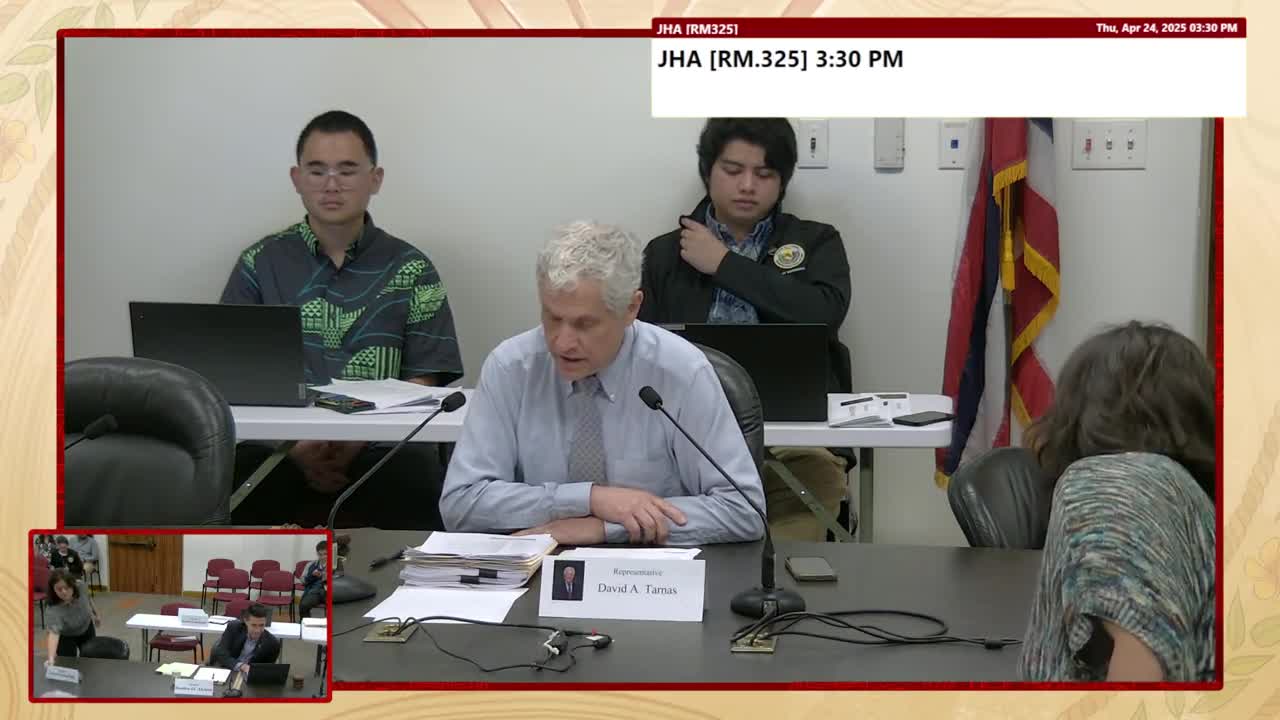 43SEC
Conference Committee
 2MIN
Conference Committee
 1MIN
Conference Committee
 3MIN
Conference Committee
 14MIN
Senate Standing Committee on Judiciary
Bill Author

Bill Co-Author(s):