HB 1957: Counties; Law Enforcement Officers; Private Entranceways; Obstruction
- Session Year: 2025-2026
- House: House
- Latest Version Date: 2026-03-24
Current Status:
Failed
(2026-04-07: The committee on JDC deferred the measure.)
Introduced
In Committee
First Chamber
In Committee
Second Chamber
Final Decking
Enacted
What does this bill do?
In counties with at least 300,000 people, the bill bans a person or their belongings from sleeping, sitting, standing, or placing property within ten feet of a private doorway to homes, businesses, schools, churches, community centers, or government buildings when it blocks people from entering or leaving. Police must give a verbal warning and up to one hour to move, may issue a citation if the person does not move, and can start county clearance procedures that may remove, store, or dispose of remaining property under state law.
The summary is provided by generative AI which can make mistakes. For original language, please view the details in the table below.
Establishes, for a county with a population greater than three hundred thousand, enforcement procedures to prevent people or personal property from blocking or otherwise impeding ingress or egress to private doorways and entranceways. Effective 7/1/3000. (SD1)
Establishes, for a city with a population greater than three hundred thousand, enforcement procedures to prevent people or personal property from blocking or otherwise impeding ingress or egress to private doorways and entranceways. Effective 7/1/3000. (HD1)
Establishes, for a city with a population greater than three hundred thousand, enforcement procedures to prevent domiciling or storing personal property on public property in a manner that blocks, obstructs, or otherwise impedes ingress or egress to private doorways or entranceways.
|
HOUSE OF REPRESENTATIVES |
H.B. NO. |
1957 |
|
THIRTY-THIRD LEGISLATURE, 2026 |
H.D. 1 |
|
|
STATE OF HAWAII |
S.D. 1 |
|
|
|
|
|
|
|
||
|
|
||
A BILL FOR AN ACT
RELATING TO SAFE ENTRYWAYS.
BE IT ENACTED BY THE LEGISLATURE OF THE STATE OF HAWAII:
SECTION 1. The legislature finds that, according to the 2024 point-in-time count, the number of individuals experiencing homelessness on Oahu increased by about twelve per cent from 2023 to 2024, with unsheltered homelessness on Oahu rising by one hundred ten per cent over the past twelve years. This increase has resulted in more unsheltered individuals residing in public spaces, especially in urban areas such as public sidewalks, often in front of residential, commercial, and school entrances, thereby obstructing access and creating hazards for kupuna, keiki, persons with disabilities, and individuals with limited mobility.
Maintaining clear and accessible entrances is critical to protecting public safety, preserving access to essential services, and ensuring that all members of the community can safely enter and exit their homes, schools, and places of work.
The purpose of this Act is to establish, for counties with a population of three hundred thousand or more, enforcement procedures to prevent people or personal property from blocking or otherwise impeding ingress or egress to private doorways and entranceways.
SECTION 2. Chapter 711, Hawaii Revised Statutes, is amended by adding a new section to part I to be appropriately designated and to read as follows:
"§711- Prohibited activity at an entranceway. (1) In any county with a population of three hundred thousand or more, a person commits the offense of prohibited activity at an entranceway, if the person intentionally, knowingly, or recklessly sleeps, lies, sits, remains standing, or places personal property or a combination thereof within ten feet of a private doorway or entranceway of a protected location in a manner that obstructs or materially interferes with ingress or egress.
(2) Prohibited activity at an entranceway shall be a violation subject to citation pursuant to subsection (4)(b).
(3) The prohibitions in subsection (1) shall not apply to a person who is:
(a) Acting as authorized or allowed by state law, county ordinance, or a permit or rule issued by the state or a county;
(b) Actively waiting to enter a protected location for goods or services during the location's hours of operation; provided that the person and any personal property do not materially interfere with ingress or egress; or
(c) Present pursuant to verbal or written permission granted by the owner, lessee, or authorized agent of the protected location.
(4) A person in violation of this section shall remove themselves and all personal property at least ten feet away from the private doorway or entranceway to allow ingress or egress to the private doorway or entranceway. When a person is found in violation, a county law enforcement officer shall:
(a) Issue a verbal warning, which shall include:
(i) Notice that the person is in violation of this section;
(ii) Instructions for the person to move themselves and all personal property at least ten feet away from the private doorway or entranceway to allow ingress or egress to the private doorway or entranceway; and
(iii) Notice that if the person is still in violation of this section within one hour, it will result in a citation;
(b) Issue an initial citation if, after one hour from receipt of the verbal warning, the person continues to be in violation of subsection (1); and
(c) Initiate the county's encampment or obstruction clearance protocol, in accordance with applicable county standard operating procedures, if the person continues to be in violation of subsection (1) after a verbal warning in accordance with paragraph (a) and a reasonable opportunity to comply; provided that:
(i) Any personal property remaining at the location may be removed as part of the clearance. The status, storage, reclamation, and disposition of removed property shall be governed exclusively by section 171-31.5; and
(ii) Items that are perishable or contaminated, constitute refuse, or pose an immediate threat to public health or safety may be summarily disposed of at the time of removal; provided further that the determination shall be based on specific and articulable health or safety conditions; provided further that the officer shall document the basis for the determination in a written report prepared contemporaneously with the removal.
(5) County law enforcement agencies shall have authority to enforce this section, including issuing warnings and citations, and may effect arrests only as authorized by law.
(6) Complaints regarding individuals domiciling or storing personal property in violation of this section shall be directed primarily to county law enforcement agencies; provided that all law enforcement agencies shall work collaboratively to coordinate enforcement efforts and ensure effective compliance.
(7) This section shall supplement and shall not replace or preempt any existing state or county laws, ordinances, or rules prohibiting obstruction, domiciling, or unlawful storage of personal property on public property adjacent to private doorways or entranceways. Citations issued pursuant to this section shall be in addition to any other penalties or enforcement actions authorized under law.
(8) For the purposes of this section:
"Private doorway or entranceway" means a door, gate, or other access point that is designed or intended for pedestrian ingress or egress to or from a protected location and that directly abuts a public sidewalk or public way, including:
(a) Doorways serving residential, commercial, educational, community, or religious uses;
(b) Doorways of vacant commercial properties that remain accessible from a public sidewalk;
(c) Service or delivery entrances used for pedestrian access; and
(d) Fire escape doors, emergency exits, and other designated pedestrian egress points.
"Protected location" means a residence, business, educational institution, religious institution, community center, or governmental entity.
"Reasonable opportunity to comply" means a period of time after a verbal warning issued in accordance with subsection (4)(a), during which the person is permitted to cease the specific conduct and begin relocating themselves and any personal property. The determination shall be based on objective circumstances, including:
(a) The volume of personal property present;
(b) The person's apparent physical or mental condition;
(c) Weather and safety conditions; and
(d) Whether the person is actively and measurably relocating themselves or personal property."
SECTION 3. This Act does not affect rights and duties that matured, penalties that were incurred, and proceedings that were begun before its effective date.
SECTION 4. If any provision of this Act, or the application thereof to any person or circumstance, is held invalid, the invalidity does not affect other provisions or applications of the Act that can be given effect without the invalid provision or application, and to this end the provisions of this Act are severable.
SECTION 5. New statutory material is underscored.
SECTION 6. This Act shall take effect on July 1, 3000.
Report Title:
Counties; Law Enforcement Officers; Private Entranceways; Obstruction
Description:
Establishes, for a county with a population greater than three hundred thousand, enforcement procedures to prevent people or personal property from blocking or otherwise impeding ingress or egress to private doorways and entranceways. Effective 7/1/3000. (SD1)
The summary description of legislation appearing on this page is for informational purposes only and is not legislation or evidence of legislative intent.
|
HOUSE OF REPRESENTATIVES |
H.B. NO. |
1957 |
|
THIRTY-THIRD LEGISLATURE, 2026 |
H.D. 1 |
|
|
STATE OF HAWAII |
|
|
|
|
|
|
|
|
||
|
|
||
A BILL FOR AN ACT
RELATING TO SAFE ENTRYWAYS.
BE IT ENACTED BY THE LEGISLATURE OF THE STATE OF HAWAII:
SECTION 1. The legislature finds that, according to the 2024 point-in-time count, the number of individuals experiencing homelessness on Oahu increased by about twelve per cent from 2023 to 2024, with unsheltered homelessness on Oahu rising by one hundred ten per cent over the past twelve years. This increase has resulted in more unsheltered individuals residing in public spaces, especially in urban areas such as public sidewalks, often in front of residential, commercial, and school entrances, thereby obstructing access and creating hazards for kupuna, keiki, persons with disabilities, and individuals with limited mobility.
Maintaining clear and accessible entrances is critical to protecting public safety, preserving access to essential services, and ensuring that all members of the community can safely enter and exit their homes, schools, and places of work.
The purpose of this Act is to establish, for cities with a population of three hundred thousand or more, enforcement procedures to prevent people or personal property from blocking or otherwise impeding ingress or egress to private doorways and entranceways.
SECTION 2. Chapter 711, Hawaii Revised Statutes, is amended by adding a new section to part I to be appropriately designated and to read as follows:
"§711- Prohibited activity at an entranceway. (1) In any city with a population of three hundred thousand or more, a person commits the offense of prohibited activity at an entranceway, if the person intentionally, knowingly, or recklessly sleeps, lies, sits, remains standing, or places personal property or a combination thereof within ten feet of a private doorway or entranceway of a protected location in a manner that obstructs or materially interferes with ingress or egress.
(2) Prohibited activity at an entranceway shall be a violation subject to citation pursuant to subsection (4)(b).
(3) The prohibitions in subsection (1) shall not apply to a person who is:
(a) Acting as authorized or allowed by state law, county ordinance, or a permit or rule issued by the state or a county;
(b) Actively waiting to enter a protected location for goods or services during the location's hours of operation; provided that the person and any personal property do not materially interfere with ingress or egress; or
(c) Present pursuant to verbal or written permission granted by the owner, lessee, or authorized agent of the protected location.
(4) A person in violation of this section shall remove themselves and all personal property at least ten feet away from the private doorway or entranceway to allow ingress or egress to the private doorway or entranceway. When a person is found in violation, a county law enforcement officer shall:
(a) Issue a verbal warning, which shall include:
(i) Notice that the person is in violation of this section;
(ii) Instructions for the person to move themselves and all personal property at least ten feet away from the private doorway or entranceway to allow ingress or egress to the private doorway or entranceway; and
(iii) Notice that if the person is still in violation of this section within one hour, it will result in a citation;
(b) Issue an initial citation if, after one hour from receipt of the verbal warning, the person continues to be in violation of subsection (1); and
(c) Initiate the county's encampment or obstruction clearance protocol, in accordance with applicable county standard operating procedures, if the person continues to be in violation of subsection (1) after a verbal warning in accordance with paragraph (a) and a reasonable opportunity to comply; provided that:
(i) Any personal property remaining at the location may be removed as part of the clearance. The status, storage, reclamation, and disposition of removed property shall be governed exclusively by section 171-31.5; and
(ii) Items that are perishable or contaminated, constitute refuse, or pose an immediate threat to public health or safety may be summarily disposed of at the time of removal; provided further that the determination shall be based on specific and articulable health or safety conditions; provided further that the officer shall document the basis for the determination in a written report prepared contemporaneously with the removal.
(5) County law enforcement agencies shall have authority to enforce this section, including issuing warnings and citations, and may effect arrests only as authorized by law.
(6) Complaints regarding individuals domiciling or storing personal property in violation of this section shall be directed primarily to county law enforcement agencies; provided that all law enforcement agencies shall work collaboratively to coordinate enforcement efforts and ensure effective compliance.
(7) This section shall supplement and shall not replace or preempt any existing state or county laws, ordinances, or rules prohibiting obstruction, domiciling, or unlawful storage of personal property on public property adjacent to private doorways or entranceways. Citations issued pursuant to this section shall be in addition to any other penalties or enforcement actions authorized under law.
(8) For purposes of this section:
"Private doorway or entranceway" means a door, gate, or other access point that is designed or intended for pedestrian ingress or egress to or from a protected location and that directly abuts a public sidewalk or public way, including:
(a) Doorways serving residential, commercial, educational, community, or religious uses;
(b) Doorways of vacant commercial properties that remain accessible from a public sidewalk;
(c) Service or delivery entrances used for pedestrian access; and
(d) Fire escape doors, emergency exits, and other designated pedestrian egress points.
"Protected location" means a residence, business, educational institution, religious institution, community center, or governmental entity.
(9) For purposes of this section, "reasonable opportunity to comply" means a period of time after a verbal warning issued in accordance with subsection (4)(a), during which the person is permitted to cease the specific conduct and begin relocating themselves and any personal property. The determination shall be based on objective circumstances, including:
(a) The volume of personal property present;
(b) The person's apparent physical or mental condition;
(c) Weather and safety conditions; and
(d) Whether the person is actively and measurably relocating themselves or personal property."
SECTION 3. This Act does not affect rights and duties that matured, penalties that were incurred, and proceedings that were begun before its effective date.
SECTION 4. If any provision of this Act, or the application thereof to any person or circumstance, is held invalid, the invalidity does not affect other provisions or applications of the Act that can be given effect without the invalid provision or application, and to this end the provisions of this Act are severable.
SECTION 5. New statutory material is underscored.
SECTION 6. This Act shall take effect on July 1, 3000.
Report Title:
Counties; Law Enforcement Officers; Private Entranceways; Obstruction
Description:
Establishes, for a city with a population greater than three hundred thousand, enforcement procedures to prevent people or personal property from blocking or otherwise impeding ingress or egress to private doorways and entranceways. Effective 7/1/3000. (HD1)
The summary description of legislation appearing on this page is for informational purposes only and is not legislation or evidence of legislative intent.
|
HOUSE OF REPRESENTATIVES |
H.B. NO. |
1957 |
|
THIRTY-THIRD LEGISLATURE, 2026 |
|
|
|
STATE OF HAWAII |
|
|
|
|
|
|
|
|
||
|
|
||
A BILL FOR AN ACT
RELATING TO SAFE ENTRYWAYS.
BE IT ENACTED BY THE LEGISLATURE OF THE STATE OF HAWAII:
SECTION 1. The legislature finds that, according to the 2024 point‑in‑time count, the number of individuals experiencing homelessness on Oahu increased by about twelve per cent from 2023 to 2024, with unsheltered homelessness on Oahu rising by one hundred ten per cent over the past twelve years. This increase has resulted in more unsheltered individuals residing in public spaces, especially in urban areas such as public sidewalks, often in front of residential, commercial, and school entrances, thereby obstructing access and creating hazards for kupuna, keiki, persons with disabilities, and individuals with limited mobility.
Maintaining clear and accessible entrances is essential to protecting public safety, preserving access to essential services, and ensuring that all members of the community can safely enter and exit their homes, schools, and places of work.
The purpose of this Act is to establish, for cities with a population of three hundred thousand or more, enforcement procedures to prevent domiciling or storing personal property on public property in a manner that blocks, obstructs, or otherwise impedes ingress or egress to private doorways or entranceways.
SECTION 2. Chapter 46, Hawaii Revised Statutes, is amended by adding a new section to be appropriately designated and to read as follows:
"§46- Safe entrances; unlawful domiciling or storage of personal property. (a) In any city with a population of three hundred thousand or more, no person shall domicile or store personal property on public property:
(1) In a manner that blocks, obstructs, or otherwise impedes ingress or egress to a private doorway or entranceway; or
(2) Within ten feet of a private doorway or entranceway,
unless the person intends to immediately access the premises for lawful purposes.
(b) A person in violation of this section shall remove oneself and all personal property at least ten feet away from the private doorway or entranceway to allow ingress or egress to the private doorway or entranceway. When a person is found in violation, a county law enforcement officer shall:
(1) Issue a verbal warning, which shall include:
(A) Notice that the person is unlawfully domiciling or storing personal property in violation of this section;
(B) Instructions for the person to move oneself and all personal property at least ten feet away from the private doorway or entranceway to allow ingress or egress to the private doorway or entranceway; and
(C) Notice that failure to make reasonable or measurable efforts to comply with this subsection within one hour will result in a citation;
(2) Issue an initial citation if, after one hour from receipt of the verbal warning, the person has not made reasonable or measurable efforts to comply with this subsection and continues to violate subsection (a);
(3) Issue a second citation if, after one hour from the issuance of the initial citation, the person has not made reasonable or measurable efforts to comply with this subsection and continues to violate subsection (a); and
(4) Initiate the county's encampment or obstruction clearance protocol, in accordance with applicable county standard operating procedures, if the person continues to violate subsection (a) after one hour from the issuance of the second citation. If the clearance protocol is initiated under this paragraph:
(A) All personal property shall be removed within one hour; and
(B) Any remaining unclaimed property may be removed and disposed of in accordance with county procedures.
(c) County law enforcement agencies shall have authority to enforce this section, including issuing warnings and citations and effecting arrests as authorized by law.
(d) Complaints regarding individuals domiciling or storing personal property in violation of this section shall be directed primarily to county law enforcement agencies; provided that all law enforcement agencies shall work collaboratively to coordinate enforcement efforts and ensure effective compliance.
(e) This section shall supplement and shall not replace or preempt any existing state or county laws, ordinances, or rules prohibiting obstruction, domiciling, or unlawful storage of personal property on public property adjacent to private doorways or entranceways. Citations issued pursuant to this section shall be in addition to any other penalties or enforcement actions authorized under law.
(f) County law enforcement officers shall not presume an immediate violation and shall make reasonable, polite inquiries when responding to complaints or suspected violations. At each stage of enforcement, officers shall assess whether the person is making reasonable efforts to comply, recognizing that some persons may require additional time to safely remove personal belongings.
(g) For purposes of this section, "private doorway or entranceway" includes but is not limited to:
(1) Doorways serving residential spaces, businesses, educational institutions, community centers, or religious centers;
(2) Doorways of vacant or unoccupied commercial properties;
(3) Service or delivery entrances to residential or commercial structures; and
(4) Fire escape doors, emergency exits, and other designated egress points for buildings or homes."
SECTION 3. This Act does not affect rights and duties that matured, penalties that were incurred, and proceedings that were begun before its effective date.
SECTION 4. If any provision of this Act, or the application thereof to any person or circumstance, is held invalid, the invalidity does not affect other provisions or applications of the Act that can be given effect without the invalid provision or application, and to this end the provisions of this Act are severable.
SECTION 5. New statutory material is underscored.
SECTION 6. This Act shall take effect upon its approval.
|
INTRODUCED BY: |
_____________________________ |
|
|
|
Report Title:
Counties; Law Enforcement Officers; Private Entranceways; Obstruction
Description:
Establishes, for a city with a population greater than three hundred thousand, enforcement procedures to prevent domiciling or storing personal property on public property in a manner that blocks, obstructs, or otherwise impedes ingress or egress to private doorways or entranceways.
The summary description of legislation appearing on this page is for informational purposes only and is not legislation or evidence of legislative intent.
|
Date
|
Status
|
|---|---|
| Apr 7, 2026 | The committee on JDC deferred the measure. |
| Apr 1, 2026 | The committee(s) on JDC will hold a public decision making on 04-07-26 10:15AM; Conference Room 016 & Videoconference. |
| Mar 24, 2026 | Report adopted; Passed Second Reading, as amended (SD 1) and referred to JDC. |
| Mar 24, 2026 | Reported from PSM (Stand. Com. Rep. No. 3165) with recommendation of passage on Second Reading, as amended (SD 1) and referral to JDC. |
| Mar 20, 2026 | The committee(s) on PSM recommend(s) that the measure be PASSED, WITH AMENDMENTS. The votes in PSM were as follows: 4 Aye(s): Senator(s) Fukunaga, Lee, C., Hashimoto, DeCorte; Aye(s) with reservations: none ; 0 No(es): none; and 1 Excused: Senator(s) Inouye. |
| Mar 16, 2026 | The committee(s) on PSM has scheduled a public hearing on 03-20-26 3:15PM; Conference Room 016 & Videoconference. |
| Mar 12, 2026 | Referred to PSM, JDC. |
| Mar 12, 2026 | Passed First Reading. |
| Mar 12, 2026 | Received from House (Hse. Com. No. 324). |
| Mar 10, 2026 | Passed Third Reading with Representative(s) Iwamoto voting aye with reservations; none voting no (0) and none excused (0). Transmitted to Senate. |
| Mar 5, 2026 | Passed Second Reading as amended in HD 1; placed on the calendar for Third Reading with none voting aye with reservations; none voting no (0) and Representative(s) Perruso excused (1). |
| Mar 5, 2026 | Reported from JHA (Stand. Com. Rep. No. 915-26) as amended in HD 1, recommending passage on Second Reading and placement on the calendar for Third Reading. |
| Mar 3, 2026 | The committee on JHA recommend that the measure be PASSED, WITH AMENDMENTS. The votes were as follows: 9 Ayes: Representative(s) Tarnas, Poepoe, Belatti, Hashem, Kahaloa, Sayama, Takayama, Garcia, Shimizu; Ayes with reservations: none; Noes: none; and 1 Excused: Representative(s) Cochran. |
| Feb 27, 2026 | Bill scheduled to be heard by JHA on Tuesday, 03-03-26 2:00PM in House conference room 325 VIA VIDEOCONFERENCE. |
| Jan 28, 2026 | Referred to JHA, referral sheet 3 |
| Jan 26, 2026 | Introduced and Pass First Reading. |
| Jan 23, 2026 | Pending introduction. |
|
Date
|
Description
|
Location
|
Votes
|
|
|---|---|---|---|---|
| Mar 20, 2026 | The committee(s) on PSM recommend(s) that the measure be PASSED, WITH AMENDMENTS | Senate Standing Committee on Public Safety and Military Affairs |
Passed |
|
| Mar 10, 2026 | Third Reading | House Floor |
Passed |
|
| Mar 3, 2026 | The committee on JHA recommend that the measure be PASSED, WITH AMENDMENTS | House Standing Committee on Judiciary & Hawaiian Affairs |
Passed |
This list shows positions taken on this bill by organizations on the date displayed, which is linked to the original source.
Positions by individuals are not included.
|
Organization
|
Position
|
Date
|
|---|---|---|
| Ala Moana-Kakaʻako Neighborhood Board No.11 | *** Support | Apr 7, 2026 |
| Aloha Independent Living Hawaii | *** Against | Mar 20, 2026 |
| Retail Merchants of Hawaiʻi | *** Support | Apr 7, 2026 |
STAND. COM. REP. NO. 915-26
Honolulu, Hawaii
, 2026
RE: H.B. No. 1957
H.D. 1
Honorable Nadine K. Nakamura
Speaker, House of Representatives
Thirty-Third State Legislature
Regular Session of 2026
State of Hawaii
Madame:
Your Committee on Judiciary & Hawaiian Affairs, to which was referred H.B. No. 1957 entitled:
"A BILL FOR AN ACT RELATING TO SAFE ENTRYWAYS,"
begs leave to report as follows:
Your Committee finds that the State continues to see an increase in unsheltered individuals, which has led to more individuals residing in public spaces, including in front of residential, commercial, and school entrances in urban areas. This creates a hazard for those trying to access these places, especially for kupuna, keiki, and individuals with disabilities or limited mobility. This measure establishes enforcement procedures to ensure that there is safe ingress and egress from private doorways and entrances.
Your Committee has amended this measure by:
(1) Codifying the prohibition and enforcement framework under the Penal Code as the offense of prohibited activity at an entranceway, a violation subject to citation;
(2) Amending the scope of the prohibited conduct to prohibit a person from intentionally, knowingly, or recklessly sleeping, lying, sitting, remaining standing, or placing personal property, or a combination thereof, within ten feet of a private doorway or entranceway of a protected location in a manner that obstructs or materially interferes with ingress or egress;
(3) Adding exemptions for persons acting pursuant to state or county authorization, persons actively waiting to enter a protected location during the location's hours of operation, and persons present with the permission of the owner, lessee, or authorized agent of the protected location;
(4) Clarifying the graduated enforcement framework, which requires a verbal warning of violation, issuance of a citation after one hour for continued violation, and initiation of a county encampment or obstruction clearance protocol for continued violation after a verbal warning and reasonable opportunity to comply;
(5) Clarifying the handling, removal, and disposition of personal property during clearance, and authorizing the summary disposal of perishable, contaminated, refuse, or hazardous items only when supported by specific and articulable public health or safety conditions and documented by the officer;
(6) Deleting language specifically directing law enforcement officers on how to respond to and assess complaints or suspected violations, including requirements that officers not presume an immediate violation and make reasonable, polite inquiries;
(7) Amending the definition of "private doorway or entranceway" and adding definitions for "protected location" and "reasonable opportunity to comply";
(8) Changing the effective date to July 1, 3000, to encourage further discussion; and
(9) Making technical, nonsubstantive amendments for the purposes of clarity, consistency, and style.
As affirmed by the record of votes of the members of your Committee on Judiciary & Hawaiian Affairs that is attached to this report, your Committee is in accord with the intent and purpose of H.B. No. 1957, as amended herein, and recommends that it pass Second Reading in the form attached hereto as H.B. No. 1957, H.D. 1, and be placed on the calendar for Third Reading.
Respectfully submitted on behalf of the members of the Committee on Judiciary & Hawaiian Affairs,
|
|
|
____________________________ DAVID A. TARNAS, Chair |
|
|
|
|
|
Date
|
Testimony PDF
|
|---|---|
| Apr 7, 2026 | HB1957_SD1_TESTIMONY_JDC_04-07-26_.PDF |
| Mar 20, 2026 | HB1957_HD1_TESTIMONY_PSM_03-20-26_.PDF |
| Mar 3, 2026 | HB1957_TESTIMONY_JHA_03-03-26_.PDF |
Discussed in Hearing
 1MIN
Senate Standing Committee on Public Safety and Military Affairs
32SEC
Senate Standing Committee on Public Safety and Military Affairs
 1MIN
House Floor
 2MIN
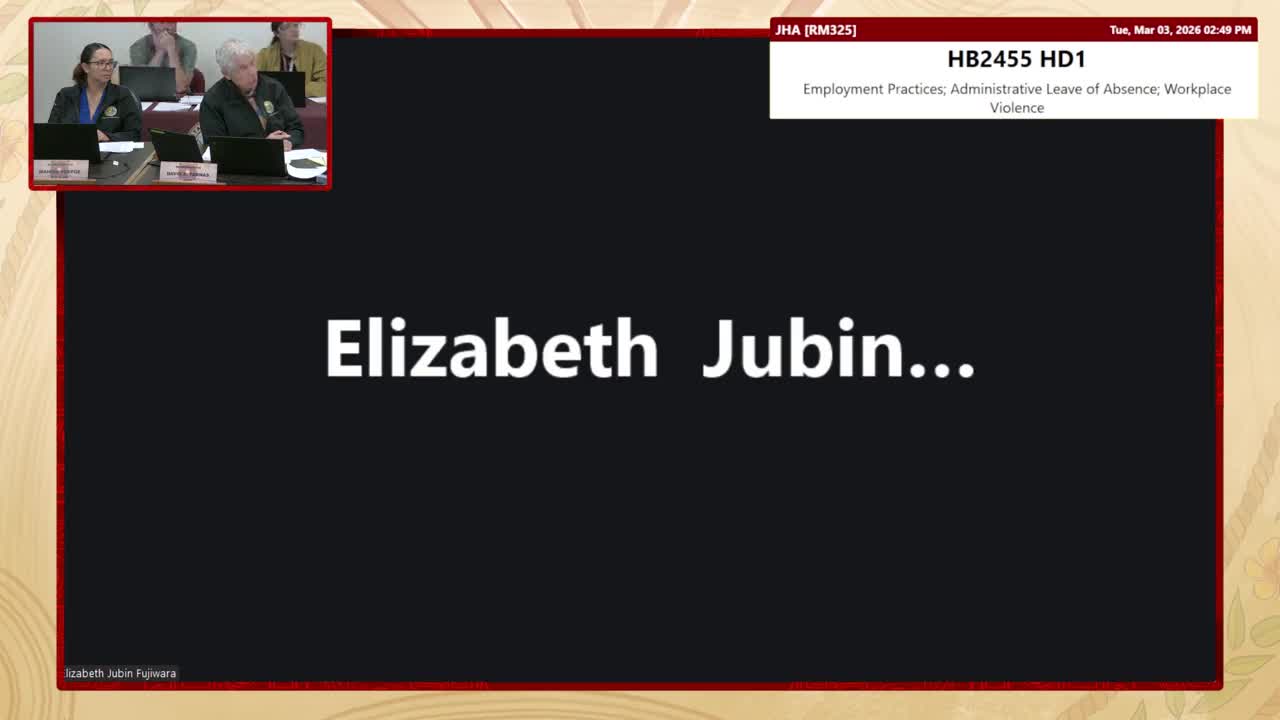
House Standing Committee on Judiciary & Hawaiian Affairs
 2MIN