HB 1896: DOE; Community Schools; Appropriation
- Session Year: 2025-2026
- House: House
- Latest Version Date: 2026-03-25
Current Status:
Failed
(2026-03-30: Report adopted; Passed Second Reading, as amended (SD 1) and referred to WAM.)
Introduced
In Committee
First Chamber
In Committee
Second Chamber
Final Decking
Enacted
Appropriates funds to the Department of Education to support community schools. Effective 7/31/2055. (SD1)
Appropriates funds to the Department of Education to support community schools. Effective 7/1/3000. (HD1)
Appropriates funds to the Department of Education to support community schools.
|
HOUSE OF REPRESENTATIVES |
H.B. NO. |
1896 |
|
THIRTY-THIRD LEGISLATURE, 2026 |
H.D. 1 |
|
|
STATE OF HAWAII |
S.D. 1 |
|
|
|
|
|
|
|
||
|
|
||
A BILL FOR AN ACT
RELATING TO COMMUNITY SCHOOLS.
BE IT ENACTED BY THE LEGISLATURE OF THE STATE OF HAWAII:
SECTION 1. The legislature finds that in Hawaii, a community school is a place where the school, its staff, families, students, and the community work together to help every student thrive.
The legislature further finds that community schools support the whole child and the whole family by addressing not only academic achievement, but also students' health, well-being, sense of belonging, and connection to their community and ʻāina. Community schools are grounded in partnership and reciprocity, recognizing students and families not only as recipients of services, but as valued contributors, leaders, and co-designers of solutions that strengthen the entire school community.
The legislature additionally finds that community schools are needed to help align and leverage the many initiatives, resources, and services already present in schools and communities that too often operate in isolation. The community schools strategy intentionally coordinates these efforts toward shared goals, collective impact, and sustainable school improvement, rather than fragmented or duplicative approaches.
The legislature also finds that community schools are built on inclusive decision-making, a shared vision, actionable data, and trusting pilina among schools, families, students, and community partners. Through this approach, community schools focus on supporting students and families through the following key practices:
(1) Expanded, enriched learning opportunities;
(2) Rigorous, community-connected classroom instruction;
(3) A culture of belonging, safety, and care;
(4) Powerful family and student engagement;
(5) Integrated systems of support; and
(6) Collaborative leadership, shared voice, and power.
The legislature further finds that community schools address the root causes of barriers to learning by engaging students, families, educators, and community members in identifying needs, assets, and solutions. Community school coordinators play a critical role in this strategy by building partnerships, aligning resources, facilitating collaboration, and supporting schools in translating community voices and data into effective action.
The legislature recognizes that community schools are a proven, time-tested strategy that can produce short-term outcomes, including improved attendance, increased family engagement, and reduced behavioral referrals, as well as long-term outcomes, such as improved academic achievement, positive school culture and climate, increased teacher retention, and higher graduation rates.
The legislature additionally finds that improving regular student attendance is a priority for the department of education and community schools are a promising approach to addressing chronic absenteeism by creating the conditions necessary for learning, including stable relationships, coordinated supports, and meaningful family engagement.
The legislature notes that research demonstrates a strong return on investment for community schools. A study of community schools in Albuquerque, New Mexico, found that for every dollar invested in a community school coordinator, the return on investment was approximately $7.11 in net benefits. A study of community schools in New York City found positive and significant effects on on-time grade progression for elementary and middle school students and increased high school graduation rates. A report by the Learning Policy Institute identified community schools as a promising approach to improving attendance by addressing underlying barriers to learning.
Accordingly, the purpose of this Act is to appropriate funds to the department of education to support the implementation, coordination, and sustainability of community schools in Hawaii.
SECTION 2. There is appropriated out of the general revenues of the State of Hawaii the sum of $ or so much thereof as may be necessary for fiscal year 2026-2027 for community schools, including administrative program management and support for implementation, and technical assistance and evaluation.
The sum appropriated shall be expended by the department of education for the purposes of this Act.
SECTION 3. This Act shall take effect on July 31, 2055.
Report Title:
DOE; Community Schools; Appropriation
Description:
Appropriates funds to the Department of Education to support community schools. Effective 7/31/2055. (SD1)
The summary description of legislation appearing on this page is for informational purposes only and is not legislation or evidence of legislative intent.
|
HOUSE OF REPRESENTATIVES |
H.B. NO. |
1896 |
|
THIRTY-THIRD LEGISLATURE, 2026 |
H.D. 1 |
|
|
STATE OF HAWAII |
|
|
|
|
|
|
|
|
||
|
|
||
A BILL FOR AN ACT
RELATING TO COMMUNITY SCHOOLS.
BE IT ENACTED BY THE LEGISLATURE OF THE STATE OF HAWAII:
SECTION 1. The legislature finds that in Hawaii, a community school is a place where the school, its staff, families, students, and the community work together to help every student thrive.
The legislature further finds that community schools support the whole child and the whole family by addressing not only academic achievement, but also students' health, well-being, sense of belonging, and connection to their community and ʻāina. Community schools are grounded in partnership and reciprocity, recognizing students and families not only as recipients of services, but as valued contributors, leaders, and co-designers of solutions that strengthen the entire school community.
The legislature additionally finds that community schools are needed to help align and leverage the many initiatives, resources, and services already present in schools and communities that too often operate in isolation. The community schools strategy intentionally coordinates these efforts toward shared goals, collective impact, and sustainable school improvement, rather than fragmented or duplicative approaches.
The legislature also finds that community schools are built on inclusive decision-making, a shared vision, actionable data, and trusting pilina among schools, families, students, and community partners. Through this approach, community schools focus on supporting students and families through the following key practices:
(1) Expanded, enriched learning opportunities;
(2) Rigorous, community-connected classroom instruction;
(3) A culture of belonging, safety, and care;
(4) Powerful family and student engagement;
(5) Integrated systems of support; and
(6) Collaborative leadership, shared voice, and power.
The legislature further finds that community schools address the root causes of barriers to learning by engaging students, families, educators, and community members in identifying needs, assets, and solutions. Community school coordinators play a critical role in this strategy by building partnerships, aligning resources, facilitating collaboration, and supporting schools in translating community voice and data into effective action.
The legislature recognizes that community schools are a proven, time-tested strategy that can produce short-term outcomes, including improved attendance, increased family engagement, and reduced behavioral referrals, as well as long-term outcomes such as improved academic achievement, positive school culture and climate, increased teacher retention, and higher graduation rates.
The legislature additionally finds that improving regular student attendance is a priority for the department of education and community schools are a promising approach to addressing chronic absenteeism by creating the conditions necessary for learning, including stable relationships, coordinated supports, and meaningful family engagement.
The legislature notes that research demonstrates a strong return on investment for community schools. A study of community schools in Albuquerque, New Mexico, found that for every dollar invested in a community school coordinator, the return on investment was approximately $7.11 in net benefits. A study of community schools in New York City found positive and significant effects on on-time grade progression for elementary and middle school students and increased high school graduation rates. A report by the Learning Policy Institute identified community schools as a promising approach to improving attendance by addressing underlying barriers to learning.
Accordingly, the purpose of this Act is to appropriate funds to the department of education to support the implementation, coordination, and sustainability of community schools in Hawaii.
SECTION 2. There is appropriated out of the general revenues of the State of Hawaii the sum of $ or so much thereof as may be necessary for fiscal year 2026-2027 for community schools, including administrative program management and support for implementation, and technical assistance and evaluation.
The sum appropriated shall be expended by the department of education for the purposes of this Act.
SECTION 3. This Act shall take effect on July 1, 3000.
Report Title:
Department of Education; Community Schools; Appropriation
Description:
Appropriates funds to the Department of Education to support community schools. Effective 7/1/3000. (HD1)
The summary description of legislation appearing on this page is for informational purposes only and is not legislation or evidence of legislative intent.
|
HOUSE OF REPRESENTATIVES |
H.B. NO. |
1896 |
|
THIRTY-THIRD LEGISLATURE, 2026 |
|
|
|
STATE OF HAWAII |
|
|
|
|
|
|
|
|
||
|
|
||
A BILL FOR AN ACT
relating to community schools.
BE IT ENACTED BY THE LEGISLATURE OF THE STATE OF HAWAII:
SECTION 1. The legislature finds that in Hawaii, a community school is a place where the school, its staff, families, students, and the community work together to help every student thrive.
The legislature further finds that community schools support the whole child and the whole family by addressing not only academic achievement, but also students' health, well-being, sense of belonging, and connection to their community and ʻāina. Community schools are grounded in partnership and reciprocity, recognizing students and families not only as recipients of services, but as valued contributors, leaders, and co-designers of solutions that strengthen the entire school community.
The legislature additionally finds that community schools are needed to help align and leverage the many initiatives, resources, and services already present in schools and communities that too often operate in isolation. The community schools strategy intentionally coordinates these efforts toward shared goals, collective impact, and sustainable school improvement, rather than fragmented or duplicative approaches.
The legislature also finds that community schools are built on inclusive decision-making, a shared vision, actionable data, and trusting pilina among schools, families, students, and community partners. Through this approach, community schools focus on supporting students and families through the following key practices:
(1) Expanded, enriched learning opportunities;
(2) Rigorous, community-connected classroom instruction;
(3) A culture of belonging, safety, and care;
(4) Powerful family and student engagement;
(5) Integrated systems of support; and
(6) Collaborative leadership, shared voice, and power.
The legislature further finds that community schools address the root causes of barriers to learning by engaging students, families, educators, and community members in identifying needs, assets, and solutions. Community school coordinators play a critical role in this strategy by building partnerships, aligning resources, facilitating collaboration, and supporting schools in translating community voice and data into effective action.
The legislature recognizes that community schools are a proven, time-tested strategy that can produce short-term outcomes, including improved attendance, increased family engagement, and reduced behavioral referrals, as well as long-term outcomes such as improved academic achievement, positive school culture and climate, increased teacher retention, and higher graduation rates.
The legislature additionally finds that improving regular student attendance is a priority for the department of education and that community schools are a promising approach to addressing chronic absenteeism by creating the conditions necessary for learning, including stable relationships, coordinated supports, and meaningful family engagement.
The legislature notes that research demonstrates a strong return on investment for community schools. A study of community schools in Albuquerque, New Mexico, found that for every dollar invested in a community school coordinator, the return on investment was approximately $7.11 in net benefits. A study of community schools in New York City found positive and significant effects on on-time grade progression for elementary and middle school students and increased high school graduation rates. A report by the Learning Policy Institute identified community schools as a promising approach to improving attendance by addressing underlying barriers to learning.
Accordingly, the purpose of this Act is to appropriate funds to the department of education to support the implementation, coordination, and sustainability of community schools in Hawaii.
SECTION 2. There is appropriated out of the general revenues of the State of Hawaii the sum of $2,152,500 or so much thereof as may be necessary for fiscal year 2026-2027 for community schools, including administrative program management and support for implementation, and technical assistance and evaluation.
The sum appropriated shall be expended by the department of education for the purposes of this Act.
SECTION 3. This Act shall take effect on July 1, 2026.
|
INTRODUCED BY: |
_____________________________ |
Report Title:
Department of Education; Community Schools; Appropriation
Description:
Appropriates funds to the Department of Education to support community schools.
The summary description of legislation appearing on this page is for informational purposes only and is not legislation or evidence of legislative intent.
|
Date
|
Status
|
|---|---|
| Mar 30, 2026 | Report adopted; Passed Second Reading, as amended (SD 1) and referred to WAM. |
| Mar 30, 2026 | Reported from EDU (Stand. Com. Rep. No. 3264) with recommendation of passage on Second Reading, as amended (SD 1) and referral to WAM. |
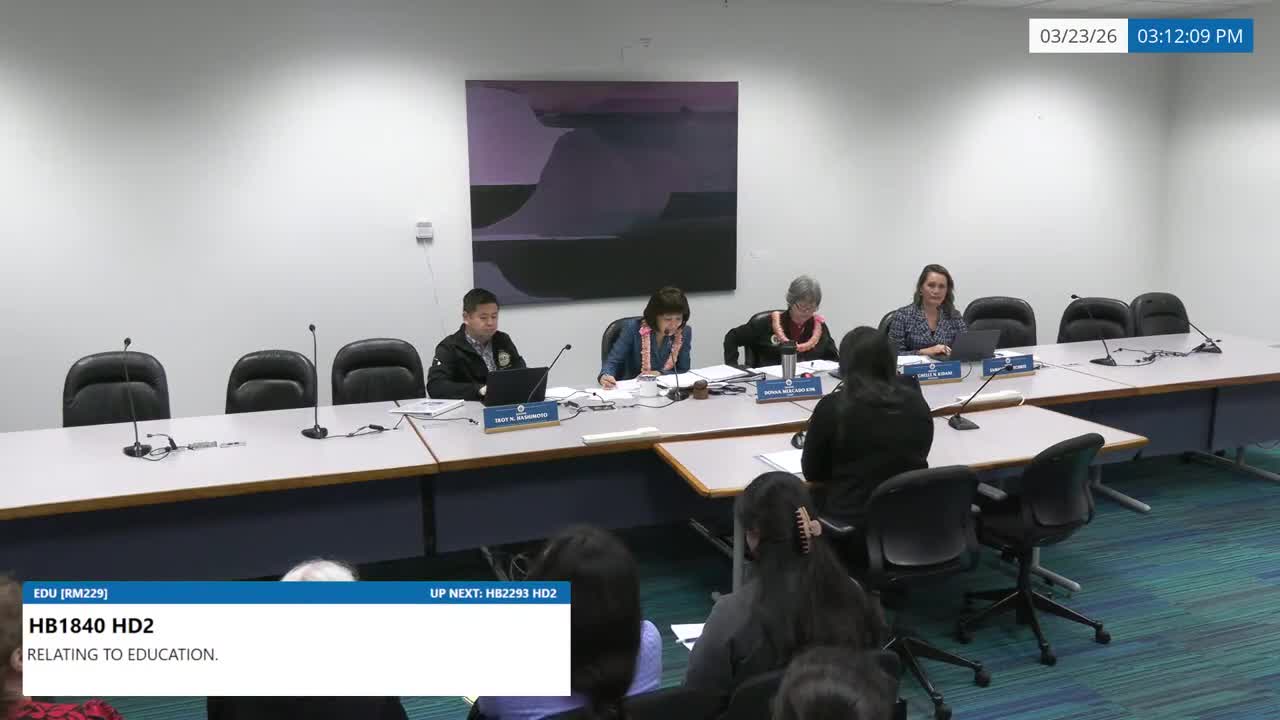
| Mar 23, 2026 | The committee(s) on EDU recommend(s) that the measure be PASSED, WITH AMENDMENTS. The votes in EDU were as follows: 4 Aye(s): Senator(s) Kim, Kidani, Hashimoto, DeCorte; Aye(s) with reservations: none ; 0 No(es): none; and 1 Excused: Senator(s) Fukunaga. |
| Mar 20, 2026 | The committee(s) on EDU has scheduled a public hearing on 03-23-26 1:11PM; Conference Room 229 & Videoconference. |
| Mar 10, 2026 | Referred to EDU, WAM. |
| Mar 10, 2026 | Passed First Reading. |
| Mar 10, 2026 | Received from House (Hse. Com. No. 165). |
| Mar 6, 2026 | Passed Third Reading with none voting aye with reservations; none voting no (0) and Representative(s) Perruso, Sayama excused (2). Transmitted to Senate. |
| Mar 6, 2026 | Reported from FIN (Stand. Com. Rep. No. 958-26), recommending passage on Third Reading. |
| Mar 3, 2026 | The committee on FIN recommend that the measure be PASSED, UNAMENDED. The votes were as follows: 16 Ayes: Representative(s) Todd, Takenouchi, Hartsfield, Hussey, Keohokapu-Lee Loy, Kitagawa, Kusch, Lee, M., Miyake, Morikawa, Perruso, Templo, Yamashita, Alcos, Gedeon, Reyes Oda; Ayes with reservations: none; 0 Noes: none; and 0 Excused: none. |
| Feb 27, 2026 | Bill scheduled to be heard by FIN on Tuesday, 03-03-26 2:00PM in House conference room 308 VIA VIDEOCONFERENCE. |
| Feb 19, 2026 | Passed Second Reading as amended in HD 1 and referred to the committee(s) on FIN with none voting aye with reservations; none voting no (0) and none excused (0). |
| Feb 19, 2026 | Reported from EDN (Stand. Com. Rep. No. 516-26) as amended in HD 1, recommending passage on Second Reading and referral to FIN. |
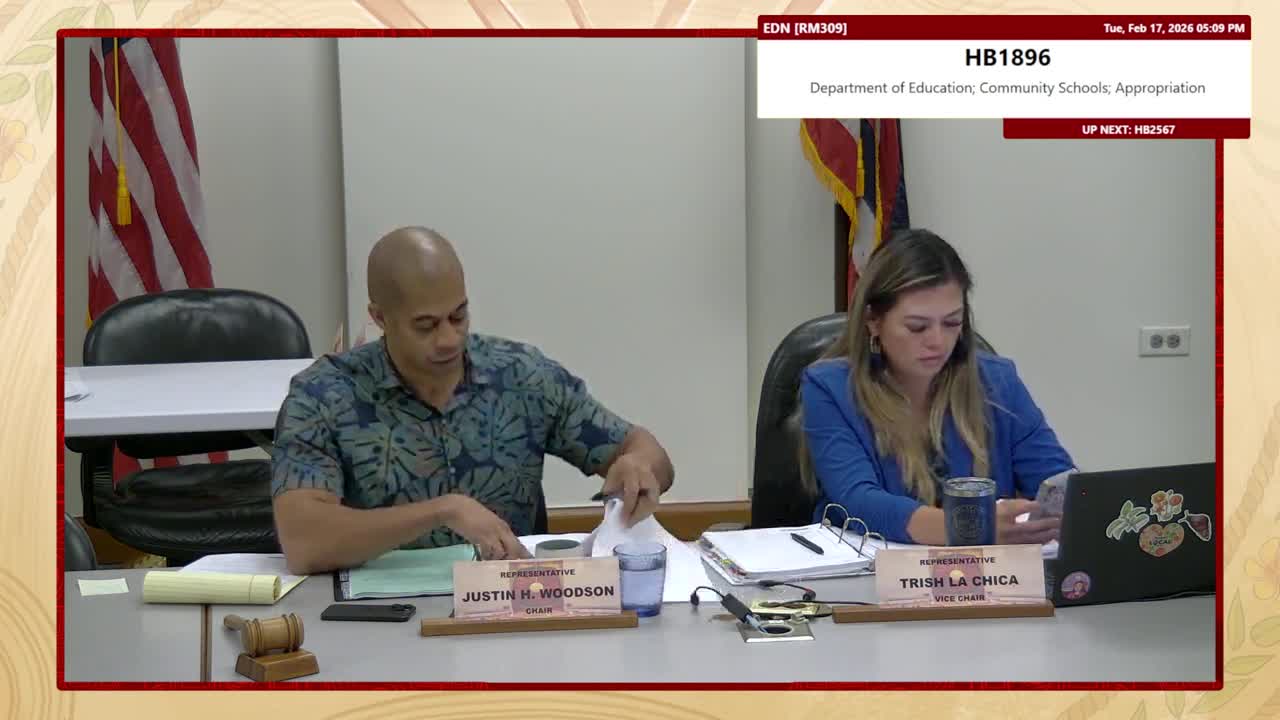
| Feb 17, 2026 | The committee on EDN recommend that the measure be PASSED, WITH AMENDMENTS. The votes were as follows: 9 Ayes: Representative(s) Woodson, La Chica, Amato, Evslin, Kapela, Kila, Olds, Muraoka, Souza; Ayes with reservations: none; 0 Noes: none; and 1 Excused: Representative(s) Garrett. |
| Feb 13, 2026 | Bill scheduled to be heard by EDN on Tuesday, 02-17-26 2:00PM in House conference room 309 VIA VIDEOCONFERENCE. |
| Jan 26, 2026 | Referred to EDN, FIN, referral sheet 2 |
| Jan 26, 2026 | Introduced and Pass First Reading. |
| Jan 23, 2026 | Pending introduction. |
|
Date
|
Description
|
Location
|
Votes
|
|
|---|---|---|---|---|
| Mar 23, 2026 | The committee(s) on EDU recommend(s) that the measure be PASSED, WITH AMENDMENTS | Senate Standing Committee on Education |
Passed |
|
| Mar 6, 2026 | Third Reading | House Floor |
Passed |
|
| Mar 3, 2026 | The committee on FIN recommend that the measure be PASSED, UNAMENDED | House Standing Committee on Finance |
Passed |
|
| Feb 17, 2026 | The committee on EDN recommend that the measure be PASSED, WITH AMENDMENTS | House Standing Committee on Education |
Passed |
This list shows positions taken on this bill by organizations on the date displayed, which is linked to the original source.
Positions by individuals are not included.
|
Organization
|
Position
|
Date
|
|---|---|---|
| Ceeds of Peace | *** Support | Mar 23, 2026 |
| Democratic Party of Hawai’i Education Caucus | *** Support | Mar 23, 2026 |
| Early Childhood Action Strategy | ** Support | |
| Early Childhood Action Strategy (Collaborative Support Services, Inc.) | *** Support | Mar 23, 2026 |
| Governor Sanford B. Dole Middle School | *** Support | Mar 23, 2026 |
| Hawaii Ohana Support Network | *** Support | Mar 23, 2026 |
| Hawaii State Department of Education | *** Support | Mar 23, 2026 |
| Hawaii Statewide Family Engagement Center | *** Support | Mar 4, 2026 |
| HawaiiKidsCAN | *** Support | Mar 23, 2026 |
| Hawaiʻi Appleseed Center for Law & Economic Justice | ** Support | |
| Hawaiʻi State Teachers Association | ** Support | |
| Hawaiʻi State Teachers Association | *** Support | Mar 4, 2026 |
| Hawaiʻi Wildlife Fund | *** Support | Feb 17, 2026 |
| Hawai‘i Afterschool Alliance | *** Support | Mar 23, 2026 |
| Hawai‘i Children’s Action Network Speaks! | *** Support | Mar 23, 2026 |
| Hawai‘i State Literacy Coalition | *** Support | Mar 23, 2026 |
| He'e Coalition | *** Support | Feb 17, 2026 |
| Heʻe Coalition | ** Support | |
| Kaimuki High School | *** Support | Mar 4, 2026 |
| Kaimuki Middle School | *** Support | Mar 23, 2026 |
| Kohala Resilience Hub | *** Support | Feb 17, 2026 |
| Olomana School | *** Support | Mar 23, 2026 |
| Pacific American Foundation | *** Support | Feb 17, 2026 |
| Pacific American Foundation | *** Support | Mar 23, 2026 |
| Pāhoa High and Intermediate School | *** Support | Mar 23, 2026 |
| Parents for Public Schools of Hawaiʻi | ** Support | |
| Parents for Public Schools of Hawai‘i | *** Support | Feb 17, 2026 |
| Partners in Development | *** Support | Feb 17, 2026 |
| Partners in Development Foundation | *** Support | Mar 23, 2026 |
| Princess Ruth Keʻelikōlani Middle School | *** Support | Mar 23, 2026 |
| The He'e Coalition | *** Support | Mar 4, 2026 |
| The Heʻe Coalition | ** Support | |
| University of Hawaiʻi at Manoa College of Education | ** Support | |
| Wai'anae Elementary School | *** Support | Mar 23, 2026 |
| Waikoloa Elementary & Middle School PTSA | *** Support | Mar 23, 2026 |
| Waikoloa Elementary and Middle School | *** Support | Mar 23, 2026 |
| Waimānalo Elementary and Intermediate Family Resource Center | *** Support | Feb 17, 2026 |
| YMCA of Honolulu | ** Support | |
| YMCA of Honolulu | *** Support | Feb 17, 2026 |
| YMCA of Honolulu | *** Support | Mar 23, 2026 |
STAND. COM. REP. NO. 958-26
Honolulu, Hawaii
, 2026
RE: H.B. No. 1896
H.D. 1
Honorable Nadine K. Nakamura
Speaker, House of Representatives
Thirty-Third State Legislature
Regular Session of 2026
State of Hawaii
Madame:
Your Committee on Finance, to which was referred H.B. No. 1896, H.D. 1, entitled:
"A BILL FOR AN ACT RELATING TO COMMUNITY SCHOOLS,"
begs leave to report as follows:
Your Committee received testimony in support of this measure from the Department of Education; University of Hawaiʻi at Manoa College of Education; Hawaiʻi State Teachers Association; Democratic Party of Hawaii Education Caucus; Ceeds of Peace; Early Childhood Action Strategy; The Heʻe Coalition; Partners in Development Foundation; Hawaiʻi Children's Action Network Speaks!; Hawaiʻi Appleseed Center for Law & Economic Justice; and numerous individuals. Your Committee received comments on this measure from the Department of Human Services.
As affirmed by the record of votes of the members of your Committee on Finance that is attached to this report, your Committee is in accord with the intent and purpose of H.B. No. 1896, H.D. 1, and recommends that it pass Third Reading.
Respectfully submitted on behalf of the members of the Committee on Finance,
|
|
|
____________________________ CHRIS TODD, Chair |
|
|
|
|
STAND. COM. REP. NO. 516-26
Honolulu, Hawaii
, 2026
RE: H.B. No. 1896
H.D. 1
Honorable Nadine K. Nakamura
Speaker, House of Representatives
Thirty-Third State Legislature
Regular Session of 2026
State of Hawaii
Madame:
Your Committee on Education, to which was referred H.B. No. 1896 entitled:
"A BILL FOR AN ACT RELATING TO COMMUNITY SCHOOLS,"
begs leave to report as follows:
Your Committee received testimony in support of this measure from the Department of Education; Hawaiʻi State Teachers Association; Hawaiʻi Afterschool Alliance; Parents for Public Schools of Hawaiʻi; Hawaiʻi Appleseed Center for Law and Economic Justice; Early Childhood Action Strategy; Hawaiʻi Children's Action Network Speaks!; Partners in Development Foundation; Democratic Party of Hawaiʻi Education Caucus; Ceeds of Peace; Heʻe Coalition; YMCA of Honolulu; and numerous individuals. Your Committee received testimony in opposition to this measure from one individual. Your Committee received comments on this measure from the Department of Human Services and University of Hawaiʻi at Mānoa.
Your Committee finds that community schools help align and leverage resources already in the community to address students' barriers to learning. Community schools are a proven, time-tested strategy that can produce short-term results, including improving family engagement and attendance and decreasing behavioral referrals. Community schools also help achieve long-term results like improving academic scores, school culture and climate, student enrollment, teacher retention, and graduation rates. Your Committee further finds that the funding provided by this measure will ensure high‑quality educational opportunities and improved educational outcomes for students through the support and input from families of students and the local community.
Your Committee has amended this measure by:
(1) Changing the appropriation to an unspecified amount;
(2) Changing the effective date to July 1, 3000; and
(3) Making a technical, nonsubstantive amendment for clarity, consistency, and style.
Your Committee respectfully requests your Committee on Finance, should it deliberate on this measure, to consider an appropriation amount of $2,152,500.
As affirmed by the record of votes of the members of your Committee on Education that is attached to this report, your Committee is in accord with the intent and purpose of H.B. No. 1896, as amended herein, and recommends that it pass Second Reading in the form attached hereto as H.B. No. 1896, H.D. 1, and be referred to your Committee on Finance.
Respectfully submitted on behalf of the members of the Committee on Education,
|
|
|
____________________________ JUSTIN H. WOODSON, Chair |
|
|
|
|
|
Date
|
Testimony PDF
|
|---|---|
| Mar 23, 2026 | HB1896_HD1_TESTIMONY_EDU_03-23-26_.PDF |
| Mar 4, 2026 | HB1896_HD1_TESTIMONY_FIN_03-03-26_.PDF |
| Feb 17, 2026 | HB1896_TESTIMONY_EDN_02-17-26_.PDF |
Discussed in Hearing
 15MIN
Senate Standing Committee on Education
15MIN
Senate Standing Committee on Labor and Technology
 18SEC
Senate Standing Committee on Education
18SEC
Senate Standing Committee on Labor and Technology
 2MIN
House Standing Committee on Finance
 4MIN
House Standing Committee on Education
 27SEC
House Standing Committee on Education
Bill Author

Bill Co-Author(s):