HB 2595: DAB; Agriculture; Regional Agriculture Feasibility; Food Systems Planning; Study; Working Group; Reports; Appropriation
- Session Year: 2025-2026
- House: House
- Latest Version Date: 2026-03-23
Current Status:
Failed
(2026-03-24: Report adopted; Passed Second Reading, as amended (SD 1) and referred to WAM.)
Introduced
In Committee
First Chamber
In Committee
Second Chamber
Final Decking
Enacted
What does this bill do?
The bill creates a two-year working group in the Department of Agriculture and Biosecurity to study which crops and production systems can be grown profitably in each island and region. The group, with members from the University of Hawaiʻi, economic and land agencies, and the agribusiness corporation, will map crop suitability, assess infrastructure and labor needs, explore indoor farming options, and recommend how small, mid, and large farms can meet demand from schools, hospitals, and other institutional buyers, then report its findings to the Legislature.
The summary is provided by generative AI which can make mistakes. For original language, please view the details in the table below.
Establishes the Regional Agricultural Feasibility and Food Systems Production Studies Working Group within the Department of Agriculture and Biosecurity to provide coordinated, region‑specific agricultural production and crop feasibility analysis across the State. Requires reports to the Legislature. Appropriates funds. Repeals 6/30/2028. Effective 7/1/2050. (SD1)
Establishes the Regional Agricultural Feasibility and Food Systems Production Studies Working Group within the Department of Agriculture and Biosecurity to provide coordinated, region-specific agricultural production and crop feasibility analysis across the State. Requires reports to the Legislature. Appropriates funds. Repeals 6/30/2028. Effective 7/1/3000. (HD1)
Establishes the Regional Agricultural Feasibility and Food Systems Production Studies Working Group within the Department of Agriculture and Biosecurity to provide coordinated, region-specific agricultural production and crop feasibility analysis across the State. Requires reports to the Legislature. Appropriates funds. Repeals 6/30/2028.
|
HOUSE OF REPRESENTATIVES |
H.B. NO. |
2595 |
|
THIRTY-THIRD LEGISLATURE, 2026 |
H.D. 1 |
|
|
STATE OF HAWAII |
S.D. 1 |
|
|
|
|
|
|
|
||
|
|
||
A BILL FOR AN ACT
RELATING TO REGIONAL AGRICULTURE AND FOOD PRODUCTION.
BE IT ENACTED BY THE LEGISLATURE OF THE STATE OF HAWAII:
The legislature further finds that comprehensive agricultural feasibility assessments require a coordinated, multi-agency, evidence-based planning framework that integrates agro-ecological science, economic modeling, workforce analysis, and infrastructure feasibility to ensure food systems plans are adequate to support agriculture in the State. A working group is therefore necessary to produce the necessary data and information to support farmers at all scales; strengthen neighbor island food system development; align production capacity with institutional demand; and guide state investment in agricultural infrastructure, regional kitchens, and procurement initiatives.
The purpose of this Act is to establish the regional agricultural feasibility and food systems production studies working group to provide coordinated, region-specific agricultural production and crop feasibility analysis across the State.
SECTION 2. (a) The department of agriculture and biosecurity shall establish and implement a two-year regional agricultural feasibility and food systems production studies working group to conduct island- and region-specific agricultural feasibility studies to inform statewide food system planning, public procurement strategies, and agricultural investment.
(b) The working group shall be conducted through a multi‑agency framework that shall consist of the following members:
(1) A representative from the university of Hawaii at Manoa college of tropical agriculture and human resilience, who shall be responsible for agro‑ecological analysis, crop suitability, soil health, assessments, climate and elevation modeling, and production systems research;
(2) A representative from the department of business, economic development, and tourism, who shall be responsible for economic modeling, cost-of-production analysis, institutional demand alignment, regional market feasibility, and integration with economic development strategies;
(3) A representative from the agribusiness development corporation who shall be responsible for a feasibility analysis of state agricultural lands, irrigation and water systems, processing and aggregation infrastructure, and other relevant agricultural facilities relevant to projected production scenarios;
(4) A representative from the department of agriculture and biosecurity, who shall be responsible for statewide agricultural policy coordination and alignment with food security and agricultural development initiatives; and
(5) A representative from the department of land and natural resources, who shall serve in an advisory capacity to provide information on land classification, water resource availability, and constraints relevant to agricultural suitability.
(c) The regional agricultural feasibility and food systems production studies working group shall conduct island- and region-specific agricultural feasibility studies that assess:
(1) Crop feasibility and production potential, including:
(A) Crops that can be grown profitably by island, region, elevation, and climate zone;
(B) Expected production volumes under real-world conditions; and
(C) Production risks associated with pests, water constraints, weather variability, and market volatility;
(2) Infrastructure constraints and requirements, including:
(A) Processing, aggregation, and cold storage capacity;
(B) Access to land, water, electricity, and transportation corridors; and
(C) Regional gaps in equipment, technology, and shared-use facilities;
(3) Labor and mechanization needs, including:
(A) Current and projected agricultural labor gaps by crop and production systems;
(B) Opportunities to improve labor efficiency through mechanization or automation; and
(C) Workforce development needs, training capacity, and barriers to entry for new growers;
(4) Controlled environment agriculture opportunities, including:
(A) Identification of crops best suited for vertical farming, aquaponics, and other controlled environment systems;
(B) Feasibility of locating controlled environment systems in industrial areas or enterprise zones; and
(C) Strategies to reduce pressure on arable lands while expanding local production capacity; and
(5) Alignment of agricultural supply with institutional demand, including:
(A) Comparison of cost-of-production to institutional price points;
(B) Compatibility with regional kitchen and farm‑to‑school procurement forecasts; and
(C) Capacity for small-, mid-, and large-scale farms to supply institutional buyers, including off‑grade products.
(d) The regional agricultural feasibility and food systems production studies working group shall prioritize neighbor island needs by:
(1) Conducting island-specific studies that reflect regional conditions, infrastructure gaps, and market access constraints;
(2) Developing recommendations that do not assume Oahu‑level economies of scale; and
(3) Providing tailored strategies for infrastructure, procurement readiness, and production scaling.
(e) The working group may consult with:
(1) County agricultural offices;
(2) Farmers, ranchers, processors, and agricultural cooperatives;
(3) Institutional buyers, including the department of education, university of Hawaii, and health care institutions;
(4) The Hawaii emergency management agency, for climate resilience considerations; and
(5) Any other community or technical partners the working group deems relevant.
(f) The working group shall submit an interim report of its preliminary findings, recommendations, and any identified data gaps, to the legislature no later than twenty days prior to the convening of the regular session of 2027.
(g) The working group shall submit a final statewide agricultural feasibility and food systems production report, including island- and region-specific feasibility assessments, policy recommendations, and proposed investment strategies, to the legislature no later than twenty days prior to the convening of the regular session of 2028.
(h) Each report identified in subsections (f) and (g) shall include:
(1) Region-by-region crop feasibility maps and production scenarios;
(2) Infrastructure investment priorities;
(3) Workforce and mechanization needs assessments;
(4) Controlled-environment agriculture recommendations;
(5) Institutional procurement alignment analyses; and
(6) Strategies to support small-, mid-, and large-scale farmers.
SECTION 3. There is appropriated out of the general revenues of the State of Hawaii the sum of $ or so much thereof as may be necessary for fiscal year 2026-2027 for the department of agriculture and biosecurity to implement the regional agricultural feasibility and food systems production studies working group.
The sum appropriated shall be expended by the department of agriculture and biosecurity for the purposes of this Act.
SECTION 4. This Act shall take effect on July 1, 2050, and shall be repealed on June 30, 2028.
Report Title:
DAB; Agriculture; Regional Agriculture Feasibility; Food Systems Planning; Study; Working Group; Reports; Appropriation
Description:
Establishes the Regional Agricultural Feasibility and Food Systems Production Studies Working Group within the Department of Agriculture and Biosecurity to provide coordinated, region‑specific agricultural production and crop feasibility analysis across the State. Requires reports to the Legislature. Appropriates funds. Repeals 6/30/2028. Effective 7/1/2050. (SD1)
The summary description of legislation appearing on this page is for informational purposes only and is not legislation or evidence of legislative intent.
|
HOUSE OF REPRESENTATIVES |
H.B. NO. |
2595 |
|
THIRTY-THIRD LEGISLATURE, 2026 |
H.D. 1 |
|
|
STATE OF HAWAII |
|
|
|
|
|
|
|
|
||
|
|
||
A BILL FOR AN ACT
RELATING TO REGIONAL AGRICULTURE AND FOOD PRODUCTION.
BE IT ENACTED BY THE LEGISLATURE OF THE STATE OF HAWAII:
The legislature further finds that comprehensive agricultural feasibility assessments require a coordinated, multi-agency, evidence-based planning framework that integrates agro-ecological science, economic modeling, workforce analysis, and infrastructure feasibility to ensure food systems plans are adequate to support agriculture in the State. A working group is therefore necessary to produce the necessary data and information to support farmers at all scales; strengthen neighbor island food system development; align production capacity with institutional demand; and guide state investment in agricultural infrastructure, regional kitchens, and procurement initiatives.
The purpose of this Act is to establish the regional agricultural feasibility and food systems production studies working group to provide coordinated, region-specific agricultural production and crop feasibility analysis across the State.
SECTION 2. (a) The department of agriculture and biosecurity shall establish and implement a two-year regional agricultural feasibility and food systems production studies working group to conduct island- and region-specific agricultural feasibility studies to inform statewide food system planning, public procurement strategies, and agricultural investment.
(b) The working group shall be conducted through a multi-agency framework that shall consist of the following members:
(1) A representative from the university of Hawaii at Manoa college of tropical agriculture and human resilience, who shall be responsible for agro-ecological analysis, crop suitability, soil health, assessments, climate and elevation modeling, and production systems research;
(2) A representative from the department of business, economic development, and tourism, who shall be responsible for economic modeling, cost-of-production analysis, institutional demand alignment, regional market feasibility, and integration with economic development strategies;
(3) A representative from the agribusiness development corporation who shall be responsible for a feasibility analysis of state agricultural lands, irrigation and water systems, processing and aggregation infrastructure, and other relevant agricultural facilities relevant to projected production scenarios;
(4) A representative from the department of agriculture and biosecurity, who shall be responsible for statewide agricultural policy coordination and alignment with food security and agricultural development initiatives; and
(5) A representative from the department of land and natural resources, who shall serve in an advisory capacity to provide information on land classification, water resource availability, and constraints relevant to agricultural suitability.
(c) The regional agricultural feasibility and food systems production studies working group shall conduct island- and region-specific agricultural feasibility studies that assess:
(1) Crop feasibility and production potential, including:
(A) Crops that can be grown profitably by island, region, elevation, and climate zone;
(B) Expected production volumes under real-world conditions; and
(C) Production risks associated with pests, water constraints, weather variability, and market volatility;
(2) Infrastructure constraints and requirements, including:
(A) Processing, aggregation, and cold storage capacity;
(B) Access to land, water, electricity, and transportation corridors; and
(C) Regional gaps in equipment, technology, and shared-use facilities;
(3) Labor and mechanization needs, including:
(A) Current and projected agricultural labor gaps by crop and production systems;
(B) Opportunities to improve labor efficiency through mechanization or automation; and
(C) Workforce development needs, training capacity, and barriers to entry for new growers;
(4) Controlled environment agriculture opportunities, including:
(A) Identification of crops best suited for vertical farming, aquaponics, and other controlled environment systems;
(B) Feasibility of locating controlled environment systems in industrial areas or enterprise zones; and
(C) Strategies to reduce pressure on arable lands while expanding local production capacity; and
(5) Alignment of agricultural supply with institutional demand, including:
(A) Comparison of cost-of-production to institutional price points;
(B) Compatibility with regional kitchen and farm-to-school procurement forecasts; and
(C) Capacity for small-, mid-, and large-scale farms to supply institutional buyers, including off-grade products.
(d) The regional agricultural feasibility and food systems production studies working group shall prioritize neighbor island needs by:
(1) Conducting island-specific studies that reflect regional conditions, infrastructure gaps, and market access constraints;
(2) Developing recommendations that do not assume Oahu-level economies of scale; and
(3) Providing tailored strategies for infrastructure, procurement readiness, and production scaling.
(e) The working group may consult with:
(1) County agricultural offices;
(2) Farmers, ranchers, processors, and agricultural cooperatives;
(3) Institutional buyers, including the department of education, university of Hawaii, and health care institutions;
(4) The Hawaii emergency management agency, for climate resilience considerations; and
(5) Any other community or technical partners the working group deems relevant.
(f) The working group shall submit an interim report of its preliminary findings, recommendations, and any identified data gaps, to the legislature no later than twenty days prior to the convening of the regular session of 2027.
(g) The working group shall submit a final statewide agricultural feasibility and food systems production report, including island-specific feasibility assessments, policy recommendations, and proposed investment strategies, to the legislature no later than twenty days prior to the convening of the regular session of 2028.
(h) Each report identified in subsections (f) and (g) shall include:
(1) Region-by-region crop feasibility maps and production scenarios;
(2) Infrastructure investment priorities;
(3) Workforce and mechanization needs assessments;
(4) Controlled-environment agriculture recommendations;
(5) Institutional procurement alignment analyses; and
(6) Strategies to support small-, mid-, and large-scale farmers.
SECTION 3. There is appropriated out of the general revenues of the State of Hawaii the sum of $ or so much thereof as may be necessary for fiscal year 2026-2027 for the department of agriculture and biosecurity to implement the regional agricultural feasibility and food systems production studies working group.
The sum appropriated shall be expended by the department of agriculture and biosecurity for the purposes of this Act.
SECTION 4. This Act shall take effect on July 1, 3000, and shall be repealed on June 30, 2028.
Report Title:
DAB; Agriculture; Regional Agriculture Feasibility; Food Systems Planning; Study; Working Group; Reports; Appropriation
Description:
Establishes the Regional Agricultural Feasibility and Food Systems Production Studies Working Group within the Department of Agriculture and Biosecurity to provide coordinated, region-specific agricultural production and crop feasibility analysis across the State. Requires reports to the Legislature. Appropriates funds. Repeals 6/30/2028. Effective 7/1/3000. (HD1)
The summary description of legislation appearing on this page is for informational purposes only and is not legislation or evidence of legislative intent.
|
HOUSE OF REPRESENTATIVES |
H.B. NO. |
2595 |
|
THIRTY-THIRD LEGISLATURE, 2026 |
|
|
|
STATE OF HAWAII |
|
|
|
|
|
|
|
|
||
|
|
||
A BILL FOR AN ACT
relating to regional agriculture and food production.
BE IT ENACTED BY THE LEGISLATURE OF THE STATE OF HAWAII:
The legislature further finds that comprehensive agricultural feasibility assessments require a coordinated, multi-agency, evidence-based planning framework that integrates agro-ecological science, economic modeling, workforce analysis, and infrastructure feasibility to ensure food systems plans are adequate to support agriculture in the State. A working group is therefore necessary to produce the necessary data and information to support farmers at all scales; strengthen neighbor island food system development; align production capacity with institutional demand; and guide state investment in agricultural infrastructure, regional kitchens, and procurement initiatives.
The purpose of this Act is to establish the regional agricultural feasibility and food systems production studies working group to provide coordinated, region-specific agricultural production and crop feasibility analysis across the State.
SECTION 2. (a) The department of agriculture and biosecurity shall establish and implement a two-year regional agricultural feasibility and food systems production studies working group to conduct island and region-specific agricultural feasibility studies to inform statewide food system planning, public procurement strategies, and agricultural investment.
(b) The working group shall be conducted through a multi-agency framework that shall consist of the following members:
(1) A representative from university of Hawaii at Manoa college of tropical agriculture and human resilience who shall be responsible for agro-ecological analysis, crop suitability, soil health, assessments, climate and elevation modeling, and production systems research;
(2) A representative from the department of business, economic development, and tourism who shall be responsible for economic modeling, cost-of-production analysis, institutional demand alignment, regional market feasibility, and integration with economic development strategies;
(3) A representative from the agribusiness development corporation who shall be responsible for feasibility analysis of state agricultural lands, irrigation and water systems, processing and aggregation infrastructure, and other relevant agricultural facilities relevant to projected production scenarios;
(4) A representative from the department of agriculture and biosecurity who shall be responsible for statewide agricultural policy coordination and alignment with food security and agricultural development initiatives; and
(5) A representative from the department of land and natural resources who shall serve in an advisory capacity to provide information on land classification, water resource availability, and constraints relevant to agricultural suitability.
(c) The regional agricultural feasibility and food systems production studies working group shall conduct island- and region-specific agricultural feasibility studies that assess:
(1) Crop feasibility and production potential, including:
(A) Crops that can be grown profitably by island, region, elevation, and climate zone;
(B) Expected production volumes under real-world conditions; and
(C) Production risks associated with pests, water constraints, weather variability, and market volatility;
(2) Infrastructure constraints and requirements, including:
(A) Processing, aggregation, and cold storage capacity;
(B) Access to land, water, electricity, and transportation corridors; and
(C) Regional gaps in equipment, technology, and shared-use facilities;
(3) Labor and mechanization needs, including:
(A) Current and projected agricultural labor gaps by crop and production systems;
(B) Opportunities to improve labor efficiency through mechanization or automation; and
(C) Workforce development needs, training capacity, and barriers to entry for new growers;
(4) Controlled environment agriculture opportunities, including:
(A) Identification of crops best suited for vertical farming, aquaponics, and other controlled environment systems;
(B) Feasibility of locating controlled environment systems in industrial areas or enterprise zones; and
(C) Strategies to reduce pressure on arable lands while expanding local production capacity; and
(5) Alignment of agricultural supply with institutional demand, including:
(A) Comparison of cost-of-production to institutional price points;
(B) Compatibility with regional kitchen and farm-to-school procurement forecasts; and
(C) Capacity for small-, mid-, and large-scale farms to supply institutional buyers, including off-grade products.
(d) The regional agricultural feasibility and food systems production studies working group shall prioritize neighbor island needs by:
(1) Conducting island-specific studies that reflect regional conditions, infrastructure gaps, and market access constraints;
(2) Developing recommendations that do not assume Oahu-level economies of scale; and
(3) Providing tailored strategies for infrastructure, procurement readiness, and production scaling.
(e) The working group may consult with:
(1) County agricultural offices;
(2) Farmers, ranchers, processors, and agricultural cooperatives;
(3) Institutional buyers, including the department of education, university of Hawaii, and healthcare institutions;
(4) The Hawaii emergency management agency, for climate resilience considerations; and
(5) Any other community or technical partners the working group deems relevant.
(f) The working group shall submit an interim report of its preliminary findings, recommendations, and any identified data gaps, to the legislature no later than twenty days prior to the convening of the regular session of 2027.
(g) The working group shall submit a final statewide agricultural feasibility and food systems production report, including island-specific feasibility assessments, policy recommendations, and proposed investment strategies to the legislature no later than twenty days prior to the convening of the regular session of 2028.
(h) Each report identified in subsections (f) and (g) shall include:
(1) Region-by-region crop feasibility maps and production scenarios;
(2) Infrastructure investment priorities;
(3) Workforce and mechanization needs assessments;
(4) Controlled-environment agriculture recommendations;
(5) Institutional procurement alignment analyses; and
(6) Strategies to support small-, mid-, and large-scale farmers.
SECTION 3. There is appropriated out of the general revenues of the State of Hawaii the sum of $ or so much thereof as may be necessary for fiscal year 2026-2027 for the department of agriculture and biosecurity to implement the regional agricultural feasibility and food systems production studies working group.
The sum appropriated shall be expended by the department of agriculture and biosecurity for the purposes of this Act.
SECTION 4. This Act shall take effect on July 1, 2026, and shall be repealed on June 30, 2028.
|
INTRODUCED BY: |
_____________________________ |
|
|
|
Report Title:
DAB; Agriculture; Regional Agriculture Feasibility; Food Systems Planning; Study; Working Group; Reports; Appropriation
Description:
Establishes the Regional Agricultural Feasibility and Food Systems Production Studies Working Group within the Department of Agriculture and Biosecurity to provide coordinated, region-specific agricultural production and crop feasibility analysis across the State. Requires reports to the Legislature. Appropriates funds. Repeals 6/30/2028.
The summary description of legislation appearing on this page is for informational purposes only and is not legislation or evidence of legislative intent.
|
Date
|
Status
|
|---|---|
| Mar 24, 2026 | Report adopted; Passed Second Reading, as amended (SD 1) and referred to WAM. |
| Mar 24, 2026 | Reported from AEN (Stand. Com. Rep. No. 3156) with recommendation of passage on Second Reading, as amended (SD 1) and referral to WAM. |
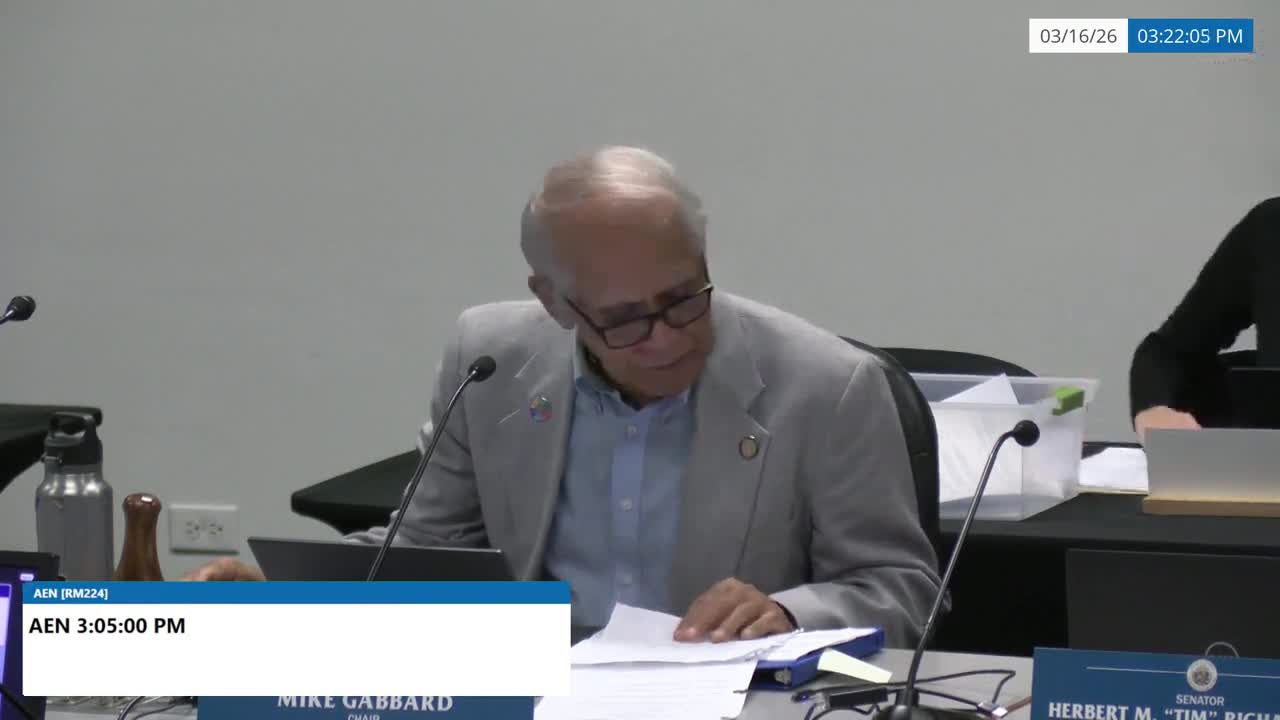
| Mar 16, 2026 | The committee(s) on AEN recommend(s) that the measure be PASSED, WITH AMENDMENTS. The votes in AEN were as follows: 4 Aye(s): Senator(s) Gabbard, Richards, DeCoite, Rhoads; Aye(s) with reservations: none ; 0 No(es): none; and 1 Excused: Senator(s) Awa. |
| Mar 13, 2026 | The committee(s) on AEN has scheduled a public hearing on 03-16-26 3:05PM; Conference Room 224 & Videoconference. |
| Mar 10, 2026 | Referred to AEN, WAM. |
| Mar 10, 2026 | Passed First Reading. |
| Mar 10, 2026 | Received from House (Hse. Com. No. 225). |
| Mar 6, 2026 | Passed Third Reading with none voting aye with reservations; none voting no (0) and Representative(s) Perruso, Sayama excused (2). Transmitted to Senate. |
| Mar 6, 2026 | Reported from FIN (Stand. Com. Rep. No. 929-26), recommending passage on Third Reading. |
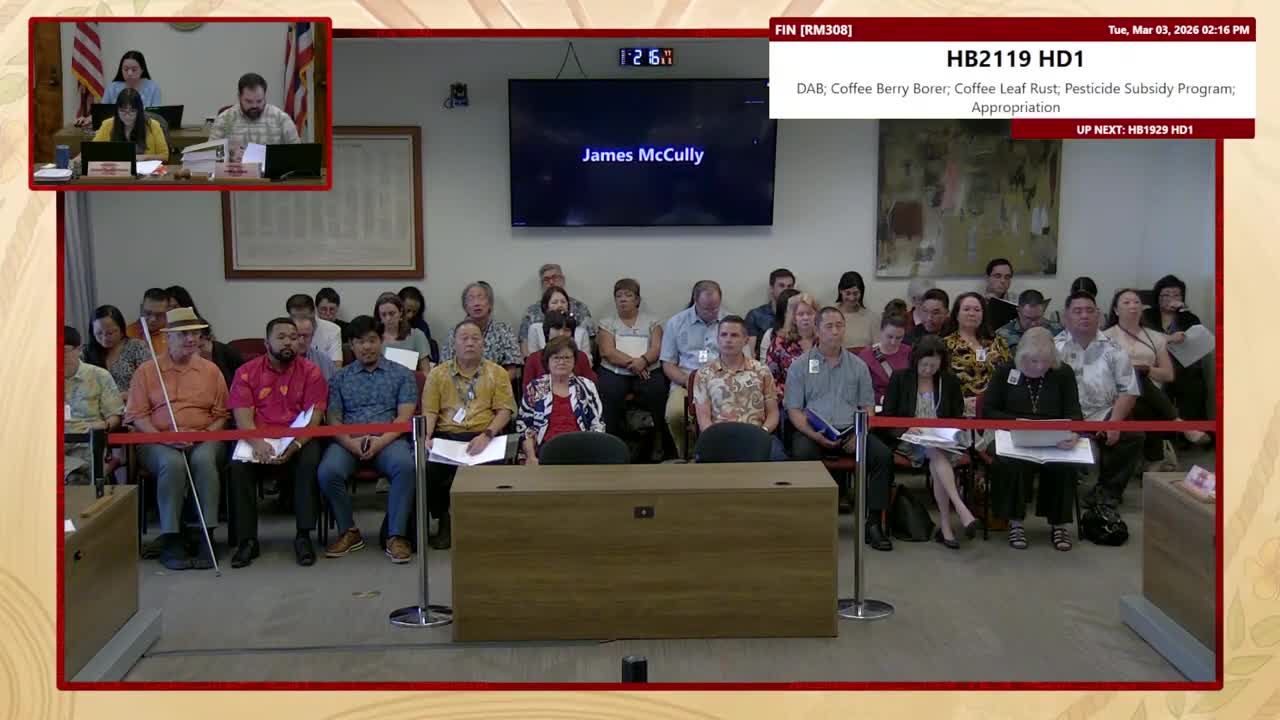
| Mar 3, 2026 | The committee on FIN recommend that the measure be PASSED, UNAMENDED. The votes were as follows: 16 Ayes: Representative(s) Todd, Takenouchi, Hartsfield, Hussey, Keohokapu-Lee Loy, Kitagawa, Kusch, Lee, M., Miyake, Morikawa, Perruso, Templo, Yamashita, Alcos, Gedeon, Reyes Oda; Ayes with reservations: none; 0 Noes: none; and 0 Excused: none. |
| Feb 27, 2026 | Bill scheduled to be heard by FIN on Tuesday, 03-03-26 2:00PM in House conference room 308 VIA VIDEOCONFERENCE. |
| Feb 17, 2026 | Passed Second Reading as amended in HD 1 and referred to the committee(s) on FIN with none voting aye with reservations; none voting no (0) and Representative(s) Cochran, Lee, M., Poepoe excused (3). |
| Feb 17, 2026 | Reported from AGR (Stand. Com. Rep. No. 327-26) as amended in HD 1, recommending passage on Second Reading and referral to FIN. |
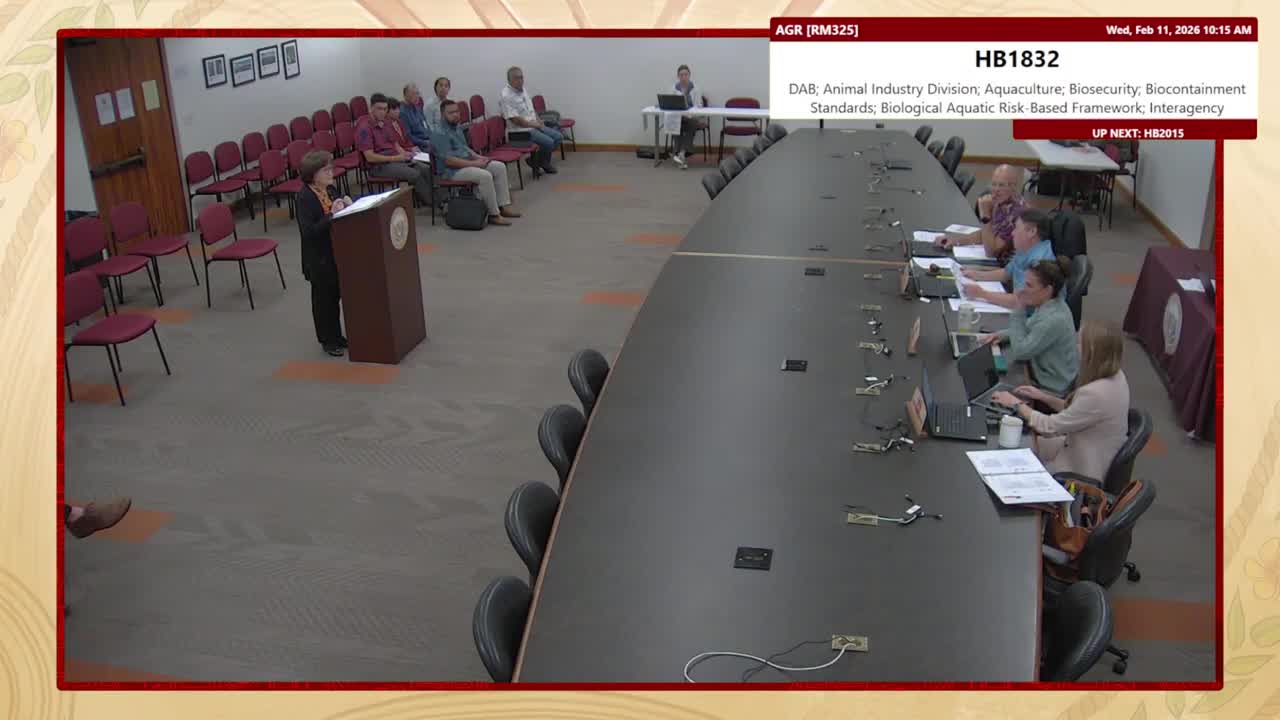
| Feb 11, 2026 | The committee on AGR recommend that the measure be PASSED, WITH AMENDMENTS. The votes were as follows: 5 Ayes: Representative(s) Chun, Kusch, Kahaloa, Perruso, Matsumoto; Ayes with reservations: none; Noes: none; and 2 Excused: Representative(s) Lowen, Quinlan. |
| Feb 6, 2026 | Bill scheduled to be heard by AGR on Wednesday, 02-11-26 9:30AM in House conference room 325 VIA VIDEOCONFERENCE. |
| Feb 2, 2026 | Referred to AGR, FIN, referral sheet 6 |
| Jan 28, 2026 | Introduced and Pass First Reading. |
|
Date
|
Description
|
Location
|
Votes
|
|
|---|---|---|---|---|
| Mar 16, 2026 | The committee(s) on AEN recommend(s) that the measure be PASSED, WITH AMENDMENTS | Senate Standing Committee on Agriculture and Environment |
Passed |
|
| Mar 6, 2026 | Third Reading | House Floor |
Passed |
|
| Mar 3, 2026 | The committee on FIN recommend that the measure be PASSED, UNAMENDED | House Standing Committee on Finance |
Passed |
|
| Feb 11, 2026 | The committee on AGR recommend that the measure be PASSED, WITH AMENDMENTS | House Standing Committee on Agriculture & Food Systems |
Passed |
This list shows positions taken on this bill by organizations on the date displayed, which is linked to the original source.
Positions by individuals are not included.
|
Organization
|
Position
|
Date
|
|---|---|---|
| Bayer | ** Support | |
| Chamber of Commerce Hawaii | *** Support | Mar 16, 2026 |
| Department of Agriculture and Biosecurity | ** Support | |
| Hawaii Food Industry Association | *** Support | Mar 16, 2026 |
| Hawaiʻi Farm Bureau | ** Support | |
| Hawaiʻi Food+ Policy | ** Support | |
| Hawaiʻi Farmers Union | *** Support | Mar 16, 2026 |
| Hawai‘i Farm Bureau | *** Support | Mar 16, 2026 |
| Maui Chamber of Commerce | *** Support | Mar 16, 2026 |
| Retail Merchants of Hawaiʻi | *** Support | Mar 16, 2026 |
| The Food+ Policy internship / Food+ Policy Team | *** Support | Feb 11, 2026 |
STAND. COM. REP. NO. 929-26
Honolulu, Hawaii
, 2026
RE: H.B. No. 2595
H.D. 1
Honorable Nadine K. Nakamura
Speaker, House of Representatives
Thirty-Third State Legislature
Regular Session of 2026
State of Hawaii
Madame:
Your Committee on Finance, to which was referred H.B. No. 2595, H.D. 1, entitled:
"A BILL FOR AN ACT RELATING TO REGIONAL AGRICULTURE AND FOOD PRODUCTION,"
begs leave to report as follows:
The purpose of this measure is to:
(1) Establish and appropriate funds for the Regional Agricultural Feasibility and Food Systems Production Studies Working Group to provide coordinated, region-specific agricultural production and crop feasibility analysis across the State; and
(2) Require the Working Group to submit an interim report and final statewide agricultural feasibility and food systems production report to the Legislature.
Your Committee received testimony in support of this measure from the Department of Agriculture and Biosecurity; Hawaiʻi Farm Bureau; Hawaii Food Industry Association; and two individuals. Your Committee received comments on this measure from the University of Hawaiʻi System.
As affirmed by the record of votes of the members of your Committee on Finance that is attached to this report, your Committee is in accord with the intent and purpose of H.B. No. 2595, H.D. 1, and recommends that it pass Third Reading.
Respectfully submitted on behalf of the members of the Committee on Finance,
|
|
|
____________________________ CHRIS TODD, Chair |
|
|
|
|
STAND. COM. REP. NO. 327-26
Honolulu, Hawaii
, 2026
RE: H.B. No. 2595
H.D. 1
Honorable Nadine K. Nakamura
Speaker, House of Representatives
Thirty-Third State Legislature
Regular Session of 2026
State of Hawaii
Madame:
Your Committee on Agriculture & Food Systems, to which was referred H.B. No. 2595 entitled:
"A BILL FOR AN ACT RELATING TO REGIONAL AGRICULTURE AND FOOD PRODUCTION,"
begs leave to report as follows:
Your Committee received testimony in support of this measure from the Department of Agriculture and Biosecurity; Hawaiʻi Food+ Policy; Hawaiʻi Farm Bureau; Hawaiʻi Farmers Union United; Bayer; Chamber of Commerce Hawaii; and four individuals. Your Committee received comments on this measure from the University of Hawaiʻi College of Tropical Agriculture and Human Resilience.
Your Committee finds that Hawaii's long-term food security, rural economic resilience, and institutional procurement strategies rely on a clear, data-driven understanding of what crops can be grown profitably, at scale, in different regions of the State. Your Committee further finds that comprehensive agricultural feasibility assessments require a coordinated, multi-agency, evidence-based planning framework to ensure food systems plans are sufficient to support the State's agricultural industry. This measure establishes a working group to provide coordinated, region-specific agricultural production and crop feasibility analysis across the State to produce the necessary data and information to support farmers at all scales.
Your Committee has amended this measure by:
(1) Changing the effective date to July 1, 3000, to encourage further discussion; and
(2) Making technical, nonsubstantive amendments for the purposes of clarity, consistency, and style.
As affirmed by the record of votes of the members of your Committee on Agriculture & Food Systems that is attached to this report, your Committee is in accord with the intent and purpose of H.B. No. 2595, as amended herein, and recommends that it pass Second Reading in the form attached hereto as H.B. No. 2595, H.D. 1, and be referred to your Committee on Finance.
Respectfully submitted on behalf of the members of the Committee on Agriculture & Food Systems,
|
|
|
____________________________ CORY CHUN, Chair |
|
|
|
|
|
Date
|
Testimony PDF
|
|---|---|
| Mar 16, 2026 | HB2595_HD1_TESTIMONY_AEN_03-16-26_.PDF |
| Mar 3, 2026 | HB2595_HD1_TESTIMONY_FIN_03-03-26_.PDF |
| Feb 11, 2026 | HB2595_TESTIMONY_AGR_02-11-26_.PDF |
Discussed in Hearing
 6MIN
Senate Standing Committee on Agriculture and Environment
1MIN
Senate Standing Committee on Agriculture and Environment
 1MIN
House Standing Committee on Finance
 4MIN
House Standing Committee on Agriculture & Food Systems
 56SEC
House Standing Committee on Agriculture & Food Systems
Bill Author

Bill Co-Author(s):