HB 2534: DOE; Robotics; Interscholastic Sport; Appropriation
- Session Year: 2025-2026
- House: House
- Latest Version Date: 2026-02-06
Current Status:
Failed
(2026-03-20: The committee on EDU deferred the measure.)
Introduced
In Committee
First Chamber
In Committee
Second Chamber
Final Decking
Enacted
What does this bill do?
This bill provides state funding to the Department of Education to recognize and support robotics as an interscholastic (school) sport, affecting K–12 students and school robotics teams statewide. It directs the department to spend the funds on establishing the sport and to keep the paperwork required for teams to participate to a minimum.
The summary is provided by generative AI which can make mistakes. For original language, please view the details in the table below.
Appropriates funds to the Department of Education to establish robotics as an interscholastic sport. Effective 7/1/3000. (HD1)
Appropriates moneys to the Department of Education to establish robotics as an interscholastic sport.
|
HOUSE OF REPRESENTATIVES |
H.B. NO. |
2534 |
|
THIRTY-THIRD LEGISLATURE, 2026 |
H.D. 1 |
|
|
STATE OF HAWAII |
|
|
|
|
|
|
|
|
||
|
|
||
A BILL FOR AN ACT
RELATING TO ROBOTICS.
BE IT ENACTED BY THE LEGISLATURE OF THE STATE OF HAWAII:
SECTION 1. The legislature finds that education in robotics provides hands-on science, technology, engineering, and mathematics learning that increases critical thinking and creative problem-solving skills among students. Since the first robotics program was established at Waialua High School in 1999, the State has embraced robotics technology as both an educational and a competitive platform. Between 2008 and 2012, the legislature supported robotics programs through measures such as Act 111, Session Laws of Hawaii 2007, and other measures investing in Hawaii's emerging science and technology fields by funding scholarships for the State's first "For Inspiration and Recognition of Science and Technology" (FIRST) regional competition.
Through FIRST and VEX Robotics, two major robotics programs for students in grades pre-kindergarten through twelve, Hawaii's robotics teams engage more than two thousand five hundred students from numerous schools across the State. Today, these robotics teams achieve national and international success and contribute to the community by leading local science, technology, engineering, and mathematics education initiatives.
The legislature further finds that since 2009, the State has lost numerous high school robotics teams due to insufficient resources and a lack of mentors. Unlike most extracurricular activities, robotics is conducted year-round, with each team having several mentors. The cost of hosting a competition can exceed hundreds or even thousands of dollars.
Likewise, recent federal funding cuts have impacted several Hawaii robotics teams. These funding cuts force robotics teams to rely on competitive grants, which are not guaranteed. The lack of consistent funding has threatened robotics programs at Maui high school, James Campbell high school, and several others.
Furthermore, the legislature recognizes that participation in robotics encourages students to join the science, technology, engineering, and mathematics workforce. A majority of high school robotics alumni are employed in science, technology, engineering, and mathematics fields. However, the legislature finds that the State lacks a long-term science, technology, engineering, and mathematics workforce. According to data from the department of business, economic development, and tourism, a higher percentage of Hawaii-born students in science, technology, engineering, and mathematics occupations live in the continental United States than in the State. By supporting robotics programs, the State can stimulate economic growth and ensure Hawaii's youth have access to stable career paths.
In addition, the legislature finds that, to sustain robotics programs and science, technology, engineering, and mathematics education, states such as Texas and Connecticut recognize robotics as a sanctioned sport. According to the Oxford dictionary, a sport is "an activity involving physical exertion and skill in which an individual or team competes against another or others for entertainment." Robotics requires intense teamwork, physical endurance, and strategic thinking, and attracts crowds to competitions.
Accordingly, the purpose of this Act is to ensure high‑quality science, technology, engineering, and mathematics education and to strengthen the State's technology workforce by appropriating funds to establish robotics as an interscholastic sport.
SECTION 2. There is appropriated out of the general revenues of the State of Hawaii the sum of $ or so much thereof as may be necessary for fiscal year 2026-2027 to establish robotics as an interscholastic sport; provided that the department of education shall minimize any documentation required for teams to participate.
The sum appropriated shall be expended by the department of education for the purposes of this Act.
SECTION 3. This Act shall take effect on July 1, 3000.
Report Title:
DOE; Robotics; Interscholastic Sport; Appropriation
Description:
Appropriates funds to the Department of Education to establish robotics as an interscholastic sport. Effective 7/1/3000. (HD1)
The summary description of legislation appearing on this page is for informational purposes only and is not legislation or evidence of legislative intent.
|
HOUSE OF REPRESENTATIVES |
H.B. NO. |
2534 |
|
THIRTY-THIRD LEGISLATURE, 2026 |
|
|
|
STATE OF HAWAII |
|
|
|
|
|
|
|
|
||
|
|
||
A BILL FOR AN ACT
relating to robotics.
BE IT ENACTED BY THE LEGISLATURE OF THE STATE OF HAWAII:
SECTION 1. The legislature finds that education in robotics provides hands-on science, technology, engineering, and mathematics learning that increases critical thinking and creative problem-solving skills among students. Since the first robotics program was established at Waialua High School in 1999, the State has embraced robotics technology as both an educational and a competitive platform. Between 2008 and 2012, the legislature supported robotics programs through measures such as Act 111, Session Laws of Hawaii 2007, and other measures investing in Hawaii's emerging science and technology fields by funding scholarships for the State's first "For Inspiration and Recognition of Science and Technology" (FIRST) regional competition.
Through FIRST and VEX Robotics, two major robotics programs for students in grades pre-kindergarten through twelve, Hawaii's robotics teams engage more than two thousand five hundred students from numerous schools across the State. Today, these robotics teams achieve national and international success and contribute to the community by leading local science, technology, engineering, and mathematics education initiatives.
The legislature further finds that since 2009, the State has lost numerous high school robotics teams due to insufficient resources and a lack of mentors. Unlike most extracurricular activities, robotics is conducted year-round, with each team having several mentors. The cost of hosting a competition can exceed hundreds or even thousands of dollars.
Likewise, recent federal funding cuts have impacted several Hawaii robotics teams. These funding cuts force robotics teams to rely on competitive grants, which are not guaranteed. The lack of consistent funding has threatened robotics programs at Maui high school, James Campbell high school, and several others.
Furthermore, the legislature recognizes that participation in robotics encourages students to join the science, technology, engineering, and mathematics workforce. A majority of high school robotics alumni are employed in science, technology, engineering, and mathematics fields. However, the legislature finds that the State lacks a long-term science, technology, engineering, and mathematics workforce. According to data from the department of business, economic development, and tourism, a higher percentage of Hawaii-born students in science, technology, engineering, and mathematics occupations live in the continental United States than in the State. By supporting robotics programs, the State can stimulate economic growth and ensure Hawaii's youth have access to stable career paths.
In addition, the legislature finds that, to sustain robotics programs and science, technology, engineering, and mathematics education, states such as Texas and Connecticut recognize robotics as a sanctioned sport. According to the Oxford dictionary, a sport is "an activity involving physical exertion and skill in which an individual or team competes against another or others for entertainment." Robotics requires intense teamwork, physical endurance, and strategic thinking, and attracts crowds to competitions.
Accordingly, the purpose of this Act is to ensure high‑quality science, technology, engineering, and mathematics education and to strengthen the State's technology workforce by appropriating moneys to establish robotics as an interscholastic sport.
SECTION 2. In establishing robotics as an interscholastic sport, the department of education shall minimize any documentation required for teams to participate.
SECTION 3. There is appropriated out of the general revenues of the State of Hawaii the sum of $ or so much thereof as may be necessary for fiscal year 2026-2027 to establish robotics as an interscholastic sport.
The sum appropriated shall be expended by the department of education for the purposes of this Act.
SECTION 4. This Act shall take effect on July 1, 2026.
|
INTRODUCED BY: |
_____________________________ |
|
|
|
Report Title:
DOE; Robotics; Interscholastic Sport; Appropriation
Description:
Appropriates moneys to the Department of Education to establish robotics as an interscholastic sport.
The summary description of legislation appearing on this page is for informational purposes only and is not legislation or evidence of legislative intent.
|
Date
|
Status
|
|---|---|
| Mar 20, 2026 | The committee on EDU deferred the measure. |
| Mar 17, 2026 | The committee(s) on EDU has scheduled a public hearing on 03-20-26 1:00PM; Conference Room 229 & Videoconference. |
| Mar 10, 2026 | Referred to EDU, WAM. |
| Mar 10, 2026 | Passed First Reading. |
| Mar 10, 2026 | Received from House (Hse. Com. No. 216). |
| Mar 6, 2026 | Passed Third Reading with none voting aye with reservations; none voting no (0) and Representative(s) Perruso, Sayama excused (2). Transmitted to Senate. |
| Mar 6, 2026 | Reported from FIN (Stand. Com. Rep. No. 941-26), recommending passage on Third Reading. |
| Mar 3, 2026 | The committee on FIN recommend that the measure be PASSED, UNAMENDED. The votes were as follows: 16 Ayes: Representative(s) Todd, Takenouchi, Hartsfield, Hussey, Keohokapu-Lee Loy, Kitagawa, Kusch, Miyake, Morikawa, Perruso, Templo, Yamashita, Alcos, Gedeon, Reyes Oda; Ayes with reservations: Representative(s) Lee, M.; Noes: none; and Excused: none. |
| Feb 27, 2026 | Bill scheduled to be heard by FIN on Tuesday, 03-03-26 2:00PM in House conference room 308 VIA VIDEOCONFERENCE. |
| Feb 18, 2026 | Report adopted; referred to the committee(s) on FIN with none voting aye with reservations; none voting no (0) and none excused (0). |
| Feb 18, 2026 | Reported from ECD (Stand. Com. Rep. No. 419-26), recommending referral to FIN. |
| Feb 13, 2026 | The committee on ECD recommend that the measure be PASSED, UNAMENDED. The votes were as follows: 7 Ayes: Representative(s) Ilagan, Hussey, Holt, Tam, Templo, Yamashita, Gedeon; Ayes with reservations: none; Noes: none; and Excused: none. |
| Feb 10, 2026 | Bill scheduled to be heard by ECD on Friday, 02-13-26 8:30AM in House conference room 423 VIA VIDEOCONFERENCE. |
| Feb 10, 2026 | Passed Second Reading as amended in HD 1 and referred to the committee(s) on ECD with none voting aye with reservations; none voting no (0) and none excused (0). |
| Feb 9, 2026 | Reported from EDN (Stand. Com. Rep. No. 74-26) as amended in HD 1, recommending passage on Second Reading and referral to ECD. |
| Feb 5, 2026 | The committee on EDN recommend that the measure be PASSED, WITH AMENDMENTS. The votes were as follows: 10 Ayes: Representative(s) Woodson, La Chica, Amato, Evslin, Garrett, Kapela, Kila, Olds, Muraoka, Souza; Ayes with reservations: none; Noes: none; and Excused: none. |
| Feb 3, 2026 | Bill scheduled to be heard by EDN on Thursday, 02-05-26 2:00PM in House conference room 309 VIA VIDEOCONFERENCE. |
| Feb 2, 2026 | Referred to EDN, ECD, FIN, referral sheet 6 |
| Jan 28, 2026 | Introduced and Pass First Reading. |
|
Date
|
Description
|
Location
|
Votes
|
|
|---|---|---|---|---|
| Mar 6, 2026 | Third Reading | House Floor |
Passed |
|
| Mar 3, 2026 | The committee on FIN recommend that the measure be PASSED, UNAMENDED | House Standing Committee on Finance |
Passed |
|
| Feb 13, 2026 | The committee on ECD recommend that the measure be PASSED, UNAMENDED | House Standing Committee on Economic Development & Technology |
Passed |
|
| Feb 5, 2026 | The committee on EDN recommend that the measure be PASSED, WITH AMENDMENTS | House Standing Committee on Education |
Passed |
This list shows positions taken on this bill by organizations on the date displayed, which is linked to the original source.
Positions by individuals are not included.
|
Organization
|
Position
|
Date
|
|---|---|---|
| CARES | ** Support | |
| Hawaii FIRST Robotics | *** Support | Feb 5, 2026 |
| Hawai`i FIRST Robotics | *** Support | Feb 13, 2026 |
| Hawaiʻi Space Grant Consortium | *** Against | Mar 20, 2026 |
| James Campbell High School (Saber Dynamics) | *** Against | Mar 3, 2026 |
| Kalani HS Robotics - Team Magma 3008 | *** Support | Feb 13, 2026 |
| Kingdom of The Hawaiian Islands | *** Support | Feb 5, 2026 |
| Nānākuli High & Intermediate School | *** Support | Mar 3, 2026 |
| Oahu Interscholastic Association (OIA) | *** Against | Mar 3, 2026 |
| Oceanit Laboratories, Inc. | *** Support | Mar 20, 2026 |
| Ohana Unity Party | *** Support | Feb 5, 2026 |
| Saber Dynamics | *** Support | Feb 13, 2026 |
| Searider Robotics | *** Support | Feb 13, 2026 |
| State Public Charter School Commission | *** Support | Mar 20, 2026 |
| Team 3880 FRC | *** Support | Mar 3, 2026 |
| Tiki Techs FRC Team 3880 | ** Support | |
| University of Hawaiʻi at Mānoa Hawaiʻi Space Consortium | ** Support | |
| Waialua Robotics | *** Support | Mar 20, 2026 |
STAND. COM. REP. NO. 941-26
Honolulu, Hawaii
, 2026
RE: H.B. No. 2534
H.D. 1
Honorable Nadine K. Nakamura
Speaker, House of Representatives
Thirty-Third State Legislature
Regular Session of 2026
State of Hawaii
Madame:
Your Committee on Finance, to which was referred H.B. No. 2534, H.D. 1, entitled:
"A BILL FOR AN ACT RELATING TO ROBOTICS,"
begs leave to report as follows:
Your Committee received testimony in support of this measure from the University of Hawaiʻi at Mānoa Hawaiʻi Space Consortium; Oceanit; Waialua Robotics; Tiki Techs FRC Team 3880; and numerous individuals. Your Committee received comments in opposition to this measure from three individuals. Your Committee received comments on this measure from the Department of Education and Oahu Interscholastic Association.
As affirmed by the record of votes of the members of your Committee on Finance that is attached to this report, your Committee is in accord with the intent and purpose of H.B. No. 2534, H.D. 1, and recommends that it pass Third Reading.
Respectfully submitted on behalf of the members of the Committee on Finance,
|
|
|
____________________________ CHRIS TODD, Chair |
|
|
|
|
STAND. COM. REP. NO. 419-26
Honolulu, Hawaii
, 2026
RE: H.B. No. 2534
H.D. 1
Honorable Nadine K. Nakamura
Speaker, House of Representatives
Thirty-Third State Legislature
Regular Session of 2026
State of Hawaii
Madame:
Your Committee on Economic Development & Technology, to which was referred H.B. No. 2534, H.D. 1, entitled:
"A BILL FOR AN ACT RELATING TO ROBOTICS,"
begs leave to report as follows:
Your Committee finds that robotics programs provide valuable hands-on science, technology, engineering, and mathematics (STEM) learning opportunities. Robotics programs support critical thinking, collaboration, problem-solving, and creativity, and have contributed to student engagement and success across the State.
Your Committee further finds that robotics programs face instability due to high operational costs, mentor shortages, and inconsistent funding. These challenges have resulted in the loss of numerous school robotics teams across the State. This measure supports sustained STEM education by appropriating funds to establish robotics as an interscholastic sport.
As affirmed by the record of votes of the members of your Committee on Economic Development & Technology that is attached to this report, your Committee is in accord with the intent and purpose of H.B. No. 2534, H.D. 1, and recommends that it be referred to your Committee on Finance.
Respectfully submitted on behalf of the members of the Committee on Economic Development & Technology,
|
|
|
____________________________ GREGGOR ILAGAN, Chair |
|
|
|
|
STAND. COM. REP. NO. 74-26
Honolulu, Hawaii
, 2026
RE: H.B. No. 2534
H.D. 1
Honorable Nadine K. Nakamura
Speaker, House of Representatives
Thirty-Third State Legislature
Regular Session of 2026
State of Hawaii
Madame:
Your Committee on Education, to which was referred H.B. No. 2534 entitled:
"A BILL FOR AN ACT RELATING TO ROBOTICS,"
begs leave to report as follows:
Your Committee finds that robotics education provides hands-on science, technology, engineering, and mathematics learning that improves critical thinking and creative problem-solving skills among students. Your Committee further finds that the State has embraced robotics technology as both an educational and a competitive platform. However, since 2009, numerous Hawaii high school robotics teams have become defunct due to insufficient resources and a lack of mentors. Your Committee believes that providing funds to establish robotics as an interscholastic sport will ensure that Hawaii's students receive high quality science, technology, engineering, and mathematics education and are better prepared to enter the State's technology workforce.
Your Committee has amended this measure by:
(1) Changing the effective date to July 1, 3000; and
(2) Making technical, nonsubstantive amendments for the purposes of clarity, consistency, and style.
As affirmed by the record of votes of the members of your Committee on Education that is attached to this report, your Committee is in accord with the intent and purpose of H.B. No. 2534, as amended herein, and recommends that it pass Second Reading in the form attached hereto as H.B. No. 2534, H.D. 1, and be referred to your Committee on Economic Development & Technology.
Respectfully submitted on behalf of the members of the Committee on Education,
|
|
|
____________________________ JUSTIN H. WOODSON, Chair |
|
|
|
|
|
Date
|
Testimony PDF
|
|---|---|
| Mar 20, 2026 | HB2534_HD1_TESTIMONY_EDU_03-20-26_.PDF |
| Mar 3, 2026 | HB2534_HD1_TESTIMONY_FIN_03-03-26_.PDF |
| Feb 13, 2026 | HB2534_HD1_TESTIMONY_ECD_02-13-26_.PDF |
| Feb 5, 2026 | HB2534_TESTIMONY_EDN_02-05-26_.PDF |
Discussed in Hearing
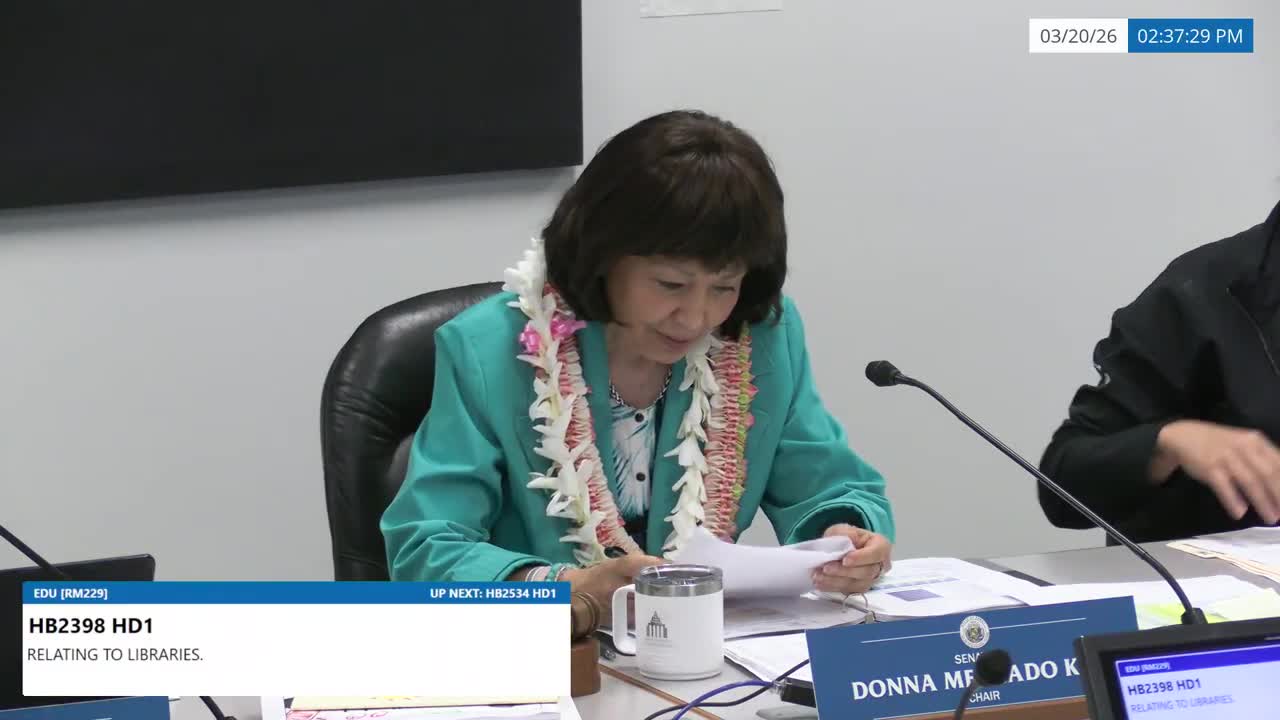 8MIN
Senate Standing Committee on Education
1MIN
Senate Standing Committee on Education
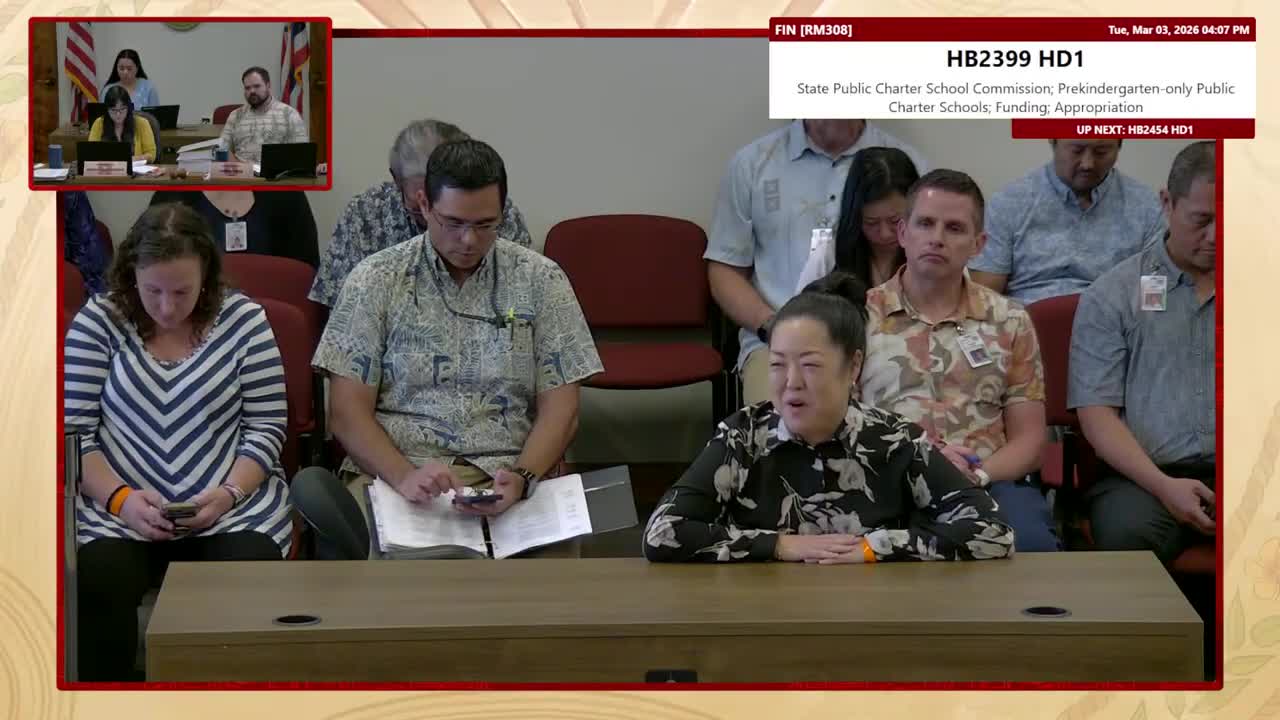 20MIN
House Standing Committee on Finance
 1MIN
House Standing Committee on Finance
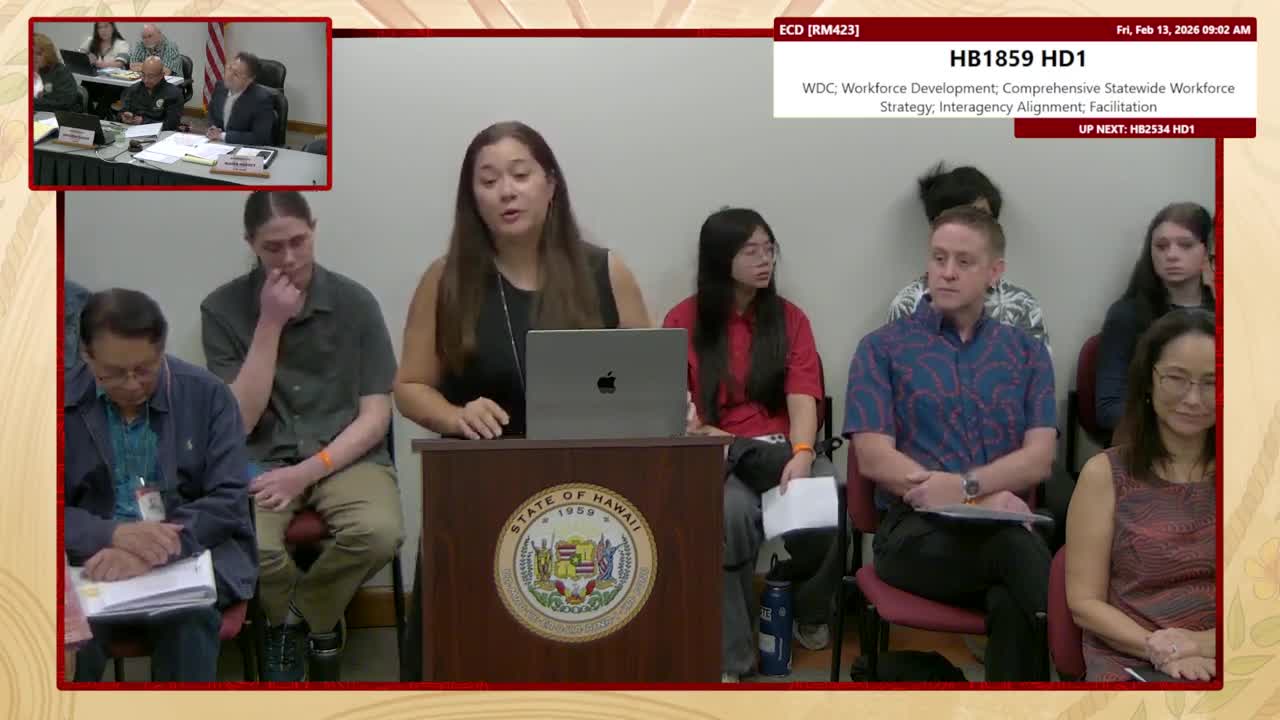 25MIN
House Standing Committee on Economic Development & Technology
 1MIN
House Standing Committee on Economic Development & Technology
 14MIN
House Standing Committee on Education
 33SEC
House Standing Committee on Education
Bill Author

Bill Co-Author(s):