HB 2490: Maui County; DBEDT; SHPD; Coastal Resilience Pilot Program; Historic Preservation Review; Reports
- Session Year: 2025-2026
- House: House
- Latest Version Date: 2026-02-18
Current Status:
Failed
(2026-03-20: Re-Referred to EDT, WAM.)
Introduced
In Committee
First Chamber
In Committee
Second Chamber
Final Decking
Enacted
Establishes a five-year Coastal Resilience Pilot Program within the Department of Business, Economic Development, and Tourism for the preservation of Mantokuji Bay. Allows the pilot program to be exempt from certain regulatory requirements. Requires the State Historic Preservation Division to conduct a streamlined historic preservation review. Establishes certain procedures for the discovery of Native Hawaiian skeletal remains. Requires annual reports to the Legislature. Sunsets 6/30/2031. Effective 7/1/3000. (HD2)
Establishes a five-year Coastal Resilience Pilot Program within the Department of Business, Economic Development, and Tourism for the preservation of Mantokuji Bay. Allows the Pilot Program to be exempt from certain regulatory requirements. Requires the State Historic Preservation Division to conduct a streamlined historic preservation review. Requires annual reports to the Legislature. Sunsets 6/30/2031. Effective 7/1/3000. (HD1)
Establishes a five-year Coastal Resilience Pilot Program within the Department of Business, Economic Development, and Tourism for the preservation of Mantokuji Bay. Exempts the Pilot Program from certain regulatory requirements. Requires the State Historic Preservation Division to conduct a streamlined historic preservation review. Requires annual reports to the Legislature. Sunsets 6/30/2031.
|
HOUSE OF REPRESENTATIVES |
H.B. NO. |
2490 |
|
THIRTY-THIRD LEGISLATURE, 2026 |
H.D. 2 |
|
|
STATE OF HAWAII |
|
|
|
|
|
|
|
|
||
|
|
||
A BILL FOR AN ACT
RELATING TO COASTAL RESILIENCE.
BE IT ENACTED BY THE LEGISLATURE OF THE STATE OF HAWAII:
The legislature further finds that county sand mining operations in the 1930s removed significant quantities of beach sand for public works projects, triggering decades of accelerated erosion that has degraded water quality, damaged coral reef ecosystems, undercut natural headland rock features, and caused the bay to widen. According to the university of Hawaii coastal geology group, the Mantokuji bay coastline is retreating inland at an average rate of approximately 1.6 feet per year, threatening residences, infrastructure, and irreplaceable cultural sites along its shores.
The legislature notes that the most significant of the threatened cultural resources along the bay is the Paia Mantokuji, a Soto Zen Buddhist temple. Established in 1906, the temple is listed on the Hawaii register of historic places and is the oldest Soto Zen Buddhist temple in the State. The temple hosts one of the State's most popular annual Obon festivals, drawing thousands of visitors. The temple grounds contain sacred burial sites, including a former crematorium and numerous ancestral remains. Coastal erosion has caused ancestral burials to fall into the ocean, creating an urgent cultural and spiritual crisis while threatening the temple's structural integrity. The bay also buffers the Hana highway, the major transportation corridor for northeast Maui communities, from coastal hazards.
The legislature additionally finds that the State's historical parcel‑by-parcel coastal management approach has prevented comprehensive regional solutions and resulted in piecemeal hardening that exacerbated regional erosion. Past county sand mining in Mantokuji bay further contributed to current conditions. Effective protection requires addressing the entire bay as a natural coastal cell for specific regional coastal remediation. Coastal resilience approaches include nature-based solutions, enhancement of naturally occurring features such as headlands and reefs, hybrid natural-engineered systems, adaptive protection structures, and other innovative coastal adaptation strategies that offer opportunities to protect Mantokuji bay while maintaining environmental protection and shoreline access.
The legislature also finds, however, that traditional regulatory processes effectively make approval of regional bay‑wide resilience solutions extremely difficult due to overlapping jurisdictions and rigid criteria not designed for comprehensive coastal management.
Accordingly, the purpose of this Act is to establish a five-year pilot program to implement comprehensive coastal resilience measures for Mantokuji bay that use streamlined regulatory processes while maintaining environmental and cultural protections, including protections related to Native Hawaiian skeletal remains, which may later be used to inform future statewide policy for protecting threatened coastal areas.
SECTION 2. (a) There is established within the department of business, economic development, and tourism a five-year coastal resilience pilot program to implement comprehensive, streamlined coastal management measures for the restoration and preservation of Mantokuji bay, Paia, in the county of Maui. Under the pilot program, the department shall approve and implement coastal management measures that support regional coastal remediation by addressing the entirety of Mantokuji bay as a natural coastal cell, rather than individual land parcels.
(b) The pilot program shall establish a monitoring program in a manner specified by the department to evaluate its efficacy and environmental impacts.
(c) The state historic preservation division shall conduct a streamlined historic preservation review to evaluate measures approved under the pilot program. The state historic preservation division shall require an archaeological literature review of archaeological and historical documentation for the area of potential effect and the project environment.
(d) The department shall coordinate with federal agencies to seek expedited review and approval of coastal management measures approved under the pilot program through consolidated applications and coordinated processes where feasible.
(e) Notwithstanding any provision of chapter 6E, Hawaii Revised Statutes, or chapter 13-300, Hawaii Administrative Rules, to the contrary, any Native Hawaiian skeletal remains discovered during activities conducted under the pilot program established pursuant to this Act shall be subject to the following procedures:
(1) Upon discovery of Native Hawaiian skeletal remains, all ground-disturbing activity within a reasonable buffer area surrounding the discovery site shall immediately cease, and the state historic preservation division and island burial council shall be notified within twenty-four hours;
(2) The applicant shall conduct a good-faith effort to identify lineal and cultural descendants, in consultation with the state historic preservation division, the office of Hawaiian affairs, and relevant Native Hawaiian organizations with knowledge of traditional practices and genealogical connections to the area;
(3) The island burial council shall determine whether the remains shall be preserved in place or relocated, following meaningful consultation with any identified lineal and cultural descendants; provided that the island burial council's determination shall give due consideration to the preferences expressed by the lineal descendants;
(4) The island burial council shall render its determination within forty-five days of notification, or at the next regularly scheduled meeting of the council at which a quorum is present, whichever is later; provided that the applicant and department of land and natural resources may mutually agree to a further extension of time if additional consultation with descendants or further archaeological assessment is warranted;
(5) All costs associated with required archaeological documentation, descendant consultation, burial treatment plans, and any mitigation measures shall be borne by the applicant; and
(6) No ground-disturbing activity shall resume within the buffer area established under paragraph (1) until the island burial council has rendered its determination and any required burial treatment plan has been approved by the state historic preservation division.
(f) Documented burials and any burials believed to be non-Native Hawaiian within the Mantokuji Soto Zen Mission cemetery shall not be subject to the requirements under subsection (e) and shall be managed in accordance with applicable department of health requirements and any other relevant state law governing established cemeteries.
(g) The applicant shall coordinate with the department of health regarding the identification, documentation, and treatment of any human remains from the Mantokuji Soto Zen Mission cemetery that may be encountered during pilot program activities.
(h) Notwithstanding any law or ordinance to the contrary, the pilot program may be exempt from:
(1) Chapter 183C, Hawaii Revised Statutes, relating to conservation districts;
(2) Chapter 205A, Hawaii Revised Statutes, relating to coastal zone management;
(3) Chapter 343, Hawaii Revised Statutes, relating to environmental impact statements;
(4) County ordinances regulating shoreline setback and variance requirements; and
(5) County building permit requirements specifically related to coastal resilience structures; provided that public safety standards shall be maintained.
(i) Nothing in this section shall be construed to exempt the pilot program from:
(1) Any federal laws and regulations, including but not limited to:
(A) United States Army Corps of Engineers permit requirements;
(B) Applicable requirements pursuant to section 106 of the National Historic Preservation Act of 1966, as amended;
(C) Consultation requirements pursuant to the Endangered Species Act of 1973, as amended;
(D) Water quality certification requirements pursuant to the Clean Water Act of 1972, as amended; and
(E) Federal consistency review requirements pursuant to the Coastal Zone Management Act of 1992, as amended;
(2) Article XII, section 7, of the Hawaii State Constitution, protecting traditional and customary rights of Native Hawaiians;
(3) Chapter 6E, Hawaii Revised Statutes, relating to historic preservation; provided that only the streamlined historic preservation review required pursuant to subsection (c) shall apply; and
(4) Marine life protection laws and water quality standards.
(j) The department shall submit an annual report on the pilot program to the legislature no later than twenty days prior to the convening of each regular session. Each report shall include:
(1) A status report for the pilot program;
(2) An evaluation of the efficacy of the pilot program;
(3) Budget expenditures; and
(4) Any other findings and recommendations, including any proposed legislation.
(k) As used in this section:
"Applicant" means the entity authorized to conduct coastal restoration activities under the pilot program.
"Department" means the department of business, economic development, and tourism.
"Island burial council" means the Maui/Lanaʻi island burial council established under section 6E-43.5, Hawaii Revised Statutes, or any successor council with jurisdiction over the project area.
"Native Hawaiian skeletal remains" means human skeletal remains or burial goods of Native Hawaiian origin, as determined by the state historic preservation division
"Pilot program" means the coastal resilience pilot program established pursuant to subsection (a).
SECTION 3. This Act shall take effect on July 1, 3000, and shall be repealed on June 30, 2031.
Report Title:
Maui County; DBEDT; SHPD; Coastal Resilience Pilot Program; Historic Preservation Review; Reports
Description:
Establishes a five-year Coastal Resilience Pilot Program within the Department of Business, Economic Development, and Tourism for the preservation of Mantokuji Bay. Allows the pilot program to be exempt from certain regulatory requirements. Requires the State Historic Preservation Division to conduct a streamlined historic preservation review. Establishes certain procedures for the discovery of Native Hawaiian skeletal remains. Requires annual reports to the Legislature. Sunsets 6/30/2031. Effective 7/1/3000. (HD2)
The summary description of legislation appearing on this page is for informational purposes only and is not legislation or evidence of legislative intent.
|
HOUSE OF REPRESENTATIVES |
H.B. NO. |
2490 |
|
THIRTY-THIRD LEGISLATURE, 2026 |
H.D. 1 |
|
|
STATE OF HAWAII |
|
|
|
|
|
|
|
|
||
|
|
||
A BILL FOR AN ACT
RELATING TO COASTAL RESILIENCE.
BE IT ENACTED BY THE LEGISLATURE OF THE STATE OF HAWAII:
The legislature further finds that county sand mining operations in the 1930s removed significant quantities of beach sand for public works projects, triggering decades of accelerated erosion that has degraded water quality, damaged coral reef ecosystems, undercut natural headland rock features, and caused the bay to widen. According to the university of Hawaii coastal geology group, the Mantokuji bay coastline is retreating inland at an average rate of approximately 1.6 feet per year, threatening residences, infrastructure, and irreplaceable cultural sites along its shores.
The legislature notes that the most significant of the threatened cultural resources along the bay is the Paia Mantokuji, a Soto Zen Buddhist temple. Established in 1906, the temple is listed on the Hawaii register of historic places and is the oldest Soto Zen Buddhist temple in the State. The temple hosts one of the State's most popular annual Obon festivals, drawing thousands of visitors. The temple grounds contain sacred burial sites, including a former crematorium and numerous ancestral remains. Coastal erosion has caused ancestral burials to fall into the ocean, creating an urgent cultural and spiritual crisis while threatening the temple's structural integrity. The bay also buffers the Hana highway, the major transportation corridor for northeast Maui communities, from coastal hazards.
The legislature finds that the State's historical parcel‑by-parcel coastal management approach has prevented comprehensive regional solutions and resulted in piecemeal hardening that exacerbated regional erosion. Past county sand mining in Mantokuji bay further contributed to current conditions. Effective protection requires addressing the entire bay as a natural coastal cell for specific regional coastal remediation. Coastal resilience approaches include nature-based solutions, enhancement of naturally occurring features such as headlands and reefs, hybrid natural-engineered systems, adaptive protection structures, and other innovative coastal adaptation strategies that offer opportunities to protect Mantokuji bay while maintaining environmental protection and shoreline access.
The legislature further finds, however, that traditional regulatory processes effectively make approval of regional bay‑wide resilience solutions extremely difficult due to overlapping jurisdictions and rigid criteria not designed for comprehensive coastal management.
Accordingly, the purpose of this Act is to establish a five-year pilot program to implement comprehensive coastal resilience measures for Mantokuji bay that use streamlined regulatory processes while maintaining environmental and cultural protections, which may later be used to inform future statewide policy for protecting threatened coastal areas.
SECTION 2. (a) There is established within the department of business, economic development, and tourism a five-year coastal resilience pilot program to implement comprehensive, streamlined coastal management measures for the restoration and preservation of Mantokuji bay, Paia, in the county of Maui. Under the pilot program, the department shall approve and implement coastal management measures that support regional coastal remediation by addressing the entirety of Mantokuji bay as a natural coastal cell, rather than individual land parcels.
(b) The pilot program shall establish a monitoring program in a manner specified by the department to evaluate its efficacy and environmental impacts.
(c) The state historic preservation division shall conduct a streamlined historic preservation review to evaluate measures approved under the pilot program. The state historic preservation division shall require:
(1) An archaeological literature review of archaeological and historical documentation for the area of potential effect and the project environment;
(2) An archaeological monitoring plan providing for a qualified archaeologist to be present during ground‑disturbing activities with the authority to halt work if significant historic properties or human remains are encountered; and
(3) An inadvertent discovery protocol establishing procedures for the treatment of any iwi kupuna, burial goods, or cultural artifacts discovered during project implementation.
The state historic preservation division shall issue a determination within forty-five calendar days of receiving the documentation required pursuant to this subsection; provided that if no determination is issued within forty-five days, the pilot program may proceed in accordance with the monitoring plan and inadvertent discovery protocol submitted pursuant to paragraphs (2) and (3); provided further that any applicable requirements pursuant to section 106 of the National Historic Preservation Act of 1966, as amended, shall be satisfied before the pilot program proceeds.
(d) The department shall coordinate with federal agencies to seek expedited review and approval of coastal management measures approved under the pilot program through consolidated applications and coordinated processes where feasible.
(e) Notwithstanding any law or ordinance to the contrary, the pilot program may be exempt from:
(1) Chapter 183C, Hawaii Revised Statutes, relating to conservation districts;
(2) Chapter 205A, Hawaii Revised Statutes, relating to coastal zone management;
(3) Chapter 343, Hawaii Revised Statutes, relating to environmental impact statements;
(4) County ordinances regulating shoreline setback and variance requirements; and
(5) County building permit requirements specifically related to coastal resilience structures; provided that public safety standards shall be maintained.
(f) Nothing in this section shall be construed to exempt the pilot program from:
(1) Any federal laws and regulations, including but not limited to:
(A) United States Army Corps of Engineers permit requirements;
(B) Applicable requirements pursuant to section 106 of the National Historic Preservation Act of 1966, as amended;
(C) Consultation requirements pursuant to the Endangered Species Act of 1973, as amended;
(D) Water quality certification requirements pursuant to the Clean Water Act of 1972, as amended; and
(E) Federal consistency review requirements pursuant to the Coastal Zone Management Act of 1992, as amended;
(2) Article XII, section 7, of the Hawaii State Constitution, protecting traditional and customary rights of Native Hawaiians;
(3) Chapter 6E, Hawaii Revised Statutes, relating to historic preservation; provided that only the streamlined historic preservation review required pursuant to subsection (c) shall apply; and
(4) Marine life protection laws and water quality standards.
(g) The department shall submit an annual report on the pilot program to the legislature no later than twenty days prior to the convening of each regular session. Each report shall include:
(1) A status report for the pilot program;
(2) An evaluation of the efficacy of the pilot program;
(3) Budget expenditures; and
(4) Any other findings and recommendations, including any proposed legislation.
(h) As used in this section:
"Department" means the department of business, economic development, and tourism.
"Pilot program" means the coastal resilience pilot program established pursuant to subsection (a).
SECTION 3. This Act shall take effect on July 1, 3000, and shall be repealed on June 30, 2031.
Report Title:
Maui County; DBEDT; SHPD; Coastal Resilience Pilot Program; Historic Preservation Review; Reports
Description:
Establishes a five-year Coastal Resilience Pilot Program within the Department of Business, Economic Development, and Tourism for the preservation of Mantokuji Bay. Allows the Pilot Program to be exempt from certain regulatory requirements. Requires the State Historic Preservation Division to conduct a streamlined historic preservation review. Requires annual reports to the Legislature. Sunsets 6/30/2031. Effective 7/1/3000. (HD1)
The summary description of legislation appearing on this page is for informational purposes only and is not legislation or evidence of legislative intent.
|
HOUSE OF REPRESENTATIVES |
H.B. NO. |
2490 |
|
THIRTY-THIRD LEGISLATURE, 2026 |
|
|
|
STATE OF HAWAII |
|
|
|
|
|
|
|
|
||
|
|
||
A BILL FOR AN ACT
relating to coastal resilience.
BE IT ENACTED BY THE LEGISLATURE OF THE STATE OF HAWAII:
The legislature further finds that county sand mining operations in the 1930s removed significant quantities of beach sand for public works projects, triggering decades of accelerated erosion that has degraded water quality, damaged coral reef ecosystems, undercut natural headland rock features, and caused the bay to widen. According to the university of Hawaii Coastal Geology Group, the Mantokuji bay coastline is retreating inland at an average rate of approximately 1.6 feet per year, threatening residences, infrastructure, and irreplaceable cultural sites along its shores.
The legislature notes that the most significant of the threatened cultural resources along the bay is the Paia Mantokuji, a Soto Zen Buddhist temple. Established in 1906, the temple is listed on the Hawaii register of historic places and is the oldest Soto Zen Buddhist temple in the State. The temple hosts one of the State's most popular annual Obon festivals, drawing thousands of visitors. The temple grounds contain sacred burial sites including a former crematorium and numerous ancestral remains. Coastal erosion has caused ancestral burials to fall into the ocean, creating an urgent cultural and spiritual crisis while threatening the temple's structural integrity. The bay also buffers the Hana highway, the major transportation corridor for northeast Maui communities, from coastal hazards.
The legislature finds that the State's historical parcel‑by-parcel coastal management approach has prevented comprehensive regional solutions and resulted in piecemeal hardening that exacerbated regional erosion. Past county sand mining in Mantokuji bay further contributed to current conditions. Effective protection requires addressing the entire bay as a natural coastal cell for specific regional coastal remediation. Coastal resilience approaches include nature-based solutions, enhancement of naturally occurring features such as headlands and reefs, hybrid natural-engineered systems, adaptive protection structures, and other innovative coastal adaptation strategies that offer opportunities to protect Mantokuji bay while maintaining environmental protection and shoreline access.
The legislature further finds, however, that traditional regulatory processes effectively make approval of regional bay‑wide resilience solutions extremely difficult due to overlapping jurisdictions and rigid criteria not designed for comprehensive coastal management.
Accordingly, the purpose of this Act is to establish a five-year pilot program to implement comprehensive coastal resilience measures for Mantokuji bay that utilize streamlined regulatory processes while maintaining environmental and cultural protections, which may later be used to inform future statewide policy for protecting threatened coastal areas.
SECTION 2. (a) There is established within the department of business, economic development, and tourism a five-year coastal resilience pilot program to implement comprehensive, streamlined coastal management measures for the restoration and preservation of Mantokuji bay, Paia, in the county of Maui. Under the pilot program, the department shall approve and implement coastal management measures that support regional coastal remediation by addressing the entirety of Mantokuji bay as a natural coastal cell, rather than individual land parcels.
(b) The pilot program shall establish a monitoring program in a manner specified by the department to evaluate its efficacy and environmental impacts.
(c) The state historic preservation division shall conduct a streamlined historic preservation review to evaluate measures approved under the pilot program. The state historic preservation division shall require:
(1) An archaeological literature review of archaeological and historical documentation for the area of potential effect and the project environment;
(2) An archaeological monitoring plan providing for a qualified archaeologist to be present during ground‑disturbing activities with the authority to halt work if significant historic properties or human remains are encountered; and
(3) An inadvertent discovery protocol establishing procedures for the treatment of any iwi kupuna, burial goods, or cultural artifacts discovered during project implementation.
The state historic preservation division shall issue a determination within forty-five calendar days of receiving the documentation required pursuant to this subsection; provided that if no determination is issued within forty-five days, the pilot program may proceed in accordance with the monitoring plan and inadvertent discovery protocol submitted pursuant to paragraphs (2) and (3); provided further that any applicable requirements pursuant to section 106 of the National Historic Preservation Act of 1996, as amended, shall be satisfied before the pilot program proceeds.
(d) The department shall coordinate with federal agencies to seek expedited review and approval of coastal management measures approved under the pilot program through consolidated applications and coordinated processes where feasible.
(e) Notwithstanding any law or ordinance to the contrary, the pilot program shall be exempt from:
(1) Chapter 183C, Hawaii Revised Statutes, relating to conservation districts;
(2) Chapter 205A, Hawaii Revised Statutes, relating to coastal zone management;
(3) Chapter 343, Hawaii Revised Statutes, relating to environmental impact statements;
(4) County ordinances regulating shoreline setback and variance requirements; and
(5) County building permit requirements specifically related to coastal resilience structures; provided that public safety standards shall be maintained.
(f) Nothing in this section shall be construed to exempt the pilot program from:
(1) Any federal laws and regulations, including but not limited to:
(A) United States Army Corps of Engineers permit requirements;
(B) Applicable requirements pursuant to section 106 of the National Historic Preservation Act of 1966, as amended;
(C) Consultation requirements pursuant to the Endangered Species Act of 1973, as amended;
(D) Water quality certification requirements pursuant to the Clean Water Act of 1972, as amended; and
(E) Federal consistency review requirements pursuant to the Coastal Zone Management Act of 1992, as amended;
(2) Article XII, section 7, of the Hawaii State Constitution, protecting traditional and customary rights of Native Hawaiians;
(3) Chapter 6E, Hawaii Revised States, relating to historic preservation; provided that only the streamlined historic preservation review required pursuant to subsection (c) shall apply; and
(4) Marine life protection laws and water quality standards.
(g) The department shall submit an annual report on the coastal resilience pilot program to the legislature no later than twenty days prior to the convening of each regular session. Each report shall include:
(1) A status report for the pilot program;
(2) An evaluation of the efficacy of the pilot program;
(3) Budget expenditures; and
(4) Any other findings and recommendations, including any proposed legislation.
(h) For the purposes of this section:
"Department" means the department of business, economic development, and tourism.
"Pilot program" means the coastal resilience pilot program established pursuant to subsection (a).
SECTION 3. This Act shall take effect on July 1, 2026, and shall be repealed on June 30, 2031.
|
INTRODUCED BY: |
_____________________________ |
|
|
|
Report Title:
Maui County; DBEDT; SHPD; Coastal Resilience Pilot Program; Historic Preservation Review; Reports
Description:
Establishes a five-year Coastal Resilience Pilot Program within the Department of Business, Economic Development, and Tourism for the preservation of Mantokuji Bay. Exempts the Pilot Program from certain regulatory requirements. Requires the State Historic Preservation Division to conduct a streamlined historic preservation review. Requires annual reports to the Legislature. Sunsets 6/30/2031.
The summary description of legislation appearing on this page is for informational purposes only and is not legislation or evidence of legislative intent.
|
Date
|
Status
|
|---|---|
| Mar 20, 2026 | Re-Referred to EDT, WAM. |
| Mar 10, 2026 | Referred to EDT/WLA, WAM. |
| Mar 10, 2026 | Passed First Reading. |
| Mar 10, 2026 | Received from House (Hse. Com. No. 215). |
| Mar 6, 2026 | Passed Third Reading with none voting aye with reservations; none voting no (0) and Representative(s) Perruso, Quinlan, Sayama excused (3). Transmitted to Senate. |
| Mar 6, 2026 | Reported from FIN (Stand. Com. Rep. No. 972-26), recommending passage on Third Reading. |
| Mar 3, 2026 | The committee on FIN recommend that the measure be PASSED, UNAMENDED. The votes were as follows: 16 Ayes: Representative(s) Todd, Takenouchi, Hartsfield, Hussey, Keohokapu-Lee Loy, Kitagawa, Kusch, Lee, M., Miyake, Morikawa, Templo, Yamashita, Alcos, Gedeon, Reyes Oda; Ayes with reservations: Representative(s) Perruso; Noes: none; and Excused: none. |
| Feb 27, 2026 | Bill scheduled to be heard by FIN on Tuesday, 03-03-26 10:00AM in House conference room 308 VIA VIDEOCONFERENCE. |
| Feb 19, 2026 | Report adopted; referred to the committee(s) on FIN as amended in HD 2 with none voting aye with reservations; none voting no (0) and none excused (0). |
| Feb 19, 2026 | Reported from ECD (Stand. Com. Rep. No. 510-26) as amended in HD 2, recommending referral to FIN. |
| Feb 13, 2026 | The committee on ECD recommend that the measure be PASSED, WITH AMENDMENTS. The votes were as follows: 7 Ayes: Representative(s) Ilagan, Hussey, Holt, Tam, Templo, Yamashita, Gedeon; Ayes with reservations: none; Noes: none; and Excused: none. |
| Feb 10, 2026 | Bill scheduled to be heard by ECD on Friday, 02-13-26 8:30AM in House conference room 423 VIA VIDEOCONFERENCE. |
| Feb 10, 2026 | Passed Second Reading as amended in HD 1 and referred to the committee(s) on ECD with none voting aye with reservations; none voting no (0) and none excused (0). |
| Feb 9, 2026 | Reported from WAL (Stand. Com. Rep. No. 97-26) as amended in HD 1, recommending passage on Second Reading and referral to ECD. |
| Feb 5, 2026 | The committee on WAL recommend that the measure be PASSED, WITH AMENDMENTS. The votes were as follows: 7 Ayes: Representative(s) Hashem, Morikawa, Ichiyama, Poepoe, Woodson, Shimizu, Souza; Ayes with reservations: none; Noes: none; and 2 Excused: Representative(s) Belatti, Iwamoto. |
| Feb 2, 2026 | Bill scheduled to be heard by WAL on Thursday, 02-05-26 9:00AM in House conference room 411 VIA VIDEOCONFERENCE. |
| Feb 2, 2026 | Referred to WAL, ECD, FIN, referral sheet 6 |
| Jan 28, 2026 | Introduced and Pass First Reading. |
|
Date
|
Description
|
Location
|
Votes
|
|
|---|---|---|---|---|
| Mar 6, 2026 | Third Reading | House Floor |
Passed |
|
| Mar 3, 2026 | The committee on FIN recommend that the measure be PASSED, UNAMENDED | House Standing Committee on Finance |
Passed |
|
| Feb 13, 2026 | The committee on ECD recommend that the measure be PASSED, WITH AMENDMENTS | House Standing Committee on Economic Development & Technology |
Passed |
|
| Feb 5, 2026 | The committee on WAL recommend that the measure be PASSED, WITH AMENDMENTS | House Standing Committee on Water & Land |
Passed |
This list shows positions taken on this bill by organizations on the date displayed, which is linked to the original source.
Positions by individuals are not included.
|
Organization
|
Position
|
Date
|
|---|---|---|
| County of Maui | *** Support | Mar 3, 2026 |
| Department of ʻOiwi Resources | *** Support | Mar 3, 2026 |
| League of Women Voters of Hawaii | *** Against | Mar 3, 2026 |
| Oceanit Laboratories, Inc. | ** Support | |
| Office of the Mayor of the County of Maui | ** Support | |
| Paia Mantokuji Soto Zen Mission | ** Support |
STAND. COM. REP. NO. 972-26
Honolulu, Hawaii
, 2026
RE: H.B. No. 2490
H.D. 2
Honorable Nadine K. Nakamura
Speaker, House of Representatives
Thirty-Third State Legislature
Regular Session of 2026
State of Hawaii
Madame:
Your Committee on Finance, to which was referred H.B. No. 2490, H.D. 2, entitled:
"A BILL FOR AN ACT RELATING TO COASTAL RESILIENCE,"
begs leave to report as follows:
The purpose of this measure is to:
(1) Establish a five-year Coastal Resilience Pilot Program within the Department of Business, Economic Development, and Tourism for the preservation of Mantokuji Bay, Paia, Maui;
(2) Allow the Pilot Program to be exempt from certain regulatory requirements; and
(3) Require the State Historic Preservation Division to conduct a streamlined historic preservation review; and
(4) Establish certain procedures for the discovery of Native Hawaiians skeletal remains discovered during activities conducted under the Pilot Program.
As affirmed by the record of votes of the members of your Committee on Finance that is attached to this report, your Committee is in accord with the intent and purpose of H.B. No. 2490, H.D. 2, and recommends that it pass Third Reading.
Respectfully submitted on behalf of the members of the Committee on Finance,
|
|
|
____________________________ CHRIS TODD, Chair |
|
|
|
|
STAND. COM. REP. NO. 510-26
Honolulu, Hawaii
, 2026
RE: H.B. No. 2490
H.D. 2
Honorable Nadine K. Nakamura
Speaker, House of Representatives
Thirty-Third State Legislature
Regular Session of 2026
State of Hawaii
Madame:
Your Committee on Economic Development & Technology, to which was referred H.B. No. 2490, H.D. 1, entitled:
"A BILL FOR AN ACT RELATING TO COASTAL RESILIENCE,"
begs leave to report as follows:
The purpose of this measure is to:
(1) Establish a five-year Coastal Resilience Pilot Program within the Department of Business, Economic Development, and Tourism for the preservation of Mantokuji Bay;
(2) Allow the pilot program to be exempt from certain regulatory requirements; and
(3) Require the State Historic Preservation Division to conduct a streamlined historic preservation review to evaluate measures approved under the pilot program.
Your Committee finds that severe coastal erosion at Mantokuji Bay threatens homes, cultural sites, transportation routes, and natural ecosystems and that existing parcel‑by‑parcel regulatory processes hinder comprehensive regional solutions. This measure establishes a five‑year pilot program to implement bay‑wide coastal resilience strategies using streamlined procedures while maintaining necessary environmental and cultural protections.
Your Committee notes that the State Historic Preservation Division has expressed concerns regarding the treatment of iwi kupuna that may be discovered during coastal restoration activities conducted under the pilot program. Amendments to this measure are therefore necessary to ensure that any such discoveries receive the full protections of Island Burial Council oversight and descendant consultation.
Accordingly, your Committee has amended this measure by:
(1) Replacing the State Historic Preservation Divison's requirement for an archaeological monitoring plan and inadvertent discovery protocol with an archaeological literature review and procedures for the discovery of Native Hawaiian skeletal remains; and
(2) Making technical, nonsubstantive amendments for the purposes of clarity, consistency, and style.
As affirmed by the record of votes of the members of your Committee on Economic Development & Technology that is attached to this report, your Committee is in accord with the intent and purpose of H.B. No. 2490, H.D. 1, as amended herein, and recommends that it be referred to your Committee on Finance in the form attached hereto as H.B. No. 2490, H.D. 2.
Respectfully submitted on behalf of the members of the Committee on Economic Development & Technology,
|
|
|
____________________________ GREGGOR ILAGAN, Chair |
|
|
|
|
STAND. COM. REP. NO. 97-26
Honolulu, Hawaii
, 2026
RE: H.B. No. 2490
H.D. 1
Honorable Nadine K. Nakamura
Speaker, House of Representatives
Thirty-Third State Legislature
Regular Session of 2026
State of Hawaii
Madame:
Your Committee on Water & Land, to which was referred H.B. No. 2490 entitled:
"A BILL FOR AN ACT RELATING TO COASTAL RESILIENCE,"
begs leave to report as follows:
Your Committee recognizes the importance of the proper stewardship of Hawaii's valuable natural and cultural resources. Your Committee finds that the pilot program in this measure presents a significant opportunity to demonstrate how comprehensive coastal-resilience efforts can simultaneously protect cultural sites, infrastructure, and natural systems.
Your Committee has amended this measure by:
(1) Allowing, rather than requiring, the pilot program to be exempt from state laws governing conservation districts, coastal zone management, and environmental review; county ordinances regulating shoreline setback and variance requirements; and county building permit requirements specifically related to coastal resilience structures;
(2) Changing its effective date to July 1, 3000, to encourage further discussion; and
(3) Making technical, nonsubstantive amendments for the purposes of clarity, consistency, and style.
As affirmed by the record of votes of the members of your Committee on Water & Land that is attached to this report, your Committee is in accord with the intent and purpose of H.B. No. 2490, as amended herein, and recommends that it pass Second Reading in the form attached hereto as H.B. No. 2490, H.D. 1, and be referred to your Committee on Economic Development & Technology.
Respectfully submitted on behalf of the members of the Committee on Water & Land,
|
|
|
____________________________ MARK J. HASHEM, Chair |
|
|
|
|
|
Date
|
Testimony PDF
|
|---|---|
| Mar 3, 2026 | HB2490_HD2_TESTIMONY_FIN_03-03-26_.PDF |
| Feb 19, 2026 | HB2490_TESTIMONY_WAL_02-05-26_.PDF |
| Feb 13, 2026 | HB2490_HD1_TESTIMONY_ECD_02-13-26_.PDF |
Discussed in Hearing
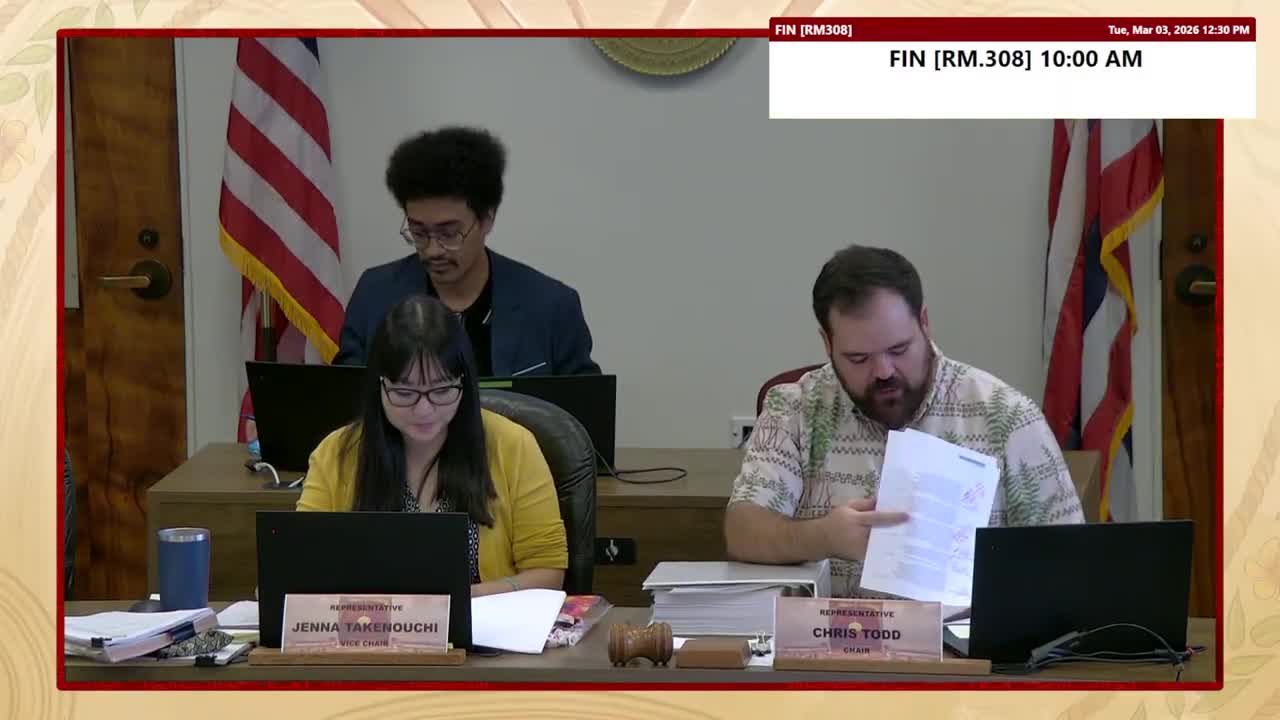 6MIN
House Standing Committee on Finance
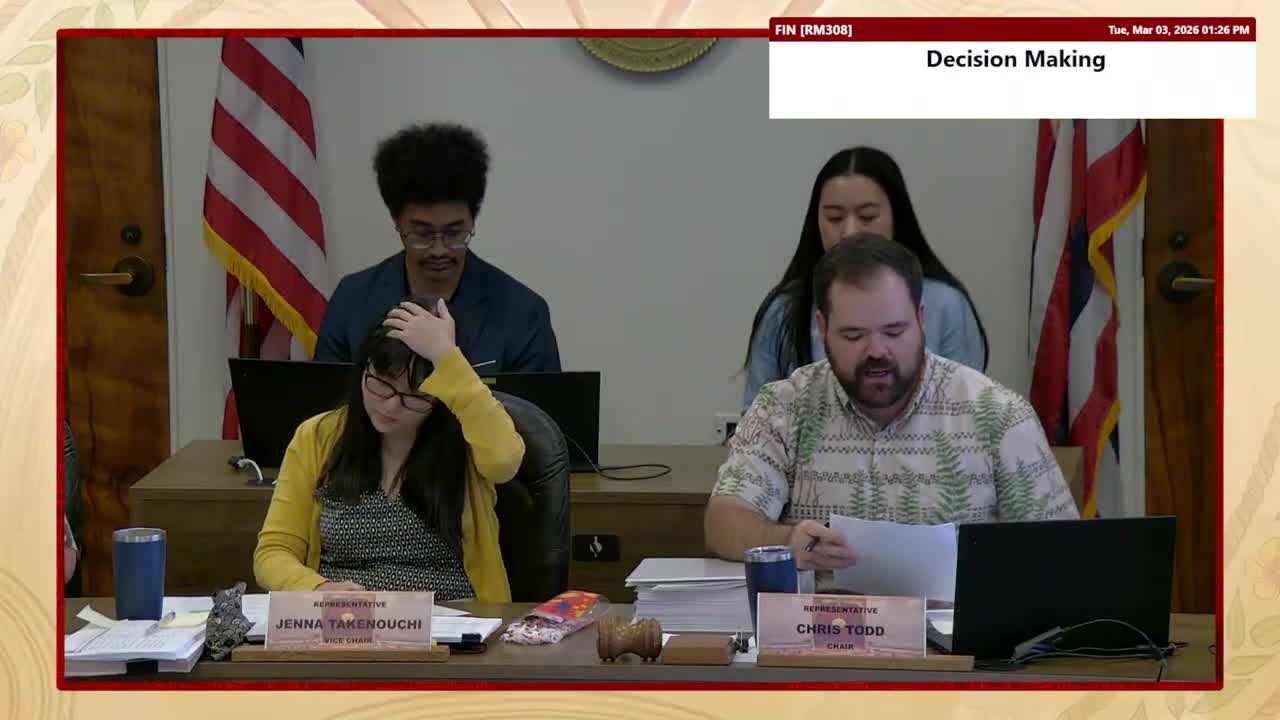 21SEC
House Standing Committee on Finance
 2MIN
House Standing Committee on Economic Development & Technology
 1MIN
House Standing Committee on Economic Development & Technology
 13MIN
House Standing Committee on Water & Land
 55SEC
House Standing Committee on Water & Land
Bill Author