HB 2288: Parole Eligibility; Required Programs
- Session Year: 2025-2026
- House: House
- Latest Version Date: 2026-03-06
Current Status:
Failed
(2026-03-12: Referred to PSM, JDC.)
Introduced
In Committee
First Chamber
In Committee
Second Chamber
Final Decking
Enacted
What does this bill do?
The bill changes parole rules so people in state prisons can qualify for parole by taking a wider range of programs, explicitly adding treatment programs, work furlough, and other reentry programs to the existing academic, vocational, and prison-industry options. It requires those programs be authorized and completed to the corrections department’s satisfaction, allows the Hawaii paroling authority to waive program requirements, and requires a waiver if the department fails to move an inmate to a facility where the needed programming is available.
The summary is provided by generative AI which can make mistakes. For original language, please view the details in the table below.
Expands the types of programs in which a committed person may participate to be eligible for parole. Effective 7/1/3000. (HD2)
Expands the types of programs in which a committed person may participate to be eligible for parole. Effective 7/1/3000. (HD1)
Amends section 353-64, HRS, to include participation in correctional programs for parole eligibility: (1) treatment (substance abuse, mental health, sex offender); (2) work furlough as part of vocational education; and (3) other programs designed to assist the committed person with successful reintegration back into the community; all of which are in the scope of programs determined by Department of Corrections and Rehabilitation's Receiving and Diagnostic (RAD) assessments and recommended for parole eligibility.
|
HOUSE OF REPRESENTATIVES |
H.B. NO. |
2288 |
|
THIRTY-THIRD LEGISLATURE, 2026 |
H.D. 2 |
|
|
STATE OF HAWAII |
|
|
|
|
|
|
|
|
||
|
|
||
A BILL FOR AN ACT
RELATING TO PAROLE ELIGIBILITY.
BE IT ENACTED BY THE LEGISLATURE OF THE STATE OF HAWAII:
SECTION 1. The legislature finds that participation in treatment, work furlough, and other programs designed to assist committed persons with successful reintegration back into the community enhances rehabilitation and reduces recidivism. The legislature further finds that treatment programs address substance abuse and alcohol addiction, mental health illness, and deviant sexual behaviors; work furlough provides opportunities to secure employment, increase financial stability, resocialize with family and support networks, and secure housing before release; and other programs, such as those focused on cognitive skills, parenting skills, and anger management, enhance skills to manage daily living activities and challenging situations.
Accordingly, the purpose of this Act is to expand the types of programs in which a committed person can participate to be eligible for parole to include treatment, work furlough, and other programs designed for successful reintegration.
SECTION 2. Section 353-64, Hawaii Revised Statutes, is amended to read as follows:
"§353-64 Committed persons paroled. Any committed person confined in any state
correctional facility in execution of any sentence imposed upon the committed
person, except in cases where the penalty of life imprisonment not subject to
parole has been imposed, shall be subject to parole in the manner and form as
set forth in this part; provided that the committed person shall be paroled in
the county where the committed person had a permanent residence or occupation
or employment [prior to] before incarceration, unless[:] the
committed person will:
(1) [The
committed person will reside] Reside in a county in which the
population exceeds [eight-hundred] eight hundred thousand
persons;
(2) [The
committed person will be]
Be released for immediate departure from the State; or
(3) [The
committed person shall be]
Be released to the county in the State in which the committed person has
the greatest family or community support, opportunities for employment, job
training, education, treatment, and other social services, as determined by the
Hawaii paroling authority; provided that to be considered for parole to another
county in the State, the committed person shall provide a written request to
the department [not] no less than six months [prior to] before
the expiration of the committed person's longest minimum sentence[.
Provided];
provided
further that, to be eligible for parole, the committed person, if the
person is determined by the department to be suitable for participation, [must]
shall have been a participant in an academic, treatment, or
vocational education[, or] program, including participation in work
furlough if so recommended; prison industry program; or other programs
designed to assist the committed person with successful reintegration back into
the community. Such programs shall be
authorized by the department, and [must] the committed person
shall have been involved in or completed the [program] programs to the satisfaction of the department[; and
provided further that this]. This
precondition for parole shall not apply if the committed person is in a
correctional facility where [academic, vocational education, and prison
industry] the required programs or related facilities are not
available. A grant of parole shall not
be subject to acceptance by the committed person[.], and the foregoing program
participation requirements may be waived at the discretion of the Hawaii
paroling authority. If the committed
person is eligible for movement to a facility where recommended programming is
available and the department fails to move the individual to a facility where
such programming is available, the Hawaii paroling authority shall waive the
program requirements for that person and shall not deny parole due to failure
to participate in that program."
SECTION 3. Statutory material to be repealed is bracketed and stricken. New statutory material is underscored.
SECTION 4. This Act shall take effect on July 1, 3000.
Report Title:
Parole Eligibility; Required Programs
Description:
Expands the types of programs in which a committed person may participate to be eligible for parole. Effective 7/1/3000. (HD2)
The summary description of legislation appearing on this page is for informational purposes only and is not legislation or evidence of legislative intent.
|
HOUSE OF REPRESENTATIVES |
H.B. NO. |
2288 |
|
THIRTY-THIRD LEGISLATURE, 2026 |
H.D. 1 |
|
|
STATE OF HAWAII |
|
|
|
|
|
|
|
|
||
|
|
||
A BILL FOR AN ACT
RELATING TO PAROLE ELIGIBILITY.
BE IT ENACTED BY THE LEGISLATURE OF THE STATE OF HAWAII:
SECTION 1. The legislature finds that participation in treatment, work furlough, and other programs designed to assist committed persons with successful reintegration back into the community enhances rehabilitation and reduces recidivism. The legislature further finds that treatment programs address substance abuse and alcohol addiction, mental health illness, and deviant sexual behaviors; work furlough provides opportunities to secure employment, increase financial stability, resocialize with family and support networks, and secure housing prior to release; and other programs, such as those focused on cognitive skills, parenting skills, and anger management, enhance skills to manage daily living activities and challenging situations.
Accordingly, the purpose of this Act is to include treatment, work furlough, and other programs designed for successful reintegration to the types of programs in which a committed person can participate to be eligible for parole.
SECTION 2. Section 353-64, Hawaii Revised Statutes, is amended to read as follows:
"§353-64 Committed persons paroled. Any committed person confined in any state correctional facility in execution of any sentence imposed upon the committed person, except in cases where the penalty of life imprisonment not subject to parole has been imposed, shall be subject to parole in the manner and form as set forth in this part; provided that the committed person shall be paroled in the county where the committed person had a permanent residence or occupation or employment prior to incarceration, unless:
(1) The committed person will reside in a county in which the population exceeds eight-hundred thousand persons;
(2) The committed person will be released for immediate departure from the State; or
(3) The
committed person shall be released to the county in the State in which the
committed person has the greatest family or community support, opportunities
for employment, job training, education, treatment, and other social services,
as determined by the Hawaii paroling authority; provided that to be considered
for parole to another county in the State, the committed person shall provide a
written request to the department not less than six months prior to the
expiration of the committed person's longest minimum sentence[.
Provided];
provided
further that to be eligible for parole, the committed person, if the person is
determined by the department to be suitable for participation, [must] shall
have been a participant in an academic, treatment, or vocational
education[, or] program, including participation in work furlough if
so recommended; prison industry program; or other programs designed to
assist the committed person with successful reintegration back into the
community. Such programs shall be
authorized by the department, and [must] the committed person
shall have been involved in or completed the [program] programs to the satisfaction of the department[; and
provided further that this]. This
precondition for parole shall not apply if the committed person is in a
correctional facility where [academic, treatment, vocational education, and
prison industry] the required programs or related facilities
are not available. A grant of parole
shall not be subject to acceptance by the committed person[.], and the foregoing program participation
requirements may be waived at the discretion of the Hawaii paroling authority."
SECTION 3. Statutory material to be repealed is bracketed and stricken. New statutory material is underscored.
SECTION 4. This Act shall take effect on July 1, 3000.
Report Title:
Parole Eligibility; Required Programs
Description:
Expands the types of programs in which a committed person may participate to be eligible for parole. Effective 7/1/3000. (HD1)
The summary description of legislation appearing on this page is for informational purposes only and is not legislation or evidence of legislative intent.
|
HOUSE OF REPRESENTATIVES |
H.B. NO. |
2288 |
|
THIRTY-THIRD LEGISLATURE, 2026 |
|
|
|
STATE OF HAWAII |
|
|
|
|
|
|
|
|
||
|
|
||
A BILL FOR AN ACT
RELATING TO PAROLE ELIGIBILITY.
BE IT ENACTED BY THE LEGISLATURE OF THE STATE OF HAWAII:
SECTION 1. The legislature finds that participation in treatment, work furlough, and other programs designed to assist committed persons with successful reintegration back into the community enhances rehabilitation and reduces recidivism. The legislature further finds that treatment programs address substance abuse and alcohol addiction, mental health illness, and deviant sexual behaviors; work furlough provides opportunities to secure employment, increase financial stability, resocialize with family and support networks, and secure housing prior to release; other programs (such as cognitive skills, parenting skills, anger management) enhance skills to manage daily living activities and challenging situations.
Accordingly, the purpose of this Act is to amend section 353-64, Hawaii Revised Statutes, to include treatment, work furlough, and other programs designed for successful reintegration in addition to academic, vocation education, and prison industry programs.
SECTION 2. Section 353-64, Hawaii Revised Statutes, is amended to read as follows:
"§353-64 Committed persons paroled. Any committed person confined in any state correctional facility in execution of any sentence imposed upon the committed person, except in cases where the penalty of life imprisonment not subject to parole has been imposed, shall be subject to parole in the manner and form as set forth in this part; provided that the committed person shall be paroled in the county where the committed person had a permanent residence or occupation or employment prior to incarceration, unless:
(1) The committed person will reside in a county in which the population exceeds eight-hundred thousand persons;
(2) The committed person will be released for immediate departure from the State; or
(3) The committed person shall be released to the county in the State in which the committed person has the greatest family or community support, opportunities for employment, job training, education, treatment, and other social services, as determined by the Hawaii paroling authority; provided that to be considered for parole to another county in the State, the committed person shall provide a written request to the department not less than six months prior to the expiration of the committed person's longest minimum sentence.
Provided further that to be
eligible for parole, the committed person, if the person is determined by the
department to be suitable for participation, must have been a participant in an
academic, treatment, vocational education, [or] including
participation in work furlough if so recommended, prison industry [program]
or other programs designed to assist the committed person with successful
reintegration back into the community authorized by the department and must
have been involved in or completed the [program] programs to the satisfaction of the department; and
provided further that this precondition for parole shall not apply if the
committed person is in a correctional facility where academic, treatment,
vocational education, [and] work furlough, prison industry [programs],
or other programs designed to assist the committed person with successful
reintegration back into the community, or facilities are not available. A grant of parole shall not be subject to
acceptance by the committed person[.] and program requirements can be waived at the discretion
of the Hawaii paroling authority."
SECTION 3. Statutory material to be repealed is bracketed and stricken. New statutory material is underscored.
SECTION 4. This Act shall take effect upon its approval.
|
INTRODUCED BY: |
_____________________________ |
|
|
BY REQUEST |
Report Title:
Parole Eligibility
Description:
Amends section 353-64, HRS, to include participation in correctional programs for parole eligibility: (1) treatment (substance abuse, mental health, sex offender); (2) work furlough as part of vocational education; and (3) other programs designed to assist the committed person with successful reintegration back into the community; all of which are in the scope of programs determined by Department of Corrections and Rehabilitation's Receiving and Diagnostic (RAD) assessments and recommended for parole eligibility.
The summary description of legislation appearing on this page is for informational purposes only and is not legislation or evidence of legislative intent.
|
Date
|
Status
|
|---|---|
| Mar 12, 2026 | Referred to PSM, JDC. |
| Mar 12, 2026 | Passed First Reading. |
| Mar 12, 2026 | Received from House (Hse. Com. No. 391). |
| Mar 10, 2026 | Passed Third Reading as amended in HD 2 with none voting aye with reservations; none voting no (0) and Representative(s) Kong, Pierick excused (2). Transmitted to Senate. |
| Mar 6, 2026 | Forty-eight (48) hours notice Tuesday, 03-10-26. |
| Mar 6, 2026 | Reported from JHA (Stand. Com. Rep. No. 1143-26) as amended in HD 2, recommending passage on Third Reading. |
| Feb 25, 2026 | The committee on JHA recommend that the measure be PASSED, WITH AMENDMENTS. The votes were as follows: 9 Ayes: Representative(s) Tarnas, Poepoe, Cochran, Hashem, Kahaloa, Sayama, Takayama, Garcia, Shimizu; Ayes with reservations: none; 0 Noes: none; and 1 Excused: Representative(s) Belatti. |
| Feb 23, 2026 | Bill scheduled to be heard by JHA on Wednesday, 02-25-26 2:00PM in House conference room 325 VIA VIDEOCONFERENCE. |
| Feb 18, 2026 | Passed Second Reading as amended in HD 1 and referred to the committee(s) on JHA with none voting aye with reservations; none voting no (0) and none excused (0). |
| Feb 18, 2026 | Reported from PBS (Stand. Com. Rep. No. 397-26) as amended in HD 1, recommending passage on Second Reading and referral to JHA. |
| Feb 11, 2026 | The committee on PBS recommend that the measure be PASSED, WITH AMENDMENTS. The votes were as follows: 9 Ayes: Representative(s) Belatti, Iwamoto, Hashem, Ichiyama, Morikawa, Poepoe, Woodson, Shimizu, Souza; Ayes with reservations: none; 0 Noes: none; and 0 Excused: none. |
| Feb 6, 2026 | Bill scheduled to be heard by PBS on Wednesday, 02-11-26 8:40AM in House conference room 411 VIA VIDEOCONFERENCE. |
| Jan 30, 2026 | Referred to PBS, JHA, referral sheet 5 |
| Jan 28, 2026 | Introduced and Pass First Reading. |
| Jan 26, 2026 | Pending introduction. |
|
Date
|
Description
|
Location
|
Votes
|
|
|---|---|---|---|---|
| Mar 10, 2026 | Third Reading | House Floor |
Passed |
|
| Feb 25, 2026 | The committee on JHA recommend that the measure be PASSED, WITH AMENDMENTS | House Standing Committee on Judiciary & Hawaiian Affairs |
Passed |
|
| Feb 11, 2026 | The committee on PBS recommend that the measure be PASSED, WITH AMENDMENTS | House Standing Committee on Public Safety |
Passed |
This list shows positions taken on this bill by organizations on the date displayed, which is linked to the original source.
Positions by individuals are not included.
|
Organization
|
Position
|
Date
|
|---|---|---|
| CARES | ** Support | |
| Community Alliance on Prisons | ** Support | |
| Hawaii Paroling Authority | ** Support | |
| Hawaii Substance Abuse Coalition | ** Support | |
| Office of Hawaiian Affairs | ** Support | |
| Office of the Public Defender | ** Support | |
| State Council on Mental Health | ** Support | |
| the Hawaiʻi Correctional System Oversight Commission | ** Against |
STAND. COM. REP. NO. 1143-26
Honolulu, Hawaii
, 2026
RE: H.B. No. 2288
H.D. 2
Honorable Nadine K. Nakamura
Speaker, House of Representatives
Thirty-Third State Legislature
Regular Session of 2026
State of Hawaii
Madame:
Your Committee on Judiciary & Hawaiian Affairs, to which was referred H.B. No. 2288, H.D. 1, entitled:
"A BILL FOR AN ACT RELATING TO PAROLE ELIGIBILITY,"
begs leave to report as follows:
Your Committee finds that participation in treatment, work furlough, and reintegration focused programs equips committed persons with essential tools for stability, including behavioral health support, employment readiness, and opportunities for gradual resocialization before release from incarceration. Your Committee further finds that expanding eligible programs aligns with Hawaii's for rehabilitating incarcerated persons and helps address criminogenic needs identified through risk and needs assessments. This measure will promote fairer, more effective pathways to rehabilitation and safer reintegration into the community.
Your Committee has amended this measure by:
(1) Requiring the Hawaii Paroling Authority to waive program requirements and not deny parole in situations where recommended programming is available and the Department of Corrections and Rehabilitation fails to move an individual; and
(2) Making technical, nonsubstantive amendments for the purposes of clarity, consistency, and style.
As affirmed by the record of votes of the members of your Committee on Judiciary & Hawaiian Affairs that is attached to this report, your Committee is in accord with the intent and purpose of H.B. No. 2288, H.D. 1, as amended herein, and recommends that it pass Third Reading in the form attached hereto as H.B. No. 2288, H.D. 2.
Respectfully submitted on behalf of the members of the Committee on Judiciary & Hawaiian Affairs,
|
|
|
____________________________ DAVID A. TARNAS, Chair |
|
|
|
|
STAND. COM. REP. NO. 397-26
Honolulu, Hawaii
, 2026
RE: H.B. No. 2288
H.D. 1
Honorable Nadine K. Nakamura
Speaker, House of Representatives
Thirty-Third State Legislature
Regular Session of 2026
State of Hawaii
Madame:
Your Committee on Public Safety, to which was referred H.B. No. 2288 entitled:
"A BILL FOR AN ACT RELATING TO PAROLE ELIGIBILITY,"
begs leave to report as follows:
Your Committee received testimony in support of this measure from the Office of Hawaiian Affairs; Hawaii Paroling Authority; Office of the Public Defender; CARES; and one individual. Your Committee received testimony in opposition to this measure from the Hawaiʻi Correctional System Oversight Commission.
Your Committee has amended this measure by:
(1) Clarifying that in its discretion, the Hawaii Paroling Authority may waive program participation requirements;
(2) Changing its effective date to July 1, 3000, to encourage further discussion; and
(3) Making technical, nonsubstantive amendments for the purposes of clarity, consistency, and style.
As affirmed by the record of votes of the members of your Committee on Public Safety that is attached to this report, your Committee is in accord with the intent and purpose of H.B. No. 2288, as amended herein, and recommends that it pass Second Reading in the form attached hereto as H.B. No. 2288, H.D. 1, and be referred to your Committee on Judiciary & Hawaiian Affairs.
Respectfully submitted on behalf of the members of the Committee on Public Safety,
|
|
|
____________________________ DELLA AU BELATTI, Chair |
|
|
|
|
|
Date
|
Testimony PDF
|
|---|---|
| Feb 25, 2026 | HB2288_HD1_TESTIMONY_JHA_02-25-26_.PDF |
| Feb 11, 2026 | HB2288_TESTIMONY_PBS_02-11-26_.PDF |
Discussed in Hearing
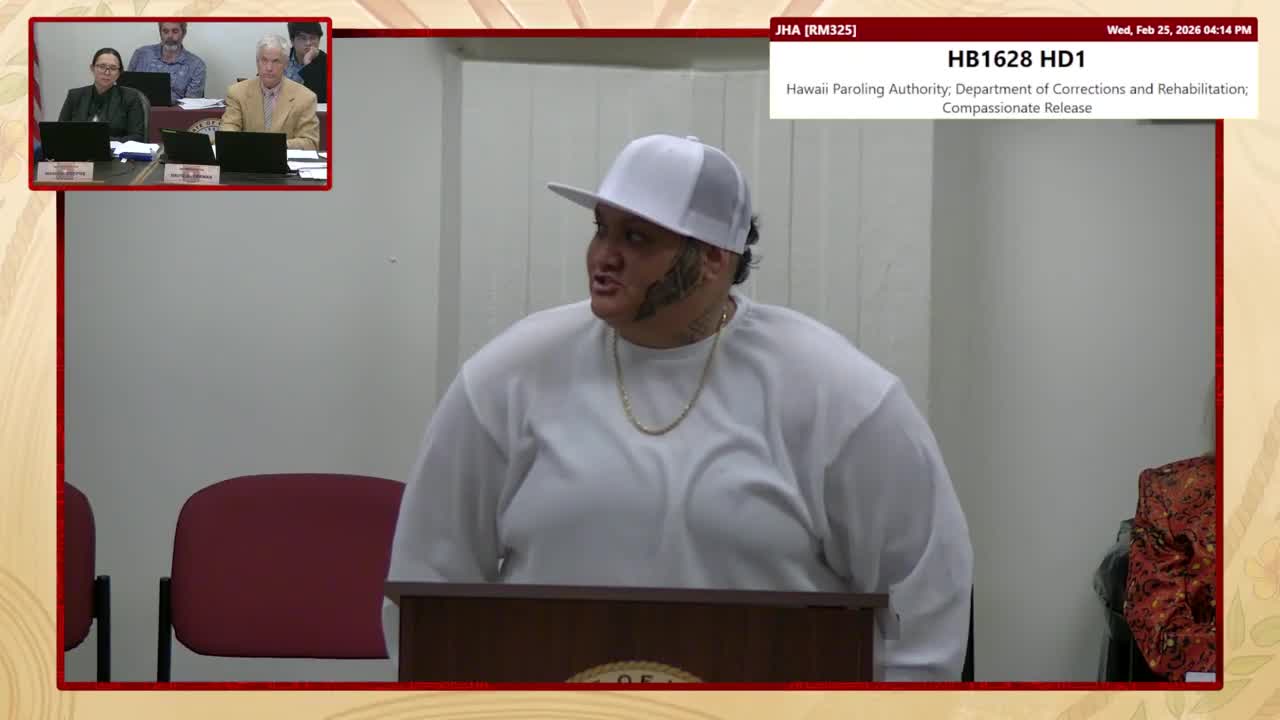 8MIN
House Standing Committee on Judiciary & Hawaiian Affairs
 1MIN
House Standing Committee on Judiciary & Hawaiian Affairs
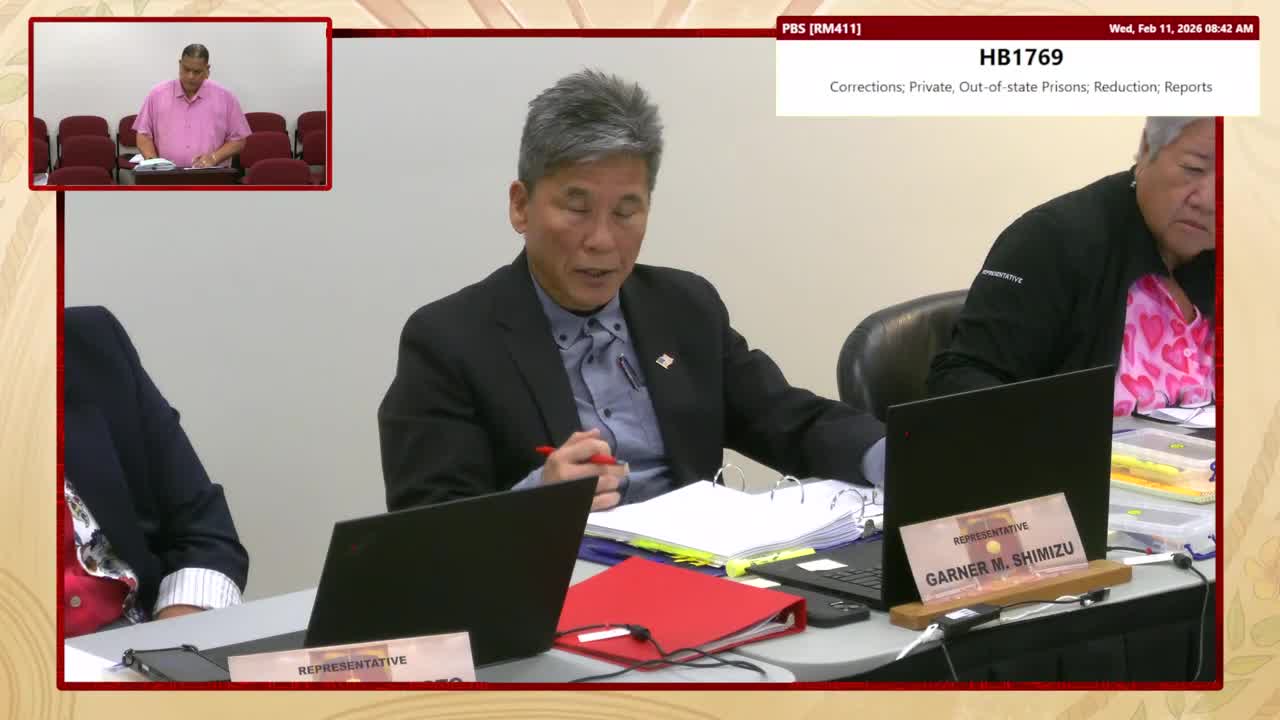 15MIN
House Standing Committee on Public Safety
 2MIN
House Standing Committee on Public Safety
Bill Author
Bill Co-Author(s):