HB 2214: Refundable Diaper Tax Credit
- Session Year: 2025-2026
- House: House
- Latest Version Date: 2026-03-06
Current Status:
Failed
(2026-03-12: Referred to HHS, WAM.)
Introduced
In Committee
First Chamber
In Committee
Second Chamber
Final Decking
Enacted
What does this bill do?
Creates a refundable diaper tax credit that gives eligible Hawaii taxpayers $50 per child to help cover diaper costs. To qualify, taxpayers must file as head of household with federal adjusted gross income under $90,000 or file jointly (or as a surviving spouse) with AGI under $120,000, have at least one dependent child under age five living with them, and have spent at least $250 on diapers in the taxable year; refunds are paid even if the taxpayer owes no income tax.
The summary is provided by generative AI which can make mistakes. For original language, please view the details in the table below.
Establishes a refundable diaper tax credit. Applies to taxable years beginning after 12/31/2025. Effective 7/1/3000. (HD2)
Establishes a refundable diaper tax credit. (HD1)
Establishes a refundable diaper income tax credit.
|
HOUSE OF REPRESENTATIVES |
H.B. NO. |
2214 |
|
THIRTY-THIRD LEGISLATURE, 2026 |
H.D. 2 |
|
|
STATE OF HAWAII |
|
|
|
|
|
|
|
|
||
|
|
||
A BILL FOR AN ACT
RELATING TO TAX CREDITS.
BE IT ENACTED BY THE LEGISLATURE OF THE STATE OF HAWAII:
SECTION 1. The legislature finds that Hawaii has the highest cost of living in the nation. The general excise tax is levied on nearly every economic activity, which, due to the highly regressive structure of the tax, disproportionately affects low- and middle-income families. This regressive nature makes it difficult for some families to afford basic life necessities, such as diapers. Diapers are a large expense for Hawaii families with small children and are essential to babies' and toddlers' health as they each require about fifty diaper changes per week, or roughly two hundred diaper changes per month. However, according to the National Diaper Bank Network, one in two families struggles to afford clean diapers for their children.
Hawaii children who come from low-income families are at-risk to meet their diaper needs. According to the National Diaper Bank Facts on Hawaii, nine per cent of Hawaii families are recipients of supplemental nutrition assistance program benefits with children under the age of five; twenty-one per cent of Hawaii families are women, infants, and children program benefit recipients with infant children; and twenty-eight per cent of Hawaii families receive temporary assistance for needy families benefits with at least one child under the age of three. The maximum amount a family of one parent and two children can receive in temporary assistance for needy families benefits is $763. It is estimated that ten and a half per cent of this maximum benefit goes toward diaper needs. Additionally, thirty-four per cent of Hawaii families have births covered by medicaid. This data shows that there is a significant number of families who are at risk of not having enough financial resources to provide necessities, such as diapers, for their children.
The legislature further finds that many child care facilities require parents to provide diapers for their children. Families who do not have access to clean diapers cannot access child care and often miss work, reducing their monthly income. Hawaii currently has two National Diaper Bank Network member diaper banks that provide diapers to families; however, this does not meet the needs of all families who struggle to provide clean diapers for their children. According to the National Diaper Bank Network, Hawaii families spend an average monthly cost of $80 to more than $100 on diapers. The State is also the most expensive state to raise a child, requiring approximately $36,000 a year. On average, Hawaii families spend a little more than twenty-five per cent of their income on child-related expenses.
The legislature also finds that dirty diapers put healthy children at risk of various diseases due to parasites, bacteria, and viruses linked to dirty diapers. Dirty diapers can cause diaper rash or diaper dermatitis, including Candida, a type of yeast infection, and Seborrhea, a type of infectious skin condition caused when skin is exposed to moisture, friction, urine, stool, or other skin irritants. Other germs found in dirty diapers are salmonella, listeria, and norovirus, which can cause a healthy child to quickly fall ill. Hepatitis A is the most common viral infection found in dirty diapers, which can lead to other hepatitis-related infections, according to the American Academy of Pediatrics. The American Academy of Pediatrics also notes that certain diaper dermatitis can lead to bladder infections that can cause urinary tract infections, which more commonly affect girls.
Accordingly, the purpose of this Act is to help alleviate the burden on local families and individuals by establishing a refundable diaper tax credit.
SECTION 2. Chapter 235, Hawaii Revised Statutes, is amended by adding a new section to part VI to be appropriately designated and to read as follows:
"§235- Refundable diaper tax credit. (a) There shall be allowed to each eligible taxpayer subject to the taxes imposed by this chapter a refundable diaper tax credit equal to $50 per qualifying child for the taxable year.
(b) The credit allowed under this section shall be claimed against the net income tax liability for the taxable year. If the tax credit claimed by the taxpayer under this section exceeds the amount of the income tax payments due from the taxpayer, the excess of credit over payments due shall be refunded to the taxpayer; provided that the tax credit properly claimed by a taxpayer who has no income tax liability shall be paid to the taxpayer; provided further that no refunds or payments on account of the tax credit allowed by this section shall be made for amounts less than $1.
(c) All claims, including amended claims, for a tax credit under this section shall be filed on or before the end of the twelfth month following the close of the taxable year for which the credit may be claimed. Failure to comply with the foregoing provision shall constitute a waiver of the right to claim the credit.
(d) The director of taxation:
(1) Shall prepare such forms as may be necessary to claim a credit under this section;
(2) May require proof of the claim for the tax credit; and
(3) May adopt rules pursuant to chapter 91 necessary to carry out the purpose of this section.
(e) For purposes of this section:
"Diaper expenses" means amounts paid by the taxpayer for the purchase of diapers, including disposable diapers, washable diapers, and diaper covers.
"Eligible taxpayer" means an individual taxpayer who:
(1) Files a:
(A) Head of household return with federal adjusted gross income of less than $90,000; or
(B) Joint return or return of surviving spouse with federal adjusted gross income of less than $120,000;
(2) Has one or more qualifying child; and
(3) Incurred at least $250 in diaper expense during the taxable year for one or more dependent children in the household.
"Eligible taxpayer" does not include a married couple filing separate tax returns for a taxable year for which a joint return could have been filed.
"Qualifying child" means a dependent, as defined by section 152 of the Internal Revenue Code, who is under five years of age at any time during the taxable year and who resides with the eligible taxpayer in the State."
SECTION 3. New statutory material is underscored.
SECTION 4. This Act shall take effect on July 1, 3000; provided that section 2 shall apply to taxable years beginning after December 31, 2025.
Report Title:
Refundable Diaper Tax Credit
Description:
Establishes a refundable diaper tax credit. Applies to taxable years beginning after 12/31/2025. Effective 7/1/3000. (HD2)
The summary description of legislation appearing on this page is for informational purposes only and is not legislation or evidence of legislative intent.
|
HOUSE OF REPRESENTATIVES |
H.B. NO. |
2214 |
|
THIRTY-THIRD LEGISLATURE, 2026 |
H.D. 1 |
|
|
STATE OF HAWAII |
|
|
|
|
|
|
|
|
||
|
|
||
A BILL FOR AN ACT
RELATING TO TAX CREDITS.
BE IT ENACTED BY THE LEGISLATURE OF THE STATE OF HAWAII:
SECTION 1. The legislature finds that Hawaii has the highest cost of living in the nation. The general excise tax is levied on nearly every economic activity, which, due to the highly regressive structure of the tax, disproportionately affects low- and middle-income families. This regressive nature makes it difficult for some families to afford basic life necessities, such as diapers. Diapers are a large expense for Hawaii families with small children and are essential to babies' and toddlers' health as they each require about fifty diaper changes per week, or roughly two hundred diaper changes per month. However, according to the National Diaper Bank Network, one in two families struggles to afford clean diapers for their children.
Hawaii children who come from low-income families are at-risk to meet their diaper needs. According to the National Diaper Bank Facts on Hawaii, nine per cent of Hawaii families are recipients of supplemental nutrition assistance program benefits with children under the age of five; twenty-one per cent of Hawaii families are women, infants, and children program benefit recipients with infant children; and twenty-eight per cent of Hawaii families receive temporary assistance for needy families benefits with at least one child under the age of three. The maximum amount a family of one parent and two children can receive in temporary assistance for needy families benefits is $763. It is estimated that ten and a half per cent of this maximum benefit goes toward diaper needs. Additionally, thirty-four per cent of Hawaii families have births covered by medicaid. This data shows that there is a significant number of families who are at risk of not having enough financial resources to provide necessities, such as diapers, for their children.
The legislature further finds that many child care facilities require parents to provide diapers for their children. Families who do not have access to clean diapers cannot access child care and often miss work, reducing their monthly income. Hawaii currently has two National Diaper Bank Network member diaper banks that provide diapers to families; however, this does not meet the needs of all families who struggle to provide clean diapers for their children. According to the National Diaper Bank Network, Hawaii families spend an average monthly cost of $80 to more than $100 on diapers. The State is also the most expensive state to raise a child, requiring approximately $36,000 a year. On average, Hawaii families spend a little more than twenty-five per cent of their income on child-related expenses.
The legislature also finds that dirty diapers put healthy children at risk of various diseases due to parasites, bacteria, and viruses linked to dirty diapers. Dirty diapers can cause diaper rash or diaper dermatitis, including Candida, a type of yeast infection, and Seborrhea, a type of infectious skin condition caused when skin is exposed to moisture, friction, urine, stool, or other skin irritants. Other germs found in dirty diapers are salmonella, listeria, and norovirus, which can cause a healthy child to quickly fall ill. Hepatitis A is the most common viral infection found in dirty diapers, which can lead to other hepatitis-related infections, according to the American Academy of Pediatrics. The American Academy of Pediatrics also notes that certain diaper dermatitis can lead to bladder infections that can cause urinary tract infections, which more commonly affect girls.
Accordingly, the purpose of this Act is to help alleviate the burden on local families and individuals by establishing a refundable diaper tax credit.
SECTION 2. Chapter 235, Hawaii Revised Statutes, is amended by adding a new section to part VI to be appropriately designated and to read as follows:
"§235- Refundable diaper tax credit. (a) There shall be allowed to each eligible taxpayer subject to the taxes imposed by this chapter a refundable diaper tax credit equal to $50 per qualifying child for the taxable year.
(b) The credit allowed under this section shall be claimed against the net income tax liability for the taxable year. If the tax credit claimed by the taxpayer under this section exceeds the amount of the income tax payments due from the taxpayer, the excess of credit over payments due shall be refunded to the taxpayer; provided that the tax credit properly claimed by a taxpayer who has no income tax liability shall be paid to the taxpayer; provided further that no refunds or payments on account of the tax credit allowed by this section shall be made for amounts less than $1.
(c) All claims, including amended claims, for a tax credit under this section shall be filed on or before the end of the twelfth month following the close of the taxable year for which the credit may be claimed. Failure to comply with the foregoing provision shall constitute a waiver of the right to claim the credit.
(d) The director of taxation:
(1) Shall prepare such forms as may be necessary to claim a credit under this section;
(2) May require proof of the claim for the tax credit; and
(3) May adopt rules pursuant to chapter 91 necessary to carry out the purpose of this section.
(e) For purposes of this section:
"Diaper expenses" means amounts paid by the taxpayer for the purchase of diapers, including disposable diapers, washable diapers, and diaper covers.
"Eligible taxpayer" means an individual taxpayer who:
(1) Files a:
(A) Head of household return with federal adjusted gross income of less than $90,000; or
(B) Joint return or return of surviving spouse with federal adjusted gross income of less than $120,000;
(2) Has one or more qualifying child; and
(3) Incurred at least $250 in diaper expense during the taxable year for one or more dependent children in the household.
"Eligible taxpayer" does not include a married couple filing separate tax returns for a taxable year for which a joint return could have been filed.
"Qualifying child" means a dependent, as defined by section 152 of the Internal Revenue Code, who is under five years of age at any time during the taxable year and who resides with the eligible taxpayer in the State."
SECTION 3. New statutory material is underscored.
SECTION 4. This Act, upon its approval, shall apply to taxable years beginning after December 31, 2025.
Report Title:
Refundable Diaper Tax Credit
Description:
Establishes a refundable diaper tax credit. (HD1)
The summary description of legislation appearing on this page is for informational purposes only and is not legislation or evidence of legislative intent.
|
HOUSE OF REPRESENTATIVES |
H.B. NO. |
2214 |
|
THIRTY-THIRD LEGISLATURE, 2026 |
|
|
|
STATE OF HAWAII |
|
|
|
|
|
|
|
|
||
|
|
||
A BILL FOR AN ACT
RELATING TO tax credits.
BE IT ENACTED BY THE LEGISLATURE OF THE STATE OF HAWAII:
SECTION 1. The legislature finds that Hawaii has the highest cost of living in the nation. The general excise tax is levied on nearly every economic activity, which, due to the highly regressive structure of the tax, disproportionately affects low- and middle-income families. This regressive nature makes it difficult for some families to afford basic life necessities, such as diapers. Diapers are a large expense for Hawaii families with small children and are essential to babies' and toddlers' health as they each require about fifty diaper changes per week, or roughly two hundred diaper changes per month. However, according to the National Diaper Bank Network, one in two families struggles to afford clean diapers for their children.
Hawaii children who come from low-income families are at-risk to meet their diaper needs. According to the National Diaper Bank Facts on Hawaii, nine per cent of Hawaii families are recipients of supplemental nutrition assistance program benefits with children under the age of five; twenty-one per cent of Hawaii families are women, infants, and children program benefit recipients with infant children; and twenty-eight per cent of Hawaii families receive temporary assistance for needy families benefits with at least one child under the age of three. The maximum amount a family of one parent and two children can receive in temporary assistance for needy families benefits is $763. It is estimated that ten and a half per cent of this maximum benefit goes toward diaper needs. Additionally, thirty-four per cent of Hawaii families have births covered by medicaid. This data shows that there is a significant number of families who are at risk of not having enough financial resources to provide necessities, such as diapers, for their children.
The legislature further finds that many child care facilities require parents to provide diapers for their children. Families who do not have access to clean diapers cannot access child care and often miss work, reducing their monthly income. Hawaii currently has two National Diaper Bank Network member diaper banks that provide diapers to families; however, this does not meet the needs of all families who struggle to provide clean diapers for their children. According to the National Diaper Bank Network, Hawaii families spend an average monthly cost of $80 to more than $100 on diapers. The State is also the most expensive state to raise a child, requiring approximately $36,000 a year. On average, Hawaii families spend a little more than twenty-five per cent of their income on child-related expenses.
The legislature also finds that dirty diapers put healthy children at risk of various diseases due to parasites, bacteria, and viruses linked to dirty diapers. Dirty diapers can cause diaper rash or diaper dermatitis, including Candida, a type of yeast infection, and Seborrhea, a type of infectious skin condition caused when skin is exposed to moisture, friction, urine, stool, or other skin irritants. Other germs found in dirty diapers are salmonella, listeria, and norovirus, which can cause a healthy child to quickly fall ill. Hepatitis A is the most common viral infection found in dirty diapers, which can lead to other hepatitis-related infections, according to the American Academy of Pediatrics. The American Academy of Pediatrics also notes that certain diaper dermatitis can lead to bladder infections that can cause urinary tract infections, which more commonly affect girls.
Accordingly, the purpose of this Act is to help alleviate the burden on local families and individuals by establishing a refundable diaper income tax credit.
SECTION 2. Chapter 235, Hawaii Revised Statutes, is amended by adding a new section to part VI to be appropriately designated and to read as follows:
"§235- Refundable diaper tax credit. (a) There shall be allowed to each eligible taxpayer subject to the taxes imposed by this chapter a refundable tax credit equal to $50 per qualifying child for the taxable year.
(b) The credit allowed under this section shall be claimed against the net income tax liability for the taxable year. If the tax credit claimed by the taxpayer under this section exceeds the amount of the income tax payments due from the taxpayer, the excess of credit over payments due shall be refunded to the taxpayer; provided that the tax credit properly claimed by a taxpayer who has no income tax liability shall be paid to the taxpayer; provided further that no refunds or payments on account of the tax credit allowed by this section shall be made for amounts less than $1.
(c) All claims, including amended claims, for a tax credit under this section shall be filed on or before the end of the twelfth month following the close of the taxable year for which the credit may be claimed. Failure to comply with the foregoing provision shall constitute a waiver of the right to claim the credit.
(d) The director of taxation:
(1) Shall prepare such forms as may be necessary to claim a credit under this section;
(2) May require proof of the claim for the tax credit; and
(3) May adopt rules pursuant to chapter 91 necessary to carry out the purpose of this section.
(e) For purposes of this section:
"Diaper expenses" means amounts paid by the taxpayer for the purchase of diapers, including disposable diapers, washable diapers, diaper covers, and necessary diapering supplies.
"Eligible taxpayer" means an individual taxpayer who:
(1) Files a:
(A) Head of household return with federal adjusted gross income of less than $90,000; or
(B) Joint return or return of surviving spouse with federal adjusted gross income of less than $120,000;
(2) Has one or more qualifying child; and
(3) Incurred at least $250 in diaper expense during the taxable year for one or more dependent children in the household.
"Eligible taxpayer" does not include a married couple filing separate tax returns for a taxable year for which a joint return could have been filed.
"Qualifying child" means a dependent, as defined by section 152 of the Internal Revenue Code, who is under five years of age at any time during the taxable year and who resides with the eligible taxpayer in the State."
SECTION 3. New statutory material is underscored.
SECTION 4. This Act, upon its approval, shall apply to
taxable years beginning after December 31, 2025.
|
INTRODUCED BY: |
_____________________________ |
Report Title:
Refundable Diaper Tax Credit
Description:
Establishes a refundable diaper income tax credit.
The summary description of legislation appearing on this page is for informational purposes only and is not legislation or evidence of legislative intent.
|
Date
|
Status
|
|---|---|
| Mar 12, 2026 | Referred to HHS, WAM. |
| Mar 12, 2026 | Passed First Reading. |
| Mar 12, 2026 | Received from House (Hse. Com. No. 379). |
| Mar 10, 2026 | Passed Third Reading as amended in HD 2 with none voting aye with reservations; none voting no (0) and Representative(s) Kong, Pierick excused (2). Transmitted to Senate. |
| Mar 6, 2026 | Forty-eight (48) hours notice Tuesday, 03-10-26. |
| Mar 6, 2026 | Reported from FIN (Stand. Com. Rep. No. 1070-26) as amended in HD 2, recommending passage on Third Reading. |
| Feb 26, 2026 | The committee on FIN recommend that the measure be PASSED, WITH AMENDMENTS. The votes were as follows: 16 Ayes: Representative(s) Todd, Takenouchi, Hartsfield, Hussey, Keohokapu-Lee Loy, Kitagawa, Kusch, Lee, M., Miyake, Morikawa, Perruso, Templo, Yamashita, Alcos, Gedeon, Reyes Oda; Ayes with reservations: none; Noes: none; and Excused: none. |
| Feb 24, 2026 | Bill scheduled to be heard by FIN on Thursday, 02-26-26 2:00PM in House conference room 308 VIA VIDEOCONFERENCE. |
| Feb 19, 2026 | Passed Second Reading as amended in HD 1 and referred to the committee(s) on FIN with none voting aye with reservations; none voting no (0) and none excused (0). |
| Feb 19, 2026 | Reported from HSH (Stand. Com. Rep. No. 524-26) as amended in HD 1, recommending passage on Second Reading and referral to FIN. |
| Feb 17, 2026 | The committee on HSH recommend that the measure be PASSED, WITH AMENDMENTS. The votes were as follows: 7 Ayes: Representative(s) Marten, Olds, Keohokapu-Lee Loy, Takayama, Takenouchi, Alcos, Garcia; Ayes with reservations: none; Noes: none; and 2 Excused: Representative(s) Amato, Hartsfield. |
| Feb 12, 2026 | Bill scheduled to be heard by HSH on Tuesday, 02-17-26 9:30AM in House conference room 329 VIA VIDEOCONFERENCE. |
| Jan 30, 2026 | Referred to HSH, FIN, referral sheet 5 |
| Jan 28, 2026 | Introduced and Pass First Reading. |
| Jan 26, 2026 | Pending introduction. |
|
Date
|
Description
|
Location
|
Votes
|
|
|---|---|---|---|---|
| Mar 10, 2026 | Third Reading | House Floor |
Passed |
|
| Feb 26, 2026 | The committee on FIN recommend that the measure be PASSED, WITH AMENDMENTS | House Standing Committee on Finance |
Passed |
|
| Feb 17, 2026 | The committee on HSH recommend that the measure be PASSED, WITH AMENDMENTS | House Standing Committee on Human Services & Homelessness |
Passed |
This list shows positions taken on this bill by organizations on the date displayed, which is linked to the original source.
Positions by individuals are not included.
|
Organization
|
Position
|
Date
|
|---|---|---|
| AAUW of Hawaii | ** Support | |
| Collaborative Support Services, INC. | *** Support | Feb 26, 2026 |
| Early Childhood Action Strategy | ** Support | |
| Hawaiʻi Children's Action Network Speaks! | ** Support | |
| Hawaiʻi Diaper Bank | ** Support | |
| Hawaiʻi Diaper Bank | ** Support | |
| Hawai‘i Diaper Bank | *** Support | Feb 26, 2026 |
| National Diaper Bank Network | ** Support | |
| National Diaper Bank Network | *** Support | Feb 26, 2026 |
| Tax Foundation of Hawaii | *** Against | Feb 16, 2026 |
STAND. COM. REP. NO. 1070-26
Honolulu, Hawaii
, 2026
RE: H.B. No. 2214
H.D. 2
Honorable Nadine K. Nakamura
Speaker, House of Representatives
Thirty-Third State Legislature
Regular Session of 2026
State of Hawaii
Madame:
Your Committee on Finance, to which was referred H.B. No. 2214, H.D. 1, entitled:
"A BILL FOR AN ACT RELATING TO TAX CREDITS,"
begs leave to report as follows:
The purpose of this measure is to establish a refundable diaper tax credit for eligible taxpayers.
Your Committee received testimony in support of this measure from the AAUW of Hawaii; Early Childhood Action Strategy; Hawaiʻi Diaper Bank; National Diaper Bank Network; and Hawaiʻi Children's Action Network Speaks!. Your Committee received comments on this measure from the Department of Taxation and Tax Foundation of Hawaii.
Your Committee has amended this measure by changing the effective date to July 1, 3000, to encourage further discussion.
As affirmed by the record of votes of the members of your Committee on Finance that is attached to this report, your Committee is in accord with the intent and purpose of H.B. No. 2214, H.D. 1, as amended herein, and recommends that it pass Third Reading in the form attached hereto as H.B. No. 2214, H.D. 2.
Respectfully submitted on behalf of the members of the Committee on Finance,
|
|
|
____________________________ CHRIS TODD, Chair |
|
|
|
|
STAND. COM. REP. NO. 524-26
Honolulu, Hawaii
, 2026
RE: H.B. No. 2214
H.D. 1
Honorable Nadine K. Nakamura
Speaker, House of Representatives
Thirty-Third State Legislature
Regular Session of 2026
State of Hawaii
Madame:
Your Committee on Human Services & Homelessness, to which was referred H.B. No. 2214 entitled:
"A BILL FOR AN ACT RELATING TO TAX CREDITS,"
begs leave to report as follows:
The purpose of this measure is to establish a Refundable Diaper Tax Credit.
Your Committee received testimony in support of this measure from the National Diaper Bank Network; Early Childhood Action Strategy; AAUW of Hawaii; Hawaiʻi Children's Action Network Speaks!; Hawaiʻi Diaper Bank; and three individuals. Your Committee received comments on this measure from the Department of Taxation and Tax Foundation of Hawaii.
Your Committee finds that the high cost of living in Hawaii, combined with the regressive nature of the general excise tax, places a disproportionate financial burden on low- and middle-income families, particularly those with young children. Your Committee further finds that many families struggle to afford diapers, which are essential to children's health and well‑being. Diapers are a significant cost for families with young children, with each child wearing diapers costing their parents or caregivers up to $1,500 annually. This measure alleviates part of that burden by establishing a refundable diaper tax credit to support families in meeting this basic need.
Your Committee has amended this measure by:
(1) Removing necessary diapering supplies from the definition of "diaper expenses" so as to avoid any ambiguity; and
(2) Making technical, nonsubstantive amendments for the purposes of clarity, consistency, and style.
Your Committee notes the concern raised in testimony by the Department of Taxation, that refundable credits are more susceptible to fraud and abuse. However, your Committee recognizes the benefit in keeping the tax credit refundable because the individuals and families who would benefit the most from the tax credit fall below the minimum income thresholds and do not have to file tax returns. Your Committee further notes that this measure imposes an age requirement of under five years to be considered a qualifying child, which will also lessen the chance of fraud.
As affirmed by the record of votes of the members of your Committee on Human Services & Homelessness that is attached to this report, your Committee is in accord with the intent and purpose of H.B. No. 2214, as amended herein, and recommends that it pass Second Reading in the form attached hereto as H.B. No. 2214, H.D. 1, and be referred to your Committee on Finance.
Respectfully submitted on behalf of the members of the Committee on Human Services & Homelessness,
|
|
|
____________________________ LISA MARTEN, Chair |
|
Date
|
Testimony PDF
|
|---|---|
| Feb 26, 2026 | HB2214_HD1_TESTIMONY_FIN_02-26-26_.PDF |
| Feb 16, 2026 | HB2214_TESTIMONY_HSH_02-17-26_.PDF |
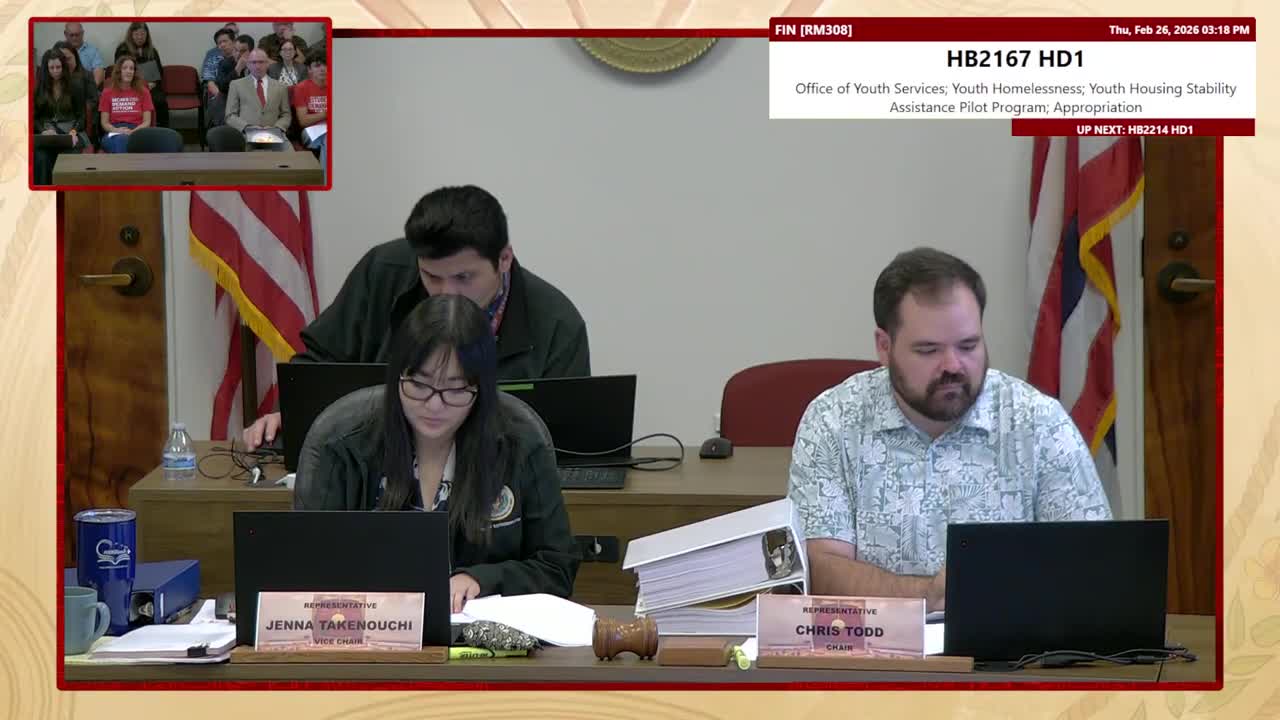
Discussed in Hearing
 4MIN
House Standing Committee on Finance
 7SEC
House Standing Committee on Finance
 4MIN
House Standing Committee on Human Services & Homelessness
 1MIN