HB 2151: State Building Codes; County Building Codes; Hempcrete
- Session Year: 2025-2026
- House: House
- Latest Version Date: 2026-03-06
Current Status:
Failed
(2026-03-12: Referred to PSM/EIG, JDC/WAM.)
Introduced
In Committee
First Chamber
In Committee
Second Chamber
Final Decking
Enacted
What does this bill do?
The bill prevents state and county building codes from banning the use of hempcrete — a hemp-and-lime non-structural building material — and allows builders, architects, and homeowners to use it. It lets building officials approve hempcrete when it meets fire, moisture, energy, durability, and overall safety standards, and says hempcrete cannot be used as a load-bearing structural element unless specifically approved.
The summary is provided by generative AI which can make mistakes. For original language, please view the details in the table below.
Specifies that no state or county building code shall prohibit the use of hempcrete as a non-structural building material. Authorizes building officials to approve hempcrete construction that meets applicable safety and performance standards. Effective 7/1/3000. (HD2)
Specifies that no state or county building code shall prohibit the use of hempcrete. Authorizes building officials to approve hempcrete construction that meets applicable safety and performance standards. Effective 7/1/3000. (HD1)
Recognizes hempcrete as an allowable non-structural building material under state law. Clarifies that no state or county building code shall prohibit the use of hempcrete. Provides the authority for building officials to approve hempcrete construction that meets applicable safety and performance standards.
|
HOUSE OF REPRESENTATIVES |
H.B. NO. |
2151 |
|
THIRTY-THIRD LEGISLATURE, 2026 |
H.D. 2 |
|
|
STATE OF HAWAII |
|
|
|
|
|
|
|
|
||
|
|
||
A BILL FOR AN ACT
RELATING TO BUILDING MATERIALS.
BE IT ENACTED BY THE LEGISLATURE OF THE STATE OF HAWAII:
SECTION 1. The legislature finds that Hawaii is experiencing an ongoing housing crisis marked by a severe shortage of affordable housing, escalating construction costs, and heavy reliance on imported building materials. These challenges are compounded by the State's geographic isolation, vulnerability to supply chain disruptions, and the urgent need to reduce greenhouse gas emissions and improve climate resilience in the built environment.
The legislature further finds that hempcrete, also known as hemp-lime, is a bio-composite building material made from the woody core of the industrial hemp plant, combined with a lime-based binder and water. Hempcrete is widely used internationally as a non-structural building material for wall infill, insulation, and plaster. Hempcrete is fire-resistant, mold-resistant, pest-resistant, breathable, and capable of sequestering carbon over its lifecycle.
The legislature recognizes that indigenous nations and tribal communities in the continental United States, including tribes in Minnesota, have been leaders in advancing hempcrete construction as a means of promoting sustainable housing, cultural self-determination, workforce development, and community resilience. These efforts demonstrate how natural building materials can support housing needs while aligning with values of stewardship, self-sufficiency, and long-term environmental responsibility.
The legislature additionally finds that clarifying hempcrete as an approved non-structural building material in state law will reduce regulatory uncertainty; lower barriers to innovation in construction; and allow builders, architects, and homeowners to use this material without needing repeated variances or discretionary approvals. By enabling broader use of hempcrete, Hawaii can support the development of more climate-appropriate housing, diversify construction methods, reduce material costs over time, and help expand the supply of housing necessary to address the State's housing crisis.
The purpose of this Act is to support the development of sustainable, affordable, and resilient housing in the State by:
(1) Clarifying that no state or county building code shall prohibit the use of a hempcrete as a non-structural building material; and
(2) Providing clear authority for building officials to approve hempcrete construction that meets applicable safety and performance standards.
SECTION 2. Chapter 107, Hawaii Revised Statutes, is amended by adding a new section to be appropriately designated and to read as follows:
"§107- Hempcrete use; building material. (a) Except as provided in subsection (b), no provision of the Hawaii state building codes or any county building code shall prohibit or otherwise limit the use of hempcrete as a non-structural building material.
(b) Hempcrete may be used in non-load-bearing construction; provided that the material and the material's application shall comply with all applicable requirements relating to:
(1) Fire safety;
(2) Structural integrity of the overall building system;
(3) Moisture management and durability;
(4) Energy efficiency; and
(5) Health and safety standards.
(c) Hempcrete shall not be used as a load-bearing structural element unless otherwise approved pursuant to applicable state building codes and standards as recognized in section 107-25.
(d) State and county building officials may approve the use of hempcrete as a non-structural building material without requiring a variance; provided that the proposed use of hempcrete shall comply with applicable state building codes, rules, and standards.
(e) The department, in consultation with the counties, may adopt rules pursuant to chapter 91 to implement this section. Rules adopted pursuant to this section may include providing guidance regarding approval of hempcrete construction consistent with applicable state building codes and nationally recognized standards.
(f) As used in this section:
"Hemp" means Cannabis sativa L. and any part of that plant, including the seeds thereof and all derivatives, extracts, cannabinoids, isomers, acids, salts, and salts of isomers, whether growing or not, with a total tetrahydrocannabinol concentration of no more than 0.3 per cent on a dry weight basis.
"Hempcrete" means a bio-composite material consisting of the woody core of industrial hemp, a lime-based binder, and water.
"Industrial hemp" means hemp:
(1) Grown for the use of the stalk of the plant, fiber produced from such a stalk, or any other non-cannabinoid derivative, mixture, preparation, or manufacture of such a stalk;
(2) Grown for the use of the whole grain, oil, cake, nut, hull, or any other non-cannabinoid compound, derivative, mixture, preparation, or manufacture of the seeds of such plant;
(3) Grown for purposes of producing microgreens or other edible hemp leaf products intended for human consumption that are derived from an immature hemp plant that is grown from seeds with a total tetrahydrocannabinol concentration of no more than 0.3 per cent on a dry weight basis;
(4) That is a plant that does not enter the stream of commerce and is intended to support hemp research at an institution of higher education or an independent research institute; or
(5) Grown for the use of a viable seed of the plant produced solely for the production or manufacture of any material described in paragraphs (1) through (4)."
SECTION 3. New statutory material is underscored.
SECTION 4. This Act shall take effect on July 1, 3000.
Report Title:
State Building Codes; County Building Codes; Hempcrete
Description:
Specifies that no state or county building code shall prohibit the use of hempcrete as a non-structural building material. Authorizes building officials to approve hempcrete construction that meets applicable safety and performance standards. Effective 7/1/3000. (HD2)
The summary description of legislation appearing on this page is for informational purposes only and is not legislation or evidence of legislative intent.
|
HOUSE OF REPRESENTATIVES |
H.B. NO. |
2151 |
|
THIRTY-THIRD LEGISLATURE, 2026 |
H.D. 1 |
|
|
STATE OF HAWAII |
|
|
|
|
|
|
|
|
||
|
|
||
A BILL FOR AN ACT
RELATING TO BUILDING MATERIALS.
BE IT ENACTED BY THE LEGISLATURE OF THE STATE OF HAWAII:
SECTION 1. The legislature finds that Hawaii is experiencing an ongoing housing crisis marked by a severe shortage of affordable housing, escalating construction costs, and heavy reliance on imported building materials. These challenges are compounded by the State's geographic isolation, vulnerability to supply chain disruptions, and the urgent need to reduce greenhouse gas emissions and improve climate resilience in the built environment.
The legislature further finds that hempcrete, also known as hemp-lime, is a bio-composite building material made from the woody core of the industrial hemp plant, combined with a lime-based binder and water. Hempcrete is widely used internationally as a non-structural building material for wall infill, insulation, and plaster. Hempcrete is fire-resistant, mold-resistant, pest-resistant, breathable, and capable of sequestering carbon over its lifecycle.
The legislature recognizes that indigenous nations and tribal communities in the continental United States, including tribes in Minnesota, have been leaders in advancing hempcrete construction as a means of promoting sustainable housing, cultural self-determination, workforce development, and community resilience. These efforts demonstrate how natural building materials can support housing needs while aligning with values of stewardship, self-sufficiency, and long-term environmental responsibility.
The legislature additionally finds that clarifying hempcrete as an approved non-structural building material in state law will reduce regulatory uncertainty; lower barriers to innovation in construction; and allow builders, architects, and homeowners to use this material without needing repeated variances or discretionary approvals. By enabling broader use of hempcrete, Hawaii can support the development of more climate-appropriate housing, diversify construction methods, reduce material costs over time, and help expand the supply of housing necessary to address the State's housing crisis.
The purpose of this Act is to support the development of sustainable, affordable, and resilient housing in the State by:
(1) Clarifying that no state or county building code shall prohibit the use of a hempcrete; and
(2) Providing clear authority for building officials to approve hempcrete construction that meets applicable safety and performance standards.
SECTION 2. Chapter 107, Hawaii Revised Statutes, is amended by adding a new section to be appropriately designated and to read as follows:
"§107- Hempcrete use; building material. (a) No provision of the Hawaii state building codes or any county building code shall prohibit or otherwise limit the use of hempcrete as a non-structural building material.
(b) Hempcrete may be used in non-load-bearing construction; provided that the material and the material's application shall comply with all applicable requirements relating to:
(1) Fire safety;
(2) Structural integrity of the overall building system;
(3) Moisture management and durability;
(4) Energy efficiency; and
(5) Health and safety standards.
(c) Hempcrete shall not be used as a load-bearing structural element unless otherwise approved pursuant to applicable state building codes and standards as recognized in section 107-25.
(d) State and county building officials may approve the use of hempcrete as a non-structural building material without requiring a variance; provided that the proposed use of hempcrete shall comply with applicable state building codes, rules, and standards.
(e) The department, in consultation with the counties, may adopt rules pursuant to chapter 91 to implement this section. Rules adopted pursuant to this section may include providing guidance regarding approval of hempcrete construction consistent with applicable state building codes and nationally recognized standards.
(f) As used in this section:
"Hemp" means Cannabis sativa L. and any part of that plant, including the seeds thereof and all derivatives, extracts, cannabinoids, isomers, acids, salts, and salts of isomers, whether growing or not, with a total tetrahydrocannabinol concentration of no more than 0.3 per cent on a dry weight basis.
"Hempcrete" or "hemp-lime" means a bio-composite material consisting of the woody core of industrial hemp, a lime-based binder, and water.
"Industrial hemp" means hemp:
(1) Grown for the use of the stalk of the plant, fiber produced from such a stalk, or any other non-cannabinoid derivative, mixture, preparation, or manufacture of such a stalk;
(2) Grown for the use of the whole grain, oil, cake, nut, hull, or any other non-cannabinoid compound, derivative, mixture, preparation, or manufacture of the seeds of such plant;
(3) Grown for purposes of producing microgreens or other edible hemp leaf products intended for human consumption that are derived from an immature hemp plant that is grown from seeds with a total tetrahydrocannabinol concentration of no more than 0.3 per cent on a dry weight basis;
(4) That is a plant that does not enter the stream of commerce and is intended to support hemp research at an institution of higher education or an independent research institute; or
(5) Grown for the use of a viable seed of the plant produced solely for the production or manufacture of any material described in paragraphs (1) through (4)."
SECTION 3. New statutory material is underscored.
SECTION 4. This Act shall take effect on July 1, 3000.
Report Title:
State Building Codes; County Building Codes; Hempcrete
Description:
Specifies that no state or county building code shall prohibit the use of hempcrete. Authorizes building officials to approve hempcrete construction that meets applicable safety and performance standards. Effective 7/1/3000. (HD1)
The summary description of legislation appearing on this page is for informational purposes only and is not legislation or evidence of legislative intent.
|
HOUSE OF REPRESENTATIVES |
H.B. NO. |
2151 |
|
THIRTY-THIRD LEGISLATURE, 2026 |
|
|
|
STATE OF HAWAII |
|
|
|
|
|
|
|
|
||
|
|
||
A BILL FOR AN ACT
relating to building materials.
BE IT ENACTED BY THE LEGISLATURE OF THE STATE OF HAWAII:
SECTION 1. The legislature finds that Hawaii is experiencing an ongoing housing crisis marked by a severe shortage of affordable housing, escalating construction costs, and heavy reliance on imported building materials. These challenges are compounded by the State's geographic isolation, vulnerability to supply chain disruptions, and the urgent need to reduce greenhouse gas emissions and improve climate resilience in the built environment.
The legislature further finds that hempcrete, also known as hemp-lime, is a bio-composite building material made from the woody core of the industrial hemp plant, combined with a lime-based binder and water. Hempcrete is widely used internationally as a non-structural building material for wall infill, insulation, and plaster. Hempcrete is fire-resistant, mold-resistant, pest-resistant, breathable, and capable of sequestering carbon over its lifecycle.
The legislature recognizes that indigenous nations and tribal communities in the continental United States, including tribes in Minnesota, have been leaders in advancing hempcrete construction as a means of promoting sustainable housing, cultural self-determination, workforce development, and community resilience. These efforts demonstrate how natural building materials can support housing needs while aligning with values of stewardship, self-sufficiency, and long-term environmental responsibility.
The legislature additionally finds that clarifying hempcrete as an approved non-structural building material in state law will reduce regulatory uncertainty, lower barriers to innovation in construction, and allow builders, architects, and homeowners to utilize this material without requiring repeated variances or discretionary approvals. By enabling broader use of hempcrete, Hawaii can support the development of more climate-appropriate housing, diversify construction methods, reduce material costs over time, and help expand the supply of housing necessary to address the State's housing crisis.
The purpose of this Act is to support the development of sustainable, affordable, and resilient housing in the State by:
(1) Recognizing hempcrete, also known as hemp-lime, as an allowable non-structural building material under state law;
(2) Clarifying that no state or county building code shall prohibit the use of a hempcrete; and
(3) Providing clear authority for building officials to approve hempcrete construction that meets applicable safety and performance standards.
SECTION 2. Chapter 107, Hawaii Revised Statutes, is amended by adding a new section to be appropriately designated and to read as follows:
"§107- Hempcrete use; building material. (a) Hempcrete, also known as hemp-lime, shall be recognized as an allowable non-structural building material in the State.
(b) No provision of the Hawaii state building codes or any county building code shall prohibit or otherwise limit the use of hempcrete as a non-structural building material.
(c) Hempcrete shall be permitted for use in non-load-bearing construction; provided that the material and the material's application shall comply with all applicable requirements relating to:
(1) Fire safety;
(2) Structural integrity of the overall building system;
(3) Moisture management and durability;
(4) Energy efficiency; and
(5) Health and safety standards.
(d) Hempcrete shall not be used as a load-bearing structural element unless otherwise approved pursuant to applicable state building codes and standards as recognized in section 107-25.
(e) State and county building officials may approve the use of hempcrete as a non-structural building material without requiring a variance; provided that the proposed use of hempcrete shall comply with applicable state building codes, rules, and standards.
(f) The department, in consultation with the counties, may adopt rules pursuant to chapter 91 to implement this section. Rules adopted pursuant to this section may include providing guidance regarding approval of hempcrete construction consistent with applicable state building codes and nationally recognized standards.
(g) As used in this section:
"Hemp" means Cannabis sativa L. and any part of that plant, including the seeds thereof and all derivatives, extracts, cannabinoids, isomers, acids, salts, and salts of isomers, whether growing or not, with a total tetrahydrocannabinol concentration of no more than 0.3 per cent on a dry weight basis.
"Hempcrete" or "hemp-lime" means a bio-composite material consisting of the woody core of industrial hemp, a lime-based binder, and water.
"Industrial hemp" means hemp:
(1) Grown for the use of the stalk of the plant, fiber produced from such a stalk, or any other non-cannabinoid derivative, mixture, preparation, or manufacture of such a stalk;
(2) Grown for the use of the whole grain, oil, cake, nut, hull, or any other non-cannabinoid compound, derivative, mixture, preparation, or manufacture of the seeds of such plant;
(3) Grown for purposes of producing microgreens or other edible hemp leaf products intended for human consumption that are derived from an immature hemp plant that is grown from seeds with a total tetrahydrocannabinol concentration of no more than 0.3 per cent on a dry weight basis;
(4) That is a plant that does not enter the stream of commerce and is intended to support hemp research at an institution of higher education or an independent research institute; or
(5) Grown for the use of a viable seed of the plant produced solely for the production or manufacture of any material described in paragraphs (1) through (4)."
SECTION 3. New statutory material is underscored.
SECTION 4. This Act shall take effect upon its approval.
|
INTRODUCED BY: |
_____________________________ |
|
|
|
Report Title:
State Building Codes; County Building Codes; Hempcrete
Description:
Recognizes hempcrete as an allowable non-structural building material under state law. Clarifies that no state or county building code shall prohibit the use of hempcrete. Provides the authority for building officials to approve hempcrete construction that meets applicable safety and performance standards.
The summary description of legislation appearing on this page is for informational purposes only and is not legislation or evidence of legislative intent.
|
Date
|
Status
|
|---|---|
| Mar 12, 2026 | Referred to PSM/EIG, JDC/WAM. |
| Mar 12, 2026 | Passed First Reading. |
| Mar 12, 2026 | Received from House (Hse. Com. No. 367). |
| Mar 10, 2026 | Passed Third Reading as amended in HD 2 with Representative(s) Iwamoto voting aye with reservations; none voting no (0) and Representative(s) Pierick excused (1). Transmitted to Senate. |
| Mar 6, 2026 | Forty-eight (48) hours notice Tuesday, 03-10-26. |
| Mar 6, 2026 | Reported from JHA (Stand. Com. Rep. No. 1104-26) as amended in HD 2, recommending passage on Third Reading. |
| Mar 4, 2026 | The committee on JHA recommend that the measure be PASSED, WITH AMENDMENTS. The votes were as follows: 8 Ayes: Representative(s) Tarnas, Poepoe, Hashem, Kahaloa, Sayama, Takayama, Garcia, Shimizu; Ayes with reservations: none; Noes: none; and 2 Excused: Representative(s) Belatti, Cochran. |
| Feb 27, 2026 | Bill scheduled to be heard by JHA on Wednesday, 03-04-26 2:00PM in House conference room 325 VIA VIDEOCONFERENCE. |
| Feb 13, 2026 | Passed Second Reading as amended in HD 1 and referred to the committee(s) on JHA with none voting aye with reservations; none voting no (0) and Representative(s) Chun, Kong, Kusch excused (3). |
| Feb 13, 2026 | Reported from WAL (Stand. Com. Rep. No. 269-26) as amended in HD 1, recommending passage on Second Reading and referral to JHA. |
| Feb 10, 2026 | The committee on WAL recommend that the measure be PASSED, WITH AMENDMENTS. The votes were as follows: 9 Ayes: Representative(s) Hashem, Morikawa, Belatti, Ichiyama, Poepoe, Woodson, Shimizu, Souza; Ayes with reservations: Representative(s) Iwamoto; Noes: none; and Excused: none. |
| Feb 6, 2026 | Bill scheduled to be heard by WAL on Tuesday, 02-10-26 9:00AM in House conference room 411 VIA VIDEOCONFERENCE. |
| Jan 30, 2026 | Referred to WAL, JHA, referral sheet 5 |
| Jan 28, 2026 | Introduced and Pass First Reading. |
| Jan 26, 2026 | Pending introduction. |
|
Date
|
Description
|
Location
|
Votes
|
|
|---|---|---|---|---|
| Mar 10, 2026 | Third Reading | House Floor |
Passed |
|
| Mar 4, 2026 | The committee on JHA recommend that the measure be PASSED, WITH AMENDMENTS | House Standing Committee on Judiciary & Hawaiian Affairs |
Passed |
|
| Feb 10, 2026 | The committee on WAL recommend that the measure be PASSED, WITH AMENDMENTS | House Standing Committee on Water & Land |
Passed |
This list shows positions taken on this bill by organizations on the date displayed, which is linked to the original source.
Positions by individuals are not included.
|
Organization
|
Position
|
Date
|
|---|---|---|
| 350Hawaii.org | ** Support | |
| AIA Hawaiʻi (American Institute of Architects, Hawaiʻi State Council) | *** Support | Feb 10, 2026 |
| American Institute of Architects, Hawaii Chapter | ** Support | |
| Building Design Services | *** Support | Mar 4, 2026 |
| Climate Protectors Hawaii | ** Support | |
| Hawai'i Farm Bureau | *** Support | Mar 4, 2026 |
| Hawaiʻi Farm Bureau | ** Support | |
| Kohala Coast Community Fund | ** Support |
STAND. COM. REP. NO. 1104-26
Honolulu, Hawaii
, 2026
RE: H.B. No. 2151
H.D. 2
Honorable Nadine K. Nakamura
Speaker, House of Representatives
Thirty-Third State Legislature
Regular Session of 2026
State of Hawaii
Madame:
Your Committee on Judiciary & Hawaiian Affairs, to which was referred H.B. No. 2151, H.D. 1, entitled:
"A BILL FOR AN ACT RELATING TO BUILDING MATERIALS,"
begs leave to report as follows:
The purpose of this measure is to:
(1) Specify that no state or county building code shall prohibit or otherwise limit the use of hempcrete as a non-structural building material; and
(2) Authorize state and county building officials to approve hempcrete construction that meets applicable safety and performance standards.
Your Committee received testimony in support of this measure from Climate Protectors Hawaii; 350Hawaii.org; Kohala Coast Community Fund; Hawaiʻi Farm Bureau; and three individuals.
Your Committee finds that the State's housing shortage, high construction costs, and dependence on imported materials create significant barriers to producing affordable, climate-resilient homes. Your Committee further finds that hempcrete is a safe, low-carbon, pest-resistant, and fire-resistant material that can reduce emissions, increase housing flexibility, and enable innovation in sustainable building practices. This measure will support alternative construction methods that advance long-term affordability, resilience, and environmental goals.
Your Committee has amended this measure by making technical, nonsubstantive amendments for the purposes of clarity, consistency, and style.
As affirmed by the record of votes of the members of your Committee on Judiciary & Hawaiian Affairs that is attached to this report, your Committee is in accord with the intent and purpose of H.B. No. 2151, H.D. 1, as amended herein, and recommends that it pass Third Reading in the form attached hereto as H.B. No. 2151, H.D. 2.
Respectfully submitted on behalf of the members of the Committee on Judiciary & Hawaiian Affairs,
|
|
|
____________________________ DAVID A. TARNAS, Chair |
|
|
|
|
STAND. COM. REP. NO. 269-26
Honolulu, Hawaii
, 2026
RE: H.B. No. 2151
H.D. 1
Honorable Nadine K. Nakamura
Speaker, House of Representatives
Thirty-Third State Legislature
Regular Session of 2026
State of Hawaii
Madame:
Your Committee on Water & Land, to which was referred H.B. No. 2151 entitled:
"A BILL FOR AN ACT RELATING TO BUILDING MATERIALS,"
begs leave to report as follows:
The purpose of this measure is to:
(1) Recognize hempcrete, also known as hemp-lime, as an allowable non-structural building material under state law;
(2) Clarify that no state or county building code shall prohibit the use of hempcrete; and
(3) Authorize state and county building officials to approve hempcrete construction that meets applicable safety and performance standards.
Your Committee received testimony in support of this measure from American Institute of Architects, Hawaii Chapter; Hawaiʻi Farm Bureau; 350Hawaii.org; Climate Protectors Hawaiʻi; and three individuals.
Your Committee has amended this measure by:
(1) Deleting the proposed section 107- (a), Hawaii Revised Statutes, which would have explicitly recognized hempcrete, also known as hemp-lime, as an allowable non-structural building material in the State, as its intent appears to be accomplished by the remaining provisions of this measure;
(2) Changing its effective date to July 1, 3000, to encourage further discussion; and
(3) Making technical, nonsubstantive amendments for the purposes of clarity, consistency, and style.
As affirmed by the record of votes of the members of your Committee on Water & Land that is attached to this report, your Committee is in accord with the intent and purpose of H.B. No. 2151, as amended herein, and recommends that it pass Second Reading in the form attached hereto as H.B. No. 2151, H.D. 1, and be referred to your Committee on Judiciary & Hawaiian Affairs.
Respectfully submitted on behalf of the members of the Committee on Water & Land,
|
|
|
____________________________ MARK J. HASHEM, Chair |
|
Date
|
Testimony PDF
|
|---|---|
| Mar 4, 2026 | HB2151_HD1_TESTIMONY_JHA_03-04-26_.PDF |
| Feb 10, 2026 | HB2151_TESTIMONY_WAL_02-10-26_.PDF |
Discussed in Hearing
 6MIN
House Standing Committee on Judiciary & Hawaiian Affairs
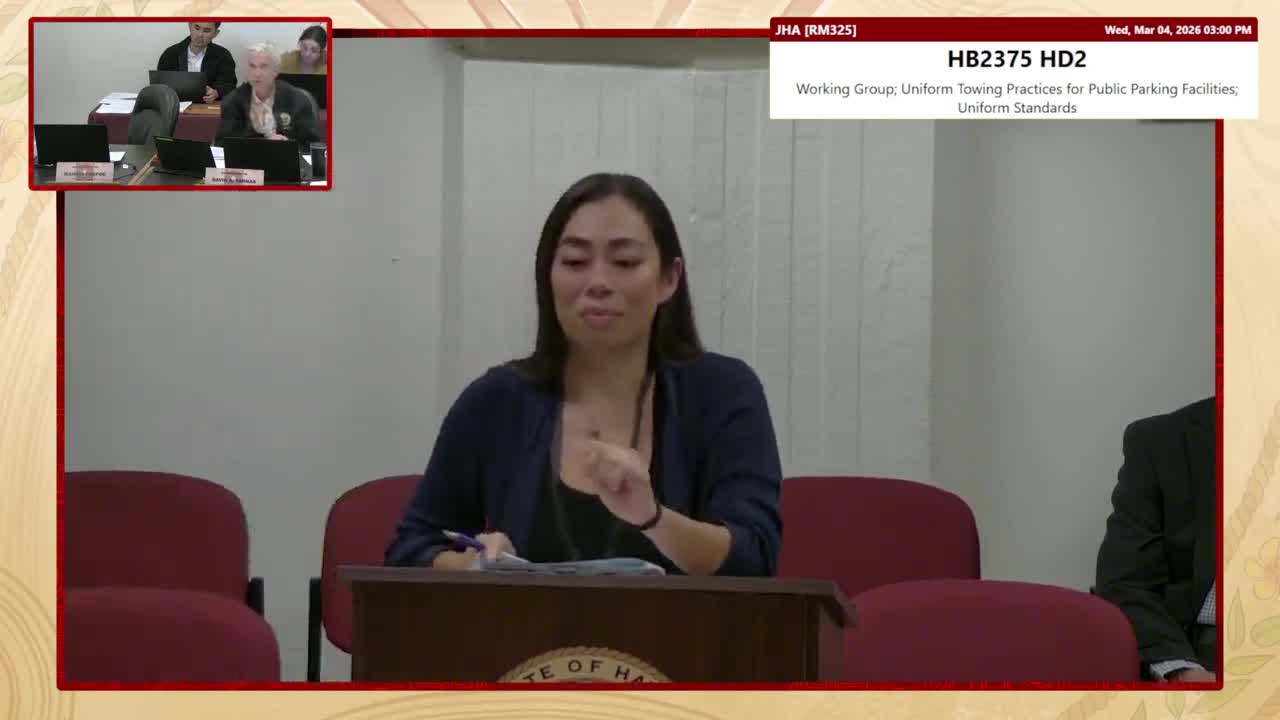 35SEC
House Standing Committee on Judiciary & Hawaiian Affairs
 1MIN