HB 1790: UH; SSRI; Hawaii Center for Policing and Criminal Justice Research; Hawaii Crime Lab; AG; Law Enforcement Stops; Uses of Force; Complaints; Appropriation
- Session Year: 2025-2026
- House: House
- Latest Version Date: 2026-02-19
Current Status:
Failed
(2026-03-12: Referred to EDU/PSM, WAM/JDC.)
Introduced
In Committee
First Chamber
In Committee
Second Chamber
Final Decking
Enacted
What does this bill do?
The bill creates a Hawaii Center for Policing and Criminal Justice Research at the University of Hawaii to house a Hawaii Crime Lab and requires police departments and oversight agencies to collect and report detailed data on stops, uses of force, and complaints. The Crime Lab must publish incident-level data and an annual report, and the attorney general will adopt rules setting the data standards and reporting process.
The summary is provided by generative AI which can make mistakes. For original language, please view the details in the table below.
Establishes the Hawaii Center for Policing and Criminal Justice Research within the Social Science Research Institute, College of Social Sciences, University of Hawaii at Manoa to house the Hawaii Crime Lab. Requires law enforcement agencies and law enforcement oversight agencies to collect and report certain data regarding law enforcement stops, uses of force, and complaints to the Hawaii Crime Lab. Requires the Hawaii Crime Lab to collect and publish incident-level information and an annual report on the data collected. Requires the Department of the Attorney General to adopt rules, in coordination with the Hawaii Crime Lab, Office of Hawaiian Affairs, and any community advisory boards. Appropriates funds for the establishment and operation of the Hawaii Center for Policing and Criminal Justice Research within the Social Science Research Institute, College of Social Sciences, University of Hawaii at Manoa to support implementation. Effective 7/1/3000. (HD2)
Requires law enforcement agencies and law enforcement oversight agencies to collect and report certain data regarding law enforcement stops, uses of force, and complaints to the Hawaii Crime Lab affiliated with the University of Hawaii. Requires the Hawaii Crime Lab to collect and publish incident-level information and an annual report on the data collected. Requires the Department of the Attorney General to adopt rules, in coordination with the Hawaii Crime Lab. Effective 7/1/3000. (HD1)
Requires law enforcement agencies and police oversight agencies to collect and report certain data regarding law enforcement stops, uses of force, and complaints to the Hawaii Crime Lab affiliated with the University of Hawaii. Requires the Hawaii Crime Lab to collect and publish incident-level information and an annual report on the data collected. Requires the Department of the Attorney General to adopt rules, in coordination with the Hawaii Crime Lab.
|
HOUSE OF REPRESENTATIVES |
H.B. NO. |
1790 |
|
THIRTY-THIRD LEGISLATURE, 2026 |
H.D. 2 |
|
|
STATE OF HAWAII |
|
|
|
|
|
|
|
|
||
|
|
||
A BILL FOR AN ACT
RELATING TO POLICING.
BE IT ENACTED BY THE LEGISLATURE OF THE STATE OF HAWAII:
SECTION 1. The legislature finds that public trust in law enforcement is critical to ensuring justice for all under the law. The legislature further finds that data collection is an essential tool that allows the public, law enforcement, and policymakers to analyze the effectiveness of existing practices, determine which policies work and do not work, and support policy decisions with clear and relevant data.
The legislature further finds that implementing statewide policing data reporting at the incident level requires durable technical infrastructure, standardized definitions, quality assurance, and public-facing reporting capacity. The legislature further finds that the university of Hawaii at Manoa, through the social science research institute in the college of social sciences, is well positioned to provide independent, methodologically rigorous research and analytic capacity to support statewide transparency, evaluation, and continuous improvement in policing practices. The legislature also finds that establishing a Hawaii center for policing and criminal justice research will strengthen Hawaii's ability to implement this Act, leverage available federal and extramural resources, and expand applied criminology and criminal justice training and research opportunities for university students.
Numerous states and the District of Columbia have enacted laws to standardize the collection of complete and accurate policing data to increase community trust, transparency, and internal accountability through data analysis. Similarly, in 2020, Hawaii enacted Act 47, Session Laws of Hawaii 2020, to standardize best practices for the use of force statewide.
The legislature further finds that federal funding is available for the collection of law enforcement stop demographic data. The National Highway Traffic Safety Administration administers a grant program under section 1906 of the Safe, Accountable, Flexible, Efficient Transportation Equity Act: A Legacy for Users, and this grant program was reauthorized through the Infrastructure Investment and Jobs Act in November 2021. Section 1906 grants are available to encourage states to maintain and allow public inspection of statistical information on the race and ethnicity of drivers stopped by law enforcement.
The legislature also finds that in accordance with article X, section 6, of the Hawaii State Constitution, this Act involves a matter of statewide concern.
The purpose of this Act is to require:
(1) Law enforcement agencies and law enforcement oversight agencies to collect and report certain data regarding law enforcement stops, uses of force, and complaints to the Hawaii Crime Lab, housed within the Hawaii center for policing and criminal justice research at the social science research institute, college of social sciences, university of Hawaii at Manoa; and
(2) The Hawaii Crime Lab, housed within the Hawaii center for policing and criminal justice research at the social science research institute, college of social sciences, university of Hawaii at Manoa, to collect and publish incident-level information and an annual report on the data collected.
SECTION 2. Chapter 139, Hawaii Revised Statutes, is amended by adding a new part to be appropriately designated and to read as follows:
"Part . LAW ENFORCEMENT DATA COLLECTION AND REPORTING
§139- Definitions. As used in this part:
"Center" means the Hawaii center for policing and criminal justice research within the social science research institute, college of social sciences, university of Hawaii at Manoa.
"Central reporting entity" means the Hawaii Crime Lab affiliated with the university of Hawaii, housed within the center, or any successor entity selected by the governor to collect and report data under this part.
"Complaint" means any allegation of unlawful, unauthorized, or otherwise inappropriate conduct by a law enforcement officer against a member of the public.
"Hawaiian" has the same meaning as in section 10-2.
"Law enforcement oversight agency" means any agency, board, or commission created by a political subdivision to accept and review complaints against law enforcement officers employed by the political subdivision, but does not include any office, division, or other entity within a law enforcement agency.
"Law enforcement stop" or "stop" means any encounter, whether on foot or in a vehicle, between a law enforcement officer and a member of the public, whether initiated by the officer or conducted in response to a call for service, that:
(1) Constitutes a non-consensual stop or a stop that would make a reasonable person feel that they are not free to leave or otherwise end the encounter; or
(2) Culminates in a consensual or non-consensual frisk, search, seizure of property, or arrest of a person, including an arrest pursuant to an outstanding warrant.
"Law enforcement stop" or "stop" does not include a detention or search of a vehicle or pedestrian at a roadblock or checkpoint that is conducted based on a neutral formula that does not include any personal characteristics or attributes. "Law enforcement stop" or "stop" includes a vehicle or pedestrian at a roadblock or checkpoint that is singled out for additional screening or inspection based on individualized suspicion or personal characteristics.
"Physical force" or "force" means the use of physical effort or the application of a physical tool, technique, or weapon intended to induce a person's compliance or overcome a person's resistance. "Physical force" or "force" does not include physical contact used solely for facilitating custody of a fully compliant person, such as the application of handcuffs on a cooperative arrestee.
"Publicly available" means posted conspicuously in a text-searchable format that is accessible at no cost.
"Serious bodily injury" has the same meaning as in section 707-700.
"Use of force" means:
(1) Use of physical force against a person that results in death, serious bodily injury, or any other injury that results in medical treatment or evaluation;
(2) Discharge of a firearm at or in the direction of another person, regardless of whether injury occurs;
(3) Use of a weapon against a person; or
(4) Deployment of a canine against a person.
§139- Hawaii center for policing and criminal justice research; establishment; duties. (a) There is established the Hawaii center for policing and criminal justice research within the social science research institute, college of social sciences, university of Hawaii at Manoa.
(b) The center shall support the central reporting entity in carrying out this part, including but not limited to:
(1) Developing and maintaining data standards, dictionaries, and technical specifications consistent with this part and rules adopted under this part;
(2) Secure intake, storage, validation, and quality assurance of submitted data;
(3) Workflows for publication of incident-level, machine-readable public datasets and annual reporting; and
(4) Technical assistance and coordination with reporting agencies to improve completeness and consistency.
(c) The center may conduct and disseminate policing-focused research and policy evaluation consistent with this part, including analyses of stops, uses of force, and complaints, and may provide applied training and student research opportunities in criminology and criminal justice consistent with the center's mission.
(d) The center may seek, receive, and expend grants, gifts, and other funds, including federal funds, consistent with applicable law.
§139- Law enforcement stops; uses of force; complaints; annual report. (a) Beginning January 1, 2028:
(1) The chief or director of each law enforcement agency shall submit to the central reporting entity an annual report of all law enforcement stops and uses of force conducted in the prior year by law enforcement officers employed by the law enforcement agency and complaints received by the law enforcement agency; and
(2) Each law enforcement oversight agency shall submit to the central reporting entity an annual report of all complaints received.
The reporting period shall be from January 1 to December 31 of the year immediately before the year of the report submission.
(b) At minimum, the report shall include the following information for each law enforcement stop:
(1) Whether the person was in a motor vehicle at the time of the stop;
(2) The date, time, location, and approximate duration of the stop; provided that if the encounter occurs at or near a specific residential address, officers shall include either the nearest cross street or block number to avoid revealing the identity of the person stopped;
(3) The reason for the stop;
(4) Whether a search was conducted during the stop and, if a search was conducted:
(A) The basis for the search;
(B) Whether the officer requested consent to search the person or the person's property and, if so, whether consent was provided;
(C) Whether person, property, or both was searched and, if so, the type of search used; and
(D) Whether contraband or property was seized during the search and, if so, the type and amount of contraband or property that was seized and the basis for the seizure;
(5) The final outcome of the stop, including whether:
(A) A warning was issued and, if so, the reasons for the warning;
(B) A citation was issued and, if so, the violation charged; and
(C) An arrest was made and, if so, all criminal offenses charged;
(6) The total number of persons involved in the stop;
(7) The perceived age, race or ethnicity, and gender of each person involved in the stop, including each individual race or ethnicity if a person has more than one race or ethnicity; provided that Hawaiian shall be reported as a distinct category for all persons identifying as Hawaiian, whether alone or in combination with other racial or ethnic identities. Self-identification of age, race or ethnicity, and gender should be facilitated to the greatest extent possible. For vehicle stops, the above demographic information need only be provided for the driver, unless a passenger was searched, cited, arrested, or subjected to physical force;
(8) The perceived disability status of each person involved in the stop;
(9) Whether the person stopped appeared to be experiencing a mental health or behavioral crisis;
(10) Whether the person stopped appeared to suffer from cognitive impairment, including dementia;
(11) The use or perceived use of alcohol or drugs of each person involved in the stop;
(12) The residential zip code of each person involved or their homelessness status;
(13) The total number of officers involved in the stop;
(14) The name, age, race, gender, and beat or type of assignment of each officer involved in the stop;
(15) Whether physical force was used and, if so, the reason for the use of force;
(16) Whether the officer pointed a firearm or electric gun as defined under section 134-81 at any person;
(17) Whether a law enforcement canine performed a sniff and, if so, whether the canine was alerted to the presence of contraband;
(18) For vehicle stops, whether the officer ordered any person to exit the vehicle; and
(19) Whether the officer handcuffed or physically restrained any person during the stop.
(c) The report shall include the following information for each use of force incident:
(1) The type of force used;
(2) The date, time, and location of the use of force incident; provided that if the incident occurs at or near a specific residential address, officers shall include either the nearest cross street or block number to avoid revealing the identity of the person against whom force was directed;
(3) The reason for initial contact with the person and, if the initial contact was due to suspicion of unlawful activity, the most serious offense the person was suspected of;
(4) The type and severity of the injuries sustained, if any;
(5) The total number of persons involved in the use of force incident;
(6) The perceived age, race or ethnicity, and gender of each person involved in the use of force incident, including each individual race or ethnicity if a person has more than one race or ethnicity; provided that Hawaiian shall be reported as a distinct category for all persons identifying as Hawaiian, whether alone or in combination with other racial or ethnic identities. Self-identification of age, race or ethnicity, and gender should be facilitated when possible;
(7) The perceived disability status of each person against whom force was directed;
(8) Whether the person against whom force was directed appeared to be experiencing a mental health or behavioral crisis;
(9) Whether the person against whom force was directed appeared to suffer from cognitive impairment, including dementia;
(10) The perceived use of alcohol or drugs of each person against whom force was directed;
(11) The residential zip code of each person involved in the use of force incident or their homelessness status;
(12) Any actions by the person against whom force was directed that led to the officer's decision to use force;
(13) Whether:
(A) The officer perceived the person against whom force was directed to be armed and, if so, the type of weapon the officer perceived; and
(B) The person was actually armed and, if so, the type of weapon the person was armed with;
(14) The total number of officers involved in the use of force incident;
(15) The number of non-law enforcement persons involved in the use of force incident;
(16) The name, age, race, and gender of each officer involved in the use of force incident; and
(17) Whether the use of force report was filed by the officer who engaged in the use of force or another officer who observed the use of force.
(d) The report shall include the following information for each complaint received by a law enforcement agency or law enforcement oversight agency:
(1) The date on which the complaint was received and the alleged date, time, and location of the incident; provided that if the incident occurs at or near a specific residential address, officers shall include either the nearest cross street or block number to avoid revealing the identity of the person who submitted the complaint or is the complainant;
(2) The age, race or ethnicity, and gender of the complainant, if known; provided that Hawaiian shall be reported as a distinct category for all persons identifying as Hawaiian, whether alone or in combination with other racial or ethnic identities;
(3) The nature of the alleged misconduct; provided that the central reporting entity shall define categories of misconduct;
(4) Whether the complaint was or is being investigated and, if so, the status or conclusion of the investigation, including whether the investigation is pending, unfounded, or sustained;
(5) The name or unique identification number of each officer alleged to have engaged in misconduct, if known;
(6) The beat or type of assignment of each officer; and
(7) The disciplinary action taken by the law enforcement agency or law enforcement oversight agency, if any, and whether the disciplinary action is final or pending the resolution of an appeal or challenge.
(e) The central reporting entity shall ensure that publicly available reports present Hawaiian data as a distinct category and shall be reported for all persons identifying as Hawaiian, whether alone or in combination with other racial or ethnic identities.
(f) For the purposes of this section, "received" means a complaint has been submitted to a law enforcement agency or law enforcement oversight agency in accordance with the agency's publicly available procedures for filing a complaint. "Received" includes a complaint that otherwise complies with the agency's procedures but is submitted anonymously, is not signed by the complainant, or is submitted by a third party.
§139- Public access; record retention; privacy; data review. (a) The central reporting entity shall make all incident-level information collected pursuant to this part publicly available on the central reporting entity's website in a clear, machine-readable format on an annual basis. The central reporting entity shall also issue an annual report with a summary of data and visual displays that include but are not limited to graphs and charts showing trends related to law enforcement stops, including arrests made pursuant to a stop; uses of force; and complaints.
(b) The chief or director of each law enforcement agency shall retain the electronic and paper records relating to law enforcement stops, including arrests made pursuant to a stop, uses of force, and complaints in accordance with the agency's record retention policy, or for at least five years after the information is submitted to the central reporting entity, whichever period is longer.
(c) Law enforcement agencies and law enforcement oversight agencies shall not report or make publicly available the name, address, social security number, or other unique personal identifying information of any person stopped, against whom use of force was directed, or who submitted a complaint or is the complainant. Law enforcement agencies and law enforcement oversight agencies are solely responsible for ensuring that the personal identifying information of the person stopped, against whom use of force was directed, or who submitted the complaint or is the complainant is not transmitted to the central reporting entity or released to the public.
(d) Each law enforcement agency shall develop and make publicly available a policy governing review and auditing of all data collected under this part.
§139- Rules. (a) No later than March 1, 2027, the department of the attorney general, in coordination with the central reporting entity, and in consultation with the office of Hawaiian affairs and any community advisory board established pursuant to this chapter, shall adopt rules pursuant to chapter 91 for the collection and reporting of data required under this part.
(b) The rules shall specify all data to be reported, and provide standards, definitions, and technical specifications consistent with the requirements of this part to ensure uniform reporting practices across all reporting agencies.
(c) To the greatest extent possible, the rules shall be compatible with any similar federal data collection or reporting programs.
§139- Enforcement mechanisms. (a) The chief or director of each law enforcement agency and law enforcement oversight agency shall certify annually in writing to the central reporting entity that the law enforcement agency or law enforcement oversight agency complied with all requirements set forth in this part during the previous calendar year.
(b) The department of the attorney general may investigate and, if warranted, bring a civil action against any agency to obtain equitable or declaratory relief to enforce the requirements of this part.
(c) Any person who resides within the jurisdiction of a law enforcement agency or law enforcement oversight agency subject to this part may bring a civil action against the law enforcement agency or law enforcement oversight agency to obtain equitable or declaratory relief to enforce the disclosure requirements of this part to which they are entitled herein. A prevailing plaintiff shall be entitled to reasonable attorney's fees and costs.
(d) No action may be commenced under this part against a law enforcement agency or law enforcement oversight agency unless the plaintiff has provided written notice of the alleged violation to the agency at least sixty days before filing suit, in a manner that is reasonably calculated to allow the agency to cure the alleged violation.
§139- Federal grant funding for data collection. Funding for the section 1906 grant program, authorized under the Safe, Accountable, Flexible, Efficient Transportation Equity Act: A Legacy for Users, P.L. 109-59, shall be pursued and, to the extent awarded to the State, administered in accordance with applicable federal requirements. The central reporting entity may support the State's application for section 1906 funds and may receive and expend section 1906 funds as a subrecipient or contractor, consistent with applicable law, for purposes of this part."
SECTION 3. Chapter 139, Hawaii Revised Statutes, is amended by amending its title to read as follows:
"CHAPTER 139
LAW ENFORCEMENT STANDARDS AND DATA COLLECTION"
SECTION 4. Chapter 139, Hawaii Revised Statutes, is amended by designating section 139-1 as part I, entitled "General Provisions".
SECTION 5. Chapter 139, Hawaii Revised Statutes, is amended by designating sections 139-2 to 139-9 as part II, entitled "Law Enforcement Standards Board; Officer Standards, Training, and Certification".
SECTION 6. Chapter 139, Hawaii Revised Statutes, is amended by designating sections 139-10 to 139-13 as part III, entitled "Law Enforcement Policies and Accountability".
SECTION 7. There is appropriated out of the general revenues of the State of Hawaii the sum of $ or so much thereof as may be necessary for fiscal year 2026-2027 for the establishment and operation of the Hawaii center for policing and criminal justice research within the social science research institute, college of social sciences, university of Hawaii at Manoa, including support for the central reporting entity responsibilities under part of chapter 139, Hawaii Revised Statutes.
The sum appropriated shall be expended by the university of Hawaii for the purposes of this Act.
SECTION 8. New statutory material is underscored.
SECTION 9. This Act shall take effect on July 1, 3000.
Report Title:
UH; SSRI; Hawaii Center for Policing and Criminal Justice Research; Hawaii Crime Lab; AG; Law Enforcement Stops; Uses of Force; Complaints; Appropriation
Description:
Establishes the Hawaii Center for Policing and Criminal Justice Research within the Social Science Research Institute, College of Social Sciences, University of Hawaii at Manoa to house the Hawaii Crime Lab. Requires law enforcement agencies and law enforcement oversight agencies to collect and report certain data regarding law enforcement stops, uses of force, and complaints to the Hawaii Crime Lab. Requires the Hawaii Crime Lab to collect and publish incident-level information and an annual report on the data collected. Requires the Department of the Attorney General to adopt rules, in coordination with the Hawaii Crime Lab, Office of Hawaiian Affairs, and any community advisory boards. Appropriates funds for the establishment and operation of the Hawaii Center for Policing and Criminal Justice Research within the Social Science Research Institute, College of Social Sciences, University of Hawaii at Manoa to support implementation. Effective 7/1/3000. (HD2)
The summary description of legislation appearing on this page is for informational purposes only and is not legislation or evidence of legislative intent.
|
HOUSE OF REPRESENTATIVES |
H.B. NO. |
1790 |
|
THIRTY-THIRD LEGISLATURE, 2026 |
H.D. 1 |
|
|
STATE OF HAWAII |
|
|
|
|
|
|
|
|
||
|
|
||
A BILL FOR AN ACT
RELATING TO POLICING.
BE IT ENACTED BY THE LEGISLATURE OF THE STATE OF HAWAII:
SECTION 1. The legislature finds that public trust in law enforcement is critical to ensuring justice for all under the law. The legislature further finds that data collection is an essential tool that allows the public, law enforcement, and policymakers to analyze the effectiveness of existing practices, determine which policies work and do not work, and support policy decisions with clear and relevant data.
Numerous states and the District of Columbia have enacted laws to standardize the collection of complete and accurate policing data to increase community trust, transparency, and internal accountability through data analysis. Similarly, in 2020, Hawaii enacted Act 47, Session Laws of Hawaii 2020, to standardize best practices for the use of force statewide.
The legislature further finds that federal funding is available for the collection of law enforcement stop demographic data. The National Highway Traffic Safety Administration administers a grant program under section 1906 of the Safe, Accountable, Flexible, Efficient Transportation Equity Act: A Legacy for Users, and this grant program was reauthorized through the Infrastructure Investment and Jobs Act in November 2021. Section 1906 grants are available to encourage states to maintain and allow public inspection of statistical information on the race and ethnicity of drivers stopped by law enforcement.
The legislature also finds that in accordance with article X, section 6, of the Hawaii State Constitution, this Act involves a matter of statewide concern.
The purpose of this Act is to require:
(1) Law enforcement agencies and law enforcement oversight agencies to collect and report certain data regarding law enforcement stops, uses of force, and complaints to the Hawaii Crime Lab affiliated with the university of Hawaii; and
(2) The Hawaii Crime Lab affiliated with the university of Hawaii to collect and publish incident-level information and an annual report on the data collected.
SECTION 2. Chapter 139, Hawaii Revised Statutes, is amended by adding a new part to be appropriately designated and to read as follows:
"Part . LAW ENFORCEMENT DATA COLLECTION AND REPORTING
§139- Definitions. As used in this part:
"Central reporting entity" means the Hawaii Crime Lab affiliated with the university of Hawaii, or any successor entity selected by the governor to collect and report data under this part.
"Complaint" means any allegation of unlawful, unauthorized, or otherwise inappropriate conduct by a law enforcement officer against a member of the public.
"Law enforcement stop" or "stop" means any encounter, whether on foot or in a vehicle, between a law enforcement officer and a member of the public, whether initiated by the officer or conducted in response to a call for service, that:
(1) Constitutes a non-consensual stop or a stop that would make a reasonable person feel that they are not free to leave or otherwise end the encounter; or
(2) Culminates in a consensual or non-consensual frisk, search, seizure of property, or arrest of a person, including an arrest pursuant to an outstanding warrant.
"Law enforcement stop" does not include a detention or search of a vehicle or pedestrian at a roadblock or checkpoint that is conducted based on a neutral formula that does not include any personal characteristics or attributes. "Law enforcement stop" includes a vehicle or pedestrian at a roadblock or checkpoint that is singled out for additional screening or inspection based on individualized suspicion or personal characteristics.
"Physical force" or "force" means the use of physical effort or the application of a physical tool, technique, or weapon intended to induce a person's compliance or overcome a person's resistance. "Physical force" or "force" does not include physical contact used solely for facilitating custody of a fully compliant person, such as the application of handcuffs on a cooperative arrestee.
"Law enforcement oversight agency" means any agency, board, or commission created by a political subdivision to accept and review complaints against law enforcement officers employed by the political subdivision, but does not include any office, division, or other entity within a law enforcement agency.
"Publicly available" means posted conspicuously in a text-searchable format that is accessible at no cost.
"Serious bodily injury" has the same meaning as in section 707-700.
"Use of force" means:
(1) Use of physical force against a person that results in death, serious bodily injury, or any other injury that results in medical treatment or evaluation;
(2) Discharge of a firearm at or in the direction of another person, regardless of whether injury occurs;
(3) Use of a weapon against a person; or
(4) Deployment of a canine against a person.
§139- Law enforcement stops; uses of force; complaints; annual report. (a) Beginning January 1, 2028:
(1) The chief or director of each law enforcement agency shall submit to the central reporting entity an annual report of all law enforcement stops and uses of force conducted in the prior year by law enforcement officers employed by the law enforcement agency and complaints received by the law enforcement agency; and
(2) Each law enforcement oversight agency shall submit to the central reporting entity an annual report of all complaints received.
The reporting period shall be from January 1 to December 31 of the year immediately before the year of the report submission.
(b) At minimum, the report shall include the following information for each law enforcement stop:
(1) Whether the person was in a motor vehicle at the time of the stop;
(2) The date, time, location, and approximate duration of the stop; provided that if the encounter occurs at or near a specific residential address, officers shall include either the nearest cross street or block number to avoid revealing the identity of the person stopped;
(3) The reason for the stop;
(4) Whether a search was conducted during the stop and, if a search was conducted:
(A) The basis for the search;
(B) Whether the officer requested consent to search the person or the person's property and, if so, whether consent was provided;
(C) Whether person, property, or both was searched and, if so, the type of search used; and
(D) Whether contraband or property was seized during the search and, if so, the type and amount of contraband or property that was seized and the basis for the seizure;
(5) The final outcome of the stop, including whether:
(A) A warning was issued and, if so, the reasons for the warning;
(B) A citation was issued and, if so, the violation charged; and
(C) An arrest was made and, if so, all criminal offenses charged;
(6) The total number of persons involved in the stop;
(7) The perceived age, race, and gender of each person involved in the stop; provided that for vehicle stops, this information need only be provided for the driver, unless a passenger was searched, cited, arrested, or subjected to physical force;
(8) The perceived disability status of each person involved in the stop;
(9) Whether the person stopped appeared to be experiencing a mental health or behavioral crisis;
(10) Whether the person stopped suffers from cognitive impairment, including dementia;
(11) The use or perceived use of alcohol or drugs of each person involved in the stop;
(12) The residential zip code of each person involved or their homelessness status;
(13) The total number of officers involved in the stop;
(14) The name, age, race, gender, and beat or type of assignment of each officer involved in the stop;
(15) Whether physical force was used and, if so, the reason for the use of force;
(16) Whether the officer pointed a firearm or electric gun as defined under section 134-81 at any person;
(17) Whether a law enforcement canine performed a sniff and, if so, whether the canine was alerted to the presence of contraband;
(18) For vehicle stops, whether the officer ordered any person to exit the vehicle; and
(19) Whether the officer handcuffed or physically restrained any person during the stop.
(c) The report shall include the following information for each use of force incident:
(1) The type of force used;
(2) The date, time, and location of the use of force incident; provided that if the incident occurs at or near a specific residential address, officers shall include either the nearest cross street or block number to avoid revealing the identity of the person against whom force was directed;
(3) The reason for initial contact with the person and, if the initial contact was due to suspicion of unlawful activity, the most serious offense the person was suspected of;
(4) The type and severity of the injuries sustained, if any;
(5) The total number of persons involved in the use of force incident;
(6) The perceived age, race, and gender of each person involved in the use of force incident;
(7) The perceived disability status of each person against whom force was directed;
(8) Whether the person against whom force was directed appeared to be experiencing a mental health or behavioral crisis;
(9) Whether the person against whom force was directed suffers from cognitive impairment, including dementia;
(10) The perceived use of alcohol or drugs of each person against whom force was directed;
(11) The residential zip code of each person involved in the use of force incident or their homelessness status;
(12) Any actions by the person against whom force was directed that led to the officer's decision to use force;
(13) Whether:
(A) The officer perceived the person against whom force was directed to be armed and, if so, the type of weapon the officer perceived; and
(B) The person was actually armed and, if so, the type of weapon the person was armed with;
(14) The total number of officers involved in the use of force incident;
(15) The number of non-law enforcement persons involved in the use of force incident;
(16) The name, age, race, and gender of each officer involved in the use of force incident; and
(17) Whether the use of force report was filed by the officer who engaged in the use of force or another officer who observed the use of force.
(d) The report shall include the following information for each complaint received by a law enforcement agency or law enforcement oversight agency:
(1) The date on which the complaint was received and the alleged date, time, and location of the incident; provided that if the incident occurs at or near a specific residential address, officers shall include either the nearest cross street or block number to avoid revealing the identity of the person who submitted the complaint or is the complainant;
(2) The race, age, and gender of the complainant, if known;
(3) The nature of the alleged misconduct; provided that the central reporting entity shall define categories of misconduct;
(4) Whether the complaint was or is being investigated and, if so, the status or conclusion of the investigation, including whether the investigation is pending, unfounded, or sustained;
(5) The name or unique identification number of each officer alleged to have engaged in misconduct, if known;
(6) The beat or type of assignment of each officer; and
(7) The disciplinary action taken by the law enforcement agency or law enforcement oversight agency, if any, and whether the disciplinary action is final or pending the resolution of an appeal or challenge.
(e) For the purposes of this section, "received" means a complaint has been submitted to a law enforcement agency or law enforcement oversight agency in accordance with the agency's publicly available procedures for filing a complaint. "Received" includes a complaint that otherwise complies with the agency's procedures but is submitted anonymously, is not signed by the complainant, or is submitted by a third party.
§139- Public access; record retention; privacy; data review. (a) The central reporting entity shall make all incident-level information collected pursuant to this part publicly available on the central reporting entity's website in a clear, machine-readable format on an annual basis. The central reporting entity shall also issue an annual report with a summary of data and visual displays that include but are not limited to graphs and charts showing trends related to law enforcement stops, including arrests made pursuant to a stop; uses of force; and complaints.
(b) The chief or director of each law enforcement agency shall retain the electronic and paper records relating to law enforcement stops, including arrests made pursuant to a stop, uses of force, and complaints in accordance with the agency's record retention policy, or for at least five years after the information is submitted to the central reporting entity, whichever period is longer.
(c) Law enforcement agencies and law enforcement oversight agencies shall not report or make publicly available the name, address, social security number, or other unique personal identifying information of any person stopped, against whom use of force was directed, or who submitted a complaint or is the complainant. Law enforcement agencies and law enforcement oversight agencies are solely responsible for ensuring that the personally identifying information of the person stopped, against whom use of force was directed, or who submitted the complaint or is the complainant is not transmitted to the central reporting entity or released to the public.
(d) Each law enforcement agency shall develop and make publicly available a policy governing review and auditing of all data collected under this part.
§139- Rules. (a) No later than March 1, 2027, the department of the attorney general, in coordination with the central reporting entity, shall adopt rules pursuant to chapter 91 for the collection and reporting of data required under this part.
(b) The rules shall specify all data to be reported, and provide standards, definitions, and technical specifications consistent with the requirements of this part to ensure uniform reporting practices across all reporting agencies.
(c) To the greatest extent possible, the rules shall be compatible with any similar federal data collection or reporting programs.
§139- Enforcement mechanisms. (a) The chief or director of each law enforcement agency and law enforcement oversight agency shall certify annually in writing to the central reporting entity that the law enforcement agency or law enforcement oversight agency complied with all requirements set forth in this part during the previous calendar year.
(b) The department of the attorney general may investigate and, if warranted, bring a civil action against any agency to obtain equitable or declaratory relief to enforce the requirements of this part.
(c) Any person who resides within the jurisdiction of a law enforcement agency or law enforcement oversight agency subject to this part may bring a civil action against the law enforcement agency or law enforcement oversight agency to obtain equitable or declaratory relief to enforce the disclosure requirements of this part to which they are entitled herein. A prevailing plaintiff shall be entitled to reasonable attorney's fees and costs.
(d) No action may be commenced under this part against a law enforcement agency or law enforcement oversight agency unless the plaintiff has provided written notice of the alleged violation to the agency at least sixty days before filing suit, in a manner that is reasonably calculated to allow the agency to cure the alleged violation.
§139- Federal grant funding for data collection. Funding for the section 1906 grant program, authorized under the Safe, Accountable, Flexible, Efficient Transportation Equity Act: A Legacy for Users, P.L. 109-59, shall be administered by the central reporting entity for the purposes of this part."
SECTION 3. Chapter 139, Hawaii Revised Statutes, is amended by amending its title to read as follows:
"CHAPTER 139
LAW ENFORCEMENT STANDARDS AND DATA COLLECTION"
SECTION 4. Chapter 139, Hawaii Revised Statutes, is amended by designating section 139-1 as part I, entitled "General Provisions".
SECTION 5. Chapter 139, Hawaii Revised Statutes, is amended by designating sections 139-2 to 139-9 as part II, entitled "Law Enforcement Standards Board; Officer Standards, Training, and Certification".
SECTION 6. Chapter 139, Hawaii Revised Statutes, is amended by designating sections 139-10 to 139-12 as part III, entitled "Law Enforcement Policies and Accountability".
SECTION 7. Statutory material to be repealed is bracketed and stricken. New statutory material is underscored.
SECTION 8. This Act shall take effect on July 1, 3000.
Report Title:
UH; Hawaii Crime Lab; AG; Law Enforcement Stops; Uses of Force; Complaints
Description:
Requires law enforcement agencies and law enforcement oversight agencies to collect and report certain data regarding law enforcement stops, uses of force, and complaints to the Hawaii Crime Lab affiliated with the University of Hawaii. Requires the Hawaii Crime Lab to collect and publish incident-level information and an annual report on the data collected. Requires the Department of the Attorney General to adopt rules, in coordination with the Hawaii Crime Lab. Effective 7/1/3000. (HD1)
The summary description of legislation appearing on this page is for informational purposes only and is not legislation or evidence of legislative intent.
|
HOUSE OF REPRESENTATIVES |
H.B. NO. |
1790 |
|
THIRTY-THIRD LEGISLATURE, 2026 |
|
|
|
STATE OF HAWAII |
|
|
|
|
|
|
|
|
||
|
|
||
A BILL FOR AN ACT
RELATING TO POLICING.
BE IT ENACTED BY THE LEGISLATURE OF THE STATE OF HAWAII:
SECTION 1. The legislature finds that public trust in law enforcement is critical to ensuring justice for all under the law. The legislature further finds that data collection is an essential tool that allows the public, law enforcement, and policymakers to analyze the effectiveness of existing practices, determine which policies work and do not work, and support policy decisions with clear and relevant data.
Numerous states and the District of Columbia have enacted laws to standardize the collection of complete and accurate policing data to increase community trust, transparency, and internal accountability through data analysis. Similarly, in 2020, Hawaii enacted Act 47, Session Laws of Hawaii 2020, to standardize best practices for the use of force statewide.
The legislature further finds that federal funding is available for the collection of police stop demographic data. The National Highway Traffic Safety Administration administers a grant program under section 1906 of the Safe, Accountable, Flexible, Efficient Transportation Equity Act: A Legacy for Users, and this grant program was reauthorized through the Infrastructure Investment and Jobs Act in November 2021. Section 1906 grants are available to encourage states to maintain and allow public inspection of statistical information on the race and ethnicity of drivers stopped by law enforcement.
The purpose of this Act is to require:
(1) Law enforcement agencies and police oversight agencies to collect and report certain data regarding law enforcement stops, uses of force, and complaints to the Hawaii Crime Lab affiliated with the university of Hawaii; and
(2) The Hawaii Crime Lab affiliated with the university of Hawaii to collect and publish incident-level information and an annual report on the data collected.
SECTION 2. Chapter 139, Hawaii Revised Statutes, is amended by adding a new part to be appropriately designated and to read as follows:
"Part . LAW ENFORCEMENT DATA COLLECTION AND REPORTING
§139- Definitions. As used in this part:
"Central reporting entity" means the Hawaii Crime Lab affiliated with the university of Hawaii, or any successor entity selected by the governor to collect and report data under this part.
"Complaint" means any allegation of unlawful, unauthorized, or otherwise inappropriate conduct by a law enforcement officer against a member of the public.
"Law enforcement stop" or "stop" means any encounter, whether on foot or in a vehicle, between a law enforcement officer and a member of the public, whether initiated by the officer or conducted in response to a call for service, that:
(1) Constitutes a non-consensual stop or a stop that would make a reasonable person feel that they are not free to leave or otherwise end the encounter; or
(2) Culminates in a consensual or non-consensual frisk, search, seizure of property, or arrest of a person, including an arrest pursuant to an outstanding warrant.
"Law enforcement stop" does not include a detention or search of a vehicle or pedestrian at a roadblock or checkpoint that is conducted based on a neutral formula that does not include any personal characteristics or attributes. "Law enforcement stop" includes a vehicle or pedestrian at a roadblock or checkpoint that is singled out for additional screening or inspection based on individualized suspicion or personal characteristics.
"Physical force" means the use of physical effort or the application of a tool, technique, or weapon intended to induce a person's compliance or overcome a person's resistance. "Physical force" does not include physical contact used solely for facilitating custody of a fully compliant person, such as the application of handcuffs on a cooperative arrestee.
"Police oversight agency" means any agency, board, or commission created by a political subdivision to accept and review complaints against police officers employed by the political subdivision.
"Publicly available" means posted conspicuously in a text-searchable format that is accessible at no cost.
"Serious bodily injury" means bodily injury that results in a permanent disfigurement; extreme physical pain; loss or impairment of a bodily function, limb, or organ; or a substantial risk of death.
"Use of force" means:
(1) Use of physical force against a person that results in death, serious bodily injury, or any other injury requiring medical treatment or evaluation;
(2) Discharge of a firearm at or in the direction of another person, regardless of whether injury occurs;
(3) Use of a weapon against a person; or
(4) Deployment of a canine against a person.
§139- Law enforcement stops; uses of force; complaints; annual report. (a) Beginning January 1, 2028:
(1) The chief or director of each law enforcement agency shall submit to the central reporting entity an annual report of all law enforcement stops and uses of force conducted in the prior year by law enforcement officers employed by the law enforcement agency and complaints received by the law enforcement agency; and
(2) Each police oversight agency shall submit to the central reporting entity an annual report of all complaints received.
The reporting period shall be from January 1 to December 31 of the year immediately before the year of the report submission.
(b) At minimum, the report shall include the following information for each law enforcement stop:
(1) Whether the person was in a motor vehicle at the time of the stop;
(2) The date, time, location, and approximate duration of the stop; provided that if the encounter occurs at or near a specific residential address, officers shall include either the nearest cross street or block number to avoid revealing the identity of the person stopped;
(3) The reason for the stop;
(4) Whether a search was conducted during the stop and, if a search was conducted:
(A) The basis for the search;
(B) Whether the officer requested consent to search the person or the person's property and, if so, whether consent was provided;
(C) Whether person, property, or both was searched and, if so, the type of search used; and
(D) Whether contraband or property was seized during the search and, if so, the type and amount of contraband or property that was seized and the basis for the seizure;
(5) The final outcome of the stop, including whether:
(A) A warning was issued and, if so, the reasons for the warning;
(B) A citation was issued and, if so, the violation charged; and
(C) An arrest was made and, if so, all criminal offenses charged;
(6) The total number of persons involved in the stop;
(7) The perceived age, race, and gender of each person involved in the stop; provided that for vehicle stops, this information need only be provided for the driver, unless a passenger was searched, cited, arrested, or subjected to physical force;
(8) The perceived disability status of each person involved in the stop;
(9) Whether the person stopped appeared to be experiencing a mental health or behavioral crisis;
(10) The use or perceived use of alcohol or drugs of each person involved in the stop;
(11) The residential zip code of each person involved or their homelessness status;
(12) The total number of officers involved in the stop;
(13) The name, age, race, gender, and beat or type of assignment of each officer involved in the stop;
(14) Whether force was used and, if so, the reason for the use of force;
(15) Whether the officer pointed a firearm or electric gun as defined under section 134-81 at any person;
(16) Whether a law enforcement canine performed a sniff and, if so, whether the canine was alerted to the presence of contraband;
(17) For vehicle stops, whether the officer ordered any person to exit the vehicle; and
(18) Whether the officer handcuffed or physically restrained any person during the stop.
(c) The report shall include the following information for each use of force incident:
(1) The type of force used;
(2) The date, time, and location of the use of force incident; provided that if the incident occurs at or near a specific residential address, officers shall include either the nearest cross street or block number to avoid revealing the identity of the person against whom force was directed;
(3) The reason for initial contact with the person and, if the initial contact was due to suspicion of unlawful activity, the most serious offense the person was suspected of;
(4) The type and severity of the injuries sustained, if any;
(5) The total number of persons involved in the use of force incident;
(6) The perceived age, race, and gender of each person involved in the use of force incident;
(7) The perceived disability status of each person against whom force was directed;
(8) Whether the person against whom force was directed appeared to be experiencing a mental health or behavioral crisis;
(9) The perceived use of alcohol or drugs of each person against whom force was directed;
(10) The residential zip code of each person involved in the use of force incident or their homelessness status;
(11) Any actions by the person against whom force was directed that led to the officer's decision to use force;
(12) Whether:
(A) The officer perceived the person against whom force was directed to be armed and, if so, the type of weapon the officer perceived; and
(B) The person was actually armed and, if so, the type of weapon the person was armed with;
(13) The total number of officers involved in the use of force incident;
(14) The number of non-law enforcement persons involved in the use of force incident;
(15) The name, age, race, and gender of each officer involved in the use of force incident; and
(16) Whether the use of force report was filed by the officer who engaged in the use of force or another officer who observed the use of force.
(d) The report shall include the following information for each complaint received by a law enforcement agency or police oversight agency:
(1) The date on which the complaint was received and the alleged date, time, and location of the incident; provided that if the incident occurs at or near a specific residential address, officers shall include either the nearest cross street or block number to avoid revealing the identity of the person who submitted the complaint or is the complainant;
(2) The race, age, and gender of the complainant, if known;
(3) The nature of the alleged misconduct; provided that the central reporting entity shall define categories of misconduct;
(4) Whether the complaint was or is being investigated and, if so, the status or conclusion of the investigation, including whether the investigation is pending, unfounded, or sustained;
(5) The name or unique identification number of each officer alleged to have engaged in misconduct, if known;
(6) The beat or type of assignment of each officer; and
(7) The disciplinary action taken by the law enforcement agency or police oversight agency, if any, and whether the disciplinary action is final or pending the resolution of an appeal or challenge.
(e) For the purposes of this section, "received" means a complaint has been submitted to a law enforcement agency or police oversight agency in accordance with the agency's publicly available procedures for filing a complaint. "Received" includes a complaint that otherwise complies with the agency's procedures but is submitted anonymously, is not signed by the complainant, or is submitted by a third party.
§139- Public access; record retention; privacy; data review. (a) The central reporting entity shall make all incident-level information collected pursuant to this part publicly available on the central reporting entity's website in a clear, machine-readable format on an annual basis. The central reporting entity shall also issue an annual report with a summary of data and visual displays that include but are not limited to graphs and charts showing trends related to law enforcement stops, including arrests made pursuant to a stop; uses of force; and complaints.
(b) The chief or director of each law enforcement agency shall retain the electronic and paper records relating to law enforcement stops, including arrests made pursuant to a stop, uses of force, and complaints in accordance with the agency's record retention policy, or for at least five years after the information is submitted to the central reporting entity, whichever period is longer.
(c) Law enforcement agencies and police oversight agencies shall not report or make publicly available the name, address, social security number, or other unique personal identifying information of any person stopped, against whom use of force was directed, or who submitted a complaint or is the complainant. Law enforcement agencies and police oversight agencies are solely responsible for ensuring that the personally identifying information of the person stopped, against whom use of force was directed, or who submitted the complaint or is the complainant is not transmitted to the central reporting entity or released to the public.
(d) Each law enforcement agency shall develop and make publicly available a policy governing review and auditing of all data collected under this part.
§139- Rules. (a) No later than March 1, 2027, the department of the attorney general, in coordination with the central reporting entity, shall adopt rules pursuant to chapter 91 for the collection and reporting of data required under this part.
(b) The rules shall specify all data to be reported, and provide standards, definitions, and technical specifications consistent with the requirements of this part to ensure uniform reporting practices across all reporting agencies.
(c) To the greatest extent possible, the rules shall be compatible with any similar federal data collection or reporting programs.
§139- Enforcement mechanisms. (a) The chief or director of each law enforcement agency and police oversight agency shall certify annually in writing to the central reporting entity that the law enforcement agency or police oversight agency complied with all requirements set forth in this part during the previous calendar year.
(b) The department of the attorney general may investigate and, if warranted, bring a civil action against any agency to obtain equitable or declaratory relief to enforce the requirements of this part.
(c) Any person who resides within the jurisdiction of a law enforcement agency or police oversight agency subject to this part may bring a civil action against the law enforcement agency or police oversight agency to obtain equitable or declaratory relief to enforce the disclosure requirements of this part to which they are entitled herein. A prevailing plaintiff shall be entitled to reasonable attorney's fees and costs.
(d) No action may be commenced under this part against a law enforcement agency or police oversight agency unless the plaintiff has provided written notice of the alleged violation to the agency at least sixty days before filing suit, in a manner that is reasonably calculated to allow the agency to cure the alleged violation.
§139- Federal grant funding for data collection. Funding for the section 1906 grant program, authorized under the Safe, Accountable, Flexible, Efficient Transportation Equity Act: A Legacy for Users, P.L. 109-59, shall be administered by the central reporting entity for the purposes of this part."
SECTION 3. Chapter 139, Hawaii Revised Statutes, is amended by amending its title to read as follows:
"CHAPTER 139
LAW ENFORCEMENT STANDARDS AND DATA COLLECTION"
SECTION 4. Chapter 139, Hawaii Revised Statutes, is amended by designating section 139-1 as part I, entitled "General Provisions".
SECTION 5. Chapter 139, Hawaii Revised Statutes, is amended by designating sections 139-2 to 139-9 as part II, entitled "Law Enforcement Standards Board; Officer Standards, Training, and Certification".
SECTION 6. Chapter 139, Hawaii Revised Statutes, is amended by designating sections 139-10 to 139-12 as part III, entitled "Law Enforcement Policies and Accountability".
SECTION 7. Statutory material to be repealed is bracketed and stricken. New statutory material is underscored.
SECTION 8. This Act shall take effect upon its approval.
|
INTRODUCED BY: |
_____________________________ |
|
|
|
Report Title:
UH; Hawaii Crime Lab; AG; Law Enforcement Stops; Uses of Force; Complaints
Description:
Requires law enforcement agencies and police oversight agencies to collect and report certain data regarding law enforcement stops, uses of force, and complaints to the Hawaii Crime Lab affiliated with the University of Hawaii. Requires the Hawaii Crime Lab to collect and publish incident-level information and an annual report on the data collected. Requires the Department of the Attorney General to adopt rules, in coordination with the Hawaii Crime Lab.
The summary description of legislation appearing on this page is for informational purposes only and is not legislation or evidence of legislative intent.
|
Date
|
Status
|
|---|---|
| Mar 12, 2026 | Referred to EDU/PSM, WAM/JDC. |
| Mar 12, 2026 | Passed First Reading. |
| Mar 12, 2026 | Received from House (Hse. Com. No. 289). |
| Mar 10, 2026 | Passed Third Reading with Representative(s) Cochran voting aye with reservations; Representative(s) Alcos, Garcia, Gedeon, Matsumoto, Muraoka, Shimizu voting no (6) and Representative(s) Pierick excused (1). Transmitted to Senate. |
| Mar 6, 2026 | Reported from FIN (Stand. Com. Rep. No. 1100-26), recommending passage on Third Reading. |
| Mar 5, 2026 | The committee on FIN recommend that the measure be PASSED, UNAMENDED. The votes were as follows: 15 Ayes: Representative(s) Todd, Takenouchi, Hartsfield, Hussey, Keohokapu-Lee Loy, Kitagawa, Kusch, Lee, M., Miyake, Morikawa, Templo, Yamashita, Reyes Oda; Ayes with reservations: Representative(s) Alcos, Gedeon; Noes: none; and 1 Excused: Representative(s) Perruso. |
| Mar 3, 2026 | Bill scheduled to be heard by FIN on Thursday, 03-05-26 2:00PM in House conference room 308 VIA VIDEOCONFERENCE. |
| Feb 20, 2026 | Report adopted; referred to the committee(s) on FIN as amended in HD 2 with Representative(s) Alcos, Cochran, Gedeon, Matsumoto voting aye with reservations; Representative(s) Garcia, Pierick voting no (2) and Representative(s) Quinlan excused (1). |
| Feb 20, 2026 | Reported from JHA (Stand. Com. Rep. No. 749-26) as amended in HD 2, recommending referral to FIN. |
| Feb 18, 2026 | The committee on JHA recommend that the measure be PASSED, WITH AMENDMENTS. The votes were as follows: 7 Ayes: Representative(s) Tarnas, Poepoe, Belatti, Kahaloa, Takayama; Ayes with reservations: Representative(s) Cochran, Shimizu; 1 Noes: Representative(s) Garcia; and 2 Excused: Representative(s) Hashem, Sayama. |
| Feb 13, 2026 | Bill scheduled to be heard by JHA on Wednesday, 02-18-26 2:00PM in House conference room 325 VIA VIDEOCONFERENCE. |
| Feb 10, 2026 | Passed Second Reading as amended in HD 1 and referred to the committee(s) on JHA with none voting aye with reservations; none voting no (0) and none excused (0). |
| Feb 10, 2026 | Reported from HED (Stand. Com. Rep. No. 126-26) as amended in HD 1, recommending passage on Second Reading and referral to JHA. |
| Feb 6, 2026 | The committee on HED recommend that the measure be PASSED, WITH AMENDMENTS. The votes were as follows: 10 Ayes: Representative(s) Garrett, Amato, Evslin, Kapela, Kila, La Chica, Olds, Woodson, Muraoka, Souza; Ayes with reservations: none; Noes: none; and Excused: none. |
| Feb 4, 2026 | Bill scheduled for decision making on Friday, 02-06-26 2:10PM in conference room 309 VIA VIDEOCONFERENCE. |
| Feb 4, 2026 | The committee(s) on HED recommend(s) that the measure be deferred until 02-06-26 at 2:10 PM. |
| Jan 30, 2026 | Bill scheduled to be heard by HED on Wednesday, 02-04-26 2:00PM in House conference room 309 VIA VIDEOCONFERENCE. |
| Jan 26, 2026 | Referred to HED, JHA, FIN, referral sheet 1 |
| Jan 23, 2026 | Introduced and Pass First Reading. |
| Jan 22, 2026 | Pending introduction. |
|
Date
|
Description
|
Location
|
Votes
|
|
|---|---|---|---|---|
| Mar 10, 2026 | Third Reading | House Floor |
Passed |
|
| Mar 5, 2026 | The committee on FIN recommend that the measure be PASSED, UNAMENDED | House Standing Committee on Finance |
Passed |
|
| Feb 18, 2026 | The committee on JHA recommend that the measure be PASSED, WITH AMENDMENTS | House Standing Committee on Judiciary & Hawaiian Affairs |
Passed |
|
| Feb 6, 2026 | The committee on HED recommend that the measure be PASSED, WITH AMENDMENTS | House Standing Committee on Higher Education |
Passed |
This list shows positions taken on this bill by organizations on the date displayed, which is linked to the original source.
Positions by individuals are not included.
|
Organization
|
Position
|
Date
|
|---|---|---|
| ACLU of Hawaiʻi | ** Support | |
| Aloha Independent Living Hawaii | ** Support | |
| Alzheimer's Association Hawaii Chapter | ** Support | |
| Center for Policing Equity | ** Support | |
| City and County of Honolulu | *** Against | Mar 5, 2026 |
| College of Social Sciences | *** Support | Feb 18, 2026 |
| Connecticut Racial Profiling Prohibition Project | ** Support | |
| Connecticut Racial Profiling Prohibition Project of the University of Connecticut Institute for Municipal and Regional Policy | ** Support | |
| County of Kaua‘i | *** Against | Mar 5, 2026 |
| County of Maui | *** Against | Mar 5, 2026 |
| Hawaii Crime Lab | ** Support | |
| Hawaiʻi Appleseed Center for Law & Economic Justice | ** Support | |
| Hawaiʻi Crime Lab | ** Support | |
| Hawaiʻi Crime Lab, University of Hawaiʻi | *** Support | Feb 4, 2026 |
| Honolulu Police Department | *** Against | Mar 5, 2026 |
| Institute for Municipal and Regional Policy | *** Support | Mar 5, 2026 |
| Institute for Municipal and Regional Policy, University of Connecticut | *** Support | Feb 4, 2026 |
| Kaua‘i Police Department | *** Against | Mar 5, 2026 |
| Maui Police Department | *** Against | Mar 5, 2026 |
| Measures for Justice | ** Support | |
| Measures for Justice | *** Support | Feb 18, 2026 |
| National Police Accountability Project | ** Support | |
| National Police Accountability Project (NPAP) | *** Support | Mar 5, 2026 |
| Office Hawaiian Affairs | ** Support | |
| Office of Public Defender | ** Support | |
| Office of the Public Defender | ** Support | |
| Policing Project | ** Support | |
| Public First Law Center | ** Support | |
| Social Science Research Institute | *** Support | Mar 5, 2026 |
| University of Connecticut | *** Support | Mar 5, 2026 |
| University of Connecticut - Institute for Municipal and Regional Policy | *** Support | Feb 18, 2026 |
| University of Hawaiʻi at Mānoa College of Social Sciences | ** Support | |
| University of Hawaiʻi at Mānoa's College of Social Sciences | ** Support | |
| University of Hawaiʻi College of Social Sciences | ** Support | |
| University of Hawaiʻi at Manoa | *** Support | Mar 5, 2026 |
| University of Hawaiʻi College of Social Sciences | *** Support | Feb 4, 2026 |
STAND. COM. REP. NO. 1100-26
Honolulu, Hawaii
, 2026
RE: H.B. No. 1790
H.D. 2
Honorable Nadine K. Nakamura
Speaker, House of Representatives
Thirty-Third State Legislature
Regular Session of 2026
State of Hawaii
Madame:
Your Committee on Finance, to which was referred H.B. No. 1790, H.D. 2, entitled:
"A BILL FOR AN ACT RELATING TO POLICING,"
begs leave to report as follows:
The purpose of this measure is to:
(1) Establish and appropriate funds for the Hawaii Center for Policing and Criminal Justice Research within the Social Science Research Institute, College of Social Sciences, University of Hawaii at Manoa, to support the central reporting entity, or Hawaii Crime Lab;
(2) Require law enforcement agencies and law enforcement oversight agencies to collect and report certain data regarding law enforcement stops, uses of force, and complaints to the Hawaii Crime Lab;
(3) Require the Hawaii Crime Lab to collect and publish incident-level information and an annual report on the data collected; and
(4) Require the Department of the Attorney General to adopt rules, in coordination with the Hawaii Crime Lab, Office of Hawaiian Affairs, and any community advisory boards for the collection and reporting of data.
Your Committee received testimony in support of this measure from the Office of the Public Defender; Office Hawaiian Affairs; University of Hawaiʻi at Mānoa College of Social Sciences; ACLU of Hawaiʻi; Alzheimer's Association Hawaii Chapter; Hawaiʻi Appleseed Center for Law & Economic Justice; Aloha Independent Living Hawaii; Policing Project; Hawaiʻi Crime Lab; National Police Accountability Project, and one individual. Your Committee received testimony in opposition to this measure from the Honolulu Police Department; Kauaʻi Police Department; and Maui Police Department.
As affirmed by the record of votes of the members of your Committee on Finance that is attached to this report, your Committee is in accord with the intent and purpose of H.B. No. 1790, H.D. 2, and recommends that it pass Third Reading.
Respectfully submitted on behalf of the members of the Committee on Finance,
|
|
|
____________________________ CHRIS TODD, Chair |
|
|
|
|
STAND. COM. REP. NO. 749-26
Honolulu, Hawaii
, 2026
RE: H.B. No. 1790
H.D. 2
Honorable Nadine K. Nakamura
Speaker, House of Representatives
Thirty-Third State Legislature
Regular Session of 2026
State of Hawaii
Madame:
Your Committee on Judiciary & Hawaiian Affairs, to which was referred H.B. No. 1790, H.D. 1, entitled:
"A BILL FOR AN ACT RELATING TO POLICING,"
begs leave to report as follows:
The purpose of this measure is to require:
(1) Law enforcement agencies and law enforcement oversight agencies to collect and report certain data regarding law enforcement stops, uses of force, and complaints to the Hawaii Crime Lab affiliated with the University of Hawaii; and
(2) The Hawaii Crime Lab affiliated with the University of Hawaii to collect and publish incident-level information and an annual report on the data collected.
Your Committee received testimony in support of this measure from the Office of Public Defender; University of Hawaiʻi at Mānoa's College of Social Sciences; Office of Hawaiian Affairs; Hawaiʻi Appleseed Center for Law & Economic Justice; American Civil Liberties Union of Hawaiʻi; Measures for Justice; Policing Project of the New York University School of Law; Connecticut Racial Profiling Prohibition Project of the University of Connecticut Institute for Municipal and Regional Policy; Hawaiʻi Crime Lab; Public First Law Center; and six individuals. Your Committee received testimony in opposition to this measure from the Honolulu Police Department. Your Committee received comments on this measure from the Department of Law Enforcement and Alzheimer's Association.
Your Committee finds that standardized, statewide collection and public reporting of law enforcement stop, use-of-force, and complaint data is essential to promoting transparency, accountability, and public trust in law enforcement. Your Committee further finds that designating the Hawaii Crime Lab as the central reporting entity will support consistent statewide reporting, enable meaningful analysis of law enforcement activity, and allow the State to capture available federal funding to support law enforcement data collection.
Your Committee has amended this measure by:
(1) Amending the preamble;
(2) Establishing the Hawaii Center for Policing and Criminal Justice Research within the Social Science Research Institute, College of Social Sciences, University of Hawaii at Manoa, to house and support the Hawaii Crime Lab;
(3) Clarifying race and ethnicity demographic data collection, including recognition of Hawaiian identity and prioritization of self-identification where feasible;
(4) Clarifying data collection to reflect perceived cognitive impairment, rather than an actual determination of cognitive impairment;
(5) Requiring the central reporting entity to ensure that publicly available reports present Hawaiian data as a distinct category for all persons identifying as Hawaiian, whether alone or in combination with other racial or ethnic identities;
(6) Requiring the Department of the Attorney General to consult with the Office of Hawaiian Affairs and any community advisory board in adopting rules;
(7) Clarifying the pursuit, administration, and permissible use of federal section 1906 grant funds for law enforcement data collection, including the role of the central reporting entity;
(8) Appropriating funds for the Hawaii Center for Policing and Criminal Justice Research, including support for the central reporting entity responsibilities; and
(9) Making technical, nonsubstantive amendments for the purposes of clarity, consistency, and style.
Your Committee respectfully requests your Committee on Finance, should it deliberate on this measure, to consider an appropriation amount of $300,000 and an effective date of July 1, 2026.
As affirmed by the record of votes of the members of your Committee on Judiciary & Hawaiian Affairs that is attached to this report, your Committee is in accord with the intent and purpose of H.B. No. 1790, H.D. 1, as amended herein, and recommends that it be referred to your Committee on Finance in the form attached hereto as H.B. No. 1790, H.D. 2.
Respectfully submitted on behalf of the members of the Committee on Judiciary & Hawaiian Affairs,
|
|
|
____________________________ DAVID A. TARNAS, Chair |
|
|
|
|
STAND. COM. REP. NO. 126-26
Honolulu, Hawaii
, 2026
RE: H.B. No. 1790
H.D. 1
Honorable Nadine K. Nakamura
Speaker, House of Representatives
Thirty-Third State Legislature
Regular Session of 2026
State of Hawaii
Madame:
Your Committee on Higher Education, to which was referred H.B. No. 1790 entitled:
"A BILL FOR AN ACT RELATING TO POLICING,"
begs leave to report as follows:
The purpose of this measure is to require:
(1) Law enforcement agencies and police oversight agencies to collect and report certain data regarding law enforcement stops, uses of force, and complaints to the Hawaii Crime Lab affiliated with the University of Hawaii; and
(2) The Hawaii Crime Lab affiliated with the University of Hawaii to collect and publish incident-level information and an annual report on the data collected.
Your Committee received testimony in support of this measure from the Office of the Public Defender; University of Hawaiʻi College of Social Sciences; Hawaiʻi Appleseed Center for Law and Economic Justice; Hawaii Crime Lab; ACLU of Hawaii; Policing Project at NYU School of Law; Center for Policing Equity; National Police Accountability Project; Alzheimer's Association Hawaii Chapter; Connecticut Racial Profiling Prohibition Project; and one individual. Your Committee received comments on this measure from the Department of the Attorney General and Department of Law Enforcement.
Your Committee finds that public trust in law enforcement is critical to ensuring justice for all under the law. Your Committee further finds that complete and accurate data collection on law enforcement stops, uses of force, and complaints against law enforcement officers not only allows the public, law enforcement, and policymakers to analyze the effectiveness of existing practices, but also increases community trust, transparency, and internal accountability through data analysis.
Your Committee has amended this measure by:
(1) Amending language to avoid confusion regarding certain definitions;
(2) Clarifying that collecting and analyzing data regarding law enforcement stops, uses of force, and complaints against law enforcement officers is a matter of statewide concern;
(3) Including cognitive impairments such as dementia as a relative data point;
(4) Changing the effective date to July 1, 3000, to encourage further discussion; and
(5) Making technical, nonsubstantive amendments for the purposes of clarity, consistency, and style.
As affirmed by the record of votes of the members of your Committee on Higher Education that is attached to this report, your Committee is in accord with the intent and purpose of H.B. No. 1790, as amended herein, and recommends that it pass Second Reading in the form attached hereto as H.B. No. 1790, H.D. 1, and be referred to your Committee on Judiciary & Hawaiian Affairs.
Respectfully submitted on behalf of the members of the Committee on Higher Education,
|
|
|
____________________________ ANDREW TAKUYA GARRETT, Chair |
|
|
|
|
|
Date
|
Testimony PDF
|
|---|---|
| Mar 5, 2026 | HB1790_HD2_TESTIMONY_FIN_03-05-26_.PDF |
| Feb 18, 2026 | HB1790_HD1_TESTIMONY_JHA_02-18-26_.PDF |
| Feb 4, 2026 | HB1790_TESTIMONY_HED_02-04-26_.PDF |
Discussed in Hearing
 4MIN
House Standing Committee on Finance
 20MIN
House Standing Committee on Judiciary & Hawaiian Affairs
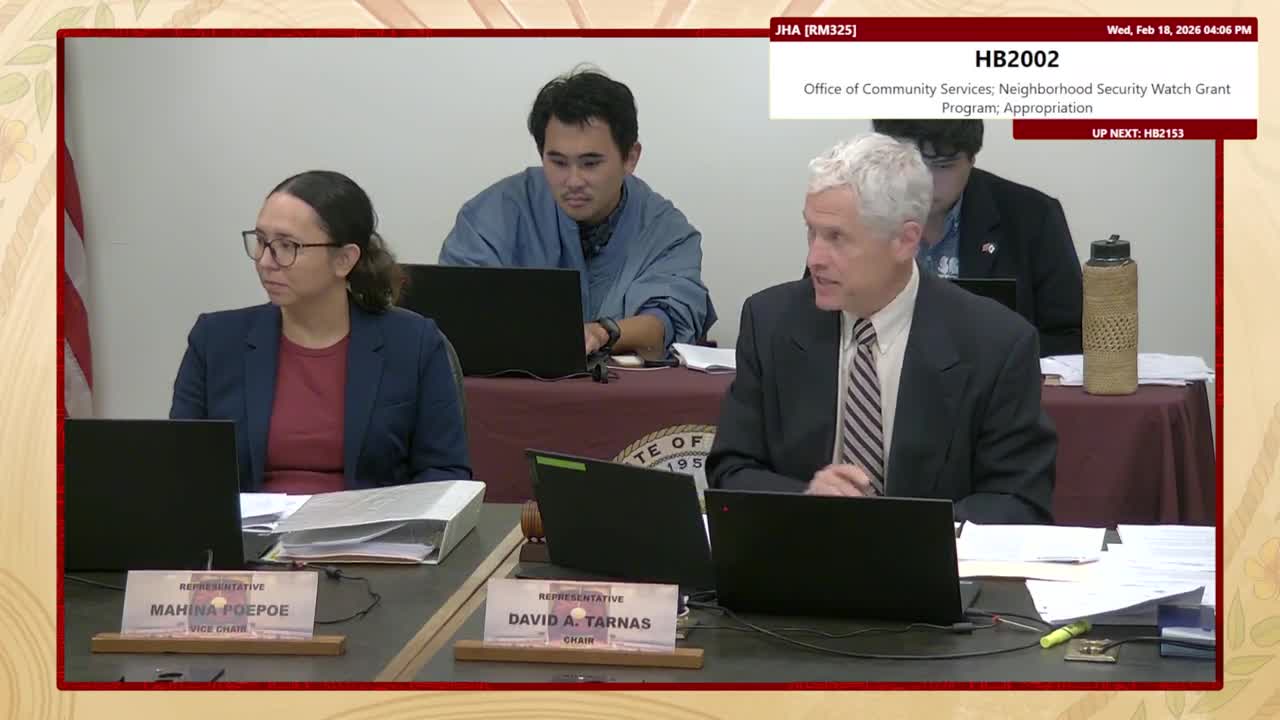 11MIN
House Standing Committee on Judiciary & Hawaiian Affairs
 3MIN
House Standing Committee on Education
3MIN
House Standing Committee on Higher Education
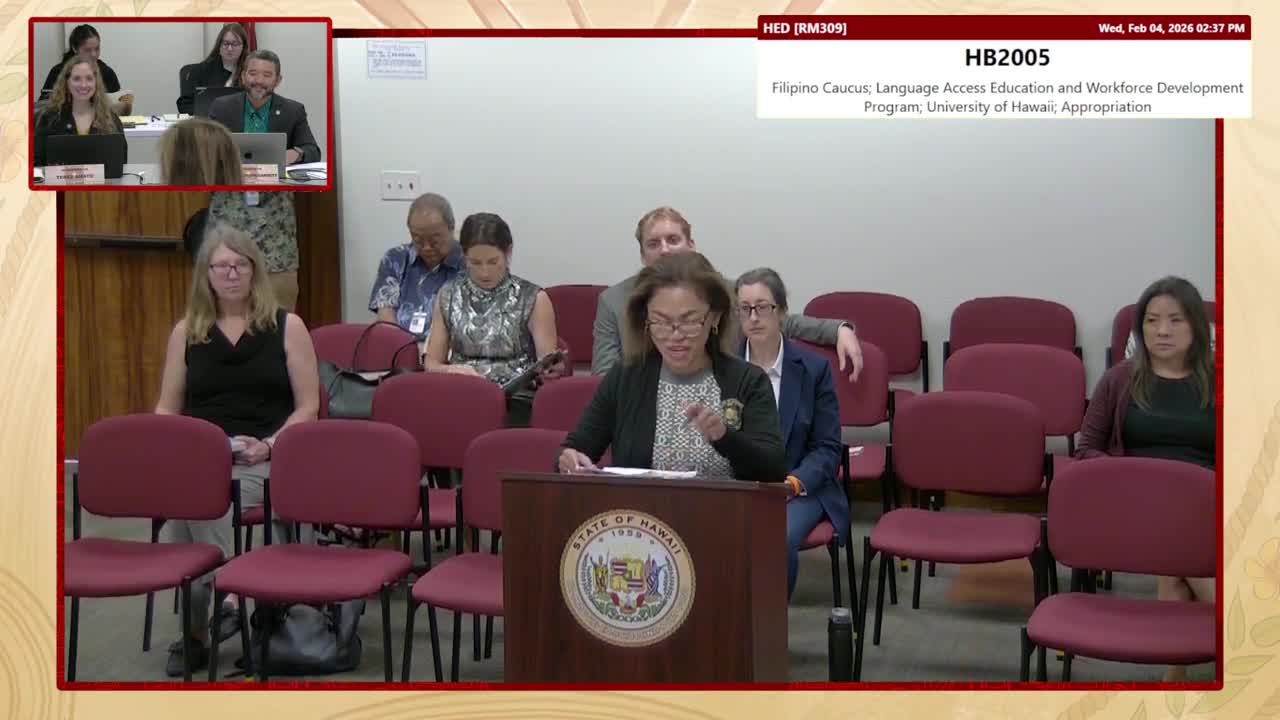 5MIN
House Standing Committee on Higher Education
19SEC
House Standing Committee on Higher Education
Bill Author