HB 1559: Department of Education; Telecommunication Devices; Prohibited
- Session Year: 2025-2026
- House: House
- Latest Version Date: 2026-03-06
Current Status:
Failed
(2026-03-20: The committee on EDU deferred the measure.)
Introduced
In Committee
First Chamber
In Committee
Second Chamber
Final Decking
Enacted
What does this bill do?
This bill prohibits public school students from using telecommunication devices—such as cell phones, smart watches, or tablets—on school grounds during the instructional day, except with teacher or administrator permission for class use, for documented medical needs, in a school emergency, or when required by a student's IEP/504/ADA accommodations. Students who violate the rule more than once in a school year may have devices confiscated and face additional discipline; confiscated devices must be stored securely and can be released only to a parent or guardian within three months or become school property if not retrieved.
The summary is provided by generative AI which can make mistakes. For original language, please view the details in the table below.
Prohibits a student from using a telecommunication device on school grounds during the instructional day, with certain exceptions. Requires a confiscated telecommunication device to be released only to the student's parent or legal guardian, who has three months to retrieve the device before it is subject to forfeiture. Effective 7/1/3000. (HD2)
Prohibits a student from using a telecommunication device on school grounds during the instructional day, with certain exceptions. Requires a confiscated telecommunication device to be released only to the student's legal parent or guardian, who then has three months to retrieve the device or subject the device to forfeiture. Effective 7/1/3000. (HD1)
Prohibits a student from using a telecommunication device on school grounds during the instructional day, with certain exceptions. Requires a confiscated telecommunication device to be released only to the student's legal parent or guardian, who then has three months to retrieve the device or subject the device to forfeiture.
|
HOUSE OF REPRESENTATIVES |
H.B. NO. |
1559 |
|
THIRTY-THIRD LEGISLATURE, 2026 |
H.D. 2 |
|
|
STATE OF HAWAII |
|
|
|
|
|
|
|
|
||
|
|
||
A BILL FOR AN ACT
RELATING TO EDUCATION.
BE IT ENACTED BY THE LEGISLATURE OF THE STATE OF HAWAII:
SECTION 1. The legislature finds that the State is committed to maintaining high levels of education by ensuring that public schools provide a safe, secure, and effective learning environment for students. However, the increased presence and use of telecommunication devices during the school day have become a significant distraction for students, leading to reduced attention and diminished classroom engagement.
The legislature further finds that numerous states have enacted statewide policies that restrict or prohibit student use of cell phones and similar devices during the school day. Certain states, including Louisiana, have adopted policies limiting student cell phone use during the instructional day, with exceptions for educational or authorized purposes, and that early reports from school officials in those states indicate improvements in student focus, attendance, and academic performance following implementation. National surveys of public school leaders and teachers indicate that a majority report negative impacts from student cell phone use on mental health, attention spans, and educational outcomes.
The purpose of this Act is to establish a uniform, statewide policy restricting student use of telecommunication devices during the instructional day in public schools in order to strengthen learning environments, support student mental and emotional well-being, and improve academic outcomes for students throughout Hawaii.
SECTION 2. Chapter 302A, Hawaii Revised Statutes, is amended by adding a new section to part II, subpart C, to be appropriately designated and to read as follows:
"§302A- Telecommunication devices; prohibited. (a) Beginning with the 2026-2027 school year, except as provided in subsection (b), no student enrolled in a public school shall use a telecommunication device on school grounds during the instructional day.
(b) A telecommunication device may be used on school grounds during the instructional day:
(1) With the direct permission of a teacher or school administrator for instructional or educational purposes;
(2) When the device is required for documented medical purposes, including monitoring or managing a medical condition;
(3) During a schoolwide emergency, when use of a telecommunication device is necessary to protect the health or safety of students or staff; or
(4) When the device is required pursuant to a student's individualized education program or section 504 plan, or as required by the Americans with Disabilities Act of 1990, title 42 United States Code sections 12101 to 12213.
(c) A student who violates this section more than once within the same school year shall be subject to the following:
(1) Immediate confiscation of the telecommunication device by a teacher or school administrator; and
(2) Additional disciplinary action for subsequent violations.
(d) A confiscated telecommunication device shall be stored by a teacher or school administrator in a secure location. Storage procedures and policies shall be determined by each school.
(e) A confiscated telecommunication device shall be released only to the student's legal parent or guardian. A legal parent or guardian shall have no more than three months from the date of confiscation to retrieve the telecommunication device. During that three-month period, the school shall provide the legal parent or guardian with at least three notifications regarding retrieval of the telecommunication device. A telecommunication device that is not retrieved within three months from the date of confiscation shall be deemed forfeited to the school and may be disposed of or repurposed.
(f) No school, teacher, or school administrator shall be liable for the loss, damage, or destruction of a confiscated telecommunication device; provided that the device is stored in a secure location that is not accessible to students, is reasonably protected from theft or damage, and is handled in accordance with school-adopted storage procedures until the device is retrieved by the student's parent or legal guardian.
(g) The department may adopt rules pursuant to chapter 91 necessary for the purposes of this section.
(h) For purposes of this section:
"Instructional day" means the entire school day, including instructional periods, lunch, recess, and transitions between classes.
"Telecommunication device" means any electronic device capable of connecting to the Internet or a cellular network and transmitting or receiving communications, including but not limited to cellular phones, smart phones, smart watches, tablets, and other similar devices."
SECTION 3. New statutory material is underscored.
SECTION 4. This Act shall take effect on July 1, 3000.
Report Title:
Department of Education; Telecommunication Devices; Prohibited
Description:
Prohibits a student from using a telecommunication device on school grounds during the instructional day, with certain exceptions. Requires a confiscated telecommunication device to be released only to the student's parent or legal guardian, who has three months to retrieve the device before it is subject to forfeiture. Effective 7/1/3000. (HD2)
The summary description of legislation appearing on this page is for informational purposes only and is not legislation or evidence of legislative intent.
|
HOUSE OF REPRESENTATIVES |
H.B. NO. |
1559 |
|
THIRTY-THIRD LEGISLATURE, 2026 |
H.D. 1 |
|
|
STATE OF HAWAII |
|
|
|
|
|
|
|
|
||
|
|
||
A BILL FOR AN ACT
RELATING TO EDUCATION.
BE IT ENACTED BY THE LEGISLATURE OF THE STATE OF HAWAII:
SECTION 1. The legislature finds that the State is committed to maintaining high levels of education by ensuring that public schools provide a safe, secure, and effective learning environment for students. However, the increased presence and use of telecommunication devices during the school day have become a significant distraction for students, leading to reduced attention and diminished classroom engagement.
The legislature further finds that numerous states have enacted statewide policies that restrict or prohibit student use of cell phones and similar devices during the school day. Certain states, including Louisiana, have adopted policies limiting student cell phone use during the instructional day, with exceptions for educational or authorized purposes, and that early reports from school officials in those states indicate improvements in student focus, attendance, and academic performance following implementation. National surveys of public school leaders and teachers indicate that a majority report negative impacts from student cell phone use on mental health, attention spans, and educational outcomes.
The purpose of this Act is to establish a uniform, statewide policy restricting student use of telecommunication devices during the instructional day in public schools in order to strengthen learning environments, support student mental and emotional well-being, and improve academic outcomes for students throughout Hawaii.
SECTION 2. Chapter 302A, Hawaii Revised Statutes, is amended by adding a new section to part II, subpart C, to be appropriately designated and to read as follows:
"§302A- Telecommunication devices; prohibited. (a) Beginning with the 2026-2027 school year, except as provided in subsection (b), no student in a public school shall use a telecommunication device on school grounds during the instructional day.
(b) A telecommunication device may be used on school grounds during the instructional day:
(1) With the direct permission of a teacher or school administrator for instructional or educational purposes;
(2) When the device is required for documented medical purposes, including monitoring or managing a medical condition;
(3) During a schoolwide emergency, when use of a telecommunication device is necessary to protect the health or safety of students or staff; or
(4) When the device is required pursuant to a student's individualized education program or section 504 plan, or as required by the Americans with Disabilities Act of 1990, title 42 United States Code sections 12101 to 12213.
(c) A student who violates this section within the same school year shall be subject to the following:
(1) Immediate confiscation of the telecommunication device by a teacher or administrator; and
(2) Additional disciplinary action for subsequent violations.
(d) A confiscated telecommunication device shall be stored by a teacher or school administrator in a secure location. Storage operations and policies shall be determined by each school.
(e) A confiscated telecommunication device shall be released only to the student's legal parent or guardian. A legal parent or guardian shall have no more than three months from the date of confiscation to retrieve the telecommunication device. During that three-month period, the school shall provide the legal parent or guardian with at least three notifications regarding retrieval of the telecommunication device. A telecommunication device that is not retrieved within three months from the date of confiscation shall be deemed forfeited to the school and may be disposed of or repurposed.
(f) No school, teacher, or school administrator shall be liable for the loss, damage, or destruction of a confiscated telecommunication device; provided that reasonable steps shall be taken to secure the device until the device is retrieved by the student's legal parent or guardian.
(g) The department may adopt rules pursuant to chapter 91 necessary for the purposes of this section.
(h) For purposes of this section:
"Instructional day" means the entire school day, including instructional periods, lunch, recess, and transitions between classes.
"Telecommunication device" means any electronic device capable of connecting to the Internet or a cellular network and transmitting or receiving communications, including but not limited to cellular phones, smart phones, smart watches, tablets, and other similar devices."
SECTION 3. New statutory material is underscored.
SECTION 4. This Act shall take effect on July 1, 3000.
Report Title:
Department of Education; Telecommunication Devices; Prohibited
Description:
Prohibits a student from using a telecommunication device on school grounds during the instructional day, with certain exceptions. Requires a confiscated telecommunication device to be released only to the student's legal parent or guardian, who then has three months to retrieve the device or subject the device to forfeiture. Effective 7/1/3000. (HD1)
The summary description of legislation appearing on this page is for informational purposes only and is not legislation or evidence of legislative intent.
|
HOUSE OF REPRESENTATIVES |
H.B. NO. |
1559 |
|
THIRTY-THIRD LEGISLATURE, 2026 |
|
|
|
STATE OF HAWAII |
|
|
|
|
|
|
|
|
||
|
|
||
A BILL FOR AN ACT
relating to education.
BE IT ENACTED BY THE LEGISLATURE OF THE STATE OF HAWAII:
SECTION 1. The legislature finds that the State is committed to maintaining high levels of education by ensuring that public schools provide a safe, secure, and effective learning environment for students. However, the increased presence and use of telecommunication devices during the school day have become a significant distraction for students, leading to reduced attention and diminished classroom engagement.
The legislature further finds that numerous states have enacted statewide policies that restrict or prohibit student use of cell phones and similar devices during the school day. Certain states, including Louisiana, have adopted policies limiting student cell phone use during the instructional day, with exceptions for educational or authorized purposes, and that early reports from school officials in those states indicate improvements in student focus, attendance, and academic performance following implementation. National surveys of public school leaders and teachers indicate that a majority report negative impacts from student cell phone use on mental health, attention spans, and educational outcomes.
The purpose of this Act is to establish a uniform, statewide policy restricting student use of telecommunication devices during the instructional day in public schools in order to strengthen learning environments, support student mental and emotional well-being, and improve academic outcomes for students throughout Hawaii.
SECTION 2. Chapter 302A, Hawaii Revised Statutes, is amended by adding a new section to part II, subpart C, to be appropriately designated and to read as follows:
"§302A- Telecommunication devices; prohibited. (a) Beginning with the 2026-2027 school year, except as provided in subsection (b), no student in a public school shall use a telecommunication device on school grounds during the instructional day.
(b) A telecommunication device may be used on school grounds during the instructional day:
(1) With the direct permission of a teacher or school administrator for instructional or educational purposes;
(2) When the device is required for documented medical purposes, including monitoring or managing a medical condition; or
(3) During a schoolwide emergency, when use of a telecommunication device is necessary to protect the health or safety of students or staff.
(c) A student who violates this section within the same school year shall be subject to the following:
(1) Immediate confiscation of the telecommunication device by a teacher or administrator; and
(2) Additional disciplinary action for subsequent violations.
(d) A confiscated telecommunication device shall be stored by a teacher or school administrator in a secure location. Storage operations and policies shall be determined by each school.
(e) A confiscated telecommunication device shall be released only to the student's legal parent or guardian. A legal parent or guardian shall have no more than three months from the date of confiscation to retrieve the telecommunication device. During that three-month period, the school shall provide the legal parent or guardian with at least three notifications regarding retrieval of the telecommunication device. A telecommunication device that is not retrieved within three months from the date of confiscation shall be deemed forfeited to the school and may be disposed of or repurposed.
(f) No school, teacher, or school administrator shall be liable for the loss, damage, or destruction of a confiscated telecommunication device; provided that reasonable steps shall be taken to secure the device until it is retrieved by the student's legal parent or guardian.
(g) The department may adopt rules pursuant to chapter 91 necessary for the purposes of this section.
(h) For purposes of this section:
"Instructional day" means the entire school day, including instructional periods, lunch, recess, and transitions between classes.
"Telecommunication device" means any electronic device capable of connecting to the Internet or a cellular network and transmitting or receiving communications, including but not limited to cellular phones, smart phones, smart watches, tablets, and other similar devices."
SECTION 3. New statutory material is underscored.
SECTION 4. This Act shall take effect upon its approval.
|
INTRODUCED BY: |
_____________________________ |
Report Title:
Department of Education; Telecommunication Devices; Prohibited
Description:
Prohibits a student from using a telecommunication device on school grounds during the instructional day, with certain exceptions. Requires a confiscated telecommunication device to be released only to the student's legal parent or guardian, who then has three months to retrieve the device or subject the device to forfeiture.
The summary description of legislation appearing on this page is for informational purposes only and is not legislation or evidence of legislative intent.
|
Date
|
Status
|
|---|---|
| Mar 20, 2026 | The committee on EDU deferred the measure. |
| Mar 17, 2026 | The committee(s) on EDU has scheduled a public hearing on 03-20-26 1:00PM; Conference Room 229 & Videoconference. |
| Mar 12, 2026 | Referred to EDU, JDC. |
| Mar 12, 2026 | Passed First Reading. |
| Mar 12, 2026 | Received from House (Hse. Com. No. 244). |
| Mar 10, 2026 | Passed Third Reading as amended in HD 2 with Representative(s) Souza voting aye with reservations; Representative(s) Cochran, Iwamoto, Shimizu voting no (3) and none excused (0). Transmitted to Senate. |
| Mar 6, 2026 | Forty-eight (48) hours notice Tuesday, 03-10-26. |
| Mar 6, 2026 | Reported from JHA (Stand. Com. Rep. No. 1140-26) as amended in HD 2, recommending passage on Third Reading. |
| Mar 5, 2026 | The committee on JHA recommend that the measure be PASSED, WITH AMENDMENTS. The votes were as follows: 5 Ayes: Representative(s) Tarnas, Poepoe, Kahaloa, Takayama, Garcia; Ayes with reservations: none; 2 Noes: Representative(s) Cochran, Shimizu; and 3 Excused: Representative(s) Belatti, Hashem, Sayama. |
| Mar 3, 2026 | Bill scheduled to be heard by JHA on Thursday, 03-05-26 2:00PM in House conference room 325 VIA VIDEOCONFERENCE. |
| Feb 20, 2026 | Passed Second Reading as amended in HD 1 and referred to the committee(s) on JHA with none voting aye with reservations; Representative(s) Pierick voting no (1) and Representative(s) Quinlan excused (1). |
| Feb 20, 2026 | Reported from EDN (Stand. Com. Rep. No. 695-26) as amended in HD 1, recommending passage on Second Reading and referral to JHA. |
| Feb 19, 2026 | The committee on EDN recommend that the measure be PASSED, WITH AMENDMENTS. The votes were as follows: 10 Ayes: Representative(s) Woodson, La Chica, Amato, Evslin, Garrett, Kapela, Kila, Olds, Muraoka, Souza; Ayes with reservations: none; Noes: none; and Excused: none. |
| Feb 17, 2026 | Bill scheduled to be heard by EDN on Thursday, 02-19-26 2:00PM in House conference room 309 VIA VIDEOCONFERENCE. |
| Jan 26, 2026 | Referred to EDN, JHA, referral sheet 1 |
| Jan 21, 2026 | Introduced and Pass First Reading. |
| Jan 15, 2026 | Prefiled. |
|
Date
|
Description
|
Location
|
Votes
|
|
|---|---|---|---|---|
| Mar 10, 2026 | Third Reading | House Floor |
Passed |
|
| Mar 5, 2026 | The committee on JHA recommend that the measure be PASSED, WITH AMENDMENTS | House Standing Committee on Judiciary & Hawaiian Affairs |
Passed |
|
| Feb 19, 2026 | The committee on EDN recommend that the measure be PASSED, WITH AMENDMENTS | House Standing Committee on Education |
Passed |
This list shows positions taken on this bill by organizations on the date displayed, which is linked to the original source.
Positions by individuals are not included.
|
Organization
|
Position
|
Date
|
|---|---|---|
| Hawai'i State Teachers Association | *** Support | Mar 20, 2026 |
STAND. COM. REP. NO. 1140-26
Honolulu, Hawaii
, 2026
RE: H.B. No. 1559
H.D. 2
Honorable Nadine K. Nakamura
Speaker, House of Representatives
Thirty-Third State Legislature
Regular Session of 2026
State of Hawaii
Madame:
Your Committee on Judiciary & Hawaiian Affairs, to which was referred H.B. No. 1559, H.D. 1, entitled:
"A BILL FOR AN ACT RELATING TO EDUCATION,"
begs leave to report as follows:
Your Committee finds that excessive and unregulated use of telecommunication devices during the school day has significantly disrupted classroom instruction, reduced student engagement, and contributed to declines in attention and academic performance. Your Committee further finds that inconsistent telecommunication device policies across campuses have created operational challenges and that national trends demonstrate the benefits of restricting devices and the need for clear, uniform expectations for students. Your Committee believes that establishing statewide baseline rules for permissible use while allowing necessary exceptions for education, safety, disability accommodations, and medical needs will strengthen learning environments and support the healthy development and well-being of Hawaii's students.
Your Committee has amended this measure by:
(1) Clarifying that a student who violates the telecommunications restrictions policy more than once within the same school year shall be subject to confiscation of the telecommunication device and additional disciplinary action;
(2) Expanding the steps taken to secure a student's confiscated telecommunications device until the device is retrieved by the student's parent or legal guardian; and
(3) Making technical, nonsubstantive amendments for the purposes of clarity, consistency, and style.
As affirmed by the record of votes of the members of your Committee on Judiciary & Hawaiian Affairs that is attached to this report, your Committee is in accord with the intent and purpose of H.B. No. 1559, H.D. 1, as amended herein, and recommends that it pass Third Reading in the form attached hereto as H.B. No. 1559, H.D. 2.
Respectfully submitted on behalf of the members of the Committee on Judiciary & Hawaiian Affairs,
|
|
|
____________________________ DAVID A. TARNAS, Chair |
STAND. COM. REP. NO. 695-26
Honolulu, Hawaii
, 2026
RE: H.B. No. 1559
H.D. 1
Honorable Nadine K. Nakamura
Speaker, House of Representatives
Thirty-Third State Legislature
Regular Session of 2026
State of Hawaii
Madame:
Your Committee on Education, to which was referred H.B. No. 1559 entitled:
"A BILL FOR AN ACT RELATING TO EDUCATION,"
begs leave to report as follows:
Your Committee finds that national surveys of public school leaders and teachers indicate that a majority report negative impacts from student use of cell phones and similar devices on students' mental health, attention span, and educational outcomes. Your Committee further finds that numerous states have enacted statewide policies to restrict or prohibit student use of cell phones and similar devices during the instructional day, with exceptions for certain educational or authorized purposes. Early reports show that those states have experienced improvements in student focus, attendance, and academic performance. This measure will help strengthen learning environments, support student mental and emotional well-being, and improve academic outcomes for students throughout the State.
Your Committee has amended this measure by:
(1) Allowing a telecommunication device to be used on school grounds during the instruction day when the device is required pursuant to a student's individualized education program or section 504 plan, or as required by the Americans with Disabilities Act of 1990;
(2) Changing the effective date to July 1, 3000; and
(3) Making technical, nonsubstantive amendments for the purposes of clarity, consistency, and style.
As affirmed by the record of votes of the members of your Committee on Education that is attached to this report, your Committee is in accord with the intent and purpose of H.B. No. 1559, as amended herein, and recommends that it pass Second Reading in the form attached hereto as H.B. No. 1559, H.D. 1, and be referred to your Committee on Judiciary & Hawaiian Affairs.
Respectfully submitted on behalf of the members of the Committee on Education,
|
|
|
____________________________ JUSTIN H. WOODSON, Chair |
|
|
|
|
|
Date
|
Testimony PDF
|
|---|---|
| Mar 20, 2026 | HB1559_HD2_TESTIMONY_EDU_03-20-26_.PDF |
| Mar 5, 2026 | HB1559_HD1_TESTIMONY_JHA_03-05-26_.PDF |
| Feb 19, 2026 | HB1559_TESTIMONY_EDN_02-19-26_.PDF |
Discussed in Hearing
 11MIN
Senate Standing Committee on Education
 2MIN
House Floor
 10MIN
House Standing Committee on Judiciary & Hawaiian Affairs
 2MIN
House Standing Committee on Judiciary & Hawaiian Affairs
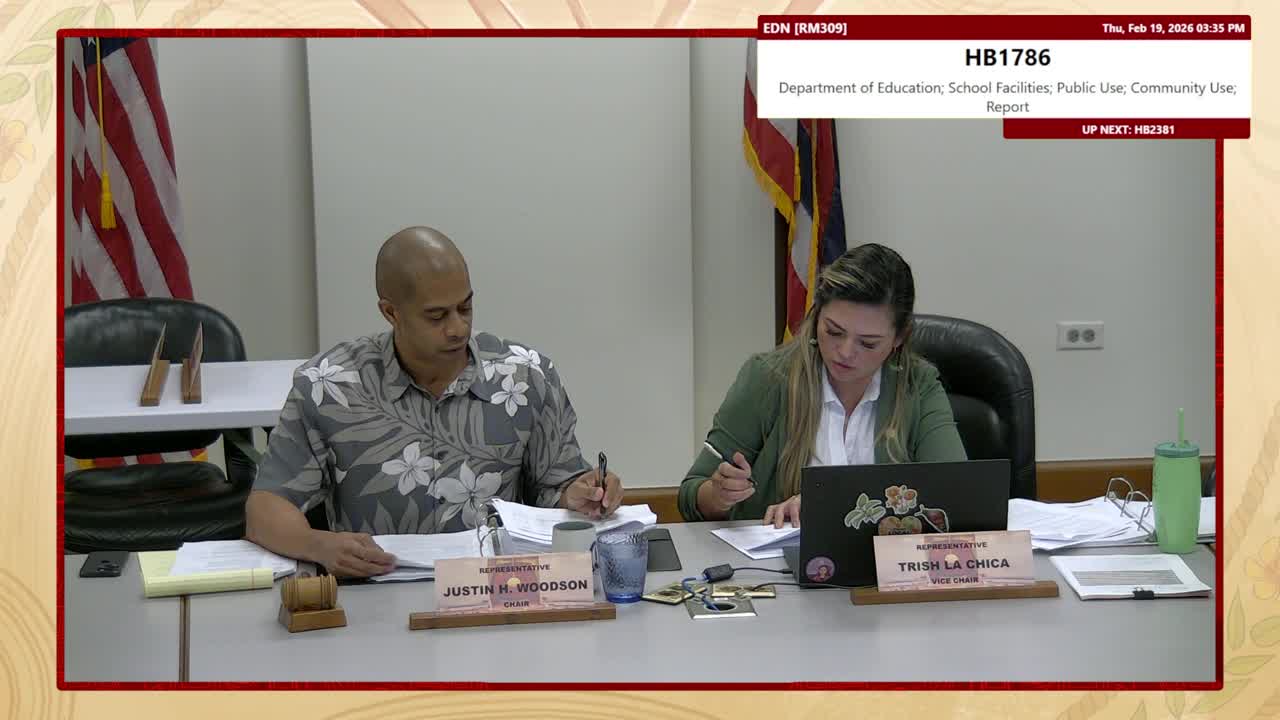 3MIN
House Standing Committee on Education
2MIN
House Standing Committee on Education
Bill Author