HB 1237: DOA; Maui County; Biosecurity; Invasive Species; Appropriations
- Session Year: 2025-2026
- House: House
- Latest Version Date: 2025-03-18
Current Status:
Failed
(2025-12-08: Carried over to 2026 Regular Session.)
Introduced
In Committee
First Chamber
In Committee
Second Chamber
Final Decking
Enacted
Appropriates funds to the Department of Agriculture for agricultural biosecurity and the prevention, detection, and control of invasive species in Maui County. Effective 7/1/2050. (SD1)
Appropriates funds to the Department of Agriculture for agricultural biosecurity and the prevention, detection, and control of invasive species in Maui County. Effective 7/1/3000. (HD1)
Appropriates funds to the Department of Agriculture for agricultural biosecurity and the prevention, detection, and control of invasive species in Maui County.
|
HOUSE OF REPRESENTATIVES |
H.B. NO. |
1237 |
|
THIRTY-THIRD LEGISLATURE, 2025 |
H.D. 1 |
|
|
STATE OF HAWAII |
S.D. 1 |
|
|
|
|
|
|
|
||
|
|
||
A BILL FOR AN ACT
RELATING TO BIOSECURITY.
BE IT ENACTED BY THE LEGISLATURE OF THE STATE OF HAWAII:
SECTION 1. The legislature finds that the absence of a state agricultural inspector and quarantine facility on Molokai leaves the island vulnerable to the introduction and spread of invasive species. The legislature further finds that invasive pests have and will continue to arrive via imported goods, posing a significant risk to Molokai's unique ecosystems and economy. High-risk pathways, such as the importation of plants, planting materials, mulch, used vehicles, and farm equipment, further exacerbate this threat. Notably, invasive species such as the little fire ant and coconut rhinoceros beetle have not yet been detected on Molokai.
The legislature also finds that there is no state agricultural inspector or island invasive species committee on Lanai. However, community agricultural production on the island is vibrant and growing. To date, Lanai has remained free of many invasive species that are causing devastation across the State, including little fire ants, coconut rhinoceros beetles, and coqui frogs. The legislature additionally finds that like Molokai, Lanai and the State as a whole would benefit immensely from an increased presence by the department of agriculture to provide inspections and other support for agricultural producers and the creation of an island invasive species committee.
Furthermore, the legislature finds that on Maui, urgent action and resources are required to combat the increasing threats of little fire ants, coconut rhinoceros beetles, and coqui frogs. To effectively educate the public, implement rapid responses, and carry out timely interventions and control measures, sustained funding is essential. With consistent financial support, it remains possible to reduce the economic, environmental, and social effects of invasive species by appropriating funds to public agencies and private organizations to aggressively treat and monitor little fire ant and coqui frog infestations and conduct rigorous monitoring for coconut rhinoceros beetle sightings.
Moreover, the legislature finds that investing in prevention and early detection of invasive species is essential because it can potentially save tens of millions of dollars in long-term damage and irrecoverable losses. For instance, invasive species like the coconut rhinoceros beetle threaten native and indigenous plants critical to food security and cultural continuity, such as kalo, loʻulu, maiʻa (banana), hala, and ko (sugarcane).
In addition, the legislature finds that as an island state, Hawaii has the unique advantage of being able to prevent the spread of invasive species through isolation, allowing non‑infected islands to serve as critical repositories for native plants and species threatened by infestations elsewhere. This proactive approach to biosecurity will help safeguard Hawaii's environment, economy, and culture.
Therefore, the purpose of this Act is to address critical gaps in Maui county's agricultural biosecurity and support the prevention, detection, and control of invasive species in Maui county by appropriating funds for these purposes.
SECTION 2. There is appropriated out of the general revenues of the State of Hawaii the sum of $ or so much thereof as may be necessary for fiscal year 2025-2026 and the same sum or so much thereof as may be necessary for fiscal year 2026-2027 for the department of agriculture to prevent and control little fire ant and coconut rhinoceros beetle infestations in Maui county, including through the hiring of general professionals for biosecurity efforts.
The sums appropriated shall be expended by the department of agriculture for the purposes of this Act.
SECTION 3. (a) There is appropriated out of the general revenues of the State of Hawaii the sum of $ or so much thereof as may be necessary for fiscal year 2025-2026 and the same sum or so much thereof as may be necessary for fiscal year 2026-2027 to combat the spread of coqui frogs in Maui county; provided that the funding shall be allocated in the following manner:
(1) $ to the university of Hawaii Pacific cooperative studies unit for the Maui invasive species committee or its Molokai subcommittees to support education, early detection, response, and control efforts regarding coqui frogs; provided further that this funding may include providing equipment and supplies to residents to treat coqui frog infestations on their properties; and
(2) $ to establish a Lanai invasive species committee as a sub-branch of the Maui invasive species committee.
(b) The department of agriculture may make grants to, or enter into contracts with, the university of Hawaii Pacific cooperative studies unit for the Maui invasive species committee or its Molokai subcommittees to accomplish the purposes of this section.
(c) The sums appropriated shall be expended by the department of agriculture for the purposes of this Act.
SECTION 4. This Act shall take effect on July 1, 2050.
Report Title:
DOA; Maui County; Biosecurity; Invasive Species; Appropriations
Description:
Appropriates funds to the Department of Agriculture for agricultural biosecurity and the prevention, detection, and control of invasive species in Maui County. Effective 7/1/2050. (SD1)
The summary description of legislation appearing on this page is for informational purposes only and is not legislation or evidence of legislative intent.
|
HOUSE OF REPRESENTATIVES |
H.B. NO. |
1237 |
|
THIRTY-THIRD LEGISLATURE, 2025 |
H.D. 1 |
|
|
STATE OF HAWAII |
|
|
|
|
|
|
|
|
||
|
|
||
A BILL FOR AN ACT
RELATING TO BIOSECURITY.
BE IT ENACTED BY THE LEGISLATURE OF THE STATE OF HAWAII:
SECTION 1. The legislature finds that the absence of a state agricultural inspector and quarantine facility on Molokai leaves the island vulnerable to the introduction and spread of invasive species. The legislature further finds that invasive pests have and will continue to arrive via imported goods, posing a significant risk to Molokai's unique ecosystems and economy. High-risk pathways, such as the importation of plants, planting materials, mulch, used vehicles, and farm equipment, further exacerbate this threat. Notably, invasive species such as the little fire ant and coconut rhinoceros beetle have not yet been detected on Molokai.
The legislature also finds that there is no state agricultural inspector or island invasive species committee on Lanai. However, community agricultural production on the island is vibrant and growing. To date, Lanai has remained free of many invasive species that are causing devastation across the State, including little fire ants, coconut rhinoceros beetles, and coqui frogs. The legislature additionally finds that like Molokai, Lanai and the State as a whole would benefit immensely from an increased presence by the department of agriculture to provide inspections and other support for agricultural producers and the creation of an island invasive species committee.
Furthermore, the legislature finds that on Maui, urgent action and resources are required to combat the increasing threats of little fire ants, coconut rhinoceros beetles, and coqui frogs. To effectively educate the public, implement rapid responses, and carry out timely interventions and control measures, sustained funding is essential. With consistent financial support, it remains possible to reduce the economic, environmental, and social effects of invasive species by appropriating funds to public agencies and private organizations to aggressively treat and monitor little fire ant and coqui frog infestations and conduct rigorous monitoring for coconut rhinoceros beetle sightings.
Moreover, the legislature finds that investing in prevention and early detection of invasive species is essential because it can potentially save tens of millions of dollars in long-term damage and irrecoverable losses. For instance, invasive species like the coconut rhinoceros beetle threaten native and indigenous plants critical to food security and cultural continuity, such as kalo, loʻulu, maiʻa (banana), hala, and ko (sugarcane).
In addition, the legislature finds that as an island state, Hawaii has the unique advantage of being able to prevent the spread of invasive species through isolation, allowing non-infected islands to serve as critical repositories for native plants and species threatened by infestations elsewhere. This proactive approach to biosecurity will help safeguard Hawaii's environment, economy, and culture.
Therefore, the purpose of this Act is to address critical gaps in Maui county's agricultural biosecurity and support the prevention, detection, and control of invasive species in Maui county by appropriating funds for these purposes.
SECTION 2. There is appropriated out of the general revenues of the State of Hawaii the sum of $ or so much thereof as may be necessary for fiscal year 2025-2026 and the same sum or so much thereof as may be necessary for fiscal year 2026-2027 for the department of agriculture to prevent and control little fire ant and coconut rhinoceros beetle infestations in Maui county, including through the hiring of general professionals for biosecurity efforts.
The sums appropriated shall be expended by the department of agriculture for the purposes of this Act.
SECTION 3. (a) There is appropriated out of the general revenues of the State of Hawaii the sum of $ or so much thereof as may be necessary for fiscal year 2025-2026 and the same sum or so much thereof as may be necessary for fiscal year 2026-2027 to combat the spread of coqui frogs in Maui county; provided that the funding shall be allocated in the following manner:
(1) $ to the university of Hawaii Pacific cooperative studies unit for the Maui invasive species committee or its Molokai subcommittees to support education, early detection, response, and control efforts regarding coqui frogs; provided further that this funding may include providing equipment and supplies to residents to treat coqui frog infestations on their properties; and
(2) $ to establish a Lanai invasive species committee as a sub-branch of the Maui invasive species committee.
(b) The department of agriculture may make grants to or enter into contracts with the university of Hawaii Pacific cooperative studies unit for the Maui invasive species committee or its Molokai subcommittees to accomplish the purposes of this section.
(c) The sums appropriated shall be expended by the department of agriculture for the purposes of this Act.
SECTION 4. This Act shall take effect on July 1, 3000.
Report Title:
Biosecurity; Invasive Species; Department of Agriculture; Maui County; University of Hawaii; Appropriation
Description:
Appropriates funds to the Department of Agriculture for agricultural biosecurity and the prevention, detection, and control of invasive species in Maui County. Effective 7/1/3000. (HD1)
The summary description of legislation appearing on this page is for informational purposes only and is not legislation or evidence of legislative intent.
|
HOUSE OF REPRESENTATIVES |
H.B. NO. |
1237 |
|
THIRTY-THIRD LEGISLATURE, 2025 |
|
|
|
STATE OF HAWAII |
|
|
|
|
|
|
|
|
||
|
|
||
A BILL FOR AN ACT
relating to biosecurity.
BE IT ENACTED BY THE LEGISLATURE OF THE STATE OF HAWAII:
SECTION 1. The legislature finds that the absence of a state agricultural inspector and quarantine facility on Molokai leaves the island vulnerable to the introduction and spread of invasive species. The legislature further finds that invasive pests have and will continue to arrive via imported goods, posing a significant risk to Molokai's unique ecosystems and economy. High-risk pathways, such as the importation of plants, planting materials, mulch, used vehicles, and farm equipment, further exacerbate this threat. Notably, invasive species such as little fire ants and coconut rhinoceros beetles have not yet been detected on Molokai.
The legislature also finds that there is no state agricultural inspector or island invasive species committee on Lanai. However, community agricultural production on the island is vibrant and growing. To date, Lanai has remained free of many invasive species that are causing devastation across the State, including little fire ants, coconut rhinoceros beetles, and coqui frogs. The legislature additionally finds that like Molokai, Lanai and the State as a whole would benefit immensely from an increased presence by the department of agriculture to provide inspections and other support for agricultural producers and the creation of an island invasive species committee.
Furthermore, the legislature finds that on Maui, urgent action and resources are required to combat the increasing threats of little fire ants, coconut rhinoceros beetles, and coqui frogs. To effectively educate the public, implement rapid responses, and carry out timely interventions and control measures, sustained funding is essential. With consistent financial support, it remains possible to reduce the economic, environmental, and social effects of invasive species by appropriating funds to public agencies and private organizations to aggressively treat and monitor little fire ant and coqui frog infestations and conduct rigorous monitoring for coconut rhinoceros beetle sightings.
Moreover, the legislature finds that investing in prevention and early detection of invasive species is essential, because it can potentially save tens of millions of dollars in long-term damage and irrecoverable losses. For instance, invasive species like the coconut rhinoceros beetle threaten native and indigenous plants critical to food security and cultural continuity, such as kalo, loʻulu, maiʻa (banana), hala, and ko (sugarcane).
In addition, the legislature finds that as an island state, Hawaii has the unique advantage of being able to prevent the spread of invasive species through isolation, allowing non-infected islands to serve as critical repositories for native plants and species threatened by infestations elsewhere. This proactive approach to biosecurity will help safeguard Hawaii's environment, economy, and culture.
Therefore, the purpose of this Act is to address critical gaps in Maui county's agricultural biosecurity and the prevention, detection, and control of invasive species in Maui county by appropriating funds for these purposes.
SECTION 2. There is appropriated out of the general revenues of the State of Hawaii the sum of $3,000,000 or so much thereof as may be necessary for fiscal year 2025-2026 and the same sum or so much thereof as may be necessary for fiscal year 2026-2027 for the department of agriculture to prevent and control little fire ant and coconut rhinoceros beetle infestations in Maui county; provided that the funding shall be allocated in the following manner:
(1) $ for one full-time equivalent (1.0 FTE) plant quarantine inspector I position on Molokai to serve the harbor and airport, including salary and fringe benefits, and for necessary equipment and supplies; and
(2) $ for one full-time equivalent (1.0 FTE) plant quarantine inspector I position on Lanai to serve the harbor and airport, including salary and fringe benefits, and for necessary equipment and supplies.
The sums appropriated shall be expended by the department of agriculture for the purposes of this Act.
SECTION 3. (a) There is appropriated out of the general revenues of the State of Hawaii the sum of $2,250,000 or so much thereof as may be necessary for fiscal year 2025-2026 and the same sum or so much thereof as may be necessary for fiscal year 2026-2027 to combat the spread of coqui frogs in Maui county; provided that the funding shall be allocated in the following manner:
(1) $2,000,000 to the Maui invasive species committee to support education, early detection, response, and control efforts regarding coqui frogs; provided further that this funding may include providing equipment and supplies to residents to treat coqui frog infestations on their properties; and
(2) $250,000 to establish a Lanai invasive species committee as a sub-branch of the Maui invasive species committee.
(b) The department of agriculture may make grants to or enter into contracts with the Maui invasive species committee to accomplish the purposes of this section.
(c) The sums appropriated shall be expended by the department of agriculture for the purposes of this Act.
SECTION 4. This Act shall take effect on July 1, 2025.
|
INTRODUCED BY: |
_____________________________ |
|
|
|
Report Title:
Biosecurity; Invasive Species; Department of Agriculture; Maui County; Appropriation
Description:
Appropriates funds to the Department of Agriculture for agricultural biosecurity and the prevention, detection, and control of invasive species in Maui County.
The summary description of legislation appearing on this page is for informational purposes only and is not legislation or evidence of legislative intent.
|
Date
|
Status
|
|---|---|
| Dec 8, 2025 | Carried over to 2026 Regular Session. |
| Mar 19, 2025 | Report adopted; Passed Second Reading, as amended (SD 1) and referred to WAM. |
| Mar 19, 2025 | Reported from AEN (Stand. Com. Rep. No. 1168) with recommendation of passage on Second Reading, as amended (SD 1) and referral to WAM. |
| Mar 17, 2025 | The committee(s) on AEN recommend(s) that the measure be PASSED, WITH AMENDMENTS. The votes in AEN were as follows: 5 Aye(s): Senator(s) Gabbard, Richards, DeCoite, Rhoads, Awa; Aye(s) with reservations: none ; 0 No(es): none; and 0 Excused: none. |
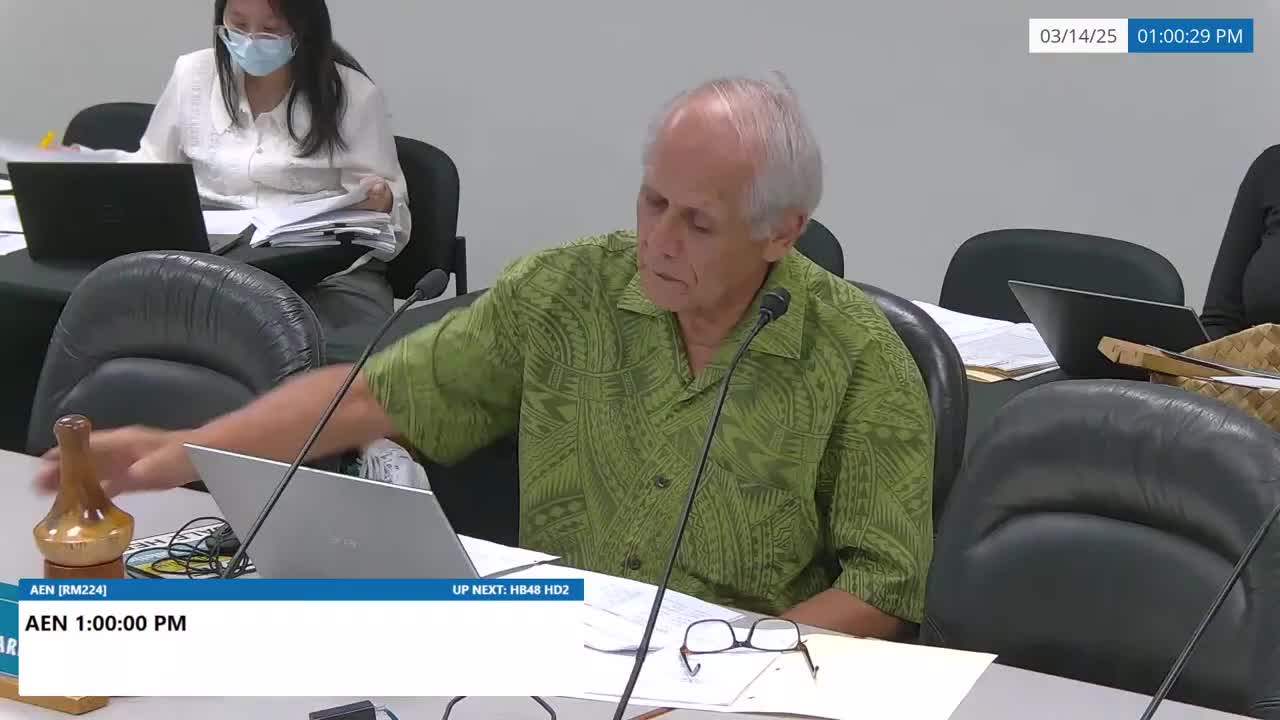
| Mar 14, 2025 | The committee(s) on AEN deferred the measure until 03-17-25 1:02PM; Conference Room 224 & Videoconference. |
| Mar 11, 2025 | The committee(s) on AEN has scheduled a public hearing on 03-14-25 1:00PM; Conference Room 224 & Videoconference. |
| Mar 4, 2025 | Referred to AEN, WAM. |
| Feb 28, 2025 | Passed First Reading. |
| Feb 28, 2025 | Received from House (Hse. Com. No. 73). |
| Feb 27, 2025 | Passed Third Reading with none voting aye with reservations; none voting no (0) and Representative(s) Cochran, Pierick, Templo, Ward excused (4). Transmitted to Senate. |
| Feb 27, 2025 | Reported from FIN (Stand. Com. Rep. No. 877), recommending passage on Third Reading. |
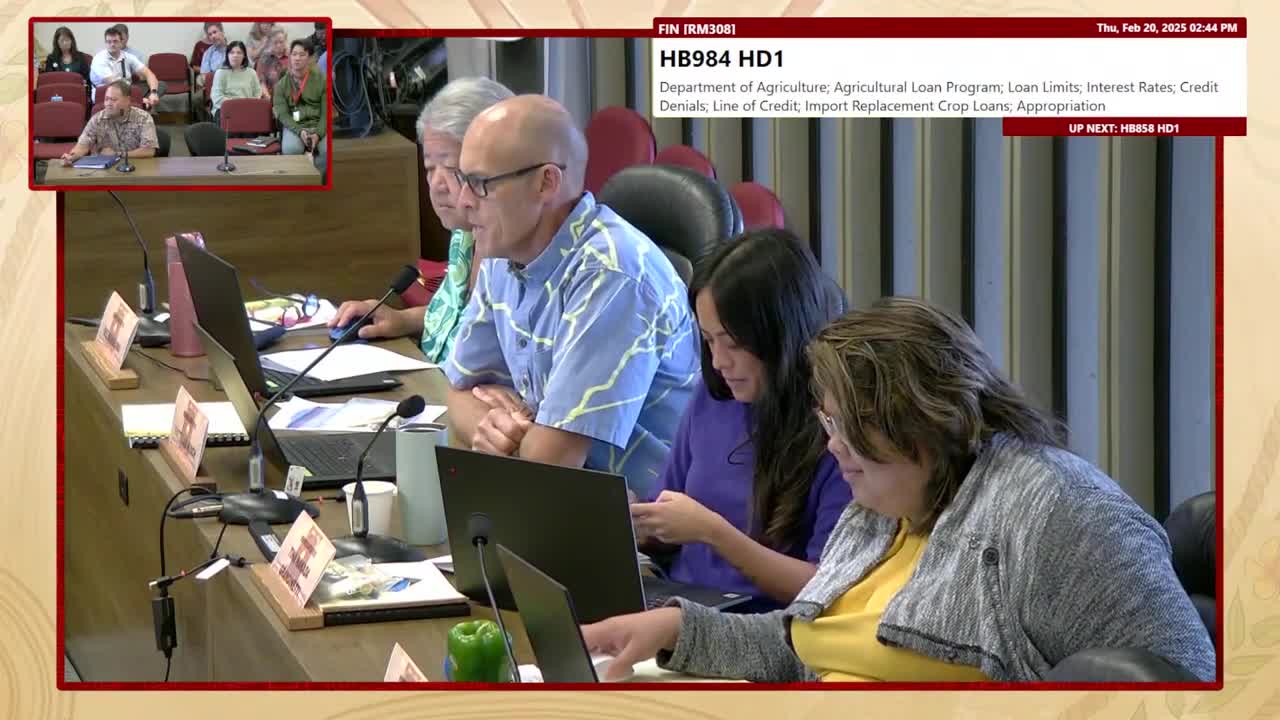
| Feb 20, 2025 | The committee on FIN recommend that the measure be PASSED, UNAMENDED. The votes were as follows: 14 Ayes: Representative(s) Yamashita, Takenouchi, Grandinetti, Holt, Hussey, Keohokapu-Lee Loy, Kitagawa, Kusch, Lamosao, Lee, M., Miyake, Morikawa, Templo, Reyes Oda; Ayes with reservations: none; Noes: none; and 2 Excused: Representative(s) Alcos, Ward. |
| Feb 18, 2025 | Bill scheduled to be heard by FIN on Thursday, 02-20-25 2:00PM in House conference room 308 VIA VIDEOCONFERENCE. |
| Feb 14, 2025 | Passed Second Reading as amended in HD 1 and referred to the committee(s) on FIN with none voting aye with reservations; none voting no (0) and Representative(s) Cochran, Matayoshi, Poepoe, Ward excused (4). |
| Feb 14, 2025 | Reported from AGR (Stand. Com. Rep. No. 636) as amended in HD 1, recommending passage on Second Reading and referral to FIN. |
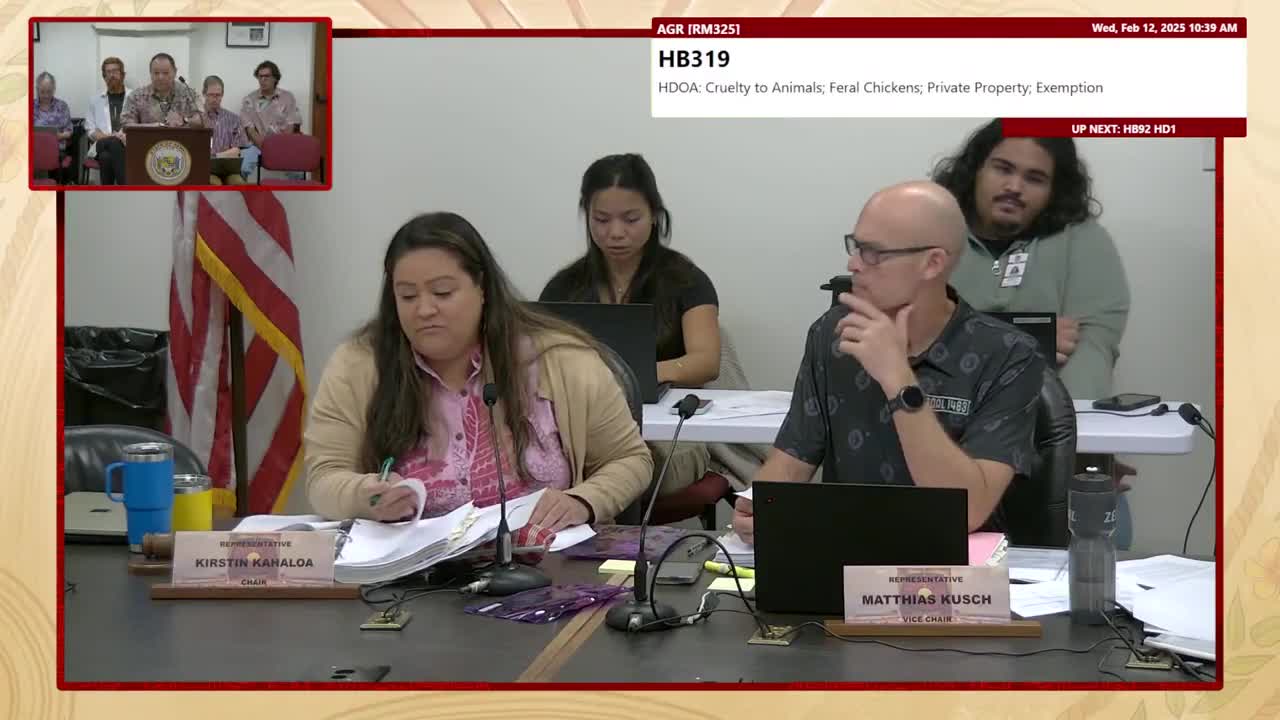
| Feb 12, 2025 | The committee on AGR recommend that the measure be PASSED, WITH AMENDMENTS. The votes were as follows: 5 Ayes: Representative(s) Kahaloa, Kusch, Lowen, Perruso, Quinlan; Ayes with reservations: none; 0 Noes: none; and 1 Excused: Representative(s) Ward. |
| Feb 7, 2025 | Bill scheduled to be heard by AGR on Wednesday, 02-12-25 9:30AM in House conference room 325 VIA VIDEOCONFERENCE. |
| Jan 27, 2025 | Referred to AGR, FIN, referral sheet 4 |
| Jan 23, 2025 | Introduced and Pass First Reading. |
| Jan 22, 2025 | Pending introduction. |
|
Date
|
Description
|
Location
|
Votes
|
|
|---|---|---|---|---|
| Mar 17, 2025 | The committee(s) on AEN recommend(s) that the measure be PASSED, WITH AMENDMENTS | Senate Standing Committee on Agriculture and Environment |
Passed |
|
| Feb 27, 2025 | Third Reading | House Floor |
Passed |
|
| Feb 20, 2025 | The committee on FIN recommend that the measure be PASSED, UNAMENDED | House Standing Committee on Finance |
Passed |
|
| Feb 12, 2025 | The committee on AGR recommend that the measure be PASSED, WITH AMENDMENTS | House Standing Committee on Agriculture & Food Systems |
Passed |
This list shows positions taken on this bill by organizations on the date displayed, which is linked to the original source.
Positions by individuals are not included.
|
Organization
|
Position
|
Date
|
|---|---|---|
| ALAOLU OHANA | ** Support | |
| Carol Kwan Consulting, LLC | ** Support | |
| Coordinating Group on Alien Pest Species (CGAPS) | *** Support | Mar 14, 2025 |
| County of Maui (Office of the Mayor) | *** Support | Mar 14, 2025 |
| Department of Agriculture | ** Support | |
| Hawaiʻi Farm Bureau | *** Support | Mar 14, 2025 |
| Hawaiʻi Farmers Union | *** Support | Mar 14, 2025 |
| Hawaiʻi Invasive Species Council (HISC) | *** Support | Mar 14, 2025 |
| Mālama Learning Center | *** Support | Mar 14, 2025 |
| Maui Chamber of Commerce | *** Support | Mar 14, 2025 |
| Maui Invasive Species Committee (MISC) | *** Support | Feb 20, 2025 |
| MoMISC | *** Support | Mar 14, 2025 |
STAND. COM. REP. NO. 1168
Honolulu, Hawaii
RE: H.B. No. 1237
H.D. 1
S.D. 1
Honorable Ronald D. Kouchi
President of the Senate
Thirty-Third State Legislature
Regular Session of 2025
State of Hawaii
Sir:
Your Committee on Agriculture and Environment, to which was referred H.B. No. 1237, H.D. 1, entitled:
"A BILL FOR AN ACT RELATING TO BIOSECURITY,"
begs leave to report as follows:
The purpose and intent of this measure is to appropriate funds to the Department of Agriculture for agricultural biosecurity and the prevention, detection, and control of invasive species in Maui County.
Your Committee received testimony in support of this measure from the Department of Agriculture; Hawaii Invasive Species Council, Maui Invasive Species Committee, Molokai/Maui Invasive Species Committee, University of Hawaiʻi System, Office of the Mayor of the County of Maui, one member of the Maui County Council, Hawaiʻi Farm Bureau, Coordinating Group on Alien Pest Species, Maui Chamber of Commerce, Mālama Learning Center, Hawaiʻi Farmers Union United, and seventeen individuals.
Your Committee recognizes that the jurisdiction of Maui County covers three islands: Maui, Molokai, and Lanai. Your Committee finds that the Molokai lacks a quarantine facility, there is no island invasive species committee on Lanai, and both islands historically have not had dedicated state agricultural inspectors. Your Committee further recognizes that the cost of controlling invasive species after they become established is significantly higher than the cost of prevention and early intervention. According to testimony received by your Committee, to date, pests, such as the little fire ant, coconut rhinoceros beetle, and coqui frog have not been detected on Molokai or Lanai, making prevention efforts all the more urgent. This measure aims to safeguard local agriculture and also preserve the environment of the islands in Maui County as repositories for native species and agricultural biodiversity.
Your Committee has amended this measure by:
(1) Inserting an effective date of July 1, 2050, to encourage further discussion; and
(2) Making technical, nonsubstantive amendments for the purposes of clarity and consistency.
As affirmed by the record of votes of the members of your Committee on Agriculture and Environment that is attached to this report, your Committee is in accord with the intent and purpose of H.B. No. 1237, H.D. 1, as amended herein, and recommends that it pass Second Reading in the form attached hereto as H.B. No. 1237, H.D. 1, S.D. 1, and be referred to your Committee on Ways and Means.
Respectfully submitted on behalf of the members of the Committee on Agriculture and Environment,
|
|
|
________________________________ MIKE GABBARD, Chair |
|
|
|
|
STAND. COM. REP. NO. 877
Honolulu, Hawaii
, 2025
RE: H.B. No. 1237
H.D. 1
Honorable Nadine K. Nakamura
Speaker, House of Representatives
Thirty-Third State Legislature
Regular Session of 2025
State of Hawaii
Madame:
Your Committee on Finance, to which was referred H.B. No. 1237, H.D. 1, entitled:
"A BILL FOR AN ACT RELATING TO BIOSECURITY,"
begs leave to report as follows:
Your Committee received testimony in support of this measure from the Hawaii Invasive Species Council; Hawaii Farm Bureau; ALAOLU OHANA; Coordinating Group on Alien Pest Species; Maui Chamber of Commerce; and numerous individuals. Your Committee received testimony in opposition to this measure from two individuals. Your Committee received comments on this measure from the Department of Agriculture; Maui Invasive Species Committee; and five individuals.
As affirmed by the record of votes of the members of your Committee on Finance that is attached to this report, your Committee is in accord with the intent and purpose of H.B. No. 1237, H.D. 1, and recommends that it pass Third Reading.
Respectfully submitted on behalf of the members of the Committee on Finance,
|
|
|
____________________________ KYLE T. YAMASHITA, Chair |
|
|
|
|
STAND. COM. REP. NO. 636
Honolulu, Hawaii
, 2025
RE: H.B. No. 1237
H.D. 1
Honorable Nadine K. Nakamura
Speaker, House of Representatives
Thirty-Third State Legislature
Regular Session of 2025
State of Hawaii
Madame:
Your Committee on Agriculture & Food Systems, to which was referred H.B. No. 1237 entitled:
"A BILL FOR AN ACT RELATING TO BIOSECURITY,"
begs leave to report as follows:
Your Committee received testimony in support of this measure from the Department of Agriculture; Hawaii Invasive Species Council; Hawaii Farm Bureau; Coordinating Group on Alien Pest Species; Carol Kwan Consulting, LLC; and Maui Chamber of Commerce. Your Committee received comments on this measure from the University of Hawaii System.
Your Committee finds that the absence of state agricultural inspectors and quarantine facilities on Molokai and Lanai leaves these islands highly vulnerable to the introduction and spread of invasive species. With high-risk pathways such as imported plants, mulch, and used farm equipment, invasive pests like little fire ants and coconut rhinoceros beetles pose a serious threat to local agriculture, ecosystems, and cultural resources. This measure addresses these vulnerabilities by appropriating funds to establish necessary biosecurity infrastructure in Maui County, including inspections, invasive species committees, and control measures.
Your Committee has amended this measure by:
(1) Changing the appropriations and allocations to unspecified amounts;
(2) Specifying that the appropriation for the Department of Agriculture to prevent and control little fire ant and coconut rhinoceros beetle infestations in Maui County includes the hiring of general professionals for biosecurity efforts, rather than Plant Quarantine Inspector I positions on Molokai and Lanai;
(3) Clarifying that the appropriated funds to combat the spread of coqui frogs in Maui County shall be allocated to the University of Hawaii Pacific Cooperative Studies Unit, rather than directly to the Maui Invasive Species Committee;
(4) Changing the effective date to July 1, 3000, to encourage further discussion; and
(5) Making technical, nonsubstantive amendments for the purposes of clarity, consistency, and style.
Your Committee respectfully requests your Committee on Finance, should it deliberate on this measure, to consider an appropriation amount of $3,000,000 for the Department of Agriculture to prevent and control little fire ant and coconut rhinoceros beetle infestations in Maui County; and $2,250,000 to combat the spread of coqui frogs in Maui County, including $2,000,000 to the University of Hawaii Pacific Cooperative Studies Unit for the Maui Invasive Species Committee or its Molokai subcommittees and $250,000 to establish a Lanai Invasive Species Committee.
As affirmed by the record of votes of the members of your Committee on Agriculture & Food Systems that is attached to this report, your Committee is in accord with the intent and purpose of H.B. No. 1237, as amended herein, and recommends that it pass Second Reading in the form attached hereto as H.B. No. 1237, H.D. 1, and be referred to your Committee on Finance.
Respectfully submitted on behalf of the members of the Committee on Agriculture & Food Systems,
|
|
|
____________________________ KIRSTIN KAHALOA, Chair |
|
|
|
|
|
Date
|
Testimony PDF
|
|---|---|
| Mar 14, 2025 | HB1237_HD1_TESTIMONY_AEN_03-14-25_.PDF |
| Feb 20, 2025 | HB1237_HD1_TESTIMONY_FIN_02-20-25_.PDF |
| Feb 11, 2025 | HB1237_TESTIMONY_AGR_02-12-25_.PDF |
Discussed in Hearing
 5MIN
Senate Standing Committee on Agriculture and Environment
 6MIN
House Standing Committee on Finance
 14MIN
House Standing Committee on Agriculture & Food Systems
Bill Author