HB 1358: Public Land Trust Working Group; OHA; Public Land Trust; Appropriation
- Session Year: 2025-2026
- House: House
- Latest Version Date: 2025-02-28
Current Status:
Failed
(2026-02-02: Re-Referred to WLA/HWN, WAM.)
Introduced
In Committee
First Chamber
In Committee
Second Chamber
Final Decking
Enacted
Appropriates moneys to the Office of Hawaiian Affairs to facilitate the hiring of necessary staff and the purchase of equipment and professional services on behalf of the public land trust working group. Effective 7/1/3000. (HD3)
Appropriates moneys to the Office of Hawaiian Affairs to facilitate the hiring of necessary staff and the purchase of equipment and professional services on behalf of the public land trust working group. Effective 7/1/3000. (HD2)
Appropriates moneys to the Office of Hawaiian Affairs to facilitate the hiring of necessary staff and the purchase of equipment and professional services on behalf of the public land trust working group. Effective 7/1/3000. (HD1)
Appropriates moneys to the Office of Hawaiian Affairs to facilitate the hiring of necessary staff and the purchase of equipment and professional services on behalf of the public land trust working group.
|
HOUSE OF REPRESENTATIVES |
H.B. NO. |
1358 |
|
THIRTY-THIRD LEGISLATURE, 2025 |
H.D. 3 |
|
|
STATE OF HAWAII |
|
|
|
|
|
|
|
|
||
|
|
||
A BILL FOR AN ACT
RELATING TO THE PUBLIC LAND TRUST WORKING GROUP.
BE IT ENACTED BY THE LEGISLATURE OF THE STATE OF HAWAII:
SECTION 1. In Act 226, Session Laws of Hawaii 2022 (Act 226), which in part established the public lands trust working group, the legislature stated in relevant part:
"It is incumbent upon the legislature to enact legislation that upholds its trust responsibilities and duty of care to native Hawaiians to:
(1) Account for all ceded lands in the public lands trust inventory;
(2) Account for all income and proceeds derived from the public land trust; and
(3) Transfer the full twenty per cent pro rata share of income and proceeds from the public land trust annually to the office of Hawaiian affairs (OHA) for the betterment of the conditions of native Hawaiians.
The genesis and source of the State's public land trust responsibility to native Hawaiians are the historical events that led to the illegal overthrow of the Kingdom of Hawaii; the transfer of approximately 1,800,000 acres of crown, government, and public lands to the United States under the 1898 Joint Resolution of Annexation without the consent of and without compensation to the native Hawaiian people or their sovereign government; the admission of Hawaii as a state of the Union in 1959, with the explicit trust responsibility and requirement in section 5(f) of the 1959 Admission Act that one of the five purposes of the public land trust is that the income and proceeds from the public land trust are to be used "for the betterment of the conditions of native Hawaiians"; and the 1978 Constitutional Convention's recognition that native Hawaiians are one of the beneficiaries of the public land trust and the creation of OHA to manage and administer the specific allocation of "all income and proceeds from that pro rata portion of the [public land] trust . . . for native Hawaiians" (Article XII, section 6, of the Hawaii State Constitution). The United States and the courts have consistently affirmed the trust nature of the government and crown lands, including large tracts of ceded lands used for military or other purposes under federal control.
In 1959, as a condition of its admission into the Union, the State of Hawaii agreed to hold certain lands granted to the State by the United States in a public trust for five purposes delineated in section 5(f) of the Admission Act, which provides in relevant part:
The lands granted to the State of Hawaii by subsection (b) of this section and public lands retained by the United States under subsections (c) and (d) and later conveyed to the State under subsection (e), together with the proceeds from the sale or other disposition of any such lands and the income therefrom, shall be held by said State as a public trust [(1)] for the support of the public schools and other public educational institutions, [(2)] for the betterment of the conditions of native Hawaiians, as defined in the Hawaiian Homes Commission Act, 1920, as amended, [(3)] for the development of farm and home ownership on as widespread a basis as possible [(4)] for the making of public improvements, and [(5)] for the provision of lands for public use. Such lands, proceeds, and income shall be managed and disposed of for one or more of the foregoing purposes in such manner as the constitution and laws of said State may provide, and their use for any other object shall constitute a breach of trust for which suit may be brought by the United States.
(Emphasis added.)
In 1978, the people of Hawaii affirmed the State's trust obligation to native Hawaiians by ratifying constitutional amendments from the Constitutional Convention, including article XII, sections 4, 5, and 6, of the Hawaii State Constitution, which established OHA and charged it with managing income and proceeds from the public land trust for the benefit of native Hawaiians. Article XVI, section 7, of the Hawaii State Constitution required the State to enact legislation to comply with its trust obligations. Thus, in 1979, legislation, codified as chapter 10, Hawaii Revised Statutes, set forth the purposes of OHA and described the duties of its trustees.
In September 1981, an initial land inventory by the department of land and natural resources listed approximately 1,271,652 acres, falling woefully short of its duty to provide a complete inventory of the public land trust lands. Additionally, the state land information management system does not include all lands held by all state entities.
Act 273, Session Laws of Hawaii 1980, enacted section 10-13.5, Hawaii Revised Statutes, to implement OHA's pro rata share and required that OHA receive "[t]wenty per cent of all funds derived from the public land trust[.]" This legislative directive addressing the constitutional mandate has led to a series of lawsuits and legislative enactments concerning OHA's constitutional pro rata share of the public land trust. The State and OHA have labored to resolve the political question of the statutory pro rata share of income and proceeds derived from the public land trust, and payment to OHA.
Act 178, Session Laws of Hawaii 2006, affirmed the State's trust obligation to native Hawaiians by requiring that the department of land and natural resources provide an annual accounting of revenue-generating public trust lands and the amounts derived from those lands to the legislature. The measure also set a fixed amount of $15,100,000 from the pro rata share of the public land trust income and proceeds due to OHA for the betterment of the conditions of native Hawaiians until further action is taken by the legislature for this purpose.
Act 15, Session Laws of Hawaii 2012, (Act 15) was enacted to address past-due amounts, which accumulated during the period between November 7, 1978, up to and including June 30, 2012, of income and proceeds from the public land trust owed to OHA by implementing an agreement between the State and OHA for the State to convey certain lands in Kakaako, Oahu, to OHA valued at approximately $200,000,000. Act 15 did not, however, address the State's constitutional obligations relating to OHA's twenty per cent pro rata share of the income and proceeds from the public land trust generated after June 30, 2012. Notably, a 2015-2016 financial review initiated by OHA found that the minimum amount of total gross receipts from sources that OHA has historically claimed was approximately $394,322,163 in the fiscal year 2015-2016. Twenty per cent of this gross amount is approximately $78,900,000."
In 2022, the legislature found that to uphold its constitutional trust obligation and duty to native Hawaiians, it must enact another legislative measure in light of the information, data, and facts provided to the legislature by state agencies since the enactment of Act 178, Session Laws of Hawaii 2006, more than a decade earlier.
Act 226 was enacted to:
(1) Increase the office of Hawaiian affairs' interim annual share of the income and proceeds of the public land trust beginning in fiscal year 2022-2023 from $15,100,000 to $21,500,000;
(2) Appropriate $64,000,000 to the office of Hawaiian affairs; and
(3) Establish a public land trust working group (working group) to determine the pro rata share of income and proceeds from the public land trust due annually to the office of Hawaiian affairs after June 30, 2022.
Conference Committee Report No. 250-22 filed with S.B. No. 2021, S.D. 1, H.D. 2, C.D. 1, which would later be enacted as Act 226, further found that "the past-due sum owed to the Office of Hawaiian Affairs for any and all underpayments of the pro-rata portion of the income and proceeds of the Public Land Trust for the period from July 1, 2012, to June 30, 2022, is $64,000,000, and that this sum is intended to represent the cumulative impact of an inflation adjustment for that period."
The legislature finds that Act 15 and Act 226 have addressed past-due amounts that accumulated during the period between November 7, 1978, up to and including June 30, 2022, of income and proceeds from the public land trust owed to the office of Hawaiian affairs.
The legislature finds that Act 54, Session Laws of Hawaii 2011 (Act 54), mandates the establishment of a comprehensive information system to inventory and maintain information about the lands of the public land trust as described in section 5(f) of the Admission Act and article XII, section 4 of the state constitution. The department of land and natural resources worked with a consultant to develop a public land trust information system (information system) to satisfy the requirements of Act 54. The information system will be a geographic information system that is intended for a complete inventory of all state-owned and county-owned lands, as well as a complete inventory of encumbrances issued by state and county agencies over these lands. To meet these goals, each state or county agency must submit comprehensive lists of its land and encumbrance inventories.
The legislature further finds that the working group established under Act 226 was assigned to:
(1) Account for all ceded lands in the public land trust inventory;
(2) Account for all income and proceeds from the public land trust; and
(3) Subsequently determine the twenty per cent pro rata share of income and proceeds from the public land trust due annually to the office of Hawaiian affairs for the betterment of the conditions of Native Hawaiians.
In December 2023, the working group submitted to all state agencies that hold title to, maintain management control, or otherwise use ceded lands, a written request to provide information, data, documents, and maps to ensure that those agencies have completely and accurately identified and reported to the department of land and natural resources: (1) all ceded land parcels for the purpose of an inventory; and (2) all income and proceeds collected or received from the public land trust.
The working group has been informed that the last financial review by an outside independent accounting firm of the pro rata share was the fiscal year 2015-2016 financial review initiated by the office of Hawaiian affairs. At the time, the financial review identified total gross receipts from historically claimed public land trust revenue sources in the minimum amount of approximately $394,322,163 in the fiscal year 2015-2016. Twenty per cent of this gross amount is approximately $78,900,000. The working group found that there has been no new financial review since the 2015-2016 financial review. The 2016 financial review cost $145,404.
The legislature notes that Act 178, Session Laws of Hawaii 2006 (Act 178), requires the department of land and natural resources, with the cooperation of the department of budget and finance and any other state department or agency that uses or manages public lands, to provide an accounting of all receipts from lands described in section 5(f) of the Admission Act for the prior fiscal year. The working group has been informed that state agencies' self-reported information for the purposes of these reports is not audited or reviewed for accuracy by the department of land and natural resources.
The working group has been informed that work began on the process to procure a consultant for the information system after the enactment of Act 54 and that the development of the information system began in 2012 and the information system was launched in October 2018. Act 54 appropriated up to $360,000 from a land conservation fund for the work by an outside independent consultant. The final amount for the creation of the information system and training was $340,382.
As part of the implementation of the information system, all state and county agencies that hold title to land are required to submit their entire land inventory, regardless of the public land trust status, regardless of whether there are any encumbrances on the land, and regardless of whether revenue is being generated on the land. All state and county agencies are additionally required to submit encumbrances that they have issued over state-owned and county-owned land, regardless if they hold title to that land or not and regardless if they were revenue generating. This includes all encumbrances, including leases, permits, right‑of‑entries, and easements. The goal was to have all encumbrances issued over state-owned and county-owned land represented in the information system.
As with the reporting to the department of land and natural resources on public land trust revenues, the information system is also based on self-reporting by state agencies and the counties. There are some disclaimers about the information. The department of land and natural resources has encouraged all state and county departments to regularly update data in the system. Updates, however, are also based on self-reported information. The legislature believes that independent third‑party professionals need to evaluate this practice.
The working group has been informed that when a parcel consists of both ceded and nonceded lands, the state agencies use a "rule of thumb" to determine whether a parcel is ceded or not. When more than fifty per cent of a parcel is ceded land, it is categorized as ceded. The working group has been unable to determine whether this is detrimental to the calculation of the office of Hawaiian affairs' pro rata share. The legislature believes that independent third-party professionals need to evaluate this practice.
The working group has been informed that there are many parcels without tax map key numbers in the information system and therefore may not be included in the system. This is particularly so for submerged lands, which are generally considered public land trust lands. The legislature believes that independent third-party professionals need to evaluate how to include these parcels so that the information system contains the complete and accurate inventory.
The working group has been informed that the lands under federal jurisdiction are not included in the information system and that the counties do not report any of the revenue from the public land trust to the department of land and natural resources for the purposes of the annual accounting required pursuant to Act 178 (Act 178 report).
To the knowledge of the working group, there has been no third-party independent audit, review, or evaluation of the thoroughness and accuracy of the information system or the current reporting by agencies for the purpose of preparing the annual Act 178 report, nor has there been any analysis or comparison of the data in the information system with the data in the Act 178 reports.
The working group has conducted research and has determined that the services of one or more third-party independent consultants with the necessary financial, accounting, and land inventory expertise will be appropriate to address the concerns that have been raised regarding the thoroughness and accuracy of the information system, to ensure that the working group completes its objectives under Act 226.
Based on the amounts expended for the office of Hawaiian affairs' 2016 financial review and the creation and launch of the information system, which cost $495,786, the working group has estimated that approximately $1,000,000 is needed for the retention of third-party independent professionals.
Accordingly, the purpose of this Act is to appropriate moneys to the office of Hawaiian affairs for the hiring of necessary staff and the purchase of equipment and professional services on behalf of the public land trust working group.
SECTION 2. There is appropriated out of the general revenues of the State of Hawaii the sum of $ or so much thereof as may be necessary for fiscal year 2025-2026 and the same sum or so much thereof as may be necessary for fiscal year 2026-2027 for the hiring of necessary staff and the purchase of equipment and professional services on behalf of the public land trust working group; provided that in obtaining services by uniquely qualified persons, the office of Hawaiian affairs shall be exempt from chapter 103D, Hawaii Revised Statutes.
The sums appropriated shall be expended by the office of Hawaiian affairs for the purposes of this Act.
SECTION 3. This Act shall take effect on July 1, 3000.
Report Title:
Public Land Trust Working Group; OHA; Public Land Trust; Appropriation
Description:
Appropriates moneys to the Office of Hawaiian Affairs to facilitate the hiring of necessary staff and the purchase of equipment and professional services on behalf of the public land trust working group. Effective 7/1/3000. (HD3)
The summary description of legislation appearing on this page is for informational purposes only and is not legislation or evidence of legislative intent.
|
HOUSE OF REPRESENTATIVES |
H.B. NO. |
1358 |
|
THIRTY-THIRD LEGISLATURE, 2025 |
H.D. 2 |
|
|
STATE OF HAWAII |
|
|
|
|
|
|
|
|
||
|
|
||
A BILL FOR AN ACT
RELATING TO THE PUBLIC LAND TRUST WORKING GROUP.
BE IT ENACTED BY THE LEGISLATURE OF THE STATE OF HAWAII:
SECTION 1. In Act 226, Session Laws of Hawaii 2022 (Act 226), which in part established the public lands trust working group, the legislature stated in relevant part:
It is incumbent upon the legislature to enact legislation that upholds its trust responsibilities and duty of care to native Hawaiians to:
(1) Account for all ceded lands in the public lands trust inventory;
(2) Account for all income and proceeds derived from the public land trust; and
(3) Transfer the full twenty per cent pro rata share of income and proceeds from the public land trust annually to the office of Hawaiian affairs (OHA) for the betterment of the conditions of native Hawaiians.
The genesis and source of the State's public land trust responsibility to native Hawaiians are the historical events that led to the illegal overthrow of the Kingdom of Hawaii; the transfer of approximately 1,800,000 acres of crown, government, and public lands to the United States under the 1898 Joint Resolution of Annexation without the consent of and without compensation to the native Hawaiian people or their sovereign government; the admission of Hawaii as a state of the Union in 1959, with the explicit trust responsibility and requirement in section 5(f) of the 1959 Admission Act that one of the five purposes of the public land trust is that the income and proceeds from the public land trust are to be used "for the betterment of the conditions of native Hawaiians"; and the 1978 Constitutional Convention's recognition that native Hawaiians are one of the beneficiaries of the public land trust and the creation of OHA to manage and administer the specific allocation of "all income and proceeds from that pro rata portion of the [public land] trust . . . for native Hawaiians" (Article XII, section 6, of the Hawaii State Constitution). The United States and the courts have consistently affirmed the trust nature of the government and crown lands, including large tracts of ceded lands used for military or other purposes under federal control.
In 1959, as a condition of its admission into the Union, the State of Hawaii agreed to hold certain lands granted to the State by the United States in a public trust for five purposes delineated in section 5(f) of the Admission Act, which provides in relevant part:
The lands granted to the State of Hawaii by subsection (b) of this section and public lands retained by the United States under subsections (c) and (d) and later conveyed to the State under subsection (e), together with the proceeds from the sale or other disposition of any such lands and the income therefrom, shall be held by said State as a public trust [(1)] for the support of the public schools and other public educational institutions, [(2)] for the betterment of the conditions of native Hawaiians, as defined in the Hawaiian Homes Commission Act, 1920, as amended, [(3)] for the development of farm and home ownership on as widespread a basis as possible [(4)] for the making of public improvements, and [(5)] for the provision of lands for public use. Such lands, proceeds, and income shall be managed and disposed of for one or more of the foregoing purposes in such manner as the constitution and laws of said State may provide, and their use for any other object shall constitute a breach of trust for which suit may be brought by the United States.
(Emphasis added.)
In 1978, the people of Hawaii affirmed the State's trust obligation to native Hawaiians by ratifying constitutional amendments from the Constitutional Convention, including article XII, sections 4, 5, and 6, of the Hawaii State Constitution, which established OHA and charged it with managing income and proceeds from the public land trust for the benefit of native Hawaiians. Article XVI, section 7, of the Hawaii State Constitution required the State to enact legislation to comply with its trust obligations. Thus, in 1979, legislation, codified as chapter 10, Hawaii Revised Statutes, set forth the purposes of OHA and described the duties of its trustees.
In September 1981, an initial land inventory by the department of land and natural resources listed approximately 1,271,652 acres, falling woefully short of its duty to provide a complete inventory of the public land trust lands. Additionally, the state land information management system does not include all lands held by all state entities.
Act 273, Session Laws of Hawaii 1980, enacted section 10-13.5, Hawaii Revised Statutes, to implement OHA's pro rata share and required that OHA receive "[t]wenty per cent of all funds derived from the public land trust[.]" This legislative directive addressing the constitutional mandate has led to a series of lawsuits and legislative enactments concerning OHA's constitutional pro rata share of the public land trust. The State and OHA have labored to resolve the political question of the statutory pro rata share of income and proceeds derived from the public land trust, and payment to OHA.
Act 178, Session Laws of Hawaii 2006, affirmed the State's trust obligation to native Hawaiians by requiring that the department of land and natural resources provide an annual accounting of revenue-generating public trust lands and the amounts derived from those lands to the legislature. The measure also set a fixed amount of $15,100,000 from the pro rata share of the public land trust income and proceeds due to OHA for the betterment of the conditions of native Hawaiians until further action is taken by the legislature for this purpose.
Act 15, Session Laws of Hawaii 2012, (Act 15) was enacted to address past-due amounts, which accumulated during the period between November 7, 1978, up to and including June 30, 2012, of income and proceeds from the public land trust owed to OHA by implementing an agreement between the State and OHA for the State to convey certain lands in Kakaako, Oahu, to OHA valued at approximately $200,000,000. Act 15 did not, however, address the State's constitutional obligations relating to OHA's twenty per cent pro rata share of the income and proceeds from the public land trust generated after June 30, 2012. Notably, a 2015-2016 financial review initiated by OHA found that the minimum amount of total gross receipts from sources that OHA has historically claimed was approximately $394,322,163 in the fiscal year 2015-2016. Twenty per cent of this gross amount is approximately $78,900,000.
The legislature finds that to uphold its constitutional trust obligation and duty to native Hawaiians, it must enact another legislative measure in light of the information, data, and facts provided to the legislature by state agencies since the enactment of Act 178, Session Laws of Hawaii 2006, more than a decade ago.
The legislature finds that Act 54, Session Laws of Hawaii 2011 (Act 54), mandates the establishment of a comprehensive information system to inventory and maintain information about the lands of the public land trust as described in section 5(f) of the Admission Act and article XII, section 4 of the state constitution. The department of land and natural resources worked with a consultant to develop a public land trust information system (information system) to satisfy the requirements of Act 54. The information system will be a geographic information system that is intended for a complete inventory of all state-owned and county-owned lands, as well as a complete inventory of encumbrances issued by state and county agencies over these lands. To meet these goals, each state or county agency must submit comprehensive lists of its land and encumbrance inventories.
The legislature further finds the public land trust working group (working group) was created under Act 226 and was assigned to:
(1) Account for all ceded lands in the public land trust inventory;
(2) Account for all income and proceeds from the public land trust; and
(3) Subsequently determine the twenty per cent pro rata share of income and proceeds from the public land trust due annually to the office of Hawaiian affairs for the betterment of the conditions of Native Hawaiians.
In December 2023, the working group submitted to all state agencies that hold title to, maintain management control, or otherwise use ceded lands, a written request to provide information, data, documents, and maps to ensure that those agencies have completely and accurately identified and reported to the department of land and natural resources: (1) all ceded land parcels for the purpose of an inventory; and (2) all income and proceeds collected or received from the public land trust.
The working group has been informed that the last financial review by an outside independent accounting firm of the pro rata share was the fiscal year 2015-2016 financial review initiated by the office of Hawaiian affairs. At the time, the financial review identified total gross receipts from historically claimed public land trust revenue sources in the minimum amount of approximately $394,322,163 in the fiscal year 2015-2016. Twenty per cent of this gross amount is approximately $78,900,000. The working group found that there has been no new financial review since the 2015-2016 financial review. The 2016 financial review cost $145,404.
The legislature notes that Act 178, Session Laws of Hawaii 2006 (Act 178), requires the department of land and natural resources, with the cooperation of the department of budget and finance and any other state department or agency that uses or manages public lands, to provide an accounting of all receipts from lands described in section 5(f) of the Admission Act for the prior fiscal year. The working group has been informed that state agencies' self-reported information for the purposes of these reports is not audited or reviewed for accuracy by the department of land and natural resources.
The working group has been informed that work began on the process to procure a consultant for the information system after the enactment of Act 54 and that the development of the information system began in 2012 and the information system was launched in October 2018. Act 54 appropriated up to $360,000 from a land conservation fund for the work by an outside independent consultant. The final amount for the creation of the information system and training was $340,382.
As part of the implementation of the information system, all state and county agencies that hold title to land are required to submit their entire land inventory, regardless of the public land trust status, regardless of whether there are any encumbrances on the land, and regardless of whether revenue is being generated on the land. All state and county agencies are additionally required to submit encumbrances that they have issued over state-owned and county-owned land, regardless if they hold title to that land or not and regardless if they were revenue generating. This includes all encumbrances, including leases, permits, right‑of‑entries, and easements. The goal was to have all encumbrances issued over state-owned and county-owned land represented in the information system.
As with the reporting to the department of land and natural resources on public land trust revenues, the information system is also based on self-reporting by state agencies and the counties. There are some disclaimers about the information. The department of land and natural resources has encouraged all state and county departments to regularly update data in the system. Updates, however, are also based on self-reported information. The legislature believes that independent third‑party professionals need to evaluate this practice.
The working group has been informed that when a parcel consists of both ceded and nonceded lands, the state agencies use a "rule of thumb" to determine whether a parcel is ceded or not. When more than fifty per cent of a parcel is ceded land, it is categorized as ceded. The working group has been unable to determine whether this is detrimental to the calculation of the office of Hawaiian affairs' pro rata share. The legislature believes that independent third-party professionals need to evaluate this practice.
The working group has been informed that there are many parcels without tax map key numbers in the information system and therefore may not be included in the system. This is particularly so for submerged lands, which are generally considered public land trust lands. The legislature believes that independent third-party professionals need to evaluate how to include these parcels so that the information system contains the complete and accurate inventory.
The working group has been informed that the lands under federal jurisdiction are not included in the information system and that the counties do not report any of the revenue from the public land trust to the department of land and natural resources for the purposes of the annual accounting required pursuant to Act 178 (Act 178 report).
To the knowledge of the working group, there has been no third-party independent audit, review, or evaluation of the thoroughness and accuracy of the information system or the current reporting by agencies for the purpose of preparing the annual Act 178 report, nor has there been any analysis or comparison of the data in the information system with the data in the Act 178 reports.
The working group has conducted research and has determined that the services of one or more third-party independent consultants with the necessary financial, accounting, and land inventory expertise will be appropriate to address the concerns that have been raised regarding the thoroughness and accuracy of the information system, to ensure that the working group completes its objectives under Act 226.
Based on the amounts expended for the office of Hawaiian affairs' 2016 financial review and the creation and launch of the information system, which cost $495,786, the working group has estimated that approximately $1,000,000 is needed for the retention of third-party independent professionals.
Accordingly, the purpose of this Act is to appropriate moneys to the office of Hawaiian affairs for the hiring of necessary staff and the purchase of equipment and professional services on behalf of the public land trust working group.
SECTION 2. There is appropriated out of the general revenues of the State of Hawaii the sum of $ or so much thereof as may be necessary for fiscal year 2025-2026 and the same sum or so much thereof as may be necessary for fiscal year 2026-2027 for the hiring of necessary staff and the purchase of equipment and professional services on behalf of the public land trust working group; provided that in obtaining services by uniquely qualified persons, the office of Hawaiian affairs shall be exempt from chapter 103D, Hawaii Revised Statutes.
The sums appropriated shall be expended by the office of Hawaiian affairs for the purposes of this Act.
SECTION 3. This Act shall take effect on July 1, 3000.
Report Title:
Public Land Trust Working Group; OHA; Public Land Trust; Appropriation
Description:
Appropriates moneys to the Office of Hawaiian Affairs to facilitate the hiring of necessary staff and the purchase of equipment and professional services on behalf of the public land trust working group. Effective 7/1/3000. (HD2)
The summary description of legislation appearing on this page is for informational purposes only and is not legislation or evidence of legislative intent.
|
HOUSE OF REPRESENTATIVES |
H.B. NO. |
1358 |
|
THIRTY-THIRD LEGISLATURE, 2025 |
H.D. 1 |
|
|
STATE OF HAWAII |
|
|
|
|
|
|
|
|
||
|
|
||
A BILL FOR AN ACT
RELATING TO THE PUBLIC LAND TRUST WORKING GROUP.
BE IT ENACTED BY THE LEGISLATURE OF THE STATE OF HAWAII:
SECTION 1. In Act 226, Session Laws of Hawaii 2022 (Act 226), which in part established the public lands trust working group, the legislature stated in relevant part:
It is incumbent upon the legislature to enact legislation that upholds its trust responsibilities and duty of care to native Hawaiians to:
(1) Account for all ceded lands in the public lands trust inventory;
(2) Account for all income and proceeds derived from the public land trust; and
(3) Transfer the full twenty per cent pro rata share of income and proceeds from the public land trust annually to the office of Hawaiian affairs (OHA) for the betterment of the conditions of native Hawaiians.
The genesis and source of the State's public land trust responsibility to native Hawaiians are the historical events that led to the illegal overthrow of the Kingdom of Hawaii; the transfer of approximately 1,800,000 acres of crown, government, and public lands to the United States under the 1898 Joint Resolution of Annexation without the consent of and without compensation to the native Hawaiian people or their sovereign government; the admission of Hawaii as a state of the Union in 1959, with the explicit trust responsibility and requirement in section 5(f) of the 1959 Admission Act that one of the five purposes of the public land trust is that the income and proceeds from the public land trust are to be used "for the betterment of the conditions of native Hawaiians"; and the 1978 Constitutional Convention's recognition that native Hawaiians are one of the beneficiaries of the public land trust and the creation of OHA to manage and administer the specific allocation of "all income and proceeds from that pro rata portion of the [public land] trust . . . for native Hawaiians" (Article XII, section 6, of the Hawaii State Constitution). The United States and the courts have consistently affirmed the trust nature of the government and crown lands, including large tracts of ceded lands used for military or other purposes under federal control.
In 1959, as a condition of its admission into the Union, the State of Hawaii agreed to hold certain lands granted to the State by the United States in a public trust for five purposes delineated in section 5(f) of the Admission Act, which provides in relevant part:
The lands granted to the State of Hawaii by subsection (b) of this section and public lands retained by the United States under subsections (c) and (d) and later conveyed to the State under subsection (e), together with the proceeds from the sale or other disposition of any such lands and the income therefrom, shall be held by said State as a public trust [(1)] for the support of the public schools and other public educational institutions, [(2)] for the betterment of the conditions of native Hawaiians, as defined in the Hawaiian Homes Commission Act, 1920, as amended, [(3)] for the development of farm and home ownership on as widespread a basis as possible [(4)] for the making of public improvements, and [(5)] for the provision of lands for public use. Such lands, proceeds, and income shall be managed and disposed of for one or more of the foregoing purposes in such manner as the constitution and laws of said State may provide, and their use for any other object shall constitute a breach of trust for which suit may be brought by the United States.
(Emphasis added.)
In 1978, the people of Hawaii affirmed the State's trust obligation to native Hawaiians by ratifying constitutional amendments from the Constitutional Convention, including article XII, sections 4, 5, and 6, of the Hawaii State Constitution, which established OHA and charged it with managing income and proceeds from the public land trust for the benefit of native Hawaiians. Article XVI, section 7, of the Hawaii State Constitution required the State to enact legislation to comply with its trust obligations. Thus, in 1979, legislation, codified as chapter 10, Hawaii Revised Statutes, set forth the purposes of OHA and described the duties of its trustees.
In September 1981, an initial land inventory by the department of land and natural resources listed approximately 1,271,652 acres, falling woefully short of its duty to provide a complete inventory of the public land trust lands. Additionally, the state land information management system does not include all lands held by all state entities.
Act 273, Session Laws of Hawaii 1980, enacted section 10-13.5, Hawaii Revised Statutes, to implement OHA's pro rata share and required that OHA receive "[t]wenty per cent of all funds derived from the public land trust[.]" This legislative directive addressing the constitutional mandate has led to a series of lawsuits and legislative enactments concerning OHA's constitutional pro rata share of the public land trust. The State and OHA have labored to resolve the political question of the statutory pro rata share of income and proceeds derived from the public land trust, and payment to OHA.
Act 178, Session Laws of Hawaii 2006, affirmed the State's trust obligation to native Hawaiians by requiring that the department of land and natural resources provide an annual accounting of revenue-generating public trust lands and the amounts derived from those lands to the legislature. The measure also set a fixed amount of $15,100,000 from the pro rata share of the public land trust income and proceeds due to OHA for the betterment of the conditions of native Hawaiians until further action is taken by the legislature for this purpose.
Act 15, Session Laws of Hawaii 2012, (Act 15) was enacted to address past-due amounts, which accumulated during the period between November 7, 1978, up to and including June 30, 2012, of income and proceeds from the public land trust owed to OHA by implementing an agreement between the State and OHA for the State to convey certain lands in Kakaako, Oahu, to OHA valued at approximately $200,000,000. Act 15 did not, however, address the State's constitutional obligations relating to OHA's twenty per cent pro rata share of the income and proceeds from the public land trust generated after June 30, 2012. Notably, a 2015-2016 financial review initiated by OHA found that the minimum amount of total gross receipts from sources that OHA has historically claimed was approximately $394,322,163 in the fiscal year 2015-2016. Twenty per cent of this gross amount is approximately $78,900,000.
The legislature finds that to uphold its constitutional trust obligation and duty to native Hawaiians, it must enact another legislative measure in light of the information, data, and facts provided to the legislature by state agencies since the enactment of Act 178, Session Laws of Hawaii 2006, more than a decade ago.
The legislature finds that Act 54, Session Laws of Hawaii 2011 (Act 54), mandates the establishment of a comprehensive information system to inventory and maintain information about the lands of the public land trust as described in section 5(f) of the Admission Act and article XII, section 4 of the state constitution. The department of land and natural resources worked with a consultant to develop a public land trust information system (information system) to satisfy the requirements of Act 54. The information system will be a geographic information system that is intended for a complete inventory of all state-owned and county-owned lands, as well as a complete inventory of encumbrances issued by state and county agencies over these lands. To meet these goals, each state or county agency must submit comprehensive lists of its land and encumbrance inventories.
The legislature further finds the public land trust working group (working group) was created under Act 226 and was assigned to:
(1) Account for all ceded lands in the public land trust inventory;
(2) Account for all income and proceeds from the public land trust; and
(3) Subsequently determine the twenty per cent pro rata share of income and proceeds from the public land trust due annually to the office of Hawaiian affairs for the betterment of the conditions of Native Hawaiians.
In December 2023, the working group submitted to all state agencies that hold title to, maintain management control or otherwise use ceded lands, a written request to provide information, data, documents, and maps to ensure that those agencies have completely and accurately identified and reported to the department of land and natural resources: (1) all ceded land parcels for the purpose of an inventory; and (2) all income and proceeds collected or received from the public land trust.
The working group has been informed that the last financial review by an outside independent accounting firm of the pro rata share was the fiscal year 2015-2016 financial review initiated by the office of Hawaiian affairs. At the time, the financial review identified total gross receipts from historically claimed public land trust revenue sources in the minimum amount of approximately $394,322,163 in the fiscal year 2015-2016. Twenty per cent of this gross amount is approximately $78,900,000. The working group found that there has been no new financial review since the 2015-2016. The 2016 financial review cost $145,404.
The legislature notes that Act 178, Session Laws of Hawaii 2006 (Act 178), requires the department of land and natural resources, with the cooperation of the department of budget and finance and any other state department or agency that uses or manages public lands, to provide an accounting of all receipts from lands described in section 5(f) of the Admission Act for the prior fiscal year. The working group has been informed that state agencies' self-reported information for the purposes of these reports is not audited or reviewed for accuracy by the department of land and natural resources.
The working group has been informed that work began on the process to procure a consultant for the information system after the enactment of Act 54 and that the development of the information system began in 2012 and the information system was launched in October 2018. Act 54 appropriated up to $360,000 from a land conservation fund for the work by an outside independent consultant. The final amount for the creation of the information system and training was $340,382.
As part of the implementation of the information system, all state and county agencies that hold title to land are required to submit their entire land inventory, regardless of the public land trust status, regardless of whether there are any encumbrances on the land, and regardless of whether revenue is being generated on the land. All state and county agencies are additionally required to submit encumbrances that they have issued over state-owned and county-owned land, regardless if they hold title to that land or not and regardless if they were revenue generating. This includes all encumbrances, including leases, permits, right‑of‑entries, and easements. The goal was to have all encumbrances issued over state-owned and county-owned land represented in the information system.
As with the reporting to the department of land and natural resources on public land trust revenues, the information system is also based on self-reporting by state agencies and the counties. There are some disclaimers about the information. The department of land and natural resources has encouraged all state and county departments to regularly update data in the system. Updates, however, are also based on self-reported information. The legislature believes that independent third‑party professionals need to evaluate this practice.
The working group has been informed that when a parcel consists of both ceded and nonceded lands, the state agencies use a "rule of thumb" to determine whether a parcel is ceded or not. When more than fifty per cent of a parcel is ceded land, it is categorized as ceded. The working group has been unable to determine whether this is detrimental to the calculation of the office of Hawaiian affairs' pro rata share. The legislature believes that independent third-party professionals need to evaluate this practice.
The working group has been informed that there are many parcels without tax map key numbers in the information system and therefore may not be included in the system. This is particularly so for submerged lands, which are generally considered public land trust lands. The legislature believes that independent third-party professionals need to evaluate how to include these parcels so that the information system contains the complete and accurate inventory.
The working group has been informed that the lands under federal jurisdiction are not included in the information system and that the counties do not report any of the revenue from the public land trust to the department of land and natural resources for the purposes of the annual accounting required pursuant to Act 178 (Act 178 report).
To the knowledge of the working group, there has been no third-party independent audit, review, or evaluation of the thoroughness and accuracy of the information system or the current reporting by agencies for the purpose of the preparing the annual Act 178 report, nor has there been any analysis or comparison of the data in the information system with the data in the Act 178 reports.
The working group has conducted research and has determined that the services of one or more third-party independent consultants with the necessary financial, accounting, land inventory expertise will be appropriate to address the concerns that have been raised regarding the thoroughness and accuracy of the information system, to ensure that the working group completes its objectives under Act 226.
Based on the amounts expended for the office of Hawaiian affairs' 2016 financial review and the creation and launch of the information system, which cost $495,786, the working group has estimated that approximately $1,000,000 is needed for the retention of third-party independent professionals.
Accordingly, the purpose of this Act is to appropriate moneys to the office of Hawaiian affairs for the hiring of necessary staff and the purchase of equipment and professional services on behalf of the public land trust working group.
SECTION 2. There is appropriated out of the general revenues of the State of Hawaii the sum of $ or so much thereof as may be necessary for fiscal year 2025-2026 and the same sum or so much thereof as may be necessary for fiscal year 2026-2027 for the hiring of necessary staff and the purchase of equipment and professional services on behalf of the public land trust working group; provided that in obtaining services by uniquely qualified persons, the office of Hawaiian affairs shall be exempt from chapter 103D, Hawaii Revised Statutes.
The sums appropriated shall be expended by the office of Hawaiian affairs for the purposes of this Act.
SECTION 3. This Act shall take effect on July 1, 3000.
Report Title:
Public Land Trust Working Group; OHA; Public Land Trust; Appropriation
Description:
Appropriates moneys to the Office of Hawaiian Affairs to facilitate the hiring of necessary staff and the purchase of equipment and professional services on behalf of the public land trust working group. Effective 7/1/3000. (HD1)
The summary description of legislation appearing on this page is for informational purposes only and is not legislation or evidence of legislative intent.
|
HOUSE OF REPRESENTATIVES |
H.B. NO. |
1358 |
|
THIRTY-THIRD LEGISLATURE, 2025 |
|
|
|
STATE OF HAWAII |
|
|
|
|
|
|
|
|
||
|
|
||
A BILL FOR AN ACT
RELATING TO THE PUBLIC LAND TRUST WORKING GROUP.
BE IT ENACTED BY THE LEGISLATURE OF THE STATE OF HAWAII:
SECTION 1. In Act 226, Session Laws Hawaii 2022, (Act 226), which in part established the public lands trust working group, the legislature stated in relevant part:
It is incumbent upon the legislature to enact legislation that upholds its trust responsibilities and duty of care to native Hawaiians to:
(1) Account for all ceded lands in the public lands trust inventory;
(2) Account for all income and proceeds derived from the public land trust; and
(3) Transfer the full twenty per cent pro rata share of income and proceeds from the public land trust annually to the office of Hawaiian affairs (OHA) for the betterment of the conditions of native Hawaiians.
The genesis and source of the State's public land trust responsibility to native Hawaiians are the historical events that led to the illegal overthrow of the Kingdom of Hawaii; the transfer of approximately 1,800,000 acres of crown, government, and public lands to the United States under the 1898 Joint Resolution of Annexation without the consent of and without compensation to the native Hawaiian people or their sovereign government; the admission of Hawaii as a state of the Union in 1959, with the explicit trust responsibility and requirement in section 5(f) of the 1959 Admission Act that one of the five purposes of the public land trust is that the income and proceeds from the public land trust are to be used "for the betterment of the conditions of native Hawaiians"; and the 1978 Constitutional Convention's recognition that native Hawaiians are one of the beneficiaries of the public land trust and the creation of OHA to manage and administer the specific allocation of "all income and proceeds from that pro rata portion of the [public land] trust . . . for native Hawaiians" (Article XII, section 6, of the Hawaii State Constitution). The United States and the courts have consistently affirmed the trust nature of the government and crown lands, including large tracts of ceded lands used for military or other purposes under federal control.
In 1959, as a condition of its admission into the Union, the State of Hawaii agreed to hold certain lands granted to the State by the United States in a public trust for five purposes delineated in section 5(f) of the Admission Act, which provides in relevant part:
The lands granted to the State of Hawaii by subsection (b) of this section and public lands retained by the United States under subsections (c) and (d) and later conveyed to the State under subsection (e), together with the proceeds from the sale or other disposition of any such lands and the income therefrom, shall be held by said State as a public trust [(1)] for the support of the public schools and other public educational institutions, [(2)] for the betterment of the conditions of native Hawaiians, as defined in the Hawaiian Homes Commission Act, 1920, as amended, [(3)] for the development of farm and home ownership on as widespread a basis as possible [(4)] for the making of public improvements, and [(5)] for the provision of lands for public use. Such lands, proceeds, and income shall be managed and disposed of for one or more of the foregoing purposes in such manner as the constitution and laws of said State may provide, and their use for any other object shall constitute a breach of trust for which suit may be brought by the United States.
(Emphasis added.)
In 1978, the people of Hawaii affirmed the State's trust obligation to native Hawaiians by ratifying constitutional amendments from the Constitutional Convention, including article XII, sections 4, 5, and 6, of the Hawaii State Constitution, which established OHA and charged it with managing income and proceeds from the public land trust for the benefit of native Hawaiians. Article XVI, section 7, of the Hawaii State Constitution required the State to enact legislation to comply with its trust obligations. Thus, in 1979, legislation, codified as chapter 10, Hawaii Revised Statutes, set forth the purposes of OHA and described the duties of its trustees.
In September 1981, an initial land inventory by the department of land and natural resources listed approximately 1,271,652 acres, falling woefully short of its duty to provide a complete inventory of the public land trust lands. Additionally, the state land information management system does not include all lands held by all state entities.
Act 273, Session Laws of Hawaii 1980, enacted section 10-13.5, Hawaii Revised Statutes, to implement OHA's pro rata share and required that OHA receive "[t]wenty per cent of all funds derived from the public land trust[.]" This legislative directive addressing the constitutional mandate has led to a series of lawsuits and legislative enactments concerning OHA's constitutional pro rata share of the public land trust. The State and OHA have labored to resolve the political question of the statutory pro rata share of income and proceeds derived from the public land trust, and payment to OHA.
Act 178, Session Laws of Hawaii 2006, affirmed the State's trust obligation to native Hawaiians by requiring that the department of land and natural resources provide an annual accounting of revenue-generating public trust lands and the amounts derived from those lands to the legislature. The measure also set a fixed amount of $15,100,000 from the pro rata share of the public land trust income and proceeds due to OHA for the betterment of the conditions of native Hawaiians until further action is taken by the legislature for this purpose.
Act 15, Session Laws of Hawaii 2012, (Act 15) was enacted to address past-due amounts, which accumulated during the period between November 7, 1978, up to and including June 30, 2012, of income and proceeds from the public land trust owed to OHA by implementing an agreement between the State and OHA for the State to convey certain lands in Kakaako, Oahu, to OHA valued at approximately $200,000,000. Act 15 did not, however, address the State's constitutional obligations relating to OHA's twenty per cent pro rata share of the income and proceeds from the public land trust generated after June 30, 2012. Notably, a 2015-2016 financial review initiated by OHA found that the minimum amount of total gross receipts from sources that OHA has historically claimed was approximately $394,322,163 in the fiscal year 2015-2016. Twenty per cent of this gross amount is approximately $78,900,000.
The legislature finds that to uphold its constitutional trust obligation and duty to native Hawaiians, it must enact another legislative measure in light of the information, data, and facts provided to the legislature by state agencies since the enactment of Act 178, Session Laws of Hawaii 2006, more than a decade ago.
SECTION 2. Act 54, Session Laws of Hawaii 2011, (Act 54) mandates the establishment of a comprehensive information system to inventory and maintain information about the lands of the public land trust as described in section 5(f) of the Admission Act and article XII, section 4 of the state constitution. The department of land and natural resources worked with a consultant to develop a public land trust information system (information system) to satisfy the requirements of Act 54. The information system will be a geographic information system that is intended for a complete inventory of all state-owned and county-owned lands, as well as a complete inventory of encumbrances issued by state and county agencies over these lands. To meet these goals, each state or county agency must submit comprehensive lists of its land and encumbrance inventories.
SECTION 3. The public land trust working group (working group) was created under Act 226 and was assigned to:
(1) Account for all ceded lands in the public land trust inventory;
(2) Account for all income and proceeds from the public land trust; and
(3) Subsequently determine the twenty per cent pro rata share of income and proceeds from the public land trust due annually to the office of Hawaiian affairs for the betterment of the conditions of Native Hawaiians.
In December 2023, the working group submitted to all state agencies that hold title to, maintain management control or otherwise use ceded lands, a written request to provide information, data, documents, and maps to ensure that those agencies have completely and accurately identified and reported to the department of land and natural resources: (1) all ceded land parcels for the purpose of an inventory; and (2) all income and proceeds collected or received from the public land trust.
The working group has been informed that the last financial review by an outside independent accounting firm of the pro rata share was the fiscal year 2015-2016 financial review initiated by the office of Hawaiian affairs. At the time, the financial review identified total gross receipts from historically claimed public land trust revenue sources in the minimum amount of approximately $394,322,163 in the fiscal year 2015-2016. Twenty per cent of this gross amount is approximately $78,900,000. The working group found that there has been no new financial review since the 2015-2016. The 2016 financial review cost $145,404.
The legislature notes that Act 178, Session Laws of Hawaii 2006 (Act 178), requires the department of land and natural resources, with the cooperation of the department of budget and finance and any other state department or agency that uses or manages public lands, to provide an accounting of all receipts from lands described in section 5(f) of the Admission Act for the prior fiscal year. The working group has been informed that state agencies' self-reported information for the purposes of these reports is not audited or reviewed for accuracy by the department of land and natural resources.
The working group has been informed that work began on the process to procure a consultant for the information system after the enactment of Act 54 and that the development of the information system began in 2012 and the information system was launched in October 2018. Act 54 appropriated up to $360,000 from a land conservation fund for the work by an outside independent consultant. The final amount for the creation of the information system and training was $340,382.
The implementation of the information system informed all state and county agencies that hold title to land that they must submit their entire land inventory, regardless of the public land trust status, regardless of whether there are any encumbrances on the land, and regardless of whether revenue is being generated on the land. The goal here was to have all state-owned and county-owned land represented in the information system. All state and county agencies must submit encumbrances that they have issued over state-owned and county-owned land, regardless if they hold title to that land or not. This includes all encumbrances, including leases, permits, right‑of‑entries, and easements. All encumbrances must be submitted, regardless of whether they generate revenue or not. The goal was to have all encumbrances issued over state-owned and county-owned land represented in the information system.
As with the reporting to the department of land and natural resources on public land trust revenues, the information system is also based on self-reporting by state agencies and the counties. There are some disclaimers about the information. The department of land and natural resources has encouraged all state and county departments to regularly update data in the system. Updates, however, are also based on self-reported information. The legislature believes that independent third‑party professionals need to evaluate this practice.
The working group has been informed that State agencies use a "rule of thumb" to determine whether a parcel is ceded or not when it is both. When more than fifty per cent of a parcel is ceded land, it is categorized as ceded. The working group is not able to determine whether this is detrimental to the calculation of the office of Hawaiian affairs' pro rata share. The legislature believes that independent third-party professionals need to evaluate this practice.
The working group has been informed that there are many parcels without tax map key numbers in the information system and therefore may not be included in the system. This is particularly the case for the submerged lands which are generally considered public land trust lands. The legislature believes that independent third-party professionals need to evaluate how to include these parcels so that the information system contains the complete and accurate inventory.
The working group has been informed that the lands under federal jurisdiction are not included in the information system and that the counties do not report any of the revenue from the public land trust to the department of land and natural resources for the purposes of the annual accounting required pursuant to Act 178 (Act 178 report).
To the knowledge of the working group, there has been no third-party independent audit, review, or evaluation of the thoroughness and accuracy of the information system or the current reporting by agencies for the purpose of the preparing the annual Act 178 report, nor has there been any analysis or comparison of the data in the information system with the data in the Act 178 reports.
The working group has conducted research and has determined that the services of one or more third-party independent consultants with the necessary financial, accounting, land inventory expertise will be appropriate to address the concerns that have been raised regarding the thoroughness and accuracy of the information system, to ensure that the working group completes its objectives under Act 226.
Based on the amounts expended for the office of Hawaiian affairs' 2016 financial review and the creation and launch of the information system, which cost $495,786, the working group has estimated that approximately $1,000,000 is needed for the retention of third party independent professionals.
Accordingly, the purpose of this Act is to appropriate moneys to the office of Hawaiian affairs to facilitate the hiring of necessary staff and the purchase of equipment and professional services on behalf of the public land trust working group.
SECTION 4. There is appropriated out of the general revenues of the State of Hawaii the sum of $1,000,000 or so much thereof as may be necessary for fiscal year 2025-2026 and the same sum or so much thereof as may be necessary for fiscal year 2026-2027 to carry out the purposes of this Act, including the hiring of necessary staff and the purchase of equipment and professional services; provided that in obtaining services by uniquely qualified persons, the office of Hawaiian affairs shall be exempt from chapter 103D, Hawaii Revised Statutes.
The sums appropriated shall be expended by the office of Hawaiian affairs for the purposes of this Act.
SECTION 5. This Act shall take effect on July 1, 2025.
|
INTRODUCED BY: |
_____________________________ |
|
|
|
Report Title:
Public Land Trust Working Group; OHA; Public Land Trust; Appropriations
Description:
Appropriates moneys to the Office of Hawaiian Affairs to facilitate the hiring of necessary staff and the purchase of equipment and professional services on behalf of the public land trust working group.
The summary description of legislation appearing on this page is for informational purposes only and is not legislation or evidence of legislative intent.
|
Date
|
Status
|
|---|---|
| Feb 2, 2026 | Re-Referred to WLA/HWN, WAM. |
| Dec 8, 2025 | Carried over to 2026 Regular Session. |
| Mar 6, 2025 | Referred to WTL/HWN, WAM. |
| Mar 6, 2025 | Passed First Reading. |
| Mar 6, 2025 | Received from House (Hse. Com. No. 361). |
| Mar 4, 2025 | Passed Third Reading as amended in HD 3 with none voting aye with reservations; none voting no (0) and Representative(s) Pierick, Ward excused (2). Transmitted to Senate. |
| Feb 28, 2025 | Forty-eight (48) hours notice Tuesday, 03-04-25. |
| Feb 28, 2025 | Reported from FIN (Stand. Com. Rep. No. 1158) as amended in HD 3, recommending passage on Third Reading. |
| Feb 24, 2025 | The committee on FIN recommend that the measure be PASSED, WITH AMENDMENTS. The votes were as follows: 15 Ayes: Representative(s) Yamashita, Takenouchi, Grandinetti, Holt, Hussey, Keohokapu-Lee Loy, Kitagawa, Kusch, Lamosao, Lee, M., Miyake, Morikawa, Templo, Alcos, Reyes Oda; Ayes with reservations: none; Noes: none; and 1 Excused: Representative(s) Ward. |
| Feb 21, 2025 | Bill scheduled to be heard by FIN on Monday, 02-24-25 2:00PM in House conference room 308 VIA VIDEOCONFERENCE. |
| Feb 14, 2025 | Report adopted; referred to the committee(s) on FIN as amended in HD 2 with none voting aye with reservations; none voting no (0) and Representative(s) Cochran, Matayoshi, Poepoe, Ward excused (4). |
| Feb 14, 2025 | Reported from JHA (Stand. Com. Rep. No. 685) as amended in HD 2, recommending referral to FIN. |
| Feb 12, 2025 | The committee on JHA recommend that the measure be PASSED, WITH AMENDMENTS. The votes were as follows: 10 Ayes: Representative(s) Tarnas, Poepoe, Belatti, Hashem, Kahaloa, Perruso, Takayama, Todd, Garcia, Shimizu; Ayes with reservations: none; Noes: none; and 1 Excused: Representative(s) Cochran. |
| Feb 7, 2025 | Bill scheduled to be heard by JHA on Wednesday, 02-12-25 2:00PM in House conference room 325 VIA VIDEOCONFERENCE. |
| Feb 6, 2025 | Passed Second Reading as amended in HD 1 and referred to the committee(s) on JHA with none voting aye with reservations; none voting no (0) and Representative(s) Ward excused (1). |
| Feb 6, 2025 | Reported from WAL (Stand. Com. Rep. No. 198) as amended in HD 1, recommending passage on Second Reading and referral to JHA. |
| Feb 4, 2025 | The committee on WAL recommend that the measure be PASSED, WITH AMENDMENTS. The votes were as follows: 10 Ayes: Representative(s) Hashem, Lamosao, Belatti, Ichiyama, Iwamoto, Morikawa, Poepoe, Woodson, Shimizu, Souza; Ayes with reservations: none; 0 Noes: none; and 0 Excused: none. |
| Jan 30, 2025 | Bill scheduled to be heard by WAL on Tuesday, 02-04-25 9:00AM in House conference room 411 VIA VIDEOCONFERENCE. |
| Jan 27, 2025 | Referred to WAL, JHA, FIN, referral sheet 4 |
| Jan 23, 2025 | Introduced and Pass First Reading. |
|
Date
|
Description
|
Location
|
Votes
|
|
|---|---|---|---|---|
| Mar 4, 2025 | Third Reading | House Floor |
Passed |
|
| Feb 24, 2025 | The committee on FIN recommend that the measure be PASSED, WITH AMENDMENTS | House Standing Committee on Finance |
Passed |
|
| Feb 12, 2025 | The committee on JHA recommend that the measure be PASSED, WITH AMENDMENTS | House Standing Committee on Judiciary & Hawaiian Affairs |
Passed |
|
| Feb 4, 2025 | The committee on WAL recommend that the measure be PASSED, WITH AMENDMENTS | House Standing Committee on Water & Land |
Passed |
This list shows positions taken on this bill by organizations on the date displayed, which is linked to the original source.
Positions by individuals are not included.
|
Organization
|
Position
|
Date
|
|---|---|---|
| ACLU of Hawaiʻi | ** Support | |
| Ali'i Pauahi Hawaiian Civic Club | *** Support | Feb 12, 2025 |
| Alii Pauahi Hawaiian Civic Club | ** Support | |
| Center for Hawaiian Sovereignty Studies | ** Against | |
| Center for Hawaiian Sovereignty Studies | *** Against | Feb 12, 2025 |
| Department of Land and Natural Resources | ** Support | |
| Hana Health | ** Support | |
| Hawaiian Nationals Regardless of Race | ** Support | |
| Humu'ula Kala'i'eha LLC | *** Support | Feb 24, 2025 |
| Ka Lāhui Hawai‘i | *** Support | Feb 4, 2025 |
| Kahua O Kakou, Hui (Corp) | *** Support | Feb 24, 2025 |
| Kahua O Kakou, Hui Humuʻula Kalaʻiʻeha LLC | ** Support | |
| Koʻolauloa Hawaiian Civic Club | ** Support | |
| Ko’olauloa Hawaiian Civic Club | *** Support | Feb 24, 2025 |
| Makaha Hawaiian Civic Club | *** Support | Feb 4, 2025 |
| Malama Kauaʻi | ** Support | |
| Moanalua Gardens Foundation, Inc., dba MGF Hawaiʻi | ** Support | |
| Naalehu Theatre | ** Support | |
| Nohopapa Hawaii, LLC | ** Support | |
| Office of Hawaiian Affairs | ** Support | |
| one trustee of the Office of Hawaiian Affairs | ** Support | |
| Pilina Center for Wellbeing | ** Support | |
| Prince Kuhio Hawaiian Civic Club | ** Support | |
| The Spoehr Foundation | ** Support |
STAND. COM. REP. NO. 1158
Honolulu, Hawaii
, 2025
RE: H.B. No. 1358
H.D. 3
Honorable Nadine K. Nakamura
Speaker, House of Representatives
Thirty-Third State Legislature
Regular Session of 2025
State of Hawaii
Madame:
Your Committee on Finance, to which was referred H.B. No. 1358, H.D. 2, entitled:
"A BILL FOR AN ACT RELATING TO THE PUBLIC LAND TRUST WORKING GROUP,"
begs leave to report as follows:
Your Committee received testimony in support of this measure from the Department of Land and Natural Resources; Office of Hawaiian Affairs; ACLU of Hawaiʻi; Hana Health; Prince Kuhio Hawaiian Civic Club; Kahua O Kakou, Hui Humuʻula Kalaʻiʻeha LLC; Moanalua Gardens Foundation, Inc., dba MGF Hawaiʻi; Koʻolauloa Hawaiian Civic Club; and numerous individuals. Your Committee received testimony in opposition to this measure from one individual.
Your Committee has amended this measure by:
(1) Including additional preamble language clarifying legislative intent; and
(2) Making technical, nonsubstantive amendments for the purposes of clarity, consistency, and style.
As affirmed by the record of votes of the members of your Committee on Finance that is attached to this report, your Committee is in accord with the intent and purpose of H.B. No. 1358, H.D. 2, as amended herein, and recommends that it pass Third Reading in the form attached hereto as H.B. No. 1358, H.D. 3.
Respectfully submitted on behalf of the members of the Committee on Finance,
|
|
|
____________________________ KYLE T. YAMASHITA, Chair |
|
|
|
|
STAND. COM. REP. NO. 685
Honolulu, Hawaii
, 2025
RE: H.B. No. 1358
H.D. 2
Honorable Nadine K. Nakamura
Speaker, House of Representatives
Thirty-Third State Legislature
Regular Session of 2025
State of Hawaii
Madame:
Your Committee on Judiciary & Hawaiian Affairs, to which was referred H.B. No. 1358, H.D. 1, entitled:
"A BILL FOR AN ACT RELATING TO THE PUBLIC LAND TRUST WORKING GROUP,"
begs leave to report as follows:
Your Committee received testimony in support of this measure from the Department of Land and Natural Resources; Office of Hawaiian Affairs; Pilina Center for Wellbeing; Alii Pauahi Hawaiian Civic Club; ACLU Hawaii; and numerous individuals. Your Committee received testimony in opposition to this measure from the Center for Hawaii Sovereignty Studies and one individual.
Your Committee finds that the Public Lands Trust Working Group (Working Group) was established pursuant to Act 226, Session Laws of Hawaii 2022, to account for all ceded lands in the public land trust inventory and income and proceeds from the public land trust to determine the pro rata share of income and proceeds from the Public Land Trust due annually to the Office of Hawaiian Affairs. Your Committee further finds that the Working Group has determined that information in the Public Land Trust Information System (PLTIS) developed and maintained by the Department of Land and Natural Resources is based in part on self-reporting of revenues by state agencies and counties. Your Committee notes that there has not been a third-party independent audit, review, or evaluation of the thoroughness or accuracy of the PLTIS, including existing reporting practices and determinations of what lands should be included or excluded from the PLTIS database. This measure will appropriate funds for a third-party review of the PLTIS to support the Working Group in accurately determining the pro rata share of income and proceeds due to the Office of Hawaiian Affairs.
Your Committee has amended this measure by making technical, nonsubstantive amendments for the purposes of clarity, consistency, and style.
Your Committee respectfully requests your Committee on Finance, should it deliberate on this measure, to consider an appropriation amount of $1,000,000.
As affirmed by the record of votes of the members of your Committee on Judiciary & Hawaiian Affairs that is attached to this report, your Committee is in accord with the intent and purpose of H.B. No. 1358, H.D. 1, as amended herein, and recommends that it be referred to your Committee on Finance in the form attached hereto as H.B. No. 1358, H.D. 2.
Respectfully submitted on behalf of the members of the Committee on Judiciary & Hawaiian Affairs,
|
|
|
____________________________ DAVID A. TARNAS, Chair |
|
|
|
|
STAND. COM. REP. NO. 198
Honolulu, Hawaii
, 2025
RE: H.B. No. 1358
H.D. 1
Honorable Nadine K. Nakamura
Speaker, House of Representatives
Thirty-Third State Legislature
Regular Session of 2025
State of Hawaii
Madame:
Your Committee on Water & Land, to which was referred H.B. No. 1358 entitled:
"A BILL FOR AN ACT RELATING TO THE PUBLIC LAND TRUST WORKING GROUP,"
begs leave to report as follows:
Your Committee received testimony in support of this measure from the Department of Land and Natural Resources; Office of Hawaiian Affairs; one trustee of the Office of Hawaiian Affairs; Malama Kauaʻi; Hawaiian Nationals Regardless of Race; Nohopapa Hawaii, LLC; Hana Health; Koʻolauloa Hawaiian Civic Club; The Spoehr Foundation; Naalehu Theatre; Ka Lahui Hawaiʻi; and numerous individuals. Your Committee received testimony in opposition to this measure from the Center for Hawaiian Sovereignty Studies and one individual.
Your Committee finds that Act 226, Session Laws of Hawaii 2022, established a Public Lands Trust Working Group (Working Group) to determine the pro rata share of income and proceeds from the Public Land Trust due annually to the Office of Hawaiian Affairs. Your Committee further finds that the Working Group has determined that information in the Public Land Trust Information System (PLTIS) developed and maintained by the Department of Land and Natural Resources is based in part on self-reporting of revenues by state agencies and counties and there has not been a third-party independent audit, review, or evaluation of the thoroughness or accuracy of the PLTIS, including existing reporting practices and determinations of what lands should be included or excluded from the PLTIS database. This measure is intended to support the efforts of the Working Group in accurately determining the pro rata share of income and proceeds due to the Office of Hawaiian Affairs by appropriating funds for a third-party review of the PLTIS.
Your Committee has amended this measure by:
(1) Changing the appropriation to an unspecified amount;
(2) Changing the effective date to July 1, 3000, to encourage further discussion; and
(3) Making technical, nonsubstantive amendments for the purposes of clarity, consistency, and style.
Your Committee respectfully requests your Committee on Finance, should it deliberate on this measure, to consider an appropriation amount of $1,000,000.
As affirmed by the record of votes of the members of your Committee on Water & Land that is attached to this report, your Committee is in accord with the intent and purpose of H.B. No. 1358, as amended herein, and recommends that it pass Second Reading in the form attached hereto as H.B. No. 1358, H.D. 1, and be referred to your Committee on Judiciary & Hawaiian Affairs.
Respectfully submitted on behalf of the members of the Committee on Water & Land,
|
|
|
____________________________ MARK J. HASHEM, Chair |
|
|
|
|
|
Date
|
Testimony PDF
|
|---|---|
| Feb 24, 2025 | HB1358_HD2_TESTIMONY_FIN_02-24-25_.PDF |
| Feb 12, 2025 | HB1358_HD1_TESTIMONY_JHA_02-12-25_.PDF |
| Feb 4, 2025 | HB1358_TESTIMONY_WAL_02-04-25_.PDF |
Discussed in Hearing
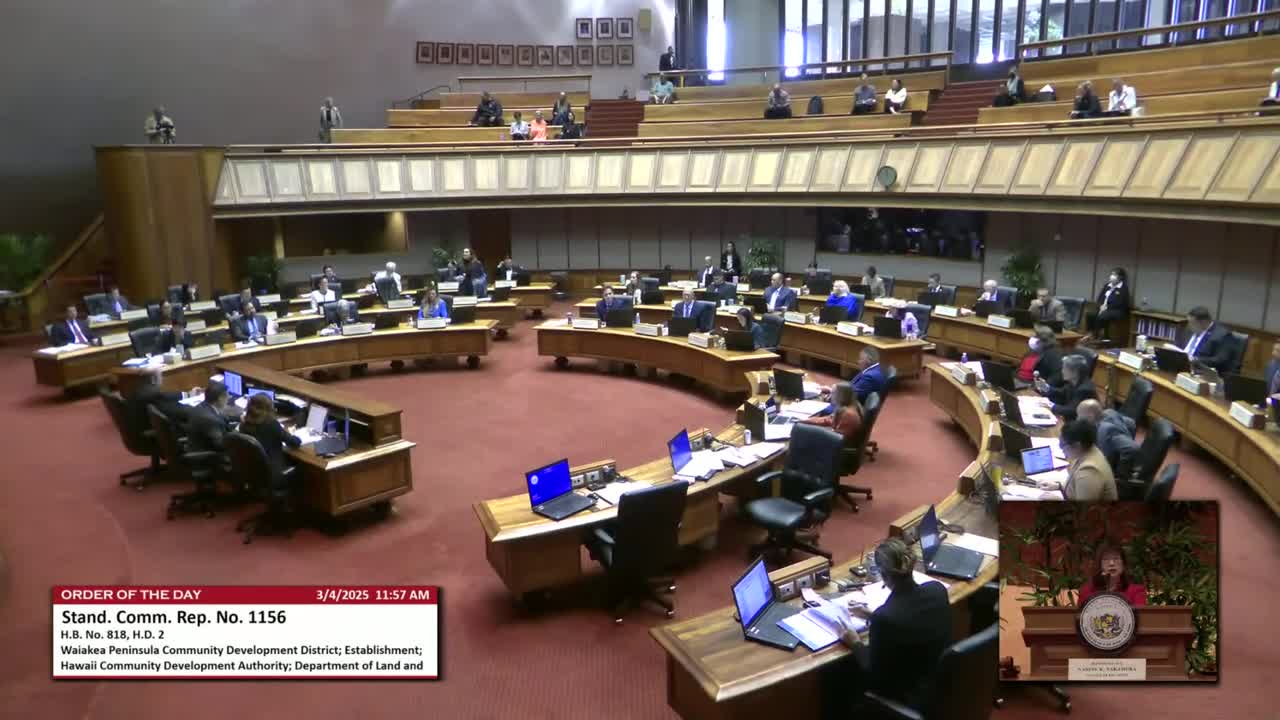 1MIN
House Floor
 2MIN
House Standing Committee on Finance
 9MIN
House Standing Committee on Judiciary & Hawaiian Affairs
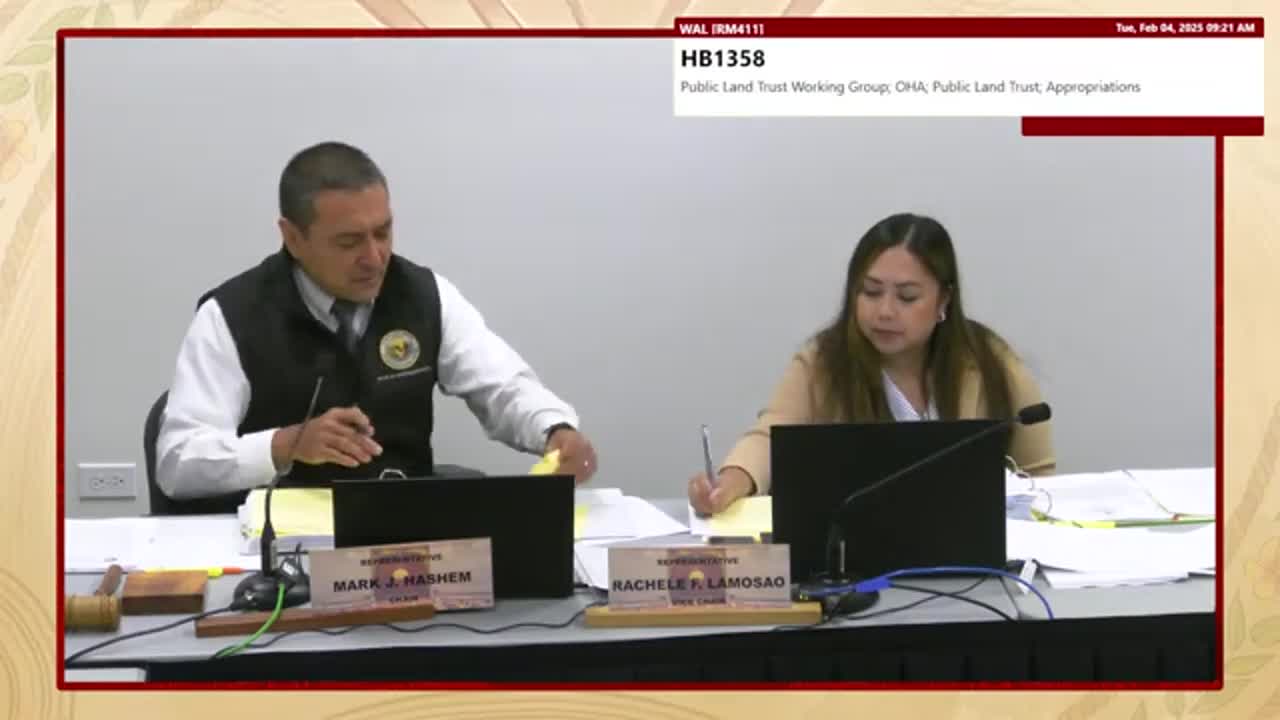 27MIN