SB 2277: SHPDA; Health Care; Hospitals; Price Transparency; Consumer Protection; Federal Requirements
- Session Year: 2025-2026
- House: Senate
- Latest Version Date: 2026-03-18
Current Status:
Failed
(2026-03-19: Passed Second Reading as amended in HD 1 and referred to the committee(s) on CPC with none voting aye with reservations; none voting no (0) and none excused (0).)
Introduced
In Committee
First Chamber
In Committee
Second Chamber
Final Decking
Enacted
Requires each hospital licensed in the State to provide an annual attestation to the State Health Planning and Development Agency that the hospital is in compliance with federal hospital price transparency requirements. Permits patients to file a counterclaim against debt collection actions filed by hospitals to determine if the hospital is in compliance with federal hospital price transparency requirements. Requires hospitals to provide patients with an easy-to-understand itemized bill statement before initiating a debt collection action against a patient. Effective 1/30/2050. (HD1)
Requires each hospital in the State to comply with federal hospital price transparency requirements. Requires the Department of Health to monitor and enforce compliance. Establishes a process for patients to challenge debt collection actions filed by noncompliant hospitals. Requires the Department of Health to publish a list of any enforcement actions taken against noncompliant hospitals. Requires hospitals to provide patients with an easy-to-understand itemized bill statement before initiating a debt collection action against a patient. Effective 1/30/2050. (SD1)
Requires each hospital in the State to comply with federal hospital price transparency requirements. Requires the Department of Health to monitor and enforce compliance. Establishes a process for patients to challenge debt collection actions filed by a noncompliant hospitals. Requires the Department of Health to publish a list of any enforcement actions taken against noncompliant hospitals. Requires hospitals to provide patients with an easy-to-understand itemized bill statement before initiating a debt collection action against a patient.
|
THE SENATE |
S.B. NO. |
2277 |
|
THIRTY-THIRD LEGISLATURE, 2026 |
S.D. 1 |
|
|
STATE OF HAWAII |
H.D. 1 |
|
|
|
|
|
|
|
||
|
|
||
A BILL FOR AN ACT
RELATING TO HOSPITAL PRICE TRANSPARENCY.
BE IT ENACTED BY THE LEGISLATURE OF THE STATE OF HAWAII:
"Part . Hospital Price Transparency
§323D-A Short title. This part shall be known and may be cited as the "Hospital Price Transparency Act".
§323D-B Definitions. As used in this part:
"Chargemaster" means the list of all hospital items or services maintained by a hospital for which the hospital has established charges.
"Collection action" means any of the following actions taken with respect to a debt for an item or service that was purchased by or provided to a patient by a hospital on a date during which the hospital was in violation of this part:
(1) Attempting to collect a debt from a patient or patient guarantor by referring the debt, directly or indirectly, to a debt collector, collection agency, or other third party retained by or on behalf of the hospital;
(2) Suing the patient or patient guarantor or enforcing an arbitration or mediation clause in a hospital document, including any contract, agreement, statement, or bill; or
(3) Directly or indirectly causing a report to be made to a consumer reporting agency.
"Collection agency" means a person that:
(1) Engages in a business for the principal purpose of collecting debts; or
(2) Performs any of the following:
(A) Regularly collects or attempts to collect, directly or indirectly, debts owed or due, or asserted to be owed or due, to another;
(B) Accepts the assignment of debts for collection purposes; or
(C) Directly or indirectly solicits for the collection of debts owed or due, or asserted to be owed or due, to another.
"Consumer reporting agency" means a person that, for a monetary fee or dues on a cooperative nonprofit basis, regularly engages in the practice of assembling or evaluating consumer credit information or other consumer information for the purpose of furnishing consumer reports to third parties. "Consumer reporting agency" does not include business entities that only provide check verification or check guarantee services.
"Debt" means the obligation or alleged obligation of a consumer to pay money arising out of a transaction, regardless of whether the obligation has been reduced to a judgment. "Debt" does not include a debt for business, investment, commercial, or agricultural purposes or a debt incurred by a business.
"Debt collector" means a person employed or engaged by a collection agency to perform the collection of debts owed or due or debts asserted to be owed or due to another.
"De-identified maximum negotiated charge" means the highest charge that a hospital has negotiated with all third-party payors for a hospital item or service.
"De-identified minimum negotiated charge" means the lowest charge that a hospital has negotiated with all third-party payors for a hospital item or service.
"Discounted cash price" means the charge that applies to a person who pays cash or a cash equivalent for a hospital item or service.
"Gross charge" means the charge for a hospital item or service as reflected on the hospital's chargemaster, excluding any discount.
"Hospital" means a public hospital, for-profit or nonprofit private hospital, or general or special hospital that is licensed as a hospital by the department of health pursuant to section 321-14.5.
"Item or service" means an item or service that a hospital could provide to a patient in connection with an inpatient admission or an outpatient visit for which the hospital has established a standard charge, including:
(1) A supply or procedure;
(2) Room and board;
(3) A facility fee; or
(4) A professional fee.
"Patient guarantor" means a person or entity legally responsible for paying a patient's medical bills, including the patient, a parent, legal guardian, or spouse.
"Payor-specific negotiated charge" means the charge that a hospital has negotiated with a third-party payor for a hospital item or service.
"Professional fee" means a fee charged by a health care practitioner for medical services.
"Standard charge" means the regular rate established by a hospital for a hospital item or service provided to a specific group of paying patients. "Standard charge" includes the:
(1) Gross charge;
(2) Payor-specific negotiated charge;
(3) De-identified maximum negotiated charge;
(4) De-identified minimum negotiated charge; or
(5) Discounted cash price.
"Third party payor" means an entity other than the patient that reimburses for and manages health care expenses incurred by a contracted beneficiary, including an insurance company, a governmental payer, or a self-insured employer plan.
§323D-C Hospital price transparency; compliance. (a) Each hospital licensed in the State shall submit a report to the state agency in a form and manner approved by the state agency attesting that the hospital is in compliance with federal hospital price transparency requirements under title 45 Code of Federal Regulations part 180. The state agency may rely on the hospital's attestation and publicly available federal compliance determinations in determining compliance with this part.
(b) No hospital shall be considered in violation of this part if the hospital is participating in a compliance or corrective action process with the Centers for Medicare and Medicaid Services to remedy any alleged noncompliance with federal hospital price transparency requirements, including through a corrective action plan or other documented compliance process recognized by the Centers for Medicare and Medicaid Services.
§323D-D Collection actions; counterclaims permitted. A patient subject to a lawsuit from a hospital for the collection of medical debt may file a counterclaim to determine whether:
(1) The hospital was noncompliant with any provision of the federal hospital price transparency requirements under title 45 Code of Federal Regulations part 180 or related rules adopted by the state agency on the date that the items or services were provided or purchased; and
(2) The noncompliance was related to the items or services.
§323D-E Patient rights. Before initiating a collection action against a patient, a hospital or a debt collector acting on behalf of a hospital shall provide the patient with:
(1) An easy-to-understand itemized statement of the medical debt owed by the patient to the hospital, including the applicable billing codes for each item or service, using commonly recognized billing code sets;
(2) A copy of the detailed receipts of any payments made to the hospital or debt collector by the patient or the patient's guarantor within thirty calendar days of each payment;
(3) Information about the availability of language‑assistance services for persons with limited English proficiency; and
(4) The contact information for a designated office or administrator at the hospital who can:
(A) Discuss the specific details of an itemized statement; and
(B) Make appropriate changes to the statement, if warranted.
§323D-F Rulemaking. The state agency may adopt rules pursuant to chapter 91 as necessary to implement and administer this part."
SECTION 2. This Act does not affect rights and duties that matured, penalties that were incurred, and proceedings that were begun before its effective date.
SECTION 3. In codifying the new sections added by section 1 of this Act, the revisor of statutes shall substitute appropriate section numbers for the letters used in designating the new sections in this Act.
SECTION 4. This Act shall take effect on January 30, 2050.
Report Title:
SHPDA; Health Care; Hospitals; Price Transparency; Consumer Protection; Federal Requirements
Description:
Requires each hospital licensed in the State to provide an annual attestation to the State Health Planning and Development Agency that the hospital is in compliance with federal hospital price transparency requirements. Permits patients to file a counterclaim against debt collection actions filed by hospitals to determine if the hospital is in compliance with federal hospital price transparency requirements. Requires hospitals to provide patients with an easy-to-understand itemized bill statement before initiating a debt collection action against a patient. Effective 1/30/2050. (HD1)
The summary description of legislation appearing on this page is for informational purposes only and is not legislation or evidence of legislative intent.
|
THE SENATE |
S.B. NO. |
2277 |
|
THIRTY-THIRD LEGISLATURE, 2026 |
S.D. 1 |
|
|
STATE OF HAWAII |
|
|
|
|
|
|
|
|
||
|
|
||
A BILL FOR AN ACT
RELATING TO HOSPITAL PRICE TRANSPARENCY.
BE IT ENACTED BY THE LEGISLATURE OF THE STATE OF HAWAII:
SECTION 1. The legislature finds that the State's residents struggle with increased health care costs each year. Many residents also have limited knowledge of health care pricing, particularly regarding hospital care. The legislature believes that patients in the State should be empowered to compare hospital costs to find the best value for care and services. Increased price transparency would help decrease prices by better informing consumers, and thus increasing competition in the market.
The legislature also finds that federal requirements currently regulate hospital price transparency. The federal Public Health Service Act requires each hospital operating in the United States to make all standard charges publicly available, including gross charges, discounted cash prices, and charges negotiated with third-party payors. In 2021, the Centers for Medicare and Medicaid Services promulgated regulations requiring hospitals to make these standard charges publicly available in two ways:
(1) A single comprehensive machine-readable file including all standard charges established by the hospital for all the items and services it provides; and
(2) A consumer‑friendly display of certain standard charges identified by the Centers for Medicare and Medicaid Services.
The legislature further finds that, according to a 2024 analysis by the nonprofit PatientRightsAdvocate.org, no major hospital system in the State is fully compliant with federal price transparency requirements. The legislature believes that codifying federal requirements in state law will enable the State to better monitor and enforce compliance with the requirements thereby protecting patient consumer rights.
Accordingly, the purpose of this Act is to:
(1) Require each hospital in the State to comply with federal price transparency requirements;
(2) Require the department of health to monitor and enforce compliance with federal price transparency requirements;
(3) Establish a process for patients to challenge a debt collection lawsuit filed by a hospital if the hospital was not in compliance with price disclosure and transparency requirements;
(4) Require the department of health to publish a list of any enforcement actions taken against non-compliant hospitals; and
(5) Require hospitals to provide easily accessible itemized bills to patients prior to any debt collection or legal actions being taken against the patient.
SECTION 2. Chapter 321, Hawaii Revised Statutes, is amended by adding a new part to be appropriately designated and to read as follows:
"Part . Hospital Price Transparency
§321-A Short title. This part shall be known and may be cited as the "Hospital Price Transparency Act".
§321-B Definitions. As used in this part:
"Chargemaster" means the list of all hospital items or services maintained by a hospital for which the hospital has established charges.
"Collection action" means any of the following actions taken with respect to a debt for an item or service that was purchased by or provided to a patient by a hospital on a date during which the hospital was in violation of this part:
(1) Attempting to collect a debt from a patient or patient guarantor by referring the debt, directly or indirectly, to a debt collector, collection agency, or other third party retained by or on behalf of the hospital;
(2) Suing the patient or patient guarantor or enforcing an arbitration or mediation clause in a hospital document, including any contract, agreement, statement, or bill; or
(3) Directly or indirectly causing a report to be made to a consumer reporting agency.
"Collection agency" means a person that:
(1) Engages in a business for the principal purpose of collecting debts; or
(2) Performs any of the following:
(A) Regularly collects or attempts to collect, directly or indirectly, debts owed or due, or asserted to be owed or due, to another;
(B) Accepts the assignment of debts for collection purposes; or
(C) Directly or indirectly solicits for the collection of debts owed or due, or asserted to be owed or due, to another.
"Consumer reporting agency" means a person that, for a monetary fee or dues on a cooperative nonprofit basis, regularly engages in the practice of assembling or evaluating consumer credit information or other consumer information for the purpose of furnishing consumer reports to third parties. "Consumer reporting agency" does not include business entities that only provide check verification or check guarantee services.
"Debt" means the obligation or alleged obligation of a consumer to pay money arising out of a transaction, regardless of whether the obligation has been reduced to a judgment. "Debt" does not include a debt for business, investment, commercial, or agricultural purposes or a debt incurred by a business.
"Debt collector" means a person employed or engaged by a collection agency to perform the collection of debts owed or due or debts asserted to be owed or due to another.
"De-identified maximum negotiated charge" means the highest charge that a hospital has negotiated with all third-party payors for a hospital item or service.
"De-identified minimum negotiated charge" means the lowest charge that a hospital has negotiated with all third-party payors for a hospital item or service.
"Department" means the department of health.
"Discounted cash price" means the charge that applies to a person who pays cash or a cash equivalent for a hospital item or service.
"Gross charge" means the charge for a hospital item or service as reflected on the hospital's chargemaster, excluding any discount.
"Hospital" means a public hospital, for-profit or nonprofit private hospital, or general or special hospital that is licensed as a hospital by the department pursuant to section 321-14.5.
"Item or service" means an item or service that a hospital could provide to a patient in connection with an inpatient admission or an outpatient visit for which the hospital has established a standard charge, including:
(1) A supply or procedure;
(2) Room and board;
(3) A facility fee; or
(4) A professional fee.
"Machine-readable format" means a digital representation of information in a file that can be easily imported or read into a computer system for further processing without any additional preparation.
"Patient guarantor" means a person or entity legally responsible for paying a patient's medical bills, including the patient, a parent, legal guardian, or spouse.
"Payor-specific negotiated charge" means the charge that a hospital has negotiated with a third-party payor for a hospital item or service.
"Professional fee" means a fee charged by a health care practitioner for medical services.
"Shoppable service" means a service that may be scheduled in advance by a person.
"Standard charge" means the regular rate established by a hospital for a hospital item or service provided to a specific group of paying patients. "Standard charge" includes the:
(1) Gross charge;
(2) Payor-specific negotiated charge;
(3) De-identified maximum negotiated charge;
(4) De-identified minimum negotiated charge; or
(5) Discounted cash price.
"Third party payor" means an entity other than the patient that reimburses for and manages health care expenses incurred by a contracted beneficiary, including an insurance company, a governmental payer, or a self-insured employer plan.
§321-C Public availability of price information; required. (a) Each hospital in the State shall comply with federal hospital price transparency requirements as provided in title 45 Code of Federal Regulations part 180, and authorized by the Public Health Service Act title 42 United States Code section 300gg-18 et seq. Compliance shall include publishing the following information on the hospital's publicly accessible website:
(1) A digital file in a machine-readable format that contains standard charges for all hospital items or services displayed in dollar amounts; and
(2) A consumer-friendly list that a reasonable person could easily understand, containing information for no fewer than three hundred shoppable services offered and provided by that specific hospital location, with charges clearly displayed in dollar amounts.
(b) In lieu of maintaining and making publicly available the list of shoppable services required by subsection (a), a hospital may alternatively maintain an internet-based price estimator tool that is deemed by the Centers for Medicare and Medicaid Services to comply with federal hospital price transparency requirements.
(c) Except as otherwise provided in this part, the format and presentation of the required information shall follow federal hospital price transparency requirements and any associated guidance from the Centers for Medicare and Medicaid Services.
§321-D Enforcement. (a) The department shall establish and make available on its website an electronic form for individuals to use to submit complaints of any alleged violations of the hospital price transparency requirements under this part.
(b) A hospital shall be in violation of this part if the hospital:
(1) Violates any provision of this part;
(2) Fails to take immediate action to remedy a violation of this part or rules adopted pursuant to this part;
(3) Fails to submit a plan of correction in accordance with this section;
(4) Fails to comply with a plan of correction;
(5) Charges a patient more for any item or service than the dollar amount published in the lists required by section 321-C; or
(6) Violates an order previously issued by the department in a disciplinary matter related to this part.
(c) The department shall regularly monitor the compliance of hospitals with the requirements of this part by:
(1) Evaluating any received complaints regarding noncompliance with this part;
(2) Reviewing any third-party analysis prepared regarding noncompliance with this part;
(3) Auditing hospital websites for compliance with this part; and
(4) Taking any additional measures that the department deems reasonable and necessary in accordance with this part.
(d) If the department determines that a hospital is not in compliance with any provision of this part, the department shall issue a written notice to the noncompliant hospital that:
(1) Clearly explains the manner in which the hospital is noncompliant with this part; and
(2) Requires the hospital to either:
(A) Take immediate corrective action to remedy the violation; or
(B) Submit a plan of correction to the department within thirty calendar days if the hospital is unable to reasonably take corrective action to remedy the violation.
(e) Any hospital required to take immediate corrective action pursuant to subsection (d)(2)(A) shall provide the department with written confirmation that the necessary corrective action has been taken within thirty calendar days of the department's written notice.
(f) For any hospital required to submit a plan of correction pursuant to subsection (d)(2)(B), the department shall require that the violation be remedied within a specified period of time, as determined by the department. A hospital shall be deemed to have failed to comply with a plan of correction if the hospital fails to adequately address a violation within the time period specified by the department.
(g) The department shall publish and maintain a publicly available list on its website of any hospitals determined to be noncompliant with the hospital price transparency requirements under this part.
§321-E Civil penalties. (a) The department may bring a civil action on behalf of the State against any hospital that violates this part. Any hospital that violates any of the requirements under this part shall be subject to the following civil penalties for each separate offense:
(1) Not less than $600 for a hospital having thirty or fewer beds;
(2) Not less than $20 per bed for a hospital having at least thirty-one beds, but fewer than five hundred fifty beds; and
(3) Not less than $11,000 for a hospital having more than five hundred fifty beds.
Each day of the violation shall constitute a separate offense.
(b) In determining the amount of a civil penalty imposed pursuant to subsection (a), the department shall consider:
(1) Any previous violations by the hospital;
(2) The severity of the violation;
(3) Any demonstrated good-faith effort by the hospital to comply with this part and any order issued by the department; and
(4) Any other factors as determined by the department in accordance with the purposes of this part.
§321-F Collection of debt; noncompliance. (a) No hospital in violation of this part on the date that items or services are purchased by or provided to a patient by the hospital shall initiate or pursue a collection action against the patient, patient guarantor, or applicable third-party payor for a debt owed for the items or services; provided that the violation is related to the patient's billed items or services.
(b) A collection action initiated by a hospital, or any agent, assignee, or successor-in-interest to the hospital's rights as a creditor in violation of subsection (a) shall constitute a complete affirmative defense to the collection action, and the patient or patient guarantor may file a declaratory judgment action based on the same.
(c) A patient subject to a lawsuit for the collection of medical debt in violation of this section may file a counterclaim to determine whether:
(1) The hospital was noncompliant with any provision of this part or related rules adopted by the department on the date that the items or services were provided or purchased; and
(2) The noncompliance was related to the items or services.
(d) A hospital found to be noncompliant with this part by a judge or jury in a counterclaim action pursuant to subsection (c), at a minimum shall:
(1) Refund the payor any amount of the debt paid by the payor;
(2) Cover any costs of the action incurred by the patient or patient guarantor, including reasonable attorneys' fees as determined appropriate by the court;
(3) Dismiss or cause to be dismissed with prejudice any court action; and
(4) Remove or cause to be removed from the patient or patient guarantor's credit report any report made to a consumer reporting agency relating to the debt.
(e) Nothing in this section shall be construed to:
(1) Prohibit a hospital in compliance with this part from billing a patient, patient guarantor, or third-party payor, including a health insurer, for an item or service provided to the patient; or
(2) Require a hospital to refund a payment made to the hospital for an item or service provided to the patient if no collection is taken in violation of this section.
§321-G Patient rights. (a) Before initiating a collection action against a patient, a hospital or a debt collector acting on behalf of a hospital shall provide the patient with:
(1) An easy-to-understand itemized statement of the medical debt owed by the patient to the hospital, including the applicable billing codes for each item or service, using commonly recognized billing code sets;
(2) A copy of the detailed receipts of any payments made to the hospital or debt collector by the patient or the patient's guarantor within thirty calendar days of each payment;
(3) Information about the availability of language‑assistance services for persons with limited English proficiency; and
(4) The contact information for a designated office or administrator at the hospital who can:
(A) Discuss the specific details of an itemized statement; and
(B) Make appropriate changes to the statement, if warranted.
(b) Any violation of this section shall be deemed an unfair or deceptive act or practice in violation of chapter 480.
§321-H Remedies not exclusive. The remedies provided for in this chapter are in addition to and not exclusive of any other remedies provided by law.
§321-I Rulemaking. The department may adopt rules pursuant to chapter 91 as necessary to implement and administer this part."
SECTION 3. This Act does not affect rights and duties that matured, penalties that were incurred, and proceedings that were begun before its effective date.
SECTION 4. In codifying the new sections added by section 2 of this Act, the revisor of statutes shall substitute appropriate section numbers for the letters used in designating the new sections in this Act.
SECTION 5. This Act shall take effect on January 30, 2050.
Report Title:
DOH; Health Care; Hospitals; Price Transparency; Consumer Protection; Enforcement; Federal Requirements; Civil Penalties
Description:
Requires each hospital in the State to comply with federal hospital price transparency requirements. Requires the Department of Health to monitor and enforce compliance. Establishes a process for patients to challenge debt collection actions filed by noncompliant hospitals. Requires the Department of Health to publish a list of any enforcement actions taken against noncompliant hospitals. Requires hospitals to provide patients with an easy-to-understand itemized bill statement before initiating a debt collection action against a patient. Effective 1/30/2050. (SD1)
The summary description of legislation appearing on this page is for informational purposes only and is not legislation or evidence of legislative intent.
|
THE SENATE |
S.B. NO. |
2277 |
|
THIRTY-THIRD LEGISLATURE, 2026 |
|
|
|
STATE OF HAWAII |
|
|
|
|
|
|
|
|
||
|
|
||
A BILL FOR AN ACT
Relating to Hospital Price Transparency.
BE IT ENACTED BY THE LEGISLATURE OF THE STATE OF HAWAII:
The legislature also finds that federal requirements currently regulate hospital price transparency. The federal Public Health Service Act requires each hospital operating in the United States to make all standard charges publicly available, including gross charges, discounted cash prices, and charges negotiated with third-party payors. In 2021, the Centers for Medicare and Medicaid Services promulgated regulations requiring hospitals to make these standard charges publicly available in two ways:
(1) A single comprehensive machine-readable file including all standard charges established by the hospital for all the items and services it provides; and
(2) A consumer‑friendly display of certain standard charges identified by the Centers for Medicare and Medicaid Services.
The legislature further finds that, according to a 2024 analysis by the nonprofit PatientRightsAdvocate.org, no major hospital system in the State is fully compliant with federal price transparency requirements. The legislature believes that codifying federal requirements in state law will enable the State to better monitor and enforce compliance with the requirements thereby protecting patient consumer rights.
Accordingly, the purpose of this Act is to:
(1) Require each hospital in the State to comply with federal price transparency requirements;
(2) Require the department of health to monitor and enforce compliance with federal price transparency requirements;
(3) Establish a process for patients to challenge a debt collection lawsuit filed by a hospital if the hospital was not in compliance with price disclosure and transparency requirements;
(4) Require the department of health to publish a list of any enforcement actions taken against non-compliant hospitals; and
(5) Require hospitals to provide easily accessible itemized bills to patients prior to any debt collection or legal actions being taken against the patient.
SECTION 2. Chapter 321, Hawaii Revised Statutes, is amended by adding a new part to be appropriately designated and to read as follows:
"Part . Hospital Price Transparency
§321-A Short title. This part shall be known and may be cited as the "Hospital Price Transparency Act".
§321-B Definitions. For the purposes of this part unless the context otherwise requires:
"Chargemaster" means the list of all hospital items or services maintained by a hospital for which the hospital has established charges.
"Collection action" means any of the following actions taken with respect to a debt for an item or service that was purchased by or provided to a patient by a hospital on a date during which the hospital was in violation of this part:
(1) Attempting to collect a debt from a patient or patient guarantor by referring the debt, directly or indirectly, to a debt collector, collection agency, or other third party retained by or on behalf of the hospital;
(2) Suing the patient or patient guarantor or enforcing an arbitration or mediation clause in a hospital document, including any contract, agreement, statement, or bill; or
(3) Directly or indirectly causing a report to be made to a consumer reporting agency.
"Collection agency" means a person that:
(1) Engages in a business for the principal purpose of collecting debts; or
(2) Performs any of the following:
(A) Regularly collects or attempts to collect, directly or indirectly, debts owed or due, or asserted to be owed or due, to another;
(B) Accepts the assignment of debts for collection purposes; or
(C) Directly or indirectly solicits for the collection of debts owed or due, or asserted to be owed or due, to another.
"Consumer reporting agency" means a person that, for a monetary fee or dues on a cooperative nonprofit basis, regularly engages in the practice of assembling or evaluating consumer credit information or other consumer information for the purpose of furnishing consumer reports to third parties. "Consumer reporting agency" does not include business entities that only provide check verification or check guarantee services.
"Debt" means the obligation or alleged obligation of a consumer to pay money arising out of a transaction, regardless of whether the obligation has been reduced to a judgment. "Debt" does not include a debt for business, investment, commercial, or agricultural purposes or a debt incurred by a business.
"Debt collector" means a person employed or engaged by a collection agency to perform the collection of debts owed or due or debts asserted to be owed or due to another.
"De-identified maximum negotiated charge" means the highest charge that a hospital has negotiated with all third-party payors for a hospital item or service.
"De-identified minimum negotiated charge" means the lowest charge that a hospital has negotiated with all third-party payors for a hospital item or service.
"Department" means the department of health.
"Discounted cash price" means the charge that applies to a person who pays cash or a cash equivalent for a hospital item or service.
"Gross charge" means the charge for a hospital item or service as reflected on the hospital's chargemaster, excluding any discount.
"Hospital" means a public hospital, for-profit or nonprofit private hospital, or general or special hospital that is licensed as a hospital by the department pursuant to section 321-14.5.
"Item or service" means an item or service that a hospital could provide to a patient in connection with an inpatient admission or an outpatient visit for which the hospital has established a standard charge, including:
(1) A supply or procedure;
(2) Room and board;
(3) A facility fee; or
(4) A professional fee.
"Machine-readable format" means a digital representation of information in a file that can be easily imported or read into a computer system for further processing without any additional preparation.
"Patient guarantor" means a person or entity legally responsible for paying a patient's medical bills, including the patient, a parent, legal guardian, or spouse.
"Payor-specific negotiated charge" means the charge that a hospital has negotiated with a third-party payor for a hospital item or service.
"Professional fee" means a fee charged by a health care practitioner for medical services.
"Shoppable service" means a service that may be scheduled in advance by a person.
"Standard charge" means the regular rate established by a hospital for a hospital item or service provided to a specific group of paying patients. "Standard charge" includes the:
(1) Gross charge;
(2) Payor-specific negotiated charge;
(3) De-identified maximum negotiated charge;
(4) De-identified minimum negotiated charge; and
(5) Discounted cash price.
"Third party payor" means an entity other than the patient that reimburses for and manages health care expenses incurred by a contracted beneficiary, including an insurance company, a governmental payer, or a self-insured employer plan.
§321-C Public availability of price information; required. (a) Each hospital in the State shall comply with federal hospital price transparency requirements as provided in title 45 Code of Federal Regulations part 180, and authorized by the Public Health Service Act title 42 United States Code Section 300gg-18 et seq. Compliance shall include publishing the following information on the hospital's publicly accessible website:
(1) A digital file in a machine-readable format that contains standard charges for all hospital items or services displayed in dollar amounts; and
(2) A consumer-friendly list that a reasonable person could easily understand, containing information for no fewer than three hundred shoppable services offered and provided by that specific hospital location, with charges clearly displayed in dollar amounts.
(b) In lieu of maintaining and making publicly available the list of shoppable services required by subsection (a), a hospital may alternatively maintain an internet-based price estimator tool that is deemed by the Centers for Medicare and Medicaid Services to comply with federal hospital price transparency requirements.
(c) Except as otherwise provided in this part, the format and presentation of the required information shall follow federal hospital price transparency requirements and any associated guidance from the Centers for Medicare and Medicaid Services.
§321-D Enforcement. (a) The department shall establish and make available on its website an electronic form for individuals to use to submit complaints of any alleged violations of the hospital price transparency requirements under this part.
(b) A hospital shall be in violation of this part if the hospital:
(1) Violates any provision of this part;
(2) Fails to take immediate action to remedy a violation of this part or rules adopted pursuant to this part;
(3) Fails to submit a plan of correction in accordance with this section;
(4) Fails to comply with a plan of correction;
(5) Charges a patient more for any item or service than the dollar amount published in the lists required by section 321-C; or
(6) Violates an order previously issued by the department in a disciplinary matter related to this part.
(c) The department shall regularly monitor the compliance of hospitals with the requirements of this part by:
(1) Evaluating any received complaints regarding noncompliance with this part;
(2) Reviewing any third-party analysis prepared regarding noncompliance with this part;
(3) Auditing hospital websites for compliance with this part; and
(4) Taking any additional measures that the department deems reasonable and necessary in accordance with this part.
(d) If the department determines that a hospital is not in compliance with any provision of this part, the department shall issue a written notice to the noncompliant hospital that:
(1) Clearly explains the manner in which the hospital is noncompliant with this part; and
(2) Requires the hospital to either:
(A) Take immediate corrective action to remedy the violation; or
(B) Submit a plan of correction to the department within thirty calendar days if the hospital is unable to reasonably take corrective action to remedy the violation.
(e) Any hospital required to take immediate corrective action pursuant to subsection (d)(2)(A) shall provide the department with written confirmation that the necessary corrective action has been taken within thirty calendar days of the department's written notice.
(f) For any hospital required to submit a plan of correction pursuant to subsection (d)(2)(B), the department shall require that the violation be remedied within a specified period of time, as determined by the department. A hospital shall be deemed to have failed to comply with a plan of correction if the hospital fails to adequately address a violation within the time period specified by the department.
(g) The department shall publish and maintain a publicly available list on its website of any hospitals determined to be noncompliant with the hospital price transparency requirements under this part.
§321-E Civil penalties. (a) Any hospital that violates any of the requirements under this part shall be subject to the following civil penalties for each separate offense:
(1) Not less than $600 for a hospital having thirty or fewer beds;
(2) Not less than $20 per bed for a hospital having at least thirty-one beds, but fewer than five hundred fifty beds; and
(3) Not less than $11,000 for a hospital having more than five hundred fifty beds.
Each day of the violation shall constitute a separate offense.
(b) In determining the amount of a civil penalty imposed pursuant to subsection (a), the department shall consider:
(1) Any previous violations by the hospital;
(2) The severity of the violation;
(3) Any demonstrated good-faith effort by the hospital to comply with this part and any order issued by the department; and
(4) Any other factors as determined by the department in accordance with the purposes of this part.
§321-F Collection of debt; noncompliance. (a) No hospital in violation of this part on the date that items or services are purchased by or provided to a patient by the hospital shall initiate or pursue a collection action against the patient, patient guarantor, or applicable third-party payor for a debt owed for the items or services; provided that the violation is related to the patient's billed items or services.
(b) A collection action initiated by a hospital, or any agent, assignee, or successor-in-interest to the hospital's rights as a creditor in violation of subsection (a) shall constitute a complete affirmative defense to the collection action, and the patient or patient guarantor may file a declaratory judgment action based on the same.
(c) A patient subject to a lawsuit for the collection of medical debt in violation of this section may file a counterclaim to determine whether:
(1) The hospital was noncompliant with any provision of this part or related rules adopted by the department on the date that the items or services were provided or purchased; and
(2) The noncompliance was related to the items or services.
(d) A hospital found to be noncompliant with this part by a judge or jury in a counterclaim action pursuant to subsection (c), at a minimum shall:
(1) Refund the payor any amount of the debt paid by the payor;
(2) Cover any costs of the action incurred by the patient or patient guarantor, including reasonable attorney fees as determined appropriate by the court;
(3) Dismiss or cause to be dismissed with prejudice any court action; and
(4) Remove or cause to be removed from the patient or patient guarantor's credit report any report made to a consumer reporting agency relating to the debt.
(e) Nothing in this section shall be construed to:
(1) Prohibit a hospital in compliance with this part from billing a patient, patient guarantor, or third-party payor, including a health insurer, for an item or service provided to the patient; or
(2) Require a hospital to refund a payment made to the hospital for an item or service provided to the patient if no collection is taken in violation of this section.
§321-G Patient rights. (a) Prior to initiating a collection action against a patient, a hospital or a debt collector acting on behalf of a hospital shall provide the patient with:
(1) An easy-to-understand itemized statement of the medical debt owed by the patient to the hospital, including the applicable billing codes for each item or service, using commonly recognized billing code sets;
(2) A copy of the detailed receipts of any payments made to the hospital or debt collector by the patient or the patient's guarantor within thirty calendar days of each payment;
(3) Information about the availability of language‑assistance services for persons with limited English proficiency; and
(4) The contact information for a designated office or administrator at the hospital who can:
(A) Discuss the specific details of an itemized statement; and
(B) Make appropriate changes to the statement, if warranted.
(b) Any willful or knowing violation of this section shall constitute an unfair or deceptive act or practice in violation of chapter 480.
§321-H Rulemaking. The department may adopt rules pursuant to chapter 91 as necessary to implement and administer this part."
SECTION 3. This Act does not affect rights and duties that matured, penalties that were incurred, and proceedings that were begun before its effective date.
SECTION 4. In codifying the new sections added by section 2 of this Act, the revisor of statutes shall substitute appropriate section numbers for the letters used in designating the new sections in this Act.
SECTION 5. This Act shall take effect upon its approval.
|
INTRODUCED BY: |
_____________________________ |
Report Title:
DOH; Health Care; Hospitals; Price Transparency; Consumer Protection; Enforcement; Federal Requirements; Civil Penalties
Description:
Requires each hospital in the State to comply with federal hospital price transparency requirements. Requires the Department of Health to monitor and enforce compliance. Establishes a process for patients to challenge debt collection actions filed by a noncompliant hospitals. Requires the Department of Health to publish a list of any enforcement actions taken against noncompliant hospitals. Requires hospitals to provide patients with an easy-to-understand itemized bill statement before initiating a debt collection action against a patient.
The summary description of legislation appearing on this page is for informational purposes only and is not legislation or evidence of legislative intent.
|
Date
|
Status
|
|---|---|
| Mar 19, 2026 | Passed Second Reading as amended in HD 1 and referred to the committee(s) on CPC with none voting aye with reservations; none voting no (0) and none excused (0). |
| Mar 19, 2026 | Reported from HLT (Stand. Com. Rep. No. 1241-26) as amended in HD 1, recommending passage on Second Reading and referral to CPC. |
| Mar 18, 2026 | The committee on HLT recommend that the measure be PASSED, WITH AMENDMENTS. The votes were as follows: 8 Ayes: Representative(s) Takayama, Keohokapu-Lee Loy, Amato, Marten, Olds, Takenouchi, Alcos, Garcia; Ayes with reservations: none; Noes: none; and 1 Excused: Representative(s) Hartsfield. |
| Mar 12, 2026 | Bill scheduled to be heard by HLT on Wednesday, 03-18-26 9:00AM in House conference room 329 VIA VIDEOCONFERENCE. |
| Mar 12, 2026 | Referred to HLT, CPC, FIN, referral sheet 17 |
| Mar 12, 2026 | Pass First Reading |
| Mar 10, 2026 | Received from Senate (Sen. Com. No. 205) in amended form (SD 1). |
| Mar 10, 2026 | Report adopted; Passed Third Reading. Ayes, 25; Aye(s) with reservations: none . Noes, 0 (none). Excused, 0 (none). Transmitted to House. |
| Mar 6, 2026 | One Day Notice 03-10-26. |
| Mar 6, 2026 | Reported from JDC/WAM (Stand. Com. Rep. No. 3035) with recommendation of passage on Third Reading. |
| Mar 4, 2026 | The committee(s) on WAM recommend(s) that the measure be PASSED, UNAMENDED. The votes in WAM were as follows: 13 Aye(s): Senator(s) Dela Cruz, Moriwaki, DeCoite, Elefante, Hashimoto, Inouye, Kanuha, Kidani, Kim, Lee, C., Richards, Wakai, Fevella; Aye(s) with reservations: none ; 0 No(es): none; and 0 Excused: none. |
| Mar 4, 2026 | The committee(s) on JDC recommend(s) that the measure be PASSED, UNAMENDED. The votes in JDC were as follows: 5 Aye(s): Senator(s) Rhoads, Gabbard, Chang, San Buenaventura, Awa; Aye(s) with reservations: none ; 0 No(es): none; and 0 Excused: none. |
| Mar 2, 2026 | The committee(s) on JDC/WAM will hold a public decision making on 03-04-26 10:35AM; Conference Room 211 & Videoconference. |
| Feb 20, 2026 | Report adopted; Passed Second Reading, as amended (SD 1) and referred to JDC/WAM. |
| Feb 20, 2026 | Reported from HHS/CPN (Stand. Com. Rep. No. 2554) with recommendation of passage on Second Reading, as amended (SD 1) and referral to JDC/WAM. |
| Feb 6, 2026 | The committee(s) on CPN recommend(s) that the measure be PASSED, WITH AMENDMENTS. The votes in CPN were as follows: 5 Aye(s): Senator(s) Keohokalole, Fukunaga, Lamosao, McKelvey, Awa; Aye(s) with reservations: none ; 0 No(es): none; and 0 Excused: none. |
| Feb 6, 2026 | The committee(s) on HHS recommend(s) that the measure be PASSED, WITH AMENDMENTS. The votes in HHS were as follows: 4 Aye(s): Senator(s) San Buenaventura, McKelvey, Kanuha, Keohokalole; Aye(s) with reservations: none ; 0 No(es): none; and 1 Excused: Senator(s) Fevella. |
| Feb 2, 2026 | The committee(s) on HHS/CPN has scheduled a public hearing on 02-06-26 9:00AM; Conference Room 229 & Videoconference. |
| Jan 26, 2026 | Referred to HHS/CPN, JDC/WAM. |
| Jan 21, 2026 | Introduced and passed First Reading. |
| Jan 15, 2026 | Pending Introduction. |
|
Date
|
Description
|
Location
|
Votes
|
|
|---|---|---|---|---|
| Mar 18, 2026 | The committee on HLT recommend that the measure be PASSED, WITH AMENDMENTS | House Standing Committee on Health |
Passed |
|
| Mar 10, 2026 | Third Reading | Senate Floor |
Passed |
|
| Mar 4, 2026 | The committee(s) on WAM recommend(s) that the measure be PASSED, UNAMENDED | Senate Standing Committee on Ways and Means |
Passed |
|
| Mar 4, 2026 | The committee(s) on JDC recommend(s) that the measure be PASSED, UNAMENDED | Senate Standing Committee on Judiciary |
Passed |
|
| Feb 6, 2026 | The committee(s) on CPN recommend(s) that the measure be PASSED, WITH AMENDMENTS | Senate Standing Committee on Commerce and Consumer Protection |
Passed |
|
| Feb 6, 2026 | The committee(s) on HHS recommend(s) that the measure be PASSED, WITH AMENDMENTS | Senate Standing Committee on Health and Human Services |
Passed |
This list shows positions taken on this bill by organizations on the date displayed, which is linked to the original source.
Positions by individuals are not included.
|
Organization
|
Position
|
Date
|
|---|---|---|
| Department of Health | *** Against | Mar 18, 2026 |
| Department of Health | *** Support | Feb 6, 2026 |
| Healthcare Association of Hawaii | *** Against | Mar 18, 2026 |
| Patient Rights Advocate | ** Support | |
| Patient Rights Advocate | *** Support | Mar 18, 2026 |
| PatientRightsAdvocate.org | ** Support | |
| Power to the Patients | ** Support | |
| Power to the Patients | *** Support | Feb 6, 2026 |
| Silver Plume Strategies | *** Support | Mar 18, 2026 |
| State Health Planning and Development Agency (SHPDA) | *** Support | Mar 18, 2026 |
STAND. COM. REP. NO. 3035
Honolulu, Hawaii
RE: S.B. No. 2277
S.D. 1
Honorable Ronald D. Kouchi
President of the Senate
Thirty-Third State Legislature
Regular Session of 2026
State of Hawaii
Sir:
Your Committees on Judiciary and Ways and Means, to which was referred S.B. No. 2277, S.D. 1, entitled:
"A BILL FOR AN ACT RELATING TO HOSPITAL PRICE TRANSPARENCY,"
beg leave to report as follows:
The purpose and intent of this measure is to:
(1) Require each hospital in the State to comply with federal hospital price transparency requirements;
(2) Require the Department of Health to monitor and enforce compliance;
(3) Establish a process for patients to challenge debt collection actions filed by noncompliant hospitals;
(4) Require the Department of Health to publish a list of any enforcement actions taken against noncompliant hospitals; and
(5) Require hospitals to provide patients with an easy‑to‑understand itemized bill statement before initiating a debt collection action against a patient.
Your Committees received testimony in support of this measure from the State Health Planning and Development Agency, Silver Plume Strategies, and Patient Rights Advocate.
Your Committees received testimony in opposition to this measure from the Healthcare Association of Hawaii.
Your Committees received comments on this measure from the Department of Health and Office of Consumer Protection of the Department of Commerce and Consumer Affairs.
Your Committees find that competition and market pricing exist in virtually every other sector of the nation's economy except health care. One of the ways to benefit families' and communities' access to health care is to create a more functional market, where patients, employers, and unions can advocate for themselves in a manner that combats increasing health care costs. By making the cost of a hospital item or service publicly available, this measure will increase affordability and transparency to support patients' rights.
Your Committees note that price transparency regarding medical and health care costs is a significant issue within the United States health care system, highlighted by global analyses when compared to the United State's international counterparts. Creating more competition through increased transparency will allow families to anticipate costs, compare options, and avoid preventable medical debt.
As affirmed by the records of votes of the members of your Committees on Judiciary and Ways and Means that are attached to this report, your Committees are in accord with the intent and purpose of S.B. No. 2277, S.D. 1, and recommend that it pass Third Reading.
Respectfully submitted on behalf of the members of the Committees on Judiciary and Ways and Means,
|
________________________________ DONOVAN M. DELA CRUZ, Chair |
|
________________________________ KARL RHOADS, Chair |
STAND. COM. REP. NO. 2554
Honolulu, Hawaii
RE: S.B. No. 2277
S.D. 1
Honorable Ronald D. Kouchi
President of the Senate
Thirty-Third State Legislature
Regular Session of 2026
State of Hawaii
Sir:
Your Committees on Health and Human Services and Commerce and Consumer Protection, to which was referred S.B. No. 2277 entitled:
"A BILL FOR AN ACT RELATING TO HOSPITAL PRICE TRANSPARENCY,"
beg leave to report as follows:
The purpose and intent of this measure is to:
(1) Require each hospital in the State to comply with federal hospital price transparency requirements;
(2) Require the Department of Health to monitor and enforce compliance;
(3) Establish a process for patients to challenge debt collection actions filed by noncompliant hospitals;
(4) Require the Department of Health to publish a list of any enforcement actions taken against noncompliant hospitals; and
(5) Require hospitals to provide patients with an easy-to-understand itemized bill statement before initiating a debt collection action against a patient.
Your Committees received testimony in support of this measure from the State Health Planning and Development Agency, PatientRightsAdvocate.org, Silver Plume Strategies, Power to the Patients, and one individual.
Your Committees received testimony in opposition to this measure from the Healthcare Association of Hawaii.
Your Committees received comments on this measure from the Office of Consumer Protection of the Department of Commerce and Consumer Affairs and Department of Health.
Your Committees find that the State's residents struggle with increased health care costs each year, and that many residents also have limited knowledge of health care pricing, particularly regarding hospital care. Your Committees believe that patients in the State should be empowered to compare hospital costs to find the best value for care and services. This measure codifies certain federal price transparency requirements into state law to allow the State to better monitor and enforce compliance with those requirements and protect patient consumer rights.
Your Committees have amended this measure by:
(1) Inserting language to clarify that the Department of Health shall be authorized to bring civil actions to collect civil penalties;
(2) Clarifying that any violation, not just willful or knowing violations, of requirements to provide patients with certain information prior to initiating a collection action against the patient shall constitute an unfair or deceptive act or practice in violation of chapter 480, Hawaii Revised Statutes;
(3) Inserting language to clarify that the remedies provided for under the Hospital Price Transparency Act are in addition to and not exclusive of any other remedies provided by law;
(4) Inserting an effective date of January 30, 2050, to encourage further discussion; and
(5) Making technical, nonsubstantive amendments for the purposes of clarity and consistency.
As affirmed by the records of votes of the members of your Committees on Health and Human Services and Commerce and Consumer Protection that are attached to this report, your Committees are in accord with the intent and purpose of S.B. No. 2277, as amended herein, and recommend that it pass Second Reading in the form attached hereto as S.B. No. 2277, S.D. 1, and be referred to your Committees on Judiciary and Ways and Means.
Respectfully submitted on behalf of the members of the Committees on Health and Human Services and Commerce and Consumer Protection,
|
________________________________ JARRETT KEOHOKALOLE, Chair |
|
________________________________ JOY A. SAN BUENAVENTURA, Chair |
|
|
|
|
|
Date
|
Testimony PDF
|
|---|---|
| Mar 18, 2026 | SB2277_SD1_TESTIMONY_HLT-HSH_03-18-26_.PDF |
| Mar 3, 2026 | SB2277_SD1_TESTIMONY_WAM-JDC_03-04-26_.PDF |
| Feb 6, 2026 | SB2277_TESTIMONY_HHS-CPN_02-06-26_.PDF |
Discussed in Hearing
 18MIN
House Standing Committee on Health
18MIN
House Standing Committee on Human Services & Homelessness
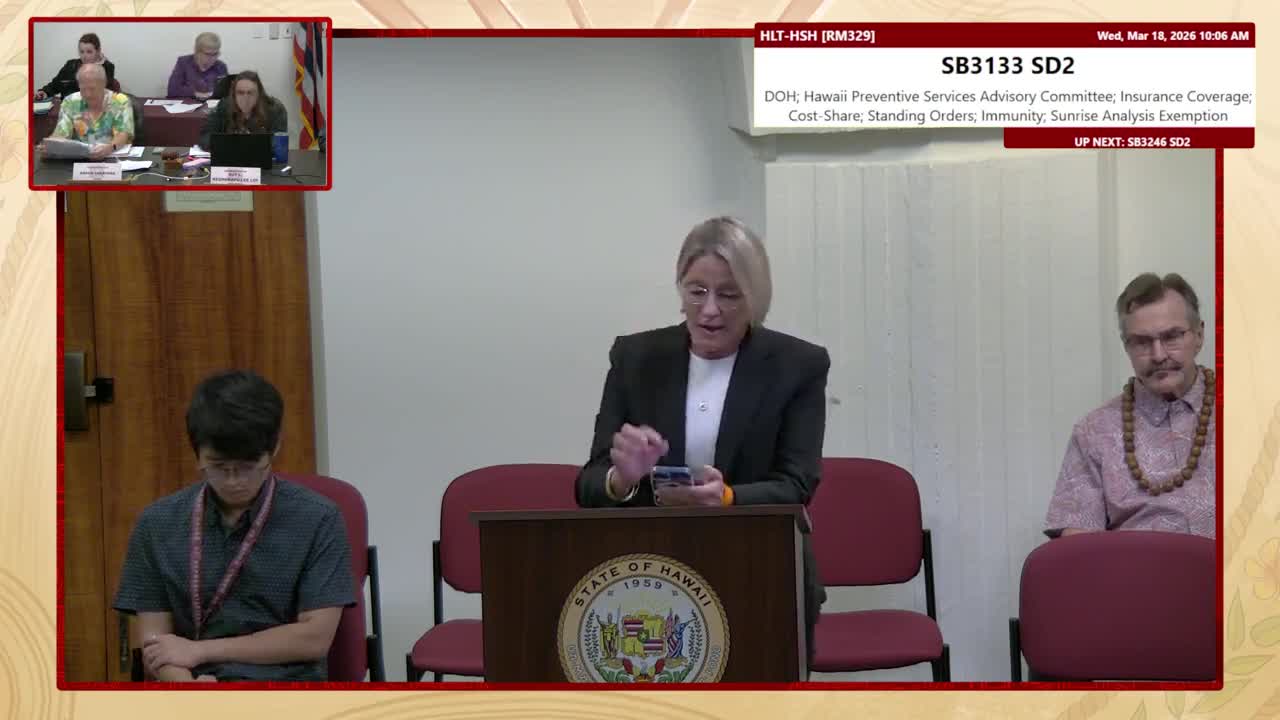 2MIN
House Standing Committee on Health
2MIN
House Standing Committee on Human Services & Homelessness
 31SEC
Senate Standing Committee on Judiciary
31SEC
Senate Standing Committee on Ways and Means
 6MIN
Senate Standing Committee on Commerce and Consumer Protection
6MIN
Senate Standing Committee on Hawaiian Affairs
Bill Author

Bill Co-Author(s):