SB 307: Law Enforcement Activities; Recordings; Private Right of Action
- Session Year: 2025-2026
- House: Senate
- Latest Version Date: 2025-03-20
Current Status:
Failed
(2025-12-08: Carried over to 2026 Regular Session.)
Introduced
In Committee
First Chamber
In Committee
Second Chamber
Final Decking
Enacted
Establishes the right of a person to record law enforcement activities. Establishes a private right of action for any violation of the right to record law enforcement activities. Effective 7/1/3000. (HD2)
Establishes the right of a person to record law enforcement activities. Establishes a private right of action for any violation of the right to record law enforcement activities. Effective 7/1/3000. (HD1)
Establishes the right of a person to record law enforcement activities. Establishes a private right of action for any violation of the right to record law enforcement activities. Effective 9/1/2025. (SD2)
Establishes the right of a person to record law enforcement activities. Establishes a private right of action for any violation of the right to record law enforcement activities. Effective 7/1/2077. (SD1)
Establishes the right of a person to record law enforcement activities. Establishes a private right of action for any violation of the right to record law enforcement activities.
|
THE SENATE |
S.B. NO. |
307 |
|
THIRTY-THIRD LEGISLATURE, 2025 |
S.D. 2 |
|
|
STATE OF HAWAII |
H.D. 2 |
|
|
|
|
|
|
|
||
|
|
||
A BILL FOR AN ACT
RELATING TO RECORDINGS OF LAW ENFORCEMENT ACTIVITIES.
BE IT ENACTED BY THE LEGISLATURE OF THE STATE OF HAWAII:
"Chapter
recording law enforcement activities
§ -1 Definitions. As used in this chapter:
"Law enforcement activity" means any activity by a law enforcement officer acting under the color of law.
"Law enforcement officer" means any public servant, whether employed by the State or subdivisions thereof or by the United States, vested by law with a duty to maintain public order, to make arrests for offenses, or to enforce the criminal laws, whether that duty extends to all offenses or is limited to a specific class of offenses.
"Record" means to capture or attempt to capture any moving or still image, sound, or impression through the use of any recording device, camera, or other device capable of capturing audio, moving images, or still images, or by way of written notes or observations.
§ -2 Right to record law enforcement activities. A person neither under arrest nor in the custody of a law enforcement officer shall have the right to record law enforcement activity and to maintain custody and control of that recording and of any property or instruments used by that person to record law enforcement activities; provided that a person under arrest or in custody of a law enforcement officer does not, by that status alone, forfeit the right to have any recordings taken before the arrest or before being taken into custody or the right to have any property and instruments used for the recording to be maintained and returned to the person under arrest or in custody. Nothing in this chapter shall be construed to permit a person to engage in actions that physically interfere with law enforcement activity or otherwise constitute a crime under chapter 710.
§ -3 Private right of action. (a) A claim of unlawful interference with recording a law enforcement activity shall be established under this section when a person demonstrates that the person exercised or attempted to exercise the right to record law enforcement activities pursuant to section -2 and a law enforcement officer acted to interfere with that person's recording of a law enforcement activity, including by:
(1) Intentionally preventing or attempting to prevent that person from recording law enforcement activity;
(2) Threatening that person for recording law enforcement activity;
(3) Commanding that the person cease recording law enforcement activity when the person was otherwise authorized by law to do so;
(4) Stopping, seizing, searching, ticketing, or arresting that person because that person recorded law enforcement activity;
(5) Unlawfully seizing property or instruments used by that person to record law enforcement activity;
(6) Unlawfully destroying or seizing a recorded image or recorded images of law enforcement activity; or
(7) Copying a recording of law enforcement activity without the consent of the person who recorded it or approval from a court of competent jurisdiction.
(b) It shall be an affirmative defense to a civil action under this section that, at the time of the law enforcement officer's conduct, the law enforcement officer had probable cause to arrest the person recording the law enforcement activity for a crime under chapter 710.
(c) A person subject to unlawful interference with recording law enforcement activities under this section may bring an action for any violation of this section in any court of competent jurisdiction for damages, including:
(1) Punitive damages;
(2) Declaratory and injunctive relief; and
(3) Other remedies as the court may deem appropriate.
(d) In any action or proceeding brought pursuant to this section, the court may award a prevailing plaintiff reasonable attorneys' and expert witness fees.
(e) Any action or proceeding brought pursuant to this section shall be commenced no later than three years after the date on which the violation of this section was committed.
§ -4 Preservation of rights. The rights under this chapter shall be in addition to all other rights and remedies available pursuant to law."
SECTION 2. If any provision of this Act, or the application thereof to any person or circumstance, is held invalid, the invalidity does not affect other provisions or applications of the Act that can be given effect without the invalid provision or application, and to this end the provisions of this Act are severable.
SECTION 3. This Act does not affect rights and duties that matured, penalties that were incurred, and proceedings that were begun before its effective date.
SECTION 4. This Act shall take effect on July 1, 3000.
Report Title:
Law Enforcement Activities; Recordings; Private Right of Action
Description:
Establishes the right of a person to record law enforcement activities. Establishes a private right of action for any violation of the right to record law enforcement activities. Effective 7/1/3000. (HD2)
The summary description of legislation appearing on this page is for informational purposes only and is not legislation or evidence of legislative intent.
|
THE SENATE |
S.B. NO. |
307 |
|
THIRTY-THIRD LEGISLATURE, 2025 |
S.D. 2 |
|
|
STATE OF HAWAII |
H.D. 1 |
|
|
|
|
|
|
|
||
|
|
||
A BILL FOR AN ACT
RELATING TO RECORDINGS OF LAW ENFORCEMENT ACTIVITIES.
BE IT ENACTED BY THE LEGISLATURE OF THE STATE OF HAWAII:
"Chapter
recording law enforcement activities
§ -1 Definitions. As used in this chapter:
"Law enforcement activity" means any activity by a law enforcement officer acting under the color of law.
"Law enforcement officer" means any public servant, whether employed by the State or subdivisions thereof or by the United States, vested by law with a duty to maintain public order, to make arrests for offenses, or to enforce the criminal laws, whether that duty extends to all offenses or is limited to a specific class of offenses.
"Record" means to capture or attempt to capture any moving or still image, sound, or impression through the use of any recording device, camera, or any other device capable of capturing audio, moving images, or still images, or by way of written notes or observations.
§ -2 Right to record law enforcement activities. A person neither under arrest nor in the custody of a law enforcement officer shall have the right to record law enforcement activity and to maintain custody and control of that recording and of any property or instruments used by that person to record law enforcement activities; provided that a person under arrest or in custody of a law enforcement officer does not, by that status alone, forfeit the right to have any recordings taken before the arrest or before being taken into custody or the right to have any property and instruments used for the recording to be maintained and returned to the person under arrest or in custody. Nothing in this chapter shall be construed to permit a person to engage in actions that physically interfere with law enforcement activity or otherwise constitute a crime under chapter 710.
§ -3 Private right of action. (a) A claim of unlawful interference with recording a law enforcement activity shall be established under this section when a person demonstrates that the person exercised or attempted to exercise the right to record law enforcement activities pursuant to section -2 and a law enforcement officer acted to interfere with that person's recording of a law enforcement activity, including by:
(1) Intentionally preventing or attempting to prevent that person from recording law enforcement activity;
(2) Threatening that person for recording law enforcement activity;
(3) Commanding that the person cease recording law enforcement activity when the person was otherwise authorized by law to do so;
(4) Stopping, seizing, searching, ticketing, or arresting that person because that person recorded law enforcement activity;
(5) Unlawfully seizing property or instruments used by that person to record law enforcement activity;
(6) Unlawfully destroying or seizing a recorded image or recorded images of law enforcement activity; or
(7) Copying a recording of law enforcement activity without the consent of the person who recorded it or approval from a court of competent jurisdiction.
(b) It shall be an affirmative defense to a civil action under this section that, at the time of the law enforcement officer's conduct, the law enforcement officer had probable cause to arrest the person recording the law enforcement activity for a crime under chapter 710.
(c) A person subject to unlawful interference with recording law enforcement activities under this section may bring an action for any violation of this section in any court of competent jurisdiction for damages, including:
(1) Punitive damages;
(2) Declaratory and injunctive relief; and
(3) Other remedies as the court may deem appropriate.
(d) In any action or proceeding brought pursuant to this section, the court may award a prevailing plaintiff reasonable attorneys' and expert witness fees.
(e) Any action or proceeding brought pursuant to this section shall be commenced no later than three years after the date on which the violation of this section was committed.
§ -4 Preservation of rights. The rights under this chapter shall be in addition to all other rights and remedies available pursuant to law."
SECTION 2. If any provision of this Act, or the application thereof to any person or circumstance, is held invalid, the invalidity does not affect other provisions or applications of the Act that can be given effect without the invalid provision or application, and to this end the provisions of this Act are severable.
SECTION 3. This Act does not affect rights and duties that matured, penalties that were incurred, and proceedings that were begun before its effective date.
SECTION 4. This Act shall take effect on July 1, 3000.
Report Title:
Law Enforcement Activities; Recordings; Private Right of Action
Description:
Establishes the right of a person to record law enforcement activities. Establishes a private right of action for any violation of the right to record law enforcement activities. Effective 7/1/3000. (HD1)
The summary description of legislation appearing on this page is for informational purposes only and is not legislation or evidence of legislative intent.
|
THE SENATE |
S.B. NO. |
307 |
|
THIRTY-THIRD LEGISLATURE, 2025 |
S.D. 2 |
|
|
STATE OF HAWAII |
|
|
|
|
|
|
|
|
||
|
|
||
A BILL FOR AN ACT
RELATING TO RECORDINGS OF LAW ENFORCEMENT ACTIVITIES.
BE IT ENACTED BY THE LEGISLATURE OF THE STATE OF HAWAII:
"Chapter
recording law enforcement activities
§ -1 Definitions. As used in this chapter:
"Law enforcement activity" means any activity by a law enforcement officer acting under the color of law.
"Law enforcement officer" means any public servant, whether employed by the State or subdivisions thereof or by the United States, vested by law with a duty to maintain public order, to make arrests for offenses, or to enforce the criminal laws, whether that duty extends to all offenses or is limited to a specific class of offenses.
"Record" means to capture or attempt to capture any moving or still image, sound, or impression through the use of any recording device, camera, or any other device capable of capturing audio, moving images, or still images, or by way of written notes or observations.
§ -2 Right to record law enforcement activities. A person neither under arrest nor in the custody of a law enforcement officer shall have the right to record law enforcement activity and to maintain custody and control of that recording and of any property or instruments used by that person to record law enforcement activities; provided that a person under arrest or in custody of a law enforcement officer does not, by that status alone, forfeit the right to have any recordings taken before the arrest or before being taken into custody or the right to have any property and equipment used for the recording to be maintained and returned to that person. Nothing in this chapter shall be construed to permit a person to engage in actions that physically interfere with law enforcement activity or otherwise constitute a crime under chapter 710.
§ -3 Private right of action. (a) A claim of unlawful interference with recording a law enforcement activity shall be established under this section when a person demonstrates that the person exercised or attempted to exercise the right to record law enforcement activities pursuant to section -2 and a law enforcement officer acted to interfere with that person's recording of a law enforcement activity, including by:
(1) Intentionally preventing or attempting to prevent that person from recording law enforcement activity;
(2) Threatening that person for recording law enforcement activity;
(3) Commanding that the person cease recording law enforcement activity when the person was otherwise authorized by law to do so;
(4) Stopping, seizing, searching, ticketing, or arresting that person because that person recorded law enforcement activity;
(5) Unlawfully seizing property or instruments used by that person to record law enforcement activity;
(6) Unlawfully destroying or seizing a recorded image or recorded images of law enforcement activity; or
(7) Copying a recording of law enforcement activity without the consent of the person who recorded it or approval from a court of competent jurisdiction.
(b) It shall be an affirmative defense to a civil action under this section that, at the time of the law enforcement officer's conduct, the law enforcement officer had probable cause to arrest the person recording the law enforcement activity for a crime under chapter 710.
(c) A person subject to unlawful interference with recording law enforcement activities under this section may bring an action for any violation of this section in any court of competent jurisdiction for damages, including:
(1) Punitive damages;
(2) Declaratory and injunctive relief; and
(3) Other remedies as the court may deem appropriate.
(d) In any action or proceeding brought pursuant to this section, the court may award a prevailing plaintiff reasonable attorneys' and expert witness fees.
(e) Any action or proceeding brought pursuant to this section shall be commenced no later than three years after the date on which the violation of this section was committed.
§ -4 Preservation of rights. The rights under this chapter shall be in addition to all other rights and remedies available pursuant to law."
SECTION 2. If any provision of this Act, or the application thereof to any person or circumstance, is held invalid, the invalidity does not affect other provisions or applications of the Act that can be given effect without the invalid provision or application, and to this end the provisions of this Act are severable.
SECTION 3. This Act does not affect rights and duties that matured, penalties that were incurred, and proceedings that were begun before its effective date.
SECTION 4. This Act shall take effect on September 1, 2025.
Report Title:
Law Enforcement Activities; Recordings; Private Right of Action
Description:
Establishes the right of a person to record law enforcement activities. Establishes a private right of action for any violation of the right to record law enforcement activities. Effective 9/1/2025. (SD2)
The summary description of legislation appearing on this page is for informational purposes only and is not legislation or evidence of legislative intent.
|
THE SENATE |
S.B. NO. |
307 |
|
THIRTY-THIRD LEGISLATURE, 2025 |
S.D. 1 |
|
|
STATE OF HAWAII |
|
|
|
|
|
|
|
|
||
|
|
||
A BILL FOR AN ACT
RELATING TO RECORDINGS OF LAW ENFORCEMENT ACTIVITIES.
BE IT ENACTED BY THE LEGISLATURE OF THE STATE OF HAWAII:
"Chapter
recording law enforcement activities
§ -1 Definitions. As used in this chapter:
"Law enforcement activity" means any activity by a law enforcement officer acting under the color of law.
"Law enforcement officer" means any public servant, whether employed by the State or subdivisions thereof or by the United States, vested by law with a duty to maintain public order, to make arrests for offenses, or to enforce the criminal laws, whether that duty extends to all offenses or is limited to a specific class of offenses.
"Record" means to capture or attempt to capture any moving or still image, sound, or impression through the use of any recording device, camera, or any other device capable of capturing audio, moving images, or still images, or by way of written notes or observations.
§ -2 Right to record law enforcement activities. A person neither under arrest nor in the custody of a law enforcement officer shall have the right to record law enforcement activity and to maintain custody and control of that recording and of any property or instruments used by that person to record law enforcement activities; provided that a person under arrest or in custody of a law enforcement officer does not, by that status alone, forfeit the right to have any recordings taken before the arrest or before being taken into custody or the right to have any property and equipment used for the recording to be maintained and returned to that person. Nothing in this chapter shall be construed to permit a person to engage in actions that physically interfere with law enforcement activity or otherwise constitute a crime under chapter 710.
§ -3 Private right of action. (a) A claim of unlawful interference with recording a law enforcement activity shall be established under this section when a person demonstrates that the person exercised or attempted to exercise the right to record law enforcement activities pursuant to section -2 and a law enforcement officer acted to interfere with that person's recording of a law enforcement activity, including by:
(1) Intentionally preventing or attempting to prevent that person from recording law enforcement activity;
(2) Threatening that person for recording law enforcement activity;
(3) Commanding that the person cease recording law enforcement activity when the person was otherwise authorized by law to do so;
(4) Stopping, seizing, searching, ticketing, or arresting that person because that person recorded law enforcement activity;
(5) Unlawfully seizing property or instruments used by that person to record law enforcement activity;
(6) Unlawfully destroying or seizing a recorded image or recorded images of law enforcement activity; or
(7) Copying a recording of law enforcement activity without the consent of the person who recorded it or approval from a court of competent jurisdiction.
(b) It shall be an affirmative defense to a civil action under this section that, at the time of the law enforcement officer's conduct, the law enforcement officer had probable cause to arrest the person recording the law enforcement activity for a crime under chapter 710.
(c) A person subject to unlawful interference with recording law enforcement activities under this section may bring an action for any violation of this section in any court of competent jurisdiction for damages, including:
(1) Punitive damages;
(2) Declaratory and injunctive relief; and
(3) Other remedies as the court may deem appropriate.
(d) In any action or proceeding brought pursuant to this section, the court may award a prevailing plaintiff reasonable attorneys' and expert witness fees.
(e) Any action or proceeding brought pursuant to this section shall be commenced no later than three years after the date on which the violation of this section was committed.
§ -4 Preservation of rights. The rights under this chapter shall be in addition to all other rights and remedies available pursuant to law."
SECTION 2. If any provision of this Act, or the application thereof to any person or circumstance, is held invalid, the invalidity does not affect other provisions or applications of the Act that can be given effect without the invalid provision or application, and to this end the provisions of this Act are severable.
SECTION 3. This Act does not affect rights and duties that matured, penalties that were incurred, and proceedings that were begun before its effective date.
SECTION 4. This Act shall take effect on July 1, 2077.
Report Title:
Law Enforcement Activities; Recordings; Private Right of Action
Description:
Establishes the right of a person to record law enforcement activities. Establishes a private right of action for any violation of the right to record law enforcement activities. Effective 7/1/2077. (SD1)
The summary description of legislation appearing on this page is for informational purposes only and is not legislation or evidence of legislative intent.
|
THE SENATE |
S.B. NO. |
307 |
|
THIRTY-THIRD LEGISLATURE, 2025 |
|
|
|
STATE OF HAWAII |
|
|
|
|
|
|
|
|
||
|
|
||
A BILL FOR AN ACT
relating to recordings of law enforcement activities.
BE IT ENACTED BY THE LEGISLATURE OF THE STATE OF HAWAII:
"Chapter
recording law enforcement activities
§ -1 Definitions. As used in this chapter:
"Law enforcement activity" means any activity by a law enforcement officer acting under the color of law.
"Law enforcement officer" means any public servant, whether employed by the State or subdivisions thereof or by the United States, vested by law with a duty to maintain public order or, to make arrests for offenses or to enforce the criminal laws, whether that duty extends to all offenses or is limited to a specific class of offenses.
"Record" means to capture or attempt to capture any moving or still image, sound, or impression through the use of any recording device, camera, or any other device capable of capturing audio, moving images, or still images, or by way of written notes or observations.
§ -2 Right to record law enforcement activities. A person neither under arrest nor in the custody of a law enforcement officer shall have the right to record law enforcement activity and to maintain custody and control of that recording and of any property or instruments used by that person to record law enforcement activities; provided that a person under arrest or in custody of a law enforcement officer does not, by that status alone, forfeit the right to have any recordings taken before the arrest or before being taken into custody or the right to have any property and equipment used for the recording to be maintained and returned to that person. Nothing in this chapter shall be construed to permit a person to engage in actions that physically interfere with law enforcement activity or otherwise constitute a crime under chapter 710.
§ -3 Private right of action. (a) A claim of unlawful interference with recording a law enforcement activity shall be established under this section when a person demonstrates that the person exercised or attempted to exercise the right to record law enforcement activities pursuant to section -2 and a law enforcement officer acted to interfere with that person's recording of a law enforcement activity, including by:
(1) Intentionally preventing or attempting to prevent that person from recording law enforcement activity;
(2) Threatening that person for recording law enforcement activity;
(3) Commanding that the person cease recording law enforcement activity when the person was otherwise authorized by law to do so;
(4) Stopping, seizing, searching, ticketing, or arresting that person because that person recorded law enforcement activity;
(5) Unlawfully seizing property or instruments used by that person to record law enforcement activity;
(6) Unlawfully destroying or seizing a recorded image or recorded images of law enforcement activity; or
(7) Copying a recording of law enforcement activity without the consent of the person who recorded it or approval from a court of competent jurisdiction.
(b) It shall be an affirmative defense to a civil action under this section that, at the time of the law enforcement officer's conduct, the law enforcement officer had probable cause to arrest the person recording the law enforcement activity for a crime under chapter 710.
(c) A person subject to unlawful interference with recording law enforcement activities under this section may bring an action for any violation of this section in any court of competent jurisdiction for damages, including:
(1) Punitive damages;
(2) Declaratory and injunctive relief; and
(3) Other remedies as the court may deem appropriate.
(d) In any action or proceeding brought pursuant to this section, the court may award a prevailing plaintiff reasonable attorneys' and expert witness fees.
(e) Any action or proceeding brought pursuant to this section shall be commenced no later than three years after the date on which the violation of this section was committed.
§ -4 Preservation of rights. The rights under this chapter shall be in addition to all other rights and remedies available pursuant to law."
SECTION 2. If any provision of this Act, or the application thereof to any person or circumstance, is held invalid, the invalidity does not affect other provisions or applications of the Act that can be given effect without the invalid provision or application, and to this end the provisions of this Act are severable.
SECTION 3. This Act does not affect rights and duties that matured, penalties that were incurred, and proceedings that were begun before its effective date.
SECTION 4. This Act shall take effect upon its approval.
|
INTRODUCED BY: |
_____________________________ |
|
|
|
Report Title:
Law Enforcement Activities; Recordings; Private Right of Action
Description:
Establishes the right of a person to record law enforcement activities. Establishes a private right of action for any violation of the right to record law enforcement activities.
The summary description of legislation appearing on this page is for informational purposes only and is not legislation or evidence of legislative intent.
|
Date
|
Status
|
|---|---|
| Dec 8, 2025 | Carried over to 2026 Regular Session. |
| Mar 21, 2025 | Report adopted; referred to the committee(s) on FIN as amended in HD 2 with none voting aye with reservations; none voting no (0) and Representative(s) Cochran, Garrett, Kapela, Kitagawa, Ward excused (5). |
| Mar 21, 2025 | Reported from JHA (Stand. Com. Rep. No. 1457) as amended in HD 2, recommending referral to FIN. |
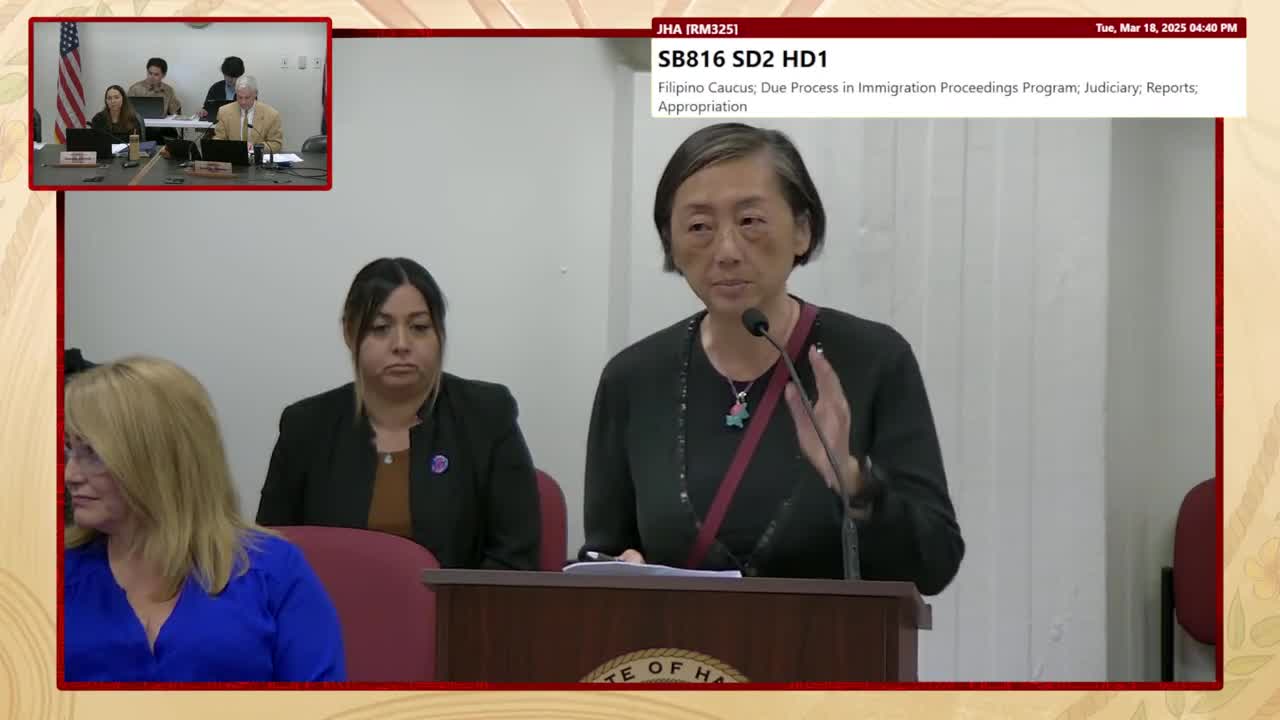
| Mar 18, 2025 | The committee on JHA recommend that the measure be PASSED, WITH AMENDMENTS. The votes were as follows: 10 Ayes: Representative(s) Tarnas, Poepoe, Belatti, Hashem, Kahaloa, Perruso, Takayama, Todd, Garcia, Shimizu; Ayes with reservations: none; Noes: none; and 1 Excused: Representative(s) Cochran. |
| Mar 14, 2025 | Bill scheduled to be heard by JHA on Tuesday, 03-18-25 2:15PM in House conference room 325 VIA VIDEOCONFERENCE. |
| Mar 14, 2025 | Passed Second Reading as amended in HD 1 and referred to the committee(s) on JHA with none voting aye with reservations; none voting no (0) and Representative(s) Cochran, Holt, Iwamoto, Ward excused (4). |
| Mar 14, 2025 | Reported from LAB (Stand. Com. Rep. No. 1256) as amended in HD 1, recommending passage on Second Reading and referral to JHA. |
| Mar 13, 2025 | The committee on LAB recommend that the measure be PASSED, WITH AMENDMENTS. The votes were as follows: 6 Ayes: Representative(s) Sayama, Lee, M., Garrett, Kapela, Kong, Reyes Oda; Ayes with reservations: none; 0 Noes: none; and 0 Excused: none. |
| Mar 10, 2025 | Bill scheduled to be heard by LAB on Thursday, 03-13-25 9:00AM in House conference room 309 VIA VIDEOCONFERENCE. |
| Mar 6, 2025 | Referred to LAB, JHA, FIN, referral sheet 19 |
| Mar 6, 2025 | Pass First Reading |
| Mar 4, 2025 | Received from Senate (Sen. Com. No. 128) in amended form (SD 2). |
| Mar 4, 2025 | Report adopted; Passed Third Reading, as amended (SD 2). Ayes, 25; Aye(s) with reservations: none . Noes, 0 (none). Excused, 0 (none). Transmitted to House. |
| Feb 28, 2025 | 48 Hrs. Notice 03-04-25. |
| Feb 28, 2025 | Reported from JDC (Stand. Com. Rep. No. 902) with recommendation of passage on Third Reading, as amended (SD 2). |
| Feb 12, 2025 | The committee(s) on JDC recommend(s) that the measure be PASSED, WITH AMENDMENTS. The votes in JDC were as follows: 3 Aye(s): Senator(s) Rhoads, Gabbard, Chang; Aye(s) with reservations: none ; 0 No(es): none; and 2 Excused: Senator(s) San Buenaventura, Awa. |
| Feb 11, 2025 | The committee(s) on JDC deferred the measure until 02-12-25 9:50AM; Conference Room 016 & Videoconference. |
| Feb 7, 2025 | The committee(s) on JDC will hold a public decision making on 02-11-25 10:00AM; Conference Room 016 & Videoconference. |
| Feb 5, 2025 | Report adopted; Passed Second Reading, as amended (SD 1) and referred to JDC. |
| Feb 5, 2025 | Reported from PSM (Stand. Com. Rep. No. 38) with recommendation of passage on Second Reading, as amended (SD 1) and referral to JDC. |
| Jan 27, 2025 | The committee(s) on PSM recommend(s) that the measure be PASSED, WITH AMENDMENTS. The votes in PSM were as follows: 5 Aye(s): Senator(s) Elefante, Wakai, Fukunaga, Rhoads, DeCorte; Aye(s) with reservations: none ; 0 No(es): none; and 0 Excused: none. |
| Jan 24, 2025 | The committee(s) on PSM has scheduled a public hearing on 01-27-25 3:00PM; Conference Room 225 & Videoconference. |
| Jan 21, 2025 | Referred to PSM, JDC. |
| Jan 15, 2025 | Introduced and passed First Reading. |
| Jan 14, 2025 | Pending Introduction. |
|
Date
|
Description
|
Location
|
Votes
|
|
|---|---|---|---|---|
| Mar 18, 2025 | The committee on JHA recommend that the measure be PASSED, WITH AMENDMENTS | House Standing Committee on Judiciary & Hawaiian Affairs |
Passed |
|
| Mar 13, 2025 | The committee on LAB recommend that the measure be PASSED, WITH AMENDMENTS | House Standing Committee on Labor |
Passed |
|
| Mar 4, 2025 | Third Reading | Senate Floor |
Passed |
|
| Feb 12, 2025 | The committee(s) on JDC recommend(s) that the measure be PASSED, WITH AMENDMENTS | Senate Standing Committee on Judiciary |
Passed |
|
| Jan 27, 2025 | The committee(s) on PSM recommend(s) that the measure be PASSED, WITH AMENDMENTS | Senate Standing Committee on Public Safety and Military Affairs |
Passed |
This list shows positions taken on this bill by organizations on the date displayed, which is linked to the original source.
Positions by individuals are not included.
|
Organization
|
Position
|
Date
|
|---|---|---|
| ACLU of Hawaiʻi | ** Support | |
| All Hawaii News | ** Support | |
| Big Island Press Club | ** Support | |
| Drug Policy Forum of Hawaii | ** Support | |
| Kingdom of The Hawaiian Islands | *** Support | Mar 18, 2025 |
| League of Women Voters of Hawaii | ** Support | |
| Office of the Public Defender | ** Support | |
| Ohana Unity Party | ** Support | |
| Public First Law Center | ** Support | |
| The Legal Clinic | ** Support |
STAND. COM. REP. NO. 1457
Honolulu, Hawaii
, 2025
RE: S.B. No. 307
S.D. 2
H.D. 2
Honorable Nadine K. Nakamura
Speaker, House of Representatives
Thirty-Third State Legislature
Regular Session of 2025
State of Hawaii
Madame:
Your Committee on Judiciary & Hawaiian Affairs, to which was referred S.B. No. 307, S.D. 2, H.D. 1, entitled:
"A BILL FOR AN ACT RELATING TO RECORDINGS OF LAW ENFORCEMENT ACTIVITIES,"
begs leave to report as follows:
Your Committee received testimony in support of this measure from the Office of the Public Defender; League of Women Voters of Hawaii; Public First Law Center; All Hawaii News; ACLU of Hawaiʻi; Big Island Press Club; Drug Policy Forum of Hawaii; Ohana Unity Party; and three individuals.
Your Committee finds that this measure codifies the constitutional right to record police activity, as recognized by the Hawaii Supreme Court in State v. Russo, 141 Haw. 181 (2017). This measure would also promote police accountability by creating a statutory right of action.
Your Committee has amended this measure by making a technical, nonsubstantive amendment for the purposes of clarity, consistency, and style.
As affirmed by the record of votes of the members of your Committee on Judiciary & Hawaiian Affairs that is attached to this report, your Committee is in accord with the intent and purpose of S.B. No. 307, S.D. 2, H.D. 1, as amended herein, and recommends that it be referred to your Committee on Finance in the form attached hereto as S.B. No. 307, S.D. 2, H.D. 2.
Respectfully submitted on behalf of the members of the Committee on Judiciary & Hawaiian Affairs,
|
|
|
____________________________ DAVID A. TARNAS, Chair |
|
|
|
|
STAND. COM. REP. NO. 1256
Honolulu, Hawaii
, 2025
RE: S.B. No. 307
S.D. 2
H.D. 1
Honorable Nadine K. Nakamura
Speaker, House of Representatives
Thirty-Third State Legislature
Regular Session of 2025
State of Hawaii
Madame:
Your Committee on Labor, to which was referred S.B. No. 307, S.D. 2, entitled:
"A BILL FOR AN ACT RELATING TO RECORDINGS OF LAW ENFORCEMENT ACTIVITIES,"
begs leave to report as follows:
Your Committee received testimony in support of this measure from the Office of the Public Defender; League of Women Voters of Hawaii; ACLU Hawaiʻi; and Public First Law Center.
Your Committee finds that the First Amendment of the United States Constitution protects freedom of speech and expression and courts have determined that this includes the right to record police officers in public spaces so long as it does not interfere with the officer's duties and is done lawfully. Your Committee further finds that it is important to protect the right to record law enforcement activities, prevent infringements upon this right, and provide a remedy when this right is violated. Your Committee believes that this measure strikes an appropriate balance between an individual's right to record law enforcement activities and bring an action for any violation of this right with law enforcement's ability to carry out its duties.
Your Committee has amended this measure by:
(1) Changing the effective date to July 1, 3000, to encourage further discussion; and
(2) Making technical, nonsubstantive amendments for the purposes of clarity, consistency, and style.
As affirmed by the record of votes of the members of your Committee on Labor that is attached to this report, your Committee is in accord with the intent and purpose of S.B. No. 307, S.D. 2, as amended herein, and recommends that it pass Second Reading in the form attached hereto as S.B. No. 307, S.D. 2, H.D. 1, and be referred to your Committee on Judiciary & Hawaiian Affairs.
Respectfully submitted on behalf of the members of the Committee on Labor,
|
|
|
____________________________ JACKSON D. SAYAMA, Chair |
|
|
|
|
STAND. COM. REP. NO. 902
Honolulu, Hawaii
RE: S.B. No. 307
S.D. 2
Honorable Ronald D. Kouchi
President of the Senate
Thirty-Third State Legislature
Regular Session of 2025
State of Hawaii
Sir:
Your Committee on Judiciary, to which was referred S.B. No. 307, S.D. 1, entitled:
"A BILL FOR AN ACT RELATING TO RECORDINGS OF LAW ENFORCEMENT ACTIVITIES,"
begs leave to report as follows:
The purpose and intent of this measure is to:
(1) Establish the right of a person to record law enforcement activities; and
(2) Establish a private right of action for any violation of the right to record law enforcement activities.
Your Committee received testimony in support of this measure from the ACLU of Hawaiʻi, Public First Law Center, League of Women Voters of Hawaii, Big Island Press Club, and two individuals.
Your Committee finds that taking photographs and videos of things plainly visible in public spaces, including police and other government officials carrying out their duties, is a constitutional right that has been reaffirmed in numerous court cases. Your Committee further finds that recording police creates an independent record of incidents that can exonerate police officers if they were acting appropriately or provide evidence if they were not. This measure will promote the mutual interests of law enforcement and the communities they serve by increasing legitimacy and trust in law enforcement activities.
Your Committee has amended this measure by inserting an effective date of September 1, 2025.
As affirmed by the record of votes of the members of your Committee on Judiciary that is attached to this report, your Committee is in accord with the intent and purpose of S.B. No. 307, S.D. 1, as amended herein, and recommends that it pass Third Reading in the form attached hereto as S.B. No. 307, S.D. 2.
Respectfully submitted on behalf of the members of the Committee on Judiciary,
|
|
|
________________________________ KARL RHOADS, Chair |
|
|
|
|
STAND. COM. REP. NO. 38
Honolulu, Hawaii
RE: S.B. No. 307
S.D. 1
Honorable Ronald D. Kouchi
President of the Senate
Thirty-Third State Legislature
Regular Session of 2025
State of Hawaii
Sir:
Your Committee on Public Safety and Military Affairs, to which was referred S.B. No. 307 entitled:
"A BILL FOR AN ACT RELATING TO RECORDINGS OF LAW ENFORCEMENT ACTIVITIES,"
begs leave to report as follows:
The purpose and intent of this measure is to:
(1) Establish the right of a person to record law enforcement activities; and
(2) Establish a private right of action for any violation of the right to record law enforcement activities.
Your Committee received testimony in support of this measure from ACLU Hawaiʻi, All Hawaii News, Big Island Press Club, League of Women Voters of Hawaii, The Legal Clinic, and three individuals.
Your Committee received comments on this measure from one individual.
Your Committee finds that taking photographs and videos of things plainly visible in public spaces is a constitutional right, including police and other government officials carrying out their duties. However, law enforcement officers have been observed ordering people to stop recording in public places, and even harassing, detaining, and arresting those who fail to comply. Recording police activity creates an independent record of incidents, free from accusations of bias or faulty memory, and further promotes the mutual interests of law enforcement and the communities they serve by increasing legitimacy and trust in law enforcement activities. This measure will ensure that individuals have the right to record law enforcement activities in public spaces by making this right an express part of state laws and by establishing the ability to seek remedies through civil litigation for violations of this right.
Your Committee has amended this measure by:
(1) Inserting an effective date of July 1, 2077, to encourage further discussion; and
(2) Making technical, nonsubstantive amendments for the purposes of clarity and consistency.
As affirmed by the record of votes of the members of your Committee on Public Safety and Military Affairs that is attached to this report, your Committee is in accord with the intent and purpose of S.B. No. 307, as amended herein, and recommends that it pass Second Reading in the form attached hereto as S.B. No. 307, S.D. 1, and be referred to your Committee on Judiciary.
Respectfully submitted on behalf of the members of the Committee on Public Safety and Military Affairs,
|
|
|
________________________________ BRANDON J.C. ELEFANTE, Chair |
|
|
|
|
|
Date
|
Testimony PDF
|
|---|---|
| Mar 18, 2025 | SB307_HD1_TESTIMONY_JHA_03-18-25_.PDF |
| Mar 12, 2025 | SB307_SD2_TESTIMONY_LAB_03-13-25_.PDF |
| Feb 10, 2025 | SB307_SD1_TESTIMONY_JDC_02-11-25_.PDF |
| Jan 27, 2025 | SB307_TESTIMONY_PSM_01-27-25_.PDF |
Discussed in Hearing
 5MIN
House Standing Committee on Judiciary & Hawaiian Affairs
 3MIN
House Standing Committee on Labor
 27SEC
Senate Standing Committee on Judiciary
Bill Author

Bill Co-Author(s):