SB 2005: DLNR; BLNR; Conservation Banks
- Session Year: 2025-2026
- House: Senate
- Latest Version Date: 2026-03-18
Current Status:
Failed
(2026-03-19: Passed Second Reading as amended in HD 1 and referred to the committee(s) on WAL with Representative(s) Cochran voting aye with reservations; Representative(s) Garcia voting no (1) and none excused (0).)
Introduced
In Committee
First Chamber
In Committee
Second Chamber
Final Decking
Enacted
What does this bill do?
Allows the Department of Land and Natural Resources and approved public or private groups to create and run conservation banks—sites that restore or protect threatened and endangered species—and to sell mitigation credits to people or projects that must offset harm under incidental take permits and habitat conservation plans. It also adds the U.S. Geological Survey Ecosystems Mission Area associate director to the Endangered Species Recovery Committee and requires that committee to review, recommend on, and oversee conservation bank applications and credit use.
The summary is provided by generative AI which can make mistakes. For original language, please view the details in the table below.
Authorizes the Department of Land and Natural Resources and certain public or private entities to operate conservation banks, subject to approval from the Board of Land and Natural Resources, for situations where a person or entity is required to provide compensatory mitigation to offset adverse impacts to threatened, endangered, candidate, or proposed species as part of an approved incidental take license and habitat conservation plan. Adds the Associate Director of the United States Geological Survey, Ecosystems Mission Area, to the membership of the Endangered Species Recovery Committee. Requires the Endangered Species Recovery Committee to review applications and proposals for conservation banks and conduct subsequent reviews and oversight. Effective 7/1/3000. (HD1)
Authorizes the Department of Land and Natural Resources and certain public or private entities to operate conservation banks, subject to approval from the Board of Land and Natural Resources, for situations where a person or entity is required to provide compensatory mitigation to offset adverse impacts to threatened, endangered, candidate, or proposed species as part of an approved incidental take license and habitat conservation plan. Adds the associate director of the United States Geological Survey, Ecosystem Mission Area, to the membership of the Endangered Species Recovery Committee. Requires the Endangered Species Recovery Committee to review applications and proposals for conservation banks and conduct subsequent reviews and oversight. Effective 7/1/2050. (SD1)
Authorizes the use of conservation banks for compensatory mitigation in a habitat conservation plan and associated incidental take license. Amends the membership and scope of authority for the Endangered Species Recovery Committee.
|
THE SENATE |
S.B. NO. |
2005 |
|
THIRTY-THIRD LEGISLATURE, 2026 |
S.D. 1 |
|
|
STATE OF HAWAII |
H.D. 1 |
|
|
|
|
|
|
|
||
|
|
||
A BILL FOR AN ACT
RELATING TO CONSERVATION BANKING.
BE IT ENACTED BY THE LEGISLATURE OF THE STATE OF HAWAII:
SECTION 1. The legislature finds that the use of conservation banks as compensatory mitigation projects for incidental take licensees with habitat conservation plans increases certainty that the mitigation obligation is complete, expedites project review, and makes project costs more predictable for incidental take licensees. Conservation banks provide long-term, landscape-scale protection to Hawaii's threatened, endangered, candidate, and proposed species.
Accordingly, the purpose of this Act is to:
(1) Authorize the department of land and natural resources and certain public or private entities to operate conservation banks, subject to approval from the board of land and natural resources, for situations where a person or entity is required to provide compensatory mitigation to offset adverse impacts to threatened, endangered, candidate, or proposed species as part of an approved incidental take license and habitat conservation plan;
(2) Add the associate director of the United States Geological Survey, Ecosystems Mission Area, to the membership of the endangered species recovery committee; and
(3) Require the endangered species recovery committee to review applications and proposals for conservation banks and conduct subsequent reviews and oversight.
SECTION 2. Chapter 195D Hawaii Revised Statutes, is amended by adding a new part to be appropriately designated and to read as follows:
"Part . Conservation banking
§195D-A Definitions. As used in this part:
"Adaptive management strategy" means the actions to be taken if the resource management plan is not achieving its goals.
"Administrative amendments" means changes to the bank sponsor's name, address, or contact information.
"Bank sponsor" means any public or private entity responsible for establishing or operating a conservation bank.
"Compensatory mitigation" means actions taken to fulfill, in whole or in part, mitigation requirements pursuant to this chapter.
"Conservation bank" means a site or suite of sites established under a conservation bank instrument for the purposes of restoring, creating, enhancing, or protecting populations of threatened, endangered, candidate, or proposed species and their habitats expressed as credits.
"Conservation bank instrument" means an agreement between the board and a bank sponsor that establishes a conservation bank and describes the terms and conditions of its operation, including a system for assessing and releasing credits to be used for compensatory mitigation.
"Credit" means a value based on defined units representing the increase in numbers of a listed species or attainment of enhanced ecological functions or services essential to the survival of a listed species at a conservation bank and released as the conservation bank meets performance criteria included in its conservation bank instrument.
"Credit bundling" means a single unit of a conservation bank that provides two or more spatially overlapping ecosystem functions or services that are grouped together into a single credit type and used as a single commodity to compensate for a single permitted action.
"Credit stacking" means a single unit of a conservation bank that provides two or more credit types representing spatially overlapping ecosystem functions or services that can be unstacked and used as separate commodities to compensate for different permitted actions.
"Maintenance plan" means a bank sponsor's plan to ensure the conservation bank remains viable after construction and throughout the life of the conservation bank, including a description of management requirements and a schedule for their implementation. "Maintenance plan" includes infrastructure and ecological management components within the project area and an identification of regular or recurring actions needed for upkeep of the conservation bank site.
"Major amendments" means changes that are not administrative amendments. "Major amendments" include changes to the bank sponsor, species that the conservation bank is established to protect, resource management plan, financial assurances, system for assessing and releasing credits, or the site protection instrument.
"Monitoring requirements" means a description of parameters to be monitored and a methodology to monitor those requirements to determine if the conservation bank is on track to meet performance standards or if an adaptive management strategy is needed.
"Performance standards" means ecologically based standards that are used to determine whether the conservation bank is achieving objectives in the resource management plan and that describe the attribute to be measured, the level that constitutes success, and the time period to achieve success.
"Resource management plan" means the plan identified by a conservation bank instrument and described in section 195D-B.
"Site protection instrument" means an interest in real property that protects a conservation bank for either long-term stewardship or in perpetuity, such as a conservation easement, deed restriction, condition, or covenant.
(b) Applications to establish and operate a conservation bank shall include a proposed conservation bank instrument that identifies:
(1) The geographic area encompassed by the conservation bank and the ecosystems, natural communities, or habitat types within the conservation bank;
(2) The threatened, endangered, candidate, or proposed species that the conservation bank is established to protect;
(3) A resource management plan for long-term stewardship that includes:
(A) Goals and objectives;
(B) A review of the presence or absence of any threatened, endangered, candidate, or proposed species on the property, including the species identified in paragraph (2);
(C) Performance standards;
(D) Monitoring requirements;
(E) A maintenance plan; and
(F) An adaptive management strategy;
(4) Any other information that the department requires in rules adopted pursuant to section 195D-C;
(5) A system for assessing and releasing credits; and
(6) The measures for property protection.
(c) In addition to the requirements set forth in subsection (b), for applications from bank sponsors other than the department, the proposed conservation bank instrument shall contain:
(1) Assurances that the bank sponsor has the scientific and technical competence required to perform the necessary conservation actions for the species identified in subsection (b)(2);
(2) Financial assurances necessary to ensure the successful completion of habitat construction, management, monitoring, and remedial actions;
(3) A site protection instrument; and
(4) A provision requiring the bank sponsor to submit an annual report on the current status of the conservation bank to the department within ninety days after the end of each fiscal year ending June 30.
(d) After consultation with the endangered species recovery committee, the board may approve a conservation bank instrument for the operation of a conservation bank by the department or bank sponsor if the board determines that:
(1) The conservation bank will further the purposes of this chapter by restoring, creating, enhancing, or protecting populations of threatened, endangered, candidate, or proposed species and their habitats;
(2) The system for assessing and releasing credits is based on the best available scientific information, and where there is uncertainty about what constitutes the best available scientific information, the rationale used for developing the system for assessing and releasing credits gives the benefit of the doubt to the species;
(3) For a conservation bank operated by a bank sponsor other than the department:
(A) The bank sponsor has the scientific and technical competencies required to perform the necessary conservation actions for the species identified in subsection (b)(2);
(B) The bank sponsor's funding source is adequate to ensure the successful completion of habitat construction, management, monitoring, and remedial actions;
(C) The nature and duration of the site protection instrument is adequate to ensure the successful completion of habitat construction, management, monitoring, or remedial actions; and
(D) The conservation bank instrument shall run with the land for the term specified in the site protection instrument and shall not be assignable or transferable separate from the land;
(4) For a conservation bank operated by the department, the conservation bank shall be established on land managed by the department; and
(5) The conservation bank instrument satisfies all requirements in subsections (b) and (c).
Board approval shall require an affirmative vote of no less than two-thirds of the authorized membership of the board. The board shall not approve a conservation bank instrument that the majority of the endangered species recovery committee recommended for disapproval.
(e) The board's approval of a conservation bank instrument for a conservation bank operated by a sponsor other than the department does not relieve the bank sponsor of its obligation to secure a temporary license pursuant to section 195D-4(f) or (g) before causing take of any threatened, endangered, candidate, or proposed species.
(f) After a conservation bank has created a credit following the system for assessing and releasing credits identified in the conservation bank instrument, the bank sponsor may transfer or sell the credit to an incidental take licensee for use of an approved conservation bank as compensatory mitigation; provided that:
(1) The use of the credit as compensatory mitigation for incidental take of threatened or endangered species is part of a habitat conservation plan and satisfies incidental take license requirements pursuant to section 195D-4(g) and habitat conservation plan requirements in section 195D-21(b);
(2) A majority of the endangered species recovery committee approves the use of the credit as compensatory mitigation;
(3) Credit stacking is prohibited;
(4) Credit bundling may be used to compensate for all or a subset of the functions or services included in the credit type but shall be used only once; and
(5) Once a credit is transferred or sold, that credit is retired and cannot be used again.
(g) Notwithstanding any other law to the contrary, the board shall suspend or revoke the approval of any conservation bank instrument approved under this section if the board determines that:
(1) The bank sponsor or its successor has breached its obligations under the conservation bank instrument and has failed to cure the breach in a timely manner, and the effect of the breach will diminish the likelihood that the conservation bank will achieve its goals within the time frame or manner set forth in the conservation bank instrument;
(2) For a conservation bank operated by a bank sponsor other than the department, the conservation bank no longer has the funding source specified in subsection (d)(3)(B) or another sufficient funding source to ensure the successful completion of the habitat construction, management, monitoring, and remedial actions in accordance with the conservation bank instrument; or
(3) Continued operation of the conservation bank would appreciably reduce the likelihood of survival or recovery of any threatened or endangered species in the wild.
If approval of a conservation bank instrument is suspended, then the bank sponsor shall not sell or transfer any credits from that conservation bank. Any bank sponsor whose conservation bank instrument has been revoked shall not be eligible to apply to operate another conservation bank.
(h) An approved conservation bank instrument may be amended through administrative amendment or major amendment; provided that:
(1) The department may process administrative amendments without recommendation from the endangered species recovery committee and without approval from the board; and
(2) Major amendments shall be reviewed and recommended for approval by the endangered species recovery committee and approved by the board pursuant to an affirmative vote of no less than two-thirds of the authorized membership of the board; provided that the board shall not approve a major amendment that the majority of the endangered species recovery committee recommended for disapproval.
(i) The department may collect from bank sponsors fees or payment for costs incurred by the department during:
(1) Its rulemaking process;
(2) Application processing; and
(3) Establishment, monitoring, and oversight of the bank sponsor's conservation bank.
(j) This part shall not apply to aquatic life or their habitats.
§195D-C Rulemaking. The department may adopt rules pursuant to chapter 91 necessary to implement this part."
SECTION 3. Section 195D-25, Hawaii Revised Statutes, is amended by amending subsections (a) and (b) to read as follows:
"(a)
There is established within the department for administrative purposes
only, the endangered species recovery committee, which shall serve as a
consultant to the board and the department on matters relating to endangered,
threatened, proposed, and candidate species.
The committee shall consist of two field biologists with expertise in
conservation biology, the chairperson of the board or the chairperson's
designee, the ecoregion director of the United States Fish and Wildlife Service
or the director's designee, [the director of the United States Geological
Survey, Biological Resources Division or the director's designee,] the
associate director of the United States Geological Survey, Ecosystems Mission
Area, or the associate director's designee, the dean of the University of
Hawaii at Manoa college of natural sciences or the dean's designee, and a
person possessing a background in native Hawaiian traditional and customary
practices, as evidenced by:
(1) A college degree in a relevant field, such as Hawaiian studies, native Hawaiian law, native Hawaiian traditional and customary practices, or related subject area;
(2) Work history that demonstrates an appropriate level of knowledge in native Hawaiian traditional and customary practices; or
(3) Substantial experience in native Hawaiian traditional and customary practices.
Nongovernmental members shall be appointed by the governor pursuant to section 26-34. Nongovernmental members shall not serve for more than two consecutive terms. Nongovernmental members shall serve for four-year staggered terms, except that one of the members first appointed shall serve for two years.
Governmental members from the federal agencies are requested but not required to serve on the committee. The ability of the committee to carry out its functions and purposes shall not be affected by the vacancy of any position allotted to a federal governmental member.
(b) The endangered species recovery committee shall:
(1) Review all applications and proposals for
habitat conservation plans, safe harbor agreements, [and] incidental
take licenses, and conservation banks and make recommendations, based on
a full review of the best available scientific and other reliable data and at
least one site visit to each property that is the subject of the proposed
action, and in consideration of the cumulative impacts of the proposed action
on the recovery potential of the endangered, threatened, proposed, or candidate
species, to the department and the board as to whether or not they should be
approved, amended, or rejected;
(2) Review all habitat conservation plans, safe
harbor agreements, [and] incidental take licenses, and conservation
banks on an annual basis to ensure compliance with agreed to activities
and, on the basis of any available monitoring reports, and scientific and other
reliable data, make recommendations for any necessary changes;
(3) Consider and recommend appropriate incentives to encourage landowners to voluntarily engage in efforts that restore and conserve endangered, threatened, proposed, and candidate species;
(4) Perform such other duties as provided in this chapter;
(5) Consult with persons possessing expertise in such areas as the committee may deem appropriate and necessary in the course of exercising its duties; and
(6) Not conduct more than one site visit per year
to each property that is the subject of a habitat conservation plan [or]
safe harbor agreement[.], or conservation bank instrument."
SECTION 4. In codifying the new sections added by section 2 of this Act, the revisor of statutes shall substitute appropriate section numbers for the letters used in designating the new sections in this Act.
SECTION 5. Statutory material to be repealed is bracketed and stricken. New statutory material is underscored.
SECTION 6. This Act shall take effect on July 1, 3000.
Report Title:
DLNR; BLNR; Conservation Banks
Description:
Authorizes the Department of Land and Natural Resources and certain public or private entities to operate conservation banks, subject to approval from the Board of Land and Natural Resources, for situations where a person or entity is required to provide compensatory mitigation to offset adverse impacts to threatened, endangered, candidate, or proposed species as part of an approved incidental take license and habitat conservation plan. Adds the Associate Director of the United States Geological Survey, Ecosystems Mission Area, to the membership of the Endangered Species Recovery Committee. Requires the Endangered Species Recovery Committee to review applications and proposals for conservation banks and conduct subsequent reviews and oversight. Effective 7/1/3000. (HD1)
The summary description of legislation appearing on this page is for informational purposes only and is not legislation or evidence of legislative intent.
|
THE SENATE |
S.B. NO. |
2005 |
|
THIRTY-THIRD LEGISLATURE, 2026 |
S.D. 1 |
|
|
STATE OF HAWAII |
|
|
|
|
|
|
|
|
||
|
|
||
A BILL FOR AN ACT
Relating to Conservation Banking.
BE IT ENACTED BY THE LEGISLATURE OF THE STATE OF HAWAII:
SECTION 1. The legislature finds that the use of conservation banks as compensatory mitigation projects for incidental take licensees with habitat conservation plans increases certainty that the mitigation obligation is complete, expedites project review, and makes project costs more predictable for incidental take licensees. Conservation banks provide long-term, landscape-scale protection to Hawaii's threatened, endangered, candidate, and proposed species.
Accordingly, the purpose of this Act is to:
(1) Authorize the department of land and natural resources and certain public or private entities to operate conservation banks, subject to approval from the board of land and natural resources, for situations where a person or entity is required to provide compensatory mitigation to offset adverse impacts to threatened, endangered, candidate, or proposed species as part of an approved incidental take license and habitat conservation plan;
(2) Add the associate director of the United States Geological Survey, Ecosystem Mission Area, to the membership of the endangered species recovery committee; and
(3) Require the endangered species recovery committee to review applications and proposals for conservation banks and conduct subsequent reviews and oversight.
SECTION 2. Chapter 195D Hawaii Revised Statutes, is amended by adding a new part to be appropriately designated and to read as follows:
"Part . Conservation banking
§195D-A Definitions. As used in this part:
"Adaptive management strategy" means the actions to be taken if the resource management plan is not achieving its goals.
"Administrative amendments" means changes to the bank sponsor's name, address, or contact information.
"Bank sponsor" means any public or private entity responsible for establishing or operating a conservation bank.
"Compensatory mitigation" means actions taken to fulfill, in whole or in part, mitigation requirements pursuant to this chapter.
"Conservation bank" means a site or suite of sites established under a conservation bank instrument for the purposes of restoring, creating, enhancing, or protecting populations of threatened, endangered, candidate, or proposed species and their habitats expressed as credits.
"Conservation bank instrument" means an agreement between the board and a bank sponsor that establishes a conservation bank and describes the terms and conditions of its operation, including a system for assessing and releasing credits to be used for compensatory mitigation.
"Credit" means a value based on defined units representing the increase in numbers of a listed species or attainment of enhanced ecological functions or services essential to the survival of a listed species at a conservation bank and released as the conservation bank meets performance criteria included in its conservation bank instrument.
"Credit bundling" means a single unit of a conservation bank that provides two or more spatially overlapping ecosystem functions or services that are grouped together into a single credit type and used as a single commodity to compensate for a single permitted action.
"Credit stacking" means a single unit of a conservation bank that provides two or more credit types representing spatially overlapping ecosystem functions or services that can be unstacked and used as separate commodities to compensate for different permitted actions.
"Maintenance plan" means a bank sponsor's plan to ensure the conservation bank remains viable after construction and throughout the life of the conservation bank, including a description of management requirements and a schedule for their implementation. "Maintenance plan" includes infrastructure and ecological management components within the project area and an identification of regular or recurring actions needed for upkeep of the conservation bank site.
"Major amendments" means changes that are not administrative amendments. "Major amendments" include changes to the bank sponsor, species that the conservation bank is established to protect, resource management plan, financial assurances, system for assessing and releasing credits, or the site protection instrument.
"Monitoring requirements" means a description of parameters to be monitored and a methodology to monitor those requirements to determine if the conservation bank is on track to meet performance standards or if an adaptive management strategy is needed.
"Performance standards" means ecologically based standards that are used to determine whether the conservation bank is achieving objectives in the resource management plan and that describe the attribute to be measured, the level that constitutes success, and the time period to achieve success.
"Resource management plan" means the plan identified by a conservation bank instrument and described in section 195D-B.
"Site protection instrument" means an interest in real property that protects a conservation bank for either long-term stewardship or in perpetuity, such as a conservation easement, deed restriction, condition, or covenant.
(b) Applications to establish and operate a conservation bank shall include a proposed conservation bank instrument that identifies:
(1) The geographic area encompassed by the conservation bank and the ecosystems, natural communities, or habitat types within the conservation bank;
(2) The endangered, threatened, proposed, or candidate species that the conservation bank is established to protect;
(3) A resource management plan for long-term stewardship that includes:
(A) Goals and objectives;
(B) A review of the presence or absence of any endangered or threatened species on the property including the species identified in paragraph (2);
(C) Performance standards;
(D) Monitoring requirements;
(E) A maintenance plan; and
(F) An adaptive management strategy;
(4) Any other information that the department requires in rules adopted pursuant to section 195D-C;
(5) A system for assessing and releasing credits; and
(6) The measures for property protection.
(c) In addition to the requirements set forth in subsection (b), for applications from bank sponsors other than the department, the proposed conservation bank instrument shall contain:
(1) Assurances that the bank sponsor has the scientific and technical competence required to perform the necessary conservation actions for the species identified in subsection (b)(2);
(2) Financial assurances necessary to ensure the successful completion of habitat construction, management, monitoring, and remedial actions;
(3) A site protection instrument; and
(4) A provision requiring the bank sponsor to submit an annual report on the current status of the conservation bank to the department within ninety days after the end of each fiscal year ending June 30.
(d) After consultation with the endangered species recovery committee, the board may approve a conservation bank instrument for the operation of a conservation bank by the department or bank sponsor if the board determines that:
(1) The conservation bank will further the purposes of this chapter by restoring, creating, enhancing, or protecting populations of threatened, endangered, candidate, or proposed species and their habitats;
(2) The system for assessing and releasing credits is based on the best available scientific information, and where there is uncertainty about what constitutes the best available scientific information, the rationale used for developing the system for assessing and releasing credits gives the benefit of the doubt to the species;
(3) For a conservation bank operated by a bank sponsor other than the department:
(A) The bank sponsor has the scientific and technical competencies required to perform the necessary conservation actions for the species identified in subsection (b)(2);
(B) The bank sponsor's funding source is adequate to ensure the successful completion of habitat construction, management, monitoring, and remedial actions;
(C) The nature and duration of the site protection instrument is adequate to ensure the successful completion of habitat construction, management, monitoring, or remedial actions; and
(D) The conservation bank instrument shall run with the land for the term specified in the site protection instrument and shall not be assignable or transferable separate from the land;
(4) For a conservation bank operated by the department, the conservation bank shall be established on land managed by the department; and
(5) The conservation bank instrument satisfies all requirements in subsections (b) and (c).
Board approval shall require an affirmative vote of no less than two-thirds of the authorized membership of the board. The board shall not approve a conservation bank instrument that the majority of the endangered species recovery committee recommended for disapproval.
(e) The board's approval of a conservation bank instrument for a conservation bank operated by a sponsor other than the department does not relieve the bank sponsor of its obligation to secure a temporary license pursuant to section 195D-4(f) or (g) before causing take of any endangered, threatened, proposed, or candidate species.
(f) After a conservation bank has created a credit following the system for assessing and releasing credits identified in the conservation bank instrument, the bank sponsor may transfer or sell the credit to an incidental take licensee for use of an approved conservation bank as compensatory mitigation; provided that:
(1) The use of the credit as compensatory mitigation for incidental take of threatened or endangered species is part of a habitat conservation plan and satisfies incidental take license requirements pursuant to section 195D-4(g) and habitat conservation plan requirements in section 195D-21(b);
(2) A majority of the endangered species recovery committee approves the use of the credit as compensatory mitigation;
(3) Credit stacking is prohibited;
(4) Credit bundling may be used to compensate for all or a subset of the functions or services included in the credit type but shall be used only once; and
(5) Once a credit is transferred or sold, that credit is retired and cannot be used again.
(g) Notwithstanding any other law to the contrary, the board shall suspend or revoke the approval of any conservation bank instrument approved under this section if the board determines that:
(1) The bank sponsor or its successor has breached its obligations under the conservation bank instrument and has failed to cure the breach in a timely manner, and the effect of the breach will diminish the likelihood that the conservation bank will achieve its goals within the time frame or manner set forth in the conservation bank instrument;
(2) For a conservation bank operated by a bank sponsor other than the department, the conservation bank no longer has the funding source specified in subsection (d)(3)(B) or another sufficient funding source to ensure the successful completion of the habitat construction, management, monitoring, and remedial actions in accordance with the conservation bank instrument; or
(3) Continued operation of the conservation bank would appreciably reduce the likelihood of survival or recovery of any threatened or endangered species in the wild.
If approval of a conservation bank instrument is suspended, then the bank sponsor shall not sell or transfer any credits from that conservation bank. Any bank sponsor whose conservation bank instrument has been revoked shall not be eligible to apply to operate another conservation bank.
(h) An approved conservation bank instrument may be amended through administrative amendment or major amendment; provided that:
(1) The department may process administrative amendments without recommendation from the endangered species recovery committee and without approval from the board; and
(2) Major amendments shall be reviewed and recommended for approval by the endangered species recovery committee and approved by the board pursuant to an affirmative vote of not less than two-thirds of the authorized membership of the board; provided that the board shall not approve a major amendment that the majority of the endangered species recovery committee recommended for disapproval.
(i) The department may collect from bank sponsors fees or payment for costs incurred by the department during:
(1) Its rulemaking process;
(2) Application processing; and
(3) Establishment, monitoring, and oversight of the bank sponsor's conservation bank.
(j) This part shall not apply to aquatic life or their habitats.
§195D-C Rulemaking. The department may adopt rules pursuant to chapter 91 necessary to implement this part."
SECTION 3. Section 195D-25, Hawaii Revised Statutes, is amended by amending subsections (a) and (b) to read as follows:
"(a)
There is established within the department for administrative purposes
only, the endangered species recovery committee, which shall serve as a
consultant to the board and the department on matters relating to endangered,
threatened, proposed, and candidate species.
The committee shall consist of two field biologists with expertise in
conservation biology, the chairperson of the board or the chairperson's
designee, the ecoregion director of the United States Fish and Wildlife Service
or the director's designee, [the director of the United States Geological
Survey, Biological Resources Division or the director's designee,] the
associate director of the United States Geological Survey, Ecosystem Mission
Area, or the associate director's designee, the dean of the University of
Hawaii at Manoa college of natural sciences or the dean's designee, and a
person possessing a background in native Hawaiian traditional and customary
practices, as evidenced by:
(1) A college degree in a relevant field, such as Hawaiian studies, native Hawaiian law, native Hawaiian traditional and customary practices, or related subject area;
(2) Work history that demonstrates an appropriate level of knowledge in native Hawaiian traditional and customary practices; or
(3) Substantial experience in native Hawaiian traditional and customary practices.
Nongovernmental members shall be appointed by the governor pursuant to section 26-34. Nongovernmental members shall not serve for more than two consecutive terms. Nongovernmental members shall serve for four-year staggered terms, except that one of the members first appointed shall serve for two years.
Governmental members from the federal agencies are requested but not required to serve on the committee. The ability of the committee to carry out its functions and purposes shall not be affected by the vacancy of any position allotted to a federal governmental member.
(b) The endangered species recovery committee shall:
(1) Review all applications and proposals for
habitat conservation plans, safe harbor agreements, [and] incidental
take licenses, and conservation banks and make recommendations, based on
a full review of the best available scientific and other reliable data and at
least one site visit to each property that is the subject of the proposed
action, and in consideration of the cumulative impacts of the proposed action
on the recovery potential of the endangered, threatened, proposed, or candidate
species, to the department and the board as to whether or not they should be
approved, amended, or rejected;
(2) Review all habitat conservation plans, safe
harbor agreements, [and] incidental take licenses, and conservation
banks on an annual basis to ensure compliance with agreed to activities
and, on the basis of any available monitoring reports, and scientific and other
reliable data, make recommendations for any necessary changes;
(3) Consider and recommend appropriate incentives to encourage landowners to voluntarily engage in efforts that restore and conserve endangered, threatened, proposed, and candidate species;
(4) Perform such other duties as provided in this chapter;
(5) Consult with persons possessing expertise in such areas as the committee may deem appropriate and necessary in the course of exercising its duties; and
(6) Not conduct more than one site visit per year
to each property that is the subject of a habitat conservation plan [or]
safe harbor agreement[.], or conservation bank instrument."
SECTION 4. In codifying the new sections added by section 2 of this Act, the revisor of statutes shall substitute appropriate section numbers for the letters used in designating the new sections in this Act.
SECTION 5. Statutory material to be repealed is bracketed and stricken. New statutory material is underscored.
SECTION 6. This Act shall take effect on July 1, 2050.
Report Title:
DLNR; BLNR; Conservation Banks
Description:
Authorizes the Department of Land and Natural Resources and certain public or private entities to operate conservation banks, subject to approval from the Board of Land and Natural Resources, for situations where a person or entity is required to provide compensatory mitigation to offset adverse impacts to threatened, endangered, candidate, or proposed species as part of an approved incidental take license and habitat conservation plan. Adds the associate director of the United States Geological Survey, Ecosystem Mission Area, to the membership of the Endangered Species Recovery Committee. Requires the Endangered Species Recovery Committee to review applications and proposals for conservation banks and conduct subsequent reviews and oversight. Effective 7/1/2050. (SD1)
The summary description of legislation appearing on this page is for informational purposes only and is not legislation or evidence of legislative intent.
|
THE SENATE |
S.B. NO. |
2005 |
|
THIRTY-THIRD LEGISLATURE, 2026 |
|
|
|
STATE OF HAWAII |
|
|
|
|
|
|
|
|
||
|
|
||
A BILL FOR AN ACT
Relating to Conservation Banking.
BE IT ENACTED BY THE LEGISLATURE OF THE STATE OF HAWAII:
SECTION 1. The legislature finds that the use of conservation banks as compensatory mitigation projects for incidental take licensees with habitat conservation plans increases certainty that the mitigation obligation is complete, expedites project review, and makes project costs more predictable for incidental take licensees. The legislature further finds that conservation banks provide long-term, landscape-scale protection for Hawaii's threatened, endangered, candidate, and proposed species.
Accordingly, the purpose of this Act is to authorize the use of conservation banks where a person or entity is required to provide compensatory mitigation to offset adverse impacts to threatened, endangered, candidate, or proposed species as part of a habitat conservation plan and associated incidental take license.
SECTION 2. Chapter 195D, Hawaii Revised Statutes, is amended by adding a new section to be appropriately designated and to read as follows:
"§195D- Conservation banking. (a) The department or other bank sponsor may seek board approval of a conservation bank instrument to operate a conservation bank for the purposes of restoring, creating, enhancing, or protecting populations of threatened, endangered, candidate, or proposed species and their habitats to provide for situations in which a person or entity is required to provide compensatory mitigation to offset adverse impacts to threatened, endangered, candidate, or proposed species as part of an approved incidental take license and habitat conservation plan.
(b) The department may adopt rules pursuant to chapter 91 necessary to implement this section."
SECTION 3. Section 195D-2, Hawaii Revised Statutes, is amended by adding a new definition to be appropriately inserted and to read as follows:
""Conservation bank" means a site or suite of sites established under a conservation bank instrument for the purposes of restoring, creating, enhancing, or protecting populations of threatened, endangered, candidate, or proposed species and their habitats, expressed as credits."
SECTION 4. Section 195D-21, Hawaii Revised Statutes, is amended by amending subsection (b) to read as follows:
(A) The plan will further the purposes of this chapter by protecting, maintaining, restoring, or enhancing identified ecosystems, natural communities, or habitat types upon which endangered, threatened, proposed, or candidate species depend within the area covered by the plan;
(B) The plan will increase the likelihood of recovery of the endangered or threatened species that are the focus of the plan; and
(C) The plan satisfies all the requirements of this chapter.
[In the event] If the board votes to enter into a habitat conservation plan for
which the majority of the endangered species recovery committee recommended
disapproval, the board [may] shall not enter into the habitat
conservation plan unless the plan is approved by a two-thirds majority vote of
both houses of the legislature. Habitat
conservation plans may allow conservation rental agreements, habitat banking, conservation
banks, and direct payments. Any
habitat conservation plan approved pursuant to this section shall be based on
the best available scientific and other reliable data available at the time the
plan is approved.
(2) Each habitat conservation plan shall:
(A) Identify the geographic area encompassed by the plan; the ecosystems, natural communities, or habitat types within the plan area that are the focus of the plan; and the endangered, threatened, proposed, and candidate species known or reasonably expected to be present in those ecosystems, natural communities, or habitat types in the plan area;
(B) Describe the activities contemplated to be undertaken within the plan area with sufficient detail to allow the department to evaluate the impact of the activities on the particular ecosystems, natural communities, or habitat types within the plan area that are the focus of the plan;
(C) Identify the steps that will be taken to minimize and mitigate all negative impacts, including without limitation the impact of any authorized incidental take, with consideration of the full range of the species on the island so that cumulative impacts associated with the take can be adequately assessed; and the funding that will be available to implement those steps;
(D) Identify those measures or actions to be undertaken to protect, maintain, restore, or enhance the ecosystems, natural communities, or habitat types within the plan area; a schedule for implementation of the measures or actions; and an adequate funding source to ensure that the actions or measures, including monitoring, are undertaken in accordance with the schedule;
(E) Be consistent with the goals and objectives of any approved recovery plan for any endangered species or threatened species known or reasonably expected to occur in the ecosystems, natural communities, or habitat types in the plan area;
(F) Provide reasonable certainty that the ecosystems, natural communities, or habitat types will be maintained in the plan area, throughout the life of the plan, in sufficient quality, distribution, and extent to support within the plan area those species typically associated with the ecosystems, natural communities, or habitat types, including any endangered, threatened, proposed, and candidate species known or reasonably expected to be present in the ecosystems, natural communities, or habitat types within the plan area;
(G) Include an agreement to enter into and maintain an annual service contract with a stand-by and response facility available to provide emergency medical and rehabilitation services to native wildlife affected by activities undertaken within the plan area;
(H) Contain objective, measurable goals, the achievement of which will contribute significantly to the protection, maintenance, restoration, or enhancement of the ecosystems, natural communities, or habitat types; time frames within which the goals are to be achieved; provisions for monitoring (such as field sampling techniques), including periodic monitoring by representatives of the department or the endangered species recovery committee, or both; and provisions for evaluating progress in achieving the goals quantitatively and qualitatively; and
(I) Provide for an adaptive management strategy that specifies the actions to be taken periodically if the plan is not achieving its goals."
SECTION 5. Section 195D-25, Hawaii Revised Statutes, is amended to read as follows:
"§195D-25
Endangered species recovery committee.
(a) There is established within the department
for administrative purposes only, the endangered species recovery committee,
which shall serve as a consultant to the board and the department on matters
relating to endangered, threatened, proposed, and candidate species. The committee shall consist of two field
biologists with expertise in conservation biology, the chairperson of the board
or the chairperson's designee, the ecoregion director of the United States Fish
and Wildlife Service or the director's designee, the associate director
of the United States Geological Survey, [Biological Resources Division] Ecosystem
Mission Area or the associate director's designee, the dean of the [University]
university of Hawaii at Manoa college of natural sciences or the dean's
designee, and a person possessing a background in native Hawaiian traditional
and customary practices, as evidenced by:
(1) A college degree in a relevant field, such as Hawaiian studies, native Hawaiian law, native Hawaiian traditional and customary practices, or related subject area;
(2) Work history that demonstrates an appropriate level of knowledge in native Hawaiian traditional and customary practices; or
(3) Substantial experience in native Hawaiian traditional and customary practices.
Nongovernmental members shall be appointed by the governor pursuant to section 26-34. Nongovernmental members shall not serve for more than two consecutive terms. Nongovernmental members shall serve for four-year staggered terms, except that one of the members first appointed shall serve for two years.
Governmental members from the federal agencies are requested but not required to serve on the committee. The ability of the committee to carry out its functions and purposes shall not be affected by the vacancy of any position allotted to a federal governmental member.
(b) The endangered species recovery committee shall:
(1) Review all applications and proposals for habitat conservation plans, safe harbor agreements, conservation banks, and incidental take licenses and make recommendations, based on a full review of the best available scientific and other reliable data and at least one site visit to each property that is the subject of the proposed action, and in consideration of the cumulative impacts of the proposed action on the recovery potential of the endangered, threatened, proposed, or candidate species, to the department and the board as to whether or not they should be approved, amended, or rejected;
(2) Review all habitat conservation plans, safe harbor agreements, conservation banks, and incidental take licenses on an annual basis to ensure compliance with agreed to activities and, on the basis of any available monitoring reports, and scientific and other reliable data, make recommendations for any necessary changes;
(3) Consider and recommend appropriate incentives to encourage landowners to voluntarily engage in efforts that restore and conserve endangered, threatened, proposed, and candidate species;
(4) Perform such other duties as provided in this chapter;
(5) Consult with persons possessing expertise in such areas as the committee may deem appropriate and necessary in the course of exercising its duties; and
(6) Not conduct more than one site visit per year
to each property that is the subject of a habitat conservation plan [or],
safe harbor agreement[.], or conservation bank instrument."
SECTION 6. Statutory material to be repealed is bracketed and stricken. New statutory material is underscored.
SECTION 7. This Act shall take effect upon its approval.
|
INTRODUCED BY: |
_____________________________ |
|
|
|
Report Title:
Department of Land and Natural Resources; Board of Land and Natural Resources; Conservation Banks; Habitat Conservation Plans; Compensatory Mitigation; Incidental Take License; Endangered Species
Description:
Authorizes the use of conservation banks for compensatory mitigation in a habitat conservation plan and associated incidental take license. Amends the membership and scope of authority for the Endangered Species Recovery Committee.
The summary description of legislation appearing on this page is for informational purposes only and is not legislation or evidence of legislative intent.
|
Date
|
Status
|
|---|---|
| Mar 19, 2026 | Passed Second Reading as amended in HD 1 and referred to the committee(s) on WAL with Representative(s) Cochran voting aye with reservations; Representative(s) Garcia voting no (1) and none excused (0). |
| Mar 19, 2026 | Reported from EEP (Stand. Com. Rep. No. 1218-26) as amended in HD 1, recommending passage on Second Reading and referral to WAL. |
| Mar 17, 2026 | The committee on EEP recommend that the measure be PASSED, WITH AMENDMENTS. The votes were as follows: 7 Ayes: Representative(s) Lowen, Perruso, Chun, Kahaloa, Kusch, Quinlan, Matsumoto; Ayes with reservations: none; 0 Noes: none; and 0 Excused: none. |
| Mar 12, 2026 | Bill scheduled to be heard by EEP on Tuesday, 03-17-26 9:15AM in House conference room 325 VIA VIDEOCONFERENCE. |
| Mar 10, 2026 | Referred to EEP, WAL, FIN, referral sheet 16 |
| Mar 10, 2026 | Pass First Reading |
| Mar 6, 2026 | Received from Senate (Sen. Com. No. 32) in amended form (SD 1). |
| Mar 6, 2026 | Report Adopted; Passed Third Reading. Ayes, 22; Aye(s) with reservations: none. Noes, 2 (Senator(s) Awa, Fevella). Excused, 1 (Senator(s) Ihara). Transmitted to House. |
| Mar 5, 2026 | One Day Notice 03-06-26. |
| Mar 5, 2026 | Reported from WAM (Stand. Com. Rep. No. 2750) with recommendation of passage on Third Reading. |
| Mar 3, 2026 | The committee(s) on WAM recommend(s) that the measure be PASSED, UNAMENDED. The votes in WAM were as follows: 12 Aye(s): Senator(s) Dela Cruz, Moriwaki, DeCoite, Elefante, Hashimoto, Inouye, Kanuha, Kidani, Kim, Lee, C., Richards, Wakai; Aye(s) with reservations: none ; 0 No(es): none; and 1 Excused: Senator(s) Fevella. |
| Feb 25, 2026 | The committee(s) on WAM deferred the measure until 03-03-26 10:15AM; Conference Room 211 & Videoconference. |
| Feb 23, 2026 | The committee(s) on WAM will hold a public decision making on 02-25-26 10:57AM; Conference Room 211 & Videoconference. |
| Feb 20, 2026 | Report adopted; Passed Second Reading, as amended (SD 1) and referred to WAM. |
| Feb 20, 2026 | Reported from WLA (Stand. Com. Rep. No. 2505) with recommendation of passage on Second Reading, as amended (SD 1) and referral to WAM. |
| Feb 13, 2026 | The committee(s) on WLA recommend(s) that the measure be PASSED, WITH AMENDMENTS. The votes in WLA were as follows: 4 Aye(s): Senator(s) Lee, C., Inouye, Lamosao, DeCorte; Aye(s) with reservations: none ; 0 No(es): none; and 1 Excused: Senator(s) Chang. |
| Feb 10, 2026 | The committee(s) on has rescheduled its public hearing to 02-13-26 1:01PM; CR 224 & Videoconference. |
| Feb 8, 2026 | The committee(s) on WLA deleted the measure from the public hearing scheduled on 02-09-26 1:00PM; CR 224 & Videoconference. |
| Feb 6, 2026 | The committee(s) on WLA has scheduled a public hearing on 02-09-26 1:00PM; Conference Room 224 & Videoconference. |
| Jan 22, 2026 | Referred to WLA, WAM. |
| Jan 21, 2026 | Introduced and passed First Reading. |
| Jan 14, 2026 | Pending Introduction. |
|
Date
|
Description
|
Location
|
Votes
|
|
|---|---|---|---|---|
| Mar 17, 2026 | The committee on EEP recommend that the measure be PASSED, WITH AMENDMENTS | House Standing Committee on Energy & Environmental Protection |
Passed |
|
| Mar 6, 2026 | Third Reading | Senate Floor |
Passed |
|
| Mar 3, 2026 | The committee(s) on WAM recommend(s) that the measure be PASSED, UNAMENDED | Senate Standing Committee on Ways and Means |
Passed |
|
| Feb 13, 2026 | The committee(s) on WLA recommend(s) that the measure be PASSED, WITH AMENDMENTS | Senate Standing Committee on Water, Land, Culture and the Arts |
Passed |
This list shows positions taken on this bill by organizations on the date displayed, which is linked to the original source.
Positions by individuals are not included.
|
Organization
|
Position
|
Date
|
|---|---|---|
| Department of Land and Natural Resources | *** Support | Mar 17, 2026 |
| Earthjustice | *** Support | Mar 17, 2026 |
| Hawai‘i Reef and Ocean Coalition | *** Support | Mar 17, 2026 |
| Sierra Club of Hawai‘i | *** Support | Mar 17, 2026 |
| Tawhiri Power LLC | *** Support | Mar 17, 2026 |
| The Nature Conservancy, Hawaiʻi and Palmyra | *** Support | Mar 17, 2026 |
STAND. COM. REP. NO. 2750
Honolulu, Hawaii
RE: S.B. No. 2005
S.D. 1
Honorable Ronald D. Kouchi
President of the Senate
Thirty-Third State Legislature
Regular Session of 2026
State of Hawaii
Sir:
Your Committee on Ways and Means, to which was referred S.B. No. 2005, S.D. 1, entitled:
"A BILL FOR AN ACT RELATING TO CONSERVATION BANKING,"
begs leave to report as follows:
The purpose and intent of this measure is to authorize the establishment and operation of conservation banks.
Specifically, this measure:
(1) Authorizes public and private entities to seek approval to operate a conservation bank for the benefit of a proposed species as part of an approved incidental take license and habitat conservation plan;
(2) Establishes requirements for the application to establish and operate a conservation bank;
(3) Establishes procedures for the Board of Land and Natural Resources to approve an application to establish and operate a conservation bank; and
(4) Makes a housekeeping amendment to the Endangered Species Recovery Committee membership to more accurately reflect the federal agency staffing terminology used by the United States Geological Survey.
Your Committee received written comments in support of this measure from the Division of Forestry and Wildlife of the Department of Land and Natural Resources, Earthjustice, Sierra Club of Hawaii, The Nature Conservancy, and Tawhiri Power LLC.
Your Committee received written comments on this measure from Kauai Island Utility Cooperative.
Your Committee finds that conservation banks can serve as valuable tools for incidental take permit holders to improve the habitats of plants and animals, and help to preserve Hawaii's many threatened or endangered species.
As affirmed by the record of votes of the members of your Committee on Ways and Means that is attached to this report, your Committee is in accord with the intent and purpose of S.B. No. 2005, S.D. 1, and recommends that it pass Third Reading.
Respectfully submitted on behalf of the members of the Committee on Ways and Means,
|
|
|
________________________________ DONOVAN M. DELA CRUZ, Chair |
|
|
|
|
STAND. COM. REP. NO. 2505
Honolulu, Hawaii
RE: S.B. No. 2005
S.D. 1
Honorable Ronald D. Kouchi
President of the Senate
Thirty-Third State Legislature
Regular Session of 2026
State of Hawaii
Sir:
Your Committee on Water, Land, Culture and the Arts, to which was referred S.B. No. 2005 entitled:
"A BILL FOR AN ACT RELATING TO CONSERVATION BANKING,"
begs leave to report as follows:
The purpose and intent of this measure is to:
(1) Authorize the use of conservation banks for compensatory mitigation in a habitat conservation plan and associated incidental take license; and
(2) Amend the membership and scope of authority for the Endangered Species Recovery Committee.
Your Committee received testimony in support of this measure from the Department of Land and Natural Resources; The Nature Conservancy, Hawaiʻi and Palmyra; Tawhiri Power LLC; and one individual.
Your Committee received testimony in opposition to this measure from Earthjustice.
Your Committee received comments on this measure from the Sierra Club of Hawaiʻi.
Your Committee finds that the intent of this measure is to encourage the establishment of conservation banks in the State to increase the populations of threatened or endangered species or enhance their habitats. Your Committee has heard the concerns raised in testimony that this measure, in its current form, omits necessary provisions that would prevent harmful activities. This measure provides the Department of Land and Natural Resources with broad administrative powers that would allow it to determine by rule the requirements for establishing a conservation bank or the manner in which compensatory mitigation credits would be determined and applied. These are important public policy issues that should be decided by the Legislature rather than the executive branch. Furthermore, there is concern that this measure does not clearly define which party is financially responsible for the necessary improvements to a conservation bank in the event that the conservation bank fails due to an unanticipated event rather than the harm caused by a person who buys credits from the conservation bank to mitigate the harm that they inflict on imperiled native species. Additionally, this measure authorizes the Endangered Species Recovery Committee to oversee conservation banks and review applications and proposals for conservation banks, but it does not provide the Endangered Species Recovery Committee with standards to enforce, effectively making such oversight and review meaningless.
Your Committee understands these concerns and notes that H.B. No. 1802, H.D. 1, Regular Session of 2026, also authorizes the use of conservation banks to provide protection for the State's threatened, endangered, candidate, and proposed species. Your Committee finds that the language in H.B. No. 1802, H.D. 1, is preferable because it includes statutory guardrails to ensure that a conservation program accounts for the damage caused by unanticipated events or the covered activities of a person who purchases credits from the conservation bank. The language in H.B. No. 1802, H.D. 1, is also preferable because it provides the Endangered Species Recovery Committee with the regulatory power necessary to ensure adequate protection for the State's imperiled species.
Accordingly, your Committee has amended this measure by:
(1) Deleting its contents and inserting the contents of H.B. No. 1802, H.D. 1, a measure that:
(A) Authorizes the Department of Land and Natural Resources and certain public or private entities to operate conservation banks, subject to approval from the Board of Land and Natural Resources, for situations where a person or entity is required to provide compensatory mitigation to offset adverse impacts to threatened, endangered, candidate, or proposed species as part of an approved incidental take license and habitat conservation plan;
(B) Adds the Associate Director of the United States Geological Survey, Ecosystem Mission Area, to the membership of the Endangered Species Recovery Committee; and
(C) Requires the Endangered Species Recovery Committee to review applications and proposals for conservation banks and conduct subsequent reviews and oversight;
(2) Inserting an effective date of July 1, 2050, to encourage further discussion; and
(3) Making technical, nonsubstantive amendments for the purposes of clarity and consistency.
As affirmed by the record of votes of the members of your Committee on Water, Land, Culture and the Arts that is attached to this report, your Committee is in accord with the intent and purpose of S.B. No. 2005, as amended herein, and recommends that it pass Second Reading in the form attached hereto as S.B. No. 2005, S.D. 1, and be referred to your Committee on Ways and Means.
Respectfully submitted on behalf of the members of the Committee on Water, Land, Culture and the Arts,
|
|
|
________________________________ CHRIS LEE, Chair |
|
|
|
|
|
Date
|
Testimony PDF
|
|---|---|
| Mar 17, 2026 | SB2005_SD1_TESTIMONY_EEP_03-17-26_.PDF |
| Feb 25, 2026 | SB2005_SD1_TESTIMONY_WAM_02-25-26_.PDF |
| Feb 13, 2026 | SB2005_TESTIMONY_WLA_02-13-26_.PDF |
Discussed in Hearing
 59SEC
House Standing Committee on Energy & Environmental Protection
 46SEC
House Standing Committee on Energy & Environmental Protection
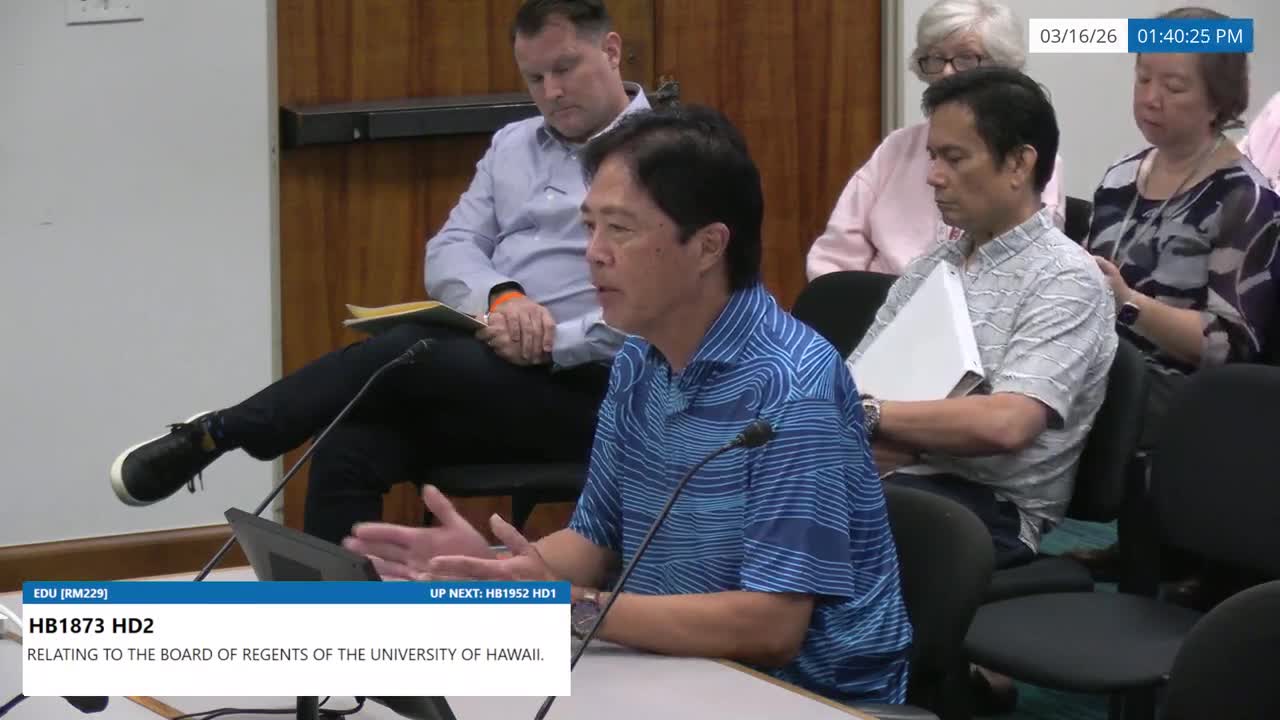 8MIN
Senate Standing Committee on Education
 4MIN
Senate Standing Committee on Water, Land, Culture and the Arts
 53SEC
Senate Standing Committee on Water, Land, Culture and the Arts
Bill Author

Bill Co-Author(s):