SB 562: DOA; Invasive Species; Plant Nursery Registry Program; Pests; Taxa; Quarantine; Control and Eradication; Biosecurity
- Session Year: 2025-2026
- House: Senate
- Latest Version Date: 2025-03-13
Current Status:
Failed
(2025-12-08: Carried over to 2026 Regular Session.)
Introduced
In Committee
First Chamber
In Committee
Second Chamber
Final Decking
Enacted
Establishes a Plant Nursery Registry Program to regulate the sale of nursery stock. Requires certain plant nurseries to register with the Department of Agriculture. Establishes penalties. Effective 7/1/3000. (HD1)
Establishes a Plant Nursery Registry Program to regulate the sale of nursery stock. Requires certain plant nurseries to register with the Department of Agriculture. Establishes penalties. Effective 7/1/2050. (SD2)
Establishes a Plant Nursery Registry Program to regulate the sale of nursery stock. Requires certain plant nurseries to register with the Department of Agriculture. (SD1)
Establishes a Plant Nursery Registry Program to regulate the sale of nursery stock. Requires certain plant nurseries to register with the Department of Agriculture.
|
THE SENATE |
S.B. NO. |
562 |
|
THIRTY-THIRD LEGISLATURE, 2025 |
S.D. 2 |
|
|
STATE OF HAWAII |
H.D. 1 |
|
|
|
|
|
|
|
||
|
|
||
A BILL FOR AN ACT
RELATING TO INVASIVE SPECIES.
BE IT ENACTED BY THE LEGISLATURE OF THE STATE OF HAWAII:
The legislature further finds that the National Plant Board has recognized plant nurseries as major pathways for the introduction and spread of pests and diseases and has provided a model nursery law with draft language that is sensible for nurseries, regulatory officials, and the public. While most nurseries employ best management practices to protect their stock from pests, some do not. Consequently, the legislature finds that regulation is necessary to protect the many from the few.
The legislature further finds that a program requiring plant nurseries to register with the department of agriculture and prohibiting the sale of pest-infested plants and other items is a common sense approach to protect consumers, agricultural producers, the general public, and the environment.
The legislature notes that other states require that plant nurseries be regularly inspected and licensed or certified, including Alabama, which requires an annual inspection certificate for certain sellers of nursery stock. Maryland and Massachusetts also require that nurseries, or places where nursery stock is grown, be inspected and certified annually. These states also require that certain fees be paid, based on the size of the nursery, to obtain the necessary credentials. Many other states, including Delaware, Kentucky, Michigan, New Hampshire, New Mexico, Ohio, Oregon, and Rhode Island, have similar programs.
The legislature also finds that the department of agriculture's existing nursery inspection program established in part III of chapter 150A, Hawaii Revised Statutes, relating to nursery stock export shipments, and the administrative rules to carry out that part, were last updated in 1981 and are limited to the certifications required to export plants from Hawaii to other states. The existing requirements are therefore not a comprehensive program to protect consumers in Hawaii from inadvertently purchasing plants infested with pests.
Accordingly, the purpose of this Act is to establish a plant nursery registration program to prevent the spread of pests within the State.
SECTION 2. Chapter 150A, Hawaii Revised Statutes, is amended as follows:
1. By adding a new part to be appropriately designated and to read:
"Part . Plant Nursery Registration Program
§150A-A Definitions. As used in this part:
"Best management practices" means any process, action, or combinations thereof, that provides effective means of preventing, reducing, or addressing pest, insect, and plant disease issues.
"Nursery stock" means any plant for planting, propagation, or ornamentation, including plants used to produce cut flowers; cut foliage; fresh fruit and vegetables; plants; trees; shrubs; vines; perennials; cut flowers; grafts; cuttings; and buds, whether cultivated or wild, and all viable parts of these plants.
"Sale" or "sell" means offering, exposing, or possessing for sale, exchange, barter, or trade.
§150A-B Nursery registration. (a) Any person directly engaged with the production or sale of nursery stock, including any person that sells, or produces for sale, nursery stock at pop-up sales, craft fairs, or fundraising events, or as part of a commercial landscaping business, shall register with the department using an online registration form developed by the department, which shall also be made available in paper form, before initiating business operations; provided that any person directly engaged in the production or sale of nursery stock before or on the effective date of this Act shall register with the department no later than one year from the effective date of this Act.
(b) Each initial and renewal nursery registration shall be valid for one year.
(c) The department may exempt from the nursery registration requirement any person whose business consists only of retail sales to the ultimate consumer where the total sales of nursery stock do not exceed $2,500 per year.
(d) A person shall register, pursuant to subsection (a), each location where the person intends to produce, sell, or regularly store or distribute nursery stock.
§150A-C Certification. Each person initially registering a location pursuant to section 150A-B shall certify to the department that the person:
(1) Will not sell at the location any plant taxa designated by the department as:
(A) A restricted plant in violation of the department's sale restriction on that taxa; or
(B) A noxious weed;
(2) Will maintain the location, including nursery stock and all other materials, to be free from pests and document in a log book all dates on which actions are taken to ensure that the location is free of pests, including a description of those actions;
(3) Will report to the department any new occurrence of a pest;
(4) Will not sell or distribute nursery stock that is infested or infected with a pest;
(5) Will utilize best management practices to maintain control of pests;
(6) Will report to the department any occurrence of a taxa, including a plant disease, that is not known to occur in the State;
(7) Will implement any best management practices required by the department for the location; and
(8) Consents to, and agrees to cooperate with, inspections by the department during reasonable business hours to ensure that the person is in compliance with the certification required by this section.
§150A-D Nursery registration fee. (a) The department may charge a fee for registration under this part.
(b) Any fees collected under this section shall be paid to the department and deposited into the pest inspection, quarantine, and eradication fund established under section 150A‑4.5.
§150A-E Inspection; quarantine; remedial measures. (a) The department may administratively inspect, with or without notice during reasonable business hours, a location registered pursuant to section 150A-B, including all nursery stock and other materials at the location. The inspection of the location shall not include the inspection of dwellings or other structures at the location that are not associated with the nursery stock.
(b) The department may:
(1) Conduct inspections pursuant to subsection (a) in response to a complaint alleging the presence of pests or failure to maintain control of pests; and
(2) Prioritize and conduct more frequent inspections pursuant to subsection (a) based on its assessment of the location's history of compliance with this part and the location's potential for spreading pests.
(c) If the department, after an inspection authorized under this section or by any other means, finds that a pest is present in nursery stock or any other material at a location where nursery stock is present, that pests are not under control at the location, or that the person who has registered the location pursuant to section 150A-B is otherwise not in compliance with a certification made under section 150A-C, the department may:
(1) Require the implementation of specific best management practices or other actions, including treatment;
(2) Issue a quarantine order for the affected nursery stock, other material, or location and, if appropriate, a treatment or destruction order for affected nursery stock or material; and
(3) Require the affected nursery stock or material to be mitigated by whatever means necessary, including destruction, confiscation, treatment, return shipment, or quarantine, at the expense of the person who registered the location, without any form of compensation from the department or State.
(d) If the department issues an order pursuant to subsection (c) for nursery stock, other material, or a location, the department shall provide, in writing, to the person who registered the location:
(1) Notice that the order has been issued, including a description of the specific nursery stock, other material, or a location that is covered by the order;
(2) A description of the specific reasons for the issuance of the order and the actions required to comply with the order; and
(3) Notice that the person who registered the location may request a subsequent inspection to lift the order; provided that, after the inspection, the department may lift the order if the department determines that the violation that caused the department to issue the order has been corrected.
(e) During the period that an order issued pursuant to subsection (c) is in effect for nursery stock, other material, or a location, no person shall sell, ship, transport, donate, or otherwise move, alter, or tamper with affected nursery stock or material at the location, unless required to comply with an order from, or under the direction of, the department.
§150A-F Economic loss or damage. The State shall not be liable for any economic loss or damages, including loss of income, related to any actions taken by the department pursuant to this part or any rules adopted under this part, including the issuance of treatment, confiscation, quarantine, return shipment, or destruction orders for any item.
§150A-G Rules. The department may adopt rules pursuant to chapter 91 to carry out the purposes of this part."
2. By adding a new section to part III to be appropriately designated and to read:
"§150A- Nursery registration required. No certification or service related to nursery stock shall be provided under this part to any person at a location unless that location is registered pursuant to part ."
SECTION 3. Section 150A-14, Hawaii Revised Statutes, is amended to read as follows:
"§150A-14
Penalty. (a) Any person who violates any
provision of this chapter other than sections 150A-5, 150A-6(3), and 150A-6(4) and
part , or who violates any rule adopted under
this chapter other than those rules involving an animal that is prohibited or a
plant, animal, or microorganism that is restricted, without a permit, and
rules adopted under part , shall be guilty of
a misdemeanor and fined [not] no less than $100. The provisions of section 706-640
notwithstanding, the maximum fine shall be $10,000. For a second offense committed within five
years of a prior offense, the person or organization shall be fined [not]
no less than $500 and [not] no more than $25,000.
(b) Any person who violates section 150A-5 shall
be guilty of a petty misdemeanor and fined [not] no less than $50
and [not] no more than $5,000.
For a second offense committed within five years of a prior offense, the
person may be fined [not] no less than $250 and [not] no
more than $15,000.
(c) Any person who:
(1) Violates section 150A-6(3) or
150A-6(4), or owns or intentionally transports, possesses, harbors, transfers,
or causes the importation of any snake or other prohibited animal seized under
section 150A‑7(b), or whose violation involves an animal that is
prohibited or a plant, animal, or microorganism that is restricted, without a
permit, shall be guilty of a misdemeanor and subject to a fine of [not]
no less than $5,000[, but not] and no more than
$20,000;
(2) Intentionally transports, harbors, or
imports with the intent to propagate, sell, or release any animal that is
prohibited or any plant, animal, or microorganism that is restricted, without a
permit, shall be guilty of a class C felony and subject to a fine of [not]
no less than $50,000[, but not] and no more than
$200,000; or
(3) Intentionally imports, possesses,
harbors, transfers, or transports, including through interisland or intraisland
movement, with the intent to propagate, sell, or release, any pest designated
by statute or rule, unless otherwise allowed by law, shall be guilty of a class
C felony and subject to a fine of [not] no less than
$50,000[, but not] and no more than $200,000.
(d) Any person who violates part or any rule adopted under part shall be fined no more than $ for each separate offense. Each date of violation shall constitute a separate offense. Any action taken to impose or collect the penalty provided for in this subsection shall be considered a civil action. All fines collected pursuant to this subsection shall be paid to the department and deposited into the pest inspection, quarantine, and eradication fund established under section 150A-4.5.
[(d)]
(e) Whenever a court sentences a
person or organization pursuant to subsection (a) or (c) for an offense [which]
that has resulted in the escape or establishment of any pest and caused
the department to initiate a program to capture, control, or eradicate that
pest, the court shall also require that the person or organization pay to the
state general fund an amount of money to be determined in the discretion of the
court upon advice of the department, based upon the cost of the development and
implementation of the program.
[(e)]
(f) The department may, at its
discretion, refuse entry, confiscate, or destroy any prohibited articles or
restricted articles that are brought into the State without a permit issued by
the department, or order the return of any plant, fruit, vegetable, or any
other article infested with pests to its place of origin or otherwise dispose
of it or [such] any part thereof as may be necessary to comply
with this chapter. Any expense or loss
in connection therewith shall be borne by the owner or the owner's agent.
[(f)]
(g) Any person or organization
that voluntarily surrenders any prohibited animal or any restricted plant,
animal, or microorganism without a permit issued by the department, [prior
to] before the initiation of any seizure action by the department,
shall be exempt from the penalties of this section.
[(g)]
(h) For purposes of this section,
"intent to propagate" shall be presumed when the person in question
is found to possess, transport, harbor, or import:
(1) Any two or more animal specimens of the opposite sex that are prohibited or restricted, without a permit, or are a pest designated by statute or rule;
(2) Any three or more animal specimens of either sex that are prohibited or restricted, without a permit, or are a pest designated by statute or rule;
(3) Any plant or microorganism having the inherent capability to reproduce and that is restricted, without a permit; or
(4) Any specimen that is in the process of reproduction."
SECTION 4. Section 150A-53, Hawaii Revised Statutes, is amended to read as follows:
"§150A-53 General actions to achieve objectives. (a) To achieve the objectives of the biosecurity program, the department shall plan for and, within available legislative appropriations or through funding from other sources, implement the following:
(1) Work with government agencies and agricultural commodity exporters of other states and countries to establish pre-entry inspection programs under which inbound cargo into the State is inspected at the ports of departure or other points outside the State;
(2) Establish, operate, or participate in operating port‑of-entry facilities where multiple government agencies may inspect, quarantine, fumigate, disinfect, destroy, or exclude as appropriate, articles that may harbor pests or exclude articles that are prohibited or restricted without a permit, with the goals of:
(A) Performing inspections in an efficient, effective, and expeditious manner for the government agencies involved and for cargo owners, carriers, and importers; and
(B) Providing for the proper and safe storage and handling of cargo, especially agricultural and food commodities, awaiting inspection;
(3) Develop, implement, and coordinate post-entry measures to eradicate, control, reduce, and suppress pests and, as appropriate, eradicate or seize and dispose of prohibited or restricted organisms without a permit that have entered the State;
(4) Collaborate with relevant government agencies, agricultural commodity importers, and other persons to examine and develop joint integrated systems to better implement the biosecurity program;
(5) Improve cargo inspection capabilities and methods, including enhancement of the content and submission requirements for cargo manifests and agricultural commodity ownership and movement certificates;
(6) Promote the production of agricultural commodities in the State to reduce cargo shipments of imported commodities into the State; and
(7) Provide public education on the
negative effects of pests and prohibited or restricted organisms without a
permit[,] to the environment and economy of the State.
(b) The department shall establish parameters and construction requirements for biosecurity facilities that provide for and ensure the safety of agricultural and food commodities consumed by Hawaii residents, including cold storage facilities established by private-public partnerships to preserve the quality and ensure the safety of the commodities arriving at the State's airports and harbors.
(c) The plant nursery registration program established under part :
(1) Shall be considered a part of the biosecurity program; and
(2) May be administered by and enforced using the officials and funds available to the biosecurity program."
SECTION 5. This Act does not affect rights and duties that matured, penalties that were incurred, and proceedings that were begun before its effective date.
SECTION 6. In codifying the new sections added by section 2 of this Act, the revisor of statutes shall substitute appropriate section numbers for the letters used in designating the new sections in this Act.
SECTION 7. Statutory material to be repealed is bracketed and stricken. New statutory material is underscored.
SECTION 8. This Act shall take effect on July 1, 3000.
Report Title:
DOA; Invasive Species; Plant Nursery Registry Program; Pests; Taxa; Quarantine; Control and Eradication; Biosecurity
Description:
Establishes a Plant Nursery Registry Program to regulate the sale of nursery stock. Requires certain plant nurseries to register with the Department of Agriculture. Establishes penalties. Effective 7/1/3000. (HD1)
The summary description of legislation appearing on this page is for informational purposes only and is not legislation or evidence of legislative intent.
|
THE SENATE |
S.B. NO. |
562 |
|
THIRTY-THIRD LEGISLATURE, 2025 |
S.D. 2 |
|
|
STATE OF HAWAII |
|
|
|
|
|
|
|
|
||
|
|
||
A BILL FOR AN ACT
RELATING TO INVASIVE SPECIES.
BE IT ENACTED BY THE LEGISLATURE OF THE STATE OF HAWAII:
The legislature further finds that the National Plant Board has recognized plant nurseries as major pathways for the introduction and spread of pests and diseases and has provided a model nursery law with draft language that is sensible for nurseries, regulatory officials, and the public. While most nurseries employ best management practices to protect their stock from pests, others do not. Consequently, the legislature finds that regulation is necessary to protect the many from the few.
The legislature further finds that a program requiring plant nurseries to register with the department of agriculture and prohibiting the sale of pest-infested plants and other items is a common sense approach to protect consumers, agricultural producers, the general public, and the environment.
The legislature notes that other states require that plant nurseries be regularly inspected and licensed or certified, including Alabama, which requires an annual inspection certificate for certain sellers of nursery stock. Maryland and Massachusetts also require that nurseries, or places where nursery stock is grown, be inspected and certified annually. These states require that certain fees be paid, based on the size of the nursery, to obtain the necessary credentials. Many other states, including Delaware, Kentucky, Michigan, New Hampshire, New Mexico, Ohio, Oregon, and Rhode Island, have similar programs.
The legislature also finds that the department of agriculture's existing nursery inspection program established in part III of chapter 150A, Hawaii Revised Statutes, relating to nursery stock export shipments, and the administrative rules to carry out that part, were last updated in 1981 and are limited to the certifications required to export plants from Hawaii to other states. The existing requirements are therefore not a comprehensive program to protect consumers in Hawaii from inadvertently purchasing plants infested with pests.
Accordingly, the purpose of this Act is to establish a plant nursery registration program to prevent the spread of pests within the State.
SECTION 2. Chapter 150A, Hawaii Revised Statutes, is amended as follows:
1. By adding a new part to be appropriately designated and to read:
"Part . Plant Nursery Registration Program
§150A-A Definitions. As used in this part:
"Best management practices" means any process, action, or combinations thereof, that provides effective means of preventing, reducing, or addressing pest, insect, and plant disease issues.
"Nursery stock" means any plant for planting, propagation, or ornamentation, including plants used to produce cut flowers; cut foliage; fresh fruit and vegetables; plants; trees; shrubs; vines; perennials; cut flowers; grafts; cuttings; and buds, whether cultivated or wild, and all viable parts of these plants.
"Sale" or "sell" means offering, exposing, or possessing for sale, exchange, barter, or trade.
§150A-B Nursery registration. (a) Any person directly engaged with the production or sale of nursery stock, including any person that sells, or produces for sale, nursery stock at pop-up sales, craft fairs, or fundraising events, or as part of a commercial landscaping business, shall register with the department using an online registration form developed by the department, which shall also be made available in paper form, before initiating business operations; provided that any person directly engaged in the production or sale of nursery stock before or on the effective date of this Act shall register with the department no later than one year from the effective date of this Act.
(b) A person shall renew their nursery registration each year.
(c) The department may exempt from the nursery registration requirement any person whose business consists only of retail sales to the ultimate consumer; provided that the total sales of nursery stock does not exceed $2,500 per year.
(d) A person shall register, pursuant to subsection (a), each location where the person produces, sells, or regularly stores or distributes nursery stock.
§150A-C Certification. Each person making a registration for a location pursuant to section 150A-B shall certify to the department that the person:
(1) Shall not sell at the location any plant taxa designated by the department as:
(A) A restricted plant in violation of the department's sale restriction on that taxa; or
(B) A noxious weed;
(2) Shall maintain the location, including nursery stock and all other materials, to be free from pests and document in a log book all dates on which any actions were taken to ensure that the location is free of pests, including a description of those actions;
(3) Shall report to the department any new occurrence of a pest;
(4) Shall not sell or distribute nursery stock that is infested or infected with a pest;
(5) Shall utilize best management practices to maintain control of pests;
(6) Shall report to the department any occurrence of a taxa, including a plant disease, that is not known to occur in the State;
(7) Shall implement any best management practices required by the department for the location; and
(8) Consents to, and agrees to cooperate with, inspections by the department during reasonable business hours to ensure that the person is in compliance with the certification required by this section.
§150A-D Nursery registration fee. (a) The department may charge a fee for registration under this part.
(b) Any fees collected under this section shall be paid to the department and deposited into the pest inspection, quarantine, and eradication fund established under section 150A‑4.5.
§150A-E Inspection; quarantine; remedial measures. (a) The department may administratively inspect, with or without notice during reasonable business hours, a location registered pursuant to section 150A-B, including all nursery stock and other materials at the location. The inspection of the location shall not include the inspection of dwellings or other structures at the location that are not associated with the nursery stock.
(b) The department may:
(1) Conduct inspections pursuant to subsection (a) in response to a complaint alleging the presence of pests or failure to maintain control of pests; and
(2) Prioritize and conduct more frequent inspections pursuant to subsection (a) based on its assessment of the location's history of compliance with this part and the location's potential for spreading pests.
(c) If the department, after an inspection authorized under this section or by any other means, finds that a pest is present in nursery stock or any other material at a location where nursery stock is present, that pests are not under control at the location, or that the person who has registered the location pursuant to section 150A-B is otherwise not in compliance with a certification made under section 150A-C, the department may:
(1) Require the implementation of specific best management practices or other actions, including treatment;
(2) Issue a quarantine order for the affected nursery stock, other material, or location and, if appropriate, a treatment or destruction order for affected nursery stock or material; and
(3) Require the affected nursery stock or material to be mitigated by whatever means necessary, including destruction, confiscation, treatment, return shipment, or quarantine, at the expense of the person who registered the location, without any form of compensation from the department or State.
(d) If the department issues an order pursuant to subsection (c) for nursery stock, other material, or a location, the department shall provide, in writing, to the person who registered the location:
(1) Notice that the order has been issued, including a description of the specific nursery stock, other material, or a location that is covered by the order;
(2) A description of the specific reasons for the issuance of the order and the actions required to comply with the order; and
(3) Notice that the person who registered the location may request a subsequent inspection to lift the order; provided that, after the inspection, the department may lift the order if the department determines that the violation that caused the department to issue the order has been corrected.
(e) During the period that an order issued pursuant to subsection (c) is in effect for nursery stock, other material, or a location, no person shall sell, ship, transport, donate, or otherwise move, alter, or tamper with affected nursery stock or material at the location, unless required to comply with an order from, or under the direction of, the department.
§150A-F Economic loss or damage. The State shall not be liable for any economic loss or damages, including loss of income, related to any actions taken by the department pursuant to this part or any rules adopted under this part. Actions include the issuance of treatment, quarantine, or destruction orders for any item.
§150A-G Rules. The department may adopt rules pursuant to chapter 91 to carry out the purposes of this part."
2. By adding a new section to part III to be appropriately designated and to read:
"§150A- Nursery registration required. No certification or service related to nursery stock may be provided under this part to any person at a location unless that location is registered pursuant to part ."
SECTION 3. Section 150A-14, Hawaii Revised Statutes, is amended to read as follows:
"§150A-14
Penalty. (a) Any person who violates any
provision of this chapter other than sections 150A-5, 150A-6(3), [and]
150A-6(4), and part , or who violates any
rule adopted under this chapter other than those rules involving an animal that
is prohibited or a plant, animal, or microorganism that is restricted, without
a permit, and those rules adopted under part ,
shall be guilty of a misdemeanor and fined not less than $100. The provisions of section 706-640
notwithstanding, the maximum fine shall be $10,000. For a second offense committed within five
years of a prior offense, the person or organization shall be fined not less
than $500 and not more than $25,000.
(b) Any person who violates section 150A-5 shall be guilty of a petty misdemeanor and fined not less than $50 and not more than $5,000. For a second offense committed within five years of a prior offense, the person may be fined not less than $250 and not more than $15,000.
(c) Any person who:
(1) Violates section 150A-6(3) or
150A-6(4), or owns or intentionally transports, possesses, harbors, transfers,
or causes the importation of any snake or other prohibited animal seized under
section 150A‑7(b), or whose violation involves an animal that is
prohibited or a plant, animal, or microorganism that is restricted, without a
permit, shall be guilty of a misdemeanor and subject to a fine of not less than
$5,000[, but] and not more than $20,000;
(2) Intentionally transports, harbors, or
imports with the intent to propagate, sell, or release any animal that is
prohibited or any plant, animal, or microorganism that is restricted, without a
permit, shall be guilty of a class C felony and subject to a fine of not less
than $50,000[, but] and not more than $200,000; or
(3) Intentionally imports, possesses,
harbors, transfers, or transports, including through interisland or intraisland
movement, with the intent to propagate, sell, or release, any pest designated
by statute or rule, unless otherwise allowed by law, shall be guilty of a class
C felony and subject to a fine of not less than $50,000[, but] and
not more than $200,000.
(d) Any person who violates part or any rule adopted under part shall be fined not more than $ for each separate offense. Each date of violation shall constitute a separate offense. Any action taken to impose or collect the penalty provided for in this subsection shall be considered a civil action. All fines collected pursuant to this subsection shall be paid to the department and deposited into the pest inspection, quarantine, and eradication fund established under section 150A-4.5.
[(d)]
(e) Whenever a court sentences a
person or organization pursuant to subsection (a) or (c) for an offense [which]
that has resulted in the escape or establishment of any pest and caused
the department to initiate a program to capture, control, or eradicate that
pest, the court shall also require that the person or organization pay to the
state general fund an amount of money to be determined in the discretion of the
court upon advice of the department, based upon the cost of the development and
implementation of the program.
[(e)]
(f) The department may, at its
discretion, refuse entry, confiscate, or destroy any prohibited articles or
restricted articles that are brought into the State without a permit issued by
the department, or order the return of any plant, fruit, vegetable, or any
other article infested with pests to its place of origin or otherwise dispose
of it or [such] any part thereof as may be necessary to comply
with this chapter. Any expense or loss
in connection therewith shall be borne by the owner or the owner's agent.
[(f)]
(g) Any person or organization
that voluntarily surrenders any prohibited animal or any restricted plant,
animal, or microorganism without a permit issued by the department, [prior
to] before the initiation of any seizure action by the department,
shall be exempt from the penalties of this section.
[(g)]
(h) For purposes of this section,
"intent to propagate" shall be presumed when the person in question
is found to possess, transport, harbor, or import:
(1) Any two or more animal specimens of the opposite sex that are prohibited or restricted, without a permit, or are a pest designated by statute or rule;
(2) Any three or more animal specimens of either sex that are prohibited or restricted, without a permit, or are a pest designated by statute or rule;
(3) Any plant or microorganism having the inherent capability to reproduce and that is restricted, without a permit; or
(4) Any specimen that is in the process of reproduction."
SECTION 4. Section 150A-53, Hawaii Revised Statutes, is amended to read as follows:
"§150A-53 General actions to achieve objectives. (a) To achieve the objectives of the biosecurity program, the department shall plan for and, within available legislative appropriations or through funding from other sources, implement the following:
(1) Work with government agencies and agricultural commodity exporters of other states and countries to establish pre-entry inspection programs under which inbound cargo into the State is inspected at the ports of departure or other points outside the State;
(2) Establish, operate, or participate in operating port‑of-entry facilities where multiple government agencies may inspect, quarantine, fumigate, disinfect, destroy, or exclude as appropriate, articles that may harbor pests or exclude articles that are prohibited or restricted without a permit, with the goals of:
(A) Performing inspections in an efficient, effective, and expeditious manner for the government agencies involved and for cargo owners, carriers, and importers; and
(B) Providing for the proper and safe storage and handling of cargo, especially agricultural and food commodities, awaiting inspection;
(3) Develop, implement, and coordinate post-entry measures to eradicate, control, reduce, and suppress pests and, as appropriate, eradicate or seize and dispose of prohibited or restricted organisms without a permit that have entered the State;
(4) Collaborate with relevant government agencies, agricultural commodity importers, and other persons to examine and develop joint integrated systems to better implement the biosecurity program;
(5) Improve cargo inspection capabilities and methods, including enhancement of the content and submission requirements for cargo manifests and agricultural commodity ownership and movement certificates;
(6) Promote the production of agricultural commodities in the State to reduce cargo shipments of imported commodities into the State; and
(7) Provide public education on the negative effects of pests and prohibited or restricted organisms without a permit, to the environment and economy of the State.
(b) The department shall establish parameters and construction requirements for biosecurity facilities that provide for and ensure the safety of agricultural and food commodities consumed by Hawaii residents, including cold storage facilities established by private-public partnerships to preserve the quality and ensure the safety of the commodities arriving at the State's airports and harbors.
(c) The plant nursery registration program established under part :
(1) Shall be considered to be a part of the biosecurity program; and
(2) May be administered by and enforced using the officials and funds available to the biosecurity program."
SECTION 5. This Act does not affect rights and duties that matured, penalties that were incurred, and proceedings that were begun before its effective date.
SECTION 6. Statutory material to be repealed is bracketed and stricken. New statutory material is underscored.
SECTION 7. This Act shall take effect on July 1, 2050.
Report Title:
DOA; Invasive Species; Plant Nursery Registry Program; Pests; Taxa; Quarantine; Control and Eradication; Biosecurity
Description:
Establishes a Plant Nursery Registry Program to regulate the sale of nursery stock. Requires certain plant nurseries to register with the Department of Agriculture. Establishes penalties. Effective 7/1/2050. (SD2)
The summary description of legislation appearing on this page is for informational purposes only and is not legislation or evidence of legislative intent.
|
THE SENATE |
S.B. NO. |
562 |
|
THIRTY-THIRD LEGISLATURE, 2025 |
S.D. 1 |
|
|
STATE OF HAWAII |
|
|
|
|
|
|
|
|
||
|
|
||
A BILL FOR AN ACT
RELATING TO INVASIVE SPECIES.
BE IT ENACTED BY THE LEGISLATURE OF THE STATE OF HAWAII:
The legislature further finds that the National Plant Board has recognized plant nurseries as major pathways for the introduction and spread of pests and diseases and has provided a model nursery law with draft language that is sensible for nurseries, regulatory officials, and the public. While most nurseries employ best management practices to protect their stock from pests, others do not. Consequently, the legislature finds that regulation is necessary to protect the many from the few.
The legislature further finds that a program requiring plant nurseries to register with the department of agriculture and prohibiting the sale of pest-infested plants and other items is a common sense approach to protect consumers, agricultural producers, the general public, and the environment.
The legislature notes that other states require that plant nurseries be regularly inspected and licensed or certified, including Alabama, which requires an annual inspection certificate for certain sellers of nursery stock. Maryland and Massachusetts also require that nurseries, or places where nursery stock is grown, be inspected and certified annually. These states require that certain fees be paid, based on the size of the nursery, to obtain the necessary credentials. Many other states, including Delaware, Kentucky, Michigan, New Hampshire, New Mexico, Ohio, Oregon, and Rhode Island, have similar programs.
The legislature also finds that the department of agriculture's existing nursery inspection program established in part III of chapter 150A, Hawaii Revised Statutes, relating to nursery stock export shipments, and the administrative rules to carry out that part, were last updated in 1981 and are limited to the certifications required to export plants from Hawaii to other states. The existing requirements are therefore not a comprehensive program to protect consumers in Hawaii from inadvertently purchasing plants infested with pests.
Accordingly, the purpose of this Act is to establish a plant nursery registration program to prevent the spread of pests within the State.
SECTION 2. Chapter 150A, Hawaii Revised Statutes, is amended as follows:
1. By adding a new part to be appropriately designated and to read:
"Part . Plant Nursery Registration Program
§150A-A Definitions. As used in this part:
"Best management practices" means any process, action, or combinations thereof, that provides effective means of preventing, reducing, or addressing pest, insect, and plant disease issues.
"Nursery stock" means any plant for planting, propagation, or ornamentation, including plants used to produce cut flowers; cut foliage; fresh fruit and vegetables; plants; trees; shrubs; vines; perennials; grafts; cuttings; and buds, whether cultivated or wild, and all viable parts of these plants.
"Sale" or "sell" means offering, exposing, or possessing for sale, exchange, barter, or trade.
§150A-B Nursery registration. (a) Any person directly engaged with the production or sale of nursery stock, including any person that sells, or produces for sale, nursery stock at pop-up sales, craft fairs, or fundraising events, or as part of a commercial landscaping business, shall register with the department using an online registration form developed by the department, which shall also be made available in paper form, before initiating business operations; provided that any person directly engaged in the production or sale of nursery stock before or on the effective date of this Act shall register with the department no later than one year from the effective date of this Act.
(b) A person shall renew their nursery registration each year.
(c) The department may exempt from the nursery registration requirement any person whose business consists only of retail sales to the ultimate consumer; provided that the total sales of nursery stock does not exceed $2,500 per year.
(d) A person shall register, pursuant to subsection (a), each location where the person produces, sells, or regularly stores or distributes nursery stock.
(e) The department shall publish on its website and other appropriate platforms a list of the locations that are registered pursuant to this section.
§150A-C Certification. Each person making a registration for a location pursuant to section 150A-B shall certify to the department that the person:
(1) Shall not sell at the location any plant taxa designated by the department as:
(A) A restricted plant in violation of the department's sale restriction on that taxa; or
(B) A noxious weed;
(2) Shall maintain the location, including nursery stock and all other materials, to be free from pests and document in a log book all dates on which any actions were taken to ensure that the location is free of pests, including a description of those actions;
(3) Shall report to the department any new occurrence of a pest;
(4) Shall not sell or distribute nursery stock that is infested or infected with a pest;
(5) Shall utilize best management practices to maintain control of pests;
(6) Shall report to the department any occurrence of a taxa, including a plant disease, that is not known to occur in the State;
(7) Shall implement any best management practices required by the department for the location; and
(8) Consents to, and agrees to cooperate with, inspections by the department during reasonable business hours to ensure that the person is in compliance with the certification required by this section.
§150A-D Nursery registration fee. (a) The department may charge a fee for registration under this part.
(b) Any fees collected under this section shall be paid to the department and deposited into the pest inspection, quarantine, and eradication fund established under section 150A-4.5.
§150A-E Inspection; quarantine; remedial measures. (a) The department may administratively inspect, with or without notice during reasonable business hours, a location registered pursuant to section 150A-B, including all nursery stock and other materials at the location. The inspection of the location shall not include the inspection of dwellings or other structures at the location that are not associated with the nursery stock.
(b) The department may:
(1) Conduct inspections pursuant to subsection (a) in response to a complaint alleging the presence of pests or failure to maintain control of pests; and
(2) Prioritize and conduct more frequent inspections pursuant to subsection (a) based on its assessment of the location's history of compliance with this part and the location's potential for spreading pests.
(c) If the department, after an inspection authorized under this section or by any other means, finds that a pest is present in nursery stock or any other material at a location where nursery stock is present, that pests are not under control at the location, or that the person who has registered the location pursuant to section 150A-B is otherwise not in compliance with a certification made under section 150A-C, the department may:
(1) Require the implementation of specific best management practices or other actions, including treatment;
(2) Issue a quarantine order for the affected nursery stock, other material, or location and, if appropriate, a treatment or destruction order for affected nursery stock or material; and
(3) Require the affected nursery stock or material to be mitigated by whatever means necessary, including destruction, confiscation, treatment, return shipment, or quarantine, at the expense of the person who registered the location, without any form of compensation from the department or State.
(d) If the department issues an order pursuant to subsection (c) for nursery stock, other material, or a location, the department shall provide, in writing, to the person who registered the location:
(1) Notice that the order has been issued, including a description of the specific nursery stock, other material, or a location that is covered by the order;
(2) A description of the specific reasons for the issuance of the order and the actions required to comply with the order; and
(3) Notice that the person who registered the location may request a subsequent inspection to lift the order; provided that, after the inspection, the department may lift the order if the department determines that the violation that caused the department to issue the order has been corrected.
(e) During the period that an order issued pursuant to subsection (c) is in effect for nursery stock, other material, or a location, no person shall sell, ship, transport, donate, or otherwise move, alter, or tamper with affected nursery stock or material at the location, unless required to comply with an order from, or under the direction of, the department.
§150A-F Economic loss or damage. The State shall not be liable for any economic loss or damages, including loss of income, related to any actions taken by the department pursuant to this part or any rules adopted under this part. Actions include the issuance of treatment, quarantine, or destruction orders for any item.
§150A-G Rules. The department may adopt rules pursuant to chapter 91 to carry out the purposes of this part."
2. By adding a new section to part III to be appropriately designated and to read:
"§150A- Nursery registration required. No certification or service related to nursery stock may be provided under this part to any person at a location unless that location is registered pursuant to part ."
SECTION 3. Section 150A-14, Hawaii Revised Statutes, is amended to read as follows:
"§150A-14 Penalty.
(a) Any
person who violates any provision of this chapter other than sections 150A-5,
150A-6(3), [and] 150A-6(4), and part ,
or who violates any rule adopted under this chapter other than those rules
involving an animal that is prohibited or a plant, animal, or microorganism
that is restricted, without a permit, and those rules adopted under part
, shall be guilty of a misdemeanor and fined
not less than $100. The provisions of
section 706-640 notwithstanding, the maximum fine shall be $10,000. For a second offense committed within five
years of a prior offense, the person or organization shall be fined not less
than $500 and not more than $25,000.
(b) Any person who violates section 150A-5 shall be guilty of a petty misdemeanor and fined not less than $50 and not more than $5,000. For a second offense committed within five years of a prior offense, the person may be fined not less than $250 and not more than $15,000.
(c) Any person who:
(1) Violates section 150A-6(3) or
150A-6(4), or owns or intentionally transports, possesses, harbors, transfers,
or causes the importation of any snake or other prohibited animal seized under
section 150A-7(b), or whose violation involves an animal that is prohibited or
a plant, animal, or microorganism that is restricted, without a permit, shall
be guilty of a misdemeanor and subject to a fine of not less than $5,000[,
but] and not more than $20,000;
(2) Intentionally transports, harbors, or
imports with the intent to propagate, sell, or release any animal that is
prohibited or any plant, animal, or microorganism that is restricted, without a
permit, shall be guilty of a class C felony and subject to a fine of not less
than $50,000[, but] and not more than $200,000; or
(3) Intentionally
imports, possesses, harbors, transfers, or transports, including through
interisland or intraisland movement, with the intent to propagate, sell, or
release, any pest designated by statute or rule, unless otherwise allowed by
law, shall be guilty of a class C felony and subject to a fine of not less than
$50,000[, but] and not more than $200,000.
(d) Any person who violates part or any rule adopted under part shall be fined not more than $ for each separate offense. Each date of violation shall constitute a separate offense. Any action taken to impose or collect the penalty provided for in this subsection shall be considered a civil action. All fines collected pursuant to this subsection shall be paid to the department and deposited into the pest inspection, quarantine, and eradication fund established under section 150A-4.5.
[(d)] (e) Whenever a court sentences a person or
organization pursuant to subsection (a) or (c) for an offense which has
resulted in the escape or establishment of any pest and caused the department
to initiate a program to capture, control, or eradicate that pest, the court
shall also require that the person or organization pay to the state general
fund an amount of money to be determined in the discretion of the court upon
advice of the department, based upon the cost of the development and
implementation of the program.
[(e)] (f) The department may, at its discretion, refuse
entry, confiscate, or destroy any prohibited articles or restricted articles
that are brought into the State without a permit issued by the department, or
order the return of any plant, fruit, vegetable, or any other article infested
with pests to its place of origin or otherwise dispose of it or such part
thereof as may be necessary to comply with this chapter. Any expense or loss in connection therewith
shall be borne by the owner or the owner's agent.
[(f)] (g) Any person or organization that voluntarily
surrenders any prohibited animal or any restricted plant, animal, or
microorganism without a permit issued by the department, [prior to] before
the initiation of any seizure action by the department, shall be exempt from
the penalties of this section.
[(g)] (h) For purposes of this section, "intent to
propagate" shall be presumed when the person in question is found to
possess, transport, harbor, or import:
(1) Any two or more animal specimens of the opposite sex that are prohibited or restricted, without a permit, or are a pest designated by statute or rule;
(2) Any three or more animal specimens of either sex that are prohibited or restricted, without a permit, or are a pest designated by statute or rule;
(3) Any plant or microorganism having the inherent capability to reproduce and that is restricted, without a permit; or
(4) Any specimen that is in the process of reproduction."
SECTION 4. Section 150A-53, Hawaii Revised Statutes, is amended to read as follows:
"§150A-53 General actions to achieve objectives. (a) To achieve the objectives of the biosecurity program, the department shall plan for and, within available legislative appropriations or through funding from other sources, implement the following:
(1) Work with government agencies and agricultural commodity exporters of other states and countries to establish pre-entry inspection programs under which inbound cargo into the State is inspected at the ports of departure or other points outside the State;
(2) Establish, operate, or participate in operating port-of-entry facilities where multiple government agencies may inspect, quarantine, fumigate, disinfect, destroy, or exclude as appropriate, articles that may harbor pests or exclude articles that are prohibited or restricted without a permit, with the goals of:
(A) Performing inspections in an efficient, effective, and expeditious manner for the government agencies involved and for cargo owners, carriers, and importers; and
(B) Providing for the proper and safe storage and handling of cargo, especially agricultural and food commodities, awaiting inspection;
(3) Develop, implement, and coordinate post-entry measures to eradicate, control, reduce, and suppress pests and, as appropriate, eradicate or seize and dispose of prohibited or restricted organisms without a permit that have entered the State;
(4) Collaborate with relevant government agencies, agricultural commodity importers, and other persons to examine and develop joint integrated systems to better implement the biosecurity program;
(5) Improve cargo inspection capabilities and methods, including enhancement of the content and submission requirements for cargo manifests and agricultural commodity ownership and movement certificates;
(6) Promote the production of agricultural commodities in the State to reduce cargo shipments of imported commodities into the State; and
(7) Provide public education on the negative effects of pests and prohibited or restricted organisms without a permit, to the environment and economy of the State.
(b) The department shall establish parameters and construction requirements for biosecurity facilities that provide for and ensure the safety of agricultural and food commodities consumed by Hawaii residents, including cold storage facilities established by private-public partnerships to preserve the quality and ensure the safety of the commodities arriving at the State's airports and harbors.
(c) The plant nursery registration program established under part :
(1) Shall be considered to be a part of the biosecurity program; and
(2) May be administered by and enforced using the officials and funds available to the biosecurity program."
SECTION 5. This Act does not affect rights and duties that matured, penalties that were incurred, and proceedings that were begun before its effective date.
SECTION 6. Statutory material to be repealed is bracketed and stricken. New statutory material is underscored.
SECTION 7. This Act shall take effect on July 1, 2025.
Report Title:
DOA; Invasive Species; Plant Nursery Registry Program; Pests; Taxa; Quarantine; Control and Eradication; Biosecurity
Description:
Establishes a Plant Nursery Registry Program to regulate the sale of nursery stock. Requires certain plant nurseries to register with the Department of Agriculture. (SD1)
The summary description of legislation appearing on this page is for informational purposes only and is not legislation or evidence of legislative intent.
|
THE SENATE |
S.B. NO. |
562 |
|
THIRTY-THIRD LEGISLATURE, 2025 |
|
|
|
STATE OF HAWAII |
|
|
|
|
|
|
|
|
||
|
|
||
A BILL FOR AN ACT
relating to Invasive Species.
BE IT ENACTED BY THE LEGISLATURE OF THE STATE OF HAWAII:
The legislature further finds that the National Plant Board has recognized plant nurseries as major pathways for the introduction and spread of pests and diseases and has provided a model nursery law with draft language that is sensible for nurseries, regulatory officials, and the public. While most nurseries employ best management practices to protect their stock from high-priority pests, others do not. Consequently, the legislature finds that regulation is necessary to protect the many from the few.
The legislature further finds that a program requiring plant nurseries to register with the department of agriculture and prohibiting the sale of pest-infested plants and other items is a common sense approach to protect consumers, agricultural producers, the general public, and the environment.
The legislature notes that other states require that plant nurseries be regularly inspected and licensed or certified, including Alabama, which requires an annual inspection certificate for certain sellers of nursery stock. Maryland and Massachusetts also require that nurseries or places where nursery stock is grown, be inspected and certified annually. These states require that certain fees be paid, based on the size of the nursery, to obtain the necessary credentials. Many other states, including Delaware, Kentucky, Michigan, New Hampshire, New Mexico, Ohio, Oregon, and Rhode Island, have similar programs.
The legislature also finds that the department of agriculture's existing nursery inspection program established in part III of chapter 150A, Hawaii Revised Statutes, relating to Nursery Stock Export Shipments, and the administrative rules to carry out that part, were last updated in 1981 and are focused on certifications required to export plants from Hawaii to other states. The existing requirements are therefore not a comprehensive program to protect consumers in Hawaii from inadvertently purchasing plants infested with pests.
Accordingly, the purpose of this Act is to establish a plant nursery registration program to prevent the spread of pests within the State.
SECTION 2. Chapter 150A, Hawaii Revised Statutes, is amended as follows:
1. By adding a new part to be appropriately designated and to read:
"Part . Plant Nursery Registration Program
§150A-A Definitions. As used in this part, unless the context requires otherwise:
"Best management practices" means processes and actions based on the best available science that provide the most cost‑effective and efficacious way to address an issue, including the prevention or reduction of pest and plant disease or pathogen problems.
"Effective control" means, when referring to non-quarantine pests, eliminating or reducing a pest to the point of an acceptable economic and environmental risk.
"High-priority pest" means a pest, including a plant disease, that poses potential negative impacts to the economy, the environment, or human wealth or welfare to an area in which the pest currently:
(1) Is not known to occur; or
(2) Has a limited distribution or is being officially controlled.
The department may designate different high-priority pests for different islands in the State.
"Non-quarantine pest" means a pest, including a plant disease, that is not designated as a high-priority pest with respect to an island and that, if under effective control, does not pose an unacceptable economic or environmental risk. The department may designate different non-quarantine pests for different islands in the State.
"Nursery stock" means any plant for planting, propagation, or ornamentation (including plants used to produce cut flowers), including all plants, trees, shrubs, vines, perennials, grafts, cuttings, and buds that may be sold for propagation, whether cultivated or wild, and all viable parts of these plants.
"Sale" or "sell" means offering, exposing, or possessing for sale, exchange, barter, or trade.
"Standards of nursery cleanliness", with respect to a location where nursery stock is produced, sold, stored, or distributed, means:
(1) The implementation at the location of any method of treatment required by the department for any pest;
(2) That nursery stock or other material infested or infected with a high-priority pest at that location is isolated pending treatment or destruction;
(3) That actions are carried out to the extent that is reasonably necessary to ensure that non-quarantine pests at that location are under effective control; and
(4) The fulfillment of any other standard to prevent the spread of pests at or from the location, as required by the department for that location.
§150A-B Nursery registration. (a) Any person directly engaged with the production or sale of nursery stock, including any person that produces or sells nursery stock as part of a commercial landscaping business, shall register with the department using an online registration form developed by the department, which shall also be made available in paper form, before initiating business operations; provided that any person directly engaged in the production or sale of nursery stock before or on the effective date of this Act shall register with the department no later than one year from the effective date of this Act.
(b) A person shall renew their nursery registration each year.
(c) The department may exempt from the nursery registration requirement any person whose business consists only of retail sales to the ultimate consumer; provided that the total sales of nursery stock does not exceed $2,500 during a year.
(d) A person shall register, pursuant to subsection (a), each location where the person produces, sells, or regularly stores or distributes nursery stock.
(e) No person shall be eligible for any certificate or service under part III unless the person makes a registration required by subsection (a).
(f) The department shall publish on its website and other appropriate platforms a list of the locations that are registered under this section.
§150A-C Certification. Each person making a registration for a location pursuant to section 150A-B shall certify to the department that the person:
(1) Shall not sell at the location any plant taxa designated by the department as:
(A) A restricted plant in violation of the department's sale restriction on that taxa; or
(B) A noxious weed;
(2) Shall maintain the location, including nursery stock and all other materials, to be free from high-priority pests and document in a log book the dates that actions were taken to ensure that the location is free of high-priority pests, including a description of those actions;
(3) Shall report to the department any new occurrence of a high-priority pest;
(4) Shall not sell or distribute nursery stock that is infested or infected with a high-priority pest or non‑quarantine pest;
(5) Shall utilize best management practices to maintain effective control of non-quarantine pests;
(6) Shall report to the department any occurrence of a taxa, including a plant disease, that is not known to occur in the State;
(7) Shall implement standards of nursery cleanliness at the location;
(8) Shall implement any best management practices required by the department for the location; and
(9) Consents to, and agrees to cooperate with, inspections by the department during reasonable business hours to ensure that the person is in compliance with the certification required by this section.
§150A-D Nursery registration fee. (a) The department may charge a fee for registration under this part.
(b) Any fees collected under this section shall be paid to the department and deposited into the pest inspection, quarantine, and eradication fund under section 150A-4.5.
§150A-E Inspection; quarantine; remedial measures; contested cases. (a) The department may administratively inspect, with or without notice during reasonable business hours, a location registered by a person pursuant to section 150A-B, including all nursery stock and other materials at the location.
(b) The department may:
(1) Conduct inspections pursuant to subsection (a) in response to a complaint alleging the presence of high‑priority pests or failure to maintain effective control of non-quarantine pests; and
(2) Prioritize and conduct more frequent inspections pursuant to subsection (a) based on its assessment of the location's history of compliance with this part and the location's potential for spreading high‑priority pests or non-quarantine pests.
(c) If the department, after an inspection authorized under this section or by any other means, finds that a high‑priority pest is present in nursery stock or any other material at a location where nursery stock is present, that non‑quarantine pests are not under effective control at the location, or that the person who has registered the location pursuant to section 150A-B is otherwise not in compliance with a certification made under section 150A-C, the department may:
(1) Require the implementation of specific best management practices or other actions, including treatment;
(2) Issue a quarantine order for the affected nursery stock, other material, or location and, if appropriate, a treatment or destruction order for affected nursery stock or material; and
(3) Require the affected nursery stock or material to be mitigated by whatever means necessary, including destruction, confiscation, treatment, return shipment, or quarantine, at the expense of the person who registered the location, without any form of compensation from the department or State.
(d) During the period that an order issued pursuant to subsection (c) is in effect for nursery stock, other material, or a location, no person shall sell, ship, transport, give away, or otherwise move, alter, or tamper with affected nursery stock or material at the location, other than for activities to mitigate any high-priority pest or other pest or to otherwise comply with the order.
(e) If the department issues an order pursuant to subsection (c) for nursery stock, other material, or a location, the department shall provide, in writing, to the owner, operator, or person in charge:
(1) Notice that the order has been issued, including a description of the specific nursery stock, other material, or a location that is covered by the order;
(2) A description of the specific reasons for the issuance of the order and the actions required to comply with the order; and
(3) Notice that the owner, operator, or person in charge may request a subsequent inspection to lift the order; provided that, after the inspection, the department determines that the violation that caused the department to issue the order has been corrected.
(f) A person affected by the department's actions under this section may initiate a contested case with the department by submitting to the department a written request for a hearing within thirty days of the date that the department issued the order or notice.
§150A-F Nursery program designation of high-priority pests and non-quarantine pests. (a) Without regard to the notice and public hearing requirements of chapter 91, the board, by order, may designate, and un-designate, taxa as high-priority pests and non-quarantine pests for each island.
(b) The board may adopt additions to, or deletions from, the list of taxa designated as high-priority pests or non-quarantine pests by order only if the department, thirty days or more before the effective date of the order, issues a press release, posts the press release on the department's website, and provides by mail or electronic mail notices to each person who has made a timely written request to the department for advance notice of the order or the department's rulemaking proceedings.
(c) The press release and notices required by subsection (b) shall include:
(1) A statement summarizing the substance of the proposed order, including taxa being added to or deleted from the lists of high-priority pests or non-quarantine pests for each island;
(2) A statement that a copy of the proposed order and the proposed exact changes shall be mailed to any interested person who requests a copy upon payment in advance of costs for photocopying, preparing, and mailing the copy;
(3) A statement as to where to obtain a copy of the proposed order online or in-person for inspection, or for pick-up after payment in full of any costs for photocopying; and
(4) A statement that the department is soliciting comments regarding the proposed order during the next thirty days, where comments may be forwarded to, and where and when the proposed order is scheduled to be discussed.
(d) The department may request the advisory committee on plants and animals to advise the board on the proposed order in a noticed, public meeting.
(e) The board shall consider the proposed order and all oral and written comments on the proposed order.
(f) Upon approval by the board at a noticed, public meeting, the order to adopt additions to or deletions from the lists of high-priority pests and non-quarantine pests for each island shall take effect ten days after the department gives public notice of the order on its website and in a daily or weekly publication of statewide circulation or in separate daily or weekly publications whose combined circulation is statewide.
§150A-G Economic loss or damage. The State shall not be liable for any economic loss or damages, including loss of income, related to any actions taken by the department pursuant to this part or any rules adopted under this part. Actions include the issuance of treatment, quarantine, or destruction orders for any item.
§150A-H Civil penalties. (a) Any person who violates a provision of this part or any rule adopted by the department pursuant to this part shall be fined not more than $ for each separate offense. Each date of violation shall constitute a separate offense. Any action taken to impose or collect the penalty provided for in this subsection shall be considered a civil action.
(b) All fines collected pursuant to this section shall be paid to the department and deposited into the pest inspection, quarantine, and eradication fund under section 150A-4.5."
2. By adding a new section to part III to be appropriately designated and to read:
"§150A- Nursery registration required. No certification or service related to nursery stock may be provided under this part to any person at a location unless that location is registered pursuant to part ."
SECTION 3. Section 150A-53, Hawaii Revised Statutes, is amended to read as follows:
"§150A-53 General actions to achieve objectives. (a) To achieve the objectives of the biosecurity program, the department shall plan for and, within available legislative appropriations or through funding from other sources, implement the following:
(1) Work with government agencies and agricultural commodity exporters of other states and countries to establish pre-entry inspection programs under which inbound cargo into the State is inspected at the ports of departure or other points outside the State;
(2) Establish, operate, or participate in operating port-of-entry facilities where multiple government agencies may inspect, quarantine, fumigate, disinfect, destroy, or exclude as appropriate, articles that may harbor pests or exclude articles that are prohibited or restricted without a permit, with the goals of:
(A) Performing inspections in an efficient, effective, and expeditious manner for the government agencies involved and for cargo owners, carriers, and importers; and
(B) Providing for the proper and safe storage and handling of cargo, especially agricultural and food commodities, awaiting inspection;
(3) Develop, implement, and coordinate post-entry measures to eradicate, control, reduce, and suppress pests and, as appropriate, eradicate or seize and dispose of prohibited or restricted organisms without a permit that have entered the State;
(4) Collaborate with relevant government agencies, agricultural commodity importers, and other persons to examine and develop joint integrated systems to better implement the biosecurity program;
(5) Improve cargo inspection capabilities and methods, including enhancement of the content and submission requirements for cargo manifests and agricultural commodity ownership and movement certificates;
(6) Promote the production of agricultural commodities in the State to reduce cargo shipments of imported commodities into the State; and
(7) Provide public education on the negative effects of pests and prohibited or restricted organisms without a permit, to the environment and economy of the State.
(b) The department shall establish parameters and construction requirements for biosecurity facilities that provide for and ensure the safety of agricultural and food commodities consumed by Hawaii residents, including cold storage facilities established by private-public partnerships to preserve the quality and ensure the safety of the commodities arriving at the State's airports and harbors.
(c) The plant nursery registration program established under part :
(1) Shall be considered to be a part of the biosecurity program; and
(2) May be administered by and enforced using the officials and funds available to the biosecurity program."
SECTION 4. This Act does not affect rights and duties that matured, penalties that were incurred, and proceedings that were begun before its effective date.
SECTION 5. New statutory material is underscored.
SECTION 6. This Act shall take effect on July 1, 2025.
|
INTRODUCED BY: |
_____________________________ |
|
|
|
|
|
|
|
|
|
|
|
|
|
|
|
|
|
|
|
|
|
|
|
|
Report Title:
DOA; Invasive Species; Plant Nursery Registry Program; Pests; Taxa; Quarantine; Control and Eradication; Biosecurity
Description:
Establishes a Plant Nursery Registry Program to regulate the sale of nursery stock. Requires certain plant nurseries to register with the Department of Agriculture.
The summary description of legislation appearing on this page is for informational purposes only and is not legislation or evidence of legislative intent.
|
Date
|
Status
|
|---|---|
| Dec 8, 2025 | Carried over to 2026 Regular Session. |
| Mar 18, 2025 | The committee(s) on JHA recommend(s) that the measure be deferred. |
| Mar 14, 2025 | Bill scheduled to be heard by JHA on Tuesday, 03-18-25 2:15PM in House conference room 325 VIA VIDEOCONFERENCE. |
| Mar 14, 2025 | Passed Second Reading as amended in HD 1 and referred to the committee(s) on JHA with none voting aye with reservations; Representative(s) Pierick voting no (1) and Representative(s) Cochran, Holt, Iwamoto, Ward excused (4). |
| Mar 14, 2025 | Reported from AGR (Stand. Com. Rep. No. 1223) as amended in HD 1, recommending passage on Second Reading and referral to JHA. |
| Mar 12, 2025 | The committee on AGR recommend that the measure be PASSED, WITH AMENDMENTS. The votes were as follows: 5 Ayes: Representative(s) Kahaloa, Kusch, Lowen, Perruso, Quinlan; Ayes with reservations: none; 0 Noes: none; and 1 Excused: Representative(s) Ward. |
| Mar 7, 2025 | Bill scheduled to be heard by AGR on Wednesday, 03-12-25 9:00AM in House conference room 325 VIA VIDEOCONFERENCE. |
| Mar 6, 2025 | Referred to AGR, JHA, FIN, referral sheet 19 |
| Mar 6, 2025 | Pass First Reading |
| Mar 4, 2025 | Received from Senate (Sen. Com. No. 168) in amended form (SD 2). |
| Mar 4, 2025 | Report adopted; Passed Third Reading, as amended (SD 2). Ayes, 25; Aye(s) with reservations: none . Noes, 0 (none). Excused, 0 (none). Transmitted to House. |
| Feb 28, 2025 | 48 Hrs. Notice 03-04-25. |
| Feb 28, 2025 | Reported from CPN/WAM (Stand. Com. Rep. No. 892) with recommendation of passage on Third Reading, as amended (SD 2). |
| Feb 26, 2025 | The committee(s) on WAM recommend(s) that the measure be PASSED, WITH AMENDMENTS. The votes in WAM were as follows: 11 Aye(s): Senator(s) Dela Cruz, Moriwaki, DeCoite, Elefante, Hashimoto, Inouye, Kanuha, Kidani, Kim, Lee, C., Wakai; Aye(s) with reservations: none ; 0 No(es): none; and 2 Excused: Senator(s) Aquino, Fevella. |
| Feb 26, 2025 | The committee(s) on CPN recommend(s) that the measure be PASSED, WITH AMENDMENTS. The votes in CPN were as follows: 5 Aye(s): Senator(s) Keohokalole, Fukunaga, McKelvey, Richards, Awa; Aye(s) with reservations: none ; 0 No(es): none; and 0 Excused: none. |
| Feb 20, 2025 | The committee(s) on CPN/WAM will hold a public decision making on 02-26-25 10:00AM; Conference Room 211 & Videoconference. |
| Feb 5, 2025 | Report adopted; Passed Second Reading, as amended (SD 1) and referred to CPN/WAM. |
| Feb 5, 2025 | Reported from AEN (Stand. Com. Rep. No. 46) with recommendation of passage on Second Reading, as amended (SD 1) and referral to CPN/WAM. |
| Jan 29, 2025 | The committee(s) on AEN recommend(s) that the measure be PASSED, WITH AMENDMENTS. The votes in AEN were as follows: 4 Aye(s): Senator(s) Gabbard, DeCoite, Rhoads, Awa; Aye(s) with reservations: none ; 0 No(es): none; and 1 Excused: Senator(s) Richards. |
| Jan 24, 2025 | The committee(s) on AEN has scheduled a public hearing on 01-29-25 1:00PM; Conference Room 224 & Videoconference. |
| Jan 21, 2025 | Referred to AEN, CPN/WAM. |
| Jan 17, 2025 | Passed First Reading. |
| Jan 17, 2025 | Introduced. |
|
Date
|
Description
|
Location
|
Votes
|
|
|---|---|---|---|---|
| Mar 12, 2025 | The committee on AGR recommend that the measure be PASSED, WITH AMENDMENTS | House Standing Committee on Agriculture & Food Systems |
Passed |
|
| Mar 4, 2025 | Third Reading | Senate Floor |
Passed |
|
| Feb 26, 2025 | The committee(s) on WAM recommend(s) that the measure be PASSED, WITH AMENDMENTS | Senate Standing Committee on Ways and Means |
Passed |
|
| Feb 26, 2025 | The committee(s) on CPN recommend(s) that the measure be PASSED, WITH AMENDMENTS | Senate Standing Committee on Commerce and Consumer Protection |
Passed |
|
| Jan 29, 2025 | The committee(s) on AEN recommend(s) that the measure be PASSED, WITH AMENDMENTS | Senate Standing Committee on Agriculture and Environment |
Passed |
This list shows positions taken on this bill by organizations on the date displayed, which is linked to the original source.
Positions by individuals are not included.
|
Organization
|
Position
|
Date
|
|---|---|---|
| Big Island Invasive Species Committee (BIISC) | *** Support | Mar 18, 2025 |
| Coordinating Group on Alien Pest Species (CGAPS) | *** Support | Mar 18, 2025 |
| Department of Agriculture | ** Support | |
| Hawai'i Forest Industry Association (HFIA) | *** Against | Mar 18, 2025 |
| Hawaiʻi Food+ Policy | ** Support | |
| Hawaiʻi Invasive Species Council | ** Support | |
| Hawaiʻi Reef and Ocean Coalition | ** Support | |
| Hawaiʻi Farmers Union United | ** Support | |
| Hawaiʻi Forest Industry Association | ** Support | |
| Hawai‘i Forest Industry Association (HFIA) | *** Against | Mar 11, 2025 |
| Kingdom of The Hawaiian Islands | *** Support | Mar 18, 2025 |
| Office of the Mayor, County of Maui | *** Support | Mar 18, 2025 |
| Ohana Unity Party | *** Support | Mar 18, 2025 |
| Oʻahu Invasive Species Committee | ** Support | |
| Sierra Club of Hawaiʻi | ** Support | |
| Windward Coalition | *** Support | Mar 18, 2025 |
STAND. COM. REP. NO. 1223
Honolulu, Hawaii
, 2025
RE: S.B. No. 562
S.D. 2
H.D. 1
Honorable Nadine K. Nakamura
Speaker, House of Representatives
Thirty-Third State Legislature
Regular Session of 2025
State of Hawaii
Madame:
Your Committee on Agriculture & Food Systems, to which was referred S.B. No. 562, S.D. 2, entitled:
"A BILL FOR AN ACT RELATING TO INVASIVE SPECIES,"
begs leave to report as follows:
The purpose of this measure is to:
(1) Establish a Plant Nursery Registry Program to regulate the sale of nursery stock; and
(2) Require certain plant nurseries to register with the Department of Agriculture.
Your Committee received testimony in support of this measure from the Department of Agriculture; Hawaiʻi Invasive Species Council; Office of the Mayor of the County of Maui; Coordinating Group on Alien Pest Species; Hawaiʻi Reef and Ocean Coalition; Hawaiʻi Food+ Policy; Big Island Invasive Species Committee; and four individuals. Your Committee received testimony in opposition to this measure from the Hawaiʻi Forest Industry Association. Your Committee received comments on this measure from the Maui Chamber of Commerce.
Your Committee finds that Hawaii's nursery industry plays a crucial role in the State's agricultural economy. However, invasive species like the coconut rhinoceros beetle, little fire ant, and coqui frog, along with plant diseases, threaten the stability and success of local nurseries. While many nurseries take proactive steps to prevent infestations, the lack of statewide regulation leaves gaps that put consumers, farmers, and the environment at risk. This measure establishes a Plant Nursery Registration Program under the Department of Agriculture to strengthen oversight, prevent the spread of pests, and align Hawaii with proven regulatory models used in other states.
Your Committee has amended this measure by:
(1) Changing the effective date to July 1, 3000, to encourage further discussion; and
(2) Making technical, nonsubstantive amendments for the purposes of clarity, consistency, and style.
As affirmed by the record of votes of the members of your Committee on Agriculture & Food Systems that is attached to this report, your Committee is in accord with the intent and purpose of S.B. No. 562, S.D. 2, as amended herein, and recommends that it pass Second Reading in the form attached hereto as S.B. No. 562, S.D. 2, H.D. 1, and be referred to your Committee on Judiciary & Hawaiian Affairs.
Respectfully submitted on behalf of the members of the Committee on Agriculture & Food Systems,
|
|
|
____________________________ KIRSTIN KAHALOA, Chair |
|
|
|
|
STAND. COM. REP. NO. 892
Honolulu, Hawaii
RE: S.B. No. 562
S.D. 2
Honorable Ronald D. Kouchi
President of the Senate
Thirty-Third State Legislature
Regular Session of 2025
State of Hawaii
Sir:
Your Committees on Commerce and Consumer Protection and Ways and Means, to which was referred S.B. No. 562, S.D. 1, entitled:
"A BILL FOR AN ACT RELATING TO INVASIVE SPECIES,"
beg leave to report as follows:
The purpose and intent of this measure is to:
(1) Establish a Plant Nursery Registry Program to regulate the sale of nursery stock; and
(2) Require certain plant nurseries to register with the Department of Agriculture.
Your Committees received testimony in support of this measure from the Department of Agriculture, Coordinating Group on Alien Pest Species, Hawaiʻi Forest Industry Association, and one individual.
Your Committees received comments on this measure from the Maui Chamber of Commerce.
Your Committees find that plant nurseries are a high-risk pathway for the movement of pests, as evidenced by the spread of little fire ants and coqui frogs across the State. These and other pest can significantly alter the State's environment and economy and the social well-being of its residents. In the event of an outbreak or infection, best practices, including remedial measures for nursery stock and thorough record-keeping, are critical to stopping further spread. This measure protects the integrity and long-term sustainability of the State's flora and plant nursery industry and protects consumers from inadvertently purchasing plants infested with pests.
Your Committees have amended this measure by:
(1) Adding cut flowers to the definition of "nursery stock";
(2) Removing language that would have required the Department of Agriculture to publish a list of the locations registered through the Plant Nursery Registration Program on its website and other appropriate platforms;
(3) Inserting an effective date of July 1, 2050, to encourage further discussion; and
(4) Making technical, nonsubstantive amendments for the purposes of clarity and consistency.
As affirmed by the records of votes of the members of your Committees on Commerce and Consumer Protection and Ways and Means that are attached to this report, your Committees are in accord with the intent and purpose of S.B. No. 562, S.D. 1, as amended herein, and recommend that it pass Third Reading in the form attached hereto as S.B. No. 562, S.D. 2.
Respectfully submitted on behalf of the members of the Committees on Commerce and Consumer Protection and Ways and Means,
|
________________________________ DONOVAN M. DELA CRUZ, Chair |
|
________________________________ JARRETT KEOHOKALOLE, Chair |
STAND. COM. REP. NO. 46
Honolulu, Hawaii
RE: S.B. No. 562
S.D. 1
Honorable Ronald D. Kouchi
President of the Senate
Thirty-Third State Legislature
Regular Session of 2025
State of Hawaii
Sir:
Your Committee on Agriculture and Environment, to which was referred S.B. No. 562 entitled:
"A BILL FOR AN ACT RELATING TO INVASIVE SPECIES,"
begs leave to report as follows:
The purpose and intent of this measure is to establish a Plant Nursery Registration Program to prevent the spread of certain pests in the State.
Your Committee received testimony in support of this measure from the Oʻahu Invasive Species Committee, Hawaiʻi Farmers Union United, Coordinating Group on Alien Pest Species, Sierra Club of Hawaiʻi, and fourteen individuals.
Your Committee received testimony in opposition to this measure from one individual.
Your Committee received comments on this measure from the Department of Agriculture and Maui Chamber of Commerce.
Your Committee finds that although most plant nurseries in the State employ best management practices to protect their nursery stock from high-priority pests, others do not. Greater action is needed to protect consumers, agricultural producers, the general public, and the environment of the State from invasive species. This measure seeks to mitigate the introduction and spread of invasive pests and plant diseases in the State by requiring certain plant nurseries to register with and be certified by the Department of Agriculture before operating.
Your Committee notes concerns from the Department of Agriculture regarding the certification of persons under the Plant Nursery Registration Program. The Department believes that it should be conducting in-person inspections of each location rather than relying purely on a registrant's attestations, but notes that no resources are allocated to this measure for the staff necessary to conduct these inspections. Your Committee respectfully requests that subsequent Committees who choose to deliberate on this measure consider this issue.
Further, according to testimony received by your Committee, a number of the provisions in this measure, in its current form, contain duplicative provisions to existing laws and administrative rules, including but not limited to the processes for the Department of Agriculture to designate a pest and the Board of Agriculture to hear appeals on inspector decisions. Amendments to this measure are therefore necessary to address these concerns.
Accordingly, your Committee has amended this measure by:
(1) Amending the definition of "best management practices" to mean any process, action, or combinations thereof, that provides effective means of preventing, reducing, or addressing pest, insect, and plant disease issues;
(2) Deleting the definition of "effective control";
(3) Deleting the definitions of "high-priority pest" and "non-quarantine pest", and replacing these terms with "pest" throughout the measure;
(4) Deleting the definition of "standards of cleanliness" and replacing this term with "best management practices" throughout the measure;
(5) Amending the definition of "nursery stock" to include cut foliage and fresh fruit and vegetables;
(6) Requiring persons who sell, or produce for sale, nursery stock at pop-up sale, craft fairs, or fundraising events to register under the Plant Nursery Registration Program;
(7) Deleting duplicative language that would have prevented a person from being eligible for any certificate of service under part III of chapter 150A, Hawaii Revised Statutes, relating to Nursey Stock Export Shipments, unless the person registers under the Plant Nursey Registration Program;
(8) Clarifying that the inspection of locations shall not include the inspection of dwellings and other structures at the location that are not associated with nursery stock;
(9) Clarifying that a person shall not sell, ship, transport, donate, or otherwise move, alter, or tamper with affected nursey stock or material at the location unless required to comply with an order from, or under the direction of, the Department of Agriculture;
(10) Deleting duplicative language regarding appeal hearings and contested case proceedings under the State's quarantine laws;
(11) Deleting language that would have required the Board of Agriculture to designate, and un-designate, taxa as high-priority pests and non-quarantine pests for each island;
(12) Deleting language that would have established a separate civil penalties section and incorporating the language regarding the penalties for violations of the Plant Nursery Registration Program into section 150A-14, Hawaii Revised Statutes, which covers penalties for violations of the State's quarantine laws;
(13) Inserting language to allow the Department of Agriculture to establish administrative rules for the Plant Nursery Registration Program; and
(14) Making technical, nonsubstantive amendments for the purposes of clarity and consistency.
As affirmed by the record of votes of the members of your Committee on Agriculture and Environment that is attached to this report, your Committee is in accord with the intent and purpose of S.B. No. 562, as amended herein, and recommends that it pass Second Reading in the form attached hereto as S.B. No. 562, S.D. 1, and be referred to your Committees on Commerce and Consumer Protection and Ways and Means.
Respectfully submitted on behalf of the members of the Committee on Agriculture and Environment,
|
|
|
________________________________ MIKE GABBARD, Chair |
|
|
|
|
|
Date
|
Testimony PDF
|
|---|---|
| Mar 18, 2025 | SB562_HD1_TESTIMONY_JHA_03-18-25_.PDF |
| Mar 11, 2025 | SB562_SD2_TESTIMONY_AGR_03-12-25_.PDF |
| Feb 26, 2025 | SB562_SD1_TESTIMONY_WAM-CPN_02-26-25_.PDF |
| Jan 29, 2025 | SB562_TESTIMONY_AEN_01-29-25_.PDF |
Discussed in Hearing
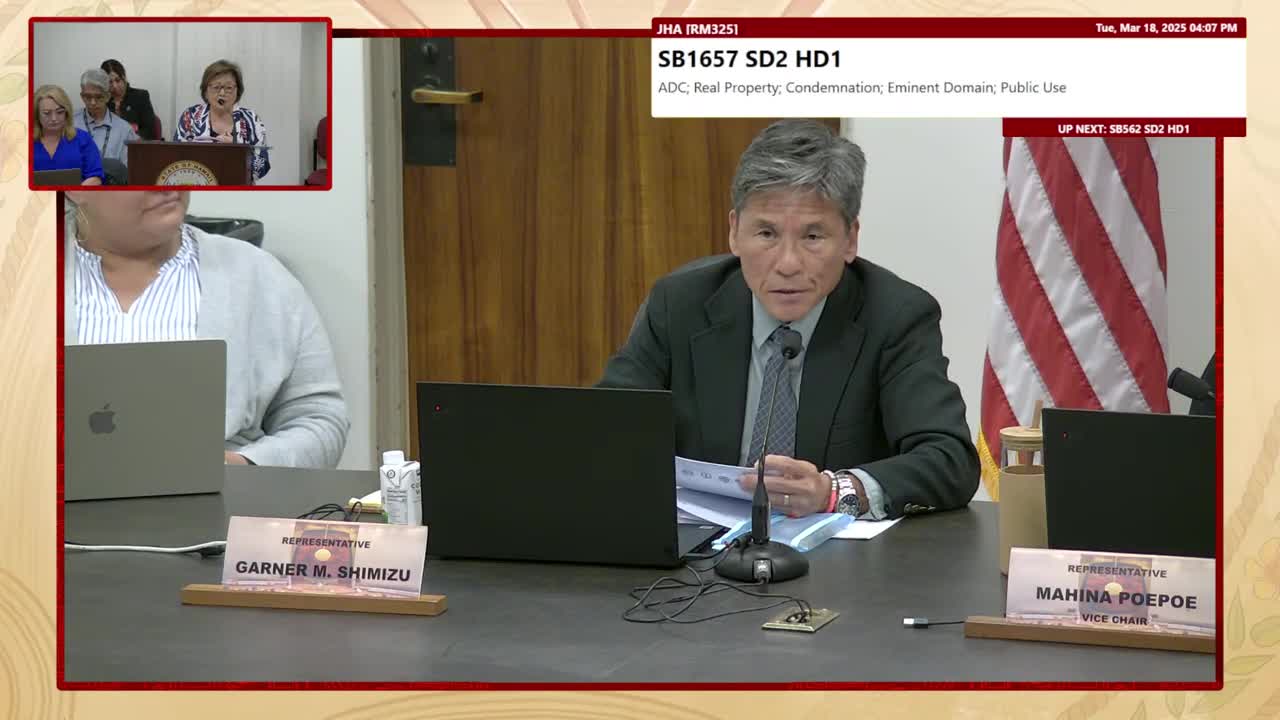 8MIN
House Standing Committee on Judiciary & Hawaiian Affairs
 16MIN
House Standing Committee on Agriculture & Food Systems
 1MIN
Senate Standing Committee on Agriculture and Environment
1MIN
Senate Standing Committee on Energy and Intergovernmental Affairs
Bill Author

Bill Co-Author(s):