HB 1958: Counties; State; Law Enforcement Officers; Bus Stop Areas
- Session Year: 2025-2026
- House: House
- Latest Version Date: 2026-02-17
Current Status:
Failed
(2026-02-18: Passed Second Reading as amended in HD 1 and referred to the committee(s) on JHA with Representative(s) Amato voting aye with reservations; none voting no (0) and none excused (0).)
Introduced
In Committee
First Chamber
In Committee
Second Chamber
Final Decking
Enacted
What does this bill do?
The bill bars people from living at or storing personal belongings in bus stop areas in counties with more than 300,000 people unless they intend to use the bus, and applies to sidewalks and shelter areas around bus stop signs. It directs police to give a verbal warning, allow time to move belongings, issue citations if the person does not comply, and, if needed, start an encampment clearance with outreach coordination and removal or disposal of unclaimed items.
The summary is provided by generative AI which can make mistakes. For original language, please view the details in the table below.
Establishes, for a county with a population greater than three hundred thousand, enforcement procedures to prevent domiciling or storing of personal property on public property within a bus stop area, if a person does not intend to use the public transportation services. Effective 7/1/3000. (HD1)
Establishes, for a city with a population greater than three hundred thousand, enforcement procedures to prevent domiciling or storing of personal property on public property within a bus stop area, if a person does not intend to use the public transportation services.
|
HOUSE OF REPRESENTATIVES |
H.B. NO. |
1958 |
|
THIRTY-THIRD LEGISLATURE, 2026 |
H.D. 1 |
|
|
STATE OF HAWAII |
|
|
|
|
|
|
|
|
||
|
|
||
A BILL FOR AN ACT
RELATING TO PUBLIC SAFETY.
BE IT ENACTED BY THE LEGISLATURE OF THE STATE OF HAWAII:
SECTION 1. The legislature finds that, according to the annual Point in Time Count, there were over four thousand individuals experiencing homelessness, with a notable twelve per cent increase in homelessness on Oahu between 2023 and 2024. The State's homelessness crisis continues to grow, particularly on the island of Oahu, where urban Honolulu has seen an increasing number of individuals residing in public spaces. One area of growing concern is the use of public bus stops as locations for domiciling and long-term storage of personal property, transforming essential transit infrastructure into areas of prolonged occupation.
In many instances, bus stops become obstructed by accumulated belongings, displacing transit riders and forcing them to stand in unsafe conditions while waiting for public transportation. Kupuna, keiki, persons with disabilities, and individuals with limited mobility are particularly affected, as they may be unable to safely stand for extended periods or navigate around obstructions. The presence of personal property within bus stops also creates hazards for passengers disembarking from buses, increasing the risk of falls and injury.
The legislature finds that maintaining clear and accessible bus stops is essential to ensuring public safety, preserving the dignity of transit riders, and promoting equitable access to transportation for all residents of the State.
Accordingly, the purpose of this Act is to establish, for counties with a population of three hundred thousand or more, enforcement procedures to prevent the domiciling or storage of personal property on public property within bus stop areas without the intent to utilize the public transportation services.
SECTION 2. Chapter 46, Hawaii Revised Statutes, is amended by adding a new section to be appropriately designated and to read as follows:
"§46- Safe bus stops; unlawful domiciling at bus stop areas. (a) In any county with a population of three hundred thousand or more, no person shall domicile or store personal property on public property within a bus stop area, unless the person intends to use the public transportation services.
(b) A person in violation of this section shall remove oneself and all personal property outside of the bus stop area. When a person is found in violation, a state or county law enforcement officer shall:
(1) Issue a verbal warning, which shall include:
(A) Notice that the person is unlawfully domiciling or storing personal property in violation of this section;
(B) Instructions for the person to move oneself and all personal property outside of the bus stop area; and
(C) Notice that failure to make reasonable or measurable efforts to comply with this subsection within two hours will result in a citation;
(2) Issue an initial citation if, after two hours from receipt of the verbal warning, the person has not made reasonable or measurable efforts to comply with this subsection and continues to violate subsection (a);
(3) Issue a second citation if, after two hours from the issuance of the initial citation, the person has not made reasonable or measurable efforts to comply with this subsection and continues to violate subsection (a); and
(4) Initiate the state's or county's encampment or obstruction clearance protocol, in accordance with applicable state or county standard operating procedures, if the person continues to violate subsection (a) after two hours from the issuance of the second citation. If the clearance protocol is initiated under this paragraph:
(A) The state or county law enforcement agency shall make reasonable efforts to notify and coordinate with homeless outreach agencies, including the statewide office on homelessness and housing solutions and any similar county office that assists persons experiencing homelessness;
(B) All personal property shall be removed within one hour; and
(C) Any remaining unclaimed property may be removed and disposed of in accordance with state or county procedures.
(c) State or county law enforcement agencies shall have authority to enforce this section, including issuing warnings and citations and effecting arrests as authorized by law.
(d) Complaints regarding individuals domiciling or storing personal property in violation of this section shall be directed primarily to state or county law enforcement agencies; provided that all law enforcement agencies shall work collaboratively to coordinate enforcement efforts and ensure effective compliance.
(e) This section shall supplement and shall not replace or preempt any existing state or county laws, ordinances, or rules prohibiting obstruction, domiciling, or unlawful storage of personal property on public property within bus stop areas. Citations issued pursuant to this section shall be in addition to any other penalties or enforcement actions authorized under law.
(f) State or county law enforcement officers shall not presume an immediate violation and shall make reasonable, polite inquiries when responding to complaints or suspected violations. At each stage of enforcement, officers shall assess whether the person is making reasonable efforts to comply, recognizing that some persons may require additional time to safely remove personal belongings.
(g) For purposes of this section:
"Bus stop" means any place at which the county transportation authority has directed the placement of a bus stop sign designating the location where public bus service stops to service passengers.
"Bus stop area" means the area at a bus stop occupying:
(1) The entire width of the sidewalk that extends twenty feet before and after a bus stop sign or bus stop route sign; or
(2) For bus stops furnished with a shelter, the footprint of the shelter, and the entire width of the sidewalk that extends twenty feet before and twenty feet after the footprint of the shelter,
and any area extending away from the street within twenty feet of a bus stop sign or the footprint of the shelter.
"Footprint of a shelter" means the vertical planes, perpendicular to the ground, extending down from the outermost edges of the shelter overhang or roof."
SECTION 3. This Act does not affect rights and duties that matured, penalties that were incurred, and proceedings that were begun before its effective date.
SECTION 4. If any provision of this Act, or the application thereof to any person or circumstance, is held invalid, the invalidity does not affect other provisions or applications of the Act that can be given effect without the invalid provision or application, and to this end the provisions of this Act are severable.
SECTION 5. New statutory material is underscored.
SECTION 6. This Act shall take effect on July 1, 3000.
Report Title:
Counties; State; Law Enforcement Officers; Bus Stop Areas
Description:
Establishes, for a county with a population greater than three hundred thousand, enforcement procedures to prevent domiciling or storing of personal property on public property within a bus stop area, if a person does not intend to use the public transportation services. Effective 7/1/3000. (HD1)
The summary description of legislation appearing on this page is for informational purposes only and is not legislation or evidence of legislative intent.
|
HOUSE OF REPRESENTATIVES |
H.B. NO. |
1958 |
|
THIRTY-THIRD LEGISLATURE, 2026 |
|
|
|
STATE OF HAWAII |
|
|
|
|
|
|
|
|
||
|
|
||
A BILL FOR AN ACT
relating to public safety.
BE IT ENACTED BY THE LEGISLATURE OF THE STATE OF HAWAII:
SECTION 1. The legislature finds that, according to the annual Point in Time Count, there were over four thousand individuals experiencing homelessness, with a notable twelve per cent increase in homelessness on Oahu between 2023 and 2024. The State's homelessness crisis continues to grow, particularly on the island of Oahu, where urban Honolulu has seen an increasing number of individuals residing in public spaces. One area of growing concern is the use of public bus stops as locations for domiciling and long-term storage of personal property, transforming essential transit infrastructure into areas of prolonged occupation.
In many instances, bus stops become obstructed by accumulated belongings, displacing transit riders and forcing them to stand in unsafe conditions while waiting for public transportation. Kupuna, keiki, persons with disabilities, and individuals with limited mobility are particularly affected, as they may be unable to safely stand for extended periods or navigate around obstructions. The presence of personal property within bus stops also creates hazards for passengers disembarking from buses, increasing the risk of falls and injury.
The legislature finds that maintaining clear and accessible bus stops is essential to ensuring public safety, preserving the dignity of transit riders, and promoting equitable access to transportation for all residents of the State.
Accordingly, the purpose of this Act is to establish, for cities with a population of three hundred thousand or more, enforcement procedures to prevent the domiciling or storage of personal property on public property within bus stop areas without the intent to utilize the public transportation services.
SECTION 2. Chapter 46, Hawaii Revised Statutes, is amended by adding a new section to be appropriately designated and to read as follows:
"§46- Safe bus stops; unlawful domiciling at bus stop areas. (a) In any city with a population of three hundred thousand or more, no person shall domicile or store personal property on public property within a bus stop area, unless the person intends to use the public transportation services.
(b) A person in violation of this section shall remove oneself and all personal property outside of the bus stop area. When a person is found in violation, a county law enforcement officer shall:
(1) Issue a verbal warning, which shall include:
(A) Notice that the person is unlawfully domiciling or storing personal property in violation of this section;
(B) Instructions for the person to move oneself and all personal property outside of the bus stop area; and
(C) Notice that failure to make reasonable or measurable efforts to comply with this subsection within two hours will result in a citation;
(2) Issue an initial citation if, after two hours from receipt of the verbal warning, the person has not made reasonable or measurable efforts to comply with this subsection and continues to violate subsection (a);
(3) Issue a second citation if, after two hours from the issuance of the initial citation, the person has not made reasonable or measurable efforts to comply with this subsection and continues to violate subsection (a); and
(4) Initiate the county's encampment or obstruction clearance protocol, in accordance with applicable county standard operating procedures, if the person continues to violate subsection (a) after two hours from the issuance of the second citation. If the clearance protocol is initiated under this paragraph:
(A) The county law enforcement agency shall make reasonable efforts to notify and coordinate with homeless outreach agencies, including the statewide office on homelessness and housing solutions and any similar county office that assists persons experiencing homelessness;
(B) All personal property shall be removed within one hour; and
(C) Any remaining unclaimed property may be removed and disposed of in accordance with county procedures.
(c) County law enforcement agencies shall have authority to enforce this section, including issuing warnings and citations and effecting arrests as authorized by law.
(d) Complaints regarding individuals domiciling or storing personal property in violation of this section shall be directed primarily to county law enforcement agencies; provided that all law enforcement agencies shall work collaboratively to coordinate enforcement efforts and ensure effective compliance.
(e) This section shall supplement and shall not replace or preempt any existing state or county laws, ordinances, or rules prohibiting obstruction, domiciling, or unlawful storage of personal property on public property within bus stop areas. Citations issued pursuant to this section shall be in addition to any other penalties or enforcement actions authorized under law.
(f) County law enforcement officers shall not presume an immediate violation and shall make reasonable, polite inquiries when responding to complaints or suspected violations. At each stage of enforcement, officers shall assess whether the person is making reasonable efforts to comply, recognizing that some persons may require additional time to safely remove personal belongings.
(g) For purposes of this section:
"Bus stop" means any place at which the county transportation authority has directed the placement of a bus stop sign designating the location where public bus service stops to service passengers.
"Bus stop area" means the area at a bus stop occupying:
(1) The entire width of the sidewalk that extends twenty feet before and after a bus stop sign or bus stop route sign; or
(2) For bus stops furnished with a shelter, the footprint of the shelter, and the entire width of the sidewalk that extends twenty feet before and twenty feet after the footprint of the shelter,
and any area extending away from the street within twenty feet of a bus stop sign or the footprint of the shelter.
"Footprint of a shelter" means the vertical planes, perpendicular to the ground, extending down from the outermost edges of the shelter overhang or roof."
SECTION 3. This Act does not affect rights and duties that matured, penalties that were incurred, and proceedings that were begun before its effective date.
SECTION 4. If any provision of this Act, or the application thereof to any person or circumstance, is held invalid, the invalidity does not affect other provisions or applications of the Act that can be given effect without the invalid provision or application, and to this end the provisions of this Act are severable.
SECTION 5. New statutory material is underscored.
SECTION 6. This Act shall take effect upon its approval.
|
INTRODUCED BY: |
_____________________________ |
|
|
|
Report Title:
Counties; Law Enforcement Officers; Bus Stop Areas
Description:
Establishes, for a city with a population greater than three hundred thousand, enforcement procedures to prevent domiciling or storing of personal property on public property within a bus stop area, if a person does not intend to use the public transportation services.
The summary description of legislation appearing on this page is for informational purposes only and is not legislation or evidence of legislative intent.
|
Date
|
Status
|
|---|---|
| Feb 18, 2026 | Passed Second Reading as amended in HD 1 and referred to the committee(s) on JHA with Representative(s) Amato voting aye with reservations; none voting no (0) and none excused (0). |
| Feb 18, 2026 | Reported from TRN (Stand. Com. Rep. No. 439-26) as amended in HD 1, recommending passage on Second Reading and referral to JHA. |
| Feb 12, 2026 | The committee on TRN recommend that the measure be PASSED, WITH AMENDMENTS. The votes were as follows: 8 Ayes: Representative(s) Kila, Miyake, Evslin, Kitagawa, La Chica, Muraoka, Pierick; Ayes with reservations: Representative(s) Cochran; Noes: none; and 1 Excused: Representative(s) Grandinetti. |
| Feb 10, 2026 | Bill scheduled to be heard by TRN on Thursday, 02-12-26 8:30AM in House conference room 430 VIA VIDEOCONFERENCE. |
| Jan 28, 2026 | Referred to TRN, JHA, referral sheet 3 |
| Jan 26, 2026 | Introduced and Pass First Reading. |
| Jan 23, 2026 | Pending introduction. |
|
Date
|
Description
|
Location
|
Votes
|
|
|---|---|---|---|---|
| Feb 12, 2026 | The committee on TRN recommend that the measure be PASSED, WITH AMENDMENTS | House Standing Committee on Transportation |
Passed |
This list shows positions taken on this bill by organizations on the date displayed, which is linked to the original source.
Positions by individuals are not included.
|
Organization
|
Position
|
Date
|
|---|---|---|
| American Civil Liberties Union of Hawai‘i | *** Against | Feb 12, 2026 |
STAND. COM. REP. NO. 439-26
Honolulu, Hawaii
, 2026
RE: H.B. No. 1958
H.D. 1
Honorable Nadine K. Nakamura
Speaker, House of Representatives
Thirty-Third State Legislature
Regular Session of 2026
State of Hawaii
Madame:
Your Committee on Transportation, to which was referred H.B. No. 1958 entitled:
"A BILL FOR AN ACT RELATING TO PUBLIC SAFETY,"
begs leave to report as follows:
Your Committee finds that Hawaii continues to face a growing homelessness crisis, with increasing numbers of individuals residing in public spaces, including public transit areas. The use of bus stops for domiciling or long-term storage of personal property can obstruct access to essential transportation infrastructure, displacing transit riders and creating safety hazards for passengers, particularly kupuna, keiki, and persons with disabilities. By ensuring that bus stop areas remain clear and accessible, this measure seeks to balance public safety and accessibility concerns with compassionate and structured enforcement practices.
Your Committee has amended this measure by:
(1) Specifying that the enforcement procedures proposed by this measure shall apply to a county, rather than a city, with a population greater than three hundred thousand;
(2) Authorizing state law enforcement officers to enforce enforcement procedures;
(3) Changing the effective date to July 1, 3000, to encourage further discussion; and
(4) Making technical, nonsubstantive amendments for the purposes of clarity, consistency, and style.
As affirmed by the record of votes of the members of your Committee on Transportation that is attached to this report, your Committee is in accord with the intent and purpose of H.B. No. 1958, as amended herein, and recommends that it pass Second Reading in the form attached hereto as H.B. No. 1958, H.D. 1, and be referred to your Committee on Judiciary & Hawaiian Affairs.
Respectfully submitted on behalf of the members of the Committee on Transportation,
|
|
|
____________________________ DARIUS KILA, Chair |
|
|
|
|
|
Date
|
Testimony PDF
|
|---|---|
| Feb 12, 2026 | HB1958_TESTIMONY_TRN_02-12-26_.PDF |
Discussed in Hearing
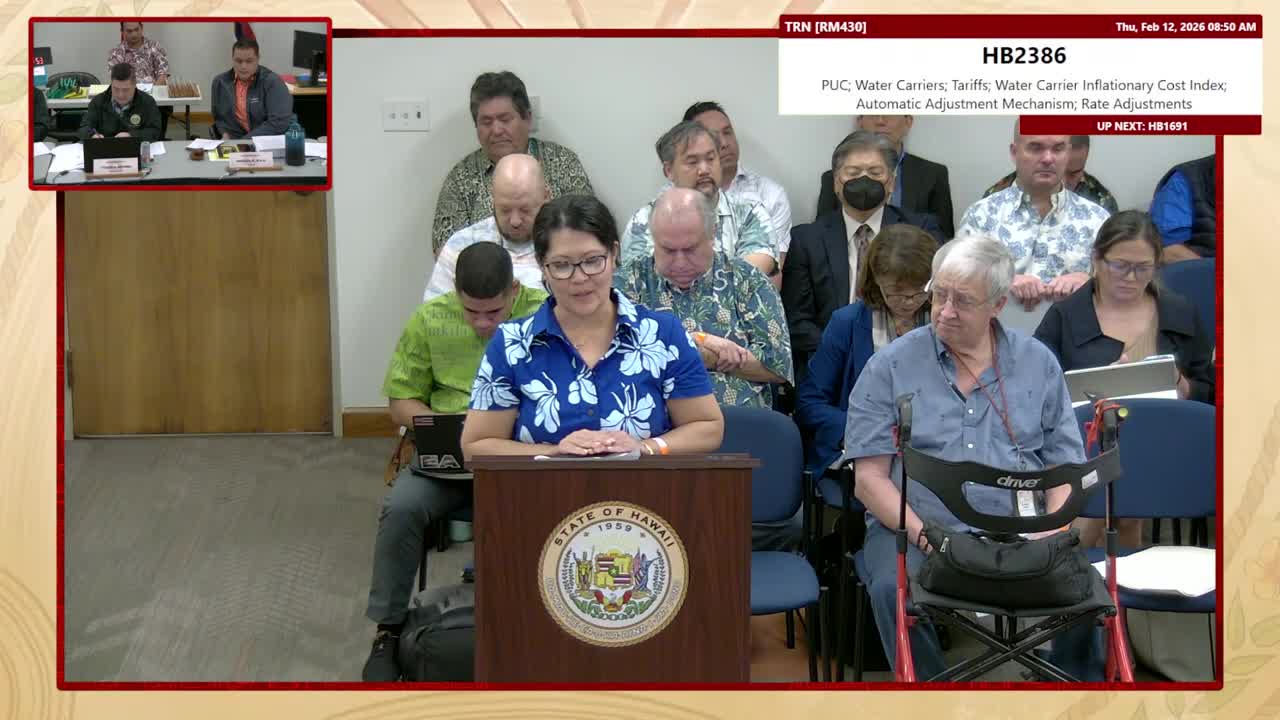 5MIN
House Standing Committee on Transportation
 1MIN