SB 3134: Department of Health; Emergency Medical Services Systems of Care
- Session Year: 2025-2026
- House: Senate
- Latest Version Date: 2026-03-06
Current Status:
Failed
(2026-03-12: Referred to HLT, CPC, referral sheet 17)
Introduced
In Committee
First Chamber
In Committee
Second Chamber
Final Decking
Enacted
What does this bill do?
This bill modernizes Hawaii law by replacing the old "emergency medical services system" with a statewide, integrated "emergency medical systems of care" run by the Department of Health, affecting EMS workers, hospitals, air-medical providers, 911 dispatch centers, and patients. It updates definitions and duties, adds air-medical transport and "medicom" communications, strengthens pediatric and trauma care, requires data collection and a trauma registry, sets standards for dispatch and training, and expands an advisory council to guide the system.
The summary is provided by generative AI which can make mistakes. For original language, please view the details in the table below.
Modernizes the State's emergency medical services statutes to align with current best practices. (SD2)
Modernizes the State's emergency medical services statutes to align with current best practices. (SD1)
Modernizes Hawaii's emergency medical services statutes to align with current best practices.
|
THE SENATE |
S.B. NO. |
3134 |
|
THIRTY-THIRD LEGISLATURE, 2026 |
S.D. 2 |
|
|
STATE OF HAWAII |
|
|
|
|
|
|
|
|
||
|
|
||
A BILL FOR AN ACT
RELATING TO EMERGENCY MEDICAL SYSTEMS OF CARE.
BE IT ENACTED BY THE LEGISLATURE OF THE STATE OF HAWAII:
The legislature further finds that contemporary models of emergency and acute care prioritize integrated systems that address time-sensitive emergencies such as trauma, heart attacks, strokes, sepsis, and burns with the same urgency and structure as traditional emergency response. By adopting a time-sensitive emergency medical systems of care model, the State can improve patient survival, reduce long-term disability, and strengthen statewide resilience in times of disaster or public health crisis.
The legislature also finds that aligning the State's emergency medical services statutes with national best practices in systems integration will:
(1) Ensure coordinated, evidence-based care for time‑sensitive emergencies across all islands;
(2) Modernize emergency medical services and trauma systems to meet current and future challenges;
(3) Improve patient outcomes through standardized, statewide protocols; and
(4) Enhance preparedness for future natural disasters, mass casualty incidents, and public health threats.
Accordingly, the purpose of this Act is to update the State's emergency medical services statutes to establish a comprehensive, time-sensitive, emergency medical systems of care model that strengthens the State's capacity to respond effectively to emergencies and safeguard the health of residents living on all islands.
SECTION 2. Section 321-221, Hawaii Revised Statutes, is amended to read as follows:
"§321-221 Findings and purpose. The legislature finds that the
establishment of [a] state emergency medical [services system,] systems
of care, including emergency medical services, emergency medical services for children, and trauma and
critical care services, is a matter of compelling state interest and is
necessary to protect and preserve public health. A system designed to reduce medical emergency
deaths, injuries, and permanent long-term disability through the implementation
of a fully integrated, cohesive network of components, the legislature further
finds, will best serve public health needs.
Accordingly, the purpose of this part is to establish and maintain [a]
state emergency medical [services system] systems of care in
communities that can be most effectively served by the State, and to fix the
responsibility for the administration of [this] state [system,] emergency
medical systems of care, which shall provide for the arrangement of
personnel, facilities, and equipment for the effective and coordinated delivery
of health care services under emergency conditions, whether occurring as the
result of a patient's condition, from natural disasters, or from other
causes. The [system] emergency
medical systems of care shall provide for personnel, personnel training,
communications, emergency transportation, facilities, coordination with
emergency medical and critical care services, coordination and use of available
public safety agencies, promotion of consumer participation, accessibility to
care, mandatory standard medical recordkeeping, consumer information and
education, independent review and evaluation, disaster linkage, mutual aid
agreements, and other components necessary to meet the purposes of this
part."
SECTION 3. Section 321-222, Hawaii Revised Statutes, is amended to read as follows:
"§321-222 Definitions. As used in this part[, unless the context
clearly requires otherwise]:
"Advanced emergency medical technician" means a health professional certified by the National Registry of Emergency Medical Technicians and licensed by the State as an advanced emergency medical technician to provide basic and limited advanced emergency medical care and transportation for critical and emergency patients to access the emergency medical systems of care.
"Advanced life support" means initiating all basic life support care as well as invasive patient care designed to stabilize and support a patient's condition due to sudden illness or injury. The care rendered, excluding basic life support, constitutes the practice of medicine.
"Advisory [committee"] council"
means the Hawaii emergency medical [services] systems of care
advisory [committee.] council.
"Air-medical services" means medical care and transport of patients by aircraft, provided by a licensed air ambulance operator with qualified medical personnel, and regulated as part of the statewide emergency medical systems of care.
"Basic life support" means
initiating noninvasive emergency patient care designed to optimize the
patient's chances of surviving the emergency situation. The care rendered consists of all first aid
procedures needed, but does not include invasive procedures [which] that
constitute the practice of medicine; provided that state-approved basic life
support personnel may use fully automatic external defibrillators, initiate
intravenous lines, place tourniquets, and perform manual external
defibrillation under the direction and personal supervision of a [mobile
intensive care technician] state‑licensed clinician and in
accordance with rules adopted by the department.
"Department" means the department of health.
"Emergency [aeromedical] air-medical
services" means a [secondary] response system that provides
immediate critical care and transport [by rotary-wing aircraft] of a
patient by aircraft to a facility that provides specialized medical
care.
"Emergency medical responder" means a person certified by the National Registry of Emergency Medical Technicians.
"Emergency medical services for children" means emergency medical services, including preventive, pre-hospital, hospital, rehabilitative, and other post-hospital care for children.
"Emergency medical services
personnel" means any [mobile intensive care technician or] paramedic,
advanced emergency medical technician, emergency medical technician,
emergency medical responder, or other health care worker who is certified
or licensed by the State.
"Emergency medical systems of care" means a fully integrated and cohesive statewide network of components that provide timely and effective care to individuals experiencing crisis situations. Components of an emergency medical systems of care include but are not limited to community-based services, pre-hospital care, emergency response, facility-based care, disaster response, and other post-hospital services that support stabilization, treatment, and transport.
"Emergency medical technician" means a person certified by the National Registry of Emergency Medical Technicians and licensed by the State whose primary focus is to provide immediate lifesaving care to patients while ensuring access to the emergency medical systems of care.
"First responder personnel" means
a person who [has successfully completed a United States Department of
Transportation approved First Responder Course of training in emergency basic
life support.] provides initial assistance until emergency medical
services personnel arrive.
"Medicom" means the emergency medical systems of care medical communications that monitor statewide resource availability, emergency dispatch, hospital notifications, interfacility transfers, and disaster communications.
"Medicom center" means the centralized coordination place for medicom functions.
"Paramedic" means a mobile intensive care technician who is an allied health professional certified by the National Registry of Emergency Medical Technicians whose primary focus is to provide advanced emergency medical care for critical and emergent patients who access the emergency medical systems of care.
"Service area" means the State, excluding any county having a population of five hundred thousand or more.
"State system" means the state [pre-hospital]
emergency medical [services system.] systems of care.
"Statewide" means all counties in the State."
SECTION 4. Section 321-223, Hawaii Revised Statutes, is amended to read as follows:
"§321-223 State emergency medical [services system,]
systems of care, establishment.
The department shall establish, administer, and maintain the state
emergency medical [services system] systems of care to serve the
emergency health needs of the people in the service area. All emergency medical services or ambulance
services contracted by or under the authority of the department or any county
within the service area shall be consistent with this part."
SECTION 5. Section 321-224, Hawaii Revised Statutes, is amended by amending subsection (a) to read as follows:
"(a) In addition to other functions and duties assigned under this part, the department shall:
(1) Regulate ambulances and ambulance services statewide;
(2) Establish
emergency medical services throughout the
service area, including emergency [aeromedical] air‑medical
services, which shall meet the requirements of this part, subject to section
321-228;
(3) Review and approve the curricula and syllabi of training courses offered to emergency medical services personnel statewide who provide basic, intermediate, and advanced life support, consult and coordinate with the University of Hawaii, or any other accredited community college, college, or university, or any professional organization that provides emergency medical services training, regarding the training for basic, intermediate, and advanced life support personnel, as provided in section 321-229;
(4) Collect
and evaluate data for the continued evaluation of the statewide emergency
medical [services system,] systems of care, subject to section
321-230;
(5) Coordinate, on a statewide basis, emergency medical resources and the allocation of emergency services and facilities in the event of mass casualties, natural disasters, national emergencies, and other emergencies, ensuring linkage to local, state, and national disaster plans, and participation in exercises to test these plans;
(6) Establish,
administer, and maintain a statewide communication system [for the
service area;] including interoperability with organizations essential
to core operations of the State's emergency medical systems of care;
(7) [Assist
each county in the service area in the] Oversee the development and
implementation of a statewide "911" emergency [telephone]
dispatch system;
(8) Secure technical assistance and other assistance and consultation necessary for the implementation of this part, subject to section 321-230;
(9) Implement public information and education programs to inform the public of the statewide system and its use, and disseminate other emergency medical information, including appropriate methods of medical self-help and first-aid, and the availability of first-aid training programs statewide;
(10) Establish standards and provide training for dispatchers in the state system, and maintain a program of quality assurance for dispatch equipment and operations; provided that individuals acting as dispatchers in the State as of July 1, 2022, shall obtain emergency medical dispatch certification by July 1, 2026, and shall maintain certification thereafter;
(11) Establish a program that will enable emergency service personnel statewide to provide early defibrillation;
(12) Establish
[within the department the] and maintain emergency medical [service
system] services for children statewide;
(13) Consult
with the advisory [committee] council on matters relating to the
implementation of this part; and
(14) Establish and maintain statewide standards for emergency medical services course instructor qualifications and statewide requirements for emergency medical services training facilities."
SECTION 6. Section 321-225, Hawaii Revised Statutes, is amended to read as follows:
"§321-225 The [state] Hawaii emergency
medical [services] systems of care advisory [committee.] council. (a)
There is established within the department of health for administrative
purposes only the [state] Hawaii emergency medical [services]
systems of care advisory [committee,] council, which shall
sit in an advisory capacity to the department of health on all matters relating
to the state system. The advisory [committee]
council may advise the department of health upon request of the
department or upon its own initiative with regard to the state system. The advisory [committee] council
shall:
(1) Monitor,
review, and evaluate on an ongoing basis the operations, administration, and
efficacy of the state system or any components thereof, to determine conformity
with and maximum implementation of this part[.];
(2) Prepare
and submit periodic assessments, reports, and other documents relating to the state system to ensure the
implementation of this part, as deemed necessary or desirable in the discretion
of the advisory [committee.] council;
(3) Seek
the input of the public in relation to the state system to ensure adequate
fulfillment of the emergency medical services, emergency medical services
for children, and trauma and critical care services needs of the State
consistent with this part[.];
(4) Participate
in any planning or other policymaking with regard to the state system, and seek
the participation of the public, including subarea health planning councils in
its consideration of plans and policies relating to the state system[.];
(5) Perform
other functions, and have other duties necessary to ensuring the fullest
implementation and maintenance of the state system[.]; and
(6) Advise
the department of health in formulating a master plan for emergency medical [services,]
systems of care, including medicom, the "911" system, and
other components necessary to meet the emergency medical needs of the people of
the State, which shall be submitted to the legislature.
(b)
The advisory [committee] council shall be composed of [twenty]
twenty-three members: [three] four nonvoting ex-officio
members, who shall be the director of transportation, the [adjutant general,]
administrator of the Hawaii emergency management agency, the executive
director of the Hawaii 911 board, and the administrator of the state health
planning and development agency, or the designated representatives thereof, and
[seventeen] nineteen members representing all counties of the
State who shall be appointed by the governor subject to section 26-34 as
follows:
(1) Five
members who shall be physicians experienced in the conduct and delivery of
emergency medical services; provided that at least two shall be engaged in the
practice of emergency medicine and be board‑eligible or board-certified
by the American Board of Emergency Medicine[, and]; provided
further that at least one physician shall be engaged in the practice of
pediatrics and be board-eligible or board‑certified by the American Board
of Pediatrics;
(2) Four members who shall be consumers of health care and who shall have no connection with or relationship to the health care system of the State and who shall be representative of all counties;
(3) Four
members of allied health professions related to emergency medical services; [and]
(4) Four
members, one from each county, who shall be mobile intensive care technicians
or emergency medical technicians engaged in the practice of pre-hospital
emergency medical [service.] services; and
(5) Two members who shall be surgeons or clinicians experienced in the conduct and delivery of trauma or acute care services.
(c)
The members of the advisory [committee] council shall
serve without compensation, but shall be reimbursed for necessary expenses
incurred in the performance of their duties, including travel expenses. The chairperson of the advisory [committee]
council shall be elected by the members from among their numbers. A majority of the members of the advisory [committee]
council shall constitute a quorum for the conduct of business of the
advisory [committee.] council.
A majority vote of the members present at a meeting at which a quorum is
established shall be necessary to validate any action of the [committee.]
council.
[(c)] (d) The advisory [committee] council
may adopt rules for its governance.
[(d)] (e) The department of health shall provide
necessary staff and other support required by the advisory [committee] council
for the performance of its duties."
SECTION 7. Section 321-228, Hawaii Revised Statutes, is amended to read as follows:
"§321-228 Emergency medical services; counties. The department shall determine, in
consultation with the advisory [committee] council under section
321-225, the levels of emergency medical services that shall be implemented in
each county within the state service area.
The department may contract to provide emergency medical services,
including emergency [aeromedical] air-medical services, or any
necessary component of the emergency [services system of] medical
systems of care within a county within the service area in conformance with
the state system. If any county within
the service area shall apply to the department to operate state emergency
medical ambulance services within the respective county, the department may
contract with the county for the provision of those services. The department shall operate emergency
medical ambulance services or contract with a private agency in those counties
within the service area that do not apply to it under this section. Any county or private agency contracting to
provide emergency medical ambulance services under this section shall be
required by the department to implement those services in a manner and at a
level consistent with the levels determined under this section."
SECTION 8. Section 321-230, Hawaii Revised Statutes, is amended to read as follows:
"§321-230 Technical assistance, data collection,
evaluation. (a) The department may contract for technical
assistance and consultation, including categorization, data collection, and
evaluation appropriate to the needs of the statewide emergency medical [services
system.] systems of care. The
collection and analysis of statewide emergency medical [services] systems
of care data, including pediatrics, trauma, cardiac, stroke, burn,
medical, and behavioral medical emergencies, shall be for the purpose of
improving the quality of services provided.
The department may implement and maintain a trauma registry for the collection of information concerning the treatment of critical trauma patients at state designated trauma centers, and carry out a system for the management of that information. The system may provide for the recording of information concerning treatment received before and after a trauma patient's admission to a hospital or medical center. All state designated trauma centers shall submit to the department periodic reports of each patient treated for trauma in the state system in the manner as the department shall specify.
For the purposes of this subsection, "categorization" means systematic identification of the readiness and capabilities of hospitals and their staffs to adequately, expeditiously, and efficiently receive and treat emergency patients.
(b)
The department shall establish, administer, and maintain an [aeromedical]
emergency [medical] air-medical services system designed to
collect and analyze data to measure the efficiency and effectiveness of each
phase of the statewide emergency [aeromedical] air-medical
program.
The department shall monitor [aeromedical]
air-medical emergency ambulance service flights statewide to include
date of service, patient demographics, transport diagnosis, and medical
outcomes. The department medicom
center shall work with each air-medical service provider and health
care facility as the intermediary to arrange emergency transport of [bariatric]
patients by licensed air-medical service providers, or by the United
States Coast Guard, and maintain a registry of all emergency transports
provided [by the United States Coast Guard]. All statewide [aeromedical] air-medical
providers shall submit their data to the department as specified and requested
by the department.
The statewide [aeromedical]
emergency [medical] air-medical services system shall serve the
emergency health needs of the people of the State by identifying:
(1) The system's strengths and weaknesses;
(2) The allocation of resources; and
(3) The
development of [rotary-wing] emergency [aeromedical] air-medical
services standards;
provided
that emergency helicopter use, including triage protocols, shall be based on
national [aeromedical] air-medical triage and transport
guidelines established by the Association of Air Medical Services, the American
College of Surgeons, the National Association of Emergency Medical Service
Physicians, or other department-approved national [aeromedical] air-medical
accreditation agency. The department, in
the implementation of this subsection, shall plan, coordinate, and provide
assistance to all entities and agencies, public and private, involved in the
statewide system.
(c)
The department shall use an emergency [aeromedical services]
air-medical quality improvement committee comprised of representatives
of trauma, emergency, and tertiary care physicians and providers to analyze
information collected from the [aeromedical] air-medical quality
improvement performance measures as established by the [American College of
Surgeons,] department, and to recommend system standards and
resources to maintain and improve [the Hawaii] emergency [aeromedical]
air‑medical services [system]."
SECTION 9. Section 321-231, Hawaii Revised Statutes, is amended to read as follows:
"[]]§321-231[]]
Grants. The state system may
seek and accept any funds or property and other desirable support and
assistance from any source whatsoever, whether gift, grant, services or any
combination thereof, subject to applicable laws. In the event that any grant applications are
made in relation to the state system, or any component thereof, the department
shall consult with the advisory [committee]
council and provide technical assistance in the preparation,
management, or administration of the application or the grant, or both."
SECTION 10. Statutory material to be repealed is bracketed and stricken. New statutory material is underscored.
SECTION 11. This Act shall take effect upon its approval.
Report Title:
Department of Health; Emergency Medical Services Systems of Care
Description:
Modernizes the State's emergency medical services statutes to align with current best practices. (SD2)
The summary description of legislation appearing on this page is for informational purposes only and is not legislation or evidence of legislative intent.
|
THE SENATE |
S.B. NO. |
3134 |
|
THIRTY-THIRD LEGISLATURE, 2026 |
S.D. 1 |
|
|
STATE OF HAWAII |
|
|
|
|
|
|
|
|
||
|
|
||
A BILL FOR AN ACT
RELATING TO EMERGENCY MEDICAL SYSTEMS OF CARE.
BE IT ENACTED BY THE LEGISLATURE OF THE STATE OF HAWAII:
The legislature further finds that contemporary models of emergency and acute care prioritize integrated systems that address time-sensitive emergencies such as trauma, heart attacks, strokes, sepsis, and burns with the same urgency and structure as traditional emergency response. By adopting a time-sensitive emergency medical systems of care model, the State can improve patient survival, reduce long-term disability, and strengthen statewide resilience in times of disaster or public health crisis.
Aligning the State's emergency medical services statutes with national best practices in systems integration will:
(1) Ensure coordinated, evidence-based care for time-sensitive emergencies across all islands;
(2) Modernize emergency medical services and trauma systems to meet current and future challenges;
(3) Improve patient outcomes through standardized, statewide protocols; and
(4) Enhance preparedness for future natural disasters, mass casualty incidents, and public health threats.
Accordingly, the purpose of this Act is to update the State's emergency medical services statutes to establish a comprehensive, time-sensitive, emergency medical systems of care model that strengthens the State's capacity to respond effectively to emergencies and safeguard the health of our residents, living on all islands.
SECTION 2. Section 321-221, Hawaii Revised Statutes, is amended to read as follows:
"§321-221 Findings and purpose. The legislature finds that the
establishment of [a] state emergency medical [services system,] systems
of care, including emergency medical services, emergency medical services for children, and trauma and
critical care services is a matter of compelling state interest and
necessary to protect and preserve public health. A system designed to reduce medical emergency
deaths, injuries, and permanent long-term disability through the implementation
of a fully integrated, cohesive network of components, the legislature further
finds, will best serve public health needs.
Accordingly, the purpose of this part is to establish and maintain [a]
state emergency medical [services system] systems of care in
communities that can be most effectively served by the State, and to fix the
responsibility for the administration of [this] state [system,] emergency
medical systems of care, which shall provide for the arrangement of
personnel, facilities, and equipment for the effective and coordinated delivery
of health care services under emergency conditions, whether occurring as the
result of a patient's condition, from natural disasters, or from other
causes. The [system] emergency
medical systems of care shall provide for personnel, personnel training,
communications, emergency transportation, facilities, coordination with
emergency medical and critical care services, coordination and use of available
public safety agencies, promotion of consumer participation, accessibility to
care, mandatory standard medical recordkeeping, consumer information and
education, independent review and evaluation, disaster linkage, mutual aid
agreements, and other components necessary to meet the purposes of this
part."
SECTION 3. Section 321-222, Hawaii Revised Statutes, is amended to read as follows:
"§321-222 Definitions. As used in this part[, unless the context
clearly requires otherwise]:
"Advanced emergency medical technician" means a health professional certified by the National Registry of Emergency Medical Technicians and licensed by the State as an advanced emergency medical technician to provide basic and limited advanced emergency medical care and transportation for critical and emergency patients to access the emergency medical systems of care.
"Advanced life support" means initiating all basic life support care as well as invasive patient care designed to stabilize and support a patient's condition due to sudden illness or injury. The care rendered, excluding basic life support, constitutes the practice of medicine.
"Advisory [committee"] council"
means the Hawaii emergency medical [services] systems of care
advisory [committee.] council.
"Air-medical services" means medical care and transport of patients by aircraft, provided by a licensed air ambulance operator with qualified medical personnel, and regulated as part of the statewide emergency medical systems of care.
"Basic life support" means
initiating noninvasive emergency patient care designed to optimize the
patient's chances of surviving the emergency situation. The care rendered consists of all first aid
procedures needed, but does not include invasive procedures [which] that
constitute the practice of medicine; provided that state-approved basic life
support personnel may use fully automatic external defibrillators, initiate
intravenous lines, place tourniquets, and perform manual external
defibrillation under the direction and personal supervision of a [mobile
intensive care technician] state-licensed clinician and in
accordance with rules adopted by the department.
"Department" means the department of health.
"Emergency [aeromedical] air-medical
services" means a [secondary] response system that provides
immediate critical care and transport [by rotary-wing aircraft] of a
patient by aircraft to a facility that provides specialized medical
care.
"Emergency medical responder" means a person certified by the National Registry of Emergency Medical Technicians.
"Emergency medical services for children" means emergency medical services, including preventive, pre-hospital, hospital, rehabilitative, and other post-hospital care for children.
"Emergency medical services
personnel" means any [mobile intensive care technician or] paramedic,
advanced emergency medical technician, emergency medical technician,
emergency medical responder, or other health care worker who is certified
or licensed by the State.
"Emergency medical systems of care" means a fully integrated and cohesive statewide network of components that provide timely and effective care to individuals experiencing crisis situations. Components of an emergency medical systems of care include but are not limited to community-based services, pre-hospital care, emergency response, facility-based care, disaster response, and other post-hospital services that support stabilization, treatment, and transport.
"Emergency medical technician" means a person certified by the National Registry of Emergency Medical Technicians and licensed by the State whose primary focus is to provide immediate lifesaving care to patients while ensuring access to the emergency medical systems of care.
"First responder personnel" means
a person who [has successfully completed a United States Department of
Transportation approved First Responder Course of training in emergency basic
life support.] provides initial assistance until emergency medical
services personnel arrive.
"Medicom" means the emergency medical systems of care medical communications that monitor statewide resource availability, emergency dispatch, hospital notifications, interfacility transfers, and disaster communications.
"Medicom center" means the centralized coordination place for medicom functions.
"Paramedic" means a mobile intensive care technician who is an allied health professional certified by the National Registry of Emergency Medical Technicians whose primary focus is to provide advanced emergency medical care for critical and emergent patients who access the emergency medical systems of care.
"Service area" means the State, excluding any county having a population of five hundred thousand or more.
"State system" means the state [pre-hospital]
emergency medical [services system.] systems of care.
"Statewide" means all counties in the State."
SECTION 4. Section 321-223, Hawaii Revised Statutes, is amended to read as follows:
"§321-223 State emergency medical [services system,]
systems of care, establishment.
The department shall establish, administer, and maintain the state
emergency medical [services system] systems of care to serve the
emergency health needs of the people in the service area. All emergency medical services or ambulance
services contracted by or under the authority of the department or any county
within the service area shall be consistent with this part."
SECTION 5. Section 321-224, Hawaii Revised Statutes, is amended by amending subsection (a) to read as follows:
"(a) In addition to other functions and duties assigned under this part, the department shall:
(1) Regulate ambulances and ambulance services statewide;
(2) Establish
emergency medical services throughout the
service area, including emergency [aeromedical] air-medical
services, which shall meet the requirements of this part, subject to section
321-228;
(3) Review and approve the curricula and syllabi of training courses offered to emergency medical services personnel statewide who provide basic, intermediate, and advanced life support, consult and coordinate with the University of Hawaii, or any other accredited community college, college, or university, or any professional organization that provides emergency medical services training, regarding the training for basic, intermediate, and advanced life support personnel, as provided in section 321-229;
(4) Collect
and evaluate data for the continued evaluation of the statewide emergency
medical [services system,] systems of care, subject to section
321-230;
(5) Coordinate, on a statewide basis, emergency medical resources and the allocation of emergency services and facilities in the event of mass casualties, natural disasters, national emergencies, and other emergencies, ensuring linkage to local, state, and national disaster plans, and participation in exercises to test these plans;
(6) Establish,
administer, and maintain a communication system [for the service area;] statewide
including interoperability with organizations essential to core operations of the
State's emergency medical systems of care;
(7) [Assist
each county in the service area in the] Oversee the development and
implementation of a statewide "911" emergency [telephone]
dispatch system;
(8) Secure technical assistance and other assistance and consultation necessary for the implementation of this part, subject to section 321-230;
(9) Implement public information and education programs to inform the public of the statewide system and its use, and disseminate other emergency medical information, including appropriate methods of medical self-help and first-aid, and the availability of first-aid training programs statewide;
(10) Establish standards and provide training for dispatchers in the state system, and maintain a program of quality assurance for dispatch equipment and operations; provided that individuals acting as dispatchers in the State as of July 1, 2022, shall obtain emergency medical dispatch certification by July 1, 2026, and shall maintain certification thereafter;
(11) Establish a program that will enable emergency service personnel statewide to provide early defibrillation;
(12) Establish
[within the department the] and maintain emergency medical [service
system] services for children statewide;
(13) Consult
with the advisory [committee] council on matters relating to the
implementation of this part; and
(14) Establish and maintain statewide standards for emergency medical services course instructor qualifications and statewide requirements for emergency medical services training facilities."
SECTION 6. Section 321-225, Hawaii Revised Statutes, is amended to read as follows:
"§321-225 The [state] Hawaii emergency
medical [services] systems of care advisory [committee.] council. (a)
There is established within the department of health for administrative
purposes only the [state] Hawaii emergency medical [services]
systems of care advisory [committee,] council, which shall
sit in an advisory capacity to the department of health on all matters relating
to the state system. The advisory [committee]
council may advise the department of health upon request of the
department or upon its own initiative with regard to the state system. The advisory [committee] council
shall:
(1) Monitor,
review, and evaluate on an ongoing basis the operations, administration, and
efficacy of the state system or any components thereof, to determine conformity
with and maximum implementation of this part[.];
(2) Prepare
and submit periodic assessments, reports, and other documents relating to the state system to ensure the
implementation of this part, as deemed necessary or desirable in the discretion
of the advisory [committee.] council;
(3) Seek
the input of the public in relation to the state system to ensure adequate
fulfillment of the emergency medical services, emergency medical services
for children, and trauma and critical care services needs of the State
consistent with this part[.];
(4) Participate
in any planning or other policymaking with regard to the state system, and seek
the participation of the public, including subarea health planning councils in
its consideration of plans and policies relating to the state system[.];
(5) Perform
other functions, and have other duties necessary to ensuring the fullest
implementation and maintenance of the state system[.]; and
(6) Advise
the department of health in formulating a master plan for emergency medical [services,]
systems of care, including medicom, the "911" system, and
other components necessary to meet the emergency medical needs of the people of
the State, which shall be submitted to the legislature.
(b)
The advisory [committee] council shall be composed of [twenty]
twenty-three members: [three] four nonvoting ex-officio
members, who shall be the director of transportation, the [adjutant general,]
administrator of the Hawaii emergency management agency, the executive
director of the Hawaii 911 board, and the administrator of the state health
planning and development agency, or the designated representatives thereof, and
[seventeen] nineteen members representing all counties of the
State who shall be appointed by the governor subject to section 26-34 as
follows:
(1) Five
members who shall be physicians experienced in the conduct and delivery of
emergency medical services; provided that at least two shall be engaged in the
practice of emergency medicine and be board-eligible or board-certified by the
American Board of Emergency Medicine[, and]; provided further
that at least one physician shall be engaged in the practice of pediatrics and
be board-eligible or board-certified by the American Board of Pediatrics;
(2) Four members who shall be consumers of health care and who shall have no connection with or relationship to the health care system of the State and who shall be representative of all counties;
(3) Four
members of allied health professions related to emergency medical services; [and]
(4) Four
members, one from each county, who shall be mobile intensive care technicians
or emergency medical technicians engaged in the practice of pre-hospital
emergency medical [service.] services; and
(5) Two members who shall be surgeons or clinicians experienced in the conduct and delivery of trauma or acute care services.
(c)
The members of the advisory [committee] council shall
serve without compensation, but shall be reimbursed for necessary expenses
incurred in the performance of their duties, including travel expenses. The chairperson of the advisory [committee]
council shall be elected by the members from among their numbers. A majority of the members of the advisory [committee]
council shall constitute a quorum for the conduct of business of the
advisory [committee.] council.
A majority vote of the members present at a meeting at which a quorum is
established shall be necessary to validate any action of the [committee.]
council.
[(c)] (d) The advisory [committee] council
may adopt rules for its governance.
[(d)] (e) The department of health shall provide
necessary staff and other support required by the advisory [committee] council
for the performance of its duties."
SECTION 7. Section 321-228, Hawaii Revised Statutes, is amended to read as follows:
"§321-228 Emergency medical services; counties. The department shall determine, in
consultation with the advisory committee under section 321-225, the levels of
emergency medical services that shall be implemented in each county within the
state service area. The department may
contract to provide emergency medical services, including emergency [aeromedical]
air-medical services, or any necessary component of the emergency [services
system of] medical systems of care within a county within the
service area in conformance with the state system. If any county within the service area shall
apply to the department to operate state emergency medical ambulance services
within the respective county, the department may contract with the county for
the provision of those services. The
department shall operate emergency medical ambulance services or contract with
a private agency in those counties within the service area that do not apply to
it under this section. Any county or
private agency contracting to provide emergency medical ambulance services
under this section shall be required by the department to implement those
services in a manner and at a level consistent with the levels determined under
this section."
SECTION 8. Section 321-230, Hawaii Revised Statutes, is amended to read as follows:
"§321-230 Technical assistance, data collection,
evaluation. (a) The department may contract for technical
assistance and consultation, including categorization, data collection, and
evaluation appropriate to the needs of the statewide emergency medical [services
system.] systems of care. The
collection and analysis of statewide emergency medical [services] systems
of care data, including pediatrics, trauma, cardiac, stroke, burn,
medical, and behavioral medical emergencies, shall be for the purpose of improving
the quality of services provided.
The department may implement and maintain a trauma registry for the collection of information concerning the treatment of critical trauma patients at state designated trauma centers, and carry out a system for the management of that information. The system may provide for the recording of information concerning treatment received before and after a trauma patient's admission to a hospital or medical center. All state designated trauma centers shall submit to the department periodic reports of each patient treated for trauma in the state system in the manner as the department shall specify.
For the purposes of this subsection, "categorization" means systematic identification of the readiness and capabilities of hospitals and their staffs to adequately, expeditiously, and efficiently receive and treat emergency patients.
(b)
The department shall establish, administer, and maintain an [aeromedical]
emergency [medical] air-medical services system designed to
collect and analyze data to measure the efficiency and effectiveness of each
phase of the statewide emergency [aeromedical] air-medical
program.
The department shall monitor [aeromedical]
air-medical emergency ambulance service flights statewide to include
date of service, patient demographics, transport diagnosis, and medical
outcomes. The department medicom
center shall work with each air-medical service provider and health
care facility as the intermediary to arrange emergency transport of [bariatric]
patients by licensed air-medical service providers, or by the United
States Coast Guard, and maintain a registry of all emergency transports
provided [by the United States Coast Guard]. All statewide [aeromedical] air-medical
providers shall submit their data to the department as specified and requested
by the department.
The statewide [aeromedical]
emergency [medical] air-medical services system shall serve the
emergency health needs of the people of the State by identifying:
(1) The system's strengths and weaknesses;
(2) The allocation of resources; and
(3) The
development of [rotary-wing] emergency [aeromedical] air-medical
services standards;
provided
that emergency helicopter use, including triage protocols, shall be based on
national [aeromedical] air-medical triage and transport
guidelines established by the Association of Air Medical Services, the American
College of Surgeons, the National Association of Emergency Medical Service
Physicians, or other department-approved national [aeromedical] air-medical
accreditation agency. The department, in
the implementation of this subsection, shall plan, coordinate, and provide
assistance to all entities and agencies, public and private, involved in the
statewide system.
(c)
The department shall use an emergency [aeromedical services]
air-medical quality improvement committee comprised of representatives
of trauma, emergency, and tertiary care physicians and providers to analyze
information collected from the [aeromedical] air-medical quality
improvement performance measures as established by the [American College of
Surgeons,] department, and to recommend system standards and
resources to maintain and improve [the Hawaii] emergency [aeromedical]
air-medical services [system]."
SECTION 9. Statutory material to be repealed is bracketed and stricken. New statutory material is underscored.
SECTION 10. This Act shall take effect upon its approval.
Report Title:
Department of Health; Emergency Medical Services Systems of Care
Description:
Modernizes the State's emergency medical services statutes to align with current best practices. (SD1)
The summary description of legislation appearing on this page is for informational purposes only and is not legislation or evidence of legislative intent.
|
THE SENATE |
S.B. NO. |
3134 |
|
THIRTY-THIRD LEGISLATURE, 2026 |
|
|
|
STATE OF HAWAII |
|
|
|
|
|
|
|
|
||
|
|
||
A BILL FOR AN ACT
RELATING TO EMERGENCY MEDICAL SYSTEMS OF CARE.
BE IT ENACTED BY THE LEGISLATURE OF THE STATE OF HAWAII:
The legislature further finds that contemporary models of emergency and acute care prioritize integrated systems that address time-sensitive emergencies such as trauma, heart attacks, strokes, sepsis, and burns with the same urgency and structure as traditional emergency response. By adopting a time-sensitive emergency medical systems of care model, Hawaii can improve patient survival, reduce long-term disability, and strengthen statewide resilience in times of disaster or public health crisis.
Aligning Hawaii's emergency medical services statutes with national best practices in systems integration will:
(1) Ensure coordinated, evidence-based care for time-sensitive emergencies across all islands;
(2) Modernize emergency medical services and trauma systems to meet current and future challenges;
(3) Improve patient outcomes through standardized, statewide protocols; and
(4) Enhance preparedness for future natural disasters, mass casualty incidents, and public health threats.
Accordingly, the purpose of this Act is to update Hawaii's emergency medical services statutes to establish a comprehensive, time-sensitive, emergency medical systems of care model that strengthens the State's capacity to respond effectively to emergencies and safeguard the health of our residents, living on all islands.
SECTION 2. Section 321-221, Hawaii Revised Statutes, is amended to read as follows:
"§321-221 Findings and purpose. The legislature finds that the
establishment of [a] state emergency medical [services system,] systems
of care, including emergency medical services, emergency medical services for children, and trauma and
critical care services is a matter of compelling state interest and
necessary to protect and preserve public health. A system designed to reduce medical emergency
deaths, injuries, and permanent long-term disability through the implementation
of a fully integrated, cohesive network of components, the legislature further
finds, will best serve public health needs. Accordingly, the [purpose] purposes
of this part [is] are to establish and maintain [a] state
emergency medical [services system] systems of care in
communities that can be most effectively served by the State, and to fix the
responsibility for the administration of [this] state [system,] emergency
medical systems of care, which shall provide for the arrangement of
personnel, facilities, and equipment for the effective and coordinated delivery
of health care services under emergency conditions, whether occurring as the
result of a patient's condition, from natural disasters, or from other causes. The [system] emergency medical
systems of care shall provide for personnel, personnel training,
communications, emergency transportation, facilities, coordination with
emergency medical and critical care services, coordination and use of available
public safety agencies, promotion of consumer participation, accessibility to
care, mandatory standard medical recordkeeping, consumer information and
education, independent review and evaluation, disaster linkage, mutual aid
agreements, and other components necessary to meet the purposes of this part."
SECTION 3. Section 321-222, Hawaii Revised Statutes, is amended to read as follows:
"§321-222 Definitions. As used in this part, unless the context clearly requires otherwise:
"Advanced emergency medical technician" means a health professional certified by the National Registry of Emergency Medical Technicians and licensed by the State of Hawaii as an advanced emergency medical technician to provide basic and limited advanced emergency medical care and transportation for critical and emergency patients to access the emergency medical systems of care.
"Advanced life support" means initiating all basic life support care as well as invasive patient care designed to stabilize and support a patient's condition due to sudden illness or injury. The care rendered, excluding basic life support, constitutes the practice of medicine.
"Advisory [committee"] council"
means the Hawaii emergency medical [services] systems of care
advisory [committee.] council.
"Air-medical services" means medical care and transport of patients by aircraft, provided by a licensed air ambulance operator with qualified medical personnel, and regulated as part of the statewide emergency medical systems of care.
"Basic life support" means
initiating noninvasive emergency patient care designed to optimize the patient's
chances of surviving the emergency situation. The care rendered consists of all first aid
procedures needed, but does not include invasive procedures [which] that
constitute the practice of medicine; provided that state-approved basic life
support personnel may use fully automatic external defibrillators, initiate
intravenous lines, place tourniquets, and perform manual external
defibrillation under the direction and personal supervision of a [mobile
intensive care technician] state-licensed clinician and in
accordance with rules adopted by the department.
"Department" means the department of health.
"Emergency [aeromedical] air-medical
services" means a [secondary] response system that provides
immediate critical care and transport [by rotary-wing aircraft] of a
patient by aircraft to a facility that provides specialized medical
care.
"Emergency medical responder" means a person certified by the National Registry of Emergency Medical Technicians.
"Emergency medical services for children" means emergency medical services, including preventive, pre-hospital, hospital, rehabilitative, and other post-hospital care for children.
"Emergency medical services personnel"
means any [mobile intensive care technician or] paramedic, advanced
emergency medical technician, emergency medical technician, emergency
medical responder, or other healthcare worker who is certified or licensed
by the State.
"Emergency medical systems of care" means a fully integrated and cohesive statewide network of components that provide timely and effective care to individuals experiencing crisis situations. Components of an emergency medical systems of care include, but are not limited to, community-based services, pre-hospital care, emergency response, facility-based care, disaster response, and other post-hospital services that support stabilization, treatment, and transport.
"Emergency medical technician" means a person certified by the National Registry of Emergency Medical Technicians and licensed by the State of Hawaii whose primary focus is to provide immediate lifesaving care to patients while ensuring access to the emergency medical systems of care.
"First responder personnel" means
a person who [has successfully completed a United States Department of
Transportation approved First Responder Course of training in emergency basic
life support.] provides initial assistance until emergency medical
services personnel arrive.
"Medicom" means the emergency medical systems of care medical communications that monitor statewide resource availability, emergency dispatch, hospital notifications, interfacility transfers, and disaster communications.
"Medicom center" means the centralized coordination place for medicom functions.
"Paramedic" means a mobile intensive care technician who is an allied health professional certified by the National Registry of Emergency Medical Technicians whose primary focus is to provide advanced emergency medical care for critical and emergent patients who access the emergency medical systems of care.
"Service area" means the State, excluding any county having a population of five hundred thousand or more.
"State system" means the state [pre-hospital]
emergency medical [services system.] systems of care.
"Statewide" means all counties in the State."
SECTION 3. Section 321-223, Hawaii Revised Statutes, is amended to read as follows:
"§321-223 State emergency medical [services
system,] systems of care, establishment. The department shall establish, administer,
and maintain the state emergency medical [services system] systems of
care to serve the emergency health needs of the people in the service area.
All emergency medical services or
ambulance services contracted by or under the authority of the department or
any county within the service area shall be consistent with this part."
SECTION 4. Section 321-224, Hawaii Revised Statutes, is amended by amending subsection (a) to read as follows:
"(a) In addition to other functions and duties assigned under this part, the department shall:
(1) Regulate ambulances and ambulance services statewide;
(2) Establish
emergency medical services throughout the
service area, including emergency [aeromedical] air-medical
services, which shall meet the requirements of this part, subject to section
321-228;
(3) Review and approve the curricula and syllabi of training courses offered to emergency medical services personnel statewide who provide basic, intermediate, and advanced life support, consult and coordinate with the University of Hawaii, or any other accredited community college, college, or university, or any professional organization that provides emergency medical services training, regarding the training for basic, intermediate, and advanced life support personnel, as provided in section 321-229;
(4) Collect
and evaluate data for the continued evaluation of the statewide emergency
medical [services system,] systems of care, subject to section
321-230;
(5) Coordinate, on a statewide basis, emergency medical resources and the allocation of emergency services and facilities in the event of mass casualties, natural disasters, national emergencies, and other emergencies, ensuring linkage to local, state, and national disaster plans, and participation in exercises to test these plans;
(6) Establish,
administer, and maintain a communication system [for the service area;] statewide
including interoperability with organizations essential to core operations of
Hawaii's emergency medical systems of care;
(7) [Assist
each county in the service area in the] Oversee the development and
implementation of a statewide "911" emergency [telephone]
dispatch system;
(8) Secure technical assistance and other assistance and consultation necessary for the implementation of this part, subject to section 321-230;
(9) Implement public information and education programs to inform the public of the statewide system and its use, and disseminate other emergency medical information, including appropriate methods of medical self-help and first-aid, and the availability of first-aid training programs statewide;
(10) Establish standards and provide training for dispatchers in the state system, and maintain a program of quality assurance for dispatch equipment and operations; provided that individuals acting as dispatchers in the State as of July 1, 2022, shall obtain emergency medical dispatch certification by July 1, 2026, and shall maintain certification thereafter;
(11) Establish a program that will enable emergency service personnel statewide to provide early defibrillation;
(12) Establish
[within the department the] and maintain emergency medical [service
system] services for children statewide;
(13) Consult
with the advisory [committee] council on matters relating to the
implementation of this part; and
(14) Establish and maintain statewide standards for emergency medical services course instructor qualifications and statewide requirements for emergency medical services training facilities."
SECTION 5. Section 321-225, Hawaii Revised Statutes, is amended to read as follows:
"§321-225 The [state] Hawaii
emergency medical [services] systems advisory [committee.]
council. (a) There is established within the department of
health for administrative purposes only the [state] Hawaii
emergency medical [services] systems advisory [committee,]
council, which shall sit in an advisory capacity to the department of
health on all matters relating to the state system. The advisory [committee] council
may advise the department of health upon request of the department or upon its
own initiative with regard to the state system.
The advisory [committee] council shall:
(1) Monitor,
review, and evaluate on an ongoing basis the operations, administration, and
efficacy of the state system or any components thereof, to determine conformity
with and maximum implementation of this part[.];
(2) Prepare
and submit periodic assessments, reports, and other documents relating to the state system to ensure the
implementation of this part, as deemed necessary or desirable in the discretion
of the advisory [committee.] council;
(3) Seek
the input of the public in relation to the state system to ensure adequate
fulfillment of the emergency medical services, emergency medical services
for children, and trauma and critical care services needs of the State
consistent with this part[.];
(4) Participate
in any planning or other policymaking with regard to the state system, and seek
the participation of the public, including subarea health planning councils in
its consideration of plans and policies relating to the state system[.];
(5) Perform
other functions, and have other duties necessary to ensuring the fullest
implementation and maintenance of the state system[.]; and
(6) Advise
the department of health in formulating a master plan for emergency medical [services,]
systems of care, including medicom, the "911" system, and
other components necessary to meet the emergency medical needs of the people of
the State, which shall be submitted to the legislature.
(b) The
advisory [committee] council shall be composed of [twenty]
twenty-three members: [three] four nonvoting ex-officio
members, who shall be the director of transportation, the adjutant general, the
executive director of the Hawaii 9-1-1 board, and the administrator of the
state health planning and development agency, or the designated representatives
thereof, and [seventeen] nineteen members representing all
counties of the State who shall be appointed by the governor subject to section
26-34 as follows:
(1) Five members who shall be physicians experienced in the conduct and delivery of emergency medical services; provided that at least two shall be engaged in the practice of emergency medicine and be board-eligible or board-certified by the American Board of Emergency Medicine, and provided further that at least one physician shall be engaged in the practice of pediatrics and be board-eligible or board-certified by the American Board of Pediatrics;
(2) Four members who shall be consumers of health care and who shall have no connection with or relationship to the health care system of the State and who shall be representative of all counties;
(3) Four
members of allied health professions related to emergency medical services; [and]
(4) Four
members, one from each county, who shall be mobile intensive care technicians
or emergency medical technicians engaged in the practice of pre-hospital
emergency medical [service.] services; and
(5) Two members who shall be surgeons or clinicians experienced in the conduct and delivery of trauma or acute care services.
(c)
The members of the advisory [committee] council shall
serve without compensation, but shall be reimbursed for necessary expenses
incurred in the performance of their duties, including travel expenses. The chairperson of the advisory [committee]
council shall be elected by the members from among their numbers. A majority of the members of the advisory [committee]
council shall constitute a quorum for the conduct of business of the
advisory [committee.] council. A majority vote of the members present at a
meeting at which a quorum is established shall be necessary to validate any
action of the [committee.] council.
[(c)] (d) The advisory [committee] council
may adopt rules for its governance.
[(d)] (e) The department of health shall provide
necessary staff and other support required by the advisory [committee] council
for the performance of its duties."
SECTION 6. Section 321-228, Hawaii Revised Statutes, is amended to read as follows:
"§321-228 Emergency medical services; counties. The department shall determine, in
consultation with the advisory committee under section 321-225, the levels of
emergency medical services that shall be implemented in each county within the
state service area. The department may
contract to provide emergency medical services, including emergency [aeromedical]
air-medical services, or any necessary component of the emergency [services
system of] medical systems of care within a county within the
service area in conformance with the state system. If any county within the service area shall
apply to the department to operate state emergency medical ambulance services
within the respective county, the department may contract with the county for
the provision of those services. The
department shall operate emergency medical ambulance services or contract with
a private agency in those counties within the service area that do not apply to
it under this section. Any county or
private agency contracting to provide emergency medical ambulance services
under this section shall be required by the department to implement those
services in a manner and at a level consistent with the levels determined under
this section."
SECTION 7. Section 321-230, Hawaii Revised Statutes, is amended to read as follows:
"§321-230 Technical assistance, data collection,
evaluation. (a) The department may contract for technical
assistance and consultation, including categorization, data collection, and
evaluation appropriate to the needs of the statewide emergency medical [services
system.] systems of care. The
collection and analysis of statewide emergency medical [services] systems
of care data, including pediatrics, trauma, cardiac, stroke, burn,
medical, and behavioral medical emergencies, shall be for the purpose of improving
the quality of services provided.
The department may implement and maintain a trauma registry for the collection of information concerning the treatment of critical trauma patients at state designated trauma centers, and carry out a system for the management of that information. The system may provide for the recording of information concerning treatment received before and after a trauma patient's admission to a hospital or medical center. All state designated trauma centers shall submit to the department periodic reports of each patient treated for trauma in the state system in the manner as the department shall specify.
For the purposes of this subsection, "categorization" means systematic identification of the readiness and capabilities of hospitals and their staffs to adequately, expeditiously, and efficiently receive and treat emergency patients.
(b) The department shall establish, administer,
and maintain an [aeromedical] emergency [medical] air-medical
services system designed to collect and analyze data to measure the efficiency
and effectiveness of each phase of the statewide emergency [aeromedical]
air-medical program.
The department shall monitor [aeromedical]
air-medical emergency ambulance service flights statewide to include
date of service, patient demographics, transport diagnosis, and medical
outcomes. The department medicom
center shall work with each air-medical service provider and health
care facility as the intermediary to arrange emergency transport of [bariatric]
patients by licensed air-medical service providers, or by the United
States Coast Guard, and maintain a registry of all emergency transports provided
[by the United States Coast Guard]. All statewide [aeromedical] air-medical
providers shall submit their data to the department as specified and requested
by the department.
The statewide [aeromedical]
emergency [medical] air-medical
services system shall serve the emergency health needs of the people of
the State by identifying:
(1) The system's strengths and weaknesses;
(2) The allocation of resources; and
(3) The
development of [rotary-wing] emergency [aeromedical] air-medical
services standards;
provided
that emergency helicopter use, including triage protocols, shall be based on
national [aeromedical] air-medical triage and transport
guidelines established by the Association of Air Medical Services, the American
College of Surgeons, the National Association of Emergency Medical Service
Physicians, or other department-approved national [aeromedical] air-medical
accreditation agency. The department, in
the implementation of this subsection, shall plan, coordinate, and provide
assistance to all entities and agencies, public and private, involved in the
statewide system.
(c) The department shall use an emergency [aeromedical
services] air-medical quality improvement committee comprised of
representatives of trauma, emergency, and tertiary care physicians and
providers to analyze information collected from the [aeromedical] air-medical
quality improvement performance measures as established by the [American
College of Surgeons,] department, and to recommend system standards
and resources to maintain and improve [the] Hawaii emergency [aeromedical]
air-medical services [system]."
SECTION 8. Statutory material to be repealed is bracketed and stricken. New statutory material is underscored.
SECTION 9. This Act shall take effect upon its approval.
|
INTRODUCED BY: |
_____________________________ |
|
|
BY REQUEST |
Report Title:
Department of Health; Emergency Medical Services Systems of Care
Description:
Modernizes Hawaii's emergency medical services statutes to align with current best practices.
The summary description of legislation appearing on this page is for informational purposes only and is not legislation or evidence of legislative intent.
|
Date
|
Status
|
|---|---|
| Mar 12, 2026 | Referred to HLT, CPC, referral sheet 17 |
| Mar 12, 2026 | Pass First Reading |
| Mar 10, 2026 | Received from Senate (Sen. Com. No. 368) in amended form (SD 2). |
| Mar 10, 2026 | Report adopted; Passed Third Reading, as amended (SD 2). Ayes, 25; Aye(s) with reservations: none . Noes, 0 (none). Excused, 0 (none). Transmitted to House. |
| Mar 6, 2026 | 48 Hrs. Notice 03-10-26. |
| Mar 6, 2026 | Reported from JDC (Stand. Com. Rep. No. 3022) with recommendation of passage on Third Reading, as amended (SD 2). |
| Mar 5, 2026 | The committee(s) on JDC recommend(s) that the measure be PASSED, WITH AMENDMENTS. The votes in JDC were as follows: 5 Aye(s): Senator(s) Rhoads, Gabbard, Chang, San Buenaventura, Awa; Aye(s) with reservations: none ; 0 No(es): none; and 0 Excused: none. |
| Feb 25, 2026 | The committee(s) on JDC will hold a public decision making on 03-05-26 10:01AM; Conference Room 016 & Videoconference. |
| Feb 17, 2026 | Report adopted; Passed Second Reading, as amended (SD 1) and referred to JDC. |
| Feb 17, 2026 | Reported from HHS (Stand. Com. Rep. No. 2289) with recommendation of passage on Second Reading, as amended (SD 1) and referral to JDC. |
| Feb 6, 2026 | The committee(s) on HHS recommend(s) that the measure be PASSED, WITH AMENDMENTS. The votes in HHS were as follows: 4 Aye(s): Senator(s) San Buenaventura, McKelvey, Keohokalole, Fevella; Aye(s) with reservations: none ; 0 No(es): none; and 1 Excused: Senator(s) Kanuha. |
| Feb 3, 2026 | The committee(s) on HHS has scheduled a public hearing on 02-06-26 1:00PM; Conference Room 225 & Videoconference. |
| Feb 2, 2026 | Referred to HHS, JDC. |
| Jan 28, 2026 | Introduced. |
| Jan 28, 2026 | Passed First Reading. |
| Jan 26, 2026 | Pending Introduction. |
|
Date
|
Description
|
Location
|
Votes
|
|
|---|---|---|---|---|
| Mar 10, 2026 | Third Reading | Senate Floor |
Passed |
|
| Mar 5, 2026 | The committee(s) on JDC recommend(s) that the measure be PASSED, WITH AMENDMENTS | Senate Standing Committee on Judiciary |
Passed |
|
| Feb 6, 2026 | The committee(s) on HHS recommend(s) that the measure be PASSED, WITH AMENDMENTS | Senate Standing Committee on Health and Human Services |
Passed |
This list shows positions taken on this bill by organizations on the date displayed, which is linked to the original source.
Positions by individuals are not included.
|
Organization
|
Position
|
Date
|
|---|---|---|
| and University of Hawaiʻi Community Colleges | ** Support | |
| Department of Defense | ** Support | |
| Department of Health | ** Support | |
| Emergency Medical Services Advisory Committee (EMSAC) | *** Support | Feb 6, 2026 |
| Hawaiʻi Emergency Management Agency | ** Support | |
| Office of Hawaiian Affairs | ** Support | |
| State Health Planning and Development Agency | ** Support | |
| State of Hawaiʻi Department of Health | *** Support | Mar 5, 2026 |
STAND. COM. REP. NO. 3022
Honolulu, Hawaii
RE: S.B. No. 3134
S.D. 2
Honorable Ronald D. Kouchi
President of the Senate
Thirty-Third State Legislature
Regular Session of 2026
State of Hawaii
Sir:
Your Committee on Judiciary, to which was referred S.B. No. 3134, S.D. 1, entitled:
"A BILL FOR AN ACT RELATING TO EMERGENCY MEDICAL SYSTEMS OF CARE,"
begs leave to report as follows:
The purpose and intent of this measure is to modernize the State's emergency medical services statutes to align with current best practices.
Your Committee received testimony in support of this measure from the Department of Health, State Health Planning and Development Agency, Office of Hawaiian Affairs, and University of Hawaiʻi Community Colleges.
Your Committee received comments on this measure from one individual.
Your Committee finds that the State's existing emergency medical services (EMS) statutes were developed decades ago and reflect emergency medical services practices and system structures that largely date back to the late 1980s, when EMS was primarily viewed as a means of transporting patients to the hospital. Since that time, the role of EMS has evolved significantly. Your Committee further finds that EMS is now an integrated and essential component of the health care and public health system, providing out-of-hospital, community-based care that includes assessment, treatment, stabilization, telehealth-supported services, and coordination of care, in addition to acute medical response and patient transport. This measure is a critical step forward in updating the State's statutory framework to better reflect present-day emergency medical services practice and the evolving public health role of modern emergency medical systems of care.
Your Committee has amended this measure by making technical, nonsubstantive amendments for the purposes of clarity and consistency.
As affirmed by the record of votes of the members of your Committee on Judiciary that is attached to this report, your Committee is in accord with the intent and purpose of S.B. No. 3134, S.D. 1, as amended herein, and recommends that it pass Third Reading in the form attached hereto as S.B. No. 3134, S.D. 2.
Respectfully submitted on behalf of the members of the Committee on Judiciary,
|
|
|
________________________________ KARL RHOADS, Chair |
|
|
|
|
STAND. COM. REP. NO. 2289
Honolulu, Hawaii
RE: S.B. No. 3134
S.D. 1
Honorable Ronald D. Kouchi
President of the Senate
Thirty-Third State Legislature
Regular Session of 2026
State of Hawaii
Sir:
Your Committee on Health and Human Services, to which was referred S.B. No. 3134 entitled:
"A BILL FOR AN ACT RELATING TO EMERGENCY MEDICAL SYSTEMS OF CARE,"
begs leave to report as follows:
The purpose and intent of this measure is to modernize the State's emergency medical services statutes to align with current best practices.
Your Committee received testimony in support of this measure from the Department of Health, State Health Planning and Development Agency, Department of Defense, Hawaiʻi Emergency Management Agency, Emergency Medical Services and Injury Prevention System Branch of the Department of Health, University of Hawaiʻi Community Colleges, and six individuals.
Your Committee finds that the State's existing emergency medical services statutes do not reflect the complexities of modern time-sensitive, emergency medical systems of care. Your Committee further finds that recent emergency events across the State have exposed significant gaps in coordination, integration, and resource deployment across emergency medical services, acute care facilities, and the trauma system. By aligning with national best practices, this measure supports coordinated, evidence-based care for critical emergencies, standardized statewide protocols, and improved preparedness for disasters and mass-casualty incidents so residents on every island of the State can receive timely, effective emergency care.
Your Committee has amended this measure by:
(1) Clarifying the membership of the Hawaii Emergency Medical Systems of Care Advisory Committee by replacing the Adjutant General with the Administrator of the Hawaii Emergency Management Agency; and
(2) Making technical, nonsubstantive amendments for the purposes of clarity and consistency.
As affirmed by the record of votes of the members of your Committee on Health and Human Services that is attached to this report, your Committee is in accord with the intent and purpose of S.B. No. 3134, as amended herein, and recommends that it pass Second Reading in the form attached hereto as S.B. No. 3134, S.D. 1, and be referred to your Committee on Judiciary.
Respectfully submitted on behalf of the members of the Committee on Health and Human Services,
|
|
|
________________________________ JOY A. SAN BUENAVENTURA, Chair |
|
|
|
|
|
Date
|
Testimony PDF
|
|---|---|
| Mar 5, 2026 | SB3134_SD1_TESTIMONY_JDC_03-05-26_.PDF |
| Feb 6, 2026 | SB3134_TESTIMONY_HHS_02-06-26_.PDF |
Discussed in Hearing
 1MIN
Senate Standing Committee on Judiciary
 1MIN
Senate Standing Committee on Health and Human Services
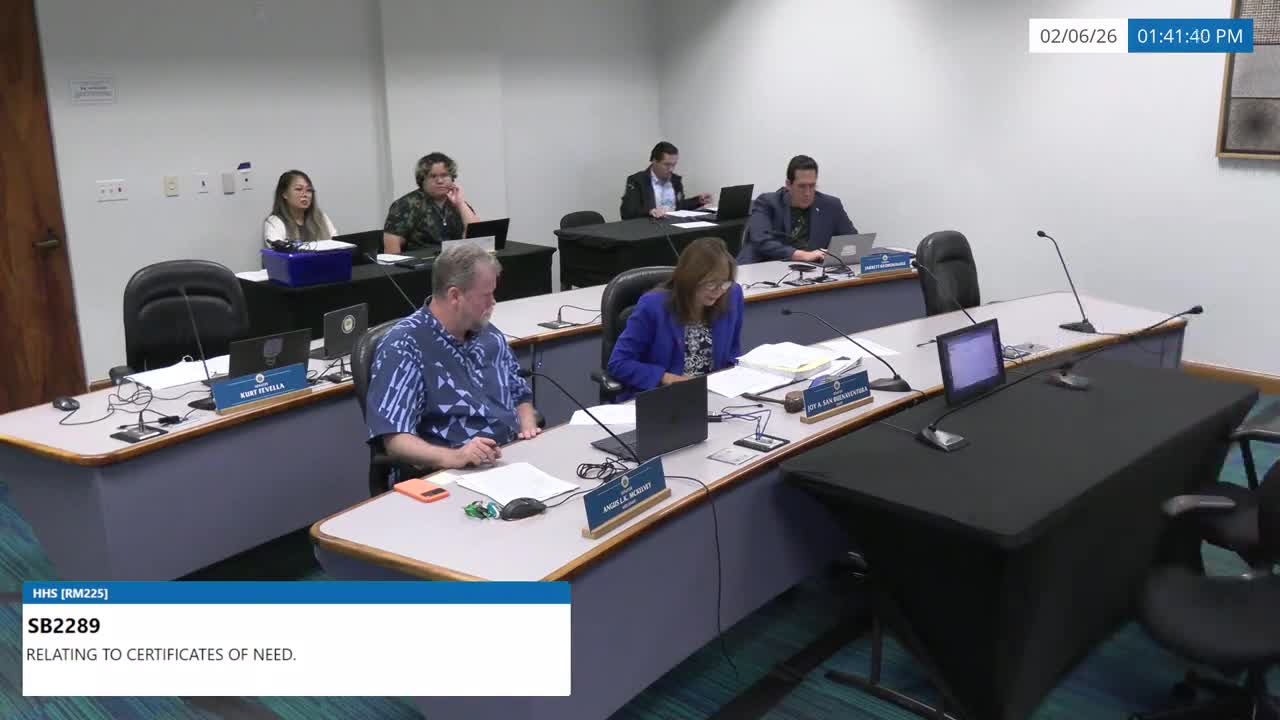 23SEC
Senate Standing Committee on Health and Human Services
Bill Author
Bill Co-Author(s):