SB 2516: Hawaii Law Enforcement Coalition Package; Public Safety; Hindering Prosecution; Accomplice Liability; Sanctions; Penalties
- Session Year: 2025-2026
- House: Senate
- Latest Version Date: 2026-03-06
Current Status:
Failed
(2026-03-12: Referred to JHA, referral sheet 17)
Introduced
In Committee
First Chamber
In Committee
Second Chamber
Final Decking
Enacted
What does this bill do?
The bill changes penalties for hindering prosecution so people who help or hide someone after a crime are punished based on how serious the original crime was, generally one level lower than that crime. For example, helping a person who committed murder would be charged as a class A felony (the most serious felony), while helping someone who committed a class C felony would be charged as a misdemeanor.
The summary is provided by generative AI which can make mistakes. For original language, please view the details in the table below.
Establishes a gradient penalty structure for the offense of hindering prosecution in the first degree, based on the level of offense hindered. (SD1)
Establishes a gradient penalty structure for the offense of hindering prosecution in the first degree, based on the level of offense hindered.
|
THE SENATE |
S.B. NO. |
2516 |
|
THIRTY-THIRD LEGISLATURE, 2026 |
S.D. 1 |
|
|
STATE OF HAWAII |
|
|
|
|
|
|
|
|
||
|
|
||
A BILL FOR AN ACT
RELATING TO PUBLIC SAFETY.
BE IT ENACTED BY THE LEGISLATURE OF THE STATE OF HAWAII:
SECTION 1. The legislature finds that there is a need to hold accountable persons who have assisted offenders after the commission of serious crimes. Often, these individuals are subject to limited sanctions for hindering prosecution in the first degree, a class C felony offense.
The legislature further finds that, under existing law, accomplice liability, which subjects a person to the same level of penalty as the percipient actor, does not apply to actions or assistance provided after the offense is committed. Thus, for example, an individual who assists a mass murderer by providing the offender shelter, food, or transportation after the commission of the offense would only be subject to a maximum penalty of a five-year prison term. A person who provided similar assistance to a person who killed or attempted to kill a police officer would also be limited to a maximum penalty of a five-year prison term.
The legislature believes that establishing a structure for more appropriate penalties, which takes into consideration the scope of the offenses and acts in question, will promote greater respect for the law, ensure offenders receive an appropriate sentence that reflects the seriousness of the offense, provide adequate deterrence for future criminal activity, and better protect the public.
Accordingly, the purpose of this Act is to establish a gradient penalty structure for the offense of hindering prosecution in the first degree, based on the level of offense hindered.
SECTION 2. Section 710-1029, Hawaii Revised Statutes, is amended by amending subsection (2) to read as follows:
"(2) Hindering prosecution in the first degree is [a
class C felony.] an offense one class or grade lower than the offense
committed by the other person; provided that when the offense committed by the
other person is murder in any degree, hindering prosecution is a class A felony;
provided further that if the underlying offense is not designated by class or
grade under Hawaii law, the court shall determine the most comparable Hawaii
offense when applying this subsection.
For the purposes of this subsection, "one class or grade
lower" means:
(a) If the underlying offense is a class A felony, the offense is a class B felony;
(b) If the underlying offense is a class B felony, the offense is a class C felony;
(c) If the underlying offense is a class C felony, the offense is a misdemeanor;
(d) If the underlying offense is a misdemeanor, the offense is a petty misdemeanor; and
(e) If the underlying offense is a petty misdemeanor, the offense is a violation."
SECTION 3. This Act does not affect rights and duties that matured, penalties that were incurred, and proceedings that were begun before its effective date.
SECTION 4. Statutory material to be repealed is bracketed and stricken. New statutory material is underscored.
SECTION 5. This Act shall take effect upon its approval.
Report Title:
Hawaii Law Enforcement Coalition Package; Public Safety; Hindering Prosecution; Accomplice Liability; Sanctions; Penalties
Description:
Establishes a gradient penalty structure for the offense of hindering prosecution in the first degree, based on the level of offense hindered. (SD1)
The summary description of legislation appearing on this page is for informational purposes only and is not legislation or evidence of legislative intent.
|
THE SENATE |
S.B. NO. |
2516 |
|
THIRTY-THIRD LEGISLATURE, 2026 |
|
|
|
STATE OF HAWAII |
|
|
|
|
|
|
|
|
||
|
|
||
A BILL FOR AN ACT
Relating to Public Safety.
BE IT ENACTED BY THE LEGISLATURE OF THE STATE OF HAWAII:
SECTION 1. The legislature finds that there is a need to hold accountable persons who have assisted offenders after the commission of serious crimes. Often, these individuals are subject to limited sanctions for hindering prosecution in the first degree, a class C felony offense.
The legislature further finds that, under existing law, accomplice liability, which subjects a person to the same level of penalty as the percipient actor, does not apply to actions or assistance provided after the offense is committed. Thus, for example, an individual who assists a mass murderer by providing the offender shelter, food, or transportation after the commission of the offense would only be subject to a maximum penalty of a five-year prison term. A person who provided similar assistance to a person who killed or attempted to kill a police officer would also be limited to a maximum penalty of a five-year prison term.
The legislature believes that establishing a structure for more appropriate penalties, which takes into consideration the scope of the offenses and acts in question, will promote greater respect for the law, ensure offenders receive an appropriate sentence that reflects the seriousness of the offense, provide adequate deterrence for future criminal activity, and better protect the public.
Accordingly, the purpose of this Act is to establish appropriate sanctions for offenders who render assistance and hinder the apprehension, prosecution, conviction, or punishment of another offender.
SECTION 2. Section 710-1029, Hawaii Revised Statutes, is amended by amending subsection (2) to read as follows:
"(2) Hindering prosecution in the first degree is [a
class C felony.] an offense one class or grade, as the case may be,
lower than the offense committed by the other person; provided that when the
offense committed by the other person is murder in any degree, hindering
prosecution is a class A felony."
SECTION 3. This Act does not affect rights and duties that matured, penalties that were incurred, and proceedings that were begun before its effective date.
SECTION 4. Statutory material to be repealed is bracketed and stricken. New statutory material is underscored.
SECTION 5. This Act shall take effect upon its approval.
|
INTRODUCED BY: |
_____________________________ |
|
|
By Request |
Report Title:
Hawaii Law Enforcement Coalition Package; Public Safety; Hindering Prosecution; Accomplice Liability; Sanctions; Penalties
Description:
Establishes a gradient penalty structure for the offense of hindering prosecution in the first degree, based on the level of offense hindered.
The summary description of legislation appearing on this page is for informational purposes only and is not legislation or evidence of legislative intent.
|
Date
|
Status
|
|---|---|
| Mar 12, 2026 | Referred to JHA, referral sheet 17 |
| Mar 12, 2026 | Pass First Reading |
| Mar 10, 2026 | Received from Senate (Sen. Com. No. 251) in amended form (SD 1). |
| Mar 10, 2026 | Report Adopted; Passed Third Reading, as amended (SD 1). Ayes, 23; Aye(s) with reservations: none. Noes, 2 (Senator(s) Awa, DeCorte). Excused, 0 (none). Transmitted to House. |
| Mar 6, 2026 | 48 Hrs. Notice 03-10-26. |
| Mar 6, 2026 | Reported from JDC (Stand. Com. Rep. No. 3091) with recommendation of passage on Third Reading, as amended (SD 1). |
| Feb 24, 2026 | The committee(s) on JDC recommend(s) that the measure be PASSED, WITH AMENDMENTS. The votes in JDC were as follows: 3 Aye(s): Senator(s) Rhoads, Chang, San Buenaventura; Aye(s) with reservations: none ; 1 No(es): Senator(s) Awa; and 1 Excused: Senator(s) Gabbard. |
| Feb 13, 2026 | The committee(s) on JDC will hold a public decision making on 02-24-26 10:00AM; Conference Room 016 & Videoconference. |
| Feb 10, 2026 | Report adopted; Passed Second Reading and referred to JDC. |
| Feb 9, 2026 | Reported from PSM (Stand. Com. Rep. No. 2133) with recommendation of passage on Second Reading and referral to JDC. |
| Feb 10, 2026 | Reported from PSM (Stand. Com. Rep. No. 2133) with recommendation of passage on Second Reading and referral to JDC. |
| Feb 2, 2026 | The committee(s) on PSM recommend(s) that the measure be PASSED, UNAMENDED. The votes in PSM were as follows: 3 Aye(s): Senator(s) Fukunaga, Lee, C., Hashimoto; Aye(s) with reservations: none ; 1 No(es): Senator(s) DeCorte; and 1 Excused: Senator(s) Inouye. |
| Jan 30, 2026 | The committee(s) on PSM has scheduled a public hearing on 02-02-26 3:00PM; Conference Room 016 & Videoconference. |
| Jan 28, 2026 | Referred to PSM, JDC. |
| Jan 23, 2026 | Passed First Reading. |
| Jan 23, 2026 | Introduced. |
|
Date
|
Description
|
Location
|
Votes
|
|
|---|---|---|---|---|
| Mar 10, 2026 | Third Reading | Senate Floor |
Passed |
|
| Feb 24, 2026 | The committee(s) on JDC recommend(s) that the measure be PASSED, WITH AMENDMENTS | Senate Standing Committee on Judiciary |
Passed |
|
| Feb 2, 2026 | The committee(s) on PSM recommend(s) that the measure be PASSED, UNAMENDED | Senate Standing Committee on Public Safety and Military Affairs |
Passed |
This list shows positions taken on this bill by organizations on the date displayed, which is linked to the original source.
Positions by individuals are not included.
|
Organization
|
Position
|
Date
|
|---|---|---|
| County of Maui Police Department | *** Support | Feb 2, 2026 |
| Department of the Attorney General | ** Support | |
| Department of the Prosecuting Attorney of the City and County of Honolulu | ** Support | |
| Department of the Attorney General | *** Support | Feb 24, 2026 |
| Department of the Prosecuting Attorney of the County of Maui | ** Support | |
| Hawaiʻi Police Department | ** Support | |
| Honolulu Police Department | *** Support | Feb 2, 2026 |
| Kauaʻi Police Department | ** Support | |
| Maui Police Department | ** Support | |
| Office of the Prosecuting Attorney of the County of Hawaii | ** Support | |
| Office of the Public Defender | *** Against | Feb 2, 2026 |
| SHOPO Hawaii | *** Support | Feb 2, 2026 |
STAND. COM. REP. NO. 3091
Honolulu, Hawaii
RE: S.B. No. 2516
S.D. 1
Honorable Ronald D. Kouchi
President of the Senate
Thirty-Third State Legislature
Regular Session of 2026
State of Hawaii
Sir:
Your Committee on Judiciary, to which was referred S.B. No. 2516 entitled:
"A BILL FOR AN ACT RELATING TO PUBLIC SAFETY,"
begs leave to report as follows:
The purpose and intent of this measure is to establish a gradient penalty structure for the offense of hindering prosecution in the first degree, based on the level of offense hindered.
Your Committee received testimony in support of this measure from the Department of the Attorney General, Office of the Prosecuting Attorney of the County of Hawaii, Department of the Prosecuting Attorney of the County of Maui, Department of the Prosecuting Attorney of the City and County of Honolulu, Kauaʻi Police Department, Hawaiʻi Police Department, and two individuals.
Your Committee finds that under existing law, offenders who obstruct or interfere with the apprehension, prosecution, conviction, or punishment of another offender are subject to a maximum penalty of a class C felony, regardless of the severity of the underlying offense. Your Committee believes that this disparity is unjust and undermines the public's confidence in the criminal justice system. This measure will ensure that those who aid others in evading justice are held accountable, thus helping to break the cycle of criminal activity and reducing the likelihood of future crimes.
Your Committee has amended this measure by:
(1) Clarifying the gradient penalty structure for the offense of hindering prosecution in the first degree; and
(2) Making technical, nonsubstantive amendments for the purposes of clarity and consistency.
As affirmed by the record of votes of the members of your Committee on Judiciary that is attached to this report, your Committee is in accord with the intent and purpose of S.B. No. 2516, as amended herein, and recommends that it pass Third Reading in the form attached hereto as S.B. No. 2516, S.D. 1.
Respectfully submitted on behalf of the members of the Committee on Judiciary,
|
|
|
________________________________ KARL RHOADS, Chair |
|
|
|
|
STAND. COM. REP. NO. 2133
Honolulu, Hawaii
RE: S.B. No. 2516
Honorable Ronald D. Kouchi
President of the Senate
Thirty-Third State Legislature
Regular Session of 2026
State of Hawaii
Sir:
Your Committee on Public Safety and Military Affairs, to which was referred S.B. No. 2516 entitled:
"A BILL FOR AN ACT RELATING TO PUBLIC SAFETY,"
begs leave to report as follows:
The purpose and intent of this measure is to establish a gradient penalty structure for the offense of hindering prosecution in the first degree, based on the level of offense hindered.
Your Committee received testimony in support of this measure from the Department of the Attorney General, Department of the Prosecuting Attorney of the County of Maui, Maui Police Department, Office of the Prosecuting Attorney of the County of Hawaii, Department of the Prosecuting Attorney of the City and County of Honolulu, and twelve individuals.
Your Committee received testimony in opposition to this measure from eleven individuals.
Your Committee finds that it is necessary to hold individuals accountable when they assist offenders who have committed serious crimes. Existing penalties for hindering prosecution in the first degree constitute a class C felony, regardless of the original offense. Consequently, individuals who hinder prosecution of serious crimes may be given similar penalties to individuals who hinder prosecution of significantly less serious offenses. This measure closes the gap in existing statute by providing a gradient of penalties for hindering prosecution in the first degree to ensure that individuals who hinder the prosecution of serious or violent crimes receive more appropriate penalties.
As affirmed by the record of votes of the members of your Committee on Public Safety and Military Affairs that is attached to this report, your Committee is in accord with the intent and purpose of S.B. No. 2516 and recommends that it pass Second Reading and be referred to your Committee on Judiciary.
Respectfully submitted on behalf of the members of the Committee on Public Safety and Military Affairs,
|
|
|
________________________________ CAROL FUKUNAGA, Chair |
|
|
|
|
|
Date
|
Testimony PDF
|
|---|---|
| Feb 24, 2026 | SB2516_TESTIMONY_JDC_02-24-26_.PDF |
| Feb 2, 2026 | SB2516_TESTIMONY_PSM_02-02-26_.PDF |
Discussed in Hearing
 1MIN
Senate Standing Committee on Judiciary
 7MIN
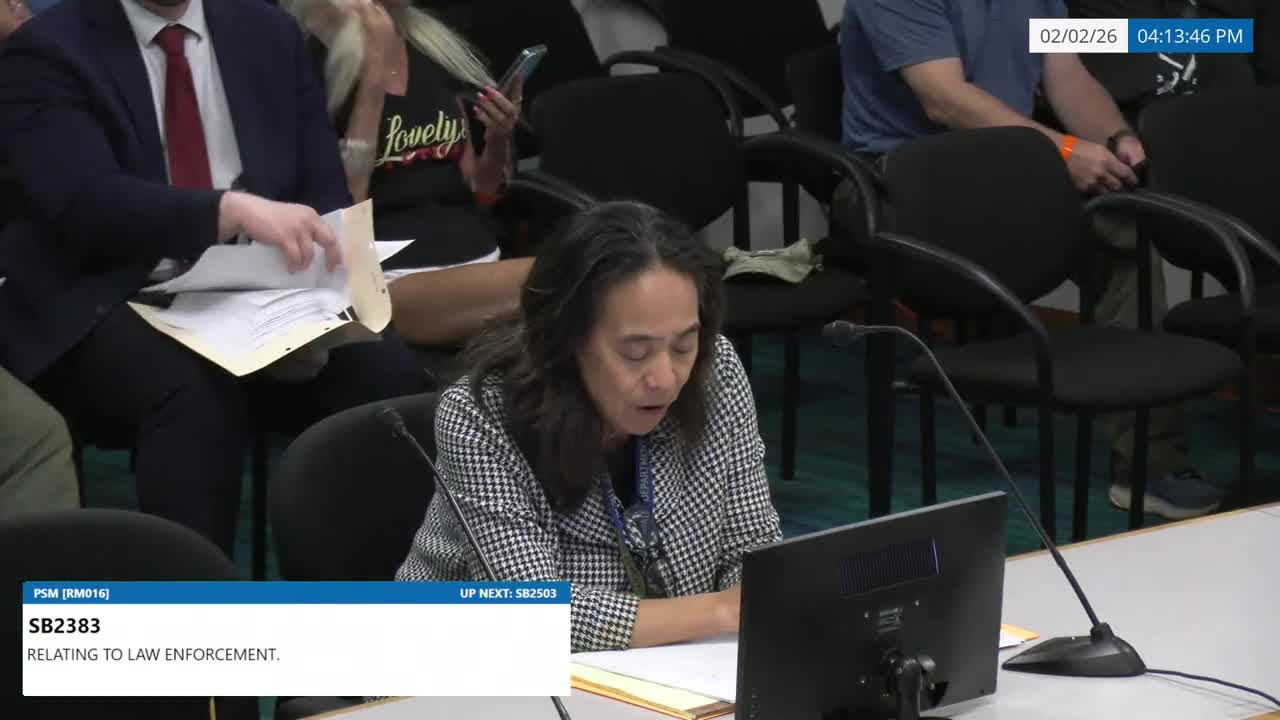
Senate Standing Committee on Public Safety and Military Affairs
Bill Author
Bill Co-Author(s):