SB 1648: RELATING TO POWER OUTAGES.
- Session Year: 2025-2026
- House: Senate
- Latest Version Date: 2025-02-13
Current Status:
Failed
(2025-12-08: Carried over to 2026 Regular Session.)
Introduced
In Committee
First Chamber
In Committee
Second Chamber
Final Decking
Enacted
Establishes requirements for compensation to utility customers following a power outage. Effective 7/1/2050. (SD1)
Establishes requirements for compensation to utility customers following a power outage.
|
THE SENATE |
S.B. NO. |
1648 |
|
THIRTY-THIRD LEGISLATURE, 2025 |
S.D. 1 |
|
|
STATE OF HAWAII |
|
|
|
|
|
|
|
|
||
|
|
||
A BILL FOR AN ACT
RELATING TO POWER OUTAGES.
BE IT ENACTED BY THE LEGISLATURE OF THE STATE OF HAWAII:
The legislature further finds that the uncertainty was understandable and continues to persist today. For example, according to Hawaiian Electric's website, customers can file a damage claim for "any loss caused by [an] outage" (although elsewhere on the website, claims appear to be limited to "sensitive electronic equipment ... damaged as the result of a power outage"). But, under rule 16 of the public utilities commission, a utility is only required to compensate customers for losses "determined by the Company to be within the Company's control." Not surprisingly, utilities rarely determine that a loss or damage was within their control; in 2023, ninety per cent of damage claims filed with Hawaiian Electric were denied. Even when a claim is approved, the time between the outage and payment can be excruciating. A month after the Chinatown blackout, the investigation into the cause of the outage had not been completed, no claims had been paid out, and Hawaiian Electric had instead issued "courtesy payments" of $500 for those business customers who submitted claims. In November 2024, businesses finally received an update: Hawaiian Electric had determined that it was not responsible for the outages but offered to cover up to fifty per cent of losses "as a gesture of goodwill".
The legislature further finds that this system unacceptably fails to provide utility customers with a clear, fair, equitable, and efficient system through which they are compensated for losses stemming from power outages. Other states such as Illinois have modified their statutory regimes to address this problem by shifting the burden of responding to these losses to the utility, rather than the customer. Illinois' system provides that when a power outage exceeds a certain threshold, the utility must compensate customers for all actual damages incurred due to the outage. The utility can seek a waiver by demonstrating to the utilities commission that the outage was a result of narrowly delineated circumstances legitimately beyond the utility's control, but in all other cases, compensation must be paid. The legislature additionally finds that the implementation of a similar scheme in the State will greatly reduce uncertainty and financial precarity stemming from losses incurred during major power outages.
Accordingly, the purpose of this Act is to:
(1) Create a default rule requiring a regulated utility to compensate customers for all actual damages incurred as a result of a power interruption affecting more than one thousand customers for four or more hours;
(2) Enable a regulated utility to seek a waiver from the public utilities commission relieving them of the obligation to compensate customers, but only if the public utilities commission determines that the interruption was the result of a specific subset of circumstances legitimately outside of the utility's control;
(3) Prevent a regulated utility from recovering losses and expenses from ratepayers; and
(4) Establish a clear timeline under which a regulated utility must pay compensation or seek a waiver, and under which the public utilities commission must issue a decision on a waiver sought by a regulated utility.
SECTION 2. Chapter 269, Hawaii Revised Statutes, is amended by adding a new section to part IX to be appropriately designated and to read as follows:
"§269- Power outage compensation. (a) If more than one thousand of the total customers of an electric utility are subjected to a continuous power interruption of four hours or more during which there is a total loss of power transmission or power is transmitted at less than fifty per cent of the standard voltage, the utility shall compensate customers affected by that interruption in an amount equal to actual damages suffered as a result of the power interruption. Actual damages shall not include consequential damages or litigation costs.
(b) The utility shall also reimburse any hospital or government entity for any power interruption as described in subsection (a) in an amount equal to the emergency and contingency expenses incurred by the hospital or government entity as a result of the power interruption.
(c) A waiver of the compensation and reimbursement requirements under subsections (a) and (b) may be granted by the commission if the utility can demonstrate that the power interruption was a result of the following:
(1) Unpreventable damage due to weather events or conditions;
(2) Customer tampering;
(3) Unpreventable damage due to civil or international unrest or animals; or
(4) Damage to utility equipment or other actions by a party other than the utility, its employees, agents, or contractors.
The loss of revenue for a utility or the expenses incurred by the utility for complying with this subsection shall not be recovered from ratepayers.
An application for a waiver under this subsection shall be submitted to the commission within thirty days of the power interruption. If a utility fails to submit an application for a waiver within thirty days, the utility shall be deemed to forfeit its right to obtain a waiver under this subsection.
Within ninety days of submission of the application for a waiver, the commission shall issue a decision to deny or approve the application.
The public utilities commission may adopt rules in accordance with chapter 91 to carry out the purposes of this subsection.
(d) No later than twenty-four hours before planned or routine maintenance or repairs of a utility's equipment that will result in transmission of power at less than fifty per cent of the standard voltage, a loss of power, or power fluctuation, the utility shall make reasonable efforts to notify potentially affected customers.
(e) Claims under this section shall be submitted to the utility within one hundred fifty days of the power interruption, unless extended by the governor or the commission.
(f) The utility shall have thirty days from the commission's decision under subsection (c) or thirty days from the date the claim is submitted to the utility, whichever is later, to issue a decision to approve, deny, or partially approve and partially deny the claim; provided that the commission may for good cause extend the deadline to issue a decision. No claim amount for actual damages shall be denied by the utility unless the utility obtains a waiver under subsection (c). Payments for an approved or partially approved and partially denied claim shall be made on the date of the utility's decision. Payments shall not be recovered from funds collected from utility rate payers.
(g) If a utility issues a decision to deny or partially approve and partially deny a claim, the claimant shall have a right of appeal to the commission; provided that the appeal is filed within thirty days after the decision was mailed to the claimant.
(h) This section shall not diminish or replace other civil or administrative remedies available to a customer or a class of customers, including the commission's authority to fine and impose other penalties on a utility.
(i) The commission, by rule adopted under chapter 91, shall require an electric utility to maintain service records detailing information on each instance of transmission of power at less than fifty per cent of the standard voltage, loss of power, or power fluctuation that affects ten or more customers. Occurrences that are momentary shall not be required to be recorded or reported. The service record shall include the following information for each occurrence:
(1) The date;
(2) The time of occurrence;
(3) The duration of the incident;
(4) The number of customers affected;
(5) A description of the cause;
(6) The geographic area affected;
(7) The specific equipment involved in the fluctuation or interruption;
(8) A description of measures taken to restore service;
(9) A description of measures taken to remedy the cause of the power interruption or fluctuation;
(10) A description of measures taken to prevent a future occurrence;
(11) The amount of remuneration, if any, paid to affected customers; and
(12) A statement of whether the fixed charge was waived for affected customers.
A copy of each record shall be filed with the commission and shall be available for public inspection. Copies of the records containing this information shall also be publicly available on the utility's website for not less than ten years after the date of the occurrence.
The commission, by rule adopted under chapter 91, shall require an electric utility to submit a report to the legislature no later than twenty days prior to the convening of the regular session of 2026 detailing the extent to which the electric utility already maintains service records in accordance with this subsection."
SECTION 3. This Act does not affect rights and duties that matured, penalties that were incurred, and proceedings that were begun before its effective date.
SECTION 4. New statutory material is underscored.
SECTION 5. This Act shall take effect on July 1, 2050.
Report Title:
Utility; Electricity; Outage
Description:
Establishes requirements for compensation to utility customers following a power outage. Effective 7/1/2050. (SD1)
The summary description of legislation appearing on this page is for informational purposes only and is not legislation or evidence of legislative intent.
|
THE SENATE |
S.B. NO. |
1648 |
|
THIRTY-THIRD LEGISLATURE, 2025 |
|
|
|
STATE OF HAWAII |
|
|
|
|
|
|
|
|
||
|
|
||
A BILL FOR AN ACT
relating to power outageS.
BE IT ENACTED BY THE LEGISLATURE OF THE STATE OF HAWAII:
The legislature further finds that the uncertainty was understandable and continues to persist today. For example, according to Hawaiian Electric's website, customers can file a damage claim for "any loss caused by [an] outage" (although elsewhere on the website, claims appear to be limited to "sensitive electronic equipment ... damaged as the result of a power outage"). But, under rule 16 of the public utilities commission, a utility is only required to compensate customers for losses "determined by the Company to be within the Company's control." Not surprisingly, utilities rarely determine that a loss or damage was within their control; in 2023, ninety per cent of damage claims filed with Hawaiian Electric were denied. Even when a claim is approved, the time between the outage and payment can be excruciating. A month after the Chinatown blackout, the investigation into the cause of the outage had not been completed, no claims had been paid out, and Hawaiian Electric had instead issued "courtesy payments" of $500 for those business customers who submitted claims. In November 2024, businesses finally received an update: Hawaiian Electric had determined that it was not responsible for the outages but offered to cover up to fifty per cent of losses "as a gesture of goodwill."
The legislation finds that this system unacceptably fails to provide utility customers with a clear, fair, equitable, and efficient system through which they are compensated for losses stemming from power outages. Other states such as Illinois have modified their statutory regimes to address this problem by shifting the burden of responding to these losses to the utility, rather than the customer. Illinois' system provides that when a power outage exceeds a certain threshold, the utility must compensate customers for all actual damages incurred due to the outage. The utility can seek a waiver by demonstrating to the utilities commission that the outage was a result of narrowly delineated circumstances legitimately beyond the utility's control, but in all other cases, compensation must be paid. The legislature finds that the implementation of a similar scheme in Hawaii will greatly reduce uncertainty and financial precarity stemming from losses incurred during major power outages.
Accordingly, the purpose of this Act is to:
(1) Create a default rule requiring a regulated utility to compensate customers for all actual damages incurred as a result of a power interruption affecting more than one thousand customers for four or more hours;
(2) Enable a regulated utility to seek a waiver from the public utilities commission relieving them of the obligation to compensate customers, but only if the public utilities commission determines that the interruption was the result of a specific subset of circumstances legitimately outside of the utility's control;
(3) Prevent a regulated utility from recovering losses and expenses from ratepayers; and
(4) Establish a clear timeline under which a regulated utility must pay compensation or seek a waiver, and under which the public utilities commission must issue a decision on a waiver sought by a regulated utility.
SECTION 2. Chapter 269, Hawaii Revised Statutes, is amended by adding a new section to part IX to be appropriately designated and to read as follows:
"§269- Power outage compensation. (a) If more than one thousand of the total customers of an electric utility are subjected to a continuous power interruption of four hours or more during which there is a total loss of power transmission or power is transmitted at less than fifty per cent of the standard voltage, the utility shall compensate customers affected by that interruption in an amount equal to actual damages suffered as a result of the power interruption. Actual damages shall not include consequential damages or litigation costs.
(b) The utility shall also reimburse any government entity for any power interruption as described in subsection (a) in an amount equal to the emergency and contingency expenses incurred by the government entity as a result of the power interruption.
(c) A waiver of the compensation and reimbursement requirements under subsections (a) and (b) may be granted by the commission if the utility can demonstrate that the power interruption was a result of the following:
(1) Unpreventable damage due to weather events or conditions;
(2) Customer tampering;
(3) Unpreventable damage due to civil or international unrest or animals; or
(4) Damage to utility equipment or other actions by a party other than the utility, its employees, agents, or contractors.
The loss of revenue for a utility or the expenses incurred by the utility for complying with this subsection shall not be recovered from ratepayers.
An application for a waiver under this subsection shall be submitted to the commission within thirty days of the power interruption. If a utility fails to submit an application for a waiver within thirty days, the utility shall be deemed to forfeit its right to obtain a waiver under this subsection.
Within ninety days of submission of the application for a waiver, the commission shall issue a decision to deny or approve the application.
(d) No later than twenty-four hours prior to planned or routine maintenance or repairs of a utility's equipment that will result in transmission of power at less than fifty per cent of the standard voltage, a loss of power, or power fluctuation, the utility shall make reasonable efforts to notify potentially affected customers.
(e) Claims under this section shall be submitted to the utility within one hundred fifty days of the power interruption, unless extended by the governor or the commission.
(f) The utility shall have thirty days from the commission's decision under subsection (c) or thirty days from the date the claim is submitted to the utility, whichever is later, to issue a decision to approve, deny, or partially approve and partially deny the claim; provided that the commission may for good cause extend the deadline to issue a decision. No claim amount for actual damages shall be denied by the utility unless the utility obtains a waiver under subsection (c). Payments for an approved or partially approved and partially denied claim shall be made on the date of the utility's decision. Payments shall not be paid out of funds collected from utility rate payers.
(g) If a utility issues a decision to deny or partially approve and partially deny a claim, the claimant shall have a right of appeal to the commission; provided that the appeal is filed within thirty days after the decision was mailed to the claimant.
(h) This section shall not diminish or replace other civil or administrative remedies available to a customer or a class of customers, including the commission's authority to fine and impose other penalties on a utility.
(i) The commission, by rule adopted under chapter 91, shall require an electric utility to maintain service records detailing information on each instance of transmission of power at less than fifty per cent of the standard voltage, loss of power, or power fluctuation that affects ten or more customers. Occurrences that are momentary shall not be required to be recorded or reported. The service record shall include the following information for each occurrence:
(1) The date;
(2) The time of occurrence;
(3) The duration of the incident;
(4) The number of customers affected;
(5) A description of the cause;
(6) The geographic area affected;
(7) The specific equipment involved in the fluctuation or interruption;
(8) A description of measures taken to restore service;
(9) A description of measures taken to remedy the cause of the power interruption or fluctuation;
(10) A description of measures taken to prevent a future occurrence;
(11) The amount of remuneration, if any, paid to affected customers; and
(12) A statement of whether the fixed charge was waived for affected customers.
A copy of each record shall be filed with the commission and shall be available for public inspection. Copies of the records containing this information shall also be publicly available on the utility's website for not less than ten years after the date of the occurrence."
SECTION 3. This Act does not affect rights and duties that matured, penalties that were incurred, and proceedings that were begun before its effective date.
SECTION 4. New statutory material is underscored.
SECTION 5. This Act shall take effect on January 1, 2026.
|
INTRODUCED BY: |
_____________________________ |
|
|
|
|
Date
|
Status
|
|---|---|
| Dec 8, 2025 | Carried over to 2026 Regular Session. |
| Mar 6, 2025 | Referred to EEP, CPC, FIN, referral sheet 19 |
| Mar 6, 2025 | Pass First Reading |
| Mar 4, 2025 | Received from Senate (Sen. Com. No. 386) in amended form (SD 1). |
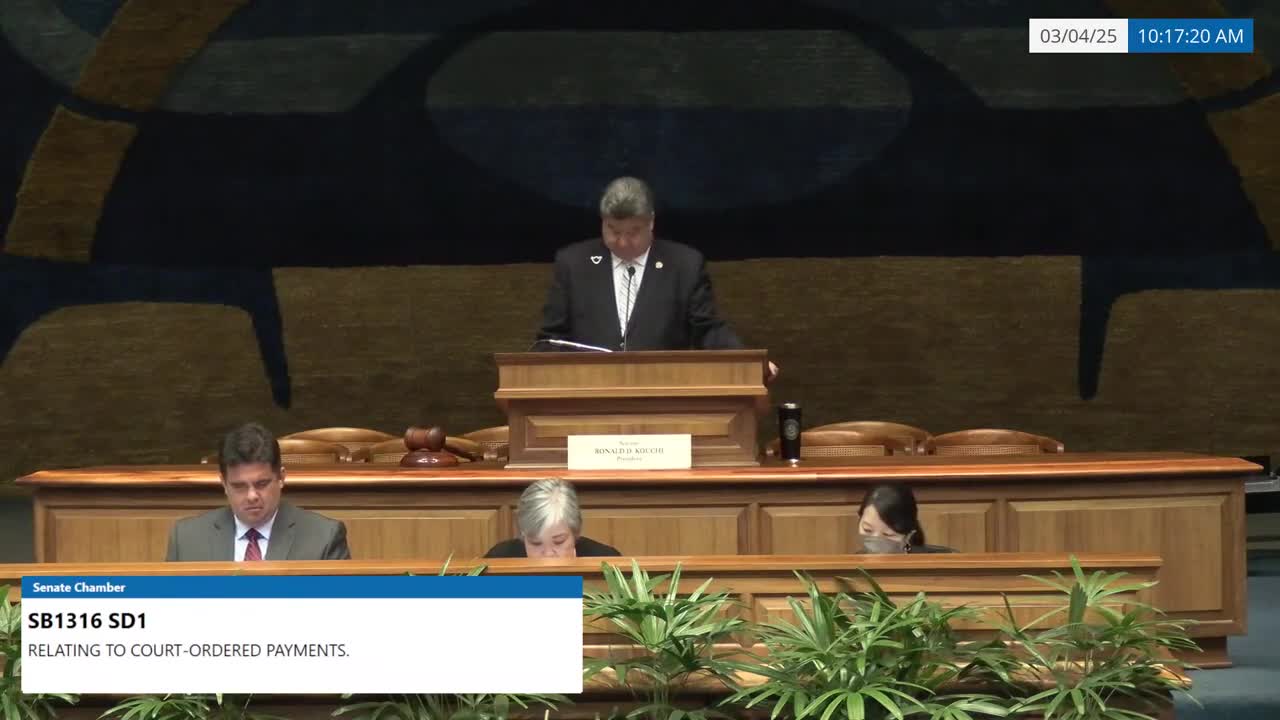
| Mar 4, 2025 | Report Adopted; Passed Third Reading. Ayes, 25; Aye(s) with reservations: Senator(s) Richards. Noes, 0 (none). Excused, 0 (none). Transmitted to House. |
| Feb 28, 2025 | One Day Notice 03-04-25. |
| Feb 28, 2025 | Reported from JDC (Stand. Com. Rep. No. 959) with recommendation of passage on Third Reading. |
| Feb 20, 2025 | The committee(s) on JDC recommend(s) that the measure be PASSED, UNAMENDED. The votes in JDC were as follows: 4 Aye(s): Senator(s) Rhoads, Chang, San Buenaventura, Awa; Aye(s) with reservations: none ; 0 No(es): none; and 1 Excused: Senator(s) Gabbard. |
| Feb 18, 2025 | The committee(s) on JDC will hold a public decision making on 02-20-25 10:01AM; CR 016 & Videoconference. |
| Feb 14, 2025 | Report adopted; Passed Second Reading, as amended (SD 1) and referred to JDC. |
| Feb 14, 2025 | Reported from CPN (Stand. Com. Rep. No. 491) with recommendation of passage on Second Reading, as amended (SD 1) and referral to JDC. |
| Feb 7, 2025 | The committee(s) on CPN recommend(s) that the measure be PASSED, WITH AMENDMENTS. The votes in CPN were as follows: 5 Aye(s): Senator(s) Keohokalole, Fukunaga, McKelvey, Awa; Aye(s) with reservations: Senator(s) Richards ; 0 No(es): none; and 0 Excused: none. |
| Feb 6, 2025 | The committee(s) on CPN deleted the measure from the public hearing scheduled on 02-10-25 9:35AM; CR 229 & Videoconference. |
| Feb 6, 2025 | The committee(s) on CPN has scheduled a public hearing on 02-10-25 9:35AM; Conference Room 229 & Videoconference. |
| Jan 31, 2025 | The committee(s) on CPN has scheduled a public hearing on 02-07-25 9:50AM; Conference Room 229 & Videoconference. |
| Jan 27, 2025 | Referred to CPN, JDC. |
| Jan 27, 2025 | Passed First Reading. |
| Jan 23, 2025 | Introduced. |
|
Date
|
Description
|
Location
|
Votes
|
|
|---|---|---|---|---|
| Mar 4, 2025 | Third Reading | Senate Floor |
Passed |
|
| Feb 20, 2025 | The committee(s) on JDC recommend(s) that the measure be PASSED, UNAMENDED | Senate Standing Committee on Judiciary |
Passed |
|
| Feb 7, 2025 | The committee(s) on CPN recommend(s) that the measure be PASSED, WITH AMENDMENTS | Senate Standing Committee on Commerce and Consumer Protection |
Passed |
This list shows positions taken on this bill by organizations on the date displayed, which is linked to the original source.
Positions by individuals are not included.
|
Organization
|
Position
|
Date
|
|---|---|---|
| Hawaiian Electric | *** Against | Feb 19, 2025 |
| Hawaiian Electric and Kauaʻi Island Utility Cooperative | ** Against | |
| Kauaʻi Island Utility Cooperative | *** Against | Feb 19, 2025 |
STAND. COM. REP. NO. 959
Honolulu, Hawaii
RE: S.B. No. 1648
S.D. 1
Honorable Ronald D. Kouchi
President of the Senate
Thirty-Third State Legislature
Regular Session of 2025
State of Hawaii
Sir:
Your Committee on Judiciary, to which was referred S.B. No. 1648, S.D. 1, entitled:
"A BILL FOR AN ACT RELATING TO POWER OUTAGES,"
begs leave to report as follows:
The purpose and intent of this measure is to:
(1) Create a default rule requiring a regulated utility to compensate customers for all actual damages incurred as a result of a power interruption affecting more than one thousand customers for four or more hours;
(2) Enable a regulated utility to seek a waiver from the Public Utilities Commission relieving them of the obligation to compensate customers, but only if the Public Utilities Commission determines that the interruption was the result of a specific subset of circumstances legitimately outside of the utility's control;
(3) Prevent a regulated utility from recovering losses and expenses from ratepayers; and
(4) Establish a clear timeline under which a regulated utility must pay compensation or seek a waiver, and under which the Public Utilities Commission must issue a decision on a waiver sought by a regulated utility.
Your Committee received testimony in support of this measure from one individual.
Your Committee received testimony in opposition to this measure from Hawaiian Electric and Kauaʻi Island Utility Cooperative.
Your Committee received comments on this measure from the Consumer Advocacy Division of the Department of Commerce and Consumer Affairs and Public Utilities Commission.
Your Committee finds that in June 2024, Honolulu's downtown and Chinatown experienced multiple power outages, the largest of which resulted in the loss of power for roughly three thousand customers of Hawaiian Electric. Over three hundred claims were filed with Hawaiian Electric in the aftermath of the blackouts, with news reports indicating that many more potential claims were not filed due to uncertainty or doubt about whether Hawaiian Electric would cover certain losses or ultimately compensate the businesses for damages. A month after the Chinatown blackout, no claims had been paid out, and Hawaiian Electric had instead issued "courtesy payments" of $500 for those business customers who submitted claims. Your Committee believes that the existing system unacceptably fails to provide utility customers with a clear, fair, equitable, and efficient system through which they are compensated for losses stemming from power outages. This measure will reduce uncertainty and financial precarity stemming from losses incurred during major power outages.
Your Committee notes that the intent of this measure is not to assign blame or fault but rather to determine who is required to pay for damages or losses under certain circumstances.
As affirmed by the record of votes of the members of your Committee on Judiciary that is attached to this report, your Committee is in accord with the intent and purpose of S.B. No. 1648, S.D. 1, and recommends that it pass Third Reading.
Respectfully submitted on behalf of the members of the Committee on Judiciary,
|
|
|
________________________________ KARL RHOADS, Chair |
|
|
|
|
STAND. COM. REP. NO. 491
Honolulu, Hawaii
RE: S.B. No. 1648
S.D. 1
Honorable Ronald D. Kouchi
President of the Senate
Thirty-Third State Legislature
Regular Session of 2025
State of Hawaii
Sir:
Your Committee on Commerce and Consumer Protection, to which was referred S.B. No. 1648 entitled:
"A BILL FOR AN ACT RELATING TO POWER OUTAGES,"
begs leave to report as follows:
The purpose and intent of this measure is to:
(1) Create a default rule requiring a regulated utility to compensate customers for all actual damages incurred as a result of a power interruption affecting more than one thousand customers for four or more hours;
(2) Enable a regulated utility to seek a waiver from the Public Utilities Commission relieving them of the obligation to compensate customers, but only if the Public Utilities Commission determines that the interruption was the result of a specific subset of circumstances legitimately outside of the utility's control;
(3) Prevent a regulated utility from recovering losses and expenses from ratepayers; and
(4) Establish a clear timeline under which a regulated utility must pay compensation or seek a waiver, and under which the Public Utilities Commission must issue a decision on a waiver sought by a regulated utility.
Your Committee received testimony in opposition to this measure from Hawaiian Electric and Kauaʻi Island Utility Cooperative.
Your Committee received comments on this measure from the Department of Commerce and Consumer Affairs and Public Utilities Commission.
Your Committee finds that existing law unacceptably fails to provide utility customers with a clear, fair, equitable, and efficient system through which they are compensated for losses stemming from power outages. This measure will protect consumers by shifting the burden of responding to losses incurred due to a power outage to the utility, rather than the consumer.
Your Committee has amended this measure by:
(1) Allowing hospitals to seek emergency and contingency expenses incurred by the hospital as a result of certain power interruptions;
(2) Allowing the Public Utilities Commission to adopt rules in accordance with chapter 91, Hawaii Revised Statutes, for the new compensation waiver process established by this measure;
(3) Clarifying that payments shall not be recovered from funds collected from utility rate payers, rather than being paid out of funds collected from utility rate payers;
(4) Requiring electric utilities to submit a report to the Legislature before the 2026 Regular Session detailing the extent to which the utility already maintains service records containing certain information;
(5) Inserting an effective date of July 1, 2050, to encourage further discussion; and
(6) Making technical, nonsubstantive amendments for the purposes of clarity and consistency.
As affirmed by the record of votes of the members of your Committee on Commerce and Consumer Protection that is attached to this report, your Committee is in accord with the intent and purpose of S.B. No. 1648, as amended herein, and recommends that it pass Second Reading in the form attached hereto as S.B. No. 1648, S.D. 1, and be referred to your Committee on Judiciary.
Respectfully submitted on behalf of the members of the Committee on Commerce and Consumer Protection,
|
|
|
________________________________ JARRETT KEOHOKALOLE, Chair |
|
|
|
|
|
Date
|
Testimony PDF
|
|---|---|
| Feb 19, 2025 | SB1648_SD1_TESTIMONY_JDC_02-20-25_.PDF |
| Feb 7, 2025 | SB1648_TESTIMONY_CPN_02-07-25_.PDF |
Bill Author