SB 124: PROPOSING AMENDMENTS TO ARTICLE IV, SECTIONS 4 AND 6, OF THE HAWAII STATE CONSTITUTION REGARDING REAPPORTIONMENT.
- Session Year: 2025-2026
- House: Senate
- Latest Version Date: 2025-02-06
Current Status:
Failed
(2025-12-08: Carried over to 2026 Regular Session.)
Introduced
In Committee
First Chamber
In Committee
Second Chamber
Final Decking
Enacted
Proposes a constitutional amendment to specify that reapportionment shall be based on the resident population, as counted in the decennial United States census for the respective reapportionment year, rather than the permanent resident population. (SD1)
Proposes a constitutional amendment to specify that reapportionment shall be based on the resident population, as counted in the most recent decennial United States census for the respective reapportionment year, rather than the permanent resident population.
|
THE SENATE |
S.B. NO. |
124 |
|
THIRTY-THIRD LEGISLATURE, 2025 |
S.D. 1 |
|
|
STATE OF HAWAII |
|
|
|
|
|
|
|
|
||
|
|
||
A BILL FOR AN ACT
PROPOSING AMENDMENTS TO ARTICLE IV, SECTIONS 4 AND 6, OF THE HAWAII STATE CONSTITUTION REGARDING REAPPORTIONMENT.
BE IT ENACTED BY THE LEGISLATURE OF THE STATE OF HAWAII:
The legislature further finds that forty-seven states base their reapportionment process on the United States census data and the concept of "usual residents". The United States census defines "usual residence" as "the place where a person lives and sleeps most of the time". 83 Fed. Reg. 5525 (Feb. 8, 2018). For federal House of Representatives purposes, Hawai‘i's two seats are allocated based on the census data. Hawai‘i ignores this approach and simply extracts non-permanent residents from the census total. Kansas, one of the only other states that did not use unadjusted census numbers for several reapportionments, stopped the practice when voters supported a state constitutional amendment in 2019. Kansas now uses the most recent census data as published by the United States Census Bureau. Hawai‘i remains an outlier in this regard. The practical effect of Hawai‘i's method is that thousands of military members, their dependents, and college students who reside in the State but are not permanent residents are excluded from reapportionment. Furthermore, these individuals are also not counted in another state for reapportionment purposes since all other states base their process on the United States census data.
The legislature additionally finds that the United States Constitution's equal protection clause requires equal representation of all persons. Elected officials represent and serve all persons living in a specific geographic area, regardless of their residence status. It is neither rational nor fair to ignore the many non-permanent resident military members, their dependents, and college students living in the State, since state and county services are provided regardless of the individual's reapportionment status. Under the State's current extraction method there are, in some census tracts, a negative net population. District to district, there is also uneven and unequal representation because those excluded are not evenly distributed across the districts. Fundamentally, individuals who are extracted live in a specific area and should be counted for representation purposes of that district.
Accordingly, the purpose of this Act is to propose amendments to article IV, sections 4 and 6, of the Hawaii State Constitution to specify that reapportionment shall be based on the resident population, as counted in the decennial United States census for the respective reapportionment year.
SECTION 2. Article 4, section 4, of the Constitution of the State of Hawaii is amended to read as follows:
"APPORTIONMENT AMONG BASIC ISLAND UNITS
Section
4. The commission shall allocate the
total number of members of each house of the state legislature being
reapportioned among the four basic island units, namely: (1) the island of Hawaii, (2) the islands of
Maui, Lanai, Molokai and Kahoolawe, (3) the island of Oahu and all other
islands not specifically enumerated, and (4) the islands of Kauai and Niihau,
using the total number of [permanent] residents, as reported by the
decennial census of the United States for the respective reapportionment year,
in each of the basic island units and computed by the method known as the
method of equal proportions; except that no basic island unit shall receive
less than one member in each house."
SECTION 3. Article 4, section 6, of the Constitution of the State of Hawaii is amended to read as follows:
"APPORTIONMENT WITHIN BASIC ISLAND UNITS
Section
6. Upon the determination of the
total number of members of each house of the state legislature to which each
basic island unit is entitled, the commission shall apportion the members among
the districts therein and shall redraw district lines where necessary in such
manner that for each house the average number of [permanent] residents,
as reported by the decennial census of the United States for the respective
reapportionment year, per member in each district is as nearly equal to the
average for the basic island unit as practicable.
In effecting such redistricting, the commission shall be guided by the following criteria:
1. No district shall extend beyond the boundaries of any basic island unit.
2. No district shall be so drawn as to unduly favor a person or political faction.
3. Except in the case of districts encompassing more than one island, districts shall be contiguous.
4. Insofar as practicable, districts shall be compact.
5. Where possible, district lines shall follow permanent and easily recognized features, such as streets, streams and clear geographical features, and, when practicable, shall coincide with census tract boundaries.
6. Where practicable, representative districts shall be wholly included within senatorial districts.
7. Not more than four members shall be elected from any district.
8. Where practicable, submergence of an area in a larger district wherein substantially different socio-economic interests predominate shall be avoided."
SECTION 4. The question to be printed on the ballot shall be as follows:
"Shall the method of reapportionment, which is the redrawing of electoral district boundaries in the State, be changed so that reapportionment is based on the total number of residents in the State, as reported by the decennial census of the United States for the respective reapportionment year, rather than based on the number of permanent residents in the State?"
SECTION 5. Constitutional material to be repealed is bracketed and stricken. New constitutional material is underscored.
SECTION 6. This amendment shall take effect upon compliance with article XVII, section 3, of the Constitution of the State of Hawaii.
Report Title:
Reapportionment; Census Data; Constitutional Amendment
Description:
Proposes a constitutional amendment to specify that reapportionment shall be based on the resident population, as counted in the decennial United States census for the respective reapportionment year, rather than the permanent resident population. (SD1)
The summary description of legislation appearing on this page is for informational purposes only and is not legislation or evidence of legislative intent.
|
THE SENATE |
S.B. NO. |
124 |
|
THIRTY-THIRD LEGISLATURE, 2025 |
|
|
|
STATE OF HAWAII |
|
|
|
|
|
|
|
|
||
|
|
||
A BILL FOR AN ACT
proposing amendments to article iv, sections 4 and 6, of the hawaii state constitution regarding reapportionment.
BE IT ENACTED BY THE LEGISLATURE OF THE STATE OF HAWAII:
The legislature further finds that forty-nine states base their reapportionment process on the United States census data and the concept of "usual residents". The United States census defines "usual residence" as "the place where a person lives and sleeps most of the time". 83 Fed. Reg. 5525 (Feb. 8, 2018). For federal House of Representatives purposes, Hawai‘i's two seats are allocated based on the census data. Hawai‘i ignores this approach and simply extracts non-permanent residents from the census total. Kansas, the only other state that did not use unadjusted census numbers for several reapportionments, stopped the practice when voters supported a state constitutional amendment in 2019. Kansas now uses the most recent census data as published by the United States Census Bureau. Hawai‘i remains the outlier in this regard. The practical effect of Hawai‘i's method is that thousands of military members, their dependents, and college students who reside in the State but are not permanent residents are excluded from reapportionment. Furthermore, these individuals are also not counted in another state for reapportionment purposes since all other states base their process on the United States census data.
The legislature additionally finds that the United States Constitution's equal protection clause requires equal representation of all persons. Elected officials represent and serve all persons living in a specific geographic area, regardless of their residence status. It is neither rational nor fair to ignore the many non-permanent resident military members, their dependents, and college students living in the State, since state and county services are provided regardless of the individual's reapportionment status. Under the State's current extraction method there are, in some census tracks, a negative net population. District to district, there is also uneven and unequal representation because those excluded are not evenly distributed across the districts. Fundamentally, individuals who are extracted live in a specific area and should be counted for representation purposes of that district.
Accordingly, the purpose of this Act is to propose amendments to article IV, sections 4 and 6, of the Hawaii State Constitution to specify that reapportionment shall be based on the resident population, as counted in the most recent decennial United States census for the respective reapportionment year.
SECTION 2. Article 4, section 4, of the Constitution of the State of Hawaii is amended to read as follows:
"Section 4. The commission
shall allocate the total number of members of each house of the state
legislature being reapportioned among the four basic island units, namely: (1) the island of Hawaii, (2) the islands of
Maui, Lanai, Molokai and Kahoolawe, (3) the island of Oahu and all other
islands not specifically enumerated, and (4) the islands of Kauai and Niihau,
using the total number of [permanent] residents, as reported by the
most recent decennial census of the United States for the respective reapportionment
year, in each of the basic island units and computed by the method known as
the method of equal proportions; except that no basic island unit shall receive
less than one member in each house."
SECTION 3. Article 4, section 6, of the Constitution of the State of Hawaii is amended to read as follows:
"Section 6. Upon the
determination of the total number of members of each house of the state
legislature to which each basic island unit is entitled, the commission shall
apportion the members among the districts therein and shall redraw district
lines where necessary in such manner that for each house the average number of
[permanent] residents, as reported by the most recent decennial
census of the United States for the respective reapportionment year, per
member in each district is as nearly equal to the average for the basic island
unit as practicable.
In effecting such redistricting, the commission shall be guided by the following criteria:
1. No district shall extend beyond the boundaries of any basic island unit.
2. No district shall be so drawn as to unduly favor a person or political faction.
3. Except in the case of districts encompassing more than one island, districts shall be contiguous.
4. Insofar as practicable, districts shall be compact.
5. Where possible, district lines shall follow permanent and easily recognized features, such as streets, streams and clear geographical features, and, when practicable, shall coincide with census tract boundaries.
6. Where practicable, representative districts shall be wholly included within senatorial districts.
7. Not more than four members shall be elected from any district.
8. Where practicable, submergence of an area in a larger district wherein substantially different socio-economic interests predominate shall be avoided."
SECTION 4. The question to be printed on the ballot shall be as follows:
"Shall the method of reapportionment, which is the redrawing of electoral district boundaries in the State, be changed so that reapportionment is based on the total number of residents in the State, as reported by the most recent decennial census of the United States for the respective reapportionment year, rather than based on the number of permanent residents in the State?"
SECTION 5. Constitutional material to be repealed is bracketed and stricken. New constitutional material is underscored.
SECTION 6. This amendment shall take effect upon compliance with article XVII, section 3, of the Constitution of the State of Hawaii.
|
INTRODUCED BY: |
_____________________________ |
|
|
|
Report Title:
Reapportionment; Census Data; Constitutional Amendment
Description:
Proposes a constitutional amendment to specify that reapportionment shall be based on the resident population, as counted in the most recent decennial United States census for the respective reapportionment year, rather than the permanent resident population.
The summary description of legislation appearing on this page is for informational purposes only and is not legislation or evidence of legislative intent.
|
Date
|
Status
|
|---|---|
| Dec 8, 2025 | Carried over to 2026 Regular Session. |
| Mar 10, 2025 | Notice of bill proposing constitutional amendment transmitted to Governor pursuant to Article XVII, Section 3 (Sen. Com. No. 1). |
| Mar 6, 2025 | Referred to JHA, FIN, referral sheet 19 |
| Mar 6, 2025 | Pass First Reading |
| Mar 4, 2025 | Received from Senate (Sen. Com. No. 92) in amended form (SD 1). |
| Mar 4, 2025 | Report Adopted; Passed Third Reading. Ayes, 21; Aye(s) with reservations: Senator(s) Fevella. Noes, 4 (Senator(s) Awa, DeCorte, McKelvey, San Buenaventura). Excused, 0 (none). Transmitted to House. |
| Feb 28, 2025 | One Day Notice 03-04-25. |
| Feb 28, 2025 | Reported from WAM (Stand. Com. Rep. No. 936) with recommendation of passage on Third Reading. |
| Feb 26, 2025 | The committee(s) on WAM recommend(s) that the measure be PASSED, UNAMENDED. The votes in WAM were as follows: 13 Aye(s): Senator(s) Dela Cruz, Moriwaki, Aquino, DeCoite, Elefante, Hashimoto, Inouye, Kanuha, Kidani, Kim, Lee, C., Wakai; Aye(s) with reservations: Senator(s) Fevella ; 0 No(es): none; and 0 Excused: none. |
| Feb 20, 2025 | The committee(s) on WAM will hold a public decision making on 02-26-25 10:03AM; Conference Room 211 & Videoconference. |
| Feb 6, 2025 | Report adopted; Passed Second Reading, as amended (SD 1) and referred to WAM. |
| Feb 6, 2025 | Reported from JDC (Stand. Com. Rep. No. 73) with recommendation of passage on Second Reading, as amended (SD 1) and referral to WAM. |
| Jan 28, 2025 | The committee(s) on JDC recommend(s) that the measure be PASSED, WITH AMENDMENTS. The votes in JDC were as follows: 3 Aye(s): Senator(s) Rhoads, Gabbard, Chang; Aye(s) with reservations: none ; 2 No(es): Senator(s) San Buenaventura, Awa; and 0 Excused: none. |
| Jan 22, 2025 | The committee(s) on JDC has scheduled a public hearing on 01-28-25 9:15AM; Conference Room 016 & Videoconference. |
| Jan 17, 2025 | Referred to JDC, WAM. |
| Jan 15, 2025 | Introduced and passed First Reading. |
| Jan 10, 2025 | Pending Introduction. |
|
Date
|
Description
|
Location
|
Votes
|
|
|---|---|---|---|---|
| Mar 4, 2025 | Third Reading | Senate Floor |
Passed |
|
| Feb 26, 2025 | The committee(s) on WAM recommend(s) that the measure be PASSED, UNAMENDED | Senate Standing Committee on Ways and Means |
Passed |
|
| Jan 28, 2025 | The committee(s) on JDC recommend(s) that the measure be PASSED, WITH AMENDMENTS | Senate Standing Committee on Judiciary |
Passed |
This list shows positions taken on this bill by organizations on the date displayed, which is linked to the original source.
Positions by individuals are not included.
|
Organization
|
Position
|
Date
|
|---|---|---|
| Seven Individuals | ** Against |
STAND. COM. REP. NO. 936
Honolulu, Hawaii
RE: S.B. No. 124
S.D. 1
Honorable Ronald D. Kouchi
President of the Senate
Thirty-Third State Legislature
Regular Session of 2025
State of Hawaii
Sir:
Your Committee on Ways and Means, to which was referred S.B. No. 124, S.D. 1, entitled:
"A BILL FOR AN ACT PROPOSING AMENDMENTS TO ARTICLE IV, SECTIONS 4 AND 6, OF THE HAWAII STATE CONSTITUTION REGARDING REAPPORTIONMENT,"
begs leave to report as follows:
The purpose and intent of this measure is to propose amendments to Article IV, Sections 4 and 6, of the Hawaii State Constitution to reapportion state legislative seats according to the resident population counted in the decennial United States Census, rather than the permanent resident population.
Your Committee received written comments in support of this measure from the League of Women Voters and three individuals.
Your Committee received written comments in opposition to this measure from a member of the Hawaii County Council and numerous individuals.
Your Committee recognizes that, under the current provisions of the Hawaii State Constitution, reapportionment for state senators and representatives is based on the average number of "permanent residents" in each district. This term excludes military members, their dependents, and college students who reside in the State but are not permanent residents. This is contrary to the law in forty-seven other states, which base their reapportionment process on data from the United States Census. Your Committee finds that adopting the reapportionment process implemented in the vast majority of other states would ensure that legislative seats more accurately reflect an area's resident population.
As affirmed by the record of votes of the members of your Committee on Ways and Means that is attached to this report, your Committee is in accord with the intent and purpose of S.B. No. 124, S.D. 1, and recommends that it pass Third Reading.
Respectfully submitted on behalf of the members of the Committee on Ways and Means,
|
|
|
________________________________ DONOVAN M. DELA CRUZ, Chair |
|
|
|
|
STAND. COM. REP. NO. 73
Honolulu, Hawaii
RE: S.B. No. 124
S.D. 1
Honorable Ronald D. Kouchi
President of the Senate
Thirty-Third State Legislature
Regular Session of 2025
State of Hawaii
Sir:
Your Committee on Judiciary, to which was referred S.B. No. 124 entitled:
"A BILL FOR AN ACT PROPOSING AMENDMENTS TO ARTICLE IV, SECTIONS 4 AND 6, OF THE HAWAII STATE CONSTITUTION REGARDING REAPPORTIONMENT,"
begs leave to report as follows:
The purpose and intent of this measure is to propose amendments to article IV, sections 4 and 6, of the Hawaii State Constitution to specify that reapportionment shall be based on the resident population, as counted in the most recent decennial United States census for the respective reapportionment year.
Your Committee received testimony in support of this measure from three individuals.
Your Committee received testimony in opposition to this measure from one member of the Hawaiʻi County Council and seven individuals.
Your Committee received comments on this measure from the Department of the Attorney General.
Your Committee finds that the Hawaii State Constitution requires that reapportionment for state senators and representatives be based on the average number of "permanent residents" in each district, which may exclude "usual residents" of the State, despite "usual residents" being included in the decennial United States census. Your Committee also finds that forty-seven states base their reapportionment process on the United States census data and the concept of "usual residents". The practical effect of the State's existing reapportionment method is that thousands of military members, their dependents, and college students who reside in the State but are not permanent residents are excluded from reapportionment. This measure will conform the State's reapportionment process with the majority of other states in the nation and ensure that seats for elected officials more accurately reflect an area's resident population by using the "usual resident" standard of the decennial United States census count rather than the "permanent resident" population.
Your Committee acknowledges the concerns raised by the testimony of the Department of the Attorney General that if the Reapportionment Commission is required to use the "most recent" decennial census, should there be a delay in the reporting of the census data the term "most recent" could be interpreted to mean the previous census from ten years earlier. Therefore, your Committee finds that amendments to this measure are necessary.
Accordingly, your Committee has amended this measure by:
(1) Specifying that reapportionment shall be based on the resident population, as counted in the decennial United States census for the respective reapportionment year, instead of census data from the most recent decennial census of the United States;
(2) Clarifying legislative findings to include that forty‑seven states base their reapportionment process on the United States census data and the concept of "usual residents";
(3) Amending section 1 to reflect its amended purpose; and
(4) Making technical, nonsubstantive amendments for the purposes of clarity and consistency.
As affirmed by the record of votes of the members of your Committee on Judiciary that is attached to this report, your Committee is in accord with the intent and purpose of S.B. No. 124, as amended herein, and recommends that it pass Second Reading in the form attached hereto as S.B. No. 124, S.D. 1, and be referred to your Committee on Ways and Means.
Respectfully submitted on behalf of the members of the Committee on Judiciary,
|
|
|
________________________________ KARL RHOADS, Chair |
|
|
|
|
Discussed in Hearing
View Older Hearings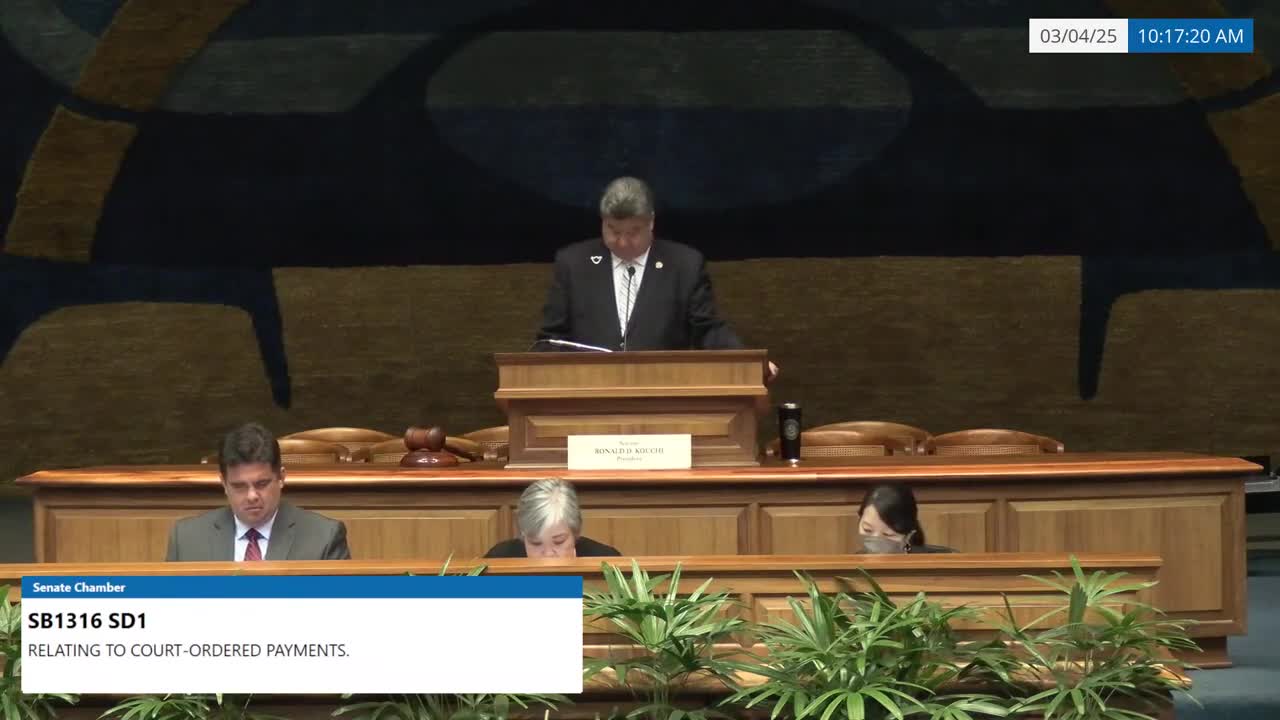
Bill Author

Bill Co-Author(s):