SB 1033: Excise Tax; Failure to Sell Excess Single-Family Residences; Housing Downpayment Trust Fund; Reports
- Session Year: 2025-2026
- House: Senate
- Latest Version Date: 2025-02-28
Current Status:
Failed
(2025-12-08: Carried over to 2026 Regular Session.)
Introduced
In Committee
First Chamber
In Committee
Second Chamber
Final Decking
Enacted
Establishes an excise tax on certain taxpayers who own excess single-family residences for failure to sell those residences. Establishes and allocates excise tax revenues to the Housing Downpayment Trust Fund. Requires annual reports to the Legislature. Applies to taxable years beginning after 12/31/2026. Effective 7/1/2050. (SD2)
Establishes an excise tax on certain taxpayers who own excess single-family residences for failure to sell those residences. Establishes and allocates excise tax revenues to the Housing Downpayment Trust Fund. Requires annual reports to the Legislature. Applies to taxable years beginning after 12/31/2026. Effective 7/1/2050. (SD1)
Establishes an excise tax on certain taxpayers who own excess single-family residences for failure to sell those residences. Establishes and allocates excise tax revenues to the Housing Downpayment Trust Fund.
|
THE SENATE |
S.B. NO. |
1033 |
|
THIRTY-THIRD LEGISLATURE, 2025 |
S.D. 2 |
|
|
STATE OF HAWAII |
|
|
|
|
|
|
|
|
||
|
|
||
A BILL FOR AN ACT
RELATING TO TAXATION.
BE IT ENACTED BY THE LEGISLATURE OF THE STATE OF HAWAII:
"Chapter
excise tax on certain taxpayers failing to sell excess
single-family residences
§ -1 Definitions. As used in this chapter:
"Applicable date" means:
(1) The last day of the first full taxable year ending on or after the effective date of Act , Session Laws of Hawaii 2025; or
(2) In the case of any taxpayer that changes its status during a taxable year, the last day of the taxable year immediately preceding the taxable year in which the taxpayer changed its status.
"Applicable single-family residence" means any single‑family residence that was acquired on or before the applicable date.
"Applicable taxpayer" means a taxpayer, including a partnership, corporation, trust or other legal entity, that:
(1) Manages funds pooled from investors and is a fiduciary with respect to those investors;
(2) Is an asset manager in any of the following asset classes:
(A) Public equity or fixed-income securities;
(B) A hedge fund;
(C) A fund of hedge funds;
(D) Private equity (including venture capital);
(E) A fund of private equity funds;
(F) A real estate investment fund;
(G) A fund of real estate funds; or
(H) Any other asset class for which an applicable fiduciary-controlled entity engages external asset managers; and
(3) That has $50,000,000 or more in net value or assets under management on any day during the taxable year.
"Applicable taxpayer" shall not include:
(1) An organization that is described in section 501(c)(3) and exempt from tax under section 501(a) of the Internal Revenue Code;
(2) An organization primarily engaged in the construction or rehabilitation of single-family residences; or
(3) An individual.
"Disqualified sale" means any sale or transfer of a single‑family residence to:
(1) A corporation or other entity engaged in a trade or business; or
(2) An individual who owns any other single-family residence at the time of the sale or transfer.
"Newly acquired single-family residence" means any single‑family residence that was acquired by the taxpayer in any taxable year beginning after the effective date of Act , Session Laws of Hawaii 2025.
"Single-family residence" means a residential property consisting of one to four dwelling units; provided that the term shall not include:
(1) Any unoccupied single-family residence acquired through foreclosure;
(2) Any single-family residence that is:
(A) Not rented or leased, and
(B) Used as the principal residence of any person who has an ownership interest in the applicable taxpayer; or
(3) Any single-family residence constructed, acquired, or operated with federal appropriated funding sources.
"Trade or business" shall include any activity treated as a trade or business under section 469(c)(5) or (6) of the Internal Revenue Code (determined without regard to the phrase "To the extent provided in regulations" in section 469(c)(6)).
§ -2 Imposition of tax. (a) In the case of an applicable taxpayer, there is hereby imposed a tax on the acquisition of any newly acquired single-family residence equal to fifty per cent of the fair market value of the residence.
(b) In the case of an applicable taxpayer who fails to meet the requirements of subsection (c), there is hereby imposed a tax equal to the product of:
(1) $50,000; and
(2) The excess of the number of applicable single-family residences owned by the taxpayer as of the last day of the taxable year, over the maximum permissible units for the taxable year.
(c) An applicable taxpayer meets the requirement of this subsection for any taxable year if the number of applicable single-family residences owned by the taxpayer as of the last day of the taxable year is equal to or less than the maximum permissible units determined with respect to the taxpayer for the taxable year. For the purposes of this subsection, a single-family residence that is sold or transferred in a disqualified sale during the taxable year shall be treated as a single-family residence that is owned by the applicable taxpayer as of the last day of the taxable year.
§ -3 Maximum permissible units. The maximum permissible units with respect to any applicable taxpayer for any taxable year shall be determined as follows:
In the case of: The maximum permissible units
for an applicable taxpayer is:
The first full taxable Ninety per cent of the number of
year beginning after applicable single-family
the applicable date residences owned by the taxpayer
on the applicable date
The second full taxable Eighty per cent of the number of
year beginning after applicable single-family
the applicable date residences owned by the taxpayer
on the applicable date
The third full taxable Seventy per cent of the number of
year beginning after applicable single-family
the applicable date residences owned by the taxpayer
on the applicable date
The fourth full taxable Sixty per cent of the number of
year beginning after applicable single-family
the applicable date residences owned by the taxpayer
on the applicable date
The fifth full taxable Fifty per cent of the number of
year beginning after applicable single-family
the applicable date residences owned by the taxpayer
on the applicable date
The sixth full taxable Forty per cent of the number of
year beginning after applicable single-family
the applicable date residences owned by the taxpayer
on the applicable date
The seventh full taxable Thirty per cent of the number of
year beginning after applicable single-family
the applicable date residences owned by the taxpayer
on the applicable date
The eighth full taxable Twenty per cent of the number of
year beginning after applicable single-family
the applicable date residences owned by the taxpayer
on the applicable date
The ninth full taxable Ten per cent of the number of
year beginning after applicable single-family
the applicable date residences owned by the taxpayer
on the applicable date
Any taxable year Zero
beginning more than
nine years after
the applicable date
§ -4 Construction. (a) For purposes of this chapter, an applicable taxpayer shall be treated:
(1) As acquiring a single-family residence if the applicable taxpayer acquires a majority ownership interest in the single-family residence, regardless of the percentage of that ownership interest; and
(2) As owning a single-family residence if the applicable taxpayer owns a majority ownership interest in the single-family residence, regardless of the percentage of that ownership interest.
(b) For the purposes of this chapter, all persons or entities that are treated as a single employer under section 52(a) and (b) of the Internal Revenue Code shall be treated as a single person or entity.
§ -5 Reporting. (a) The director shall require any reporting as the director determines necessary or appropriate to carry out the purposes of this chapter, including reporting with respect to:
(1) The dates on which single-family residences owned by an applicable taxpayer were acquired by the taxpayer; and
(2) Whether any person acquiring a single-family residence from an applicable taxpayer owns any other single‑family residences at the time of the acquisition.
(b) Any person who fails to report information required under subsection (a) or who fails to include correct information in a report shall pay a penalty of $20,000; provided that no penalty shall be imposed with respect to any failure if it is shown that the failure is due to reasonable cause and not to wilful neglect. The penalty under this subsection shall be paid upon notice and demand by the director.
§ -6 Tax form. Not later than one hundred eighty days after the effective date of Act , Session Laws of Hawaii 2025, the department shall publish a form to be used for calculating the amount of tax owed under this chapter.
§ -7 Certification. (a) The reporting required under section -5(a)(2), shall include a certification from each individual to whom a single-family residence is sold or transferred from an applicable taxpayer.
(b) The certification required under this section shall be signed by the purchaser or transferee and state the following:
(1) The name and address of the purchaser or transferee;
(2) That the sale is not a disqualified sale; and
(3) That the purchaser or transferee will be subject to the penalty imposed under section -5(b) for any false certification.
§ -8 Disposition of tax revenues. All revenues from taxes collected under this chapter shall be deposited into the housing downpayment trust fund established under section 201H- ."
SECTION 2. Chapter 201H, Hawaii Revised Statutes, is amended by adding a new section to part III, subpart A, to be appropriately designated and to read as follows:
"§201H- Housing downpayment trust fund. (a) There is established in the state treasury a fund to be known as the housing downpayment trust fund, which shall be administered by the corporation. The fund shall be held separate and apart from all other moneys, funds, and accounts in the state treasury.
(b) There shall be deposited into the fund the following:
(1) Excise tax revenues allocated to the housing downpayment trust fund pursuant to section -8;
(2) Gifts, bequests, appropriations, or other contributions of money received by the corporation for the purpose of providing downpayment assistance; and
(3) All interest earned or accrued on moneys in the fund.
(c) All moneys in the fund shall be expended by the corporation to establish new or supplement existing programs that provide downpayment assistance to families purchasing homes within the State. The corporation shall give priority to families seeking assistance to purchase any single-family residence that is sold or transferred by an applicable taxpayer, as defined in section -1.
(d) The corporation shall submit a report to the legislature, no later than twenty days prior to the convening of each regular session, providing an accounting of the receipts and expenditures of the fund."
SECTION 3. New statutory material is underscored.
SECTION 4. This Act shall take effect on July 1, 2050 and shall apply to taxable years beginning after December 31, 2026.
Report Title:
Excise Tax; Failure to Sell Excess Single-Family Residences; Housing Downpayment Trust Fund; Reports
Description:
Establishes an excise tax on certain taxpayers who own excess single-family residences for failure to sell those residences. Establishes and allocates excise tax revenues to the Housing Downpayment Trust Fund. Requires annual reports to the Legislature. Applies to taxable years beginning after 12/31/2026. Effective 7/1/2050. (SD2)
The summary description of legislation appearing on this page is for informational purposes only and is not legislation or evidence of legislative intent.
|
THE SENATE |
S.B. NO. |
1033 |
|
THIRTY-THIRD LEGISLATURE, 2025 |
S.D. 1 |
|
|
STATE OF HAWAII |
|
|
|
|
|
|
|
|
||
|
|
||
A BILL FOR AN ACT
RELATING TO TAXATION.
BE IT ENACTED BY THE LEGISLATURE OF THE STATE OF HAWAII:
"Chapter
excise tax on certain taxpayers failing to sell excess
single-family residences
§ -1 Definitions. As used in this chapter:
"Applicable date" means:
(1) The last day of the first full taxable year ending on or after the effective date of Act , Session Laws of Hawaii 2025; or
(2) In the case of any taxpayer that changes its status during a taxable year, the last day of the taxable year immediately preceding the taxable year in which the taxpayer changed its status.
"Applicable single-family residence" means any single‑family residence that was acquired on or before the applicable date.
"Applicable taxpayer" means a taxpayer, including a partnership, corporation, trust or other legal entity, that:
(1) Manages funds pooled from investors and is a fiduciary with respect to those investors;
(2) Is an asset manager in any of the following asset classes:
(A) Public equity or fixed-income securities;
(B) A hedge fund;
(C) A fund of hedge funds;
(D) Private equity (including venture capital);
(E) A fund of private equity funds;
(F) A real estate investment fund;
(G) A fund of real estate funds; or
(H) Any other asset class for which an applicable fiduciary-controlled entity engages external asset managers; and
(3) That has $50,000,000 or more in net value or assets under management on any day during the taxable year.
"Applicable taxpayer" shall not include:
(1) An organization that is described in section 501(c)(3) and exempt from tax under section 501(a) of the Internal Revenue Code; or
(2) An organization primarily engaged in the construction or rehabilitation of single-family residences.
"Disqualified sale" means any sale or transfer of a single‑family residence to:
(1) A corporation or other entity engaged in a trade or business; or
(2) An individual who owns any other single-family residence at the time of the sale or transfer.
"Newly acquired single-family residence" means any single‑family residence that was acquired by the taxpayer in any taxable year beginning after the effective date of Act , Session Laws of Hawaii 2025.
"Single-family residence" means a residential property consisting of one to four dwelling units; provided that the term shall not include:
(1) Any unoccupied single-family residence acquired through foreclosure;
(2) Any single-family residence that is:
(A) Not rented or leased, and
(B) Used as the principal residence of any person who has an ownership interest in the applicable taxpayer; or
(3) Any single-family residence constructed, acquired, or operated with federal appropriated funding sources.
"Trade or business" shall include any activity treated as a trade or business under section 469(c)(5) or (6) of the Internal Revenue Code (determined without regard to the phrase "To the extent provided in regulations" in section 469(c)(6)).
§ -2 Imposition of tax. (a) In the case of an applicable taxpayer, there is hereby imposed a tax on the acquisition of any newly acquired single-family residence equal to fifty per cent of the fair market value of the residence.
(b) In the case of an applicable taxpayer who fails to meet the requirements of subsection (c), there is hereby imposed a tax equal to the product of:
(1) $50,000; and
(2) The excess of the number of applicable single-family residences owned by the taxpayer as of the last day of the taxable year, over the maximum permissible units for the taxable year.
(c) An applicable taxpayer meets the requirement of this subsection for any taxable year if the number of applicable single-family residences owned by the taxpayer as of the last day of the taxable year is equal to or less than the maximum permissible units determined with respect to the taxpayer for the taxable year. For the purposes of this subsection, a single-family residence that is sold or transferred in a disqualified sale during the taxable year shall be treated as a single-family residence that is owned by the applicable taxpayer as of the last day of the taxable year.
§ -3 Maximum permissible units. The maximum permissible units with respect to any applicable taxpayer for any taxable year shall be determined as follows:
In the case of: The maximum permissible units
for an applicable taxpayer is:
The first full taxable Ninety per cent of the number of
year beginning after applicable single-family
the applicable date residences owned by the taxpayer
on the applicable date
The second full taxable Eighty per cent of the number of
year beginning after applicable single-family
the applicable date residences owned by the taxpayer
on the applicable date
The third full taxable Seventy per cent of the number of
year beginning after applicable single-family
the applicable date residences owned by the taxpayer
on the applicable date
The fourth full taxable Sixty per cent of the number of
year beginning after applicable single-family
the applicable date residences owned by the taxpayer
on the applicable date
The fifth full taxable Fifty per cent of the number of
year beginning after applicable single-family
the applicable date residences owned by the taxpayer
on the applicable date
The sixth full taxable Forty per cent of the number of
year beginning after applicable single-family
the applicable date residences owned by the taxpayer
on the applicable date
The seventh full taxable Thirty per cent of the number of
year beginning after applicable single-family
the applicable date residences owned by the taxpayer
on the applicable date
The eighth full taxable Twenty per cent of the number of
year beginning after applicable single-family
the applicable date residences owned by the taxpayer
on the applicable date
The ninth full taxable Ten per cent of the number of
year beginning after applicable single-family
the applicable date residences owned by the taxpayer
on the applicable date
Any taxable year Zero
beginning more than
nine years after
the applicable date
§ -4 Construction. (a) For purposes of this chapter, an applicable taxpayer shall be treated:
(1) As acquiring a single-family residence if the applicable taxpayer acquires a majority ownership interest in the single-family residence, regardless of the percentage of that ownership interest; and
(2) As owning a single-family residence if the applicable taxpayer owns a majority ownership interest in the single-family residence, regardless of the percentage of that ownership interest.
(b) For the purposes of this chapter, all persons or entities that are treated as a single employer under section 52(a) and (b) of the Internal Revenue Code shall be treated as a single person or entity.
§ -5 Reporting. (a) The director shall require any reporting as the director determines necessary or appropriate to carry out the purposes of this chapter, including reporting with respect to:
(1) The dates on which single-family residences owned by an applicable taxpayer were acquired by the taxpayer; and
(2) Whether any person acquiring a single-family residence from an applicable taxpayer owns any other single‑family residences at the time of the acquisition.
(b) Any person who fails to report information required under subsection (a) or who fails to include correct information in a report shall pay a penalty of $20,000; provided that no penalty shall be imposed with respect to any failure if it is shown that the failure is due to reasonable cause and not to wilful neglect. The penalty under this subsection shall be paid upon notice and demand by the director.
§ -6 Tax form. Not later than one hundred eighty days after the effective date of Act , Session Laws of Hawaii 2025, the department shall publish a form to be used for calculating the amount of tax owed under this chapter.
§ -7 Certification. (a) The reporting required under section -5(a)(2), shall include a certification from each individual to whom a single-family residence is sold or transferred from an applicable taxpayer.
(b) The certification required under this section shall be signed by the purchaser or transferee and state the following:
(1) The name and address of the purchaser or transferee;
(2) That the sale is not a disqualified sale; and
(3) That the purchaser or transferee will be subject to the penalty imposed under section -5(b) for any false certification.
§ -8 Disposition of tax revenues. All revenues from taxes collected under this chapter shall be deposited into the housing downpayment trust fund established under section 201H- ."
SECTION 2. Chapter 201H, Hawaii Revised Statutes, is amended by adding a new section to part III, subpart A, to be appropriately designated and to read as follows:
"§201H- Housing downpayment trust fund. (a) There is established in the state treasury a fund to be known as the housing downpayment trust fund, which shall be administered by the corporation. The fund shall be held separate and apart from all other moneys, funds, and accounts in the state treasury.
(b) There shall be deposited into the fund the following:
(1) Excise tax revenues allocated to the housing downpayment trust fund pursuant to section -8;
(2) Gifts, bequests, appropriations, or other contributions of money received by the corporation for the purpose of providing downpayment assistance; and
(3) All interest earned or accrued on moneys in the fund.
(c) All moneys in the fund shall be expended by the corporation to establish new or supplement existing programs that provide downpayment assistance to families purchasing homes within the State. The corporation shall give priority to families seeking assistance to purchase any single-family residence that is sold or transferred by an applicable taxpayer, as defined in section -1.
(d) The corporation shall submit a report to the legislature, no later than twenty days prior to the convening of each regular session, providing an accounting of the receipts and expenditures of the fund."
SECTION 3. New statutory material is underscored.
SECTION 4. This Act shall take effect on July 1, 2050 and shall apply to taxable years beginning after December 31, 2026.
Report Title:
Excise Tax; Failure to Sell Excess Single-Family Residences; Housing Downpayment Trust Fund; Reports
Description:
Establishes an excise tax on certain taxpayers who own excess single-family residences for failure to sell those residences. Establishes and allocates excise tax revenues to the Housing Downpayment Trust Fund. Requires annual reports to the Legislature. Applies to taxable years beginning after 12/31/2026. Effective 7/1/2050. (SD1)
The summary description of legislation appearing on this page is for informational purposes only and is not legislation or evidence of legislative intent.
|
THE SENATE |
S.B. NO. |
1033 |
|
THIRTY-THIRD LEGISLATURE, 2025 |
|
|
|
STATE OF HAWAII |
|
|
|
|
|
|
|
|
||
|
|
||
A BILL FOR AN ACT
relating to taxation.
BE IT ENACTED BY THE LEGISLATURE OF THE STATE OF HAWAII:
"Chapter
excise tax on certain taxpayers failing to sell excess
single-family residences
§ -1 Definitions. Whenever used in this chapter, unless the context otherwise requires:
"Applicable date" means:
(1) The last day of the first full taxable year ending on or after the effective date of Act , Session Laws of Hawaii 2025; or
(2) In the case of any taxpayer that changes its status during a taxable year, the last day of the taxable year immediately preceding the taxable year in which the taxpayer changed its status.
"Applicable single-family residence" means any single‑family residence that was acquired on or before the applicable date.
"Applicable taxpayer" means a taxpayer, including a partnership, corporation, trust or other legal entity, that:
(1) Manages funds pooled from investors and is a fiduciary with respect to those investors;
(2) Is an asset manager in any of the following asset classes:
(A) Public equity or fixed-income securities;
(B) A hedge fund;
(C) A fund of hedge funds;
(D) Private equity (including venture capital);
(E) A fund of private equity funds;
(F) A real estate investment fund;
(G) A fund of real estate funds; or
(H) Any other asset class for which an applicable fiduciary-controlled entity engages external asset managers; and
(3) That has $50,000,000 or more in net value or assets under management on any day during the taxable year.
"Applicable taxpayer" shall not include:
(1) An organization that is described in section 501(c)(3) and exempt from tax under section 501(a) of the Internal Revenue Code; or
(2) An organization primarily engaged in the construction or rehabilitation of single-family residences.
"Disqualified sale" means any sale or transfer of a single‑family residence to:
(1) A corporation or other entity engaged in a trade or business; or
(2) An individual who owns any other single-family residence at the time of the sale or transfer.
"Newly acquired single-family residence" means any single‑family residence that was acquired by the taxpayer in any taxable year beginning after the effective date of Act , Session Laws of Hawaii 2025.
"Single-family residence" means a residential property consisting of one to four dwelling units; provided that the term shall not include:
(1) Any unoccupied single-family residence acquired through foreclosure;
(2) Any single-family residence that is:
(A) Not rented or leased, and
(B) Used as the principal residence of any person who has an ownership interest in the applicable taxpayer; or
(3) Any single-family residence constructed, acquired, or operated with federal appropriated funding sources.
"Trade or business" shall include any activity treated as a trade or business under section 469(c)(5) or (6) of the Internal Revenue Code (determined without regard to the phrase "To the extent provided in regulations" in section 469(c)(6)).
§ -2 Imposition of tax. (a) In the case of an applicable taxpayer, there is hereby imposed a tax on the acquisition of any newly acquired single-family residence equal to fifty percent of the fair market value of the residence.
(b) In the case of an applicable taxpayer who fails to meet the requirements of subsection (c), there is hereby imposed a tax equal to the product of:
(1) $50,000; and
(2) The excess of the number of applicable single-family residences owned by the taxpayer as of the last day of the taxable year, over the maximum permissible units for the taxable year.
(c) An applicable taxpayer meets the requirement of this subsection for any taxable year if the number of applicable single-family residences owned by the taxpayer as of the last day of the taxable year is equal to or less than the maximum permissible units determined with respect to the taxpayer for the taxable year. For the purposes of this subsection, a single-family residence that is sold or transferred in a disqualified sale during the taxable year shall be treated as a single-family residence that is owned by the applicable taxpayer as of the last day of the taxable year.
§ -3 Maximum permissible units. The maximum permissible units with respect to any applicable taxpayer for any taxable year shall be determined as follows:
In the case of: The maximum permissible units
for an applicable taxpayer is:
The first full taxable Ninety per cent of the number of
year beginning after applicable single-family
the applicable date residences owned by the taxpayer
on the applicable date
The second full taxable Eighty per cent of the number of
year beginning after applicable single-family
the applicable date residences owned by the taxpayer
on the applicable date
The third full taxable Seventy per cent of the number of
year beginning after applicable single-family
the applicable date residences owned by the taxpayer
on the applicable date
The fourth full taxable Sixty per cent of the number of
year beginning after applicable single-family
the applicable date residences owned by the taxpayer
on the applicable date
The fifth full taxable Fifty per cent of the number of
year beginning after applicable single-family
the applicable date residences owned by the taxpayer
on the applicable date
The sixth full taxable Forty per cent of the number of
year beginning after applicable single-family
the applicable date residences owned by the taxpayer
on the applicable date
The seventh full taxable Thirty per cent of the number of
year beginning after applicable single-family
the applicable date residences owned by the taxpayer
on the applicable date
The eighth full taxable Twenty per cent of the number of
year beginning after applicable single-family
the applicable date residences owned by the taxpayer
on the applicable date
The ninth full taxable Ten per cent of the number of
year beginning after applicable single-family
the applicable date residences owned by the taxpayer
on the applicable date
Any taxable year Zero
beginning more than
nine years after
the applicable date
§ -4 Construction. (a) For purposes of this chapter, an applicable taxpayer shall be treated:
(1) As acquiring a single-family residence if the applicable taxpayer acquires a majority ownership interest in the single-family residence, regardless of the percentage of that ownership interest; and
(2) As owning a single-family residence if the applicable taxpayer owns a majority ownership interest in the single-family residence, regardless of the percentage of that ownership interest.
(b) For the purposes of this chapter, all persons or entities that are treated as a single employer under section 52(a) and (b) of the Internal Revenue Code shall be treated as a single person or entity.
§ -5 Reporting. (a) The director shall require any reporting as the director determines necessary or appropriate to carry out the purposes of this chapter, including reporting with respect to:
(1) The dates on which single-family residences owned by an applicable taxpayer were acquired by the taxpayer; and
(2) Whether any person acquiring a single-family residence from an applicable taxpayer owns any other single‑family residences at the time of the acquisition.
(b) Any person who fails to report information required under subsection (a) or who fails to include correct information in a report shall pay a penalty of $20,000; provided that no penalty shall be imposed with respect to any failure if it is shown that the failure is due to reasonable cause and not to willful neglect. The penalty under this subsection shall be paid upon notice and demand by the director.
§ -6 Tax form. Not later than one hundred eighty days after the effective date of Act , Session Laws of Hawaii 2025, the department shall publish a form to be used for calculating the amount of tax owed under this chapter.
§ -7 Certification. (a) The reporting required under section -5(a)(2), shall include a certification from each individual to whom a single-family residence is sold or transferred from an applicable taxpayer.
(b) The certification required under this section shall be signed by the purchaser or transferee and state the following:
(1) The name and address of the purchaser or transferee;
(2) That the sale is not a disqualified sale; and
(3) That the purchaser or transferee will be subject to the penalty imposed under section -5(b) for any false certification.
§ -8 Disposition of tax revenues. All revenues from taxes collected under this chapter shall be deposited into the housing downpayment trust fund established under section 201H- ."
SECTION 2. Chapter 201H, Hawaii Revised Statutes, is amended by adding a new section to part III, subpart A, to be appropriately designated and to read as follows:
"§201H- Housing downpayment trust fund. (a) There is established in the state treasury a fund to be known as the housing downpayment trust fund, which shall be administered by the corporation. The fund shall be held separate and apart from all other moneys, funds, and accounts in the state treasury.
(b) There shall be deposited into the fund the following:
(1) Excise tax revenues allocated to the housing downpayment trust fund pursuant to section -8;
(2) Gifts, bequests, appropriations, or other contributions of money received by the corporation for the purpose of providing downpayment assistance; and
(3) All interest earned or accrued on moneys in the fund.
(c) All moneys in the fund shall be expended by the corporation to establish new or supplement existing programs that provide downpayment assistance to families purchasing homes within the State. The corporation shall give priority to families seeking assistance to purchase any single-family residence that is sold or transferred by an applicable taxpayer, as defined in section -1.
(d) The corporation shall submit a report to the legislature, no later than twenty days prior to the convening of each regular session, providing an accounting of the receipts and expenditures of the fund."
SECTION 3. New statutory material is underscored.
SECTION 4. This Act shall take effect on January 1, 2026.
|
INTRODUCED BY: |
_____________________________ |
|
|
|
Report Title:
Excise Tax on Certain Taxpayers Failing to Sell Excess Single-Family Residences; Housing Downpayment Trust Fund
Description:
Establishes an excise tax on certain taxpayers who own excess single-family residences for failure to sell those residences. Establishes and allocates excise tax revenues to the Housing Downpayment Trust Fund.
The summary description of legislation appearing on this page is for informational purposes only and is not legislation or evidence of legislative intent.
|
Date
|
Status
|
|---|---|
| Dec 8, 2025 | Carried over to 2026 Regular Session. |
| Mar 6, 2025 | Referred to HSG, FIN, referral sheet 19 |
| Mar 6, 2025 | Pass First Reading |
| Mar 4, 2025 | Received from Senate (Sen. Com. No. 242) in amended form (SD 2). |
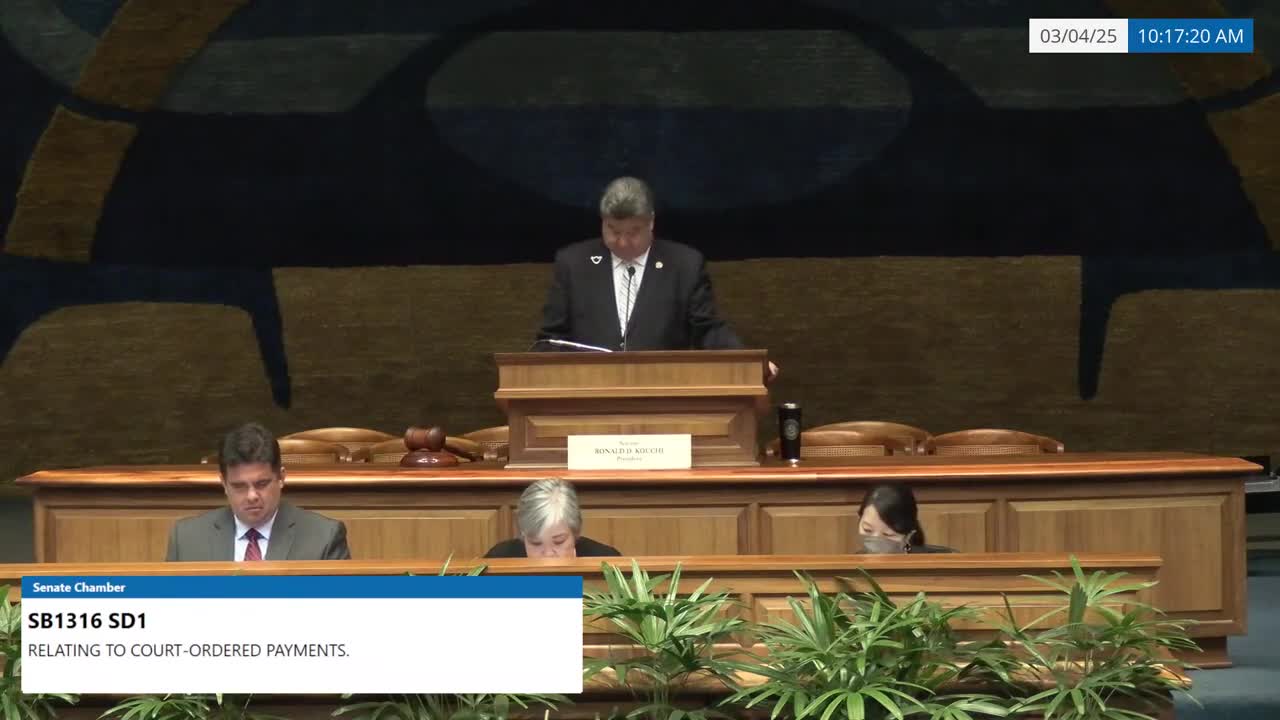
| Mar 4, 2025 | Report Adopted; Passed Third Reading, as amended (SD 2). Ayes, 25; Aye(s) with reservations: Senator(s) Fevella, Ihara, Inouye, San Buenaventura. Noes, 0 (none). Excused, 0 (none). Transmitted to House. |
| Feb 28, 2025 | 48 Hrs. Notice 03-04-25. |
| Feb 28, 2025 | Reported from WAM/JDC (Stand. Com. Rep. No. 1045) with recommendation of passage on Third Reading, as amended (SD 2). |
| Feb 26, 2025 | The committee(s) on JDC recommend(s) that the measure be PASSED, WITH AMENDMENTS. The votes in JDC were as follows: 5 Aye(s): Senator(s) Rhoads, Gabbard, Chang, Awa; Aye(s) with reservations: Senator(s) San Buenaventura ; 0 No(es): none; and 0 Excused: none. |
| Feb 26, 2025 | The committee(s) on WAM recommend(s) that the measure be PASSED, WITH AMENDMENTS. The votes in WAM were as follows: 13 Aye(s): Senator(s) Dela Cruz, Aquino, Elefante, Hashimoto, Inouye, Kanuha, Kidani, Lee, C., Wakai; Aye(s) with reservations: Senator(s) Moriwaki, DeCoite, Kim, Fevella ; 0 No(es): none; and 0 Excused: none. |
| Feb 21, 2025 | The committee(s) on WAM/JDC will hold a public decision making on 02-26-25 10:05AM; Conference Room 211 & Videoconference. |
| Feb 12, 2025 | Report adopted; Passed Second Reading, as amended (SD 1) and referred to WAM/JDC. |
| Feb 12, 2025 | Reported from HOU (Stand. Com. Rep. No. 338) with recommendation of passage on Second Reading, as amended (SD 1) and referral to WAM/JDC. |
| Feb 4, 2025 | The committee(s) on HOU recommend(s) that the measure be PASSED, WITH AMENDMENTS. The votes in HOU were as follows: 4 Aye(s): Senator(s) Chang, Hashimoto, Kanuha, Fevella; Aye(s) with reservations: none ; 0 No(es): none; and 1 Excused: Senator(s) Aquino. |
| Jan 31, 2025 | The committee(s) on HOU has scheduled a public hearing on 02-04-25 1:00PM; Conference Room 225 & Videoconference. |
| Jan 23, 2025 | Referred to HOU, WAM/JDC. |
| Jan 21, 2025 | Passed First Reading. |
| Jan 17, 2025 | Introduced. |
|
Date
|
Description
|
Location
|
Votes
|
|
|---|---|---|---|---|
| Mar 4, 2025 | Third Reading | Senate Floor |
Passed |
|
| Feb 26, 2025 | The committee(s) on JDC recommend(s) that the measure be PASSED, WITH AMENDMENTS | Senate Standing Committee on Judiciary |
Passed |
|
| Feb 26, 2025 | The committee(s) on WAM recommend(s) that the measure be PASSED, WITH AMENDMENTS | Senate Standing Committee on Ways and Means |
Passed |
|
| Feb 4, 2025 | The committee(s) on HOU recommend(s) that the measure be PASSED, WITH AMENDMENTS | Senate Standing Committee on Housing |
Passed |
This list shows positions taken on this bill by organizations on the date displayed, which is linked to the original source.
Positions by individuals are not included.
|
Organization
|
Position
|
Date
|
|---|---|---|
| Aloha Freedom Coalition | *** Against | Feb 25, 2025 |
STAND. COM. REP. NO. 1045
Honolulu, Hawaii
RE: S.B. No. 1033
S.D. 2
Honorable Ronald D. Kouchi
President of the Senate
Thirty-Third State Legislature
Regular Session of 2025
State of Hawaii
Sir:
Your Committees on Ways and Means and Judiciary, to which was referred S.B. No. 1033, S.D. 1, entitled:
"A BILL FOR AN ACT RELATING TO TAXATION,"
beg leave to report as follows:
The purpose and intent of this measure is to address the housing shortage in the State.
More specifically, this measure:
(1) Establishes an excise tax on certain taxpayers who own excess single-family residences for failing to sell those residences;
(2) Establishes and allocates excise tax revenues to the Housing Downpayment Trust Fund; and
(3) Requires annual reports to the Legislature.
Your Committees received written comments in opposition to this measure from the Aloha Freedom Coalition and ten individuals.
Your Committees received written comments on this measure from the Department of Taxation and Tax Foundation of Hawaii.
Your Committees find that, in recent years, certain entities, including large private equity hedge funds, have purchased large portfolios of foreclosed homes, preventing ordinary families and nonprofit organizations from being able to purchase those homes. Your Committees also find that this trend has continued at an alarming and accelerating rate, contributing to a critical shortage of affordable housing in the State.
Your Committees note that, although the intent of this measure is to reduce corporate ownership of single family residences and provide opportunities for individuals to purchase homes, your Committees have concerns that family corporations or individuals who own multiple properties may become subject to the excise tax established by this measure.
Your Committees have amended this measure by clarifying that the term "applicable taxpayer" does not include an individual.
As affirmed by the records of votes of the members of your Committees on Ways and Means and Judiciary that are attached to this report, your Committees are in accord with the intent and purpose of S.B. No. 1033, S.D. 1, as amended herein, and recommend that it pass Third Reading in the form attached hereto as S.B. No. 1033, S.D. 2.
Respectfully submitted on behalf of the members of the Committees on Ways and Means and Judiciary,
|
________________________________ KARL RHOADS, Chair |
|
________________________________ DONOVAN M. DELA CRUZ, Chair |
|
|
|
|
STAND. COM. REP. NO. 338
Honolulu, Hawaii
RE: S.B. No. 1033
S.D. 1
Honorable Ronald D. Kouchi
President of the Senate
Thirty-Third State Legislature
Regular Session of 2025
State of Hawaii
Sir:
Your Committee on Housing, to which was referred S.B. No. 1033 entitled:
"A BILL FOR AN ACT RELATING TO TAXATION,"
begs leave to report as follows:
The purpose and intent of this measure is to:
(1) Establish an excise tax on certain taxpayers who own excess single-family residences for failure to sell those residences; and
(2) Establish and allocate excise tax revenues to the Housing Downpayment Trust Fund.
Your Committee received comments on this measure from the Department of Budget and Finance, Department of Taxation, and Tax Foundation of Hawaii.
Your Committee finds that the state must ensure local individuals and families have the opportunity to remain in Hawaii and support the next generation of residents. Recently, certain entities, including hedge funds, corporations, partnerships, and trusts, have purchased a large share of single-family residences across the United States, limiting the available supply of housing for local individuals and families. Establishment of taxes and penalties on entities that hold excess single-family properties may alleviate some challenges for the State's limited housing supply. Accordingly, this measure establishes a new source of revenue generation for the State while encouraging the sale of single-family residences to individuals and families intending to remain in the State.
Your Committee notes the concerns raised by the Department of Taxation (DOTAX) regarding the implementation of the excise tax established by this measure. As existing income and conveyance tax filings do not require taxpayers to disclose whether they manage funds pooled from investors or are one of the specified "asset classes" established in the measure, identifying applicable taxpayers with available existing data and filings is not feasible. DOTAX would need to impose new information reporting requirements and make extensive changes to its systems to administer the proposed excise tax. Additionally, reporting requirements proposed by this measure would require DOTAX to track sales and ownership of single-family residences to specific taxpayers, which would deviate from DOTAX's existing data priorities that focus on reporting of income and gross receipts, rather than ownership of property. Finally, this measure would require DOTAX to track companies' net asset values throughout the year, as applicable taxpayers are those entities who have more than $50,000,000 in net value or assets under management on any day during the year. As this measure requires extensive changes to DOTAX's existing data collection practices, additional time is needed to develop necessary systems, forms, and processes to ensure compliance.
Your Committee has amended this measure by:
(1) Making it apply to taxable years beginning after December 31, 2026;
(2) Inserting an effective date of July 1, 2050, to encourage further discussion; and
(3) Making technical, nonsubstantive amendments for the purposes of clarity and consistency.
As affirmed by the record of votes of the members of your Committee on Housing that is attached to this report, your Committee is in accord with the intent and purpose of S.B. No. 1033, as amended herein, and recommends that it pass Second Reading in the form attached hereto as S.B. No. 1033, S.D. 1, and be referred to your Committees on Ways and Means and Judiciary.
Respectfully submitted on behalf of the members of the Committee on Housing,
|
|
|
________________________________ STANLEY CHANG, Chair |
|
|
|
|
|
Date
|
Testimony PDF
|
|---|---|
| Feb 25, 2025 | SB1033_SD1_TESTIMONY_WAM-JDC_02-26-25_.PDF |
| Feb 4, 2025 | SB1033_TESTIMONY_HOU_02-04-25_.PDF |