HB 1928: Recycling; Deposit Beverage Containers; Recycling Refund Producer Responsibility Organization Program; Deposit Beverage Container Program; Violations
- Session Year: 2025-2026
- House: House
- Latest Version Date: 2026-02-11
Current Status:
Failed
(2026-02-12: Passed Second Reading as amended in HD 1 and referred to the committee(s) on CPC with none voting aye with reservations; none voting no (0) and none excused (0).)
Introduced
In Committee
First Chamber
In Committee
Second Chamber
Final Decking
Enacted
What does this bill do?
The bill repeals Hawaii's current deposit beverage container law and replaces it with a recycling refund program run by beverage producers through a nonprofit "producer responsibility organization." It requires producers to register, label containers with a 5-cent refund, fund and maintain convenient redemption sites or machines, report sales and returns, undergo audits, and use unredeemed deposits to pay for program operations.
The summary is provided by generative AI which can make mistakes. For original language, please view the details in the table below.
Repeals the Deposit Beverage Container Program and replaces it with the Recycling Refund Producer Responsibility Organization Program. Effective 7/1/3000. (HD1)
Repeals the Deposit Beverage Container Program and replaces it with the Recycling Refund Producer Responsibility Organization Program.
|
HOUSE OF REPRESENTATIVES |
H.B. NO. |
1928 |
|
THIRTY-THIRD LEGISLATURE, 2026 |
H.D. 1 |
|
|
STATE OF HAWAII |
|
|
|
|
|
|
|
|
||
|
|
||
A BILL FOR AN ACT
RELATING TO DEPOSIT BEVERAGE CONTAINER RECYCLING.
BE IT ENACTED BY THE LEGISLATURE OF THE STATE OF HAWAII:
SECTION 1. The legislature finds that, as an island state with limited land space, Hawaii must limit waste generation or face increasing and costly reliance on off-island waste disposal and recycling management. The legislature further finds that in 2005, Hawaii implemented a deposit return program for certain beverage containers that has performed better than curbside recycling programs, but whose performance and convenience have declined over time, making it difficult for many residents to redeem containers and obtain their deposit refunds.
The legislature also finds that well-designed deposit return systems have been proven to significantly reduce litter and packaging pollution by as much as eighty per cent. These programs achieve recycling rates between eighty and ninety per cent and produce high-quality materials that support closed-loop recycling and reduce reliance on virgin resources.
Accordingly, the purpose of this Act is to update the deposit return program to improve efficiency and performance, reduce burdens on retailers, expand convenient redemption opportunities, and strengthen environmental and economic benefits for the State by repealing the existing deposit beverage container program and replacing it with a program administered by a producer or recycling refund producer responsibility organization.
SECTION 2. Chapter 342G, Hawaii Revised Statutes, is amended by adding a new part to be appropriately designated and to read as follows:
"Part
recycling refund producer responsibility program
§342G-A Definitions. As used in this part, unless the context otherwise requires:
"Brand" means a name, symbol, word, logo, or mark that identifies an item and attributes the item and its components, including packaging, to the brand owner of the item.
"Brand owner" means a person or entity that owns or licenses a brand or that otherwise has rights to market a product under the brand, whether or not the brand's trademark is registered.
"Consumer" means a person who buys a beverage in a deposit beverage container for use or consumption and pays the deposit.
"Contracted redemption pick-up operators" means affiliated or unaffiliated companies or organizations that provide individualized valet or pick-up services of aggregated deposit beverage containers for single-family or multifamily households.
"Dealer" means a person that engages in the sale of beverages in deposit beverage containers to a consumer for consumption in the State.
"Department" means the department of health.
"Deposit beverage" means beer, ale, or other drink produced by fermenting malt; mixed spirits; mixed wine; tea and coffee drinks regardless of dairy-derived product content; soda; noncarbonated water; and all nonalcoholic drinks in liquid form that are intended for internal human consumption and are contained in a deposit beverage container.
"Deposit beverage" does not include:
(1) A liquid that is:
(A) A syrup;
(B) In a concentrated form; or
(C) Typically added as a minor flavoring ingredient in food or drink, such as extracts, cooking additives, sauces, or condiments;
(2) A liquid that is a drug, medical food, or infant formula as defined by the Federal Food, Drug, and Cosmetic Act (21 U.S.C. 301 et seq.);
(3) A single serving of one ounce or less of a dietary supplement as defined in the Dietary Supplement Health and Education Act of 1994 (P.L. 103-417);
(4) A liquid that the department finds to be the sole item of a meal or diet;
(5) Products frozen at the time of sale to the consumer, or, in the case of institutional users such as hospitals and nursing homes, at the time of sale to the users;
(6) Products designed to be consumed in a frozen state;
(7) Instant drink powders;
(8) Seafood, meat, or vegetable broths, or soups, but not juices; and
(9) Milk and all other dairy-derived products, except tea and coffee drinks with trace amounts of these products.
"Deposit beverage container" means the individual, separate, sealed glass, polyethylene terephthalate, high density polyethylene, or metal container less than or equal to sixty-eight fluid ounces, used for containing, at the time of sale to the consumer, a deposit beverage intended for use or consumption in this State.
"De minimis producer" means a producer that:
(1) In its most recent fiscal year distributed fewer than two million deposit beverages in deposit beverage containers;
(2) Has a global gross revenue, not including on-premises alcohol sales, for the prior fiscal year of:
(A) Until , , less than $5,000,000; or
(B) Beginning , , less than $5,000,000,
adjusted for inflation by the department on an annual basis using the Consumer Price Index for Urban Wage Earners and Clerical Workers published by the Bureau of Labor Statistics of the federal Department of Labor, beginning , .
"Express redemption site" means a designated return location that allows consumers to return deposit beverage containers but does not provide cash handling on-site and instead may transport deposit beverage containers to processing facilities and offer credits in the form of refunds to a consumer's virtual account that is held by the producer or producer responsibility organization or their designee. "Express redemption site" includes bag-drop systems, reverse vending machines, or other redemption modalities that enhance convenience and accessibility for consumers.
"Full-service redemption site" means a return location where consumers may return deposit beverage containers to receive immediate refunds.
"Person" means individual, partnership, firm, association, public or private corporation, federal agency, the State or any of its political subdivisions, trust, estate, or any other legal entity.
"Producer" means the brand owner responsible for the brand visible on a deposit beverage container and that is responsible for compliance with the requirements of this part for a deposit beverage container that is introduced, either physically or via electronic commerce, in the State. "Producer" includes the person that:
(1) Is the importer of record for the deposit beverage container into the United States for use in a commercial enterprise that sells, offers for sale, or distributes the item in this State; or
(2) If there is no person in the State who is the producer for the purposes of paragraph (1), the producer is the person who first distributes the deposit beverage container in or into this State.
"Producer" does not include government entities or charitable organizations or social welfare organizations exempt from federal taxation under section 501(c)(3) or 501(c)(4) of the Internal Revenue Code of 1986, as amended.
"Recycling facility" means all contiguous land and structures and other appurtenances, and improvements on the land used for the collection, separation, recovery, and sale or reuse of secondary resources that would otherwise be disposed of as municipal solid waste and is an integral part of a manufacturing process aimed at producing a marketable product made of postconsumer material.
"Recycling refund producer responsibility organization" or "producer responsibility organization" means a nonprofit corporation that is exempt from federal taxation under section 501(c)(3) of the Internal Revenue Code of 1986, as amended, created by a group of producers to carry out the obligations of producers under this part.
"Redeemer" means a person, other than a dealer or distributor, that demands the refund value in exchange for the empty deposit beverage container.
"Redemption center" means an operation that accepts from consumers and provides the refund value for empty deposit beverage containers intended to be recycled and ensures that the empty deposit beverage containers are properly recycled.
"Redemption rate" means the per cent of deposit beverages eligible for refund that are successfully returned by consumers for the refund value established pursuant to section 342G-G out of the total number of deposit beverage containers eligible for refund.
"Reverse vending machine" means a mechanical device that accepts one or more types of empty deposit beverage containers and issues a redeemable credit slip with a value no less than the container's refund value.
§342G-B Producers; producer responsibility organizations; registration. (a) Each producer in the State shall register with:
(1) The department and implement a producer responsibility program individually; or
(2) A producer responsibility organization, which the producer shall become a member of, within six months after a producer responsibility organization is approved by the department and comply with all requirements under this part.
(b) A producer responsibility organization shall establish a schedule of membership fees to be paid by members of the organization; provided that de minimis producers shall not be required to pay membership fees.
(c) A producer responsibility organization shall be approved by the department no later than one year after the effective date of this Act.
(d) The department shall develop and charge the producer or producer responsibility organization for the estimated costs of the department to implement, administer, and enforce the requirements under this part no later than , .
(e) A producer or producer responsibility organization shall develop reporting requirements based on the type and number of beverage containers sold in the State.
(f) A producer or producer responsibility organization shall maintain a registry of all types of deposit beverage containers it or its registered producers, respectively, introduced and redeemed in the State.
(g) Beginning , , a producer or producer responsibility organization shall submit an annual report to the department that demonstrates its compliance with the approved program plan and meets the criteria outlined in section 342G-D.
(h) A producer or producer responsibility organization shall maintain a website that includes a searchable database of current redemption sites and a list of all brands and producers participating in the program.
§342G-C Administrative fees; administrative costs. The department shall set an annual administrative fee to be paid by the producer or producer responsibility organization to the department to fund administrative, audit, and compliance activities associated with this part.
§342G-D Producer responsibility program plan. (a) A producer or producer responsibility organization shall develop and submit a program plan to the department for approval every five years. The program plan shall include:
(1) A proposed list of the types and sizes of deposit beverage containers included in the recycling refund program;
(2) If a producer registers with a producer responsibility organization pursuant to section 342G-B, the fee structure for producer membership fees;
(3) A description of the redemption network provided by the producer or producer responsibility organization that shall ensure convenient access for all redeemers;
(4) A description of how the producer or producer responsibility organization intends to:
(A) Work with and fairly compensate existing redemption centers; provided that the fair compensation approach for existing redemption centers developed by the producer or producer responsibility organization shall be approved by the department;
(B) Develop new redemption opportunities; and
(C) Ensure convenience standards pursuant to section 342G-Q are met;
(5) Operating standards that independent redemption centers shall follow to be compensated by the producer or producer responsibility organization;
(6) A description of how the producer or producer responsibility organization intends to achieve the redemption rate goals establish pursuant to section 342G-Q;
(7) Planned education and outreach activities to promote the program, ensure consumers know which deposit beverage containers are redeemable, and provide consumers with convenient access to redemption opportunities;
(8) A description of how the producer or producer responsibility organization plans to prevent fraud, ensure compliance with its approved plan and this part, identify and report violations of its plan and of this part to the department, and conduct corrective actions to remedy the violations primarily through actions undertaken by the producer or producer responsibility organization; and
(9) Incentives for dealers and retailers that choose to act as certified redemption centers.
(b) The program plan shall be submitted after the department conducts rulemaking pursuant to section 342G-R.
§342G-E Department approval; program plan. (a) The department shall approve or deny a program plan developed pursuant to section 342G-D no later than days after submittal by a producer or producer responsibility organization.
(b) In approving a program plan, the department shall consider:
(1) Whether the producer or producer responsibility organization describes operating standards and a compensation mechanism that fairly includes independent redemption centers in the redemption network;
(2) Whether the program plan meets the convenience standards pursuant to section 342G-Q, including whether the proposed redemption network:
(A) Accounts for the total population, population density, and sales of deposit beverage containers in regions of the State; and
(B) Includes a broad range of entities that may opt to serve as a redemption location, including municipal facilities, public spaces, institutions, schools, nonprofit organizations, retailers, religious and charitable organizations, sporting events, and recycling facilities; and
(3) Whether the program plan adequately addresses internal procedures and actions to prevent, address, and report noncompliance with this part.
§342G-F Membership and other fees. (a) In addition to setting and collecting membership fees under section 342G-B(b), the producer or producer responsibility organization shall set and collect fees on a frequency defined in the program plan. The fees shall:
(1) Vary based on the total amount of deposit beverage containers each producer introduces in the State; and
(2) Reflect program costs for each deposit beverage container type, net of commodity value for that material type when used as a recycling material, as well as allocated fixed costs that do not vary based on material type.
(b) After the first program plan, the producer or recycling refund producer responsibility organization shall consider incentivizing the use of materials and design attributes that reduce the environmental impacts and human health impacts of deposit beverage containers.
§342G-G Beverage deposit; refund value. (a) By , , every deposit beverage container sold or offered for sale in the State shall have a refund value of 5 cents. Each deposit beverage container shall have the refund value clearly indicated on it as provided in section 342G-H.
(b) The refund value shall be stated on a receipt, invoice, or similar billing document given to the consumer and shall not be embedded into the price of the deposit beverage. Deposit beverage containers shall have a visible brand and universal product code to be eligible for refund by a consumer.
(c) The refund value shall be the amount of the deposit required. Once a refund value has been applied to a deposit beverage container, the deposit on that deposit beverage container shall not be changed and shall be paid to the producer or producer responsibility organization.
(d) The deposit on each filled deposit beverage container shall be paid by the producer or producer responsibility organization.
(e) Payment of the deposit beverage container fee pursuant to subsection (a) shall be paid to the department or the producer responsibility organization on a schedule set by the department or producer responsibility organization.
§342G-H Deposit beverage container requirements. (a) Except as provided in subsection (b), every deposit beverage container sold in the State shall clearly indicate the refund value of the deposit beverage container and the word "Hawaii" or the letters "HI". The names or letters representing the names of other states with comparable deposit legislation may also be included in the indication of refund value. The refund value on every deposit beverage container shall be clearly, prominently, and indelibly marked by painting, printing, scratch embossing, raised letter embossing, or securely affixed stickers and shall be affixed on the top or side of the container in letters at least one-eighth inch in size.
(b) Subsection (a) shall not apply to any type of refillable glass deposit beverage container that has a brand name permanently marked on it and that has the equivalent of a refund value of at least 5 cents, which is paid upon receipt of the container by a dealer or deposit beverage distributor.
(c) A producer or producer responsibility organization may describe through its program plan how each producer shall be required to label their deposit beverage containers for identification under the program if additional containers are added to the program.
(d) Containers that do not meet the definition of a deposit beverage container shall not indicate "Hawaii" or "HI" on the container.
§342G-I Payment; producer data report. Each producer that registers with a producer responsibility organization pursuant to section 342G-B, including de minimus producers, shall regularly generate and submit to the producer responsibility organization, as set by the producer responsibility organization, a report on the manufacture of deposit beverages in deposit beverage containers, the importation and exportation of deposit beverage containers, and the net number of deposit beverage containers sold, donated, or transferred by container size and type; provided that a producer that registers with the department pursuant to section 342G-B shall submit the report to the department. All information contained in the reports, including confidential commercial and financial information, shall be treated as confidential and protected to the extent allowed by state law.
§342G-J Redemption centers. (a) Redemption centers shall:
(1) Accept all types of empty deposit beverage containers for which a deposit has been paid;
(2) Verify that all deposit beverage containers to be redeemed bear a valid Hawaii refund value;
(3) Pay to the redeemer the full refund value in either cash or a redeemable voucher for all deposit beverage containers, except as provided in section 342G-L;
(4) Ensure each deposit beverage container collected is recycled through a contractual agreement with an out-of-state recycler or an in-state recycling facility permitted by the department; provided that this paragraph shall not apply if the redemption center is operated by a recycler permitted by the department; and
(5) Remain open at least thirty hours per week in high density population areas, of which at least five hours shall be on Saturday or Sunday.
(b) Redemption centers' redemption areas shall be maintained in full compliance with applicable laws and the orders and rules of the department, including permitting requirements if deemed necessary, under chapter 342H.
§342G-K Reverse vending machine requirements. (a) Reverse vending machines may be used by redemption centers. Reverse vending machines shall accept any type of empty deposit beverage container and pay out the full refund value in either cash or a redeemable voucher for those containers that bear a valid Hawaii refund value. The refund value payments shall be aggregated and then paid if more than one deposit beverage container is redeemed in a single transaction. If the reverse vending machine is unable to read the barcode then the reverse vending machine shall reject the container.
(b) The reverse vending machine shall be routinely serviced to ensure proper operation and continuous acceptance of empty deposit beverage containers and payment of the refund value.
§342G-L Refusal to pay refund value for a deposit beverage container. Redemption centers shall refuse to pay the refund value on any broken, corroded, or dismembered deposit beverage container, or any deposit beverage container that:
(1) Contains a free-flowing liquid;
(2) Does not properly indicate a refund value;
(3) Contains a significant amount of foreign material; or
(4) Exhibits characteristics of having been previously processed and baled.
§342G-M Advisory committee. The department shall convene an advisory committee to assist in developing the rules needed to implement this chapter. The department shall select members of the committee so as to obtain input on the state level as well as assess the impact on each individual county, consumers, recyclers, and the beverage industry. Members of the committee shall be appointed by the director and shall serve at the director's pleasure. A simple majority of the committee members shall constitute a quorum for the purposes of recommending rules and providing input to the director.
§342G-N Sales prohibitions. Beginning , , no producer shall sell or offer for sale in the State any deposit beverage container unless the producer is registered with and in compliance with the department or an approved recycling refund producer responsibility organization pursuant to this part.
§342G-O Third party audit. (a) The producer or producer responsibility organization shall hire a third-party auditor every other year to audit the producer responsibility organization, producers, and redemption centers for compliance with statutory requirements and the approved program plan.
(b) Within seven days following completion of the audit, the producer or producer responsibility organization shall submit the audit to the department.
(c) Within days following the completion of the audit, the producer or producer responsibility organization shall submit to the department a plan to address audit recommendations.
(d) The producer or producer responsibility organization shall post the completed audit on its website.
§342G-P Unredeemed deposits. Any unredeemed deposits shall be held by the producer or producer responsibility organization and used for program operation and system improvements.
§342G-Q Redemption network convenience standards; redemption rate goals. (a) Each producer or producer responsibility organization shall ensure convenient and equitable access to redemption opportunities and establish
(1) redemption centers within miles of every dealer in urban or densely populated areas;
(2) redemption centers within miles of every dealer in suburban areas; and
(3) redemption centers within miles of every dealer in rural areas.
(b) Additional convenience standard requirements shall include:
(1) Appropriately convenient and equitable access in urban, suburban, and rural areas, using multiple redemption modalities, including independent redemption centers, express redemption sites, full-service redemption sites, alternative redemption options, and contracted redemption pick-up operators;
(2) Proximity of redemption opportunities to retail establishments associated with a majority of beverage container sales in an area;
(3) No additional vehicle miles traveled for rural access;
(4) Accessible and convenient access for individuals relying on public transportation; and
(5) Reasonable opportunities for individuals to receive immediate deposit refunds.
(c) It shall be the goal of each producer or producer responsibility organization to meet the following redemption rates:
(1) per cent by ; and
(2) per cent by .
§342G-R Rules. The department shall adopt rules pursuant to chapter 91 necessary for the purposes of this part.
§342G-S Violations. (a) Failure to comply with the requirements of this part, including but not limited to failure by a producer or producer responsibility organization to implement and satisfy the requirements of its program plan, shall subject the producer, producer responsibility organization, redemption center, or other responsible party to penalties for violations as set forth in this chapter.
(b) The department may deem information contained in an audit provided by a producer or producer responsibility organization pursuant to section 342G-O or records maintained by the producer or producer responsibility organizations sufficient to establish violations of the requirements of this part.
(c) The department may conduct investigations to determine whether a producer, producer responsibility organization, redemption center, or other responsible party is complying with the requirements of this part.
(d) A producer or producer responsibility organization shall report violations of this part to the department no later than seven days after obtaining knowledge of a violation. A producer or producer responsibility organization shall cooperate in any resulting enforcement action."
SECTION 3. Section 36-27, Hawaii Revised Statutes, is amended by amending subsection (a) to read as follows:
"(a) Except as provided in this section, and notwithstanding any other law to the contrary, from time to time, the director of finance, for the purpose of defraying the prorated estimate of central service expenses of government in relation to all special funds, except the:
(1) Special out-of-school time instructional program fund under section 302A-1310;
(2) School cafeteria special funds of the department of education;
(3) Special funds of the University of Hawaii;
(4) Convention center enterprise special fund under section 201B-8;
(5) Special funds established by section 206E-6;
(6) Aloha Tower fund created by section 206J-17;
(7) Funds of the employees' retirement system created by section 88-109;
(8) Hawaii hurricane relief fund established under chapter 431P;
(9) Hawaii health systems corporation special funds and the subaccounts of its regional system boards;
(10) Universal service fund established under section 269-42;
(11) Emergency and budget reserve fund under section 328L-3;
(12) Public schools special fees and charges fund under section 302A-1130;
(13) Sport fish special fund under section 187A-9.5;
(14) Neurotrauma special fund under section 321H-4;
(15) Glass advance disposal fee established by section 342G-82;
(16) Center for nursing special fund under section 304A-2163;
(17) Passenger facility charge special fund established by section 261-5.5;
(18) Solicitation of funds for charitable purposes special fund established by section 467B-15;
(19) Land conservation fund established by section 173A-5;
(20) Court interpreting services revolving fund under section 607-1.5;
(21) Trauma system special fund under section 321-22.5;
(22) Hawaii cancer research special fund;
(23) Community health centers special fund;
(24) Emergency medical services special fund;
(25) Rental motor vehicle customer facility charge special fund established under section 261-5.6;
(26) Shared services technology special fund under section 27-43;
(27) Automated victim information and notification system special fund established under section 353-136;
[(28) Deposit
beverage container deposit special fund under section 342G-104;
(29)] (28) Hospital sustainability program special fund
under section 346G-4;
[(30)] (29) Nursing facility sustainability
program special fund under section
346F-4;
[(31)] (30) Hawaii 3R's school improvement fund under
section 302A-1502.4;
[(32)] (31) After-school plus program revolving fund
under section 302A-1149.5;
[(33)] (32) Civil monetary penalty special fund under
section 321-30.2;
[(34)] (33) Stadium development special fund under
section 109-3.5; and
[(35)] (34) Universal immunization purchase special fund
under section [[]325-133[]],
shall deduct five per cent of all receipts of all other special funds, which deduction shall be transferred to the general fund of the State and become general realizations of the State. All officers of the State and other persons having power to allocate or disburse any special funds shall cooperate with the director in effecting these transfers. To determine the proper revenue base upon which the central service assessment is to be calculated, the director shall adopt rules pursuant to chapter 91 for the purpose of suspending or limiting the application of the central service assessment of any fund. No later than twenty days prior to the convening of each regular session of the legislature, the director shall report all central service assessments made during the preceding fiscal year."
SECTION 4. Section 235-18, Hawaii Revised Statutes, is repealed.
["[§235-18] Deposit beverage container deposit exemption.
This chapter shall not apply to amounts received as a deposit
beverage container deposit collected under part VIII of chapter 342G."]
SECTION 5. Section 445-231, Hawaii Revised Statutes, is amended by amending the definition of "beer keg" to read as follows:
""Beer
keg" means a metal container used to hold five gallons or more of liquid
that is stamped, engraved, stenciled, or otherwise marked with the name of a
brewery manufacturer; provided that a deposit beverage container, as defined
under section [342G-101,] 342G-A shall not be considered a beer
keg."
SECTION 6. Section 708-835.8, Hawaii Revised Statutes, is amended by amending subsection (2) to read as follows:
"(2)
For the purposes of this section, "beer keg" means a metal
container used to hold five gallons or more of liquid that is stamped,
engraved, stenciled, or otherwise marked with the name of a brewery manufacturer;
provided that a deposit beverage container, as defined under section [342G-101,]
342G-A, shall not be considered a beer keg."
SECTION 7. Chapter 342G, part VIII, Hawaii Revised Statutes, is repealed.
SECTION 8. Any unexpended or unencumbered balance remaining in the deposit beverage container deposit special fund as of the effective date of this section shall be transferred on that date as follows:
(1) per cent to producers and producer responsibility organizations for the operation of programs pursuant to section 342G-D, Hawaii Revised Statutes; and
(2) per cent to the general fund.
SECTION 9. In codifying the new sections added by section 2 of this Act, the revisor of statutes shall substitute appropriate section numbers for the letters used in designating the new sections in this Act.
SECTION 10. Statutory material to be repealed is bracketed and stricken. New statutory material is underscored.
SECTION 11. This Act shall take effect on July 1, 3000; provided that sections 7 and 8 shall take effect on .
Report Title:
Recycling; Deposit Beverage Containers; Recycling Refund Producer Responsibility Organization Program; Deposit Beverage Container Program; Violations
Description:
Repeals the Deposit Beverage Container Program and replaces it with the Recycling Refund Producer Responsibility Organization Program. Effective 7/1/3000. (HD1)
The summary description of legislation appearing on this page is for informational purposes only and is not legislation or evidence of legislative intent.
|
HOUSE OF REPRESENTATIVES |
H.B. NO. |
1928 |
|
THIRTY-THIRD LEGISLATURE, 2026 |
|
|
|
STATE OF HAWAII |
|
|
|
|
|
|
|
|
||
|
|
||
A BILL FOR AN ACT
RELATING TO DEPOSIT BEVERAGE CONTAINER RECYCLING.
BE IT ENACTED BY THE LEGISLATURE OF THE STATE OF HAWAII:
SECTION 1. The legislature finds that, as an island state with limited land space, Hawaii must limit waste generation or face increasing and costly reliance on off-island waste disposal and recycling management. The legislature further finds that in 2005, Hawaii implemented a deposit return program for certain beverage containers that has performed better than curbside recycling programs, but whose performance and convenience have declined over time, making it difficult for many residents to redeem containers and obtain their deposit refunds.
The legislature also finds that well-designed deposit return systems have been proven to significantly reduce litter and packaging pollution by as much as eighty per cent. These programs achieve recycling rates between eighty and ninety per cent and produce high-quality materials that support closed-loop recycling and reduce reliance on virgin resources.
Accordingly, the purpose of this Act is to update the deposit return program to improve efficiency and performance, reduce burdens on retailers, expand convenient redemption opportunities, and strengthen environmental and economic benefits for the State by repealing the existing deposit beverage container program and replacing it with a program administered by a recycling refund producer responsibility organization.
SECTION 2. Chapter 342G, Hawaii Revised Statutes, is amended by adding a new part to be appropriately designated and to read as follows:
"Part
recycling refund producer responsibility organization program
§342G-A Definitions. As used in this chapter, unless the context otherwise requires:
"Brand" means a name, symbol, word, logo, or mark that identifies an item and attributes the item and its components, including packaging, to the brand owner of the item.
"Brand owner" means a person or entity that owns or licenses a brand or that otherwise has rights to market a product under the brand, whether or not the brand's trademark is registered.
"Consumer" means a person who buys a beverage in a deposit beverage container for use or consumption and pays the deposit.
"Contracted redemption pick-up operators" means affiliated or unaffiliated companies or organizations that provide individualized valet or pick-up services of aggregated deposit beverage containers for single-family or multifamily households.
"Dealer" means a person that engages in the sale of beverages in deposit beverage containers to a consumer for off-premises consumption in the State.
"Department" means the department of health.
"Deposit beverage" means beer, ale, or other drink produced by fermenting malt; mixed spirits; mixed wine; tea and coffee drinks regardless of dairy-derived product content; soda; noncarbonated water; and all nonalcoholic drinks in liquid form that are intended for internal human consumption and are contained in a deposit beverage container.
"Deposit beverage" does not include:
(1) A liquid that is:
(A) A syrup;
(B) In a concentrated form; or
(C) Typically added as a minor flavoring ingredient in food or drink, such as extracts, cooking additives, sauces, or condiments;
(2) A liquid that is a drug, medical food, or infant formula as defined by the Federal Food, Drug, and Cosmetic Act (21 U.S.C. 301 et seq.);
(3) A single serving of one ounce or less of a dietary supplement as defined in the Dietary Supplement Health and Education Act of 1994 (P.L. 103-417);
(4) A liquid that the department finds to be the sole item of a meal or diet;
(5) Products frozen at the time of sale to the consumer, or, in the case of institutional users such as hospitals and nursing homes, at the time of sale to the users;
(6) Products designed to be consumed in a frozen state;
(7) Instant drink powders;
(8) Seafood, meat, or vegetable broths, or soups, but not juices; and
(9) Milk and all other dairy-derived products, except tea and coffee drinks with trace amounts of these products.
"Deposit beverage container" means the individual, separate, sealed glass, polyethylene terephthalate, high density polyethylene, or metal container less than or equal to sixty-eight fluid ounces, used for containing, at the time of sale to the consumer, a deposit beverage intended for use or consumption in this State.
"De minimis producer" means a producer that:
(1) In its most recent fiscal year introduced into commerce in the State less than one ton of deposit beverage containers;
(2) Has a global gross revenue, not including on-premises alcohol sales, for the prior fiscal year of:
(A) Until , , less than $5,000,000; or
(B) Beginning , , less than $5,000,000, as adjusted for inflation,
adjusted for inflation by the department on an annual basis using the Consumer Price Index for Urban Wage Earners and Clerical Workers published by the Bureau of Labor Statistics of the federal Department of Labor, beginning , .
"Express redemption site" means a designated return location that allows consumers to return deposit beverage containers but do not provide cash handling on-site and instead may transport deposit beverage containers to processing facilities and offer credits in the form of refunds to a consumer's virtual account that is held by the producer responsibility organization or their designee. "Express redemption site" includes bag-drop systems, reverse vending machines, or other redemption modalities that enhance convenience and accessibility for consumers.
"Full-service redemption site" means a return location where consumers may return deposit beverage contains to receive immediate refunds.
"Person" means individual, partnership, firm, association, public or private corporation, federal agency, the State or any of its political subdivisions, trust, estate, or any other legal entity.
"Producer" means the brand owner responsible for the brand visible on a deposit beverage container and that is responsible for compliance with the requirements of this part for a deposit beverage container that is introduced, either physically or via electronic commerce, in the State. "Producer" includes the person that:
(1) Is the importer of record for the deposit beverage container into the United States for use in a commercial enterprise that sells, offers for sale, or distributes the item in this State; or
(2) First distributes the deposit beverage container in or into this State.
"Producer" does not include government entities or charitable organizations or social welfare organizations exempt from federal taxation under section 501(c)(3) or 501(c)(4) of the Internal Revenue Code of 1986, as amended.
"Recycling facility" means all contiguous land and structures and other appurtenances, and improvements on the land used for the collection, separation, recovery, and sale or reuse of secondary resources that would otherwise be disposed of as municipal solid waste and is an integral part of a manufacturing process aimed at producing a marketable product made of postconsumer material.
"Recycling refund producer responsibility organization" or "producer responsibility organization" means a nonprofit corporation that is exempt from federal taxation under section 501(c)(3) of the Internal Revenue Code of 1986, as amended, created by a group of producers to carry out the obligations of producers under this part.
"Redeemer" means a person, other than a dealer or distributor, that demands the refund value in exchange for the empty deposit beverage container.
"Redemption center" means an operation that accepts from consumers and provides the refund value for empty deposit beverage containers intended to be recycled and ensures that the empty deposit beverage containers are properly recycled.
"Reverse vending machine" means a mechanical device that accepts one or more types of empty deposit beverage containers, issues a redeemable credit slip with a value not less than the container's refund value.
§342G-B Recycling refund producer responsibility organization. (a) Each producer in the State shall register with and be a member of a producer responsibility organization within six months after a producer responsibility organization is approved by the department and shall comply with all requirements under this part.
(b) A producer responsibility organization shall establish a schedule of membership fees to be paid by members of the organization; provided that de minimis producers shall not be required to pay membership fees.
(c) A producer responsibility organization shall be approved by the department no later than one year after the effective date of this Act.
(d) The department shall develop and charge the producer responsibility organization for the estimated costs of the department to implement, administer, and enforce the requirements under this part no later than , .
(e) A producer responsibility organization shall develop reporting requirements for producers on the type and number of beverage containers sold in the State.
(f) A producer responsibility organization shall maintain a registry of all types of deposit beverage containers introduced and redeemed in the State by all registered producers.
(g) Beginning , , a producer responsibility organization shall submit an annual report to the department that demonstrates its compliance with the approved program plan and meets the criteria outlined in section 342G-D.
(h) A producer responsibility organization shall maintain a website that includes a searchable database of current redemption sites and a list of all brands and producers participating in the program.
§342G-C Administrative fees; administrative costs. The department shall set an annual administrative fee to be paid by the producer responsibility organization to fund administrative, audit, and compliance activities associated with this part.
§342G-D Producer responsibility organization program plan. (a) A producer responsibility organization shall develop and submit a program plan for approval to the department every five years. The program plan shall include:
(1) A proposed list of the types and sizes of deposit beverage containers included in the recycling refund program;
(2) The fee structure for producer membership fees;
(3) A description of the redemption network provided by the producer responsibility organization that shall ensure convenient access for all redeemers;
(4) A description of how the producer responsibility organization intends to:
(A) Work with and fairly compensate existing redemption centers; provided that the fair compensation approach for existing redemption centers developed by the producer responsibility organization shall be approved by the department;
(B) Develop new redemption opportunities; and
(C) Ensure convenience standards are met;
(5) Operating standards that independent redemption centers shall follow to be compensated by the producer responsibility organization;
(6) Proposed performance targets for the program and a description of how the producer responsibility organization intends to achieve these performance targets;
(7) Planned education and outreach activities to promote the program, ensure consumers know which deposit beverage containers are redeemable, and provide consumers with convenient access to redemption opportunities;
(8) A description of how the producer responsibility organization plans to work with the department to identify instances of fraud and prevent fraud in the program; and
(9) Incentives for dealers and retailers that choose to act as certified redemption centers.
(b) The program plan shall be submitted after the department conducts rulemaking pursuant to section 342G-R.
§342G-E Department approval; program plan. (a) The department shall approve or deny a program plan developed pursuant to section 342G-D no later than days after submittal by a producer responsibility organization.
(b) In approving a program plan, the department shall consider:
(1) Whether the producer responsibility organization describes operating standards and a compensation mechanism that fairly includes independent redemption centers in the redemption network; and
(2) Whether the program plan meets the convenience standards pursuant to section 342G-Q, including whether the proposed redemption network:
(A) Accounts for the total population, population density, and sales of deposit beverage containers in regions of the State; and
(B) Includes a broad range of entities that may opt to serve as a redemption location, including municipal facilities, public spaces, institutions, schools, nonprofit organizations, retailers, religious and charitable organizations, sporting events, and recycling facilities.
§342G-F Producer responsibility organization; fees. (a) In addition to setting and collecting membership fees under section 342G-B(b), the producer responsibility organization shall set and collect fees on a frequency defined in the program plan. The fees shall:
(1) Vary based on the total amount of deposit beverage containers each producer introduces in the State; and
(2) Reflect program costs for each deposit beverage container type, net of commodity value for that material type when used as a recycling material, as well as allocated fixed costs that do not vary based on material type.
(b) After the first program plan, the recycling refund producer responsibility organization shall consider incentivizing using materials and design attributes that reduce the environmental impacts and human health impacts of deposit beverage containers.
§342G-G Beverage deposit; refund value. (a) By , , every deposit beverage container sold or offered for sale for off-site consumption in the State shall have a refund value of 5 cents. Each deposit beverage container shall have the refund value clearly indicated on it as provided in section 342G-H.
(b) The refund value shall be stated on a receipt, invoice, or similar billing document given to the consumer and shall not be embedded into the price of the deposit beverage. Deposit beverage containers shall have a visible brand and universal product code to be eligible for refund by a consumer.
(c) The refund value shall be the amount of the deposit required. Once a refund value has been applied to a deposit beverage container, the deposit on that deposit beverage container shall not be changed and shall be paid to the producer responsibility organization.
(d) The deposit on each filled deposit beverage container shall be paid by the producer.
§342G-H Deposit beverage container requirements. (a) Except as provided in subsection (b), every deposit beverage container sold in the State shall clearly indicate the refund value of the deposit beverage container and the word "Hawaii" or the letters "HI". The names or letters representing the names of other states with comparable deposit legislation may also be included in the indication of refund value. The refund value on every deposit beverage container shall be clearly, prominently, and indelibly marked by painting, printing, scratch embossing, raised letter embossing, or securely affixed stickers and shall be affixed on the top or side of the container in letters at least one-eighth inch in size.
(b) Subsection (a) shall not apply to any type of refillable glass deposit beverage container that has a brand name permanently marked on it and that has the equivalent of a refund value of at least 5 cents, which is paid upon receipt of the container by a dealer or deposit beverage distributor.
(c) A producer responsibility organization may describe through its program plan how producers shall be required to label their deposit beverage containers for identification under the program if additional containers are added to the program.
(d) Containers that do not meet the definition of a deposit beverage container shall not indicate "Hawaii" or "HI" on the container.
§342G-I Payment; producer data report. (a) Each producer shall regularly generate and submit to the producer responsibility organization, as set by the producer responsibility organization, a report on the net number of deposit beverage containers sold, donated, or transferred by container size and type. All information contained in the reports, including confidential commercial and financial information, shall be treated as confidential and protected to the extent allowed by state law.
(b) Payment of the deposit beverage container fee pursuant to subsection (a) shall be paid to the producer responsibility organization on a schedule set by the producer responsibility organization.
§342G-J Redemption centers. (a) Redemption centers shall:
(1) Accept all types of empty deposit beverage containers for which a deposit has been paid;
(2) Verify that all deposit beverage containers to be redeemed bear a valid Hawaii refund value;
(3) Pay to the redeemer the full refund value in either cash or a redeemable voucher for all deposit beverage containers, except as provided in section 342G-L;
(4) Ensure each deposit beverage container collected is recycled through a contractual agreement with an out-of-state recycler or an in-state recycling facility permitted by the department; provided that this paragraph shall not apply if the redemption center is operated by a recycler permitted by the department; and
(5) Remain open at least thirty hours per week in high density population areas, of which at least five hours shall be on Saturday or Sunday.
(b) Redemption centers' redemption areas shall be maintained in full compliance with applicable laws and the orders and rules of the department, including permitting requirements if deemed necessary, under chapter 342H.
§342G-K Reverse vending machine requirements. (a) Reverse vending machines may be used by redemption centers. Reverse vending machines shall accept any type of empty deposit beverage container and pay out the full refund value in either cash or a redeemable voucher for those containers that bear a valid Hawaii refund value. The refund value payments shall be aggregated and then paid if more than one deposit beverage container is redeemed in a single transaction. If the reverse vending machine is unable to read the barcode then the reverse vending machine shall reject the container.
(b) The reverse vending machine shall be routinely serviced to ensure proper operation and continuous acceptance of empty deposit beverage containers and payment of the refund value.
§342G-L Refusal or refund value payment for a deposit beverage container. Redemption centers shall refuse to pay the refund value on any broken, corroded, or dismembered deposit beverage container, or any deposit beverage container that:
(1) Contains a free-flowing liquid;
(2) Does not properly indicate a refund value;
(3) Contains a significant amount of foreign material; or
(4) Exhibits characteristics of having been previously processed and baled.
§342G-M Advisory committee. The department shall convene an advisory committee to assist in developing the rules needed to implement this chapter. The department shall select members of the committee so as to obtain input on the state level as well as assess the impact on each individual county, consumers, recyclers, and the beverage industry. Members of the committee shall be appointed by the director and shall serve at the director's pleasure. A simple majority of the committee members shall constitute a quorum for the purposes of recommending rules and providing input to the director.
§342G-N Sales prohibitions. Beginning , , no producer shall sell or offer for sale in the State any deposit beverage container unless the producer is registered with and in compliance with an approved recycling refund producer responsibility organization pursuant to this part.
§342G-O Third party audit. The producer responsibility organization shall hire a third-party auditor every other year to audit the organization.
§342G-P Unredeemed deposits. Any unredeemed deposits shall be held by the producer responsibility organization and used for program operation and system improvements.
§342G-Q Redemption network convenience standards. (a) The producer responsibility organization shall propose in its program plan a quantitative convenience standard, such as number of redemption opportunities, for approval by the department, based on measurable criteria, such as travel time and distance.
(b) Additional convenience standard requirements shall include:
(1) Appropriately convenient and equitable access in urban, suburban, and rural areas, using multiple redemption modalities, including independent redemption centers, express redemption sites, full-service redemption sites, alternative redemption options, and contracted redemption pick-up operators;
(2) Proximity of redemption opportunities to retail establishments associated with a majority of beverage container sales in an area;
(3) No additional vehicle miles traveled for rural access;
(4) Accessible and convenient access for individuals relying on public transportation; and
(5) Reasonable opportunities for individuals to receive immediate deposit refunds.
§342G-R Rules. The department shall adopt rules pursuant to chapter 91 necessary for the purposes of this part.
SECTION 3. Section 36-27, Hawaii Revised Statutes, is amended by amending subsection (a) to read as follows:
"(a) Except as provided in this section, and notwithstanding any other law to the contrary, from time to time, the director of finance, for the purpose of defraying the prorated estimate of central service expenses of government in relation to all special funds, except the:
(1) Special out-of-school time instructional program fund under section 302A-1310;
(2) School cafeteria special funds of the department of education;
(3) Special funds of the University of Hawaii;
(4) Convention center enterprise special fund under section 201B-8;
(5) Special funds established by section 206E-6;
(6) Aloha Tower fund created by section 206J-17;
(7) Funds of the employees' retirement system created by section 88-109;
(8) Hawaii hurricane relief fund established under chapter 431P;
(9) Hawaii health systems corporation special funds and the subaccounts of its regional system boards;
(10) Universal service fund established under section 269-42;
(11) Emergency and budget reserve fund under section 328L-3;
(12) Public schools special fees and charges fund under section 302A-1130;
(13) Sport fish special fund under section 187A-9.5;
(14) Neurotrauma special fund under section 321H-4;
(15) Glass advance disposal fee established by section 342G-82;
(16) Center for nursing special fund under section 304A-2163;
(17) Passenger facility charge special fund established by section 261-5.5;
(18) Solicitation of funds for charitable purposes special fund established by section 467B-15;
(19) Land conservation fund established by section 173A-5;
(20) Court interpreting services revolving fund under section 607-1.5;
(21) Trauma system special fund under section 321-22.5;
(22) Hawaii cancer research special fund;
(23) Community health centers special fund;
(24) Emergency medical services special fund;
(25) Rental motor vehicle customer facility charge special fund established under section 261-5.6;
(26) Shared services technology special fund under section 27-43;
(27) Automated victim information and notification system special fund established under section 353-136;
[(28) Deposit
beverage container deposit special fund under section 342G-104;
(29)] (28) Hospital sustainability program special fund
under section 346G-4;
[(30)] (29) Nursing facility sustainability
program special fund under section
346F-4;
[(31)] (30) Hawaii 3R's school improvement fund under
section 302A-1502.4;
[(32)] (31) After-school plus program revolving fund
under section 302A-1149.5;
[(33)] (32) Civil monetary penalty special fund under
section 321-30.2;
[(34)] (33) Stadium development special fund under
section 109-3.5; and
[(35)] (34) Universal immunization purchase special fund
under section [[]325-133[]],
shall deduct five per cent of all receipts of all other special funds, which deduction shall be transferred to the general fund of the State and become general realizations of the State. All officers of the State and other persons having power to allocate or disburse any special funds shall cooperate with the director in effecting these transfers. To determine the proper revenue base upon which the central service assessment is to be calculated, the director shall adopt rules pursuant to chapter 91 for the purpose of suspending or limiting the application of the central service assessment of any fund. No later than twenty days prior to the convening of each regular session of the legislature, the director shall report all central service assessments made during the preceding fiscal year."
SECTION 4. Section 235-18, Hawaii Revised Statutes, is repealed.
["[§235-18] Deposit beverage container deposit exemption.
This chapter shall not apply to amounts received as a deposit
beverage container deposit collected under part VIII of chapter 342G."]
SECTION 5. Section 445-231, Hawaii Revised Statutes, is amended by amending the definition of "beer keg" to read as follows:
""Beer
keg" means a metal container used to hold five gallons or more of liquid
that is stamped, engraved, stenciled, or otherwise marked with the name of a
brewery manufacturer; provided that a deposit beverage container, as defined
under section [342G-101,] 342G-A shall not be considered a beer
keg."
SECTION 6. Section 708-835.8, Hawaii Revised Statutes, is amended by amending subsection (2) to read as follows:
"(2)
For the purposes of this section, "beer keg" means a metal
container used to hold five gallons or more of liquid that is stamped,
engraved, stenciled, or otherwise marked with the name of a brewery
manufacturer; provided that a deposit beverage container, as defined under
section [342G-101,] 342G-A, shall not be considered a beer keg."
SECTION 7. Chapter 342G, part VIII, Hawaii Revised Statutes, is repealed.
SECTION 8 In codifying the new sections added by section 2 of this Act, the revisor of statutes shall substitute appropriate section numbers for the letters used in designating the new sections in this Act.
SECTION 9. Statutory material to be repealed is bracketed and stricken. New statutory material is underscored.
SECTION 10. This Act shall take effect on July 1, 2026; provided that any remaining balance in the deposit beverage container deposit special fund shall lapse to the credit of the general fund.
|
INTRODUCED BY: |
_____________________________ |
|
|
|
Report Title:
Recycling; Deposit Beverage Containers; Recycling Refund Producer Responsibility Organization Program; Deposit Beverage Container Program
Description:
Repeals the Deposit Beverage Container Program and replaces it with the Recycling Refund Producer Responsibility Organization Program.
The summary description of legislation appearing on this page is for informational purposes only and is not legislation or evidence of legislative intent.
|
Date
|
Status
|
|---|---|
| Feb 12, 2026 | Passed Second Reading as amended in HD 1 and referred to the committee(s) on CPC with none voting aye with reservations; none voting no (0) and none excused (0). |
| Feb 12, 2026 | Reported from EEP (Stand. Com. Rep. No. 262-26) as amended in HD 1, recommending passage on Second Reading and referral to CPC. |
| Feb 11, 2026 | The committee on EEP recommend that the measure be PASSED, WITH AMENDMENTS. The votes were as follows: 6 Ayes: Representative(s) Lowen, Perruso, Chun, Kahaloa, Kusch, Matsumoto; Ayes with reservations: none; Noes: none; and 1 Excused: Representative(s) Quinlan. |
| Feb 10, 2026 | Bill scheduled for decision making on Wednesday, 02-11-26 11:30AM in conference room 325 VIA VIDEOCONFERENCE. |
| Feb 10, 2026 | The committee(s) on EEP recommend(s) that the measure be deferred until 02-11-26. |
| Feb 3, 2026 | Bill scheduled for decision making on Tuesday, 02-10-26 11:15AM in conference room 325 VIA VIDEOCONFERENCE. |
| Feb 3, 2026 | The committee(s) on EEP recommend(s) that the measure be deferred until 02-10-26. |
| Jan 30, 2026 | Bill scheduled to be heard by EEP on Tuesday, 02-03-26 9:30AM in House conference room 325 VIA VIDEOCONFERENCE. |
| Jan 28, 2026 | Referred to EEP, CPC, FIN, referral sheet 3 |
| Jan 26, 2026 | Introduced and Pass First Reading. |
| Jan 23, 2026 | Pending introduction. |
|
Date
|
Description
|
Location
|
Votes
|
|
|---|---|---|---|---|
| Feb 11, 2026 | The committee on EEP recommend that the measure be PASSED, WITH AMENDMENTS | House Standing Committee on Energy & Environmental Protection |
Passed |
This list shows positions taken on this bill by organizations on the date displayed, which is linked to the original source.
Positions by individuals are not included.
|
Organization
|
Position
|
Date
|
|---|---|---|
| American Beverage Association | *** Against | Feb 3, 2026 |
| Chamber of Commerce Hawaii | ** Support | |
| Hanada & Son Inc dba Aloha Shell Service | *** Against | Feb 3, 2026 |
| Hawaii Liquor Wholesales Association | *** Against | Feb 3, 2026 |
| UPSTREAM | ** Support |
STAND. COM. REP. NO. 262-26
Honolulu, Hawaii
, 2026
RE: H.B. No. 1928
H.D. 1
Honorable Nadine K. Nakamura
Speaker, House of Representatives
Thirty-Third State Legislature
Regular Session of 2026
State of Hawaii
Madame:
Your Committee on Energy & Environmental Protection, to which was referred H.B. No. 1928 entitled:
"A BILL FOR AN ACT RELATING TO DEPOSIT BEVERAGE CONTAINER RECYCLING,"
begs leave to report as follows:
The purpose of this measure is to repeal the Deposit Beverage Container Program and replace it with the Recycling Refund Producer Responsibility Organization Program.
Your Committee received testimony in support of this measure from the Chamber of Commerce Hawaii; Upstream; and two individuals. Your Committee received testimony in opposition to this measure from the American Beverage Association; Hawaii Liquor Wholesales Association; Hanada & Son Inc dba Aloha Shell Service; and one individual. Your Committee received comments on this measure from the Department of Health; Solid Waste Reduction Task Force of Hawaii Environmental Change Agents; Zero Waste Hawaiʻi Island; Hawaiʻi Reef and Ocean Coalition; Hawaii Food Industry Association; Container Recycling Institute; The Story of Stuff Project; Down to Earth; Mr. K's Recycle & Redemption Center Inc.; Cares; and two individuals.
Your Committee finds that over time the performance and convenience of the Deposit Beverage Container Program have declined. Your Committee recognizes that it is necessary to update this program to improve efficiency and performance, reduce burdens on retailers, and expand redemption opportunities for deposit beverage containers. Accordingly, this measure replaces the existing Deposit Beverage Container Program with a Recycling Refund Producer Responsibility Organization Program, which places certain responsibilities on producers to register with a producer responsibility organization that will develop and implement a plan for the recycling and redemption of deposit beverage containers.
Your Committee has amended this measure by:
(1) Amending the definitions of "dealer", "de minimus producer", and "producer" and inserting a definition for "redemption rate";
(2) Requiring producers to register with the Department of Health and implement producer responsibility plans individually;
(3) Amending the required contents of the producer responsibility program plan;
(4) Requiring the Department of Health, when deciding whether to approve a program plan, to consider whether the plan adequately addresses internal procedures and actions to prevent noncompliance;
(5) Expanding reporting requirements for producers that register with a producer responsibility organization, including de minimus producers, to include the manufacture of deposit beverages in deposit beverage containers and the importation and exportation of deposit beverage containers;
(6) Adding third party audit requirements;
(7) Adding requirements for the establishment of redemption centers and redemption rate goals;
(8) Subjecting violators to penalties and authorizing the Department of Health to conduct investigations and take enforcement actions;
(9) Adding a provision that requires certain percentages of the remaining balance of the Deposit Beverage Container Deposit Special Fund to be transferred to producers and producer responsibility organizations and to the general fund upon request of the fund;
(10) Changing the effective date to July 1, 3000, to encourage further discussion; and
(11) Making technical, nonsubstantive amendments for the purposes of clarity, consistency, and style.
Your Committee notes that additional amendments will be needed to address the transition to the Recycling Refund Producer Responsibility Program.
As affirmed by the record of votes of the members of your Committee on Energy & Environmental Protection that is attached to this report, your Committee is in accord with the intent and purpose of H.B. No. 1928, as amended herein, and recommends that it pass Second Reading in the form attached hereto as H.B. No. 1928, H.D. 1, and be referred to your Committee on Consumer Protection & Commerce.
Respectfully submitted on behalf of the members of the Committee on Energy & Environmental Protection,
|
|
|
____________________________ NICOLE E. LOWEN, Chair |
|
|
|
|
|
Date
|
Testimony PDF
|
|---|---|
| Feb 3, 2026 | HB1928_TESTIMONY_EEP_02-03-26_.PDF |
Discussed in Hearing
 4MIN
House Standing Committee on Agriculture & Food Systems
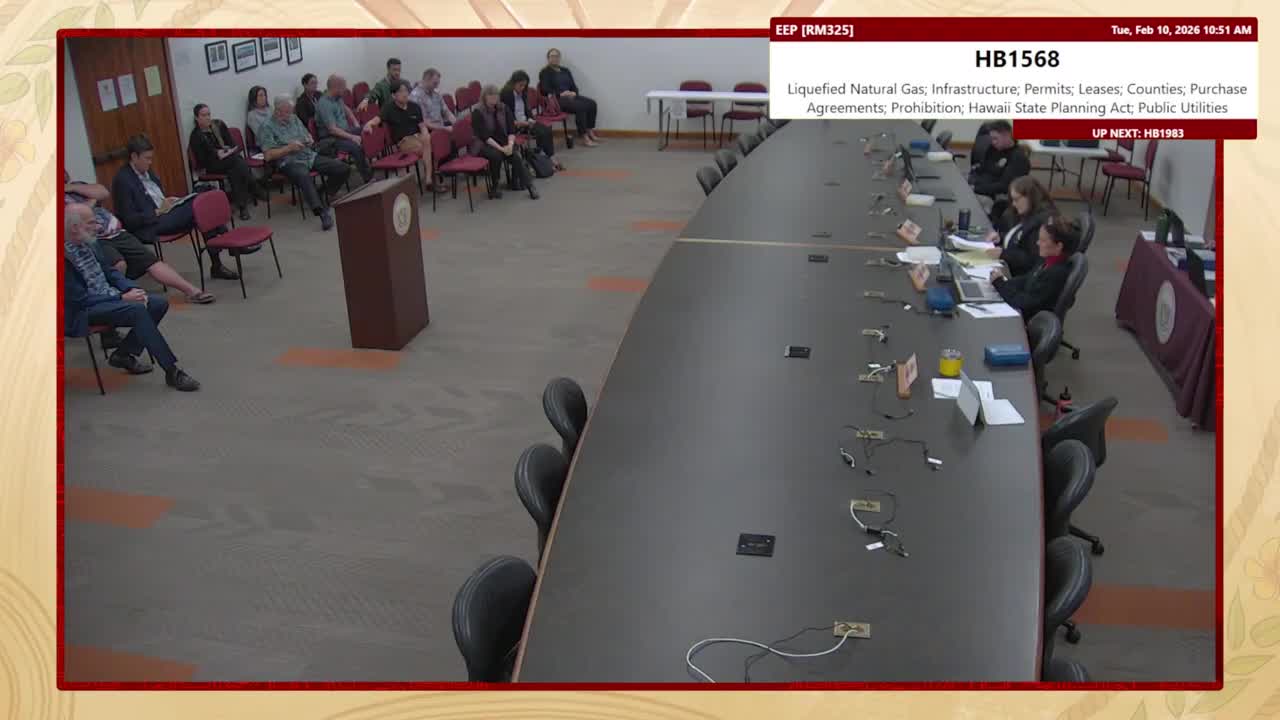 20SEC
House Standing Committee on Energy & Environmental Protection
20SEC
House Standing Committee on Human Services & Homelessness
 6MIN
House Standing Committee on Energy & Environmental Protection
Bill Author

Bill Co-Author(s):