HB 243: RELATING TO ENERGY.
- Session Year: 2025-2026
- House: House
- Latest Version Date: 2025-02-12
Current Status:
Failed
(2025-12-08: Carried over to 2026 Regular Session.)
Introduced
In Committee
First Chamber
In Committee
Second Chamber
Final Decking
Enacted
Requires the Public Utilities Commission to establish a streamlined grid-ready home interconnection process. Requires the Hawaii Electricity Reliability Administrator to report to the Legislature on the streamlined grid-ready home interconnection process. Effective 7/1/3000. (HD2)
Requires the Public Utilities Commission to establish a streamlined grid-ready home interconnection process. Requires a report to the Legislature on the streamlined grid-ready home interconnection process. Effective 7/1/3000. (HD1)
Requires solar conduit- and electrical panel-readiness for new residential construction offered for sale at fair market value and electric vehicle-readiness when an electrical panel and parking area are installed. Effective 1/1/2026.
|
HOUSE OF REPRESENTATIVES |
H.B. NO. |
243 |
|
THIRTY-THIRD LEGISLATURE, 2025 |
H.D. 2 |
|
|
STATE OF HAWAII |
|
|
|
|
|
|
|
|
||
|
|
||
A BILL FOR AN ACT
RELATING TO ENERGY.
BE IT ENACTED BY THE LEGISLATURE OF THE STATE OF HAWAII:
SECTION 1. The legislature finds that pursuant to Act 97, Session Laws of Hawaii 2015, Hawaii has committed to achieving a one hundred percent renewable portfolio standard by December 31, 2045. This transition away from imported fossil fuels toward locally available renewable energy sources is critical for ensuring the State's energy independence, economic sustainability, and environmental resilience.
The legislature further finds that the transition to a clean energy economy requires customer-friendly processes to enable widespread adoption of distributed energy resources and electrification technologies. Current interconnection and utility service upgrade processes have led to delays, unexpected costs, and increased customer dissatisfaction, hindering progress toward achieving the State's clean energy goals. These challenges also result in localized power quality issues and power outages when customers increase loads without informing the utility.
The legislature also finds that establishing streamlined and transparent interconnection processes will encourage consumer adoption, enable proactive utility planning, and ensure reliability and cost-effectiveness in the power system. The integration of smart inverters and other customer-sited technologies is critical to minimizing grid investments and achieving a clean, sustainable energy future.
Accordingly, the purpose of this Act is to establish a grid-ready home interconnection process that supports the rapid adoption of clean energy technologies, facilitates smart utility investments, and ensures power system reliability.
SECTION 2. Section 269-141, Hawaii Revised Statutes, is amended by adding a new definition to be appropriately inserted and to read as follows:
""Grid-ready home" means a residential property equipped or modified to anticipate and streamline the integration of clean electrification technologies such as electric vehicle chargers and heat pumps, distributed energy resources such as photovoltaic systems, batteries leveraging current national standards for functionality such as UL 1741, and advanced grid modernization technology."
SECTION 3. Section 269-142, Hawaii Revised Statutes, is amended to read as follows:
"[[]§269-142[]] Reliability standards; interconnection
requirements; adoption and development; force and effect[.];
streamlined grid-ready home interconnection process. (a)
The commission may adopt, by rule or order, reliability standards and
interconnection requirements.
Reliability standards and interconnection requirements adopted by the
commission shall apply to any electric utility and any user, owner, or operator
of the Hawaii electric system. The
commission shall not contract for the performance of the functions under this
subsection to any other entity as provided under section 269-147.
(b) The commission may develop reliability standards and interconnection requirements as it determines necessary or upon recommendation from any entity, including an entity contracted by the commission to serve as the Hawaii electricity reliability administrator provided for under this part, for the continuing reliable design and operation of the Hawaii electric system. Any reliability standard or interconnection requirement developed by the commission shall be adopted by the commission in accordance with subsection (a) in order to be effective. The commission shall not contract for the performance of the functions under this subsection to any other entity as provided under section 269-147.
(c) The commission shall have jurisdiction over matters concerning interconnection requirements and interconnections located in the State between electric utilities, any user, owner, or operator of the Hawaii electric system, or any other person, business, or entity connecting to the Hawaii electric system or otherwise applying to connect generation or equipment providing ancillary services to, or operate generation and equipment providing ancillary services in parallel with the Hawaii electric system under processes established in accordance with section 269-145. Nothing in this subsection is intended to give the commission general supervision authority over any user, owner, or operator of the Hawaii electric system or any other person, business, or entity that is not a public utility as defined in section 269-1.
(d) No later than October 1, 2026, the commission shall establish, for investor-owned electric utility companies, a streamlined grid-ready home interconnection process for grid-tied renewable energy generation and storage systems, including electric vehicle charging. The process shall include:
(1) A streamlined notification and approval process for customers seeking to install distributed energy resources systems using UL 1741 or equivalent certified functionality;
(2) Service upgrades where necessary, to be paid by the distributed energy resource asset owner;
(3) Requirements obligating regulated investor-owned electric utility companies to process notifications and grant interconnection to grid-ready homes within two weeks for systems with electrical permits for the grid-ready improvements that have been approved by the appropriate authority;
(4) Provisions to allow distributed energy resources operation with managed power export/import where service upgrades are required;
(5) Protocols for virtual commissioning and interconnection agreement issuance within one week of the submission of a commissioning packet; and
(6) Requirements obligating regulated investor-owned utility companies to update their interconnection rules by , to incorporate vehicle-to-grid compliance requirements to allow for the interconnection and utilization of vehicle-to-grid capabilities, including vehicle-to-home and vehicle-to-grid services; provided that updates to the interconnection rules pursuant to this subsection shall include UL 1741 SC and UL 1741 QIKP certification."
SECTION 4. Section 269-145, Hawaii Revised Statutes, is amended to read as follows:
"[[]§269-145[]] Grid access; procedures for interconnection;
dispute resolution. (a) Each user, owner, or operator of the Hawaii
electric system, or any other person, business, or entity seeking to make an
interconnection on the Hawaii electric system shall do so in accordance with
procedures to be established by the commission by rule or order.
(b) The commission shall have the authority to make final determinations regarding any dispute between any user, owner, or operator of the Hawaii electric system, or any other person, business, or entity connecting to the Hawaii electric system, concerning either an existing interconnection on the Hawaii electric system or an interconnection to the Hawaii electric system created under the processes established by the commission under this section.
(c) In establishing a rule or order for the utility interconnection process for renewable energy and storage systems for grid-ready homes pursuant to section 269-142(d), the commission shall ensure the process:
(1) Allows licensed electricians to isolate electrical service at utility meters for meter panel replacement, meter socket adapter installation, or main panel upgrades; provided that access shall be subject to:
(A) Notification by the utility provider to the owner of the grid-ready home of the planned service disconnection on the morning of the planned service disconnection;
(B) Confirmation of passed inspections by the appropriate authority; and
(C) Confirmation of reconnection procedures;
(2) Establishes a virtual commissioning process whereby system installers may submit documentation confirming compliance with filed settings and operational requirements of the installed distributed energy resources; and
(3) Establishes a process to approve or certify licensed electricians to perform meter panel replacements, meter socket adapter installation, and main panel upgrades covered under the streamlined grid-ready home interconnection process for grid-tied renewable energy generation and storage systems."
SECTION 5. Section 269-145.5, Hawaii Revised Statutes, is amended to read as follows:
"§269-145.5 Advanced grid modernization technology; principles. (a) The commission, in carrying out its responsibilities under this chapter, shall consider the value of improving electrical generation, transmission, and distribution systems and infrastructure within the State through the use of advanced grid modernization technology in order to improve the overall reliability and operational efficiency of the Hawaii electric system.
(b) In advancing the public interest, the commission shall balance technical, economic, environmental, and cultural considerations associated with modernization of the electric grid, based on principles that include but are not limited to:
(1) Enabling a diverse portfolio of renewable energy resources;
(2) Expanding options for customers to manage their energy use;
(3) Maximizing interconnection of distributed generation to the State's electric grids on a cost-effective basis at non-discriminatory terms and at just and reasonable rates, while maintaining the reliability of the State's electric grids, and allowing such access and rates through applicable rules, orders, and tariffs as reviewed and approved by the commission;
(4) Determining fair compensation for electric grid services and other benefits provided to customers and for electric grid services and other benefits provided by distributed generation customers and other non-utility service providers; and
(5) Maintaining or enhancing grid reliability and safety through modernization of the State's electric grids.
(c) The commission, in carrying out its responsibilities under this chapter, shall ensure the grid-ready home interconnection process pursuant to section 269-142(d), aligns with principles of advanced grid modernization technology by:
(1) Streamlining customer access to renewable energy, electric vehicle charging, and storage resources;
(2) Enhancing customer participation in reliance-enhancing energy programs through rapid integration; and
(3) Optimizing grid operations to accommodate increased electrification while minimizing infrastructure costs."
SECTION 6. Section 269-149, Hawaii Revised Statutes, is amended by amending subsection (b) to read as follows:
"(b) The Hawaii electricity reliability
administrator shall report to the [commission] legislature each
year on the date of agreement under section 269-147 following the original
contracting between the Hawaii electricity reliability administrator and the
commission on [the]:
(1) The status
of its operations, financial position, and a projected operational budget for
the fiscal year following the date of the report[.]; and
(2) The status, effectiveness, and outcomes of the grid-ready home interconnection process, including:
(A) The number of customers served under the process;
(B) Average timelines for interconnection approvals and upgrades;
(C) Total fees collected by the electric utility under the process;
(D) Total costs recovered by the electric utility in service of the process; and
(E) Value of infrastructure upgrades deferred or avoided as a result of the process."
SECTION 7. Statutory material to be repealed is bracketed and stricken. New statutory material is underscored.
SECTION 8. This Act shall take effect on July 1, 3000.
Report Title:
Grid-ready Home Interconnection Process; Renewable Energy; Public Utilities Commission; Investor-Owned Electric Utility Company; Electricity Reliability Administrator; Electricity Reliability Surcharge
Description:
Requires the Public Utilities Commission to establish a streamlined grid-ready home interconnection process. Requires the Hawaii Electricity Reliability Administrator to report to the Legislature on the streamlined grid-ready home interconnection process. Effective 7/1/3000. (HD2)
The summary description of legislation appearing on this page is for informational purposes only and is not legislation or evidence of legislative intent.
|
HOUSE OF REPRESENTATIVES |
H.B. NO. |
243 |
|
THIRTY-THIRD LEGISLATURE, 2025 |
H.D. 1 |
|
|
STATE OF HAWAII |
|
|
|
|
|
|
|
|
||
|
|
||
A BILL FOR AN ACT
relating to energy.
BE IT ENACTED BY THE LEGISLATURE OF THE STATE OF HAWAII:
SECTION 1. The legislature finds that pursuant to Act 97, Session Laws of Hawaii 2015, Hawaii has committed to achieving a one hundred percent renewable portfolio standard by December 31, 2045. This transition away from imported fossil fuels toward locally available renewable energy sources is critical for ensuring the State's energy independence, economic sustainability, and environmental resilience.
The legislature further finds that the transition to a clean energy economy requires customer-friendly processes to enable widespread adoption of distributed energy resources and electrification technologies. Current interconnection and utility service upgrade processes have led to delays, unexpected costs, and increased customer dissatisfaction, hindering progress toward achieving the State's clean energy goals. These challenges also result in localized power quality issues and power outages when customers increase loads without informing the utility.
The legislature finds that establishing streamlined and transparent interconnection processes will encourage consumer adoption, enable proactive utility planning, and ensure reliability and cost-effectiveness in the power system. The integration of smart inverters and other customer-sited technologies is critical to minimizing grid investments and achieving a clean, sustainable energy future.
Accordingly, the purpose of this Act is to establish a grid-ready home interconnection process that supports the rapid adoption of clean energy technologies, facilitates smart utility investments, and ensures power system reliability.
SECTION 2. Section 269-141, Hawaii Revised Statutes, is amended by adding a new definition to be appropriately inserted and to read as follows:
""Grid-ready home" means a residential property equipped or modified to anticipate and streamline the integration of clean electrification technologies such as electric vehicle chargers and heat pumps, distributed energy resources such as photovoltaic systems, batteries leveraging current national standards for functionality such as UL 1741, and advanced grid modernization technology."
SECTION 3. Section 269-142, Hawaii Revised Statutes, is amended to read as follows:
"[[]§269-142[]] Reliability standards; interconnection
requirements; adoption and development; force and effect[.];
streamlined grid-ready home interconnection process. (a)
The commission may adopt, by rule or order, reliability standards and
interconnection requirements.
Reliability standards and interconnection requirements adopted by the
commission shall apply to any electric utility and any user, owner, or operator
of the Hawaii electric system. The
commission shall not contract for the performance of the functions under this
subsection to any other entity as provided under section 269-147.
(b) The commission may develop reliability standards and interconnection requirements as it determines necessary or upon recommendation from any entity, including an entity contracted by the commission to serve as the Hawaii electricity reliability administrator provided for under this part, for the continuing reliable design and operation of the Hawaii electric system. Any reliability standard or interconnection requirement developed by the commission shall be adopted by the commission in accordance with subsection (a) in order to be effective. The commission shall not contract for the performance of the functions under this subsection to any other entity as provided under section 269-147.
(c) The commission shall have jurisdiction over matters concerning interconnection requirements and interconnections located in the State between electric utilities, any user, owner, or operator of the Hawaii electric system, or any other person, business, or entity connecting to the Hawaii electric system or otherwise applying to connect generation or equipment providing ancillary services to, or operate generation and equipment providing ancillary services in parallel with the Hawaii electric system under processes established in accordance with section 269-145. Nothing in this subsection is intended to give the commission general supervision authority over any user, owner, or operator of the Hawaii electric system or any other person, business, or entity that is not a public utility as defined in section 269-1.
(d) No later than October 1, 2026, the commission shall establish a streamlined grid-ready home interconnection process for grid-tied renewable energy generation and storage systems. The process shall include:
(1) A streamlined notification and approval process for customers seeking to install distributed energy resources systems using UL 1741 or equivalent certified functionality;
(2) A cost-sharing fee of $ to address service upgrades where necessary, to be paid by the asset owner;
(3) Requirements obligating regulated electric utilities to process notifications and grant interconnection to grid-ready homes within two weeks for systems with electrical permits for the grid-ready improvements that have been approved by the appropriate authority;
(4) Provisions to allow distributed energy resources operation with managed power export/import where service upgrades are required;
(5) Protocols for virtual commissioning and interconnection agreement issuance within one week of the submission of a commissioning packet; and
(6) Requirements obligating regulated utilities to update their interconnection rules by , to incorporate vehicle-to-grid compliance requirements to allow for the interconnection and utilization of vehicle-to-grid capabilities, including vehicle-to-home and vehicle-to-grid services; provided that updates to the interconnection rules pursuant to this subsection shall include UL 1741 SC and UL 1741 QIKP certification."
SECTION 4. Section 269-145, Hawaii Revised Statutes, is amended to read as follows:
"[[]§269-145[]] Grid access; procedures for interconnection;
dispute resolution. (a) Each user, owner, or operator of the Hawaii
electric system, or any other person, business, or entity seeking to make an
interconnection on the Hawaii electric system shall do so in accordance with
procedures to be established by the commission by rule or order.
(b) The commission shall have the authority to make final determinations regarding any dispute between any user, owner, or operator of the Hawaii electric system, or any other person, business, or entity connecting to the Hawaii electric system, concerning either an existing interconnection on the Hawaii electric system or an interconnection to the Hawaii electric system created under the processes established by the commission under this section.
(c) In establishing a rule or order for the utility interconnection process for renewable energy and storage systems for grid-ready homes, the commission shall ensure the process:
(1) Allows licensed electricians to isolate electrical service at utility meters for meter panel replacement, meter socket adapter installation, or main panel upgrades; provided that access shall be subject to:
(A) Notification by the utility provider to the owner of the grid-ready home of the planned service disconnection on the morning of the planned service disconnection;
(B) Confirmation of passed inspections by the appropriate authority; and
(C) Confirmation of reconnection procedures; and
(2) Establishes a virtual commissioning process whereby system installers may submit documentation confirming compliance with filed settings and operational requirements of the installed distributed energy resources."
SECTION 5. Section 269-145.5, Hawaii Revised Statutes, is amended to read as follows:
"§269-145.5 Advanced grid modernization technology; principles. (a) The commission, in carrying out its responsibilities under this chapter, shall consider the value of improving electrical generation, transmission, and distribution systems and infrastructure within the State through the use of advanced grid modernization technology in order to improve the overall reliability and operational efficiency of the Hawaii electric system.
(b) In advancing the public interest, the commission shall balance technical, economic, environmental, and cultural considerations associated with modernization of the electric grid, based on principles that include but are not limited to:
(1) Enabling a diverse portfolio of renewable energy resources;
(2) Expanding options for customers to manage their energy use;
(3) Maximizing interconnection of distributed generation to the State's electric grids on a cost-effective basis at non-discriminatory terms and at just and reasonable rates, while maintaining the reliability of the State's electric grids, and allowing such access and rates through applicable rules, orders, and tariffs as reviewed and approved by the commission;
(4) Determining fair compensation for electric grid services and other benefits provided to customers and for electric grid services and other benefits provided by distributed generation customers and other non-utility service providers; and
(5) Maintaining or enhancing grid reliability and safety through modernization of the State's electric grids.
(c) The commission, in carrying out its responsibilities under this chapter, shall ensure the grid-ready home interconnection process aligns with principles of advanced grid modernization technology by:
(1) Streamlining customer access to renewable energy, electric vehicle charging, and storage resources;
(2) Enhancing customer participation in reliance-enhancing energy programs through rapid integration; and
(3) Optimizing grid operations to accommodate increased electrification while minimizing infrastructure costs."
SECTION 6. Section 269-149, Hawaii Revised Statutes, is amended by amending subsection (b) to read as follows:
"(b) The Hawaii electricity reliability
administrator shall report to the [commission] legislature each
year on the date of agreement under section 269-147 following the original
contracting between the Hawaii electricity reliability administrator and the
commission on [the]:
(1) The status
of its operations, financial position, and a projected operational budget for
the fiscal year following the date of the report[.]; and
(2) The status, effectiveness, and outcomes of the grid-ready home interconnection process, including:
(A) The number of customers served under the process;
(B) Average timelines for interconnection approvals and upgrades;
(C) Total fees collected by the electric utility under the process;
(D) Total costs recovered by the electric utility in service of the process; and
(E) Value of infrastructure upgrades deferred or avoided as a result of the process."
SECTION 7. Statutory material to be repealed is bracketed and stricken. New statutory material is underscored.
SECTION 8. This Act shall take effect on July 1, 3000.
Report Title:
Grid-ready Home Interconnection Process; Renewable Energy; Public Utilities Commission; Electricity Reliability Administrator; Electricity Reliability Surcharge
Description:
Requires the Public Utilities Commission to establish a streamlined grid-ready home interconnection process. Requires a report to the Legislature on the streamlined grid-ready home interconnection process. Effective 7/1/3000. (HD1)
The summary description of legislation appearing on this page is for informational purposes only and is not legislation or evidence of legislative intent.
|
HOUSE OF REPRESENTATIVES |
H.B. NO. |
243 |
|
THIRTY-THIRD LEGISLATURE, 2025 |
|
|
|
STATE OF HAWAII |
|
|
|
|
|
|
|
|
||
|
|
||
A BILL FOR AN ACT
relating to energy.
BE IT ENACTED BY THE LEGISLATURE OF THE STATE OF HAWAII:
SECTION 1. The legislature finds that meeting the State's goal of transitioning completely to renewable energy by 2045 for electricity and transportation is most cost-efficient when certain measures are taken during the construction of new homes rather than as retrofits after construction has already been completed.
The legislature further finds that when undertaken during home construction, preparation for the future installation of infrastructure for photovoltaic systems and electric vehicles can leverage existing work activities with minimal additional time and effort. In contrast, retrofitting a completed home to install photovoltaic infrastructure may require breaking and repairing walls, installing longer conduits, and performing expensive upgrades of already-installed electric service panels. Retrofitting a finished home to install electric vehicle infrastructure may also require trenching, demolition, and re-paving. Furthermore, the costs for permitting, inspection, and project management are lower for new construction than for existing structures.
On February 18, 2020, the office of climate change, sustainability and resiliency of the city and county of Honolulu provided cost estimates for certain measures passed by the Honolulu city council in order to make new homes photovoltaic- and electric vehicle-ready. The cost estimate for solar conduit- and electric panel-readiness and electric vehicle-readiness ranges from $100 to $300.
The city and county of Honolulu enacted a measure to require solar conduit- and electrical panel-readiness for new construction and a measure to require electric vehicle-readiness when an electrical panel and parking area are installed. The legislature finds that these important actions should be adopted statewide.
Therefore, the purpose of this Act is to require, beginning on January 1, 2026:
(1) Solar conduit- and electrical panel-readiness for new residential construction offered for sale at fair market value; and
(2) Electric vehicle-readiness when an electrical panel and parking area are installed.
SECTION 2. Chapter 196, Hawaii Revised Statutes, is amended by adding two new sections to be appropriately designated and to read as follows:
"§196-A Photovoltaic infrastructure; new residential construction. (a) With respect to the construction of new residences, construction plans shall indicate:
(1) A location for inverters, metering equipment, battery equipment, energy storage equipment, and other equipment to interconnect a residence with on-site solar energy generation facilities with the electric grid in compliance with all applicable laws and utility tariffs; and
(2) A pathway for the routing of conduits from the solar panel location to the point of interconnection with electrical service.
(b) An electrical panel with the capacity to accommodate no less than a five-kilowatt alternating current photovoltaic system shall be installed for each newly constructed single-family residence or each residential unit within a two-family detached residence or duplex.
(c) An electrical panel that includes reserved space to accommodate a photovoltaic system shall be installed for each newly constructed multi-family residence. The electrical panel shall be sized:
(1) To serve common-area electrical loads; or
(2) To the amount of available space on the roof of the multi-family residence.
The reserved space shall be clearly labeled "solar photovoltaic-ready".
(d) All feeders and electrical distribution equipment, including switchgear, switchboards, and panelboards, that will be fed simultaneously by the electric grid and other power sources shall be sized to support the installation of future solar energy generation systems in accordance with the interconnection requirements of the applicable electrical code.
(e) Conduits of no less than one and one-half inches that provide a pathway from the electrical panel to the inverter location and from the inverter location to the underside of the roof sufficient to allow future installation of solar equipment shall be installed for all newly constructed residences.
(f) If conduits are to be installed between buildings or other structures, the construction plans shall provide sufficient details to demonstrate that compliance with the applicable electrical code's restrictions on the number of power supplies to each building or other structure has been examined.
(g) This section shall apply only to buildings exclusively occupied by residential units offered for sale at fair market value.
(h) As used in this section:
"Residential unit" means each individual dwelling in a two-family detached residence or duplex that is designed or used exclusively for residential occupancy and has all necessary facilities for permanent residency, such as living, sleeping, cooking, eating, and sanitation.
"Single-family residence" means an individual, freestanding, unattached dwelling unit, typically built on a lot larger than the structure itself, resulting in an area surrounding the dwelling.
"Two-family detached residence" means a freestanding, unattached dwelling unit that is intended or designed to be occupied by only two families in the following manner:
(1) The individual residential units are constructed side by side and joined by a common wall; or
(2) One residential unit is located on the first floor and the other residential unit is located on the second floor.
§196-B Electric vehicle-readiness. (a) In addition to the requirements of the applicable electrical code, if an application for a building permit involves the installation of an electrical panel and parking area for:
(1) A multi-family residence of three or fewer stories; or
(2) A single-family residence, two-family detached residence, or duplex,
a dedicated receptacle for an electric vehicle shall be provided with a minimum alternating current level 2.
(b) As used in this section:
"Residential unit" has the same meaning as in section 196-A.
"Single-family residence" has the same meaning as in section 196-A.
"Two-family detached residence" has the same meaning as in section 196-A."
SECTION 3. In codifying the new sections added by section 2 of this Act, the revisor of statutes shall substitute appropriate section numbers for the letters used in designating the new sections in this Act.
SECTION 4. New statutory material is underscored.
SECTION 5. This Act shall take effect on January 1, 2026.
|
INTRODUCED BY: |
_____________________________ |
|
|
|
Report Title:
Photovoltaic Systems and Electric Vehicles; Readiness; New Residential Construction
Description:
Requires solar conduit- and electrical panel-readiness for new residential construction offered for sale at fair market value and electric vehicle-readiness when an electrical panel and parking area are installed. Effective 1/1/2026.
The summary description of legislation appearing on this page is for informational purposes only and is not legislation or evidence of legislative intent.
|
Date
|
Status
|
|---|---|
| Dec 8, 2025 | Carried over to 2026 Regular Session. |
| Feb 13, 2025 | Report adopted; referred to the committee(s) on FIN as amended in HD 2 with none voting aye with reservations; Representative(s) Garcia, Pierick voting no (2) and Representative(s) Cochran, Kitagawa, Ward excused (3). |
| Feb 13, 2025 | Reported from HSG (Stand. Com. Rep. No. 586) as amended in HD 2, recommending referral to FIN. |
| Feb 12, 2025 | The committee on HSG recommend that the measure be PASSED, WITH AMENDMENTS. The votes were as follows: 6 Ayes: Representative(s) Evslin, Miyake, Grandinetti, Kila, Kitagawa, La Chica; Ayes with reservations: none; 2 Noes: Representative(s) Muraoka, Pierick; and 1 Excused: Representative(s) Cochran. |
| Feb 6, 2025 | Bill scheduled to be heard by HSG on Wednesday, 02-12-25 9:00AM in House conference room 430 VIA VIDEOCONFERENCE. |
| Feb 4, 2025 | Passed Second Reading as amended in HD 1 and referred to the committee(s) on HSG with none voting aye with reservations; Representative(s) Garcia voting no (1) and Representative(s) Cochran, Kong, Ward excused (3). |
| Feb 4, 2025 | Reported from EEP (Stand. Com. Rep. No. 107) as amended in HD 1, recommending passage on Second Reading and referral to HSG. |
| Jan 28, 2025 | The committee on EEP recommend that the measure be PASSED, WITH AMENDMENTS. The votes were as follows: 5 Ayes: Representative(s) Lowen, Perruso, Kahaloa, Kusch, Quinlan; Ayes with reservations: none; 0 Noes: none; and 1 Excused: Representative(s) Ward. |
| Jan 24, 2025 | Bill scheduled to be heard by EEP on Tuesday, 01-28-25 9:00AM in House conference room 325 VIA VIDEOCONFERENCE. |
| Jan 21, 2025 | Referred to EEP, HSG, FIN, referral sheet 1 |
| Jan 17, 2025 | Introduced and Pass First Reading. |
| Jan 16, 2025 | Pending introduction. |
|
Date
|
Description
|
Location
|
Votes
|
|
|---|---|---|---|---|
| Feb 12, 2025 | The committee on HSG recommend that the measure be PASSED, WITH AMENDMENTS | House Standing Committee on Housing |
Passed |
|
| Jan 28, 2025 | The committee on EEP recommend that the measure be PASSED, WITH AMENDMENTS | House Standing Committee on Energy & Environmental Protection |
Passed |
This list shows positions taken on this bill by organizations on the date displayed, which is linked to the original source.
Positions by individuals are not included.
|
Organization
|
Position
|
Date
|
|---|---|---|
| 350Hawaii.org | ** Support | |
| 350Hawaii.org | *** Support | Feb 12, 2025 |
| Alliance for Automotive Innovation | ** Support | |
| Alternate Energy Hawaii | *** Support | Feb 12, 2025 |
| Alternate Energy Hawaii | ** Support | |
| Alternate Energy Hawaii Inc. | ** Support | |
| Alternate Energy Inc. | *** Support | Feb 12, 2025 |
| Chamber of Sustainable Commerce | ** Support | |
| Citizens Climate Lobby Hawaiʻi | ** Support | |
| Climate Protectors Hawaii | *** Support | Feb 12, 2025 |
| Climate Protectors Hawaii | ** Support | |
| Credence Projects LLC | ** Support | |
| Credence Projects LLC | *** Support | Feb 12, 2025 |
| Green Party of Hawaii | ** Support | |
| Green Party of Hawai’i | *** Support | Feb 12, 2025 |
| Hawaii Solar Energy Association | ** Support | |
| Hawaii Electric Vehicle Association | ** Support | |
| Hawaii Electric Vehicle Association | *** Support | Feb 12, 2025 |
| Hawaii Solar Energy Association (HSEA) | *** Support | Feb 12, 2025 |
| Hawaii State Energy Office | ** Support | |
| Hawaiian Electric | *** Against | Feb 12, 2025 |
| Hawaiʻi Workers Center | *** Support | Feb 12, 2025 |
| Inter-Island Solar Supply | ** Support | |
| International Brotherhood of Electrical Workers Local 1260 | *** Against | Feb 12, 2025 |
| Kauai Climate ACTION Coalition | *** Support | Feb 12, 2025 |
| Kauai Climate Action Coalition | ** Support | |
| Kauaʻi Island Utility Cooperative (KIUC) | *** Against | Feb 12, 2025 |
| KCAC-Kauai Climate ACTION Coalition | *** Support | Jan 28, 2025 |
| LIMBY Hawaii | *** Support | Feb 12, 2025 |
| LIMBY Hawaiʻi | ** Support | |
| NAIOP Hawaii | ** Against | |
| Photonworks Engineering | ** Support | |
| Photonworks Engineering LLP | *** Support | Feb 12, 2025 |
| Sierra Club of Hawaiʻi | *** Support | Feb 12, 2025 |
| Sunrun Inc. | *** Support | Feb 12, 2025 |
| Sunrun Inc. | ** Support | |
| Tesla | ** Support | |
| Tesla | *** Support | Feb 12, 2025 |
| The Solaray Corporation / Inter-Island Solar Supply | *** Support | Feb 12, 2025 |
STAND. COM. REP. NO. 586
Honolulu, Hawaii
, 2025
RE: H.B. No. 243
H.D. 2
Honorable Nadine K. Nakamura
Speaker, House of Representatives
Thirty-Third State Legislature
Regular Session of 2025
State of Hawaii
Madame:
Your Committee on Housing, to which was referred H.B. No. 243, H.D. 1, entitled:
"A BILL FOR AN ACT RELATING TO ENERGY,"
begs leave to report as follows:
The purpose of this measure is to:
(1) Require the Public Utilities Commission to establish a streamlined grid-ready home interconnection process; and
(2) Require the Hawaii Electricity Reliability Administrator to submit a report to the Legislature on the streamlined grid-ready home interconnection process.
Your Committee received testimony in support of this measure from Tesla; Green Party of Hawaii; Hawaii Electric Vehicle Association; Kauai Climate Action Coalition; Sunrun Inc.; 350Hawaii.org; Hawaii Solar Energy Association; Climate Protectors Hawaii; Credence Projects LLC; Photonworks Engineering; Alternate Energy Hawaii; Alternate Energy Hawaii Inc.; Inter-Island Solar Supply; LIMBY Hawaiʻi; and numerous individuals. Your Committee received testimony in opposition to this measure from Hawaiian Electric; Kauaʻi Island Utility Cooperative; and International Brotherhood of Electrical Workers Local 1260. Your Committee received comments on this measure from the Department of Commerce and Consumer Affairs and Public Utilities Commission.
Your Committee finds that grid-ready homes represent a low-cost, high-impact solution to expedite the deployment of advanced distributed energy resources, such as paired solar and energy storage, electric vehicle charging, and vehicle-to-grid technologies. By reducing interconnection bottlenecks and costly infrastructure upgrades, this measure enables customers to install grid-interactive clean energy technologies rapidly and affordably.
Your Committee has amended this measure by:
(1) Specifying that the streamlined grid-ready home interconnection process for grid-tied renewable energy and storage systems is for investor-owned electric utility companies;
(2) Expanding the scope of the grid-ready home interconnection process to include electric vehicle charging;
(3) Removing the cost-sharing fee requirement under the streamlined grid-ready home interconnection process;
(4) Clarifying that the service upgrades are to be paid by the distributed energy resources asset owner;
(5) Requiring that a rule or order for the streamlined grid-ready home interconnection process for grid-tied renewable energy generation and storage systems establishes a process to approve or certify licensed electricians; and
(6) Making technical, nonsubstantive amendments for the purposes of clarity, consistency, and style.
As affirmed by the record of votes of the members of your Committee on Housing that is attached to this report, your Committee is in accord with the intent and purpose of H.B. No. 243, H.D. 1, as amended herein, and recommends that it be referred to your Committee on Finance in the form attached hereto as H.B. No. 243, H.D. 2.
Respectfully submitted on behalf of the members of the Committee on Housing,
|
|
|
____________________________ LUKE A. EVSLIN, Chair |
|
|
|
|
STAND. COM. REP. NO. 107
Honolulu, Hawaii
, 2025
RE: H.B. No. 243
H.D. 1
Honorable Nadine K. Nakamura
Speaker, House of Representatives
Thirty-Third State Legislature
Regular Session of 2025
State of Hawaii
Madame:
Your Committee on Energy & Environmental Protection, to which was referred H.B. No. 243 entitled:
"A BILL FOR AN ACT RELATING TO ENERGY,"
begs leave to report as follows:
Your Committee received testimony in support of this measure from the Hawaii State Energy Office; Green Party of Hawaiʻi; Citizens Climate Lobby Hawaiʻi; Climate Protectors Hawaiʻi; 350Hawaii.org; Hawaii Electric Vehicle Association; Hawaii Solar Energy Association; Alliance for Automotive Innovation; Kauai Climate Action Coalition; Chamber of Sustainable Commerce; and numerous individuals. Your Committee received testimony in opposition to this measure from NAIOP Hawaii.
Your Committee finds that there is an urgent need to encourage the rapid transition to renewable energy. Your Committee further finds that this measure would better accomplish this need by establishing a Streamlined Grid-Ready Home Interconnection Process that supports the rapid adoption of clean energy technologies and ensures power system reliability.
Your Committee has amended this measure by:
(1) Deleting its contents and inserting the contents of H.B. No. 340, a measure heard and considered by your Committee that:
(A) Requires the Public Utilities Commission to establish a Streamlined Grid-Ready Home Interconnection Process; and
(B) Authorizes the use of the Hawaii Electricity Reliability Surcharge for cost recovery of certain expenses of the Hawaii Electricity Reliability Administrator associated with the Streamlined Grid-Ready Home Interconnection Process;
(2) Changing the deadline for the Public Utilities Commission to establish the Streamlined Grid-Ready Home Interconnection Process to October 1, 2026;
(3) Changing the cost-sharing fee for service upgrades to an unspecified amount and deleting the deadline for completion of service upgrades;
(4) Adding requirements obligating regulated electric utilities to allow for the interconnection and utilization of vehicle-to-grid capabilities;
(5) Removing the provision authorizing the use of the Hawaii Electricity Reliability Surcharge for cost recovery of certain expenses;
(6) Requiring reports on the status of the Streamlined Grid-Ready Home Interconnection Process to be submitted to the Legislature instead of the Public Utilities Commission;
(7) Changing the effective date to July 1, 3000, to encourage further discussion; and
(8) Making technical, nonsubstantive amendments for the purposes of clarity, consistency, and style.
As affirmed by the record of votes of the members of your Committee on Energy & Environmental Protection that is attached to this report, your Committee is in accord with the intent and purpose of H.B. No. 243, as amended herein, and recommends that it pass Second Reading in the form attached hereto as H.B. No. 243, H.D. 1, and be referred to your Committee on Housing.
Respectfully submitted on behalf of the members of the Committee on Energy & Environmental Protection,
|
|
|
____________________________ NICOLE E. LOWEN, Chair |
|
|
|
|
|
Date
|
Testimony PDF
|
|---|---|
| Feb 12, 2025 | HB243_HD1_TESTIMONY_HSG_02-12-25_.PDF |
| Jan 28, 2025 | HB243_TESTIMONY_EEP_01-28-25_.PDF |
Discussed in Hearing
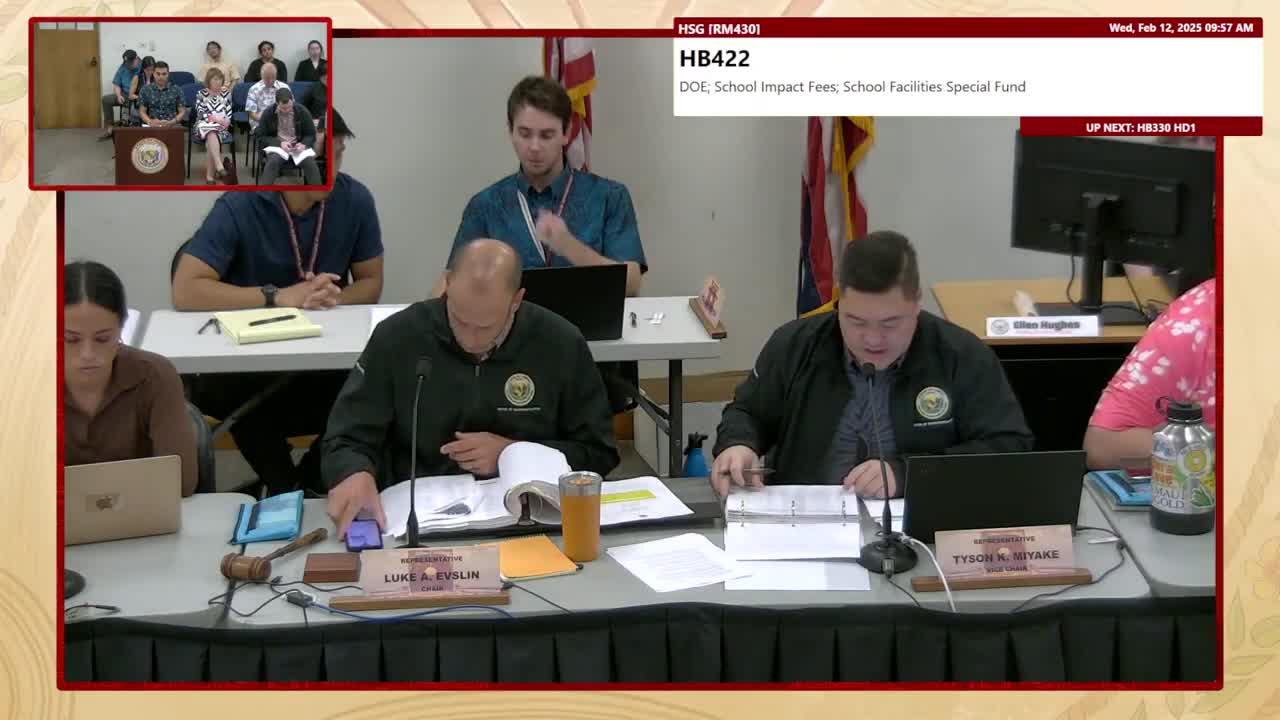 6MIN
House Standing Committee on Housing
 1MIN
House Standing Committee on Energy & Environmental Protection
Bill Author

Bill Co-Author(s):