HB 439: RELATING TO EDUCATION.
- Session Year: 2025-2026
- House: House
- Latest Version Date: 2025-02-10
Current Status:
Failed
(2025-12-08: Carried over to 2026 Regular Session.)
Introduced
In Committee
First Chamber
In Committee
Second Chamber
Final Decking
Enacted
Requires the Hawaii Teacher Standards Board to establish an international teacher license for certain visa holders and the requirements to obtain the international teacher license. Requires a report to the Legislature. Effective 7/1/3000. (HD1)
Requires the Hawaii Teacher Standards Board to establish an international teacher license for certain visa holders. Establishes criteria for obtaining an international teacher license.
|
HOUSE OF REPRESENTATIVES |
H.B. NO. |
439 |
|
THIRTY-THIRD LEGISLATURE, 2025 |
H.D. 1 |
|
|
STATE OF HAWAII |
|
|
|
|
|
|
|
|
||
|
|
||
A BILL FOR AN ACT
RELATING TO EDUCATION.
BE IT ENACTED BY THE LEGISLATURE OF THE STATE OF HAWAII:
The legislature also finds that 22.4 per cent of the public school student population identifies as Filipino, while only 7.4 per cent of educators share the same background. According to the federal Institute of Education Sciences, diverse educator representation significantly impacts student learning. Teachers of color can often help close achievement gaps and improve attendance and behavioral outcomes, and are highly rated by students of all backgrounds.
Beyond academic benefits, having educators who reflect their students' backgrounds can inspire future aspirations. Seeing role models in the classroom can encourage students to pursue similar career paths. Presently, the State's implementation of the J-1 visa program has aimed to expose Filipino children to Filipino educators, inspiring them to consider careers in education. Conversely, the J-1 visa program has further contributed to classroom diversity while eliminating certain barriers to academic achievement.
Since its implementation, the J-1 visa program has been a resounding success. To date, two hundred eighteen internationally certified educators, primarily from the Philippines, serve in fifty-five public schools statewide. Similar to the Philippines, Kenya also has strong educational equivalencies, and the State's first J-1 teacher from Kenya was hired at an elementary school serving military families accustomed to working with diverse educators around the globe. Educators from the J-1 visa program are positively impacting the State's diverse classrooms, and the program has strong support from community organizations, including groups from the Filipino community.
However, the State's existing licensing rules hinder the full potential of prospective teachers for the J-1 visa program. Unlike states such as Alaska, Nevada, and North Carolina, which have streamlined licensing processes for international educators, Hawaii classifies J-1 teachers as "emergency hires". This designation requires prospective participants to take a series of additional comprehensive examinations that can exceed $1,000 in costs. Preparing for these exams significantly reduces the time available to analyze formative assessments, meet with families, and plan curriculum. Further, J-1 teachers are ineligible for additional compensation offered to educators in hard-to-fill positions despite performing equal work.
The legislature further finds that the State's existing licensure reciprocity policies do not adequately recognize the international qualifications of J-1 teachers. This limitation contradicts the department of education's commitment to being "globally competitive and locally committed". By creating a more inclusive and equitable licensing system, the State can fully leverage the skills, knowledge, and experience of international educators.
Accordingly, the purpose of this Act is to recognize the qualifications and experience of international educators, while ensuring equitable compensation, by requiring the Hawaii teacher standards board to establish a provisional licensing pathway for visiting international teachers.
SECTION 2. Section 302A-802, Hawaii Revised Statutes, is amended by amending subsection (c) to read as follows:
"(c) The board shall adopt policies, exempt from chapters 91 and 92, to initiate the following:
(1) Develop criteria allowing more individuals with trade or industry experience to teach in vocational, technical, and career pathway programs, and criteria for the issuance of permits allowing qualified individuals to teach when recommended by the superintendent or the commission, when appropriate. The department or the commission, when appropriate, shall be responsible for the review and acceptance of the relevant licenses, certificates, or other qualifications related to an individual's vocational, technical, or career pathway education-related experience that the department or the commission, when appropriate, deems necessary for a permit. The department or the commission, when appropriate, shall have the authority to waive the requirement of a bachelor's degree to teach in a vocation, technical, or career pathway education program;
(2) Develop a plan to accept teachers from any state as long as they have completed state-approved teacher education programs and pass relevant Hawaii teacher examinations or their equivalent;
(3) Clarify the requirements, on a state-by-state basis, for out-of-state licensed teachers to obtain a license in Hawaii;
(4) Develop a plan to facilitate licensing for those who intend to teach in Hawaii immersion programs, the island of Niihau, or any other extraordinary situation as defined by the superintendent or the superintendent's designee, or by the commission, when appropriate;
(5) Pursue full teacher license
reciprocity with all other states; [and]
(6) Develop a plan to facilitate an
optional certification for those who teach or intend to teach at private
schools[.]; and
(7) Establish a visiting international teacher license, and the requirements necessary to obtain the visiting international teacher license, to promote cultural and educational exchange between the State and other countries."
SECTION 3. The Hawaii teacher standards board shall submit a report to the legislature no later than twenty days prior to the convening of the regular session of 2026 on how to support international teachers teaching in the State through the J-1 visa program.
SECTION 4. Statutory material to be repealed is bracketed and stricken. New statutory material is underscored.
SECTION 5. This Act shall take effect on July 1, 3000.
Report Title:
Filipino Caucus; HTSB; International Teacher License; Criteria; Establishment; Report
Description:
Requires the Hawaii Teacher Standards Board to establish an international teacher license for certain visa holders and the requirements to obtain the international teacher license. Requires a report to the Legislature. Effective 7/1/3000. (HD1)
The summary description of legislation appearing on this page is for informational purposes only and is not legislation or evidence of legislative intent.
|
HOUSE OF REPRESENTATIVES |
H.B. NO. |
439 |
|
THIRTY-THIRD LEGISLATURE, 2025 |
|
|
|
STATE OF HAWAII |
|
|
|
|
|
|
|
|
||
|
|
||
A BILL FOR AN ACT
relating to EDUCATION.
BE IT ENACTED BY THE LEGISLATURE OF THE STATE OF HAWAII:
The legislature also finds that 22.4 per cent of the public school student population identifies as Filipino, while 7.4 per cent of educators share the same background. According to the federal Institute of Education Sciences, diverse educator representation significantly impacts student learning. Teachers of color can often help close achievement gaps and improve attendance and behavioral outcomes, and are highly rated by students of all backgrounds.
Beyond academic benefits, having educators who reflect their students' backgrounds can inspire future aspirations. Seeing role models in the classroom can encourage students to pursue similar career paths. Presently, the State's implementation of the J-1 visa program has aimed to expose Filipino children to Filipino educators, inspiring them to consider careers in education. Conversely, the J-1 visa program has further contributed to classroom diversity while eliminating certain barriers to academic achievement.
Since its implementation, the J-1 visa program has been a resounding success. To date, two hundred eighteen internationally certified educators, primarily from the Philippines, serve in fifty-five public schools statewide. Similar to the Philippines, Kenya also has strong educational equivalencies, and the State's first J-1 teacher from Kenya was hired at an elementary school serving military families accustomed to working with diverse educators around the globe. Educators from the J-1 visa program are positively impacting the State's diverse classrooms, and the program has strong support from community organizations, including groups from the Filipino community.
However, the State's existing licensing rules hinder the full potential of prospective teachers for the J-1 visa program. Unlike states such as Alaska, Nevada, and North Carolina, which have streamlined licensing processes for international educators, Hawaii classifies J-1 teachers as "emergency hires". This designation requires prospective participants to take a series of additional comprehensive examinations that can exceed $1,000 in costs. Preparing for these exams significantly reduces the time available to analyze formative assessments, meet with families, and plan curriculum. Further, J-1 teachers are ineligible for additional compensation offered to educators in hard-to-fill positions despite performing equal work.
The legislature further finds that the State's existing licensure reciprocity policies do not adequately recognize the international qualifications of J-1 teachers. This limitation contradicts the department of education's commitment to being "globally competitive and locally committed". By creating a more inclusive and equitable licensing system, the State can fully leverage the skills, knowledge, and experience of international educators.
Accordingly, the purpose of this Act is to recognize the qualifications and experience of international educators, while ensuring equitable compensation, by requiring the Hawaii teacher standards board to establish a provisional licensing pathway for visiting international teachers.
SECTION 2. Section 302A-802, Hawaii Revised Statutes, is amended by amending subsection (c) to read as follows:
"(c) The board shall adopt policies, exempt from chapters 91 and 92, to initiate the following:
(1) Develop criteria allowing more individuals with trade or industry experience to teach in vocational, technical, and career pathway programs, and criteria for the issuance of permits allowing qualified individuals to teach when recommended by the superintendent or the commission, when appropriate. The department or the commission, when appropriate, shall be responsible for the review and acceptance of the relevant licenses, certificates, or other qualifications related to an individual's vocational, technical, or career pathway education-related experience that the department or the commission, when appropriate, deems necessary for a permit. The department or the commission, when appropriate, shall have the authority to waive the requirement of a bachelor's degree to teach in a vocation, technical, or career pathway education program;
(2) Develop a plan to accept teachers from any state as long as they have completed state-approved teacher education programs and pass relevant Hawaii teacher examinations or their equivalent;
(3) Clarify the requirements, on a state-by-state basis, for out-of-state licensed teachers to obtain a license in Hawaii;
(4) Develop a plan to facilitate licensing for those who intend to teach in Hawaii immersion programs, the island of Niihau, or any other extraordinary situation as defined by the superintendent or the superintendent's designee, or by the commission, when appropriate;
(5) Pursue full teacher license
reciprocity with all other states; [and]
(6) Develop a plan to facilitate an
optional certification for those who teach or intend to teach at private
schools[.]; and
(7) Establish a visiting international teacher license to promote cultural and educational exchange between the State and other countries. The international teacher license shall provide educators hired by the department or public charter school the ability to teach all subjects and grade levels that the teacher is qualified to teach. International educators hired by the department or public charter schools with an appropriate visa shall be issued a renewable visiting international teacher license upon receipt of the following:
(A) The equivalent of a United States bachelor's degree or higher;
(B) Completion of an equivalent United States teacher preparation program that verifies basic skills and content knowledge;
(C) A valid and active international teacher license; and
(D) Verification of three years of employment at a public or private school in a pre-kindergarten through grade twelve setting."
SECTION 3. Statutory material to be repealed is bracketed and stricken. New statutory material is underscored.
SECTION 4. This Act shall take effect upon its approval.
|
INTRODUCED BY: |
_____________________________ |
|
|
|
Report Title:
Filipino Caucus; HTSB; International Teacher License; Criteria; Establishment
Description:
Requires the Hawaii Teacher Standards Board to establish an international teacher license for certain visa holders. Establishes criteria for obtaining an international teacher license.
The summary description of legislation appearing on this page is for informational purposes only and is not legislation or evidence of legislative intent.
|
Date
|
Status
|
|---|---|
| Dec 8, 2025 | Carried over to 2026 Regular Session. |
| Feb 20, 2025 | The committee(s) on CPC recommend(s) that the measure be deferred. |
| Feb 18, 2025 | Bill scheduled to be heard by CPC on Thursday, 02-20-25 2:00PM in House conference room 329 VIA VIDEOCONFERENCE. |
| Feb 11, 2025 | Passed Second Reading as amended in HD 1 and referred to the committee(s) on CPC with Representative(s) Muraoka voting aye with reservations; none voting no (0) and Representative(s) Cochran, Ward excused (2). |
| Feb 11, 2025 | Reported from EDN (Stand. Com. Rep. No. 347) as amended in HD 1, recommending passage on Second Reading and referral to CPC. |
| Feb 4, 2025 | The committee on EDN recommend that the measure be PASSED, WITH AMENDMENTS. The votes were as follows: 11 Ayes: Representative(s) Woodson, La Chica, Amato, Evslin, Garrett, Kapela, Kila, Olds, Sayama, Souza; Ayes with reservations: Representative(s) Muraoka; Noes: none; and Excused: none. |
| Jan 31, 2025 | Bill scheduled to be heard by EDN on Tuesday, 02-04-25 2:00PM in House conference room 309 VIA VIDEOCONFERENCE. |
| Jan 21, 2025 | Referred to EDN, CPC, referral sheet 2 |
| Jan 21, 2025 | Introduced and Pass First Reading. |
| Jan 17, 2025 | Pending introduction. |
|
Date
|
Description
|
Location
|
Votes
|
|
|---|---|---|---|---|
| Feb 4, 2025 | The committee on EDN recommend that the measure be PASSED, WITH AMENDMENTS | House Standing Committee on Education |
Passed |
This list shows positions taken on this bill by organizations on the date displayed, which is linked to the original source.
Positions by individuals are not included.
|
Organization
|
Position
|
Date
|
|---|---|---|
| Alliance Abroad | *** Support | Feb 4, 2025 |
| Alliance Abroad Group | ** Support | |
| Alliance Abroad Group, Inc. | *** Support | Feb 20, 2025 |
| Baldwin HS | *** Support | Feb 4, 2025 |
| Department of Education | *** Support | Feb 20, 2025 |
| Eleʻele Elementary | *** Support | Feb 4, 2025 |
| FACEH (former VP) | *** Support | Feb 4, 2025 |
| Filipino Chamber of Commerce of Hawaii | ** Support | |
| Foreign Cultural Exchange Consultants LLC | ** Support | |
| HAFE | *** Support | Feb 4, 2025 |
| Hawa'i Friends of Civil Rights | *** Support | Feb 20, 2025 |
| Hawaii Association of Filipino Educators | ** Support | |
| Hawaii Association of Filipino Educators (HAFE) | *** Support | Feb 4, 2025 |
| Hawaii DOE | *** Support | Feb 20, 2025 |
| Hawai‘i Teacher Standards Board | *** Against | Feb 4, 2025 |
| HIDOE | *** Support | Feb 4, 2025 |
| J-1 Teachers | *** Support | Feb 4, 2025 |
| J1 Teacher | *** Support | Feb 4, 2025 |
| J1 Teachers | *** Support | Feb 4, 2025 |
| Kahakai Elementary | *** Support | Feb 4, 2025 |
| Kainalu Elementary School | *** Support | Feb 20, 2025 |
| Kauai Visayan Club | *** Support | Feb 4, 2025 |
| Kaua’i High School | *** Support | Feb 20, 2025 |
| Kihei Elementary | *** Support | Feb 4, 2025 |
| Kings Church | ** Support | |
| Kings Church Lanai | *** Support | Feb 4, 2025 |
| Lanai High and Elementary School | *** Support | Feb 20, 2025 |
| Lokelani Intermediate School | *** Support | Feb 20, 2025 |
| Mauka Lani Elementary | *** Support | Feb 4, 2025 |
| Naalehu Elementary | *** Support | Feb 4, 2025 |
| Oahu Filipino Community Council | *** Support | Feb 20, 2025 |
| Pearl Harbor Kai Elementary | *** Support | Feb 4, 2025 |
| Solomon Elementary | *** Support | Feb 4, 2025 |
| University of Hawaiʻi at Hilo | *** Support | Feb 4, 2025 |
| Waipahu High School | *** Support | Feb 4, 2025 |
STAND. COM. REP. NO. 347
Honolulu, Hawaii
, 2025
RE: H.B. No. 439
H.D. 1
Honorable Nadine K. Nakamura
Speaker, House of Representatives
Thirty-Third State Legislature
Regular Session of 2025
State of Hawaii
Madame:
Your Committee on Education, to which was referred H.B. No. 439 entitled:
"A BILL FOR AN ACT RELATING TO EDUCATION,"
begs leave to report as follows:
Your Committee received testimony in support of this measure from the Department of Education; Hawaii Association of Filipino Educators; Hawaiʻi Friends of Civil Rights; Oahu Filipino Community Council; Filipino Chamber of Commerce of Hawaii; Foreign Cultural Exchange Consultants LLC; Kings Church; Alliance Abroad Group; and numerous individuals. Your Committee received testimony in opposition to this measure from the Hawaiʻi Teacher Standards Board. Your Committee received comments on this measure from the Department of the Attorney General.
Your Committee finds that the BridgeUSA J-1 visa program, administered by the United States Department of State, offers foreign teachers an opportunity to teach in accredited schools in the United States servicing students in grades kindergarten through twelve. Since its implementation, the J-1 visa program has been of great success, especially in bringing educators from the Philippines to the State, serving in 55 public schools statewide.
Your Committee further finds that the State's existing licensing rules hinder the full potential of prospective teachers for the J-1 visa program. The State's existing licensure reciprocity policies also do not adequately recognize the international qualifications of J-1 teachers. This measure will recognize the qualifications and experience of international educators, while ensuring equitable compensation, to fully leverage the skills, knowledge, and experience of international educators.
Your Committee has amended this measure by:
(1) Deleting language that would have established the criteria for obtaining an international teacher license;
(2) Requiring the Hawaii Teacher Standards Board to establish the requirements necessary to obtain the international teacher license;
(3) Requiring the Hawaii Teacher Standards Board to submit a report to the Legislature prior to the 2026 Regular Session on how to support international teachers teaching in the State through the J-1 visa program;
(4) Changing the effective date to July 1, 3000; and
(5) Making technical, nonsubstantive amendments for the purposes of clarity, consistency, and style.
As affirmed by the record of votes of the members of your Committee on Education that is attached to this report, your Committee is in accord with the intent and purpose of H.B. No. 439, as amended herein, and recommends that it pass Second Reading in the form attached hereto as H.B. No. 439, H.D. 1, and be referred to your Committee on Consumer Protection & Commerce.
Respectfully submitted on behalf of the members of the Committee on Education,
|
|
|
____________________________ JUSTIN H. WOODSON, Chair |
|
|
|
|
|
Date
|
Testimony PDF
|
|---|---|
| Feb 20, 2025 | HB439_HD1_TESTIMONY_CPC_02-20-25_.PDF |
| Feb 4, 2025 | HB439_TESTIMONY_EDN_02-04-25_.PDF |
Discussed in Hearing
 19MIN
House Standing Committee on Consumer Protection & Commerce
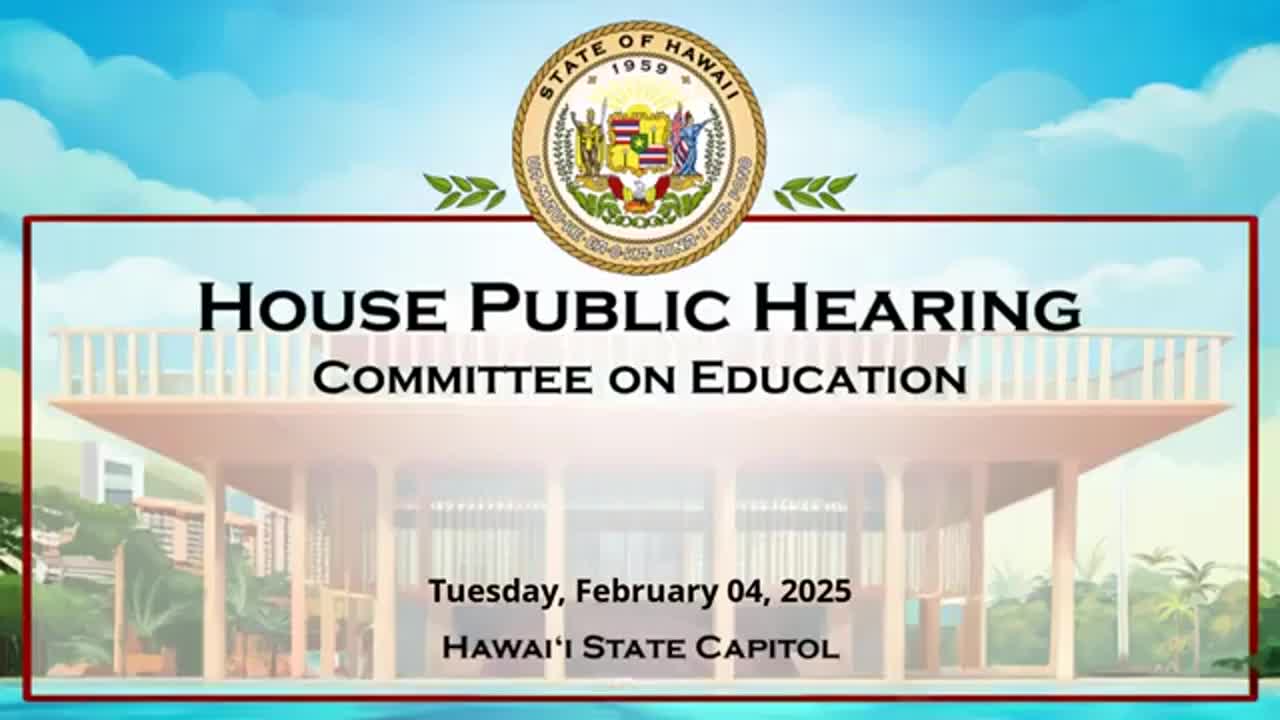 43MIN
House Standing Committee on Education
Bill Author

Bill Co-Author(s):