HB 1376: RELATING TO CORRECTIONAL FACILITIES.
- Session Year: 2025-2026
- House: House
- Latest Version Date: 2025-02-13
Current Status:
Failed
(2025-12-08: Carried over to 2026 Regular Session.)
Introduced
In Committee
First Chamber
In Committee
Second Chamber
Final Decking
Enacted
Requires the Director of Corrections and Rehabilitation to reduce the number of individuals incarcerated in private, out-of-state correctional institutions. Requires reports to the Legislature. Effective July 1, 3000. (HD2)
Requires the Director of Corrections and Rehabilitation to reduce the number of individuals incarcerated in private, out-of-state correctional institutions. Requires reports to the Legislature. Effective July 1, 3000. (HD1)
Requires the State to phase out the use of private correctional facilities to incarcerate Hawaii inmates. Prohibits the construction of new correctional facilities or the expansion of existing correctional facilities without the approval of the Hawaii Correctional System Oversight Commission.
|
HOUSE OF REPRESENTATIVES |
H.B. NO. |
1376 |
|
THIRTY-THIRD LEGISLATURE, 2025 |
H.D. 2 |
|
|
STATE OF HAWAII |
|
|
|
|
|
|
|
|
||
|
|
||
A BILL FOR AN ACT
RELATING TO CORRECTIONAL FACILITIES.
BE IT ENACTED BY THE LEGISLATURE OF THE STATE OF HAWAII:
SECTION 1. Section 353-16.2, Hawaii Revised Statutes, is amended by amending subsection (a) to read as follows:
"(a) The director may effect the transfer of a
committed felon to any correctional institution located in another state
regardless of whether the state is a member of the Western Interstate
Corrections Compact; provided that the institution is in compliance with
appropriate health, safety, and sanitation codes of the state, provides a level
of program activity for the inmate that is suitable, and is operated by that
state, by any of its political subdivisions, or by a private institution; [and]
provided further that the transfer is either:
(1) In the interest of
the security[,] or management of the correctional institution
where the inmate is presently placed, or the reduction of prison overcrowding;
or
(2) In the interest of
the inmate[.];
provided further that beginning on July 1, 2028, the director shall reduce the number of committed felons incarcerated in private, out-of-state correctional institutions by twenty-five per cent; provided further that beginning on July 1, 2030, the director shall reduce the number of committed felons incarcerated in private, out-of-state correctional institutions by fifty per cent.
As used in this section, "private, out-of-state correctional institution" includes any correctional institution outside the State operated for profit or under a public-private partnership."
SECTION 2. The department of corrections and rehabilitation shall submit a report to the legislature no later than twenty days prior to convening of the regular sessions of 2026, 2027, 2028, 2029, 2030, and 2031 on its actions and progress in meeting the reduction in the number of committee felons incarcerated in private, out-of-state correctional institutions as required by this Act.
SECTION 3. Statutory material to be repealed is
bracketed and stricken. New statutory
material is underscored.
SECTION 4. This Act shall take effect on July 1, 3000.
Report Title:
Corrections; Private, Out-of-state Prisons; Reduction; Reports
Description:
Requires the Director of Corrections and Rehabilitation to reduce the number of individuals incarcerated in private, out-of-state correctional institutions. Requires reports to the Legislature. Effective July 1, 3000. (HD2)
The summary description of legislation appearing on this page is for informational purposes only and is not legislation or evidence of legislative intent.
|
HOUSE OF REPRESENTATIVES |
H.B. NO. |
1376 |
|
THIRTY-THIRD LEGISLATURE, 2025 |
H.D. 1 |
|
|
STATE OF HAWAII |
|
|
|
|
|
|
|
|
||
|
|
||
A BILL FOR AN ACT
RELATING TO CORRECTIONAL FACILITIES.
BE IT ENACTED BY THE LEGISLATURE OF THE STATE OF HAWAII:
SECTION 1. Section 353-16.2, Hawaii Revised Statutes, is amended by amending subsection (a) to read as follows:
"(a) The director may effect the transfer of a committed felon to any correctional institution located in another state regardless of whether the state is a member of the Western Interstate Corrections Compact; provided that the institution is in compliance with appropriate health, safety, and sanitation codes of the state, provides a level of program activity for the inmate that is suitable, and is operated by that state, by any of its political subdivisions, or by a private institution; and provided further that the transfer is either:
(1) In the interest of
the security[,] or management of the correctional institution
where the inmate is presently placed, or the reduction of prison overcrowding;
or
(2) In the interest of
the inmate[.];
provided further that beginning on July 1, 2028, the director shall reduce the number of committed felons incarcerated in private, out-of-state correctional institutions by twenty-five per cent. Beginning on July 1, 2030, the director shall reduce the number of committed felons incarcerated in private, out-of-state correctional institutions by fifty per cent.
As used in this section, "private, out-of-state correctional institution" shall include any correctional institution outside the State operated under a public-private partnership."
SECTION 2. The department of corrections and rehabilitation shall submit a report to the legislature no later than twenty days prior to convening of the regular sessions of 2026, 2027, 2028, 2029, 2030, and 2031 on its actions and progress in meeting the reduction in the number of committee felons incarcerated in private, out-of-state correctional institutions as required by this Act.
SECTION 3. Statutory material to be repealed is
bracketed and stricken. New statutory
material is underscored.
SECTION 4. This Act shall take effect on July 1, 3000.
Report Title:
Corrections; Private, Out-of-state Prisons; Reduction; Reports
Description:
Requires the Director of Corrections and Rehabilitation to reduce the number of individuals incarcerated in private, out-of-state correctional institutions. Requires reports to the Legislature. Effective July 1, 3000. (HD1)
The summary description of legislation appearing on this page is for informational purposes only and is not legislation or evidence of legislative intent.
|
HOUSE OF REPRESENTATIVES |
H.B. NO. |
1376 |
|
THIRTY-THIRD LEGISLATURE, 2025 |
|
|
|
STATE OF HAWAII |
|
|
|
|
|
|
|
|
||
|
|
||
A BILL FOR AN ACT
rELATING TO correctional facilities.
BE IT ENACTED BY THE LEGISLATURE OF THE STATE OF HAWAII:
PART I
SECTION 1. The legislature finds that the State has relied on contracted private, for-profit prisons to house a significant portion of the State's prison population for more than two decades. Unfortunately, the inmates who serve their sentences in these out-of-state facilities are effectively exiled thousands of miles away from their families, friends, and crucial support networks. The effects of this isolation are felt disproportionately by the Native Hawaiian inmates, who are significantly more likely to be transferred to out-of-state prisons than inmates of other ethnicities.
More specifically, a 2010 report by the office of Hawaiian affairs, entitled "The Disparate Treatment of Native Hawaiians in the Criminal Justice System", found that out-of-state incarceration results in significant trauma to prisoners and their families. In collecting data and testimony for the report, the office of Hawaiian affairs found that incarceration outside of the State often resulted in families being torn apart. For example, one former inmate stated that he "lost [his] family--wife and kids" when he was forced to serve five years of his sentence on the mainland. Other individuals involved in the criminal justice system described how they witnessed inmates react emotionally when they realized that they would be moved thousands of miles away from their families without being able to tell them goodbye. The report also found that when the inmates returned to the State, they were more likely to encounter difficulties when reentering society due to the lack of adequate reentry programs at the out-of-state prisons and the long length of time that they spent away from their support networks and Hawaii culture.
The legislature also finds that the adverse effects of incarcerating inmates outside the State were recognized by the legislature and the former department of public safety even before the State began the practice of contracting with private mainland prisons. During the regular session of 1994, when the legislature was first considering whether to authorize the use of private, out-of-state correctional facilities to alleviate prison overcrowding, standing committees in both the senate and house of representatives expressed concerns about inmates being transferred away from their support networks and the impact this would have on their rehabilitation. Committees in both chambers expressed a clear intent that inmates with strong ties to Hawaii should not be transferred outside of the State. In 1994, the senate committee on judiciary stated in standing committee report no. 1902:
"Many inmates currently incarcerated in Hawaii's prisons have lived their entire lives in Hawaii. These inmates have no support systems in localities other than Hawaii.
Accordingly, on the basis of the representations made by . . . the director of public safety, priority for transfers should be given first to non-Hawaii resident inmates, then to those inmates who have lived in our State for five years or less, and only thereafter will those with strong roots in Hawaii be considered for transfer."
Similarly, in 1994, the committee on public safety and corrections of the house of representatives stated the following in standing committee report no. 975-94:
"[T]he public defender raised concerns that inmates with a local support system would be transferred to other states against their will.
An enormous factor in an inmate's rehabilitation is the inmate's ability to receive visits or phone calls from friends and relatives. It appears that visits or phone calls to an inmate would be greatly reduced, it not eliminated, if an inmate with a local support system is transferred to a mainland correctional center.
In light of this, it is in the intent of your Committee that any inmate having a strong, nurturing support system in Hawaii that contributes to the inmate's rehabilitation shall not be considered for interstate transfer."
Accordingly, the legislature finds that when it enacted Act 208, Session Laws of Hawaii 1994 (Act 208), which authorized the transfer of inmates to privately operated correctional facilities outside of the State, it did so with the clear intent that the former department of public safety would not transfer individuals with strong community ties. The legislature also finds that this clear intent has largely been ignored over the last few decades. The legislature further recognizes that fears regarding the significant detrimental impact that interstate transfers would have on inmates have turned out to be true. Furthermore, the problem of prison overcrowding continues to persist even though Act 208 was enacted specifically to alleviate this issue. Moreover, larger problems with the use of mass incarceration have increased since Act 208 was enacted. Thus, the legislature believes that the State must phase out the practice of transferring inmates to privately operated mainland correctional facilities.
The legislature notes that the State had the authority to transfer certain inmates to publicly operated correctional facilities, such as prisons owned and operated directly by the federal government or a state, prior to the passage of Act 208. The State will retain that authority under this Act.
The legislature also finds that the department of corrections and rehabilitation is currently planning for the construction of a new jail to replace the existing Oahu community correctional center in Kalihi. In 2018, the governor announced the selection of the Halawa animal quarantine facility site as the location for the new jail. The new facility would cost $525,000,000, and the State planned to fund the facility using either general obligation bond proceeds or through a public-private partnership, in which the State would engage with a private party to develop and operate the jail. However, the legislature takes notice of the adverse effects of using private correctional facilities, including a lack of oversight and accountability and recurring violations of inmates' constitutional rights. Therefore, the legislature does not believe it would be prudent to move forward with the construction of a new, privately operated jail within the State.
The legislature further finds that Act 179, Session Laws of Hawaii 2019, established the Hawaii correctional system oversight commission to ensure transparency in the State's correctional system; support safe conditions for employees, inmates, and detainees; and provide positive reform towards a rehabilitative and therapeutic correctional system. The commission is responsible for overseeing the State's correctional system, establishing maximum inmate population limits for each correctional facility, and monitoring crucial reentry programs, facility educational and treatment programs, rehabilitative services, work furloughs, and parole services. Since its inception, the commission has played a leading role in addressing the COVID-19 response in the State's correctional system despite being unable to hire any staff or access any of its appropriated funding.
The Hawaii correctional system oversight commission has previously expressed concerns that the department of corrections and rehabilitation's process to construct a new jail on Oahu was flawed. Despite the project's large costs, plans have been developed without meaningful input or guidance from the community, and the facility planners have failed to identify factors driving the State's jail population. The commission concluded that the State should reassess the required capacity of the new jail, noting that many of the assumptions made at the time the facility's environmental impact statement was written have changed.
In the face of the COVID-19 pandemic, the State markedly reduced the inmate population at the Oahu community correctional center to reduce chronic overcrowding. As a result, the population at the Oahu community correctional center was reduced from over one thousand inmates to less than eight hundred inmates. A study conducted by the Lawyers for Equal Justice determined that the vast majority of inmates released did not reoffend and most of those who did reoffend had been arrested for "poverty related offenses", such as those related to homelessness, including entering a closed public park or obstructing a public sidewalk.
These population reduction efforts, as well as future moves toward pretrial reform and sentencing reform, would alter the requirements of any new correctional center in the State. Accordingly, the commission recommended that planning for the new jail be paused so that additional review and crucial planning may be conducted. The legislature believes that it is crucial that the Hawaii correctional system oversight commission be included in this review and planning. In addition, as the State phases out the use of private correctional facilities, the commission's crucial role in establishing important corrections policies and providing crucial oversight will become even more important. Therefore, to ensure the State has a coordinated approach to the management of the State's correctional facilities as it brings prisoners formerly incarcerated in private, out-of-state correctional facilities back to Hawaii, the legislature believes that the commission must be included in the planning and design of any new correctional facility or the expansion of any existing correctional facility in the State.
Therefore, the purpose of this Act is to require:
(1) The State to phase out the use of private prisons; and
(2) The department of corrections and rehabilitation to obtain the Hawaii correctional system oversight commission's approval before constructing any new correctional facility or expanding any existing correctional facility.
PART II
SECTION 2. Chapter 353, Hawaii Revised Statutes, is amended by adding a new section to part I to be appropriately designated and to read as follows:
"§353- Use of private correctional institutions prohibited. (a) Beginning on July 1, 2030, the State shall not commit, transfer, or house any inmate at a private correctional institution.
(b) This section shall not be construed to prohibit the State from contracting with or housing an inmate at:
(1) Any facility providing rehabilitative, counseling, treatment, mental health, educational, or medical services to a minor who is under the jurisdiction of the family court;
(2) Any facility providing evaluation or treatment services to a person who has been detained or is subject to an order of commitment by a court;
(3) Any facility providing educational, vocational, medical, or other ancillary services to an inmate in the custody of, and under the direct supervision of, the State or any of its political subdivisions;
(4) A residential care facility licensed by the department of health or department of human services;
(5) Any school facility used for the disciplinary detention of a pupil;
(6) Any facility used for the quarantine or isolation of persons for public health reasons; or
(7) Any facility used for the temporary detention of a person detained or arrested by a merchant, private investigator or guard, or other person pursuant to section 803-3.
(c) As used in this section, "private correctional institution" includes any facility:
(1) Owned by the State and operated by a non-governmental entity; or
(2) Operated under a public-private partnership."
SECTION 3. Section 353-16.2, Hawaii Revised Statutes, is amended by amending subsection (a) to read as follows:
"(a) The director may effect the transfer of a committed felon to any correctional institution located in another state regardless of whether the state is a member of the Western Interstate Corrections Compact; provided that the institution is in compliance with appropriate health, safety, and sanitation codes of the state, provides a level of program activity for the inmate that is suitable, and is operated by that state, by any of its political subdivisions, or by a private institution; and provided further that the transfer is either:
(1) In the interest of
the security[,] or management of the correctional institution
where the inmate is presently placed, or the reduction of prison overcrowding;
or
(2) In the interest of
the inmate[.];
provided further that beginning on July 1, 2026, the director shall commence reducing the number of committed felons incarcerated in private correctional institutions. Beginning on June 30, 2030, no inmate shall be committed or transferred to any private correctional institution. As used in this section, "private correctional institution" shall include any correctional institution operated under a public-private partnership."
SECTION 4. Section 353-16.3, Hawaii Revised Statutes, is amended to read as follows:
"§353-16.3 Development of
out-of-state Hawaii correctional facilities. Notwithstanding any other provision to the
contrary, the governor, with the assistance of the director, may negotiate with
any appropriate out-of-state jurisdiction for the development of Hawaii
correctional facilities to reduce prison overcrowding; provided that any
agreement negotiated pursuant to this section shall be subject to legislative
approval by concurrent resolution in any regular or special session[.];
provided further that the authority to negotiate and execute an agreement under
this section shall expire on June 30, 2030."
PART III
SECTION 5. Chapter 353, Hawaii Revised Statutes, is amended by adding a new section to part I to be appropriately designated and to read as follows:
"§353- Construction and development of new correctional facilities; approval of Hawaii correctional system oversight commission required. (a) No new correctional facility shall be constructed and no existing correctional facility shall be expanded unless the construction or expansion is first approved by the Hawaii correctional system oversight commission.
(b) To facilitate the approval or disapproval of a proposed new or expanded correctional facility as provided in subsection (a), the department shall submit the following information to the Hawaii correctional system oversight commission upon the commission's request:
(1) The proposed maximum inmate population of the facility;
(2) Any programs proposed for the facility, including reentry programs, facility educational and treatment programs, rehabilitative services, work furloughs, and parole services; and
(3) Any other relevant information required by the commission as established by rules adopted pursuant to chapter 91."
SECTION 6. Section 353L-3, Hawaii Revised Statutes, is amended by amending subsection (b) to read as follows:
"(b) The commission shall:
(1) Oversee the State's correctional system and have jurisdiction over investigating complaints at correctional facilities and facilitating a correctional system transition to a rehabilitative and therapeutic model;
(2) Establish maximum inmate population limits for each correctional facility and formulate policies and procedures to prevent the inmate population from exceeding the capacity of each correctional facility;
(3) Consult with the department of corrections and rehabilitation on the planning of any new or expanded correctional facility in the State, and approve or disapprove those plans before the correctional facility is constructed or expanded, as provided in section 353- ;
[(3)] (4) Work
with the department of corrections and rehabilitation in monitoring and
reviewing the comprehensive offender reentry program, including facility
educational and treatment programs, rehabilitative services, work furloughs,
and the Hawaii paroling authority's oversight of parolees. The commission may make recommendations to
the department of corrections and rehabilitation, the Hawaii paroling
authority, and the legislature regarding reentry and parole services; and
[(4)] (5)
Ensure that the comprehensive offender reentry system under chapter 353H
is working properly to provide programs and services that result in the timely
release of inmates on parole when the minimum terms have been served instead of
delaying the release for lack of programs and services.
To achieve these ends, the commission shall authorize the oversight coordinator to adopt rules in accordance with chapter 91."
PART IV
SECTION 7. Statutory material to be repealed is bracketed and stricken. New statutory material is underscored.
SECTION 8. This Act shall take effect upon its approval.
|
INTRODUCED BY: |
_____________________________ |
|
|
|
Report Title:
Corrections; Private Prisons; Phase-out; Hawaii Correctional System Oversight Commission
Description:
Requires the State to phase out the use of private correctional facilities to incarcerate Hawaii inmates. Prohibits the construction of new correctional facilities or the expansion of existing correctional facilities without the approval of the Hawaii Correctional System Oversight Commission.
The summary description of legislation appearing on this page is for informational purposes only and is not legislation or evidence of legislative intent.
|
Date
|
Status
|
|---|---|
| Dec 8, 2025 | Carried over to 2026 Regular Session. |
| Feb 14, 2025 | Report adopted; referred to the committee(s) on FIN as amended in HD 2 with Representative(s) Matsumoto, Reyes Oda voting aye with reservations; Representative(s) Alcos, Garcia, Muraoka, Pierick, Shimizu voting no (5) and Representative(s) Cochran, Matayoshi, Poepoe, Ward excused (4). |
| Feb 14, 2025 | Reported from JHA (Stand. Com. Rep. No. 790) as amended in HD 2, recommending referral to FIN. |
| Feb 13, 2025 | The committee on JHA recommend that the measure be PASSED, WITH AMENDMENTS. The votes were as follows: 9 Ayes: Representative(s) Tarnas, Poepoe, Belatti, Hashem, Kahaloa, Perruso, Takayama, Todd; Ayes with reservations: Representative(s) Shimizu; 1 Noes: Representative(s) Garcia; and 1 Excused: Representative(s) Cochran. |
| Feb 10, 2025 | Bill scheduled to be heard by JHA on Thursday, 02-13-25 2:00PM in House conference room 325 VIA VIDEOCONFERENCE. |
| Feb 6, 2025 | Passed Second Reading as amended in HD 1 and referred to the committee(s) on JHA with none voting aye with reservations; Representative(s) Garcia, Muraoka, Pierick voting no (3) and Representative(s) Ward excused (1). |
| Feb 6, 2025 | Reported from PBS (Stand. Com. Rep. No. 242) as amended in HD 1, recommending passage on Second Reading and referral to JHA. |
| Feb 5, 2025 | The committee on PBS recommend that the measure be PASSED, WITH AMENDMENTS. The votes were as follows: 7 Ayes: Representative(s) Belatti, Iwamoto, Hashem, Lamosao, Poepoe, Shimizu, Souza; Ayes with reservations: none; 0 Noes: none; and 3 Excused: Representative(s) Ichiyama, Morikawa, Woodson. |
| Feb 3, 2025 | Bill scheduled to be heard by PBS on Wednesday, 02-05-25 8:30AM in House conference room 411 VIA VIDEOCONFERENCE. |
| Jan 27, 2025 | Referred to PBS, JHA, FIN, referral sheet 4 |
| Jan 23, 2025 | Introduced and Pass First Reading. |
| May 23, 2025 | Introduced and Pass First Reading. |
|
Date
|
Description
|
Location
|
Votes
|
|
|---|---|---|---|---|
| Feb 13, 2025 | The committee on JHA recommend that the measure be PASSED, WITH AMENDMENTS | House Standing Committee on Judiciary & Hawaiian Affairs |
Passed |
|
| Feb 5, 2025 | The committee on PBS recommend that the measure be PASSED, WITH AMENDMENTS | House Standing Committee on Public Safety |
Passed |
This list shows positions taken on this bill by organizations on the date displayed, which is linked to the original source.
Positions by individuals are not included.
|
Organization
|
Position
|
Date
|
|---|---|---|
| ACLU of Hawaiʻi | ** Support | |
| ACLU of Hawai‘i | *** Support | Feb 13, 2025 |
| Community Alliance on Prisons | *** Support | Feb 13, 2025 |
| Community Alliance on Prisons | ** Support | |
| Department of Corrections and Rehabilitation | *** Against | Feb 13, 2025 |
| Hawaiʻi Friends of Restorative Justice | ** Support | |
| Hawai‘i Friends of Restorative Justice | *** Support | Feb 13, 2025 |
| Imua Alliance | *** Support | Feb 13, 2025 |
| Imua Alliance | ** Support | |
| Ka Lāhui Hawaiʻi | *** Support | Feb 5, 2025 |
| Office of the Public Defender | *** Support | Feb 13, 2025 |
| Office of the Public Defender | ** Support |
STAND. COM. REP. NO. 790
Honolulu, Hawaii
, 2025
RE: H.B. No. 1376
H.D. 2
Honorable Nadine K. Nakamura
Speaker, House of Representatives
Thirty-Third State Legislature
Regular Session of 2025
State of Hawaii
Madame:
Your Committee on Judiciary & Hawaiian Affairs, to which was referred H.B. No. 1376, H.D. 1, entitled:
"A BILL FOR AN ACT RELATING TO CORRECTIONAL FACILITIES,"
begs leave to report as follows:
The purpose of this measure is to require the Director of Corrections and Rehabilitation to:
(1) Beginning July 1, 2028, reduce the number of committed felons incarcerated at private, out-of-state correctional institutions by twenty-five percent;
(2) Beginning July 1, 2030, reduce the number of committed felons incarcerated at private, out-of-state correctional institutions by fifty percent; and
(3) Submit annual reports to the Legislature on its actions and progress to meet the requirements of this measure.
Your Committee received testimony in support of this measure from the Office of the Public Defender; ACLU of Hawaiʻi; Imua Alliance; Community Alliance on Prisons; Hawaiʻi Friends of Restorative Justice; and three individuals. Your Committee received testimony in opposition to this measure from the Department of Corrections and Rehabilitation.
Your Committee finds that the gradual reduction of reliance on private, out-of-state prisons will increase accountability, provide greater control over correctional practices, and keep inmates close their families and communities, which will improve their post-release outcomes.
Your Committee has amended this measure by:
(1) Clarifying that the term "private, out-of-state correctional institutions" includes correctional institutions outside the State operated for profit; and
(2) Making technical, nonsubstantive amendments for the purposes of clarity, consistency, and style.
As affirmed by the record of votes of the members of your Committee on Judiciary & Hawaiian Affairs that is attached to this report, your Committee is in accord with the intent and purpose of H.B. No. 1376, H.D. 1, as amended herein, and recommends that it be referred to your Committee on Finance in the form attached hereto as H.B. No. 1376, H.D. 2.
Respectfully submitted on behalf of the members of the Committee on Judiciary & Hawaiian Affairs,
|
|
|
____________________________ DAVID A. TARNAS, Chair |
|
|
|
|
STAND. COM. REP. NO. 242
Honolulu, Hawaii
, 2025
RE: H.B. No. 1376
H.D. 1
Honorable Nadine K. Nakamura
Speaker, House of Representatives
Thirty-Third State Legislature
Regular Session of 2025
State of Hawaii
Madame:
Your Committee on Public Safety, to which was referred H.B. No. 1376 entitled:
"A BILL FOR AN ACT RELATING TO CORRECTIONAL FACILITIES,"
begs leave to report as follows:
The purpose of this measure is to:
(1) Require the State to phase out the use of private correctional facilities to incarcerate Hawaii inmates; and
(2) Prohibit the construction of new correctional facilities or the expansion of existing correctional facilities without the approval of the Hawaii Correctional System Oversight Commission.
Your Committee received testimony in support of this measure from ACLU Hawaiʻi; Imua Alliance; and two individuals. Your Committee received testimony in opposition to the measure from the Department of Corrections and Rehabilitation. Your Committee received comments on this measure from the Department of the Attorney General.
Your Committee finds that the State has relied on private, out-of-state prisons to house a significant number of the State's incarcerated individuals for more than two decades. These individuals are serving their sentences away from family, friends, and their support systems. Your Committee further finds that the State is currently planning for the construction of a new correctional facility. This new facility, along with a shift to focusing on diversion, should allow the Department of Corrections and Rehabilitation to reduce the number of inmates at out-of-state prisons.
Your Committee has amended this measure by:
(1) Deleting its preamble;
(2) Deleting language that would have prohibited the State from committing, transferring, or housing any inmate at a private correctional facility beginning on July 1, 2030;
(3) Adding language to require that:
(A) Beginning July 1, 2028, the Director of Corrections and Rehabilitation (Director) reduce the number of committed felons incarcerated at private, out-of-state correctional institutions by twenty-five percent; and
(B) Beginning July 1, 2030, the Director reduce the number of committed felons incarcerated at private, out-of-state correctional institutions by fifty percent;
(4) Requiring the Department of Rehabilitation and Corrections to report to the Legislature on its actions and progress in meeting the requirements of paragraph (2);
(5) Deleting language that would have prohibited the construction of new correctional facilities or the expansion of existing correctional facilities without the approval of the Hawaii Correctional System Oversight Commission;
(6) Changing the effective date to July, 1, 3000, to encourage further discussion; and
(7) Making technical, nonsubstantive amendments for the purposes of clarity, consistency, and style.
As affirmed by the record of votes of the members of your Committee on Public Safety that is attached to this report, your Committee is in accord with the intent and purpose of H.B. No. 1376, as amended herein, and recommends that it pass Second Reading in the form attached hereto as H.B. No. 1376, H.D. 1, and be referred to your Committee on Judiciary & Hawaiian Affairs.
Respectfully submitted on behalf of the members of the Committee on Public Safety,
|
|
|
____________________________ DELLA AU BELATTI, Chair |
|
|
|
|
|
Date
|
Testimony PDF
|
|---|---|
| Feb 13, 2025 | HB1376_HD1_TESTIMONY_JHA_02-13-25_.PDF |
| Feb 5, 2025 | HB1376_TESTIMONY_PBS_02-05-25_.PDF |
Discussed in Hearing
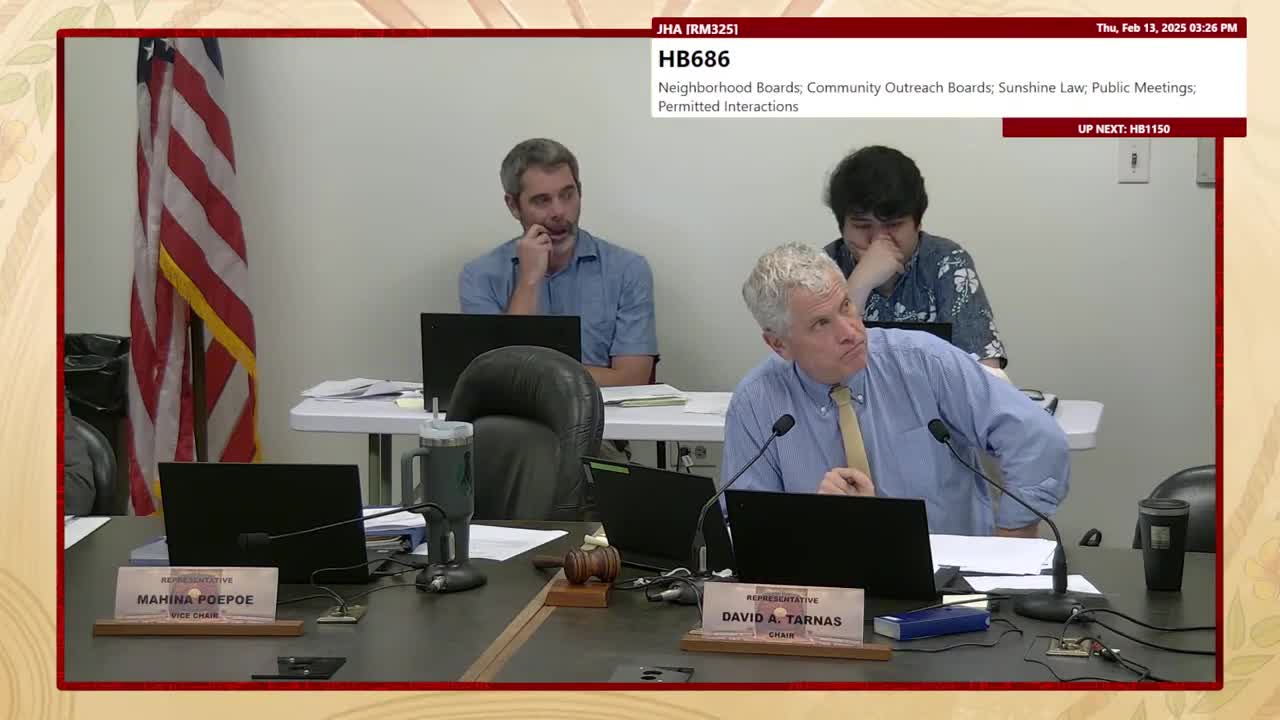 25MIN
House Standing Committee on Judiciary & Hawaiian Affairs
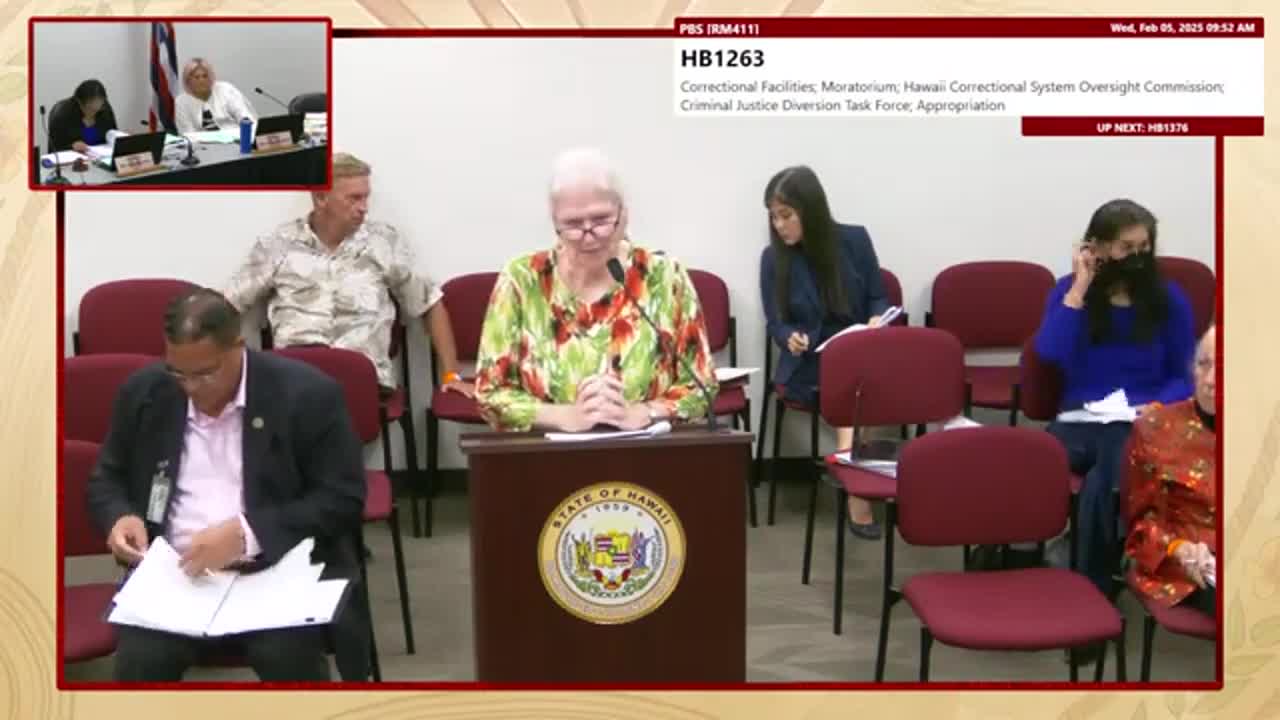 21MIN
House Standing Committee on Public Safety
Bill Author