HB 366: RELATING TO RENEWABLE ENERGY.
- Session Year: 2025-2026
- House: House
- Latest Version Date: 2025-02-03
Current Status:
Failed
(2025-12-08: Carried over to 2026 Regular Session.)
Introduced
In Committee
First Chamber
In Committee
Second Chamber
Final Decking
Enacted
Requires contested cases, environmental assessment cases, or environmental impact statement cases involving renewable energy projects over twenty megawatts in size, except cases that involve any form of incineration, to be appealed from an agency's decision directly to the Hawaii Supreme Court for final decision. Requires the cases to be prioritized and decided expeditiously. Effective 7/1/3000. (HD1)
Requires contested cases, environmental assessment cases, or environmental impact statement cases involving renewable energy projects over twenty megawatts in size, except cases that involve any form of incineration, to be appealed from an agency's decision directly to the Hawaii Supreme Court for final decision. Requires the cases to be prioritized and decided expeditiously.
|
HOUSE OF REPRESENTATIVES |
H.B. NO. |
366 |
|
THIRTY-THIRD LEGISLATURE, 2025 |
H.D. 1 |
|
|
STATE OF HAWAII |
|
|
|
|
|
|
|
|
||
|
|
||
A BILL FOR AN ACT
RELATING TO RENEWABLE ENERGY.
BE IT ENACTED BY THE LEGISLATURE OF THE STATE OF HAWAII:
SECTION 1. The legislature finds that in order to achieve the State's goal of one hundred per cent renewable energy by the year 2045, there is a need to support the efficient permitting of renewable energy projects. Due to the urgency of climate change, it is necessary that the State facilitates a swift transition to clean energy and supports innovative projects that seek to reduce the State's climate impact. As a global leader in clean energy, the State can support such projects by expediting the arduous permitting process for projects that align with its clean energy goal.
The purpose of this Act is to require contested cases, environmental assessment cases, or environmental impact statement cases involving renewable energy projects over twenty megawatts in size, except cases involving incineration, to be appealed from an agency's decision directly to the Hawaii supreme court for final decision and to be prioritized and decided expeditiously.
SECTION 2. Section 91-14, Hawaii Revised Statutes, is amended to read as follows:
"§91-14 Judicial review of
contested cases. (a) Any person aggrieved by a final decision and
order in a contested case or by a preliminary ruling of the nature that
deferral of review pending entry of a subsequent final decision would deprive
appellant of adequate relief [is] shall be entitled to judicial
review thereof under this chapter; [but] provided that nothing in
this section shall be deemed to prevent resort to other means of review,
redress, relief, or trial de novo, including the right of trial by jury,
provided by law. [Notwithstanding any
other provision of this chapter to the contrary, for the purposes of this
section, the term "person aggrieved" shall include an agency that is
a party to a contested case proceeding before that agency or another agency.]
(b)
Except as otherwise provided herein, proceedings for review shall be
instituted in the circuit court or, if applicable, the environmental court[,]
within thirty days after the preliminary ruling or within thirty days after
service of the certified copy of the final decision and order of the agency
pursuant to rule of court, except where a statute provides for a direct appeal
to the supreme court or the intermediate appellate court, subject to chapter
602. In [such] those
cases, the appeal shall be treated in the same manner as an appeal from the
circuit court to the supreme court or the intermediate appellate court,
including payment of the fee prescribed by section 607-5 for filing the notice
of appeal (except in cases appealed under sections 11-51 and 40-91). The court in its discretion may permit other
interested persons to intervene.
(c)
The proceedings for review shall not stay enforcement of the agency
decisions or the confirmation of any fine as a judgment pursuant to section
92-17(g); [but] provided that the reviewing court may order a
stay if the following criteria have been met:
(1) There is a likelihood that the subject person will prevail on the merits of an appeal from the administrative proceeding to the court;
(2) Irreparable damage to the subject person will result if a stay is not ordered;
(3) No irreparable damage to the public will result from the stay order; and
(4) Public interest will be served by the stay order.
(d)
Within twenty days after the determination of the contents of the record
on appeal in the manner provided by the rules of court, or within [such]
a further time as the court may allow, the agency shall transmit to the
reviewing court the record of the proceeding under review. The court may require or permit subsequent
corrections or additions to the record when deemed desirable.
(e)
If, before the date set for the hearing, application is made to
the court for leave to present additional evidence material to the issue in the
case, and it is shown to the satisfaction of the court that the additional
evidence is material and that there were good reasons for failure to present it
in the proceeding before the agency, the court may order that the additional
evidence be taken before the agency upon [such] conditions [as] that
the court deems proper. The agency may
modify its findings, decision, and order by reason of the additional evidence
and shall file with the reviewing court, to become a part of the record, the
additional evidence, together with any modifications or new findings [or],
decision[.], or order.
(f)
The review shall be conducted by the appropriate court without a jury
and shall be confined to the record[, except]; provided that in [the]
cases where a trial de novo, including trial by jury, is provided by law [and
also in] or cases of alleged irregularities in procedure before the
agency not shown in the record, testimony thereon may be taken in court. The court, upon request by any party, shall
receive written briefs and, at the court's discretion, may hear oral arguments.
(g) Upon review of the record, the court may affirm the decision of the agency or remand the case with instructions for further proceedings; or it may reverse or modify the decision and order if the substantial rights of the petitioners may have been prejudiced because the administrative findings, conclusions, decisions, or orders are:
(1) In violation of constitutional or statutory provisions;
(2) In excess of the statutory authority or jurisdiction of the agency;
(3) Made upon unlawful procedure;
(4) Affected by other error of law;
(5) Clearly erroneous in view of the reliable, probative, and substantial evidence on the whole record; or
(6) Arbitrary, [or]
capricious, or characterized by abuse of discretion or clearly unwarranted
exercise of discretion.
(h) Upon a trial de novo, including a trial by jury as provided by law, the court shall transmit to the agency its decision and order with instructions to comply with the order.
(i) Where a court remands a matter to an agency for the purpose of conducting a contested case hearing, the court may reserve jurisdiction and appoint a master or monitor to ensure compliance with its orders.
(j) The court shall give priority to contested case appeals of significant statewide importance over all other civil or administrative appeals or matters and shall decide these appeals as expeditiously as possible.
(k) Notwithstanding this chapter or any other law to the contrary, any contested case under this chapter that involves renewable energy projects over twenty megawatts in size, except cases that involve any form of incineration, shall be appealed from a final decision and order or a preliminary ruling that is of the nature defined by subsection (a) upon the record directly to the supreme court for final decision. Only a person aggrieved in a contested case proceeding provided for in this chapter may appeal from the final decision and order or preliminary ruling. The court shall give priority to these cases over all other civil or administrative appeals or matters and shall decide these appeals as expeditiously as possible.
(l) Notwithstanding any other provision of this chapter to the contrary, for the purposes of this section, the term "person aggrieved" includes an agency that is a party to a contested case proceeding before that agency or another agency."
SECTION 3. Section 343-7, Hawaii Revised Statutes, is amended to read as follows:
"§343-7 [Limitation]
Judicial review; limitation of actions[.]; jurisdiction. (a)
Any judicial proceeding, the subject of which is the lack of assessment
required under section 343-5, shall be initiated within one hundred twenty days
of the agency's decision to carry out or approve the action, or, if a proposed
action is undertaken without a formal determination by the agency that a
statement is or is not required, a judicial proceeding shall be instituted
within one hundred twenty days after the proposed action is started. The office, any agency responsible for
approval of the action, or the applicant shall be adjudged an aggrieved party
for the purposes of bringing judicial action under this subsection. Others, by environmental court action, may be
adjudged aggrieved.
(b) Any judicial proceeding, the subject
of which is the determination that a statement is required for a proposed
action, shall be initiated within sixty days after the public has been informed
of [such] the determination pursuant to section 343-3. Any judicial proceeding, the subject of which
is the determination that a statement is not required for a proposed action,
shall be initiated within thirty days after the public has been informed of [such]
the determination pursuant to section 343-3. The applicant shall be adjudged an aggrieved
party for the purposes of bringing judicial action under this subsection. Others, by environmental court action, may be
adjudged aggrieved.
(c)
Any judicial proceeding, the subject of which is the acceptance or
nonacceptance of an environmental impact statement required under section
343-5, shall be initiated within sixty days after the public has been informed
pursuant to section 343-3 of the acceptance or nonacceptance of [such] the
statement. Affected agencies and persons
who provided written comment to an accepted statement during the designated
review period shall be adjudged aggrieved parties for the purpose of bringing
judicial action under this subsection; provided that for aggrieved parties, the
contestable issues shall be limited to issues identified and discussed in the
written comment, and for applicants bringing judicial action under this section
on the nonacceptance of a statement, the contestable issues shall be limited to
those issues identified by the accepting authority as the basis for
nonacceptance of the statement.
(1) Determination that an environmental impact statement is required for a proposed action;
(2) Acceptance or nonacceptance of an environmental impact statement; or
(3) Determination of a finding of no significant impact for an environmental assessment,
directly to the supreme court for final decision. Only a person aggrieved in the case may appeal the agency's decision, determination, acceptance, or nonacceptance. The court shall give priority to these cases over all other civil or administrative appeals or matters and shall decide these appeals as expeditiously as possible. For the purposes of this subsection, "person" includes an agency."
SECTION 4. Section 604A-2, Hawaii Revised Statutes, is amended by amending subsection (a) to read as follows:
"(a) [The] Except as otherwise provided
in section 91‑14(k) or 343‑7(d), the environmental courts shall
have exclusive, original jurisdiction over all proceedings, including judicial
review of administrative proceedings and proceedings for declaratory judgment
on the validity of agency rules authorized under chapter 91, arising under
chapters 6D, 6E, 6K, 128D, 339, 339D, 340A, 340E, 342B, 342C, 342D, 342E, 342F,
342G, 342H, 342I, 342J, 342L, 342P, 343, and 508C, and title 12; provided that:
(1) The environmental courts shall not have exclusive, original jurisdiction over any proceedings relating to any motor vehicle, motorcycle, motor scooter, or moped parking violations adopted under agency rules pursuant to chapter 91 and authorized under chapters 6D, 6E, 6K, 128D, 339, 339D, 340A, 340E, 342B, 342C, 342D, 342E, 342F, 342G, 342H, 342I, 342J, 342L, 342P, 343, and 508C, and title 12; and
(2) Upon the motion of a party or sua sponte by the chief justice, the chief justice may assign to the environmental courts issues before the courts when the chief justice determines that due to their subject matter the assignment is required to ensure the uniform application of environmental laws throughout the State or to otherwise effectuate the purpose of this chapter."
SECTION 5. Statutory material to be repealed is bracketed and stricken. New statutory material is underscored.
SECTION 6. This Act shall take effect on July 1, 3000.
Report Title:
Supreme Court; Jurisdiction; Environmental Assessments; Environmental Impact Statements; Renewable Energy Projects
Description:
Requires contested cases, environmental assessment cases, or environmental impact statement cases involving renewable energy projects over twenty megawatts in size, except cases that involve any form of incineration, to be appealed from an agency's decision directly to the Hawaii Supreme Court for final decision. Requires the cases to be prioritized and decided expeditiously. Effective 7/1/3000. (HD1)
The summary description of legislation appearing on this page is for informational purposes only and is not legislation or evidence of legislative intent.
|
HOUSE OF REPRESENTATIVES |
H.B. NO. |
366 |
|
THIRTY-THIRD LEGISLATURE, 2025 |
|
|
|
STATE OF HAWAII |
|
|
|
|
|
|
|
|
||
|
|
||
A BILL FOR AN ACT
relating to renewable ENERGY.
BE IT ENACTED BY THE LEGISLATURE OF THE STATE OF HAWAII:
SECTION 1. The legislature finds that in order to achieve the State's goal of one hundred per cent renewable energy by the year 2045, there is a need to support the efficient permitting of renewable energy projects. Due to the urgency of climate change, it is necessary that the State facilitates a swift transition to clean energy and supports innovative projects that seek to reduce the State's climate impact. As a global leader in clean energy, the State can support such projects by expediting the arduous permitting process for projects that align with its clean energy goal.
The purpose of this Act is to:
(1) Require contested cases, environmental assessment cases, or environmental impact statement cases involving renewable energy projects over twenty megawatts in size, except cases involving incineration, to be appealed from an agency's decision directly to the Hawaii supreme court for final decision; and
(2) Require the cases to be prioritized and decided expeditiously.
SECTION 2. Section 91-14, Hawaii Revised Statutes, is amended to read as follows:
"§91-14 Judicial review of
contested cases. (a) Any person aggrieved by a final decision and
order in a contested case or by a preliminary ruling of the nature that
deferral of review pending entry of a subsequent final decision would deprive
appellant of adequate relief [is] shall be entitled to judicial
review thereof under this chapter; [but] provided that nothing in
this section shall be deemed to prevent resort to other means of review,
redress, relief, or trial de novo, including the right of trial by jury,
provided by law. [Notwithstanding any
other provision of this chapter to the contrary, for the purposes of this
section, the term "person aggrieved" shall include an agency that is
a party to a contested case proceeding before that agency or another agency.]
(b)
Except as otherwise provided herein, proceedings for review shall be
instituted in the circuit court or, if applicable, the environmental court[,]
within thirty days after the preliminary ruling or within thirty days after
service of the certified copy of the final decision and order of the agency
pursuant to rule of court, except where a statute provides for a direct appeal
to the supreme court or the intermediate appellate court, subject to chapter
602. In [such] those
cases, the appeal shall be treated in the same manner as an appeal from the
circuit court to the supreme court or the intermediate appellate court,
including payment of the fee prescribed by section 607-5 for filing the notice
of appeal (except in cases appealed under sections 11-51 and 40-91). The court in its discretion may permit other
interested persons to intervene.
(c)
The proceedings for review shall not stay enforcement of the agency
decisions or the confirmation of any fine as a judgment pursuant to section
92-17(g); [but] provided that the reviewing court may order a
stay if the following criteria have been met:
(1) There is a likelihood that the subject person will prevail on the merits of an appeal from the administrative proceeding to the court;
(2) Irreparable damage to the subject person will result if a stay is not ordered;
(3) No irreparable damage to the public will result from the stay order; and
(4) Public interest will be served by the stay order.
(d)
Within twenty days after the determination of the contents of the record
on appeal in the manner provided by the rules of court, or within [such]
a further time as the court may allow, the agency shall transmit to the
reviewing court the record of the proceeding under review. The court may require or permit subsequent
corrections or additions to the record when deemed desirable.
(e)
If, before the date set for the hearing, application is made to
the court for leave to present additional evidence material to the issue in the
case, and it is shown to the satisfaction of the court that the additional
evidence is material and that there were good reasons for failure to present it
in the proceeding before the agency, the court may order that the additional
evidence be taken before the agency upon [such] conditions [as] that
the court deems proper. The agency may
modify its findings, decision, and order by reason of the additional evidence
and shall file with the reviewing court, to become a part of the record, the
additional evidence, together with any modifications or new findings [or],
decision[.], or order.
(f)
The review shall be conducted by the appropriate court without a jury
and shall be confined to the record[, except]; provided that in [the]
cases where a trial de novo, including trial by jury, is provided by law [and
also in] or cases of alleged irregularities in procedure before the
agency not shown in the record, testimony thereon may be taken in court. The court, upon request by any party, shall
receive written briefs and, at the court's discretion, may hear oral arguments.
(g) Upon review of the record, the court may affirm the decision of the agency or remand the case with instructions for further proceedings; or it may reverse or modify the decision and order if the substantial rights of the petitioners may have been prejudiced because the administrative findings, conclusions, decisions, or orders are:
(1) In violation of constitutional or statutory provisions;
(2) In excess of the statutory authority or jurisdiction of the agency;
(3) Made upon unlawful procedure;
(4) Affected by other error of law;
(5) Clearly erroneous in view of the reliable, probative, and substantial evidence on the whole record; or
(6) Arbitrary, [or]
capricious, or characterized by abuse of discretion or clearly unwarranted
exercise of discretion.
(h) Upon a trial de novo, including a trial by jury as provided by law, the court shall transmit to the agency its decision and order with instructions to comply with the order.
(i) Where a court remands a matter to an agency for the purpose of conducting a contested case hearing, the court may reserve jurisdiction and appoint a master or monitor to ensure compliance with its orders.
(j) The court shall give priority to contested case appeals of significant statewide importance over all other civil or administrative appeals or matters and shall decide these appeals as expeditiously as possible.
(k) Notwithstanding this chapter or any other law to the contrary, any contested case under this chapter that involves renewable energy projects over twenty megawatts in size, except cases that involve any form of incineration, shall be appealed from a final decision and order or a preliminary ruling that is of the nature defined by subsection (a) upon the record directly to the supreme court for final decision. Only a person aggrieved in a contested case proceeding provided for in this chapter may appeal from the final decision and order or preliminary ruling. The court shall give priority to these cases over all other civil or administrative appeals or matters and shall decide these appeals as expeditiously as possible.
(l) Notwithstanding any other provision of this chapter to the contrary, for the purposes of this section, the term "person aggrieved" includes an agency that is a party to a contested case proceeding before that agency or another agency."
SECTION 3. Section 343-7, Hawaii Revised Statutes, is amended to read as follows:
"§343-7 [Limitation]
Judicial review; limitation of actions[.]; jurisdiction. (a)
Any judicial proceeding, the subject of which is the lack of assessment
required under section 343-5, shall be initiated within one hundred twenty days
of the agency's decision to carry out or approve the action, or, if a proposed
action is undertaken without a formal determination by the agency that a
statement is or is not required, a judicial proceeding shall be instituted
within one hundred twenty days after the proposed action is started. The office, any agency responsible for
approval of the action, or the applicant shall be adjudged an aggrieved party
for the purposes of bringing judicial action under this subsection. Others, by environmental court action, may be
adjudged aggrieved.
(b) Any judicial proceeding, the subject
of which is the determination that a statement is required for a proposed
action, shall be initiated within sixty days after the public has been informed
of [such] the determination pursuant to section 343-3. Any judicial proceeding, the subject of which
is the determination that a statement is not required for a proposed action,
shall be initiated within thirty days after the public has been informed of [such]
the determination pursuant to section 343-3. The applicant shall be adjudged an aggrieved
party for the purposes of bringing judicial action under this subsection. Others, by environmental court action, may be
adjudged aggrieved.
(c)
Any judicial proceeding, the subject of which is the acceptance or
nonacceptance of an environmental impact statement required under section
343-5, shall be initiated within sixty days after the public has been informed
pursuant to section 343-3 of the acceptance or nonacceptance of [such] the
statement. Affected agencies and persons
who provided written comment to an accepted statement during the designated
review period shall be adjudged aggrieved parties for the purpose of bringing
judicial action under this subsection; provided that for aggrieved parties, the
contestable issues shall be limited to issues identified and discussed in the
written comment, and for applicants bringing judicial action under this section
on the nonacceptance of a statement, the contestable issues shall be limited to
those issues identified by the accepting authority as the basis for
nonacceptance of the statement.
(1) Determination that an environmental impact statement is required for a proposed action; or
(2) Acceptance or nonacceptance of an environmental assessment or an environmental impact statement,
directly to the supreme court for final decision. Only a person aggrieved in the case may appeal the agency's decision, determination, acceptance, or nonacceptance. The court shall give priority to these cases over all other civil or administrative appeals or matters and shall decide these appeals as expeditiously as possible. For the purposes of this subsection, "person" includes an agency."
SECTION 4. Section 604A-2, Hawaii Revised Statutes, is amended by amending subsection (a) to read as follows:
"(a) [The] Except as otherwise provided
in section 91‑14(k) or 343‑7(d), the environmental courts shall
have exclusive, original jurisdiction over all proceedings, including judicial
review of administrative proceedings and proceedings for declaratory judgment
on the validity of agency rules authorized under chapter 91, arising under
chapters 6D, 6E, 6K, 128D, 339, 339D, 340A, 340E, 342B, 342C, 342D, 342E, 342F,
342G, 342H, 342I, 342J, 342L, 342P, 343, and 508C, and title 12; provided that:
(1) The environmental courts shall not have exclusive, original jurisdiction over any proceedings relating to any motor vehicle, motorcycle, motor scooter, or moped parking violations adopted under agency rules pursuant to chapter 91 and authorized under chapters 6D, 6E, 6K, 128D, 339, 339D, 340A, 340E, 342B, 342C, 342D, 342E, 342F, 342G, 342H, 342I, 342J, 342L, 342P, 343, and 508C, and title 12; and
(2) Upon the motion of a party or sua sponte by the chief justice, the chief justice may assign to the environmental courts issues before the courts when the chief justice determines that due to their subject matter the assignment is required to ensure the uniform application of environmental laws throughout the State or to otherwise effectuate the purpose of this chapter."
SECTION 5. Statutory material to be repealed is bracketed and stricken. New statutory material is underscored.
SECTION 6. This Act shall take effect upon its approval.
|
INTRODUCED BY: |
_____________________________ |
|
|
|
Report Title:
Supreme Court; Jurisdiction; Environmental Assessments; Environmental Impact Statements; Renewable Energy Projects
Description:
Requires contested cases, environmental assessment cases, or environmental impact statement cases involving renewable energy projects over twenty megawatts in size, except cases that involve any form of incineration, to be appealed from an agency's decision directly to the Hawaii Supreme Court for final decision. Requires the cases to be prioritized and decided expeditiously.
The summary description of legislation appearing on this page is for informational purposes only and is not legislation or evidence of legislative intent.
|
Date
|
Status
|
|---|---|
| Dec 8, 2025 | Carried over to 2026 Regular Session. |
| Feb 12, 2025 | The committee(s) on JHA recommend(s) that the measure be deferred. |
| Feb 7, 2025 | Bill scheduled to be heard by JHA on Wednesday, 02-12-25 2:00PM in House conference room 325 VIA VIDEOCONFERENCE. |
| Feb 4, 2025 | Passed Second Reading as amended in HD 1 and referred to the committee(s) on JHA with none voting aye with reservations; Representative(s) Pierick voting no (1) and Representative(s) Cochran, Kong, Ward excused (3). |
| Feb 4, 2025 | Reported from EEP (Stand. Com. Rep. No. 97) as amended in HD 1, recommending passage on Second Reading and referral to JHA. |
| Jan 28, 2025 | The committee on EEP recommend that the measure be PASSED, WITH AMENDMENTS. The votes were as follows: 5 Ayes: Representative(s) Lowen, Perruso, Kahaloa, Kusch; Ayes with reservations: Representative(s) Quinlan; Noes: none; and 1 Excused: Representative(s) Ward. |
| Jan 24, 2025 | Bill scheduled to be heard by EEP on Tuesday, 01-28-25 9:00AM in House conference room 325 VIA VIDEOCONFERENCE. |
| Jan 21, 2025 | Referred to EEP, JHA, CPC, referral sheet 1 |
| Jan 17, 2025 | Introduced and Pass First Reading. |
| Jan 16, 2025 | Pending introduction. |
|
Date
|
Description
|
Location
|
Votes
|
|
|---|---|---|---|---|
| Jan 28, 2025 | The committee on EEP recommend that the measure be PASSED, WITH AMENDMENTS | House Standing Committee on Energy & Environmental Protection |
Passed |
This list shows positions taken on this bill by organizations on the date displayed, which is linked to the original source.
Positions by individuals are not included.
|
Organization
|
Position
|
Date
|
|---|---|---|
| 350Hawaii.org and Hawaii Clean Power Alliance | ** Against | |
| 350Hawaii.org | *** Against | Feb 12, 2025 |
| Climate Protectors Hawaiʻi | ** Support | |
| Hawaii Clean Power Alliance | *** Against | Jan 28, 2025 |
| Hawaiʻi Supreme Court (Staff Attorney) | *** Against | Feb 12, 2025 |
| Kauaʻi Island Utility Cooperative (KIUC) | *** Support | Feb 12, 2025 |
| The Judiciary, State of Hawai‘i | *** Against | Feb 12, 2025 |
STAND. COM. REP. NO. 97
Honolulu, Hawaii
, 2025
RE: H.B. No. 366
H.D. 1
Honorable Nadine K. Nakamura
Speaker, House of Representatives
Thirty-Third State Legislature
Regular Session of 2025
State of Hawaii
Madame:
Your Committee on Energy & Environmental Protection, to which was referred H.B. No. 366 entitled:
"A BILL FOR AN ACT RELATING TO RENEWABLE ENERGY,"
begs leave to report as follows:
Your Committee received testimony in support of this measure from Climate Protectors Hawaiʻi and Kauaʻi Island Utility Cooperative. Your Committee received testimony in opposition to this measure from 350Hawaii.org and Hawaii Clean Power Alliance. Your Committee received comments on this measure from the Office of Planning and Sustainable Development; Public Utilities Commission; and Life of the Land.
Your Committee finds that the State can support renewable energy projects by expediting the permitting process for projects that align with its clean energy goal. This measure addresses this need by requiring contested cases, environmental assessment cases, or environmental impact statement cases involving certain renewable energy projects to be appealed from an agency's decision directly to the Hawaii Supreme Court for final decision and prioritized and decided expeditiously.
Your Committee has amended this measure by:
(1) Clarifying that cases involving the determination of a finding of no significant impact for an environmental assessment shall be appealed directly to the Hawaii Supreme Court;
(2) Changing the effective date to July 1, 3000, to encourage further discussion; and
(3) Making technical, nonsubstantive amendments for the purposes of clarity, consistency, and style.
As affirmed by the record of votes of the members of your Committee on Energy & Environmental Protection that is attached to this report, your Committee is in accord with the intent and purpose of H.B. No. 366, as amended herein, and recommends that it pass Second Reading in the form attached hereto as H.B. No. 366, H.D. 1, and be referred to your Committee on Judiciary & Hawaiian Affairs.
Respectfully submitted on behalf of the members of the Committee on Energy & Environmental Protection,
|
|
|
____________________________ NICOLE E. LOWEN, Chair |
|
|
|
|
|
Date
|
Testimony PDF
|
|---|---|
| Feb 12, 2025 | HB366_HD1_TESTIMONY_JHA_02-12-25_.PDF |
| Jan 28, 2025 | HB366_TESTIMONY_EEP_01-28-25_.PDF |
Discussed in Hearing
 2MIN
House Standing Committee on Judiciary & Hawaiian Affairs
 2MIN
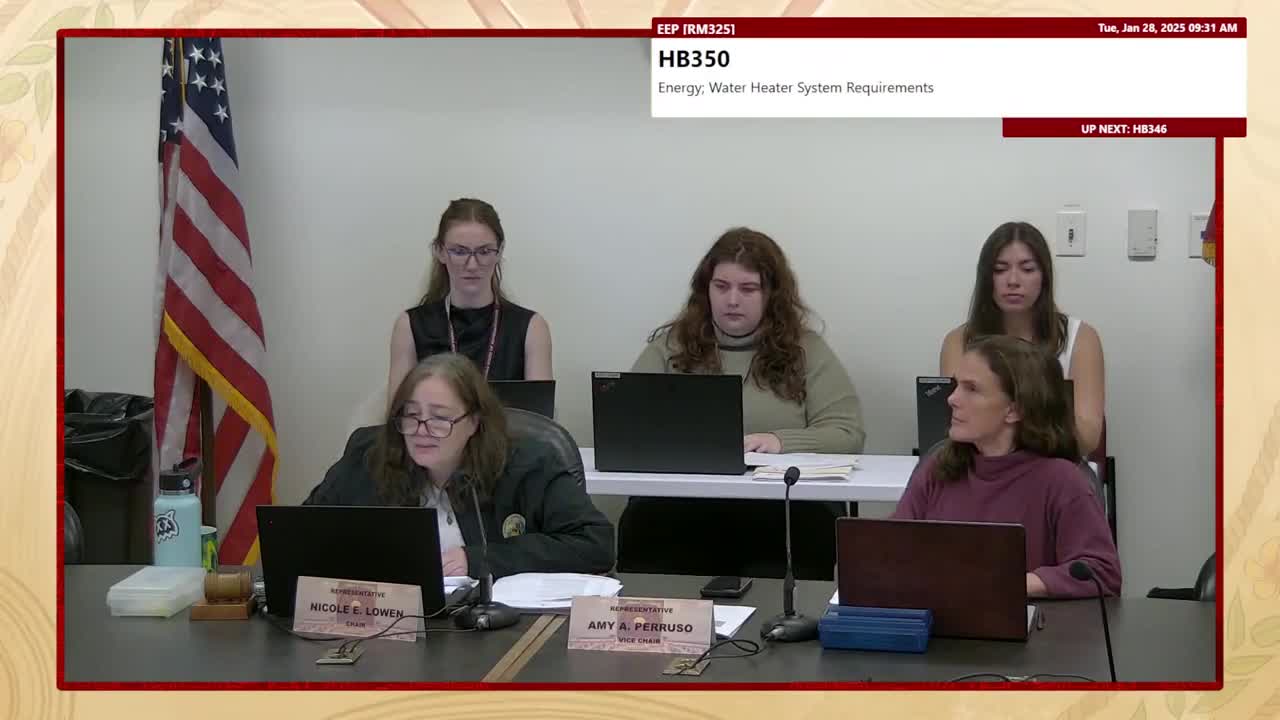
House Standing Committee on Energy & Environmental Protection
Bill Author

Bill Co-Author(s):