SB 3282: Workforce Development; Workforce Pell Grant Program; University of Hawaii; Department of Labor and Industrial Relations
- Session Year: 2025-2026
- House: Senate
- Latest Version Date: 2026-02-12
Current Status:
Failed
(2026-02-13: Report adopted; Passed Second Reading, as amended (SD 1) and referred to WAM.)
Introduced
In Committee
First Chamber
In Committee
Second Chamber
Final Decking
Enacted
What does this bill do?
This bill creates a statewide system to implement the federal Workforce Pell Grant Program, deciding which short-term training programs in Hawaii can receive federal Pell funds and affecting colleges, students, the University of Hawaii, employers, and state workforce agencies. It sets up an approval committee in the Workforce Development Council, defines eligible short-term programs (8–15 weeks, roughly 150–599 hours, not correspondence), requires stackable credential pathways at the University of Hawaii, mandates data sharing for outcomes, and adds student protections, monitoring, and the ability to withdraw state approval for noncompliant programs.
The summary is provided by generative AI which can make mistakes. For original language, please view the details in the table below.
Establishes a statewide framework for the implementation of the federal Workforce Pell Grant Program to provide financial aid for certain short-term workforce education and training programs. Establishes a Workforce Pell Grant Program Approval Committee within the Workforce Development Council. Authorizes the Department of Labor and Industrial Relations to adopt rules. Effective 1/1/2077. (SD1)
Establishes a statewide framework for the implementation of the federal Workforce Pell Grant Program to provide financial aid for certain short-term workforce education and training programs. Establishes a Workforce Pell Grant Program Approval Committee within the Workforce Development Council.
|
THE SENATE |
S.B. NO. |
3282 |
|
THIRTY-THIRD LEGISLATURE, 2026 |
S.D. 1 |
|
|
STATE OF HAWAII |
|
|
|
|
|
|
|
|
||
|
|
||
A BILL FOR AN ACT
RELATING TO THE WORKFORCE PELL GRANT PROGRAM.
BE IT ENACTED BY THE LEGISLATURE OF THE STATE OF HAWAII:
SECTION 1. The legislature finds that the United States Congress has authorized a federal workforce Pell grant program under title IV of the Higher Education Act of 1965, as amended, to expand access to short-term workforce education and training aligned with in-demand and high-wage occupations. The federal workforce Pell grant program assigns the states a formal role in identifying and approving eligible short-term workforce education programs and requires coordination among state workforce agencies, postsecondary institutions, and the United States Department of Education.
The legislature further finds that effective participation in the federal workforce Pell grant program requires clear state definitions, a transparent authorization process, safeguards to protect students and taxpayers, and secure data-sharing mechanisms to meet federal performance and accountability requirements. The legislature believes that Hawaii must modernize its workforce credential pathways and data systems to ensure that residents can access federal workforce Pell grant funding and that participating programs remain eligible under federal law. The legislature finds that ensuring access to federal grants for short-term workforce education and training programs offered by post-secondary institutions for residents of the State is a matter of statewide concern.
The purpose of this Act is to establish a comprehensive statewide framework for workforce Pell grant program implementation that:
(1) Creates a formal state authorization and approval process for workforce Pell-eligible programs;
(2) Defines key terms for the implementation of the workforce Pell grant program, including in-demand and high-wage occupations and stackable credentials;
(3) Requires stackable credential pathways within the university of Hawaii system;
(4) Enables secure, privacy-protected data sharing and outcomes reporting;
(5) Establishes student and consumer protections consistent with federal intent; and
(6) Positions the State to respond efficiently to federal regulations and timelines.
SECTION 2. The Hawaii Revised Statutes is amended by adding a new chapter to be appropriately designated and to read as follows:
"Chapter
Workforce pell grant program implementation
§ -1 Definitions. As used in this chapter: "Authorized state entity" means the workforce development council, acting through the workforce Pell grant program approval committee established pursuant to section -2.
"Correspondence course" shall have the same meaning as defined in title 34 Code of Federal Regulations section 600.2.
"High-wage occupation" means an occupation for which the median wage in the relevant geographic region of the State is at or above the statewide median wage for all occupations, as determined annually by the department of labor and industrial relations.
"In-demand industry sector or occupation" means an industry sector or occupation identified as in demand by the workforce development council pursuant to the federal Workforce Innovation and Opportunity Act, as amended, and updated at least annually.
"Participating institution" means a title IV-eligible postsecondary institution that offers a short-term workforce education program in the State or enrolls a resident of the State in such a program, regardless of whether the institution maintains a physical presence in the State.
"Short-term workforce education program" means an education or training program offered by an accredited, title IV-eligible institution that:
(1) Is at least eight weeks in length but not more than fifteen weeks in length;
(2) Consists of not fewer than one hundred fifty and not more than five hundred ninety-nine clock hours, or the equivalent as permitted under federal law;
(3) Is not a correspondence course; and
(4) Otherwise meets applicable federal workforce Pell requirements.
"Stackable credential" means a recognized postsecondary credential that:
(1) Is industry-validated and portable across more than one employer;
(2) Articulates for academic credit into a certificate, associate degree, or baccalaureate degree within the university of Hawaii system; and
(3) Is part of a documented career pathway approved by the authorized state entity.
"Title IV" means the title IV of the Higher Education Act of 1965, as amended.
"Workforce Pell grant program" means the federal workforce Pell grant program established under title IV of the Higher Education Act of 1965, as amended.
§ -2 Workforce Pell grant program approval committee; establishment; composition; duties. (a) There is established within the workforce development council, constituted pursuant to section 202-1, the workforce Pell grant program approval committee.
(b) The committee shall consist of:
(1) The director of labor and industrial relations, or the director's designee;
(2) The president of the university of Hawaii, or the president's designee;
(3) The superintendent of education, or the superintendent's designee;
(4) Two employer representatives, to be appointed by the chair of the workforce development council; and
(5) The members of the senate and the house of representatives of the legislature who serve on the workforce development council, who shall serve in a nonvoting advisory capacity.
(c) The committee shall:
(1) Establish an application and review process for short-term workforce education programs seeking workforce Pell grant program eligibility;
(2) Review programs submitted by participating institutions and determine whether each program:
(A) Prepares students for an in-demand or high-wage occupation;
(B) Confers a stackable credential;
(C) Meets federal requirements relating to program length, accreditation, institutional eligibility, and operational history;
(D) Satisfies applicable educational prerequisites for professional licensure or certification in industries where such licensure or certification is required or customary; and
(E) Is supported by employer validation of required skills and competencies;
(3) Recommend approved programs to the governor for submission to the United States Department of Education;
(4) Require annual renewal or update of state authorization; and
(5) Conduct ongoing monitoring and review of authorized programs.
§ -3 Authorization required; prohibited acts. (a) A participating institution shall not:
(1) Disburse workforce Pell grant program funds for a short-term workforce education program to a student residing in the State; nor
(2) Advertise, market, or represent that workforce Pell grant program funding is available for the short-term workforce education program, unless the program has received authorization from the authorized state entity and all required federal approvals.
(b) A violation of this section shall constitute grounds for withdrawal of state authorization under section -5.
§ -4 Conditions of authorization; student protections. The authorized state entity shall not authorize a short-term workforce education program unless the entity determines that:
(1) Instruction is not provided by an unaccredited third-party provider;
(2) The participating institution does not offer or promote private education loans or income-share agreements for the program, except for institutional no-interest payment plans;
(3) Tuition and mandatory fees charged to a student are reasonable and proportionate to the program length, expected earnings outcomes, and market comparables, and are fully disclosed to students, except where excess costs are paid by an employer, labor-management partnership, or other third party;
(4) The short-term workforce education program has been offered for at least one year prior to application for authorization;
(5) The institution publicly posts program information, including the credential awarded, occupations prepared for, competencies taught, and any third-party endorsements;
(6) The institution provides written disclosures to prospective students and obtains documented acknowledgement of receipt;
(7) Students have access to academic transcripts for completed coursework; provided that nothing in this paragraph shall prohibit an institution from charging a reasonable fee for the processing of official transcript copies; and
(8) The short-term workforce education program is credit-bearing, or the institution demonstrates how the program will be transcribed and accepted for credit toward the next credential in the pathway.
§ -5 Withdrawal of authorization. The authorized state entity shall withdraw authorization if a participating institution:
(1) Fails to submit required annual updates or renewals;
(2) No longer satisfies any condition of authorization under this chapter; or
(3) Is found by a court, administrative tribunal, or the attorney general to have engaged in an unfair or deceptive act or practice related to the program.
§ -6 University of Hawaii; stackable credential pathways; establishment. (a) The university of Hawaii shall develop and maintain system-wide stackable credential pathways linking short-term workforce credentials to higher-level certificates and degrees.
(b) The university of Hawaii shall annually publish pathway maps by industry sector and report updates to the workforce development council.
§ -7 Data sharing; outcomes reporting; confidentiality. (a) The department of labor and industrial relations shall, pursuant to written data-sharing agreements and applicable privacy protections, provide wage record data to the university of Hawaii for workforce Pell grant program compliance and evaluation.
(b) The university of Hawaii shall collect and report program-level data on enrollment, completion, job placement, and earnings as required under applicable federal law.
(c) The workforce development council shall publish an annual workforce Pell grant program outcomes report; provided that outcomes may be aggregated where necessary to protect student privacy or comply with federal disclosure limitations.
(d) Information produced pursuant to this section and designated as confidential shall be protected from public disclosure to the extent authorized by chapter 92F.
§ -8 Early warning system; corrective action. (a) The university of Hawaii shall monitor program performance against federal workforce Pell grant program benchmarks, including completion, job placement, and earnings thresholds, as defined under applicable federal law and regulations.
(b) Programs at risk of noncompliance shall submit corrective action plans within sixty days.
§ -9 Program limitations; requirements. Nothing in this chapter shall be construed to impose or increase occupational licensing or certification requirements beyond those otherwise required by law.
§ -10 Rulemaking authority. The department of labor and industrial relations may adopt rules pursuant to chapter 91 as necessary to implement this chapter."
SECTION 3. This Act shall take effect on January 1, 2077.
Report Title:
Workforce Development; Workforce Pell Grant Program; University of Hawaii; Department of Labor and Industrial Relations
Description:
Establishes a statewide framework for the implementation of the federal Workforce Pell Grant Program to provide financial aid for certain short-term workforce education and training programs. Establishes a Workforce Pell Grant Program Approval Committee within the Workforce Development Council. Authorizes the Department of Labor and Industrial Relations to adopt rules. Effective 1/1/2077. (SD1)
The summary description of legislation appearing on this page is for informational purposes only and is not legislation or evidence of legislative intent.
|
THE SENATE |
S.B. NO. |
3282 |
|
THIRTY-THIRD LEGISLATURE, 2026 |
|
|
|
STATE OF HAWAII |
|
|
|
|
|
|
|
|
||
|
|
||
A BILL FOR AN ACT
relating to the workforce pell grant program.
BE IT ENACTED BY THE LEGISLATURE OF THE STATE OF HAWAII:
SECTION 1. The legislature finds that the United States Congress has authorized a federal workforce Pell grant program under title IV of the Higher Education Act of 1965, as amended, to expand access to short-term workforce education and training aligned with in-demand and high-wage occupations. The federal workforce Pell grant program assigns the states a formal role in identifying and approving eligible short-term workforce education programs and requires coordination among state workforce agencies, postsecondary institutions, and the United States Department of Education.
The legislature further finds that effective participation in the federal workforce Pell grant program requires clear state definitions, a transparent authorization process, safeguards to protect students and taxpayers, and secure data-sharing mechanisms to meet federal performance and accountability requirements. The legislature believes that Hawaii must modernize its workforce credential pathways and data systems to ensure that residents can access federal workforce Pell grant funding and that participating programs remain eligible under federal law.
The purpose of this Act is to establish a comprehensive statewide framework for workforce Pell grant program implementation that:
(1) Creates a formal state authorization and approval process for workforce Pell-eligible programs;
(2) Defines key terms for the implementation of the workforce Pell grant program, including in-demand and high-wage occupations and stackable credentials;
(3) Requires stackable credential pathways within the university of Hawaii system;
(4) Enables secure, privacy-protected data sharing and outcomes reporting;
(5) Establishes student and consumer protections consistent with federal intent; and
(6) Positions the State to respond efficiently to federal regulations and timelines.
SECTION 2. The Hawaii Revised Statutes is amended by adding a new chapter to be appropriately designated and to read as follows:
"Chapter
Workforce pell grant program implementation
§ -1 Definitions. As used in this chapter, unless the context clearly requires otherwise:
"Authorized state entity" means the workforce development council, acting through the workforce Pell grant program approval committee established pursuant to section § -2.
"Correspondence course" shall have the same meaning as in title 34 Code of Federal Regulations section 600.2.
"High-wage occupation" means an occupation for which the median wage in the relevant geographic region of the State is at or above the statewide median wage for all occupations, as determined annually by the department of labor and industrial relations.
"In-demand industry sector or occupation" means an industry sector or occupation identified as in demand by the workforce development council pursuant to the federal Workforce Innovation and Opportunity Act, as amended, and updated at least annually.
"Participating institution" means a title IV-eligible postsecondary institution that offers a short-term workforce education program in the State or enrolls a resident of the State in such a program, regardless of whether the institution maintains a physical presence in the State.
"Short-term workforce education program" means an education or training program offered by an accredited, title IV-eligible institution that:
(1) Is at least eight weeks in length but no more than fifteen weeks in length;
(2) Consists of not fewer than one hundred fifty and not more than five hundred ninety-nine clock hours, or the equivalent as permitted under federal law;
(3) Is not a correspondence course; and
(4) Otherwise meets applicable federal workforce Pell requirements.
"Stackable credential" means a recognized postsecondary credential that:
(1) Is industry-validated and portable across more than one employer;
(2) Articulates for academic credit into a certificate, associate degree, or baccalaureate degree within the university of Hawaii system; and
(3) Is part of a documented career pathway approved by the authorized state entity.
"Title IV" means the title IV of the Higher Education Act of 1965, as amended.
"Workforce Pell grant program" means the federal workforce Pell grant program established under title IV of the Higher Education Act of 1965, as amended.
§ -2 Workforce Pell grant program approval committee; establishment; composition; duties. (a) There is established within the workforce development council, constituted pursuant to section 202-1, the workforce Pell grant program approval committee.
(b) The committee shall consist of:
(1) The director of labor and industrial relations, or the director's designee;
(2) The president of the university of Hawaii, or the president's designee;
(3) The superintendent of education, or the superintendent's designee;
(4) Two employer representatives, to be appointed by the chair of the workforce development council; and
(5) The members of the senate and the house of representatives of the legislature who serve on the workforce development council, who shall serve in a nonvoting advisory capacity.
(c) The committee shall:
(1) Establish an application and review process for short-term workforce education programs seeking workforce Pell grant program eligibility;
(2) Review programs submitted by participating institutions and determine whether each program:
(A) Prepares students for an in-demand or high-wage occupation;
(B) Confers a stackable credential;
(C) Meets federal requirements relating to program length, accreditation, institutional eligibility, and operational history;
(D) Satisfies applicable educational prerequisites for professional licensure or certification in industries where such licensure or certification is required or customary; and
(E) Is supported by employer validation of required skills and competencies;
(3) Recommend approved programs to the governor for submission to the United States Department of Education;
(4) Require annual renewal or update of state authorization; and
(5) Conduct ongoing monitoring and review of authorized programs.
§ -3 Authorization required; prohibited acts. (a) A participating institution shall not:
(1) Disburse workforce Pell grant program funds for a short-term workforce education program to a student residing in the State; nor
(2) Advertise, market, or represent that workforce Pell grant program funding is available for the short-term workforce education program, unless the program has received authorization from the authorized state entity and all required federal approvals.
(b) A violation of this section shall constitute grounds for withdrawal of state authorization under section § -5.
§ -4 Conditions of authorization; student protections. The authorized state entity shall not authorize a short-term workforce education program unless the entity determines that:
(1) Instruction is not provided by an unaccredited third-party provider;
(2) The participating institution does not offer or promote private education loans or income-share agreements for the program, except for institutional no-interest payment plans;
(3) Tuition and mandatory fees charged to a student are reasonable and proportionate to the program length, expected earnings outcomes, and market comparables, and are fully disclosed to students, except where excess costs are paid by an employer, labor-management partnership, or other third party;
(4) The short-term workforce education program has been offered for at least one year prior to application for authorization;
(5) The institution publicly posts program information, including the credential awarded, occupations prepared for, competencies taught, and any third-party endorsements;
(6) The institution provides written disclosures to prospective students and obtains documented acknowledgement of receipt;
(7) Students have access to academic transcripts for completed coursework; provided that nothing in this paragraph shall prohibit an institution from charging a reasonable fee for the processing of official transcript copies; and
(8) The short-term workforce education program is credit-bearing, or the institution demonstrates how the program will be transcribed and accepted for credit toward the next credential in the pathway.
§ -5 Withdrawal of authorization. The authorized state entity shall withdraw authorization if a participating institution:
(1) Fails to submit required annual updates or renewals;
(2) No longer satisfies any condition of authorization under this chapter; or
(3) Is found by a court, administrative tribunal, or the attorney general to have engaged in an unfair or deceptive act or practice related to the program.
§ -6 University of Hawaii; stackable credential pathways; establishment. (a) The university of Hawaii shall develop and maintain system-wide stackable credential pathways linking short-term workforce credentials to higher-level certificates and degrees.
(b) The university of Hawaii shall annually publish pathway maps by industry sector and report updates to the workforce development council.
§ -7 Data sharing; outcomes reporting; confidentiality. (a) The department of labor and industrial relations shall, pursuant to written data-sharing agreements and applicable privacy protections, provide wage record data to the university of Hawaii for workforce Pell grant program compliance and evaluation.
(b) The university of Hawaii shall collect and report program-level data on enrollment, completion, job placement, and earnings as required under applicable federal law.
(c) The workforce development council shall publish an annual workforce Pell grant program outcomes report; provided that outcomes may be aggregated where necessary to protect student privacy or comply with federal disclosure limitations.
(d) Information produced pursuant to this section and designated as confidential shall be protected from public disclosure consistent with chapter 92F.
§ -8 Early warning system; corrective action. (a) The university of Hawaii shall monitor program performance against federal workforce Pell grant program benchmarks, including completion, job placement, and earnings thresholds, as defined under applicable federal law and regulations.
(b) Programs at risk of noncompliance shall submit corrective action plans within sixty days.
§ -9 Program limitations; requirements. Nothing in this chapter shall be construed to impose or increase occupational licensing or certification requirements beyond those otherwise required by law.
§ -10 Rulemaking authority. The workforce development council may adopt rules pursuant to chapter 91 as necessary to implement this chapter."
SECTION 3. This Act shall take effect upon its approval.
|
INTRODUCED BY: |
_____________________________ |
|
|
|
Report Title:
Workforce Development; Workforce Pell Grant Program; University of Hawaii; Department of Labor and Industrial Relations
Description:
Establishes a statewide framework for the implementation of the federal Workforce Pell Grant Program to provide financial aid for certain short-term workforce education and training programs. Establishes a Workforce Pell Grant Program Approval Committee within the Workforce Development Council.
The summary description of legislation appearing on this page is for informational purposes only and is not legislation or evidence of legislative intent.
|
Date
|
Status
|
|---|---|
| Feb 13, 2026 | Report adopted; Passed Second Reading, as amended (SD 1) and referred to WAM. |
| Feb 13, 2026 | Reported from LBT/EDU (Stand. Com. Rep. No. 2264) with recommendation of passage on Second Reading, as amended (SD 1) and referral to WAM. |
| Feb 6, 2026 | The committee(s) on EDU recommend(s) that the measure be PASSED, WITH AMENDMENTS. The votes in EDU were as follows: 4 Aye(s): Senator(s) Kim, Kidani, Hashimoto, DeCorte; Aye(s) with reservations: none ; 0 No(es): none; and 1 Excused: Senator(s) Fukunaga. |
| Feb 6, 2026 | The committee(s) on LBT recommend(s) that the measure be PASSED, WITH AMENDMENTS. The votes in LBT were as follows: 5 Aye(s): Senator(s) Elefante, Lamosao, Ihara, Moriwaki, Fevella; Aye(s) with reservations: none ; 0 No(es): none; and 0 Excused: none. |
| Feb 3, 2026 | The committee(s) on LBT/EDU has scheduled a public hearing on 02-06-26 1:00PM; Conference Room 229 & Videoconference. |
| Feb 2, 2026 | Referred to LBT/EDU, WAM. |
| Jan 30, 2026 | Passed First Reading. |
| Jan 30, 2026 | Introduced. |
|
Date
|
Description
|
Location
|
Votes
|
|
|---|---|---|---|---|
| Feb 6, 2026 | The committee(s) on EDU recommend(s) that the measure be PASSED, WITH AMENDMENTS | Senate Standing Committee on Education |
Passed |
|
| Feb 6, 2026 | The committee(s) on LBT recommend(s) that the measure be PASSED, WITH AMENDMENTS | Senate Standing Committee on Labor and Technology |
Passed |
This list shows positions taken on this bill by organizations on the date displayed, which is linked to the original source.
Positions by individuals are not included.
|
Organization
|
Position
|
Date
|
|---|---|---|
| Chamber of Commerce Hawaii | ** Support | |
| Maui Chamber of Commerce | ** Support | |
| University of Hawai'i System | ** Support |
STAND. COM. REP. NO. 2264
Honolulu, Hawaii
RE: S.B. No. 3282
S.D. 1
Honorable Ronald D. Kouchi
President of the Senate
Thirty-Third State Legislature
Regular Session of 2026
State of Hawaii
Sir:
Your Committees on Labor and Technology and Education, to which was referred S.B. No. 3282 entitled:
"A BILL FOR AN ACT RELATING TO THE WORKFORCE PELL GRANT PROGRAM,"
beg leave to report as follows:
The purpose and intent of this measure is to:
(1) Establish a statewide framework for the implementation of the federal Workforce Pell Grant Program to provide financial aid for certain short-term workforce education and training programs; and
(2) Establish a Workforce Pell Grant Program Approval Committee within the Workforce Development Council.
Your Committees received testimony in support of this measure from the University of Hawai'i System, Chamber of Commerce Hawaii, and Maui Chamber of Commerce.
Your Committees received comments on this measure from the Department of the Attorney General, Department of Labor and Industrial Relations, and Office of Information Practices.
Your Committees find that the federal Workforce Pell Grant Program, slated to begin on July 1, 2026, expands access to Pell grants for short-term workforce education and training programs aligned with in-demand and high-wage occupations. Your Committees further find that the federal program assigns the states a formal role in identifying and approving eligible short-term workforce education programs and requires coordination among state workforce agencies, postsecondary institutions, and the United States Department of Education. This measure modernizes the State's workforce credential pathways and data systems and establishes a comprehensive statewide framework to ensure that residents of the State can access funding under the Workforce Pell Grant Program.
Your Committees note the concerns raised in testimony by the Office of Information Practices that the confidentiality provision in the measure for program-related information shared between the University of Hawaii and Department of Labor and Industrial Relations is ambiguous, and could be interpreted to allow the entities to shield information from public disclosure beyond what is permitted under the Uniform Information Practices Act. Your Committees also acknowledge testimony by the Department of Labor and Industrial Relations stating that federal Pell grants carry complex compliance, reporting, and audit requirements, and that the Department has dedicated staff, specialized expertise, and a proven track record and therefore is better suited to adopt rules necessary to manage the program. Therefore, amendments to this measure are necessary to address these matters.
Accordingly, your Committees have amended this measure by:
(1) Inserting language stating that ensuring access to federal grants for short-term workforce education and training programs offered by postsecondary institutions for residents of the State is a matter of statewide concern;
(2) Inserting language clarifying that program-related information shared between the University of Hawaii and Department of Labor and Industrial Relations designated as confidential is protected from public disclosure to the extent authorized by the Uniform Information Practices Act;
(3) Inserting language authorizing the Department of Labor and Industrial Relations, rather than the Workforce Development Council, to adopt rules;
(4) Amending section 1 to reflect its amended purpose;
(5) Inserting an effective date of January 1, 2077, to encourage further discussion; and
(6) Making technical, nonsubstantive amendments for the purposes of clarity and consistency.
As affirmed by the records of votes of the members of your Committees on Labor and Technology and Education that are attached to this report, your Committees are in accord with the intent and purpose of S.B. No. 3282, as amended herein, and recommend that it pass Second Reading in the form attached hereto as S.B. No. 3282, S.D. 1, and be referred to your Committee on Ways and Means.
Respectfully submitted on behalf of the members of the Committees on Labor and Technology and Education,
|
________________________________ DONNA MERCADO KIM, Chair |
|
________________________________ BRANDON J.C. ELEFANTE, Chair |
|
|
|
|
|
Date
|
Testimony PDF
|
|---|---|
| Feb 6, 2026 | SB3282_TESTIMONY_EDU-LBT_02-06-26_.PDF |
Discussed in Hearing
 9MIN
Senate Standing Committee on Education
9MIN
Senate Standing Committee on Labor and Technology
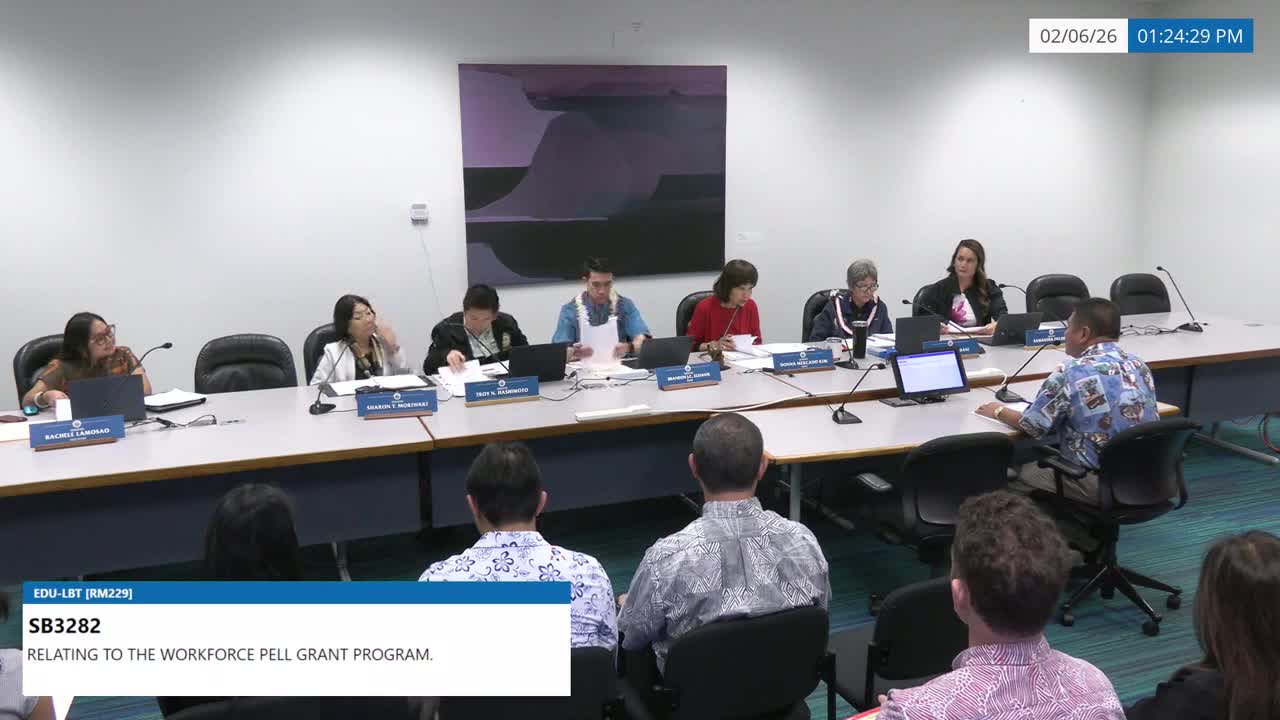 1MIN
Senate Standing Committee on Education
1MIN
Senate Standing Committee on Labor and Technology
Bill Author