SB 2048: DAB; Invasive Species; Pest-Infested Items or Materials; Sale; Barter; Donation; Prohibited; Penalties
- Session Year: 2025-2026
- House: Senate
- Latest Version Date: 2026-02-19
Current Status:
Failed
(2026-02-20: Report adopted; Passed Second Reading, as amended (SD 1) and referred to JDC/WAM.)
Introduced
In Committee
First Chamber
In Committee
Second Chamber
Final Decking
Enacted
Prohibits the sale, barter, or donation of any pest-infested item or material. Authorizes the Department of Agriculture and Biosecurity to quarantine, treat, or destroy pest-infested items or materials. Imposes penalties on individuals who sell, barter, or donate a pest-infested items or materials. Effective 7/1/2050. (SD1)
Prohibits the sale, barter, or donation of any pest-infested item or material. Authorizes the Department of Agriculture and Biosecurity to quarantine, treat, or destroy pest-infested items or materials. Imposes penalties on individuals who sell, barter, or donate a pest-infested items or materials.
|
THE SENATE |
S.B. NO. |
2048 |
|
THIRTY-THIRD LEGISLATURE, 2026 |
S.D. 1 |
|
|
STATE OF HAWAII |
|
|
|
|
|
|
|
|
||
|
|
||
A BILL FOR AN ACT
RELATING TO INVASIVE SPECIES.
BE IT ENACTED BY THE LEGISLATURE OF THE STATE OF HAWAII:
SECTION 1. The legislature finds that the transportation of plants, other nursery items, and merchandise is a known pathway that can spread invasive species to new locations and communities. The introduction and subsequent propagation of high-impact pests, including the little fire ant and coqui frog, are likely to have occurred via potted plants that were imported into the State and sold by local nurseries. While the introduction and propagation of pests may occur by other means, the State can employ a systems approach to better address primary pathways of arrival and transmission.
The legislature further finds that it is critical that nurseries and other retailers use best management practices to prevent the spread of invasive species on their products to protect unsuspecting consumers and their communities.
The legislature also finds that many states use a systems approach to prioritize pathways, regulating local plant nurseries as particularly high-risk pathways that must be certified and inspected. While the State established a certified nursery program in 1977 to fulfill the requirements of import rules in other states and protect purchasers of Hawaii plant nursery products in other states, it has not established a complementary program to protect and certify plant nursery products sold within Hawaii.
The legislature additionally finds that imposing penalties on individuals who sell pest-infested items in the State is one component of a more comprehensive program to regulate plant nursery products sold within the State.
Accordingly, the purpose of this Act is to prohibit the sale of pest-infested items and materials to the public, preventing the spread of pests within the State.
SECTION 2. Chapter 150A, Hawaii Revised Statutes, is amended by adding a new section to be appropriately designated and to read as follows:
"§150A- Sale of pest-infested items or materials; prohibited. (a) No person shall sell, barter, or donate; offer for sale, barter, or donation; or otherwise make available to the public any item or material that is:
(1) Infested or infected with a pest;
(2) Itself a pest; or
(3) Prohibited from being sold or otherwise made available to the public under this chapter or any rule adopted pursuant to this chapter.
(b) The prohibition in subsection (a) shall not apply to any item or material that:
(1) The department provides access to for research or testing pursuant to an appropriate permit issued by the department; or
(2) Is infested or infected with a biocontrol agent transferred pursuant to an appropriate permit issued by the department.
(c) The department may compel the quarantine, treatment, or destruction of any item or material sold, bartered, or donated; offered for sale, barter, or donation; or otherwise made available to the public in violation of subsection (a).
(d) Any quarantine, treatment, or destruction pursuant to subsection (c) shall be at the expense of the owner of the item or material. The State shall not be responsible for any economic loss or damage related to any action taken by the department under this section."
SECTION 3. Section 150A-14, Hawaii Revised Statutes, is amended by amending subsections (a) and (b) to read as follows:
"(a) Any person who violates any
provision of this chapter other than sections 150A-5, 150A-6(3), [and]
150A-6(4), and 150A- , or who violates any rule adopted under
this chapter other than those rules involving an animal that is prohibited or a
plant, animal, or microorganism that is restricted, without a permit, shall be
guilty of a misdemeanor and fined not less than $100. The provisions of section 706-640
notwithstanding, the maximum fine shall be $10,000. For a second offense committed within five years
of a prior offense, the person or organization shall be fined not less than
$500 and not more than $25,000.
(b) Any person who violates section 150A-5 [or],
150A-58, or 150A- , or any rule adopted pursuant to those
sections, shall be fined [no] not less than $100 and [no]
not more than $10,000. For a
second violation committed within five years of a prior violation, the person
may be fined [no] not less than $500 and [no] not
more than $25,000."
SECTION 4. Statutory material to be repealed is bracketed and stricken. New statutory material is underscored.
SECTION 5. This Act shall take effect on July 1, 2050.
Report Title:
DAB; Invasive Species; Pest-Infested Items or Materials; Sale; Barter; Donation; Prohibited; Penalties
Description:
Prohibits the sale, barter, or donation of any pest-infested item or material. Authorizes the Department of Agriculture and Biosecurity to quarantine, treat, or destroy pest-infested items or materials. Imposes penalties on individuals who sell, barter, or donate a pest-infested items or materials. Effective 7/1/2050. (SD1)
The summary description of legislation appearing on this page is for informational purposes only and is not legislation or evidence of legislative intent.
|
THE SENATE |
S.B. NO. |
2048 |
|
THIRTY-THIRD LEGISLATURE, 2026 |
|
|
|
STATE OF HAWAII |
|
|
|
|
|
|
|
|
||
|
|
||
A BILL FOR AN ACT
relating to invasive species.
BE IT ENACTED BY THE LEGISLATURE OF THE STATE OF HAWAII:
SECTION 1. The legislature finds that the transportation of plants, other nursery items, and merchandise is a known pathway that can spread invasive species to new locations and communities. The introduction and subsequent propagation of high-impact pests, including the little fire ant and coqui frog, are likely to have occurred via potted plants that were imported into the State and sold by local nurseries. While the introduction and propagation of pests may occur by other means, the State can employ a systems approach to better address primary pathways of arrival and transmission.
The legislature further finds that it is critical that nurseries and other retailers use best management practices to prevent the spread of invasive species on their products to protect unsuspecting consumers and their communities.
The legislature also finds that many states use a systems approach to prioritize pathways, regulating local plant nurseries as particularly high-risk pathways that must be certified and inspected. While the State established a certified nursery program in 1977 to fulfill the requirements of import rules in other states and protect purchasers of Hawaii plant nursery products in other states, it has not established a complementary program to protect and certify plant nursery products sold within Hawaii.
The legislature additionally finds that imposing penalties on individuals who sell pest-infested items in the State is one component of a more comprehensive program to regulate plant nursery products sold within the State.
Accordingly, the purpose of this Act is to prohibit the sale of pest-infested items and materials to the public, preventing the spread of pests within the State.
SECTION 2. Chapter 150A, Hawaii Revised Statutes, is amended by adding a new section to be appropriately designated and to read as follows:
"§150A- Sale of pest-infested items or materials; prohibited. (a) No person shall sell, barter, or donate; offer for sale, barter, or donation; or otherwise make available to the public any item or material that is:
(1) Infested or infected with a pest;
(2) Itself a pest; or
(3) Prohibited from being sold under this chapter or any rule adopted pursuant to this chapter.
(b) The prohibition in subsection (a) shall not apply to any item or material that:
(1) The department provides access to for research or testing; or
(2) Is a biocontrol agent transferred pursuant to an appropriate permit.
(c) The department may compel the quarantine, treatment, or destruction of any item or material sold, bartered, or donated; offered for sale, barter, or donation; or otherwise made available to the public in violation of subsection (a).
(d) Any quarantine, treatment, or destruction pursuant to subsection (c) shall be at the expense of the owner of the item or material. The State shall not be responsible for any economic loss or damage related to any action taken by the department under this section."
SECTION 3. Section 150A-14, Hawaii Revised Statutes, is amended by amending subsections (a) and (b) to read as follows:
"(a) Any person who violates any
provision of this chapter other than sections 150A-5, 150A-6(3), [and]
150A-6(4), and 150A- , or who violates any rule adopted under
this chapter other than those rules involving an animal that is prohibited or a
plant, animal, or microorganism that is restricted, without a permit, shall be
guilty of a misdemeanor and fined not less than $100. The provisions of section 706-640
notwithstanding, the maximum fine shall be $10,000. For a second offense committed within five
years of a prior offense, the person or organization shall be fined not less
than $500 and not more than $25,000.
(b) Any person who violates section 150A-5 [or],
150A-58, or 150A- , or any rule adopted pursuant to these
sections, shall be fined [no] not less than $100 and [no]
not more than $10,000. For a
second violation committed within five years of a prior violation, the person
may be fined [no] not less than $500 and [no] not
more than $25,000."
SECTION 4. Statutory material to be repealed is bracketed and stricken. New statutory material is underscored.
SECTION 5. This Act shall take effect upon its approval.
|
INTRODUCED BY: |
_____________________________ |
|
|
|
|
|
|
Report Title:
DAB; Invasive Species; Pest-Infested Items or Materials; Sale; Barter; Donation; Prohibited; Penalties
Description:
Prohibits the sale, barter, or donation of any pest-infested item or material. Authorizes the Department of Agriculture and Biosecurity to quarantine, treat, or destroy pest-infested items or materials. Imposes penalties on individuals who sell, barter, or donate a pest-infested items or materials.
The summary description of legislation appearing on this page is for informational purposes only and is not legislation or evidence of legislative intent.
|
Date
|
Status
|
|---|---|
| Feb 20, 2026 | Report adopted; Passed Second Reading, as amended (SD 1) and referred to JDC/WAM. |
| Feb 20, 2026 | Reported from AEN/CPN (Stand. Com. Rep. No. 2646) with recommendation of passage on Second Reading, as amended (SD 1) and referral to JDC/WAM. |
| Feb 11, 2026 | The committee(s) on CPN recommend(s) that the measure be PASSED, WITH AMENDMENTS. The votes in CPN were as follows: 5 Aye(s): Senator(s) Keohokalole, Fukunaga, Lamosao, McKelvey, Awa; Aye(s) with reservations: none ; 0 No(es): none; and 0 Excused: none. |
| Feb 11, 2026 | The committee(s) on AEN recommend(s) that the measure be PASSED, WITH AMENDMENTS. The votes in AEN were as follows: 5 Aye(s): Senator(s) Gabbard, Richards, DeCoite, Rhoads, Awa; Aye(s) with reservations: none ; 0 No(es): none; and 0 Excused: none. |
| Feb 6, 2026 | The committee(s) on AEN/CPN has scheduled a public hearing on 02-11-26 10:00AM; Conference Room 229 & Videoconference. |
| Jan 22, 2026 | Referred to AEN/CPN, JDC/WAM. |
| Jan 21, 2026 | Introduced and passed First Reading. |
| Jan 14, 2026 | Pending Introduction. |
|
Date
|
Description
|
Location
|
Votes
|
|
|---|---|---|---|---|
| Feb 11, 2026 | The committee(s) on CPN recommend(s) that the measure be PASSED, WITH AMENDMENTS | Senate Standing Committee on Commerce and Consumer Protection |
Passed |
|
| Feb 11, 2026 | The committee(s) on AEN recommend(s) that the measure be PASSED, WITH AMENDMENTS | Senate Standing Committee on Agriculture and Environment |
Passed |
This list shows positions taken on this bill by organizations on the date displayed, which is linked to the original source.
Positions by individuals are not included.
|
Organization
|
Position
|
Date
|
|---|---|---|
| Coordinating Group on Alien Pest Species | ** Support | |
| Department of Land and Natural Resources | ** Support | |
| Department of Agriculture and Biosecurity | ** Support | |
| Free Access Coalition | ** Support | |
| Hawaii Forest Association | *** Support | Feb 10, 2026 |
| Hawaiʻi Food+ Policy | ** Support | |
| Hawaiʻi Forest Association | ** Support | |
| Libertarian Party of Hawaii | *** Against | Feb 10, 2026 |
| Sierra Club of Hawaiʻi | ** Support |
STAND. COM. REP. NO. 2646
Honolulu, Hawaii
RE: S.B. No. 2048
S.D. 1
Honorable Ronald D. Kouchi
President of the Senate
Thirty-Third State Legislature
Regular Session of 2026
State of Hawaii
Sir:
Your Committees on Agriculture and Environment and Commerce and Consumer Protection, to which was referred S.B. No. 2048 entitled:
"A BILL FOR AN ACT RELATING TO INVASIVE SPECIES,"
beg leave to report as follows:
The purpose and intent of this measure is to:
(1) Prohibit the sale, barter, or donation of any pest-infested item or material;
(2) Authorize the Department of Agriculture and Biosecurity to quarantine, treat, or destroy pest-infested items or materials; and
(3) Impose penalties on individuals who sell, barter, or donate a pest-infested item or materials.
Your Committees received testimony in support of this measure from the Department of Land and Natural Resources, Department of Agriculture and Biosecurity, Coordinating Group on Alien Pest Species, Sierra Club of Hawaiʻi, Hawaiʻi Forest Association, Hawaiʻi Food+ Policy, Free Access Coalition, and sixteen individuals.
Your Committees received testimony in opposition to this measure from the Libertarian Party of Hawaii.
Your Committees received comments on this measure from the Hawaiʻi Farm Bureau and one individual.
Your Committees find that the transportation of plants and other plant associated items is a known pathway that can spread invasive species to new locations and communities throughout the State. The introduction of high-impact pests, such as the little fire ant and coqui frog, likely propagated from the imported sale of infested agricultural materials into the State. Your Committees further find that additional measures to implement a comprehensive biosecurity program in the State are necessary to protect food production, public safety, and the ecosystem. Therefore, this measure will expand the Department of Agriculture and Biosecurity's ability to mitigate the spread of invasive species and further protect Hawaii's biodiversity.
Your Committees have amended this measure by:
(1) Clarifying that, in addition to selling, making any pest-infested material available to the public is also prohibited;
(3) Inserting an effective date of July 1, 2050, to encourage further discussion; and
(4) Making a technical, nonsubstantive amendment for the purposes of clarity and consistency.
As affirmed by the records of votes of the members of your Committees on Agriculture and Environment and Commerce and Consumer Protection that are attached to this report, your Committees are in accord with the intent and purpose of S.B. No. 2048, as amended herein, and recommend that it pass Second Reading in the form attached hereto as S.B. No. 2048, S.D. 1, and be referred to your Committees on Judiciary and Ways and Means.
Respectfully submitted on behalf of the members of the Committees on Agriculture and Environment and Commerce and Consumer Protection,
|
________________________________ JARRETT KEOHOKALOLE, Chair |
|
________________________________ MIKE GABBARD, Chair |
|
|
|
|
|
Date
|
Testimony PDF
|
|---|---|
| Feb 10, 2026 | SB2048_TESTIMONY_CPN-AEN_02-11-26_.PDF |
Discussed in Hearing
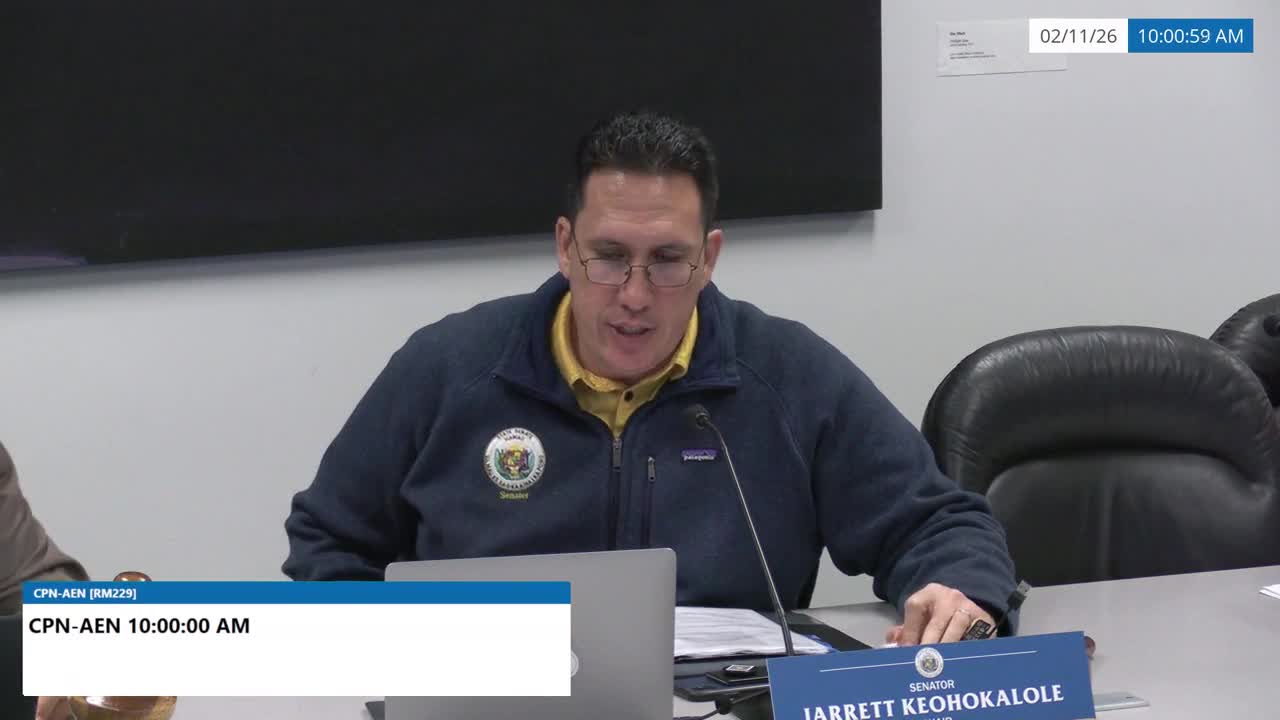 5MIN
Senate Standing Committee on Agriculture and Environment
5MIN
Senate Standing Committee on Commerce and Consumer Protection
5MIN
Senate Standing Committee on Government Operations
2MIN
Senate Standing Committee on Agriculture and Environment
2MIN
Senate Standing Committee on Commerce and Consumer Protection
2MIN
Senate Standing Committee on Government Operations
Bill Author