HB 466: RELATING TO EVICTIONS.
- Session Year: 2025-2026
- House: House
- Latest Version Date: 2025-02-05
Current Status:
Failed
(2025-12-08: Carried over to 2026 Regular Session.)
Introduced
In Committee
First Chamber
In Committee
Second Chamber
Final Decking
Enacted
Prohibits landlords from terminating certain tenancies without cause. Establishes criteria under which landlords can undertake a no-fault eviction. Requires landlords, when proceeding with a no-fault eviction, to offer relocation assistance to the tenant or waiver of the final month's rent. Effective 1/1/3000. (HD1)
Prohibits landlords from terminating certain tenancies without cause. Establishes criteria under which landlords can undertake a no-fault eviction. Requires landlords, when proceeding with a no-fault eviction, to offer relocation assistance to the tenant or waiver of the final month's rent. Effective 1/1/2026.
|
HOUSE OF REPRESENTATIVES |
H.B. NO. |
466 |
|
THIRTY-THIRD LEGISLATURE, 2025 |
H.D. 1 |
|
|
STATE OF HAWAII |
|
|
|
|
|
|
|
|
||
|
|
||
A BILL FOR AN ACT
RELATING TO EVICTIONS.
BE IT ENACTED BY THE LEGISLATURE OF THE STATE OF HAWAII:
SECTION 1. The legislature finds that nearly forty per cent of Hawaii households are renters. Currently, renters can lose their housing through arbitrary non-renewals of their leases, even if they are tenants in good standing. These arbitrary no-cause evictions disrupt the lives of tenants and contribute to financial insecurity and housing instability. The fear of retaliatory no-cause evictions can also deter tenants from advocating for repairs and addressing habitability issues.
The legislature further finds that preventing housing insecurity and displacement for local families requires that tenants be protected from arbitrary displacement.
Therefore, the purpose of this Act is to:
(1) Prohibit landlords from terminating certain tenancies without cause;
(2) Establish criteria under which landlords can undertake a no-fault eviction; and
SECTION 2. Chapter 521, Hawaii Revised Statutes, is amended by adding a new part to be appropriately designated and to read as follows:
"Part . CAUSE FOR EVICTION; NO-FAULT EVICTIONS
§521-A Definitions. As used in this part:
"No-fault eviction" means an action for summary possession brought by a landlord that does not constitute cause under section 521-B(b).
"Substantial violation" means any act or series of acts by the tenant or any guest of the tenant that, when considered together:
(1) Occurs on or near the premises and endangers persons or willfully and substantially endangers the property of the landlord, any co-tenant, or any person living on or near the premises;
(2) Occurs on or near the premises and constitutes a violent or drug-related felony; or
(3) Occurs on the tenant's premises or the common areas, hallway, grounds, parking lot, or other area located in the same building or complex in which the tenant's dwelling unit is located and constitutes a criminal act in violation of federal or state law or county ordinance that:
(A) Carries a potential sentence of imprisonment of one hundred eighty days or more; and
(B) Has been declared to be a public nuisance under state law or county ordinance.
§521-B Termination of tenancy; cause for eviction. (a) No landlord shall serve a notice to terminate tenancy or file an action for summary possession unless there is cause for the eviction.
(b) The following actions by a tenant shall constitute cause for eviction:
(1) Substantial violation;
(2) Material noncompliance with section 521-51;
(3) Nonpayment of rent, subject to section 521-68;
(4) Waste, failure to maintain, or unlawful use, subject to section 521-69;
(5) Whenever the term of the rental agreement expires, whether by passage of time, by mutual agreement, by the giving of notice as provided in section 521-71(a), (b), (c), or (d) or by the exercise by the landlord of a right to terminate given under this chapter, continued possession of the dwelling unit after the date of termination without the landlord's consent, subject to section 521-71(e);
(6) Breach of any rule authorized under section 521-52, subject to section 521-72;
(7) Continued possession after a legal sale pursuant to section 521-74(b)(6);
(8) Refusal or failure to surrender property that has been sold under a judgment or decree by the party or privies to the judgment or decree after the expiration of the time of redemption, when redemption is allowed by law, after the purchaser demands the property;
(9) Continued possession by an heir or a devisee of a premises sold and conveyed by a personal representative;
(10) Failure of a holdover vendee to comply with an agreement to purchase lands or structures on the premises; or
(11) Nuisance, negligent damage of the dwelling unit, or use of the dwelling unit for an illegal purpose or for purposes that are in violation of the rental agreement.
§521-C No fault eviction; demolition, conversion, or change of use. In addition to the requirements for termination of a month-to-month tenancy pursuant to section 571-71(c), when a landlord contemplates voluntary demolition of the dwelling units, conversion to a condominium property regime under chapter 514B, or changing the use of the building to transient vacation rentals, the landlord may initiate a no-fault eviction of a tenant of the residential premises; provided that the landlord shall provide the tenant proper service of a written notice of the no-fault eviction. The written notice shall include:
(1) The date by which the tenant shall vacate the dwelling unit, which shall be at least one hundred and twenty days in advance of the anticipated demolition, conversion, or changing of use; and
(2) A description and timeline of the anticipated demolition, conversion, or changing of use of the building and a material demonstration of the proposed date upon which the project will commence, such as a copy of a building permit or application for a permit or license to operate a transient vacation rental, where applicable.
§521-D No fault eviction; substantial repairs, alterations, or renovations. (a) Except as provided in subsection (b), when a landlord plans to make substantial repairs, alterations, or renovations to a premises, the landlord may initiate a no-fault eviction of a tenant; provided that the landlord shall:
(1) Allow the tenant at least sixty days after receiving the written notice to vacate the dwelling unit, during which time the tenant may remain in possession of the dwelling unit under the same terms of the tenant's existing rental agreement;
(2) Provide the tenant proper service of a written notice of the no-fault eviction, which shall include the date by which the tenant shall quit the premises; provided that the date shall be at least sixty days after receipt of the written notice;
(3) Provide the tenant an expected completion date and a general description of the substantial repairs, alterations, or renovations to the premises;
(4) Proceed without unreasonable delay to complete the substantial repairs, alterations, or renovations upon the landlord's recovery of possession of the premises; and
(5) For any repairs, alterations, or renovations expected to last less than one hundred eighty days, provide the tenant a written notice sent in a manner that the landlord typically uses to communicate with the tenant; provided that:
(A) The notice shall include the expected completion date for the repairs, alterations, or renovations;
(B) If, within ten days after receiving the notice, the tenant notifies the landlord that the tenant wants to return to the premises, the landlord shall offer the tenant the first right of refusal to sign a new rental agreement with reasonable terms; and
(C) If the tenant accepts the new rental agreement, the tenant shall have thirty days to occupy the dwelling unit, unless the parties mutually agree on an extended timeline in writing.
(b) A landlord shall not initiate a no-fault eviction of a tenant pursuant to subsection (a) if the substantial repairs, alterations, or renovations that are the alleged basis of the no-fault eviction are:
(1) Required for the landlord to satisfy all required remedial action concerning a breach of the warranty of habitability; or
(2) Initiated by the landlord in retaliation against the tenant in violation of section 521-74(a).
§521-E No-fault eviction; landlord or immediate family; assuming occupancy. (a) When a landlord plans to recover possession of a dwelling unit for immediate use as the landlord's own abode or that of the landlord's immediate family, the landlord may initiate a no-fault eviction; provided that:
(1) Except as provided in subsection (c), the landlord or the landlord's immediate family shall move into the dwelling unit within three months after the tenant vacates the dwelling unit;
(2) Except as provided in subsection (b), the landlord shall provide the tenant proper service of a written notice of the no-fault eviction and allow the tenant at least sixty days after receiving the written notice to vacate the dwelling unit, during which time the tenant may remain in possession of the dwelling unit under the same terms of the tenant's existing rental agreement;
(3) In the case of a multi-family unit building, no substantially equivalent dwelling unit is vacant and available to house the landlord or the landlord's immediate family in the same building; and
(4) The landlord shall not list the dwelling unit as a transient vacation rental for at least sixty days after the date the tenant is required to vacate.
(b) If the landlord is a servicemember or the spouse of a servicemember, the landlord shall provide the tenant proper service of a written notice of the no-fault eviction and allow the tenant at least forty-five days after receiving the written notice to vacate the dwelling unit, during which time the tenant may remain in possession of the dwelling unit under the same terms of the tenant's existing rental agreement.
As used in this subsection, "servicemember" means an active duty member of the regular or reserve component of the United States armed forces, the United States Coast Guard, or the Hawaii national guard, who is on ordered federal duty for a period of ninety days or more and who is a party to a rental agreement under this chapter.
(c) If the landlord or the landlord's family member is an individual with a disability, the landlord may extend for a reasonable time the period of time provided in subsection (a)(1) to allow for changes to be made to the dwelling unit to accommodate the landlord's or landlord's family member's disability.
§521-F No-fault eviction; sale of the dwelling unit. (a) When a landlord plans to sell a dwelling unit that is a single-family residence, a townhome, a duplex, or an individual unit in a condominium governed by chapter 514B, the landlord may initiate a no-fault eviction; provided that the landlord shall:
(1) Allow the tenant at least sixty days after receiving the written notice to vacate the dwelling unit, during which time the tenant may remain in possession of the dwelling unit under the same terms of the tenant's existing rental agreement;
(2) Provide the tenant proper service of a written notice of the landlord's intent to withdraw the dwelling unit from the rental market and sell the dwelling unit and the date by which the tenant shall quit the premises; and
(3) Not list the dwelling unit as a transient vacation rental for at least sixty days after the date on which the tenant is required to quit the premises; provided that this paragraph shall not apply if the landlord produces evidence that the dwelling unit was listed for sale on a multiple listing service after the tenant was required to vacate.
(b) Nothing in this section shall be construed to allow a landlord to initiate a no-fault eviction or otherwise terminate a rental agreement without cause before the end of the term of the rental agreement.
§521-G Relocation assistance; waiver of final month's rent. Any landlord who undertakes a no-fault eviction of a tenant under this part shall:
(1) Offer relocation assistance in an amount equal to one month's rent under the terms of the existing rental agreement to the tenant; or
(2) Waive the final month's rent.
§521-H Other rights or remedies not excluded or limited. This part shall not be construed to exclude or limit any other rights or remedies otherwise available to a tenant under any other law.
§521-I Good cause; federal law and regulations. Nothing in this part shall be construed to affect the interpretation of the meaning of the term "good cause" as that term is used in federal law or federal regulations.
§521-J Effect of this part. Nothing in this part shall be applied so as to impair any contract existing in a manner violative of the state constitution or Article I, section 10, of the United States Constitution."
SECTION 3. Section 521-74, Hawaii Revised Statutes, is amended by amending subsection (b) to read as follows:
"(b) Notwithstanding subsection (a), the landlord may serve a notice to terminate tenancy or file an action for summary possession and recover possession of the dwelling unit if:
(1) The tenant is committing waste, or a nuisance, or is using the dwelling unit for an illegal purpose or for other than living or dwelling purposes in violation of the tenant's rental agreement;
(2) The landlord seeks in good faith to recover possession of the dwelling unit for immediate use as the landlord's own abode or that of the landlord's immediate family; provided that the landlord meets the requirements under 521-E;
(3) The landlord seeks in good faith to recover
possession of the dwelling unit for the purpose of substantially repairing,
altering, [remodeling,] renovating, or demolishing the premises;
(4) The complaint or request of subsection (a) relates only to a condition or conditions caused by the lack of ordinary care by the tenant or another person in the tenant's household or on the premises with the tenant's consent;
(5) The landlord has received from the department of health certification that the dwelling unit and other property and facilities used by or affecting the use and enjoyment of the tenant were on the date of filing of the complaint or request in compliance with health laws and regulations;
(6) The landlord has in good faith contracted to sell the property, and the contract of sale contains a representation by the purchaser corresponding to paragraph (2) or (3); or
(7) The landlord is seeking to recover possession on the basis of a notice to terminate a periodic tenancy, which notice was given to the tenant previous to the complaint or request of subsection (a).
Good faith actions for summary possession by the landlord under this subsection shall constitute no-fault evictions pursuant to part ."
SECTION 4. This Act does not affect rights and duties that matured, penalties that were incurred, and proceedings that were begun before its effective date.
SECTION 5. If any provision of this Act, or the application thereof to any person or circumstance, is held invalid, the invalidity does not affect other provisions or applications of the Act that can be given effect without the invalid provision or application, and to this end the provisions of this Act are severable.
SECTION 6. In codifying the new sections added by section 2 of this Act, the revisor of statutes shall substitute appropriate section numbers for the letters used in designating the new sections in this Act.
SECTION 7. This Act shall take effect on January 1, 3000.
Report Title:
Landlord-Tenant Code; No-fault Evictions; For-cause Evictions; Relocation Assistance; Waiver of Rent
Description:
Prohibits landlords from terminating certain tenancies without cause. Establishes criteria under which landlords can undertake a no-fault eviction. Requires landlords, when proceeding with a no-fault eviction, to offer relocation assistance to the tenant or waiver of the final month's rent. Effective 1/1/3000. (HD1)
The summary description of legislation appearing on this page is for informational purposes only and is not legislation or evidence of legislative intent.
|
HOUSE OF REPRESENTATIVES |
H.B. NO. |
466 |
|
THIRTY-THIRD LEGISLATURE, 2025 |
|
|
|
STATE OF HAWAII |
|
|
|
|
|
|
|
|
||
|
|
||
A BILL FOR AN ACT
relating to evictions.
BE IT ENACTED BY THE LEGISLATURE OF THE STATE OF HAWAII:
SECTION 1. The legislature finds that nearly forty per cent of Hawaii households are renters. Currently, renters can lose their housing through arbitrary non-renewals of their leases, even if they are tenants in good standing. These arbitrary no-cause evictions disrupt the lives of tenants and contribute to financial insecurity and housing instability. The fear of retaliatory no-cause evictions can also deter tenants from advocating for repairs and addressing habitability issues.
The legislature further finds that preventing housing insecurity and displacement for local families requires that tenants be protected from arbitrary displacement.
Therefore, the purpose of this Act is to:
(1) Prohibit landlords from terminating certain tenancies without cause;
(2) Establish criteria under which landlords can undertake a no-fault eviction; and
SECTION 2. Chapter 521, Hawaii Revised Statutes, is amended by adding a new part to be appropriately designated and to read as follows:
"Part . CAUSE FOR EVICTION; NO-FAULT EVICTIONS
§521-A Definitions. As used in this part:
"No-fault eviction" means an action for summary possession brought by a landlord that does not constitute cause under section 521-B(b).
"Substantial violation" means any act or series of acts by the tenant or any guest of the tenant that, when considered together:
(1) Occurs on or near the premises and endangers persons or willfully and substantially endangers the property of the landlord, any co-tenant, or any person living on or near the premises;
(2) Occurs on or near the premises and constitutes a violent or drug-related felony; or
(3) Occurs on the tenant's premises or the common areas, hallway, grounds, parking lot, or other area located in the same building or complex in which the tenant's dwelling unit is located and constitutes a criminal act in violation of federal or state law or county ordinance that:
(A) Carries a potential sentence of imprisonment of one hundred eighty days or more; and
(B) Has been declared to be a public nuisance under state law or county ordinance.
§521-B Termination of tenancy; cause for eviction. (a) A landlord shall not serve a notice to terminate tenancy or file an action for summary possession unless there is cause for the eviction.
(b) The following actions by a tenant shall constitute cause for eviction:
(1) Substantial violation;
(2) Material noncompliance with section 521-51;
(3) Nonpayment of rent, subject to section 521-68;
(4) Waste, failure to maintain, or unlawful use, subject to section 521-69;
(5) Whenever the term of the rental agreement expires, whether by passage of time, by mutual agreement, by the giving of notice as provided in section 521-71(a), (b), (c), or (d) or by the exercise by the landlord of a right to terminate given under this chapter, continued possession of the dwelling unit after the date of termination without the landlord's consent, subject to section 521-71(e);
(6) Breach of any rule authorized under section 521-52, subject to section 521-72;
(8) Continued possession after a legal sale pursuant to section 521-74(b)(6);
(9) Refusal or failure to surrender property that has been sold under a judgment or decree by the party or privies to the judgment or decree after the expiration of the time of redemption, when redemption is allowed by law, after the purchaser demands the property;
(10) Continued possession by an heir or a devisee of a premises sold and conveyed by a personal representative;
(11) Failure of a holdover vendee to comply with an agreement to purchase lands or structures on the premises; or
(12) Nuisance, negligent damage of the dwelling unit, or use of the dwelling unit for an illegal purpose or for purposes that are in violation of the rental agreement.
§521-C No fault eviction; demolition, conversion, or change of use. In addition to the requirements for termination of a month-to-month tenancy pursuant to section 571-71(c), when a landlord contemplates voluntary demolition of the dwelling units, conversion to a condominium property regime under chapter 514B, or changing the use of the building to transient vacation rentals, the landlord may initiate a no-fault eviction of a tenant of the residential premises at the end of the term of the rental agreement; provided that the landlord shall provide the tenant proper service of a written notice of the no-fault eviction. The written notice shall include:
(1) The date by which the tenant shall vacate the dwelling unit, which shall be at least one hundred and twenty days in advance of the anticipated demolition, conversion, or changing of use; and
(2) A description and timeline of the anticipated demolition, conversion, or changing of use of the building and a material demonstration of the proposed date upon which the project will commence, such as a copy of a building permit or application for a permit or license to operate a transient vacation rental, where applicable.
§521-D No fault eviction; substantial repairs, alterations, or renovations. (a) Except as provided in subsection (b), when a landlord plans to make substantial repairs, alterations, or renovations to a premises, the landlord may initiate a no-fault eviction of a tenant at the end of the term of the rental agreement; provided that the landlord shall:
(1) Allow the tenant at least ninety days after receiving the written notice to vacate the dwelling unit, during which time the tenant may remain in possession of the dwelling unit under the same terms of the tenant's existing rental agreement;
(2) Provide the tenant proper service of a written notice of the no-fault eviction, which shall include the date by which the tenant shall quit the premises; provided that the date shall be at least ninety days after receipt of the written notice;
(3) Provide the tenant an expected completion date and a general description of the substantial repairs, alterations, or renovations to the premises;
(4) Proceed without unreasonable delay to complete the substantial repairs, alterations, or renovations upon the landlord's recovery of possession of the premises; and
(5) For any repairs, alterations, or renovations expected to last less than one hundred eighty days, provide the tenant a written notice sent in a manner that the landlord typically uses to communicate with the tenant; provided that:
(A) The notice shall include the expected completion date for the repairs, alterations, or renovations;
(B) If, within ten days after receiving the notice, the tenant notifies the landlord that the tenant wants to return to the premises, the landlord shall offer the tenant the first right of refusal to sign a new rental agreement with reasonable terms; and
(C) If the tenant accepts the new rental agreement, the tenant shall have thirty days to occupy the dwelling unit, unless the parties mutually agree on an extended timeline in writing.
(b) A landlord shall not initiate a no-fault eviction of a tenant pursuant to subsection (a) if the substantial repairs, alterations, or renovations that are the alleged basis of the no-fault eviction are:
(1) Required for the landlord to satisfy all required remedial action concerning a breach of the warranty of habitability; or
(2) Initiated by the landlord in retaliation against the tenant in violation of section 521-74(a).
§521-E No-fault eviction; landlord or immediate family; assuming occupancy. (a) When a landlord plans to recover possession of a dwelling unit for immediate use as the landlord's own abode or that of the landlord's immediate family, the landlord may initiate a no-fault eviction at the end of the term of the rental agreement; provided that:
(1) Except as provided in subsection (c), the landlord or the landlord's immediate family shall move into the dwelling unit within three months after the tenant vacates the dwelling unit;
(2) Except as provided in subsection (b), the landlord shall provide the tenant proper service of a written notice of the no-fault eviction and allow the tenant at least ninety days after receiving the written notice to vacate the dwelling unit, during which time the tenant may remain in possession of the dwelling unit under the same terms of the tenant's existing rental agreement;
(3) In the case of a multi-family unit building, no substantially equivalent dwelling unit is vacant and available to house the landlord or the landlord's immediate family in the same building; and
(4) The landlord shall not list the premises as a transient vacation rental for at least ninety days after the date the tenant is required to vacate.
(b) If the landlord is a servicemember or the spouse of a servicemember, the landlord shall provide the tenant proper service of a written notice of the no-fault eviction and allow the tenant at least forty-five days after receiving the written notice to vacate the dwelling unit, during which time the tenant may remain in possession of the dwelling unit under the same terms of the tenant's existing rental agreement.
As used in this subsection, "servicemember" means an active duty member of the regular or reserve component of the United States armed forces, the United States Coast Guard, or the Hawaii national guard, who is on ordered federal duty for a period of ninety days or more and who is a party to a rental agreement under this chapter.
(c) If the landlord or the landlord's family member is an individual with a disability, the landlord may extend for a reasonable time the period of time provided in subsection (a)(1) to allow for changes to be made to the dwelling unit to accommodate the landlord's or landlord's family member's disability.
§521-F No-fault eviction; sale of the dwelling unit. (a) When a landlord plans to sell a dwelling unit that is a single-family residence, a townhome, a duplex, or an individual unit in a condominium governed by chapter 514B, the landlord may initiate a no-fault eviction at the end of the term of the rental agreement; provided that the landlord shall:
(1) Allow the tenant at least ninety days after receiving the written notice to vacate the dwelling unit, during which time the tenant may remain in possession of the dwelling unit under the same terms of the tenant's existing rental agreement;
(2) Provide the tenant proper service of a written notice of the landlord's intent to withdraw the dwelling unit from the rental market and sell the dwelling unit and the date by which the tenant shall quit the premises; and
(3) Not list the dwelling unit as a transient vacation rental for at least ninety days after the date on which the tenant is required to quit the premises.
This subsection shall not apply if the landlord produces evidence that the dwelling unit as listed for sale on a multiple listing service after the tenant was required to vacate.
(b) Nothing in this section shall be construed to allow a landlord to initiate a no-fault eviction or otherwise terminate a rental agreement without cause before the end of the term of the rental agreement.
§521-G No-fault eviction; refusal to sign new lease. If a tenant refuses to sign a new rental agreement with reasonable terms, the landlord may initiate a no-fault eviction of the tenant; provided that the landlord shall:
(1) Allow the tenant at least ninety days after receiving the written notice to vacate the dwelling unit, during which time the tenant may remain in possession of the dwelling unit under the same terms of the tenant's existing rental agreement; and
(2) Provide the tenant proper service of a written notice of the landlord's intent to terminate the tenancy, which shall include the date by which the tenant shall quit the premises; provided that the date shall be at least ninety days after receipt of the written notice.
§521-H No-fault eviction; history of nonpayment of rent. (a) In addition to the remedies available under section 521-68, if a tenant submits a rent payment late more than two times during the term of the rental agreement, the landlord may initiate a no-fault eviction at the end of the term of the rental agreement; provided that the landlord:
(1) Allow the tenant at least ninety days after receiving the written notice to vacate the dwelling unit, during which time the tenant may remain in possession of the dwelling unit under the same terms of the tenant's existing rental agreement; and
(2) Provide the tenant proper service of a written notice of the landlord's intent to terminate the tenancy, which shall include the date by which the tenant shall quit the premises.
(b) For the purposes of this section, a rent payment shall be considered late if it is submitted more than ten calendar days after the day on which it is due according to the rental agreement and the landlord provides the tenant with proper service of a written notice regarding the late payment of rent.
§521-I Relocation assistance; waiver of final month's rent. Any landlord who undertakes a no-fault eviction of a tenant under this part shall:
(1) Offer relocation assistance to the tenant; or
(2) Waive the final month's rent.
§521-J Other rights or remedies not excluded or limited. This part shall not be construed to exclude or limit any other rights or remedies otherwise available to a tenant under any other law.
§521-K Good cause; federal law and regulations. Nothing in this part shall be construed to affect the interpretation of the meaning of the term "good cause" as that term is used in federal law or federal regulations."
SECTION 3. Section 521-68, Hawaii Revised Statutes, is amended by amending subsection (a) to read as follows:
"(a) [A] In addition to the remedies
available under section 521-H, a landlord or the landlord's agent may, any
time after rent is due, demand payment thereof and notify the tenant in writing
that unless payment is made within a time mentioned in the notice, not less
than five business days after receipt thereof, the rental agreement will be
terminated. If the tenant cannot be
served with notice as required, notice may be given the tenant by posting the
same in a conspicuous place on the dwelling unit. If the tenant remains in default, the
landlord may thereafter bring a summary proceeding for possession of the
dwelling unit or any other proper proceeding, action, or suit for
possession."
SECTION 4. Section 521-74, Hawaii Revised Statutes, is amended by amending subsection (b) to read as follows:
"(b) Notwithstanding subsection (a), the landlord may serve a notice to terminate tenancy or file an action for summary possession and recover possession of the dwelling unit if:
(1) The tenant is committing waste, or a nuisance, or is using the dwelling unit for an illegal purpose or for other than living or dwelling purposes in violation of the tenant's rental agreement;
(2) The landlord seeks in good faith to recover possession of the dwelling unit for immediate use as the landlord's own abode or that of the landlord's immediate family; provided that the landlord meets the requirements under 521-E;
(3) The landlord seeks in good faith to recover
possession of the dwelling unit for the purpose of substantially repairing,
altering, [remodeling,] renovating, or demolishing the premises;
(4) The complaint or request of subsection (a) relates only to a condition or conditions caused by the lack of ordinary care by the tenant or another person in the tenant's household or on the premises with the tenant's consent;
(5) The landlord has received from the department of health certification that the dwelling unit and other property and facilities used by or affecting the use and enjoyment of the tenant were on the date of filing of the complaint or request in compliance with health laws and regulations;
(6) The landlord has in good faith contracted to sell the property, and the contract of sale contains a representation by the purchaser corresponding to paragraph (2) or (3); or
(7) The landlord is seeking to recover possession on the basis of a notice to terminate a periodic tenancy, which notice was given to the tenant previous to the complaint or request of subsection (a).
Good faith actions for summary possession by the landlord under this subsection shall constitute no-fault evictions pursuant to part ."
SECTION 5. This Act does not affect rights and duties that matured, penalties that were incurred, and proceedings that were begun before its effective date.
SECTION 6. In codifying the new sections added by section 2 of this Act, the revisor of statutes shall substitute appropriate section numbers for the letters used in designating the new sections in this Act.
SECTION 7. This Act shall take effect on January 1, 2026.
|
INTRODUCED BY: |
_____________________________ |
|
|
|
Report Title:
Landlord-Tenant Code; No-fault Evictions; For-cause Evictions; Relocation Assistance; Waiver of Rent
Description:
Prohibits landlords from terminating certain tenancies without cause. Establishes criteria under which landlords can undertake a no-fault eviction. Requires landlords, when proceeding with a no-fault eviction, to offer relocation assistance to the tenant or waiver of the final month's rent. Effective 1/1/2026.
The summary description of legislation appearing on this page is for informational purposes only and is not legislation or evidence of legislative intent.
|
Date
|
Status
|
|---|---|
| Dec 8, 2025 | Carried over to 2026 Regular Session. |
| Feb 6, 2025 | Passed Second Reading as amended in HD 1 and referred to the committee(s) on CPC with Representative(s) Amato, Garcia voting aye with reservations; none voting no (0) and Representative(s) Ward excused (1). |
| Feb 6, 2025 | Reported from HSG (Stand. Com. Rep. No. 213) as amended in HD 1, recommending passage on Second Reading and referral to CPC. |
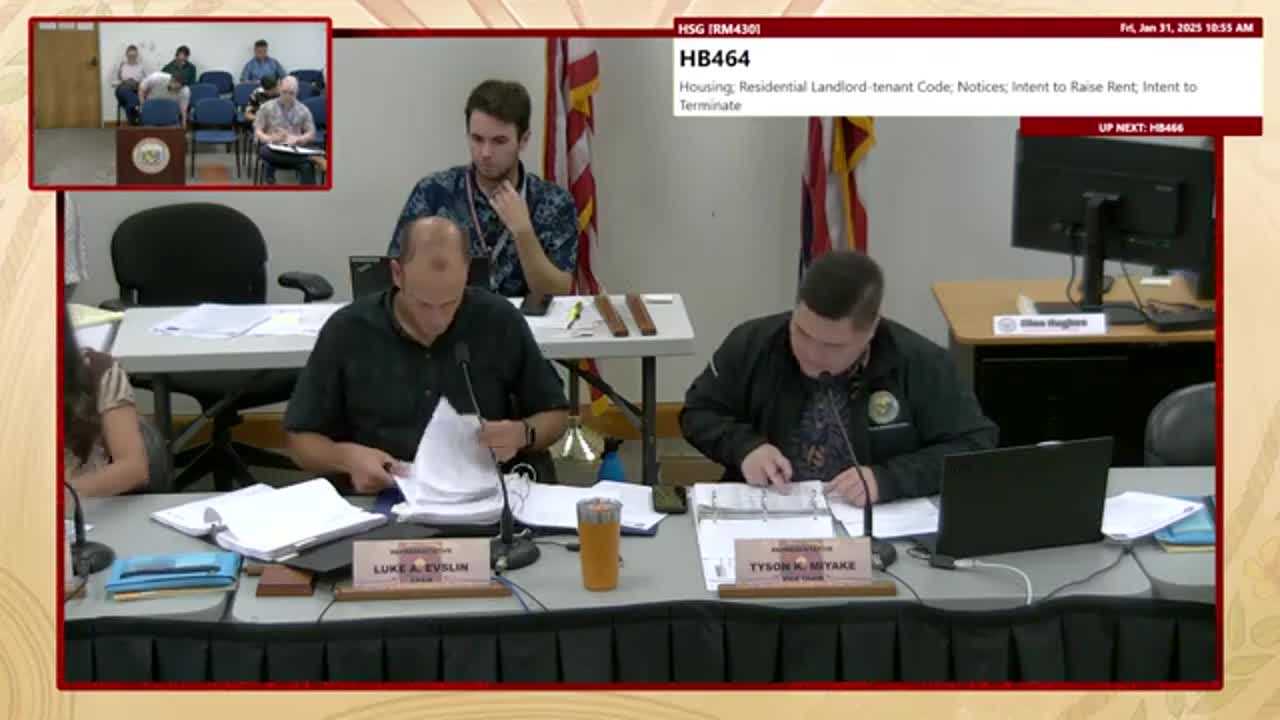
| Jan 31, 2025 | The committee on HSG recommend that the measure be PASSED, WITH AMENDMENTS. The votes were as follows: 7 Ayes: Representative(s) Evslin, Miyake, Grandinetti, Kila, La Chica, Muraoka, Pierick; Ayes with reservations: none; Noes: none; and 2 Excused: Representative(s) Cochran, Kitagawa. |
| Jan 28, 2025 | Bill scheduled to be heard by HSG on Friday, 01-31-25 9:15AM in House conference room 430 VIA VIDEOCONFERENCE. |
| Jan 21, 2025 | Referred to HSG, CPC, JHA, referral sheet 2 |
| Jan 21, 2025 | Introduced and Pass First Reading. |
| Jan 17, 2025 | Pending introduction. |
|
Date
|
Description
|
Location
|
Votes
|
|
|---|---|---|---|---|
| Jan 31, 2025 | The committee on HSG recommend that the measure be PASSED, WITH AMENDMENTS | House Standing Committee on Housing |
Passed |
This list shows positions taken on this bill by organizations on the date displayed, which is linked to the original source.
Positions by individuals are not included.
|
Organization
|
Position
|
Date
|
|---|---|---|
| Catholic Charities Hawaiʻi | ** Support | |
| Hawaii Guerrilla Video Hui | ** Support | |
| Hawaii Guerrilla Video Hui | *** Support | Jan 31, 2025 |
| Hawaiʻi Association of REALTORS | ** Against | |
| Hawaiʻi Workers Center | ** Support | |
| Hawaiʻi YIMBY | ** Support | |
| Maui Housing Hui | ** Support |
STAND. COM. REP. NO. 213
Honolulu, Hawaii
, 2025
RE: H.B. No. 466
H.D. 1
Honorable Nadine K. Nakamura
Speaker, House of Representatives
Thirty-Third State Legislature
Regular Session of 2025
State of Hawaii
Madame:
Your Committee on Housing, to which was referred H.B. No. 466 entitled:
"A BILL FOR AN ACT RELATING TO EVICTIONS,"
begs leave to report as follows:
The purpose of this measure is to:
(1) Prohibit landlords from terminating certain tenancies without cause;
(2) Establish criteria under which landlords can undertake a no-fault eviction; and
Your Committee received testimony in support of this measure from the Maui Housing Hui; Hawaiʻi YIMBY; Catholic Charities Hawaiʻi; Hawaii Guerrilla Video Hui; Hawaiʻi Workers Center; and numerous individuals. Your Committee received testimony in opposition to this measure from the Hawaiʻi Association of REALTORS. Your Committee received comments on this measure from the Department of the Attorney General.
Your Committee finds that Hawaii's high cost of housing has created a large population of long-term renters, yet existing laws allow landlords to terminate leases without cause, even when tenants have followed all terms of their rental agreements. This lack of protection leaves tenants vulnerable to sudden displacement, contributing to financial instability, housing insecurity, and, in some cases, homelessness. The fear of arbitrary evictions can also prevent tenants from reporting habitability issues, further compromising their living conditions. This measure seeks to address these concerns by prohibiting no-cause evictions, establishing clear criteria for when a landlord may lawfully terminate a tenancy, and requiring relocation assistance or a rent waiver in cases of no-fault evictions.
Your Committee has amended this measure by:
(1) Deleting language throughout the measure that would have authorized a landlord to initiate a no-fault eviction at the end of the term of a rental agreement;
(2) Reducing the amount of time a landlord is required to give a tenant to vacate the dwelling unit upon initiation of a no-fault eviction from ninety days to sixty days and reducing the amount of time the landlord must wait to list the dwelling unit as a transient vacation rental from ninety days to sixty days after a tenant vacates;
(3) Deleting language that would have authorized a landlord to initiate a no-fault eviction if a tenant refuses to sign a new rental agreement with reasonable terms, under certain circumstances;
(4) Deleting language that would have authorized a landlord to initiate a no-fault eviction at the end of the term of a rental agreement if a tenant submits late rent payments, under certain circumstances;
(5) Clarifying that rental assistance is an amount equal to one month's rent;
(6) Specifying that nothing under the measure shall be applied so as to impair any contract in a manner violative of the Hawaii State Constitution or Article I, Section 10, of the United States Constitution;
(7) Inserting a severability clause;
(8) Changing the effective date to January 1, 3000, to encourage further discussion; and
(9) Making technical, nonsubstantive amendments for the purposes of clarity, consistency, and style.
As affirmed by the record of votes of the members of your Committee on Housing that is attached to this report, your Committee is in accord with the intent and purpose of H.B. No. 466, as amended herein, and recommends that it pass Second Reading in the form attached hereto as H.B. No. 466, H.D. 1, and be referred to your Committee on Consumer Protection & Commerce.
Respectfully submitted on behalf of the members of the Committee on Housing,
|
|
|
____________________________ LUKE A. EVSLIN, Chair |
|
|
|
|
|
Date
|
Testimony PDF
|
|---|---|
| Jan 31, 2025 | HB466_TESTIMONY_HSG_01-31-25_.PDF |
Bill Author