HB 2236: Emergency Management; State of Emergency; Local State of Emergency
- Session Year: 2025-2026
- House: House
- Latest Version Date: 2026-02-17
Current Status:
Failed
(2026-02-18: Passed Second Reading as amended in HD 1 and referred to the committee(s) on JHA with none voting aye with reservations; none voting no (0) and none excused (0).)
Introduced
In Committee
First Chamber
In Committee
Second Chamber
Final Decking
Enacted
What does this bill do?
The bill clarifies how the governor and county mayors may use emergency powers, including rules for suspending laws that require officials to identify and justify any suspension and keep it no broader or longer than necessary. It bars governors and mayors from suspending agency response deadlines for public records and vital records requests during emergencies, though agencies may delay responses up to six months. The bill also defines “severe weather warning” and lets the Legislature or a county council end a state or local emergency by a two‑thirds vote.
The summary is provided by generative AI which can make mistakes. For original language, please view the details in the table below.
Clarifies state and local authority during a state or local state of emergency. Adds a definition of "severe weather warning". Allows the Legislature to terminate a state of emergency and city councils to terminate a local state of emergency. Effective 7/1/3000. (HD1)
Clarifies State and local authority during a state or local state of emergency. Adds definition of "severe weather warning". Allows the Legislature to terminate a state of emergency and city councils to terminate a local state of emergency.
|
HOUSE OF REPRESENTATIVES |
H.B. NO. |
2236 |
|
THIRTY-THIRD LEGISLATURE, 2026 |
H.D. 1 |
|
|
STATE OF HAWAII |
|
|
|
|
|
|
|
|
||
|
|
||
A BILL FOR AN ACT
RELATING TO EMERGENCY MANAGEMENT.
BE IT ENACTED BY THE LEGISLATURE OF THE STATE OF HAWAII:
The legislature finds that chapter 127A, Hawaii Revised Statutes, should clearly specify and articulate the bases for emergency actions. To that end, the purpose of this Act is to clarify state and county emergency management authority, ensure effective and adaptable emergency responses, and further the goals of transparency and democratic accountability within the State's constitutional system.
SECTION 2. Chapter 127A, Hawaii Revised Statutes, is amended by adding a new section to be appropriately designated and to read as follows:
"§127A- Suspension of certain record requests; prohibited. (a) The governor or mayor shall not, through any proclamation or declaration of emergency or any rule or order adopted pursuant to this chapter, suspend agency response deadlines for requests for:
(1) Public records pursuant to part II of chapter 92F; or
(2) Vital records or statistics pursuant to sections 338‑18.
(b) Due to extenuating circumstances, there may be a reasonable delay for up to six months in an agency's response to a request; provided that an agency shall not reject a request at any time, regardless of whether an emergency has been declared."
SECTION 3. Section 127A-2, Hawaii Revised Statutes, is amended by adding a new definition to be appropriately inserted and to read as follows:
""Severe weather warning" means the issuance of a public notification by the National Weather Service, Pacific Tsunami Warning Center, United States Geological Survey, or other public authority, that a dangerous condition exists that could impact the State, or any portion of it, within a specified period of time. "Severe weather warning" includes but is not limited to warnings of coastal inundation, high surf, flash flooding, volcanic activity, a tsunami, or a hurricane."
SECTION 4. Section 127A-13, Hawaii Revised Statutes, is amended to read as follows:
"§127A-13 Additional powers in an emergency period. (a) In the event of a state of emergency declared by the governor pursuant to section 127A-14, the governor may exercise the following additional powers pertaining to emergency management during the emergency period:
(1) Provide for and require the quarantine or segregation of persons who are affected with or believed to have been exposed to any infectious, communicable, or other disease that is, in the governor's opinion, dangerous to the public health and safety, or persons who are the source of other contamination, in any case where, in the governor's opinion, the existing laws are not adequate to assure the public health and safety; provide for the care and treatment of the persons; supplement the provisions of sections 325-32 to 325-38 concerning compulsory immunization programs; provide for the isolation or closing of property that is a source of contamination or is in a dangerous condition in any case where, in the governor's opinion, the existing laws are not adequate to assure the public health and safety, and designate as public nuisances acts, practices, conduct, or conditions that are dangerous to the public health or safety or to property; authorize that public nuisances be summarily abated and, if need be, that the property be destroyed by any police officer or authorized person, or provide for the cleansing or repair of property, and if the cleansing or repair is to be at the expense of the owner, the procedure therefor shall follow as nearly as may be the provisions of section 322-2, which shall be applicable; and further, authorize without the permission of the owners or occupants, entry on private premises for any of these purposes;
(2) Relieve hardships and
inequities, or obstructions to the public health, safety, or welfare, found by
the governor to exist in the laws and to result from the operation of federal
programs or measures taken under this chapter, by suspending the laws, in whole
or in part, or by alleviating [the provisions of laws on], subject
to terms and conditions [as] that the governor may [impose,]
specify, the provisions of laws, including licensing laws, quarantine
laws, and laws relating to labels, grades, and standards;
(3) [Suspend] Except
as provided in section 127A- , suspend any law that
impedes or tends to impede or be detrimental to the expeditious and efficient
execution of, or to conflict with, emergency functions, including laws that by
this chapter specifically are made applicable to emergency personnel; provided
that any suspension of law shall be no broader and last no longer than the
governor deems necessary for the execution of emergency management functions,
and any suspension of law shall identify the section of law suspended and, for
each section, shall both specify the emergency management functions facilitated
and justify the suspension based on protecting the public health, safety, and
welfare; provided further that any suspension of law that requires permits,
authorizations, or approvals from any state or county agency may continue
beyond the emergency period to allow for the completion of any repairs,
reconstruction, rebuilding, or construction of any state or county
infrastructure, facilities, or properties that would otherwise be delayed by
any permit, authorization, or approval;
(4) Suspend the provisions of any regulatory law prescribing the procedures for out-of-state utilities to conduct business in the State including any licensing laws applicable to out-of-state utilities or their respective employees, as well as any order, rule, or regulation of any state agency, if strict compliance with the provisions of any law, order, rule, or regulation would in any way prevent, hinder, or delay necessary action of a state utility in coping with the emergency or disaster with assistance that may be provided under a mutual assistance agreement;
(5) In the event of disaster or
emergency beyond local control, [or] an event that in the opinion of the
governor[, renders] makes state operational control or
coordination necessary, or upon request of the [local entity,] county,
and notwithstanding sections 127A-14 and 127A‑25, requires the county to
obtain the governor's approval, or the approval of the director of the Hawaii
emergency management agency, before issuing any emergency order, rule, or
proclamation under this chapter, assume direct operational control over all
or any part of the emergency management functions within the affected area;
(6) Shut off water mains, gas mains, or electric power connections, or suspend other services;
(7) Direct and control the mandatory evacuation of the civilian population;
(8) Exercise additional emergency functions to the extent necessary to prevent hoarding, waste, or destruction of materials, supplies, commodities, accommodations, facilities, and services, to effectuate equitable distribution thereof, or to establish priorities therein as the public welfare may require; to investigate; and notwithstanding any other law to the contrary, to regulate or prohibit, by means of licensing, rationing, or otherwise, the storage, transportation, use, possession, maintenance, furnishing, sale, or distribution thereof, and any business or any transaction related thereto;
(9) Suspend section 8-1, relating to state holidays, except the last paragraph relating to holidays declared by the president, which shall remain unaffected, and in the event of the suspension, the governor may establish state holidays by proclamation;
(10) Adjust the hours for voting to take into consideration the working hours of the voters during the emergency period, and suspend those provisions of section 11-131 that fix the hours for voting, and fix other hours by stating the same in the election proclamation or notice, as the case may be;
(11) Assure the continuity of service by critical infrastructure facilities, both publicly and privately owned, by regulating or, if necessary to the continuation of the service thereof, by taking over and operating the same; and
(12) Except as provided in section 134-7.2, whenever in the governor's opinion, the laws of the State do not adequately provide for the common defense, public health, safety, and welfare, investigate, regulate, or prohibit the storage, transportation, use, possession, maintenance, furnishing, sale, or distribution of, as well as any transaction related to, explosives, firearms, and ammunition, inflammable materials and other objects, implements, substances, businesses, or services of a hazardous or dangerous character, or particularly capable of misuse, or obstructive of or tending to obstruct law enforcement, emergency management, or military operations, including intoxicating liquor and the liquor business; and authorize the seizure and forfeiture of any objects, implements, or substances unlawfully possessed, as provided in this chapter.
(b) In the event of a local state of emergency declared by the mayor pursuant to section 127A-14, the mayor may exercise the following additional powers pertaining to emergency management during the emergency period:
(1) Relieve hardships and
inequities, or obstructions to the public health, safety, or welfare, found by
the mayor to exist in the laws of the county and to result from the operation
of federal programs or measures taken under this chapter, by suspending the
county laws, in whole or in part, or by alleviating [the provisions of
county laws on], subject to terms and conditions [as] that
the mayor may [impose,] specify, the provisions of county laws,
including county licensing laws[,] and county laws relating to labels,
grades, and standards;
(2) [Suspend] Except
as provided in section 127A- , suspend any county law that
impedes or tends to impede or be detrimental to the expeditious and efficient
execution of, or to conflict with, emergency functions, including laws that by
this chapter specifically are made applicable to emergency personnel; provided
that any suspension of law shall be no broader and last no longer than the
mayor deems necessary for the execution of emergency management functions, and
any suspension of law shall identify the section of law suspended and, for each
section, shall both specify the emergency management functions facilitated and
justify the suspension based on protecting the public health, safety, and
welfare; provided further that any suspension of law that requires permits,
authorizations, or approvals from any state or county agency may continue
beyond the emergency period to allow for the completion of any repairs,
reconstruction, rebuilding, or construction of any state or county
infrastructure, facilities, or properties that would otherwise be
delayed by any permit, authorization, or approval;
(3) Shut off water mains, gas mains, or electric power connections, or suspend other services;
(4) Direct and control the mandatory evacuation of the civilian population; and
(5) Exercise additional emergency functions, to the extent necessary to prevent hoarding, waste, or destruction of materials, supplies, commodities, accommodations, facilities, and services, to effectuate equitable distribution thereof, or to establish priorities therein as the public welfare may require; to investigate; and any other county law to the contrary notwithstanding, to regulate or prohibit, by means of licensing, rationing, or otherwise, the storage, transportation, use, possession, maintenance, furnishing, sale, or distribution thereof, and any business or any transaction related thereto."
SECTION 5. Section 127A-14, Hawaii Revised Statutes, is amended to read as follows:
"§127A-14 State of emergency. (a) The governor may declare the existence of a state of emergency in the State by proclamation if the governor finds that an emergency or a disaster has occurred or that there is imminent danger or threat of an emergency or a disaster in any portion of the State.
(b) A mayor may declare the existence of a local state of emergency in the county by proclamation if the mayor finds that an emergency or a disaster has occurred or that there is imminent danger or threat of an emergency or a disaster in any portion of the county.
(c) [The] Except
as provided in subsections (e) and (f), the governor or mayor shall be the
sole judge of the existence of the danger, threat, or circumstances giving rise
to a declaration, an extension, or a termination of a state of emergency in the
State or a local state of emergency in the county, as applicable. This section shall not limit the power and
authority of the governor under section 127A-13(a)(5).
(d) A state of emergency and a local state of emergency shall terminate automatically sixty days after the issuance of a proclamation of a state of emergency or local state of emergency, respectively, unless extended or terminated by a separate or supplementary proclamation of the governor or mayor. The governor or mayor shall proclaim the termination of a state of emergency or local state of emergency, respectively, at the earliest possible date that conditions warrant.
(e) The legislature may, by an affirmative vote of two-thirds of the members to which each house is entitled, terminate a state of emergency, in part or in whole, declared by the governor pursuant to this section.
(f) The county council may, by an affirmative vote of two-thirds, terminate a local state of emergency, in part or in whole, declared by the mayor pursuant to this section."
SECTION 6. Statutory material to be repealed is bracketed and stricken. New statutory material is underscored.
SECTION 7. This Act shall take effect on July 1, 3000.
Report Title:
Emergency Management; State of Emergency; Local State of Emergency
Description:
Clarifies state and local authority during a state or local state of emergency. Adds a definition of "severe weather warning". Allows the Legislature to terminate a state of emergency and city councils to terminate a local state of emergency. Effective 7/1/3000. (HD1)
The summary description of legislation appearing on this page is for informational purposes only and is not legislation or evidence of legislative intent.
|
HOUSE OF REPRESENTATIVES |
H.B. NO. |
2236 |
|
THIRTY-THIRD LEGISLATURE, 2026 |
|
|
|
STATE OF HAWAII |
|
|
|
|
|
|
|
|
||
|
|
||
A BILL FOR AN ACT
relating to emergency management.
BE IT ENACTED BY THE LEGISLATURE OF THE STATE OF HAWAII:
The legislature finds that chapter 127A, Hawaii Revised Statutes, should clearly specify and articulate the bases for emergency actions. To that end, the purpose of this Act is to clarify state and county emergency management authority, ensure effective and adaptable emergency responses, and further the goals of transparency and democratic accountability within the State's constitutional system.
SECTION 2. Chapter 127A, Hawaii Revised Statutes, is amended by adding a new section to be appropriately designated and to read as follows:
"§127A- Suspension of certain record requests; prohibited. (a) The governor or mayor shall not, through any proclamation or declaration of emergency or any rule or order adopted pursuant to this chapter, suspend agency response deadlines for requests for:
(1) Public records pursuant to part II of chapter 92F; or
(2) Vital records or statistics pursuant to sections 338‑18.
(b) Due to extenuating circumstances, there may be a reasonable delay in an agency's response to a request; provided that an agency shall not reject a request at any time, regardless of whether an emergency has been declared."
SECTION 3. Section 127A-2, Hawaii Revised Statutes, is amended by adding a new definition to be appropriately inserted and to read as follows:
""Severe weather warning" means the issuance of a public notification by the National Weather Service, Pacific Tsunami Warning Center, United States Geological Survey, or other public authority, that a dangerous condition exists that could impact the State, or any portion of it, within a specified period of time. "Severe weather warning" includes but is not limited to warnings of coastal inundation, high surf, flash flooding, volcanic activity, a tsunami, or a hurricane."
SECTION 4. Section 127A-13, Hawaii Revised Statutes, is amended to read as follows:
"§127A-13 Additional powers in an emergency period. (a) In the event of a state of emergency declared by the governor pursuant to section 127A-14, the governor may exercise the following additional powers pertaining to emergency management during the emergency period:
(1) Provide for and require the quarantine or segregation of persons who are affected with or believed to have been exposed to any infectious, communicable, or other disease that is, in the governor's opinion, dangerous to the public health and safety, or persons who are the source of other contamination, in any case where, in the governor's opinion, the existing laws are not adequate to assure the public health and safety; provide for the care and treatment of the persons; supplement the provisions of sections 325-32 to 325-38 concerning compulsory immunization programs; provide for the isolation or closing of property that is a source of contamination or is in a dangerous condition in any case where, in the governor's opinion, the existing laws are not adequate to assure the public health and safety, and designate as public nuisances acts, practices, conduct, or conditions that are dangerous to the public health or safety or to property; authorize that public nuisances be summarily abated and, if need be, that the property be destroyed by any police officer or authorized person, or provide for the cleansing or repair of property, and if the cleansing or repair is to be at the expense of the owner, the procedure therefor shall follow as nearly as may be the provisions of section 322-2, which shall be applicable; and further, authorize without the permission of the owners or occupants, entry on private premises for any of these purposes;
(2) Relieve hardships and
inequities, or obstructions to the public health, safety, or welfare, found by
the governor to exist in the laws and to result from the operation of federal
programs or measures taken under this chapter, by suspending the laws, in whole
or in part, or by alleviating [the provisions of laws on], subject
to terms and conditions [as] that the governor may [impose,]
specify, the provisions of laws, including licensing laws, quarantine
laws, and laws relating to labels, grades, and standards;
(3) [Suspend] Except
as provided in section 127A- , suspend any law that impedes or
tends to impede or be detrimental to the expeditious and efficient execution
of, or to conflict with, emergency functions, including laws that by this
chapter specifically are made applicable to emergency personnel; provided
that any suspension of law shall be no broader and last no longer than the
governor deems necessary for the execution of emergency management functions,
and any suspension of law shall identify the section of law suspended and, for
each section, shall both specify the emergency management functions facilitated
and justify the suspension based on protecting the public health, safety, and
welfare; provided further that any suspension of law that requires permits,
authorizations, or approvals from any state or county agency may continue
beyond the emergency period to allow for the completion of any repairs,
reconstruction, rebuilding, or construction of any state or county
infrastructure, facilities, or properties that would otherwise be delayed by
any permit, authorization, or approval;
(4) Suspend the provisions of any regulatory law prescribing the procedures for out-of-state utilities to conduct business in the State including any licensing laws applicable to out-of-state utilities or their respective employees, as well as any order, rule, or regulation of any state agency, if strict compliance with the provisions of any law, order, rule, or regulation would in any way prevent, hinder, or delay necessary action of a state utility in coping with the emergency or disaster with assistance that may be provided under a mutual assistance agreement;
(5) In the event of disaster or
emergency beyond local control, [or] an event that in the opinion of the
governor[, renders] makes state operational control or
coordination necessary, or upon request of the [local entity,] county,
and notwithstanding sections 127A-14 and 127A‑25, requires the county to
obtain the governor's approval, or the approval of the director of the Hawaii
emergency management agency, before issuing any emergency order, rule, or
proclamation under this chapter, assume direct operational control over all
or any part of the emergency management functions within the affected area;
(6) Shut off water mains, gas mains, or electric power connections, or suspend other services;
(7) Direct and control the mandatory evacuation of the civilian population;
(8) Exercise additional emergency functions to the extent necessary to prevent hoarding, waste, or destruction of materials, supplies, commodities, accommodations, facilities, and services, to effectuate equitable distribution thereof, or to establish priorities therein as the public welfare may require; to investigate; and notwithstanding any other law to the contrary, to regulate or prohibit, by means of licensing, rationing, or otherwise, the storage, transportation, use, possession, maintenance, furnishing, sale, or distribution thereof, and any business or any transaction related thereto;
(9) Suspend section 8-1, relating to state holidays, except the last paragraph relating to holidays declared by the president, which shall remain unaffected, and in the event of the suspension, the governor may establish state holidays by proclamation;
(10) Adjust the hours for voting to take into consideration the working hours of the voters during the emergency period, and suspend those provisions of section 11-131 that fix the hours for voting, and fix other hours by stating the same in the election proclamation or notice, as the case may be;
(11) Assure the continuity of service by critical infrastructure facilities, both publicly and privately owned, by regulating or, if necessary to the continuation of the service thereof, by taking over and operating the same; and
(12) Except as provided in section 134-7.2, whenever in the governor's opinion, the laws of the State do not adequately provide for the common defense, public health, safety, and welfare, investigate, regulate, or prohibit the storage, transportation, use, possession, maintenance, furnishing, sale, or distribution of, as well as any transaction related to, explosives, firearms, and ammunition, inflammable materials and other objects, implements, substances, businesses, or services of a hazardous or dangerous character, or particularly capable of misuse, or obstructive of or tending to obstruct law enforcement, emergency management, or military operations, including intoxicating liquor and the liquor business; and authorize the seizure and forfeiture of any objects, implements, or substances unlawfully possessed, as provided in this chapter.
(b) In the event of a local state of emergency declared by the mayor pursuant to section 127A-14, the mayor may exercise the following additional powers pertaining to emergency management during the emergency period:
(1) Relieve hardships and
inequities, or obstructions to the public health, safety, or welfare, found by
the mayor to exist in the laws of the county and to result from the operation
of federal programs or measures taken under this chapter, by suspending the
county laws, in whole or in part, or by alleviating [the provisions of
county laws on], subject to terms and conditions [as] that
the mayor may [impose,] specify, the provisions of county laws,
including county licensing laws[,] and county laws relating to labels,
grades, and standards;
(2) [Suspend] Except
as provided in section 127A- , suspend any county law that
impedes or tends to impede or be detrimental to the expeditious and efficient
execution of, or to conflict with, emergency functions, including laws that by
this chapter specifically are made applicable to emergency personnel; provided
that any suspension of law shall be no broader and last no longer than the
mayor deems necessary for the execution of emergency management functions, and
any suspension of law shall identify the section of law suspended and, for each
section, shall both specify the emergency management functions facilitated and
justify the suspension based on protecting the public health, safety, and
welfare; provided further that any suspension of law that requires permits,
authorizations, or approvals from any state or county agency may continue
beyond the emergency period to allow for the completion of any repairs,
reconstruction, rebuilding, or construction of any state or county
infrastructure, facilities, or properties that would otherwise be
delayed by any permit, authorization, or approval;
(3) Shut off water mains, gas mains, or electric power connections, or suspend other services;
(4) Direct and control the mandatory evacuation of the civilian population; and
(5) Exercise additional emergency functions, to the extent necessary to prevent hoarding, waste, or destruction of materials, supplies, commodities, accommodations, facilities, and services, to effectuate equitable distribution thereof, or to establish priorities therein as the public welfare may require; to investigate; and any other county law to the contrary notwithstanding, to regulate or prohibit, by means of licensing, rationing, or otherwise, the storage, transportation, use, possession, maintenance, furnishing, sale, or distribution thereof, and any business or any transaction related thereto."
SECTION 5. Section 127A-14, Hawaii Revised Statutes, is amended to read as follows:
"§127A-14 State of emergency. (a) The governor may declare the existence of a state of emergency in the State by proclamation if the governor finds that an emergency or a disaster has occurred or that there is imminent danger or threat of an emergency or a disaster in any portion of the State.
(b) A mayor may declare the existence of a local state of emergency in the county by proclamation if the mayor finds that an emergency or a disaster has occurred or that there is imminent danger or threat of an emergency or a disaster in any portion of the county.
(c) [The] Except
as provided in subsections (e) and (f), the governor or mayor shall be the
sole judge of the existence of the danger, threat, or circumstances giving rise
to a declaration, an extension, or a termination of a state of emergency in the
State or a local state of emergency in the county, as applicable. This section shall not limit the power and
authority of the governor under section 127A-13(a)(5).
(d) A state of emergency and a local state of emergency shall terminate automatically sixty days after the issuance of a proclamation of a state of emergency or local state of emergency, respectively, unless extended or terminated by a separate or supplementary proclamation of the governor or mayor. The governor or mayor shall proclaim the termination of a state of emergency or local state of emergency, respectively, at the earliest possible date that conditions warrant.
(e) The legislature may, by an affirmative vote of two-thirds of the members to which each house is entitled, terminate a state of emergency, in part or in whole, declared by the governor pursuant to this section.
(f) The county council may, by an affirmative vote of two-thirds, terminate a local state of emergency, in part or in whole, declared by the mayor pursuant to this section."
SECTION 6. Statutory material to be repealed is bracketed and stricken. New statutory material is underscored.
SECTION 7. This Act shall take effect upon its approval.
|
INTRODUCED BY: |
_____________________________ |
|
|
|
Report Title:
Emergency Management; State of Emergency; Local State of Emergency
Description:
Clarifies State and local authority during a state or local state of emergency. Adds definition of "severe weather warning". Allows the Legislature to terminate a state of emergency and city councils to terminate a local state of emergency.
The summary description of legislation appearing on this page is for informational purposes only and is not legislation or evidence of legislative intent.
|
Date
|
Status
|
|---|---|
| Feb 18, 2026 | Passed Second Reading as amended in HD 1 and referred to the committee(s) on JHA with none voting aye with reservations; none voting no (0) and none excused (0). |
| Feb 18, 2026 | Reported from PBS (Stand. Com. Rep. No. 393-26) as amended in HD 1, recommending passage on Second Reading and referral to JHA. |
| Feb 11, 2026 | The committee on PBS recommend that the measure be PASSED, WITH AMENDMENTS. The votes were as follows: 9 Ayes: Representative(s) Belatti, Iwamoto, Hashem, Ichiyama, Morikawa, Poepoe, Woodson, Shimizu, Souza; Ayes with reservations: none; Noes: none; and Excused: none. |
| Feb 6, 2026 | Bill scheduled to be heard by PBS on Wednesday, 02-11-26 8:40AM in House conference room 411 VIA VIDEOCONFERENCE. |
| Jan 30, 2026 | Referred to PBS, JHA, referral sheet 5 |
| Jan 28, 2026 | Introduced and Pass First Reading. |
| Jan 26, 2026 | Pending introduction. |
|
Date
|
Description
|
Location
|
Votes
|
|
|---|---|---|---|---|
| Feb 11, 2026 | The committee on PBS recommend that the measure be PASSED, WITH AMENDMENTS | House Standing Committee on Public Safety |
Passed |
This list shows positions taken on this bill by organizations on the date displayed, which is linked to the original source.
Positions by individuals are not included.
|
Organization
|
Position
|
Date
|
|---|---|---|
| Grassroot Institute of Hawaii | ** Support | |
| the Hawaiʻi Emergency Management Agency | ** Against |
STAND. COM. REP. NO. 393-26
Honolulu, Hawaii
, 2026
RE: H.B. No. 2236
H.D. 1
Honorable Nadine K. Nakamura
Speaker, House of Representatives
Thirty-Third State Legislature
Regular Session of 2026
State of Hawaii
Madame:
Your Committee on Public Safety, to which was referred H.B. No. 2236 entitled:
"A BILL FOR AN ACT RELATING TO EMERGENCY MANAGEMENT,"
begs leave to report as follows:
The purpose of this measure is to:
(1) Clarify state and local authority during a state or local state of emergency;
(2) Add a definition of "severe weather warning"; and
(3) Allow the Legislature to terminate a state of emergency and county councils to terminate a local state of emergency.
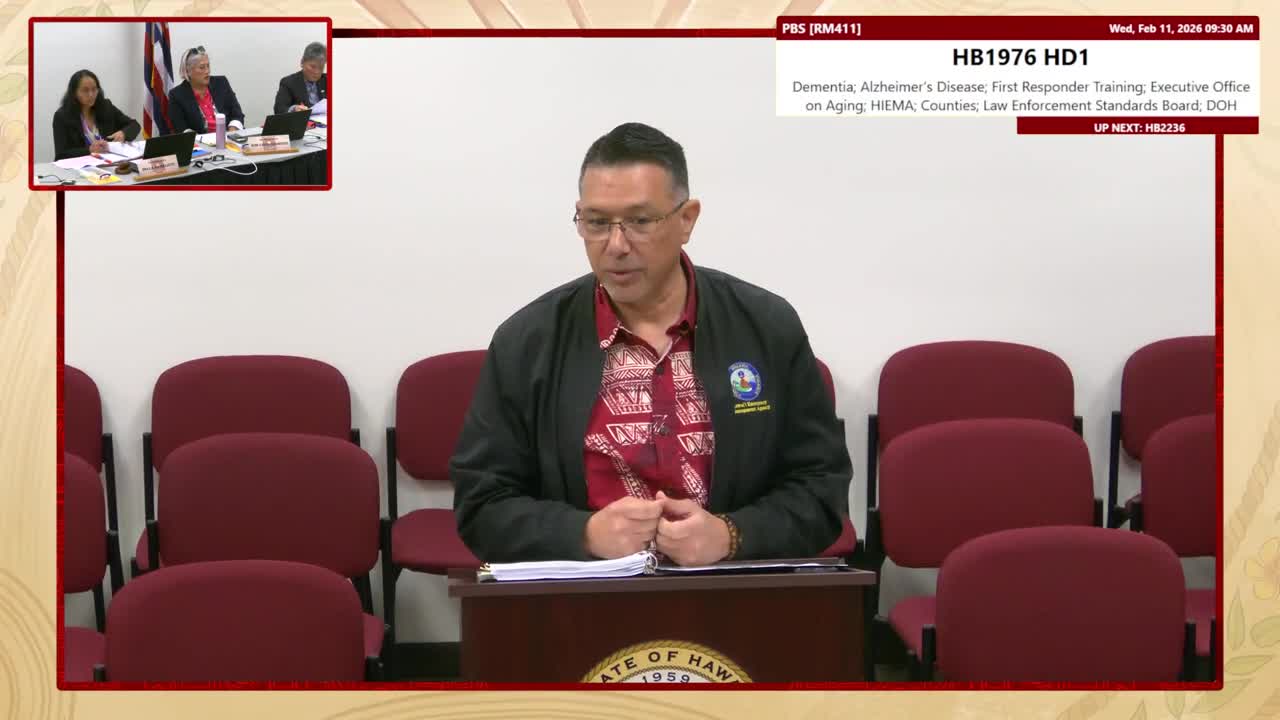
Your Committee received testimony in support of this measure from the Grassroot Institute of Hawaii. Your Committee received testimony in opposition to this measure from the Hawaiʻi Emergency Management Agency. Your Committee received comments on this measure from the Office of Information Practices.
Your Committee finds that government transparency and accountability must be maintained even during a state of emergency. Your Committee further finds that it is vital to the constitutional framework of checks and balances and the separation of powers to ensure that the Governor or a mayor's emergency powers do not become a tool for unchecked executive authority. This measure seeks to avoid such a situation.
Your Committee has amended this measure by:
(1) Clarifying that the reasonable delay in an agency's response to requests for certain records due to extenuating circumstances cannot exceed six months;
(2) Changing its effective date to July 1, 3000, to encourage further discussion; and
(3) Making technical, nonsubstantive amendments for the purposes of clarity, consistency, and style.
As affirmed by the record of votes of the members of your Committee on Public Safety that is attached to this report, your Committee is in accord with the intent and purpose of H.B. No. 2236, as amended herein, and recommends that it pass Second Reading in the form attached hereto as H.B. No. 2236, H.D. 1, and be referred to your Committee on Judiciary & Hawaiian Affairs.
Respectfully submitted on behalf of the members of the Committee on Public Safety,
|
|
|
____________________________ DELLA AU BELATTI, Chair |
|
|
|
|
|
Date
|
Testimony PDF
|
|---|---|
| Feb 11, 2026 | HB2236_TESTIMONY_PBS_02-11-26_.PDF |
Discussed in Hearing
 5MIN
House Standing Committee on Public Safety
 1MIN
House Standing Committee on Public Safety
Bill Author