HB 1623: Hawaii Climate Change Mitigation and Adaptation Commission; Duties; Executive Committee; Member Agencies; Reports; Sea Level Rise Vulnerability and Adaptation Reports; Zero Emissions Clean Economy Target
- Session Year: 2025-2026
- House: House
- Latest Version Date: 2026-02-06
Current Status:
Failed
(2026-02-10: Passed Second Reading as amended in HD 1 and referred to the committee(s) on WAL with none voting aye with reservations; Representative(s) Garcia, Pierick voting no (2) and none excused (0).)
Introduced
In Committee
First Chamber
In Committee
Second Chamber
Final Decking
Enacted
What does this bill do?
This bill reorganizes the Hawaii Climate Change Mitigation and Adaptation Commission by creating a five-member executive committee, changing its membership, and requiring member state and county agencies to carry out the commission's climate strategies. Agencies must report progress using a standard template; the commission will keep and update fifty-year sea-level rise reports and may enter contracts; and the bill sets statewide net greenhouse gas targets of at least 50% below 2005 by 2030 and net‑zero by 2045 (net = emissions minus removals).
The summary is provided by generative AI which can make mistakes. For original language, please view the details in the table below.
Establishes an executive committee and amends the membership and duties of the Hawaii Climate Change Mitigation and Adaptation Commission (Commission). Requires each member agency of the Commission to implement its own actions to address certain strategies and goals established by the Commission. Establishes reporting and review requirements for member agencies relating to climate change mitigation and adaptation efforts and clean economy targets. Updates reporting requirements for the Sea Level Rise Vulnerability and Adaptation reports. Allows the Commission to enter into certain procurement contracts. Updates the zero emissions clean economy target. Effective 7/1/3000. (HD1)
Establishes an executive committee and amends the membership and duties of the Hawaii Climate Change Mitigation and Adaptation Commission (Commission). Requires each member agency of the Commission to implement its own actions to address certain strategies and goals established by the Commission. Establishes reporting and review requirements for member agencies relating to climate change mitigation and adaptation efforts and clean economy targets. Updates reporting requirements for the Sea Level Rise Vulnerability and Adaptation reports. Allows the Commission to enter into certain procurement contracts. Updates the zero emissions clean economy target.
|
HOUSE OF REPRESENTATIVES |
H.B. NO. |
1623 |
|
THIRTY-THIRD LEGISLATURE, 2026 |
H.D. 1 |
|
|
STATE OF HAWAII |
|
|
|
|
|
|
|
|
||
|
|
||
A BILL FOR AN ACT
RELATING TO THE ENVIRONMENT.
BE IT ENACTED BY THE LEGISLATURE OF THE STATE OF HAWAII:
SECTION 1. The legislature finds that the climate crisis is the overriding challenge of the twenty-first century, presenting significant threats to the environment, public health, and economic stability of the State.
In 2024, the department of transportation reached an unprecedented settlement in the Navahine v. Hawaii Department of Transportation constitutional climate lawsuit, underscoring the State's commitment to addressing climate change through responsible governance and innovative solutions. The settlement further emphasized the importance of ensuring that future generations and youth will inherit a life-sustaining climate with access to the same diversity and cultural resources enjoyed by previous generations.
The legislature recognized in Act 32, Session Laws of Hawaii 2017 (Act 32), that on December 12, 2015, one hundred ninety-five countries at the 21st Conference of the Parties of the United Nations Framework Convention on Climate Change adopted an agreement addressing greenhouse gas emissions mitigation, adaptation, and finance starting in the year 2020, known as the Paris Agreement. Act 32 further documented the State's commitment to implement the goals of the Paris Agreement, demonstrating the State's proactive stance in contributing to global climate mitigation efforts by systematically reducing greenhouse gas emissions.
Furthermore, the United States has set ambitious, nationally determined contributions under the Paris Agreement, aiming to significantly reduce national greenhouse gas emissions. In December 2023, the Hawaii state energy office completed the first Hawaiʻi Pathways to Decarbonization report to estimate sector and category-level projections of greenhouse gas emissions necessary to reach the overarching emissions target established in section 225P-5, Hawaii Revised Statutes, by Act 238, Session Laws of Hawaii 2022. Through this work, sector-specific targets can be derived, providing a clearer roadmap for achieving comprehensive emissions reductions across all sectors of the State's economy.
The legislature further finds that the current overarching targets established within section 225P-5, Hawaii Revised Statutes, are consistent with the nationally determined contributions but can be strengthened by providing more specificity and clarity. Similarly, the responsibilities and powers of the Hawaii climate change mitigation and adaptation commission could be updated to better address the environmental threats facing the State.
Accordingly, the purpose of this Act is to:
(1) Establish an executive committee and amend the membership and duties of the Hawaii climate change mitigation and adaptation commission;
(2) Require each member agency of the Hawaii climate change mitigation and adaptation commission to implement its own actions to address certain strategies and goals established by the commission;
(3) Establish reporting and review requirements for member agencies relating to climate change mitigation and adaptation efforts and clean economy targets;
(4) Update reporting requirements for the sea level rise vulnerability and adaptation reports;
(5) Allow the Hawaii climate change mitigation and adaptation commission to enter into certain procurement contracts; and
(6) Update the zero emissions clean economy target.
SECTION 2. Section 225P-2, Hawaii Revised Statutes, is amended by adding twelve new definitions to be appropriately inserted and to read as follows:
""Anthropogenic greenhouse gas emissions" means the release of greenhouse gases into the atmosphere as a direct result of human activities generated through sources including but not limited to fuel combustion, industrial operations, deforestation, agricultural practices, and waste management.
"Carbon sink" means any process, activity, or mechanism that removes greenhouse gases, an aerosol, or a precursor of a greenhouse gas from the atmosphere.
"Emission leakage" means the net increase of anthropogenic greenhouse gas emissions occurring outside an established inventory system boundary in one location or sector that results from efforts to reduce greenhouse gas emissions in another location or sector.
"Greenhouse gas" means any gas in the atmosphere that traps or emits heat and results in increasing the Earth's surface temperatures. "Greenhouse gas" includes carbon dioxide, methane, nitrous oxide, and fluorinated gases.
"Greenhouse gas emission" means the production or release of greenhouse gases from human activities including but not limited to the burning of carbon-based fuels, the release of gases from certain chemical reactions, the release and leakage of refrigerants, the application of fertilizer, or deforestation.
"Greenhouse gas emissions inventory" means the statewide greenhouse gas emissions inventory report published by the department of health pursuant to section 342B-71.
"Greenhouse gas emitting category" means the various economic sub-classifications within each sector as defined by the Intergovernmental Panel on Climate Change of the United Nations.
"Greenhouse gas emitting sector" means the various economic classifications that contribute to greenhouse gas emissions, including the energy, transport, buildings, industry, agriculture, forestry, and waste management sectors, as determined by the Intergovernmental Panel on Climate Change of the United Nations.
"Greenhouse gas reservoir" means a physical unit or component of the biosphere, geosphere, or hydrosphere with the capability to store, accumulate, or release a greenhouse gas removed from the atmosphere by a greenhouse gas sink or a greenhouse gas captured from a greenhouse gas emission source.
"Member agency" mean any state or county agency represented by a member of the commission pursuant to section 225P-3(c).
"Member state agency" mean any state agency represented by a member of the commission pursuant to section 225P-3(c).
"Net greenhouse gas emission" means the estimated balance between the emissions produced or released into the atmosphere, subtracted from the emissions sequestered through natural and technological processes, or the sum of emissions sources and sinks."
SECTION 3. Section 225P-3, Hawaii Revised Statutes, is amended to read as follows:
"§225P-3 Hawaii climate change mitigation and adaptation commission; general functions, duties, and powers. (a) There is established the Hawaii climate change mitigation and adaptation commission that shall be placed within the department of land and natural resources for administrative purposes only.
(b) [Coordination of the] The
commission shall be [headed jointly by the chairperson of the board of land
and natural resources, or the chairperson's designee, and the director of the
office of planning and sustainable development, or the director's designee.]
headed by a five-member executive committee, to be elected annually from
among the members of the commission at its first meeting of the calendar
year. The executive committee shall
consist of:
(1) One of the commission members described in subsection (c)(1);
(2) Two of the commission members described in subsection (c)(2) to (14);
(3) One of the commission members described in subsection (c)(15); and
(4) One of the commission members described in subsection (c)(2), (4), (6), (8), (9), (10), (12), or (13) that is not elected under paragraph (2).
(c) The commission shall include the following members:
(1) The chairs of the standing committees of the legislature with subject matter jurisdiction encompassing environmental protection, climate mitigation, transportation, and land use;
(2) The chairperson of
the board of land and natural resources or the chairperson's designee[, who
shall be the co-chair of the commission];
(3) The director of
the office of planning and sustainable development or the director's designee[,
who shall be the co-chair of the commission];
(4) The director of business, economic development, and tourism or the director's designee;
(5) The chairperson of the board of directors of the Hawaii tourism authority or the chairperson's designee;
(6) The chairperson of the board of agriculture and biosecurity or the chairperson's designee;
(7) The chief executive officer of the office of Hawaiian affairs or the officer's designee;
(8) The chairperson of the Hawaiian homes commission or the chairperson's designee;
(9) The director of transportation or the director's designee;
(10) The director of health or the director's designee;
(11) The [adjutant
general] administrator of the Hawaii emergency management agency or
the [adjutant general's] administrator's designee;
(12) The [chairperson]
superintendent of [the board of] education or the [chairperson's]
superintendent's designee;
[(13) The directors
of each of the county planning departments, or the directors' designees; and
(14)] (13) The [manager of the coastal zone
management program.] comptroller or the comptroller's designee;
(14) The chief energy officer or the officer's designee; and
(15) The directors of each of the county planning departments, or the directors' designees.
(d)
In addition to the members listed in subsection (c), the [chairs of
the commission] executive committee may
request [the participation or input of] members of the public; experts
in the field; [and] county, state, or federal officials [or];
and others as necessary[.] to participate in or provide input to
the commission.
(e) The members of the commission shall serve without pay but shall be reimbursed for their actual and necessary expenses, including travel expenses, incurred in carrying out their duties.
(f) The commission shall provide policy direction, facilitation, coordination, and planning among state and county agencies, federal agencies, and other partners as appropriate.
(g) The commission shall establish climate change mitigation and adaptation strategies and goals to help guide planning and implementation statewide using the latest scientific analysis and risk assessment to monitor and forecast climate change related impacts at the regional, state, and local level, including any additional information deemed necessary. Each member agency shall implement actions within its own agency to address the strategies and goals established by the commission.
(h) The commission shall identify vulnerable people, communities, industries, ecosystems, and the potential economic and public health ramifications for climate change related impacts.
(i)
The commission shall identify existing climate change mitigation and
adaptation efforts at the federal, state, and local levels and make
recommendations [for how] and determine direct actions needed to
meet or exceed Hawaii's state mitigation goals and shall adopt a liberal
approach in preparation, so as to minimize future risk to the people and
environment of Hawaii.
(j) The commission shall assess the capacity and availability of existing resources and identify new sources of revenue necessary to address climate change mitigation and adaptation and shall advise the governor, legislature, and counties on the economic and budgetary ramifications of climate change impacts, mitigation, and adaptation.
(k) The commission shall identify the information necessary to track progress in implementing climate change mitigation and adaptation efforts and shall submit an annual report to the governor and legislature no later than twenty days prior to the convening of each regular session of the legislature.
(l) The commission shall maintain a website that includes a mission statement as well as access to climate change related actions, plans, policies, and results.
(m) The commission shall conduct a comprehensive review of the implementation as required by this section and submit a report to the governor, legislature, and the counties no later than twenty days prior to the convening of the regular session of 2023 and every five years thereafter. Each member agency shall identify information necessary to track progress in implementing climate change mitigation and adaptation efforts, select implementation actions that align with the agency's primary purpose, and submit to the commission a comprehensive review of its implementation actions and progress no later than twenty days prior to the convening of the regular session of 2028 and every five years thereafter. The commission shall assist member agencies with the documentation requirements specific to each agency and make the reports publicly available.
(n)
The commission shall[, as a first step, focus on and develop] maintain
and publish sea level rise vulnerability and adaptation reports that shall
include:
(1) Identification of
the major areas of sea level rise impacts affecting the State and counties
through 2050[;] and shall publish updated reports as these impacts
over a fifty-year planning horizon are identified;
(2) Identification of
expected impacts of sea level rise based on the latest scientific research for
each area through 2050[;] and shall publish updated reports as these
expected impacts over a fifty-year planning horizon are identified;
(3) Identification of the economic ramifications of sea level rise;
(4) Identification of applicable federal laws, policies, or programs that impact affected areas; and
(5) Recommendations for planning, management, and adaptation for hazards associated with increasing sea level rise.
The [reports shall be made publicly available no
later than December 31, 2017, and the] commission shall reevaluate and
update the 2017 sea level rise vulnerability and adaptation report every
five years.
(o) In developing the report, pursuant to subsection (n), the commission shall:
(1) Solicit public views and concerns; and
(2) Coordinate with the various county, state, and federal agencies involved in ongoing climate change adaptation planning initiatives.
SECTION 4. Section 225P-5, Hawaii Revised Statutes, is amended to read as follows:
"§225P-5 Zero emissions clean
economy target. (a) Considering [both atmospheric carbon and]
all in-state anthropogenic greenhouse gas emissions as well as [offsets]
carbon sink capacity from the local in-state sequestration of
atmospheric carbon [and greenhouse gases] through long-term carbon
sinks and greenhouse gas reservoirs, a statewide net greenhouse gas
emission target is hereby established to sequester more atmospheric carbon
and greenhouse gases than [emitted] anthropogenic greenhouse gas
emissions within the State as quickly as practicable[, but no later than
2045; provided that the statewide target includes a greenhouse gas emissions
limit, to be achieved no later than].
The net greenhouse gas emissions target shall be as follows:
(1) By December 31,
2030, [of] statewide net greenhouse gas emissions shall be at
least fifty per cent below the level of the statewide net greenhouse gas
emissions in 2005[.], as determined by the greenhouse gas emissions
inventory; and
(2) By December 31, 2045, statewide net greenhouse gas emissions shall be no greater than zero.
(b) The commission shall work:
(1) With stakeholders in all greenhouse gas emitting sectors and categories to develop and inform science-based targets in those sectors and categories; and
(2) To ensure that all member agencies avoid emission leakage resulting from policies, projects, and programs implemented to achieve the targets established pursuant to this section.
[(b)] (c) The [Hawaii climate change mitigation and
adaptation] commission shall [endeavor to] provide policy and
program guidance to member agencies and non-governmental agencies on the
actions needed to achieve the goals of this section.
(d) After January 1, [2020,] 2027,
member state agency plans, decisions, including procurement decisions,
and strategies shall [give consideration to] consider the impact
of those plans, decisions, and strategies on the State's ability to achieve the
[goals] targets outlined in this section, weighed appropriately
against their primary purpose.
(e) Each member agency shall submit to the commission and include in its annual report to the legislature and governor pursuant to section 225P-3(k) a summary of actions taken, or not taken, to help the State meet the established clean economy targets. The commission shall develop a standardized reporting template to facilitate reporting for member agencies."
SECTION 5. Statutory material to be repealed is bracketed and stricken. New statutory material is underscored.
SECTION 6. This Act shall take effect on July 1, 3000.
Report Title:
Hawaii Climate Change Mitigation and Adaptation Commission; Duties; Executive Committee; Member Agencies; Reports; Sea Level Rise Vulnerability and Adaptation Reports; Zero Emissions Clean Economy Target
Description:
Establishes an executive committee and amends the membership and duties of the Hawaii Climate Change Mitigation and Adaptation Commission (Commission). Requires each member agency of the Commission to implement its own actions to address certain strategies and goals established by the Commission. Establishes reporting and review requirements for member agencies relating to climate change mitigation and adaptation efforts and clean economy targets. Updates reporting requirements for the Sea Level Rise Vulnerability and Adaptation reports. Allows the Commission to enter into certain procurement contracts. Updates the zero emissions clean economy target. Effective 7/1/3000. (HD1)
The summary description of legislation appearing on this page is for informational purposes only and is not legislation or evidence of legislative intent.
|
HOUSE OF REPRESENTATIVES |
H.B. NO. |
1623 |
|
THIRTY-THIRD LEGISLATURE, 2026 |
|
|
|
STATE OF HAWAII |
|
|
|
|
|
|
|
|
||
|
|
||
A BILL FOR AN ACT
relating to the environment.
BE IT ENACTED BY THE LEGISLATURE OF THE STATE OF HAWAII:
SECTION 1. The legislature finds that the climate crisis is the overriding challenge of the twenty-first century, presenting significant threats to the environment, public health, and economic stability of the State.
In 2024, the department of transportation reached an unprecedented settlement in the Navahine v. Hawaii Department of Transportation constitutional climate lawsuit, underscoring the State's commitment to addressing climate change through responsible governance and innovative solutions. The settlement further emphasized the importance of ensuring that future generations and youth will inherit a life-sustaining climate with access to the same diversity and cultural resources enjoyed by previous generations.
The legislature recognized in Act 32, Session Laws of Hawaii 2017 (Act 32), that on December 12, 2015, one hundred ninety-five countries at the 21st Conference of the Parties of the United Nations Framework Convention on Climate Change adopted an agreement addressing greenhouse gas emissions mitigation, adaptation, and finance starting in the year 2020, known as the Paris Agreement. Act 32 further documented the State's commitment to implement the goals of the Paris Agreement, demonstrating the State's proactive stance in contributing to global climate mitigation efforts by systematically reducing greenhouse gas emissions.
Furthermore, the United States has set ambitious, nationally determined contributions under the Paris Agreement, aiming to significantly reduce national greenhouse gas emissions. In December 2023, the Hawaii state energy office completed the first Hawaiʻi Pathways to Decarbonization report to estimate sector and category-level projections of greenhouse gas emissions necessary to reach the overarching emissions target established in section 225P-5, Hawaii Revised Statutes, by Act 238, Session Laws of Hawaii 2022. Through this work, sector-specific targets can be derived, providing a clearer roadmap for achieving comprehensive emissions reductions across all sectors of the State's economy.
The legislature further finds that the current overarching targets established within section 225P-5, Hawaii Revised Statutes, are consistent with the nationally determined contributions but can be strengthened by providing more specificity and clarity. Similarly, the responsibilities and powers of the Hawaii climate change mitigation and adaptation commission could be updated to better address the environmental threats facing the State.
Accordingly, the purpose of this Act is to:
(1) Establish an executive committee and amend the membership and duties of the Hawaii climate change mitigation and adaptation commission;
(2) Require each member agency of the Hawaii climate change mitigation and adaptation commission to implement its own actions to address certain strategies and goals established by the commission;
(3) Establish reporting and review requirements for member agencies relating to climate change mitigation and adaptation efforts and clean economy targets;
(4) Update reporting requirements for the sea level rise vulnerability and adaptation reports;
(5) Allow the Hawaii climate change mitigation and adaptation commission to enter into certain procurement contracts; and
(6) Update the zero emissions clean economy target.
SECTION 2. Section 225P-2, Hawaii Revised Statutes, is amended by adding twelve new definitions to be appropriately inserted and to read as follows:
""Anthropogenic greenhouse gas emissions" means the release of greenhouse gases into the atmosphere as a direct result of human activities generated through sources including but not limited to fuel combustion, industrial operations, deforestation, agricultural practices, and waste management.
"Carbon sink" means any process, activity, or mechanism that removes greenhouse gases, an aerosol, or a precursor of a greenhouse gas from the atmosphere.
"Emission leakage" means the net increase of anthropogenic greenhouse gas emissions occurring outside an established inventory system boundary in one location or sector that results from efforts to reduce greenhouse gas emissions in another location or sector.
"Greenhouse gas" means any gas in the atmosphere that traps or emits heat and results in increasing the Earth's surface temperatures. "Greenhouse gas" includes carbon dioxide, methane, nitrous oxide, and fluorinated gases.
"Greenhouse gas emission" means the production or release of greenhouse gases from human activities including but not limited to the burning of carbon-based fuels, the release of gases from certain chemical reactions, the release and leakage of refrigerants, the application of fertilizer, or deforestation.
"Greenhouse gas emitting category" means the various economic sub-classifications within each sector as defined by the Intergovernmental Panel on Climate Change of the United Nations.
"Greenhouse gas emitting sector" means the various economic classifications that contribute to greenhouse gas emissions, including the energy, transport, buildings, industry, agriculture, forestry, and waste management sectors, as determined by the Intergovernmental Panel on Climate Change of the United Nations.
"Greenhouse gas emissions inventory" means the statewide greenhouse gas emissions inventory report published by the department of health pursuant to section 342B-71.
"Greenhouse gas reservoir" means a physical unit or component of the biosphere, geosphere, or hydrosphere with the capability to store, accumulate, or release a greenhouse gas removed from the atmosphere by a greenhouse gas sink or a greenhouse gas captured from a greenhouse gas emission source.
"Member state agency" mean any state agency represented by a member of the commission pursuant to section 225P-3(c).
"Member agency" mean any state or county agency represented by a member of the commission pursuant to section 225P-3(c).
"Net greenhouse gas emission" means the estimated balance between the emissions produced or released into the atmosphere, subtracted from the emissions sequestered through natural and technological processes, or the sum of emissions sources and sinks."
SECTION 3. Section 225P-3, Hawaii Revised Statutes, is amended to read as follows:
"§225P-3 Hawaii climate change mitigation and adaptation commission; general functions, duties, and powers. (a) There is established the Hawaii climate change mitigation and adaptation commission that shall be placed within the department of land and natural resources for administrative purposes only.
(b) [Coordination of the] The
commission shall be [headed jointly by the chairperson of the board of land
and natural resources, or the chairperson's designee, and the director of the
office of planning and sustainable development, or the director's designee.]
headed by a five-member executive committee, to be elected annually from
among the members of the commission at its first meeting of the calendar year. The executive committee shall consist of:
(1) One of the commission members described in subsection (c)(1);
(2) Two of the commission members described in subsection (c)(2) to (14);
(3) One of the commission members described in subsection (c)(15); and
(4) One of the commission members described in subsection (c)(2), (4), (6), (8), (9), (10), (12), or (13) that is not elected under paragraph (3).
(c) The commission shall include the following members:
(1) The chairs of the standing committees of the legislature with subject matter jurisdiction encompassing environmental protection, climate mitigation, transportation, and land use;
(2) The chairperson of
the board of land and natural resources or the chairperson's designee[, who
shall be the co-chair of the commission];
(3) The director of
the office of planning and sustainable development or the director's designee[,
who shall be the co-chair of the commission];
(4) The director of business, economic development, and tourism or the director's designee;
(5) The chairperson of the board of directors of the Hawaii tourism authority or the chairperson's designee;
(6) The chairperson of the board of agriculture and biosecurity or the chairperson's designee;
(7) The chief executive officer of the office of Hawaiian affairs or the officer's designee;
(8) The chairperson of the Hawaiian homes commission or the chairperson's designee;
(9) The director of transportation or the director's designee;
(10) The director of health or the director's designee;
(11) The [adjutant
general] administrator of the Hawaii emergency management agency or
the [adjutant general's] administrator's designee;
(12) The [chairperson]
superintendent of [the board of] education or the [chairperson's]
superintendent's designee;
[(13) The directors
of each of the county planning departments, or the directors' designees; and
(14)] (13) The [manager of the coastal zone
management program.] comptroller or the comptroller's designee;
(14) The chief energy officer or the officer's designee; and
(15) The directors of each of the county planning departments, or the directors' designees.
(d)
In addition to the members listed in subsection (c), the [chairs of
the commission] executive committee may
request [the participation or input of] members of the public; experts
in the field; [and] county, state, or federal officials [or];
and others as necessary[.] to participate in or provide input to
the commission.
(e) The members of the commission shall serve without pay but shall be reimbursed for their actual and necessary expenses, including travel expenses, incurred in carrying out their duties.
(f) The commission shall provide policy direction, facilitation, coordination, and planning among state and county agencies, federal agencies, and other partners as appropriate.
(g) The commission shall establish climate change mitigation and adaptation strategies and goals to help guide planning and implementation statewide using the latest scientific analysis and risk assessment to monitor and forecast climate change related impacts at the regional, state, and local level, including any additional information deemed necessary. Each member agency shall implement actions within its own agency to address the strategies and goals established by the commission.
(h) The commission shall identify vulnerable people, communities, industries, ecosystems, and the potential economic and public health ramifications for climate change related impacts.
(i)
The commission shall identify existing climate change mitigation and
adaptation efforts at the federal, state, and local levels and make
recommendations [for how], set standards, and determine direct
actions needed to meet or exceed Hawaii's state mitigation goals and shall
adopt a liberal approach in preparation, so as to minimize future risk to the
people and environment of Hawaii.
(j) The commission shall assess the capacity and availability of existing resources and identify new sources of revenue necessary to address climate change mitigation and adaptation and shall advise the governor, legislature, and counties on the economic and budgetary ramifications of climate change impacts, mitigation, and adaptation.
(k) The commission and each member agency shall identify the information necessary to track progress in implementing climate change mitigation and adaptation efforts and shall each submit an annual report to the governor and legislature no later than twenty days prior to the convening of each regular session of the legislature.
(l) The commission shall maintain a website that includes a mission statement as well as access to climate change related actions, plans, policies, and results.
(m) The commission shall conduct a comprehensive review of the implementation as required by this section and submit a report to the governor, legislature, and the counties no later than twenty days prior to the convening of the regular session of 2023 and every five years thereafter. Each member agency shall select implementation actions relating to climate mitigation and adaptation that align with the agency's primary purpose and submit to the commission a comprehensive review of its implementation actions no later than twenty days prior to the convening of the regular session of 2028 and every five years thereafter. The commission shall assist member agencies with the documentation requirements specific to each agency and make the reports publicly available.
(n)
The commission shall[, as a first step, focus on and develop] maintain
and publish sea level rise vulnerability and adaptation reports that shall
include:
(1) Identification of
the major areas of sea level rise impacts affecting the State and counties
through 2050[;] and shall publish updated reports as these impacts
over a fifty-year planning horizon are identified;
(2) Identification of
expected impacts of sea level rise based on the latest scientific research for
each area through 2050[;] and shall publish updated reports as these
expected impacts over a fifty-year planning horizon are identified;
(3) Identification of the economic ramifications of sea level rise;
(4) Identification of applicable federal laws, policies, or programs that impact affected areas; and
(5) Recommendations for planning, management, and adaptation for hazards associated with increasing sea level rise.
The [reports shall be made publicly available no
later than December 31, 2017, and the] commission shall reevaluate and
update the 2017 sea level rise vulnerability and adaptation report every
five years.
(o) In developing the report, pursuant to subsection (n), the commission shall:
(1) Solicit public views and concerns; and
(2) Coordinate with the various county, state, and federal agencies involved in ongoing climate change adaptation planning initiatives.
SECTION 4. Section 225P-5, Hawaii Revised Statutes, is amended to read as follows:
"§225P-5 Zero emissions clean
economy target. (a) Considering [both atmospheric carbon and]
all in-state anthropogenic greenhouse gas emissions as well as [offsets]
carbon sink capacity from the local in-state sequestration of
atmospheric carbon [and greenhouse gases] through long-term carbon
sinks and greenhouse gas reservoirs, a statewide net greenhouse gas
emission target is hereby established to sequester more atmospheric carbon
and greenhouse gases than are anthropogenically emitted within the State
as quickly as practicable[, but no later than 2045; provided that the
statewide target includes a greenhouse gas emissions limit, to be achieved no
later than].
The net greenhouse gas emissions target shall be as follows:
(1) By December 31,
2030, [of] statewide net greenhouse gas emissions shall be at
least fifty per cent below the level of the statewide net greenhouse gas
emissions in 2005[.], as determined by the greenhouse gas emissions
inventory; and
(2) By December 31, 2045, statewide net greenhouse gas emissions shall be no greater than zero.
(b) The commission shall work:
(1) With stakeholders in all greenhouse gas emitting sectors and categories to develop and inform science-based targets in those sectors and categories; and
(2) To ensure that all member agencies avoid emission leakage resulting from policies, projects, and programs implemented to achieve the targets established pursuant to this section.
[(b)] (c) The [Hawaii climate change mitigation and
adaptation] commission shall [endeavor to] provide policy and
program guidance to member agencies and non-governmental agencies on the
actions needed to achieve the goals of this section.
(d) After January 1, [2020,] 2027, member
state agency plans, decisions, including procurement decisions, and
strategies shall [give consideration to] consider the impact of
those plans, decisions, and strategies on the State's ability to achieve the [goals]
targets outlined in this section, weighed appropriately against their
primary purpose.
(e) Each member agency shall submit to the commission and include in its annual report to the legislature and governor pursuant to section 225P-3(k) a summary of actions taken, or not taken, to help the State meet the established clean economy targets. The commission shall develop a standardized reporting template to facilitate reporting for member agencies."
SECTION 5. Statutory material to be repealed is bracketed and stricken. New statutory material is underscored.
SECTION 6. This Act shall take effect upon its approval.
|
INTRODUCED BY: |
_____________________________ |
|
|
|
Report Title:
Hawaii Climate Change Mitigation and Adaptation Commission; Duties; Executive Committee; Member Agencies; Reports; Sea Level Rise Vulnerability and Adaptation Reports; Zero Emissions Clean Economy Target
Description:
Establishes an executive committee and amends the membership and duties of the Hawaii Climate Change Mitigation and Adaptation Commission (Commission). Requires each member agency of the Commission to implement its own actions to address certain strategies and goals established by the Commission. Establishes reporting and review requirements for member agencies relating to climate change mitigation and adaptation efforts and clean economy targets. Updates reporting requirements for the Sea Level Rise Vulnerability and Adaptation reports. Allows the Commission to enter into certain procurement contracts. Updates the zero emissions clean economy target.
The summary description of legislation appearing on this page is for informational purposes only and is not legislation or evidence of legislative intent.
|
Date
|
Status
|
|---|---|
| Feb 10, 2026 | Passed Second Reading as amended in HD 1 and referred to the committee(s) on WAL with none voting aye with reservations; Representative(s) Garcia, Pierick voting no (2) and none excused (0). |
| Feb 9, 2026 | Reported from EEP (Stand. Com. Rep. No. 82-26) as amended in HD 1, recommending passage on Second Reading and referral to WAL. |
| Feb 5, 2026 | The committee on EEP recommend that the measure be PASSED, WITH AMENDMENTS. The votes were as follows: 7 Ayes: Representative(s) Lowen, Perruso, Chun, Kahaloa, Kusch, Quinlan, Matsumoto; Ayes with reservations: none; Noes: none; and Excused: none. |
| Feb 2, 2026 | Bill scheduled to be heard by EEP on Thursday, 02-05-26 9:00AM in House conference room 325 VIA VIDEOCONFERENCE. |
| Jan 26, 2026 | Referred to EEP, WAL, FIN, referral sheet 1 |
| Jan 21, 2026 | Introduced and Pass First Reading. |
| Jan 16, 2026 | Prefiled. |
|
Date
|
Description
|
Location
|
Votes
|
|
|---|---|---|---|---|
| Feb 5, 2026 | The committee on EEP recommend that the measure be PASSED, WITH AMENDMENTS | House Standing Committee on Energy & Environmental Protection |
Passed |
This list shows positions taken on this bill by organizations on the date displayed, which is linked to the original source.
Positions by individuals are not included.
|
Organization
|
Position
|
Date
|
|---|---|---|
| Democratic Party of Hawaiʻi | ** Support | |
| Hawaiʻi Climate Change Mitigation and Adaptation Commission | ** Support |
STAND. COM. REP. NO. 82-26
Honolulu, Hawaii
, 2026
RE: H.B. No. 1623
H.D. 1
Honorable Nadine K. Nakamura
Speaker, House of Representatives
Thirty-Third State Legislature
Regular Session of 2026
State of Hawaii
Madame:
Your Committee on Energy & Environmental Protection, to which was referred H.B. No. 1623 entitled:
"A BILL FOR AN ACT RELATING TO THE ENVIRONMENT,"
begs leave to report as follows:
The purpose of this measure is to:
(1) Establish an executive committee and amend the membership and duties of the Hawaii Climate Change Mitigation and Adaptation Commission;
(2) Require each member agency of the Hawaii Climate Change Mitigation and Adaptation Commission to implement its own actions to address certain strategies and goals established by the Commission;
(3) Establish reporting and review requirements for member agencies relating to climate change mitigation and adaptation efforts and clean economy targets;
(4) Update reporting requirements for the Sea Level Rise Vulnerability and Adaptation Reports;
(5) Allow the Hawaii Climate Change Mitigation and Adaptation Commission to enter into certain procurement contracts; and
(6) Update the zero emissions clean economy target.
Your Committee received testimony in support of this measure from the Hawaiʻi Climate Change Mitigation and Adaptation Commission; Democratic Party of Hawaiʻi; and one individual. Your Committee received comments on this measure from the Hawaiʻi Tourism Authority; Hawaiʻi State Energy Office; and Life of the Land.
Your Committee finds that the climate crisis poses an escalating threat to Hawaii's environment, public health, and economic stability and that recent legal, scientific, and policy developments underscore the urgent need for coordinated, sector‑wide climate action. This measure seeks to better position the State to address environmental threats by strengthening statewide emissions targets, requiring agency-specific action on climate initiatives, and updating the structure, duties, and accountability mechanisms of the Hawaii Climate Change Mitigation and Adaptation Commission.
Your Committee has amended this measure by:
(1) Removing the requirement that the Climate Change Mitigation and Adaptation Commission set standards to meet or exceed mitigation goals;
(2) Consolidating reporting requirements for member agencies;
(3) Changing its effective date to July 1, 3000, to encourage further discussion; and
(4) Making technical, nonsubstantive amendments for the purposes of clarity, consistency, and style.
As affirmed by the record of votes of the members of your Committee on Energy & Environmental Protection that is attached to this report, your Committee is in accord with the intent and purpose of H.B. No. 1623, as amended herein, and recommends that it pass Second Reading in the form attached hereto as H.B. No. 1623, H.D. 1, and be referred to your Committee on Water & Land.
Respectfully submitted on behalf of the members of the Committee on Energy & Environmental Protection,
|
|
|
____________________________ NICOLE E. LOWEN, Chair |
|
|
|
|
|
Date
|
Testimony PDF
|
|---|---|
| Feb 5, 2026 | HB1623_TESTIMONY_EEP_02-05-26_.PDF |
Discussed in Hearing
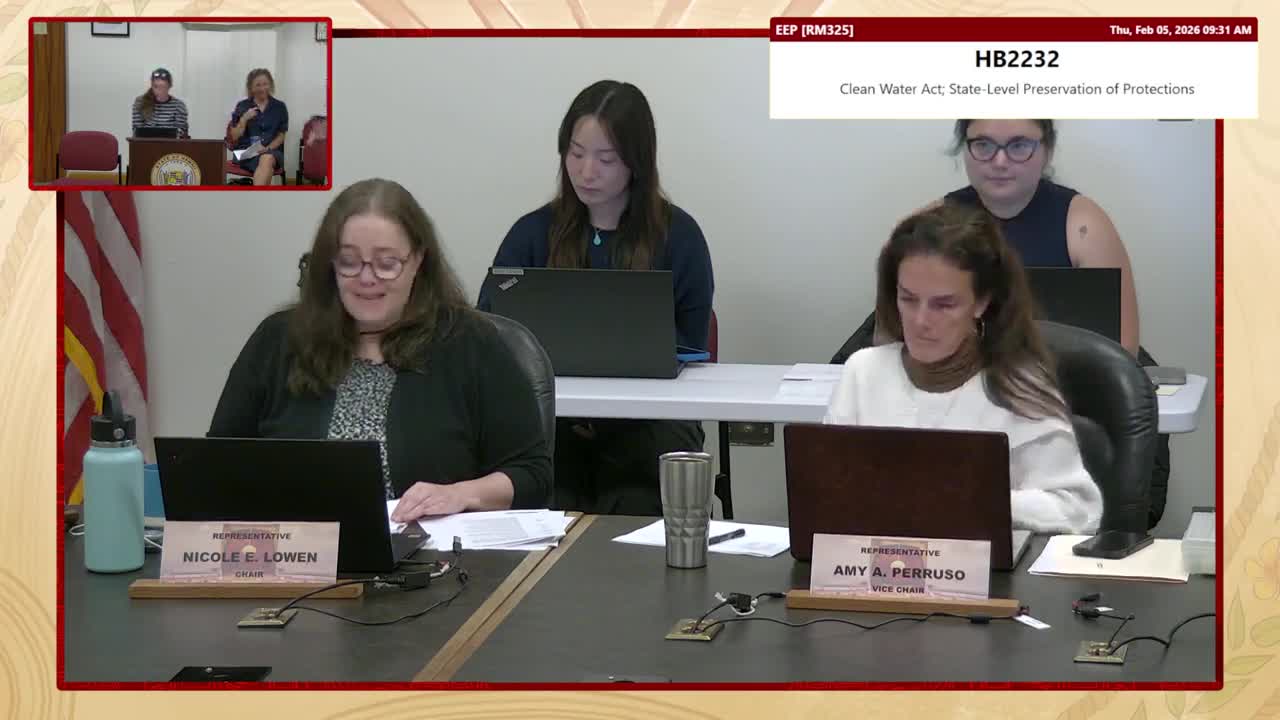 3MIN
House Standing Committee on Energy & Environmental Protection
57SEC
House Standing Committee on Energy & Environmental Protection
Bill Author

Bill Co-Author(s):