HB 1383: RELATING TO A FAMILY RESILIENCE PILOT PROGRAM.
- Session Year: 2025-2026
- House: House
- Latest Version Date: 2025-02-07
Current Status:
Failed
(2025-12-08: Carried over to 2026 Regular Session.)
Introduced
In Committee
First Chamber
In Committee
Second Chamber
Final Decking
Enacted
Establishes and appropriates funds for a five-year family resilience pilot program within the Office of Wellness and Resilience. Requires the Office of Wellness and Resilience to establish data and referral system tracking needs and protocols and an implementation and evaluation plan by 12/31/2025. Sunsets the pilot program 6/30/2030. Effective 7/1/3000. (HD1)
Establishes and appropriates funds for a five-year family resilience pilot program within the Office of Wellness and Resilience.
|
HOUSE OF REPRESENTATIVES |
H.B. NO. |
1383 |
|
THIRTY-THIRD LEGISLATURE, 2025 |
H.D. 1 |
|
|
STATE OF HAWAII |
|
|
|
|
|
|
|
|
||
|
|
||
A BILL FOR AN ACT
RELATING TO A FAMILY RESILIENCE PILOT PROGRAM.
BE IT ENACTED BY THE LEGISLATURE OF THE STATE OF HAWAII:
SECTION 1. The legislature finds that more programs and services must be established to address the unmet needs of children and families at risk of child welfare system involvement.
The malama ohana working group was established by Act 86, Session Laws of Hawaii 2023, within the office of wellness and resilience to seek, design, and recommend transformative changes to the State's existing child welfare system. In its report submitted to the legislature, the malama ohana working group stated that there is a shortage of resources in Hawaii dedicated to preventing the need for children's and families' involvement with child welfare services, especially primary prevention and universal support. Many families at high risk of entering the child welfare system are unaware of available services or how to access them. The malama ohana working group recommended that the establishment of programs, such as universal family supports, that allow families to thrive be prioritized above all other commitments in an effort to divert children and families away from involvement with the child welfare system. The malama ohana working group specifically provided suggestions for family support, such as creating accessible pathways to concrete supports like food and shelter, establishing community-based resource centers staffed by individuals with lived experience, and meeting families' basic needs for housing, child care, and physical and mental health care.
The legislature further finds that examples of child welfare diversion programs exist in other states and have been successful in reducing the number of families involved with child welfare. These diversion programs have been successful by screening at-risk families and providing them with peer support and system navigation, resource program supports and financial assistance, and parenting and family-strengthening classes and therapy.
Accordingly, the purpose of this Act is to establish and appropriate funds for a five-year family resilience pilot program within the office of wellness and resilience.
SECTION 2. (a) There is established within the office of wellness and resilience a family resilience pilot program, in which the office of wellness and resilience shall provide:
(1) Trauma-informed peer support navigators who have lived experience going through the social service system to assist families with enrollment in public or other benefits, family strengthening, and cultural programming;
(2) Financial assistance and resource supports to aid with food, clothing, hygiene, housing, parenting, child care, household, and transportation needs; and
(3) A trauma-informed, parenting intervention program that improves caregiver-child relationships and parenting skills through teaching and coaching on positive communication, child behavior management strategies, and calming and emotional regulation strategies for both caregiver and child.
(b) The office of wellness and resilience shall establish, no later than December 31, 2025, the following:
(1) Data and referral system tracking needs and protocols to comply with applicable federal and state laws; and
(2) An implementation and evaluation plan that includes specific, measurable, attainable, reasonable, and time-bound goals.
(c) The office of wellness and resilience shall submit a report of the effectiveness and participation in the pilot program, including any proposed legislation, to the legislature no later than twenty days prior to the convening of the regular session of 2031.
(d) The family resilience pilot program shall cease on June 30, 2030.
SECTION 3. There is appropriated out of the general revenues of the State of Hawaii the sum of $ or so much thereof as may be necessary for fiscal year 2025-2026 and the same sum or so much thereof as may be necessary for fiscal year 2026-2027 for the office of wellness and resilience to establish a family resilience pilot program pursuant to this Act, including the contracting of services to implement the pilot program.
The sums appropriated shall be expended by the
office of wellness and resilience for the purposes of this Act.
SECTION 4. This Act shall take effect on July 1, 3000.
Report Title:
Family Resilience Pilot Program; Office of Wellness and Resilience; Data and Referral System; Implementation and Evaluation Plan; Appropriation
Description:
Establishes and appropriates funds for a five-year family resilience pilot program within the Office of Wellness and Resilience. Requires the Office of Wellness and Resilience to establish data and referral system tracking needs and protocols and an implementation and evaluation plan by 12/31/2025. Sunsets the pilot program 6/30/2030. Effective 7/1/3000. (HD1)
The summary description of legislation appearing on this page is for informational purposes only and is not legislation or evidence of legislative intent.
|
HOUSE OF REPRESENTATIVES |
H.B. NO. |
1383 |
|
THIRTY-THIRD LEGISLATURE, 2025 |
|
|
|
STATE OF HAWAII |
|
|
|
|
|
|
|
|
||
|
|
||
A BILL FOR AN ACT
relating to a family resilience pilot program.
BE IT ENACTED BY THE LEGISLATURE OF THE STATE OF HAWAII:
SECTION 1. The legislature finds that more programs and services must be established to address the unmet needs of children and families at risk of child welfare system involvement.
The malama ohana working group was established by Act 86, Session Laws of Hawaii 2023, within the office of wellness and resilience to seek, design, and recommend transformative changes to the State's existing child welfare system. In its report submitted to the legislature, the malama ohana working group stated that there is a shortage of resources in Hawaii dedicated to preventing the need for children's and families' involvement with child welfare services, especially primary prevention and universal support. Many families at high risk of entering the child welfare system are unaware of available services or how to access them. The malama ohana working group recommended that the establishment of programs, such as universal family supports, that allow families to thrive are prioritized above all other commitments in an effort to divert children and families away from involvement with the child welfare system. The malama ohana working group specifically provided suggestions for family support, such as creating accessible pathways to concrete supports like food and shelter, establishing community-based resource centers staffed by individuals with lived experience, and meeting families' basic needs for housing, child care, and physical and mental health care.
The legislature further finds that examples of child welfare diversion programs exist in other states and have been successful in reducing the numbers of families involved with child welfare. These diversion programs have been successful by screening at-risk families and providing them with peer support and system navigation, resource program supports and financial assistance, and parenting and family-strengthening classes and therapy.
Accordingly, the purpose of this Act is to establish and appropriate funds for a five-year family resilience pilot program within the office of wellness and resilience.
SECTION 2. (a) There is established within the office of wellness and resilience a family resilience pilot program, in which the office of wellness and resilience shall provide:
(1) Trauma-informed peer support navigators who have lived experience going through the social service system to assist families with enrollment in public or other benefits, family strengthening, and cultural programming;
(2) Financial assistance and resource supports to aid with food, clothing, hygiene, housing, parenting, child care, household, and transportation needs; and
(3) A trauma-informed, parenting intervention program that improves caregiver-child relationships and parenting skills through teaching and coaching on positive communication, child behavior management strategies, and calming and emotional regulation strategies for both caregiver and child.
(b) The office of wellness and resilience shall submit a report of the effectiveness and participation in the pilot program, including any proposed legislation, to the legislature no later than twenty days prior to the convening of the regular session of 2031.
(c) The family resilience pilot program shall cease on June 30, 2030.
SECTION 3. There is appropriated out of the general revenues of the State of Hawaii the sum of $1,468,500 or so much thereof as may be necessary for fiscal year 2025-2026 and the same sum or so much thereof as may be necessary for fiscal year 2026-2027 for the office of wellness and resilience to establish a family resilience pilot program pursuant to this Act, including the contracting of services to implement the pilot program.
The sums appropriated shall be expended by the office of wellness and resilience for the purposes of this Act.
SECTION 4. This Act shall take effect on July 1, 2025.
|
INTRODUCED BY: |
_____________________________ |
|
|
|
Report Title:
Family Resilience Pilot Program; Office of Wellness and Resilience; Appropriation
Description:
Establishes and appropriates funds for a five-year family resilience pilot program within the Office of Wellness and Resilience.
The summary description of legislation appearing on this page is for informational purposes only and is not legislation or evidence of legislative intent.
|
Date
|
Status
|
|---|---|
| Dec 8, 2025 | Carried over to 2026 Regular Session. |
| Feb 10, 2025 | Passed Second Reading as amended in HD 1 and referred to the committee(s) on FIN with none voting aye with reservations; none voting no (0) and Representative(s) Belatti, Cochran, Kila, Ward excused (4). |
| Feb 10, 2025 | Reported from HSH (Stand. Com. Rep. No. 265) as amended in HD 1, recommending passage on Second Reading and referral to FIN. |
| Feb 4, 2025 | The committee on HSH recommend that the measure be PASSED, WITH AMENDMENTS. The votes were as follows: 9 Ayes: Representative(s) Marten, Olds, Amato, Chun, Keohokapu-Lee Loy, Takayama, Takenouchi, Alcos, Garcia; Ayes with reservations: none; Noes: none; and Excused: none. |
| Jan 31, 2025 | Bill scheduled to be heard by HSH on Tuesday, 02-04-25 9:30AM in House conference room 329 VIA VIDEOCONFERENCE. |
| Jan 27, 2025 | Referred to HSH, FIN, referral sheet 4 |
| Jan 23, 2025 | Introduced and Pass First Reading. |
|
Date
|
Description
|
Location
|
Votes
|
|
|---|---|---|---|---|
| Feb 4, 2025 | The committee on HSH recommend that the measure be PASSED, WITH AMENDMENTS | House Standing Committee on Human Services & Homelessness |
Passed |
This list shows positions taken on this bill by organizations on the date displayed, which is linked to the original source.
Positions by individuals are not included.
|
Organization
|
Position
|
Date
|
|---|---|---|
| Catholic Charities Hawaii | ** Support | |
| Department of Human Services | ** Support | |
| Early Childhood Action Strategy | ** Support | |
| East Hawaii HI H.O.P.E.S. | *** Support | Feb 4, 2025 |
| Hale Kipa | ** Support | |
| Hale Kipa | *** Support | Feb 4, 2025 |
| Hawai'i Coalition for Child Protective Reform | *** Support | Feb 4, 2025 |
| Hawaii Coalition for Child Protective Reform | ** Support | |
| Hawaii Children's Action Network Speaks! | ** Support | |
| Hawaii Youth Services Network | ** Support | |
| Karen Worthington Consulting | *** Support | Feb 4, 2025 |
| Mālama Ohana Working Group | ** Support | |
| National Center for Youth Law | ** Support | |
| Office of the Governor | *** Support | Feb 4, 2025 |
| Office of Wellness and Resilience | ** Support |
STAND. COM. REP. NO. 265
Honolulu, Hawaii
, 2025
RE: H.B. No. 1383
H.D. 1
Honorable Nadine K. Nakamura
Speaker, House of Representatives
Thirty-Third State Legislature
Regular Session of 2025
State of Hawaii
Madame:
Your Committee on Human Services & Homelessness, to which was referred H.B. No. 1383 entitled:
"A BILL FOR AN ACT RELATING TO A FAMILY RESILIENCE PILOT PROGRAM,"
begs leave to report as follows:
Your Committee received testimony in support of this measure from the Office of Wellness and Resilience; Department of Human Services; Hawaii Coalition for Child Protective Reform; Mālama Ohana Working Group; Hawaii Children's Action Network Speaks!; Catholic Charities Hawaii; Hawaii Youth Services Network; Early Childhood Action Strategy; National Center for Youth Law; Hale Kipa; and five individuals.
Your Committee finds that Hawaii lacks sufficient resources to prevent families from entering the child welfare system, particularly in primary prevention and universal support services. Many at-risk families are unaware of available assistance, and establishing programs like family resource centers and accessible pathways to basic needs can help divert them from child welfare involvement. Therefore, this measure establishes and funds a five-year Family Resilience Pilot Program within the Office of Wellness and Resilience to support at-risk families and reduce child welfare system involvement.
Your Committee has amended this measure by:
(1) Requiring the Office of Wellness and Resilience to establish data and referral system tracking needs and protocols and an implementation and evaluation plan that includes certain goals by December 31, 2025;
(2) Changing the appropriation amount to an unspecified amount;
(3) Changing the effective date to July 1, 3000, to encourage further discussion; and
(4) Making technical, nonsubstantive amendments for the purposes of clarity, consistency, and style.
Your Committee respectfully respects your Committee on Finance, should it deliberate on this measure, to consider an appropriation amount of $1,468,500.
As affirmed by the record of votes of the members of your Committee on Human Services & Homelessness that is attached to this report, your Committee is in accord with the intent and purpose of H.B. No. 1383, as amended herein, and recommends that it pass Second Reading in the form attached hereto as H.B. No. 1383, H.D. 1, and be referred to your Committee on Finance.
Respectfully submitted on behalf of the members of the Committee on Human Services & Homelessness,
|
|
|
____________________________ LISA MARTEN, Chair |
|
Date
|
Testimony PDF
|
|---|---|
| Feb 4, 2025 | HB1383_TESTIMONY_HSH_02-04-25_.PDF |
Discussed in Hearing
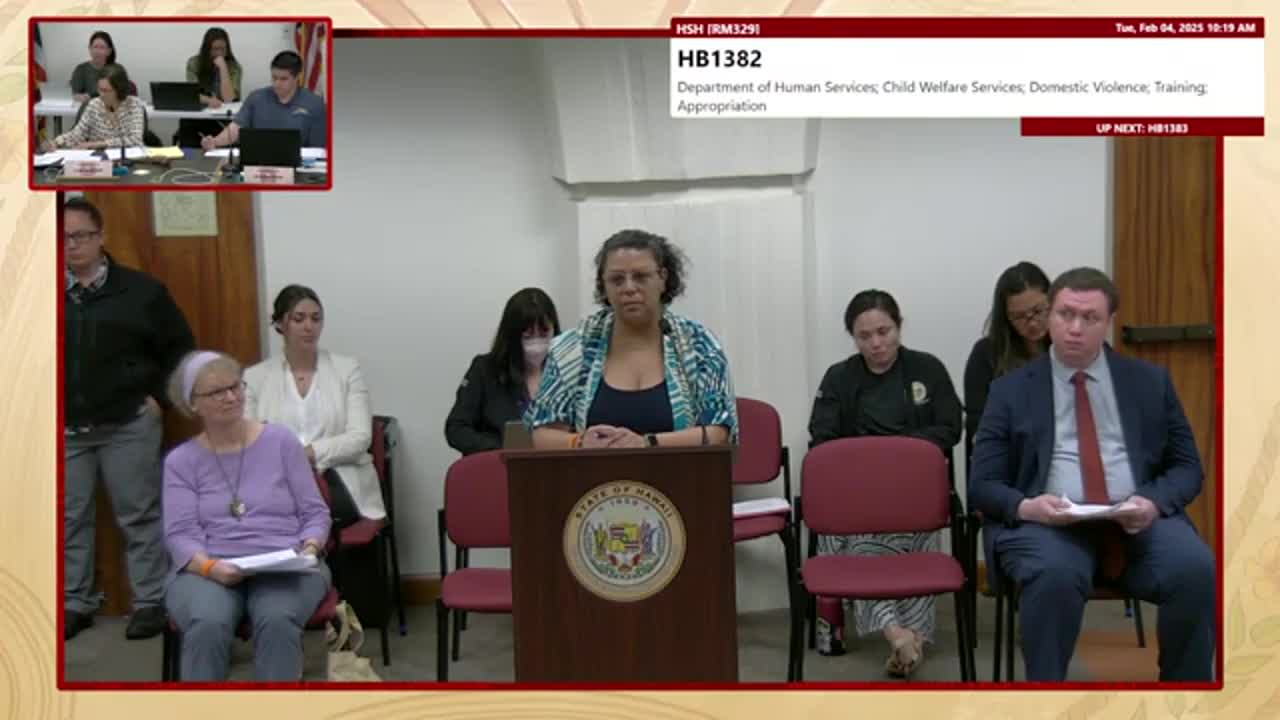 5MIN
House Standing Committee on Human Services & Homelessness
Bill Author
Bill Co-Author(s):