SB 3327: HCDA; Housing; Community Planning and Development; Quality of Life
- Session Year: 2025-2026
- House: Senate
- Latest Version Date: 2026-02-19
Current Status:
Failed
(2026-03-03: The committee on WAM deferred the measure.)
Introduced
In Committee
First Chamber
In Committee
Second Chamber
Final Decking
Enacted
What does this bill do?
The bill requires the Hawaii Community Development Authority to plan for “complete communities” when it plans or develops housing, affecting residents, developers, and local businesses. Required elements include utilities, affordable housing, commercial space, parks, and cultural and performance spaces. It also calls for community business hubs and micro‑business spaces, walking/biking/transit infrastructure aiming for 70% of local trips without cars, public parking hubs with EV charging (25% EV‑ready), and options to raise revenue to help pay for the improvements.
The summary is provided by generative AI which can make mistakes. For original language, please view the details in the table below.
Requires the Hawaii Community Development Authority, when planning and developing housing, to plan for complete communities that include various aspects supporting quality of life. Effective 7/1/2050. (SD1)
Requires the Hawaii Community Development Authority, when planning and developing housing, to plan for complete communities that include various aspects supporting quality of life.
|
THE SENATE |
S.B. NO. |
3327 |
|
THIRTY-THIRD LEGISLATURE, 2026 |
S.D. 1 |
|
|
STATE OF HAWAII |
|
|
|
|
|
|
|
|
||
|
|
||
A BILL FOR AN ACT
RELATING TO THE HAWAII COMMUNITY DEVELOPMENT AUTHORITY.
BE IT ENACTED BY THE LEGISLATURE OF THE STATE OF HAWAII:
The legislature further finds that the Hawaii community development authority's traditional development strategy relies heavily on requiring private developers to finance public infrastructure through negotiation and compromise. This approach frequently results in inadequate or substandard public improvements that diminish community quality of life. It also increases housing costs and reduces the availability of affordable housing units. By contrast, modern development strategies used elsewhere shift much of the responsibility for financing public infrastructure away from developers and toward a mix of innovative revenue sources. These approaches enable the creation of complete communities with stronger public infrastructure and amenities, while lowering housing and overall living costs for residents.
The purpose of this Act is to provide statutory updates to ensure that the Hawaii community development authority can fully modernize its development strategy and adopt best practices that have been successfully implemented for decades in jurisdictions across the United States and around the world.
SECTION 2. Section 206E-6, Hawaii Revised Statutes, is amended to read as follows:
"§206E-6 District-wide improvement program. (a) The authority shall develop a district-wide improvement program to identify necessary district-wide public facilities within a community development district.
(b) Whenever the authority determines to undertake, or causes to be undertaken, planning and development to include housing in a district or community, the authority shall endeavor to plan for complete communities that include, to the maximum extent appropriate:
(1) Infrastructure for utilities, including sewer, water, power, and similar needs;
(2) Affordable housing and related infrastructure;
(3) Public and private commercial spaces;
(4) Public spaces of meaningful scale that shall include:
(A) Public parks and gathering spaces;
(B) Public spaces for hosting markets and events;
(C) Natural areas with open green space and water for passive relaxation;
(D) Public spaces for active recreation; and
(E) Public spaces for pets and animals;
(5) Facilities for public arts and culture that include:
(A) Public libraries;
(B) Public works of art;
(C) Spaces for public performances and events;
(D) Accessible educational and narrative exhibits on the history, culture, and people of the area; and
(E) Flexible spaces and infrastructure for seasonal, rotating, and evolving programming and engagement;
(6) Public spaces for local economic development and community empowerment; provided that the primary focus shall be assisting local residents, entrepreneurs, and brands, including:
(A) Community-based economic development hubs and cooperative spaces such as public commercial kitchens, processing facilities, or similar work hubs available to the community and small businesses;
(B) Cooperative commercial and retail locations capable of supporting and aggregating products and services from numerous small businesses;
(C) Spaces for hosting micro-businesses such as food trucks, market stalls, and similar temporary business fronts;
(D) Spaces for hosting growing small businesses in permanent micro or small commercial locations or rotating pop-up locations; and
(E) Spaces for hosting larger, maturing businesses in regular food, retail, and commercial locations;
(7) Commuting infrastructure; provided that the infrastructure shall be designed to have the capacity to enable at least seventy per cent of all daily commutes to, from, and within the area to be safely and comfortably made by walking, biking, using micro‑mobility devices, or using public transit, between common destinations, as well as for long‑distance daily commuting without interruption pursuant to section 264-142 and shall include amenities such as rest stops, secure bicycle and micro-mobility device parking, and emergency support stations with tools and other resources as may be appropriate; and
(8) Public parking hubs of meaningful capacity, including charging for electric vehicles, a reasonable distance from which minimum requirements for parking stalls that are not designated as parking spaces reserved for persons with disabilities as defined in section 291-51 shall be prohibited; provided that of the parking stalls developed as part of the public parking hubs pursuant to this paragraph, twenty-five per cent shall be electric vehicle-ready.
(c) Public properties, public commercial facilities, and other relevant infrastructure shall be planned with the capacity to provide meaningful revenue generation from appropriate facilities, leases, programs, or other means as may be appropriate to help finance the infrastructure projects identified in this section, fund public community programs in the area, or financially sustain the community within the district.
[(b)]
(d) Whenever the authority shall
determine to undertake, or cause to be undertaken, any public facility as part
of the district-wide improvement program, the cost of providing the public
facilities shall be assessed against the real property in the community
development district specially benefiting from [such] the public
facilities[.], the revenue generated under subsection (c), or other
revenue generated by any financing mechanism available to the authority under
this chapter. The authority shall determine
the areas of the community development district [which] that will
benefit from the public facilities to be undertaken and, if less than the
entire community development district benefits, the authority may establish
assessment areas within the community development district. The authority may issue and sell bonds in [such]
the amounts as may be authorized by the legislature to provide funds to
finance [such] public facilities.
The authority shall fix the assessments against real property specially
benefited. All assessments made pursuant
to this section shall be a statutory lien against each lot or parcel of land
assessed from the date of the notice declaring the assessment until paid and [such]
the lien shall have priority over all other liens except the lien of
property taxes. As between liens of
assessments, the earlier lien shall be superior to the later lien.
[(c)]
(e) Bonds issued to provide funds
to finance public facilities shall be secured solely by the real properties
benefited or improved, the assessments thereon, or by the revenues derived from
the program for which the bonds are issued, including reserve accounts and
earnings thereon, insurance proceeds, and other revenues, or any combination
thereof. The bonds may be additionally
secured by the pledge or assignment of loans and other agreements or any note
or other undertaking, obligation, or property held by the authority. Bonds issued pursuant to this section and the
income therefrom shall be exempt from all state and county taxation, except
transfer and estate taxes. The bonds
shall be issued according and subject to the provisions of the rules adopted
pursuant to this section.
[(d)]
(f) Any other law to the contrary
notwithstanding, in assessing real property for public facilities, the
authority shall assess the real property within an assessment area according to
the special benefits conferred upon the real property by the public
facilities. These methods may include
assessment on a frontage basis or according to the area of real property within
an assessment area or any other assessment method [which] that
assesses the real property according to the special benefit conferred, or any
combination thereof. No [such]
assessment levied against real property specially benefited as provided by this
chapter shall constitute a tax on real property within the meanings of any
constitutional or statutory provisions.
[(e)]
(g) The authority shall adopt
rules pursuant to chapter 91, and may amend the rules from time to time,
providing for the method of undertaking and financing public facilities in an
assessment area or an entire community development district. The rules adopted pursuant to this section
shall include[,] but are not limited to[,] the following: methods by which the authority shall
establish assessment areas; the method of assessment of real properties
specially benefited; the costs to be borne by the authority, the county in
which the public facilities are situated, and the property owners; the
procedures before the authority relating to the creation of the assessment
areas by the owners of real property therein, including provisions for
petitions, bids, contracts, bonds, and notices; provisions relating to
assessments; provisions relating to financing, such as bonds, special funds,
advances from available funds, special funds for payment of bonds, payment of
principal and interest, and sale and use of bonds; provisions relating to funds
and refunding of outstanding debts; [and] provisions relating to
limitations on time to sue[,]; and other related provisions.
[(f)]
(h) Any provisions to the
contrary notwithstanding, the authority [may], in its discretion, may
enter into any agreement with the county in which the public facilities are
located, to implement all or part of the purposes of this section.
[(g)]
(i) All sums collected under this
section shall be deposited in the Hawaii community development special fund
established by section 206E-16; [except] provided that,
notwithstanding section 206E-16, all moneys collected on account of assessments
and interest thereon for any specific public facilities financed by the
issuance of bonds shall be set apart in a separate special fund and applied
solely to the payment of the principal and interest on these bonds[,];
the cost of administering, operating, and maintaining the program[,];
the establishment of reserves[,]; and other purposes as may be
authorized in the proceedings providing for the issuance of the bonds. If any surplus remains in any special fund
after the payment of the bonds chargeable against that fund, it shall be
credited to and become a part of the Hawaii community development special
fund. Moneys in the Hawaii community
development special fund may be used to make up any deficiencies in the special
fund.
[(h)]
(j) If the public facilities to
be financed through bonds issued by the authority may be dedicated to the
county in which the public facilities are to be located, the authority shall
ensure that the public facilities are designed and constructed to meet county
requirements.
[(i)]
(k) Notwithstanding any law to
the contrary, whenever as part of a district-wide improvement program it
becomes necessary to remove, relocate, replace, or reconstruct public utility
facilities, the authority shall establish by rule the allocation of cost
between the authority, the affected public utilities, and properties that may
specially benefit from [such] the improvement, if any. In determining the allocation of cost, the
authority shall consider the cost allocation policies for improvement districts
established by the county in which the removal, relocation, replacement, or
reconstruction is to take place."
SECTION 3. Statutory material to be repealed is bracketed and stricken. New statutory material is underscored.
SECTION 4. This Act shall take effect on July 1, 2050.
Report Title:
HCDA; Housing; Community Planning and Development; Quality of Life
Description:
Requires the Hawaii Community Development Authority, when planning and developing housing, to plan for complete communities that include various aspects supporting quality of life. Effective 7/1/2050. (SD1)
The summary description of legislation appearing on this page is for informational purposes only and is not legislation or evidence of legislative intent.
|
THE SENATE |
S.B. NO. |
3327 |
|
THIRTY-THIRD LEGISLATURE, 2026 |
|
|
|
STATE OF HAWAII |
|
|
|
|
|
|
|
|
||
|
|
||
A BILL FOR AN ACT
relating to the Hawaii community development authority.
BE IT ENACTED BY THE LEGISLATURE OF THE STATE OF HAWAII:
The legislature further finds that the Hawaii community development authority's traditional development strategy relies heavily on requiring private developers to finance public infrastructure through negotiation and compromise. This approach frequently results in inadequate or substandard public improvements that diminish community quality of life. It also increases housing costs and reduces the availability of affordable housing units. By contrast, modern development strategies used elsewhere shift much of the responsibility for financing public infrastructure away from developers and toward a mix of innovative revenue sources. These approaches enable the creation of complete communities with stronger public infrastructure and amenities, while lowering housing and overall living costs for residents.
The purpose of this Act is to provide statutory updates to ensure that the Hawaii community development authority can fully modernize its development strategy and adopt best practices that have been successfully implemented for decades in jurisdictions across the United States and around the world.
SECTION 2. Section 206E-6, Hawaii Revised Statutes, is amended to read as follows:
"§206E-6 District-wide improvement program. (a) The authority shall develop a district-wide improvement program to identify necessary district-wide public facilities within a community development district.
(b) Whenever the authority determines to undertake, or causes to be undertaken, planning and development to include housing in a district or community, the authority shall endeavor to plan for complete communities that include, to the maximum extent appropriate:
(1) Infrastructure for utilities, including sewer, water, power, and similar needs;
(2) Affordable housing and related infrastructure;
(3) Public and private commercial spaces;
(4) Public spaces of meaningful scale that shall include:
(A) Public parks and gathering spaces;
(B) Public spaces for hosting markets and events;
(C) Natural areas with open green space and water for passive relaxation;
(D) Public spaces for active recreation; and
(E) Public spaces for pets and animals;
(5) Facilities for public arts and culture that include:
(A) Public libraries;
(B) Public works of art;
(C) Spaces for public performances and events;
(D) Accessible educational and narrative exhibits on the history, culture, and people of the area; and
(E) Flexible spaces and infrastructure for seasonal, rotating, and evolving programming and engagement;
(6) Public spaces for local economic development and community empowerment; provided that the primary focus shall be assisting local residents, entrepreneurs, and brands, including:
(A) Community-based economic development hubs and cooperative spaces such as public commercial kitchens, processing facilities, or similar work hubs available to the community and small businesses;
(B) Cooperative commercial and retail locations capable of supporting and aggregating products and services from numerous small businesses;
(C) Spaces for hosting micro-businesses such as food trucks, market stalls, and similar temporary business fronts;
(D) Spaces for hosting growing small businesses in permanent micro or small commercial locations or rotating pop-up locations; and
(E) Spaces for hosting larger maturing businesses in regular food, retail, and commercial locations;
(7) Commuting infrastructure; provided that the infrastructure shall be designed to have the capacity to enable at least seventy per cent of all daily commutes to, from, and within the area to be safely and comfortably made by walking, biking, using micro‑mobility devices, or using public transit, between common destinations, as well as for long‑distance daily commuting without interruption pursuant to section 264-142 and shall include amenities such as rest stops, secure bicycle and micro-mobility device parking, and emergency support stations with tools and other resources as may be appropriate; and
(8) Public parking hubs of meaningful capacity, including charging for electric vehicles, a reasonable distance from which the partnership shall waive requirements for or limit the number of parking stalls required by the State or counties; provided that of the parking stalls developed as part of the public parking hubs pursuant to this paragraph, twenty-five per cent shall be electric vehicle-ready.
(c) Public properties, public commercial facilities, and other relevant infrastructure shall be planned with the capacity to provide meaningful revenue generation from appropriate facilities, leases, programs, or other means as may be appropriate to help finance the infrastructure projects identified in this section, fund public community programs in the area, or financially sustain the community within the district.
[(b)]
(d) Whenever the authority shall
determine to undertake, or cause to be undertaken, any public facility as part
of the district-wide improvement program, the cost of providing the public
facilities shall be assessed against the real property in the community
development district specially benefiting from [such] the public
facilities[.], the revenue generated under subsection (c), or other
revenue generated by any financing mechanism available to the authority under
this chapter. The authority shall
determine the areas of the community development district [which] that
will benefit from the public facilities to be undertaken and, if less than the
entire community development district benefits, the authority may establish
assessment areas within the community development district. The authority may issue and sell bonds in [such]
the amounts as may be authorized by the legislature to provide funds to
finance [such] public facilities.
The authority shall fix the assessments against real property specially
benefited. All assessments made pursuant
to this section shall be a statutory lien against each lot or parcel of land
assessed from the date of the notice declaring the assessment until paid and [such]
the lien shall have priority over all other liens except the lien of
property taxes. As between liens of
assessments, the earlier lien shall be superior to the later lien.
[(c)]
(e) Bonds issued to provide funds
to finance public facilities shall be secured solely by the real properties
benefited or improved, the assessments thereon, or by the revenues derived from
the program for which the bonds are issued, including reserve accounts and
earnings thereon, insurance proceeds, and other revenues, or any combination
thereof. The bonds may be additionally
secured by the pledge or assignment of loans and other agreements or any note
or other undertaking, obligation, or property held by the authority. Bonds issued pursuant to this section and the
income therefrom shall be exempt from all state and county taxation, except
transfer and estate taxes. The bonds
shall be issued according and subject to the provisions of the rules adopted
pursuant to this section.
[(d)]
(f) Any other law to the contrary
notwithstanding, in assessing real property for public facilities, the
authority shall assess the real property within an assessment area according to
the special benefits conferred upon the real property by the public
facilities. These methods may include
assessment on a frontage basis or according to the area of real property within
an assessment area or any other assessment method [which] that
assesses the real property according to the special benefit conferred, or any
combination thereof. No [such]
assessment levied against real property specially benefited as provided by this
chapter shall constitute a tax on real property within the meanings of any
constitutional or statutory provisions.
[(e)]
(g) The authority shall adopt
rules pursuant to chapter 91, and may amend the rules from time to time,
providing for the method of undertaking and financing public facilities in an
assessment area or an entire community development district. The rules adopted pursuant to this section
shall include, but are not limited to, the following: methods by which the authority shall
establish assessment areas; the method of assessment of real properties
specially benefited; the costs to be borne by the authority, the county in
which the public facilities are situated, and the property owners; the
procedures before the authority relating to the creation of the assessment
areas by the owners of real property therein, including provisions for
petitions, bids, contracts, bonds, and notices; provisions relating to
assessments; provisions relating to financing, such as bonds, special funds,
advances from available funds, special funds for payment of bonds, payment of
principal and interest, and sale and use of bonds; provisions relating to funds
and refunding of outstanding debts; and provisions relating to limitations on
time to sue, and other related provisions.
[(f)]
(h) Any provisions to the
contrary notwithstanding, the authority [may], in its discretion, may
enter into any agreement with the county in which the public facilities are
located, to implement all or part of the purposes of this section.
[(g)]
(i) All sums collected under this
section shall be deposited in the Hawaii community development special fund
established by section 206E-16; except that notwithstanding section 206E-16,
all moneys collected on account of assessments and interest thereon for any
specific public facilities financed by the issuance of bonds shall be set apart
in a separate special fund and applied solely to the payment of the principal
and interest on these bonds, the cost of administering, operating, and
maintaining the program, the establishment of reserves, and other purposes as
may be authorized in the proceedings providing for the issuance of the
bonds. If any surplus remains in any
special fund after the payment of the bonds chargeable against that fund, it
shall be credited to and become a part of the Hawaii community development
special fund. Moneys in the Hawaii
community development special fund may be used to make up any deficiencies in
the special fund.
[(h)]
(j) If the public facilities to
be financed through bonds issued by the authority may be dedicated to the
county in which the public facilities are to be located, the authority shall
ensure that the public facilities are designed and constructed to meet county
requirements.
[(i)]
(k) Notwithstanding any law to
the contrary, whenever as part of a district-wide improvement program it
becomes necessary to remove, relocate, replace, or reconstruct public utility
facilities, the authority shall establish by rule the allocation of cost
between the authority, the affected public utilities, and properties that may
specially benefit from [such] the improvement, if any. In determining the allocation of cost, the
authority shall consider the cost allocation policies for improvement districts
established by the county in which the removal, relocation, replacement, or
reconstruction is to take place."
SECTION 3. Statutory material to be repealed is bracketed and stricken. New statutory material is underscored.
SECTION 4. This Act shall take effect upon its approval.
|
INTRODUCED BY: |
_____________________________ |
|
|
|
Report Title:
HCDA; Housing; Community Planning and Development; Quality of Life
Description:
Requires the Hawaii Community Development Authority, when planning and developing housing, to plan for complete communities that include various aspects supporting quality of life.
The summary description of legislation appearing on this page is for informational purposes only and is not legislation or evidence of legislative intent.
|
Date
|
Status
|
|---|---|
| Mar 3, 2026 | The committee on WAM deferred the measure. |
| Feb 25, 2026 | The committee(s) on WAM deferred the measure until 03-03-26 10:15AM; Conference Room 211 & Videoconference. |
| Feb 23, 2026 | The committee(s) on WAM will hold a public decision making on 02-25-26 10:56AM; Conference Room 211 & Videoconference. |
| Feb 20, 2026 | Report adopted; Passed Second Reading, as amended (SD 1) and referred to WAM. |
| Feb 20, 2026 | Reported from WLA/HOU (Stand. Com. Rep. No. 2598) with recommendation of passage on Second Reading, as amended (SD 1) and referral to WAM. |
| Feb 17, 2026 | The committee(s) on WLA recommend(s) that the measure be PASSED, WITH AMENDMENTS. The votes in WLA were as follows: 5 Aye(s): Senator(s) Lee, C., Inouye, Chang, Lamosao, DeCorte; Aye(s) with reservations: none ; 0 No(es): none; and 0 Excused: none. |
| Feb 17, 2026 | The committee(s) on HOU recommend(s) that the measure be PASSED, WITH AMENDMENTS. The votes in HOU were as follows: 5 Aye(s): Senator(s) Chang, Hashimoto, Elefante, Rhoads; Aye(s) with reservations: Senator(s) Fevella ; 0 No(es): none; and 0 Excused: none. |
| Feb 13, 2026 | The committee(s) on WLA/HOU has scheduled a public hearing on 02-17-26 1:00PM; Conference Room 225 & Videoconference. |
| Feb 2, 2026 | Referred to WLA/HOU, WAM. |
| Jan 30, 2026 | Passed First Reading. |
| Jan 30, 2026 | Introduced. |
|
Date
|
Description
|
Location
|
Votes
|
|
|---|---|---|---|---|
| Feb 17, 2026 | The committee(s) on WLA recommend(s) that the measure be PASSED, WITH AMENDMENTS | Senate Standing Committee on Water, Land, Culture and the Arts |
Passed |
|
| Feb 17, 2026 | The committee(s) on HOU recommend(s) that the measure be PASSED, WITH AMENDMENTS | Senate Standing Committee on Housing |
Passed |
This list shows positions taken on this bill by organizations on the date displayed, which is linked to the original source.
Positions by individuals are not included.
|
Organization
|
Position
|
Date
|
|---|---|---|
| AARP Hawai‘i | *** Support | Feb 24, 2026 |
| Hawaiʻi Climate Change Mitigation and Adaptation Commission | ** Support | |
| Housing Hawaiʻi's Future | ** Support | |
| Oahu Metropolitan Planning Organization | *** Support | Feb 24, 2026 |
| State Council on Developmental Disabilities | ** Support |
STAND. COM. REP. NO. 2598
Honolulu, Hawaii
RE: S.B. No. 3327
S.D. 1
Honorable Ronald D. Kouchi
President of the Senate
Thirty-Third State Legislature
Regular Session of 2026
State of Hawaii
Sir:
Your Committees on Water, Land, Culture and the Arts and Housing, to which was referred S.B. No. 3327 entitled:
"A BILL FOR AN ACT RELATING TO THE HAWAII COMMUNITY DEVELOPMENT AUTHORITY,"
beg leave to report as follows:
The purpose and intent of this measure is to require the Hawaii Community Development Authority, when planning and developing housing, to plan for complete communities that include various aspects supporting quality of life.
Your Committees received testimony in support of this measure from the Hawaiʻi Climate Change Mitigation and Adaptation Commission, State Council on Developmental Disabilities, Oahu Metropolitan Planning Organization, AARP Hawaiʻi, Housing Hawaiʻi's Future, and one individual.
Your Committees received testimony in opposition to this measure from one individual.
Your Committees received comments on this measure from the Hawaiʻi Community Development Authority.
Your Committees find that the Hawaii Community Development Authority's traditional development strategy relies heavily on requiring private developers to finance infrastructure through negotiation and compromise, frequently resulting in inadequate and substandard public improvements, increased housing costs, and reduction in the availability of affordable housing units. By contrast, modern development strategies shift the financing of public infrastructure away from developers and toward a mixture of innovative revenue sources, which enables the creation of complete communities, improves the quality of public infrastructure and amenities, and lowers housing and overall living costs for residents. This measure ensures the Hawaii Community Development Authority can fully modernize its development strategy and adopt best practices that have long been implemented to the benefit of communities across the United States and internationally.
Your Committees have amended this measure by:
(1) Specifying that, at a reasonable distance from public parking hubs of meaningful capacity, including charging for electric vehicles, minimum requirements for parking stalls that are not designated as parking spaces reserved for persons with disabilities as defined in section 291-51 shall be prohibited;
(2) Inserting an effective date of July 1, 2050, to encourage further discussion; and
(3) Making technical, nonsubstantive amendments for the purposes of clarity and consistency.
As affirmed by the records of votes of the members of your Committees on Water, Land, Culture and the Arts and Housing that are attached to this report, your Committees are in accord with the intent and purpose of S.B. No. 3327, as amended herein, and recommend that it pass Second Reading in the form attached hereto as S.B. No. 3327, S.D. 1, and be referred to your Committee on Ways and Means.
Respectfully submitted on behalf of the members of the Committees on Water, Land, Culture and the Arts and Housing,
|
________________________________ STANLEY CHANG, Chair |
|
________________________________ CHRIS LEE, Chair |
|
|
|
|
|
Date
|
Testimony PDF
|
|---|---|
| Feb 24, 2026 | SB3327_SD1_TESTIMONY_WAM_02-25-26_.PDF |
| Feb 17, 2026 | SB3327_TESTIMONY_HOU-WLA_02-17-26_.PDF |
Discussed in Hearing
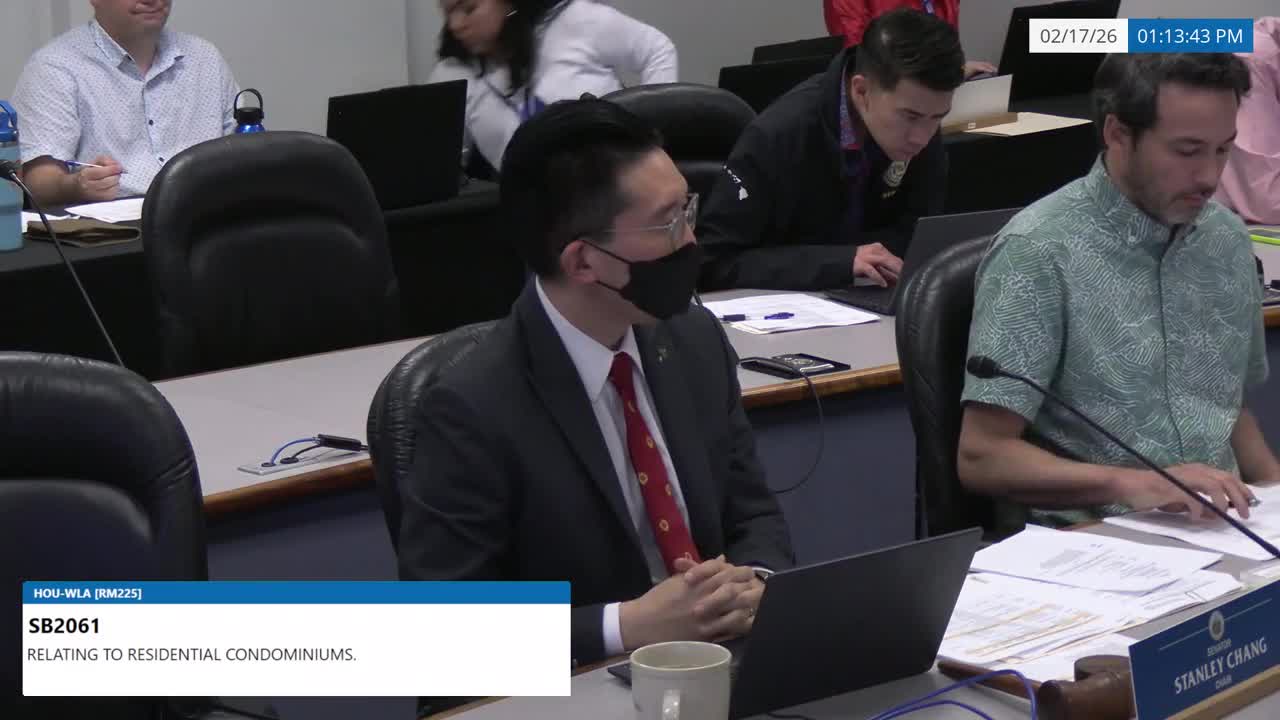 11MIN
Senate Standing Committee on Housing
11MIN
Senate Standing Committee on Water, Land, Culture and the Arts
2MIN
Senate Standing Committee on Housing
2MIN