SCR 145: requesting the Department of Labor and Industrial Relations to convene a working group to develop recommendations for establishing and implementing a paid family and medical leave program for the state.
- Session Year: 2025-2026
- House: Senate
- Latest Version Date: 2025-04-01
Current Status:
Passed
(2025-04-22: Resolution adopted in final form.)
Introduced
In Committee
First Chamber
In Committee
Second Chamber
Final Decking
Enacted
requesting the Department of Labor and Industrial Relations to convene a working group to develop recommendations for establishing and implementing a paid family and medical leave program for the state.
requesting the Senate standing committee on labor and technology AND house of representatives standing COMMITTEE on Labor to convene a legislative working group to develop recommendations for establishing and implementing a paid family and medical leave program for the state.
|
THE SENATE |
S.C.R. NO. |
145 |
|
THIRTY-THIRD LEGISLATURE, 2025 |
S.D. 1 |
|
|
STATE OF HAWAII |
|
|
|
|
|
|
|
|
||
|
|
||
SENATE CONCURRENT
RESOLUTION
requesting the Department of Labor and Industrial Relations to convene a working group to develop recommendations for establishing and implementing a paid family and medical leave program for the state.
WHEREAS, the United States is the only remaining industrialized nation without mandated access to paid family and medical leave benefits for private sector employees under federal law; and
WHEREAS, the federal Family and Medical Leave Act of 1993 (FMLA) requires employers with fifty of more employees to provide unpaid family and medical leave to their employees and existing Hawaii law requires employers with one hundred or more employees to provide unpaid family leave to their employees; and
WHEREAS, ninety-six percent of private employers in the State, however, have fewer than fifty employees, and are therefore not statutorily required to provide unpaid family and medical leave under the FMLA or family leave under existing state law; and
WHEREAS, as a result, only one in four private sector workers in the State have access to paid family and medical leave, voluntarily provided by their employers; and
WHEREAS, according to a May 2020 report published by the AARP and National Alliance for Caregiving, there are nearly forty-eight million family caregivers in the United States, of which sixty-one percent are working while juggling caregiving responsibilities; and
WHEREAS, a family caregiver is a relative, partner, friend, or neighbor who has a significant personal relationship with, and who provides a broad range of assistance for, an older person or an adult with a chronic, disabling, or serious health condition; and
WHEREAS, family caregivers are the backbone of the long‑term care system in the State, especially in the context of the ongoing health care workforce shortage; and
WHEREAS, according to the Valuing the Invaluable: 2023 Update report published by AARP in March 2023, there are 154,000 family caregivers in the State, contributing 144 million hours of unpaid services, worth an estimated $2.6 billion; and
WHEREAS, family caregivers face many physical, emotional, and financial challenges, especially because they are often required to balance unpaid caregiving duties with employment and other personal responsibilities; and
WHEREAS, a survey conducted in 2023 by AARP and S&P Global showed that sixty-seven percent of family caregivers are having difficulty balancing their jobs with caregiving duties; twenty‑seven percent of working caregivers have shifted from full‑time to part‑time work or have reduced work hours and sixteen percent have turned down a promotion; sixteen percent have stopped working entirely for a period of time; and thirteen percent have changed employers to meet caregiving responsibilities; and
WHEREAS, during the past two decades, heightened attention has been given to the dual responsibilities of "sandwich generation" caregivers, who are family caregivers sandwiched between a younger generation--children or grandchildren they care for--and an older one--an older family member or friend for whom they also provide care; and
WHEREAS, in 2019, thirty percent of family caregivers in the United States were sandwich generation caregivers, who generally span ages thirty-five to sixty-four and are more likely than other caregivers to be working while performing their caregiving responsibilities; and
WHEREAS, inequity in the existing socioeconomic structure and support infrastructure are also subjecting working women and people of color to be unequally burdened by caregiving duties and economic hardships due to caregiving; and
WHEREAS, a paid family and medical leave program would enable family caregivers to take a limited period of time off from work to care of loved ones without fear of losing their jobs or income; and
WHEREAS, paid family and medical leave programs are associated with improved outcomes in the earliest years of life for individuals, including higher rates of breastfeeding and immunization and lower rates of child abuse, domestic violence, and financial instability; and
WHEREAS, in the face of the current workforce shortage, a paid family and medical leave program would incentivize individuals to join the labor market and improve employee retention, filling gaps and saving employers long-term recruitment and training costs; and
WHEREAS, most small businesses in the State however, cannot finance a privately-funded paid family and medical leave insurance program that can provide benefits for all of their employees; and
WHEREAS, a state-administered paid family and medical leave program would benefit the State's workforce while reducing the financial burden for employers compared to a privately funded alternative; now, therefore,
BE IT RESOLVED by the Senate of the Thirty-third Legislature of the State of Hawaii, Regular Session of 2025, the House of Representatives concurring, that the Department of Labor and Industrial Relations is requested to convene a working group to develop recommendations for establishing and implementing a paid family and medical leave program for the State; and
BE IT FURTHER RESOLVED that the Department of Labor and Industrial Relations is requested to conduct an actuarial study of the State's workforce, employers, potential beneficiaries, and other elements necessary to implement a paid family and medical leave program; and
BE IT FURTHER RESOLVED that the working group is requested to:
(1) Recommend parameters for a statewide paid family and medical leave program that benefits both public and private sector workers;
(2) Review the impacts of federal and state laws, including the federal Employee Retirement Income Security Act of 1974; federal Family and Medical Leave Act of 1993; Prepaid Health Care Act, codified at chapter 393, Hawaii Revised Statutes; and Hawaii Family Leave Law, codified at chapter 398, Hawaii Revised Statutes; federal and state regulations; and any relevant programs, on the establishment of a paid family and medical leave program;
(3) Review independent studies, research, and other information regarding paid family and medical leave;
(4) Develop an implementation plan that considers the findings of the actuarial study conducted by the Department of Labor and Industrial Relations and outlines an administrative framework for paid family and medical leave, including departmental oversight, projected costs, employer and employee contribution rates, staffing needs, outreach to employers and employees, and potential timelines for program enactment and the initiation of benefits distribution;
(5) Examine and address how the State's Temporary Disability Insurance (TDI) program may interface with or complement the paid family and medical leave program, including the feasibility, cost-benefit analysis, and a general roadmap for transitioning the existing private TDI program to an expanded public program that includes or complements paid family and medical leave benefits; and
(6) Review any other relevant subject matter items it deems necessary to fulfill its purpose of developing recommendations for the establishment and implementation of a paid family and medical leave program for the State; and
BE IT FURTHER RESOLVED that the working group is requested to be composed of the following members:
(1) The Director of Labor and Industrial Relations, or the Director's designee, to serve as chairperson of the working group;
(2) The Chair of the House of Representatives Standing Committee on Labor, or the Chair's designee;
(3) The Chair of the Senate Standing Committee on Labor and Technology, or the Chair's designee;
(4) The Director of Human Resources Development;
(5) A representative from the Hawaii State Teachers Association, to be invited by the chairperson of the working group;
(6) A representative from the United Public Workers, AFSCME Local 646, AFL-CIO, to be invited by the chairperson of the working group;
(7) A representative from the Hawaii Government Employees Association, AFSCME Local 152, AFL-CIO, to be invited by the chairperson of the working group;
(8) A representative from Aloha United Way, to be invited by the chairperson of the working group;
(9) A representative from the American Association of University Women of Hawaii, to be invited by the chairperson of the working group;
(10) A representative from an organization representing the interests of businesses with fewer than fifty employees, to be selected and invited by the Senate President;
(11) A representative from an organization representing the interests of businesses with fewer than fifty employees, to be selected and invited by the Speaker of the House of Representatives;
(12) A representative from AARP Hawaii, to be invited by the chairperson of the working group;
(13) A representative from the University of Hawaii Professional Assembly, to be invited by the chairperson of the working group;
(14) A representative from Hawaii Children's Action Network Speaks!, to be invited by the chairperson of the working group;
(15) A representative from a private insurance company offering Temporary Disability Insurance benefits in the State or an association of insurers, to be selected and invited by the Governor; and
(16) Any other individual whom the chairperson of the working group deems necessary or to have relevant experience, knowledge, or expertise, to be selected and invited by the chairperson of the working group; and
BE IT FURTHER RESOLVED that the working group is requested to identify parameters for a paid family and medical leave program, including:
(1) A minimum duration of leave that meets the needs of the State's workers;
(2) A system of wage replacement;
(3) Coverage for a worker's serious illness, caring for a loved one with a serious illness, bonding with a new child, and needs arising from military deployment and the effects of domestic violence, stalking, and sexual assault;
(4) Coverage for all employees of employers who employ one or more employees, and a mechanism for the participation of the self-employed;
(5) A definition of "family" or "family member" for whom an individual may take leave for purposes of providing care that is at least as broad as the definition in chapter 398, Hawaii Revised Statutes, the existing Hawaii Family Leave Law; and
(6) Employment protections to ensure use of paid family and medical leave does not adversely impact employment; and
BE IT FURTHER RESOLVED that the working group is requested to utilize independent consultants and administrative facilitators that may be contracted by the Department of Labor and Industrial Relations, as needed, to:
(1) Support the working group in performing its duties, including but not limited to providing administrative facilitation and assisting with the working group's:
(A) Review of relevant federal and state laws, regulations, and programs;
(B) Comparative analyses;
(C) Development of recommendations on the parameters of the paid family and medical leave program, including compliance requirements, eligibility criteria, and other program requirements;
(D) Development of recommendations on the Department of Labor and Industrial Relations' staffing and operating requirements; and
(F) Drafting of the report of its findings and recommendations to the Legislature, including drafting of the proposed legislation; and
(2) Assist the Department of Labor and Industrial Relations in conducting the actuarial study as requested in this resolution; and
BE IT FURTHER RESOLVED that the working group is requested to submit a report of its findings and recommendations, including any proposed legislation, to the Legislature no later than twenty days prior to the convening of the Regular Session of 2026; and
BE IT FURTHER RESOLVED that certified copies of this Concurrent Resolution be transmitted to the Governor, President of the Senate, Speaker of the House of Representatives, Chair of the Senate Standing Committee on Labor and Technology, Chair of the House of Representatives Standing Committee on Labor, Director of Labor and Industrial Relations, and Director of Human Resources Development.
DLIR; DHRD; Legislative Working Group; Labor; Paid Family and Medical Leave; Report
|
THE SENATE |
S.C.R. NO. |
145 |
|
THIRTY-THIRD LEGISLATURE, 2025 |
|
|
|
STATE OF HAWAII |
|
|
|
|
|
|
|
|
||
|
|
||
SENATE CONCURRENT
RESOLUTION
requesting the Senate standing committee on labor and technology AND house of representatives standing COMMITTEE on Labor to convene a legislative working group to develop recommendations for establishing and implementing a paid family and medical leave program for the state.
WHEREAS, the United States is the only remaining industrialized nation without mandated access to paid family and medical leave benefits for the private sector employees under federal law; and
WHEREAS, existing Hawaii law does not require employers to provide paid family and medical leave to employees; and
WHEREAS, the federal Family and Medical Leave Act of 1993 (FMLA) requires employers with fifty of more employees to provide unpaid family and medical leave to their employees and existing Hawaii law requires employers with one hundred or more employees to provide unpaid family leave to their employees; and
WHEREAS, ninety-six percent of private employers in the State however, have fewer than fifty employees, and are therefore not statutorily required to provide unpaid family and medical leave under the FMLA or family leave under existing state law; and
WHEREAS, as a result, only one in four private sector workers in the State have access to paid family and medical leave, voluntarily provided by their employers; and
WHEREAS, according to a May 2020 report published by the AARP and National Alliance for Caregiving, there are nearly forty-eight million family caregivers in the United States, of which sixty-one percent are working while juggling caregiving responsibilities; and
WHEREAS, a family caregiver is a relative, partner, friend, or neighbor who has a significant personal relationship with, and who provides a broad range of assistance for, an older person or an adult with a chronic, disabling, or serious health condition; and
WHEREAS, family caregivers are the backbone of the long-term care system in the State, especially in the context of the ongoing health care workforce shortage; and
WHEREAS, according to the Valuing the Invaluable: 2023 Update report published by AARP in March 2023, there are 154,000 family caregivers in the State, contributing 144 million hours of unpaid services, worth an estimated $2.6 billion; and
WHEREAS, family caregivers face many physical, emotional, and financial challenges, especially because they are often required to balance unpaid caregiving duties with employment and other personal responsibilities; and
WHEREAS, a survey conducted in 2023 by AARP and S&P Global showed that sixty-seven percent of family caregivers are having difficulty balancing their jobs with caregiving duties; twenty-seven percent of working caregivers have shifted from full-time to part-time work or have reduced work hours and sixteen percent have turned down a promotion; sixteen percent have stopped working entirely for a period of time; and thirteen percent have changed employers to meet caregiving responsibilities; and
WHEREAS, during the past two decades, heightened attention has been given to the dual responsibilities of "sandwich generation" caregivers, who are family caregivers sandwiched between a younger generation--children or grandchildren they care for--and an older one--an older family member or friend for whom they also provide care; and
WHEREAS, in 2019, thirty percent of family caregivers in the United States were sandwich generation caregivers, who generally span ages thirty-five to sixty-four and are more likely than other caregivers to be working while performing their caregiving responsibilities; and
WHEREAS, as a result of the dual-generation care demands, sandwich generation caregivers report higher levels of emotional and financial strain; and
WHEREAS, inequity in the existing socio-economic structure and support infrastructure are also subjecting working women and people of color to be unequally burdened by caregiving duties and economic hardships due to caregiving; and
WHEREAS, a paid family and medical leave program would enable family caregivers to take a limited period of time off from work to care of loved ones without fear of losing their jobs or income; and
WHEREAS, paid family and medical leave programs are associated with improved outcomes in the earliest years of life for individuals, including higher rates of breastfeeding and immunization and lower rates of child abuse, domestic violence, and financial instability; and
WHEREAS, in the face of the current workforce shortage, a paid family and medical leave programs would incentivize individuals to join the labor market and improve employee retention, filling gaps and saving employers long-term recruitment and training costs; and
WHEREAS, most small businesses in the State however, cannot finance a privately-funded paid family and medical leave insurance program that can provide benefits for all of their employees; and
WHEREAS, a state-administered paid family and medical leave program would benefit the State's workforce while reducing the financial burden for employers compared to a privately funded alternative; now, therefore,
BE IT RESOLVED by the Senate of the Thirty-third Legislature of the State of Hawaii, Regular Session of 2025, the House of Representatives concurring, that the Senate Standing Committee on Labor and Technology and House of Representatives Standing Committee on Labor are requested to convene a legislative working group to develop recommendations for establishing and implementing a paid family and medical leave program for the State; and
BE IT FURTHER RESOLVED that the working group is requested to:
(1) Recommend parameters for a statewide paid family and medical leave program that benefits both public and private sector workers;
(2) Review the impact of federal and state regulations on the establishment of a paid family and medical leave program;
(3) Develop an implementation plan that outlines an administrative framework for paid family and medical leave, including departmental oversight, projected costs, employer and employee contribution rates, staffing needs, outreach to employers and employees, and potential timelines for program enactment and the initiation of benefits distribution; and
(4) Examine and address how the State's Temporary Disability Insurance (TDI) program may interface with or complement the paid family and medical leave program, including the feasibility, cost-benefit analysis, and a general roadmap for transitioning the existing private TDI program to an expanded public program that includes or complements paid family and medical leave benefits; and
BE IT FURTHER RESOLVED that the working group is requested to be composed of the following members:
(1) The Director of Labor and Industrial Relations, or the Director's designee, to serve as chairperson of the working group;
(2) The Chair of the House of Representatives Standing Committee on Labor, or the Chair's designee;
(3) The Chair of the Senate Standing Committee on Labor and Technology, or the Chair's designee;
(4) The Director of Human Resources Development;
(5) A representative from the Hawaii State Teachers Association, to be invited by the chairperson of the working group;
(6) A representative from the United Public Workers, AFSCME Local 646, AFL-CIO, to be invited by the chairperson of the working group;
(7) A representative from the Hawaii Government Employees Association, to be invited by the chairperson of the working group;
(8) A representative from Aloha United Way, to be invited by the chairperson of the working group;
(9) A representative from the American Association of University Women of Hawaii, to be invited by the chairperson of the working group;
(10) A representative from an organization representing the interests of businesses with fewer than fifty employees, to be selected and invited by the Senate President;
(11) A representative from an organization representing the interests of businesses with fewer than fifty employees, to be selected and invited by the Speaker of the House of Representatives;
(12) A representative from AARP Hawaii, to be invited by the chairperson of the working group;
(13) A representative from Hawaii Children's Action Network Speaks!, to be invited by the chairperson of the working group; and
(14) A representative from a private insurance company offering Temporary Disability Insurance benefits in the State or an association of insurers, to be selected and invited by the Governor; and
BE IT FURTHER RESOLVED that the working group is requested to identify parameters for a paid family and medical leave program, including:
(1) A minimum duration of leave that meets the needs of the State's workers;
(2) A system of wage replacement;
(3) Coverage for a worker's serious illness, caring for a loved one with a serious illness, bonding with a new child, and needs arising from military deployment and the effects of domestic violence, stalking, and sexual assault;
(4) Coverage for all employees of employers who employe one or more employees, and a mechanism for the participation of the self-employed;
(5) A definition of "family" or "family member" for whom an individual may take leave for purposes of providing care that is at least as broad as the definition in chapter 398, Hawaii Revised Statutes, the existing Hawaii Family Leave Law; and
(6) Employment protections to ensure use of paid family and medical leave does not adversely impact employment; and
BE IT FURTHER RESOLVED that the working group is requested to review independent studies, research, and other information regarding paid family and medical leave; and
BE IT FURTHER RESOLVED that the working group is requested to utilize independent consultants and administrative facilitators, including the Legislative Reference Bureau, as needed to assist in the performance of its duties, including but not limited to the preparation of the report to the Legislature; and
BE IT FURTHER RESOLVED that the working group is requested to submit a report of its findings and recommendations, including any proposed legislation, to the Legislature no later than twenty days prior to the convening of the Regular Session of 2026; and
BE IT FURTHER RESOLVED that certified copies of this Concurrent Resolution be transmitted to the Governor, President of the Senate, Speaker of the House of Representatives, Chair of the Senate Standing Committee on Labor and Technology, Chair of the House of Representatives Standing Committee on Labor, Director of the Legislative Reference Bureau, Director of Labor and Industrial Relations, and Director of Human Resources Development.
|
|
OFFERED BY: |
_____________________________ |
|
|
|
|
DLIR; DHRD; LRB; Legislative Working Group; Labor; Paid Family and Medical Leave; Report
|
Date
|
Status
|
|---|---|
| Apr 22, 2025 | Resolution adopted in final form. |
| Apr 22, 2025 | Received from House (Hse. Com. No. 789). |
| Apr 21, 2025 | Transmitted to Senate. |
| Apr 21, 2025 | Adopted with Representative(s) Garcia voting aye with reservations; Representative(s) Muraoka, Pierick voting no (2) and Representative(s) Cochran excused (1). |
| Apr 21, 2025 | Reconsideration of action taken on 04-14-25. |
| Apr 21, 2025 | Re-referred to LAB, referral sheet 34 |
| Apr 14, 2025 | Report adopted; referred to the committee(s) on FIN with none voting aye with reservations; Representative(s) Pierick voting no (1) and none excused (0). |
| Apr 14, 2025 | Reported from LAB (Stand. Com. Rep. No. 2069), recommending referral to FIN. |
| Apr 11, 2025 | The committee on LAB recommend that the measure be PASSED, UNAMENDED. The votes were as follows: 5 Ayes: Representative(s) Sayama, Lee, M., Kapela, Kong, Reyes Oda; Ayes with reservations: none; Noes: none; and 1 Excused: Representative(s) Garrett. |
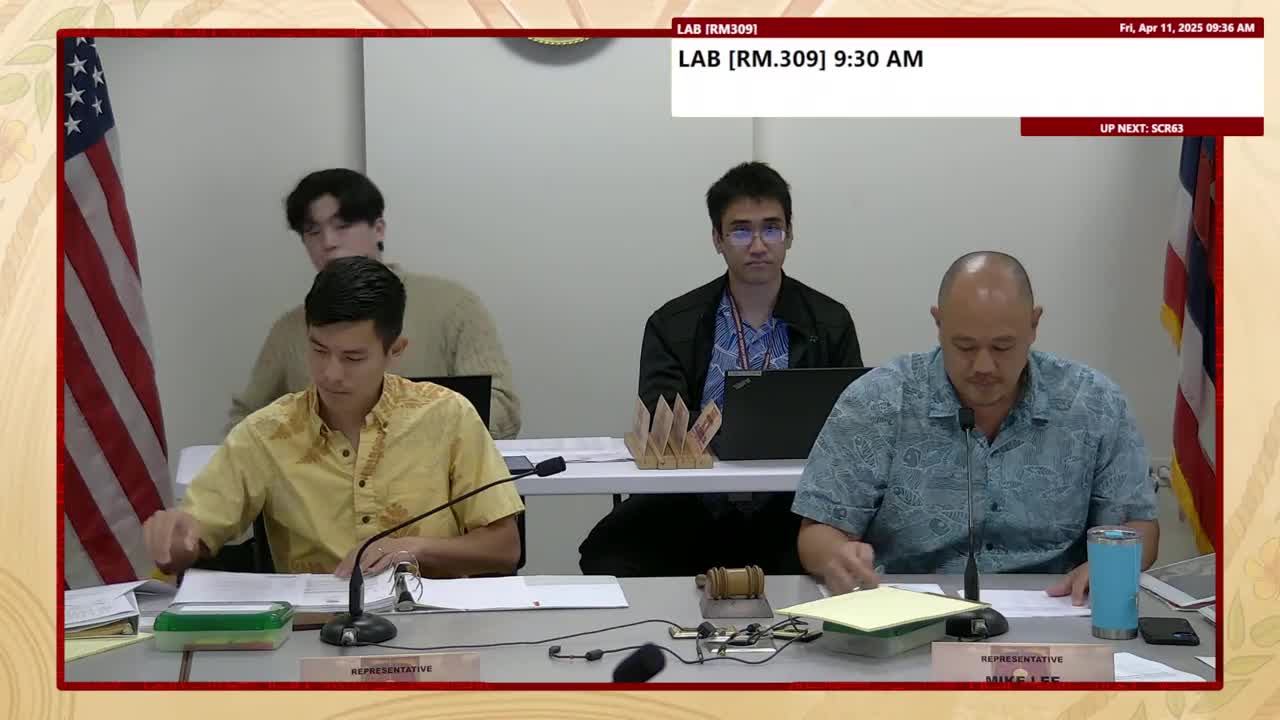
| Apr 7, 2025 | Resolution scheduled to be heard by LAB on Friday, 04-11-25 9:30AM in conference room 309 VIA VIDEOCONFERENCE. |
| Apr 4, 2025 | Referred to LAB, FIN, referral sheet 28 |
| Apr 3, 2025 | Received from Senate (Sen. Com. No. 516) in amended form (SD 1). |
| Apr 3, 2025 | Report and Resolution Adopted, as amended (SD 1). Transmitted to House. |
| Apr 2, 2025 | One Day Notice 04-03-25. |
| Apr 2, 2025 | Reported from LBT (Stand. Com. Rep. No. 1547) with recommendation of adoption, as amended (SD 1). |
| Mar 28, 2025 | The committee(s) on LBT recommend(s) that the measure be PASSED, WITH AMENDMENTS. The votes in LBT were as follows: 5 Aye(s): Senator(s) Aquino, Lee, C., Ihara, Moriwaki, Fevella; Aye(s) with reservations: none ; 0 No(es): none; and 0 Excused: none. |
| Mar 24, 2025 | The committee(s) on LBT deferred the measure until 03-28-25 3:00PM; Conference Room 224 & Videoconference. |
| Mar 20, 2025 | The committee(s) on LBT has scheduled a public hearing on 03-24-25 3:00PM; Conference Room 224 & Videoconference. |
| Mar 12, 2025 | Referred to LBT. |
| Mar 7, 2025 | Offered. |
|
Date
|
Description
|
Location
|
Votes
|
|
|---|---|---|---|---|
| Apr 11, 2025 | The committee on LAB recommend that the measure be PASSED, UNAMENDED | House Standing Committee on Labor |
Passed |
|
| Mar 28, 2025 | The committee(s) on LBT recommend(s) that the measure be PASSED, WITH AMENDMENTS | Senate Standing Committee on Labor and Technology |
Passed |
This list shows positions taken on this bill by organizations on the date displayed, which is linked to the original source.
Positions by individuals are not included.
|
Organization
|
Position
|
Date
|
|---|---|---|
| AARP Hawaii | *** Support | Apr 11, 2025 |
| AARP Hawaiʻi | ** Support | |
| AAUW Hawaii | ** Support | |
| AAUW Hawaii | *** Support | Apr 11, 2025 |
| Aloha United Way | *** Support | Apr 11, 2025 |
| Aloha United Way | ** Support | |
| AlohaCare | ** Support | |
| AlohaCare | *** Support | Apr 11, 2025 |
| American Heart Association | ** Support | |
| American Heart Association | *** Support | Apr 11, 2025 |
| Americans For Democratic Action | ** Support | |
| Americans for Democratic Action Hawaii | *** Support | Apr 11, 2025 |
| Catholic Charities Hawaiʻi | ** Support | |
| Catholic Charities Hawai‘i | *** Support | Apr 11, 2025 |
| Chamber of Commerce Hawaii | ** Support | |
| Democratic Party of Hawaiʻi Education Caucus | ** Support | |
| Democratic Party of Hawaiʻi | ** Support | |
| Democratic Party of Hawai‘i | *** Support | Apr 11, 2025 |
| Democratic Party of Hawai‘i Education Caucus | *** Support | Apr 11, 2025 |
| Department of Labor and Industrial Relations | ** Support | |
| Executive Office on Aging | ** Support | |
| Hawaii Government Employees Association, AFSCME Local 152 | *** Support | Apr 11, 2025 |
| Hawaii Government Employees Association, AFSCME Local 152, AFL-CIO | ** Support | |
| Hawaii State AFL-CIO | ** Support | |
| Hawaii State AFL-CIO | *** Support | Apr 11, 2025 |
| Hawaiʻi State Lesbian, Gay, Bisexual, Transgender, Queer Plus Commission | ** Support | |
| Hawaiʻi State Teachers Association | ** Support | |
| Hawaiʻi Children's Action Network Speaks! | ** Support | |
| Hawaiʻi Family Caregiver Coalition | ** Support | |
| Hawaiʻi Family Caregiver Coalition | *** Support | Apr 11, 2025 |
| Hawaiʻi Nurses' Association OPEIU Local 50 | ** Support | |
| Hawaiʻi State Coalition Against Domestic Violence | ** Support | |
| Hawaiʻi State Commission on the Status of Women | ** Support | |
| Hawaiʻi State Teachers Association | *** Support | Apr 11, 2025 |
| Hawai‘i Children’s Action Network Speaks! | *** Support | Apr 11, 2025 |
| Hawai‘i County Council (District 2) | *** Support | Apr 11, 2025 |
| Hawai‘i County Council - District 2 | *** Support | Mar 24, 2025 |
| Hawai‘i Public Health Institute / HEAL Coalition | *** Support | Apr 11, 2025 |
| Hawai‘i State LGBTQ+ Commission | *** Support | Apr 11, 2025 |
| Health Committee of the Democratic Party of Hawaiʻi | ** Support | |
| Health Committee, Democratic Party of Hawaiʻi | *** Support | Apr 11, 2025 |
| Healthy Eating Active Living Coalition | ** Support | |
| Holomua Collaborative | ** Support | |
| Holomua Collaborative | *** Support | Apr 11, 2025 |
| Honolulu County Committee on the Status of Women | *** Support | Apr 11, 2025 |
| Honolulu County Committee on the Status of Women | ** Support | |
| Imua Alliance | *** Support | Apr 11, 2025 |
| Imua Alliance | ** Support | |
| Indivisible Hawaiʻi | ** Support | |
| Office of Wellness and Resilience | ** Support | |
| Office of Wellness and Resilience, Office of the Governor | *** Support | Apr 11, 2025 |
| Parents And Children Together | ** Support | |
| Parents and Children Together (PACT) | *** Support | Apr 11, 2025 |
| Pride at Work – Hawai‘i | *** Support | Apr 11, 2025 |
| Pride at Work-Hawaiʻi | ** Support | |
| United Public Workers, AFSCME Local 646 | *** Support | Mar 24, 2025 |
| University of Hawaii Professional Assembly | *** Support | Apr 11, 2025 |
| University of Hawaii Professional Assembly | ** Support | |
| Wainiha Country Market Inc | ** Support | |
| Wainiha Country Market | ** Support | |
| Wainiha Country Market | *** Support | Apr 11, 2025 |
STAND. COM. REP. NO. 2069
Honolulu, Hawaii
, 2025
RE: S.C.R. No. 145
S.D. 1
Honorable Nadine K. Nakamura
Speaker, House of Representatives
Thirty-Third State Legislature
Regular Session of 2025
State of Hawaii
Madame:
Your Committee on Labor, to which was referred S.C.R. No. 145, S.D. 1, entitled:
"SENATE CONCURRENT RESOLUTION REQUESTING THE DEPARTMENT OF LABOR AND INDUSTRIAL RELATIONS TO CONVENE A WORKING GROUP TO DEVELOP RECOMMENDATIONS FOR ESTABLISHING AND IMPLEMENTING A PAID FAMILY AND MEDICAL LEAVE PROGRAM FOR THE STATE,"
begs leave to report as follows:
Your Committee received testimony in support of this measure from the Department of Labor and Industrial Relations; Hawaiʻi State Lesbian, Gay, Bisexual, Transgender, Queer Plus Commission; Office of Wellness and Resilience; Hawaiʻi State Commission on the Status of Women; Executive Office on Aging; one member of the Hawaiʻi County Council; Honolulu County Committee on the Status of Women; AARP Hawaiʻi; Hawaiʻi Family Caregiver Coalition; Hawaiʻi State Teachers Association; Parents and Children Together; Hawaii State AFL-CIO; Hawaiʻi Children's Action Network Speaks!; Hawaii Government Employees Association, AFSCME Local 152, AFL-CIO; Catholic Charities Hawaiʻi; Pride at Work-Hawaiʻi; Aloha United Way; Imua Alliance; Democratic Party of Hawaiʻi Education Caucus; American Heart Association; Health Committee of the Democratic Party of Hawaiʻi; AAUW Hawaii; AlohaCare; Americans for Democratic Action; Wainiha Country Market; Healthy Eating Active Living Coalition; University of Hawaii Professional Assembly; Holomua Collaborative; Democratic Party of Hawaiʻi; Chamber of Commerce Hawaii; and numerous individuals. Your Committee received comments on this measure from the Department of Human Resources Development; Maui Chamber of Commerce; and ACLU of Hawaiʻi.
Your Committee finds that the United States is the only remaining industrialized nation without mandated access to paid family and medical leave benefits for the private sector employees under federal law. Your Committee further finds that Hawaii's working families are not adequately supported during times of caregiving and illness. While the federal Family and Medical Leave Act allows twelve weeks of unpaid leave to employees who have worked at a business that employs fifty or more employees, the majority of Hawaii's workforce cannot afford to take unpaid leave to care for a new child or attend to the needs of a family member with a serious health condition. The working group established under this measure seeks to support all employees in the State by finding methods to successfully institute a state-wide Family Paid Leave Program.
As affirmed by the record of votes of the members of your Committee on Labor that is attached to this report, your Committee concurs with the intent and purpose of S.C.R. No. 145, S.D. 1, and recommends that it be referred to your Committee on Finance.
Respectfully submitted on behalf of the members of the Committee on Labor,
|
|
|
____________________________ JACKSON D. SAYAMA, Chair |
|
|
|
|
STAND. COM. REP. NO. 1547
Honolulu, Hawaii
RE: S.C.R. No. 145
S.D. 1
Honorable Ronald D. Kouchi
President of the Senate
Thirty-Third State Legislature
Regular Session of 2025
State of Hawaii
Sir:
Your Committee on Labor and Technology, to which was referred S.C.R. No. 145 entitled:
"SENATE CONCURRENT RESOLUTION REQUESTING THE SENATE STANDING COMMITTEE ON LABOR AND TECHNOLOGY AND HOUSE OF REPRESENTATIVES STANDING COMMITTEE ON LABOR TO CONVENE A LEGISLATIVE WORKING GROUP TO DEVELOP RECOMMENDATIONS FOR ESTABLISHING AND IMPLEMENTING A PAID FAMILY AND MEDICAL LEAVE PROGRAM FOR THE STATE,"
begs leave to report as follows:
The purpose and intent of this measure is to request the Senate Standing Committee on Labor and Technology and House of Representatives Standing Committee on Labor to convene a legislative working group to develop recommendations for establishing and implementing a paid family and medical leave program for the State.
Your Committee received testimony in support of this measure from the Office of Wellness and Resilience; Executive Office on Aging; one member of the Hawaii County Council; Holomua Collaborative; Hawaii Government Employees Association, AFSCME Local 152, AFL-CIO; Hawaiʻi State Teachers Association; United Public Workers, AFSCME Local 646, AFL-CIO; Hawaii Children's Action Network Speaks!; Hawaii State Commission on the Status of Women; Catholic Charities Hawaiʻi; Parents and Children Together; Hawaii State AFL-CIO; Hawaiʻi Nurses' Association OPEIU Local 50; Hawaiʻi Family Caregiver Coalition; Democratic Party of Hawaiʻi Education Caucus; Democratic Party of Hawaiʻi; Hawaiʻi State Coalition Against Domestic Violence; Hawaiʻi Public Health Institute; Imua Alliance; Indivisible Hawaiʻi; Wainiha Country Market Inc; Aloha United Way; AAUW Hawaii; Pride at Work Hawaiʻi; and forty individuals.
Your Committee received comments on this measure from the Department of Labor and Industrial Relations, Department of Human Resources Development, Legislative Reference Bureau, University of Hawaii Professional Assembly, Maui Chamber of Commerce, and Society of Human Resources Management Hawaii.
Your Committee has amended this measure by:
(1) Requesting the Department of Labor and Industrial Relations, rather than the Senate Standing Committee on Labor and Technology and House of Representatives Standing Committee on Labor, to convene the working group;
(2) Inserting language requesting the Department of Labor and Industrial Relations to conduct an actuarial study of the State's workforce, employers, potential beneficiaries, and other elements necessary to implement a paid family and medical leave program;
(3) Inserting language requesting the working group to review the impacts of federal and state laws, including the federal Employee Retirement Income Security Act of 1974; federal Family and Medical Leave Act of 1993; Prepaid Health Care Act, codified at chapter 393, Hawaii Revised Statutes; and Hawaii Family Leave Law, codified at chapter 398, Hawaii Revised Statutes, and any relevant programs, on the establishment of a paid family and medical leave program;
(4) Inserting language requesting the working group to consider the findings of the actuarial study conducted by the Department of Labor and Industrial Relations in developing an implementation plan for a paid family and medical leave program;
(5) Inserting language requesting the working group to review, in addition to those specified in this measure, any other relevant subject matter item the working group deems necessary to fulfill its purpose;
(6) Inserting language requesting that the working group include as members to be invited by its chairperson:
(A) A representative from the University of Hawaii Professional Assembly; and
(B) Any other individual whom the chairperson deems necessary or to have relevant experience, knowledge, or expertise;
(7) Deleting language that would have requested the working group to utilize the Legislative Reference Bureau to assist in the performance of its duties;
(8) Inserting language requesting the Department of Labor and Industrial Relations to contract with independent consultants and administrative facilitators to support and assist the working group and Department of Labor and Industrial Relations in performing the duties requested in this measure;
(9) Amending its title accordingly; and
(10) Making technical, nonsubstantive amendments for the purposes of clarity and consistency.
As affirmed by the record of votes of the members of your Committee on Labor and Technology that is attached to this report, your Committee concurs with the intent and purpose of S.C.R. No. 145, as amended herein, and recommends its adoption in the form attached hereto as S.C.R. No. 145, S.D. 1.
Respectfully submitted on behalf of the members of the Committee on Labor and Technology,
|
|
|
________________________________ HENRY J.C. AQUINO, Chair |
|
|
|
|
|
Date
|
Testimony PDF
|
|---|---|
| Apr 11, 2025 | SCR145_SD1_TESTIMONY_LAB_04-11-25_.PDF |
| Mar 24, 2025 | SCR145_TESTIMONY_LBT_03-24-25_.PDF |
Discussed in Hearing
 17MIN
House Standing Committee on Labor
 14MIN
Senate Standing Committee on Labor and Technology
Bill Author
Bill Co-Author(s):