SB 2160: DAB; Beekeepers; Registration; Industry Standards; Best Management Practices; Apiary Program; Limitation on Liability; Appropriation
- Session Year: 2025-2026
- House: Senate
- Latest Version Date: 2026-02-02
Current Status:
Failed
(2026-02-03: Report adopted; Passed Second Reading, as amended (SD 1) and referred to WAM/CPN.)
Introduced
In Committee
First Chamber
In Committee
Second Chamber
Final Decking
Enacted
Clarifies the registration process for beekeepers with the Department of Agriculture and Biosecurity. Requires the Department of Agriculture and Biosecurity to provide guidance and support to registered beekeepers to help beekeepers adhere to certain industry standards and best management practices. Establishes a limitation on liability for any registered beekeeper who follows industry standards and best practices. Appropriates funds. Effective 7/1/2050. (SD1)
Clarifies the registration process for beekeepers with the Department of Agriculture and Biosecurity. Requires the Department of Agriculture and Biosecurity to provide guidance and support to registered beekeepers to help beekeepers adhere to certain industry standards and best management practices. Establishes a limitation on liability for any registered beekeeper who follows industry standards and best practices. Appropriates funds.
|
THE SENATE |
S.B. NO. |
2160 |
|
THIRTY-THIRD LEGISLATURE, 2026 |
S.D. 1 |
|
|
STATE OF HAWAII |
|
|
|
|
|
|
|
|
||
|
|
||
A BILL FOR AN ACT
RELATING TO BEEKEEPING.
BE IT ENACTED BY THE LEGISLATURE OF THE STATE OF HAWAII:
The legislature further finds that the department of agriculture and biosecurity currently manages and monitors the beekeeping industry in the State. However, its ability to monitor, respond to, and prevent disease or pest outbreaks, as well as pursue and distribute financial resources available to beekeepers, could be more efficiently achieved with more up‑to‑date data.
The legislature also finds that new beekeepers who do not have proper training or information on how to safely manage bees may cause harm to both the beekeeping industry or nearby properties, increasing the risk of personal liability.
Accordingly, the purpose of this Act is to:
(1) Clarify the registration process for beekeepers with the department of agriculture and biosecurity;
(2) Require the department of agriculture and biosecurity to provide guidance and support to registered beekeepers to help beekeepers adhere to certain industry standards and best management practices in beekeeping; and
(3) Establish a limitation on liability for any registered beekeeper who follows industry standards and best practices.
SECTION 2. Section 142-100, Hawaii Revised Statutes, is amended to read as follows:
"§142-100 Beekeepers, registration; apiary program. (a) Beekeepers may register with the department of agriculture and biosecurity, on forms prescribed and prepared by the department, which shall include the following information:
(1) The name, address, and contact information for the beekeeper; and
(2) Other information that may assist the department in compiling accurate information on Hawaii's beekeeping industry.
(b) The department of agriculture and biosecurity
shall keep registration information confidential subject to the limitations on
confidentiality imposed under chapter 92F; provided that the name and business
address of each registrant shall be made publicly available by the department; [and]
provided further that the department may compile statistics based on the
information[,] pursuant to section 141‑1.
(c) The registration shall be effective for a
period of [one year,] five years, and shall be renewed at the end
of the [one-year] five-year period.
(d) The department of agriculture and biosecurity shall advise and support the efforts of registered beekeepers to adhere to the following industry standards and best management practices:
(1) Keep colonies at least twenty-five feet from property lines; provided that a distance between ten and twenty-five feet shall be adequate if:
(A) Beekeepers ensure that colonies face the direction opposite the property line; or
(B) Beekeepers situate colonies behind a flyover barrier that directs bee flight paths away from the property line;
(2) Keep colonies in hives with removable frames that shall be kept in sound and usable condition;
(3) Maintain an adequate and accessible supply of fresh water on-site, including landing sites for the bees to drink from;
(4) Ensure that hives are protected from bright lights at night;
(5) Manage colonies in a controlled manner to manage swarming;
(6) Adhere to storage and sanitation practices that prevent disease and theft; mitigate pests, including small hive beetles, wax moths, and varroa mites; and support the overall health of the hives;
(7) Thoroughly clean reused hive and beekeeping equipment of hive products, including old comb and honey;
(8) Grow flowers and plant species where practicable for all seasons that are suitable for regional climates to support bee activity year-round; and
(9) Requeen hives and colonies if the apiary begins to demonstrate more aggressive behavior; provided that additional factors including genetic traits, such as pest or disease resistance, and hygienic behaviors shall be taken into consideration before requeening hives and colonies.
[[(d)]]
(e) The department of
agriculture and biosecurity shall establish an apiary program, which may
include the following positions, to carry out the purposes of this [[]section[]]:
(1) One apiary specialist;
(2) One apiary planner; and
(3) Two apiary technicians.
(f) A beekeeper that is actively registered with the department of agriculture and biosecurity pursuant to subsection (a), and in good faith adheres to the industry standards and best management practices established in subsection (d), shall not be liable for any injury resulting to any person arising from the beekeeper's apiary, except for damages that result from the beekeeper's gross negligence or wanton acts or omissions.
(g) For the purposes of this section:
"Apiary" means the assembly of one or more managed bee colonies and their hives kept at a single location.
"Bee" means all life stages of the common domesticated European honeybee. "Bee" does not include wasps, hornets, African subspecies, or Africanized hybrids.
"Colony" means an aggregate of bees consisting principally of workers, but ideally also consists of one queen, and includes drones, brood, combs, and honey.
"Disease" means any condition adversely affecting bees or their brood, including bacteria, viruses, invertebrate pests, and the presence of undesirable genetic characteristics.
"Flyover barrier" means a solid wall, fence, dense vegetation, or combination thereof that encourages bees to fly over rather than fly through.
"Hive" means a structure of housing for a colony."
SECTION 3. There is appropriated out of the general revenues of the State of Hawaii the sum of $ or so much thereof as may be necessary for fiscal year 2026-2027 for the department of agriculture and biosecurity to register and provide support to beekeepers pursuant to this Act, including the establishment of positions for the department's apiary program.
The sum appropriated shall be expended by the department of agriculture and biosecurity for the purposes of this Act.
SECTION 4. This Act does not affect rights and duties that matured, penalties that were incurred, and proceedings that were begun before its effective date.
SECTION 5. Statutory material to be repealed is bracketed and stricken. New statutory material is underscored.
SECTION 6. This Act shall take effect on July 1, 2050.
Report Title:
DAB; Beekeepers; Registration; Industry Standards; Best Management Practices; Apiary Program; Limitation on Liability; Appropriation
Description:
Clarifies the registration process for beekeepers with the Department of Agriculture and Biosecurity. Requires the Department of Agriculture and Biosecurity to provide guidance and support to registered beekeepers to help beekeepers adhere to certain industry standards and best management practices. Establishes a limitation on liability for any registered beekeeper who follows industry standards and best practices. Appropriates funds. Effective 7/1/2050. (SD1)
The summary description of legislation appearing on this page is for informational purposes only and is not legislation or evidence of legislative intent.
|
THE SENATE |
S.B. NO. |
2160 |
|
THIRTY-THIRD LEGISLATURE, 2026 |
|
|
|
STATE OF HAWAII |
|
|
|
|
|
|
|
|
||
|
|
||
A BILL FOR AN ACT
RELATING TO BEEKEEPING.
BE IT ENACTED BY THE LEGISLATURE OF THE STATE OF HAWAII:
The legislature further finds that the department of agriculture and biosecurity currently manages and monitors the beekeeping industry in the State. However, its ability to monitor, respond to, and prevent disease or pest outbreaks, as well as pursue and distribute financial resources available to beekeepers, could be more efficiently achieved with more up‑to‑date data.
The legislature also finds that new beekeepers who do not have proper training or information on how to safely manage bees may cause harm to both the beekeeping industry or nearby properties, increasing the risk of personal liability.
Accordingly, the purpose of this Act is to:
(1) Clarify the registration process for beekeepers with the department of agriculture and biosecurity;
(2) Require the department of agriculture and biosecurity to provide guidance and support to registered beekeepers to help beekeepers adhere to certain industry standards and best management practices in beekeeping; and
(3) Establish a limitation on liability for any registered beekeeper who follows industry standards and best practices.
SECTION 2. Section 142-100, Hawaii Revised Statutes, is amended to read as follows:
"[[]§142-100 Beekeepers, registration; apiary program.[]]
(a)
Beekeepers may register with the department of agriculture and
biosecurity, on forms prescribed and prepared by the department, which shall
include the following information:
(1) The name, address, and contact information for the beekeeper; and
(2) Other information that may assist the department in compiling accurate information on Hawaii's beekeeping industry.
(b) The department of agriculture and biosecurity
shall keep registration information confidential subject to the limitations on
confidentiality imposed under chapter 92F; provided that the name and business
address of each registrant shall be made publicly available by the department; [and]
provided further that the department may compile statistics based on the
information[,] pursuant to section 141‑1.
(c) The registration shall be effective for a
period of [one year,] five years, and shall be renewed at the end
of the [one-year] five-year period.
(d) The department of agriculture and biosecurity shall advise and support the efforts of registered beekeepers to adhere to the following industry standards and best management practices:
(1) Keep colonies at least twenty-five feet from property lines; provided that a distance between ten and twenty-five feet shall be adequate if:
(A) Beekeepers ensure that colonies face the direction opposite the property line; or
(B) Beekeepers situate colonies behind a flyover barrier that directs bee flight paths away from the property line;
(2) Keep colonies in hives with removable frames that shall be kept in sound and usable condition;
(3) Maintain an adequate and accessible supply of fresh water on-site, including landing sites for the bees to drink from;
(4) Ensure that hives are protected from bright lights at night;
(5) Manage colonies in a controlled manner to prevent swarming;
(6) Adhere to storage and sanitation practices that prevent disease and theft; mitigate pests, including small hive beetles, wax moths, and varroa mites; and support the overall health of the hives;
(7) Thoroughly clean reused hive and beekeeping equipment of hive products, including old comb and honey;
(8) Grow flowers and plant species where practicable for all seasons that are suitable for regional climates to support bee activity year-round; and
(9) Requeen hives and colonies if the apiary begins to demonstrate more aggressive behavior.
[(d)]
(e) The department of
agriculture and biosecurity shall establish an apiary program, which may
include the following positions, to carry out the purposes of this [[]section[]]:
(1) One apiary specialist;
(2) One apiary planner; and
(3) Two apiary technicians.
(f) A beekeeper that is actively registered with the department of agriculture and biosecurity pursuant to subsection (a), and in good faith adheres to the industry standards and best management practices established in subsection (d), shall not be liable for any injury resulting to any person arising from the beekeeper's apiary, except for damages that result from the beekeeper's gross negligence or wanton acts or omissions.
(g) For the purposes of this section:
"Apiary" means the assembly of one or more managed bee colonies and their hives kept at a single location.
"Bee" means all life stages of the common domesticated European honeybee. "Bee" does not include wasps, hornets, African subspecies, or Africanized hybrids.
"Colony" means an aggregate of bees consisting principally of workers, but ideally also consists of one queen, and includes drones, brood, combs, and honey.
"Disease" means any condition adversely affecting bees or their brood, including bacteria, viruses, invertebrate pests, and the presence of undesirable genetic characteristics.
"Flyover barrier" means a solid wall, fence, dense vegetation, or combination thereof that encourages bees to fly over rather than fly through.
"Hive" means a structure of housing for a colony."
SECTION 3. There is appropriated out of the general revenues of the State of Hawaii the sum of $ or so much thereof as may be necessary for fiscal year 2026-2027 for the department of agriculture and biosecurity to register and provide support to beekeepers pursuant to this Act, including the establishment of positions for the department's apiary program.
The sum appropriated shall be expended by the department of agriculture and biosecurity for the purposes of this Act.
SECTION 4. This Act does not affect rights and duties that matured, penalties that were incurred, and proceedings that were begun before its effective date.
SECTION 5. Statutory material to be repealed is bracketed and stricken. New statutory material is underscored.
SECTION 6. This Act shall take effect on July 1, 2026.
|
INTRODUCED BY: |
_____________________________ |
|
|
|
Report Title:
DAB; Beekeepers; Registration; Industry Standards; Best Management Practices; Apiary Program; Limitation on Liability; Appropriation
Description:
Clarifies the registration process for beekeepers with the Department of Agriculture and Biosecurity. Requires the Department of Agriculture and Biosecurity to provide guidance and support to registered beekeepers to help beekeepers adhere to certain industry standards and best management practices. Establishes a limitation on liability for any registered beekeeper who follows industry standards and best practices. Appropriates funds.
The summary description of legislation appearing on this page is for informational purposes only and is not legislation or evidence of legislative intent.
|
Date
|
Status
|
|---|---|
| Feb 3, 2026 | Report adopted; Passed Second Reading, as amended (SD 1) and referred to WAM/CPN. |
| Feb 3, 2026 | Reported from AEN (Stand. Com. Rep. No. 2106) with recommendation of passage on Second Reading, as amended (SD 1) and referral to WAM/CPN. |
| Jan 28, 2026 | The committee(s) on AEN recommend(s) that the measure be PASSED, WITH AMENDMENTS. The votes in AEN were as follows: 4 Aye(s): Senator(s) Gabbard, Richards, DeCoite, Rhoads; Aye(s) with reservations: none ; 1 No(es): Senator(s) Awa; and 0 Excused: none. |
| Jan 23, 2026 | The committee(s) on AEN has scheduled a public hearing on 01-28-26 3:00PM; Conference Room 224 & Videoconference. |
| Jan 22, 2026 | Referred to AEN, WAM/CPN. |
| Jan 21, 2026 | Introduced and passed First Reading. |
| Jan 14, 2026 | Pending Introduction. |
|
Date
|
Description
|
Location
|
Votes
|
|
|---|---|---|---|---|
| Jan 28, 2026 | The committee(s) on AEN recommend(s) that the measure be PASSED, WITH AMENDMENTS | Senate Standing Committee on Agriculture and Environment |
Passed |
This list shows positions taken on this bill by organizations on the date displayed, which is linked to the original source.
Positions by individuals are not included.
|
Organization
|
Position
|
Date
|
|---|---|---|
| Hānai Hives | ** Support | |
| Hanai Hives | *** Support | Jan 28, 2026 |
| Hawaiʻi Farm Bureau | ** Support | |
| Hawaiʻi Food+ Policy | ** Support | |
| Hawaiʻi Farm Bureau (HFB) | *** Support | Jan 28, 2026 |
| Libertarian Party of Hawaii | *** Against | Jan 28, 2026 |
| Nalo Meli Honey | *** Against | Jan 28, 2026 |
| Oahu Beekeepers | *** Support | Jan 28, 2026 |
| the Department of Agriculture and Biosecurity | ** Support | |
| Tynanes Bee Farms | *** Support | Jan 28, 2026 |
STAND. COM. REP. NO. 2106
Honolulu, Hawaii
RE: S.B. No. 2160
S.D. 1
Honorable Ronald D. Kouchi
President of the Senate
Thirty-Third State Legislature
Regular Session of 2026
State of Hawaii
Sir:
Your Committee on Agriculture and Environment, to which was referred S.B. No. 2160 entitled:
"A BILL FOR AN ACT RELATING TO BEEKEEPING,"
begs leave to report as follows:
The purpose and intent of this measure is to:
(1) Clarify the registration process for beekeepers with the Department of Agriculture and Biosecurity;
(2) Require the Department of Agriculture and Biosecurity to provide guidance and support to registered beekeepers to help beekeepers adhere to certain industry standards and best management practices;
(3) Establish a limitation on liability for any registered beekeeper who follows industry standards and best practices; and
(4) Appropriate funds.
Your Committee received testimony in support of this measure from the Department of Agriculture and Biosecurity, Hawaiʻi Farm Bureau, Hawaiʻi Food+ Policy, Hānai Hives, and seven individuals.
Your Committee received testimony in opposition to this measure from the Libertarian Party of Hawaii and Nalo Meli Honey.
Your Committee finds that while honeybees may not be native to the State, they have become critical to local agricultural production. Your Committee further finds that the beekeeping industry is facing ongoing challenges that include disease and pest outbreaks that can impact hives and commercial honey output. In recent years, biosecurity responses utilizing pesticides have contributed to the decline of honeybee resilience. Further, there has been a reduction of apiary support within the Department of Agriculture and Biosecurity, that is critical to continue biosecurity efforts to protect the beekeeping industry. Therefore, this measure will introduce necessary mechanisms for the Department of Agriculture and Biosecurity to support beekeeping and agricultural production within the State.
Your Committee has amended this measure by:
(1) Clarifying that managing, rather than preventing, colony swarms shall be an industry standard and best management practice for registered beekeepers;
(2) Inserting language that requires additional considerations be taken prior to requiring a registered beekeeper to engage in the process of requeening hives and colonies;
(3) Inserting an effective date of July 1, 2050, to encourage further discussion; and
(4) Making technical, nonsubstantive amendments for the purposes of clarity and consistency.
As affirmed by the record of votes of the members of your Committee on Agriculture and Environment that is attached to this report, your Committee is in accord with the intent and purpose of S.B. No. 2160, as amended herein, and recommends that it pass Second Reading in the form attached hereto as S.B. No. 2160, S.D. 1, and be referred to your Committees on Ways and Means and Commerce and Consumer Protection.
Respectfully submitted on behalf of the members of the Committee on Agriculture and Environment,
|
|
|
________________________________ MIKE GABBARD, Chair |
|
|
|
|
|
Date
|
Testimony PDF
|
|---|---|
| Jan 28, 2026 | SB2160_TESTIMONY_AEN_01-28-26_.PDF |
Discussed in Hearing
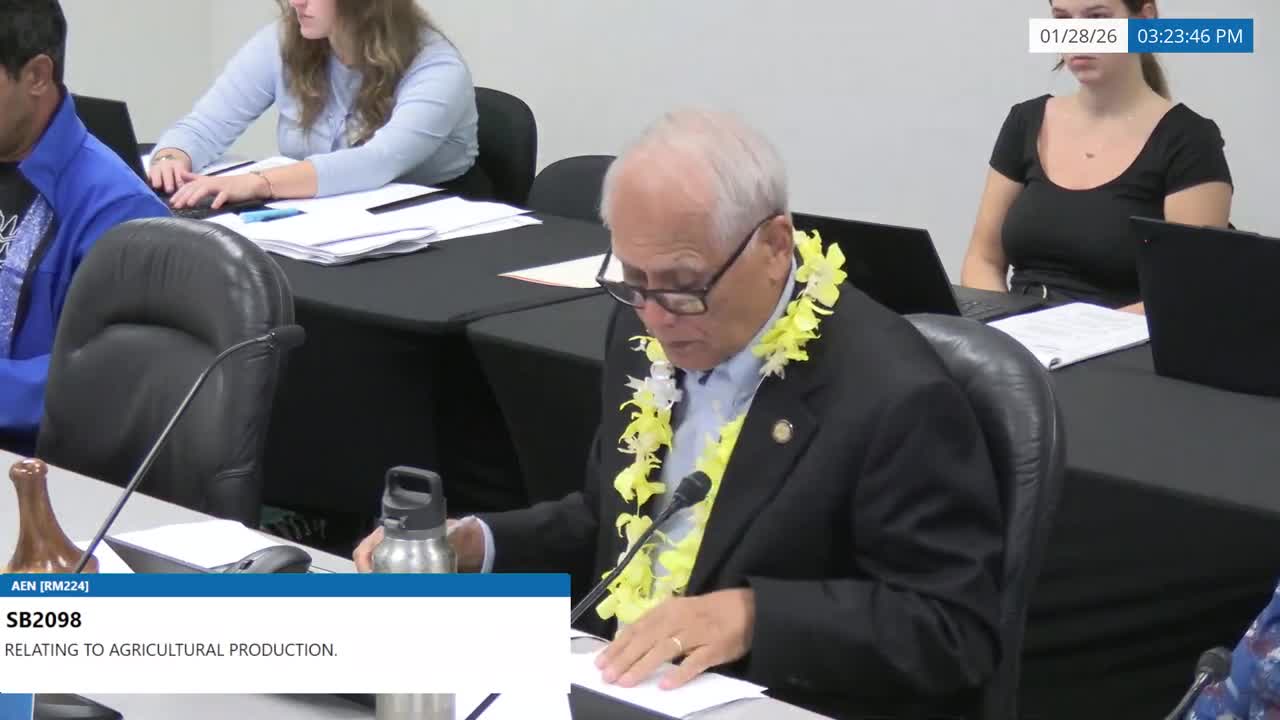 12MIN
Senate Standing Committee on Agriculture and Environment
Bill Author

Bill Co-Author(s):